
If you need flood insurance claim help Apex has a licensed and bonded public adjusting firm ready to step in: For The Public Adjusters, Inc. represents you, the policyholder — not the insurance company. We document the flood damage, prepare the sworn proof of loss your policy requires, and negotiate for a fair settlement based on what repairs actually cost in Wake County. You pay nothing upfront; our fee is a percentage of what your claim recovers.
What This Service Is
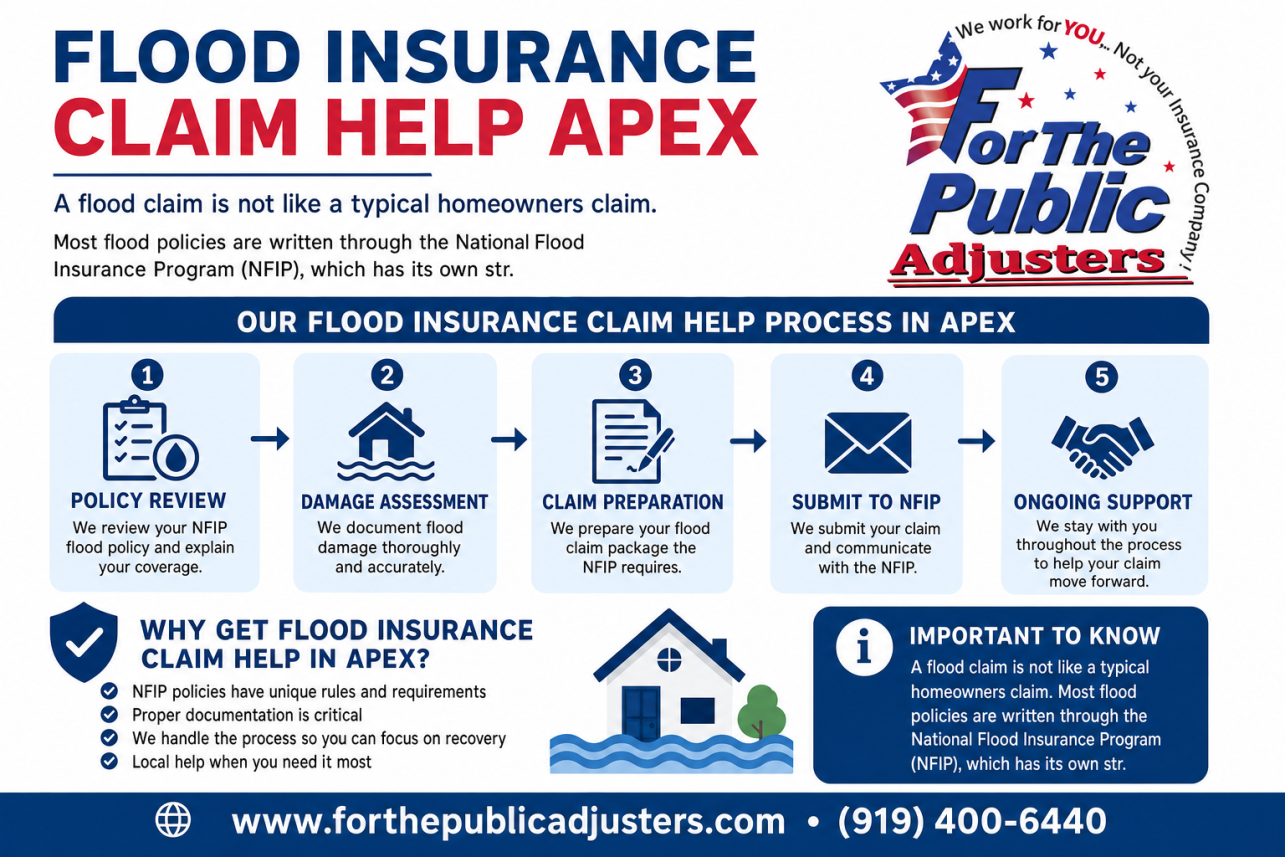
A flood claim is not like a typical homeowners claim. Most flood policies are written through the National Flood Insurance Program (NFIP), which has its own strict rules — including a sworn proof of loss that is generally due within 60 days of the flood. Miss that deadline or fill it out wrong, and even a legitimate claim can be denied.
As your public adjuster, we handle that entire process for you. We read your flood policy line by line so you know your coverage limits for the building and for contents, which are paid separately. We measure and photograph every affected area, track how water and moisture spread into walls, insulation, and flooring, and build a room-by-room personal property inventory so your contents claim isn’t guessed at.
We then prepare a detailed, defensible repair estimate and compare it against the insurance company’s numbers. If their adjuster applied heavy depreciation, paid you actual cash value when you’re owed more, or simply missed damage, we challenge it with documentation. Policyholders do win these fights — in Gaston County Dyeing Machine Co. v. Northfield Insurance Co., the North Carolina Supreme Court sided with the insured in a dispute over accidental property damage coverage, a reminder that an insurer’s first answer is not the final word.
We never guarantee a specific outcome — no honest adjuster can — but we make sure your loss is fully documented and your claim is argued by someone who does this every day.
Common Problems
Why Is My Flood Payout So Much Lower Than My Contractor’s Estimate?
This is the most common call we get after floodwater hits an Apex home. The insurer’s adjuster may have paid actual cash value — the depreciated worth of your old flooring and drywall — rather than what it costs to replace them today. Flood policies also split building coverage and contents coverage, and each has its own limit, so money can run short in one bucket while you assumed it was all one pool.
We rebuild the estimate from scratch using local repair pricing, itemize what the carrier missed, and challenge depreciation that was applied too aggressively. Small line items — trim, insulation, subfloor drying, electrical checks — add up fast when they’re actually counted.
Flood Insurance Claim Help Apex Homeowners Need When A Claim Stalls Or Gets Denied
Flood claims get denied or stuck for reasons that have nothing to do with whether your loss was real. Common ones: the proof of loss wasn’t filed within the deadline, the damage was blamed on groundwater seepage instead of flooding, or the file simply sat while mold spread through wet wall cavities — damage the carrier may then call neglect.
A denial is not the end. NFIP claims have a formal appeal process through the Federal Emergency Management Agency (FEMA), and it runs on documentation. We assemble the photos, moisture readings, elevation details, and estimates that give an appeal a real foundation, and we handle the correspondence so nothing else slips past a deadline.
Should I Fight The Flood Claim Myself, Or Is Hiring A Public Adjuster Worth It?
You can absolutely handle your own claim — but you’ll be negotiating against trained adjusters using rules written into the fine print of your policy. The NCDOI Public Adjusters Guide explains what public adjusters do and confirms we must be licensed in North Carolina; ask any firm for proof of licensing and bonding before you sign anything. We provide both.
Our fee is a contingency percentage of the recovery, agreed in writing up front, so our interests line up with yours. A good public adjuster doesn’t just argue louder — they document better: sworn inventories, measured moisture mapping, and estimates the carrier can’t wave away.
Our Process
Free Policy Review And On-Site Damage Inspection
We start by reading your flood policy so you know exactly what’s covered, what’s excluded, and what your building and contents limits are. Then we inspect your home in person — measuring water lines, photographing every room, and testing moisture levels in materials that look dry but aren’t. Hidden saturation in walls and subfloors is where flood claims most often get underpaid.
Documentation, Inventory, And The Sworn Proof Of Loss
We build a complete file: structural damage documentation, a room-by-room contents inventory with values, and a detailed repair estimate priced for the Apex market. We prepare and submit the proof of loss correctly and on time — the single step where more flood claims go wrong than any other.
Negotiation, And Appeal If The Carrier Won’t Move
We present the claim to the insurance company’s adjuster, meet them on site if needed, and answer every objection with evidence. If the offer stays unfairly low or the claim is denied, we pursue the formal appeal process, and when a dispute needs to escalate further, we can connect you with insurance dispute lawyers we trust.
| What’s Involved | Filing on Your Own | With For The Public Adjusters |
|---|---|---|
| Damage documentation | Photos of visible damage; hidden moisture in walls, subfloors, and insulation is usually missed | Moisture mapping, thermal imaging, and test cuts that document damage above and behind the water line |
| Proof of Loss (NFIP 60-day rule) | Many policyholders don’t know it’s mandatory until the deadline has passed | Prepared, signed, and submitted on time — with written extensions requested when needed |
| Estimate accuracy | You rely on the carrier’s adjuster’s scope, which typically covers only obvious damage | Independent line-item estimate on carrier-standard pricing software, checked against actual NFIP coverage rules |
| Negotiation | You argue your own case against a trained claims professional | A licensed adjuster who works flood claims full-time advocates on your behalf |
| Sorting flood vs. homeowners coverage | Easy to file damage under the wrong policy and get denied by both | Both policies audited so every covered item is claimed under the correct one |
| Typical result | Settlements frequently based on partial scopes and low pricing | Documented supplemental claims that regularly recover multiples of the initial offer |
Commonly Overlooked In The Public Adjusting Industry
- Moisture wicking above the visible water line — Drywall and insulation pull water upward for days after the flood recedes, but carrier adjusters typically measure only the stain line they can see.
- The NFIP 60-day Proof of Loss requirement — Policyholders assume the adjuster’s paperwork counts as their claim, and nobody at the carrier is obligated to remind them the sworn form is mandatory.
- Flooded HVAC equipment, ductwork, and water heaters — Mechanical systems tucked in crawlspaces and closets get skipped during quick inspections even though flood policies specifically cover them.
- Subfloor saturation under intact-looking flooring — Luxury vinyl plank and tile can look fine on top while the plywood underneath is soaked, so the damage doesn’t appear until months later — after the claim is closed.
- Which policy actually owes for which damage — Flood policies exclude wind-driven rain and homeowners policies exclude rising water, and damage filed under the wrong one gets denied instead of redirected.
- Depreciation applied incorrectly to building items — Carriers sometimes depreciate materials or apply actual cash value where the policy allows replacement cost, and few policyholders know to check the math.
- Foundation, crawlspace, and vapor barrier damage — Nobody wants to crawl under the house, so shifted piers, wet insulation batts, and destroyed vapor barriers rarely appear in the first estimate.
- Contents documentation before tear-out — Restoration crews move fast, and once soaked belongings hit the dumpster without photos and serial numbers, that portion of the claim is nearly impossible to prove.
Case Studies
Case Study #1
Situation: A family off Kelly Road in Apex came home after a tropical storm remnant pushed several inches of water through their finished basement and first-floor garage. They had an NFIP flood policy through a Write-Your-Own carrier and filed the claim themselves the next morning.
Problem: The carrier’s adjuster measured only visible water lines and wrote an estimate for two feet of drywall removal and carpet replacement — about $18,400. The estimate ignored wicking above the water line, saturated insulation behind the walls, and the HVAC air handler sitting in the flooded mechanical closet.
Investigation: We brought moisture meters and a thermal camera into the home within 48 hours of being retained. We documented elevated moisture readings up to four feet above the visible line, opened test cuts to photograph wet fiberglass insulation, and had an HVAC contractor put in writing that the flooded air handler could not be safely restored.
Findings: The original scope missed roughly 60% of the actual damage. Wicking had carried water into wall cavities well above the flood line, the subfloor under the luxury vinyl plank was saturated, and NFIP rules actually allowed replacement of the damaged mechanical equipment that the first estimate skipped entirely.
Solution: We prepared a line-item estimate on the same pricing platform the carrier uses, attached moisture maps and photo logs keyed to each room, and submitted a signed, sworn Proof of Loss for the corrected amount before the NFIP deadline. When the carrier pushed back on the air handler, we supplied the contractor’s condemnation letter and the manufacturer’s water-exposure guidance.
Outcome: The claim settled at $61,200 — more than three times the original offer — including full mechanical replacement, four-foot flood cuts, insulation, subfloor, and code-required upgrades where the policy allowed them.
Lesson: Flood water damage almost never stops at the visible water line. If nobody measures moisture inside the walls in the first days after a flood, that damage usually never makes it into the settlement.
Case Study #2
Situation: A small business owner near downtown Apex ran a retail shop that took on floodwater when a nearby creek overtopped during back-to-back heavy rain events. He carried both a commercial flood policy and separate business property coverage, and he assumed the flood carrier would handle everything.
Problem: Sixty days in, he had a partial payment that didn’t come close to covering inventory, flooring, and the built-out fixtures he’d installed. Worse, the NFIP 60-day Proof of Loss window was closing, and no one had told him a signed, sworn Proof of Loss is a hard requirement — not a formality.
Investigation: We audited both policies side by side to sort which carrier owed what, since flood policies and standard commercial policies exclude each other’s perils. We reconstructed his inventory loss from supplier invoices, POS records, and pre-loss photos, and we inspected the slab and wall assemblies the first adjuster had marked as ‘dry.’
Findings: The inventory claim had been undervalued by using depreciated guesses instead of documented replacement cost, the tenant-installed fixtures had been wrongly excluded even though his policy covered improvements and betterments, and the ‘dry’ rear wall showed moisture readings consistent with hidden saturation.
Solution: We requested and secured a Proof of Loss extension in writing, then submitted a fully documented supplemental claim: itemized inventory with source records, a corrected building scope with moisture documentation, and a coverage memo showing why the improvements and betterments belonged in the flood claim.
Outcome: The combined settlement more than doubled the initial payment, the fixture coverage was reinstated in full, and the shop reopened without the owner taking on the loan he’d been quoted to bridge the gap.
Lesson: Federal flood claims run on strict deadlines and strict paperwork. Missing the Proof of Loss requirement can forfeit money you’re legally owed, no matter how real the damage is.
| Situation or Task | Deadline / Timing | Why It Matters | Common Mistake |
|---|---|---|---|
| Report the flood loss to your carrier | Immediately — within days of the event | Late notice gives the carrier grounds to question or deny the claim | Waiting to ‘see how bad it is’ before calling |
| Photograph and video everything before cleanup | Before any water removal or demolition | NFIP claims are paid on documented damage; discarded material is unpaid material | Throwing out soaked contents without photos, serial numbers, or samples |
| Mitigate further damage (extract water, run dehumidifiers) | First 24–72 hours | Policies require reasonable steps to prevent additional damage, and mold complicates coverage | Doing nothing while waiting for the adjuster, letting mold set in |
| Keep flood-cut samples of flooring and drywall | During tear-out | Physical samples prove material quality and support replacement pricing | Contractors hauling everything away, leaving no proof of what was installed |
| Submit the signed, sworn Proof of Loss | Within 60 days of the loss (NFIP), unless extended in writing | Miss it and the carrier can lawfully refuse payment, even for real damage | Assuming the adjuster’s estimate counts as your Proof of Loss |
| Get an independent scope before accepting payment | Before cashing settlement checks or signing releases | The first payment is often based on a partial scope; supplements are your right | Treating the first check as the final word on what’s owed |
| Sort flood damage from wind or rain damage | As soon as both types of damage are suspected | Flood policies and homeowners policies cover different perils; misfiling means denial | Filing everything under one policy and getting both claims stalled |
| Bring in a public adjuster if numbers don’t add up | The earlier the better — ideally before the carrier’s inspection | Early documentation of hidden moisture is the strongest evidence you’ll ever have | Waiting until after a lowball settlement, when the house has been dried and repaired |


Reviews
After the creek behind our neighborhood flooded, the insurance company’s adjuster spent maybe twenty minutes in our house and offered us less than half of what repairs actually cost. For The Public Adjusters came out with moisture meters, found wet insulation the first guy never checked, and handled the entire Proof of Loss filing before the deadline. Our final settlement was almost triple the first offer. I genuinely don’t know how homeowners get through an NFIP claim without this kind of help.
Denise M., Apex NC
I needed flood insurance claim help in Apex after my crawlspace and first floor took on water, and I’m glad I called before signing anything. They caught that my ductwork and water heater were covered items the carrier’s estimate had completely left out, and they explained the difference between what my flood policy paid versus my homeowners policy so nothing fell through the cracks. Professional, responsive, and worth every penny of the fee.
Robert T., Apex NC
Our biggest fear was the 60-day Proof of Loss deadline — we had contractors telling us different numbers and no idea what to submit. This team built the entire estimate line by line, documented wicking damage two feet above the water mark, and negotiated directly with the flood carrier so we didn’t have to. Only reason it’s not perfect is the process still took a few months, but that was the carrier dragging, not them. The outcome was far better than we’d have gotten alone.
Karen & Jim L., Apex NC
Frequently Asked Questions
Why Would I Need Flood Insurance Claim Help Apex Homeowners Can Trust Instead Of Handling The Claim Myself?
Flood claims are among the most technical claims in property insurance, and they are handled differently from standard homeowners claims. Most flood policies in Apex are written through the National Flood Insurance Program (NFIP), which has strict documentation rules, a sworn Proof of Loss requirement, and hard deadlines that trip up even careful homeowners. Miss one requirement and your payout can be reduced or denied outright.
On top of that, the insurance company’s adjuster works for the insurer, not for you. Their scope of damage often overlooks items like saturated insulation behind walls, compromised subflooring, HVAC ductwork under the home, and foundation moisture issues that show up weeks later.
A licensed public adjuster works exclusively for the policyholder. We document every category of covered damage, prepare the estimate using the same software carriers use, complete and submit the Proof of Loss correctly, and negotiate directly with the flood adjuster and carrier. In Apex, where storm runoff from rapid development has made flooding worse in neighborhoods near Beaver Creek and along the Middle Creek basin, we know what local damage patterns look like and how carriers tend to undervalue them.
Homeowners who bring in professional representation early typically recover significantly more than those who accept the carrier’s first offer. The consultation costs nothing, and our fee is a percentage of what we recover, so there is no risk in having your claim reviewed before you sign anything or cash any check.
How Does The Flood Claim Process Work In Apex, And What Deadlines Do I Need To Know?
The clock starts the moment floodwater enters your property. Under most NFIP policies, you must submit a signed, sworn Proof of Loss within 60 days of the date of loss. That is not just a form; it must be supported by a complete, itemized damage estimate. Submit an incomplete one and the carrier can deny everything beyond what they have already acknowledged.
Here is how the process typically unfolds for a Wake County property. First, report the loss to your carrier immediately and take extensive photos and video before removing anything. Second, mitigate further damage by extracting water and drying the structure, but keep samples of damaged materials like flooring and drywall, along with every receipt.
Third, the carrier assigns an independent flood adjuster who inspects and writes a scope. This is where claims go wrong, because that scope frequently misses hidden moisture damage. Fourth, the Proof of Loss is prepared and submitted, and payment is negotiated.
When we represent an Apex homeowner or business, we handle steps three and four entirely. We attend the inspection, prepare our own line-item estimate, and challenge low valuations with documentation. If the 60-day deadline is approaching, we can often secure extensions or file a preliminary Proof of Loss to protect your rights. The earlier we are involved, the more leverage you keep, so call before the carrier’s adjuster ever sets foot on your property if you can.
My Flood Claim Was Denied Or Underpaid. Can For The Public Adjusters, Inc. Still Provide Flood Insurance Claim Help Apex Property Owners Can Use After The Fact?
Yes, and this is one of the most common situations we see. Providing flood insurance claim help Apex residents can rely on after a denial or lowball payment is a core part of what we do, and many of those outcomes can be reversed or improved.
Denials usually rest on a few arguments: the carrier claims the damage was caused by groundwater seepage rather than a general flood condition, blames pre-existing wear, or asserts you missed a documentation deadline. Underpayments typically come from pricing damaged materials below actual Wake County replacement costs, omitting entire trades like electrical or insulation, or applying depreciation too aggressively.
Our first step is a full review of your policy, the carrier’s estimate, and the denial or payment letter. We then re-inspect the property, often finding covered damage the original adjuster never documented, especially in crawlspaces, wall cavities, and under flooring where moisture lingers.
From there, we can file a supplemental claim, submit an amended Proof of Loss, or pursue the NFIP appeal process with FEMA if the policy is a federal flood policy. Each path has its own deadlines, and NFIP appeals generally must be filed within 60 days of the denial letter, so do not wait.
Even if you already deposited a check, that usually does not close your claim. Bring us the paperwork, and we will tell you honestly whether more money is recoverable and exactly what it will take to get it.
What Does It Cost To Hire A Public Adjuster In Apex For A Flood Claim, And Is It Worth It For A Smaller Loss?
We work on contingency, which means you pay nothing up front and nothing out of pocket. Our fee is a percentage of the insurance settlement we recover for you, agreed to in writing before any work begins. If we do not recover money, you owe us nothing. North Carolina licenses and regulates public adjusters, so the fee structure and contract terms are transparent and governed by state law.
Whether it is worth it depends less on the size of the loss and more on the gap between what the carrier offered and what your damage actually costs to repair. Flood losses in Apex are frequently underestimated because so much of the damage is hidden. A claim the carrier values at $15,000 might actually involve $40,000 in legitimate covered repairs once subfloor replacement, drywall flood cuts, insulation, cabinet bases, and code-required upgrades are properly scoped.
For genuinely small, clean losses where the carrier’s estimate matches reality, we will tell you so at the free consultation. We have no interest in taking a percentage of a claim we cannot improve.
For most flooded properties in the Apex area, though, our involvement pays for itself several times over. Homeowners near flood-prone stretches of Kelly Road, downtown Apex, and the Sunset Lake area have used our representation to turn partial payments into full recoveries. The review costs nothing, so before you accept any offer, let a local expert put a second set of trained eyes on your file.
Can I Start Cleanup And Repairs Before I Get Flood Insurance Claim Help Apex Adjusters Recommend, Or Will That Hurt My Claim?
You can — and in many cases should — begin emergency mitigation right away. Both NFIP and private flood policies require you to take reasonable steps to prevent further damage, so removing standing water, drying out the structure, and pulling soaked drywall or flooring are usually appropriate. What hurts claims is discarding evidence before it’s documented.
Before anything leaves the property, photograph and video everything: waterline marks on walls, each damaged room from multiple angles, appliance model and serial numbers, and the contents you’re throwing out. Cut and keep small samples of carpet, pad, and flooring. NFIP adjusters in particular will ask for proof of what was there and how high the water rose.
Save every receipt for tarps, fans, dehumidifiers, dumpsters, and mitigation contractors. Those costs are typically reimbursable, but only if you can document them. Keep a simple log of dates, who you spoke with, and what was done.
Where Apex homeowners often stumble is starting permanent repairs — new drywall, cabinets, flooring — before the insurer’s inspection or before scope disagreements are resolved. Once damage is covered up, it becomes much harder to prove the full extent of the loss. Our team can walk the property first, build a complete inventory and moisture map, and tell you exactly what’s safe to remove now and what needs to stay in place until it’s been properly documented. That single step protects thousands of dollars of your claim.
My Homeowners Policy Denied My Water Damage As ‘flood.’ How Do I Know Which Policy Actually Applies In Apex?
This is one of the most common disputes we see in Wake County, and the distinction matters enormously. In insurance terms, ‘flood’ generally means surface water rising from outside — an overflowing creek, sheet flow across your yard, or storm runoff entering at ground level. That falls under a flood policy, whether NFIP or private. Water from above, like wind-driven rain through a damaged roof, or sudden internal events like a burst pipe, typically belong under your homeowners policy.
The problem is that real storms rarely respect these categories. A heavy storm along Beaver Creek or in low-lying parts of Apex near Middle Creek can produce wind damage, rain intrusion, and rising water in the same event. When that happens, each insurer has a financial incentive to point at the other — and homeowners get caught in the middle with two denials or two lowball offers.
Sorting this out requires evidence: waterline heights, the direction of water staining, weather data for your specific address, and a room-by-room analysis of which damage came from which cause. That’s exactly the work a public adjuster in Apex does on your behalf.
For The Public Adjusters, Inc. reviews both policies, documents the loss to show which coverage responds to which damage, and pursues both claims in parallel when appropriate. If you’ve already received a denial letter citing the flood exclusion — or a flood denial citing wind — bring us both letters. The wording often reveals whether the carrier actually investigated or simply defaulted to the exclusion.
Does For The Public Adjusters, Inc. Handle Both NFIP And Private Flood Policies For Apex Properties?
Yes, we work with both, and the difference between them shapes the entire claim strategy. NFIP policies — the federal program most Apex homeowners carry if their lender required flood coverage — come with rigid rules: a signed, sworn Proof of Loss due within 60 days of the loss, strict documentation standards, and coverage caps of $250,000 for the building and $100,000 for contents on residential policies. Miss the Proof of Loss deadline and you can forfeit the claim entirely, no matter how legitimate the damage.
Private flood policies, which have become more common in Wake County as carriers expand into the market, often have higher limits and broader coverage, but their terms vary widely from one insurer to the next. Some include additional living expenses; NFIP does not. Some cover basements more generously; others exclude them almost entirely. Reading the actual policy language is step one, not an afterthought.
We also assist commercial property owners along the Highway 55 and downtown Apex corridors, where business interruption, inventory losses, and tenant improvements add layers most flood adjusters sent by the carrier don’t fully develop.
When you bring us your policy, we identify which rules govern your claim, calendar every deadline, prepare the sworn documentation the insurer requires, and build an independent estimate of the full loss. That kind of flood insurance claim help Apex property owners rely on is especially valuable with NFIP claims, where a paperwork error can be just as costly as an undervalued estimate.

How Long Will My Flood Claim Take, And Can Your Team Speed Things Up?
Timelines vary, but a straightforward residential flood claim in Apex typically runs 30 to 90 days from the date of loss to payment. Complications — coverage disputes, underestimated scopes, missing documentation, or a widespread storm event that overwhelms carrier adjusters — can stretch that to six months or longer. After major storms affecting Wake County, NFIP adjusters are often assigned hundreds of files at once, and individual claims stall simply from inattention.
A public adjuster shortens the process in practical ways. First, we submit a complete, well-organized claim package from the start: photos, moisture readings, a detailed line-item estimate, contents inventory, and the sworn Proof of Loss done correctly the first time. Incomplete submissions are the single biggest cause of delay, because every request for more information resets the insurer’s review clock.
Second, we push the file forward. We follow up on statutory response timelines, schedule joint inspections promptly, and escalate when a desk adjuster goes quiet. Carriers move faster on files where a professional is tracking every date.
Third, we resolve scope disputes early. Rather than trading vague objections back and forth for weeks, we meet the carrier’s adjuster on site, walk the damage line by line, and document exactly where the estimates diverge.
We can’t promise a specific date — no honest adjuster can — but Apex homeowners we represent consistently avoid the months of drift that come from handling a flood file alone. If your claim is already stalled, we can often diagnose the holdup within one review of your correspondence.
What Documentation Do I Need Before Requesting Flood Insurance Claim Help Apex Residents Rely On?
Start with photos and video of every affected room before anything is moved, discarded, or dried out. Capture the waterline on walls, damaged flooring, cabinetry, HVAC systems, and personal property. In Apex crawl-space homes, that includes ductwork, insulation, and vapor barriers, which are frequently missed.
Next, pull together your policy declarations page, any prior inspection reports, and receipts or records for major purchases and past renovations. If you don’t have receipts, don’t panic — bank statements, credit card records, and even old photos of the home can help us establish what you owned and its condition.
Keep every receipt going forward: emergency mitigation, tarping, dehumidifier rentals, temporary lodging, even fuel for a generator. Under NFIP rules, reasonable steps to protect the property are compensable, but only if they’re documented.
Finally, save all correspondence with your carrier, including the claim number, the field adjuster’s name, and any preliminary reports. When our Wake County team steps in, we build on this record with our own moisture readings, structural documentation, and a line-item estimate. The stronger the file, the harder it is for the insurer to dispute the scope of loss. If you’re missing pieces, call us anyway — we know how to reconstruct documentation, and starting sooner is always better than waiting until everything is perfect.
My Apex Home Flooded From Beaver Creek Overflow After A Storm. Does It Matter Where The Water Came From?
It matters enormously, and it’s one of the first things we investigate. Flood policies cover rising surface water — creek overflow, stormwater runoff pooling across the ground, or saturated soil pushing water into a crawl space. Homeowners policies cover sudden discharge from plumbing or, with the right endorsement, wind-driven rain through storm damage.
In Apex, properties near Beaver Creek, Middle Creek, and the low-lying areas off Old US 1 and Kelly Road often see genuine rising-water events during heavy storms. But many losses are mixed: wind tears shingles off, rain enters from above, and floodwater enters from below in the same event. Carriers routinely assign all the damage to whichever policy pays less, or point each policy at the other.
We document the cause of loss room by room — waterline evidence, entry points, debris patterns, and weather data for the specific storm — so each policy is held responsible for its share. That allocation can change your recovery by tens of thousands of dollars.
The water source also affects coverage limits. NFIP policies restrict what’s payable in basements and below-grade spaces, so how we characterize and document a finished lower level or crawl space matters. If a creek or drainage system contributed to your loss, get an adjuster on your side before the carrier’s narrative gets locked into the file. Once their cause-of-loss determination is written, changing it is much harder than shaping it correctly from the start.
Do You Provide Flood Insurance Claim Help Apex Business Owners Can Use For Commercial Properties?
Yes. For The Public Adjusters, Inc. offers flood insurance claim help Apex commercial property owners can lean on, and business flood claims are often where professional representation pays off most. Commercial losses involve layers residential claims don’t: building coverage, business personal property, tenant improvements, and in many cases a dispute over who insures what under the lease.
We work with retail spaces, restaurants, offices, and light industrial properties throughout Apex and Wake County, including businesses along the Salem Street corridor and in the commercial parks off US-64 and NC-55. Ground-floor units and buildings with below-grade storage are especially vulnerable during heavy stormwater events.
One critical point for business owners: standard NFIP commercial policies do not include business interruption coverage. If you carry a private flood policy or a separate endorsement, lost income may be recoverable, and calculating it correctly requires financial documentation carriers rarely explain how to prepare. We build that piece of the claim alongside the physical damage estimate.
We also coordinate the timeline around your operations. Getting a business reopened quickly sometimes means negotiating advance payments for mitigation and priority repairs rather than waiting for full settlement. That’s a negotiation, and it goes better with an experienced adjuster pushing it.
If your commercial property took on floodwater, call before you sign off on the carrier’s scope. Undervalued commercial flood settlements are common, and correcting them after acceptance is far more difficult.
Will Hiring A Public Adjuster For My Flood Claim Create Problems With My Insurance Company Or Raise My Rates?
No. Retaining a licensed public adjuster is a right protected under North Carolina law, and carriers deal with us every day. Once we file our letter of representation, the insurer communicates through our office — which most Apex homeowners find is a relief, not a complication. You stop fielding calls, chasing paperwork, and second-guessing what the field adjuster meant.
As for rates, flood premiums don’t work the way auto insurance does. NFIP pricing under Risk Rating 2.0 is based on your property’s specific flood risk — elevation, distance to water, foreseeable flood frequency — not on whether you hired representation or how firmly your claim was negotiated. Filing the claim itself is what appears in your history, and you’ve already done that. Advocating for the full value of that claim doesn’t add anything negative.
Some policyholders worry that pushing back will make the carrier adversarial. In our experience across Wake County, the opposite tends to happen: when insurers see a professionally documented file with moisture mapping, code-compliant repair scopes, and accurate pricing for the Apex market, disputes shrink because there’s less room to argue.
The one thing that genuinely can hurt you is accepting an undervalued settlement, because reopening a closed flood claim is difficult and deadline-bound. Having a professional on your side protects against that outcome. If you’re unsure whether your situation warrants representation, we’ll review your claim at no charge and tell you honestly whether we can add value.
My Apex Home Sits On A Crawl Space And The Flood Damaged My HVAC And Ductwork. Is That Covered, And Can Flood Insurance Claim Help Apex Crawl-Space Homeowners Actually Recover Those Costs?
Crawl-space losses are one of the most commonly shortchanged parts of a flood claim, and they’re everywhere in Apex — a huge share of homes in neighborhoods like Scotts Mill, Haddon Hall, and older streets near downtown are built on crawl spaces rather than slabs.
Under most NFIP policies, equipment in a crawl space such as furnaces, heat pumps, water heaters, ductwork, insulation, and vapor barriers is covered when floodwater reaches it. The problem is that insurance company adjusters frequently do a quick visual check from the access door, miss saturated duct insulation or corroded electrical connections, and price the repair as a simple cleanout.
Our team physically inspects the full crawl space, documents moisture readings in framing and subfloor, and brings in HVAC documentation showing when flood-contaminated ductwork needs replacement rather than cleaning. We also account for code-required items like new vapor barriers and proper drying protocols.
The difference matters. A crawl-space flood loss priced as “pump out water, replace some insulation” might come in at a few thousand dollars, while the properly documented scope — ductwork, mechanicals, subfloor drying, electrical inspection — is often several times that. If your Wake County home flooded and the carrier’s estimate barely mentions the crawl space, that’s a strong sign the claim was underscoped, and it’s exactly the kind of loss we’re built to correct.
The Insurance Company’s Adjuster Already Inspected My Flooded Apex Property And I Disagree With Their Estimate. What Are My Options Now?
You are not stuck with the carrier’s number. The estimate written by the insurance company’s adjuster is their opinion of the loss — it is not a final ruling, and NFIP and private flood policies both give you paths to challenge it.
First, we conduct our own independent inspection and build a line-by-line estimate using the same pricing software carriers use. When we compare the two, we almost always find missed rooms, undercounted materials, omitted code requirements, or drying costs priced at a fraction of actual local contractor rates in Wake County.
From there, the route depends on your policy. On NFIP claims, we can submit a supplemental or amended Proof of Loss with supporting documentation, request a re-inspection, or pursue the formal appeal process with FEMA if the carrier won’t move. On private flood policies, many contracts include an appraisal clause that lets a neutral umpire resolve pricing disputes.
Timing matters, especially on federal flood policies where Proof of Loss deadlines are strict, so don’t sit on a low estimate hoping the carrier reconsiders on its own. For The Public Adjusters, Inc. has handled these disputes for homeowners across Apex and the surrounding Triangle, and in most cases a properly documented challenge produces a meaningfully better settlement than the first offer. Bring us the carrier’s estimate and photos of the damage, and we can usually tell you quickly whether it’s worth contesting.
What Is Increased Cost Of Compliance Coverage, And Does It Apply To Flood-Damaged Homes In Apex?
Increased Cost of Compliance, or ICC, is a separate pot of money inside most NFIP policies — up to $30,000 beyond your building coverage — that pays for bringing a substantially flood-damaged home into compliance with current floodplain regulations. Very few Apex homeowners know it exists, and carriers rarely volunteer it.
ICC generally comes into play when the Town of Apex or Wake County determines your home is “substantially damaged,” meaning repair costs equal or exceed 50% of the structure’s market value. Once that determination is made, ICC funds can pay toward elevating the home, floodproofing, relocating it, or in some cases demolition.
This matters most for properties near flood-prone areas along Beaver Creek, Middle Creek tributaries, and low-lying lots in older parts of town. If your home has flooded before, a second qualifying loss within ten years can also trigger eligibility under the repetitive-loss provisions.
The catch is that ICC has its own claim process, its own documentation, and its own deadlines separate from your main building claim. Local permitting decisions, elevation certificates, and the substantial-damage letter all have to line up correctly. As part of the flood insurance claim help Apex property owners get from our firm, we identify whether ICC applies to your situation, coordinate the paperwork with local floodplain officials, and make sure that money doesn’t get left on the table while you’re focused on the primary repair claim.

Mold Started Growing After The Floodwater Receded From My House. Will My Flood Policy Pay For Mold Remediation?
Sometimes yes, sometimes no — and the deciding factor is usually what you did in the days immediately after the water went down. Flood policies, especially NFIP policies, exclude mold damage that could have been avoided by the policyholder, but they do cover mold that resulted directly from the flood despite reasonable mitigation efforts.
In practice, that means the timeline is everything. Apex’s humid climate accelerates mold growth dramatically; in summer conditions, visible growth can appear on wet drywall and framing within 48 to 72 hours. If you reported the loss promptly, started drying efforts, and mold still developed inside wall cavities or under flooring where you couldn’t reasonably see it, there’s a strong argument the remediation belongs in your claim.
Carriers often deny mold outright with a form-letter exclusion, betting the homeowner won’t push back. We push back with documentation: dated photos, moisture-mapping records, mitigation invoices, and remediation protocols from licensed professionals showing the growth traces directly to floodwater intrusion rather than neglect.
A few practical steps protect you. Report the flood immediately, photograph everything before and during cleanup, keep receipts for fans, dehumidifiers, and any drying company you hire, and don’t seal up walls until cavities test dry. If mold has already appeared and the carrier is balking, a public adjuster in Apex can evaluate whether the denial actually holds up under the policy language — in our experience, many of these denials don’t survive a properly documented challenge.
Local Relevance
Apex sits in the western part of Wake County, where fast growth has put thousands of homes near creeks, retention ponds, and low-lying lots that were pasture or woods not long ago. Summer thunderstorms here can drop several inches of rain in an afternoon, and the remnants of tropical systems moving inland from the coast periodically push local streams out of their banks.
That combination catches homeowners off guard. Many Apex houses — from older downtown-area homes to newer subdivisions still settling their grading — take on water through crawl spaces, garages, and finished basements during heavy runoff events. Because standard homeowners policies exclude flood, these losses fall under separate flood coverage with its own deadlines and rules, and that’s exactly where a local public adjuster earns their keep. We also handle related residential claims across Wake County, including water damage, tree damage, and fire and smoke losses.
Apex’s dense Piedmont clay soil sheds heavy rain quickly rather than absorbing it, so intense summer downpours often send runoff into crawl spaces and slab-level rooms even in homes well outside mapped flood zones — which is why documenting exactly how the water entered matters so much to whether a flood policy responds.
Flooded In Apex? Get Your Claim Documented Before The Deadline Passes
The proof of loss clock starts running the day the water recedes — and evidence disappears fast once cleanup begins. For The Public Adjusters, Inc. is licensed and bonded in North Carolina, and there’s no fee unless your claim recovers. Call for a free policy review and inspection anywhere in Wake County.
Call us: (919) 400-6440
Helpful Resources
- National Flood Insurance Program (NFIP)
- Federal Emergency Management Agency (FEMA)
- NCDOI Public Adjusters Guide
- FEMA flood insurance information — Federal guidance on flood coverage and the claims process
Last updated: August 20, 2026