
If you need flood damage insurance claim help Cary homeowners can count on, For The Public Adjusters, Inc. represents you — not the insurance company — from the first inspection to the final settlement check. We handle NFIP flood claims and private flood policies, document every inch of structural and contents damage, and push back when the insurer's number doesn't match the real cost of putting your home back together. As licensed and bonded public adjusters, we work on your side for a percentage of the recovery, so our interests are aligned with yours.
What This Service Is
A public adjuster is a licensed professional who manages your property insurance claim on your behalf. When floodwater gets into your home — whether from a swollen creek after a tropical downpour or storm runoff that overwhelmed the neighborhood drainage — the insurance company sends its own adjuster to assess the damage. That adjuster works for the insurer.
We do the opposite. Our team inspects the property, documents structural damage down to the subfloor and wall cavities, builds a room-by-room inventory of damaged belongings, prepares repair estimates based on real local costs, and files the sworn proof of loss the National Flood Insurance Program requires. Then we negotiate directly with the insurer.
Flood claims are their own animal. Standard homeowners policies exclude flood, so most Cary flood losses run through the NFIP — a federal program with strict paperwork rules, tight deadlines, and coverage limits that surprise many policyholders. We also handle related claims that often ride along with a storm, including wind damage, tree damage, and water damage from sources your homeowners policy does cover. We never guarantee a specific dollar outcome — no honest adjuster can — but we make sure the claim is fully documented and fairly presented.
Common Problems
Flood Damage Insurance Claim Help Cary Homeowners Seek Too Late: The Proof Of Loss Trap
NFIP flood policies generally require a signed, sworn proof of loss within 60 days of the flood, unless FEMA extends the deadline after a major event. Miss it, or fill it out with numbers you can't support, and you can lose money you were otherwise entitled to.
Many families are still ripping out wet drywall when that clock is running. That's exactly the window when a Cary public adjuster earns their fee — building the documentation and filing the paperwork correctly while you deal with everything else.
Courts take these rules seriously, which is why getting it right the first time matters far more than arguing about it later.
The First Offer Is Rarely The Full Picture
Flood adjusters working for the insurer often measure the obvious — stained drywall, soaked carpet — and stop there. What gets missed is what floodwater actually does: it wicks up inside walls, saturates insulation, warps subflooring, and corrodes electrical components you can't see from the living room.
In Cary's summer humidity, mold can start colonizing wet cavities within days, turning a modest water loss into a much larger one. If the initial estimate didn't open walls or test moisture levels, it almost certainly undervalued the loss.
A low offer isn't the end of the conversation. It's the starting point for a properly documented supplemental claim or appeal.
Depreciation, Contents, And The Coverage-Limit Squeeze
NFIP building coverage tops out at $250,000 and contents at $100,000, and contents are paid at actual cash value — meaning the insurer deducts depreciation from what it would cost to replace your furniture, electronics, and clothing today. That gap between the check and the real replacement cost is where policyholders get squeezed.
NFIP policies also don't pay additional living expenses, so there's no hotel money while your home dries out. Every dollar of the building and contents claim has to count.
We build a detailed personal property inventory, challenge excessive depreciation, and make sure basement limitations and other policy fine print are applied correctly rather than used as a blanket excuse to underpay.
Our Process
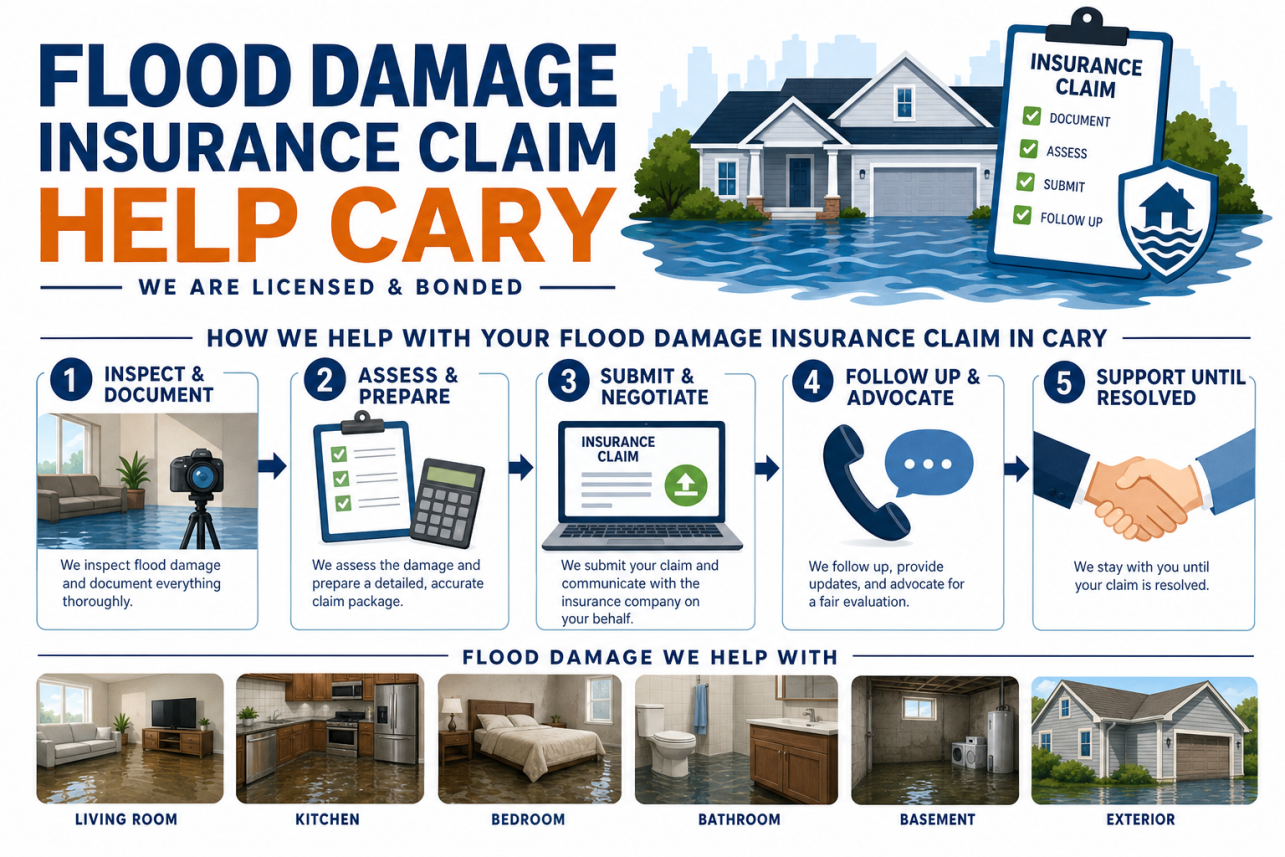
Free Claim Review And Policy Breakdown
We start by reading your actual policy — NFIP or private flood — and explaining in plain language what's covered, what's excluded, and what deadlines apply. If you've already received an offer or a denial, we review it line by line. There's no obligation, and you'll know exactly where you stand before deciding anything.
Full Documentation Of The Loss
We inspect the property thoroughly: moisture readings, photographs, measurements, structural damage notes, and a room-by-room contents inventory with values. We prepare repair estimates that reflect what contractors in Wake County actually charge, not a software default. Then we assemble and file the sworn proof of loss and supporting documentation so nothing gets rejected on a technicality.
Negotiation, Appeal, And Settlement
We present the claim to the insurer's adjuster, answer their questions, and negotiate every disputed line item. If the claim is denied or underpaid, we pursue the FEMA appeal process or supplemental claim with the evidence to back it up. Policyholders do win these fights — in Broussard v. State Farm, a well-known Hurricane Katrina case, homeowners took their denied storm-damage claim to trial and a federal jury found in their favor, with coverage upheld on appeal. We work on a contingency fee, so we're only paid from what we recover for you.
| Claim Stage | Handling It Yourself | With For The Public Adjusters |
|---|---|---|
| Initial documentation | Photos on your phone, damaged items often discarded too early | Moisture mapping, flood-line measurements, and a full contents inventory before anything leaves the property |
| The carrier's estimate | You accept the field adjuster's scope, which typically stops at carpet and low drywall | Every line checked against the flood policy — ductwork, HVAC equipment, subfloors, crawlspace, and code upgrades included |
| Proof of loss deadline | Easy to miss the NFIP's 60-day sworn proof of loss requirement, which can void payment | Filed on time, in the correct format, with supporting documentation attached |
| Supplemental claims | Hidden damage found during demo often goes unpaid because it was never re-opened | Supplements prepared and negotiated as damage is uncovered during tear-out |
| Negotiation | You argue with a trained adjuster using their vocabulary and their pricing software | A licensed NC public adjuster negotiates with policy language, unit pricing, and documented evidence |
| Typical result | First offers on flood claims frequently cover a fraction of the true repair cost | Settlements built to fund the actual restoration, not a partial patch |
Commonly Overlooked In The Public Adjusting Industry
- The NFIP's 60-day sworn proof of loss deadline — Homeowners assume filing the claim starts the clock on payment, not realizing an unsigned or late proof of loss can legally forfeit the entire recovery.
- Floodwater contamination of ductwork and HVAC equipment — Field adjusters rarely crawl under Cary homes, so a flooded air handler and sediment-filled ducts get left off estimates worth tens of thousands.
- Subfloor and joist damage beneath hardwood that looks salvageable — Hardwood cups and delaminates weeks after the water recedes, and by then the claim has often already been closed at a carpet-only number.
- Category 3 water protocols for flood-contacted materials — Floodwater is contaminated by definition, so materials carriers price to clean and reuse actually require full removal under industry drying standards.
- Increased Cost of Compliance coverage — Few policyholders know NFIP includes up to $30,000 for code-required elevation or floodproofing when a home is substantially damaged, and carriers rarely volunteer it.
- Documenting discarded contents before the debris pile hits the curb — Cary's post-storm cleanup pressure means ruined belongings get hauled off before anyone photographs, inventories, or prices them for the claim.
- The distinction between flood and wind-driven rain in a single storm — One event can trigger two separate policies with different deductibles, and misassigning damage to the wrong one leaves money unclaimed on both.
- Crawlspace vapor barriers, insulation, and pest-treatment reapplication — These below-floor items are invisible from inside the house, so they vanish from estimates unless someone physically inspects and photographs them.
Case Studies
Case Study #1
Situation: A family in the Lochmere area of Cary came home after a tropical storm stalled over Wake County to find eight inches of standing water in their finished basement and crawlspace. Their home sat near a Swift Creek tributary, and runoff had overwhelmed the yard drainage in under two hours.
Problem: Their NFIP flood carrier's field adjuster spent forty minutes on site and issued an estimate of $19,400 — mostly for carpet, drywall cut two feet up, and a dehumidifier rental. It ignored the HVAC air handler sitting in the crawlspace, the buckled hardwood on the first floor above, and the insulation soaked between the joists.
Investigation: Our team performed moisture mapping with pin and pinless meters across the first floor, documented water lines with laser measurement, and pulled the serial plate on the air handler to confirm the flood line exceeded its coil housing. We also photographed sediment staining inside the ductwork, which NFIP policies cover when floodwater physically enters the system.
Findings: The carrier's estimate had missed roughly $47,000 in covered damage: a contaminated duct system, a destroyed air handler and condensate infrastructure, subfloor delamination under the hardwoods, and vapor barrier and insulation replacement throughout the crawlspace. The drywall allowance also used a flush-and-patch price instead of full replacement of Category 3 water-contacted material.
Solution: We rebuilt the claim line by line against the Standard Flood Insurance Policy language, submitted a supplemental proof of loss with the moisture logs and equipment documentation before the NFIP's strict deadline, and met the carrier's re-inspection adjuster on site to walk every disputed item.
Outcome: The claim settled at $66,800 — more than three times the original offer — and the family replaced the mechanical system and flooring instead of patching around contaminated materials.
Lesson: Flood adjusters working fast after a regional event routinely miss what sits below the floor line. In Cary homes with crawlspaces, that's often where half the covered damage lives.
Case Study #2
Situation: The owner of a small retail suite off Kildaire Farm Road experienced flash flooding when a nearby storm drain backed up during a heavy summer downpour. Water pushed under the storefront doors and sat for most of a night, soaking inventory, fixtures, and the lower wall assemblies.
Problem: The commercial flood carrier initially tried to reclassify the loss as surface water excluded under the property policy rather than a flood event, then offered $8,200 against documented losses well into six figures. The owner had already thrown out damaged inventory under pressure from the landlord to reopen, weakening the paper trail.
Investigation: We reconstructed the inventory loss from point-of-sale records, supplier invoices, and pre-loss photos, then obtained Town of Cary stormwater records and NOAA rainfall data confirming the event met the policy's definition of flood — a general and temporary condition of inundation affecting adjacent properties.
Findings: Two neighboring tenants had filed flood claims from the same event, which contradicted the carrier's surface-water position. We also identified covered business personal property the estimate ignored entirely: slat-wall fixtures wicking water above the flood line, a point-of-sale counter with swollen substrate, and code-required electrical work at flood-damaged outlets.
Solution: We filed a detailed sworn proof of loss with the reconstructed inventory schedule, the meteorological documentation, and comparable claims evidence, then negotiated directly with the carrier's examiner rather than the field adjuster who wrote the original estimate.
Outcome: The carrier accepted the flood classification and paid $114,600, including the full documented inventory loss and building damage the tenant was contractually responsible to repair.
Lesson: Never discard flood-damaged inventory before it's documented, even under pressure to reopen. And when a carrier disputes whether an event was a flood at all, public records from the Town of Cary and NOAA can settle the argument fast.
| Damaged Item or Area | Typically Covered by Flood Policy? | What It Depends On |
|---|---|---|
| Drywall, insulation, and flooring on main level | Yes | Water must have physically touched it; document the flood line before demo begins |
| Finished basement contents | Partially | NFIP covers a specific list below grade (washer, dryer, freezer, food); most furniture and electronics down there are excluded |
| HVAC air handler and ductwork in the crawlspace | Yes | Floodwater must reach the equipment or enter the ducts; carriers often skip inspecting under the house |
| Mold that appears weeks after the flood | Sometimes | Covered if it resulted from the flood and you took reasonable steps to dry the property; delays hurt the claim |
| Landscaping, decks, fences, and detached sheds | Mostly no | NFIP excludes most exterior items; a private flood policy may differ, so check the actual policy form |
| Sewer or drain backup during the storm | Depends | Covered under flood policies only if caused by a general flood condition; otherwise it may fall under a homeowner's water backup endorsement |
| Additional living expenses while displaced | No under NFIP | Standard flood insurance pays nothing for hotels or rent; private flood policies sometimes include it |
| Code-required electrical or elevation upgrades | Sometimes | NFIP's Increased Cost of Compliance coverage can add up to $30,000 if the home is declared substantially damaged |
Reviews
When Crabtree Creek backed up into our neighborhood, the flood carrier offered us $22K for a house that needed the whole first floor gutted. For The Public Adjusters found the crawlspace damage, the ruined ductwork, and the subfloor issues the first adjuster never even looked at. We ended up with almost triple the original number, and they handled the proof of loss deadline I didn't even know existed.
Marcus T., Cary NC
Our NFIP claim was a nightmare until we called them. The insurance company kept saying our contents weren't covered because they were 'below grade,' which turned out to be only half true. This team knew exactly which items in a finished basement the flood policy does pay for and got every one of them into the settlement. Worth every penny of the fee.
Diane R., Preston area
Water came in during that October storm and my carrier's adjuster wrote up carpet and two feet of drywall — nothing else. These folks brought moisture meters, found the hardwood cupping across the whole main level, and documented mold starting behind the baseboards. The revised settlement covered a real restoration instead of a cover-up. Only wish I'd called them the day after the flood instead of a month later.
Kevin O., MacGregor Downs
Frequently Asked Questions
Why Would I Need Flood Damage Insurance Claim Help Cary Homeowners Can Actually Trust, Instead Of Just Filing With My Insurer Directly?
Flood claims are among the most technical claims in the insurance world, and they're handled very differently from standard homeowners claims. Most flood coverage in Wake County runs through the National Flood Insurance Program (NFIP), which has strict deadlines, a mandatory Proof of Loss requirement, and pricing rules that differ from a typical wind or fire claim. Miss a deadline or undervalue your Proof of Loss, and you may permanently forfeit money you were owed.
When you file directly, the insurer's adjuster documents the loss according to their guidelines, not yours. In Cary neighborhoods near Crabtree Creek, Swift Creek, and the low-lying areas around Lake Crabtree, we routinely see initial estimates that miss hidden damage: saturated subfloors, wicking in drywall above the visible water line, contaminated insulation, and HVAC ductwork sitting in crawlspaces.
As licensed public adjusters, For The Public Adjusters, Inc. works only for you, never the insurance company. We inspect the property ourselves, use moisture mapping to document everything the water actually touched, prepare the itemized estimate, and handle the negotiation. Homeowners who bring in professional flood damage insurance claim help Cary-wide typically see meaningfully higher settlements than those who accept the first offer, simply because the claim is documented completely and priced correctly from the start.
If you've already filed and something feels off, it's not too late. We can review the insurer's estimate, identify what's missing, and pursue a supplemental claim on your behalf.
What Deadlines Apply To Flood Claims In Cary, And What Happens If I Miss One?
Deadlines are where flood claims live or die. If your policy is an NFIP flood policy, which covers most flood-insured homes in Cary, you generally must submit a signed and sworn Proof of Loss within 60 days of the date of loss. That is not a soft target. FEMA and the write-your-own carriers that administer NFIP policies routinely deny or reduce claims when the Proof of Loss is late, incomplete, or understated.
Here's the trap most homeowners fall into: they assume the insurance company's adjuster "filed the claim" for them. In reality, the adjuster's report is not your Proof of Loss. If the carrier's estimate is low and you sign off on it, claiming additional money later becomes far harder.
There are also practical deadlines. Standing water and saturated materials in a Cary crawlspace or finished basement start growing mold within 24 to 72 hours in our humid North Carolina climate, and insurers can argue that secondary damage stems from your failure to mitigate. You're required to take reasonable steps to protect the property, and to document conditions before anything is removed.
Our team tracks every deadline from day one. We prepare and submit the Proof of Loss with a complete, defensible valuation, request extensions in writing when circumstances justify them, and preserve photographic and moisture-reading evidence so nothing is lost when debris gets hauled away. If a deadline has already passed, call us anyway; depending on the situation, there are sometimes still avenues to pursue, but time matters.
My Insurer'S Flood Estimate Seems Low. What Does A Cary Public Adjuster Look For That They Missed?
Low initial flood estimates are extremely common, and the gaps tend to fall into predictable categories once you know where to look.
First, hidden moisture. Water wicks upward through drywall and insulation well above the visible flood line. In Cary homes with crawlspaces, which is most of them, we frequently find soaked subfloor sheathing, floor joists, ductwork, and vapor barriers that were never inspected because the carrier's adjuster didn't go under the house with a moisture meter. We do.
Second, code-required upgrades. Wake County and the Town of Cary enforce current building codes on repairs, which can require electrical, insulation, or flood-venting upgrades that a bare-bones estimate ignores. If your policy includes coverage for code compliance, those costs belong in the claim.
Third, pricing and scope errors. Estimates often use outdated regional pricing, omit drying equipment, undercount drywall removal (flood cuts should extend well above the water line), skip content manipulation, or leave out contaminated flooring layers beneath the visible surface. Floodwater is Category 3 water, which requires more aggressive removal and sanitization than clean-water losses.
Finally, contents documentation. Homeowners under stress rarely inventory everything, and adjusters won't do it for you. We build a room-by-room contents inventory with replacement-cost documentation.
When For The Public Adjusters, Inc. reviews a low estimate, we re-inspect, re-measure, and produce our own line-item estimate, then negotiate the difference with the carrier directly. You shouldn't be arguing with an insurance company while your house is torn apart.
How Much Does Flood Damage Insurance Claim Help Cost In Cary, And How Do Public Adjuster Fees Work In North Carolina?
For The Public Adjusters, Inc. works on a contingency-fee basis, which means you pay nothing upfront and nothing out of pocket. Our fee is a percentage of the settlement we recover for you, agreed to in writing before we begin, and North Carolina regulates how public adjusters may charge for their services. If we don't recover money for you, you don't owe us a fee.
That structure matters for two reasons. First, our interests are aligned with yours: we're paid based on what we actually recover, so we have every incentive to document and pursue the full value of your loss. Second, it makes professional representation accessible right after a flood, when most families are paying for temporary housing, dehumidifiers, and emergency mitigation and don't have room in the budget for hourly professional fees.
Homeowners often ask whether the fee eats into their recovery. In our experience handling flood losses across Cary and greater Wake County, the increase in settlement value from proper documentation, complete Proof of Loss preparation, and firm negotiation typically exceeds the fee by a wide margin, especially on flood claims where NFIP paperwork errors are so costly.
Every engagement starts with a free claim review. We'll look at your policy, the carrier's estimate if one exists, and photos of the damage, then tell you honestly whether flood damage insurance claim help cary residents hire us for is likely to add value in your situation. If the insurer's offer is already fair, we'll tell you that too and you'll owe nothing.
Does My Homeowners Policy Cover Flooding In Cary, Or Do I Need A Separate Flood Policy?
In almost every case, a standard homeowners policy in North Carolina excludes flood — meaning rising water from heavy rain, overflowing creeks like Swift Creek or Walnut Creek, or storm surge pushed inland by a hurricane. Flood coverage comes from a separate policy, usually through the National Flood Insurance Program (NFIP) or a private flood carrier.
That distinction matters more than most Cary homeowners realize. Water that enters your home from above — a roof opening during a storm, for example — is often a homeowners claim. Water that rises from the ground and enters at or below grade is a flood claim. Many losses involve both, and carriers frequently point at the other policy to limit what they pay.
Our adjusters sort out which policy owes for which damage, document the water's path of entry, and file the claims correctly the first time. If you have an NFIP policy, we also know its unique rules, such as the requirement to sign a sworn Proof of Loss, which trips up many policyholders.
If you're unsure whether you even have flood coverage, pull your declarations page or call your agent before the next storm season. Homes in Wake County outside FEMA's mapped flood zones flood more often than people expect, and NFIP policies typically carry a 30-day waiting period, so waiting until rain is in the forecast is too late.
What Should I Do In The First 48 Hours After My Cary Home Floods?
Your first two days shape the entire claim. Start by making sure the property is safe — shut off electricity to affected areas and don't wade through standing water near outlets or appliances.
Then document everything before you touch anything. Photograph and video the waterline on the walls, every affected room, flooring, furniture, appliances, and the exterior showing where water entered. Timestamped photos are some of the strongest evidence you can have.
Next, take reasonable steps to prevent further damage. Extract standing water, run fans and dehumidifiers, and move salvageable belongings to a dry area. Keep every receipt for equipment rentals, tarps, or emergency mitigation services — those costs are typically reimbursable.
Do not throw damaged items away until they've been documented and, ideally, inspected. If health concerns force you to discard something like saturated carpet or drywall, photograph it thoroughly first and cut a sample to keep. Flood carriers routinely reduce payments for contents they never got to see.
Finally, report the loss to your carrier promptly, but be careful about giving detailed recorded statements before you understand the full scope of damage. Hidden problems — moisture trapped in wall cavities, damaged insulation, mold blooming behind baseboards — often don't show up for days. Bringing in a public adjuster in Cary early means the damage gets measured completely before the carrier's number gets set.
My Flood Claim Was Already Denied Or Underpaid — Can Flood Damage Insurance Claim Help Cary Homeowners Hire Still Make A Difference?
Yes, and this is actually one of the most common situations we handle. Getting flood damage insurance claim help Cary policyholders can lean on after a denial or lowball payment often changes the outcome, because most denials rest on documentation gaps or scope disputes rather than genuine coverage problems.
We start by reviewing the carrier's denial letter or estimate line by line against your actual policy language. Flood adjusters working high-volume storm events frequently miss damage — moisture wicking up drywall above the visible waterline, saturated subfloors under intact flooring, compromised HVAC ductwork in crawl spaces, and foundation issues common in Cary's older neighborhoods near creek corridors.
From there, we build the evidence the carrier didn't have: moisture readings, detailed room-by-room estimates using current Wake County construction pricing, contents inventories, and engineering or mold assessments when warranted. Then we file a supplemental claim or formal dispute with that documentation attached.
Timing matters. NFIP claims have strict windows — the sworn Proof of Loss deadline and a one-year limit to file suit after a written denial — so don't sit on a denial hoping the carrier reconsiders on its own. Private flood policies carry their own deadlines, which vary by carrier.
Even if you've already accepted a payment, the claim usually isn't closed for good. Accepting a check is rarely a final settlement, and supplemental payments for newly documented damage are common when the evidence supports them.
How Long Does A Flood Claim Take To Settle In Cary, And What Slows The Process Down?
A straightforward, well-documented flood claim in Wake County often resolves in 45 to 90 days. Larger losses, disputed claims, or claims filed after a major hurricane — when carriers are handling thousands of files across the Carolinas at once — can stretch to six months or longer.
The biggest delays are usually preventable. Incomplete documentation is the top culprit: missing photos, no contents inventory, or an unsigned Proof of Loss on an NFIP claim will stall a file indefinitely. Scope disputes are second — when your contractor's repair estimate and the carrier's estimate are far apart, the claim can bounce back and forth for months without a structured response.
Our job is to compress that timeline. We submit a complete, professionally documented claim package up front, so the carrier's adjuster has fewer reasons to request more information. We respond to carrier questions quickly, track every deadline, and escalate when a file goes quiet — something that happens often during busy storm seasons.
One local factor worth knowing: after regional flooding events affecting the Triangle, qualified adjusters and contractors get booked out fast, and inspection appointments can lag by weeks. Engaging help early puts your claim ahead of that backlog rather than behind it.
While the claim is pending, keep mitigating damage and saving receipts. Reasonable emergency expenses are typically covered, and staying on top of them means you're not floating those costs any longer than necessary.
Is Flood Damage Insurance Claim Help Cary Residents Get Different For NFIP Policies Versus Private Flood Insurance?
Yes, and the difference matters more than most homeowners realize. The National Flood Insurance Program operates under strict federal rules, while private flood carriers follow their own policy language and North Carolina insurance regulations. Each requires a different claim strategy.
NFIP claims come with rigid requirements — a signed, sworn Proof of Loss with supporting documentation is mandatory, and the standard deadline is 60 days from the date of loss unless FEMA extends it. Miss that filing or submit an incomplete Proof of Loss, and the carrier can deny payment even for legitimate damage. NFIP policies also exclude things private policies sometimes cover, like additional living expenses while you're displaced.
Private flood policies, which have become more common in Wake County as carriers expand into the market, often have broader coverage but also more room for interpretation — which means more room for disputes over scope and pricing.
For The Public Adjusters, Inc. handles both types regularly for Cary homeowners. We prepare the NFIP Proof of Loss correctly the first time, itemize damage using the documentation standards FEMA adjusters expect, and for private policies we read the actual policy language rather than accepting the carrier's summary of it. Knowing which set of rules governs your claim is the foundation of getting it paid fairly.
How Should I Document My Damaged Furniture, Electronics, And Belongings After A Flood In Cary?
Contents documentation is where flood claims are most often shortchanged, because homeowners throw things away before proving what they lost. Before anything leaves your Cary home, photograph and video every damaged item — wide shots showing the room, then close-ups showing waterlines, serial numbers, and model tags on electronics and appliances.
Create a written inventory as you go. For each item, note the brand, model, approximate purchase date, and what it would cost to replace today. Pull receipts, credit card statements, or online order histories where you can, but don't panic if you can't — reasonable documentation and photos carry real weight.
Here's the critical part for flood claims specifically: NFIP rules generally require you to keep damaged items, or at least representative samples, until the adjuster inspects them. If health concerns force you to discard saturated mattresses or upholstery, cut and keep swatches of fabric and carpet, and photograph everything before disposal. Never let a remediation crew haul debris away undocumented.
Our adjusters routinely rebuild contents inventories for Wake County families after storms push Crabtree and Swift Creek out of their banks, and the difference between a rushed list and a properly supported one is often tens of thousands of dollars. If you call us early, we'll walk the property with you and build the inventory to the standard the carrier's reviewers actually require.
Are Basements, Crawl Spaces, And Lower-Level Rooms Covered When A Cary Home Floods?
This is one of the most misunderstood parts of flood coverage, and it catches Cary homeowners off guard constantly. Under an NFIP policy, coverage in basements and enclosed areas below the lowest elevated floor is sharply limited. The policy will typically pay for structural elements and essential equipment — the furnace, water heater, electrical panel, sump pump, foundation walls, and unfinished drywall.
What it generally won't pay for in a basement is finished space: carpet, paneling, finished ceilings, furniture, and most personal belongings stored down there. If you have a finished lower level in a home near Lochmere, MacGregor Downs, or along the Swift Creek corridor, this exclusion can be painful.
Crawl spaces, which are extremely common in Cary construction, get similar treatment. Ductwork, insulation, and vapor barriers under the home are frequent points of dispute — carriers sometimes undervalue or skip them entirely, even though saturated crawl space insulation and flooded HVAC ducts must be replaced to prevent mold and air-quality problems.
Private flood policies may offer broader basement coverage, so the answer depends on reading your specific policy, not assuming. When we take on flood damage insurance claim help Cary homeowners need, one of the first things we do is map exactly which below-grade damage is covered, then fight for full pricing on every covered item the carrier's estimate glossed over.
The Town Says My Flooded House Has To Be Brought Up To Current Code Before I Rebuild. Will Insurance Pay For That?
Possibly — through a benefit many policyholders never hear about called Increased Cost of Compliance, or ICC. Most NFIP policies include up to $30,000 in ICC coverage on top of your building claim. It applies when the Town of Cary or Wake County determines your home is substantially damaged, meaning repair costs reach roughly 50% of the structure's market value, and local floodplain ordinances then require you to elevate, floodproof, relocate, or demolish.
This comes up in Cary more than people expect, particularly for older homes near mapped floodplains along Crabtree Creek and Walnut Creek. A substantial damage determination changes everything about your rebuild, and ICC money can be the difference between elevating your home and walking away from it.
The catch is that ICC has its own claim process, its own documentation, and its own deadlines separate from your main flood claim. You need the town's substantial damage letter, permits, and contractor documentation submitted in a specific sequence, and carriers rarely volunteer guidance on any of it.
Beyond ICC, code-upgrade disputes also arise in ordinary repairs — updated electrical requirements, flood vents, and elevation of mechanical systems. As part of the flood claim help we provide across Cary, For The Public Adjusters, Inc. coordinates with town inspectors, secures the determinations ICC requires, and makes sure code-driven costs end up in your settlement rather than out of your pocket.
Will My Flood Policy Pay For A Hotel Or Rental While My Cary Home Is Being Repaired?
This surprises a lot of Wake County homeowners: if you have a standard NFIP flood policy, the answer is no. Unlike your homeowners policy, NFIP coverage does not include Additional Living Expenses, so hotel bills, short-term rentals, and extra meal costs after a flood come out of your own pocket.
That makes the speed and accuracy of your building payout even more important. Every week your claim sits underpaid or under-scoped is another week you are paying for housing in the Cary and Apex rental market on your own dime. Our job is to document the full scope of damage quickly and push the claim toward a settlement that lets you start repairs sooner.
There are two exceptions worth checking. Some private flood carriers writing policies in North Carolina do include a loss-of-use or ALE provision, so we always read your policy language line by line before assuming anything. Second, if your flood was part of a federally declared disaster, FEMA disaster assistance may offer limited rental help separate from your insurance claim, and we can point you toward that process.
When we handle a flood claim in Cary, we also make sure temporary measures the policy does cover — like moving and storing salvageable contents to protect them from further damage — are properly documented and paid. Those costs are frequently left off insurer estimates, and recovering them can offset some of what you spend on temporary housing.
Mold Started Growing In My Flooded Cary Home Before Repairs Began. Is That Covered, And How Do You Handle It?
Mold after a flood in Cary is almost inevitable given our humidity — drywall and framing can show visible growth within 48 to 72 hours in a North Carolina summer. Whether the policy pays for it depends heavily on how the claim is documented and argued.
NFIP policies exclude mold that results from the policyholder's failure to mitigate. That is why insurers so often deny mold-related costs by claiming the homeowner waited too long to dry the property out. In reality, many Cary homeowners could not access their homes immediately, could not get a mitigation company scheduled during a widespread event, or were told by the insurer itself to wait for an inspection.
When we take over a flood claim, we build a timeline proving you acted reasonably: when the water receded, when you called for mitigation, how long crews were backlogged across Wake County, and what the carrier told you. That record is often the difference between a paid remediation and a denied one.
We also make sure the mold scope is complete. Proper remediation is not just spraying a surface — it typically means removing wet drywall and insulation, treating framing, running containment and air scrubbing, and passing clearance testing. Insurer estimates routinely price a wipe-down when the situation calls for full remediation. We write the scope the way a licensed remediation contractor actually performs the work, and we support it with moisture readings and photographs so the carrier has little room to cut it.
Do You Provide Flood Damage Insurance Claim Help Cary Businesses And Rental Property Owners Can Use, Or Only Homeowners?
We handle both. For The Public Adjusters, Inc. represents homeowners, landlords, condo owners, HOAs, and commercial property owners throughout Cary and the surrounding Wake County area, and flood claims for income properties and businesses have their own complications that make representation especially valuable.
For rental property owners, the big issues are lost rental income and tenant coordination. NFIP policies do not cover lost rent, but some private flood policies do, and documenting the building damage thoroughly speeds up the repairs that get tenants back in and rent flowing again. We also make sure the claim separates the owner's building damage from tenants' personal property, which belongs on their renters or flood policies, not yours.
For Cary businesses — from retail spaces near downtown to offices and warehouses along the NC-54 and Weston corridors — commercial flood claims involve tenant improvements, inventory, equipment, and often business interruption questions under separate policies. Insurers frequently underpay the building side because commercial finishes and specialized systems get priced like residential materials. We scope them at their real replacement cost.
Condo situations add another layer: the master flood policy carried by the association covers certain building elements while the unit owner's policy covers others, and disputes over that dividing line stall claims for months. We read both policies, the bylaws, and North Carolina condo statutes to establish who owes what.
Whatever the property type, the arrangement is the same — we work on contingency, we document everything, and we negotiate directly with the carrier so you can keep running your property or business.
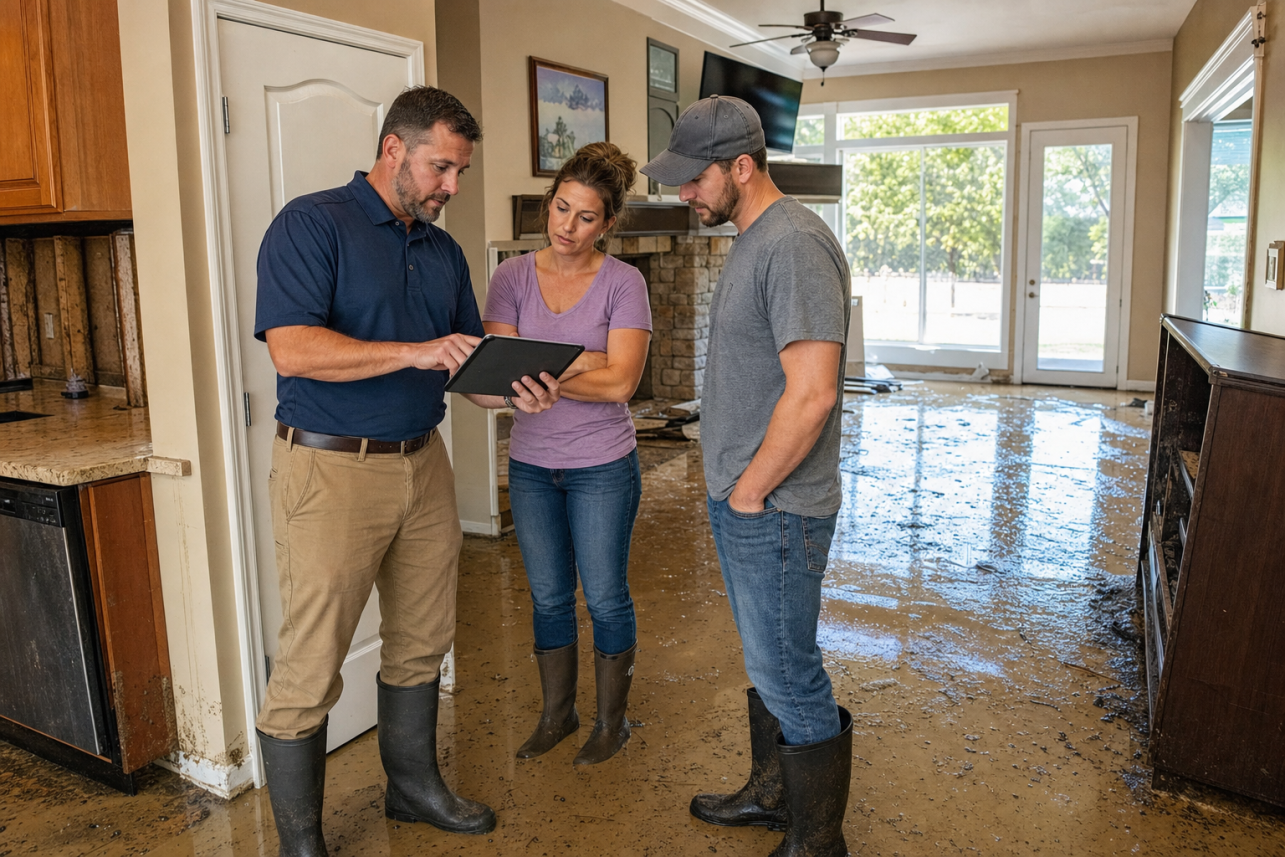
What Actually Happens Step By Step After I Hire Your Firm To Handle My Flood Claim?
It starts with a free review. We look at your flood policy, any correspondence from the carrier, and the damage itself — either in person at your Cary property or through photos and documents if the loss is recent. If we believe we can add real value, we explain our contingency fee and you sign a representation agreement that authorizes us to deal with the insurer on your behalf.
Next comes documentation. We inspect the property thoroughly, take moisture readings, photograph every affected room and system, and build a detailed line-item estimate using the same estimating software insurers use. For contents, we help you create a full inventory with values, which is where flood settlements are most often shortchanged.
Then we take over communication. We notify the carrier that we represent you, attend the insurer adjuster's inspection alongside them, and submit our estimate, the contents inventory, and the sworn Proof of Loss within the required timeframe. From that point on, the phone calls, emails, and negotiation pressure fall on us, not you.
Most claims resolve through negotiation once the carrier sees professionally documented damages. If yours does not, we advise you on next steps, including appraisal or referral to counsel where appropriate.
Homeowners searching for flood damage insurance claim help Cary wide usually call us at one of two moments: right after the water recedes, or after a disappointing insurer offer arrives. Either way works — but the earlier we are involved, the cleaner the documentation and the stronger your position.
Local Relevance
Cary sits in the Piedmont, where dense clay soil sheds water instead of absorbing it. When a summer thunderstorm dumps two inches of rain in an hour — or a tropical system stalls over the Triangle — that runoff has to go somewhere, and homes near creek corridors and low-lying lots often take the hit.
Because Cary isn't coastal, many homeowners here don't carry flood insurance and assume their homeowners policy will respond. It won't; flood is excluded from standard policies. Those who do carry NFIP coverage often bought it at closing and haven't looked at it since, which means they discover the 30-day waiting period, the contents depreciation rules, and the missing living-expense coverage at the worst possible moment.
Much of Cary was built during the growth boom of the 1980s through the 2000s, and homes from that era frequently have finished lower levels, hardwood floors, and drywall-finished garages — exactly the materials that flood claims chronically undervalue. The North Carolina Department of Insurance licenses public adjusters for a reason: policyholders here have the right to professional representation, and its Public Adjusters Guide is worth reading before you sign anything with anyone, including us.
Inland flooding in Cary tends to come fast and drain fast — creek and runoff flooding from summer storms and tropical remnants often recedes within hours, which means the visible waterline disappears before the insurer's adjuster ever arrives. Photographing the high-water mark, saturated materials, and damaged contents in the first day or two often makes the difference between a fully paid claim and a disputed one.
Flooded In Cary? Get Your Claim Reviewed Before You Sign Anything
Whether the water came from a creek, a storm surge of runoff, or a hurricane remnant, the decisions you make in the first weeks shape your settlement. For The Public Adjusters, Inc. is licensed and bonded in North Carolina, and we only get paid when you do. Call for a free, no-obligation review of your flood claim — new, underpaid, or denied.
Call us: (919) 400-6440
Helpful Resources
- National Flood Insurance Program (NFIP)
- Federal Emergency Management Agency (FEMA)
- NCDOI Public Adjusters Guide
- National Association of Insurance Commissioners (NAIC)
- FEMA flood insurance and claims guidance — Federal guidance on filing and appealing flood claims
Last updated: July 15, 2026