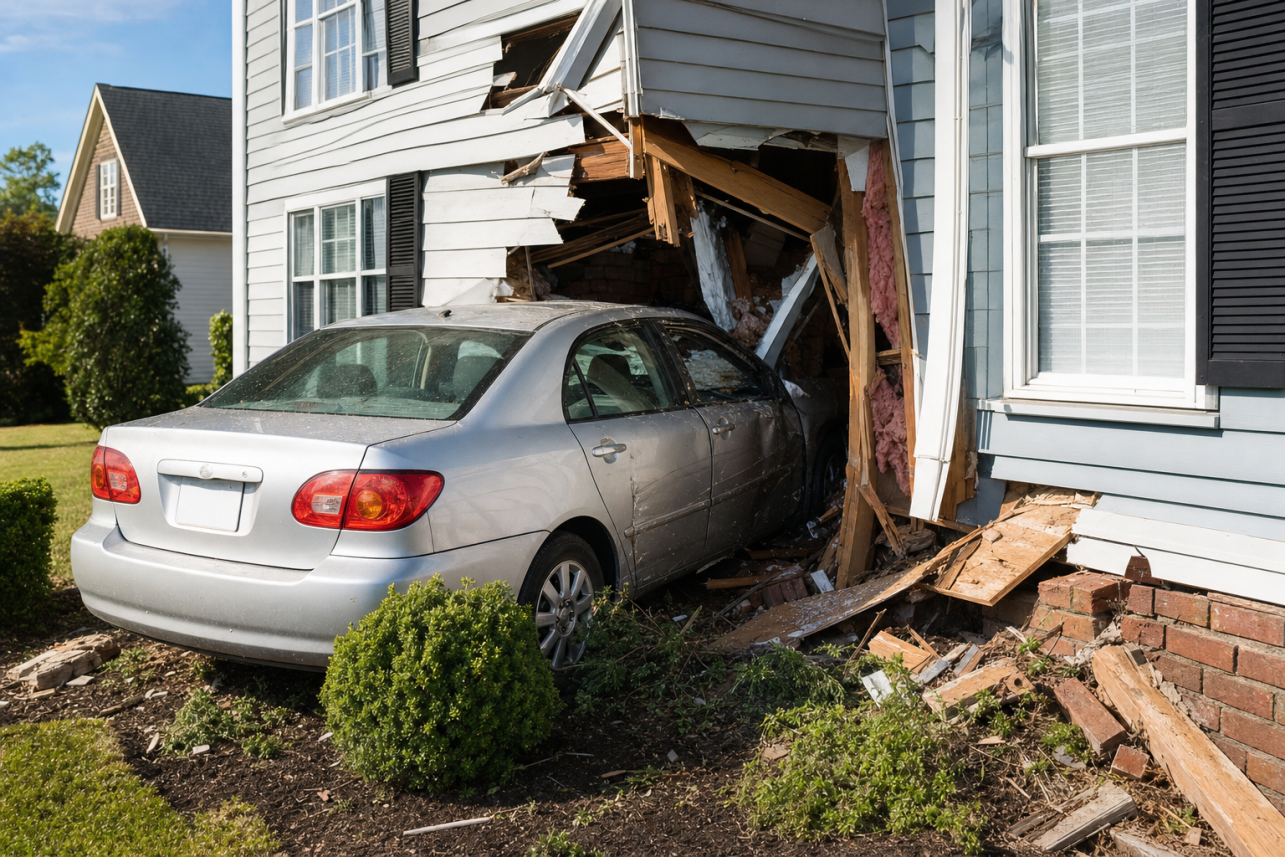
A Car Hits Home Claim Apex NC homeowners file after a vehicle strikes their house is usually paid through two routes: the at-fault driver's auto liability coverage and your own homeowners policy. For The Public Adjusters, Inc. is a licensed and bonded North Carolina public adjusting firm that documents the structural damage, prepares the repair estimate, and negotiates with both insurance companies on your behalf. We work only for you, the policyholder — never for the carrier.
What This Service Is
When a car crashes into a home, the damage almost always goes deeper than the hole you can see. Brick veneer cracks transfer load in ways that are invisible from the outside. A struck wall may be load-bearing, which means the impact can affect framing, the roofline, and even the foundation.Our job as your public adjuster is to make sure every bit of that damage is found, documented, and paid for. We arrange emergency board-up so the opening is secured, then bring in the right structural evaluation before anyone starts patching. A repair estimate written off a quick walk-through almost never captures hidden framing damage, and once you sign off on a settlement, reopening it is an uphill fight.
We also sort out who pays what. The driver's auto insurer owes for the damage they caused, but liability determination can drag on for weeks — especially if the driver disputes fault or carried minimal coverage. In most cases we recommend filing through your own homeowners policy first so repairs start quickly, then letting your carrier pursue the driver's insurer through subrogation to recover what it paid, including your deductible in many cases. These are the same coordination problems we untangle on a Car Hits Home Claim in Raleigh NC, and the pattern holds across the Triangle.
Common Problems
What Does A Car Hits Home Claim Apex NC Settlement Actually Have To Cover?
More than most homeowners are offered at first. A proper settlement should include structural repairs down to the framing and foundation, matching brick or siding, interior finishes, damaged contents, and code upgrade costs if Apex's current building requirements force changes the original construction didn't have.Watch the fine print on actual cash value versus replacement cost. If your carrier pays actual cash value, it deducts depreciation from the payout — and homeowners have fought that successfully in court. In Hicks v. State Farm Fire & Casualty, a federal appeals court sided with the insured and ruled the carrier could not depreciate labor costs when calculating a property payout. If the home is unsafe to occupy, your loss of use coverage should also pay temporary housing costs — a detail that gets left off first offers surprisingly often.
The Adjuster Low-Balled Me Or Stopped Responding. Now What?
A home insurance adjuster low ball offer after a vehicle strike is common because the first inspection is usually visual only. If nobody opened the wall, nobody priced the broken studs behind it. You have the right to dispute that estimate with your own documentation and your own repair figures.A home insurance adjuster not responding is the other frequent complaint, especially when your homeowners carrier and the driver's auto carrier are each waiting for the other to move. We keep both files active, put every request in writing, and escalate when deadlines slip. The North Carolina Department of Insurance also accepts consumer complaints when a carrier goes silent, and we're not shy about reminding adjusters of that. Never accept a quick check as final — in many cases a claim underpayment can be reopened with better evidence.
Should I Handle This Myself Or Hire My Own Adjuster?
If the damage is a cracked porch rail, handle it yourself. If a vehicle hit a wall of your house, the stakes are different: load-bearing questions, foundation movement, two insurance companies, and a liability fight you didn't ask for.The NCDOI Public Adjusters Guide explains what we are: state-licensed professionals who represent the policyholder, not the insurance company. Verify the license, confirm the firm is bonded, and ask whether they've handled vehicle-impact losses specifically — they behave differently from a water or fire loss. Homeowners searching for the Best Public Adjuster Apex NC has available should ask exactly those questions before signing anything. We cannot promise a particular dollar outcome — no honest adjuster can — but we can promise the damage gets fully documented and your side gets argued by someone who does this every day.

Our Process
Secure The Home And Document Everything
We start with emergency board-up and tarping so the opening doesn't invite water damage or make things worse. Then we photograph and measure everything — the impact point, cracks radiating through brick and drywall, racked door frames, and any sign the foundation shifted. The police report and the driver's insurance information get preserved from day one, because the at-fault driver's carrier will ask for all of it.
Build The Real Repair Estimate
We bring in structural evaluation where it's warranted and write a line-item estimate that covers framing, masonry matching, finishes, contents, and required code upgrades. This is the number we negotiate from — not the carrier's walk-through figure. When contractor estimates and the insurer's estimate disagree, we reconcile them item by item so the dispute is about facts, not opinions.
Negotiate With Both Carriers And Settle
As a licensed Public Adjuster in Apex NC, we manage your homeowners claim and the liability claim against the driver's auto insurer in parallel, so neither one stalls the other. We handle the back-and-forth, track the subrogation recovery of your deductible, and review every settlement document before you sign. You stay informed; we do the arguing.
| What's at Stake | Handling the Claim Alone | With For The Public Adjusters, Inc. |
|---|---|---|
| Hidden structural damage | Carrier scopes what's visible — brick, siding, drywall | Walls opened, framing and foundation inspected, engineer brought in when warranted |
| Which policy pays | Confusion between the driver's auto liability and your homeowners coverage often delays payment | We file under the correct policy first and position your carrier to recover your deductible through subrogation |
| Contents thrown or crushed by impact | Often forgotten or lumped into a small allowance | Itemized inventory with documented replacement pricing |
| Code upgrades during rebuild | Rarely included in the first estimate | Ordinance or law coverage identified and claimed where the policy provides it |
| Pressure to settle fast | Quick releases can close the claim before hidden damage appears | No release signed until the full scope is documented |
| Emergency shoring and board-up costs | Sometimes paid out of pocket and never reimbursed | Documented and submitted as part of the covered loss |
Commonly Overlooked In The Public Adjusting Industry
- Fractured sill plates and cracked studs behind intact brick veneer — Brick can absorb an impact and look repairable while the wood framing behind it is split, so estimates written from the exterior miss the real structural loss.
- Foundation and footing damage below the point of impact — The force of a vehicle strike travels downward into the foundation, but nobody checks the crawlspace or footing unless an engineer is brought in.
- Roof and truss movement when a bearing wall is hit — A wall knocked out of plumb shifts the roof structure it supports, yet adjusters rarely look up when the obvious damage is at ground level.
- Ordinance or law coverage for code-required upgrades — Apex rebuilds must meet current Wake County building code, and the policy provision that pays for those upgrades is almost never volunteered by the carrier.
- Subrogation and deductible recovery from the at-fault driver — Homeowners often don't realize their own carrier can recover the deductible from the driver's auto insurer, so they absorb a cost they're entitled to get back.
- Impact-caused plumbing, gas, and electrical damage inside the wall — Carriers try to reclassify a sheared pipe or crushed conduit as a maintenance problem when it was actually caused by the collision itself.
- Contents damaged by the shock of impact, not just the hole in the wall — Items knocked off shelves and furniture thrown across the room are covered, but they get cleaned up before anyone photographs or inventories them.
- Matching requirements for brick, siding, and flooring — Partial repairs with mismatched materials reduce a home's value, and policyholders rarely know their options for full-elevation or continuous-surface replacement.
Case Studies
Case Study #1
Situation: A family on Olive Chapel Road in Apex had a sedan jump the curb and strike the corner of their brick-veneer home at roughly 35 mph. The impact crushed a section of the garage wall and shifted the corner of the house visibly out of plumb.
Problem: The driver's auto liability carrier offered a quick settlement based on a drive-by estimate that covered only brick replacement and drywall patching. It ignored the framing behind the veneer and pressured the homeowners to sign a release within two weeks.
Investigation: Our adjusters opened the wall cavity, documented cracked studs and a split sill plate, and brought in a structural engineer to evaluate the foundation. We also measured racking in the garage door opening and checked the roof trusses that bear on the damaged wall.
Findings: The engineer confirmed the impact had fractured the sill plate along eight feet of foundation, cracked two foundation blocks, and knocked the corner framing nearly an inch out of alignment. The garage door no longer tracked properly because the opening itself had shifted. None of this appeared in the auto carrier's estimate.
Solution: We filed the claim under the homeowners policy first, since collision with a vehicle is a covered peril, and documented every structural item with engineer reports and photographs. We prepared a line-item estimate including shoring, foundation repair, framing replacement, matching brick, and code-required upgrades under the ordinance or law provision, then let the homeowners' carrier pursue subrogation against the driver.
Outcome: The settlement reached was more than four times the auto carrier's original offer and funded a full structural repair rather than a cosmetic patch. The homeowners paid their deductible, which their carrier later recovered through subrogation and returned to them.
Lesson: Never accept a vehicle-into-home settlement based on what's visible from the driveway. Structural damage hides behind brick and drywall, and the fastest offer is rarely the correct one. Courts have long backed policyholders who push back — in Guyther v. Nationwide Mutual Fire Insurance Co., 109 N.C. App. 506 (1993), the North Carolina Court of Appeals upheld a judgment for the insured homeowners after their carrier tried to avoid paying a dwelling fire loss, a reminder that policyholders who document their losses and stand firm can prevail.
Case Study #2
Situation: A retired couple in the Scotts Mill neighborhood of Apex had a pickup truck slide off the road in the rain and plow into their sunroom and adjacent kitchen wall. Glass, framing, and a corner of the roof overhang came down, and the impact ruptured a water line inside the wall.
Problem: Their homeowners carrier accepted the claim but scoped it as a sunroom rebuild only. It denied the kitchen cabinets, flooring, and contents, arguing the water damage inside the kitchen was a 'separate maintenance issue' rather than part of the collision loss.
Investigation: We performed moisture mapping across the kitchen and crawlspace, photographed the sheared supply line at the exact point of impact, and inventoried damaged contents including small appliances, cookware, and a china cabinet thrown over by the collision. We also had the roof overhang evaluated, since the sunroom tied into the main roof structure.
Findings: The water line failure traced directly to the vehicle strike — the pipe sheared where the stud it was strapped to snapped. Moisture readings showed water had traveled under the kitchen hardwoods into the subfloor. The roof tie-in had separated, meaning the repair scope extended well beyond the sunroom footprint.
Solution: We rebuilt the claim as a single collision loss with a documented chain of causation, submitted a contents inventory with replacement pricing, and included the roof tie-in and kitchen flooring in a unified estimate. We requested a re-inspection with the carrier's adjuster present alongside our documentation.
Outcome: The carrier reversed its position on the kitchen and contents and issued a revised settlement covering the full scope, including additional living expenses while the kitchen was unusable. The couple rebuilt the sunroom and kitchen together, matched the flooring throughout, and replaced every damaged item.
Lesson: When a vehicle hits a house, the covered loss includes everything the impact set in motion — broken pipes, damaged contents, and structure beyond the point of contact. Carriers often try to carve those out as separate problems. Policyholders have won on exactly this kind of causation dispute: in Guyther v. Nationwide, 109 N.C. App. 506 (1993), North Carolina's appellate court sided with homeowners whose carrier resisted paying the full dwelling loss, affirming that insurers must honor the policy as written.
| Situation | Immediate Step | Why It Matters for Your Claim |
|---|---|---|
| Car still in or against the house | Call 911 and do not move anything until police document the scene | The police report establishes the driver's liability and the point of impact |
| Visible cracks, sagging, or doors that won't close | Keep everyone out of the affected rooms and request emergency shoring | Structural movement can worsen fast, and shoring costs are typically part of the covered loss |
| Gas smell or electrical damage near the impact | Evacuate and call the utility company before re-entering | Safety first — and utility reports become evidence of impact-related damage |
| Driver's insurer offers a quick settlement | Do not sign a release before the full damage is scoped | A signed release can close the door on structural damage found later |
| Water leaking from a wall near the strike | Shut off the supply and photograph the sheared line before repairs | Impact-caused pipe breaks are part of the collision loss, not a separate maintenance issue |
| Belongings knocked over or crushed | Photograph items in place before cleaning up, then list everything | Contents coverage pays only for what you can document |
| You can't stay in the home | Save receipts for lodging and meals from day one | Additional living expense coverage reimburses documented costs, not estimates |
| Carrier's estimate covers cosmetics only | Get an independent scope before accepting | Framing, foundation, and roof tie-in damage hide behind finished surfaces |

Reviews
A teenager lost control and hit the front of our house near Kelly Road. The insurance company's first estimate didn't even mention the cracked foundation or the shifted porch posts. For The Public Adjusters brought in an engineer, documented everything behind the siding, and the final settlement covered a real structural repair instead of a cosmetic one. They handled every call with the adjuster so we didn't have to.
Danielle R., Apex
After a delivery van backed through our garage wall, we were bounced between the driver's auto carrier and our homeowners insurance for weeks. This team explained exactly which policy to file under, documented the bent garage framing and damaged contents, and got the claim moving. The difference between the first offer and what we actually received paid for the brick matching and a proper rebuild.
Marcus T., Apex
A car came through our fence and hit the corner of the house by the master bedroom. We had no idea the impact had cracked studs and knocked a window frame out of square until these adjusters opened things up. They were thorough, patient with our questions, and their estimate held up when the carrier pushed back. Took a little time, but worth every bit of it.
Priya S., Apex
Frequently Asked Questions
What Should I Do First When I Need To File A Car Hits Home Claim Apex NC Homeowners Can Rely On?
The first priority after a vehicle strikes your house is safety. Keep everyone away from the impact area, because a car can compromise load-bearing walls, gas lines, and electrical wiring even when the damage looks minor from the street. Call 911 so Apex Police can document the incident, and ask the Town of Apex or your utility provider to check gas and power connections before anyone re-enters.
Next, photograph everything before any debris is moved: the vehicle position, skid marks, the breach in the wall, interior cracking, and any damaged contents. Get the driver's auto insurance information from the police report, since that policy is often the primary source of recovery for structural damage.
Then notify your own homeowners insurer, even if the driver was clearly at fault. Your policy may need to respond first while liability is sorted out, and late notice can create problems. Before you accept any quick settlement or sign repair authorizations, consider having a licensed public adjuster review the damage. Vehicle-impact losses in Wake County frequently involve hidden foundation shifting, cracked footings, and framing damage that a drive-by estimate misses.
For The Public Adjusters, Inc. is licensed and bonded, and we represent you — not the insurance company — in documenting and negotiating the property damage. One important note: we handle the damage to your home, structure, and contents only. We do not handle claims for the vehicle itself, and any injury claims should go to an attorney.
Who Pays When A Car Crashes Into My House In Apex — My Homeowners Policy Or The Driver's Auto Insurance?
Usually both policies can be involved, and knowing how they interact matters. The at-fault driver's auto liability coverage is typically responsible for damage to your home and belongings. In North Carolina, drivers must carry property damage liability coverage, but serious structural damage to a brick or frame home in Apex can easily exceed those minimum limits.
When the driver's limits are too low, the driver is uninsured, or the driver flees the scene — which happens more than people expect on busy corridors like US-1, NC-55, and Ten Ten Road — your own homeowners policy steps in. Vehicle impact is a covered peril under standard homeowners forms, so your insurer should pay for the structural repairs, contents, and often additional living expenses if the home is unsafe to occupy.
Your homeowners carrier may then pursue the driver's insurer through subrogation to recover what it paid, which can also help you recoup your deductible. The complication is that two insurance companies pointing at each other can slow everything down while your house sits with a hole in it.
A public adjuster in Apex coordinates the property side of both claims, prepares one complete damage estimate, and pushes for a prompt, properly scoped settlement. We are licensed and bonded, and while we never guarantee a specific outcome, our job is to make sure every covered item — from the foundation to the drywall to damaged furniture — is documented and claimed. We do not handle the claim for the car itself.
What Hidden Damage Do Insurers Commonly Miss After A Vehicle Impact, And Have Policyholders Won In Court Over Underpaid Building Claims?
Vehicle impacts transfer enormous force through a structure, and the visible hole is rarely the full story. Common missed items in Apex homes include shifted sill plates, cracked slab edges and footings, racked wall framing several feet from the impact point, broken drain or supply lines inside the wall, damaged brick ties behind veneer, and hairline foundation cracks that widen over time. Older homes near downtown Apex with original framing are especially prone to hidden movement.
Insurance companies sometimes scope these losses as simple patch-and-paint repairs. That is where independent documentation — engineer reports, moisture readings, and a line-by-line estimate — changes the conversation.
Policyholders have successfully challenged insurers in court over building damage. In Bentoria Holdings, Inc. v. Travelers Indemnity Co., 20 N.Y.3d 65 (2012), a building owner's structure cracked when a neighboring excavation undermined it, and the insurer denied coverage under an earth-movement exclusion. New York's highest court sided with the insured, holding the exclusion did not unambiguously bar the loss and the building owner was entitled to pursue coverage. Similarly, in Joy Tabernacle – The New Testament Church v. State Farm (6th Cir. 2015), the insured prevailed on appeal after the carrier denied a structural collapse loss to its building.
These cases show courts will hold insurers to the policy language when structural damage is properly documented. That is exactly the groundwork we lay on every Car Hits Home Claim Apex NC property owners bring to us — thorough evidence first, so the carrier has little room to minimize the loss.
Why Should I Hire For The Public Adjusters, Inc. Instead Of Handling A Vehicle-Into-House Claim Myself?
You are allowed to handle the claim yourself, and for a truly minor loss that may be fine. But a car striking a home is a structural event, and the gap between a quick carrier estimate and the real cost of proper repair is often substantial. The insurance company's adjuster works for the insurance company. A public adjuster works only for you.
On a Car Hits Home Claim Apex NC homeowners bring to our office, we inspect the entire structure — not just the impact zone — and build a complete scope: foundation, framing, veneer, utilities, finishes, code-upgrade costs under current Wake County building requirements, damaged contents, and temporary housing if the home is unsafe. We handle the paperwork, meet the carrier's adjuster on site, and negotiate on your behalf.
We also manage the moving parts unique to these losses: coordinating between the driver's liability carrier and your homeowners insurer, documenting the loss before emergency board-up crews alter the scene, and tracking depreciation holdback so you recover it after repairs.
For The Public Adjusters, Inc. is licensed and bonded in North Carolina. We are honest about what we do and do not do: we represent policyholders on damage to homes, buildings, and contents only. We do not handle claims involving the vehicle itself, injuries, health, or life insurance, and we never promise a specific dollar outcome — no ethical adjuster can. What we do promise is a thorough, professionally documented claim and an advocate who answers to you, not the carrier.
How Long Does A Car Hits Home Claim Apex NC Homeowners File Typically Take To Resolve?
Most vehicle-into-house claims in Apex resolve in 60 to 120 days, but the timeline depends heavily on how the claim is documented up front. A straightforward impact to brick veneer or a garage door may move faster. Claims involving foundation displacement, shifted load-bearing walls, or ruptured utility lines often take longer because structural engineering reports are needed before repair scoping can even begin.
North Carolina requires insurers to acknowledge claims promptly and to pay undisputed amounts without unreasonable delay. In practice, delays usually come from incomplete documentation — a missing engineer's letter, an estimate that omits code-required upgrades, or a dispute over whether cracking predates the impact.
When we manage a Car Hits Home Claim Apex NC residents bring to us, we front-load the file: photographs, moisture and crack mapping, engineering coordination, and a line-item estimate built to Wake County permitting and code requirements. A complete file gives the carrier fewer reasons to stall.
Keep in mind that if the at-fault driver's auto liability carrier is also involved, that subrogation process can run on its own track. Your homeowners claim should not be held hostage while the two insurance companies sort out who ultimately pays. We cannot guarantee any particular outcome or timeline, but a properly built claim almost always moves more efficiently than one assembled piecemeal after the first denial or lowball offer.
What Happens If The Driver Who Hit My Apex Home Was Uninsured Or Fled The Scene?
You are not out of luck. Your homeowners policy covers sudden, accidental physical damage to your dwelling from vehicle impact regardless of whether the driver is ever identified. A hit-and-run on a cul-de-sac off Olive Chapel Road is handled the same way under your dwelling coverage as a crash where the driver stays and exchanges information.
The first step is filing a police report with the Apex Police Department or the Wake County Sheriff's Office. Your carrier will want that report number, and it preserves your insurer's right to pursue the driver later if they are found.
The practical difference with an uninsured or unknown driver is that your deductible applies and may not be recoverable. When a driver is identified and insured, your homeowners carrier typically subrogates against the at-fault driver's liability coverage and refunds your deductible once it recovers. Without a responsible party, that reimbursement path disappears.
To be clear, our role is limited to the damage to your home, other structures, and personal property inside — we do not handle claims for the vehicle itself, and nothing involving auto, health, or life coverage. What we do is make sure the building claim captures everything: the obvious hole in the wall plus cracked footings, racked framing, damaged plumbing or gas lines, and matching requirements for siding and masonry. An uninsured-driver situation makes maximizing your homeowners recovery even more important, since it is likely your only source of repair funds.
Can My Insurer Pay Only For The Visible Damage And Refuse To Address Foundation Or Framing Problems?
They can try, and this is one of the most common fights after a vehicle strikes a house in Apex. A car carries enormous kinetic energy, and that force travels well beyond the point of contact — into footings, sill plates, floor joists, and the connections that keep a wall plumb. Paying for brick and drywall while ignoring structural displacement leaves you with a home that looks repaired but is not.
Your leverage is documentation. An independent structural engineer's report carries far more weight than a field adjuster's visual walkthrough. We regularly see initial estimates on these claims miss shifted foundations, cracked slabs, compromised shear walls, and separated wall-to-roof connections.
Courts have repeatedly sided with policyholders when insurers underpaid legitimate building damage. In State Farm Fire & Casualty Co. v. Simmons, the Texas Supreme Court upheld a verdict for homeowners after finding the insurer conducted an outcome-oriented investigation of their house damage claim rather than a fair one. The lesson applies everywhere: an insurer must investigate the full scope of loss in good faith, not just the portion that is cheapest to acknowledge.
In Wake County, repairs to structural elements also trigger permitting and current building-code compliance, which can add legitimate cost to the claim if your policy includes ordinance or law coverage. We cannot promise any specific settlement figure, but a claim supported by engineering evidence and a code-compliant repair scope is far harder for a carrier to minimize.

Will Filing A Claim For A Car Hitting My House Raise My Homeowners Premiums In Apex?
A vehicle striking your home is a not-at-fault, sudden event, and in most cases it affects your rates far less than claims where the homeowner bears some responsibility. When the driver is identified and their auto liability carrier reimburses your homeowners insurer through subrogation, many carriers treat the claim neutrally at renewal because they recovered their payout. Your deductible is often refunded in that scenario as well.
That said, the claim will appear on your CLUE report, the industry database insurers check when pricing policies. North Carolina homeowners rates are also influenced by broader factors — statewide loss trends, construction costs in the Triangle, and your carrier's overall book — so isolating the effect of a single not-at-fault claim is difficult.
Here is the more important calculation. Structural repairs from a vehicle impact routinely run from tens of thousands of dollars into six figures once foundation work, framing, masonry matching, and Wake County code upgrades are included. Absorbing that cost to avoid a possible premium adjustment rarely makes financial sense.
If you are weighing whether a loss is worth reporting, we can review the damage first so you understand the realistic scope before anything is filed. As a licensed and bonded firm, we work only for you, never the carrier, and we will tell you honestly if a loss looks too small to pursue. For a Car Hits Home Claim Apex NC policyholders are considering, that early scoping conversation often clarifies the decision quickly.
Does A Car Hits Home Claim Apex NC Policyholders File Cover Temporary Repairs, Board-Up Costs, And A Hotel Stay?
Yes, in most cases. Standard homeowners policies in North Carolina require you to protect the property from further damage, and they typically reimburse reasonable emergency measures. That includes board-up of a breached wall, tarping, temporary shoring of a compromised load path, and fencing off a dangerous opening.
Keep every receipt. If a contractor in Apex charges you for emergency stabilization at 2 a.m., that invoice belongs in the claim file, not your shoebox. Photograph the damage before and after temporary work so the carrier can't argue about what the impact actually did.
If the house is unsafe to occupy — a cracked bearing wall, exposed electrical, or a garage structure threatening collapse — your policy's Additional Living Expense (ALE) coverage usually pays for comparable temporary housing, extra mileage, and increased food costs. Many Wake County families don't realize ALE exists and pay out of pocket for weeks.
Our team documents habitability issues in writing early, because carriers sometimes resist ALE when damage "looks" cosmetic from the street even though the structure behind the brick is compromised. We also track your displacement costs in the format adjusters expect, which reduces back-and-forth.
One caution: emergency repairs should stabilize, not rebuild. If you fully repair before the insurer inspects, you can hurt your own claim. Stabilize, document, and let the full scope be measured before permanent work begins. We are licensed and bonded, and we handle this sequencing for homeowners across Apex so nothing gets missed or waived.
What Documentation Should I Gather Before The Insurance Adjuster Inspects My Apex Home After A Vehicle Impact?
Start with the police report. When a car strikes a house in Apex, responding officers create a crash report that identifies the driver, their auto insurer, and the basic facts. That report anchors both the liability claim against the driver and your own homeowners claim.
Next, photograph everything from multiple angles before anything is moved: the point of impact, cracked brick veneer, shifted framing, interior drywall cracks, doors that no longer close, and any damaged contents like furniture or appliances near the strike zone. Video walk-throughs with narration are even better.
Gather your policy declarations page, any prior inspection reports or appraisal photos showing the home's pre-loss condition, and receipts for emergency board-up or shoring. If neighbors have doorbell or security footage of the crash, request it quickly — most systems overwrite within days.
For structural impacts, we often recommend an independent structural engineer's evaluation before the carrier's inspection. A vehicle transfers enormous force through a wall, and damage frequently extends into footings, sill plates, and roof framing far from the visible hole. An engineer's letter puts that hidden scope on the record early.
When homeowners in Wake County hire us before the first inspection, we prepare the file so the carrier's adjuster sees a complete, organized loss rather than a few phone photos. That changes the tone of the entire claim. We never promise a specific outcome, but thorough documentation consistently supports a fuller scope of repair than a bare-bones submission does.
Can I Recover For Furniture, Appliances, And Other Belongings Damaged When A Car Crashed Into My House?
Yes. Most homeowners policies include Coverage C for personal property, and contents damaged by a vehicle impact — crushed furniture, a refrigerator knocked over, electronics destroyed by debris, clothing contaminated by insulation and masonry dust — are generally covered perils under standard forms used in North Carolina.
The catch is how the carrier values those items. Many policies initially pay actual cash value, which deducts depreciation, and only release the recoverable depreciation after you replace the items and submit receipts. Homeowners in Apex frequently leave that second payment unclaimed because no one explained the process.
Inventory matters enormously here. We build a room-by-room contents list with photos, ages, and replacement pricing rather than the vague "miscellaneous items" entries that invite lowball valuations. Items pushed into other rooms by the impact, or damaged by dust migration through the HVAC system, belong on that list too.
Courts have backed policyholders who push back on undervalued property losses. In Cedar Bluff Townhome Condominium Association v. American Family Mutual Insurance Co. (Minnesota Supreme Court, 2014), the insured association prevailed when the court held the insurer had to replace all building siding so the repair would reasonably match, not just patch the directly struck panels. The same matching principle matters when a vehicle destroys part of a brick wall or siding run on an Apex home — a patchwork repair that doesn't match is not a proper indemnity.
One clarification: we handle the building and contents side of the loss. Damage to the vehicle itself is strictly between the driver and their auto carrier, and we do not handle motor vehicle claims.
The Insurer's Estimate Only Covers Patching The Wall — Can A Public Adjuster Reopen Or Expand The Scope?
Usually, yes. A carrier's first estimate on a vehicle-into-structure loss is often written from a quick visual inspection, and it tends to price a cosmetic patch: replace some brick, hang drywall, paint. The physics of a multi-ton vehicle hitting a wall rarely stop at the surface.
As your advocate on a Car Hits Home Claim Apex NC carriers will take seriously, we re-inspect with the full structure in mind — racked framing, cracked footings, separated sill plates, shifted roof trusses, disturbed plumbing or gas lines inside the wall cavity, and code-upgrade requirements that Wake County permitting will enforce during reconstruction. Ordinance and law coverage, when present on your policy, pays for those mandated upgrades, and it's missed constantly.
North Carolina claims remain open-ended enough that supplements are normal. We submit documented supplement requests with engineering support, contractor estimates, and photographs, and we negotiate scope line by line in the Xactimate format adjusters use. If the carrier still refuses a legitimate scope item, policy appraisal provisions and, where appropriate, legal remedies remain available — insureds have prevailed in court on underpaid building claims, as in Cedar Bluff v. American Family, where the policyholder won on the requirement that repairs reasonably match the undamaged structure.
We can't guarantee any particular result, and no honest adjuster will. What we can do is make sure the measured scope reflects the real damage to your Apex home rather than the cheapest visible fix, then press the carrier to pay what the policy actually owes.
The Impact Damaged My Brick And Siding — Can The Insurer Patch One Section, Or Must Repairs Match The Rest Of My Apex Home?
Matching is one of the most common fights after a vehicle strikes a house. Insurers often approve replacing only the damaged bricks or siding panels, even when the new materials will never blend with weathered masonry or discontinued siding profiles common in older Apex neighborhoods off Salem Street and in established Wake County subdivisions.
Most North Carolina homeowners policies promise to repair with materials of like kind and quality. When a patched wall is visibly mismatched, you may be entitled to replacement of a larger continuous area — sometimes an entire elevation — so the home is actually restored.
Policyholders have won this fight in court. In Windridge of Naperville Condominium Association v. Philadelphia Indemnity Insurance Co. (7th Cir. 2019), the insurer wanted to replace only storm-damaged siding on some elevations. The court sided with the insured, holding that the mismatched result did not restore the property and that replacing siding on all sides was the reasonable remedy. The reasoning in matching cases like this is persuasive when a carrier tries to leave an Apex homeowner with a checkerboard wall.
When we handle a vehicle-into-home loss, we document the existing brick blend, mortar color, and siding product line, obtain discontinuation letters from suppliers when materials are no longer made, and push the scope to a result a reasonable buyer would accept. A patched impact scar on the front of your home affects value, and the policy language often supports far more than a spot repair.
Does A Car Hits Home Claim Apex NC Homeowners File Also Cover My Garage, Fence, Mailbox, Or Other Detached Structures?
In most cases, yes. A standard homeowners policy splits your property into Coverage A for the dwelling and attached structures, and Coverage B for detached structures — typically set at ten percent of your dwelling limit. If a vehicle plows through a fence, clips a detached garage, or takes out a brick mailbox column before reaching the house, each of those items can be part of the same claim.
This matters in Apex, where many homes near Olive Chapel Road and throughout western Wake County sit close to curves and intersections, and a single out-of-control vehicle often damages several structures in one event. We frequently see carriers pay for the obvious hole in the wall while quietly leaving the cracked driveway apron, shifted fence posts, or racked garage framing out of the estimate.
Attached versus detached matters for which limit applies, so we verify how your garage or carport is classified under your specific policy. We also measure the full path of the vehicle — tire gouges in the yard, landscaping, irrigation lines, and hardscape are often recoverable and often forgotten.
One deductible generally applies to the whole occurrence, not one per structure. Our job is to make sure every damaged item along the vehicle's path is scoped, priced at current Wake County repair costs, and included before you settle. We cannot promise a particular dollar outcome, but we can make sure nothing is left off the table.
My Apex House Is Older — Will The Claim Pay For Code Upgrades The Town Requires During Repairs?
It can, if your policy includes ordinance or law coverage, and most modern homeowners policies in North Carolina include at least some. When a vehicle destroys a load-bearing wall, the Town of Apex and Wake County inspections will require the rebuild to meet the current North Carolina Residential Code — not the code in effect when the home was built.
For homes built in the 1980s and 1990s, that can mean upgraded framing connections, modern electrical wiring and GFCI protection in the repaired area, updated insulation values, and sometimes engineered repairs to the foundation or slab. These upgrades are real costs, and they are routinely missing from the carrier's first estimate because the field adjuster prices a like-for-like patch without pulling permits into the analysis.
Ordinance or law coverage usually appears as a percentage of your dwelling limit, commonly ten percent, though endorsements vary. We read the actual policy language, identify which code-driven costs are triggered by your specific repair scope, and support them with citations to the applicable code sections and, where needed, a structural engineer's letter.
One caution: some policies only pay code-upgrade costs as the work is completed, not up front. We help sequence the claim so you are not stuck fronting money the policy owes you later. If an inspector red-tags part of the structure, that documentation also strengthens the argument that a cosmetic patch is simply not a legal repair.

How Does For The Public Adjusters, Inc. Charge For A Car Hits Home Claim Apex NC Families Bring To Your Office, And Are You Licensed?
We are licensed and bonded public adjusters in North Carolina, and we work on a contingency fee — an agreed percentage of the insurance recovery, disclosed in writing before we start. There are no hourly bills and no upfront charges. If the claim pays nothing, we earn nothing, which keeps our interests aligned with yours.
Our fee agreement follows the requirements of the North Carolina Department of Insurance, which regulates public adjusters, caps how fees may be structured, and requires the contract terms to be spelled out clearly. You are welcome to review the agreement with an attorney or family member before signing — we encourage it.
To be clear about scope: we handle the property side only. That means the structure, attached and detached buildings, your damaged contents, and additional living expenses under your homeowners policy. We do not handle motor vehicle, health, or life insurance claims, so any damage to the car itself or injury claims against the driver are matters for the auto carrier or an attorney.
We never guarantee a specific settlement amount — no honest adjuster can, and North Carolina law prohibits that kind of promise. What we do commit to is a complete, documented scope of your Apex loss: structural, cosmetic, code-related, and contents, priced at real Wake County repair costs and pursued persistently until the carrier addresses all of it. Most homeowners tell us the first carrier estimate looked nothing like the final documented claim.
Local Relevance
Apex has grown fast, and that growth matters for this kind of loss. Busy corridors now run past subdivisions built in the late 1990s and 2000s, with homes sitting close to the road on corner lots and cul-de-sac entrances — exactly where vehicle strikes happen. Much of that housing stock is brick veneer over wood framing, a combination where impact damage hides well.North Carolina is an at-fault state, so the driver's liability coverage is on the hook, but minimum policy limits don't always cover a serious structural repair. That's when your own homeowners coverage has to carry the difference, and why filing both claims correctly matters. The Insurance Information Institute notes that homeowners policies generally cover vehicle damage to the dwelling, but the burden of proving the full scope of that damage still falls on you.
We handle these losses throughout the Triangle — a Car Hits Home Insurance Claim in Durham raises the same two-carrier problems we see here in Wake County — so we know how regional adjusters price these repairs and where their estimates typically fall short. Whether your policy is a state farm home insurance claim or with any other carrier, the documentation standard we build to is the same.
Much of Apex sits on Triassic Basin clay that shrinks and swells with moisture, so many homes here already have minor slab and foundation movement — and when a car strikes a house, carriers often try to blame impact-related cracks on that pre-existing settling. Documenting which cracks are fresh, and tying them to the impact line, is often the difference between a patch job and a properly rebuilt wall.
A Car Hit Your House. Don't Face Two Insurance Companies Alone.
For The Public Adjusters, Inc. is licensed and bonded in North Carolina, and we represent you — not the carriers. From emergency board-up through the final settlement check, we document the full damage and negotiate both claims so nothing gets left on the table. The consultation costs you nothing, and you'll know exactly where your claim stands before you commit to anything.
Call us: (919) 400-6440
Helpful Resources
- NCDOI Public Adjusters Guide
- Insurance Information Institute (III)
- North Carolina Department of Insurance — State regulator for insurance and consumer complaints
- Insurance Information Institute — Consumer education on homeowners coverage
Last updated: October 15, 2026