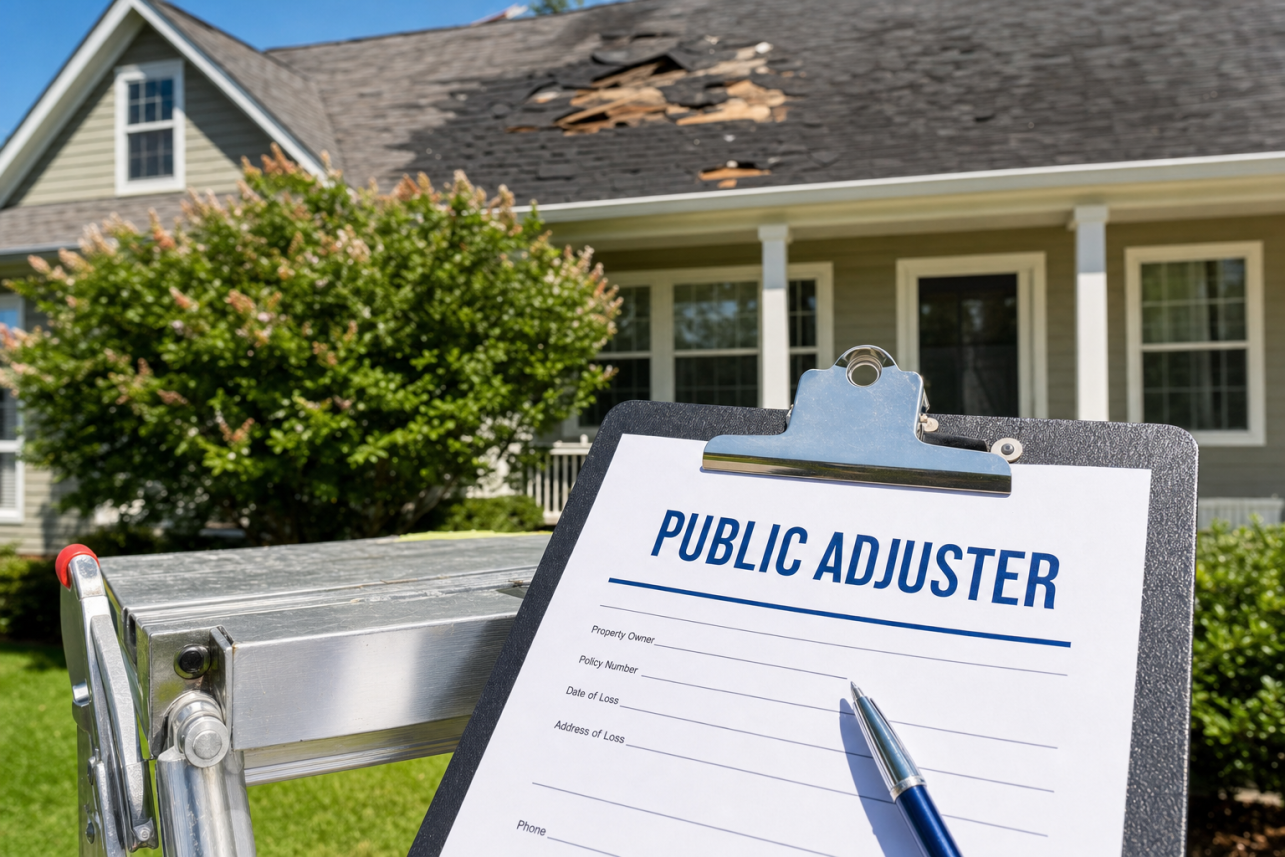
A public adjuster Wake Forest NC property owners hire works exclusively for the policyholder — never the insurance company — to document, value, and negotiate a property damage claim. For The Public Adjusters, Inc. is licensed and bonded, and we handle fire, smoke, water, tree, flood, vandalism, and hurricane or tornado damage claims for homes and businesses throughout Wake Forest and Wake County. Our job is to make sure the loss is measured completely before the insurer sets the number.
What This Service Is
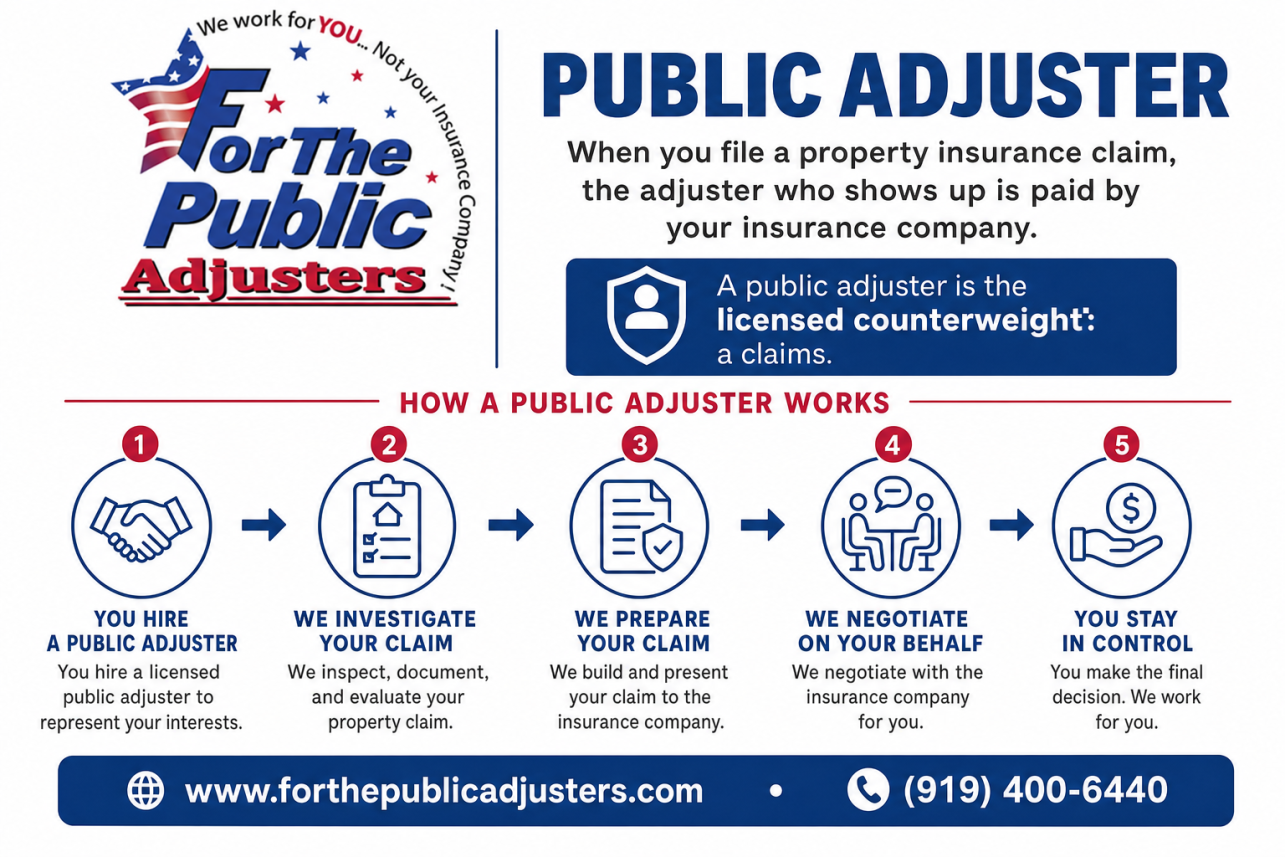
When you file a property insurance claim, the adjuster who shows up is paid by your insurance company. A public adjuster is the licensed counterweight: a claims professional who represents you, the insured, from the first inspection through the final settlement check.
In practice that means reading your policy line by line, photographing and scoping every room touched by the loss, pricing the repairs with current local construction costs, inventorying damaged contents, and negotiating directly with the carrier's adjuster. The North Carolina Department of Insurance licenses public adjusters in this state, and its NCDOI Public Adjusters Guide explains exactly what we can and cannot do on a policyholder's behalf — a resource we encourage every client to read.
We handle residential homeowners claims and commercial business claims alike: fire and smoke damage, water damage from burst pipes or roof intrusion, tree damage, vandalism and arson claims, car-hits-home losses, and flood insurance claims. We do not handle claims involving vehicles, cell phones, health, or life insurance — buildings and their contents are our entire practice.
Common Problems
What Does A Public Adjuster Wake Forest NC Homeowners Hire Actually Cost?
Public adjusters in North Carolina work on a contingency fee — a percentage of what the insurance company pays, disclosed in writing before any work begins. There is no hourly billing and no upfront retainer.
The more useful question is what an incomplete claim costs you. Carrier estimates routinely miss code-upgrade requirements, smoke residue in wall cavities, moisture that migrated behind baseboards, and matching issues on roofing or siding. We cannot guarantee any particular outcome on any claim, but a properly scoped loss is consistently a larger loss than a quick walkthrough produces.
Courts have backed policyholders on exactly these gaps. In Windridge of Naperville Condominium Association v. Philadelphia Indemnity Insurance Company, the insured won when the court held the insurer had to replace storm-damaged siding on all elevations so the building matched — not just patch the panels that were physically hit. That is the kind of detail a policyholder's own adjuster fights for.
My Claim Keeps Getting Delayed, Lowballed, Or Partially Denied — What Now?
This is the most common call we get in Wake Forest. The carrier's first estimate arrives weeks late, covers half the visible damage, and ignores everything hidden. Or the claim is denied on a policy exclusion the adjuster never explained.
Do not accept the first number and do not sign a release under pressure. You have the right to dispute the carrier's valuation, submit your own documented estimate, and invoke policy provisions like appraisal when the two sides cannot agree on value.
We build the file the carrier has to answer: room-by-room scopes, moisture readings, contents inventories, and repair pricing. When a claim needs legal escalation beyond negotiation, we work alongside insurance dispute lawyers so nothing is lost in the handoff.
Should I Just Handle The Claim Myself, Or Is Hiring Help Worth It?
For a small, clearly covered loss with a cooperative carrier, handling it yourself can be fine. The math changes with any significant fire, water, smoke, or tree loss — because you are negotiating against a professional who values claims for a living, using a policy written by their employer.
A good public adjuster does three things you likely cannot: reads the policy the way carriers read it, prices repairs with documentation an insurer must respond to, and knows which disputes are worth pushing. Before hiring anyone, verify their North Carolina license and confirm they are bonded — we are both.
Be wary of anyone who knocks on your door after a storm promising a specific dollar figure. No honest adjuster guarantees a result, and North Carolina regulators warn against exactly that pitch.
Our Process
Free Claim Review And Policy Analysis
We start by reading your actual policy — declarations, endorsements, exclusions — and walking the damage with you. You learn what coverage genuinely applies before anything is filed or signed. If we don't believe we can add value, we tell you so.
Full Documentation And Valuation Of The Loss
We photograph and scope every affected area, test for hidden moisture and smoke migration, inventory damaged contents, and price repairs using current Triangle-area construction costs. This becomes the demand package the carrier must respond to, rather than the other way around.
Negotiation Through Settlement
We meet the carrier's adjuster on site, answer every request for documentation, and negotiate each line item until the offer reflects the documented loss. If the carrier will not move, we advise you on appraisal and dispute options. You approve every decision; we cannot and do not promise a specific outcome, only a fully presented claim.
| What Matters | Filing on Your Own | With For The Public Adjusters, Inc. |
|---|---|---|
| Who documents the damage | The carrier's adjuster, who works for the insurance company | An independent licensed adjuster working only for you |
| Hidden damage detection | Rarely — visual inspection only | Moisture mapping, thermal imaging, and expert testing when needed |
| Estimate accuracy | Carrier software defaults, often missing code upgrades and matching | Line-by-line estimate built to actual Wake County repair costs |
| Negotiation leverage | You vs. a trained claims professional | Documented supplements, policy citations, and re-inspection representation |
| Your time investment | Dozens of hours of calls, paperwork, and follow-up | We handle communication; you approve decisions |
| Typical cost | Free upfront, but underpayment risk is high | Contingency fee — no recovery, no fee |
Commonly Overlooked In The Public Adjusting Industry
- Code upgrade (ordinance or law) coverage — Carrier estimates price repairs to old code, and homeowners don't know their policy pays for the drip edge, GFCI, and permit costs current Wake County code requires.
- Shingle and siding matching for discontinued materials — Adjusters approve a patch without checking whether the material is still made, when a discontinued line can justify replacing the whole slope or elevation.
- Hidden moisture behind walls and under flooring — Carrier inspections are visual, so wet insulation and subfloor go undetected until mold appears months after the claim is closed.
- HVAC and ductwork contamination after fire or smoke — Soot inside duct systems is invisible from the registers, and it recirculates residue through a home long after cleanup looks finished.
- Depreciation recovery (recoverable depreciation) — Policyholders cash the initial actual-cash-value check and never file the paperwork to collect the withheld depreciation they're owed after repairs.
- Additional living expense benefits during displacement — Families pay for hotels, meals, and pet boarding out of pocket without realizing their policy reimburses those costs while the home is unlivable.
- Supplemental claims for damage found during repairs — Contractors uncover rotted decking or damaged framing mid-project, and homeowners assume the original settlement is final when it can be reopened.
- Proof-of-loss deadlines and policy time limits — North Carolina policies impose strict filing windows, and a strong claim can be forfeited simply because paperwork arrived a few weeks late.
Case Studies
Case Study #1
Situation: A homeowner off Heritage Lake Road in Wake Forest had a spring hailstorm punch through their neighborhood. Their insurance carrier sent an adjuster who spent about twenty minutes on the roof and issued a check for $4,800 to replace a few shingles and one section of gutter.
Problem: The homeowner noticed water staining on an upstairs ceiling two months later. The carrier said the interior damage was a 'maintenance issue' unrelated to the storm and refused to reopen the claim, leaving the family facing repairs the payout wouldn't come close to covering.
Investigation: Our team performed a full inspection: roof deck moisture readings, attic thermal imaging, a soft-metal test on vents and flashing, and a review of NOAA hail data for the storm date. We also pulled the carrier's original estimate line by line.
Findings: Hail had bruised shingle mats across three slopes, not one, and fractured a plumbing boot that was slowly leaking into the attic. The carrier's estimate omitted code-required drip edge, ice-and-water shield at valleys, and interior remediation entirely. Matching shingles for the partial repair were also discontinued.
Solution: We reopened the claim with a documented supplement, invoked the North Carolina matching considerations for the discontinued shingle line, and presented moisture mapping tying the ceiling stains directly to the storm-fractured boot. We handled every carrier call and re-inspection.
Outcome: The claim settled at $38,200 — a full roof replacement, interior drywall and paint, and code-upgrade items the first estimate never mentioned. The homeowner paid nothing out of pocket beyond their deductible.
Lesson: A quick carrier inspection after a hailstorm often catches the obvious damage and misses the expensive damage. Independent documentation, done early, is what turns a partial payment into a complete one.
Case Study #2
Situation: A family-owned restaurant near downtown Wake Forest suffered a kitchen fire that started in a fryer hood. The fire itself was contained quickly, but smoke and suppression chemicals spread through the dining room, walk-in coolers, and HVAC system.
Problem: The carrier's adjuster valued the loss mostly on visible fire damage and offered $61,000. The offer ignored smoke contamination in the ductwork, spoiled inventory, and — most critically — the business income loss during the months the restaurant would be closed.
Investigation: We brought in an industrial hygienist to test for soot and protein residue throughout the building, inventoried every piece of contaminated equipment against replacement pricing, and reconstructed twelve months of sales data to build a defensible business interruption model.
Findings: Soot residue was present in the HVAC system and on porous surfaces well beyond the kitchen, requiring full duct cleaning and dining room refinishing. The equipment schedule undervalued the commercial line by nearly $40,000, and the business income projection ignored the restaurant's peak season.
Solution: We submitted a rebuilt claim package with lab results, itemized contents documentation, and a season-adjusted business interruption calculation, then negotiated directly with the carrier's large-loss unit through two rounds of review.
Outcome: The final settlement reached $247,000 across building, contents, and business income coverage — roughly four times the original offer. The restaurant reopened fully renovated instead of patched together.
Lesson: On commercial fire losses, the visible damage is usually the smallest part of the claim. Contamination testing and a proper business income analysis are where most of the money gets left behind.
| Your Situation | Handle It Yourself? | What It Depends On |
|---|---|---|
| Small claim under your deductible or just above it | Usually yes | If repairs cost less than the deductible plus fee, hiring help rarely pays off |
| Roof hail or wind damage with a partial-repair offer | No — get a second opinion | Discontinued shingles and matching rules often justify full replacement |
| Water damage where walls or floors got wet | No | Hidden moisture in cavities causes mold; carriers rarely test for it |
| Fire or smoke loss of any size | No | Smoke contamination spreads far beyond visible damage and needs testing |
| Claim denied outright | No — act fast | Denials can often be reversed with proper documentation, but deadlines apply |
| Lowball offer that feels short | No | If contractor bids exceed the offer, an independent estimate usually closes the gap |
| Business loss with lost income | Never | Business interruption calculations require financial reconstruction most owners can't do alone |
| Claim already settled and check cashed | Maybe | North Carolina allows reopening within policy time limits if new damage is found |

Reviews
Our insurance company offered $9,000 after a pipe burst flooded our first floor near Joyner Park. For The Public Adjusters found hidden moisture in the wall cavities the carrier's guy never even checked, documented everything with meters and photos, and got the claim settled for over $34,000. They handled every phone call so I didn't have to argue with the adjuster once.
Marcus T., Wake Forest
After the hailstorm last April, our carrier said our roof only needed a partial repair. This team proved the shingles were discontinued and got us a full replacement plus interior ceiling repairs. As a Wake Forest public adjuster they knew the local storm dates cold and had the weather data ready before the re-inspection. Worth every penny of the fee.
Denise R., Heritage neighborhood
Tree came through our roof during a windstorm and the first offer didn't even cover the tarp and tree removal, let alone the structural repairs. These folks reopened the claim, brought in an engineer, and the settlement ended up almost triple. Only ding is the process took about eleven weeks, but they warned us upfront and kept us updated the whole way.
Jim & Carol P., Wake Forest
Frequently Asked Questions
How Much Does It Cost To Hire A Public Adjuster Wake Forest NC Homeowners Can Trust?
For The Public Adjusters, Inc. works on contingency, which means you pay nothing upfront and no hourly fees. Our compensation is a percentage of the settlement we recover for you, agreed to in writing before any work begins. If we don't recover money for your claim, you don't owe us a fee.
In North Carolina, public adjuster fees are regulated by the Department of Insurance, and contracts must clearly disclose the percentage. That protects homeowners in Wake Forest from surprise charges and keeps the arrangement transparent from day one.
Here's the part most people miss: studies and our own case files consistently show that professionally represented claims settle for significantly more than claims homeowners handle alone. Insurance carriers use trained adjusters and estimating software built to protect their bottom line. When you have your own licensed advocate documenting damage, writing a competing estimate, and negotiating line by line, the final settlement often increases enough to cover the fee many times over.
We've seen this play out repeatedly with hail and wind claims in neighborhoods like Heritage and Traditions, where initial carrier offers missed matching requirements for siding and roofing, code-upgrade costs, and interior water damage hidden behind walls. Those overlooked items add up fast.
Before you sign anything, we'll review your claim at no charge and tell you honestly whether hiring us makes financial sense. If your claim is small or the carrier's offer is fair, we'll say so.
When Should I Call A Wake Forest Public Adjuster Instead Of Handling The Claim Myself?
Call before you file, if you can. The way a claim is reported, documented, and presented in the first two weeks shapes everything that follows. We routinely see Wake Forest homeowners accidentally understate damage on the initial call, and that early description follows the claim through every negotiation afterward.
That said, it's rarely too late. You should absolutely bring in your own adjuster if any of these apply: your claim was denied or partially denied, the carrier's offer seems far below actual repair costs, the insurance company is delaying or going silent, or the damage is complex — think roof damage from one of our spring hailstorms combined with interior water intrusion, or fire and smoke damage where contents need to be inventoried.
Large losses are another clear trigger. If your home off Capital Boulevard or in the Route 98 corridor suffered major storm, fire, or water damage, the claim will involve structural estimates, additional living expenses, contents valuation, and code-upgrade coverage. Each of those is a category the carrier can undervalue, and each one benefits from professional documentation.
Smaller, straightforward claims — a single broken window, minor fence damage — usually don't need representation, and we'll tell you that upfront.
North Carolina generally allows three years to pursue a property claim, but policy deadlines for proof of loss and supplemental claims can be much shorter. Even if your claim was closed or paid months ago, it may be reopenable if new damage is found. A free file review will tell you where you stand.
What Types Of Property Damage Claims Do You Handle In Wake Forest And Greater Wake County?
Our team handles the full range of residential and commercial property claims common to this part of North Carolina.
Storm damage leads the list. Wake Forest sits in a corridor that takes hail and straight-line wind damage nearly every spring, and tropical systems moving inland — the way Fran and Florence did — bring wind and water losses across Wake County. We handle roof claims involving asphalt shingle, metal, and slate, plus siding, gutters, windows, and fencing, and we push back when carriers try to patch a roof that genuinely needs replacement or ignore North Carolina's matching considerations.
Water and pipe-burst claims are a close second. Winter cold snaps here catch homes with crawl-space plumbing off guard, and slab leaks and supply-line failures cause damage that spreads into flooring, drywall, and cabinetry. We document hidden moisture with meters and thermal imaging so nothing gets left out of the estimate.
We also represent policyholders on fire and smoke claims — including full contents inventories and additional living expenses while you're displaced — as well as lightning strikes, fallen trees, vandalism, and business-interruption losses for commercial properties along South Main Street and the Capital Boulevard corridor.
One important note: standard homeowners policies don't cover rising floodwater, which falls under separate flood insurance. During your free consultation we'll read your actual policy language, explain what's covered, and identify every coverage — dwelling, other structures, contents, ordinance and law, loss of use — that applies to your situation.
How Does The Claims Process Work With A Public Adjuster Wake Forest NC Property Owners Hire?
When you hire For The Public Adjusters, Inc., the process starts with a free, no-obligation inspection of your Wake Forest property and a full review of your insurance policy. We identify every applicable coverage, note deadlines, and give you an honest assessment of whether representation makes sense.
If you move forward, you sign a state-regulated contract and we take over communication with the insurance company. That alone removes most of the stress — no more chasing desk adjusters or explaining the same damage three times.
Next comes documentation, which is where claims are won. We photograph and measure everything, use moisture meters and thermal imaging where appropriate, and prepare a detailed, line-item estimate using the same professional estimating software carriers use. For contents losses, we build a room-by-room inventory with replacement values.
We then meet the insurance company's adjuster on site and walk the damage together, pointing out what their initial inspection missed. From there, we negotiate — supported by photos, measurements, code requirements from the Town of Wake Forest and Wake County, and policy language — until the settlement reflects the true cost to restore your property.
Most claims resolve within 30 to 90 days of our involvement, though complex or disputed losses can take longer. If a carrier refuses to be reasonable, North Carolina policies include an appraisal provision we can invoke to force a fair resolution.
Throughout, you stay informed and in control. Settlement checks come to you, and you choose your own contractors. Our job is simply to make sure the money is enough to do the job right.
My Insurance Company Already Made An Offer — Can A Public Adjuster Wake Forest NC Residents Rely On Still Help?
Yes, and this is actually one of the most common situations we handle. An initial offer from your carrier is a starting point, not a final verdict. In North Carolina, you generally have the right to dispute a settlement and reopen or supplement a claim, and many of the files we take on in Wake Forest come to us after a homeowner receives an offer that felt too low.
When you bring us an existing offer, we start by comparing the carrier's estimate against a full, independent inspection of your property. Insurance estimates frequently miss hidden damage — moisture trapped behind drywall after a pipe burst, hail bruising on shingles that only shows up on close inspection, or code-upgrade costs required by Wake County when repairs are made.
We then prepare a detailed, line-item counter estimate with photo documentation and present it to the carrier, handling the negotiation from that point forward. If the claim was underpaid because of a coverage dispute rather than a scope dispute, we review your policy language and push back where the denial or reduction doesn't hold up.
One important note on timing: North Carolina policies typically set deadlines for disputing settlements and filing suit, so the sooner you have your offer reviewed, the more options you keep open. Even if you've already cashed a check, that usually doesn't close the door on recovering additional funds for damage the first estimate missed. A quick review costs you nothing and tells you exactly where you stand.
How Long Does It Take To Settle A Property Damage Claim In Wake Forest?
Most residential claims we handle in Wake Forest resolve within 30 to 90 days from the date we take over the file, though the timeline depends on the size of the loss, the carrier involved, and how complete the documentation is.
Smaller, straightforward claims — a single-room water loss or localized roof damage — often settle on the faster end. Larger losses like house fires, major storm damage, or claims involving structural repairs take longer because there's simply more to document, estimate, and negotiate. Claims that were previously denied or disputed can also add time, since we may need to build a case that overturns the carrier's original position.
North Carolina insurance regulations require carriers to acknowledge claims promptly and to pay within a set window once a settlement is agreed, which works in your favor. Where delays usually happen is in the back-and-forth over scope and pricing — and that's exactly the stage where having an experienced advocate speeds things up. Because we submit complete, well-documented estimates up front, carriers have fewer reasons to stall or request endless re-inspections.
After major weather events, like the hailstorms and hurricane remnants that periodically sweep through Wake County, every carrier's adjusters are stretched thin and timelines lengthen across the board. In those situations, a professionally prepared claim tends to move to the front of the line simply because it's ready to be paid. We keep you updated at every stage, so you're never left wondering where your claim stands or when funds will arrive.
Are Public Adjusters Licensed In North Carolina, And How Do I Verify Yours?
Yes. North Carolina requires anyone acting as a public adjuster to hold a license issued by the North Carolina Department of Insurance. That licensing process includes an examination, a background check, continuing education requirements, and a bond — real safeguards that protect you as a policyholder.
Verifying a license takes about two minutes. Visit the NC Department of Insurance website and use their licensee search tool, or call the Department directly. You can search by the adjuster's name or license number, and the record will show whether the license is active and in good standing. Any legitimate professional will hand over their license number without hesitation — we certainly do, and we encourage every Wake Forest homeowner to check before signing anything.
Licensing matters because the title gets misused. After big storms, out-of-state operators and unlicensed "claim consultants" often canvass neighborhoods around Wake Forest, Rolesville, and Youngsville. Some are contractors who legally cannot negotiate your insurance claim in North Carolina, no matter what they promise at your door.
Beyond the license itself, look for a written contract that clearly states the fee percentage, an office you can actually visit, and references from local homeowners. Ask how many claims they've handled with your specific carrier and your type of loss. For The Public Adjusters, Inc. is fully licensed in North Carolina, and we're happy to walk you through our credentials, our fee agreement, and examples of local results before you commit to anything.
What Should I Do Right After Storm Or Water Damage, Before The Public Adjuster Wake Forest NC Homeowners Call Gets On Site?
The first priority is safety and preventing further damage — your policy actually requires you to take reasonable steps to protect the property. If a tree has opened your roof or a pipe has flooded a floor, shut off the water at the main, tarp exposed areas if it's safe to do so, and move undamaged belongings out of harm's way.
Before you throw anything out or start cleanup, document everything. Take wide photos of each affected room, then close-ups of individual damage. Video walkthroughs are excellent because they capture context that photos miss. Keep damaged items when possible — carriers sometimes dispute losses they can't inspect.
Save every receipt. Emergency tarping, water extraction, a hotel stay if your home isn't livable — these are typically reimbursable under your policy's additional living expense and mitigation provisions, but only if you can prove the cost.
What we'd urge you not to do: don't give a recorded statement to the insurance company before you understand your coverage, don't sign an assignment of benefits with a contractor who shows up at your door, and don't accept a quick settlement check under pressure. Statements made early in a claim get used to limit payouts later.
Then call us. We serve Wake Forest and surrounding Wake County communities and can usually get eyes on your property quickly after a loss. The earlier we're involved, the more thoroughly we can document the damage in its original state — and that documentation is the foundation of a full, fair settlement.
What Is The Difference Between A Public Adjuster Wake Forest NC Homeowners Hire And The Adjuster My Insurance Company Sends?
The adjuster your insurance company sends works for the insurance company. Their job is to evaluate the claim from the carrier's perspective, and their estimate often reflects the carrier's interests, pricing software settings, and internal guidelines. They are not obligated to point out coverage you forgot to claim.
A public adjuster works exclusively for you, the policyholder. At For The Public Adjusters, Inc., we read your entire policy, document every item of damage — including things carrier adjusters commonly miss, like matching issues on roofing and siding, hidden moisture behind walls, and code-upgrade costs — and build an independent estimate that reflects real repair pricing in Wake County.
The difference shows up in the details. A carrier adjuster might spend 30 minutes on your roof in Heritage or Traditions and write for a partial repair. We take the time to measure, photograph, test, and argue for full replacement when the policy and the damage support it.
Think of it like a legal dispute: the carrier already has a professional representing its side. Hiring your own advocate simply levels the playing field. We negotiate directly with the carrier's adjuster and desk examiners so you are never pressured into accepting a number that does not restore your home.
Can You Reopen A Claim That Was Denied Or Already Closed By My Insurer?
In many cases, yes. In North Carolina, a denial or a closed claim is rarely the final word. Most policies allow supplemental claims when additional damage is discovered or when the original settlement did not account for the true scope of repairs. The key constraints are your policy's deadlines and the state's statute of limitations, so acting promptly matters.
We start with a free review of the denial letter, the carrier's estimate, and your policy language. Denials in the Wake Forest area often hinge on disputed causation — for example, a carrier claiming roof damage is wear and tear rather than the hailstorm that actually caused it, or attributing water intrusion to long-term seepage instead of a sudden pipe failure.
Our team rebuilds the claim from the ground up. That can include a fresh inspection, moisture mapping, weather data pulled for your specific address, engineering reports when needed, and a line-item estimate the carrier cannot easily dismiss. We then submit a formal supplement or dispute with documentation that directly counters the reason for denial.
If the carrier still refuses to pay fairly, North Carolina policies typically include an appraisal clause, which lets the dispute be decided by independent appraisers rather than the carrier alone. We guide clients through that process regularly. Bring us the paperwork before you accept a denial — many of our strongest recoveries started as claims another adjuster had already closed.
Will Hiring A Public Adjuster In Wake Forest Raise My Insurance Rates Or Get My Policy Canceled?
No. Hiring your own representative does not affect your premiums or your insurability. Rates in North Carolina are driven by your claims history, your property's characteristics, and broader factors like regional storm losses — not by who represents you during a claim.
Filing the claim itself is what appears on your loss history, and that happens whether you handle it alone or bring in professional help. If anything, working with a licensed advocate often means the claim is documented correctly the first time, which reduces the back-and-forth, reinspections, and disputes that can drag a file out.
Carriers also cannot legally retaliate against you for exercising your rights as a policyholder. North Carolina's unfair claims settlement practices laws protect you, and hiring representation is an established, regulated part of the insurance system — the same way carriers hire their own adjusters and experts.
We hear this concern often from homeowners around Wake Forest, especially after a hailstorm sweeps through and neighbors start comparing notes on their roof claims. The honest answer is that the bigger financial risk is usually the opposite: accepting an underpaid settlement and covering the shortfall out of pocket. A properly documented and negotiated claim protects your largest investment, and your relationship with your carrier remains exactly what it was before — a contract they are obligated to honor.
What Documents Should I Gather Before Meeting With A Public Adjuster Wake Forest NC Property Owners Recommend?
The single most important document is your full insurance policy — the declarations page plus the complete policy form and any endorsements. If you only have the declarations page, we can request the rest from your agent or carrier on your behalf. The policy language determines what is covered, so we read every word before building your claim.
Next, gather anything related to the loss itself: photos and videos of the damage, the date it occurred, and any communication with your carrier — claim numbers, adjuster names, emails, letters, and estimates they have already provided. If contractors have looked at the damage, their estimates and inspection reports help too.
For contents losses, start a simple list of damaged belongings with approximate purchase dates and values. Receipts, credit card statements, and even old photos of rooms in your home can support valuations. Do not throw damaged items away until they are documented.
If you have already paid for emergency work — a tarp on the roof, water extraction, board-up services — keep every receipt, because those costs are typically reimbursable under your policy.
Don't worry if your paperwork is incomplete. Plenty of Wake Forest homeowners come to us with nothing but a claim number and a leaking ceiling. We handle the document requests, conduct our own inspection, and build the file from scratch when needed. Having records ready simply speeds things up.
Do You Handle Commercial Property Claims For Wake Forest Businesses, Or Only Residential?
We handle both. For The Public Adjusters, Inc. represents homeowners as well as business owners throughout Wake Forest and the surrounding Wake County area, and commercial claims are often where our involvement makes the biggest difference.
Commercial losses are more complicated than residential ones. A restaurant on South Main Street, a retail space near the Gateway Commons area, or a warehouse off Capital Boulevard each carries layered coverage — building, business personal property, tenant improvements, and often business interruption. Insurers frequently underpay the business interruption portion because documenting lost income requires financial records, projections, and a defensible methodology.
Our team builds that documentation for you. We work with your bookkeeper or accountant to establish pre-loss revenue trends, calculate the true period of restoration, and account for continuing expenses like payroll and rent. We also scope the physical damage separately, because carriers sometimes lump code-upgrade costs and tenant build-outs together to minimize the payout.
If you lease your space, we sort out which policy responds to which damage — landlord versus tenant — so nothing falls through the cracks. That distinction alone can be worth tens of thousands of dollars on a Wake Forest commercial claim.
Whether it's fire damage to a downtown storefront, a burst pipe in a medical office, or hail damage to a flat commercial roof, we manage the entire claim so you can focus on keeping your business running. The consultation is free, and we can review your commercial policy before disaster strikes so you know where the gaps are.
What Deadlines Apply To Property Damage Claims With A Public Adjuster Wake Forest NC Policyholders Should Know About?
North Carolina generally gives you three years from the date of loss to bring legal action on a property insurance claim, but your policy almost always imposes shorter deadlines that matter far more in practice. Most policies require "prompt" notice of the loss and submission of a signed proof of loss within a set window — often 60 days after the carrier requests it.
Miss those contractual deadlines and the insurer gains leverage to reduce or deny your claim, even if the damage is legitimate. This is one of the most common problems we see when Wake Forest homeowners call us months after a storm, hoping the roof damage will still be covered.
There are also practical deadlines. Hail and wind damage from a spring storm becomes harder to attribute to a specific date the longer you wait, because carriers will argue the damage is old wear and tear. Water damage claims are especially time-sensitive — delayed reporting invites a "long-term seepage" exclusion argument.
Our advice: report the loss quickly, then bring in professional representation before you give a recorded statement or sign anything. When you hire a public adjuster Wake Forest NC deadlines become our responsibility to track — we calendar every proof-of-loss date, respond to carrier document requests on time, and preserve your rights under both the policy and state law.
If a deadline has already passed, don't assume you're out of options. Depending on the circumstances, we may still be able to establish that notice was reasonable or that the carrier wasn't prejudiced by the delay. Call us and we'll review the timeline for free.
How Do You Determine What My Property Damage Claim Is Actually Worth?
We build the claim value from the ground up rather than reacting to the insurance company's number. That distinction is why our settlements routinely come in well above initial carrier offers.
It starts with a thorough inspection. We document every affected area — not just the obvious damage, but the hidden losses carriers tend to skip, like moisture inside wall cavities, matching issues with discontinued siding or shingles, and smoke residue in HVAC systems. In Wake Forest's mix of newer construction in Heritage and Traditions and older homes near the downtown historic district, matching and code-upgrade issues come up constantly.
Next, we write a line-item estimate using the same professional estimating software carriers use, but with accurate local pricing for the Raleigh-Wake Forest market — real labor rates, real material costs, current contractor availability. Carrier estimates often rely on outdated regional pricing that no local contractor will actually work for.
We then apply your policy correctly. That means claiming ordinance and law coverage for required code upgrades, replacement cost rather than depreciated value where the policy allows, and additional living expenses if you've been displaced. Personal property gets inventoried item by item with fair replacement pricing.
Finally, we compare our documented scope against the carrier's estimate line by line and negotiate the differences with evidence — photos, moisture readings, contractor bids, and policy language. You'll see exactly how we arrived at the number, and you approve any settlement before it's final. Nothing is guessed; everything is documented and defensible.
Which Neighborhoods And Nearby Towns Does Your Public Adjuster Wake Forest NC Team Serve?
We serve all of Wake Forest — from the historic downtown core and neighborhoods along North Main Street to Heritage, Traditions, Holding Village, Bowling Green, St. Ives, Stonegate, and the newer communities along Highway 98 and Ligon Mill Road. If your property sits inside town limits or in the surrounding unincorporated parts of Wake County, we can help.
We also work regularly in the neighboring communities policyholders here know well: Rolesville, Youngsville, Franklinton, Wakefield and North Raleigh, Falls, and out toward Zebulon and Knightdale. Because we're based in the area, there's no travel surcharge and no delay getting an adjuster to your property — we can typically inspect within days, not weeks.
Local knowledge genuinely matters on these claims. We know how the spring hailstorms that track through northern Wake County damage architectural shingles, how clay-heavy soil around here contributes to foundation and drainage-related water intrusion, and which local contractors write realistic repair bids that hold up in negotiation. We also understand the permitting and code requirements the Town of Wake Forest and Wake County enforce, which affects what your carrier owes under ordinance and law coverage.
If you're just outside the areas listed, call anyway. Our licenses cover the state, and we take claims throughout the Triangle when the loss warrants professional representation. The initial consultation and policy review are free regardless of where you are, and we'll tell you honestly whether hiring us makes financial sense for your specific situation.
Local Relevance
Wake Forest sits in northern Wake County, where a historic downtown core of older homes meets two decades of fast-built new subdivisions — and each brings its own claim problems. Older houses near downtown often carry aging plumbing, original plaster, and mature trees overhead; newer construction brings builder-grade roofing and siding where matching disputes are common after a loss.
The regional weather does the rest. Humid subtropical summers feed severe thunderstorms, tropical remnants push inland from the coast and have historically hit Wake County hard, and occasional winter ice events burst pipes in unheated spaces. We regularly handle tree damage claims — much like the tree damage insurance claim help we provide in Carrboro — along with water intrusion losses similar to the house insurance claims for water damage we handle in Morrisville.
For properties near creeks and low-lying drainage areas, flood is a separate policy entirely. The Federal Emergency Management Agency administers the National Flood Insurance Program, and flood claims follow NFIP rules that differ sharply from a standard homeowners claim — a distinction that trips up many policyholders and one we manage every year. We serve all of Wake County, including neighbors in Garner, and communities north into Durham County such as Rougemont.
Many Wake Forest lots — especially in the older neighborhoods around downtown — are shaded by mature loblolly pines and hardwoods, and when tropical remnants saturate the clay soil those trees come down onto roofs; the resulting claims are often underpaid because the carrier scopes the visible roof puncture but misses the water that followed it into attic insulation and ceiling cavities.
Talk To A Wake Forest Public Adjuster Before You Accept The Carrier's Number
If your home or business in Wake Forest has fire, smoke, water, tree, flood, or storm damage, get a free claim review from a licensed, bonded adjuster who works only for you. There's no fee unless your claim pays, and no obligation to find out where you stand.
Call us: (919) 400-6440
Helpful Resources
- NCDOI Public Adjusters Guide
- Federal Emergency Management Agency (FEMA)
- National Flood Insurance Program (NFIP)
- North Carolina Department of Insurance — State regulator that licenses public adjusters and assists consumers
Our services in this city
- Fire Claim Adjuster Wake Forest: Help When Smoke, Soot, And Firefighting Water Reach Far Beyond The Burn
- Insurance Dispute Lawyers Wake Forest: When To Escalate A Denied Or Underpaid Property Claim — And When A Public Adjuster Resolves It First
- Smoke Damage Claim Help Wake Forest: When Soot And Odor Travel Far Beyond The Fire Room
- Water Damage Claims Adjuster Wake Forest NC For Burst Pipes, Hidden Leaks, And Underpaid Settlements
Last updated: August 22, 2026