
A Tree Damage Claim Fuquay Varina Fuquay-Varina homeowners file on their own is frequently settled for far less than the actual cost of removing the tree, repairing the roof, and fixing hidden structural damage underneath. For The Public Adjusters, Inc. works only for you — never the insurance company — to document every dollar of loss and negotiate the settlement. We are licensed and bonded in North Carolina, and we review your situation at no upfront cost.
What This Service Is
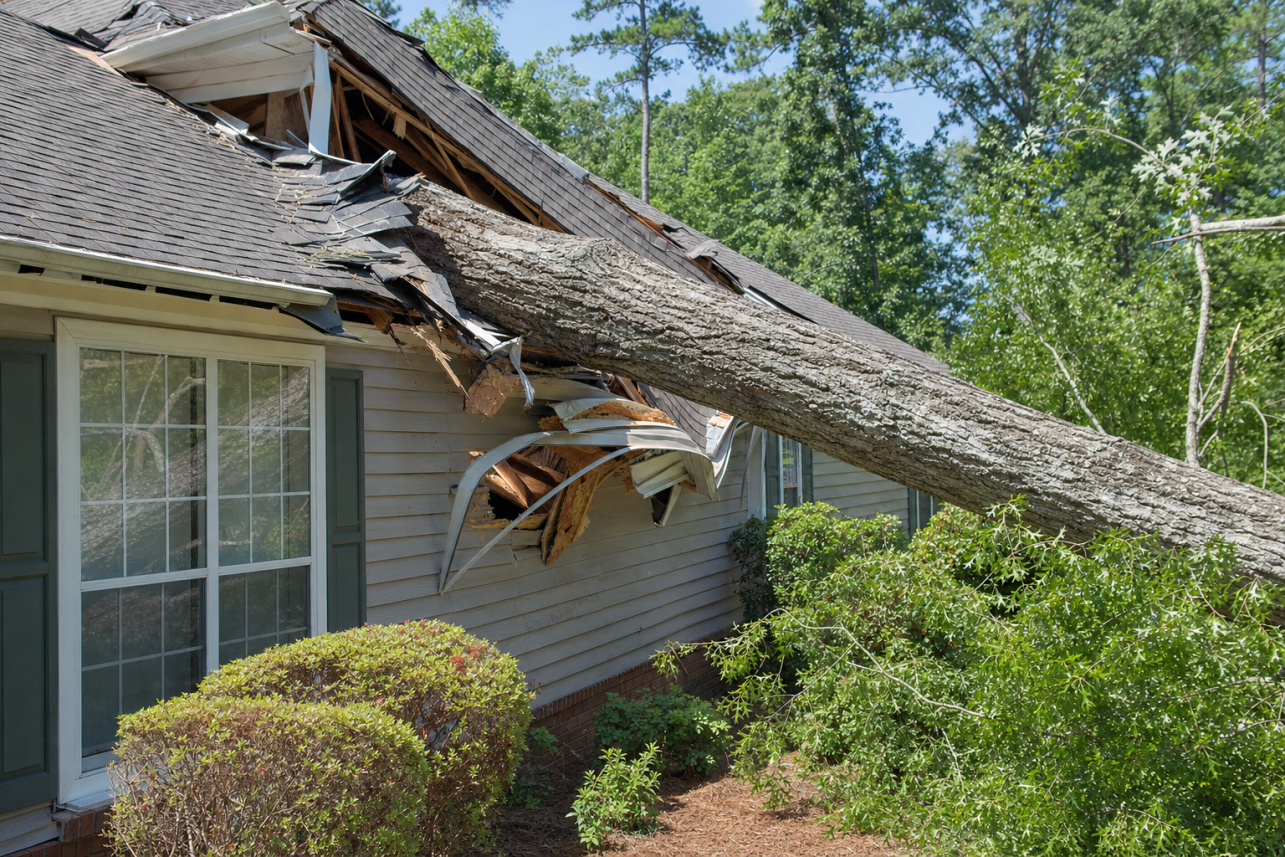
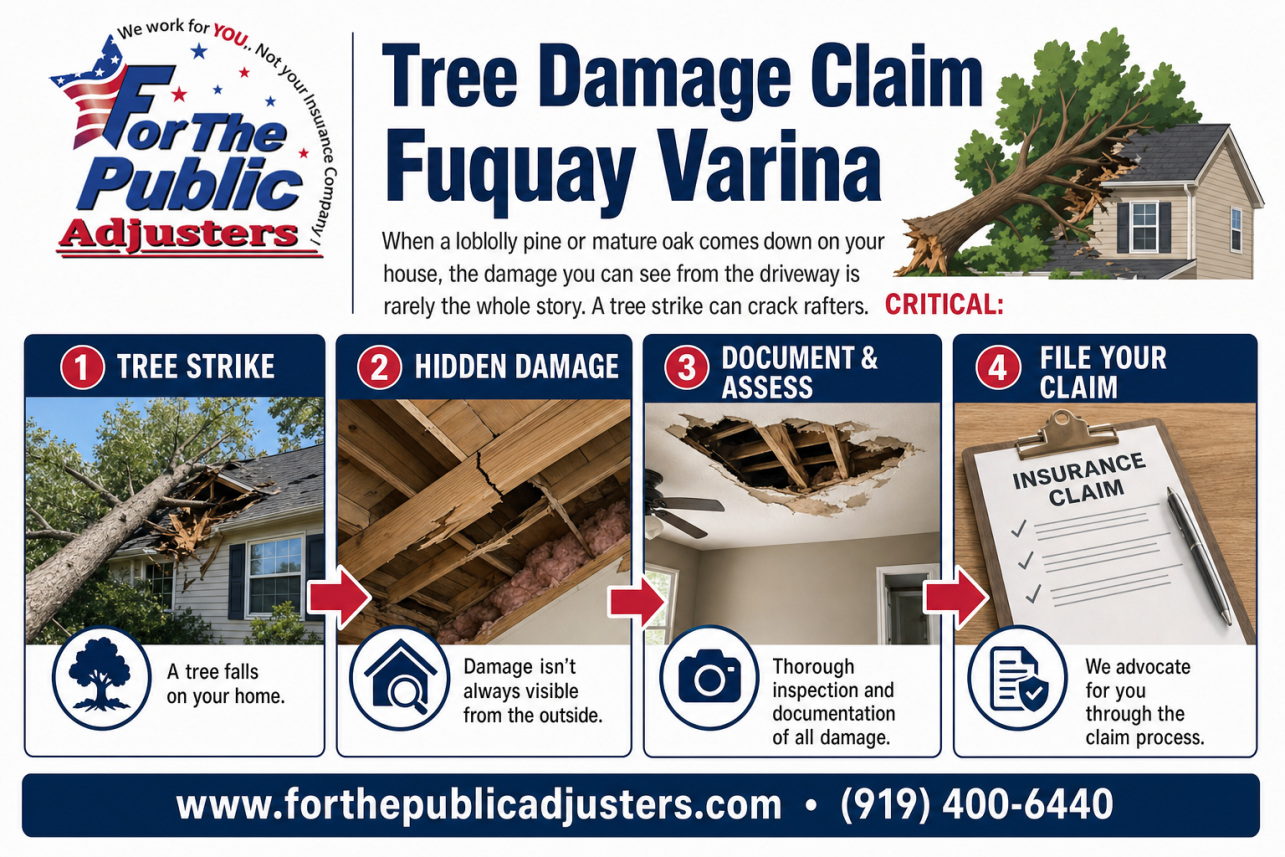
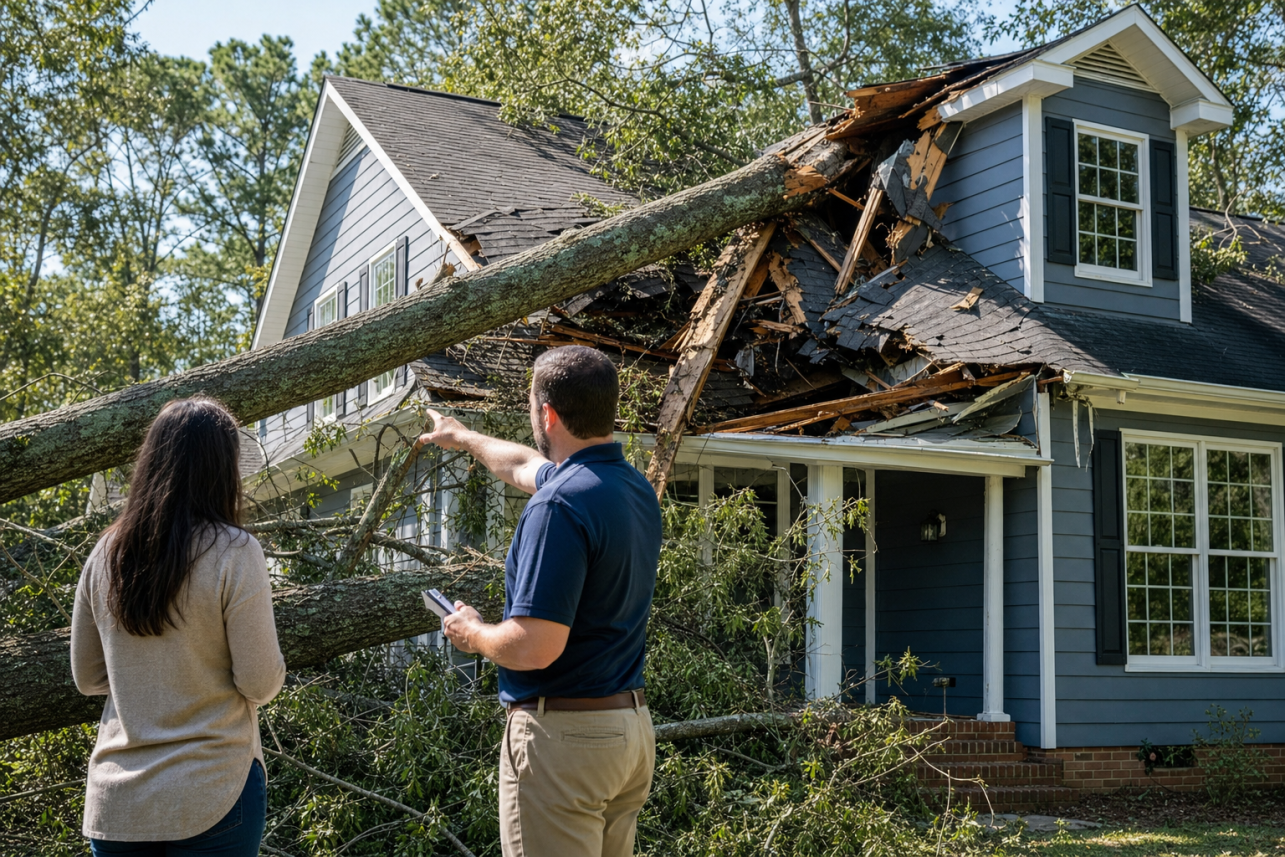
When a loblolly pine or mature oak comes down on your house, the damage you can see from the driveway is rarely the whole story. A tree strike can crack rafters, shift trusses, split sheathing, and open the roof to water — problems a quick walk-around inspection often misses entirely.
A public adjuster is a state-licensed claims professional who represents the policyholder, not the carrier. We read your homeowners policy, inspect the full scope of damage, prepare the documentation and proof of loss, and negotiate with the insurance company on your behalf. The NCDOI Public Adjusters Guide explains exactly how this licensing works in North Carolina, and we encourage every homeowner to verify any adjuster's license before signing anything.
Tree claims involve more moving parts than most people expect: tree removal cost limits, roof repair versus roof replacement, interior water damage, fencing and outbuildings, and sometimes temporary housing while repairs are made. We handle all of it, the same way our team handles a Tree Damage Claim in Raleigh NC or anywhere else in Wake County.
Common Problems
Why Was My Tree Damage Claim Fuquay Varina Fuquay-Varina Payout So Low?
Low tree-damage payouts usually come from three places. First, many policies cap tree removal at a small dollar amount, and carriers sometimes apply that cap too broadly — removal needed to repair the structure is often covered differently than hauling away a tree that fell in the yard.
Second, the carrier may pay actual cash value instead of replacement cost, deducting depreciation from an aging roof so the check covers a fraction of what a roofer will actually charge. Third, the estimate may simply miss damage: patched shingles instead of a full slope, no allowance for cracked framing, nothing for the ceiling stains that show up two weeks later.
After your deductible comes out, those gaps become out-of-pocket costs. We build a complete, line-item estimate so the settlement reflects what repairs genuinely cost in this market — the same approach behind every tree damage house claim in Holly Springs we handle next door.
The Insurance Company Denied Or Delayed My Claim — Now What?
Denials on tree claims often lean on policy exclusions or "wear and tear" language, arguing the roof was already failing before the tree hit it. Delays happen when the carrier keeps requesting more paperwork, sends multiple adjusters, or disputes which damage the tree actually caused.
You are not stuck with that answer. Courts have long held insurers to a duty of good faith: in Gruenberg v. Aetna Insurance Co., the California Supreme Court sided with a policyholder whose fire loss to his building was mishandled, establishing that an insurer who unreasonably withholds payment can be held liable for acting in bad faith.
Most disputes never need a courtroom. A properly documented re-inspection, a corrected scope of damage, and firm negotiation resolve the majority of underpaid and denied claims. When litigation truly is the right path, we work alongside insurance dispute attorneys — but documentation always comes first.
Should I Just Accept The Adjuster's Estimate, Or Get My Own Help?
The adjuster the insurance company sends is paid by the insurance company. That person may be perfectly professional, but their estimate protects the carrier's interests, and their inspection is often brief — one trip, one ladder, no engineer.
Handling it yourself works fine for a small fence repair. It gets risky when a tree has hit the structure, because structural and hidden water damage require a deeper assessment, and once you cash a settlement check, reopening the claim is much harder.
A good public adjuster inspects before the carrier does, documents the full loss with photos and measurements, prepares the proof of loss, and negotiates until the numbers hold up. If a neighbor's tree caused the damage, we also help sort out whose policy responds — a question that confuses almost everyone the first time. Homeowners dealing with a tree fell on house claim in Morrisville face these same decisions, and the answer is the same: get the full scope on paper before you settle.
Our Process
Emergency Protection And Free Claim Review
First, we make sure your home is safe and protected — tarping, board-up, and temporary repairs are typically covered obligations under your policy, and documenting them matters. Then we review your homeowners policy line by line so you know what coverage you actually have, including tree removal limits and additional living expenses if you can't stay in the home.
Full Documentation And Scope Of Damage
We inspect the roof, attic, framing, interior, and grounds, photographing and measuring everything the tree touched — and everything it compromised that isn't visible from the street. From that inspection we build a detailed, defensible estimate and prepare the proof of loss, noting storm dates and weather records that connect the damage to a covered event.
Negotiation And Settlement
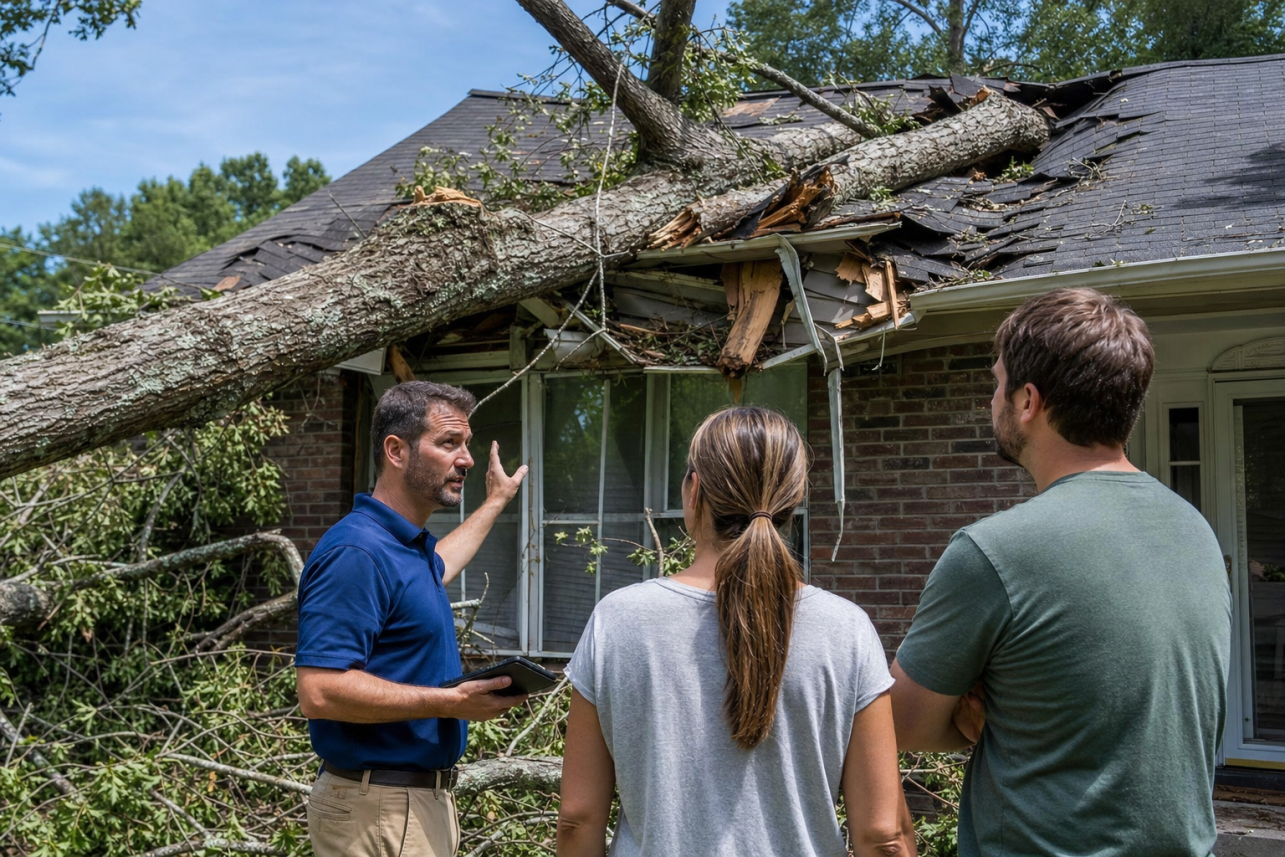
We present the documented claim to your carrier, attend the insurance adjuster's inspection, and challenge any lowball figures item by item. We never promise a specific dollar outcome — no honest adjuster can — but we make sure the settlement is negotiated from complete facts rather than a fifteen-minute walkthrough. Our fee is a percentage of the recovery, so our interests stay aligned with yours.
| Claim Task | Homeowner Alone | With For The Public Adjusters |
|---|---|---|
| Damage documentation | Phone photos of the visible hole and the fallen trunk | Attic framing inspection, moisture mapping, impact-path analysis, and a full contents inventory |
| Debris removal payment | Often accepts one blanket figure for all trees | Reviews whether the policy pays a separate debris amount per tree and per occurrence |
| Scope of repairs | Carrier's estimate, typically patch-level | Line-item estimate covering structural members, roofing systems, interior finishes, and matching materials |
| Rain vs. flood water disputes | May accept a flood exclusion at face value | Separates covered rain entry through the breach from true flood, and directs flood issues to FEMA/NFIP |
| Policy interpretation | Takes the adjuster's reading as final | Applies North Carolina law favoring the insured where language is ambiguous, as in Gaston County Dyeing Machine Co. v. Northfield Ins. Co. |
| Negotiation | One voice against a trained desk adjuster | A licensed, bonded professional presenting documented evidence on your behalf |
Commonly Overlooked In The Public Adjusting Industry
- Per-tree debris removal language — Many policies pay a separate debris amount for each fallen tree, but carriers routinely apply one blanket cap and homeowners rarely read that clause.
- Shifted or cracked framing beyond the visible hole — The impact force of a multi-ton trunk travels through rafters and ridge boards, and nobody checks the attic rooms away from the puncture.
- Rain entry misclassified as flood — Water that pours through a storm-created opening is covered, but it looks the same as excluded flood water once it's on the floor, so denials slip through.
- The 'your policy responds first' rule for a neighbor's tree — Homeowners waste weeks demanding payment from the neighbor's insurer when their own policy is the one that owes the claim.
- Roof decking and matching-shingle requirements — Patching three squares around the impact point ignores discontinued shingle lines and code-required decking replacement under North Carolina building rules.
- Contents damaged by secondary water, not the tree itself — Insureds photograph the crushed furniture but forget the rugs, clothing, and electronics ruined by rain in the days before permanent repairs.
- Stump grinding and landscape restoration limits — Removal estimates stop at cutting the trunk, leaving the stump, torn sod, and crushed plantings unclaimed even where coverage exists.
- Ambiguity resolved in the policyholder's favor — North Carolina courts, as in Gaston County Dyeing Machine Co. v. Northfield Insurance Co., construe unclear policy wording for the insured — a lever most homeowners never know they hold.
Case Studies
Case Study #1
Situation: A homeowner off Judd Parkway in Fuquay-Varina had a mature willow oak crash through the roof and master bedroom ceiling when the remnants of a hurricane pushed through Wake County overnight.
Problem: The carrier's adjuster paid for tarping, tree removal up to the policy's debris cap, and a small patch of shingles. The estimate ignored the fractured rafters, the cracked ceiling joists two rooms away, and the soaked insulation and drywall from rain that entered before the tarp went up.
Investigation: Our licensed and bonded team documented the attic framing with photos and moisture readings, mapped the impact path of the trunk, and pulled the engineer-grade measurements the carrier never took. We also inventoried water-damaged contents in the bedroom and closet, item by item.
Findings: The impact had displaced the ridge line nearly two inches and split three rafters beyond the visible hole. The interior water migration reached hardwood flooring in the hallway. The carrier's scope covered less than a third of the actual repair.
Solution: We prepared a complete line-item estimate, cited the policy's building and contents provisions, and invoked North Carolina's rule that ambiguous coverage language is construed in the policyholder's favor — the same principle the North Carolina Supreme Court applied for the insured in Gaston County Dyeing Machine Co. v. Northfield Insurance Co., 351 N.C. 293 (2000).
Outcome: After a re-inspection with our documentation in hand, the carrier issued a substantially revised settlement that funded structural repairs, interior finishes, and the damaged contents. We never promise a specific dollar result, but a complete file changed this claim entirely.
Lesson: A tree through the roof is almost never just a roof claim. Hidden framing and water damage are where underpaid estimates hide, and they must be documented before repairs begin.
Case Study #2
Situation: A family near downtown Fuquay-Varina lost a pine onto their detached garage and fence during a tornado-warned storm cell, and heavy rain that followed flooded the garage slab where lawn equipment and stored furniture sat.
Problem: The insurer treated the whole loss as one small event, applied a single low debris-removal limit, and denied the water-damaged contents entirely, claiming the water intrusion was 'flood' and therefore excluded.
Investigation: We separated the loss into its actual causes: wind-driven tree impact from the tornado-producing storm, rain entry through the breach the tree created, and any true surface flooding. We photographed the breach point, collected weather data for the storm path over Wake County, and reviewed the policy's debris and other-structures provisions.
Findings: Most of the water damage entered through the hole the tree made in the garage roof — a covered opening created by a covered peril — not rising surface water. Only a small portion of the loss was arguably flood-related, which belongs with FEMA's National Flood Insurance Program (floodsmart.gov) rather than the homeowners policy.
Solution: We re-presented the claim with the causes properly separated, documented the covered rain entry, and corrected the debris-removal calculation, which the policy allowed per tree rather than as one blanket figure. We pointed the family to fema.gov for the small flood component.
Outcome: The carrier reversed the contents denial for everything damaged by rain through the breach, paid the corrected debris figures, and funded the garage and fence rebuild under the other-structures coverage.
Lesson: Carriers sometimes lump covered rain entry in with excluded flood water. Separating the causes of loss, with evidence, is often the difference between a denial and a paid claim.
| Scenario | What Usually Applies | What It Depends On |
|---|---|---|
| Tree falls on your house during a hurricane or tornado | Dwelling coverage plus debris removal | Whether hidden structural and water damage gets documented before repairs close it in |
| Tree falls in the yard, hits nothing | Often little or no coverage | Some policies pay limited removal only if the tree blocks a driveway or handicap access |
| Neighbor's tree falls on your home | Your own policy responds first | Your carrier may pursue the neighbor later only if their negligence (a known dead tree) can be proven |
| Tree damages fence, shed, or detached garage | Other-structures coverage, usually 10% of dwelling limit | Whether that sublimit is enough for the rebuild — a reason to review the full scope early |
| Rain enters through the hole the tree made | Covered as water entering through a storm-created opening | Distinguishing that rain entry from excluded groundwater or flood, which belongs with NFIP (floodsmart.gov) |
| Tree crushes stored contents or furniture | Personal property coverage | A detailed inventory with photos and values — undocumented items are rarely paid |
| Multiple trees down in one storm | Debris removal potentially payable per tree | The exact policy wording; carriers often apply a single cap unless challenged |
| Carrier says the tree was rotten or neglected | Possible denial for maintenance exclusion | An arborist or evidence the tree was alive and the storm — not decay — caused the failure |

Reviews
A hurricane remnant dropped two oaks on our house near South Lakes. The insurance company offered one debris-removal payment for both trees. For The Public Adjusters showed them our policy allowed a separate amount per tree and caught cracked trusses their adjuster never climbed up to see. Completely different settlement once the full damage was on paper.
Marcus T., Fuquay-Varina
After a tree punched through our sunroom during the spring tornado warnings, the carrier's estimate didn't even include the water-ruined furniture inside. This team inventoried every item, documented the roof breach, and handled every call with the adjuster. I didn't realize how much we would have left behind doing it ourselves.
Deborah L., Wake County
Our neighbor's pine fell on our garage and the insurer kept telling us to chase the neighbor instead of paying. For The Public Adjusters explained that our own policy responds first and got the claim moving. They were honest that no outcome is guaranteed, but the result was far beyond the first offer. Licensed, bonded, and worth every bit of their fee.
James R., Fuquay-Varina
Frequently Asked Questions
What Does A Tree Damage Claim Fuquay Varina Fuquay-Varina Policyholder Typically Recover, And How Can A Public Adjuster Help?
A Tree Damage Claim Fuquay Varina Fuquay-Varina homeowners file usually involves more than the obvious hole in the roof. When a tree comes down on a house, the covered damage often extends to rafters, decking, sheathing, interior ceilings, insulation, drywall, flooring, and personal contents soaked by rain that entered through the opening.
Insurance carriers frequently write estimates that stop at the visible impact point. We see this constantly in Wake County neighborhoods with mature oaks and pines, where a trunk strike can shift framing or crack trusses well beyond where the tree landed. A thorough inspection documents structural movement, hidden moisture, and code-required repairs that a quick carrier visit can miss.
As licensed and bonded public adjusters, For The Public Adjusters, Inc. works only for the policyholder, never the insurance company. We read the policy language, measure and photograph every affected area, prepare a detailed line-item estimate, and negotiate directly with the carrier's adjuster on your behalf.
No one can promise a specific dollar outcome, and we never guarantee results. What we can do is make sure every covered item is documented, priced at local Fuquay-Varina repair costs, and presented so the carrier has to respond to the full scope of damage rather than a fraction of it.
My Neighbor's Tree Fell On My House In Fuquay-Varina. Whose Insurance Pays?
In most situations, your own homeowners policy responds first, even when the tree belonged to a neighbor. That surprises a lot of people, but property insurance generally follows the damaged property, not the tree's owner.
There is an important exception. If your neighbor knew the tree was dead, diseased, or leaning dangerously and ignored it, your carrier may pay your claim and then pursue the neighbor's liability insurance through a process called subrogation. If that recovery succeeds, you may get your deductible back. Documenting the tree's condition before removal, with dated photos of rot, fungus, or dead limbs, matters enormously here.
In Fuquay-Varina's older neighborhoods and along wooded lots near Hilltop and south toward the Harnett County line, mature pines and oaks sit close to property lines, so these neighbor disputes come up often after severe storms.
As public adjusters in Fuquay-Varina, we help you open the claim correctly, preserve evidence of the tree's pre-loss condition, and document the full scope of structural and interior damage. One caution: if storm water rose from the ground and flooded your home at the same time, that flooding is handled separately under the National Flood Insurance Program. FEMA.gov and FloodSmart.gov explain NFIP coverage, which is distinct from the tree damage portion of your homeowners claim.
Does Homeowners Insurance Cover Tree Removal And Debris Cleanup After A Hurricane Or Tornado In Wake County?
Generally, yes, when the tree damages a covered structure. If a hurricane like the remnants of Fran, Florence, or a spin-up tornado drops a tree onto your house, garage, fence, or deck, most policies pay to remove the tree from the structure and repair the damage, subject to your deductible.
The tricky part is the tree that falls in the yard without hitting anything. Many policies cap debris removal for that scenario at a small amount, often $500 to $1,000 per tree with an overall limit, and some exclude it entirely unless the tree blocks a driveway or a handicap-access ramp. Reading your specific policy language is essential before assuming anything.
After a hurricane moves through southern Wake County, we also look closely at secondary damage. A trunk that glances off a roof edge can crack fascia, bend gutters, fracture shingle mats, and open seams that leak weeks later. Carriers sometimes classify that as maintenance rather than storm damage, which is where detailed documentation makes the difference.
For The Public Adjusters, Inc. inspects the entire property, not just the strike zone, and builds the claim around everything the policy actually covers. Remember that rising floodwater from a hurricane is a separate peril handled through the NFIP, so if your Fuquay-Varina home took on ground water as well, that portion needs its own flood claim through FEMA's program.
What Can I Do If The Insurance Company Underpays Or Denies My Tree Damage Claim?
You have real options, and a lowball estimate is not the final word. Policyholders can demand a re-inspection, submit their own detailed estimate, invoke the appraisal clause found in most policies, or ultimately pursue the matter in court.
North Carolina courts have sided with policyholders in significant property damage disputes. In Gaston County Dyeing Machine Co. v. Northfield Insurance Co., 351 N.C. 293 (2000), the North Carolina Supreme Court ruled in favor of the insured, rejecting the insurance company's narrow reading of its policy and confirming that physical damage to property triggered coverage the carrier had tried to avoid. The case is a reminder that carrier interpretations are not automatically correct, and policy language is construed in favor of coverage when it is ambiguous.
Before it ever reaches a courtroom, though, most underpaid claims can be resolved through documentation and negotiation. A tree strike on a Fuquay-Varina home often involves hidden damage, shifted trusses, cracked ceiling joints, wet insulation, that the carrier's first estimate never captured. Reopening the claim with engineering support and a complete line-item scope frequently changes the conversation.
As a licensed and bonded firm, For The Public Adjusters, Inc. handles that process for homeowners across Wake County. We cannot guarantee any particular settlement, but we can make certain your claim is fully documented, properly presented, and pressed through every option your policy provides.
How Does The Tree Damage Claim Fuquay Varina Fuquay-Varina Process Work When I Hire A Public Adjuster?
It starts with a free review of your policy and the damage. We walk your property in person, documenting the point of impact, the roof decking, trusses, gutters, siding, fencing, and anything inside the home that was affected when the tree came down.
From there, we prepare a detailed, line-item estimate using the same software insurance carriers use. Tree strikes often cause hidden structural damage that a quick drive-by inspection misses, so we open up the scope where the evidence supports it — cracked rafters, shifted framing, torn underlayment, and damaged insulation.
We then present the claim to your carrier, attend the adjuster's inspection alongside you, and negotiate every line until the settlement reflects the real cost of repairs in Wake County. You stay informed at each step, but you don't have to argue with the insurance company yourself.
For The Public Adjusters, Inc. is licensed and bonded, and we work only for policyholders — never for insurance companies. While no one can promise a specific dollar outcome, having a professional document and negotiate your claim means nothing gets overlooked or quietly left off the estimate. Most homeowners in Fuquay-Varina only go through this once, while carriers handle thousands of claims a year. We level that playing field.
How Long Do I Have To File A Claim After A Tree Falls On My Fuquay-Varina Home?
Report the damage to your carrier as soon as it's safe to do so. Nearly every homeowners policy requires 'prompt notice,' and waiting weeks or months gives the insurance company an argument that delay made the damage worse or harder to verify.
Beyond the notice requirement, North Carolina law generally gives policyholders three years to bring a breach-of-contract action against an insurer, though many policies attempt to shorten that window with their own suit-limitation clauses. Reading those provisions carefully matters, because missing a contractual deadline can end an otherwise valid claim.
That said, filing quickly doesn't mean settling quickly. You're entitled to take the time needed to document everything properly. After a tornado or hurricane moves through Wake County, tree strikes are common and carriers are flooded with claims, which is exactly when rushed, low initial estimates happen most often.
If you've already filed and received a payment you believe is short, you typically still have time to reopen or supplement the claim within the policy and statutory deadlines. Courts have repeatedly held insurers to their coverage obligations — in Gaston County Dyeing Machine Co. v. Northfield Insurance Co., 351 N.C. 293 (2000), the North Carolina Supreme Court sided with the insured on a disputed property damage claim, rejecting the carrier's narrow reading of its own policy. The lesson for Fuquay-Varina homeowners: the first answer from an insurance company is not always the final one.
Will Insurance Pay To Repair My Roof And Structure, Or Just To Remove The Tree?
A properly handled Tree Damage Claim Fuquay Varina Fuquay-Varina settlement should cover far more than hauling away the trunk. Tree removal is usually a capped line item — often $500 to $1,000 per tree under many policies — but the structural repairs are where the real money is.
When a mature oak or pine punches through a roof here in Wake County, the damage rarely stops at the shingles. The impact can crack rafters and trusses, shift the ridge line, tear the underlayment, and crush gutters and fascia. Inside, you may have damaged drywall, insulation, flooring, and personal contents from rain entering through the opening.
Your policy's dwelling coverage should respond to all of that, and contents coverage should address damaged belongings. If the home is unsafe to occupy during repairs, additional living expense coverage can pay for temporary housing.
The problem is that initial carrier estimates often scope only what's visible from the ground or a quick attic peek. We've seen Fuquay-Varina homeowners offered a few thousand dollars for damage that required tens of thousands in structural work once the roof was opened up. That's why thorough documentation — photos, moisture readings, contractor input, and engineering opinions where warranted — matters before you accept any settlement. We can't guarantee a particular result, but we can make sure every covered item is actually in the claim.
The Tree Strike Let Rain Into My House — Is That Water Damage Covered Too?
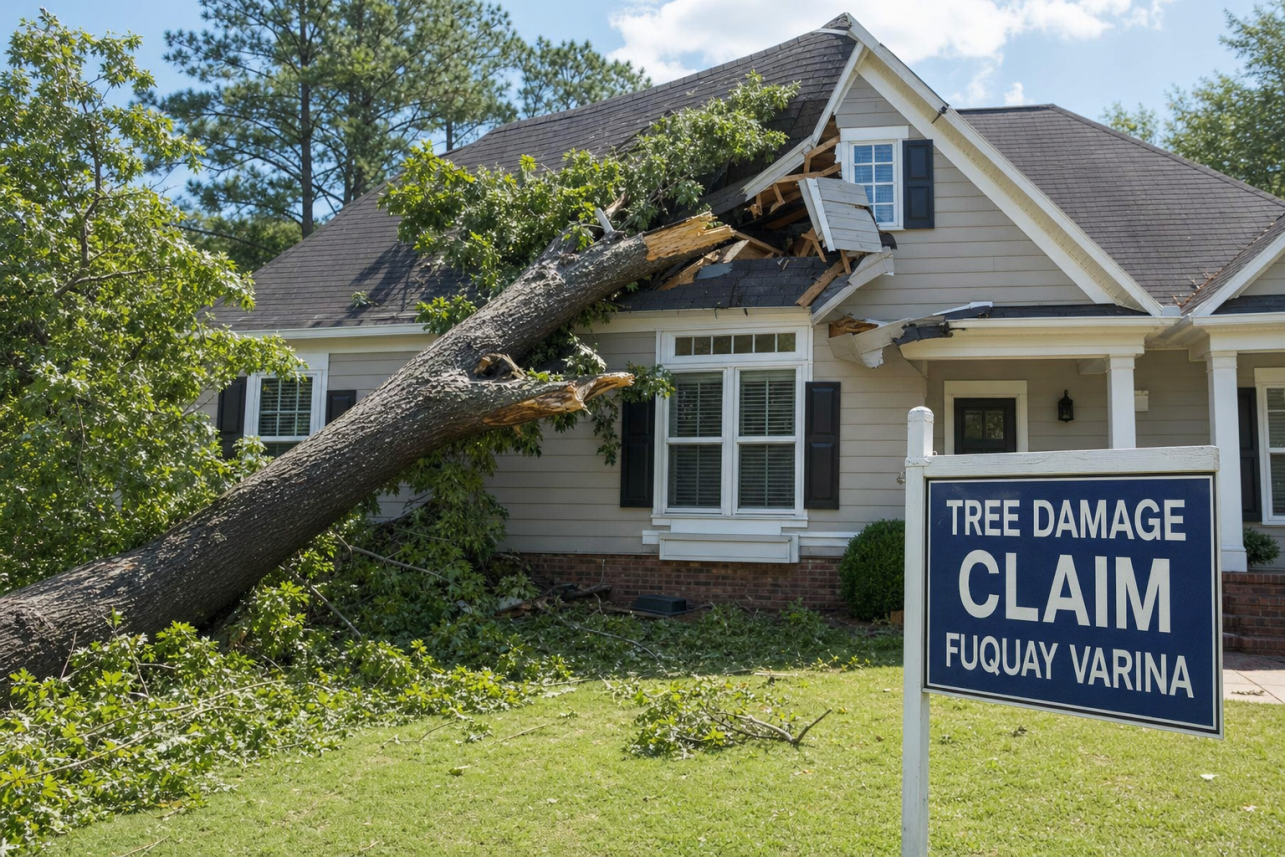
In most cases, yes. When a tree creates an opening in your roof or wall and rain enters through that opening, the resulting interior water damage is typically covered under a standard homeowners policy. The tree impact is the covered cause, and the water intrusion follows directly from it.
This matters because carriers sometimes try to categorize interior damage as a maintenance or seepage issue, which policies exclude. Documenting the chain of events — the hole, the storm date, the water path through the attic and ceilings — is critical to keeping that damage inside the claim. Photos taken immediately, before tarping and cleanup, are some of the strongest evidence you can have.
One important distinction: rain entering through a tree-made opening is different from rising floodwater. If storm flooding from a creek or heavy runoff entered your home at ground level, that falls under flood insurance, not homeowners coverage. Flood claims go through the National Flood Insurance Program, and FEMA's resources at fema.gov and floodsmart.gov explain how NFIP claims work.
Homeowners near low-lying areas off Kennebec Road or along the creeks that feed into the Neuse basin sometimes face both issues after a major storm — a tree through the roof and water at the foundation. In that situation, you may have two separate claims under two separate policies, and keeping the damage documented and allocated correctly protects both. A Fuquay-Varina public adjuster can help you sort out which policy owes for what.
What Does It Cost To Hire For The Public Adjusters, Inc. For A Tree Damage Claim Fuquay Varina Fuquay-Varina?
We work on a contingency fee basis, which means there is no upfront cost to you. Our fee is a percentage of the settlement your insurance company pays, so if your claim does not pay, you owe us nothing for our adjusting services.
That structure matters after a tree strike, because most homeowners are already facing out-of-pocket expenses for emergency tarping, tree removal deposits, and temporary living arrangements. The last thing you need is another bill before any insurance money arrives.
It also aligns our interests with yours. Because our compensation depends on your recovery, we have every reason to document the full scope of damage — roof decking, trusses, interior finishes, contents, and debris removal — rather than accept a quick, low estimate. We are licensed and bonded, and we handle the inspections, estimates, and negotiations so you are not trying to argue construction pricing with a carrier adjuster on your own.
To be clear, no one can guarantee a specific outcome or dollar amount, and you should be skeptical of anyone who does. What we can promise is a thorough, professionally documented claim presented under the actual terms of your policy. For many Fuquay-Varina homeowners, that level of preparation is the difference between a settlement that covers patchwork and one that funds proper repairs. Call us before you sign anything, and we will review your situation at no charge.
What Documentation Should I Gather After A Tree Hits My Home In Fuquay-Varina?
Start with photographs and video before anything is moved. Capture the tree where it fell, the point of impact, the roof from multiple angles, and every interior room showing cracks, water stains, or debris. If a tree service must cut the tree to make the home safe, photograph each stage of removal.
Keep every receipt: tarping, board-up, tree removal, hotel stays, and meals if you were displaced. These costs are often reimbursable under your policy's additional living expense and reasonable repairs provisions. Save the tree contractor's invoice with a written description of what was done, and ask whether the trunk showed rot or was healthy — that detail can matter if liability questions come up later.
For contents, make a room-by-room inventory of damaged belongings with photos, approximate purchase dates, and replacement costs. Do not throw items away until they have been documented, unless they pose a health hazard.
Strong documentation protects you if the claim is ever disputed. Courts have long held insurers to a duty of good faith in paying property claims — in Gruenberg v. Aetna Insurance Co., 9 Cal.3d 566 (1973), the California Supreme Court sided with a policyholder whose fire-damaged building claim had been wrongfully refused, confirming that an insured can hold a carrier accountable for bad-faith claim handling. As your Fuquay-Varina public adjuster, we build the file so the evidence speaks for itself from day one.
Does My Policy Cover A Fence, Shed, Or Detached Garage Crushed By A Fallen Tree?
In most cases, yes. Standard homeowners policies include Coverage B, often called other structures coverage, which typically provides a limit around 10% of your dwelling coverage for detached garages, storage buildings, fences, gazebos, and similar structures. If a hurricane or tornado drops a pine across your fence line and shed, both can be part of the same claim as your house.
The details matter, though. Fencing is frequently underpaid because adjusters price only the broken panels rather than accounting for matching, post replacement, and the reality that a partially rebuilt fence rarely matches twenty-year-old weathered sections. Detached structures with workshops or stored contents also raise personal property questions that get overlooked in a rushed inspection.
When For The Public Adjusters, Inc. manages a Tree Damage Claim Fuquay Varina Fuquay-Varina homeowners bring to us, we measure and document every affected structure on the property — not just the house — and present them under the correct coverage parts of your specific policy.
One important caution: homeowners policies exclude flood. If rising water from a storm saturated the soil and contributed to damage, that portion generally falls under a separate flood policy through the National Flood Insurance Program. You can learn more at FEMA.gov and FloodSmart.gov. We can help you sort out which damage belongs under which policy so nothing falls through the cracks.
Is It Okay To Remove The Tree And Start Repairs Before The Insurance Adjuster Inspects?
You can — and in some situations you must — but do it carefully. Every policy includes a duty to mitigate, meaning you are required to take reasonable steps to prevent further damage. If a tree has opened your roof, tarping the hole and removing the immediate hazard protects both your home and your claim. Waiting days for an inspection while rain pours into your attic can give the carrier grounds to deny the resulting water damage.
The key is documentation before action. Photograph and video everything thoroughly, then hire a reputable tree service and keep the invoice. Make only temporary, emergency repairs at this stage. Do not begin permanent reconstruction — replacing the roof, rebuilding framing, repairing drywall — until the damage has been inspected and the scope of loss is agreed upon. Premature permanent repairs destroy the evidence the claim depends on.
After hurricanes and tornado events in Wake County, carrier adjusters are stretched thin and inspections can take weeks. That delay is exactly why Fuquay-Varina policyholders bring us in early. We document the loss independently, coordinate emergency measures so your mitigation duty is satisfied, and preserve the proof needed to support every line item.
If you have already removed the tree, do not panic. Tree service invoices, dated photos from neighbors, and physical evidence in the roof structure can still establish what happened. Call our team and we will assess what documentation
Does A Tree Damage Claim Fuquay Varina Fuquay-Varina Settlement Include Money To Replace The Fallen Tree And Damaged Landscaping?
Sometimes, but the coverage is narrower than most homeowners expect. Standard HO-3 policies in Wake County typically pay for tree and shrub replacement only when the loss was caused by specific named perils — fire, lightning, explosion, vandalism, or a vehicle not owned by you. A tree knocked down by a hurricane or tornado usually is not covered as landscaping, even though the damage it caused to your home is.
When landscaping coverage does apply, most policies cap it at 5% of your dwelling limit overall and around $500 per tree or shrub. On a $350,000 dwelling policy, that is a $17,500 landscaping ceiling — real money if lightning splits a mature oak in an established Fuquay-Varina neighborhood like Ballentine or South Lakes.
What carriers frequently miss is everything around the tree. Crushed irrigation lines, damaged hardscaping, broken retaining walls, torn gutters, and ruts left by heavy removal equipment are often covered under the dwelling or other structures portions of the policy, not the landscaping sublimit. Adjusters working high claim volumes after a storm routinely lump these items together or skip them entirely.
As licensed and bonded public adjusters, we read your specific policy language, separate what falls under the landscaping sublimit from what belongs under broader dwelling coverage, and document each line item so nothing covered gets left off the estimate. We cannot promise a particular outcome, but we can make sure every covered dollar is actually claimed.
Will My Insurer Pay Replacement Cost Or Actual Cash Value For Tree Damage Repairs, And What Is Recoverable Depreciation?
Most homeowners policies written in Wake County pay dwelling repairs on a replacement cost basis — but not all at once. The carrier first issues an actual cash value payment, which is the replacement cost minus depreciation for age and wear. If your 15-year-old architectural shingle roof was crushed by a pine, the first check reflects a roof that was already 15 years into its lifespan.
The difference between that depreciated payment and the full repair cost is called recoverable depreciation. You collect it after the work is completed and you submit proof — invoices, contractor statements, and sometimes photos. Miss the policy's deadline to complete repairs, often one or two years, and that held-back money can be forfeited.
This is where tree damage claims in Fuquay-Varina commonly go wrong. Carriers sometimes apply depreciation too aggressively, depreciate labor when the policy or North Carolina law does not support it, or fail to clearly explain how to recover the withheld funds. Homeowners accept the first check believing it is the final settlement.
Our team reviews the depreciation schedule line by line, challenges percentages that do not match the actual age and condition of your materials, and tracks the recoverable depreciation process through to the final payment. We also verify that the ACV check accounts for current Wake County construction pricing, which has climbed sharply, rather than outdated software pricing that leaves you short before repairs even begin.
A Tree Destroyed One Slope Of My Roof — Can I Get The Whole Roof Replaced So The Shingles Match?
Often yes, and this is one of the most disputed issues we see on a Tree Damage Claim Fuquay Varina Fuquay-Varina homeowners bring to us. Carriers frequently want to patch only the damaged slope, even when your shingle color or profile has been discontinued and a repair would leave an obvious mismatch visible from the street.
North Carolina policy interpretation favors the insured when language is ambiguous. In Gaston County Dyeing Machine Co. v. Northfield Insurance Co., 351 N.C. 293 (2000), the North Carolina Supreme Court ruled for the insured in a property damage dispute, holding that ambiguous policy provisions must be construed in favor of coverage. That principle matters here, because most policies promise to repair with materials of like kind and quality — and if matching materials no longer exist, a patch arguably fails that promise.
Matching disputes also involve practical arguments: mixing new shingles into an aged roof can void manufacturer warranties, create sealing problems, and reduce resale value in Fuquay-Varina's competitive housing market.
We document the discontinued materials, obtain supplier letters confirming no match is available, photograph the mismatch risk, and present the policy argument in writing. Carriers respond differently to a documented demand than to a homeowner's phone call. We never guarantee a full roof replacement — no honest adjuster can — but we build the strongest supportable case your policy language allows, and we have seen partial-repair offers turn into full-slope and full-roof settlements once the evidence is on the table.
A Fallen Tree Made My House Unlivable — Will Insurance Pay For A Hotel And Meals While Repairs Are Done?
Yes, under the Additional Living Expenses portion of your policy, often called Coverage D or Loss of Use. If a tree strike from a hurricane or tornado leaves your Fuquay-Varina home uninhabitable — an open roof, structural instability, no safe power — your policy pays the reasonable increase in your living costs while covered repairs are made.
That includes hotel or short-term rental costs, the portion of restaurant meals that exceeds your normal grocery spending, pet boarding, laundry service, extra commuting mileage if you are displaced far from your usual routine, and storage fees for furniture moved out during reconstruction. The key phrase is increase: the carrier pays what displacement costs you above your normal monthly expenses.
Two problems come up constantly. First, carriers pressure families to return home before the house is genuinely livable, cutting off ALE while tarps still cover the roof. Second, homeowners fail to keep receipts and lose thousands in legitimate reimbursement. Keep every receipt from day one, even for small purchases.
ALE is also limited by your policy — either a dollar cap or a time limit, commonly 12 to 24 months. In Fuquay-Varina, where contractor backlogs after a major storm can stretch rebuild timelines, managing that limit strategically matters.
As public adjusters, we calculate your documented ALE entitlement, push back when a carrier tries to terminate it prematurely, and coordinate it alongside the structural claim so your displacement period and your repair timeline are argued consistently. We cannot promise specific amounts, but we make sure every eligible expense is submitted and supported.
Local Relevance
Fuquay-Varina sits in southern Wake County surrounded by tall loblolly pines and mature hardwoods, and the town has grown fast — new subdivisions built since the late 1990s alongside older homes near the historic downtown areas of Fuquay Springs and Varina. Both housing types get hit hard when trees come down.
The weather here gives trees plenty of reasons to fall. Remnants of hurricanes push through central North Carolina carrying saturated soil and gusts that uproot pines whole. Winter ice storms load limbs until they snap onto rooflines. Spring thunderstorms and the occasional tornado cut narrow paths — which is why "nobody else on my street filed a claim" tells you nothing about your own damage.
The Insurance Information Institute notes that tree damage questions are among the most common homeowners run into after storms, especially when a neighbor's tree is involved. We know how these claims are evaluated in Wake County specifically, and we bring the same local documentation standards whether the loss is here, a tree damage to house in Pittsboro, or a tree damage claim in Elon. One important note: standard homeowners policies exclude flood, so if storm runoff also entered your home, separate flood coverage through the NFIP would need to respond.
Ice is the underrated tree-killer in this part of Wake County — the December 2002 ice storm showed how much damage loaded pine limbs can do, yet limb-strike and ice-related roof claims still tend to get underpaid because carriers treat them as minor one-off events rather than documenting the full structural and water damage underneath.
A Tree Hit Your Home? Talk To Us Before You Settle
For The Public Adjusters, Inc. is licensed and bonded in North Carolina, and we work only for policyholders — never for insurance companies. Whether your claim was underpaid, denied, or you haven't filed yet, a no-cost review of your policy and damage tells you exactly where you stand before you sign anything.
Call us: (919) 400-6440
Helpful Resources
- NCDOI Public Adjusters Guide
- Insurance Information Institute (III)
- North Carolina Department of Insurance — State regulator overseeing insurers and public adjuster licensing
- Insurance Information Institute — Consumer education on homeowners coverage and tree damage
Serving Fuquay-Varina · Wake
Last updated: October 23, 2026