A public adjuster Apex NC policyholders hire works for you — not the insurance company — to document, value, and negotiate your property damage claim. For The Public Adjusters, Inc. is licensed and bonded, and we handle residential and commercial losses across Wake County, from kitchen fires and burst pipes to tree strikes and flood damage. If your claim has been underpaid, delayed, or denied, we can review it at no obligation and tell you honestly whether we can help.
What This Service Is
A public adjuster is a state-licensed insurance professional who represents the policyholder in a property claim. The adjuster your insurance company sends works for the insurer; we work only for you. In North Carolina, public adjusters must be licensed and bonded, and the NCDOI Public Adjusters Guide explains what we may and may not do on your behalf — a standard we take seriously.
In practice, that means we read your full policy, inspect and photograph the damage, prepare a detailed line-item estimate, and handle communications and negotiations with your carrier. We take on fire, smoke, water, flood, tree damage, vandalism, arson (for innocent homeowners), car-hits-home losses, and commercial business claims.
We do not handle claims involving cell phones, motor vehicles, health, or life insurance — our work is buildings, homes, and the contents inside them. Fees are contingent on your recovery, so our interests are aligned with yours from day one.
Common Problems
What Does Hiring An Apex Public Adjuster Cost — And Is It Actually Worth It?
We work on a contingency fee, meaning we're paid a percentage of what your claim recovers — there is no hourly bill and no upfront charge for our claim work. If we don't believe we can add value beyond what your insurer has already offered, we'll tell you that in the first conversation.
The value comes from what carriers commonly leave out: code-upgrade costs, smoke and odor remediation behind walls, matching materials, contents inventories, and additional living expenses. A homeowner reviewing a settlement offer usually doesn't know what's missing. We do, because building a complete estimate is the whole job. We never guarantee a specific outcome, but a properly documented claim is almost always a stronger claim.
The Insurance Company Underpaid, Delayed, Or Denied My Claim — Now What?
This is the most common reason Apex homeowners call us. A lowball estimate, a demand for endless documentation, or a denial letter citing a policy exclusion doesn't have to be the final word. Policyholders have the right to dispute the carrier's valuation, invoke appraisal in many policies, and present their own professionally prepared estimate.
Courts have backed policyholders on exactly these issues. In Windridge of Naperville Condominium Association v. Philadelphia Indemnity Insurance Co., a federal appeals court sided with the insured property owner, holding that the insurer had to replace storm-damaged building siding so the repaired structure actually matched — not just patch the damaged panels. The principle matters here too: you're owed a repair that restores your property, not a partial fix. We reopen and supplement underpaid claims regularly, and we document everything so the file supports your position.
How Do I Pick The Right Public Adjuster Apex NC Has To Offer?
Start with licensing. North Carolina requires public adjusters to be licensed and bonded, and you can verify any license with the state before signing anything. Then ask about experience with your specific loss type — a fire claim with smoke contamination is a very different job than an NFIP flood claim, which follows federal rules and strict proof-of-loss deadlines.
A good adjuster will inspect before promising anything, put the fee in writing, and never guarantee a dollar figure — that's a red flag, not a selling point. Doing it yourself is legal and sometimes fine for small, straightforward losses. But for a significant fire, water, or flood loss, you're negotiating against trained claim professionals, and having your own trained professional levels the field.

Our Process
Free Policy And Damage Review
We start by reading your actual policy — declarations, endorsements, and exclusions — and walking the loss with you. Whether it's a kitchen fire, a failed supply line, or a tree through the roof, we identify every coverage that applies, including ones homeowners often overlook like code upgrades and additional living expenses.
Documentation And A Complete Estimate
We photograph and measure the damage, inventory affected contents room by room, and build a line-item repair estimate using the same estimating standards insurers use. Hidden damage — smoke residue in wall cavities, moisture migration under flooring — gets tested and documented, not guessed at. This file becomes the backbone of your claim.
Negotiation And Settlement
We present the claim to your carrier, attend the insurer's inspections, respond to their adjuster's questions, and negotiate line by line. If the carrier disputes value, we can pursue supplements or the appraisal process where your policy allows it. You stay informed at every step, and nothing settles without your approval.
| What Happens | Filing on Your Own | With For The Public Adjusters |
|---|---|---|
| Damage documentation | You rely on the carrier's adjuster, who works for the insurance company | Independent inspection with moisture mapping, photos, and a line-item estimate built for you |
| Hidden damage | Often missed — wet insulation, wall cavities, and HVAC contamination go unclaimed | Systematically tested for and added to the claim before settlement |
| Estimate negotiation | You argue against a trained adjuster using their own pricing software | Licensed professional negotiates in Xactimate, line by line, on your behalf |
| Policy interpretation | Exclusions and matching rules are read in the carrier's favor | Coverage, code upgrade, and NC matching provisions applied to maximize recovery |
| Time commitment | Dozens of hours of calls, emails, and paperwork during a stressful time | We handle communication, deadlines, and documentation start to finish |
| Typical result | Settlements frequently based on visible damage only | Settlements that reflect the full, documented scope of loss |
Commonly Overlooked In The Public Adjusting Industry
- Recoverable depreciation left unclaimed — Carriers hold back depreciation until repairs are done, and homeowners who never file the completion paperwork forfeit thousands they were already owed.
- NC matching requirements for discontinued materials — When shingles or siding can't be reasonably matched, North Carolina guidance can support larger replacement — but carriers rarely volunteer that analysis.
- Moisture migration beyond visible staining — Water wicks through insulation and wall cavities far past the stain, and quick carrier inspections don't include meter readings to find it.
- Ordinance and law (code upgrade) coverage — Apex's current building code often requires upgrades during repair, and this coverage sits unused because nobody itemizes the code-driven costs.
- HVAC and ductwork contamination after fire or water losses — Soot and moisture inside duct systems are invisible from the living space, so estimates routinely skip cleaning or replacement entirely.
- Additional living expense (ALE) tracking from day one — Hotel nights, meals, and mileage are reimbursable, but families who don't keep receipts from the first day rarely recover them.
- Supplemental claims after settlement — Most policyholders assume the first check is final, when damage discovered during repairs can legitimately reopen and increase the claim.
- Contents depreciation applied too aggressively — Carriers depreciate belongings on generic schedules, and without an itemized inventory with ages and conditions, owners accept far less than replacement cost.
Case Studies
Case Study #1
Situation: A family in the Scotts Mill neighborhood of Apex came home after a July thunderstorm to find water pouring through their kitchen ceiling. Lightning had struck a pine in the backyard, dropping a limb through the roof decking above the kitchen and master bath.
Problem: Their carrier's field adjuster spent twenty minutes on site and issued an estimate of $11,400 — enough to patch the roof and repaint two ceilings. It ignored saturated insulation, wet drywall inside the wall cavities, and the fact that the discontinued shingle line meant a partial repair would never match.
Investigation: Our team ran moisture mapping on every affected wall and ceiling, pulled attic insulation samples, and documented humidity readings over three visits. We also obtained the shingle manufacturer's discontinuation notice and a matching analysis showing no reasonable repair match existed under NC matching guidance.
Findings: Moisture had wicked eleven feet beyond the visible stain, contaminating insulation across a third of the attic. Two wall cavities showed early microbial growth. The roof required full slope replacement, not a patch, and the HVAC ductwork in the attic had taken on water at two joints.
Solution: We rebuilt the claim from the studs out: a line-item Xactimate estimate with proper drying protocols, insulation removal and replacement, containment for the microbial remediation, full slope roof replacement, and duct repairs. We then presented the documentation package and negotiated directly with the carrier's desk adjuster.
Outcome: The claim settled at $67,800 — nearly six times the original offer — with recoverable depreciation released on completion. The family also recovered additional living expenses for the eight days they couldn't use the kitchen and master bath.
Lesson: The first estimate after a storm loss almost always prices what's visible, not what's wet. In Apex's humidity, hidden moisture becomes a mold problem fast, and matching rules for discontinued shingles can turn a patch into a full replacement — but only if someone documents it.
Case Study #2
Situation: The owner of a small dental practice off Salem Street in downtown Apex suffered a fire in the break room that spread smoke throughout the suite overnight. Sprinklers contained the flames, but soot and water reached the operatories, sterilization area, and front office.
Problem: The carrier accepted the fire claim but lowballed contents and pushed back hard on business interruption, arguing the practice could reopen in two weeks. It also proposed cleaning smoke-exposed dental equipment rather than replacing it, ignoring manufacturer contamination protocols.
Investigation: We inventoried every piece of equipment and contents room by room, obtained written statements from the equipment manufacturers on soot contamination and warranty voidance, and worked with the practice's accountant to build a defensible business-income model based on prior-year production schedules.
Findings: Corrosive soot residue had penetrated handpieces, the autoclave, and digital sensors — items the manufacturers confirmed could not be certified safe for patient use after smoke exposure. The realistic reopening timeline, given equipment lead times and required inspections, was eleven weeks, not two.
Solution: We presented a full replacement-cost contents claim backed by manufacturer documentation, a corrected structural scope including duct cleaning and odor sealing, and a business interruption calculation tied to actual lead times and patient production data rather than the carrier's assumptions.
Outcome: The settlement grew from an initial $94,000 position to just over $412,000, including eleven weeks of business income and extra expense coverage that let the dentist rent temporary operatory space and keep staff on payroll.
Lesson: Commercial smoke claims turn on documentation the carrier will never gather for you. When contaminated equipment touches patient safety, manufacturer protocols — not the adjuster's cleaning vendor — decide what's salvageable, and the interruption clock runs on real-world lead times.
| Your Situation | Handle It Yourself? | Bring In a Public Adjuster? | What It Depends On |
|---|---|---|---|
| Minor loss under ~$5,000 with obvious, visible damage | Usually fine | Rarely needed | Whether your deductible eats most of it and no hidden moisture is suspected |
| Roof or storm damage with any interior water staining | Risky | Strongly recommended | Water travels — visible stains almost never show the true extent of saturation |
| Fire or smoke loss, even a small one | Not advised | Yes | Soot contamination, odor sealing, and contents claims are routinely underscoped |
| Carrier's offer feels low but you can't say why | Difficult | Yes — get a free claim review | You need an independent line-item estimate to compare against theirs |
| Claim denied or coverage disputed | Very difficult | Yes, quickly | Policy language and documentation deadlines drive whether a denial can be reversed |
| Commercial loss with business interruption | Not advised | Yes | Income documentation and realistic reopening timelines require professional modeling |
| Claim already settled but new damage appeared | Possible to reopen | Yes — supplements are our specialty | NC allows supplemental claims; success depends on tying new damage to the original loss |
| Total loss or displacement from your home | Not advised | Yes, immediately | Additional living expenses, contents inventory, and dwelling limits all need active management |
Reviews
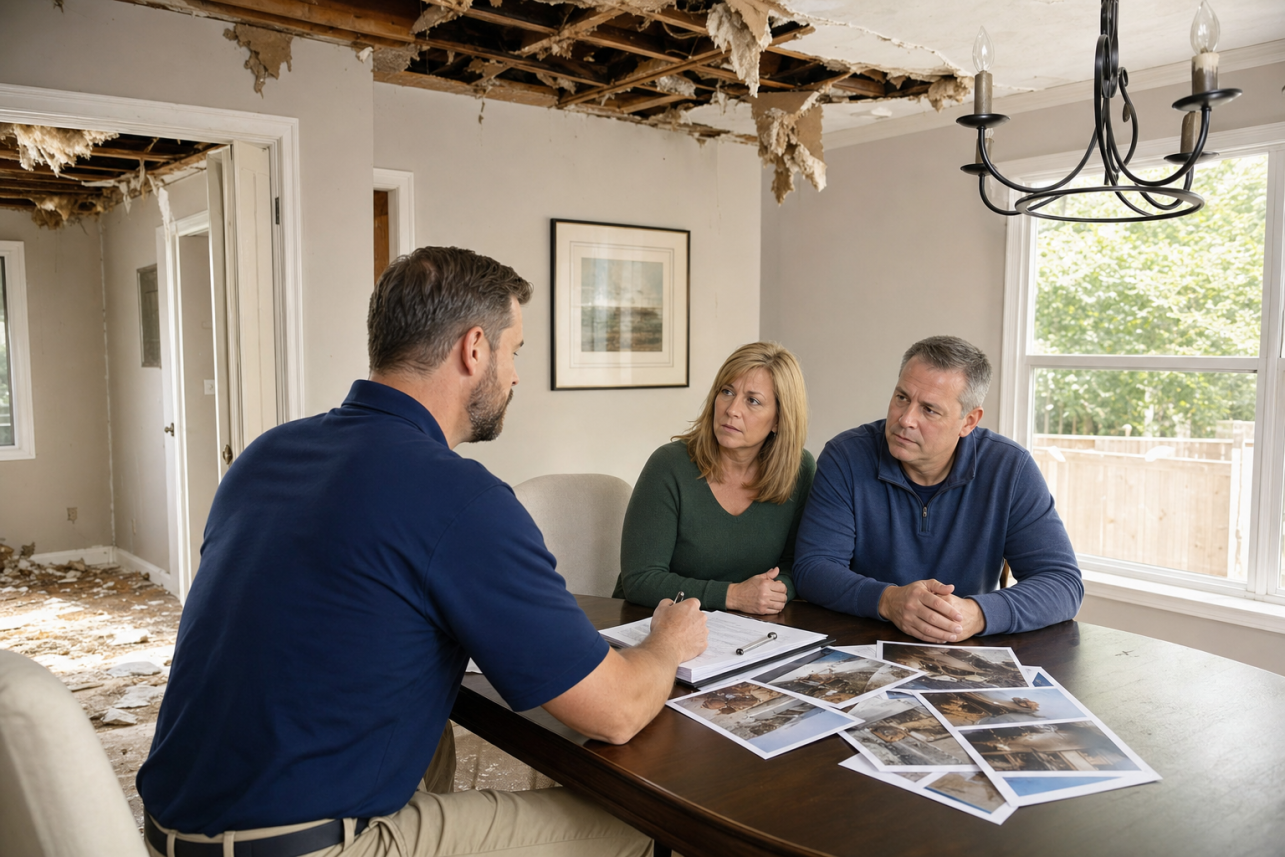
After a tree came through our roof near Kelly Road, the insurance company offered us barely enough to tarp and patch. For The Public Adjusters found water damage in walls we didn't even know were wet and got the whole roof replaced instead of patched. The final settlement was more than four times the first offer. I honestly didn't know homeowners could hire their own adjuster until a neighbor mentioned it.
Danielle R., Apex
Our restaurant had a kitchen fire and the carrier kept stalling on the business interruption piece. This team documented our lost income month by month, handled every call with the insurance company, and kept us updated the whole way. We reopened with a settlement that actually covered the downtime, not just the drywall.
Marcus T., Apex
A burst pipe upstairs flooded our kitchen while we were traveling. The insurer's estimate ignored the hardwood floors that had cupped and the cabinets that wicked water up from the bottom. Our adjuster measured moisture in everything, fought the 'just refinish it' response, and won full flooring and cabinet replacement. Worth every penny of the fee — the increase covered it many times over.
Priya S., Apex
Frequently Asked Questions
What Does A Public Adjuster Apex NC Homeowners Hire Actually Do For My Insurance Claim?
A licensed public adjuster works exclusively for you, the policyholder — never for the insurance company. When you hire For The Public Adjusters, Inc., we take over the entire claim process: documenting the damage, reading your policy line by line, preparing a detailed estimate, and negotiating directly with your insurer's adjuster until you receive a fair settlement.
The insurance company's adjuster is paid by the carrier, and their estimate often reflects that. Our job is to build an independent, evidence-backed valuation of your loss. For a typical Apex home — whether it's a newer build in Bella Casa or an older property near downtown — that means measuring every affected room, photographing hidden damage behind drywall or under flooring, and pricing repairs at real Wake County contractor rates, not the carrier's software defaults.
We also handle the paperwork that trips up most homeowners: proof of loss forms, supplemental claims, and deadline tracking under North Carolina insurance regulations. If the carrier disputes our findings, we manage the back-and-forth so you don't have to.
Most clients call us in one of two situations: right after a loss, before they've filed, or after receiving a settlement offer that seems far too low to actually rebuild. We can step in at either stage. In many cases we reopen underpaid claims and recover significantly more than the original offer — often several times the initial figure on major water, fire, or storm losses.
How Much Does It Cost To Hire A Public Adjuster In Apex, And Is It Worth It?
We work on contingency, which means you pay nothing upfront and nothing out of pocket. Our fee is a percentage of the settlement we recover for you, agreed to in writing before we begin. If we don't recover money, you don't owe us anything.
North Carolina regulates public adjuster fees, so the percentage is disclosed clearly in your contract — there are no hidden charges or hourly bills. This structure also means our interests are fully aligned with yours: we only do well when your settlement does.
Is it worth it? For most significant claims, yes, and often dramatically so. Industry studies and our own case files show that professionally represented claims routinely settle for far more than the carrier's first offer. On a hail-damaged roof in Scotts Mill or a burst-pipe loss in a Peakway-area townhome, the difference between the insurer's estimate and the true cost of repair from a Wake County contractor can run into tens of thousands of dollars.
That said, we're honest when representation doesn't make sense. If your loss is small — a few hundred dollars over your deductible — we'll tell you during the free consultation and point you in the right direction instead. We review your policy and damage at no charge, so you can make an informed decision before signing anything.
When Should I Call A Public Adjuster Apex NC Residents Can Trust — Before Or After Filing My Claim?
The best time to bring in a public adjuster Apex NC property owners rely on is before you file, or as early in the process as possible. Early involvement lets us document the damage properly from day one, frame the claim correctly under your specific policy language, and prevent the missteps that carriers later use to reduce payouts.
Common early mistakes we see in Apex include giving a recorded statement without preparation, discarding damaged materials before they're photographed, accepting the carrier's preferred contractor estimate as final, and missing hidden damage — like moisture trapped in wall cavities after a pipe break, which is a frequent issue in slab-foundation homes throughout Wake County.
That said, it is never too late to call. If you've already filed and received a lowball offer, we can prepare a supplemental claim with new documentation and reopen negotiations. If your claim was denied outright, we'll review the denial letter against your policy — denials based on 'wear and tear' or 'pre-existing damage' after Triangle-area hailstorms are frequently reversible with the right engineering and weather-data evidence.
Even claims that were closed and paid months ago can sometimes be reopened in North Carolina if the payment didn't reflect the full scope of the loss. Bring us your paperwork and we'll give you a straight answer, free of charge, about whether more money is realistically recoverable.
What Types Of Property Damage Claims Do You Handle For Apex And Wake County Homeowners?
We handle virtually every type of residential and commercial property claim that occurs in this part of the Triangle.
Storm and wind damage is our most common call. Apex sits in the path of severe spring thunderstorms and the occasional remnant hurricane pushing up from the coast, and roofs here take a beating from hail and straight-line winds. Carriers often approve partial roof repairs when full replacement is warranted — we fight for the correct scope, including code-upgrade coverage under Wake County building requirements.
Water damage claims are a close second. Burst supply lines, failed water heaters, and washing machine hose failures cause extensive hidden damage in local homes, especially two-story properties where water travels through floor systems. We use moisture mapping to prove the full extent of the loss, not just what's visible.
We also represent clients on fire and smoke claims, including the complicated contents inventories and additional living expense (ALE) coverage that insurers frequently underpay while families are displaced. Lightning strikes, fallen trees, vandalism, and theft claims round out our residential work.
For business owners along the NC-55 and US-64 corridors, we handle commercial property damage and business interruption claims, where lost-income calculations require careful documentation the carrier won't do for you.
If you're unsure whether your situation qualifies, call For The Public Adjusters, Inc. for a free policy and damage review. We'll tell you honestly what your claim is worth and whether professional representation makes sense.
My Insurance Company Already Sent Their Own Adjuster — Why Would I Still Need A Public Adjuster Apex NC Homeowners Recommend?
The adjuster your insurance company sends works for the insurance company, not for you. Their job is to evaluate the claim from the carrier's perspective, and that often means damage gets minimized, overlooked, or classified in ways that reduce your payout. A public adjuster works exclusively for you, the policyholder.
When For The Public Adjusters, Inc. inspects a home in Apex, we frequently find damage the carrier's adjuster missed — hidden water intrusion behind walls after a pipe break, wind-lifted shingles that don't show from the ground, or code-upgrade costs that Wake County requires during repairs. Those items add up, and if they're not documented, they're not paid.
We also read your policy line by line. Many homeowners in Apex have coverage they don't realize exists, such as ordinance-and-law coverage, additional living expenses, or debris removal. The carrier's adjuster has no obligation to point those out. We do.
The difference shows up in the settlement. Independent studies and our own case files consistently show that professionally represented claims settle for significantly more than unrepresented ones. If the insurance company's estimate feels low — or you simply want a second set of trained eyes before you sign anything — that's exactly when hiring your own adjuster makes sense. There's no obligation for us to review your estimate and tell you honestly whether it's fair.
How Long Will My Insurance Claim Take To Settle If I Work With Your Team In Apex?
Every claim is different, but most residential claims we handle in Apex resolve within 30 to 90 days from the date we get involved. Straightforward claims — a kitchen fire with clear documentation, or roof damage from a single storm event — often settle on the faster end. Larger losses, disputed claims, or claims that were previously denied can take longer because they require additional inspections, engineering reports, or negotiation rounds.
North Carolina law works in your favor here. Insurers operating in the state are expected to acknowledge, investigate, and respond to claims within reasonable timeframes, and we hold them to it. When a carrier drags its feet, we document every delay and escalate appropriately, including involving the North Carolina Department of Insurance when warranted.
One thing worth knowing: getting us involved early usually shortens the timeline, not lengthens it. Claims stall most often because of incomplete documentation, missed deadlines, or back-and-forth over scope. We front-load the work — detailed damage inventories, photo documentation, contractor-grade estimates — so the carrier has fewer excuses to delay.
If you're already months into a stalled claim, we can step in mid-stream. We'll audit what's been submitted, identify what's missing, and push the file toward resolution. For Apex homeowners displaced from their homes, we also make sure additional living expense payments keep flowing while the main claim gets sorted out, so the wait doesn't hurt your family financially.
Is Your Public Adjusting Firm Licensed To Handle Claims In North Carolina, And How Do I Verify That?
Yes. For The Public Adjusters, Inc. is licensed by the North Carolina Department of Insurance, which is a legal requirement for anyone representing policyholders on insurance claims in this state. You can verify any adjuster's license yourself through the NCDOI's online licensee lookup — we encourage every homeowner to do exactly that before signing a contract with anyone.
Licensing matters more than most people realize. North Carolina requires licensed adjusters to pass a state examination, maintain a surety bond, and follow strict rules about contracts, fees, and conduct. Unlicensed "claim consultants" and storm-chasing contractors who offer to "handle your claim" are operating outside the law, and they can put your claim — and your settlement — at serious risk.
Beyond the license itself, ask any adjuster you're considering about their experience with claims in Wake County specifically. Local knowledge matters. We know how carriers typically respond to hail and wind claims in the Apex and Cary area, what Wake County permitting and building code requirements add to repair costs, and which local contractors produce reliable repair estimates that hold up in negotiations.
When you contact us, we'll gladly provide our license number up front, along with references from homeowners in the area we've represented. A legitimate public adjuster Apex NC families can trust will never hesitate to prove their credentials — and you should walk away from anyone who does.

Can You Help If My Claim Was Already Denied Or The Payout Seems Too Low?
Absolutely — denied and underpaid claims make up a large share of our work in Apex. A denial letter from your insurance company is not the final word. It's the carrier's opinion, and opinions can be challenged with better evidence.
We start by pulling apart the denial itself. Carriers deny claims for specific stated reasons: they'll claim the damage is wear and tear rather than storm-related, that it falls under an exclusion, or that it predates your policy. Each of those arguments can be tested. We bring in our own inspection, document the damage properly, and when needed, engage engineers or moisture-mapping specialists to establish the true cause of loss.
Underpaid claims are even more common than outright denials. A carrier might pay for patching a section of roof when matching shingles are no longer manufactured, meaning full replacement is actually owed. Or they might miss required code upgrades that Wake County inspectors will enforce during repairs. We rebuild the estimate from scratch and negotiate the difference.
North Carolina policies also include appraisal provisions — a formal dispute-resolution process when you and the carrier disagree on the amount of loss. We can guide you through appraisal when negotiation stalls, and it frequently produces substantially better outcomes.
One important note: policy deadlines apply even after a denial, so don't wait. Bring us your denial letter, your policy, and the carrier's estimate, and we'll give you a straight answer about whether the claim is worth reopening. If we don't believe we can improve your outcome, we'll tell you that honestly.
What Should I Do Right After Storm Or Water Damage To My Apex Home, Before Your Team Arrives?
Your first job is safety and mitigation. If a summer thunderstorm has torn shingles off your roof near Beaver Creek or a burst pipe has flooded a kitchen in Scotts Mill, shut off the water or power to the affected area if you can do so safely, then take steps to prevent further damage — tarping a roof opening, moving furniture out of standing water, or running fans to slow mold growth.
Your policy actually requires reasonable mitigation, so keep every receipt for tarps, fans, plumbers, or emergency dry-out services. Those costs are typically reimbursable, but only if you can document them.
Next, photograph and video everything before anything gets thrown away or repaired. Wide shots of each room, close-ups of damaged materials, and images of the source of the loss all matter. In Wake County's humid climate, water damage evolves quickly, so time-stamped photos from day one are powerful evidence.
Do not sign contracts with contractors who show up at your door promising to "handle the claim," and avoid giving a recorded statement to the insurance company before you understand your coverage. Then call us. As your Apex public adjuster, we'll inspect the property, document the loss to insurance-industry standards, and take over communication with the carrier so nothing you say or discard early on weakens your claim later.
Will Hiring A Public Adjuster Apex NC Insurance Companies Deal With Regularly Make My Carrier Treat Me Differently?
In our experience, yes — but in your favor, not against you. Carriers handle thousands of claims across the Triangle, and their adjusters quickly recognize which files are professionally documented and which are not. When a claim arrives with a detailed line-item estimate, moisture readings, photographs, and correct policy citations, it tends to move through review with fewer lowball offers and fewer requests for endless re-inspections.
Some homeowners worry that bringing in their own representative will make the insurer defensive or slow things down. North Carolina law protects your right to representation, and carriers cannot penalize you for exercising it. What actually changes is the balance of the conversation: instead of a homeowner guessing at repair costs, the carrier is negotiating with someone who prices losses the same way their own adjusters do.
We work claims throughout Apex and Wake County, so we also know local repair costs — what it genuinely takes to replace architectural shingles, match brick, or remediate crawlspace moisture in this market — and we hold estimates to those real numbers rather than statewide averages.
The practical result for most clients is less friction, not more. You stop fielding calls, chasing paperwork, and second-guessing offers. We handle the back-and-forth, and the carrier deals with a licensed professional who documents everything in writing. That accountability alone often changes the tone of a claim.
Do You Represent Commercial Property Owners In Apex, Or Only Homeowners?
We represent both. Alongside residential work, we handle claims for commercial buildings, retail spaces, restaurants, offices, and rental properties throughout Apex and the surrounding Wake County communities — including landlords with single-family rentals and small multifamily buildings.
Commercial claims carry complications that residential policies don't. Business income and extra expense coverage, tenant improvements and betterments, code-upgrade requirements when Apex or Wake County permitting triggers newer building standards, and equipment breakdown provisions all require careful reading of the policy and precise documentation. A missed coverage in any of these areas can cost an owner tens of thousands of dollars.
For business owners, the loss itself is often only half the problem. Every week a storefront along the downtown Salem Street corridor or a unit in a Highway 55 business park sits closed, revenue disappears. We prepare business interruption calculations with supporting financial records so that lost income is claimed correctly, not estimated casually by the carrier.
For landlords, we document loss of rents, coordinate around tenant schedules for inspections, and make sure repairs are scoped to restore the property to a rentable condition — not merely patched.
If you own commercial or investment property in Apex and you're facing fire, water, wind, or storm damage, we're glad to review your policy and the loss at no cost and tell you honestly whether representation will add value to your claim.
What Should I Have Ready Before Our First Meeting About My Claim?
The single most useful document is your full insurance policy — the complete package with declarations page, endorsements, and exclusions, not just the summary card. If you can't locate it, request a certified copy from your agent or carrier; you're entitled to one, and we can help you ask for it correctly.
Beyond the policy, gather whatever you have that tells the story of the loss: photos and video of the damage, the date and cause of the event, any claim number if you've already filed, and copies of correspondence, estimates, or checks from the insurance company. If the carrier's adjuster has already inspected, bring their estimate — comparing it against our own scope is often where underpayments become obvious.
Receipts matter too. Emergency repairs, hotel stays if your home was unlivable, water extraction invoices, and even older receipts or photos showing your home's pre-loss condition all strengthen the file.
Don't worry if you're missing pieces. Many Apex homeowners come to us with nothing but a claim number and a leaking ceiling, and we build the documentation from there. When you meet with a public adjuster Apex NC property owners have worked with on real Wake County claims, part of the job is knowing exactly what evidence carriers respond to and assembling it for you.
The consultation itself costs nothing, so bring what you have and we'll map out the rest together.
Will Hiring A Public Adjuster Apex NC Homeowners Use Cause My Insurance Premiums To Go Up Or My Policy To Be Cancelled?
No. Your premiums are tied to the claim itself — the type of loss, your claims history, and regional risk factors — not to who represents you during the process. Whether you handle the claim alone or bring in professional representation, the carrier already knows a claim exists the moment you report it.
North Carolina law also protects you here. Carriers cannot legally retaliate against a policyholder for exercising the right to representation, and non-renewal decisions must be based on legitimate underwriting factors, not on whether you pushed back on a low estimate.
In practice, we often see the opposite concern play out. Homeowners in Apex who accept a rushed, underpaid settlement sometimes end up filing supplemental claims later when hidden damage surfaces — and multiple claims on your record can affect future rates more than one properly documented, fully settled claim.
Our job is to get your loss measured accurately and closed out completely the first time. That means documenting everything from roof decking to interior moisture readings so nothing gets missed and reopened later. If you are worried about how a claim might affect your policy going forward, bring that up during your free consultation. We will walk you through what is and is not a factor, so you can make the decision based on facts rather than fear of the carrier's reaction.
I Already Accepted A Partial Payment From My Insurance Company — Can Your Team Still Get Involved?
Yes, in most cases. Cashing an initial check from your carrier rarely closes your claim for good. In North Carolina, most property policies allow supplemental claims, and you generally have up to three years from the date of loss to pursue the full amount you are owed under your policy.
This situation comes up constantly in Apex, especially after hail and wind events sweep through Wake County. The carrier's first estimate covers the obvious damage — a few shingles, a stained ceiling — and the homeowner deposits the check assuming that is the end of it. Then a contractor opens up the roof or a wall and finds decking damage, saturated insulation, or code-required upgrades the original estimate never touched.
When we take over a partially paid claim, we start by reviewing the carrier's estimate line by line against your policy and the actual scope of damage. We document what was missed, price it using current local labor and material costs, and submit a supplemental demand with the evidence to back it up.
The one thing to watch for is whether you signed a full release or a settlement agreement, which is different from simply endorsing a check. Bring us whatever paperwork you signed and we will tell you honestly where you stand. If the claim can be reopened — and most can — we will fight for the difference between what you received and what your policy actually owes you.
How Does The Claim Negotiation Actually Work — Will I Still Have To Deal With My Insurance Company Myself?
Once you sign our representation agreement, we become your point of contact with the carrier. The adjuster calls us instead of you. The document requests come to our office. The scheduling, the follow-ups, the estimate disputes — all of it lands on our desk, not yours.
Here is what that looks like in practice. We start with a thorough inspection of your Apex property, often catching damage the carrier's adjuster walked past. We photograph everything, take moisture readings where water is involved, and build a detailed estimate using the same industry software the insurance companies use, priced for actual Wake County labor and material costs.
Then we submit that estimate with supporting documentation and negotiate directly with the carrier's adjuster or desk examiner. When there is a gap between their numbers and ours, we schedule a joint reinspection and walk the property together, pointing to the evidence line by line. Most disputes get resolved this way because we are arguing facts, not opinions.
You stay informed the entire time — we update you at every milestone and no settlement is accepted without your approval. But you will not be stuck on hold with a claims department or trying to decode an estimate written in adjuster jargon. Your only real jobs are to give us access to the property, forward anything the carrier mails you directly, and make the final call when the offer comes in.

Do You Only Work In Apex, Or Can A Public Adjuster Apex NC Based Firm Handle Claims In Nearby Towns Too?
We serve all of Apex and the surrounding communities across Wake County and beyond. As a public adjuster Apex NC property owners rely on, we regularly handle claims in Cary, Holly Springs, Fuquay-Varina, Morrisville, Raleigh, Garner, and Wake Forest — and our North Carolina license allows us to represent policyholders anywhere in the state.
That regional reach matters more than people realize. Storms do not respect town lines. When a hail cell tracks up US-1 or a severe thunderstorm rolls across western Wake County, we often work dozens of claims from the same weather event across multiple towns. That gives us a clear picture of what the storm actually did — hail size, wind speeds, damage patterns — which strengthens every individual claim we handle.
It also means we know how each carrier is responding to that specific event. If an insurance company is systematically underpaying roof claims from a particular storm date, we see the pattern early and adjust our documentation and negotiation strategy accordingly.
Being based near our clients matters for the practical side of the work too. We can be on-site quickly for inspections, meet the carrier's adjuster in person for joint reinspections, and return for follow-up documentation as repairs uncover hidden damage. If your property is in the Triangle area — or anywhere in North Carolina — call us and we will let you know right away whether we can take your claim. In almost every case, the answer is yes.
Local Relevance
Apex sits in the heart of Wake County, where humid subtropical weather delivers heavy summer thunderstorms, occasional ice events, and the inland remnants of tropical systems moving up from the coast. Those storms drive the claims we see most here: water intrusion, lightning-related fires, tornado damage when severe cells track through the Triangle, and mature pines and hardwoods coming down on roofs when saturated ground gives way.
The housing stock adds its own wrinkles. Apex has grown fast, so newer subdivision homes sit alongside older houses near the historic downtown — and older plumbing, aging water heaters, and original roofing behave very differently in a claim than new construction does. Carriers price repairs accordingly, and so do we.
Flooding deserves special mention. Standard homeowners policies exclude flood, so rising-water losses in low-lying areas run through the National Flood Insurance Program, which the Federal Emergency Management Agency oversees. NFIP claims have their own paperwork, deadlines, and proof-of-loss requirements, and we handle those files for Apex and greater Wake County policyholders alongside standard homeowners and commercial claims.
In Apex, many of the largest homeowner losses start with trees — the area's tall loblolly pines shed limbs or topple entirely when tropical-remnant rains saturate the red clay soil, and a tree-on-house claim often hides secondary water damage that carriers miss on a quick inspection. Getting the roof deck, attic insulation, and interior moisture documented early tends to make the difference between a patch job payment and a full repair.
Get A Straight Answer About Your Claim
If your Apex home or business has fire, smoke, water, tree, or flood damage — or your carrier's offer just doesn't add up — talk to For The Public Adjusters, Inc. We're licensed and bonded in North Carolina, we review claims at no obligation, and we'll tell you honestly whether we can help before you sign anything.
Request Your Free Claim Review
Call us: (919) 400-6440
Helpful Resources
- NCDOI Public Adjusters Guide
- Federal Emergency Management Agency (FEMA)
- North Carolina Department of Insurance — State regulator where consumers can verify adjuster licensing
- FEMA flood insurance information — Official National Flood Insurance Program resource
Our services in this city
- Fire Claims Adjuster Apex NC — When Your Insurer Underpays Or Stalls Your House Fire And Smoke Damage Claim
- Flood Insurance Adjuster Apex: NFIP Claim Help After Creek Flooding, Storm Runoff, And Hurricane Remnants
- Flood Insurance Claim Help Apex — When Storm Runoff Floods Your Home And The NFIP Proof Of Loss Clock Is Ticking
- Insurance Dispute Lawyer Apex — Why A Public Adjuster Should Be Your First Call, Not A Law Firm
- Public Adjuster Water Damage Apex NC: When The Insurance Company's Adjuster Low-Balls Your Water Claim
Last updated: August 16, 2026