
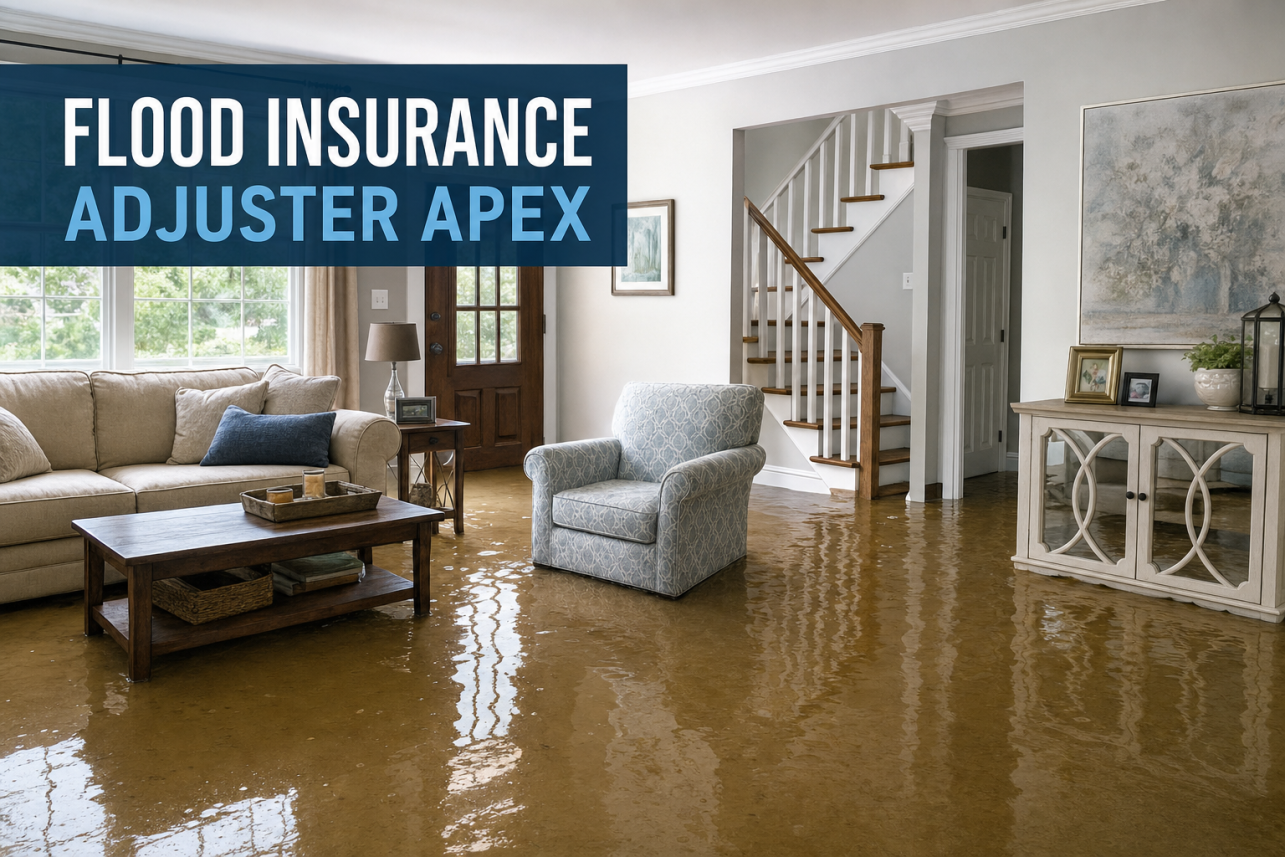
A flood insurance adjuster apex property owners hire works for you — not the insurance company — to document flood damage, prepare the proof of loss, and negotiate the settlement on your NFIP or private flood policy. For The Public Adjusters, Inc. is licensed and bonded, and we handle every step from the first inspection to the final payment. If floodwater has entered your home or business in Apex, the paperwork and deadlines start running immediately, and how the loss is documented in the first weeks often decides how the claim ends.
What This Service Is
When floodwater gets into a house, most people assume their homeowners policy will respond. It usually won’t — flood is excluded from standard homeowners coverage, which is why a separate flood policy through the National Flood Insurance Program or a private carrier exists in the first place. That separate policy comes with its own rules, its own forms, and its own strict deadlines that most policyholders have never seen before the water shows up.
Our job is to level that playing field. We inspect the property, measure and photograph the water lines, document structural damage to framing, subfloors, drywall, and insulation, and build a room-by-room inventory of damaged contents. We then prepare the repair estimate and the sworn proof of loss the flood program requires, and we negotiate directly with the carrier’s adjuster on your behalf.
We work on a contingency fee, meaning we are paid a percentage of what the claim recovers — never an upfront charge. We never guarantee a specific outcome, because no honest adjuster can, but we make sure nothing covered gets left off the claim. We do this same work across Wake County, including for homeowners who search for a public adjuster in Garner, and throughout the surrounding counties.
Common Problems
Why Is The Flood Payout So Much Lower Than My Contractor’s Repair Estimate?
This is the single most common call we get after a flood. The carrier’s estimate pays actual cash value on many items, which means depreciation gets subtracted from what it actually costs to rebuild. Your contractor quotes real-world prices; the insurance estimate often uses lower unit costs and misses hidden damage inside walls and under floors.
Flood policies also carry coverage limits — the NFIP caps building coverage and contents coverage separately, and contents are often underinsured or overlooked entirely. If nobody itemizes your damaged personal property line by line, that money simply never appears in the settlement.
We rebuild the estimate from the ground up, apply the policy correctly, and push back on depreciation and pricing that doesn’t match what repairs cost in the Triangle. The gap between a first offer and a properly documented claim can be substantial, and you shouldn’t be covering it out of pocket.
My Flood Claim Was Delayed, Underpaid, Or Denied — What Now?
Flood claims fail on paperwork more than anything else. The proof of loss deadline is unforgiving — miss it or file it incomplete, and even a legitimate claim can be denied. Carriers also dispute whether damage came from flood versus pre-existing wear, or argue the water didn’t meet the policy’s definition of a flood at all.
The courts have made clear that insurers must treat policyholders fairly. In Gruenberg v. Aetna Insurance Co., the insured won against his carrier after it wrongfully refused to pay his fire loss on a building he owned — the court held the insurer breached its duty of good faith and fair dealing. Policyholders have rights, and carriers know it.
- If your claim is stalled or denied, there is an appeal process, and a properly prepared supplemental claim with photographs, moisture readings, and a corrected estimate often changes the outcome. We handle disputed and underpaid flood claims regularly, from Apex to Archer Lodge homeowners we’ve represented in Johnston County.
Choosing A Flood Insurance Adjuster Apex Property Owners Can Actually Trust
Can you handle the claim yourself? Legally, yes. But you’d be negotiating against a professional adjuster who handles flood claims every day, using forms and deadlines built by the flood program. Most homeowners don’t know what a proof of loss is until the day it’s late.
When you compare adjusters, ask three things: are they licensed in North Carolina, are they bonded, and do they work on contingency with the fee spelled out in writing? The NCDOI Public Adjusters Guide explains what public adjusters may and may not do in this state — a legitimate firm will welcome those questions, not dodge them.
Also ask about flood-specific experience. A flood claim is not a burst-pipe water damage claim; the coverage, exclusions, and documentation requirements are completely different. We handle both, along with fire, smoke, and tree damage claims, so we know exactly where the lines are drawn.
Our Process
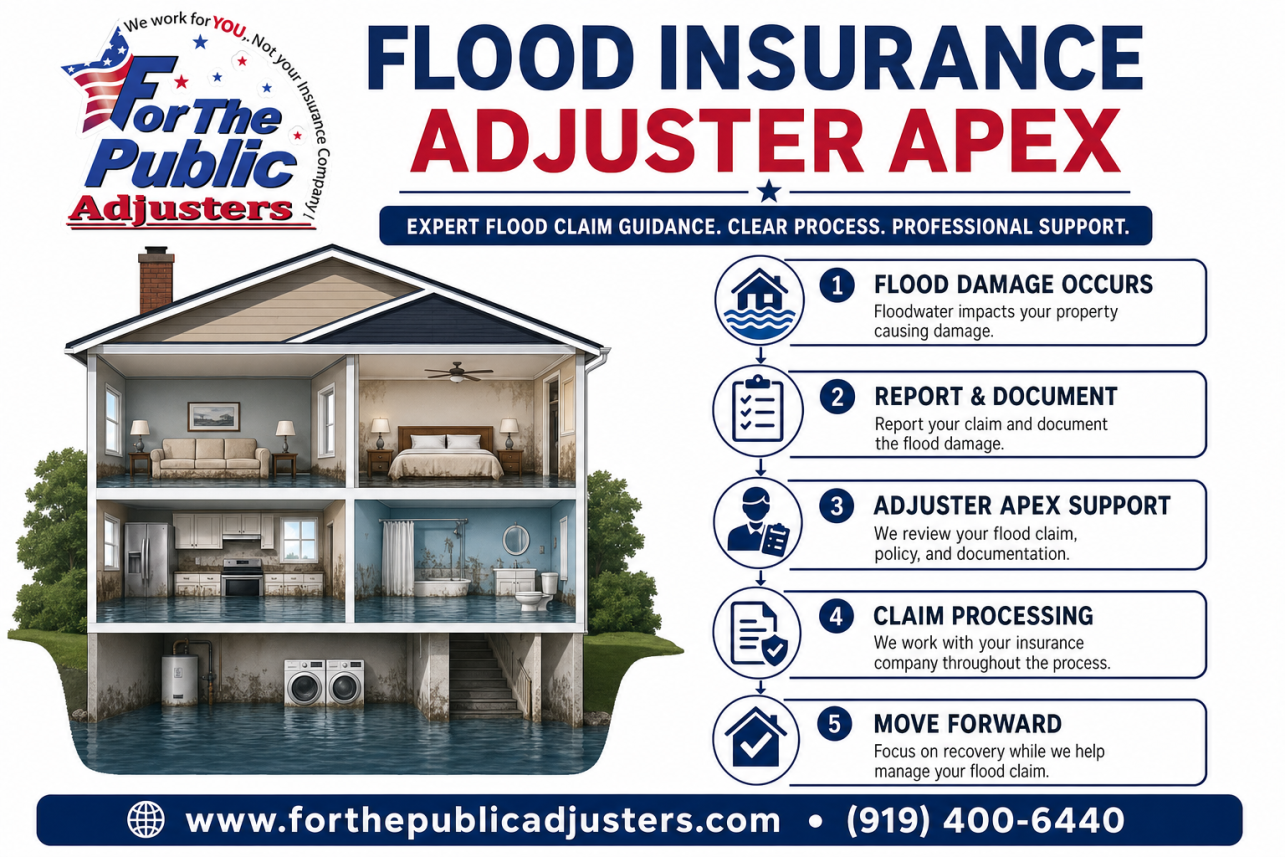
Free Claim Review And Property Inspection
We start by reading your flood policy and walking the property with you. We document the high-water line, test moisture levels in walls and subfloors, and identify damage the carrier’s adjuster is likely to miss — including areas where mold will develop if the claim drags on. Water damage doesn’t wait for negotiations; it spreads, and our documentation captures the loss before it changes.
Full Documentation, Estimate, And Proof Of Loss
We build a detailed repair estimate, a room-by-room contents inventory with values, and the sworn proof of loss the flood program requires — filed complete and on time. If you’ve been displaced, we also document your additional living costs where your coverage allows. This file becomes the evidence the entire negotiation rests on.
Negotiation Through Final Settlement
We present the claim to the carrier, respond to every pushback with documentation, and pursue supplemental payments when repairs uncover hidden damage. You approve every decision; we handle every argument. Our fee is a contingency percentage of the recovery, so our interests stay aligned with yours from the first inspection to the last check. We provide this same representation across the region, including for policyholders searching for a public adjuster in Rougemont NC.
| What Happens | Filing Alone | With For The Public Adjusters |
|---|---|---|
| Damage scope | Carrier’s adjuster measures once, often at the visible waterline | Moisture mapping documents wicking, hidden saturation, and mechanical damage |
| Proof of loss | 60-day NFIP deadline is easy to miss; late filings can void payment | Prepared, itemized, and submitted on time with supporting documentation |
| Building vs. contents | Items frequently miscategorized, shrinking both coverage buckets | Every item assigned to the correct coverage under the policy form |
| Lowball estimates | Most owners accept the first figure or argue without evidence | Line-item rebuttal estimates and re-inspection requests backed by data |
| ICC / code upgrades | Increased Cost of Compliance money is rarely claimed | ICC benefits pursued for elevation, floodproofing, or required demolition |
| Your time | Weeks of calls, paperwork, and disputes on your own | We manage the carrier while you manage recovery |
Commonly Overlooked In The Public Adjusting Industry
- The NFIP 60-day proof of loss deadline — Homeowners assume filing the claim is enough, but without a signed, itemized proof of loss submitted in time, the carrier can lawfully refuse to pay.
- Moisture wicking above the visible waterline — Drywall and insulation pull water upward for days after the flood recedes, so an estimate written at the stain line misses a foot or more of saturated material.
- Silt and contamination inside HVAC ducts and air handlers — Equipment that looks dry on the outside often holds floodwater sediment inside the cabinet, and it rarely appears in a quick field estimate.
- Increased Cost of Compliance (ICC) benefits — Up to $30,000 in extra NFIP money for elevation or floodproofing goes unclaimed because carriers seldom volunteer that it exists.
- Building versus contents miscategorization — Built-in cabinets, water heaters, and installed flooring are building coverage under the flood form, and putting them in the contents column shrinks the payout twice.
- The exact flood definition in private (non-NFIP) policies — Private carriers write their own definitions, and one word difference between ‘flood’ and ‘surface water seepage’ can trigger a sublimit that caps a six-figure loss at $10,000.
- Separating flood damage from wind damage after a storm — When one event involves both, each carrier tries to assign the loss to the other policy, and mixed documentation gives them the opening to do it.
- Foundation and crawlspace damage below grade — Vapor barriers, piers, and insulation under the house are covered building items that inspectors skip when they never enter the crawlspace.
Case Studies
Case Study #1
Situation: A family off Kelly Road in Apex had two feet of water push into their finished basement after a tropical storm stalled over Wake County. They filed their NFIP flood claim promptly and the carrier’s adjuster inspected within a week.
Problem: The carrier’s initial estimate came back at $18,400 — enough to cut out wet drywall, but nothing for the engineered flooring, the HVAC air handler that sat in six inches of water, or the built-in cabinetry along the rec room wall.
Investigation: Our team re-inspected with moisture meters and a hygrometer, documented wick lines above the visible waterline, and pulled the flood policy’s Increased Cost of Compliance provision. We also photographed silt inside the air handler cabinet and ductwork boots.
Findings: Moisture had wicked 14 inches above the flood line, meaning the four-foot flush cut in the estimate was correct but the insulation replacement scope was not. The air handler was a covered building item under the NFIP dwelling form, and the built-ins qualified as building property, not contents.
Solution: We prepared a line-item rebuttal estimate in the same software the flood carrier used, submitted a proof of loss revision before the statutory deadline, and requested a re-inspection with the carrier’s adjuster present.
Outcome: The claim settled at $61,200 — more than three times the original figure — including full HVAC replacement and an ICC payment toward elevating the mechanical equipment above base flood elevation.
Lesson: NFIP claims live and die on the proof of loss deadline and on knowing which items count as building versus contents. Homeowners who accept the first estimate almost never see money for mechanical systems and code-required upgrades.
Case Study #2
Situation: A small dental practice near Apex Peakway took on floodwater when a nearby creek overtopped after back-to-back summer storms. The suite had a commercial flood policy through a private carrier, not the NFIP.
Problem: The carrier denied a large portion of the claim, arguing the water intrusion was ‘surface water seepage’ subject to a sublimit, and paid only $9,700 against roughly $150,000 in visible damage to equipment, flooring, and walls.
Investigation: We obtained the FEMA flood event declaration for Wake County, pulled USGS stream gauge data for the creek, and interviewed neighboring tenants whose units flooded at the same hour. We then mapped the water’s entry path against the policy’s actual definition of flood.
Findings: The policy defined flood broadly enough to include overflow of inland waters, and the gauge data proved the creek crested 40 minutes before water entered the suite. The seepage sublimit did not apply to a general condition of flooding affecting two or more properties.
Solution: We submitted a coverage position letter with the hydrology data attached, a full contents inventory of the dental equipment with serial numbers and replacement quotes, and a business income worksheet covering the six weeks the practice was closed.
Outcome: The carrier reversed the sublimit position and settled at $212,000, including business interruption — money the practice used to reopen with new operatories rather than refurbished equipment.
Lesson: Private flood policies are not NFIP policies. Their flood definitions vary word by word, and the difference between ‘seepage’ and ‘flood’ can be six figures. Independent hydrology evidence is often what forces a carrier to re-read its own policy.
| Situation | What You Should Do | Why the Timing Matters |
|---|---|---|
| Water is still receding | Photograph waterlines in every room before cleanup begins | Once you dry out, the single best piece of depth evidence is gone |
| Carrier’s adjuster is scheduled | Have someone walk the inspection and take your own notes and photos | NFIP estimates are hard to reopen without proof of what was missed |
| First estimate arrived and feels low | Get an independent review before signing or cashing anything | A rebuttal is far stronger before the file closes than after |
| Approaching 60 days since the loss | Confirm your NFIP proof of loss has actually been submitted | Missing this deadline can legally bar recovery, even on a valid claim |
| Claim partially denied as ‘seepage’ or ‘groundwater’ | Request the denial in writing and the exact policy definition of flood | Many denials rest on definitions that outside hydrology data can defeat |
| Home is in the floodplain and repairs are major | Ask about Increased Cost of Compliance before finalizing scope | ICC can add up to $30,000 for elevation or floodproofing, but only if claimed |
| Both flood and wind damage occurred | Keep separate documentation for each cause of loss | Flood and wind are different policies; blurred evidence lets both carriers point at the other |


Reviews
After the September storms our crawlspace and first floor flooded, and the NFIP adjuster’s estimate didn’t even mention our ductwork or the water heater. For The Public Adjusters found silt in the ducts, cited the exact policy language, and got the settlement raised from $22K to $58K. They also caught the proof of loss deadline we had no idea existed.
Marcus T., Scotts Mill
Our flood carrier tried to call two feet of creek overflow ‘groundwater seepage’ and cap us at $10,000. This team pulled stream gauge records, proved it was a flood event, and turned a lowball into a real settlement. They handled every call with the carrier so I could focus on drying out my shop on Salem Street.
Deepa R., downtown Apex
Honest and thorough. They re-measured everything the flood adjuster rushed through, found wicking damage above the waterline, and got us paid for flooring the carrier said was ‘pre-existing.’ The one thing to know is NFIP claims take time — ours ran about four months — but they kept us updated the whole way.
Bill and Janice K., Haddon Hall
Frequently Asked Questions
What Does A Flood Insurance Adjuster Apex Homeowners Can Hire Actually Do For My Claim?
When you hire a flood insurance adjuster apex property owners can trust, you’re bringing in a licensed professional who works exclusively for you — not the insurance company. At For The Public Adjusters, Inc., we handle every stage of your flood claim from start to finish.
That begins with a thorough inspection of your property. Flood damage in Wake County homes often hides in wall cavities, subflooring, crawl spaces, and HVAC ductwork, and carrier adjusters frequently miss or undervalue these items. We document everything with moisture readings, photos, and detailed line-item estimates using the same pricing software insurers use.
From there, we prepare and file your proof of loss, which under most NFIP policies must be submitted within 60 days of the flood — a deadline that trips up many homeowners. We then negotiate directly with the carrier or FEMA-certified adjuster on your behalf, pushing back on lowball estimates with documented evidence.
Many Apex residents don’t realize that flood policies, especially federal NFIP coverage, have strict rules and exclusions that differ from standard homeowners insurance. Basements, for example, have very limited coverage, and knowing how to properly categorize damaged areas can significantly change your settlement. Our job is to make sure every covered dollar of damage is claimed correctly, documented properly, and paid fairly — so you can focus on getting your home back to normal.
How Much Does It Cost To Hire A Public Adjuster In Apex For A Flood Claim?
For The Public Adjusters, Inc. works on a contingency fee basis, which means you pay nothing upfront and nothing out of pocket. Our fee is a percentage of the settlement we recover for you, and we only get paid when you get paid.
This structure matters for flood claims in particular. After a major storm moves through Wake County, families are often facing hotel bills, water mitigation costs, and lost belongings all at once. The last thing you need is another invoice. Contingency-based representation lets you get professional help immediately, when documentation matters most.
It’s also worth understanding what that fee typically buys you. Industry studies and our own case history show that professionally represented flood claims routinely settle for substantially more than claims homeowners handle alone. Carrier estimates often omit code-upgrade requirements, proper drying protocols, matching materials for flooring and drywall, and contents losses — items we identify and fight for.
In North Carolina, public adjuster fees are regulated and must be disclosed clearly in a written contract before any work begins. We’ll walk you through that agreement line by line so there are no surprises. During your free initial consultation, we’ll review your flood policy, assess the damage, and give you an honest opinion about whether representation makes financial sense for your situation. If your claim is small or already being handled fairly, we’ll tell you that too.
My Flood Claim In Apex Was Underpaid Or Denied — Can You Still Help?
Yes, and this is one of the most common reasons Apex homeowners call us. A denial or a low settlement offer is rarely the end of the road, especially with flood claims, which carriers and NFIP adjusters get wrong more often than most people realize.
If your claim was underpaid, we start by comparing the carrier’s estimate against a fresh, independent inspection of your property. We frequently find missed damage — saturated insulation, compromised subfloors, mold growth behind baseboards, damaged electrical systems — that was never included in the original scope. We then prepare a supplemental claim with full documentation and negotiate for the difference.
If your claim was denied outright, we review the denial letter against your actual policy language. Denials often hinge on technicalities: a proof of loss filed late or incomplete, damage attributed to groundwater seepage rather than flood, or disputes over what qualifies as a “general condition of flooding” under NFIP rules. Many of these can be challenged successfully with proper evidence.
Timing matters, though. NFIP claims carry strict deadlines, including a one-year window to file suit after a written denial, so the sooner you bring us in, the more options you have. Whether your flooding came from a Jordan Lake watershed overflow, backed-up drainage during a tropical storm, or flash flooding along Beaver Creek, we know how these losses play out locally and how to build a case the carrier can’t easily dismiss.
Why Should I Choose A Local Apex Adjuster Instead Of The One My Insurance Company Sends?
The adjuster your insurance company sends works for the insurance company. Their estimate is built to protect the carrier’s bottom line, and after a widespread flood event, they’re often out-of-state contractors handling dozens of claims a day with limited time at each property. A local flood insurance adjuster apex homeowners hire independently changes that dynamic completely — we work only for you, and your claim is our sole focus.
Local knowledge genuinely matters here. We know Apex construction: the mix of older homes near downtown and the newer builds in communities like Bella Casa and Scotts Mill, each with different flood vulnerabilities. We understand how water moves through this part of Wake County, which neighborhoods sit in or near FEMA flood zones, and how storms tracking up from the coast typically damage homes in the Triangle.
We also know local rebuilding costs. National pricing databases often understate what Wake County contractors actually charge, especially after a regional flood event when demand spikes. We adjust our estimates to reflect real, current local pricing — and we can document why.
Finally, we’re here after the settlement check arrives. If contractors uncover hidden damage during repairs, we reopen and supplement the claim. An out-of-town carrier adjuster is long gone by then. With For The Public Adjusters, Inc., you get an advocate who lives and works in this community and answers the phone when you call.
How Soon After Flooding Should I Contact A Flood Insurance Adjuster Apex Property Owners Trust?
The honest answer: as soon as the water recedes and everyone is safe. The first 24 to 72 hours after a flood are when the most important evidence exists, and it disappears quickly. Water lines fade, saturated drywall gets torn out, and contents get hauled to the curb before anyone documents them properly.
Bringing in a flood insurance adjuster Apex homeowners can rely on early means we photograph and measure everything before mitigation crews start cutting. That documentation becomes the backbone of your claim. Once materials are in a dumpster, proving their condition and value gets much harder.
There are also hard deadlines to think about. NFIP flood policies require a signed, sworn Proof of Loss within 60 days of the date of loss unless FEMA extends it. Miss that window and you can lose your right to recover, no matter how legitimate the damage is. Private flood policies carry their own notice and documentation requirements that vary by carrier.
If you have already started cleanup, do not panic. Save every damaged item you can, keep receipts for tarps, fans, dehumidifiers, and temporary lodging, and take photos of everything before it leaves the property. Even a claim that is already underway benefits from professional review — but the earlier we get involved, the more leverage you have. A quick call costs you nothing, and it can prevent mistakes in the first week that take months to undo.
What Flood Damage Documentation Do I Need For A Claim On My Apex Home?
Flood claims are won or lost on documentation, and NFIP claims in particular demand far more paperwork than a standard homeowners claim. You will need date-stamped photos and video of standing water and water lines on walls, room-by-room images of damaged flooring, drywall, cabinets, and mechanical systems, and clear shots of every damaged item of personal property.
Beyond photos, you need a detailed contents inventory listing each item, its age, purchase price, and replacement cost. Receipts, credit card statements, and even old photos of rooms before the flood all help establish what you owned. Keep samples of flooring, carpet, and drywall — carriers often dispute material quality after the fact.
You also need mitigation records: invoices from water extraction companies, moisture readings, drying logs, and receipts for anything you bought yourself, like fans or dehumidifiers. If your Apex home sits near Beaver Creek, Middle Creek, or one of the stormwater basins that back up during heavy Wake County rains, elevation certificates and prior FEMA flood zone documentation can matter too.
Finally, NFIP requires a sworn Proof of Loss supported by a line-item estimate. This is where most homeowners struggle, because building a defensible estimate takes construction knowledge and familiarity with flood policy exclusions. Our team handles that entire package — the inventory, the estimate, the Proof of Loss, and the supporting exhibits — so nothing gets rejected for being incomplete or unsupported.
Does It Matter Whether I Have An NFIP Policy Or Private Flood Insurance?
Yes, and the differences change how your claim should be handled from day one. Most flood policies in Apex are written through the National Flood Insurance Program, even when a familiar carrier’s name is on the paperwork. NFIP policies follow federal rules: strict 60-day Proof of Loss deadlines, actual cash value payouts on contents, coverage caps of $250,000 for the building and $100,000 for contents on residential policies, and no coverage for things like additional living expenses.
Private flood policies are different animals. Some offer replacement cost on contents, higher limits, loss-of-use coverage, and more flexible deadlines. Others are narrower than NFIP in surprising ways. The only way to know is to read the actual policy language, which we do on every claim before building a strategy.
The dispute process differs too. NFIP claims that go sideways involve federal appeal rights and, if needed, litigation in federal court on a tight one-year clock. Private flood disputes typically follow North Carolina insurance law and often include an appraisal clause we can invoke to resolve pricing disagreements.
We handle both types regularly for Wake County homeowners. When you call, one of the first things we do is identify exactly what kind of policy you have, flag the deadlines that apply, and structure the documentation to satisfy that specific policy. Getting this wrong early is one of the most common reasons flood claims get underpaid or denied on technicalities.

How Long Does A Flood Insurance Claim Take To Settle In Apex, NC?
A straightforward, well-documented flood claim typically resolves in 60 to 90 days. Complicated claims — large losses, disputed causation, or claims that started off poorly documented — can stretch to six months or longer. The single biggest factor is the quality of the initial submission.
NFIP claims run on a fairly predictable track: the carrier assigns an independent adjuster, an inspection happens, and a Proof of Loss must be signed and submitted within 60 days of the loss. When the estimate and inventory are complete and defensible from the start, payment often follows within weeks of the Proof of Loss. When the carrier’s numbers come in low, supplemental claims and appeals add time, but they also add money.
After a major regional event — like the tropical remnants that have pushed Beaver Creek and local stormwater systems past capacity in recent years — expect delays. Carriers get flooded with claims across Wake County, inspections back up, and homeowners who submit clean, organized files move through the queue faster than those who send in a shoebox of photos.
As your flood insurance adjuster Apex claims are our full-time job, so we push files forward instead of waiting on the carrier’s timeline. We track every deadline, respond to document requests the same week, and escalate when a claim stalls. Most clients tell us the process moved noticeably faster once we took over — and the settlement was larger than what the carrier first offered.
Can A Flood Insurance Adjuster Apex Business Owners Hire Also Handle Commercial Flood Claims?
Yes. For The Public Adjusters, Inc. represents both homeowners and commercial policyholders throughout Apex and the rest of Wake County. Commercial flood claims are often more complex than residential ones, and that’s exactly where professional representation pays off.
A business claim typically involves more than the building itself. Inventory, equipment, tenant improvements, and business income losses all need to be documented and valued separately. Restaurants and retail spaces near downtown Apex or along the US-1 corridor frequently carry layered coverage that the carrier’s adjuster may not fully apply without pushback.
We also see confusion around NFIP commercial policies, which cap building coverage at $500,000 and contents at $500,000. If your losses exceed those limits, we help identify whether excess flood coverage, business interruption provisions, or other policy sections can respond to the shortfall.
For landlords and property managers, we handle multi-unit losses where several tenants are affected by the same event. Coordinating documentation across units, distinguishing owner property from tenant property, and tracking loss of rents all require careful organization from day one.
Whether it’s a flooded crawlspace under a professional office off Ten-Ten Road or standing water in a warehouse near the industrial areas west of town, the process starts the same way: a thorough independent inspection, a complete reading of your policy, and a documented claim built to withstand the carrier’s scrutiny. Reach out before you sign anything from the insurance company, and we’ll evaluate your commercial loss at no obligation.
What Hidden Flood Damage Gets Missed Most Often In Apex Homes?
The most commonly missed damage in this area sits below the floor line. Many Apex homes, especially older properties near Beaver Creek and Middle Creek, are built on crawlspaces. Floodwater that recedes quickly from the living space often lingers underneath, saturating insulation, subflooring, ductwork, and vapor barriers. Carrier adjusters frequently give crawlspaces a quick glance or skip them entirely.
Moisture wicking is another big one. Water climbs inside wall cavities well above the visible waterline. Drywall may look dry at eighteen inches while insulation behind it is soaked at three feet. Without moisture meter readings and selective openings, that damage goes unclaimed and turns into mold weeks later.
HVAC systems deserve special attention. Flood-contacted ductwork in a crawlspace, a submerged condensing unit, or a water heater that took on even a few inches of water may need replacement, not cleaning. These items are routinely undervalued or left off the carrier’s estimate.
We also check electrical systems, since floodwater in outlets and junction boxes creates safety issues that code requires addressing. Foundation and slab issues, buckled hardwoods that seem fine until they cup weeks later, and contaminated contents stored in low cabinets round out the list.
Our inspections are built around finding what the first walkthrough missed. If you suspect your Apex flood claim was scoped too lightly, an independent second look often reveals thousands of dollars in legitimate, covered damage.
Will Hiring A Public Adjuster Slow Down My Claim Or Cause Problems With My Insurance Company?
No — and in most cases it does the opposite. Insurers deal with licensed public adjusters every day, and North Carolina law specifically authorizes policyholders to hire their own representation. Your carrier cannot penalize you, cancel your policy, or treat your claim differently because you brought in professional help.
What actually slows claims down is incomplete documentation. When a homeowner submits a partial contents list, misses the NFIP proof of loss deadline, or can’t support a disputed line item, the file bounces back and forth for months. A prepared, professionally documented claim moves through review faster because there’s less for the carrier to question.
Flood claims in particular are deadline-driven. NFIP policies require a signed, sworn proof of loss within 60 days of the loss, though FEMA sometimes extends this after major events. Missing that deadline can forfeit parts of your recovery. We track every deadline so nothing lapses while you’re focused on getting your family or business back to normal.
Communication also improves. Once we’re on the file, the carrier’s adjuster deals with someone who speaks their language — the same estimating software, the same policy provisions, the same documentation standards. That tends to reduce friction, not create it.
The honest trade-off is this: a thoroughly built claim may take slightly longer to assemble up front than a quick, incomplete one. But a fast underpayment isn’t a win. Our goal for every Apex policyholder is full recovery on a timeline that doesn’t sacrifice dollars for speed.
What Happens During The First Inspection When I Hire A Flood Insurance Adjuster Apex Residents Recommend?
The first visit is a top-to-bottom independent assessment of your property — not a quick walkthrough. When you bring in a flood insurance adjuster Apex homeowners have trusted through storms like Fred and the remnants of Florence, expect a detailed, methodical process that usually takes a few hours.
We start with the exterior: grading, foundation, entry points where water came in, and the high-water line. Then we move inside, room by room, photographing everything and taking moisture readings on walls, floors, and cabinetry. In crawlspace homes, which are common in established Apex neighborhoods like Scotts Mill and Haddon Hall, we go under the house to inspect subflooring, insulation, and ductwork.
We document your contents as well — furniture, appliances, electronics, clothing, and stored items — with photos, model numbers where possible, and condition notes. Flooded contents are frequently the most underpaid part of a claim, so this inventory matters.
While on site, we review your policy in detail: coverage limits, deductibles, whether you hold an NFIP or private flood policy, and any endorsements that affect your recovery. We explain what’s covered, what isn’t, and where we see the strongest path to full payment.
Before we leave, you’ll know exactly what happens next: the estimate we’ll build, the deadlines that apply, and how we’ll present the claim to your carrier. There’s no cost for this initial evaluation, and you’re under no obligation until you decide the numbers justify moving forward.
Is A Burst Pipe Or Roof Leak Handled The Same Way As Flood Damage On My Apex Property?
No, and this distinction trips up a lot of Apex homeowners. Insurance treats “flood” very specifically: rising surface water that covers normally dry land and affects two or more acres or two or more properties. Water from Beaver Creek overflowing its banks or stormwater sheeting across your yard and into your home falls under your flood policy.
A burst pipe, a failed water heater, or rain entering through a wind-damaged roof is water damage, which belongs on your standard homeowners policy instead. The two policies have different deductibles, different coverage limits, and completely separate claim processes.
Where it gets complicated is when both happen at once. A severe storm in Wake County can drive rain through a damaged roof while runoff floods your crawl space. In that situation, you may need to file two claims with two carriers, and each will try to attribute the damage to the other policy. That finger-pointing is exactly where claims get shortchanged.
Our team sorts out causation, documents which damage belongs to which policy, and pursues both claims in parallel so neither carrier gets to deny responsibility. We have handled plenty of these split-cause claims across Apex, from Scotts Mill to older homes near downtown, and knowing how to allocate damage correctly often makes a five-figure difference in the final settlement.
Does Flood Insurance Cover Basements, Crawl Spaces, And Personal Belongings In My Apex Home?
Coverage in below-grade spaces is one of the most misunderstood parts of flood policies, and it matters in Apex because so many homes here sit on crawl spaces or have finished basements. NFIP policies cover structural elements in basements — the foundation, furnace, water heater, electrical panel, sump pump, and unfinished drywall — but they generally exclude finished flooring, paneling, and most personal property stored below grade.
Contents coverage is also separate from building coverage under NFIP rules. If you only purchased building coverage, your furniture, electronics, and clothing are not covered at all, even on the main floor. Many policyholders discover this gap only after a loss.
A flood insurance adjuster Apex families work with will read your specific policy before making any promises, because private flood policies often cover far more than NFIP contracts do. We identify every category of covered damage, including items carriers frequently overlook: HVAC ductwork under the house, insulation in the crawl space, and code-required upgrades during repairs.
We also document borderline items carefully. A washer and dryer in a basement, for example, is covered under NFIP building coverage even when other basement contents are not. Knowing these distinctions — and proving them with photos, receipts, and policy language — is how we recover money that would otherwise be left on the table.
What Is The Proof Of Loss Deadline, And Can A Flood Insurance Adjuster Apex Policyholders Hire Help Me Meet It?
Yes, and this deadline is one of the biggest reasons people call us. Under NFIP rules, you must submit a signed, sworn proof of loss within 60 days of the flood, unless FEMA formally extends the deadline after a major event. Miss it, and the carrier can deny your claim outright, regardless of how legitimate your damage is.
The proof of loss is not just a form. It must be supported by a complete, itemized estimate of your damages — structure and contents — with documentation backing every line. The carrier’s adjuster will often prepare one for you based on their own inspection, but signing it locks you into their numbers. If their estimate missed damage under your subfloor or behind your walls, you have just sworn to an amount that is too low.
We prepare an independent proof of loss built on our own inspection, moisture readings, and line-item pricing that reflects actual Wake County repair costs, not a national software default. If you have already signed one, we can file a supplemental proof of loss for the difference, provided the deadline has not passed.
As a flood insurance adjuster Apex homeowners can call the same week a storm hits, we track every deadline from day one: the 60-day proof of loss, appeal windows, and any FEMA extensions announced after the event. Timing errors sink more flood claims than bad documentation does, so do not wait to get help.

I Already Accepted A Partial Payment From My Flood Carrier — Can My Claim Still Be Reopened?
In most cases, yes. Accepting a payment does not close your claim or waive your right to pursue more. Flood carriers routinely issue an initial payment based on a quick first inspection, and that check often covers only the obvious surface damage — wet drywall, ruined flooring — while missing everything underneath.
The key question is timing. NFIP claims allow supplemental filings, but you must submit a supplemental proof of loss with supporting documentation before the applicable deadline expires. After major flood events, FEMA frequently extends these deadlines, sometimes by months, so even if you think you are out of time, it is worth having us check.
When we take on an underpaid claim in Apex, we start with a fresh inspection. We open up areas the original adjuster never checked: subfloors over damp crawl spaces, wall cavities where moisture wicked above the visible waterline, ductwork, and insulation. We compare our findings line by line against the carrier’s estimate and build the supplemental claim around the gap.
We have reopened claims where the original payment covered less than half the true cost of repairs. Cashing the first check was not the mistake — assuming it was final would have been. Bring us the carrier’s estimate and your payment records, and we will tell you honestly whether there is enough uncaptured damage to justify a supplemental claim. If there is not, we will say so.
Local Relevance
Apex sits in the rolling Piedmont of western Wake County, and while it’s far from the coast, flooding here is real. Remnants of hurricanes and slow-moving summer thunderstorms can drop several inches of rain in hours, and the area’s dense clay soil sheds water fast instead of absorbing it. Creeks and low-lying lots take the runoff, and homes with crawl spaces, finished basements, or slab foundations near drainage paths take the damage.
Apex’s rapid growth adds another layer. New subdivisions mean more rooftops and pavement upstream, which changes how stormwater moves through neighborhoods that never flooded before. Many affected homeowners are shocked to learn their homeowners policy excludes flood entirely, and that only a separate policy through the Federal Emergency Management Agency’s flood program responds — with its own thirty-day waiting period before coverage even begins.
We represent policyholders throughout the Triangle, from downtown Apex’s older homes to newer construction near Jordan Lake, and in nearby communities where we serve as a public adjuster for Fearrington Village residents and beyond into Guilford County, including High Point policyholders dealing with the same storm systems.
Because Apex has grown so quickly, many flooded homes here sit outside mapped high-risk flood zones — the water comes from stormwater runoff off newer upstream development rather than a river. Those claims often face extra scrutiny over whether the event meets the policy’s definition of a flood, which makes early, precise documentation of the water source and high-water line especially important.
Flood Damage In Apex? Get Your Own Adjuster Before You Sign Anything
The carrier has an adjuster protecting its interests — you deserve one protecting yours. For The Public Adjusters, Inc. is licensed and bonded, works on contingency, and handles your flood claim from documentation through settlement. The proof of loss clock is already running, so let’s review your policy and your damage now, at no cost.
Request Your Free Claim Review
Call us: (919) 400-6440
Helpful Resources
- Federal Emergency Management Agency (FEMA)
- NCDOI Public Adjusters Guide
- FEMA flood insurance resources — Federal guidance on flood insurance and claims
- FloodSmart, the official NFIP site — National Flood Insurance Program consumer information
Last updated: August 21, 2026