

Wind Damage Claim Help Burlington NC from For The Public Adjusters, Inc. means a licensed and bonded public adjuster works for you — not the insurance company — after a tornado or the remnants of a hurricane damage your roof and let water into your home. We document the storm damage, the water intrusion it caused inside, and the full cost to put things right, then we handle the claim negotiation on your behalf. You focus on your family; we handle the insurance company.
What This Service Is
When a tornado or a hurricane pushing inland through the Carolinas hits Burlington, the damage rarely stops at missing shingles. Once wind peels back roofing or tears off flashing, rain follows it inside — soaking attic insulation, staining ceilings, running down inside walls, and ruining floors and furniture.
That creates a two-part claim: the storm damage to the structure itself, and the interior water damage that came through the opening. Insurance companies often try to split those apart, paying for a patch on the roof while arguing about the ceilings, drywall, and contents below it. A public adjuster's job is to keep the whole loss connected and documented as one event.
As your representative, we read your homeowners policy line by line, inspect the property ourselves, prepare a detailed repair estimate, and negotiate directly with the carrier's adjuster. The North Carolina Department of Insurance explains in its NCDOI Public Adjusters Guide that public adjusters are the only licensed adjusters who work exclusively for the policyholder — the company adjuster works for the insurer. That distinction matters most on exactly this kind of claim, where the cause of the interior damage becomes the whole argument.
Policyholders have won that argument before. In Broussard v. State Farm Fire & Casualty Co., a homeowner couple whose house was destroyed in Hurricane Katrina took their insurer to court over whether wind or excluded flooding caused the loss — and a federal jury sided with the homeowners, awarding them their policy benefits. Cases like that are a reminder that the insurance company's first answer is not always the final one. Beyond storm work, we also handle fire, smoke, water, tree damage, and vandalism claims for homeowners and commercial property owners across Alamance County.
Common Problems
Why Is The Insurance Check So Much Smaller Than The Repair Estimate?
This is the most common call we get after a storm. The carrier's estimate often misses whole categories of damage — saturated insulation, wet drywall behind an intact-looking wall, damaged decking under the shingles, or contents ruined by the water that came in.
Then depreciation gets subtracted. Many policies initially pay the depreciated value of your roof and interior finishes — actual cash value — and only release the rest after repairs are done. If nobody explains that, homeowners think the low first check is all they'll ever see.
Your deductible matters too. Some North Carolina policies carry a separate, higher windstorm deductible, and it may be a percentage of your home's insured value rather than a flat dollar amount. We review your policy so you know exactly what applies before you accept anything — because once you cash a check believing it's final, pushing back gets harder.
The Adjuster Says The Water Damage Inside Isn't Covered — Now What?
Here's the argument insurers love on these claims: rain damage is only covered if wind first created an opening in the roof or walls. So their adjuster looks at your stained ceilings and suggests the water came from an old leak, worn shingles, or 'wear and tear' — all excluded.
The fix is proof. Photographs of the wind-created opening, weather records for the storm date, and a proper inspection tying the interior water path back to that opening can turn a denial into a payable claim. Timing matters: tarping the roof and drying the interior protects your home and is usually required by your policy, but document everything before and during those emergency repairs.
If the claim has already been denied, delayed for weeks, or answered with a lowball offer, you are not stuck. We build the evidence file, challenge the carrier's conclusions, and if new damage surfaces during repairs, we file the supplemental claim for it. The Insurance Information Institute notes that wind is among the most frequent causes of homeowner property claims nationwide — carriers see thousands of these, and they know exactly which ones will push back.
Do I Really Need Wind Damage Claim Help Burlington NC, Or Can I Handle The Claim Myself?
You can file on your own, and for a small, simple loss that may be fine. But a storm claim that involves both roof damage and interior water intrusion is where homeowners most often leave money behind — because the carrier's adjuster controls the scope, the estimate, and the cause-of-loss conclusion unless someone qualified challenges them.
A good public adjuster does the things you can't easily do yourself: read the policy the way the insurer does, write a repair estimate in the same software carriers use, and document causation so the interior damage can't be brushed off as pre-existing.
When you're choosing someone, ask three things: Are they licensed by the North Carolina Department of Insurance? Are they bonded? Will they inspect the property personally rather than working from your photos? We answer yes to all three, and our fee comes from the settlement — never as an upfront charge — so our interests line up with yours from day one.
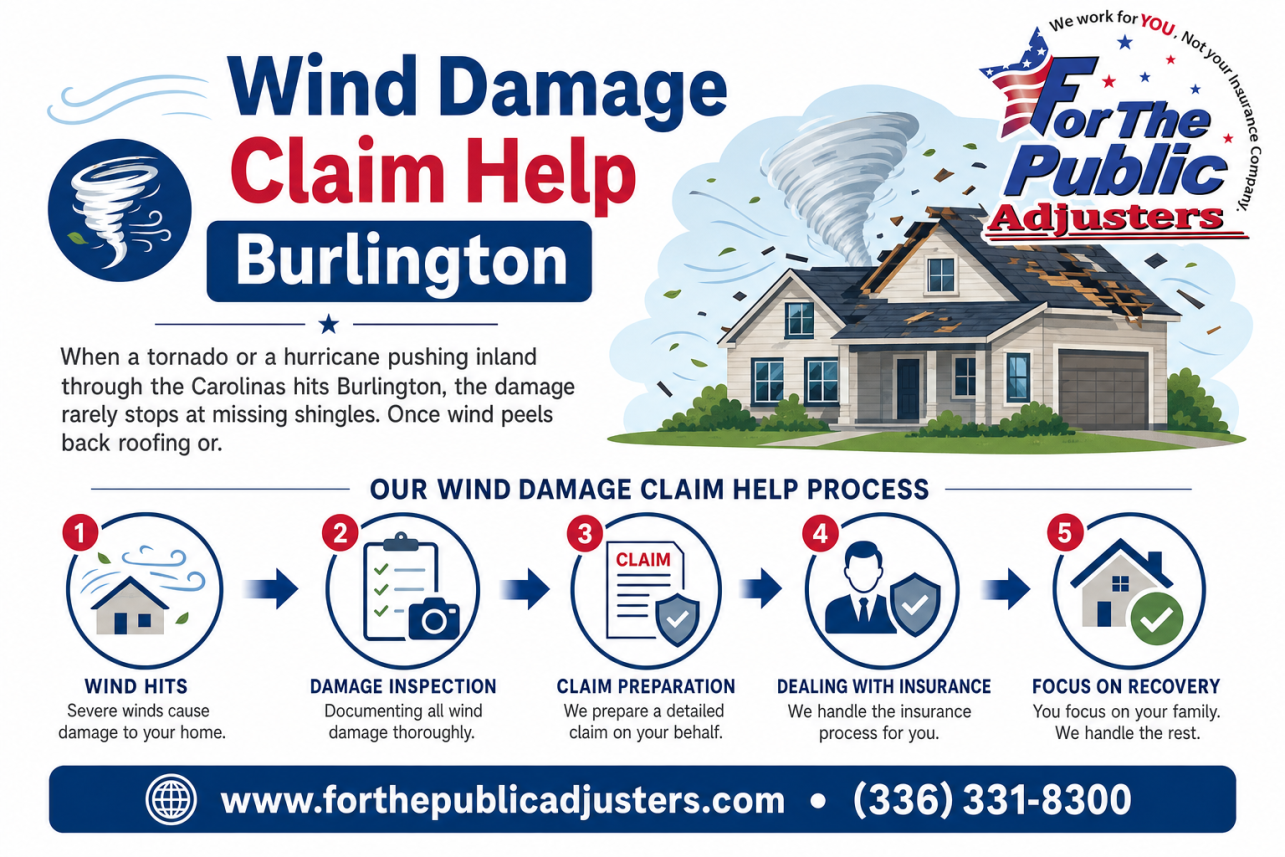
Our Process
Policy Review And On-Site Inspection
We start by reading your homeowners policy in full — coverage limits, the deductible that applies to windstorm, and any exclusions the carrier might lean on. Then we inspect the property ourselves, from the roof opening down through the attic, walls, and floors, tracing every path the water took.
Documentation And A Complete Repair Estimate
We photograph and measure everything, pull the weather data for the storm, and inventory damaged contents room by room. From that, we prepare a detailed line-item repair estimate covering structural damage, interior water damage, and emergency protection costs like tarping — so nothing gets waved off later as unrelated.
Negotiation Through To Settlement
We present the claim to the insurance company, meet their adjuster at the property, and answer every dispute with documentation. If hidden damage turns up once repairs begin, we file the supplement. We stay on the claim until it's resolved — and we never ask you to accept an offer we haven't reviewed with you first.
| What Happens | Handling It Yourself | With Our Team on Your Side |
|---|---|---|
| Damage documentation | Photos of visible stains and missing shingles only | Moisture mapping, thermal imaging, attic and wall-cavity readings, full photo log tied to the storm date |
| Scope of the estimate | Carrier's estimate, often limited to spot repairs | Independent line-item estimate covering roof, insulation, drywall, drying, and code upgrades |
| Hidden water intrusion | Usually found months later as mold or bubbling paint | Identified and included in the claim before the settlement closes |
| Negotiating with the insurer | You against a trained company adjuster | A licensed NC public adjuster negotiating with evidence, not opinions |
| Supplemental damage found later | Often denied as 'seepage' or 'wear' | Tied back to the original covered wind event with documented timelines |
| Typical result | Fast, low first offer accepted under pressure | Settlements frequently several times the initial offer |
Commonly Overlooked In The Public Adjusting Industry
- Creased but still-attached shingles — Carrier adjusters count missing shingles from the ground, but a crease breaks the wind seal on the whole slope and it never shows in a drive-by photo.
- Wet blown-in insulation above the ceiling stain — Insulation soaks up water like a sponge and permanently loses its insulating value, but nobody checks it because the drywall below dries and looks fine.
- Water tracking inside wall cavities — Water follows framing sideways and down, so the wet studs and insulation are often rooms away from where the ceiling stain appears.
- Shingle matching requirements — When discontinued shingles can't be matched, North Carolina claims practice can require replacing full slopes, but carriers quietly estimate a patch instead.
- Code-upgrade costs for decking, drip edge, and ventilation — Current building code often requires more than putting back what was there, and ordinance-or-law coverage pays for it only if someone actually itemizes it.
- Drying logs and daily moisture readings during mitigation — Without documented readings, the carrier can later claim mold came from 'ongoing seepage' rather than the storm, and the homeowner has no proof otherwise.
- Reimbursable emergency tarping and tree-removal costs — Homeowners pay for tarps and limb removal out of pocket right after the storm and forget those expenses are covered mitigation costs under the policy.
- The supplemental claim window — Most people assume the first check closes the claim, when in reality newly discovered storm-related damage can be added long after the initial settlement.
Case Studies
Case Study #1
Situation: A family in the Glen Raven area of Burlington called us three days after a spring squall line pushed through Alamance County with 70+ mph straight-line winds. Shingles had peeled off the rear slope of their roof, and rain the following night soaked the master bedroom ceiling.
Problem: Their insurance carrier's field adjuster spent twenty minutes on site, counted lifted shingles, and issued an estimate for a roof-slope repair only — about $4,100. Nothing was allowed for the saturated ceiling drywall, wet blown-in insulation, or the water tracking down the wall cavity into the closet below.
Investigation: We performed a full inspection with a moisture meter and thermal camera, mapping wet insulation across roughly 400 square feet of attic and moisture readings inside two wall cavities. We also documented creased shingles across the entire slope — not just the missing ones — and pulled the local weather data confirming the wind event.
Findings: The wind damage was systemic, not spot damage. Creased shingles had broken their seal across the whole rear plane, which is why water entered in multiple places. Interior moisture had migrated well beyond the visible stain, and the insulation had lost its R-value permanently.
Solution: We prepared a line-item estimate covering full slope replacement, matching considerations for the adjacent slopes, insulation removal and replacement, drywall and paint for the bedroom and closet, and drying equipment. We then met the carrier's re-inspector on the roof and in the attic and walked them through every moisture reading.
Outcome: The claim settled at just over $38,000 — more than nine times the original offer — covering the roof, interior repairs, and code-required upgrades at the ridge and drip edge.
Lesson: Wind rarely damages a roof in one neat spot. If water got inside, the interior scope is almost always larger than the stain on the ceiling, and it has to be measured, not eyeballed.
Case Study #2
Situation: A retired couple near Lake Mackintosh had a large oak limb punch through their roof decking during a nighttime thunderstorm. Rain poured through the opening for several hours before a neighbor helped tarp it, soaking the living room, hallway, and part of the kitchen ceiling.
Problem: The carrier accepted the claim but paid based on drying out the existing materials and patching the decking hole. Weeks later the homeowners noticed a musty smell and bubbling paint, and the carrier's position was that any new damage was 'ongoing seepage' excluded under the policy.
Investigation: We reviewed the original adjuster's photos and drying logs, then brought in independent moisture mapping and air sampling. The drying company hired after the storm had never removed the wet insulation above the kitchen, and moisture readings in the ceiling cavity were still elevated a month after the storm.
Findings: The mold and bubbling paint traced directly back to the original wind-created opening — a covered peril — not to any long-term seepage. The initial drying scope was simply inadequate, which is a claims-handling issue, not an exclusion issue.
Solution: We filed a supplemental claim tying the microbial growth to the storm date with lab results and a moisture timeline, and rebuilt the estimate to include ceiling tear-out, insulation replacement, remediation protocols, and repainting of connected surfaces for a uniform finish.
Outcome: The carrier reversed its seepage position and issued a supplemental payment of roughly $21,500 on top of the original settlement, including remediation and full interior restoration.
Lesson: A storm claim isn't over when the first check arrives. If the structure wasn't dried and documented correctly, problems that show up later are usually still part of the original covered loss — but you have to prove the timeline.
| Situation | Do This First | Why It Matters for Your Claim |
|---|---|---|
| Shingles missing and rain is forecast | Have the roof tarped by a professional and keep the receipt | Emergency mitigation is reimbursable, and it stops the carrier from blaming later damage on your inaction |
| Water stain appears on a ceiling | Photograph it with a date stamp and do not paint over it | Fresh, dated evidence links interior damage directly to the wind event |
| Ceiling is sagging or bulging | Poke a small drain hole over a bucket and stay out of the room | Prevents a collapse injury and documents active water intrusion, not old seepage |
| Insulation may be wet in the attic | Get moisture readings before any repairs begin | Wet insulation loses R-value permanently and is often left out of carrier estimates |
| Carrier's adjuster already inspected | Get the written estimate before signing or cashing anything | A first offer for spot repairs rarely reflects the full water-intrusion scope |
| Musty smell weeks after the storm | Request air or surface sampling and note the date it started | Mold traced to the storm opening is covered; undocumented, it gets called excluded seepage |
| Offer feels low or the claim was denied | Have an independent public adjuster review the file | In NC you can reopen or supplement a claim, and most policies allow years to do it |


Reviews
When the April windstorm ripped part of our roof off on Kirkpatrick Road, water came through the attic and ruined two bedroom ceilings. Our insurer offered barely enough to fix the shingles. For The Public Adjusters found wet insulation and damage inside the walls we never would have caught, and the final settlement covered everything — roof, ceilings, insulation, and paint.
Danielle R., Burlington
A tree limb went through our roof during a storm and the rain flooded our living room before we could tarp it. The insurance company's first estimate ignored half the interior damage. This team documented every wet wall with a moisture meter, handled all the calls, and got us more than triple the original offer. Worth every penny of their fee.
Marcus T., Alamance County
We honestly thought the water stain on our ceiling after the windstorm was minor. For The Public Adjusters showed us the soaked insulation and mold starting behind the drywall. They reopened our claim, met the carrier's adjuster at our house, and the difference in payout let us actually repair the house right instead of painting over a problem.
Sheila and Greg W., Burlington
Frequently Asked Questions
How Do I Know If I Need Wind Damage Claim Help Burlington NC After A Storm Lets Water Into My Home?
If wind lifted shingles, tore off flashing, or drove debris through your roof and rain followed it inside, you almost certainly have a claim worth professional attention. The tricky part is that insurers often try to separate the wind event from the water damage, paying for a few shingles while denying the soaked drywall, insulation, and flooring underneath.
That's exactly where Wind Damage Claim Help Burlington NC from For The Public Adjusters, Inc. changes the outcome. We document the storm-created opening — the point where wind breached the roof or siding — and tie every drop of interior water damage back to it. Under most North Carolina homeowner policies, water intrusion caused by a wind-created opening is covered, but you have to prove the connection.
Watch for warning signs even if the ceiling looks dry right now: water stains that appear days later, a musty smell in the attic, sagging drywall, or granules from shingles collecting in your gutters. Alamance County storms frequently produce straight-line winds strong enough to compromise a roof without tearing it completely off, and those partial breaches are the ones adjusters most often undervalue.
Our advice is simple. Before you accept the insurance company's first inspection as the final word, get an independent assessment. We inspect the roof, attic, and interior together, moisture-map affected areas, and build the documentation the carrier can't easily dismiss. If the damage is minor, we'll tell you honestly. If it's not, you'll know exactly what your claim is really worth.
My Insurance Company Says The Water Damage Inside My Burlington Home Isn't Covered. Can That Decision Be Challenged?
Yes, and it's one of the most common disputes we handle for homeowners in Burlington and across Alamance County. Carriers frequently classify interior water damage as "wear and tear," "long-term seepage," or a maintenance issue — categories that are excluded — instead of acknowledging that a wind-created opening let the water in during a covered storm.
The difference comes down to evidence. A staff adjuster who spends twenty minutes on your roof may miss lifted shingle tabs, creased mats, broken seals, or displaced ridge caps. Without that proof of a storm-created breach, the interior claim collapses. Our job as your public adjuster in Burlington is to rebuild that chain of causation properly.
We start by pulling weather data confirming wind speeds on the date of loss, then perform a detailed roof and exterior inspection, photograph and document every breach point, and use moisture meters and thermal imaging to map how water traveled through the attic, wall cavities, and ceilings. We then prepare a line-item estimate that reflects the true scope — not just paint and patch, but wet insulation removal, drywall replacement, flooring, and mold prevention where warranted.
North Carolina policyholders have the right to dispute a denial, request a re-inspection, and invoke appraisal in many policies. Denials get reversed regularly when the documentation is done right. If your carrier has already said no, don't repair anything yet — preserving the evidence is critical. Call us first and let us evaluate whether the denial holds up.
What Does A Public Adjuster In Burlington Actually Do Differently From The Insurance Company's Adjuster?
The insurance company's adjuster works for the insurance company. That's not a criticism — it's simply their job, and their estimate reflects their employer's interests. A public adjuster works exclusively for you, the policyholder, and is licensed by the State of North Carolina to represent your side of the claim.
On a wind and water intrusion loss, that difference shows up in the details. Carrier adjusters often scope only what's visible: a stained ceiling, a few missing shingles. For The Public Adjusters, Inc. opens up the full picture — we inspect the attic decking, check insulation moisture content, trace water paths inside wall cavities, and identify hidden saturation that will cause mold and rot if it's paid as a surface-level repair.
We also read your policy the way it's written, not the way it's summarized to you over the phone. Coverage for wind-driven rain, matching requirements for roofing and siding, code-upgrade provisions, and additional living expenses are all areas where Burlington homeowners routinely leave money on the table without knowing it.
From there, we prepare our own independent estimate using the same professional software carriers use, submit it with full photo and moisture documentation, and negotiate directly with the insurer so you don't have to. You stay informed at every step, but the back-and-forth, the re-inspections, and the pushback become our problem instead of yours. Most of our clients tell us the biggest relief isn't just the larger settlement — it's not having to fight the fight alone.
How Much Does Wind Damage Claim Help Burlington NC Cost, And When Should I Call After A Storm?
For The Public Adjusters, Inc. works on a contingency basis, which means there's no upfront cost and no hourly billing. Our fee is a percentage of the claim settlement, agreed in writing before we begin, and regulated under North Carolina law. If we don't recover anything for you, you don't owe us anything. The initial inspection and claim review are free.
As for timing: call as soon as you can safely assess that something is wrong. The best window is before the insurance company's adjuster inspects, so we can document the wind breach and interior water damage on our terms and be present for their inspection. That said, we regularly step in mid-claim — after a lowball offer, a partial payment, or an outright denial — and still improve the result significantly.
Speed matters with water intrusion specifically. Wet insulation and drywall in a Burlington summer can develop mold within days, and delayed mitigation gives the carrier an argument to reduce or deny that portion of the claim. Take photos immediately, tarp the roof or hire an emergency mitigation company (keep every receipt), and avoid permanent repairs until the damage is fully documented.
Also remember that North Carolina policies impose deadlines for reporting losses and filing proof of loss, and suit limitation periods apply. Waiting months after a storm makes everything harder to prove. Whether the storm hit last night or last spring, reach out — we'll tell you honestly whether professional wind damage claim assistance will make a meaningful difference in your case.
What Should I Document Before Repairs Begin If Wind Opened My Roof And Rain Got Inside?
Before anyone touches the roof or the interior, photograph everything. Get wide shots of each affected room, then close-ups of stained ceilings, wet drywall, buckled flooring, and damaged insulation. Outside, photograph missing or lifted shingles, displaced flashing, and any debris in the yard that shows the direction and force of the wind.
Keep every damaged item until your claim is resolved, or at minimum photograph it thoroughly and note the make, model, and approximate age. Insurance carriers in Alamance County routinely dispute claims where the homeowner discarded evidence before an inspection.
You should also save receipts for emergency measures like tarping, water extraction, and dehumidifiers. Your policy requires you to prevent further damage, and those mitigation costs are typically reimbursable — but only if you can prove them.
When our team handles Wind Damage Claim Help Burlington NC cases, we build a documented timeline: the date of the storm, when water intrusion was discovered, what emergency steps were taken, and how the damage progressed. That timeline matters because carriers often argue interior water damage came from long-term leaks or poor maintenance rather than a single wind event. Weather data from the storm, paired with your photos and dated receipts, makes that argument much harder for them to sustain.
If you have already started repairs, don't panic. Call us anyway. We can often reconstruct the damage picture from contractor photos, moisture readings, and material samples, though the claim is always stronger when we're involved before demolition starts.
Wind Damaged My Roof But The Insurer Only Wants To Pay For A Few Shingles. What About The Water Damage Inside?
This is one of the most common disputes we see after severe storms move through Burlington. The carrier's adjuster spends twenty minutes on the roof, counts visible missing shingles, and writes an estimate for a small patch — ignoring the fact that wind-driven rain entered the home and saturated ceilings, insulation, and wall cavities.
A proper wind claim addresses the full chain of damage. If wind created an opening in the roof and rain followed it inside, the resulting interior damage is generally part of the same covered loss. That includes drywall, paint, flooring, trim, insulation, and personal property that got wet.
There's also the matching question. North Carolina claims often involve roofs where replacement shingles no longer match the existing ones, or where repairing one slope leaves an obvious patchwork. Depending on your policy language and the extent of damage, a full slope or full roof replacement may be justified — and we push for that when the facts support it.
Hidden moisture is the other issue. Water travels along rafters and inside walls, so damage frequently shows up several feet from the entry point. We use moisture meters and, when needed, thermal imaging to map the actual extent of intrusion before the carrier closes the file.
As Burlington public adjusters, our job is to re-scope the loss completely, price it at real local repair costs, and negotiate until the settlement reflects everything the storm actually did — not just what was visible from a ladder.
Is Wind Damage Claim Help Burlington NC Worth It For A Smaller Claim, Or Only For Major Losses?
It depends less on the size of the visible damage and more on what's hiding behind it. A claim that looks small — one water-stained ceiling, one wet bedroom — often grows substantially once someone opens the wall and measures moisture properly. We've handled Alamance County claims that started as a few-thousand-dollar carrier estimate and settled for many times that after the full scope of water intrusion was documented.
Here's a practical rule of thumb. If the damage is genuinely minor, the carrier's offer seems fair, and repairs are straightforward, you may not need professional representation. But if water reached the interior of your home, be cautious. Wet insulation, saturated framing, and moisture trapped in wall cavities lead to mold and structural problems that a quick estimate won't capture.
Red flags that Wind Damage Claim Help Burlington NC will likely pay for itself: the carrier's estimate doesn't include drying equipment or mold prevention, the roof scope covers only a handful of shingles, interior damage is dismissed as "pre-existing," or the offer won't come close to actual contractor quotes.
Because we work on a percentage of the recovery, there's no upfront cost to find out. We review your policy, inspect the damage, and tell you honestly whether the carrier's offer is reasonable. If it is, we'll say so. If it isn't — which is the far more common outcome after wind and water losses — you'll know exactly what the claim should be worth before you sign anything.

How Long Does A Wind And Water Intrusion Claim Take To Settle In The Burlington Area?
Timelines vary, but here's a realistic picture. North Carolina requires insurers to acknowledge a claim promptly and to investigate and respond within reasonable timeframes. A straightforward, well-documented wind claim can settle in four to eight weeks. Claims involving disputed interior water damage often take two to four months, and complex or initially denied claims can run longer.
What slows claims down is almost always disagreement over scope and causation. When a carrier argues that ceiling stains came from an old leak instead of the storm, or excludes wall cavities from the estimate, the back-and-forth adds weeks. Having a Burlington public adjuster prepare complete documentation up front — weather data, moisture mapping, photos, and a line-item estimate at local pricing — shortens that fight considerably because there's less for the carrier to question.
A few things you can do to keep your claim moving: report the loss quickly, mitigate further damage right away and keep receipts, respond to carrier requests promptly, and don't accept a first offer just to end the process. Early low offers after storm events are common, especially when a widespread storm has adjusters spread thin across Alamance County and the Triad.
One more note on timing. If you're facing mold growth or an unlivable home, tell us immediately. Additional living expense coverage may pay for temporary housing while repairs are pending, and emergency mitigation can often be authorized before the full claim settles. We manage those interim payments as part of representing you, so the delay in final settlement doesn't leave your family stuck in a damaged house.
Wind Tore Off Part Of My Roof And Rain Soaked The Attic Insulation And Ceilings. Will Hidden Damage Inside My Walls Be Covered Too?
In most cases, yes — but only if it gets found and documented before the claim closes. When wind opens a roof over an Alamance County home, water rarely stays in one spot. It travels down rafters, saturates blown-in insulation, wicks into top plates, and runs inside wall cavities where it can sit unseen for weeks.
The insurance company's adjuster typically inspects what's visible: stained ceilings, wet carpet, the roof itself. Damage hidden behind drywall or under flooring often never makes it into their estimate, which means it never makes it into your settlement.
When we provide Wind Damage Claim Help Burlington NC homeowners can rely on, we use moisture meters, thermal imaging, and physical inspection of attic spaces and wall cavities to map the full path the water took. We document elevated moisture readings room by room, because a reading taken today proves damage that might not show as a stain until months later.
If hidden damage is discovered after your claim settles, you can sometimes file a supplemental claim, but it's an uphill battle — the insurer may argue the damage came from a later event or from neglect. It's far stronger to capture everything up front. If you've already noticed musty odors, bubbling paint, or soft drywall anywhere below the roof breach, don't paint over it or tear it out yet. Call us first so it can be documented properly and included in the claim.
The Insurer Wants To Pay Actual Cash Value For My Storm-Damaged Roof And Interior. How Does Depreciation Work On A Claim Like This?
Most homeowner policies in North Carolina pay claims in two stages. First, the carrier issues an actual cash value (ACV) payment — the replacement cost minus depreciation for the age and condition of your roof, drywall, flooring, and other damaged materials. Then, after repairs are completed, you can recover the withheld depreciation, called recoverable depreciation, by submitting proof of the completed work.
Here's where Burlington homeowners get shortchanged. If the initial estimate is too low — missing the water-damaged insulation, the warped hardwood, the interior paint — then both the ACV check and the recoverable depreciation are calculated from that undersized number. You can't recover depreciation on damage that was never listed.
Depreciation percentages themselves are also negotiable more often than people realize. A carrier might depreciate a roof aggressively based on age alone, ignoring that it was in serviceable condition before the storm. Interior finishes like drywall and trim generally shouldn't be depreciated as heavily as roofing.
As Burlington public adjusters, we scrutinize the depreciation applied to every line item, challenge amounts that don't reflect the actual pre-loss condition, and make sure the underlying scope is complete so the full replacement cost is on the table. We also help you track deadlines — many policies give you a limited window, often 180 days to two years depending on the policy, to complete repairs and claim that held-back depreciation. Miss it, and that money stays with the insurance company.
It's Been Three Weeks Since The Storm And Mold Is Starting To Show On My Ceilings. Does That Hurt My Claim, And Can Wind Damage Claim Help Burlington NC Still Make A Difference?
Mold complicates things, but it doesn't automatically sink your claim — and yes, getting Wind Damage Claim Help Burlington NC involved at this stage can absolutely still change the outcome.
Here's the tension. Your policy requires you to take reasonable steps to protect the property after a loss, and insurers sometimes use mold growth to argue you failed that duty. At the same time, most policies do cover mold that results directly from a covered peril — like rainwater entering through a wind-opened roof — even if the policy excludes mold from other causes. The dispute usually comes down to proving the chain of events: wind caused the opening, the opening let water in, and the water caused the mold.
Given Burlington's humid summers, mold can appear fast even when a homeowner did everything reasonably possible. If you tarped the roof, ran fans, or called a mitigation company and got put on a waiting list — as happened all over Alamance County after recent severe storms — that matters, and we document it.
Our team builds the causation timeline with dated photos, weather data for your specific address, moisture readings, and mitigation records. We also review your policy's mold sublimit, which may cap that portion of the payment, and structure the claim so structural water damage isn't wrongly lumped under the mold cap.
Don't let the insurer's first reaction discourage you. Act now: keep dehumidifiers running, save every receipt, and get the damage professionally documented before remediation removes the evidence.
I Already Accepted A Settlement Check For My Wind And Water Damage. Is It Too Late To Get More?
Usually not. Cashing a claim check in North Carolina generally does not close your claim or waive your right to additional payment, unless you signed a full release — which is rare in standard homeowner claims. Most Burlington homeowners who call us after accepting a payment are surprised to learn the claim can be reopened or supplemented.
The typical scenario looks like this: the carrier paid for roof repairs and a ceiling patch, but once contractors opened things up, they found soaked insulation, damaged decking, or water tracking two rooms away from where the stain appeared. That newly discovered damage can be presented as a supplemental claim, backed by photos, moisture documentation, and contractor findings.
We also review the original settlement itself. Underpayments are common on storm losses with interior water intrusion — missing line items, lowballed labor rates that don't match what Alamance County contractors actually charge, overhead and profit omitted on multi-trade repairs, and depreciation applied too aggressively.
There are deadlines, though. Your policy sets time limits for supplementing claims and for filing suit if a dispute can't be resolved, so the sooner you act, the more options you have. Bring us your settlement letter, the carrier's estimate, and any contractor bids. As public adjusters serving Burlington and the surrounding towns, we'll compare what was paid against what the repair genuinely costs — and if there's a gap, we'll build the documentation to close it. The review costs you nothing up front.
The Storm Forced Us Out Of Our House Because Rain Soaked The Ceilings And Floors. Will Insurance Pay For Us To Stay Somewhere Else While It Dries Out?
Most homeowners policies include Additional Living Expenses coverage, often called ALE or Loss of Use. If wind opened your roof and water intrusion made the home unsafe or unlivable, ALE can pay for a hotel, a short-term rental, extra mileage, and even the difference in food costs while repairs happen.
The catch is that insurers rarely volunteer this coverage, and they frequently dispute whether a Burlington home is truly uninhabitable. Saturated insulation, soft drywall, exposed wiring, and active mold growth are all legitimate reasons a family cannot stay in a house, but you have to document and argue them.
Our team reviews your specific policy language, establishes why the home is unfit to occupy, and tracks every eligible expense so nothing gets left off the claim. We also push back when a carrier tries to cut off ALE before repairs are actually finished, which happens more often than people expect.
Keep every receipt from day one, even before you know whether you qualify. Hotel bills, restaurant meals, laundry costs, and pet boarding in Alamance County can all count. A Burlington public adjuster can often recover thousands in living expenses that homeowners never realized they were owed.
My Insurer's Adjuster Blamed My Leaking Roof On Age And Wear, Not The Storm. Can Wind Damage Claim Help Burlington NC Prove The Wind Actually Caused It?
This is one of the most common denial tactics we see after severe storms move through Alamance County, and yes, it can be challenged with the right evidence. Carriers know that if they label roof damage as "wear and tear" or "deferred maintenance," the entire claim collapses, including the water damage inside your home.
Proving wind causation starts with the physical evidence. Creased, lifted, or displaced shingles, broken seal strips, fresh fastener pulls, and debris impact marks all tell a different story than gradual aging. We photograph and document these indicators before repairs erase them.
We also pull certified weather data showing recorded wind speeds in Burlington on the date of loss. When a documented storm with damaging gusts passed directly over your neighborhood and your interior water damage appeared immediately afterward, the timeline itself becomes powerful evidence.
Under North Carolina law, the burden shifts once you show a covered peril occurred. A roof can be fifteen years old and still be wind-damaged; age alone is not a valid reason to deny a storm claim. If the carrier hired an engineer to support its denial, we scrutinize that report for errors and, when needed, bring in independent experts to rebut it. Many "wear and tear" denials do not survive a properly documented challenge.
My Shingles Were Discontinued And Only Part Of The Roof Was Damaged. Can I Get A Full Roof Replacement, And What About Mismatched Paint And Flooring Inside?
Matching disputes come up constantly on wind and water intrusion claims around Burlington. If your shingles are discontinued and no reasonable match exists, there is a strong argument that patching one slope leaves you with a mismatched roof that does not restore your home to its pre-loss condition.
North Carolina does not have a statute that automatically forces full replacement, but policy language requiring repairs with "like kind and quality" gives us real leverage. We document the discontinued product with manufacturer verification, get supplier statements confirming no match is available, and press the carrier on what the policy actually promises.
The same logic applies inside the house. If rainwater ruined half your continuous hardwood flooring or stained one wall of an open-concept living space, spot repairs often produce an obvious mismatch. We push for replacement of continuous flooring runs and repainting of full connected wall planes rather than a patchwork result.
Carriers frequently offer partial repairs first and hope homeowners accept. Before you sign off on a partial roof repair or a single repainted wall, have someone review whether the estimate truly makes you whole. On many Burlington claims, the difference between a patch and a proper replacement is tens of thousands of dollars.

How Long Do I Have To File Or Dispute A Wind And Water Damage Claim In North Carolina Before I Lose My Rights?
North Carolina generally gives homeowners three years from the date of loss to bring a legal action on a property claim, though your specific policy may set its own suit limitation period, so the actual deadline depends on your contract language. Separate from that, policies require "prompt" notice of the loss, and waiting months to report storm damage gives the carrier an easy argument that delays caused or worsened the problem.
The practical deadlines matter even more than the legal ones. Water intrusion damage evolves quickly; stains spread, materials deteriorate, and mold develops, making it harder to tie everything cleanly back to the storm. The sooner the damage is documented, the stronger your position.
If you already filed and received a lowball offer or denial, you are not out of time. Claims can be disputed, supplemented, and reopened well after the initial decision, as long as you act within the policy and statutory windows. For The Public Adjusters, Inc. regularly steps into claims months after the storm and builds the documentation the first inspection missed.
If you are unsure where your claim stands, getting Wind Damage Claim Help Burlington NC for a policy and deadline review costs you nothing up front. We work on contingency, so an early consultation simply tells you what your rights are and how much time you realistically have left to use them.
Local Relevance
Burlington sits in the North Carolina Piedmont, far enough inland that hurricanes usually arrive as weakened but still dangerous remnant systems — heavy wind and driving rain that find every weakness in a roof. The area also sees severe spring and summer thunderstorms, and tornadoes are a real, if less frequent, threat across Alamance County.
Burlington's housing stock adds a wrinkle. As a former textile mill town, the city has many homes dating from the early and mid twentieth century, with older roof framing, layered re-roofs, and plaster interiors. When wind opens up one of these roofs, water spreads through old wall cavities in ways that a quick surface inspection misses — and carriers are quick to call the resulting damage 'age' rather than 'storm.'
We work these claims across Burlington, Graham, Elon, Mebane, and the rest of Alamance County. Because we inspect locally and know how these older homes fail in wind events, we can document what a drive-by company adjuster overlooks. And if a storm brings rising water rather than wind-driven rain, that's a different animal entirely — flood losses fall under separate NFIP flood policies, and we handle those claims too.
Because Burlington is well inland, hurricane damage here tends to come from remnant wind and driving rain rather than a direct strike — which means carriers often argue the damage was gradual wear rather than a single storm event. On the city's many mill-era homes with older roofing, pinning the loss to the specific storm date with weather records and prompt photos is frequently the difference between a paid claim and a denial.
Storm Tore Your Roof Open? Talk To A Burlington Public Adjuster Before You Settle
If a tornado or hurricane remnant damaged your home and rain got inside, don't let the insurance company's first estimate become the final word. For The Public Adjusters, Inc. is licensed and bonded, we work only for policyholders, and your consultation costs nothing. Let us review your policy and inspect the damage so you know where your claim actually stands.
Call us: (336) 331-8300
Helpful Resources
- NCDOI Public Adjusters Guide
- Insurance Information Institute (III)
- North Carolina Department of Insurance — State regulator that licenses public adjusters and assists consumers
- Insurance Information Institute — Nonprofit consumer education on homeowners insurance and storm claims
Serving Burlington · Alamance
Last updated: July 29, 2026