
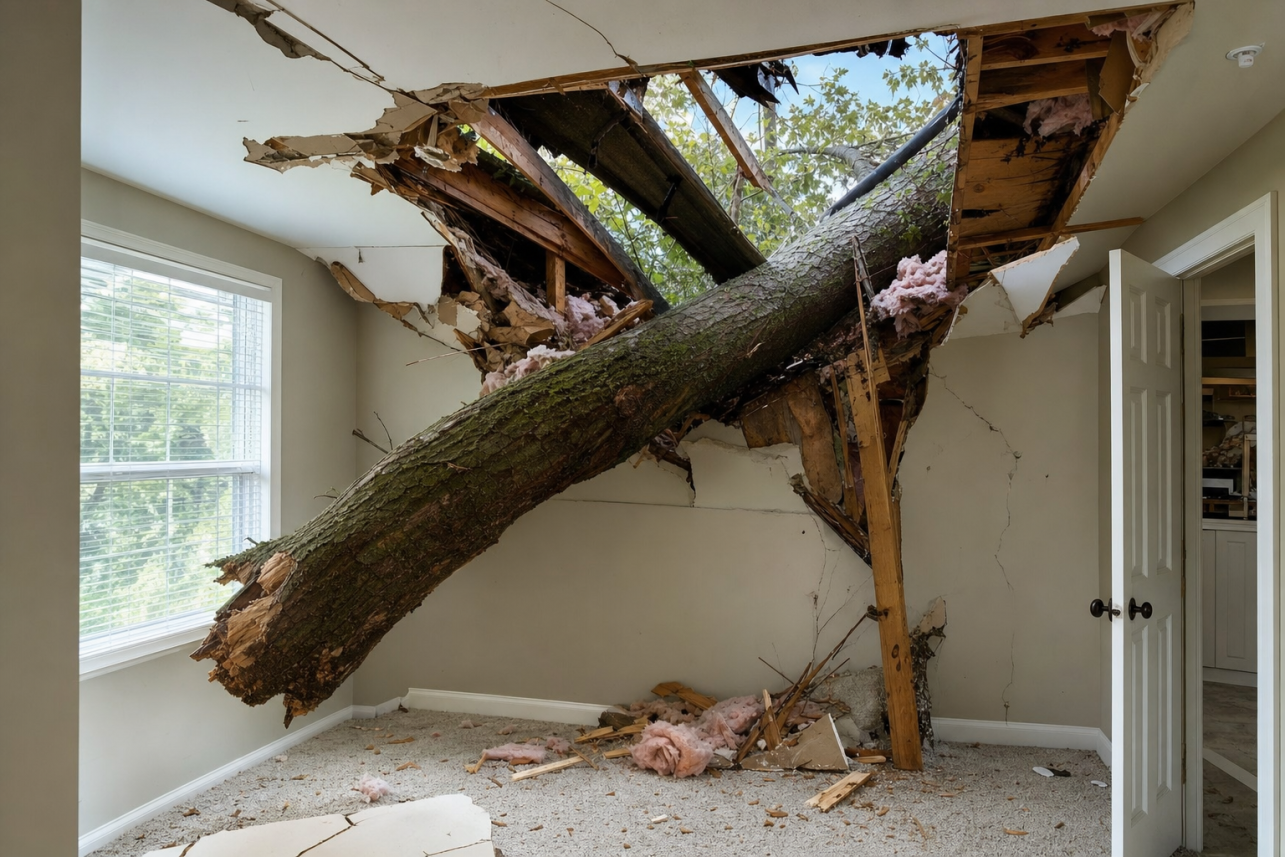
A tree fell on house insurance claim apex homeowners file is almost always covered under a standard policy — falling trees are a named peril, whether the tree was yours or your neighbor's. The real fight is rarely about coverage; it is about scope. Carriers routinely pay for the visible roof hole while missing cracked rafters, shifted framing, and interior water damage that follows the impact. For The Public Adjusters, Inc. is a licensed and bonded public adjusting firm that documents the full loss and negotiates directly with your insurance company on your behalf.
What This Service Is
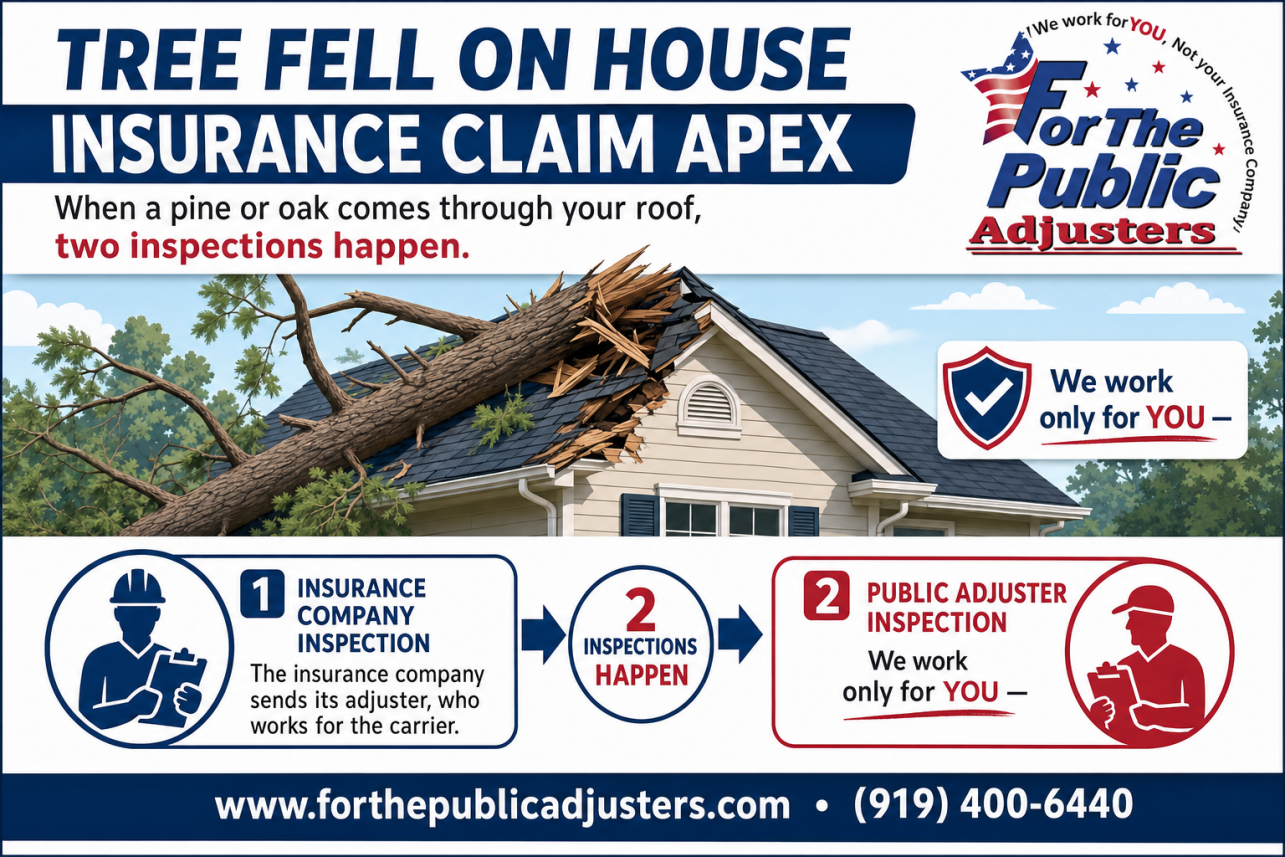
When a pine or oak comes through your roof, two inspections happen. The insurance company sends its adjuster, who works for the carrier. We work only for you — the policyholder.
Our job starts with a complete structural damage assessment: the roof deck, the trusses or rafters underneath, the ceilings, the walls the load transferred into, and everything the rain soaked after the hole opened up. Impact damage travels. A trunk that punches through one slope can rack framing two rooms away, and that never shows up in a quick ladder-level inspection.
From there we build the claim itself — the repair estimate, the contents inventory, the tree removal costs your policy allows, and the proof of loss the carrier requires. If the house is unlivable, we document your additional living expenses so the hotel, rental, and meal costs get claimed rather than absorbed. We handled a tree fell on house claim in Morrisville where the carrier's first estimate covered shingles and decking only; the full structural write-up changed the conversation entirely.
We handle residential and commercial losses alike, and we take on related claims — water damage from the breach, smoke or fire if a line arced when the tree came down. We do not handle vehicle, cell phone, health, or life claims, and we never guarantee a specific dollar outcome. What we guarantee is that your side of the file is complete.
Common Problems
What Will The Insurance Actually Pay — And Does It Cover Getting The Tree Off My House?
A standard homeowners policy pays to repair the structure, replace damaged contents, and remove the tree — though removal coverage often carries its own sub-limit, and many owners never learn it exists until the bill arrives.
The bigger money question is actual cash value versus replacement cost. If your policy pays replacement cost, the carrier owes what it costs to rebuild today, not a depreciated figure. Carriers frequently issue the depreciated amount first and quietly make you chase the rest after repairs.
Your deductible comes off the top, and that is normal. What is not normal is paying out of pocket for framing, insulation, or interior finishes the carrier's estimate simply skipped. A tree damage claim in Raleigh NC we reviewed had an initial estimate less than a third of the documented repair cost — the gap was entirely in items the first inspection never scoped.
What If My Tree Fell On House Insurance Claim Apex Adjusters Reviewed Comes Back Denied Or Underpaid?
Denials and lowball offers on fallen-tree losses usually follow a pattern. The carrier argues the tree was already dead or rotten and calls it neglect. Or it blames the roof's age and labels the damage wear and tear. Or it pays for the puncture but refuses the structural repairs around it, disputing the scope of damage rather than the coverage.
You can challenge all of this. A disputed estimate is not a final answer — it is an opening position. Independent documentation, storm dates, arborist findings, and a line-by-line rebuttal estimate are how underpaid claims get corrected.
Courts have long held carriers accountable for refusing to pay what a policy owes. In Gruenberg v. Aetna Insurance Co. (1973), the California Supreme Court ruled for a policyholder whose insurer withheld payment after his building burned, establishing that an insurance company breaches its duty of good faith when it unreasonably refuses to pay a covered loss. Bad faith is real, and insurers know it. If a dispute escalates beyond negotiation, we work alongside insurance dispute lawyers — but most underpaid files get fixed well before that point.
Do I Need My Own Adjuster, Or Can I Just Work With The One The Insurance Company Sends?
The carrier's adjuster is not neutral. They may be courteous and competent, but their estimate protects the company's interests, and their inspection is often brief — a tree-strike claim can get thirty minutes of attention and a roof-only write-up.
Handling it yourself is possible on a small, clean loss. But once there is structural damage, interior water intrusion, displaced living costs, or a depreciation holdback, you are negotiating against professionals who do this every day. Deadlines matter too — North Carolina policies set time limits for filing and for submitting proof of loss, and missing them can cost you the claim.
A good public adjuster inspects everything, writes a complete estimate, handles every call and letter, and is paid a percentage of the recovery — not an hourly fee. When vetting one, check licensing through the state. The NCDOI Public Adjusters Guide explains exactly how public adjusters are licensed and regulated in North Carolina, and any legitimate firm will welcome that scrutiny. We are licensed and bonded, and we tell homeowners honestly when a claim is too small to benefit from representation.
Our Process
Full Inspection And Documentation Of The Strike
We photograph and measure everything before repairs erase the evidence: the impact point, the framing beneath it, interior ceilings and walls, and every room rain reached. We also document the tree itself — species, condition, and where it stood — because that record defeats later arguments about neglect. On a tree damage house claim in Holly Springs, that pre-repair record was what kept hidden rafter damage in the settlement.
Emergency Protection And A Complete Claim Package
Your policy requires you to prevent further damage, so we make sure tarping and board-up happen fast and get billed to the claim, not to you. Then we assemble the estimate, contents inventory, removal costs, additional living expenses, and the formal proof of loss. A complete package filed on time removes the carrier's easiest reasons to stall or shortchange the file.
Negotiation Until The Numbers Match The Damage
We meet the carrier's adjuster on site, walk them through our scope item by item, and push back in writing on anything they cut. If they depreciate your roof or dispute structural repairs, we answer with documentation rather than frustration. We never promise a specific figure — no honest adjuster can — but we stay on the file until the offer reflects what the policy actually owes.
| Claim Step | Handling It Alone | With For The Public Adjusters |
|---|---|---|
| Damage inspection | Carrier adjuster's brief visit sets the scope; hidden truss and rafter damage is often missed | Full attic, framing, and interior inspection, with a structural engineer when the impact warrants it |
| Debris and tree removal | Homeowner often accepts the per-tree sublimit as the final word | Debris removal coverage, additional percentages, and liability recovery from a negligent tree owner are all pursued |
| Interior water damage | Easily denied as 'pre-existing' or 'wear and tear' | Moisture mapping and weather records tie interior damage to the covered roof breach on a specific date |
| Estimate and pricing | Carrier's software pricing, often below real Wake County contractor costs | Line-item scope written to local repair pricing, including code upgrades and matching issues |
| Negotiation | Homeowner argues with a trained adjuster while living under a tarp | A licensed, bonded adjuster who works only for the policyholder handles every call and re-inspection |
Commonly Overlooked In The Public Adjusting Industry
- Fractured trusses and rafters above the visible hole — Impact energy travels well beyond the puncture point, and nobody finds the cracks unless someone actually climbs into the attic with a light.
- Debris removal coverage stacked on top of the dwelling limit — Most policies add an extra percentage specifically for debris removal, but carriers rarely volunteer it and homeowners don't know to ask.
- The per-tree removal sublimit versus the real crane bill — Policies often cap tree removal at $500 or $1,000 per tree while a crane lift over an Apex rooftop can cost several times that, and the gap is frequently recoverable elsewhere in the policy or from a negligent tree owner.
- Shingle matching when the product is discontinued — A patch on a discontinued architectural shingle leaves a visible mismatch, and insureds routinely accept a patch estimate without knowing matching rules may support replacing the full slope.
- Ordinance or law coverage for code upgrades — Repairs to an older Apex roof may trigger current Wake County code requirements, and that added cost is covered under a separate provision most first estimates ignore.
- Water migration into wall cavities before tarping — Rain entering during the hours or days before emergency tarping soaks insulation and framing out of sight, and untreated moisture becomes a mold problem the carrier later blames on the homeowner.
- Additional living expenses when the home is unsafe — Families stay in a structurally compromised house because no one told them the policy pays for temporary housing while the roof structure is repaired.
- The negligent-neighbor recovery path — If the tree's owner had prior written warning the tree was hazardous, the deductible and amounts above sublimits may be recoverable — a second claim most homeowners never file.
Case Studies
Case Study #1
Situation: When the remnants of a hurricane tracked over Wake County, a mature willow oak split and dropped a limb the size of a small tree onto a two-story home in the Scotts Mill area of Apex. The limb punched through the shingles and decking directly above the master bedroom.
Problem: The carrier's adjuster spent twenty minutes on site, approved emergency tarping, and wrote an estimate for a 10-by-10 patch of shingles and one sheet of decking. The homeowners' contractor said the real repair was far larger, but the insurer refused to revisit the estimate.
Investigation: We performed a full roof-to-foundation inspection, opened the attic above the impact zone, and brought in a structural engineer. We also moisture-mapped the master bedroom ceiling and walls, because the roof had been open to rain for two days before tarping.
Findings: Two roof trusses were fractured at the top chord, the impact had shifted the ridge line, and water had migrated into the wall cavities behind the crown molding. The existing architectural shingles were discontinued, meaning a patch could never match the surrounding slopes. None of this appeared in the carrier's estimate.
Solution: We rewrote the scope to include engineered truss repairs, full slope replacement based on the matching problem, interior drywall and insulation replacement, and the debris removal coverage the policy provided on top of the dwelling limit. We presented the engineer's report and photo documentation at a re-inspection we scheduled with the carrier.
Outcome: The carrier issued a revised settlement many times the original estimate, covering the structural repairs, the full roof slopes, the interior water damage, and tree debris removal. The family completed repairs without paying for structural work out of pocket. Every claim is different and results vary, but the difference here came entirely from documentation the first estimate never captured.
Lesson: A tree strike is almost never a shingle problem. The energy of impact travels into framing, and the first estimate after a fast inspection rarely reflects it. North Carolina courts have long sided with policyholders who push back on lowball valuations — in Surratt v. Grain Dealers Mutual Insurance Co., the North Carolina Court of Appeals upheld a homeowner's right to recover under the policy's replacement-cost provisions after the insurer tried to pay less than the cost to actually rebuild.
Case Study #2
Situation: During a January ice storm, a loblolly pine on a neighbor's lot snapped under ice load and fell across the roof and rear deck of a home near Haddon Hall in Apex. The trunk crushed a section of the rear roof plane and tore the gutter system off two elevations.
Problem: The insurer accepted the roof impact but denied the interior ceiling and hardwood floor damage, claiming the staining was 'pre-existing wear and long-term seepage.' They also capped tree removal at a $500-per-tree sublimit and told the owners the neighbor's insurance was 'not their problem.'
Investigation: We pulled weather data for the storm date, photographed fresh fracture surfaces on the trunk showing healthy wood, and documented the direct path from the roof breach to the stained ceiling and cupped flooring below. We separated tree debris removal from storm debris removal, which many policies treat differently, and reviewed the neighbor's potential negligence since the pine had been flagged by an arborist the prior year.
Findings: The interior damage pattern matched a single sudden water event, not long-term seepage — the stain edges, moisture readings, and flooring cupping all dated to the storm. The arborist's prior written warning to the neighbor opened a legitimate negligence recovery path for the deductible and amounts above policy sublimits.
Solution: We submitted a rebuttal package tying the interior damage to the covered roof breach, invoked the appraisal provision in the policy when the carrier held its position, and simultaneously documented the negligence claim against the neighbor's liability coverage for the uncovered portions.
Outcome: The appraisal process resolved in the homeowners' favor on the interior scope, and the neighbor's carrier reimbursed the deductible and excess tree removal costs. The owners replaced the roof section, ceiling, and flooring in full. We never promise a specific result, but a documented timeline is very hard for a carrier to argue against.
Lesson: When a neighbor's tree falls on your home, your own policy usually pays first — but if the neighbor knew the tree was hazardous, you may have a second recovery path most homeowners never pursue. Denials based on 'pre-existing damage' can often be overcome with moisture mapping and weather records that pin the loss to a single date.
| Scenario | Who Typically Pays | What It Depends On |
|---|---|---|
| Your tree falls on your house | Your homeowner's policy | Whether the cause was a covered peril such as a hurricane, tornado, or ice storm, and your deductible amount |
| Neighbor's tree falls on your house | Your policy first; neighbor's liability coverage second | Whether the neighbor had notice the tree was dead, diseased, or hazardous — that can recover your deductible and sublimit gaps |
| Your tree falls on a neighbor's house | The neighbor's policy, unless you were negligent | Prior arborist warnings, visible decay, or ignored complaints about the tree's condition |
| Tree falls on a detached garage or shed | Your policy's 'other structures' coverage | The other-structures limit, usually 10% of the dwelling limit, which can be exhausted quickly |
| Tree falls in the yard but hits nothing | Usually not covered for removal | Some policies pay if the tree blocks a driveway or a handicap-access ramp; otherwise removal is typically out of pocket |
| Tree falls on fences or landscaping | Your policy, within tight sublimits | Per-tree and per-item caps on landscaping, often $500 to $1,000, and whether the peril is covered |
| Tree falls on a vehicle | The vehicle's auto comprehensive coverage | This runs through auto insurance, not the homeowner's policy — it falls outside the claims we handle |


Reviews
A hickory came down on our roof during the hurricane remnants last fall and our insurance company offered barely enough to patch the hole. For The Public Adjusters found two cracked rafters and water damage inside the wall that the company adjuster never even looked for. The final settlement covered the real repair, not a band-aid. I wish we had called them the day the tree fell instead of three weeks later.
Melissa T., Apex
Our neighbor's pine crushed the corner of our garage and the insurer tried to cap the tree removal at $500 when the crane bill alone was over $2,000. This team knew exactly where the debris removal coverage was hiding in our policy and got the removal and the structural repair handled. They explained every step in plain English and dealt with the insurance company so we didn't have to.
Derrick and Anna W., Scotts Mill
The ice storm dropped a huge limb through our roof over the kitchen. The first estimate from the insurance company didn't include the ceiling, the cabinets that took water, or matching the discontinued shingles. For The Public Adjusters documented everything, brought in an engineer, and the revised payment was dramatically different. Honest about what they could and couldn't do from day one, which I appreciated.
Raj P., Apex
Frequently Asked Questions
What Should I Do First With A Tree Fell On House Insurance Claim Apex Homeowners Are Facing?
Your first priority is safety. If a tree has punctured the roof or walls, keep everyone out of the affected rooms and have the power shut off to that part of the home if wiring may be damaged. Then document everything before anything is moved — photos and video of the tree, the point of impact, interior damage, and any wet or crushed contents.
North Carolina policies require you to take reasonable steps to prevent further damage, so emergency tarping of the roof is usually necessary. Keep every receipt for tarps, board-up work, and tree removal, because those costs are typically reimbursable under your policy.
Notify your insurance carrier promptly, but be careful with recorded statements before you understand your coverage. Adjusters for the carrier often scope these losses quickly and miss hidden structural damage — cracked rafters, shifted trusses, and water intrusion inside wall cavities are common in Apex homes after hurricane and tornado events.
This is where a licensed, bonded public adjuster earns their fee. For The Public Adjusters, Inc. documents the full scope of structural, roofing, and contents damage before repairs erase the evidence. Courts have long sided with policyholders who push back on incomplete settlements — in Cedar Bluff Townhome Condominium Ass'n v. American Family Mutual Insurance Co. (Minn. 2014), the court ruled the insurer had to replace all the building's siding so the repair matched, not just patch the damaged section. The same matching principle matters when a tree destroys part of a roof in Wake County.
Does Homeowners Insurance Cover Tree Removal And Roof Repair After A Tree Hits My Apex Home?
In most cases, yes — when a tree strikes a covered structure, a standard homeowners policy pays for removal of the tree from the structure, repair of the roof and framing, interior water damage that resulted from the opening, and damaged contents. Causes tied to hurricanes and tornadoes, which Wake County knows well from storms like Fran and the April 2011 tornado outbreak, are typically covered perils.
Where homeowners get shortchanged is in the scope. Carriers often pay to patch a roof section rather than replace it, ignore cracked trusses hidden under shingles, or lowball the cost of matching materials. Tree removal limits are another trap — many policies cap removal at $500 to $1,000 per tree unless it struck a covered structure, so how the loss is written up matters enormously.
Note that if a tree falls in your yard without hitting anything insured, coverage is far more limited. And if flooding accompanied the storm, that portion of the loss falls under a separate flood policy through the NFIP, not your homeowners coverage — FEMA and FloodSmart.gov are the right resources for that piece.
For The Public Adjusters, Inc. is licensed and bonded, and we work only for the policyholder, never the carrier. We can't promise a specific dollar outcome — no honest adjuster can — but we can make sure every covered dollar of damage is documented, claimed, and supported before you settle.
The Insurance Company's Offer Won't Cover My Repairs In Apex. What Are My Options?
A low first offer is common, not final. In North Carolina you have the right to dispute the carrier's estimate, submit your own documentation, and invoke the appraisal clause in most policies when the two sides disagree on the amount of loss. You are not obligated to accept the first check — and cashing an undisputed portion generally doesn't close your claim.
The gap usually comes from scope, not price. When a mature oak or pine comes through a roof in an older Apex neighborhood, the visible hole is only part of the loss. Shifted load-bearing framing, separated drywall seams two rooms away, and moisture inside insulation often go unlisted on the carrier's estimate. A detailed, line-item rebuttal estimate changes the conversation.
Policyholders who push back with evidence have strong footing. In Mills v. Foremost Insurance Co. (11th Cir. 2008), homeowners whose property was damaged in a hurricane won the right to pursue payment the insurer had withheld for overhead, profit, and taxes on repairs — costs the carrier argued it didn't owe until repairs were complete. The court sided with the insureds.
As your public adjuster in Apex, For The Public Adjusters, Inc. re-scopes the entire loss, prepares the supporting estimate, and negotiates directly with the carrier on your behalf. We never guarantee a specific result, but we make certain nothing covered is left off the table.
My Neighbor's Tree Fell On My House — Whose Insurance Pays, And How Does The Claim Work?
This surprises most Wake County homeowners: in nearly every case, your own homeowners policy pays, even when the tree belonged to your neighbor. A tree that falls during a hurricane, tornado, or ice storm is treated as an act of nature, and each owner's policy covers their own property.
The exception is negligence. If the tree was visibly dead or diseased and your neighbor had been warned about it, your carrier may pay your claim and then pursue the neighbor's liability insurance through subrogation. Save any emails, texts, or photos showing the tree's condition before it fell — that evidence can affect whether your deductible is eventually recovered.
Either way, the claim process is the same on your end. Document the damage thoroughly, mitigate further loss with tarping, keep receipts, and report the loss promptly. Where it gets complicated is the scope: impact damage, water intrusion through the opening, damaged contents, and sometimes additional living expenses if a room is unusable all belong in a single, well-organized claim file.
A tree fell on house insurance claim Apex policyholders handle on their own frequently settles for less than the true repair cost simply because hidden damage was never documented. For The Public Adjusters, Inc. inspects the full structure, inventories damaged contents, and builds the claim before the carrier's number is locked in. We're licensed and bonded, we work exclusively for policyholders, and our fee comes from the recovery — we don't get paid unless you do.
How Long Should A Tree Damage Claim Take To Settle In Apex, And What Slows It Down?
In North Carolina, insurers are expected to acknowledge your claim promptly and investigate within a reasonable time, and the Department of Insurance watches for unreasonable delays. In practice, a straightforward tree-strike claim in Apex often resolves in 30 to 60 days, while claims with structural damage, disputed scope, or engineering reports can stretch to several months.
The most common delays we see in Wake County involve the carrier's first estimate missing hidden damage. A trunk that punches through decking often cracks rafters, shifts framing, and tears underlayment well beyond the visible hole. If the adjuster only prices shingles and a tarp, you end up in rounds of supplements, and each supplement adds weeks.
Moisture is the other time thief. Apex humidity means saturated insulation and sheathing can grow mold quickly, and remediation disputes drag out negotiations. Documenting moisture readings early keeps the file moving.
Courts have made clear that insurers who drag their feet or underpay do so at their own risk. In Vail v. Texas Farm Bureau Mutual Insurance Co., the Texas Supreme Court sided with homeowners after their carrier wrongfully refused to pay a residential loss in full, holding the insurer liable for the damages its denial caused. That precedent reflects a principle policyholders everywhere can lean on: carriers owe a duty of good faith.
As licensed and bonded public adjusters, we build a fully documented claim from day one — photos, measurements, moisture logs, and a line-item estimate — so there is less for the carrier to question and fewer reasons for the file to stall.
What Does A Public Adjuster Actually Do On A Tree Fell On House Insurance Claim Apex Residents File?
A public adjuster works only for you, the policyholder — never the insurance company. On a tree fell on house insurance claim Apex homeowners bring us, our job is to document the full loss, interpret your policy, prepare a detailed estimate, and negotiate with the carrier's adjuster until the settlement reflects what the repairs genuinely cost in Wake County.
The carrier's adjuster may inspect the roof for twenty minutes. We spend hours. We photograph the impact zone, trace cracked rafters and trusses into the attic, take moisture readings where rain entered, and inventory damaged contents room by room. Then we write a line-item estimate using local Apex labor and material pricing, not a generic database figure.
We also read the policy itself — dwelling limits, debris removal allowances, tree removal sublimits, ordinance and law coverage, and additional living expense provisions if your family can't stay in the home. Many homeowners never realize they have coverage for a hotel stay or code-required upgrades until someone points it out.
From there, we handle the paperwork, the proof of loss, the inspections, and every negotiation call. You review and approve; we do the legwork. We're licensed and bonded in North Carolina, and we work on your behalf from the first inspection to the final payment.
We can't promise a specific dollar outcome — no honest adjuster can — but we can promise the claim will be documented thoroughly and argued professionally, which is what a fair settlement requires.
Can My Insurer Deny My Apex Claim By Saying The Tree Was Dead Or Rotten Before It Fell?
This is one of the most common pushbacks we see on tree claims in Apex, and it deserves a careful response rather than quick acceptance. Carriers sometimes argue that a dead or decayed tree was a maintenance issue you should have addressed, and that the resulting damage is therefore excluded as neglect.
Here's the key point: the burden sits differently than many homeowners assume. The damage to your home — the crushed roof, broken framing, and wet interior — is still a sudden, accidental loss to the dwelling. For a neglect-based denial to hold up, the carrier generally has to show you knew the tree was hazardous and unreasonably ignored it. A tree that looked healthy from the ground, with internal rot no homeowner could see, is a very different situation from one a certified arborist formally warned you about.
When we handle these disputes, we gather evidence on your side: photos of the fallen trunk, an arborist's opinion on whether decay was visible externally, and any records showing routine yard care. That documentation often dismantles the denial argument.
Policyholders who push back can and do win. In Vail v. Texas Farm Bureau Mutual Insurance Co., 754 S.W.2d 129 (Tex. 1988), homeowners whose residential property loss was wrongfully denied took their carrier to court — and the state's highest court ruled for the insureds, holding the insurer accountable for failing to pay what the policy owed.
If you've received a denial letter citing the tree's condition, don't sign anything or accept it as final. Get the denial reviewed by a licensed and bonded public adjuster before the deadline to dispute passes.

The Tree Opened My Roof And Rain Soaked The Interior — Is That Water Damage Covered, And What About Flooding?
Rain that enters through a hole the tree created is typically covered, because the storm opened the building envelope. That means soaked drywall, insulation, flooring, and damaged furniture inside the breach are usually part of the same claim as the roof itself. Document everything fast — in Apex's climate, wet materials can develop mold within days, and carriers scrutinize mold-related costs closely.
There's an important distinction, though. Water falling in through the roof is one thing; water rising from the ground is another. If a storm also pushed surface water or an overflowing creek into your home, that's flood damage, and standard homeowners policies exclude it. Flood losses are handled through separate flood insurance, most commonly a National Flood Insurance Program policy. If that applies to you, FEMA (fema.gov) and the NFIP (floodsmart.gov) are the right starting points for that portion of the loss.
On the covered portion, be thorough. Photograph water lines on walls, pull back carpet to show wet pad, and keep damaged contents until the adjuster documents them. Save receipts for emergency tarping, water extraction, and dehumidifiers — reasonable mitigation costs are generally reimbursable, and your policy actually requires you to prevent further damage.
Where homeowners get shortchanged is scope: a carrier may pay to dry a room but not to replace insulation that stays saturated inside the wall cavity. Moisture meter readings and infrared imaging settle those arguments with data. That's exactly the documentation our Apex team builds into every interior water loss tied to a fallen tree, so the hidden damage gets counted alongside the obvious damage.
How Does Depreciation Work On A Tree Fell On House Insurance Claim Apex Homeowners File?
Most homeowners policies in Apex pay claims in two stages. The insurer first issues an actual cash value (ACV) payment — the cost to repair your roof, framing, and siding minus depreciation for age and wear. Once repairs are complete, you can recover the withheld depreciation if your policy includes replacement cost coverage, which most Wake County policies do.
The problem is how aggressively some carriers depreciate. We regularly see adjusters apply steep depreciation to a fifteen-year-old architectural shingle roof that had decades of life left, or depreciate labor costs in ways North Carolina policyholders can and should challenge. Every dollar of excess depreciation is a dollar out of your pocket until — and sometimes unless — you fight for it.
There are also deadlines. Policies typically require you to complete repairs and claim the recoverable depreciation within a set window, often 180 days to a year from the ACV payment. Miss it, and the carrier may refuse to release those funds.
As licensed and bonded public adjusters, we review the depreciation schedule line by line, verify the age and condition of each damaged component, and document why the carrier's numbers are wrong when they are. We cannot guarantee a specific outcome on any claim, but we can make sure the depreciation applied to your home reflects reality rather than a software default. If a tree has opened up your roof, do not accept the first depreciation calculation as final — it is frequently the most negotiable number in the entire estimate.
The Tree Crushed Part Of My Roof And Damaged Furniture And Belongings Inside. How Do I Document Personal Property Losses?
Your contents claim is separate from the structural claim, and it lives or dies on documentation. Start by photographing everything where it sits — the crushed dresser under the broken rafters, the water-stained books, the insulation and debris on the bedding. Do not throw anything away until the insurance adjuster has seen it or you have written permission to dispose of it.
Next, build a room-by-room inventory. For each item, record a description, brand and model if known, approximate purchase date, original cost, and the replacement cost today. Pull receipts, credit card statements, and old photos of the rooms to support values. Apex homeowners often forget items stored in attics and closets that a falling tree destroys — check those spaces carefully.
Like the structure, contents are usually paid at actual cash value first, with depreciation held back until you actually replace the items. Carriers frequently over-depreciate contents, assigning short lifespans to furniture and electronics that were in excellent condition.
The courts have long sided with policyholders who properly prove their losses. In State Farm Fire & Casualty Co. v. Von Der Lieth (1991), the California Supreme Court ruled in favor of homeowners whose insurer had denied coverage for serious damage to their house, affirming that the insured's documented loss was covered. The lesson carries everywhere: thorough proof puts the burden back on the carrier. Our team prepares detailed contents inventories for tree-strike claims across Wake County so nothing damaged inside your home gets overlooked or undervalued.
The Tree Only Destroyed Part Of My Roof. Can The Insurer Patch It With Shingles That Don't Match The Rest?
This is one of the most common disputes we handle on tree-strike claims in Apex. The carrier wants to replace only the slope the tree hit, but your shingles were discontinued years ago, or the new ones will never match the weathered originals. You end up with a two-tone roof that hurts your home's appearance and resale value.
North Carolina does not have a statute that forces full replacement in every mismatch situation, so the outcome depends heavily on your specific policy language, whether matching materials are reasonably available, and how the damage is documented. Some policies include matching endorsements; others limit the carrier's obligation. Many carriers will extend replacement to a full slope, or the entire roof, when it is demonstrated that a reasonable match cannot be achieved — but they rarely volunteer that.
The same issue arises with siding, gutters, and fascia a falling tree tears away. Discontinued vinyl siding profiles are a frequent problem on Apex homes built in the 1990s and 2000s.
We document discontinued materials through supplier letters and independent testing, photograph the mismatch, and press the carrier using the actual policy language rather than its first position. We never promise a particular result — no honest adjuster can — but we make sure the matching question is argued on evidence instead of being waved away. If you have been told a patch is all you are owed, have the estimate and your policy reviewed before you sign anything or cash a final check.
What Does It Cost To Hire A Public Adjuster, And When Is It Worth It After A Tree Hits My Home?
On a tree fell on house insurance claim Apex policyholders typically pay a public adjuster a percentage of the recovered settlement — there is no hourly billing and no upfront fee in most cases. North Carolina caps and regulates these fees, and the agreement must be in writing before any work begins, so you know the terms from day one.
It tends to be worth it when the damage is structural or complicated. A tree through the roof often involves fractured trusses, shifted framing, interior water intrusion, insulation replacement, and code-required upgrades — items a quick carrier inspection can miss or underestimate. It also makes sense when the hurricane that dropped the tree, such as the remnants storms that regularly cross Wake County, damaged thousands of homes at once and carrier adjusters are stretched thin and moving fast.
For very small claims near your deductible, hiring anyone may not make financial sense, and we will tell you that honestly in a free review. We handle property claims only — homes, buildings, and contents — not auto, health, or life matters.
For The Public Adjusters, Inc. is licensed and bonded in North Carolina. We inspect the damage ourselves, write an independent estimate, manage every call and document, and negotiate directly with the carrier so you are not arguing with a professional adjuster alone. We cannot guarantee any specific settlement amount, but we can guarantee your claim will be fully documented and professionally presented — which is exactly what an underpaid tree-strike claim is usually missing.
My Apex Home Isn't Safe To Live In After The Tree Came Through The Roof. Who Pays For Temporary Housing?
If a fallen tree makes your home uninhabitable, the Additional Living Expenses (ALE) portion of your homeowners policy — sometimes called Loss of Use coverage — should pay the reasonable extra costs of living elsewhere while repairs are made. That typically includes hotel stays, a short-term rental in Wake County, extra mileage, pet boarding, and the increase in food costs if you're eating out instead of cooking.
The key word is "extra." ALE covers the difference between your normal living costs and what you're spending now. Keep every receipt from day one, including the night the tree fell, because insurers routinely push back on undocumented expenses.
Two problems come up constantly on tree claims in Apex. First, adjusters sometimes declare a home "livable" even when the roof is tarped, power is off to part of the house, or interior rooms are soaked. If a licensed contractor or building official says otherwise, that opinion carries weight. Second, insurers may cut off ALE before repairs are actually done, arguing the work should have been finished sooner — even when the delay was caused by their own slow approvals.
As licensed and bonded public adjusters, we document habitability with photos, moisture readings, and contractor statements, then track ALE spending so nothing is left on the table. We can't promise a specific outcome on any claim, but we can make sure your displacement costs are fully presented and supported, not just the structural repair.
The Tree Also Crushed My Detached Garage And Fence — Does A Tree Fell On House Insurance Claim Apex Homeowners File Cover Other Structures Too?
In most cases, yes — but through a different part of your policy. Standard homeowners policies split property into Coverage A (the dwelling itself) and Coverage B (other structures), which covers detached garages, fences, sheds, gazebos, decks not attached to the house, and similar improvements. Coverage B is usually capped at 10% of your dwelling limit, so a $400,000 dwelling policy typically carries $40,000 for other structures.
That cap matters in Apex, where mature oaks and pines can flatten a detached garage outright. If the garage alone costs $55,000 to rebuild, the Coverage B limit — not the repair estimate — controls what the insurer owes for it.
A few practical points. Each structure's damage should be scoped separately, including concrete slabs, garage doors, electrical runs from the house, and fencing by the linear foot. Debris removal for trees that hit a covered structure is generally included, though sub-limits often apply per tree and per occurrence. And don't let an adjuster lump a fence "repair" into a quick allowance when entire sections need replacement to match the remaining fence.
We inventory every structure on the property, measure it, and price it against current Wake County construction costs before the insurer sets its number. Note that we handle property claims only — never claims involving motor vehicles, so if the tree also hit a car in the driveway, that portion goes through your auto carrier separately.
I Already Settled My Tree Claim, But My Contractor Found More Damage Once Repairs Started. Can I Reopen It?
Usually, yes. Accepting a claim payment is not the same as signing a release, and most homeowners policies allow supplemental claims when additional covered damage is discovered. On a tree fell on house insurance claim Apex contractors frequently find hidden problems only after opening things up — cracked rafters and trusses under the sheathing, sheared framing connections, wet insulation, or decking damage the original adjuster never saw from the ground.
The process is to document the newly discovered damage immediately, in place, before it's repaired. Photograph it, have the contractor write up what was found and where, and submit a supplement with an itemized estimate. Time limits apply, so don't sit on it; North Carolina policies contain contractual deadlines for submitting proof of loss and filing suit.
Supplements are also where underpayment on the original settlement gets corrected. Courts have repeatedly sided with homeowners who challenged how carriers calculated payments on structural claims. In Sproull v. State Farm Fire & Casualty Co. (Illinois Supreme Court, 2021), the policyholder prevailed when the court held the insurer could not depreciate labor costs when paying actual cash value on a property damage claim — a practice that had quietly shrunk settlements on exactly this kind of loss.
We review closed and underpaid tree claims throughout Apex and Wake County, re-scope the damage, and present the supplement with supporting documentation. We're licensed and bonded, and while no one can guarantee a specific recovery, a properly built supplement is often the difference between a patched house and a correctly repaired one.
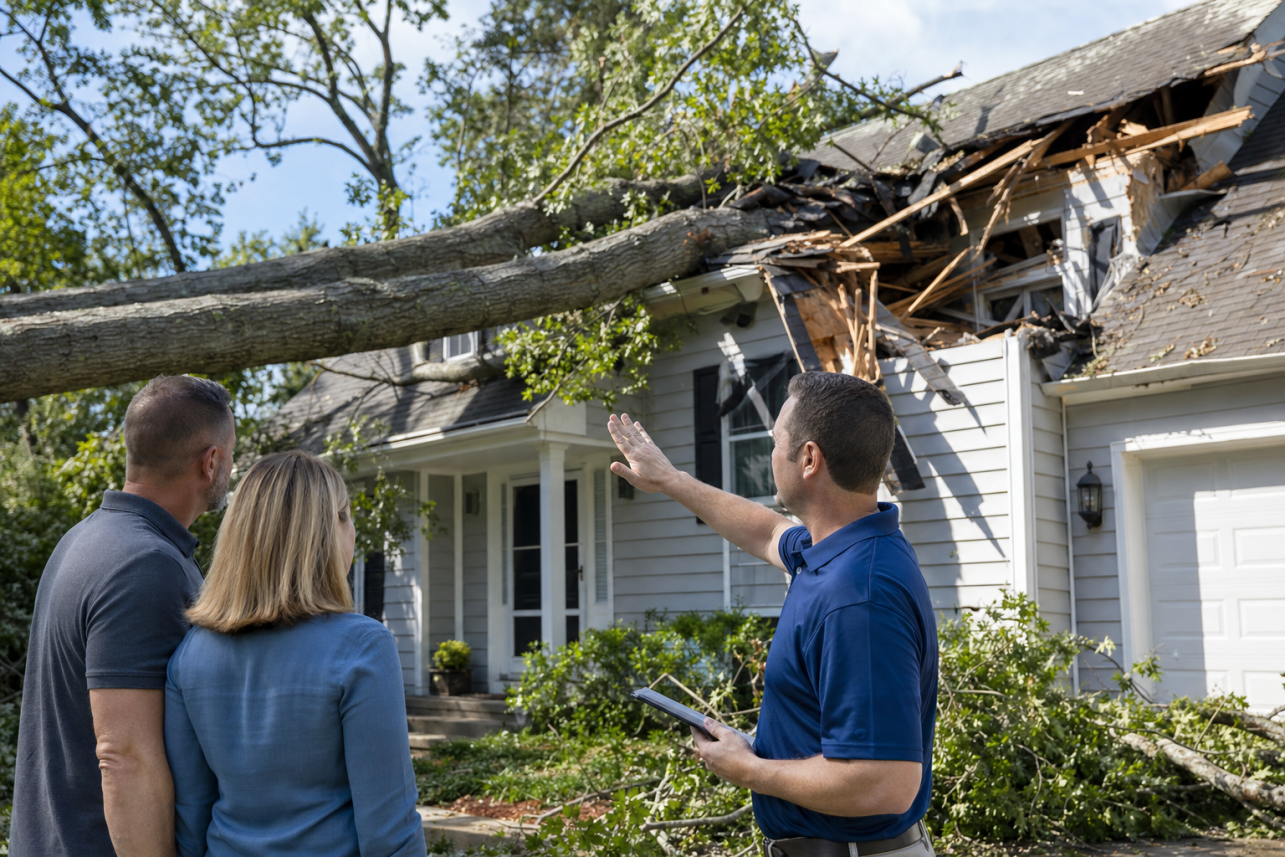
Should I Cash The Insurance Company's First Check Or Sign Their Paperwork Before Repairs Begin?
Be careful here. In North Carolina, cashing an initial claim check generally does not close your claim or waive your rights — but you should read every document that comes with it. If the check is marked "full and final settlement" or arrives with a release form, do not sign or deposit anything until you understand what you're giving up.
First checks on tree-damage losses in Apex are frequently based on a single, early inspection done before anyone opened the roof or ceiling. They often omit structural framing repairs, code-required upgrades, interior finishes, and proper debris removal. The carrier may also hold back recoverable depreciation that you can collect later, which confuses many homeowners into thinking the first check is all they'll ever get.
Also be cautious with recorded statements and the sworn proof of loss. You have a duty to cooperate with your insurer, but you're entitled to be accurate rather than rushed. Guessing at the age of your roof or the timeline of the damage on a recorded call can haunt the claim later.
Before accepting any figure, get a detailed repair estimate from a qualified Wake County contractor and compare it line by line against the insurer's scope. If the gap is significant, that's precisely when an independent review helps. For The Public Adjusters, Inc. is licensed and bonded, we work only for policyholders — never the carrier — and we'll tell you honestly whether the offer in hand is reasonable or worth challenging. We never promise a particular result, only a thorough, documented claim.
Local Relevance
Apex sits in a part of Wake County where tall, mature loblolly pines tower over rooftops in nearly every established neighborhood. Those pines are shallow-rooted for their height, and when saturated ground meets a hurricane remnant pushing up from the coast, they come down — often straight through a roof.
The Triangle's tree-strike seasons are predictable: late-summer and fall tropical systems, spring thunderstorms that occasionally spin up tornadoes, and winter ice that loads limbs until they snap. Ice-related strikes are chronically underpaid here because carriers treat them as minor one-off events rather than structural impacts.
Much of Apex's housing went up during the building boom of the late 1990s and 2000s, which means two things: the trees planted or left standing then are now at full height, and the original builder-grade roofs are at the age where carriers reach for the wear-and-tear argument on every claim. Tying the damage to a specific storm with documentation is how that argument gets beaten. We see the same dynamics across the Triangle — a tree fell on house insurance in Chapel Hill case often turns on the very same roof-age dispute.
One more local reality: storm paths here are narrow. One Apex street can take three tree strikes while the next cul-de-sac is untouched, so "nobody else in the neighborhood filed" means nothing about your claim's validity.
Whole Apex subdivisions were built together in the late '90s through mid-2000s, so the loblollies left on those lots matured together too — and when one comes through a roof of that era, carriers reliably try to split the file, paying for the puncture while writing off surrounding roof damage as age. Documenting the storm date and the impact's full structural reach is usually the difference between a patch job and a proper repair.
A Tree Came Through Your Roof — Don't Let The Estimate Stop At The Shingles
Before you accept the carrier's number or sign off on repairs, let us inspect the full extent of the damage. For The Public Adjusters, Inc
Call us: (919) 400-6440
Helpful Resources
- NCDOI Public Adjusters Guide
- Insurance Information Institute (III)
- North Carolina Department of Insurance — State regulator for insurance and adjuster licensing
- Insurance Information Institute — Consumer education on homeowners coverage and claims
Last updated: October 5, 2026