A public adjuster Knightdale NC homeowners hire works for you — not the insurance company — to document, value, and negotiate your property damage claim. For The Public Adjusters, Inc. is licensed and bonded, and we handle residential and commercial claims across Knightdale and Wake County, from fire and smoke to water, tree, and flood losses. If your settlement offer feels low or your claim has stalled, we step in as your advocate and manage the process from inspection through final payment.
What This Service Is
When a fire, burst pipe, fallen tree, or storm damages your home or business, your insurance company sends its own adjuster to assess the loss. That adjuster is paid by the insurer. A public adjuster is the opposite: a licensed professional who represents the policyholder exclusively.
Our job starts with a careful reading of your policy — the coverages, endorsements, and deadlines most homeowners never look at until disaster strikes. We then document the full scope of damage, including things carrier adjusters commonly miss: smoke residue inside wall cavities, moisture trapped under flooring, and structural issues hidden behind an intact-looking roof.
From there, we prepare a detailed, line-item estimate and negotiate directly with your insurance company on your behalf. The NCDOI Public Adjusters Guide explains how public adjusters are licensed and regulated in North Carolina, and it is worth reading before you sign any contract — with us or anyone else.
We handle fire, smoke, water, hurricane and tornado wind damage, tree damage, vandalism, arson claims where you are the innocent policyholder, car-hits-home losses, commercial business claims, and flood claims including NFIP policies. We do not handle claims involving vehicles themselves, health, life, or cell phones — property damage to buildings and contents is our entire focus.
Common Problems
What Does Hiring A Knightdale Public Adjuster Cost — And Is It Actually Worth It?
Public adjusters in North Carolina typically work on a contingency fee — a percentage of the claim settlement, agreed to in writing before any work begins. There is no hourly bill and no upfront retainer with our firm. If the claim pays nothing, you owe nothing.
Is it worth it? That depends on the loss. For a small, straightforward claim, you may not need us, and we will tell you so honestly. For significant fire, water, or structural losses, the gap between an insurer's first offer and a fully documented claim is often substantial — though no adjuster can guarantee a specific outcome, and you should be wary of anyone who promises one.
The real value is scope: catching covered damage the carrier's estimate left out, applying your policy's replacement-cost and code-upgrade provisions correctly, and not leaving contents or additional living expenses on the table.
The Insurance Company Is Delaying, Disputing, Or Lowballing My Claim. Now What?
This is the most common reason Knightdale policyholders call us. A claim sits for weeks without a decision. An estimate covers shingles but ignores the cracked rafters underneath. A water loss gets blamed on 'long-term seepage' to avoid paying.
You have more leverage than you think. Courts have repeatedly held insurers accountable for mishandling property claims. In Bi-Economy Market, Inc. v. Harleysville Insurance Co., the New York Court of Appeals ruled in favor of a business owner whose fire and smoke damage claim was underpaid and delayed, holding that the insurer could be liable for consequential damages caused by its failure to pay promptly. Cases like that exist because insurers do sometimes get it wrong.
Our role is to rebuild the claim on evidence: photographs, moisture readings, engineering input where needed, and a line-by-line rebuttal of the carrier's estimate. A well-documented file changes the conversation.
How Do I Choose A Public Adjuster Knightdale NC Property Owners Can Actually Trust?
Start with licensing. North Carolina requires public adjusters to be licensed, and you can verify any license through the state insurance department before signing anything. We are licensed and bonded, and we encourage you to check.
Ask what types of losses the adjuster actually handles. A firm that spends its time on fire, water, smoke, tree, and flood claims to homes and buildings will read your situation faster than a generalist. Ask who will inspect your property in person — it should not be a phone-only relationship.
Finally, be cautious of anyone who guarantees a dollar figure or pressures you to sign on the spot after a loss. A reputable adjuster explains the fee, the process, and the realistic range of outcomes, then lets you decide.
Our Process
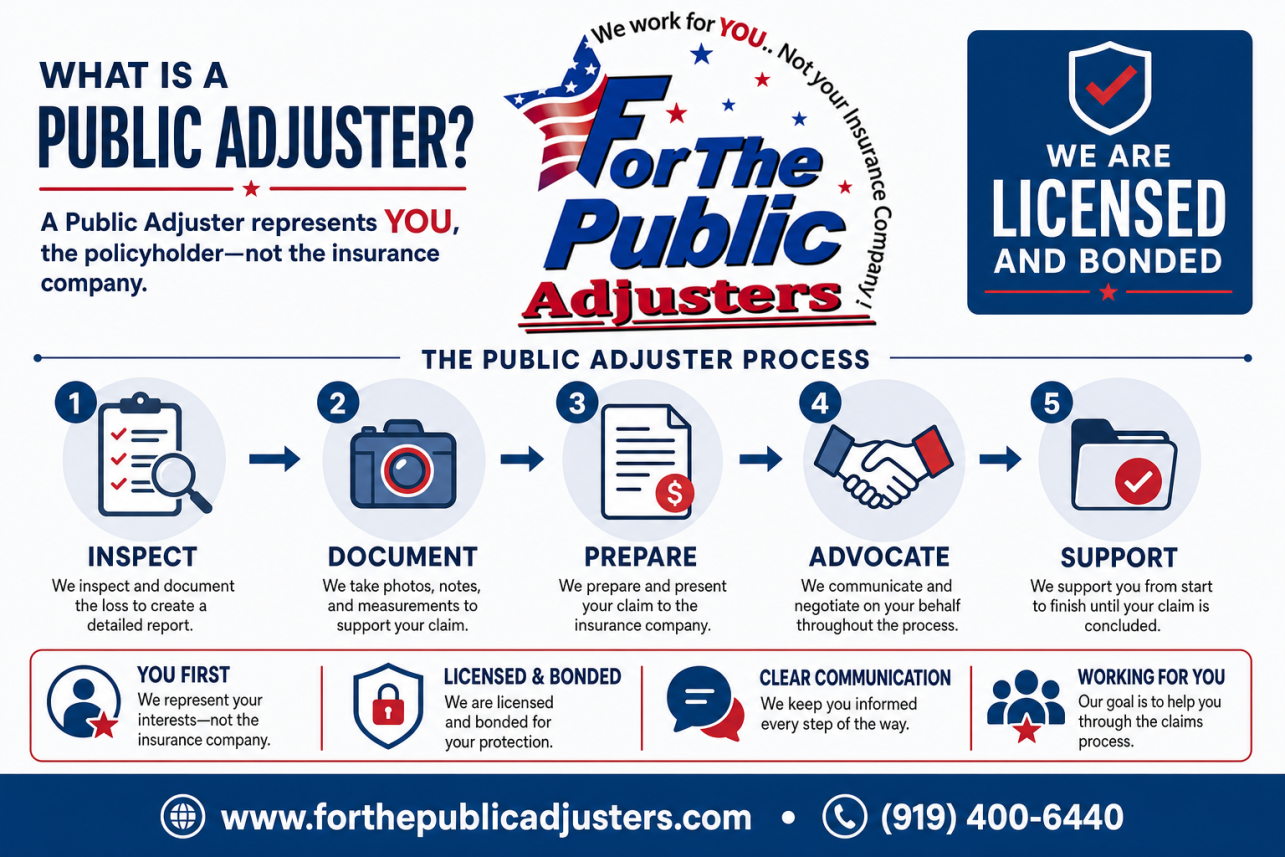
Free Policy And Damage Review
We start with a no-cost consultation, usually at your Knightdale property. We read your full policy — declarations, endorsements, exclusions — and walk the damage ourselves. You get an honest assessment of whether the claim justifies our involvement before you sign anything.
Documentation And Claim Preparation
We photograph and measure the loss, inventory damaged contents, and build a detailed line-item estimate of repair and replacement costs. For water and smoke losses, that includes what is hidden behind walls and under floors, not just what is visible. This file becomes the foundation of your claim.
Negotiation Through Settlement
We present the claim to your insurer, attend inspections alongside their adjuster, and respond to every dispute in writing with evidence. We keep negotiating until the settlement reflects the documented loss, and we keep you informed at every step. You approve any resolution before it is final.
| What Happens | Filing on Your Own | With For The Public Adjusters, Inc. |
|---|---|---|
| Damage documentation | Carrier's adjuster scopes the loss — often in one short visit — and you accept their notes | Independent inspection with moisture mapping, photo logs, and line-item Xactimate estimates |
| Estimate pricing | Carrier software defaults that often trail actual Wake County contractor pricing | Estimates built on real local labor and material costs, defended line by line |
| Negotiation | You argue your own claim against a trained company adjuster | A licensed NC public adjuster negotiates directly with the carrier on your behalf |
| Hidden damage | Frequently missed — soot migration, slab moisture, matching issues, code upgrades | Actively searched for and documented before settlement, not after |
| Cost to you | Free, but underpaid claims commonly leave thousands unrecovered | A percentage of the recovery — no fee unless your settlement is paid |
| Time commitment | Weeks of calls, paperwork, and carrier follow-ups on your schedule | We manage communications, deadlines, and proof-of-loss filings for you |
Commonly Overlooked In The Public Adjusting Industry
- Code upgrade (ordinance or law) coverage — Carrier estimates often pay to rebuild to old specs, quietly skipping the drip edge, ice barriers, and electrical updates that current Wake County code requires.
- Matching requirements for siding, shingles, and flooring — Carriers pay to patch one slope or one room, ignoring that discontinued materials make a partial repair visibly mismatched and reduce the home's value.
- Additional living expenses (ALE) during repairs — Homeowners rarely know their policy pays for hotels, rentals, and extra meal costs while the home is unlivable, and carriers seldom volunteer it.
- Moisture readings taken before demolition — Once wet drywall and flooring are torn out and hauled away, the evidence proving how far the water traveled is gone forever.
- HVAC contamination after fire or smoke losses — Soot pulled through ductwork settles in rooms far from the fire, and carrier scopes almost never include duct cleaning or system replacement unless someone tests for it.
- The proof-of-loss deadline in the policy — Most NC policies give a strict window to submit a sworn proof of loss, and missing it can sink an otherwise valid claim.
- Depreciation holdback (recoverable depreciation) — Many homeowners cash the first actual-cash-value check and never file the paperwork to recover the depreciated amount they're owed after repairs.
- Collateral damage on soft metals and screens — Dented gutters, condenser fins, and window screens are the physical proof of hail size and density, and skipping them weakens the entire roof claim.
Case Studies
Case Study #1
Situation: A homeowner off Widewaters Parkway in Knightdale called us after an April hailstorm swept through eastern Wake County. Her insurance carrier had already sent its own adjuster, who inspected the roof for roughly twenty minutes.
Problem: The carrier approved $4,200 for spot repairs to the architectural shingles, ignoring hail bruising across three slopes, dented gutters, and cracked window screens. Repairing only part of the roof would have left mismatched shingles and voided the manufacturer warranty on the remaining sections.
Investigation: Our team performed a full roof-to-foundation inspection, chalking and photographing hail impacts per square on every slope. We pulled the storm date's certified hail report showing 1.25-inch stones over her subdivision and documented collateral damage on soft metals, the HVAC condenser fins, and the vinyl siding on the west elevation.
Findings: Impact density exceeded the carrier's own repairability threshold on all slopes, not just the two they scoped. The condenser coil damage and siding damage had been left off the estimate entirely, and the original scope used contractor pricing that hadn't been achievable in the Raleigh-area market for two years.
Solution: We prepared a line-item Xactimate estimate reflecting full roof replacement, condenser fin repair, siding replacement with proper matching considerations under NC guidelines, and code-required drip edge. We then met the carrier's re-inspection adjuster on the roof and walked the evidence square by square.
Outcome: The claim settled at $38,750 — more than nine times the original offer — covering complete roof replacement, gutters, screens, siding, and the HVAC repair, minus her deductible.
Lesson: A twenty-minute carrier inspection almost never captures the full footprint of a hailstorm. Documented impact counts and collateral damage evidence are what move a partial-repair offer to a full replacement.
Case Study #2
Situation: A family in the Planters Walk area returned from a weekend trip to find their upstairs bathroom supply line had burst, sending water through the ceiling into the kitchen and living room below.
Problem: The carrier's initial estimate paid to dry the structure and replace visible drywall, but denied the kitchen cabinets, hardwood flooring, and any contents. The adjuster claimed the cabinets were 'salvageable' and pressured the family to sign off quickly so mitigation invoices could be paid.
Investigation: We brought in moisture mapping before the demolition was finished, documenting saturation readings inside the cabinet toe kicks and beneath the site-finished oak flooring. We photographed cupping across the hardwood into adjoining rooms and inventoried water-damaged contents item by item, including receipts the family recovered from email.
Findings: Moisture readings inside the lower cabinets exceeded restorable limits, and the particleboard boxes had already begun swelling. Because the hardwood ran continuously into the dining room, partial replacement would have created an unrepairable transition — NC market realities the original estimate ignored. The contents loss alone totaled over $11,000.
Solution: We submitted a supplemental claim with the moisture logs, an independent flooring assessment, a full contents inventory with replacement-cost pricing, and additional living expense documentation for the six weeks the kitchen was unusable.
Outcome: The final settlement reached $94,300, up from the carrier's opening position of $22,000, including full cabinet replacement, continuous hardwood replacement, contents, and ALE for temporary housing.
Lesson: Water losses are decided by moisture data captured early. Once demolition is done and materials are hauled away, the evidence that pays for cabinets, flooring, and contents is gone with them.
| Your Situation | Handle It Yourself If… | Call a Knightdale Public Adjuster If… |
|---|---|---|
| Small, visible damage (a few shingles, one wet ceiling patch) | Repair cost is near your deductible and the scope is obvious | The 'small' leak has been active for a while or you can't see behind walls |
| Hail or wind damage after a storm | Carrier already approved full roof replacement at fair pricing | You got a partial-repair offer, slope-by-slope denial, or 'no damage found' |
| Water or pipe burst loss | Damage is confined to one room and mitigation was paid in full | Cabinets, hardwood, contents, or ALE were denied or left off the estimate |
| Fire or smoke damage | Rarely — smoke migration almost always exceeds the visible burn area | Any fire loss; soot travels through HVAC into rooms the carrier won't scope unprompted |
| Claim denied outright | You have a clear policy exclusion in writing and agree it applies | The denial cites 'wear and tear,' 'seepage,' or 'maintenance' on sudden damage |
| Settlement offer feels low | An independent contractor bid matches the carrier's number | Local contractor bids run thousands above the carrier's estimate |
| Claim stalled past 30 days | Carrier gave a written, dated reason and a firm timeline | You're getting repeated document requests, adjuster reassignments, or silence |

Reviews
After the June windstorm, our carrier offered $6,800 for a roof that clearly needed replacing. For The Public Adjusters found wind creasing on shingles the insurance adjuster never even walked on, plus damaged ridge vents and fascia. Final settlement was $31,000. Roland handled every call with the carrier so we didn't have to.
Marcus T., Knightdale Station
Our kitchen fire claim was stalled for three months and the carrier kept asking for the same documents over and over. Within six weeks of hiring this team, we had a smoke damage assessment covering the whole house — not just the kitchen — and a settlement almost triple the first offer. They knew exactly what soot testing to demand.
Denise W., near Hodge Road
Pipe burst under our slab while we were out of town. The insurance company tried to call it long-term seepage and deny it. For The Public Adjusters brought in a leak detection report and plumber documentation proving it was sudden and accidental. Claim went from denied to fully paid, including our flooring and drywall. Only wish we'd called them on day one instead of arguing alone for a month.
James R., Emerald Pointe
Frequently Asked Questions
What Does A Public Adjuster Knightdale NC Homeowners Hire Actually Do For My Insurance Claim?
A public adjuster works exclusively for you, the policyholder — never for the insurance company. When you hire For The Public Adjusters, Inc., we take over the entire claims process: documenting the damage, reading your policy line by line, preparing a detailed estimate, and negotiating directly with the insurer's adjuster until you receive a fair settlement.
That matters because the adjuster your insurance company sends is paid by the carrier. Their estimate often reflects the insurer's interests, not the true cost of repairing your home in today's Wake County construction market.
For a typical Knightdale claim — say, hail damage to a roof off Smithfield Road or water damage in a home near Widewaters — we start with a thorough inspection, including areas the carrier's adjuster may have skipped, like attic decking, siding, gutters, and interior ceilings. We then build a repair estimate using local contractor pricing, not the insurer's software defaults.
From there, we handle every phone call, email, and document request. We meet the carrier's adjuster on site, point out overlooked damage, and push back on lowball line items. If the insurer disputes the scope, we invoke policy provisions like appraisal when appropriate.
In short, we level the playing field. Most homeowners file one or two claims in a lifetime; insurance carriers handle thousands every day. Having a licensed advocate who does this daily, and who knows how Knightdale and Wake County claims typically get handled, is often the difference between a denied or underpaid claim and a full recovery.
How Much Does It Cost To Hire A Knightdale Public Adjuster, And Is It Worth It?
For The Public Adjusters, Inc. works on a contingency fee, which means we only get paid when you do. Our fee is a percentage of the settlement we recover for you — there are no upfront costs, hourly rates, or hidden charges. If we don't recover money for you, you owe us nothing.
North Carolina regulates public adjuster fees, so the percentage is disclosed in writing before you sign anything. You'll know exactly what the arrangement is from day one.
As for whether it's worth it: industry studies and our own case files consistently show that professionally represented claims settle for substantially more than claims homeowners handle alone. Even after our fee, most clients net significantly more than the insurer's original offer.
Here's a realistic Knightdale example. A carrier offers $8,500 for a roof repair after a spring hailstorm, but a proper inspection reveals damage to decking, flashing, siding, and screens that justifies full replacement. When the corrected estimate comes back at $28,000, the homeowner comes out far ahead even with a fee deducted — and gets the roof actually repaired correctly.
Beyond the dollars, there's the time and stress you save. Insurance claims involve deadlines, proof-of-loss forms, recorded statements, and back-and-forth that can drag on for months. We handle all of it. For most families in eastern Wake County juggling work and kids, that alone justifies the arrangement — the larger settlement is the bonus.
When Should I Call A Public Adjuster In Knightdale — Before Or After Filing My Claim?
The best time to call is before you file, or as early in the process as possible. When For The Public Adjusters, Inc. is involved from the start, we can document the damage properly, frame the claim correctly, and avoid the missteps that give carriers grounds to underpay or deny.
Early involvement matters more than most homeowners realize. What you say in your first phone call to the insurer, how the damage is described, and what photos exist before repairs begin all shape the outcome. We make sure that foundation is solid.
That said, it is never too late to bring us in. Many of our Knightdale clients call after receiving a settlement offer that seems low, after a partial denial, or after weeks of unreturned calls from their carrier. We regularly reopen and supplement claims that were underpaid — including some that were already closed — as long as the policy's deadlines haven't expired.
Common situations where we help homeowners in the 27545 area include hail and wind damage from the storms that roll through eastern Wake County each spring, tree strikes during hurricanes and tropical remnants, burst pipes during winter cold snaps, and kitchen or lightning-related fires.
If you're unsure whether your situation warrants professional help, call us. We offer a free claim review, look at your policy and the damage, and give you an honest assessment. If the claim is straightforward and the insurer is treating you fairly, we'll tell you that too.
Is A Public Adjuster Knightdale NC Residents Use Licensed, And How Do I Verify That?
Yes — in North Carolina, anyone acting as a public adjuster must be licensed by the North Carolina Department of Insurance. That license requires passing a state examination, maintaining a surety bond, completing continuing education, and following strict rules on contracts, fees, and conduct. For The Public Adjusters, Inc. meets all of these requirements.
Verifying a license is easy and something we encourage every homeowner to do. Visit the NC Department of Insurance website and use the licensee search tool, or call the Department directly. You can confirm the license is active and check for any disciplinary history in minutes.
Be cautious of anyone who offers to "handle your claim" without a license. After major storms, out-of-state operators and unlicensed contractors sometimes canvass Knightdale neighborhoods promising to negotiate with your insurer. In North Carolina, that's illegal unless they hold a public adjuster license — and signing with them can jeopardize your claim.
A few other things a legitimate firm will always do: provide a written contract that clearly states the fee, give you the state-required right to cancel within the rescission period, and never pressure you to sign on the spot at your door.
When you work with our team, you're working with licensed professionals who know North Carolina policy language, Wake County building costs, and the tactics local carriers use. We're accountable to the state, to our surety bond, and most importantly to you. If you'd like our license information before scheduling a free inspection, just ask — we provide it happily.
What Types Of Insurance Claims Does A Public Adjuster Knightdale NC Property Owners Trust Actually Handle?
For The Public Adjusters, Inc. handles the full range of property damage claims that hit Wake County homes and businesses. The most common are wind and hail claims — Knightdale sits right in the path of the severe thunderstorms and occasional tropical remnants that roll through the Triangle every spring and summer, and roof damage from those events is frequently underpaid by carriers.
We also handle water damage claims, which are trickier than most homeowners expect. Burst pipes, water heater failures, and HVAC condensation leaks are covered differently than gradual seepage, and the wording in your policy determines everything. Fire and smoke claims are another major category, and smoke damage in particular is often undervalued because it spreads far beyond the visibly burned area.
Beyond those, we work hurricane claims, tree-fall damage, lightning strikes, theft and vandalism losses, and business interruption claims for commercial properties along the Knightdale Boulevard corridor and throughout eastern Wake County.
If you are not sure whether your situation qualifies, that is exactly the kind of question worth asking before you accept anything from your carrier. A claim that looks small on the surface — a few missing shingles, a stain on the ceiling — can involve hidden decking damage, insulation saturation, or code-upgrade costs that a quick carrier inspection misses. We evaluate the loss at no charge, so you know what you are actually dealing with before making any decisions.
My Insurance Company Already Sent Their Adjuster To My Knightdale Home — Why Would I Need My Own?
Because the adjuster your carrier sent works for the carrier, not for you. That is not an accusation of bad faith — it is simply how the system is structured. The company adjuster's job is to evaluate the loss within the insurer's guidelines, and those guidelines tend to favor the lower end of every estimate range.
A public adjuster in Knightdale represents only you, the policyholder. When we inspect a property, we document everything: the obvious damage, plus the things carrier adjusters routinely skip, like matching requirements for discontinued shingles, hidden moisture behind walls, damaged flashing, and code-compliance costs Wake County will require during repairs.
Here is a common local example. After a hailstorm, a carrier adjuster might approve a partial roof repair on a home in Widewaters or Planters Walk. But if the existing shingles are discontinued — which is common on homes built in the 2000s — North Carolina's matching considerations and your policy language may support a full replacement instead. That difference alone can be tens of thousands of dollars.
Having the carrier's estimate in hand does not lock you in. We regularly review those estimates for homeowners and find significant gaps. If the carrier's number turns out to be fair, we will tell you that too. But in our experience, an independent, detailed scope of loss almost always reveals items the first inspection left out.
Can A Public Adjuster Knightdale NC Homeowners Hire Help If My Claim Was Already Denied Or Underpaid?
Yes, and this is one of the most valuable times to bring in professional representation. A denial or lowball settlement is not the end of your claim — under North Carolina law, you generally have the right to dispute the carrier's decision, submit supplemental claims, and reopen claims within your policy's time limits.
The first thing we do is review the denial letter or settlement breakdown against your actual policy language. Denials often rest on thin reasoning: the carrier calls storm damage "wear and tear," attributes a pipe failure to "long-term seepage," or claims the damage predates your policy. These conclusions are frequently based on a brief inspection and can be challenged with better documentation.
Next, we build the evidence the original claim lacked. That may mean a detailed re-inspection of your property, moisture mapping, drone roof photography, weather data confirming the hail or wind event that hit eastern Wake County on a specific date, and a line-item repair estimate written to local contractor pricing rather than the carrier's software defaults.
Then we handle the dispute directly — supplemental filings, negotiations with the carrier's adjuster, and if necessary, invoking the appraisal clause in your policy, which is a formal dispute-resolution process that often resolves stubborn underpayments without litigation.
Homeowners in Knightdale bring us underpaid claims months after the fact more often than you would think, and reopened claims regularly settle for substantially more than the original offer. If you have a denial letter sitting in a drawer, it is worth a second look.
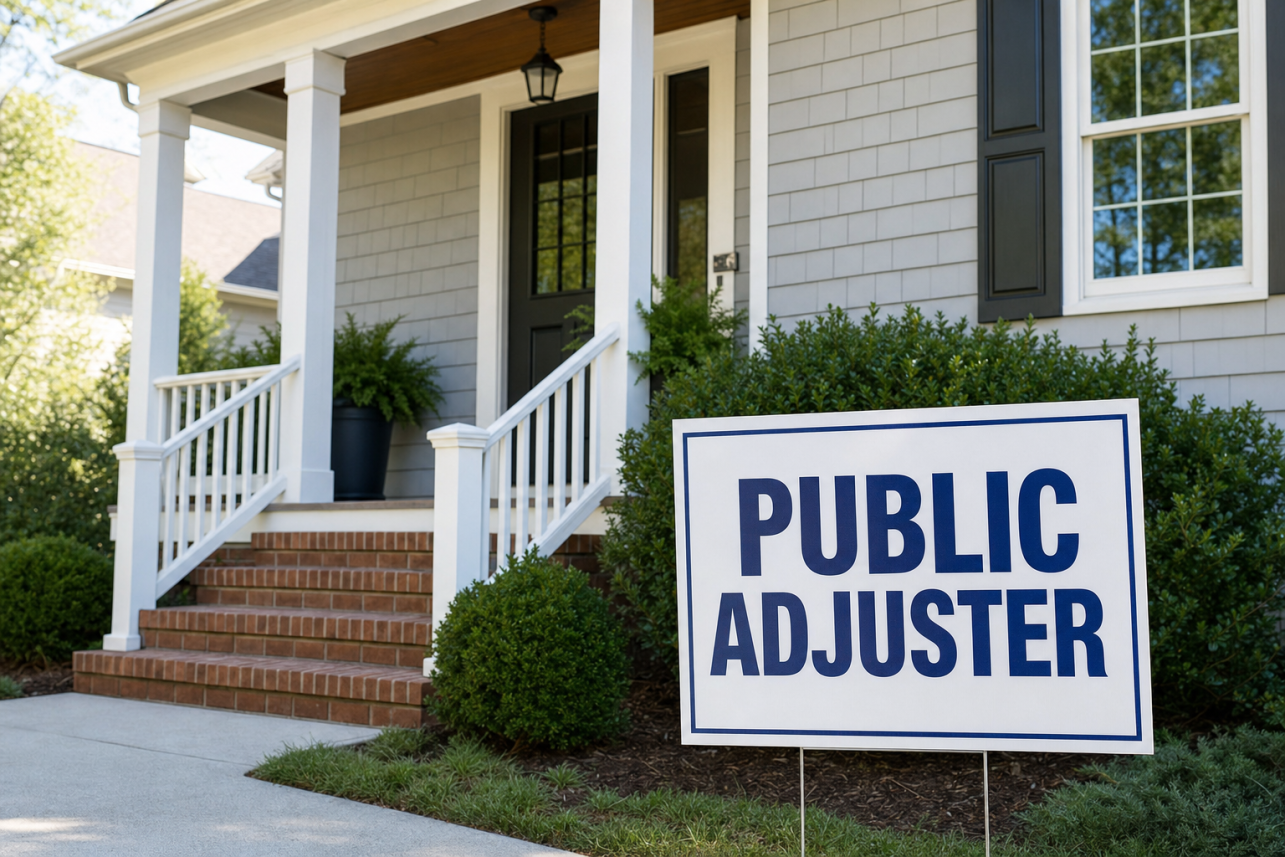
How Long Will My Claim Take With A Knightdale Public Adjuster Involved, And Does Hiring One Slow Things Down?
Hiring representation does not slow a legitimate claim down — in most cases it actually shortens the timeline, because complete documentation submitted correctly the first time prevents the back-and-forth that stalls so many claims.
Here is a realistic picture. Straightforward claims — a well-documented wind loss on a roof, a clear-cut pipe break — often resolve in 30 to 60 days once our full scope of loss is submitted. Larger or disputed claims, such as fire losses or claims a carrier initially denied, typically run 60 to 120 days. Claims that go to appraisal can take longer, but appraisal is usually faster than the alternative of letting an underpaid claim sit unresolved.
North Carolina insurance regulations also work in your favor. Carriers operating here are expected to acknowledge claims promptly and to pay undisputed amounts without unreasonable delay. When a claim stalls, we know which pressure points to use and when a delay crosses the line into something the NC Department of Insurance should hear about.
Our team also front-loads the work. On a typical Knightdale home, we complete our inspection, photograph and measure everything, and deliver a full line-item estimate to the carrier quickly — often before the carrier's own adjuster has finished their report. That puts your documentation in the file first, which shapes the entire negotiation.
The honest answer: the biggest delays in most claims come from incomplete initial submissions, not from having an advocate. Getting it right up front is the fastest path to a fair check.
What Should I Do Right After Storm Or Fire Damage In Knightdale, Before Your Team Even Arrives?
First, make sure everyone is safe and the property is secure. Your policy requires you to take reasonable steps to prevent further damage, so tarp a compromised roof, shut off water to a burst line, or board a broken window if you can do so safely. Keep every receipt — emergency mitigation costs are typically reimbursable.
Second, document everything before anything gets moved or thrown away. Take wide photos of each room, then close-ups of individual damaged items. Video walkthroughs with narration are even better. In Knightdale we see a lot of wind-driven rain and hail damage after storms roll through Wake County, and interior water staining can fade or get painted over before it's ever recorded.
Third, do not throw away damaged contents until they've been inventoried. A couch ruined by smoke or a water-soaked rug is evidence of your loss. If health or safety requires disposal, photograph the items thoroughly first.
Finally, be careful what you say when reporting the loss. Stick to the facts — what happened, when, and where — and avoid guessing at causes or values. Speculation on a recorded first notice of loss can complicate a claim later. Once For The Public Adjusters, Inc. is involved, we take over documentation, communication, and valuation so nothing gets missed or misstated. The sooner we see the damage in its original condition, the stronger your claim will be.
How Is A Public Adjuster Knightdale NC Property Owners Hire Different From A Contractor Or An Attorney?
These three roles get confused constantly, and the differences matter. A contractor's job is to repair your property. Some contractors offer to "deal with insurance for you," but in North Carolina it is actually illegal for an unlicensed contractor to negotiate or adjust your claim. Their repair estimate is a starting point, not a settlement strategy — and they have no authority to argue coverage.
An attorney handles legal disputes. If your claim ends in litigation or involves bad faith, a lawyer is the right call, but attorneys typically charge higher contingency fees and lawsuits can take years. Most claims never need to reach that stage.
A public adjuster Knightdale NC homeowners and business owners retain sits in the middle, and for most claims it's exactly where you want help. We are licensed by the North Carolina Department of Insurance specifically to represent policyholders in the claims process. We read your policy, scope and document the full loss, prepare a detailed estimate using the same software carriers use, and negotiate directly with the insurance company's adjuster.
In practice, the three roles can work together. For The Public Adjusters, Inc. often coordinates with your contractor to make sure the settlement actually covers the real cost of repairs in the Knightdale market — not a lowball figure based on outdated pricing. And if a claim truly does require legal action, we'll tell you honestly and can support your attorney with the documentation we've already built.
Are There Deadlines In North Carolina For Filing, Disputing, Or Reopening A Property Insurance Claim?
Yes, and missing them can cost you your entire recovery. Most North Carolina property policies require "prompt" notice of a loss, and many impose specific windows — often 60 days to a year — for submitting a sworn proof of loss or making a claim for replacement cost holdback after repairs are complete.
Beyond the policy itself, North Carolina generally allows three years from the date of loss to bring a legal action on a property claim, though some policies attempt to shorten that contractual period. The clock matters even more if you're disputing an underpayment: waiting too long to challenge a settlement can leave you with no leverage at all.
There's also a practical deadline that no statute mentions — evidence. Hail bruising on shingles weathers over time, water stains get repainted, and Knightdale's humid summers turn minor moisture intrusion into mold that carriers then argue is a maintenance issue rather than storm damage. The longer you wait, the easier it becomes for an insurer to dispute causation.
If you believe an older claim was underpaid, don't assume the door is closed. We regularly review settled claims for Wake County property owners, and supplemental claims can often be filed well after the initial payment if new or missed damage is properly documented. Bring us your policy, your claim correspondence, and your settlement letter — For The Public Adjusters, Inc. will tell you exactly where you stand on timing before you commit to anything.
Will Using A Public Adjuster Knightdale NC Insurers Recognize Hurt My Relationship With My Carrier Or Raise My Premiums?
No — and this is one of the most common fears we put to rest. Hiring a public adjuster Knightdale NC insurance companies deal with regularly is a normal, legally protected part of the claims process. North Carolina law gives you the right to representation, and carriers handle claims involving policyholder advocates every day. Your insurer cannot penalize you, cancel your policy, or treat your claim differently simply because you hired professional help.
As for premiums, rates are driven by the fact that you filed a claim and by the type of loss — not by who negotiated it. A storm claim settled for $40,000 with our help affects your rating the same way a $15,000 underpaid settlement would. The difference is that in one scenario your Knightdale home is actually restored properly, and in the other you're paying the shortfall out of pocket.
It's also worth knowing that the process stays professional, not adversarial. Our job is to document the loss thoroughly, present it in the format carrier adjusters work with, and negotiate based on evidence and policy language. Most claims we handle settle without any dispute escalation, because a well-documented claim is hard to argue with.
If anything, having experienced representation tends to make the process smoother. Deadlines get met, inspections get scheduled promptly, and communication stays organized — which is exactly what a fair, efficient claim looks like from both sides of the table.
What Documents Should I Gather Before Meeting With A Public Adjuster Knightdale NC Homeowners Recommend?
The most important document is your full insurance policy — not just the declarations page, but the entire policy with all endorsements. If you can't locate it, we can request a certified copy from your carrier on your behalf, which is your right under North Carolina law.
Beyond that, pull together anything that documents the damage and the property's prior condition. Photos and videos from before and after the loss are valuable, as are receipts for emergency repairs like tarping or water extraction. If you've already filed, bring your claim number, any letters from the carrier, and estimates their adjuster provided.
For contents claims, don't worry about having a perfect inventory ready. Our team walks Knightdale homeowners through a room-by-room process to reconstruct what was lost, and we know how to value items the carrier's software often lowballs.
If you have records of past claims on the property, mortgage statements, or recent appraisals, those help too — mortgage companies in Wake County are typically named on settlement checks, and knowing that early keeps the payout process moving. Don't stress if your paperwork is incomplete or was destroyed in the loss itself. That happens constantly with fire and flooding, and part of what you're hiring us for is rebuilding the documentation your claim needs.
Do You Handle Commercial Property Claims In Knightdale, Or Only Residential Homes?
We handle both. Knightdale's commercial corridor along Knightdale Boulevard and the growing retail and light-industrial spaces off I-540 and US-64 have their own claim challenges, and we represent those business owners just as often as homeowners in neighborhoods like Widewaters, Planters Walk, and Knightdale Station.
Commercial claims are usually more complex than residential ones. Beyond the building damage itself, you may have business interruption coverage, loss of rents, extra expense coverage, and tenant improvement issues in play. Carriers frequently underpay the business income portion because the calculations are complicated — we prepare that documentation properly, working from your financials to prove the actual loss.
For restaurants, salons, medical offices, and retail tenants, we also sort out the often-confusing line between what the landlord's policy covers and what your own policy covers. Getting that wrong can leave real money on the table.
On the residential side, we work everything from single-family homes to townhome and condo associations, where master policy versus unit-owner policy disputes are common. Whether it's a hail-damaged warehouse roof or smoke damage in a family kitchen, the job is the same: document the full scope of loss and hold the carrier to what the policy actually promises.
My Insurer Sent A Settlement Check Quickly — Should I Cash It, Or Talk To A Knightdale Claims Adjuster First?
Talk to someone first. A fast check often signals the carrier settled on a limited scope before the full damage was understood — and in our experience with Knightdale claims, that first payment frequently covers only a fraction of the real cost to repair.
Here's the good news: in most cases, cashing that check does not close your claim. Unless the check or accompanying paperwork contains explicit full-and-final release language, it's typically treated as a partial or undisputed payment. Still, read everything before depositing, and if anything says "final settlement" or asks you to sign a release, stop and get advice.
A public adjuster Knightdale NC property owners bring in at this stage will compare the carrier's estimate line by line against the actual damage. Common gaps we find include missed roof slopes after hail, no allowance for code upgrades required by Wake County permitting, underpriced labor rates that don't reflect the Raleigh-area market, and depreciation calculations that are simply too aggressive.
We then prepare a supplemental claim with proper documentation and negotiate the difference. Insurers expect supplements — it's a normal part of the process, not a fight you're picking. Many of our strongest recoveries started with a homeowner holding a check that felt too small, because it was.
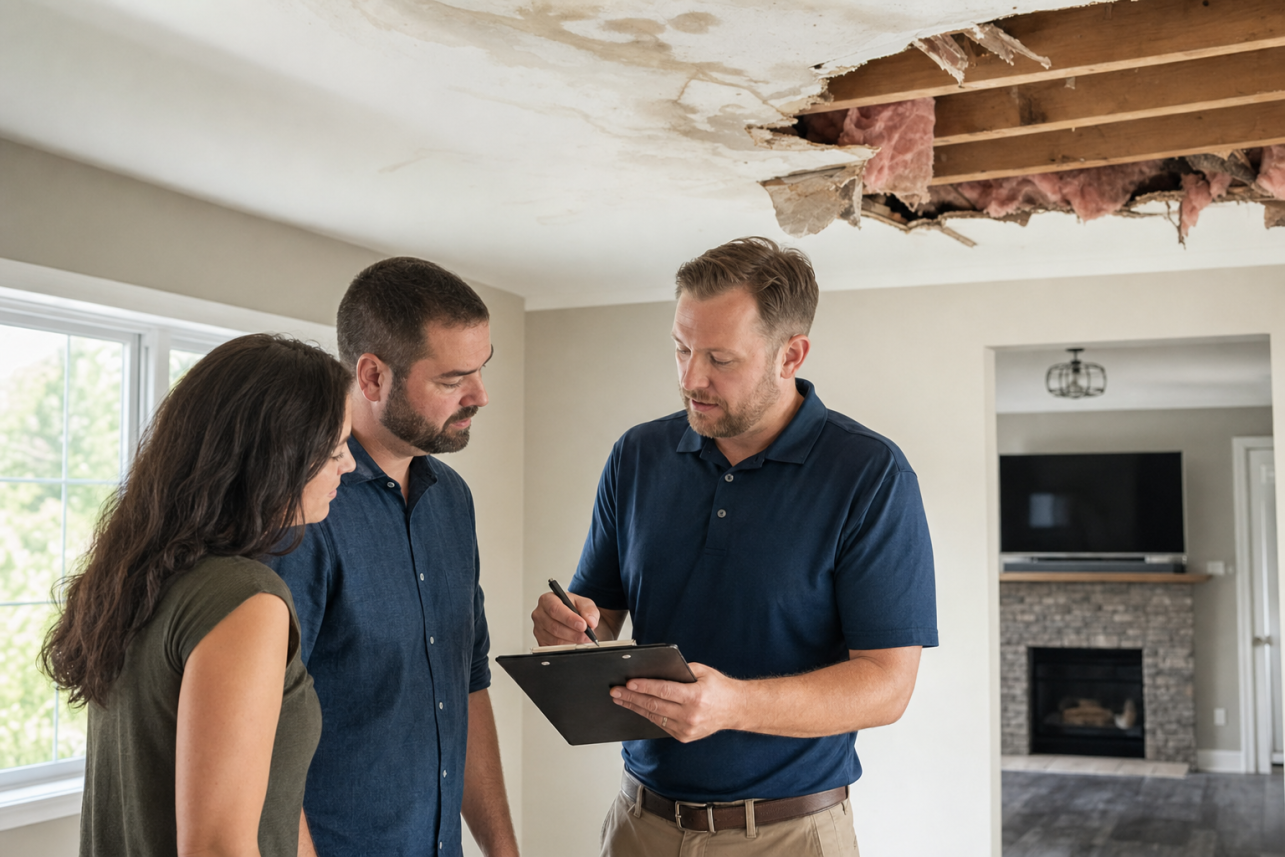
Once I Hire For The Public Adjusters, Will I Still Have To Deal With My Insurance Company Myself?
For the most part, no — and that's one of the biggest reliefs our clients describe. Once you sign our representation agreement and we notify your carrier, we become your point of contact for the claim. The adjuster's calls, emails, document requests, and inspection scheduling all route through us.
There are a few things only you can do as the policyholder. If the carrier requests an examination under oath or a signed proof of loss, your signature and participation are required — but we prepare you thoroughly beforehand and make sure everything submitted is accurate and complete. Settlement checks also come in your name (and usually your mortgage company's), so you'll handle the deposit itself.
What you won't have to do is argue scope, pricing, or coverage with a desk adjuster in another state, chase return calls, or decode estimate software line items. We handle inspections at your Knightdale property, meet the carrier's adjuster on site, and push the file forward when it stalls — which, with the claim volume Wake County carriers see after major hail and wind events, happens often.
You stay informed the whole way. We explain every offer, every letter, and every decision point in plain English, and nothing gets accepted without your approval. You keep control; you just stop carrying the burden.
Local Relevance
Knightdale sits just east of Raleigh in Wake County, and its rapid growth means the housing stock runs from older established homes to subdivisions built in the last two decades. That mix matters: older homes hide aging plumbing and wiring behind the walls, while newer builds can suffer construction shortcuts that only reveal themselves after a storm or water intrusion.
The climate here drives most of the claims we see. Humid summers bring severe thunderstorms, remnants of Atlantic hurricanes track through the Triangle, and the occasional tornado leaves a narrow path of roof and structural damage that carriers often underestimate. Tall pines saturated by heavy rain come down on roofs, fences, and vehicles' garages with regularity.
Low-lying areas near the Neuse River and local creeks add flood exposure that standard homeowners policies do not cover. Flood losses require a separate flood policy, and the Federal Emergency Management Agency (FEMA) oversees the National Flood Insurance Program that backs most of those policies. NFIP claims follow their own rules and deadlines, and we handle them alongside standard homeowners claims.
Because we work throughout Wake County, we know how local carriers' field adjusters tend to scope these losses — and where their estimates most often come up short.
Knightdale's mature loblolly pines and clay-heavy soil are a recurring claims combination: after tropical remnants saturate the ground, whole trees tend to uproot onto roofs rather than simply shedding limbs, and insurers often scope these as shingle repairs while overlooking cracked trusses and shifted framing underneath. If a tree hits your home here, insist on an inspection of the roof structure — not just the surface — before accepting any estimate.
Get A Free Claim Review In Knightdale
Before you accept a settlement or let a stalled claim drag on, let For The Public Adjusters, Inc. take a look. We are licensed and bonded, the consultation costs nothing, and you will get a straight answer about whether your claim is being handled fairly.
Request Your Free Claim Review
Call us: (919) 400-6440
Helpful Resources
- NCDOI Public Adjusters Guide
- Federal Emergency Management Agency (FEMA)
- North Carolina Department of Insurance — State regulator where NC public adjuster licenses can be verified
- FloodSmart – the National Flood Insurance Program — Official NFIP resource on flood coverage and claims
Our services in this city
- Fire Damage Insurance Claim Help Knightdale: When Smoke, Soot, And Firefighting Water Complicate Your Homeowners Claim
- Lawyer For Insurance Dispute Knightdale: Why A Licensed Public Adjuster Should Usually Be Your First Call
- Smoke Damage Claim Help Knightdale NC: When A Kitchen Grease Fire Leaves Soot, Odor, And Hidden Damage Behind
- Water Damage Claims Adjuster Knightdale NC — When A Burst Pipe Or Hidden Leak Turns Into An Underpaid Claim
Last updated: August 15, 2026