If you are searching for the Best Public Adjuster Apex NC has to offer, For The Public Adjusters, Inc. represents you — not the insurance company — on fire, water, smoke, hail, tornado, and tree damage claims. We are licensed and bonded, we document the full scope of your loss, and we negotiate directly with your carrier on your behalf. You pay nothing out of pocket; our fee comes from the settlement we help you recover.
What This Service Is
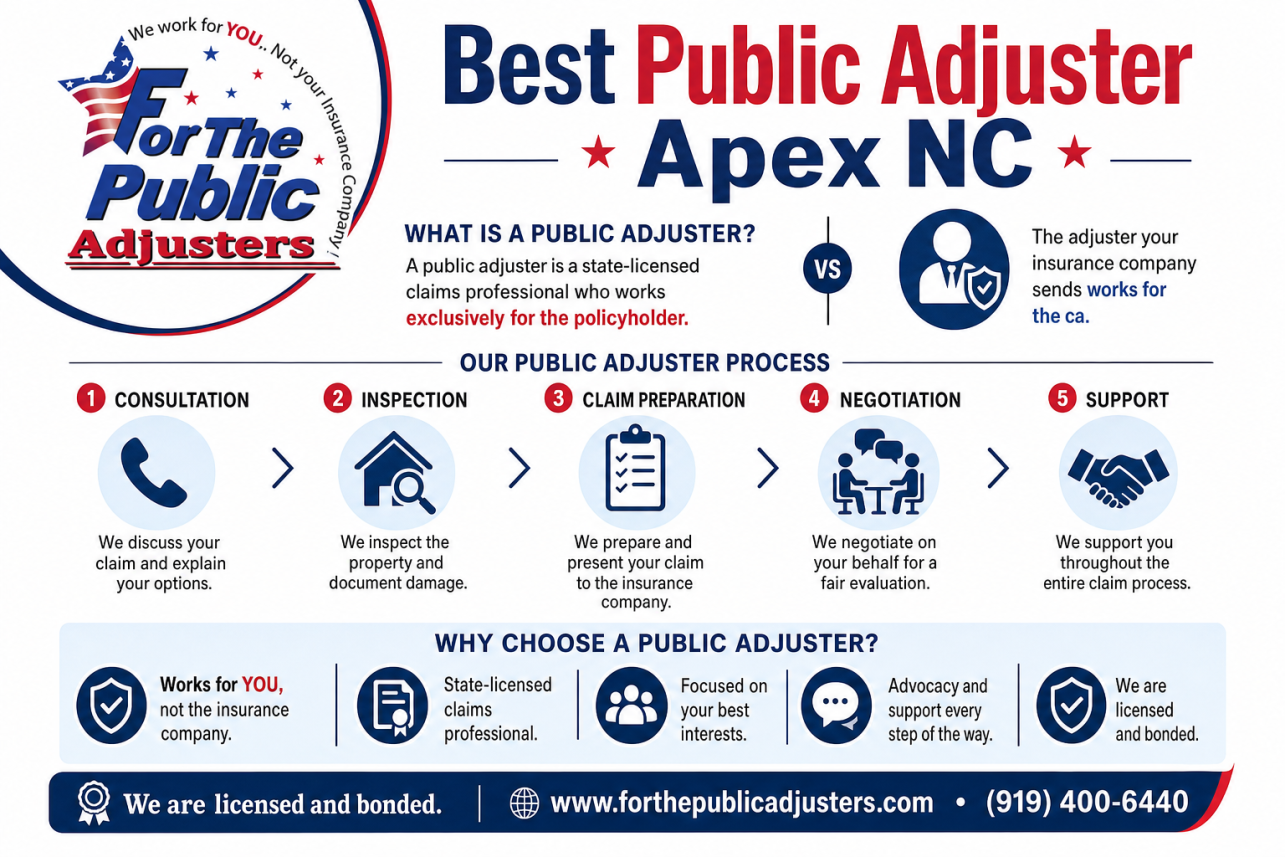
A public adjuster is a state-licensed claims professional who works exclusively for the policyholder. The adjuster your insurance company sends works for the carrier. We work for you.
The NCDOI Public Adjusters Guide makes the distinction plain: public adjusters must be licensed by the state, and they owe their duty to the insured, not the insurer. That matters when the carrier’s estimate misses hidden water intrusion behind drywall, smoke residue inside HVAC ducts, or structural movement a drive-by inspection never catches.
For Apex homeowners and business owners, that means we read your policy line by line, build an independent estimate of the damage, inventory your contents, and handle every call, letter, and meeting with the carrier. We take on residential homeowners claims and commercial business claims alike — fire, water, smoke, hail, tornado, tree strikes, vandalism, even a car hitting your home. Our work stretches across the Triangle too; for example, homeowners regularly bring us claims through our Public Adjuster Apex office when a loss crosses county lines or involves a second property.
We do not handle claims involving cell phones, motor vehicles, health, or life insurance — only damage to homes, buildings, and the contents inside them.
Common Problems
What Does Hiring A Public Adjuster Cost — And Is It Actually Worth It?
Public adjusters in North Carolina work on a contingency percentage of the settlement, so there is no upfront bill and no hourly meter running. If the claim recovers nothing, you owe nothing.
The value shows up in scope, not just dollars. The Insurance Information Institute notes that policyholders often don’t realize everything a policy covers — code upgrade costs, matching requirements, additional living expenses, debris removal. A carrier’s estimate that skips those items can look reasonable until someone who reads policies for a living goes through it.
We cannot and will not guarantee a specific outcome on any claim. What we can promise is a complete, documented, defensible claim instead of a quick one.
Best Public Adjuster Apex NC: What To Do When Your Claim Stalls Or Gets Lowballed
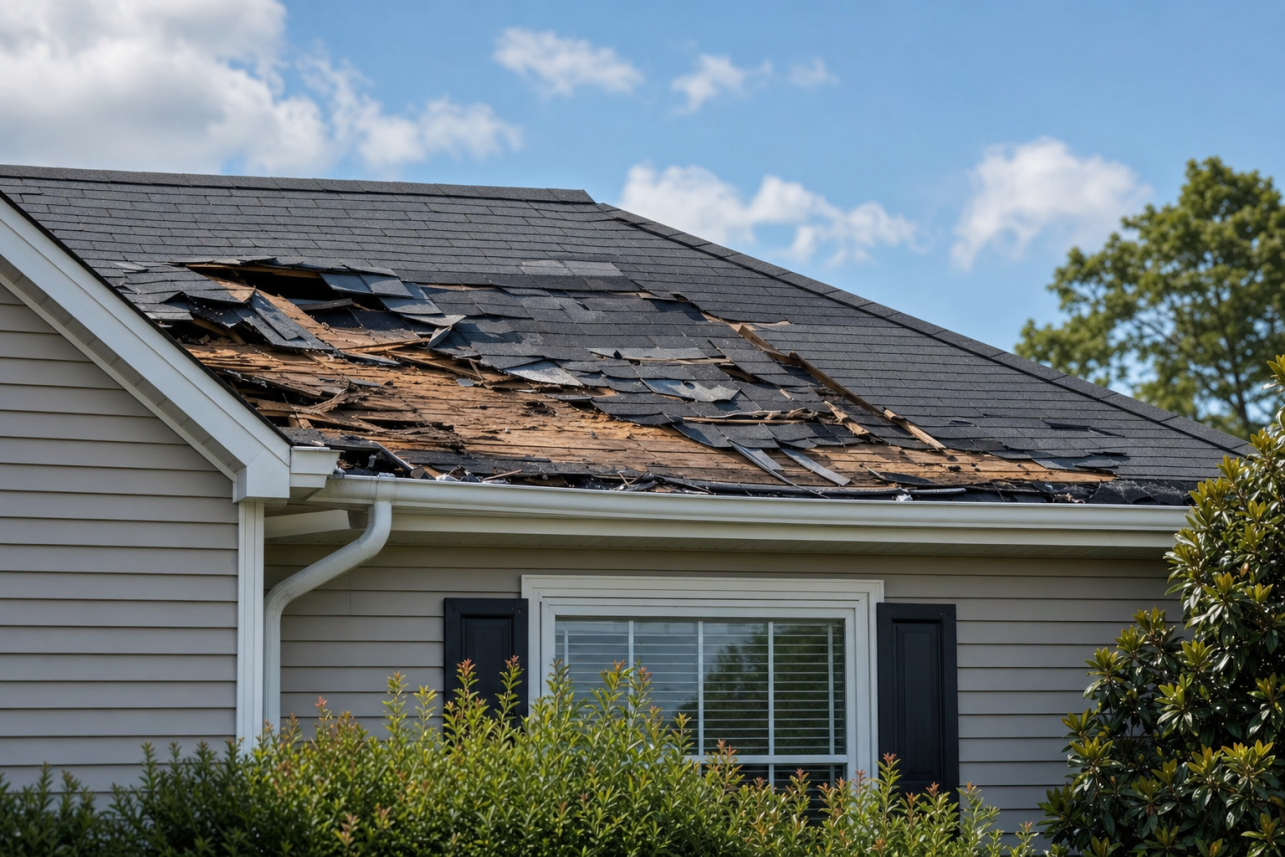
The most common story we hear in Apex is not outright denial — it’s the slow squeeze. The carrier’s estimate covers half the roof, calls the rest “wear and tear,” or pays for cleaning smoke damage that actually requires replacement.
Courts have pushed back on this behavior. In Bi-Economy Market v. Harleysville Insurance, New York’s highest court sided with a family business whose fire claim was dragged out and underpaid, ruling the insured could pursue consequential damages caused by the carrier’s delay. The lesson travels: insurers are accountable for handling claims promptly and fairly.
If your claim has stalled, don’t sign anything or accept a final payment before the full scope is documented. We routinely reopen and supplement underpaid losses, from kitchen fires here in Wake County to a Fire Damage Insurance Claim in Hillsborough, and when a dispute hardens we coordinate with insurance dispute lawyers so nothing falls through the cracks.
Everyone Claims To Be ‘the Best Public Adjuster Near Me’ — How Do I Actually Choose?
Start with licensing. North Carolina requires public adjusters to hold a state license and post a bond — ask for both, and verify them. We are licensed and bonded, and we encourage every homeowner to check before signing with anyone.
Then ask about the claim types they actually handle. Top public adjusters can walk you through losses like yours: a slab-leak water claim, a lightning fire, a tornado-damaged roof, a tree through the kitchen. Vague answers mean thin experience.
Finally, ask who does the work. Some firms sign you up locally and hand the file to someone three states away. Your adjuster should know Apex construction, Apex soil, and the storm history of this specific corner of Wake County — because the carrier’s adjuster usually doesn’t.
Our Process
Free Policy And Damage Review
We start by reading your actual policy — declarations, endorsements, exclusions — and walking the loss in person. Many Apex homeowners are surprised by what their coverage includes once someone explains it in plain English. This review costs nothing and commits you to nothing.
Full Documentation And Independent Estimate
We photograph, measure, and moisture-map the damage, inventory contents room by room, and build a line-item estimate using the same software carriers use. Hidden damage — saturated insulation, smoke in wall cavities, cracked sheathing — gets found now, not after you’ve settled. If questions come up about what a policy covers, the answers look a lot like the ones we give on Water Damage Coverage Insurance in Pittsboro cases: it depends on the cause, the policy language, and the proof.
Negotiation And Settlement
We present the claim package to your carrier, meet their adjuster on site, and answer every objection with documentation. You stay informed at each step but out of the crossfire. The claim closes when the settlement reflects the real scope of your loss — not when the carrier wants it to.
| Claim Stage | On Your Own | With For The Public Adjusters |
|---|---|---|
| Policy review | You rely on the carrier’s reading of your coverage, exclusions, and deadlines | A licensed, bonded adjuster reads the full policy and identifies every coverage that applies to your loss |
| Damage documentation | Smartphone photos and the carrier adjuster’s scope, which often misses hidden damage | Moisture mapping, contents inventory, lab testing when needed, and a complete line-item estimate |
| Negotiation | You argue your own claim against trained company adjusters | An experienced advocate who works only for you presents documented evidence to the carrier |
| Denied or underpaid claims | Accept the offer or hire a lawyer; courts like Cedell v. Farmers have sided with homeowners, but litigation is slow | Formal rebuttals, re-inspections, and appraisal options pursued before litigation is ever needed |
| Your time investment | Dozens of hours of calls, paperwork, and meetings during an already stressful time | We manage communication and paperwork while you focus on your family and home |
Commonly Overlooked In The Public Adjusting Industry
- Soot and smoke contamination in HVAC ductwork — Carrier adjusters rarely order air or surface testing, so contamination rooms away from a fire goes undocumented and unpaid.
- North Carolina matching considerations for flooring and siding — Insurers often pay to patch one section, ignoring that continuous materials like hardwoods or siding runs may need uniform replacement to restore the home.
- Code upgrade (ordinance or law) coverage — Many Apex policies include money for bringing older wiring, plumbing, or framing up to current Wake County code, but it’s never paid unless someone claims it.
- Additional living expenses during repairs — Homeowners don’t realize comparable temporary housing is often covered, so they crowd in with relatives while the benefit goes unused.
- Moisture trapped behind baseboards and inside wall cavities — Quick visual inspections miss it, and the mold that follows is then denied as a ‘maintenance issue’ months later.
- Complete contents inventories with pre-loss values — Grieving or overwhelmed families list items from memory, leaving thousands of dollars of damaged belongings off the claim entirely.
- The line between wind-driven rain and flood coverage — Rising water falls under NFIP flood policies while storm-created openings fall under homeowner coverage, and misclassifying the cause can sink an otherwise valid hurricane claim.
- Policy deadlines for proof of loss and supplemental claims — Carriers enforce these dates strictly, and homeowners who discover additional damage after settling often miss the window to reopen the claim.
Case Studies
Case Study #1
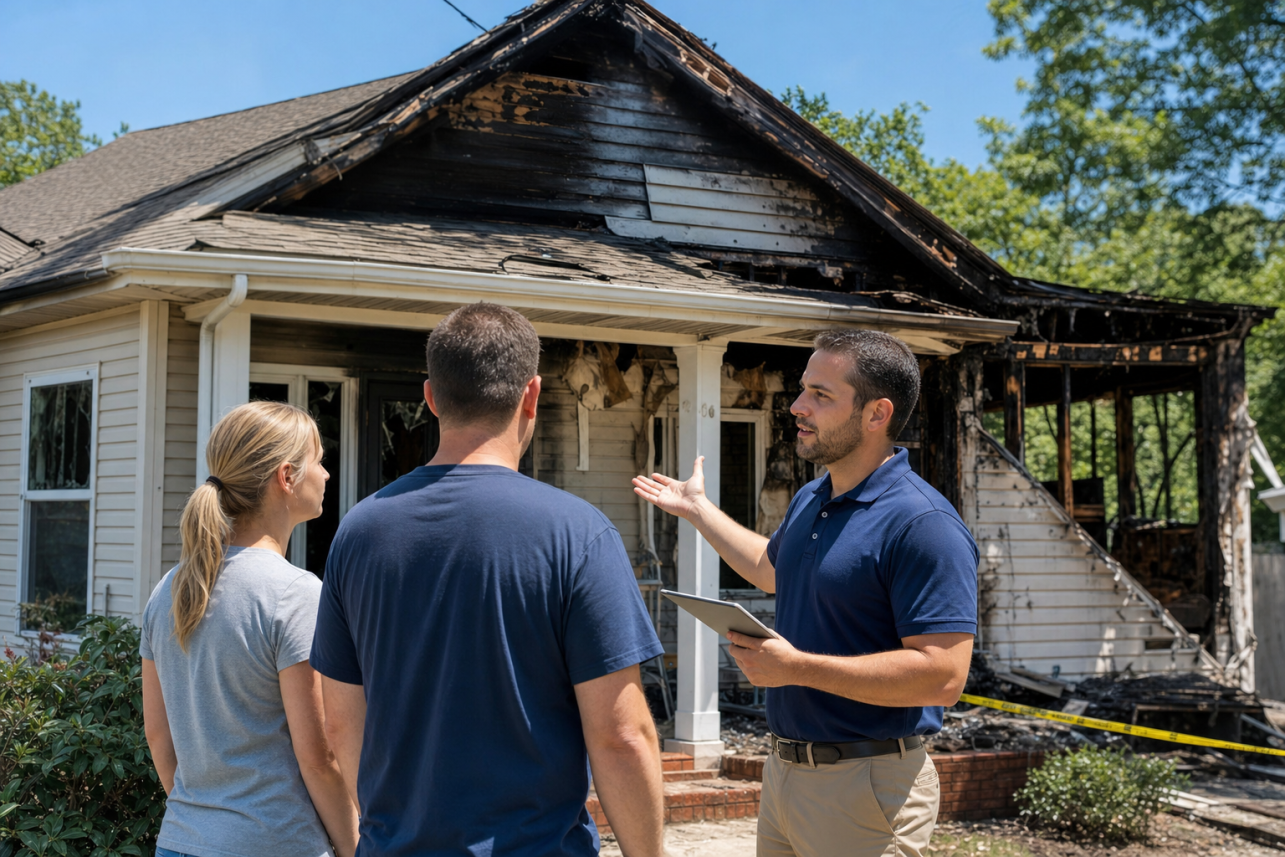
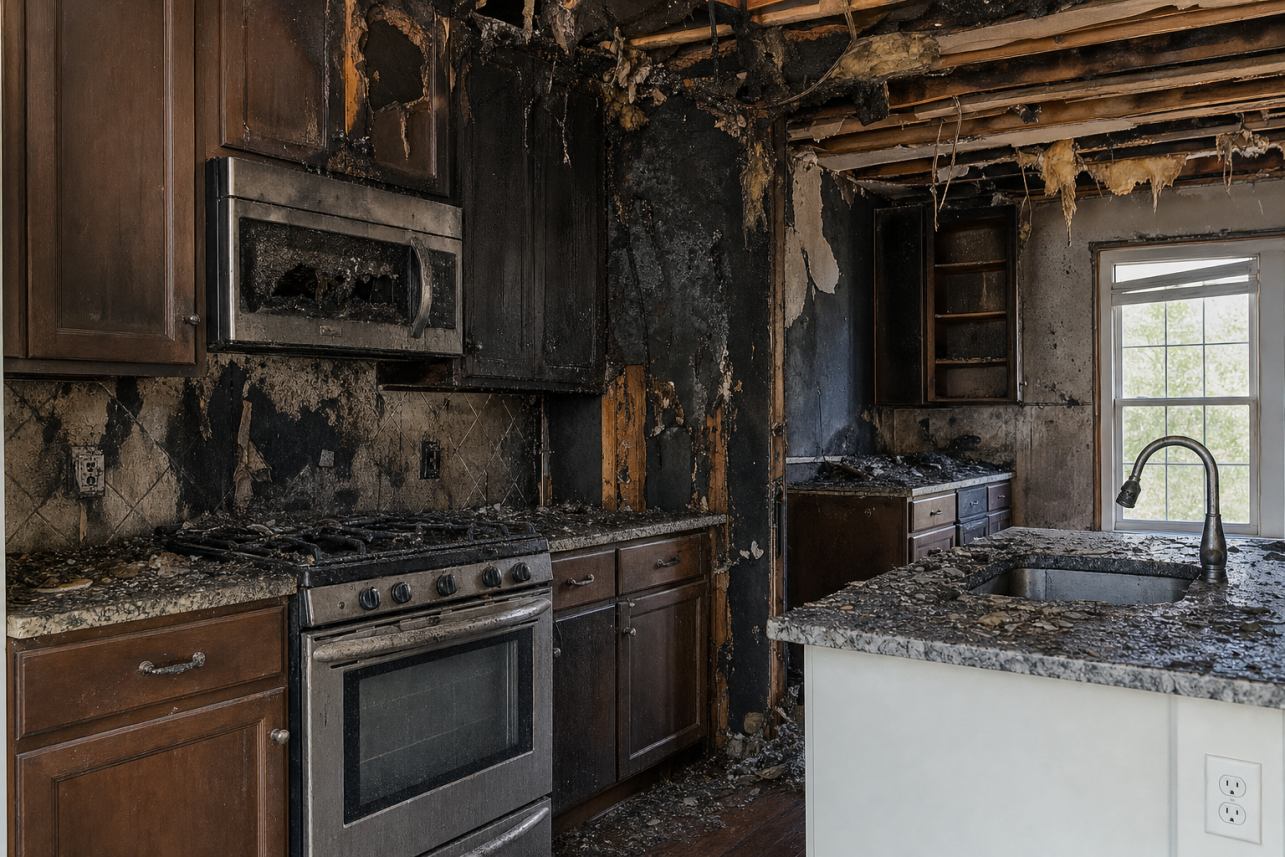
Situation: A family in the Scotts Mill neighborhood of Apex came home to a kitchen fire that started in a faulty dishwasher. Flames were contained quickly, but smoke and soot traveled through the HVAC system into every room of the two-story home.
Problem: Their carrier’s adjuster scoped the loss as a single-room cleanup and offered a settlement that covered new cabinets and paint in the kitchen only. Soot contamination in the ductwork, attic insulation, and contents in upstairs closets was never tested or documented.
Investigation: Our team brought in an independent industrial hygienist to run surface and air sampling throughout the house. We also pulled the full policy to review the replacement cost provisions, matching requirements, and additional living expense coverage the family hadn’t been told about.
Findings: Lab results confirmed chloride and soot residue in the duct system and on contents two floors away from the fire. The original estimate omitted HVAC decontamination, content cleaning and inventory, code-required electrical upgrades, and temporary housing while the work was done.
Solution: We prepared a line-item estimate built from the hygienist’s protocol, a full contents inventory with photographs, and an ALE projection for a comparable Apex rental. Then we presented the documented claim to the carrier and negotiated each disputed line item.
Outcome: The carrier reopened the claim and issued a revised settlement that was several times the original offer, covering whole-home remediation, duct cleaning, contents, and months of temporary housing. The family moved back into a fully restored home.
Lesson: Smoke travels far beyond the burn area, and courts have long sided with policyholders who push back on underscoped fire claims. In Cedell v. Farmers Insurance Co. of Washington, a homeowner whose house fire claim was lowballed and delayed took the insurer to court and won at the state supreme court level. Documentation and persistence matter.
Case Study #2
Situation: A homeowner near downtown Apex in Wake County suffered roof and interior damage when the remnants of a hurricane pushed through the Triangle. Wind-driven rain entered through hurricane-damaged shingles and saturated the attic, two bedrooms, and the hardwood flooring below.
Problem: The insurance company’s field adjuster attributed most of the interior damage to ‘long-term wear’ and ‘pre-existing seepage,’ approving only a small roof repair. The homeowner was facing tens of thousands of dollars in drying, flooring, and drywall costs with almost no payment.
Investigation: We documented the storm date against National Weather Service records for the hurricane’s track through Wake County, photographed fresh impact marks and lifted shingles, and used moisture mapping to trace water intrusion from the breach point downward through the structure.
Findings: The moisture pattern matched a single storm event, not gradual leakage. We also found the carrier’s estimate ignored North Carolina matching considerations for the continuous hardwood flooring and left out drying equipment, insulation replacement, and interior repainting entirely.
Solution: We assembled a storm-dated causation report, a complete repair estimate, and a formal rebuttal to the ‘pre-existing damage’ denial. Because the home also sat near a creek, we helped the owner confirm with FEMA and NFIP resources that no separate flood policy issue applied, keeping the claim cleanly within the homeowner’s wind-and-rain coverage.
Outcome: The carrier withdrew its wear-and-tear position and paid for full roof replacement, interior remediation, and continuous flooring replacement. The homeowner avoided litigation, though case law like Stephens & Stephens XII v. Fireman’s Fund, where a building owner fought an underpaid property claim in court and won the right to full replacement cost benefits, shows policyholders can prevail when carriers underpay.
Lesson: Hurricane claims in Apex often get reframed as ‘maintenance issues.’ Independent causation evidence, taken quickly after the storm, is what separates a denied claim from a paid one.
| Your Situation | Should You Call Us? | What It Depends On |
|---|---|---|
| House fire or significant smoke damage | Yes, as early as possible | Smoke and soot spread far beyond the burn area; early testing and inventory protect the full claim |
| Hurricane or tornado damage to roof and interior | Yes | Carriers often blame wear and tear; storm-dated causation evidence is strongest when gathered quickly |
| Burst pipe or appliance water damage | Yes, especially if walls or flooring are involved | Hidden moisture and matching issues for continuous flooring are routinely underscoped |
| Flood from rising water | Call us first for guidance | Flood losses run through NFIP policies with their own rules; FEMA and NFIP resources apply, and we can help you understand where your homeowner coverage begins and ends |
| Small claim under your deductible | Probably not | If repair costs are near your deductible, filing may not make financial sense; we’ll tell you honestly |
| Claim already denied or lowballed | Yes | Denials can often be reopened with new documentation; policyholders have even prevailed in court, as in Cedell v. Farmers, when insurers underpaid home fire claims |
| Vehicle, phone, health, or life insurance claim | No | We handle only property claims for homes, buildings, and contents, not auto, cell phone, health, or life claims |
Reviews
After our water heater failed and flooded the first floor, our insurer offered barely enough to replace the subfloor. For The Public Adjusters re-measured everything, found damage behind the baseboards the carrier’s adjuster never looked at, and handled every call so I didn’t have to. The final settlement actually covered the repairs. I’d never face a claim alone again.
Melissa T., Bella Casa, Apex
A tornado-warned storm took part of our roof and soaked both upstairs bedrooms. The insurance company said half the damage was ‘old.’ This team pulled weather records, documented the storm path through Wake County, and rebutted the denial line by line. They were licensed, bonded, and completely transparent about their fee from day one. Worth every penny.
Daryl and Renee H., Salem Village, Apex
Kitchen fire, smoke through the whole house, and a settlement offer that only covered the kitchen. For The Public Adjusters brought in testing that proved soot contamination upstairs, inventoried all our contents, and got our temporary housing covered too. The process took a few months, but they kept us informed at every step. Honest, thorough people.
Priya S., Apex NC
Frequently Asked Questions
What Does The Best Public Adjuster Apex NC Actually Do For Homeowners After Property Damage?
A public adjuster works exclusively for you, the policyholder — never for the insurance company. When your Apex home or building suffers damage from fire, hurricane, tornado, hail, water intrusion, or smoke, For The Public Adjusters, Inc. documents the full scope of loss, prepares a detailed estimate, and negotiates directly with the carrier’s adjuster on your behalf.
That matters because the insurance company’s adjuster is paid by the insurer. Homeowners in Wake County are often surprised at how much damage gets overlooked in a quick carrier inspection — hidden moisture behind drywall, smoke residue in HVAC systems, or structural issues under a roof that took tornado damage.
North Carolina courts have repeatedly recognized that policyholders deserve the full benefit of their coverage. In Gaston County Dyeing Machine Co. v. Northfield Insurance Co., the North Carolina Supreme Court sided with the insured in a dispute over property damage coverage, rejecting the insurer’s narrow reading of the policy. Cases like that show why thorough documentation and a correct interpretation of your policy language are so important.
We handle claims for homes, commercial buildings, and contents. We do not handle claims involving motor vehicles, cell phones, health, or life insurance. As a licensed and bonded firm, we follow North Carolina Department of Insurance regulations on every file. While no one can promise a specific dollar outcome, our job is to make sure nothing covered under your policy is left off the table.
How Much Does It Cost To Hire A Public Adjuster In Apex, And Is It Worth It?
Public adjusters in North Carolina typically work on a contingency fee — a percentage of the settlement the insurance company pays. There are no upfront costs to the homeowner, and the fee structure is spelled out in writing before any work begins, as required by state law.
For many Apex policyholders, the value comes from scope. A carrier estimate after a kitchen fire might cover repainting and new cabinets, but miss smoke contamination in attic insulation, odor sealing, or code-required electrical upgrades. On a hurricane claim, the first inspection may note missing shingles but skip the saturated decking and interior ceiling damage underneath. Identifying everything the policy covers is where a trained advocate earns the fee.
It is important to be honest about expectations: no public adjuster can guarantee a specific result, and anyone who promises you a certain payout should be avoided. What we can do is build a properly documented claim, apply the policy language correctly, and negotiate from evidence rather than assumptions.
North Carolina case law supports policyholders who push back. In Gaston County Dyeing Machine Co. v. Northfield Insurance Co., the state’s highest court ruled for the insured when the carrier tried to limit coverage for physical damage to property. That precedent reflects a simple principle: insurers must honor the policy as written, not as they wish it were written. Our role in Apex and across Wake County is to hold them to it.
My Apex Home Flooded — Can A Public Adjuster Help With A Flood Insurance Claim?
Yes, with an important distinction. Standard homeowners policies in North Carolina almost never cover rising water, so flood losses in Apex are usually handled under a separate flood policy through the National Flood Insurance Program (NFIP) or a private flood carrier. We assist policyholders with documenting and presenting those building and contents claims.
NFIP claims run on strict rules and tight deadlines. The Proof of Loss generally must be submitted within 60 days, and the documentation standards are unforgiving — itemized contents inventories, moisture readings, photographs, and line-item repair estimates. Missing paperwork is one of the most common reasons flood claims get underpaid or denied, and it is exactly the kind of detail work a public adjuster handles.
If you have flood questions beyond your claim, two official resources are worth bookmarking: FEMA.gov for disaster assistance programs, and FloodSmart.gov, the official NFIP site, for policy information and flood-risk maps for Wake County.
After the hurricanes that have pushed storm water into Triangle-area neighborhoods in recent years, we have seen how quickly a flooded crawlspace or finished basement turns into a complicated claim. Wet drywall, ruined flooring, mold risk, and damaged contents all need to be measured, photographed, and valued before cleanup erases the evidence. Call before you discard anything if you can — thorough documentation early makes every later step easier. We cannot promise a particular settlement, but we can make sure your flood claim is complete, accurate, and filed on time.
Why Do People Call For The Public Adjusters, Inc. The Best Public Adjuster Apex NC Homeowners Recommend After Hurricane And Fire Losses?
Reputation in this business comes down to results on real claims, and the work speaks through the details. When a hurricane tracks through Wake County or a tornado touches down near Apex, the damage is rarely limited to what is visible from the street. Our adjusters climb the roof, open the attic, run moisture meters, and inventory damaged contents room by room — because the settlement can only reflect what gets documented.
Fire and smoke claims demand the same rigor. Smoke travels far beyond the burn area, contaminating ductwork, textiles, and electronics in rooms that look untouched. We build those losses into the claim with testing and itemized inventories rather than letting them get waved off.
We are licensed and bonded in North Carolina, and we represent policyholders only. We take on home, building, and contents claims — fire, smoke, hurricane, tornado, hail, and water losses — but not claims involving vehicles, cell phones, health, or life insurance.
When carriers take an unreasonably narrow view of coverage, the law is often on the policyholder’s side. The North Carolina Supreme Court’s decision in Gaston County Dyeing Machine Co. v. Northfield Insurance Co. is a strong example: the insured prevailed when the insurer tried to deny coverage for physical damage to property. We prepare every Apex claim as if it might need to withstand that level of scrutiny. No outcome is ever guaranteed, but preparation, documentation, and persistence are — and that is what earns the recommendations.
Can The Best Public Adjuster Apex NC Reopen A Claim That Was Denied Or Underpaid?
In many cases, yes. A denial or a low settlement offer is rarely the final word. North Carolina policyholders generally have the right to dispute an insurer’s decision, supplement a claim with new documentation, or invoke the appraisal clause found in most property policies.
Our team starts by pulling apart the denial letter and the carrier’s estimate line by line. We frequently find missed damage, incorrect pricing for Wake County labor and materials, or policy language that was read against the homeowner when it should not have been.
North Carolina courts have long held that ambiguous policy language must be construed in favor of the insured. In Gaston County Dyeing Machine Co. v. Northfield Insurance Co., 351 N.C. 293 (2000), the North Carolina Supreme Court sided with the insured in a property damage coverage dispute, reinforcing that carriers cannot lean on unclear wording to avoid paying. We use the same principle every day when we challenge denials for Apex homeowners.
If your fire, water, hurricane, or tornado claim came back denied or far short of your contractor’s estimate, bring us the paperwork. We will tell you honestly whether the file is worth reopening. We never promise a specific dollar outcome — no ethical adjuster can — but we can promise a thorough, documented fight on your behalf, and our results across Apex and the greater Triangle speak for themselves.
What Types Of Property Claims Does Your Apex Team Handle — And Are There Claims You Won’t Take?
We handle insurance claims involving damage to homes, commercial buildings, and the contents inside them. In Apex, the most common losses we work are kitchen and electrical fires, smoke damage, burst pipes and other water losses, roof and structural damage from hurricanes and tornadoes, hail damage, and flooding.
For flood losses specifically, we work within the rules of the National Flood Insurance Program. Flood policies are very different from standard homeowners coverage, with their own proof-of-loss deadlines and documentation standards, so having a licensed professional on your side matters. You can learn more about how flood coverage works at FEMA.gov and FloodSmart.gov, the official NFIP site.
There are claims we do not take, and we are upfront about it. We do not handle cell phone, motor vehicle, health, or life insurance claims. Our license and expertise are focused entirely on property — the structure, the systems inside it, and your personal belongings or business contents.
If you are unsure whether your loss fits what we do, call us. A five-minute conversation will tell you whether we are the right fit, and if we are not, we will point you in the right direction. For The Public Adjusters, Inc. is licensed and bonded in North Carolina, and we only take claims where we genuinely believe we can add value for the policyholder.
When Should I Contact A Public Adjuster In Apex — Before Or After Filing My Claim?
The honest answer: the earlier, the better. The strongest claims are built in the first days after a loss, when damage is fresh, evidence is intact, and nothing has been said to the carrier that can be used to narrow coverage later.
If you call us before filing, we document the loss thoroughly — photos, moisture readings, contents inventories — and prepare the claim correctly from the start. We also handle the notice of loss and all carrier communication, so you never have to guess how to answer an adjuster’s questions about your Apex home.
That said, it is rarely too late. Many of our Wake County clients call us mid-claim, after the insurance company’s adjuster has already inspected and the first offer feels low. Others call after a denial. In both situations we can step in, re-inspect, re-estimate, and negotiate or dispute from there. Courts have repeatedly backed policyholders who push back — the North Carolina Supreme Court’s decision in Gaston County Dyeing Machine Co. v. Northfield Insurance Co. is a reminder that insurers do not get the benefit of the doubt on unclear policy terms; the insured does.
One caution on timing: policies and North Carolina law impose deadlines for proof of loss, supplements, and legal action, and NFIP flood claims have especially strict ones. If you have fire, water, hurricane, tornado, or flood damage anywhere in Apex, do not let those clocks run. A short call today costs nothing and protects your options.
Is For The Public Adjusters, Inc. Licensed In North Carolina, And What Makes You The Best Public Adjuster Apex NC Families Trust With Large Losses?
Yes. For The Public Adjusters, Inc. is licensed and bonded in North Carolina, which means we meet the state’s requirements to represent policyholders and carry a surety bond for your protection. Before hiring any adjuster, you can and should verify their license through the North Carolina Department of Insurance — we welcome that check.
What sets our work apart in Apex is specificity. We know what hurricane remnants and tornado outbreaks do to roofs and framing in neighborhoods from Scotts Mill to Bella Casa. We know current Wake County rebuild pricing, which is often higher than the generic figures in a carrier’s software. And we build contents inventories room by room, because overlooked personal property is one of the most common reasons settlements come in short.
We also know the law that protects you. North Carolina decisions like Gaston County Dyeing Machine Co. v. Northfield Insurance Co., where the insured prevailed over the carrier in a property damage coverage dispute, give policyholders real leverage when policy language is ambiguous. We put that leverage to work in negotiations.
We will never guarantee a specific settlement amount — no legitimate adjuster can, and you should be wary of anyone who does. What we can offer is licensed, bonded, local representation; meticulous documentation; and an advocate whose fee depends on your recovery, not the insurance company’s bottom line. That alignment is why Apex homeowners keep referring their neighbors to us after fires, floods, and storm losses.
How Long Will My Claim Take Once The Best Public Adjuster Apex NC Team Gets Involved?
Every loss is different, but most residential claims we manage for Apex policyholders resolve within 60 to 120 days of our engagement. Smaller kitchen fires or burst-pipe losses can settle faster. Large structural losses — a whole-house fire or major hurricane damage — often run longer because engineering reports, code-upgrade estimates, and contents inventories take time to build properly.
North Carolina law also sets expectations for carriers. Insurers are required to acknowledge claims promptly and act in good faith throughout the investigation, and we hold them to those timelines in writing at every stage.
Here is what usually moves things along: a complete, line-item estimate submitted early; a documented contents inventory with photos and replacement pricing; and consistent follow-up so the file never sits idle on an adjuster’s desk. That is the core of what our Apex team does daily.
One honest caution: if a claim was already denied or heavily disputed before we were hired, expect a longer road. Reopening a file means rebuilding the evidence the carrier should have considered the first time. We cannot promise a specific outcome or settlement amount — no ethical adjuster can — but we can promise the claim will be documented thoroughly and pushed forward on a defined schedule, with you updated at every milestone.
What Should I Do In The First 48 Hours After Fire Or Water Damage To My Apex Home?
First, make sure everyone is safe and the property is secure. Your policy requires you to prevent further damage — tarping a burned roof section, shutting off the water supply, or boarding broken windows all count. Keep every receipt, because reasonable emergency expenses are typically reimbursable under your policy.
Second, document everything before anything is cleaned up or thrown away. Photograph each room from multiple angles, video the damage while narrating what you see, and do not discard damaged contents until they have been inventoried. In our experience with Apex and Wake County losses, premature cleanup is one of the most common reasons claims get shortchanged.
Third, be careful with recorded statements. You are obligated to report the loss, but you are not obligated to speculate about cause, timing, or value on a recorded call. Stick to facts you actually know.
Fourth, call a public adjuster in Apex before the carrier’s adjuster inspects, if you can. When we are involved from day one, we attend the inspection, point out damage that is easy to miss — smoke infiltration in wall cavities, moisture migration under flooring, HVAC contamination — and make sure it lands in the carrier’s file. We are licensed and bonded in North Carolina, and early involvement is where we add the most value.
What Happens If My Insurance Company And I Disagree About The Value Of The Damage?
A valuation dispute is not the end of the road — it is actually where a skilled advocate matters most. Most North Carolina property policies include an appraisal provision: you select an appraiser, the carrier selects one, and the two choose a neutral umpire to resolve the difference. It is usually faster and far cheaper than litigation, and we regularly prepare Apex policyholders for exactly this process.
Before appraisal, though, most disputes can be narrowed with better evidence. We rebuild the estimate line by line, bring in engineers or contractors where needed, and challenge the carrier’s scope in writing. Many disagreements collapse once the documentation gap closes.
Policyholders should also know the courts have repeatedly sided with homeowners who push back. In Corban v. United Services Automobile Association (Mississippi Supreme Court, 2009), a homeowner whose house was destroyed during Hurricane Katrina challenged the insurer’s attempt to deny covered damage by lumping it together with excluded flood loss. The court ruled for the insured, holding the carrier could not escape paying for damage its policy actually covered. Cases like that shape how hurricane claims are evaluated across the Southeast, including here.
As the Best Public Adjuster Apex NC property owners call when numbers do not add up, our job is to make sure your file is strong enough that the carrier — or an umpire — sees the loss the way it actually happened.
Do You Handle Commercial Buildings And Rental Properties In Apex And Wake County, Or Only Homes?
We represent both. Alongside homeowners, we work with landlords, HOAs, and commercial property owners throughout Apex, Cary, Holly Springs, and the rest of Wake County on claims involving buildings, business personal property, and loss of rents or business income tied to covered property damage.
Commercial losses bring their own complications. A fire in a Salem Street storefront involves code-upgrade coverage, co-insurance calculations, and business-interruption accounting that residential claims never touch. Rental properties add lost rental income and tenant-displacement documentation. We build those pieces into the claim from the start rather than fighting for them later.
To be clear about scope: our practice is strictly first-party property. We handle fire, smoke, lightning, hurricane and tornado damage, water losses from plumbing failures, theft, and vandalism affecting structures and their contents. We do not take claims involving motor vehicles, cell
Will Hiring The Best Public Adjuster Apex NC Offers Cause My Insurance Company To Cancel My Policy Or Raise My Rates?
No. Hiring a public adjuster is a right protected under North Carolina law, and your insurer cannot cancel your policy or single you out for a rate increase simply because you brought in licensed representation. For The Public Adjusters, Inc. is licensed and bonded in North Carolina, and we work within the same statutes and policy language the insurance company must follow.
What actually changes when you hire us is the balance of the conversation. The carrier’s adjuster works for the carrier. We work only for you, the policyholder. That means your damage in Apex gets documented by someone whose job is to find covered losses, not minimize them.
It is also worth knowing that North Carolina courts have backed policyholders who push back. In Gray v. North Carolina Insurance Underwriting Association, 352 N.C. 61 (2000), homeowners whose coastal property was damaged by Hurricane Fran sued after their claim was mishandled, and the North Carolina Supreme Court allowed their bad-faith and unfair-practices claims to go forward. Cases like that are a reminder that insurers answer to the law, not the other way around.
Premiums in Wake County are driven by claims history, regional loss trends, and underwriting factors — not by whether a professional helped you present your claim correctly. If anything, a well-documented claim reduces disputes and gets the file closed cleanly, which is in everyone’s interest.
How Do You Document Personal Property And Contents Losses After A Fire Or Water Loss In Apex?
Contents are usually the most underpaid part of a homeowner’s claim, because most families have never written down everything they own. After a kitchen fire or a burst pipe in an Apex home, you may be asked to produce a room-by-room inventory with ages, quantities, and replacement costs — while you’re living in a hotel. That’s where we take over.
Our team walks the loss with you and builds a detailed contents inventory: photographs, model numbers where they survive, receipts and bank records where they don’t, and current replacement pricing for every item. For smoke and soot losses, we distinguish between what can be professionally cleaned and what must be replaced, because carriers often push cleaning on items that will never truly recover.
We also review your policy for how contents are paid. Many Wake County policies pay actual cash value first, then release recoverable depreciation after you replace items. Families routinely leave that second payment on the table because no one explained the process. We track those holdback amounts and pursue them.
High-value items — jewelry, firearms, instruments, collectibles — may have special limits or require appraisals, and we flag those early so nothing is missed. We never guarantee a specific dollar outcome, but we do make sure every covered item is presented, priced, and claimed properly, which is something a grieving or displaced family should not have to do alone.
Have North Carolina Homeowners Actually Won In Court Against Their Insurance Companies?
Yes, and the case law matters because it shapes how carriers behave at the negotiating table. The best-known example is Gray v. North Carolina Insurance Underwriting Association, 352 N.C. 61 (2000). After Hurricane Fran severely damaged the Grays’ Topsail Beach home, the insurer delayed and underpaid the claim. The North Carolina Supreme Court ruled the homeowners could pursue claims for bad faith and unfair and deceptive trade practices — a landmark decision that still protects policyholders across the state, including here in Wake County.
What does that mean for an Apex homeowner dealing with hurricane, tornado, fire, or water damage? It means insurers in North Carolina know that lowballing and stonewalling carry real legal risk, including the possibility of damages beyond the policy amount. That legal backdrop gives a professionally documented claim genuine leverage.
To be clear, our role as your public adjuster is to resolve the claim through thorough documentation, correct policy application, and firm negotiation — most claims never need a courtroom. When a dispute does harden, your policy’s appraisal clause offers a structured way to resolve valuation disagreements, and if legal action ever becomes appropriate, we can coordinate with policyholder attorneys.
We never promise a specific result, because no honest professional can. What we can promise is that your claim will be presented the way North Carolina law expects it to be evaluated: fully, fairly, and on the record.
What Makes The Best Public Adjuster Apex NC Homeowners Choose Different From The Insurance Company’s Adjuster Or My Contractor?
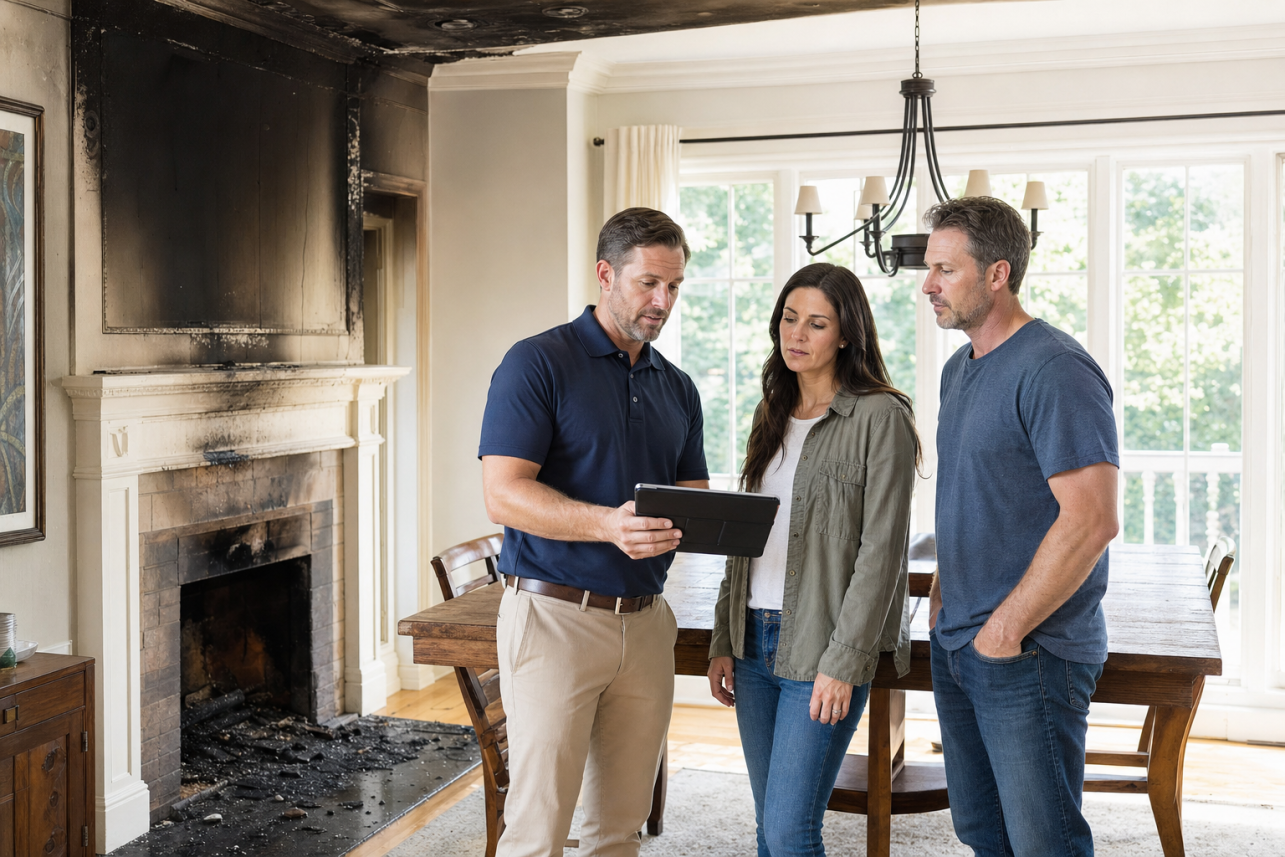
Three different people may walk your damaged property, and they have three very different jobs. The company adjuster is employed or assigned by your insurer, and their estimate reflects the carrier’s interests. Your contractor knows construction, but is not licensed to interpret your policy or negotiate your claim — and in North Carolina, it is unlawful for a contractor to act as one. A public adjuster is the only one of the three who is licensed by the state to represent you, the policyholder.
For The Public Adjusters, Inc. is licensed and bonded, and we handle the entire claim: reading the policy, documenting structural and contents damage, preparing a line-item estimate, meeting the carrier’s adjuster on site, and negotiating until the settlement reflects the actual scope of your loss. In Apex, that often means catching things first inspections miss — moisture trapped in wall cavities after a pipe break, smoke residue beyond the burn room, or hurricane and tornado damage hidden under roofing layers.
A quick note on scope: we handle claims for homes, commercial buildings, and contents. We do not handle claims involving motor vehicles, cell phones, health, or life insurance. For flood losses, we also help you navigate the separate NFIP process and point you to resources at FEMA.gov and FloodSmart.gov, because flood claims follow their own federal rules.
The difference comes down to loyalty. Everyone else in the process answers to someone else. We answer to you.
Local Relevance
Apex sits in a part of Wake County where the claims tell a consistent story. Much of the town was built during the late-1990s and 2000s boom, and those builder-grade shingles and economy flashing details are now at the age where carriers reflexively call storm damage “wear and tear.” Documenting the actual hail and storm dates is often the difference between a denial and a covered roof.
Spring brings narrow hail and tornado paths through the Triangle — one street takes a beating while the next is untouched, so “nobody else in the neighborhood filed” proves nothing about your roof. Summer humidity turns small water intrusions into mold problems fast, and winter ice events still produce limb strikes and ice-dam leaks that get treated as minor until someone opens the ceiling.
Mature hardwoods are part of Apex’s charm and part of its risk. A pine or oak through the roof is one of the most underscoped claims we see, whether it’s here in town or a Tree Damage Insurance Claim Help in Carrboro file — carriers pay to patch the hole and miss the racked framing underneath.
Flood deserves its own mention. Fast development means more pavement and more runoff than the flood maps were drawn for, and standard homeowners policies exclude flood. If rising water reaches your home, a separate flood policy through the National Flood Insurance Program is what responds — and we help policyholders document those claims too.
Much of Apex sits on the Triassic Basin, where poorly draining clays shrink and swell with the seasons — producing cracked slabs, sticking doors, and settlement that out-of-area adjusters too quickly blame on “age.” Knowing which side of that soil line a house sits on changes how a foundation or water claim should be built and argued.
Get A Free Claim Review Before You Accept The Carrier’s Number
Whether your loss happened yesterday or your settlement already feels short, it costs nothing to have a licensed, bonded Apex public adjuster read your policy and walk your damage. No pressure, no obligation — just a straight answer about where your claim stands and what it’s missing.
Call us: (919) 400-6440
Helpful Resources
- NCDOI Public Adjusters Guide
- Insurance Information Institute (III)
- National Flood Insurance Program (NFIP)
- North Carolina Department of Insurance — State regulator where public adjuster licenses can be verified
Last updated: October 13, 2026