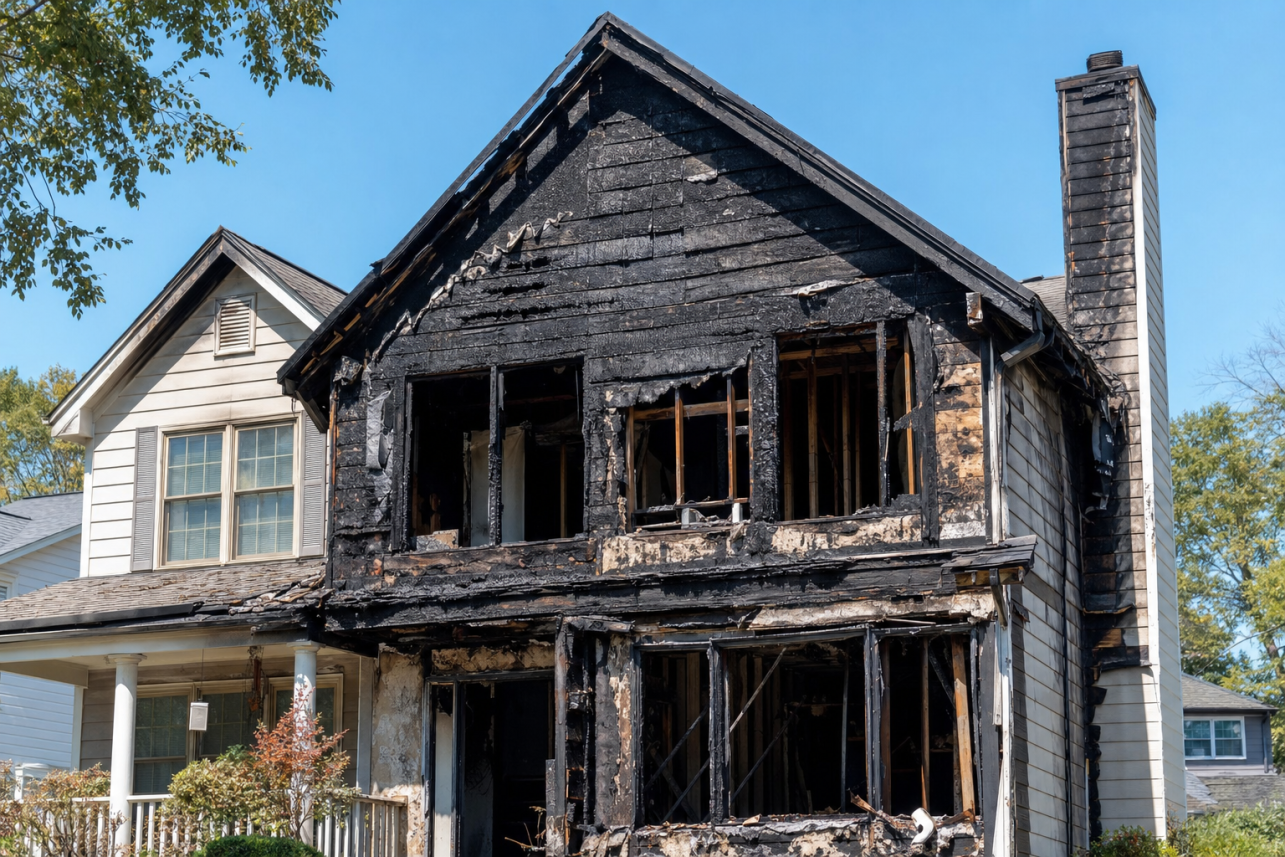
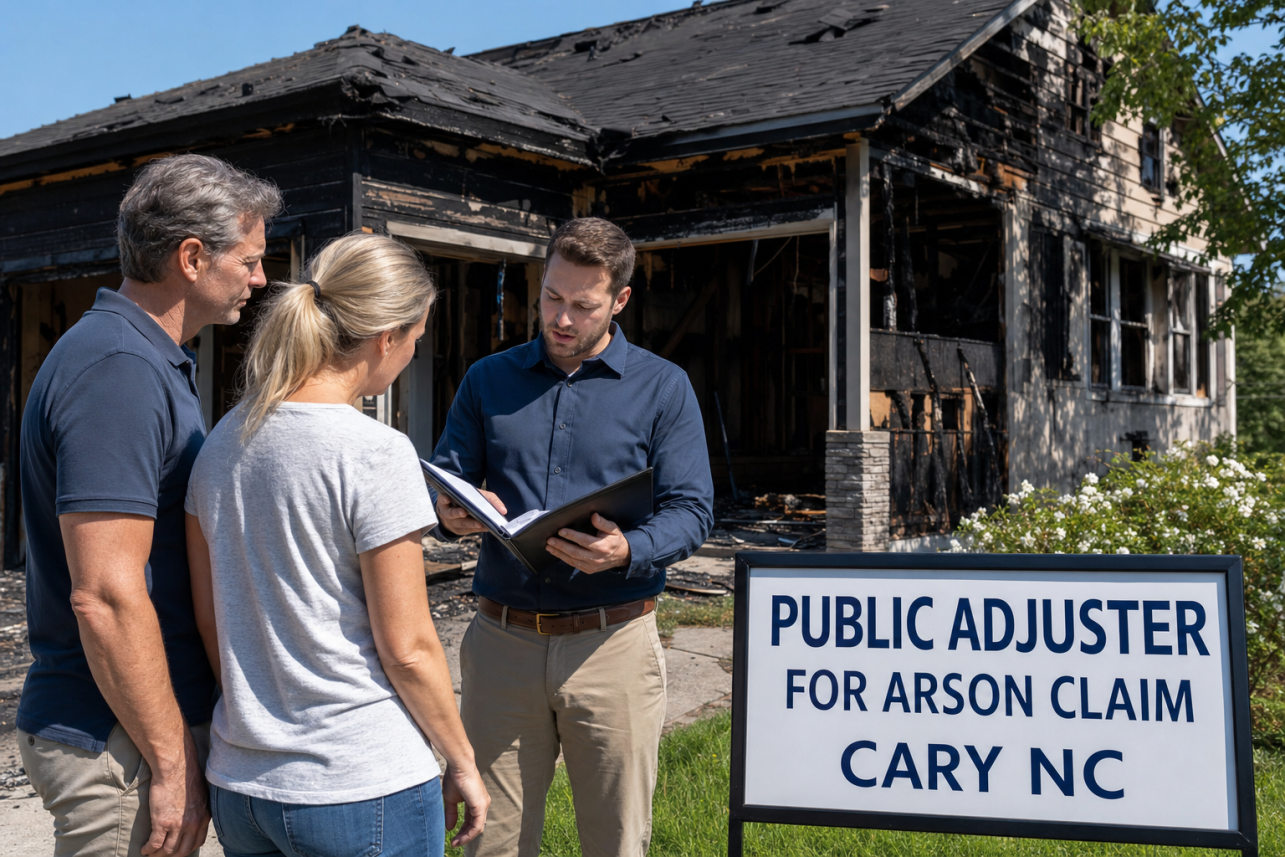
If your insurer is suggesting you set your own fire, a public adjuster for arson claim Cary NC represents you — the policyholder — not the insurance company. For The Public Adjusters, Inc. is licensed and bonded in North Carolina, and we work with innocent homeowners facing the so-called arson defense. We document the true cause and scope of your loss, manage the insurer’s demands for records and statements, and press your claim on the evidence. You do not have to face a fraud investigation unit alone.
What This Service Is
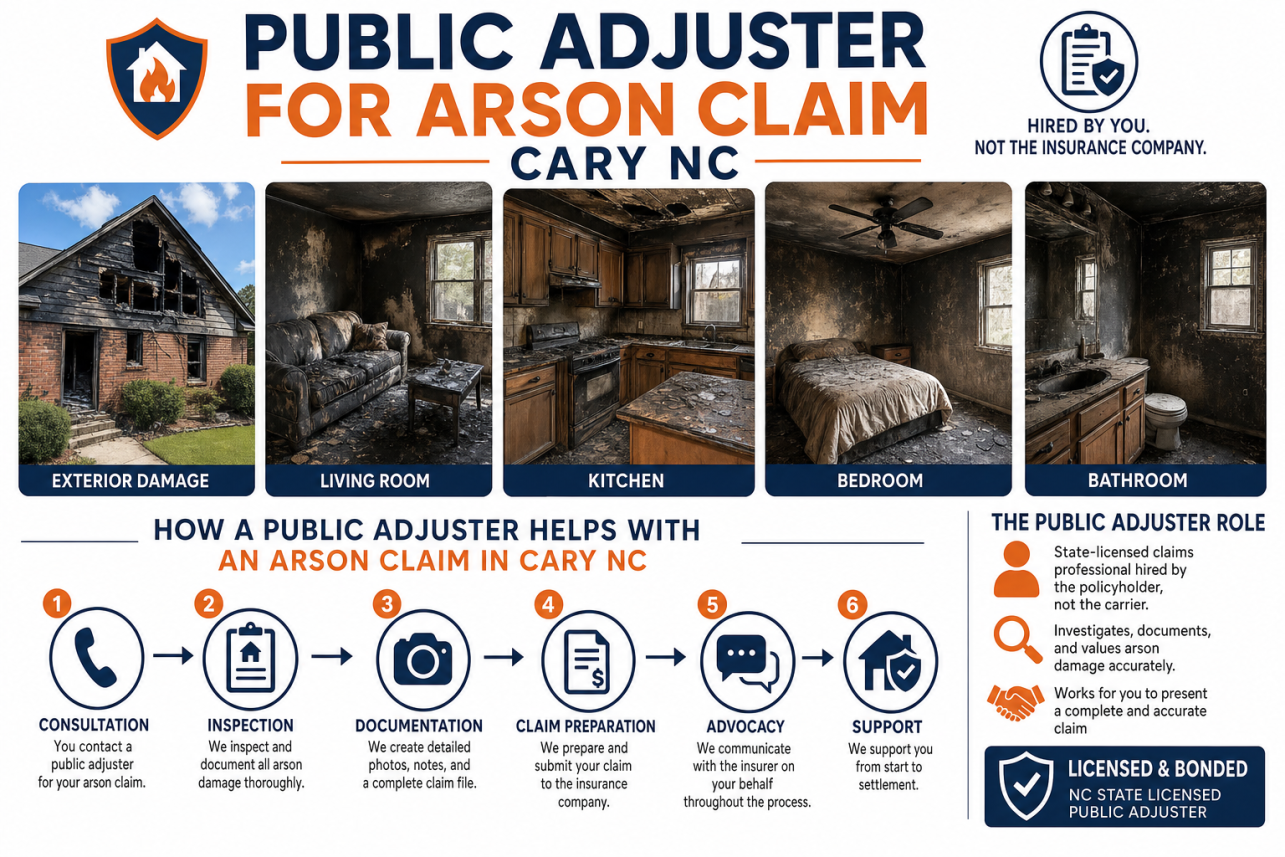
A public adjuster is a state-licensed claims professional hired by the policyholder, not the carrier. In an arson-accusation case, that role becomes critical, because the insurer’s investigators are building a file to deny your fire damage claim — and everything you submit becomes part of that file.
Our work typically includes reviewing your policy language, coordinating with independent cause-and-origin experts, preparing your contents inventory and structure estimate, and organizing the financial and personal records the insurer will inevitably demand. We also prepare you for what to expect during an examination under oath, one of the most consequential steps in any suspected-arson claim.
Courts have repeatedly made clear that an accusation is not proof. In Watson v. United Services Automobile Association, the Wisconsin Supreme Court allowed an innocent co-insured spouse to recover under a homeowners policy for damage to the home and contents even though the other spouse had intentionally set the fire. Cases like that underscore why innocent policyholders should not simply accept a denial. To be clear, we never guarantee any particular outcome — but we do make sure your side of the story is documented and forcefully presented.
Beyond arson accusations, our team handles fire damage, smoke damage, vandalism, water, wind, and tree damage claims for Wake County homeowners, along with commercial business claims.
Common Problems
The Arson Defense: How Insurers Turn A Fire Loss Into A Fraud Case
When a fire’s cause is listed as incendiary or undetermined, some carriers pivot from paying the claim to investigating the policyholder. Suddenly you’re asked about your mortgage balance, credit cards, recent listing history, even your whereabouts on the night of the fire.
The National Fire Protection Association publishes the investigative standards most fire investigators follow, and a proper cause-and-origin analysis must rule out accidental causes — lightning, electrical faults, appliance failures — before anyone should be pointing at the homeowner. In Cary’s summer thunderstorm season, we have seen lightning-related and electrical fires raise suspicion simply because the ignition point was hard to pin down. That ambiguity should never be treated as evidence against you.
Why A Public Adjuster For Arson Claim Cary NC Matters When You’re The Suspect
Once an insurer opens a special investigation, the process stops being a normal claim. Deadlines tighten, requests multiply, and small inconsistencies in your statements can be used to justify a denial.
Our adjusters know how these investigations unfold. We help you respond completely and accurately, gather the alibi, financial, and property records that support your innocence, and keep the actual damage documentation moving forward in parallel. The North Carolina Department of Insurance licenses public adjusters precisely so policyholders have qualified representation on their side of the table — and its guidance on public adjusters is worth reading before you sign anything with anyone.
Examinations Under Oath And Document Demands
Most homeowners policies give the carrier the right to take your examination under oath and to demand extensive documentation. Refusing outright can void your coverage; walking in unprepared can sink an otherwise valid claim.
We help you understand what the policy actually requires, organize responsive records so nothing looks evasive, and coordinate with your attorney if you have one. Meanwhile, we keep building the affirmative case: the structure repair estimate, the smoke and water damage scope, and the room-by-room contents inventory the insurer must eventually answer to.
Our Process
Free Policy And Investigation Review
We start by reading your full homeowners policy — not just the declarations page — and reviewing every letter, reservation-of-rights notice, and request the carrier has sent. This tells us where the investigation stands and what deadlines are already running.
You’ll get a plain-English explanation of your duties under the policy and where the insurer’s leverage points are.
Independent Documentation Of Cause And Damage
We photograph and scope the loss ourselves, and where the cause is disputed we can coordinate independent cause-and-origin expertise. Smoke penetration, heat damage, and water damage from firefighting efforts are often undervalued in arson-suspect files because the carrier’s focus is on denial, not scope.
We build the complete claim — structure, contents, and additional living expenses — so it’s ready the moment the coverage question resolves.
Negotiation And Resolution
With the documentation assembled, we present the claim, respond to the insurer’s positions point by point, and negotiate toward a settlement that reflects your actual loss. If the carrier maintains a wrongful denial, our organized file becomes the foundation your attorney can take into appraisal or litigation.
We cannot promise a specific dollar figure — no honest adjuster can — but we can promise your claim will not be dismissed for lack of evidence or preparation.
| What Happens | Going It Alone | With For The Public Adjusters |
|---|---|---|
| Origin-and-cause report | You accept the carrier’s investigator’s conclusions as final | Independent certified fire investigator re-examines the scene and challenges flawed ‘pour pattern’ or accelerant findings |
| Examination under oath | You answer alone; innocent inconsistencies become ‘evidence’ of fraud | You’re prepared in advance and accompanied, so the record stays accurate and complete |
| SIU document demands | You hand over everything requested — or refuse and risk a denial for non-cooperation | Each request is measured against your actual policy duties; overreach is formally objected to in writing |
| Motive allegations (debt, vacancy, recent coverage changes) | Left unrebutted, they anchor the denial | Documented and dismantled with financial records, timelines, and policy language |
| Claim valuation during the investigation | The dollar figure sits ignored while the accusation dominates | A full replacement-cost estimate is built and submitted so payment is ready the moment the defense collapses |
| Timeline | Delays stretch 6–12+ months with no pressure on the carrier | Written good-faith demands under NC law keep the insurer on the clock |
Commonly Overlooked In The Public Adjusting Industry
- Preserving the fire scene before demolition or cleanup — Once a restoration crew guts the house, the physical evidence that could disprove arson — burn patterns, appliance remains, wiring — is gone forever.
- The policy’s actual definition of ‘vacant’ and ‘unoccupied’ — Carriers lean on vacancy exclusions to bolster arson suspicion, but many policies require 60+ consecutive days and specific conditions the insurer never proves.
- The difference between ‘undetermined’ and ‘incendiary’ in a fire report — Homeowners assume an undetermined finding clears them, while insurers quietly treat it as license to allege intentional ignition.
- Limits on the cooperation clause — Most insureds hand over every document demanded, not realizing the duty to cooperate doesn’t obligate them to produce records with no connection to the loss.
- Additional living expense (ALE) accrual during the SIU delay — Families focus on the accusation and forget the insurer still owes documented housing and meal costs for every month the investigation drags on.
- The insurer’s burden of proof on an arson defense — In North Carolina the carrier must prove incendiary origin, motive, and opportunity — yet homeowners act as if they must prove their innocence instead.
- Cell tower, toll, and smart-home data as alibi evidence — This time-stamped data can conclusively place a homeowner elsewhere at ignition, but it’s routinely purged by providers before anyone thinks to request it.
- Building the full damage estimate while the accusation is pending — Everyone fights the fraud allegation and no one prices the loss, so when the defense collapses the insured has no leverage on the settlement number.
Case Studies
Case Study #1
Situation: A homeowner in Cary’s Lochmere neighborhood came home from a weekend trip to find her garage and kitchen destroyed by fire. The Cary Fire Department’s initial report noted an undetermined origin, and within two weeks her insurer’s Special Investigations Unit (SIU) requested an examination under oath.
Problem: The carrier’s origin-and-cause investigator flagged ‘pour patterns’ on the garage floor and pointed to a recent increase in her dwelling coverage as motive. Her claim payments were frozen, she was paying a mortgage on an unlivable house, and the SIU letters implied criminal referral was possible.
Investigation: Our team retained an independent certified fire investigator (IAAI-CFI) to re-examine the scene before demolition. We pulled her cell tower records, hotel receipts, and toll transponder data to lock down her alibi, and documented that the coverage increase came from her agent’s standard renewal review, not a request she initiated.
Findings: The ‘pour patterns’ were actually thermal shadowing from a melted plastic storage bin containing pool chemicals, a known accidental ignition source. The garage refrigerator’s compressor relay also showed arcing consistent with an electrical fault. Nothing supported an intentional set by the insured.
Solution: We prepared a rebuttal report from our fire investigator, compiled the alibi evidence into a single documented timeline, and sat with the homeowner through her examination under oath so nothing was mischaracterized. We then presented a full replacement-cost estimate the carrier’s initial scope had ignored while the SIU held the file.
Outcome: The insurer withdrew the arson defense within 60 days and paid $312,000 on dwelling, contents, and additional living expenses — roughly $95,000 more than the carrier’s pre-investigation working number. No criminal referral was ever made.
Lesson: An ‘undetermined’ cause on the fire marshal’s report is not proof of arson, and carriers know it. The insured who answers an SIU investigation with organized evidence — instead of just protests of innocence — shifts the burden back where it legally belongs: on the insurance company.
Case Study #2
Situation: A landlord who owns a rental duplex off Kildaire Farm Road in Cary had a unit burn while it sat vacant between tenants. Because vacant properties are a classic arson red flag, the insurer immediately treated him as the prime suspect and demanded five years of bank statements, tax returns, and divorce records.
Problem: The carrier argued financial motive: the property had been listed for sale for four months without an offer. They delayed the claim past 90 days, and the owner — a retired Wake County schoolteacher — was told informally by the adjuster that ‘these vacancy fires rarely get paid.’
Investigation: We documented that the property was not legally ‘vacant’ under his policy’s definition because staging furniture and utilities remained active. Our fire expert examined the electrical panel and found aluminum branch wiring at a corroded connection in the burned unit — a documented fire hazard in homes of that era.
Findings: The origin point matched the faulty junction, not any accelerant location. We also showed the listing price was above market by design because he was in no hurry to sell, undercutting the financial-distress theory. His financials showed no debt pressure at all.
Solution: We answered the document demands strategically — producing what the policy actually required and formally objecting to overreach like the divorce records, which had no bearing on the loss. We submitted a sworn proof of loss with a line-item repair estimate and put the carrier on written notice of its duty of good faith under North Carolina law.
Outcome: The insurer paid the claim in full, including lost rental income for the rebuild period — a total recovery of $187,400. The ‘vacancy’ defense collapsed once the policy language and utility records were on the table.
Lesson: Insurers often use invasive document demands to pressure wrongfully accused owners into abandoning fire claims. Knowing which requests a policy actually obligates you to answer — and which cross the line — can be the difference between a paid claim and a denial.
| Warning Sign From the Insurer | What It Usually Means | What You Should Do |
|---|---|---|
| Claim transferred to the Special Investigations Unit (SIU) | The carrier suspects fraud or arson and is building a file, not adjusting a loss | Stop giving casual recorded statements; get representation before answering anything further |
| Request for an examination under oath (EUO) | A formal, transcribed interrogation where your words can be used to deny the claim | Never attend unprepared or alone — you have the right to counsel or a representative present |
| Demand for bank statements, tax returns, or divorce records | They’re hunting for a financial motive to justify an arson defense | Verify each request against your policy’s cooperation clause before producing anything |
| ‘Undetermined’ cause on the fire report | Not a finding of arson — but carriers often treat it as an open door to allege one | Commission an independent origin-and-cause investigation before the scene is demolished |
| Reservation of rights letter | The insurer is investigating while preserving its ability to deny everything later | Take it seriously; respond in writing and start documenting every interaction |
| No payment past 90 days with vague status updates | Delay is being used as leverage to pressure a low settlement or withdrawal | Send a written demand citing the insurer’s good-faith obligations under North Carolina law |
| Police or fire marshal asks you to come in ‘just to talk’ | The civil investigation may be feeding a criminal one | Consult a criminal defense attorney before speaking — your adjuster can coordinate with them |

Reviews
After our house fire on the west side of Cary, the insurance company’s investigator basically accused my husband of setting it because he’d been laid off two months earlier. We were terrified. For The Public Adjusters brought in their own fire investigator who traced the fire to a dryer vent, and they sat with us through the examination under oath. The accusation was dropped and we were paid in full. I honestly don’t know what would have happened without them.
Denise W., Cary NC
My claim sat in SIU limbo for four months while I paid rent and a mortgage. The carrier kept hinting the fire at my Cary townhome was ‘suspicious’ but never said why. This team forced them to put their evidence in writing, tore the origin theory apart with an independent report, and got me a settlement about $80k above what the adjuster first floated. Worth every penny of the fee.
Marcus T., Wake County
Being investigated for a fire in your own home is humiliating. The insurer demanded my bank records, my phone records, everything. For The Public Adjusters knew exactly which requests were legitimate under my policy and which were fishing. They handled every letter, prepared me for the sworn statement, and my claim was paid without a lawsuit. Professional, calm, and clearly experienced with arson accusations specifically — not just regular fire claims.
Priya R., Cary NC
Frequently Asked Questions
Why Would I Need A Public Adjuster For Arson Claim Cary NC If I’ve Been Wrongfully Accused Of Setting The Fire?
When an insurance carrier suspects arson, the entire tone of your claim changes. Instead of adjusting your loss, the company begins building a defense against paying it. A public adjuster for arson claim Cary NC representation exists precisely for this moment — you need someone on your side whose only job is documenting your loss and protecting your rights as the policyholder.
Wrongful arson accusations are more common than most Cary homeowners realize. Carriers may point to financial stress, a recent listing of the home, or an inconclusive fire investigation as grounds for suspicion. None of those things prove you set a fire, but they can be used to delay or deny your claim.
Our adjusters step in to level the playing field. We review the fire investigator’s report, document every damaged item and structural loss at your Wake County property, and make sure the burden of proof stays where North Carolina law puts it — on the insurance company. A carrier cannot deny a claim on suspicion alone; it must prove intent and opportunity.
We also manage all communication with the carrier’s special investigations unit, so nothing you say can be taken out of context. Many homeowners unknowingly hurt their own claims during recorded statements or examinations under oath. Having experienced representation before those steps happen is often the difference between a paid claim and a prolonged legal fight.
What Should I Do First If My Insurance Company Accuses Me Of Arson After A House Fire In Cary?
First, do not panic, and do not give a recorded statement or sit for an examination under oath without preparation and representation. Anything you say will be scrutinized by the carrier’s special investigations unit, and innocent inconsistencies — misremembering where you were, guessing at values — can be twisted into evidence of fraud.
Second, preserve everything. Keep the fire scene as untouched as possible until independent experts can examine it. Save receipts, photos, mortgage statements, and utility records. If the Cary Fire Department or a Wake County fire marshal produced a cause-and-origin report, request a copy. Many arson suspicions rest on an ‘undetermined’ cause, which is not the same as proof of intentional burning.
Third, bring in your own advocate early. Our team at For The Public Adjusters, Inc. has worked with homeowners across Cary and the greater Triangle who were treated as suspects instead of victims. We coordinate independent cause-and-origin experts when needed, build a complete inventory of your structural and personal property losses, and handle every exchange with the carrier in writing.
Finally, keep paying your policy premiums and comply with reasonable policy conditions, because carriers look for any technical breach they can use to deny coverage. A cooperative but protected posture — full compliance, guided by someone who knows the tactics carriers use — puts you in the strongest position to get your claim paid.
Can My Insurer Legally Deny My Fire Claim Just Because The Cause Was Ruled Suspicious Or Undetermined?
No. In North Carolina, an insurance company cannot deny a fire claim simply because investigators labeled the cause ‘suspicious’ or ‘undetermined.’ To deny a claim based on arson, the carrier generally must establish that the fire was intentionally set, that you had a motive, and that you had the opportunity to set it or arrange it. Suspicion alone does not meet that standard.
This matters enormously for wrongfully accused homeowners in Cary. Electrical faults, appliance failures, and accidental ignition sources are frequently missed or left unresolved in initial investigations, especially when a fire burns hot enough to destroy evidence. An ‘undetermined’ finding often reflects the limits of the scene, not wrongdoing by the homeowner.
As your public adjuster in Cary, we push back on premature conclusions. We can bring in independent cause-and-origin experts to re-examine the scene, review the electrical system, and challenge investigative shortcuts. We also document your lack of motive — stable finances, no recent coverage increases, personal property you clearly would never destroy — because carriers must consider the full picture.
If a carrier denies or delays without meeting its burden of proof, it may be acting in bad faith, which opens the door to additional remedies under North Carolina law. Our job is to build a claim file so thorough and well-documented that denial becomes indefensible, and to refer you to experienced counsel if the carrier still refuses to act fairly.
How Does For The Public Adjusters, Inc. Handle A Public Adjuster For Arson Claim Cary NC Case, And What Does It Cost?
Every public adjuster for arson claim Cary NC engagement we take on starts with a free, confidential review of your situation — the fire report, your policy, and any correspondence from the carrier or its special investigations unit. We tell you honestly where your claim stands and what the insurer is likely trying to do.
From there, we take over the claim. We prepare a detailed structural damage estimate for your home, compile a room-by-room personal property inventory, and calculate additional living expenses so your family’s temporary housing in the Cary area is covered while the claim is contested. When an accusation is in play, we also prepare you for any examination under oath and coordinate with independent fire experts and, when appropriate, attorneys who handle bad-faith cases.
Our fee is a percentage of the recovery, and we only get paid when you do. There are no upfront costs and no hourly bills, which matters when a wrongful accusation has already frozen your claim payments and strained your finances.
Because we work fire losses throughout Cary, Apex, Morrisville, and the rest of Wake County, we know local rebuilding costs, local contractors, and how area fire investigations typically unfold. That local knowledge lets us challenge lowball estimates and unsupported arson theories with specifics, not generalities. Most wrongfully accused homeowners we represent recover substantially more than the carrier initially offered — and many recover claims that had been headed for outright denial.
How Long Can My Insurer Delay Paying My Fire Claim While An Arson Investigation Is Open In Wake County?
North Carolina insurers are allowed a reasonable investigation period, but “reasonable” is not indefinite. Under the state’s Unfair Claims Settlement Practices rules, a carrier must acknowledge your claim promptly, communicate its status, and either pay or deny within a reasonable time once it has the information it needs. An open Cary Fire Department or Wake County fire marshal file does not give the company a blank check to stall for a year.
In practice, we see arson-suspicion delays run anywhere from 60 days to well over six months when a homeowner handles things alone. Carriers request document after document — bank statements, cell records, divorce filings — and each request resets their clock.
Our adjusters push back on that pattern. We track every request, respond in organized batches, and put the carrier on written notice when its demands stop being investigation and start being delay. If a criminal investigation clears you or goes inactive, we demand the insurer move immediately, because at that point their strongest excuse is gone.
We also document your mounting losses during the delay — hotel bills in Cary, storage costs, mortgage payments on an unlivable house — so the pressure of those additional living expense obligations works in your favor. Homeowners who are wrongfully suspected often assume they have to wait quietly. You don’t. A well-managed file moves faster, and it builds a record you can use if the delay ever becomes a bad-faith issue for an attorney.
What Evidence Helps Prove I Didn’t Set The Fire At My Cary Home?
The most powerful evidence is usually the evidence that dismantles the insurer’s theory of motive and opportunity. Arson accusations against homeowners almost always rest on two claims: that you were in financial trouble, and that you had the chance to set the fire. Attack both and the accusation collapses.
On motive, gather proof of financial stability — current mortgage statements, pay stubs, savings records, and evidence the home wasn’t over-insured. If you’d recently invested in the property, like a kitchen remodel or a new roof, that undercuts any suggestion you wanted it gone.
On opportunity, establish where you were. Cell phone location data, toll records from I-40 or 540, credit card receipts, doorbell and neighbor security camera footage, and witness statements from coworkers or friends in Cary can place you away from the house.
Then there’s the fire science itself. Insurance company investigators sometimes label a fire “incendiary” on thin evidence. An independent origin-and-cause expert can identify overlooked accidental sources — electrical faults, appliance failures, lightning, even discarded smoking materials from a trespasser. NFPA 921, the national standard for fire investigation, requires ruling out accidental causes before calling a fire intentional, and many rushed reports don’t meet that bar.
When For The Public Adjusters, Inc. takes on a wrongful-accusation case, we help coordinate this evidence early, before memories fade and footage gets overwritten. The homeowner who shows up organized and documented is treated very differently from the one who shows up defensive and empty-handed.
Should I Sit For An Examination Under Oath If My Insurer Suspects Arson, And Can A Public Adjuster For Arson Claim Cary NC Help Me Prepare?
In most cases you must sit for the Examination Under Oath, because refusing gives the carrier grounds to deny your claim for non-cooperation under the policy. But you should never walk into one unprepared, especially when the insurer has hinted at arson. An EUO is not a friendly chat — it’s a recorded, sworn proceeding conducted by the insurance company’s attorney, and everything you say can be used to deny your claim.
A public adjuster for arson claim Cary NC preparation makes an enormous difference in how that examination goes. Before the EUO, we organize your entire claim file so your documents, timeline, and statements are consistent. Inconsistency — even innocent memory lapses about what time you left the house or what a room contained — is exactly what carrier attorneys use to build a fraud narrative.
We walk you through the topics they’ll cover: your finances, your whereabouts, the home’s condition, your contents inventory, and prior claims. We make sure your sworn proof of loss matches what you’ll say under oath. Where the questioning crosses into criminal territory, we’ll tell you plainly that you also need a fire-loss attorney, and we work alongside counsel regularly on Wake County cases.
One critical point: never guess during an EUO. “I don’t recall” is an honest answer; a wrong guess is a contradiction the insurer will exploit. Homeowners in Cary who prepare properly get through examinations cleanly. Those who wing it often hand the carrier the denial it was looking for.
The Fire Marshal Says My Cary House Fire Was Intentionally Set, But I Had Nothing To Do With It. Will My Claim Still Be Paid?
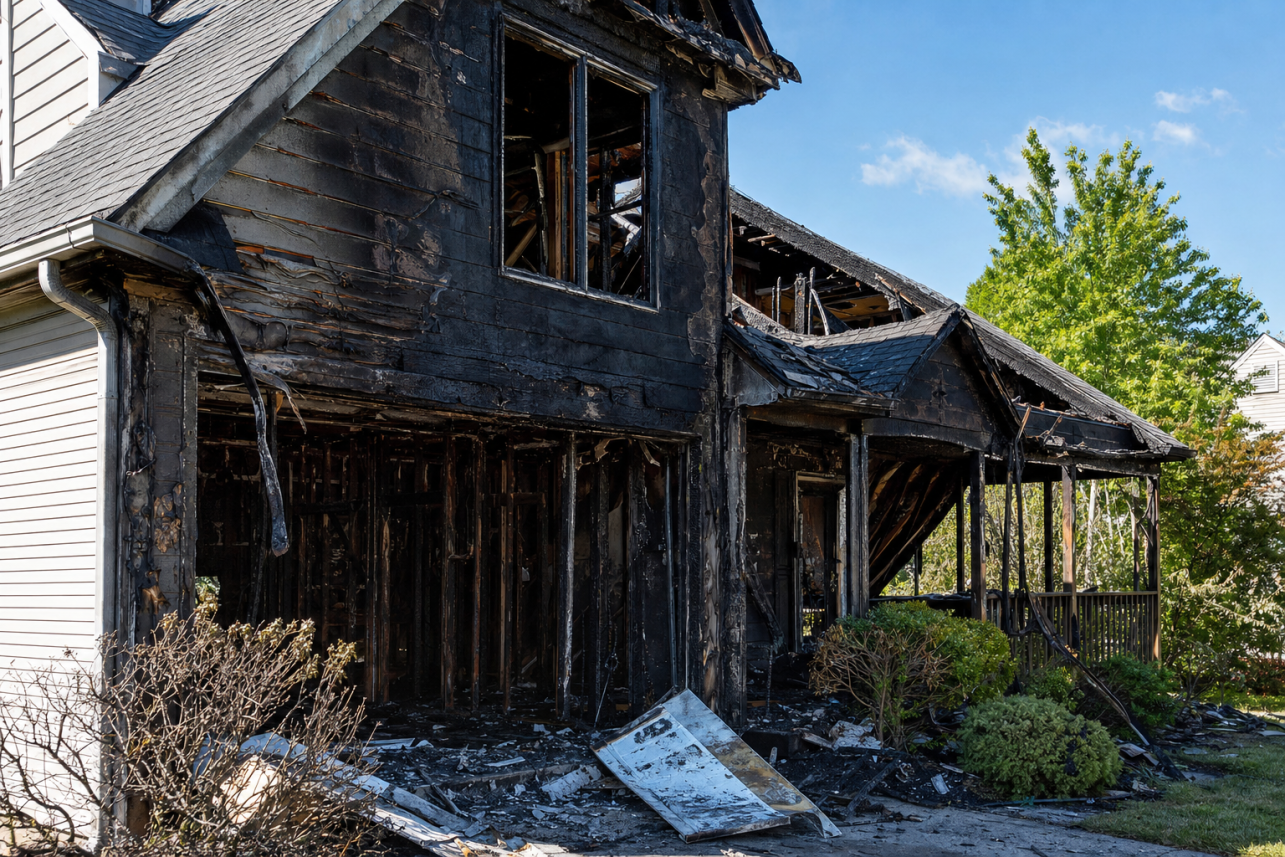
Yes — an arson finding alone does not defeat your claim. Your policy excludes fires that you intentionally set or arranged. It does not exclude fires set by a burglar, a vandal, a disgruntled acquaintance, or an unknown third party. If someone else torched your home, you are an innocent victim of a crime and your coverage applies.
This is where wrongfully accused homeowners get squeezed. The insurer takes the fire marshal’s “incendiary” ruling and quietly shifts the burden onto you, acting as though you must prove your innocence. Legally, it’s backwards: in North Carolina, the carrier bears the burden of proving its arson defense — motive, opportunity, and an intentionally set fire connected to you — before it can deny on those grounds.
Our job as your Cary public adjuster is to keep that burden where it belongs. We separate the two questions the insurer wants to blur together: was the fire set intentionally, and did you set it? A yes to the first means nothing without solid proof of the second.
Meanwhile, we keep the claim itself moving — documenting the structure damage, inventorying contents, and pressing for additional living expenses so your family isn’t paying out of pocket while the accusation plays out. For The Public Adjusters, Inc. has seen suspicious-origin files in Wake County resolve with full payment once the carrier realizes its third-party arson theory has no evidence tying it to the homeowner. An accusation is not proof, and it is not a denial.
Will Hiring A Public Adjuster For Arson Claim Cary NC Make Me Look Guilty To My Insurance Company?
No, and this fear keeps a lot of wrongfully accused homeowners from getting help when they need it most. Hiring representation after a suspicious-fire accusation is no different than hiring an attorney after being questioned by police. It signals that you take the situation seriously, not that you did something wrong.
Insurers deal with licensed public adjusters every day across Wake County. Their special investigations units expect policyholders facing an arson allegation to bring in professionals. In our experience, claims actually move differently once a carrier knows a trained adjuster is documenting every request, deadline, and communication. Sloppy delay tactics and vague accusations become harder to sustain when someone is holding the insurer to the specific language of your policy and North Carolina’s claims-handling regulations.
What genuinely hurts wrongfully accused homeowners is the opposite: going it alone, giving unprepared recorded statements, missing document deadlines, or making innocent misstatements that the carrier later frames as inconsistencies. An arson defense in a claim context is built on precision, and precision requires someone who has handled these investigations before.
At For The Public Adjusters, Inc., we represent Cary homeowners who had nothing to do with the fire and are being treated like suspects anyway. Our involvement puts the burden back where North Carolina law places it — on the insurer, which must prove both that the fire was intentionally set and that you were connected to it. Asserting your rights is not an admission of anything. It is the smartest move you can make.
Do I Have To Hand Over My Bank Statements, Tax Returns, And Phone Records If My Insurer Suspects Arson?
Probably yes, within reason — and refusing outright can backfire badly. Most homeowner policies contain a cooperation clause requiring you to produce documents the insurer reasonably requests during its investigation. When a Cary house fire is flagged as suspicious, carriers almost always ask for financial records because they are building a motive theory: that you were in debt and burned your home for the payout.
That said, “reasonable” has limits. An insurer investigating a fire at your Wake County home is not entitled to unlimited fishing expeditions into a decade of finances, your spouse’s separate accounts, or records with no plausible connection to the claim. Overbroad demands can and should be pushed back on, in writing, with specific objections rather than silence.
This is where representation matters. Our adjusters review every document request, help you comply with what the policy genuinely requires, and challenge requests that overreach. Just as important, we help you present your financial picture accurately and in context. A single late mortgage payment or a recent credit card balance looks very different when it is explained proactively than when an SIU investigator discovers it and frames it as hidden motive.
Never destroy, withhold, or alter anything — that alone can void your coverage. But never dump records on the carrier without review, either. Wrongfully accused homeowners in Cary win these disputes by cooperating strategically: fully honest, properly documented, and protected against having ordinary financial life twisted into a motive narrative.
What Happens With My Mortgage Company While My Arson-Accused Fire Claim Is Being Investigated In Cary?
Your mortgage does not pause because your home burned or because your insurer is investigating you. Payments remain due, and your lender is also a named party on the policy as mortgagee, which complicates how any settlement is eventually paid.
Here is what wrongfully accused homeowners in Cary need to understand. First, most policies contain a standard mortgage clause that protects the lender’s interest even if the insurer denies your claim. That means the carrier might pay your mortgage company its portion while refusing to pay you — leaving you with no house, no personal property recovery, and a loan that is technically satisfied but a life that is not rebuilt. Fighting the accusation is the only way to protect your own share.
Second, when a claim does pay out, structural damage checks are typically made out jointly to you and your lender. The mortgage company will hold funds in escrow and release them in stages as repairs progress, which requires inspections, contractor documentation, and paperwork many homeowners are never told about.
While your claim sits in a Wake County arson investigation, communicate with your lender early. Many servicers offer forbearance after a total-loss fire, but only if you ask before falling behind. We help our clients coordinate all three parties — insurer, lender, and contractor — so a delayed investigation does not turn into a foreclosure problem. A wrongful arson accusation is stressful enough without losing your home twice.
Someone Else Set Fire To My Property — A Vandal, An Angry Ex, Or An Unknown Arsonist. Is My Claim Handled Differently?
Yes, and often in your favor — if the distinction is documented properly. Fire caused by a third party’s arson is a covered peril under standard homeowner policies. The arson exclusion only applies when the insured, or someone acting on the insured’s behalf, intentionally set the fire. A break-in gone wrong, a vindictive former partner, or a neighborhood vandal does not void your coverage.
The problem is that insurers rarely take your word for it. When the Cary Fire Department or the Wake County fire marshal rules a fire incendiary, the carrier’s special investigations unit typically starts with the homeowner as the working suspect and makes you prove otherwise. That means the evidence separating third-party arson from insured arson becomes everything: forced-entry signs, police reports, restraining orders, threatening messages, witness statements, security camera footage, and your own documented whereabouts.
As a public adjuster for arson claim Cary NC matters like these, we work to build that record early, before evidence disappears and before the insurer’s narrative hardens. We coordinate with the criminal investigation where appropriate, since an arrest or charge against the actual arsonist can dramatically strengthen your claim position.
One more point homeowners miss: even in a clear third-party arson, the claim itself still needs professional handling. Structural estimates, smoke and soot contamination, contents inventories, and additional living expenses are all negotiable line items where carriers routinely underpay. Proving you were the victim gets the door open. Getting fully paid is a separate fight, and we handle both.
My Fire Claim Was Already Denied For Suspected Arson. Can A Public Adjuster For Arson Claim Cary NC Still Help Me Reopen It?
Yes, in many cases a denial is not the end of the road. A denial letter based on the arson defense must state the specific policy provisions and factual grounds the insurer is relying on. We start by dissecting that letter, because insurers in North Carolina carry the burden of proving three things: an incendiary fire, your opportunity to set it, and a motive. If any leg of that stool is weak, the denial is vulnerable.
At For The Public Adjusters, Inc., we frequently find that carriers denied a claim on an ‘undetermined’ cause report, thin financial-motive theories, or an origin-and-cause investigation that ignored alternative explanations like electrical faults or third-party entry. We gather the fire marshal’s file, request the insurer’s engineering and O&C reports, and commission independent cause analysis when the evidence supports it.
From there, we prepare a documented rebuttal and a full damage valuation, then demand reconsideration. Insurers often reverse or settle once they see a professionally supported challenge, because taking a shaky arson defense in front of a Wake County jury is risky for them.
Timing matters. North Carolina policies typically require suit within a limited period after the loss, often one to three years depending on the policy language, so a denied homeowner in Cary should not sit on the letter. Bring it to us early, and if litigation ultimately becomes necessary, we coordinate with policyholder attorneys and hand them a fully worked-up claim file rather than starting from zero.
What’s The Difference Between The Criminal Arson Investigation And My Insurance Company’s Investigation Of My Cary House Fire?
They are two separate tracks with different players, standards, and consequences, and homeowners who are wrongfully accused often get them confused.
The criminal side is run by the Cary Fire Department, the Town of Cary Police, the Wake County District Attorney, and sometimes the SBI. To charge you, prosecutors need proof beyond a reasonable doubt. If you are never charged, or charges are dropped, that is a powerful fact — but it does not automatically force your insurer to pay.
The insurance side is a civil matter. Your carrier only needs to prove its arson defense by the greater weight of the evidence, a much lower bar. That is why an insurer can deny a claim even when law enforcement never arrests anyone. The carrier runs its own origin-and-cause investigation, hires its own fire engineers, and can demand documents and an Examination Under Oath under the policy’s cooperation clause.
Here is the trap: anything you say in the insurance investigation can end up in the hands of investigators on the criminal side, and vice versa. That is why coordination matters. As your Cary public adjuster, we manage the civil claim — documenting your damages, responding to document demands appropriately, and challenging the insurer’s cause theory — while making sure nothing in the claim process undermines you elsewhere. If there is any active criminal exposure, we work alongside your defense attorney so both tracks move in the same direction instead of against each other.
While I’m Being Investigated For A Fire I Didn’t Set, What Parts Of My Claim Can Still Be Recovered — The House, My Belongings, Hotel Costs?
All of it remains claimable. An open investigation does not shrink what your policy covers; it only delays the insurer’s decision. Your claim in Cary typically has three main parts, and we build each one from day one so the money is ready to move the moment the arson defense collapses.
First is the dwelling. We prepare a line-item repair or rebuild estimate using local Wake County contractor pricing, including smoke and soot remediation, structural drying, code-upgrade costs required by current Cary building standards, and demolition where needed. Insurers’ early estimates on fire losses routinely miss hidden smoke migration in wall cavities and HVAC systems.
Second is your personal property. We inventory every damaged item room by room — furniture, clothing, electronics, kitchenware — with replacement pricing. This is tedious work that overwhelmed homeowners rarely complete fully on their own, and it is often worth tens of thousands more when done professionally.
Third is Additional Living Expense, sometimes called loss of use. If your home is uninhabitable, your policy pays the reasonable increase in your living costs: a rental in Cary or Apex, hotel stays, extra mileage, even boarding for pets. ALE keeps accruing during a long investigation, so we document it continuously and push the carrier to advance ALE payments even before the cause dispute is resolved — many carriers will, because ALE obligations exist regardless of the pending investigation.
Our adjusters at For The Public Adjusters, Inc. track every category so nothing is forfeited while the accusation gets sorted out.
Can My Insurer Cancel Or Non-Renew My Homeowners Policy After A Suspicious Fire In Cary, And Does That Affect My Claim?
The good news first: cancellation or non-renewal does not erase your claim. Coverage is judged as of the date of the loss. If the policy was in force when the fire happened, the insurer owes whatever the policy promised for that loss, even if it later drops you. A wrongfully accused homeowner should never assume a non-renewal notice means the claim is dead.
That said, North Carolina law limits mid-term cancellation of homeowners policies to specific grounds, such as nonpayment or material misrepresentation, and requires proper written notice. Non-renewal at the end of the term is easier for carriers, and a large fire loss — especially one flagged as suspicious — often triggers it. If you receive either notice, keep it, note the dates, and get replacement coverage quotes immediately so your mortgage lender does not force-place expensive coverage on you.
Where this intersects with your claim is leverage and pressure. Some carriers use the threat of cancellation to push a low settlement, or homeowners panic and accept less. Do not negotiate from fear. As a public adjuster for arson claim Cary NC families rely on, For The Public Adjusters, Inc. keeps the claim valuation and the policy-status issue separate: we document the full loss, hold the carrier to its obligations for the covered date of loss, and help you understand your notice rights under North Carolina statutes.
If a cancellation looks retaliatory or improperly noticed, that can also be raised with the North Carolina Department of Insurance, which takes consumer complaints seriously.
Local Relevance
Cary sits in one of the fastest-growing corners of Wake County, with housing stock that ranges from 1970s and 1980s neighborhoods to brand-new construction. Older homes here often carry aging electrical panels and original wiring — exactly the kind of conditions that produce accidental fires investigators can mistake for something suspicious when the point of origin burns away.
Summer adds its own complications. Severe thunderstorms and the fringe effects of tropical systems bring lightning strikes and power surges to the Triangle, and a lightning-sparked attic fire in an unoccupied home can look, on paper, a lot like the profile insurers scrutinize: a fire with no witnesses. Families traveling during hurricane season come home to a loss and then to pointed questions.
Local replacement costs matter too. Cary’s construction and labor prices have risen sharply with the area’s growth, so an underscoped fire settlement here leaves a bigger gap than it would in many markets. Getting the full documented value of the structure, smoke remediation, and contents is not a luxury — it’s the difference between rebuilding and settling for less than your home was worth.
Many Cary households travel during the summer months, and fires that start in unoccupied homes — often from lightning, surges, or aging wiring in the town’s older subdivisions — tend to draw heavier insurer scrutiny simply because no one was there to explain the origin; documenting your travel timeline and the home’s condition early can defuse suspicion before it hardens into a denial.
Accused Of A Fire You Didn’t Set? Get Someone On Your Side Today
For The Public Adjusters, Inc. is licensed and bonded in North Carolina and works exclusively for policyholders — never for insurance companies. If your Cary fire claim has turned into a fraud investigation, call before your examination under oath, before you sign a proof of loss, and before you accept a denial. The consultation is free, and everything you share stays confidential.
Request Your Free Claim Review
Call us: (919) 400-6440
Helpful Resources
- NCDOI Public Adjusters Guide
- National Fire Protection Association (NFPA)
- Insurance Information Institute (III)
- North Carolina Department of Insurance — State regulator that licenses public adjusters and assists NC policyholders
- U.S. Fire Administration — Federal fire safety and fire-cause education resource
Last updated: September 22, 2026