
If you need flood insurance claim help Hillsborough policyholders can actually count on, For The Public Adjusters, Inc. represents you — not the insurance company — from the first inspection through final payment. We document the damage, prepare the strict NFIP proof of loss paperwork, and negotiate directly with the flood insurer on your behalf. We are licensed and bonded, and we only get paid when you do.
What This Service Is
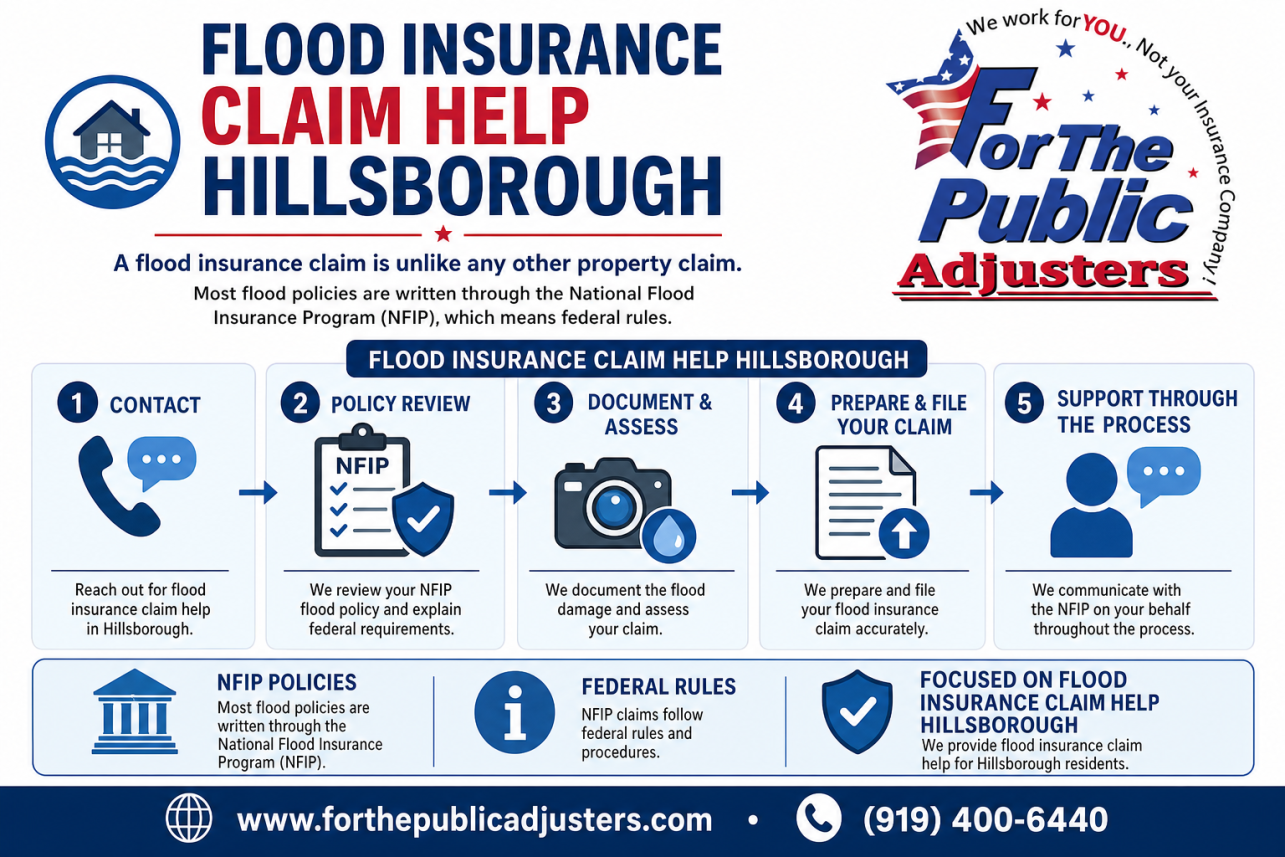
A flood claim is unlike any other property claim. Most flood policies are written through the National Flood Insurance Program (NFIP), which means federal rules apply: a signed, sworn proof of loss is generally due within 60 days of the flood, coverage for finished basements is limited, and contents are often paid at actual cash value — meaning the insurer deducts depreciation from what it would cost to replace your belongings.
Our job as your public adjuster is to level that playing field. We inspect the property, measure and photograph structural damage, build a room-by-room inventory of damaged contents, and prepare repair estimates using the same pricing tools the insurance companies use. Then we present and negotiate the claim so nothing gets quietly left out.
That matters because the adjuster the flood insurer sends works for them. When their estimate misses damaged subflooring, saturated insulation, or the electrical and HVAC components sitting low in your crawl space, that money comes out of your pocket unless someone catches it. We catch it.
We handle NFIP flood claims and private flood claims for both homes and commercial buildings in Hillsborough and throughout Orange County. If the same storm also caused a tree strike or hurricane wind damage, we can handle those homeowners claims alongside the flood claim so nothing falls between two policies.
Common Problems
The 60-Day Proof Of Loss Deadline Sneaks Up Fast
After a flood, most people are focused on drying out the house, finding a contractor, and figuring out where to sleep. Meanwhile, the NFIP clock is running: you generally must submit a signed, sworn proof of loss — with documentation supporting your numbers — within 60 days of the loss.
Miss it or submit an incomplete one, and the insurer has grounds to pay less or deny the claim entirely. We prepare and submit that paperwork correctly the first time, and we request extensions when FEMA authorizes them after major storms.
Why You May Need Flood Insurance Claim Help Hillsborough Insurers Won't Volunteer
Flood adjusters sent by the carrier often write quick estimates that stop at the visible waterline. But floodwater wicks up drywall, soaks insulation inside walls, and warps subfloors weeks after everything looks dry on the surface. In a humid Piedmont summer, mold can follow within days.
An early lowball offer based on surface damage rarely covers the real repair. We open up the claim with moisture readings, photos, and detailed estimates so the settlement reflects what your contractor will actually charge — and we pursue supplemental payments when hidden damage emerges during repairs.
Denied, Underpaid, Or Told It's 'Groundwater' Not Flood
Flood claims get denied for reasons that sound technical but are often arguable: the insurer says the water was seepage rather than a general flood, or blames pre-existing conditions, or applies coverage limits more narrowly than the policy requires. Courts have pushed back on insurers who wrongly shift blame after a storm — in Corban v. USAA, the Mississippi Supreme Court sided with homeowners on how hurricane damage must be allocated between causes, rejecting the insurer's attempt to escape payment. You don't have to accept a denial letter as the final word. We review the policy language, gather the evidence, and pursue the appeal or supplement process on your behalf.
Our Process
Free Claim Review And Damage Inspection
We start by reading your actual flood policy — coverage limits, deductibles, and whether contents are covered at all. Then we walk the property, take moisture readings, and photograph everything from the crawl space to the waterline. This inspection often uncovers damage the insurer's adjuster never looked for.
Documentation, Inventory, And Proof Of Loss
We build the complete claim file: structural repair estimates, a detailed personal property inventory with replacement values, and receipts or records for anything the water destroyed. We prepare the sworn proof of loss and submit it within the federal deadline, so a paperwork technicality never sinks a legitimate claim.
Negotiation And Settlement
We present the claim to the flood insurer, respond to their pushback line by line, and negotiate the settlement. If they underpay, we pursue supplements and appeals. Our fee is a contingency percentage of what you recover — no recovery, no fee — and we never promise a specific dollar outcome, because no honest adjuster can.
| What Happens | Filing on Your Own | With For The Public Adjusters |
|---|---|---|
| Damage documentation | Whatever the carrier's adjuster records in one visit | Independent moisture mapping, photo logs, and crawlspace/duct inspection |
| Proof of Loss (60-day NFIP deadline) | Owner must prepare and swear to it correctly or risk forfeiting payment | Prepared, itemized, and filed on time by licensed adjusters |
| Scope of the estimate | Often limited to visible damage; hidden wicking and systems missed | Full line-item estimate including contamination, code items, and depreciation review |
| Denial or lowball offer | Owner argues alone against the carrier's examiner | Formal rebuttal with meteorological data, comparables, and negotiation |
| Typical result | First offer usually accepted, often well below actual loss | Documented claims frequently settle for two to four times the initial estimate |
Commonly Overlooked In The Public Adjusting Industry
- Crawlspace ductwork contaminated by floodwater — Field adjusters rarely crawl under the house, so a full duct system replacement the NFIP policy covers gets left off the estimate entirely.
- Drywall wicking above the visible water line — Water climbs 18–24 inches inside walls even when the flood was only a few inches deep, and estimates written from the visible stain miss the required flood cuts.
- The sworn Proof of Loss 60-day deadline — Homeowners assume filing the claim is enough, but NFIP carriers can deny payment outright if the signed Proof of Loss isn't submitted in time.
- Exterior flood-depth documentation — The mud line on brick or siding is the strongest evidence of how deep water got, and it washes away or gets pressure-washed before anyone photographs it.
- The 'general condition of flooding' definition — Carriers deny claims as surface runoff or drainage failure when proof that two acres or multiple properties flooded would qualify the loss under the policy.
- Reconstructing inventory and contents from cloud and bank records — Owners guess low from memory after their paper records are destroyed, when supplier invoices and POS backups usually prove a far larger contents loss.
- Excess depreciation on flooring and mechanicals — NFIP estimates often over-depreciate items or classify replaceable materials as cleanable, and policyholders don't know they can dispute those line items.
- What flood policies genuinely exclude — Finished basements, most landscaping, and additional living expenses aren't covered under standard NFIP policies, and chasing them wastes leverage better spent on covered items.
Case Studies
Case Study #1
Situation: A family living near the Eno River off Highway 70 in Hillsborough came home after a tropical storm remnant dropped nine inches of rain in two days. Floodwater had risen roughly fourteen inches inside their crawlspace-foundation home, soaking floors, drywall, and the HVAC system.
Problem: Their NFIP flood carrier's field adjuster spent under an hour on site and issued an estimate of $18,400. It excluded the ductwork under the house, treated the hardwood floors as 'dry-out only,' and applied depreciation the family didn't understand. They knew the number was low but not why.
Investigation: Our adjusters performed a full moisture-mapping inspection, pulled baseboards to document wicking above the visible water line, and crawled the foundation to photograph collapsed flex duct and insulation hanging from the subfloor. We also documented the water line on the exterior brick to establish flood depth per FEMA guidelines.
Findings: Moisture readings showed the hardwood had cupped beyond salvage and drywall wicking extended 24 inches up, requiring flood cuts throughout the first floor. The entire duct system was contaminated with floodwater, which NFIP policies cover for replacement, not cleaning. The carrier's estimate had also missed the electrical junction boxes in the crawlspace.
Solution: We prepared a line-item Proof of Loss with photo documentation keyed to each line, submitted it within the NFIP's strict 60-day deadline, and requested a re-inspection with the carrier's adjuster present alongside ours.
Outcome: The claim was revised to $67,900 — more than three and a half times the original offer. The family replaced the ductwork, flooring, and lower drywall properly instead of patching over contaminated materials.
Lesson: NFIP flood claims live and die on documentation and the Proof of Loss deadline. What the first adjuster doesn't write down often never gets paid — unless someone re-opens the file with evidence.
Case Study #2
Situation: The owner of a small retail shop in downtown Hillsborough, a block off Churton Street, had stormwater back up through the rear entrance during a flash flood event. Inventory, display fixtures, and the rear stockroom flooring were destroyed.
Problem: The carrier initially denied most of the claim, arguing the water was 'surface runoff from a drainage failure' rather than flood as defined by the policy, and disputed the inventory valuation because the owner's records were water-damaged.
Investigation: We obtained rainfall data and stream gauge records for the event, photographed the debris line showing general flooding across adjacent parcels, and gathered witness statements from neighboring businesses that flooded the same night. For inventory, we reconstructed values using supplier invoices, point-of-sale reports pulled from cloud backups, and bank statements.
Findings: The event met the NFIP definition of flood: two or more acres and multiple properties inundated. The 'drainage failure' argument didn't hold once we showed the whole block took on water. The reconstructed inventory came to $41,000, nearly double the owner's rough estimate, because she had undervalued at-cost stock.
Solution: We submitted a formal rebuttal to the denial with the meteorological evidence, filed an amended Proof of Loss with the reconstructed inventory schedule, and negotiated directly with the carrier's examiner.
Outcome: The denial was reversed. The final settlement covered building damage, contents, and inventory for a combined $88,300, and the shop reopened within four months.
Lesson: A denial letter is a starting position, not a verdict. Flood definitions are technical, and business owners can often prove far more inventory loss than they think — if the records are rebuilt correctly.
| Your Situation | Best First Step | What It Depends On |
|---|---|---|
| Water just entered the home | Photograph the water line inside and out before pumping or cleaning anything | Depth-of-water evidence drives NFIP payment; once it's gone, it's gone |
| Carrier's adjuster already inspected | Request the written estimate and compare it line by line to actual damage | Whether ductwork, wicking, and crawlspace items were included |
| Offer feels low but you're unsure | Get a free claim review before signing or cashing anything | Depreciation applied, salvageability of flooring, and missed line items |
| Claim was denied as 'not flood' | Gather rainfall data and photos of neighboring flooded properties | Whether two-plus acres or multiple properties were inundated |
| Proof of Loss deadline is approaching | Call a licensed adjuster immediately — the 60-day NFIP window is strict | How much documentation exists and whether an extension was granted |
| Business inventory was destroyed | Rebuild valuation from supplier invoices, POS backups, and bank records | Quality of records and whether contents coverage was purchased |
| Repairs already started | Save every damaged material sample and keep all receipts | Whether removed materials were photographed and measured first |

Reviews
After the Eno flooded our street, our NFIP adjuster offered us barely enough to replace the flooring. For The Public Adjusters found the duct contamination and drywall wicking the first inspection missed and got our settlement nearly tripled. They handled the Proof of Loss paperwork so we didn't blow the deadline.
Marcus T., Hillsborough NC
Our flood claim was denied because the carrier called it 'runoff, not flood.' I was ready to give up. These adjusters pulled rainfall records and photos from my neighbors and got the denial overturned. If you need flood insurance claim help Hillsborough is lucky to have a team that actually understands NFIP rules.
Denise W., Orange County
Very responsive and honest about what my policy would and wouldn't cover — flood policies don't pay for basement finishes, and they told me that up front instead of overpromising. They still recovered about $22,000 more than the carrier's first estimate on the rest of the house. Only wish I'd called them the day the water came in.
Raymond P., Hillsborough NC
Frequently Asked Questions
How Does Flood Insurance Claim Help Hillsborough Homeowners Get Paid Fairly By The NFIP Or Their Private Carrier?
Most flood policies in Orange County are written through the National Flood Insurance Program, and NFIP claims follow strict rules that differ from ordinary homeowners insurance. The burden of proof sits almost entirely on you: the policyholder must document every damaged item, prove the cause was flooding as the policy defines it, and submit a signed, sworn Proof of Loss within 60 days of the loss in most cases. Miss that deadline or leave items off the form, and the carrier can legally decline to pay for them.
That is where a public adjuster changes the outcome. We inspect the property ourselves rather than relying on the carrier's adjuster, moisture-map the walls and flooring, and build a line-item estimate using the same pricing software insurers use. We then prepare and submit the Proof of Loss on your behalf so nothing is forfeited on a technicality.
Homes near the Eno River, Cates Creek, and the low-lying areas off Highway 70 often see water intrusion that carriers try to classify as groundwater seepage or surface runoff, which flood policies treat differently. We document the flow path and water lines to establish that the loss is covered.
For The Public Adjusters, Inc. works only for you, never the insurance company, and our fee comes from the settlement we recover. On flood losses, the difference between the carrier's first offer and a properly documented claim is frequently tens of thousands of dollars.
What Should I Do In The First 48 Hours After Floodwater Enters My Hillsborough Home?
Your first priority is safety: do not enter standing water until power to the affected area is off, and assume any water that touched the ground carries contamination. Once it is safe, start documenting before you move or discard anything.
Photograph and video every room, including the high-water line on the walls, the exterior of the house, and the source or path the water took. Flood claims live and die on evidence of the waterline, so capture it in multiple rooms with something for scale, like a tape measure.
Flood policies require you to protect the property from further damage, so it is fine, and expected, to pump out water, pull soaked carpet, and run dehumidifiers. But keep samples. Cut and save a square of carpet and pad, keep a section of damaged drywall, and hold onto ruined contents in the garage or yard until an adjuster has seen them. Throwing everything to the curb before inspection is one of the most common and costly mistakes we see in Orange County flood losses.
Keep every receipt for pumps, fans, tarps, cleaning supplies, and temporary repairs, since these are typically reimbursable. Then report the claim promptly, because flood policies have short notice requirements.
If you call our adjusters early, we can direct the documentation from day one, meet the carrier's adjuster on site, and make sure the mitigation work you do strengthens the claim instead of accidentally destroying the proof it depends on.
My Flood Claim Was Underpaid Or Denied. Can A Hillsborough Public Adjuster Still Step In?
Yes, and this is actually one of the most common points at which families bring us in. A denial letter or a low settlement check is rarely the end of a flood claim; it is usually the beginning of the supplement and appeal process.
On NFIP-backed policies, you generally have the right to file an appeal with FEMA within 60 days of the carrier's written denial, and you can submit supplemental claims when additional damage or undervalued items are identified. Private flood policies have their own dispute procedures, often including appraisal. The key in every case is timing, so bring us the denial or settlement letter as soon as you receive it.
When we take over an underpaid claim, we start with a fresh, independent inspection. Flood adjusters working high volumes after a storm frequently miss hidden damage: saturated insulation inside wall cavities, wicking above the visible waterline, compromised subfloors, and HVAC ductwork under older homes around downtown Hillsborough and the surrounding county. We open up what needs to be opened, measure moisture properly, and rebuild the estimate line by line.
We then compare our figures against the carrier's estimate, identify every omission and pricing error, and submit a documented supplement or formal appeal with photos, measurements, and policy citations. Because For The Public Adjusters, Inc. is paid a percentage of what we recover, reopening your claim costs you nothing out of pocket, and if we review the file and the carrier truly paid correctly, we will tell you that honestly.
How Much Does Professional Flood Insurance Claim Help Hillsborough Residents Can Hire Actually Cost, And Is It Worth It For A Smaller Loss?
Public adjusters work on contingency, meaning our fee is a percentage of the insurance settlement we recover for you. There is no upfront charge, no hourly billing, and no fee at all if we do not recover money. The exact percentage is stated plainly in a written agreement before we begin, as required under North Carolina licensing rules, so there are never surprises.
Is it worth it on a modest flood loss? Usually, yes, because flood claims are uniquely easy to underpay. NFIP policies pay actual cash value on many items rather than replacement cost, exclude certain basement contents, and depend entirely on the Proof of Loss you sign. A homeowner handling a claim alone tends to accept the carrier adjuster's scope as final, when in reality that scope often omits drywall above the flood cut, cabinet boxes that wicked water, electrical outlets below the waterline, and detached structures.
Even on a claim the carrier values at $20,000, a properly documented file frequently recovers substantially more, which typically far exceeds our fee. On larger losses, the gap grows.
There is also the time factor. Flood claims involve strict deadlines, sworn documents, and back-and-forth with adjusters who handle hundreds of files after a storm. We manage all of it for homeowners throughout Hillsborough and Orange County so you can focus on getting your household back to normal. If you want a straight answer on whether your claim justifies our involvement, we will review it at no charge and tell you honestly.
What Does Flood Insurance Claim Help Hillsborough Property Owners With When The Damage Came From The Eno River Or Backyard Runoff?
The source of the water matters enormously to your claim. NFIP policies define a flood as a general condition of partial or complete inundation of normally dry land affecting two or more acres or two or more properties. If the Eno River jumps its banks near Riverwalk or Gold Park and floods your street, that clearly qualifies. If runoff pooled only in your yard, the carrier may argue it does not.
Our adjusters document the event itself, not just your damage. We pull rainfall data, USGS gauge readings from the Eno, and neighborhood photos to prove a general flooding condition existed. That evidence often makes the difference between a paid claim and a denial letter.
We also sort out the coverage split between flood and homeowners policies. Wind-driven rain, sewer backup without surface flooding, and groundwater seepage each fall under different coverage, and carriers sometimes point at the other policy to avoid paying. We identify which policy owes what and pursue both when appropriate.
For Hillsborough homes in older neighborhoods near West Hillsborough or along the river corridor, foundation type also affects payment. Crawlspaces and basements have significant NFIP coverage limitations, and adjusters working for the carrier apply them aggressively. We know where those limits actually apply and where they do not, so covered damage in your ductwork, insulation, HVAC equipment, and structural elements gets included rather than quietly excluded from the estimate.
How Long Does A Flood Claim Take In Hillsborough, And What Deadlines Could Cost Me Money If I Miss Them?
The single most dangerous deadline is the NFIP Proof of Loss, which is generally due within 60 days of the flood unless FEMA extends it after a major declared event. This is not a casual form. It is a sworn statement of your damages, and if you submit a number that is too low, recovering more later becomes an uphill fight. If you miss the deadline entirely, the carrier can deny payment outright.
Private flood policies carry their own notice and documentation deadlines, often buried in the policy conditions. We read those terms on day one and calendar every date so nothing lapses.
As for overall timing, a well-documented Hillsborough flood claim typically resolves in 60 to 120 days. Claims drag longer when the file is thin, when the carrier's adjuster and the homeowner disagree on scope, or when supplemental damage like hidden mold surfaces after the first inspection.
Our involvement usually shortens the fight, not the calendar of your obligations. We prepare the Proof of Loss with a complete, line-item estimate the first time, which reduces back-and-forth with the flood carrier and limits lowball counteroffers.
If you are already close to a deadline, call us immediately. We can often request an extension in writing, preserve your rights, and still build the documentation needed. Waiting until after a deadline passes removes most of your leverage, and in Orange County we see that mistake far too often after summer storm events.
What Documentation Should I Gather Before Hiring Flood Insurance Claim Help Hillsborough Adjusters Like Your Team?
Getting flood insurance claim help Hillsborough homeowners can rely on works best when a few basics are preserved, though we can build a strong claim even if you have almost nothing. Start with your policy declarations page, whether NFIP or private flood, so we can confirm building limits, contents limits, and your deductible.
Photograph everything before you throw anything away. That means the waterline on your walls, saturated flooring, damaged furniture, appliances, and the contents of every affected room. Wide shots plus close-ups work best. If you must discard soaked drywall or carpet for health reasons, cut and keep samples showing material type and quality, and note measurements.
Save receipts for every emergency expense: water extraction, dehumidifier rentals, tarps, temporary lodging if your policy covers it, and any contractor invoices. These are often reimbursable and frequently forgotten.
If you have older photos of your home before the flood, pull them together. Pictures from real estate listings, holidays, or renovations help us prove pre-loss condition, which matters when a carrier claims damage was pre-existing.
Finally, keep a simple log of every conversation with your insurance company, including dates, names, and what was said. Once we take over, we handle those communications, but the early record protects you.
Do not worry if the flood already happened and you missed some of this. Our team regularly reconstructs contents inventories from memory, bank statements, and photos, and we bring our own moisture mapping and documentation to fill the gaps.
Is Mold From Flooding Covered, And How Do You Handle It In Hillsborough's Humid Climate?
This question comes up constantly, because North Carolina humidity turns a wet crawlspace into a mold problem fast. The general rule under NFIP policies is that mold is covered only when it results directly from the flood and could not have been avoided by the policyholder. If the carrier believes you failed to mitigate, meaning you did not dry the property reasonably quickly, they will deny the mold portion.
That is exactly where we earn our fee. We document your mitigation efforts from the start: when extraction began, when dehumidifiers ran, what access issues existed. In Hillsborough, power outages after major storms and contractor shortages after regional flooding are legitimate reasons drying was delayed, and we make that record clear to the carrier.
Older homes near downtown and in the historic district present specific challenges. Plaster walls, hardwood subfloors, and vented crawlspaces hold moisture longer than modern construction, so mold can appear weeks after the flood behind materials that looked dry. We use moisture meters and, when warranted, independent mold assessments to find hidden growth before the claim closes.
If mold appears after you have already been paid, the claim is not necessarily over. Supplemental claims for newly discovered flood-related damage are common, and our adjusters in the Hillsborough area prepare them with lab results and remediation protocols the carrier cannot easily dismiss.
The practical advice: dry aggressively, document everything, and get eyes on your crawlspace even if the living space looks fine. Most disputed mold denials trace back to damage nobody inspected early.
How Do I Know Whether My Homeowners Policy Or My Flood Policy Should Pay For Water Damage At My Hillsborough Property?
It comes down to where the water came from, and getting that wrong is one of the most expensive mistakes we see in Orange County. A standard homeowners policy covers water that originates inside or above the home, like a burst pipe or wind-driven rain through a damaged roof. A flood policy covers rising surface water from outside, such as an overflowing creek, saturated ground, or runoff pooling against your foundation.
The trouble is that many Hillsborough losses involve both. A summer storm can tear shingles off, push rain through the attic, and flood the crawlspace at the same time. Each carrier will try to point at the other, and the homeowner gets stuck in the middle.
Our adjusters inspect the property, trace each area of damage back to its cause, and document the split with photos, moisture readings, and a line-item scope. Then we present the right damage to the right carrier so neither one can deny the loss by blaming the other policy.
If you only carry one of the two policies, we still map out exactly what is covered under it so nothing legitimate gets left off the claim. Sorting the causation correctly at the start is often the difference between a fully paid claim and months of finger-pointing between insurers.
What Is Increased Cost Of Compliance Coverage, And Can It Help Me Rebuild My Flooded Hillsborough Home To Current Code?
Increased Cost of Compliance, or ICC, is a benefit built into most NFIP flood policies that many Hillsborough homeowners never hear about until it is too late. It provides up to $30,000 on top of your structural payout to bring a substantially damaged home into compliance with current floodplain regulations.
That matters here because parts of Hillsborough sit in mapped flood zones along the Eno River and its tributaries. If Orange County or the Town of Hillsborough determines your home was substantially damaged, meaning repairs cost 50 percent or more of the structure's market value, you may be required to elevate the home, relocate it, floodproof it, or demolish it before you can rebuild.
ICC money exists specifically to fund that work, but it does not pay out automatically. You need a substantial damage determination from the local floodplain administrator, proper documentation, and a claim filed within the policy's deadlines. Miss a step and the carrier can decline the benefit even though you paid for it.
When we handle a flood claim in Hillsborough, we evaluate whether ICC applies early, coordinate the paperwork with local officials, and make sure the benefit is claimed alongside your building payout rather than discovered after you have already rebuilt out of pocket. For a homeowner facing mandatory elevation, that $30,000 can be the difference between rebuilding and walking away.
Do You Work With Hillsborough Businesses And Rental Properties, Or Only Single-Family Homes?
We handle both, and commercial flood losses are often where professional representation earns its keep fastest. For The Public Adjusters, Inc. provides flood insurance claim help Hillsborough business owners, landlords, and commercial property managers can rely on, from shops near the historic downtown district to rental houses and small office buildings throughout Orange County.
Commercial and rental claims involve layers a typical homeowner claim does not. There is the building itself, tenant improvements, business personal property like inventory and equipment, and in some cases lost rental income. NFIP commercial policies also carry different limits, deductibles, and coinsurance provisions than residential policies, and carriers apply those provisions aggressively when the numbers get large.
For landlords, we sort out what belongs on your policy versus your tenant's, document unit-by-unit damage, and build the claim so it reflects the true cost of returning the property to rentable condition, not just a quick cosmetic patch.
For business owners, speed matters as much as the payout. Every week your doors stay closed costs you customers, so we push the carrier for advance payments where the policy allows and keep the claim moving through inspections, proof of loss, and payment.
If you own multiple flooded properties from the same storm, we can manage the claims together, which keeps documentation consistent and prevents one carrier's lowball position from undercutting the others.
The Insurance Company's Adjuster Is Coming To Inspect My Flood Damage. Should I Get Flood Insurance Claim Help Hillsborough Owners Use Before That Visit Happens?
Yes, and ideally before the inspection rather than after. The carrier's adjuster works for the insurance company, and the scope they write during that first walkthrough becomes the foundation of your entire payout. Anything they miss, minimize, or misclassify that day is something you will have to fight to add later.
When we are hired before the inspection, we attend it with you. We walk the adjuster through every affected area, including the spots people overlook: crawlspaces, insulation, subflooring, HVAC ductwork under the house, and water lines hidden behind baseboards. We take our own moisture readings and photographs so there is an independent record if the carrier's report comes back thin.
We also make sure the inspection covers your contents, not just the structure. Flood policies pay building and contents separately, and a rushed inspector who spends forty minutes on site often shortchanges the contents side badly.
A few practical tips regardless of when you call us. Do not sign anything at the inspection beyond acknowledging the visit occurred. Do not throw away damaged materials before they are photographed and measured. And do not accept a verbal estimate as final, because the written scope is what matters.
If the inspection has already happened and the numbers feel low, we can still order a re-inspection and rebuild the claim properly. But getting representation in place before the carrier walks your Hillsborough property is the cleaner, faster path to a fair settlement.
Why Is My Crawl Space Or Basement Damage Being Limited Or Excluded On My Flood Claim?
This is one of the most common surprises we see with Hillsborough flood claims. The NFIP Standard Flood Insurance Policy sharply limits coverage in basements and enclosed areas below the lowest elevated floor. Finished walls, flooring, carpet, and personal property stored in a basement are generally not covered, while certain items — furnaces, water heaters, sump pumps, electrical panels, foundation elements — still are.
The problem is that carriers sometimes apply the basement limitation too broadly. Many homes around Hillsborough, especially older properties near the Eno River and in the neighborhoods off Churton Street, sit on vented crawl spaces rather than true basements. A crawl space is treated differently than a below-grade finished basement, and structural components like floor joists, subfloor, insulation, ductwork, and vapor barriers damaged from below are frequently compensable.
When we take on a claim, we verify how the carrier classified the lowest level of your home, compare that to the actual construction and elevation, and challenge misclassifications with photos, measurements, and policy language. We have seen thousands of dollars in joist, duct, and insulation damage restored to a settlement simply because the space was documented correctly.
If your estimate came back with big deductions labeled as basement exclusions, do not assume the carrier got it right. Send us the estimate and a few photos of the space, and our adjusters will tell you honestly whether there is recoverable money left in the claim.
Can I Start Cleanup And Repairs Before My Flood Claim Is Paid, Or Will That Hurt Me?
You can — and in some ways you must — but the order matters. Every flood policy requires you to mitigate further damage, so extracting standing water, running dehumidifiers, and removing soaked materials that will breed mold are all appropriate. In Orange County's humidity, waiting even a few days can turn a water loss into a mold loss.
What hurts homeowners is throwing evidence away. Before anything leaves the property, photograph and video every room, every water line on the walls, and every damaged item, including model and serial numbers on appliances. Cut a small sample of damaged carpet and pad and keep it. Stack debris on the property where the carrier's adjuster can inspect it rather than hauling it to the curb before pickup.
Hold off on permanent repairs — new drywall, flooring, cabinetry — until the damage has been inspected and the scope agreed upon. Once walls are closed up, disputes about how high the water reached or whether insulation was wet become nearly impossible to win.
When clients bring us in early for flood insurance claim help Hillsborough carriers cannot easily dispute, we document the loss before demolition, direct the mitigation contractors on what to preserve, and keep receipts organized so emergency expenses are reimbursed. That sequencing — mitigate immediately, document obsessively, repair only after agreement — is what protects both your home and your settlement.
How Does Flood Insurance Claim Help Hillsborough Owners Of Older And Historic-District Homes Get Repairs Priced Correctly?
Older homes are where insurer estimates fall apart fastest, and Hillsborough has more than its share of them. Properties in and around the historic district often have plaster walls, heart-pine flooring, true-dimension framing, and millwork that cannot be replaced with off-the-shelf materials from a big-box store.
Carrier estimates are typically built on standardized pricing software using modern, builder-grade assumptions: half-inch drywall instead of three-coat plaster, laminate instead of site-finished hardwood, stock trim instead of custom-milled casing. On a historic home, that gap can amount to tens of thousands of dollars.
Our adjusters build an independent estimate that reflects what your home is actually made of. We price plaster repair, matching-species flooring, custom millwork, and the skilled trades those tasks require. Where Hillsborough's Historic District Commission review applies, we account for the approved materials and methods you are obligated to use, because 'cheaper alternative' is not an option when a Certificate of Appropriateness governs the work.
We also flag ordinance-and-law issues early. Flood-damaged older homes frequently trigger code upgrades — electrical, elevation of mechanicals, foundation venting — and Increased Cost of Compliance coverage may fund part of that.
If you own a pre-1950 home near downtown and your flood estimate reads like a tract-house repair list, that is the clearest sign the scope was never built for your property. A line-by-line comparison usually reveals exactly where the money was left out.

My Flood Settlement Included Big Deductions For Depreciation. Can I Recover That Money?
Often, yes — but the rules under a flood policy are stricter than most homeowners expect, which is why professional flood insurance claim help Hillsborough residents rely on makes such a difference here.
Under the NFIP, replacement cost coverage on the building applies only if the home is your primary residence and you are insured to at least 80 percent of replacement value. If you qualify, the carrier initially pays actual cash value — replacement cost minus depreciation — and releases the withheld depreciation, called recoverable depreciation, after you complete repairs and submit invoices or a signed contract. Contents on an NFIP policy are always settled at actual cash value, with no depreciation recovery available.
Two things go wrong routinely. First, carriers over-depreciate, applying aggressive age and condition percentages to items like roofing, cabinetry, and flooring. We challenge those percentages with documentation of actual condition and remaining useful life. Second, homeowners complete repairs but never formally request the recoverable depreciation, and the money quietly stays with the insurer.
Our team audits the depreciation schedule line by line, confirms whether your policy and occupancy qualify you for replacement cost, and handles the paperwork to release held-back funds once work is done. On private flood policies, the terms vary, so we read your specific form rather than assuming NFIP rules apply.
If your settlement letter shows a large gap between replacement cost and what was paid, bring it to us before you accept it as final. That gap is frequently recoverable with the right documentation and follow-through.
Local Relevance
Hillsborough sits along the Eno River, and anyone who has lived here through a wet summer knows how quickly the river and its feeder creeks can rise after a slow-moving thunderstorm or the remnants of a tropical system pushing up from the coast. Low-lying properties near the river corridor face genuine flood exposure, and summer is when it peaks.
The town's housing stock adds another wrinkle. Hillsborough has a large share of older and historic homes, and flood repairs on plaster walls, hardwood floors, and original millwork cost considerably more than the standard drywall-and-carpet estimate most flood adjusters write. If the insurer prices your 1920s home like a 2010s tract house, you will come up short.
FEMA flood maps also matter here: whether your home sits in a mapped flood zone affects your policy, your premiums, and sometimes how the claim is scrutinized. We know how these claims play out in Orange County, and we make sure the estimate matches the actual house — not a generic one.
Because so many Hillsborough homes were built decades before modern crawl-space and drainage standards, floodwater here often does its worst damage below the floorline — to joists, ductwork, and insulation the carrier's adjuster may never crawl under to see. Insisting on a full under-house inspection before accepting any settlement is one of the highest-value moves a local flood policyholder can make.
Flooded In Hillsborough? Talk To Your Own Adjuster First
Before you sign the insurer's proof of loss or accept their first number, get a free review from For The Public Adjusters, Inc. We're licensed and bonded, we work Orange County flood claims regularly, and we only get paid when you recover. The NFIP deadline clock is already running — don't face it alone.
Call us: (919) 400-6440
Helpful Resources
- National Flood Insurance Program (NFIP)
- Federal Emergency Management Agency (FEMA)
- FEMA flood insurance information — Federal guidance on flood coverage and claims
Serving Hillsborough · Orange
Last updated: July 24, 2026