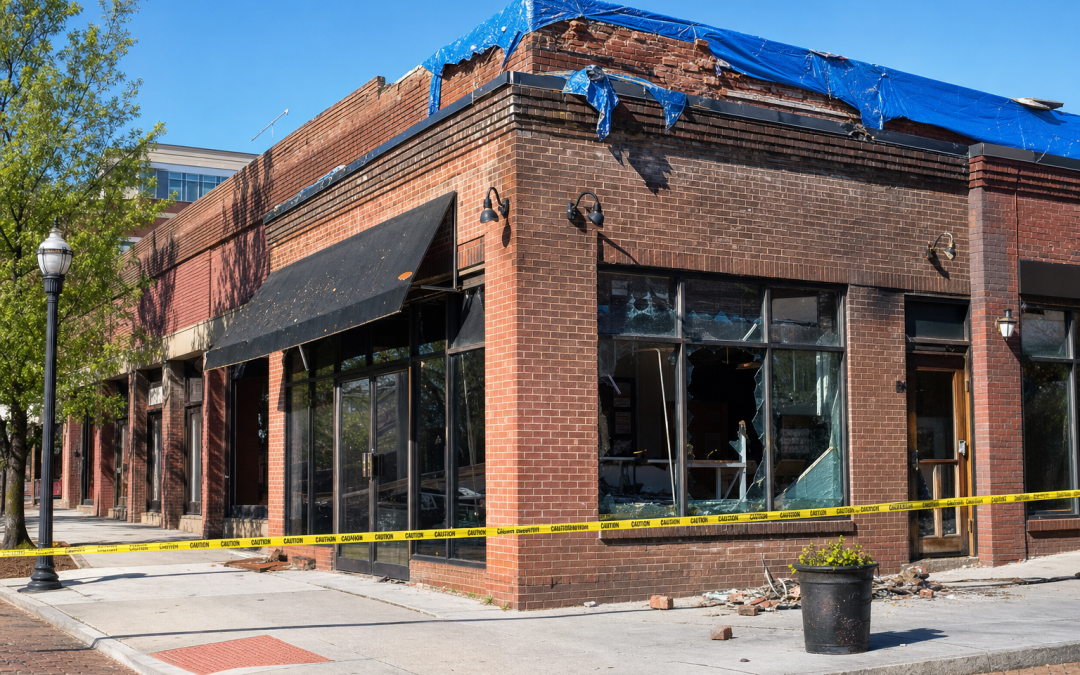
What Should Cary and Raleigh Business Owners Know About Commercial Property Claims?
Commercial property claims are insurance claims filed by a business after physical damage to its building, equipment, inventory, or income stream from a covered event like fire, storm, or water. They are more complex than residential claims, and for Triangle-area businesses, the insurer’s first offer is rarely the full measure of what the policy actually owes.
Key takeaways
- Document your commercial property’s condition before disaster strikes — pre-loss photos, inventories, and maintenance records are your strongest evidence in a claim.
- Report commercial property damage to your insurer immediately, but never accept the first settlement offer without reviewing whether it fully covers repairs, contents, and business interruption.
- Business interruption coverage can reimburse lost income while your Cary or Raleigh property is being repaired, but only if you track revenue losses and extra expenses carefully.
- North Carolina policyholders have the right to hire a licensed public adjuster or attorney to represent their interests — the insurer’s adjuster works for the insurance company, not you.
- Mitigate further damage right away (tarping, water extraction, securing the property) — insurers can deny portions of a claim if preventable secondary damage occurs.
If you own a restaurant in downtown Cary, a warehouse off Capital Boulevard, or an office suite in North Hills, your commercial policy is a very different animal from the homeowners policy covering your house. Understanding those differences before disaster strikes — or in the days right after — can change the outcome of your claim by a wide margin.
Why Commercial Claims Are More Complicated Than Residential Claims
A house fire involves one structure and one family’s belongings. A commercial loss involves several overlapping categories of damage, each valued differently under your policy:
- Building damage — the structure itself, plus tenant improvements and betterments if you lease your space.
- Business personal property — equipment, machinery, furniture, technology, and inventory, which may be valued at replacement cost or actual cash value depending on your policy language.
- Business interruption and extra expense — lost income while you’re closed and the added costs of staying operational, which require financial documentation most owners have never had to assemble for an insurer.
- Code upgrades and ordinance coverage — older Triangle buildings often can’t legally be rebuilt as-is, and code-required upgrades are only covered if your policy includes the right endorsement.
Each of these categories has its own documentation requirements, valuation rules, and potential disputes. Miss one, and money gets left on the table.
The Key Takeaway: The First Offer Is a Starting Point, Not a Verdict
Insurance carriers assign their own adjusters to estimate your loss, and those estimates frequently rely on quick inspections, standardized pricing software, and conservative assumptions about the scope of damage. Hidden problems — smoke residue in HVAC systems, moisture inside wall cavities, structural issues behind finished surfaces — often don’t appear in a first estimate at all.
That’s why experienced business owners treat the initial settlement offer as an opening position. You have the right to document your own damages, submit your own estimates, and negotiate. Many owners in Wake County bring in a licensed public adjuster in Cary to build that independent case for them.
What This Means for You Right Now
- Read your policy — especially coinsurance clauses, valuation terms, and business interruption limits — before you need it.
- Never assume the carrier’s estimate captured everything.
- Document the loss thoroughly and keep every receipt tied to the damage.
The rest of this guide walks through how the claims process works, why underpayment happens, and how to protect your business at every step.

How Does the Commercial Property Claims Process Work?
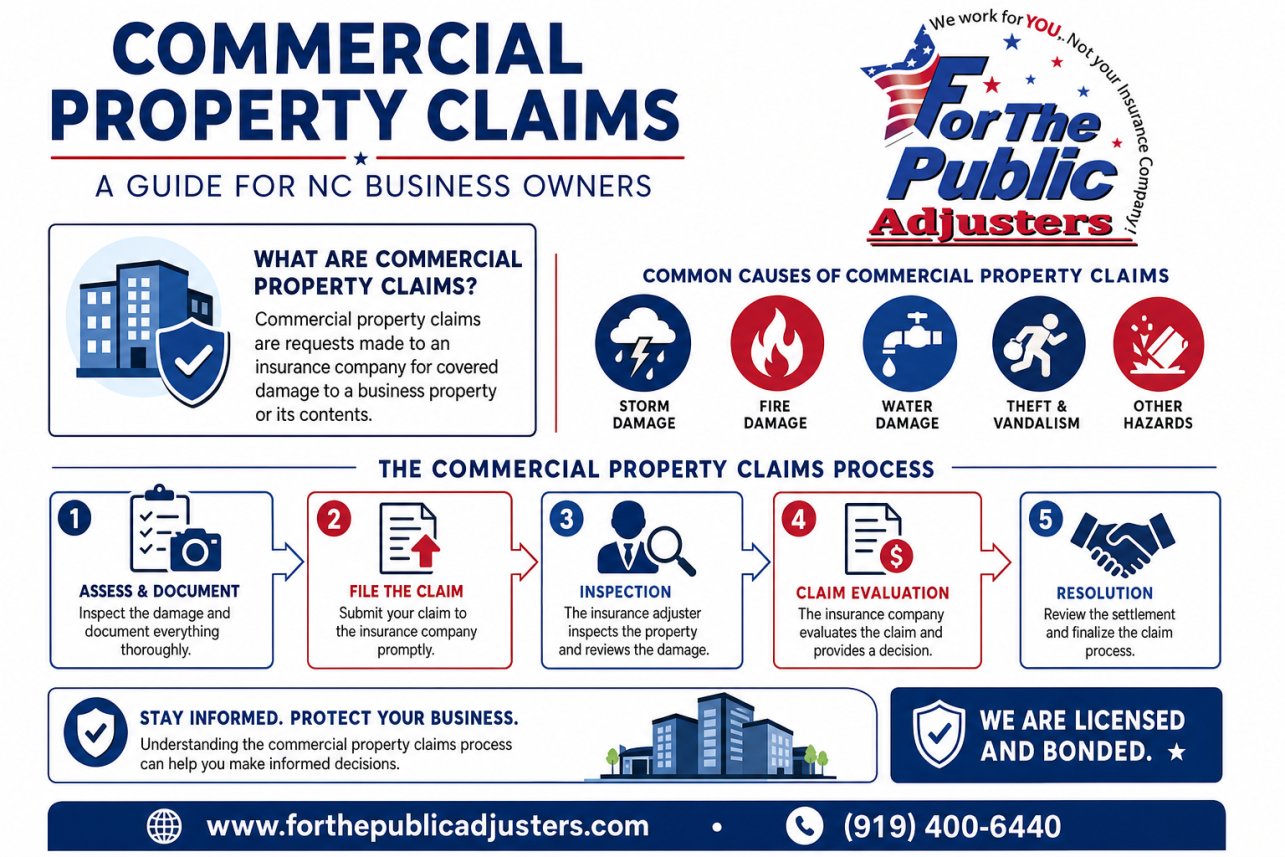
Commercial property claims follow a predictable sequence: you report the loss to your insurer promptly, protect the property from further damage, document everything, submit a sworn proof of loss, allow the insurer’s adjuster to inspect, negotiate the scope and value of repairs, and then settle. Policy deadlines in North Carolina and Virginia can be strict, so timing matters at every stage.
Understanding each step helps you avoid the mistakes that stall or shrink settlements. Here is what the process typically looks like from the moment a fire, burst pipe, hurricane, or tornado damages your building.
Step 1: Give Prompt Notice and Mitigate Damage
Nearly every commercial policy requires “prompt” notice of loss. Call your agent or the carrier’s claims line as soon as it is safe, and take reasonable steps to prevent further damage — tarping a torn roof, extracting standing water, or boarding up openings. Your policy obligates you to mitigate, and reasonable emergency expenses are generally reimbursable, so keep every receipt.
Step 2: Document the Loss Thoroughly
Before cleanup crews alter the scene, build your evidence file:
- Wide-angle and close-up photos and video of all damaged areas, equipment, and inventory
- An inventory of damaged business personal property with age, condition, and replacement cost
- Financial records supporting any business income or extra expense claim
- Invoices for emergency repairs, temporary relocation, and mitigation work
Step 3: Complete the Proof of Loss
The proof of loss is a sworn statement of what you’re claiming and why. Many policies require it within a set window — often 60 days after the insurer requests it — and missing that window can jeopardize your claim. Flood claims under the NFIP carry their own separate proof of loss deadlines that are enforced strictly.
Step 4: Inspection and Scope Development
The insurance company sends its adjuster, and often engineers or consultants, to inspect. You are entitled to have your own representative present. Disagreements at this stage usually center on the scope of damage — what actually needs repair or replacement — which is where many commercial property claims start to go sideways.
Step 5: Negotiation and Settlement
Once estimates are exchanged, expect back-and-forth over pricing, code-upgrade costs, depreciation, and business interruption calculations. Larger losses are often paid in stages: an advance, an actual cash value payment, and recoverable depreciation after repairs are completed.
Deadlines in North Carolina and Virginia
Beyond proof of loss requirements, your policy typically contains a suit limitation clause setting a deadline to file a lawsuit over the claim — frequently shorter than the standard statute of limitations for contract disputes. These clauses and deadlines vary by policy and state, so read yours carefully and calendar every date. Business owners in Wake County who want help managing these deadlines from day one can work with a licensed public adjuster in Cary NC who handles the process on the policyholder’s side.
Why Do Insurance Companies Underpay Business Damage Claims?
Insurance companies underpay business damage claims primarily to protect their own bottom line. Common tactics include over-applying depreciation, leaving damaged items out of the repair scope, invoking coinsurance penalties, and disputing business interruption calculations. Initial offers on commercial property claims frequently come in well below the documented cost to actually restore the business.
It’s important to understand that an insurance adjuster works for the carrier, not for you. That doesn’t mean every adjuster acts in bad faith — but the estimating process gives the insurer plenty of legitimate-looking ways to shrink a payout. Knowing the most common tactics helps you spot a lowball offer before you accept it.
Depreciation Games
Most commercial policies pay actual cash value (ACV) up front, with the recoverable depreciation released only after repairs are complete. Carriers can underpay by applying aggressive depreciation rates, depreciating items that shouldn’t be depreciated (like labor in some jurisdictions), or failing to clearly explain how you recover the withheld amount. Many business owners never claim their recoverable depreciation simply because no one told them they could.
Scope Omissions
A repair estimate is only as good as its scope. Adjusters working quickly — or relying on a brief walkthrough — often miss:
- Hidden damage behind walls, above ceilings, or under flooring
- Code-upgrade costs required to legally rebuild (ordinance and law coverage)
- Matching issues, where partial repairs leave mismatched roofing, siding, or finishes
- Damage to signage, HVAC systems, or exterior improvements
- Business personal property, inventory, and tenant improvements
Each omitted line item quietly reduces the settlement, and the burden usually falls on the policyholder to document and dispute what was left out.
Coinsurance Penalties
Many commercial policies contain a coinsurance clause requiring you to insure the property to a stated percentage of its value — often 80% or 90%. If the carrier decides your building was underinsured at the time of loss, it can apply a proportional penalty that cuts your payout significantly, even on a fully documented claim. Disputes often hinge on how the property was valued, which is itself negotiable.
Disputed Business Interruption Calculations
Business income losses are among the most contested parts of commercial property claims. Carriers may challenge your revenue projections, argue the shutdown period should have been shorter, exclude ongoing expenses you’re entitled to recover, or demand extensive financial records and then dispute the interpretation. Because these calculations involve forecasting what your business would have earned, there’s substantial room for the insurer’s accountants to reach a lower number than yours.
The Pattern Behind Low Initial Offers
In practice, many business owners who independently document their losses — with contractor estimates, inventories, and financial records — find the carrier’s first offer falls dramatically short of the real cost to recover. The first number is often a starting point, not a final answer, and policyholders who push back with evidence routinely secure meaningfully higher settlements.
Have Business Owners Ever Beaten Their Insurance Company in Court?
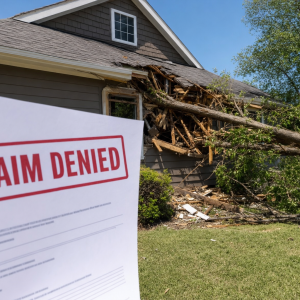
Yes. North Carolina business owners have successfully sued their insurers and won. A notable example is DENC, LLC v. Philadelphia Indemnity Insurance Co. (4th Cir. 2021), where a property owner prevailed after its insurer wrongly denied coverage for a collapsed breezeway, showing courts will hold carriers accountable for improper denials.
Wrongful denials are not just a hypothetical risk. When an insurer misreads its own policy language or leans too heavily on exclusions, policyholders can fight back — and federal appellate courts have sided with business owners in commercial property claims disputes arising right here in North Carolina.
The DENC Case: A Collapsed Breezeway and a Denied Claim
DENC, LLC owned an apartment complex in North Carolina that was insured under a commercial property policy issued by Philadelphia Indemnity Insurance Company. When a second-floor breezeway at the property collapsed, DENC filed a claim expecting coverage for the sudden structural failure.
The insurer denied the claim, pointing to policy exclusions and arguing the loss did not qualify as a covered “collapse” under the policy’s terms. DENC sued, and the dispute ultimately reached the U.S. Court of Appeals for the Fourth Circuit — the federal appellate court that covers North Carolina.
What the Court Decided
In 2021, the Fourth Circuit ruled in favor of DENC. Key takeaways from the decision include:
- Policy language matters: The court closely examined the policy’s collapse provisions and found the insurer’s narrow reading of its own language unpersuasive.
- Exclusions are construed against the insurer: Under North Carolina law, ambiguous policy terms are generally interpreted in favor of the policyholder, and the insurer bears the burden of proving an exclusion applies.
- Claim-handling conduct can create additional liability: The courts scrutinized how the insurer investigated and denied the claim, not just the denial itself — a reminder that carriers can face consequences beyond simply paying the original claim when their conduct violates North Carolina’s consumer protection laws.
What This Means for Cary and Raleigh Business Owners
You don’t have to accept a denial letter as the final word. The DENC case illustrates several practical lessons:
- A denial is a legal position, not a fact. Insurers interpret their policies in the way most favorable to themselves, and courts frequently disagree with those interpretations.
- Documentation wins cases. DENC’s ability to establish what happened to the structure, and when, was central to overcoming the insurer’s exclusion arguments.
- North Carolina law offers real protection. Between favorable rules of policy interpretation and statutes governing unfair claim practices, policyholders in this state have meaningful leverage.
Litigation should rarely be the first step — most commercial property claims are resolved through documentation, negotiation, and persistence. But knowing that business owners have taken insurers to court and won can change the dynamic of your claim before a lawsuit is ever filed.
How Can a Public Adjuster Help With a Commercial Property Claim?
A public adjuster is a licensed and bonded professional who works for you — not the insurance company. They document your losses, prepare independent repair estimates, calculate business interruption figures, and negotiate directly with your insurer. Their goal is a settlement that reflects the true cost of getting your business back to normal.
Unlike the adjuster your insurance company sends, a public adjuster has a legal duty to represent your interests throughout the commercial property claims process. In North Carolina, public adjusters must be licensed by the Department of Insurance, which means they’ve met specific training and bonding requirements before they can handle your claim.
What a Public Adjuster Actually Does
- Thorough loss documentation. They inspect the property in detail, photograph and inventory damaged equipment, stock, and building components, and often identify hidden damage — such as moisture behind walls or compromised roofing systems — that a quick walkthrough can miss.
- Independent damage estimates. Rather than relying on the insurer’s numbers, a public adjuster prepares a line-item estimate using current local labor and material costs, which frequently differs from the carrier’s initial valuation.
- Business interruption calculations. Lost income claims are among the most complex parts of a commercial loss. A public adjuster works through your financial records — sales history, payroll, ongoing expenses — to build a defensible business interruption figure your insurer must take seriously.
- Policy analysis. Commercial policies often contain coverage for code upgrades, extra expenses, and spoilage that business owners overlook. A public adjuster reads the policy carefully to make sure every applicable coverage is claimed.
- Negotiation and claim management. They handle the paperwork, deadlines, and back-and-forth with the insurance company so you can focus on running your business.
Real-World Impact — With Honest Caveats
The difference professional representation makes can be substantial. It’s not unusual for public adjusters to identify damage or coverage the initial insurer estimate missed entirely. For example, a business owner whose carrier initially offered payment only for visible water damage may recover significantly more once a public adjuster documents damaged inventory, equipment losses, and the income lost while operations were shut down.
That said, honesty matters here: every claim is different, and no public adjuster can guarantee a specific outcome. Results depend on your policy language, the nature and extent of the damage, and the quality of documentation. What a public adjuster does guarantee is that your claim will be professionally prepared and advocated for — rather than accepted at whatever figure the insurance company proposes first.
Most public adjusters work on a contingency fee, typically a percentage of the settlement, so their compensation is tied to your recovery. Before hiring one, confirm they’re licensed in North Carolina and ask for references from other commercial clients.

What Should You Do Right After Property Damage in Cary or Raleigh?
In the first 72 hours after fire, water, hurricane, or tornado damage, your priorities are safety, mitigation, and documentation. Secure the property, prevent further damage, photograph everything before cleanup, notify your insurer promptly, track every expense, and review your policy. These early steps protect both your business and your claim.
Hour 1–24: Safety and Emergency Mitigation
Before anything else, confirm the building is safe. Do not re-enter a fire-damaged or structurally compromised property until authorities clear it. Then take reasonable steps to stop the damage from getting worse—most commercial policies require it. That may mean:
- Shutting off water, gas, or electricity to affected areas
- Tarping roof openings and boarding broken windows
- Extracting standing water and starting ventilation to slow mold growth
- Moving undamaged inventory and equipment to a dry, secure location
Keep receipts for tarps, board-up services, water extraction, and temporary storage—these emergency costs are typically reimbursable under your policy.
Hour 24–48: Document Before You Clean
Thorough evidence is the foundation of strong commercial property claims. Insurers evaluate what you can prove, not just what you experienced. Before permanent repairs or disposal:
- Photograph and video every damaged area, wide shots and close-ups, including serial numbers on equipment
- Preserve damaged items whenever possible—do not throw anything away until the insurer has documented it or given written permission
- Start a written inventory of damaged stock, furniture, fixtures, and machinery
- Save weather reports or fire department records that establish the cause and date of loss
If flooding is involved, be aware that standard commercial policies usually exclude flood damage; that coverage generally comes through a separate flood policy. FEMA’s National Flood Insurance Program explains how flood claims differ and what documentation adjusters expect.
Hour 48–72: Notify, Review, and Organize
- Report the loss to your insurer in writing, noting the date, time, and person you spoke with. Late notice is a common reason claims get disputed.
- Read your policy—especially deductibles, coinsurance clauses, business interruption coverage, and deadlines for submitting a proof of loss.
- Open a claim file with all correspondence, estimates, invoices, and expense logs in one place. Track lost income and extra operating costs from day one.
- Be cautious with recorded statements and don’t sign repair contracts or releases you don’t fully understand.
When to Call for Professional Help
If the loss is large, the cause is disputed, or the insurer’s early estimate seems far below your contractor’s numbers, consider bringing in a licensed public adjuster to document and present the claim on your behalf. You can also verify licensing or file a complaint through the North Carolina Department of Insurance. Acting quickly—and documenting carefully—in these first three days gives your claim its best possible footing.
Who’s Who in Commercial Property Claims: Comparing Your Representation Options
| Representative | Who They Work For | Typical Cost to You | Best Used When |
|---|---|---|---|
| Insurance Company Adjuster | The insurance carrier | Free (paid by insurer) | Small, straightforward claims with no disputes |
| Public Adjuster | You, the policyholder | Percentage of settlement (regulated in NC) | Larger or complex claims where valuation is disputed |
| Attorney | You, the policyholder | Contingency or hourly fee | Denied, delayed, or underpaid claims; bad-faith concerns |
| Independent Contractor/Estimator | Hired by you | Estimate fees or built into repair cost | Verifying the insurer’s scope and pricing of repairs |
Illustrative Example: A Raleigh Restaurant’s Storm Claim
Illustrative example
Consider a hypothetical Raleigh restaurant owner whose roof was damaged during a summer thunderstorm, allowing water into the dining room and kitchen. She immediately photographed the damage, hired a contractor to tarp the roof, and notified her insurer the same day. When the carrier’s initial estimate covered only surface repairs, she brought in a public adjuster who documented hidden water damage behind walls and calculated lost income during the closure. With thorough documentation and professional representation, she negotiated a settlement that addressed the full scope of repairs and her business interruption losses. This composite scenario illustrates how early documentation and knowing your rights can change a claim’s outcome.
Frequently asked questions
What should I do first when filing commercial property claims in North Carolina?
Report the damage to your insurer as soon as possible, since most policies require prompt notice. Document everything with photos and video before cleaning up, take reasonable steps to prevent further damage (like tarping a roof), and keep receipts for any emergency repairs. Avoid making permanent repairs until the insurer has had a chance to inspect the property.
Does my commercial property policy cover lost income while my business is closed?
Only if your policy includes business interruption (also called business income) coverage. Standard commercial property coverage typically pays for physical damage to the building and contents, but not lost revenue. Review your policy or ask your agent whether you have business income coverage, what it covers, and whether there is a waiting period before it applies.
What if the insurance company’s settlement offer seems too low?
You don’t have to accept the first offer. Ask the insurer for a written explanation of how they calculated the amount, and compare it against your own repair estimates from licensed contractors. You can negotiate, request a re-inspection, or invoke the appraisal process if your policy includes one. Some business owners also hire a licensed public adjuster or an attorney to help dispute an undervalued claim.
How long do I have to file a commercial property claim in North Carolina?
Deadlines vary. Your policy will state how quickly you must report a loss and submit proof of loss, and policies often also set a time limit for filing a lawsuit over a claim. Because these deadlines can be shorter than you expect and missing them can jeopardize your claim, review your policy right away after a loss and report promptly, even if you don’t yet know the full extent of the damage.
Related local pages
- Public Adjuster Burlington NC: Fire, Water & Storm Damage Claims Handled On The Policyholder’s Side
- Public Adjuster Elon NC — Fire & Water Claim Help For Alamance County Homeowners
- Public Adjuster Cary NC — Licensed Help For Fire, Storm, Water & Tree Damage Claims In Wake County
Get a free claim review from our licensed and bonded public adjusters serving Cary, Raleigh, and businesses across NC and VA. Get in touch.
Last updated: July 20, 2026