
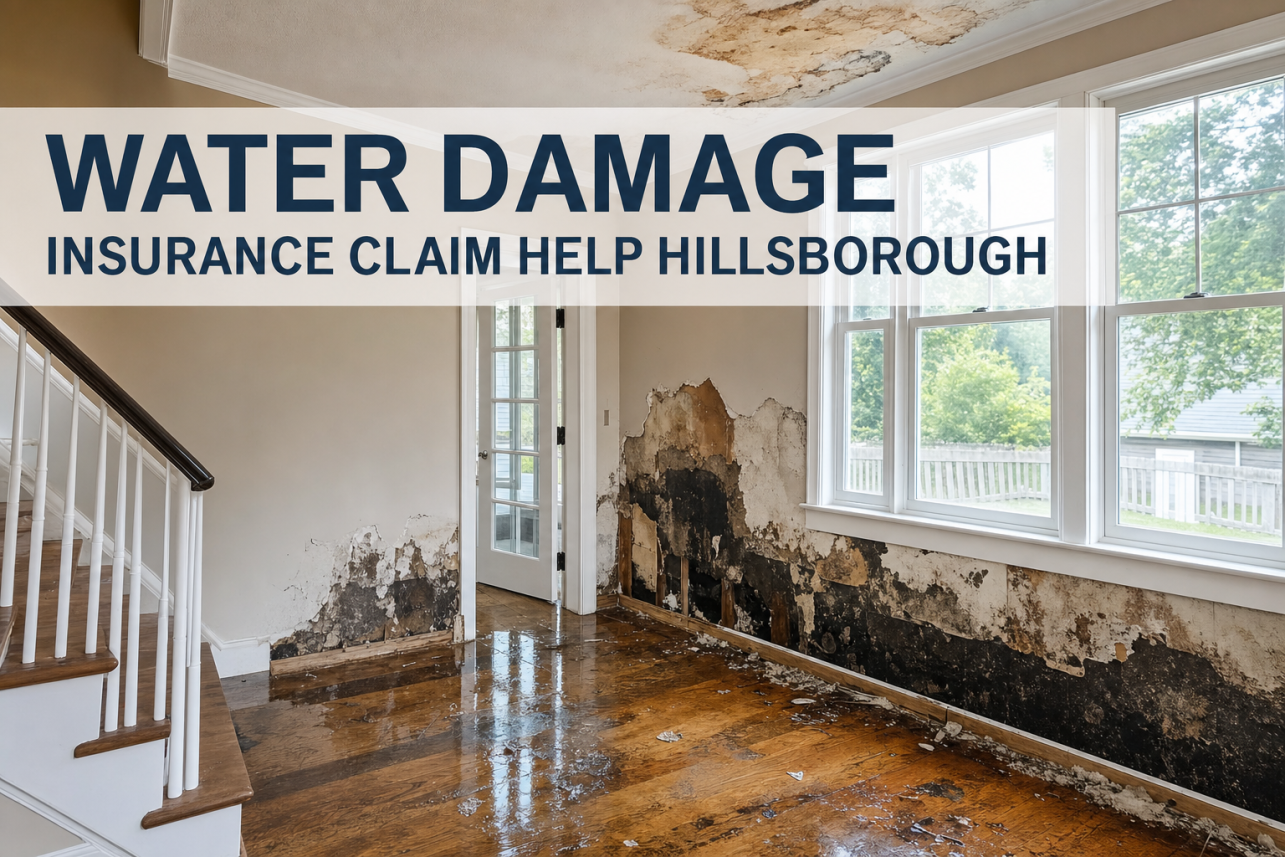
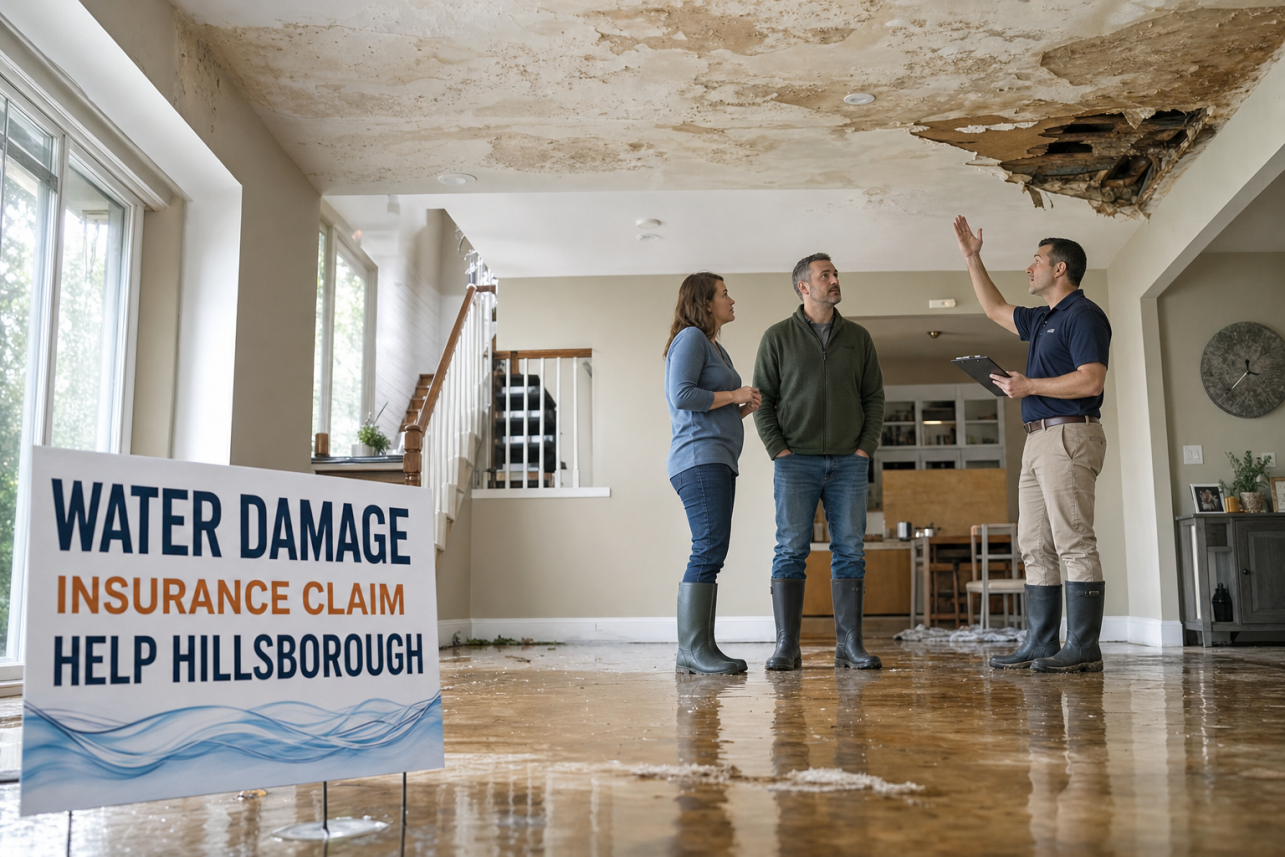
If you need water damage insurance claim help Hillsborough can rely on, For The Public Adjusters, Inc. represents you — not the insurance company — from the first inspection to the final settlement. We are licensed and bonded public adjusters who document the full scope of your loss, prepare the proof your policy requires, and negotiate directly with your insurer. Whether the water came from a burst pipe, a roof leak after a summer thunderstorm, or an appliance failure, we work to make sure nothing gets missed or undervalued.
What This Service Is
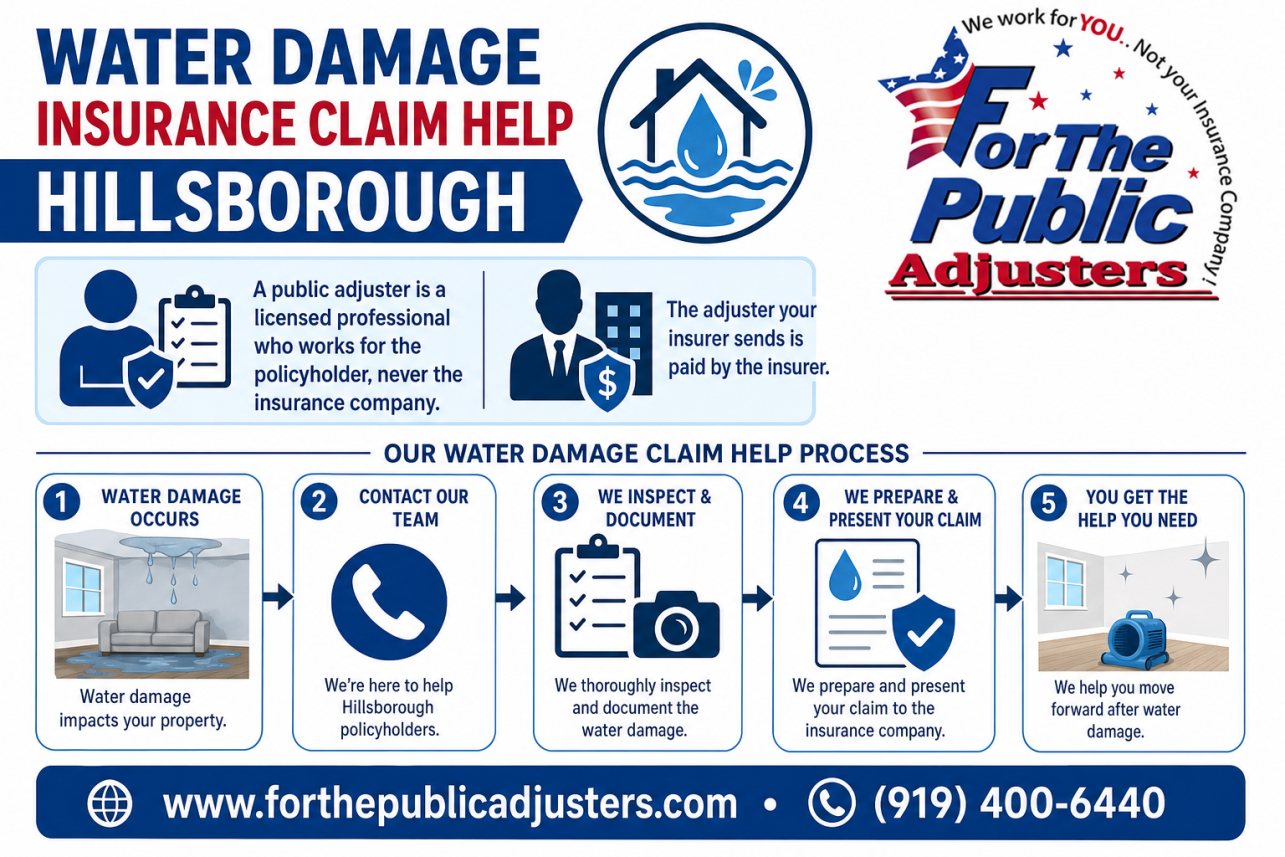
A public adjuster is a licensed professional who works for the policyholder, never the insurance company. The adjuster your insurer sends is paid by the insurer. We are the counterweight — we read your policy, measure and photograph the damage, price the repairs, and handle the back-and-forth so you aren't negotiating against a professional on your own.
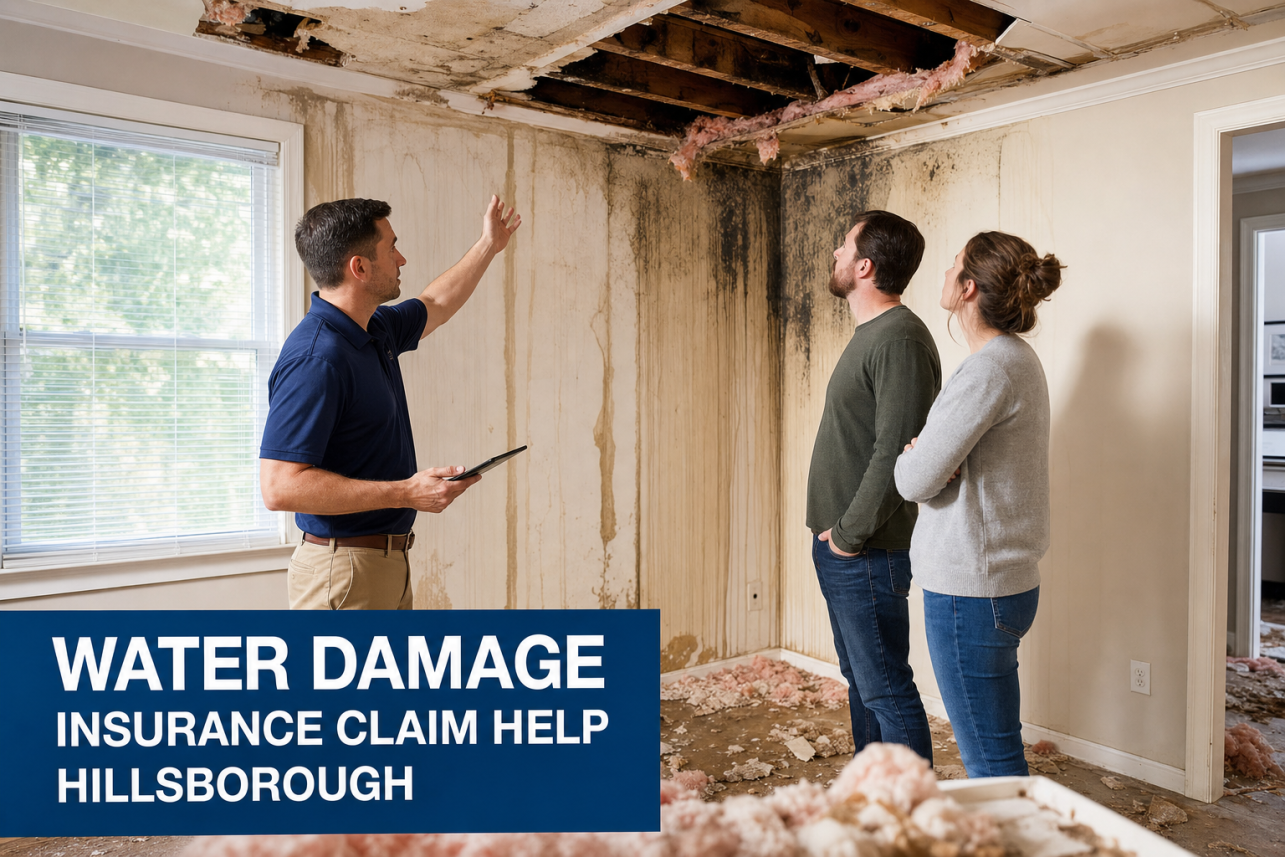
Water losses are among the most underpaid claims we see. Water travels: it runs behind walls, under flooring, and into insulation, and much of the damage isn't visible from the surface. An insurer's quick walkthrough often captures the wet drywall you can see and misses the saturated subfloor you can't.
We also make sure the paperwork is right. Most policies require a formal, sworn statement of what you lost — the proof of loss — and missing details there can shrink your settlement. The North Carolina Department of Insurance publishes the NCDOI Public Adjusters Guide explaining how public adjusters are licensed and what they may charge in this state, so you can verify that anyone you hire, including us, is operating properly.
One important distinction: your homeowners policy covers water damage from things like plumbing failures and roof leaks, but rising water from outside is a flood claim handled under a separate policy through the National Flood Insurance Program. We handle both, and we'll tell you honestly which one your situation falls under before a misfiled claim gets denied.
Common Problems
The First Offer Is Low — And Depreciation Quietly Shrinks It Further
Many Hillsborough homeowners receive an estimate that covers repainting a wall when the real job involves tearing out flooring, drying the structure, and replacing insulation. Insurers also deduct depreciation — paying you the aged value of your ten-year-old flooring rather than what it costs to replace it — and whether you recover that holdback depends on your policy language and your paperwork.
Courts have pushed back on aggressive depreciation. In Lammert v. Auto-Owners Insurance Co., the Tennessee Supreme Court sided with homeowners and ruled the insurer could not depreciate the cost of labor when calculating actual cash value on damaged homes. We scrutinize how your insurer calculated every number, because those quiet deductions are often where the underpayment hides.
Why Water Damage Insurance Claim Help Hillsborough Homeowners Ask For Usually Starts With Hidden Damage
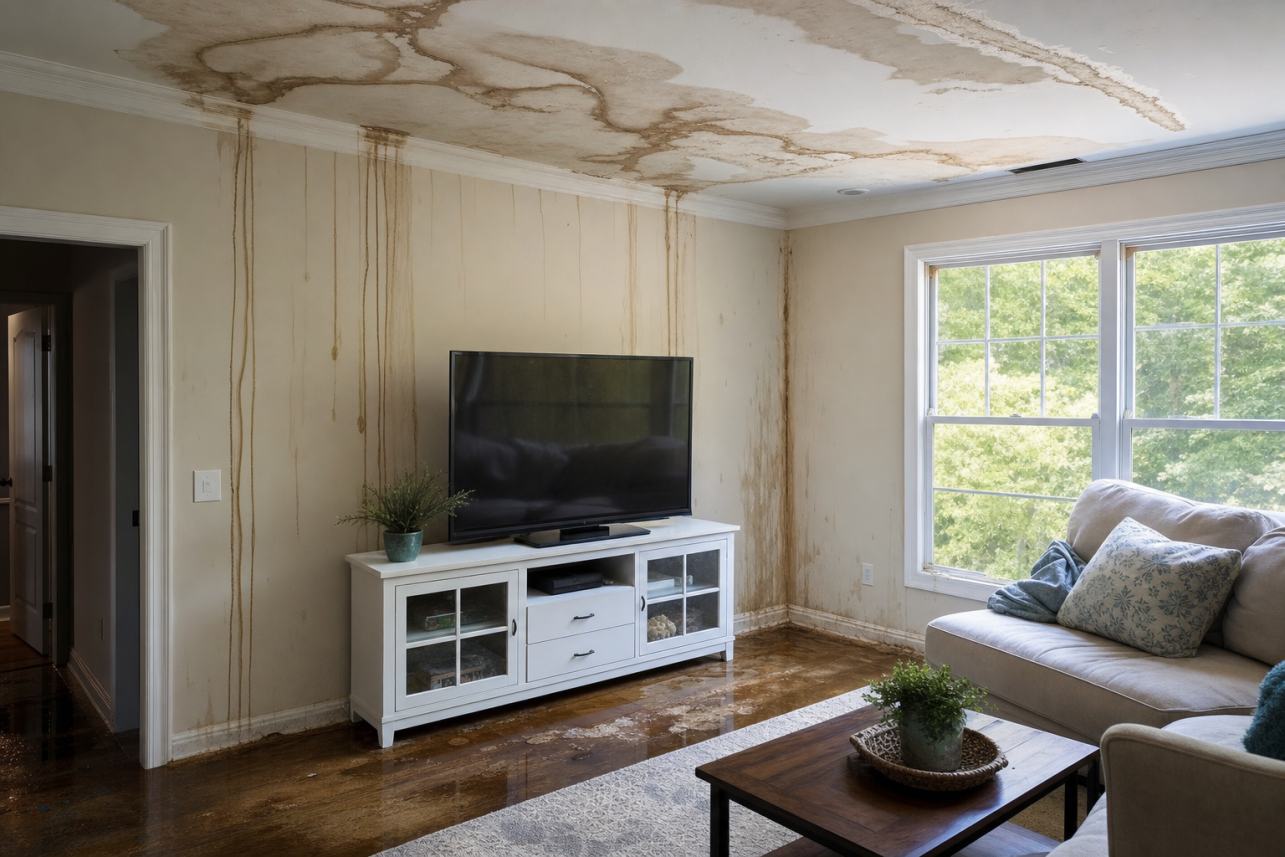
Water rarely stays where you first see it. A supply-line failure upstairs can soak framing, subfloor, and the ceiling below, and in our humid climate, damp cavities can turn into mold growth within days. If the insurer's inspection stops at the visible stain, the settlement stops there too — and you discover the rest when a contractor opens the wall months later.
We use moisture readings and thorough documentation to map where the water actually went before repairs close everything up. Getting the full scope on record early is far easier than reopening an underpaid claim later, and it protects you from paying out of pocket for damage that should have been covered from the start.
Denials, Exclusions, And The Flood-Versus-Water-Damage Trap
Denial letters often lean on policy exclusions — 'long-term seepage,' 'wear and tear,' or 'ground water' — that may not actually fit your facts. A sudden pipe burst is not gradual seepage, and a roof opened up by a violent summer storm is not deferred maintenance. The wording of your specific policy matters more than the adjuster's summary of it.
The most painful denial is the coverage gap: rain driven into your home through storm damage is typically a homeowners claim, but water rising from a swollen creek is a flood claim under a separate NFIP policy. We review your denial, your policy, and the physical evidence, then build the documented argument for why coverage applies — or route the claim to the right policy if it was filed under the wrong one.
Our Process
Free Claim Review And Policy Analysis
We start by reading your actual policy — coverage limits, your deductible, exclusions, and whether you have replacement cost or actual cash value coverage. Then we look at what happened to your home. You'll get a straight answer about whether your claim has been undervalued or wrongly denied before you commit to anything.
Full Documentation Of The Loss
We inspect and document everything the water touched: structure, flooring, walls, and your damaged contents, room by room. We record emergency mitigation costs like water extraction and drying equipment, which are typically reimbursable. This becomes the detailed repair estimate and proof of loss that anchors the entire negotiation.
Negotiation Through Settlement
We present the documented claim to your insurer, attend their inspections alongside their adjuster, and challenge line items that are missing or underpriced. If a contractor's real-world bid conflicts with the insurer's estimate, we reconcile the difference on paper. We cannot promise a specific dollar outcome — no honest adjuster can — but we make sure your claim is fully presented and firmly pursued.
| What's at Stake | Filing on Your Own | With For The Public Adjusters |
|---|---|---|
| Damage documentation | Phone photos of visible damage only | Thermal imaging, moisture mapping, and opened-wall inspection of hidden migration |
| Scope of the estimate | Carrier's adjuster writes it; hidden and matching items routinely omitted | Independent line-by-line estimate including flooring match, drying protocol, and code upgrades |
| Policy interpretation | Seepage, mold, and matching clauses read in the carrier's favor | Coverage language argued for you, with denials challenged in writing |
| Negotiation | Take the first offer or argue alone with the desk adjuster | Re-inspections requested, supplements filed, and settlement negotiated on your behalf |
| Typical result | First offers often cover a fraction of the real repair cost | Documented Hillsborough water claims frequently settle at several times the initial offer |
| Your time investment | Dozens of hours of calls, emails, and paperwork | We handle the claim; you handle your life |
Commonly Overlooked In The Public Adjusting Industry
- Lateral moisture migration under hardwood and subfloor — Water travels far beyond the visible stain, and carrier adjusters rarely take moisture readings more than a few feet from the obvious damage.
- Flooring and finish matching clauses — When ruined hardwoods or tile can't be matched, many policies require replacing the continuous area — but nobody at the carrier volunteers that.
- Recoverable depreciation on replacement-cost policies — Homeowners often accept the depreciated first check without realizing they're owed the difference once repairs are complete.
- Ordinance and law coverage for code upgrades — Rebuilding a 1950s Hillsborough bathroom to current Orange County code costs more, and that gap is covered only if someone claims it.
- The sudden-versus-seepage distinction — Carriers label losses 'gradual' to trigger the seepage exclusion, and without a plumber's causation report that label often sticks.
- Drying protocol versus surface drying — Running fans on visible surfaces leaves wall cavities and crawlspaces wet, setting up mold problems the closed claim won't pay for later.
- Additional living expenses beyond the hotel bill — Meals, laundry, pet boarding, and extra commuting during displacement are reimbursable but almost never claimed without prompting.
- Documenting before demolition or disposal — Once contractors haul out soaked materials, the proof of what was damaged goes with them, and carriers pay only what they can verify.
Case Studies
Case Study #1
Situation: A family on Churton Street in downtown Hillsborough discovered a slow supply-line leak behind their upstairs bathroom vanity after noticing a ceiling stain in the dining room below. Their 1940s home had original hardwood floors and plaster walls throughout.
Problem: The carrier's initial estimate came in at $6,400 — enough to patch the ceiling and replace a small section of subfloor, but nothing for the hardwoods, the plaster, or moisture trapped in the wall cavities. The adjuster's report also flagged the loss as 'long-term seepage,' setting up a possible denial.
Investigation: We brought in thermal imaging and moisture mapping within 48 hours of being retained. We documented moisture readings in three wall cavities the carrier's adjuster never opened, and we pulled the plumber's invoice showing the fitting failed suddenly, not gradually.
Findings: Moisture had wicked laterally under the dining room hardwoods roughly eleven feet beyond the visible stain. Matching the 80-year-old oak flooring was impossible, which under the policy's language triggered replacement of the continuous flooring, not a spot repair. The seepage exclusion didn't apply because the failure was a sudden pipe burst.
Solution: We rewrote the scope line by line — full hardwood replacement in the connected rooms, plaster repair by a qualified tradesperson rather than generic drywall pricing, proper drying protocol, and code-required upgrades to the supply lines. We submitted the moisture logs, plumber's statement, and a flooring-match letter with our demand.
Outcome: The claim settled at $41,700 — more than six times the original offer — with the seepage denial withdrawn in writing before it was ever formally issued.
Lesson: In older Hillsborough homes, hidden migration and matching issues often make up the majority of a water loss. If nobody opens the walls and reads the policy's matching language, that money simply stays with the carrier.
Case Study #2
Situation: A small business owner near the Eno River leased a retail space where a water heater in the unit above failed overnight. Water soaked her inventory, display fixtures, and the drop ceiling, forcing her to close for what she assumed would be a few days.
Problem: Her carrier accepted the property portion but lowballed the contents at actual cash value using steep depreciation, and denied most of her business interruption claim, arguing she could have reopened within a week. She had no documentation system for inventory and felt outmatched on the phone with the desk adjuster.
Investigation: We inventoried every damaged item on-site with photos, purchase records, and supplier invoices we helped her pull from vendors. We also collected air-quality and moisture readings showing the space couldn't safely reopen until drying and mold-preventive treatment were complete — a nineteen-day window, not seven.
Findings: The contents were insured at replacement cost with depreciation recoverable, which the initial offer ignored. The business interruption denial relied on an unsupported reopening date; the carrier's own vendor's drying logs contradicted it. Roughly $28,000 in covered losses had been left off the estimate entirely.
Solution: We prepared a full contents ledger, a documented loss-of-income calculation using her prior twelve months of sales, and a timeline anchored to the remediation company's daily logs. We requested a re-inspection with the field adjuster present and walked the space together.
Outcome: Contents settled at full replacement cost, and the business interruption claim paid for the actual nineteen days of closure plus extra expense for temporary storage. Total recovery went from an offered $14,200 to $53,900.
Lesson: Commercial water losses in Orange County live or die on documentation and timelines. Carriers rarely volunteer that depreciation is recoverable or that their own vendor's logs support a longer closure — someone has to build that case.
| Water Damage Scenario | Typically Covered? | What It Depends On | First Move |
|---|---|---|---|
| Burst supply line or pipe | Usually yes | Whether the carrier can frame it as long-term seepage; keep the failed part and the plumber's report | Stop the water, photograph everything, save the broken fitting |
| Slow leak behind a wall or under a floor | Often disputed | How quickly you reported it once discovered — 'known and ignored' leaks get denied | Report the moment you discover it; note the discovery date in writing |
| Water heater failure | Usually yes for resulting damage | The heater itself may be excluded; the damage it causes is typically covered | Don't discard the unit until it's been inspected and documented |
| Sewer or drain backup | Only with an endorsement | Whether you purchased water backup coverage — many Hillsborough policies don't include it by default | Check your declarations page before assuming a denial is final |
| Rainwater through a storm-damaged roof | Yes, if wind/hail created the opening | Interior water damage needs a storm-created opening; roof wear alone won't qualify | Photograph the roof damage and the interior on the same day |
| Flooding from the Eno River or surface runoff | No — homeowners policies exclude flood | Separate NFIP or private flood coverage is required | File under flood coverage if you have it; don't waste time on a homeowners claim |
| Appliance leak (dishwasher, washing machine) | Usually yes | Sudden discharge is covered; the appliance repair itself usually isn't | Shut the supply valve and keep the appliance for inspection |
| Mold found after a water event | Sometimes, capped | Most NC policies cap mold at $5,000–$10,000 and require the water loss itself to be covered | Get remediation quotes fast and tie the mold directly to the covered water event |

Reviews
Our dishwasher line burst while we were at the beach and soaked the kitchen and crawlspace. State Farm's first offer wouldn't have covered half the flooring. For The Public Adjusters found moisture in two walls the insurance company's guy never checked and got the settlement almost tripled. Worth every penny of their fee.
Melanie R., Hillsborough
I called them after my carrier tried to call a burst pipe 'gradual seepage' and deny the whole thing. They pulled the plumber's report, cited the exact policy language, and the denial disappeared. If you need water damage insurance claim help Hillsborough homeowners should call these folks before signing anything.
Doug T., Orange County
Slow leak under our master bath ruined the hardwoods in three rooms. The insurer offered to patch one room. Our adjuster documented that the flooring couldn't be matched and got continuous replacement approved, plus proper drying instead of just fans. Took about six weeks but the outcome was night and day. Only wish I'd called on day one instead of week three.
Priya S., Hillsborough
Frequently Asked Questions
What Does Water Damage Insurance Claim Help Hillsborough Actually Include, And When Should I Call?
When you hire For The Public Adjusters, Inc. for water damage insurance claim help Hillsborough homeowners get a licensed advocate who manages the claim from start to finish. We inspect the loss, document every affected area with moisture readings and photos, review your policy language, prepare a detailed line-item estimate, and negotiate directly with the insurance company's adjuster on your behalf.
The best time to call is as soon as you discover the water — ideally before the insurer's adjuster arrives. Early involvement lets us document hidden moisture in wall cavities, subfloors, and crawl spaces before it dries out or gets covered up during cleanup. That evidence often makes the difference between a partial payment and a full settlement.
That said, it is never too late. We regularly take over claims in Orange County that were underpaid or denied. If you already received an offer that will not cover proper repairs, we can reopen the negotiation, supplement the estimate, and push for what the policy actually owes.
Most of the older homes near downtown Hillsborough and in neighborhoods like Cornwallis Hills or Fairview have plaster walls, hardwood floors, and crawl-space construction that insurers routinely underestimate. Our job is to make sure the scope of repairs reflects what your home really needs, not what a quick 20-minute inspection suggests.
My Insurance Company Already Sent An Adjuster — Why Would I Need My Own?
The adjuster your insurance company sends works for the insurer, not for you. Their estimate is written to protect the carrier's bottom line, and with water losses that usually means a narrow scope: drying out the visible damage, painting over stains, and skipping what is behind the walls.
A public adjuster works exclusively for the policyholder. When we handle a water claim in Hillsborough, we look for what the carrier's inspection missed — saturated insulation, swollen subfloor, mold-prone framing in crawl spaces, damaged ductwork under the house, and matching issues with flooring and cabinetry. North Carolina's matching and repair standards often entitle you to more than a patch job, but only if someone documents and argues for it.
The difference in outcome can be substantial. It is common for us to find the carrier's estimate covers only a fraction of what licensed local contractors will actually charge to restore the home. Orange County repair costs are not the same as the national pricing software defaults insurers lean on, and we adjust for that.
You also gain time back. Instead of chasing phone calls, resubmitting documents, and deciphering reservation-of-rights letters, you hand that burden to us. We handle the correspondence, meet the carrier's adjuster on site, and keep the claim moving so repairs can start sooner.
What Types Of Water Losses Are Usually Covered Under A Homeowners Policy In Hillsborough?
Most standard homeowners policies in North Carolina cover sudden and accidental water discharge. That includes burst supply lines, failed water heaters, washing machine hose ruptures, dishwasher leaks, overflowing tubs or toilets, frozen pipes that split during a cold snap, and roof leaks caused by storm damage.
What is typically excluded is flood — meaning rising surface water from outside, like the Eno River overtopping its banks or heavy runoff pooling against a foundation. Flood requires a separate policy through the National Flood Insurance Program or a private flood carrier. Sewer and drain backups are also excluded on many policies unless you carry a specific endorsement, which is worth checking given how many Hillsborough properties sit on older lines.
The gray areas are where claims get denied unfairly. Insurers often argue a pipe leak was 'long-term seepage' rather than sudden, or that damage stems from 'wear and tear.' The truth is that even a slow leak inside a wall frequently produces covered damage the moment it becomes apparent, and policy language varies carrier to carrier.
We read your specific policy — endorsements, exclusions, and deductibles — and build the claim around what it actually says rather than what a claims examiner asserts over the phone. If your claim was denied on a seepage or maintenance argument, get a second opinion before accepting it. Many of those denials do not hold up once the loss is properly documented and the policy language is applied correctly.
How Much Does Water Damage Insurance Claim Help Hillsborough Cost, And How Long Will My Claim Take?
For The Public Adjusters, Inc. provides water damage insurance claim help Hillsborough residents can afford because we work on contingency. There are no upfront fees and no hourly billing. We earn a percentage of the settlement we recover for you, agreed to in writing before any work begins, as required under North Carolina's public adjuster licensing law. If we recover nothing, you owe nothing.
Because our fee comes from the recovery, our interests are aligned with yours: the more thoroughly the claim is documented and negotiated, the better the outcome for both of us. In most water losses, the increase we secure over the insurer's initial position exceeds our fee many times over.
As for timing, a straightforward water claim in Orange County typically resolves in four to eight weeks once we get involved. More complex situations — hidden mold, disputes over the cause of loss, or a carrier that lowballed the first estimate — can run two to four months. Reopened or supplemented claims depend on how the original claim was handled, but North Carolina generally allows up to three years from the date of loss to pursue payment, so older underpaid claims are often still viable.
Throughout the process we keep you updated at every milestone: inspection, estimate submission, carrier response, and negotiation. You will always know where the claim stands and what comes next, and you make the final call on whether to accept any settlement.
My Water Damage Claim In Hillsborough Was Denied Or Underpaid — Can For The Public Adjusters Still Help?
Yes, and this is one of the most common situations we handle. A denial or lowball offer is not the final word. In North Carolina you generally have the right to dispute the insurer's decision, submit supplemental documentation, and reopen the claim if new damage or evidence comes to light.
When we take on a denied or underpaid claim, we start by reviewing the denial letter against the actual policy language. Insurers often cite exclusions — like gradual seepage or lack of maintenance — that don't accurately match what happened in your home. A burst supply line behind a wall in an older Hillsborough home, for example, is typically sudden and accidental, even if the water sat unnoticed for a short time.
From there, we re-document the loss. That can mean moisture mapping, thermal imaging, plumber or engineer reports, and a line-item estimate that captures hidden damage the first inspection missed: saturated insulation, subfloor damage, and mold remediation needs common in our humid Orange County climate.
We then present that package to the carrier and negotiate directly on your behalf. Many claims that were denied outright end up paid, and underpaid claims frequently settle for substantially more once the full scope is documented. If you've already received a check, don't assume the claim is closed — supplemental payments are routine when the evidence supports them. Bring us your denial letter or settlement offer and we'll give you an honest read on whether it's worth fighting.
How Soon After A Leak Or Flood Should I Get Water Damage Insurance Claim Help Hillsborough Homeowners Can Rely On?
Call for water damage insurance claim help Hillsborough professionals provide as soon as the water is stopped and everyone is safe — ideally within the first 24 to 48 hours. The early hours of a water loss shape the entire claim, and decisions made in that window are hard to undo later.
There are two clocks running. The first is physical: drywall, hardwood floors, and subflooring in Hillsborough homes begin degrading quickly, and mold can start growing within 24 to 72 hours in our humidity. The second is contractual: your policy requires prompt notice of the loss and reasonable steps to prevent further damage. Waiting weeks gives the insurer an opening to argue the damage worsened because of delay.
Getting an adjuster on your side early means the loss gets documented before anything is torn out or thrown away. We photograph and measure everything, take moisture readings, inventory damaged contents, and coordinate with mitigation companies so the drying work supports your claim rather than complicating it.
It also means you don't give a recorded statement or sign mitigation contracts without guidance. Homeowners frequently say something offhand — 'that pipe has dripped before' — that carriers later use to invoke a wear-and-tear exclusion.
If the loss already happened days or weeks ago, don't assume it's too late. We regularly step into claims mid-stream, and even after a settlement offer. But the earlier we're involved, the smoother and typically larger the recovery.
Should I Start Repairs Or Hire A Restoration Company Before My Claim Settles?
You should mitigate immediately, but hold off on permanent repairs until the damage is fully documented and the scope is agreed upon. There's an important difference between the two, and mixing them up is one of the costliest mistakes we see homeowners in Hillsborough and greater Orange County make.
Mitigation means stopping ongoing damage: shutting off the water, extracting standing water, setting up drying equipment, and tarping or boarding anything exposed. Your policy actually requires this, and reasonable mitigation costs are typically reimbursable — so keep every receipt and take photos before and during the work.
Permanent repairs are different. If you replace flooring, rebuild walls, or repaint before the insurer's scope is settled, you've destroyed the evidence. The carrier can then dispute how bad the damage really was, and you'll have little to push back with.
Be careful with restoration companies that show up quickly and ask you to sign an assignment of benefits or a broad work authorization. Some of these contracts hand control of your claim to the contractor. As your public adjuster, we can recommend reputable local mitigation firms and review any contract before you sign it.
Our usual approach: mitigate right away, document everything thoroughly, agree on the full repair scope and price with the insurer, and then let repairs proceed with contractors of your choosing. That sequence protects both your home and your payout — and it usually results in repairs done once, correctly, rather than reopened later to fix what the first rushed estimate missed.
What Documents Should I Gather Before Starting A Water Damage Insurance Claim In Hillsborough?
The stronger your paper trail, the stronger your claim. Before you call the insurer — or as soon as possible afterward — pull together your full policy, including the declarations page and any endorsements. Coverage details like water backup riders, mold sublimits, and ordinance-or-law coverage vary widely, and they matter enormously in an older Hillsborough home that may need code upgrades during repairs.
Next, capture the damage itself. Take wide shots of each affected room, then close-ups of baseboards, flooring, ceilings, cabinets, and personal property. Video walkthroughs with narration are excellent. Photograph the source of the water — the failed pipe, water heater, or appliance line — and keep the broken part if a plumber removes it. Insurers sometimes want to inspect it.
Start a contents inventory: every damaged item, its age, and roughly what it cost. Receipts, credit card statements, and even old photos of the room help establish value. Save all invoices for emergency plumbing, water extraction, and drying, plus receipts for hotel stays or meals if you had to leave the house — those may fall under additional living expense coverage.
Finally, keep a simple log of every conversation with the carrier: dates, names, and what was said.
If that sounds overwhelming while your house is torn apart, that's exactly why homeowners bring in water damage insurance claim help Hillsborough residents can lean on. For The Public Adjusters handles the documentation, builds the estimate, and manages every exchange with the insurance company so nothing gets missed or lost.
Does Homeowners Insurance Cover Slow Or Hidden Leaks, And Can Water Damage Insurance Claim Help Hillsborough Residents With Gradual Damage?
It depends on what caused the leak and what your policy says — and this is exactly where claims get contested. Most North Carolina homeowners policies cover sudden and accidental water discharge, like a burst supply line or a failed water heater. What insurers often push back on is damage they label as gradual, arguing it happened over weeks or months and should have been noticed.
Here's the nuance many homeowners in Hillsborough miss: even when a leak was slow, the resulting damage is frequently still covered if the leak itself was hidden — inside a wall cavity, under a slab, or beneath flooring where no reasonable person would have seen it. Many policies specifically address hidden water damage, and the wording matters enormously.
Our adjusters read your actual policy language rather than accepting the carrier's summary of it. We document how the leak stayed concealed, when it realistically became discoverable, and what portion of the loss falls under covered perils. In older homes around downtown Hillsborough and the surrounding Orange County countryside, plumbing runs through crawl spaces and plaster walls where leaks can hide for a long time — we know how to build that timeline convincingly.
If your carrier has already told you the damage is 'wear and tear' or 'long-term seepage,' don't take that as final. Those phrases are often applied too broadly. Bring us the denial letter and your policy, and we'll tell you honestly whether the coverage argument holds water — no cost for that initial review.
My Home Flooded From The Eno River Rising — Is That Handled The Same As A Plumbing Leak?
No, and this distinction catches a lot of Hillsborough homeowners off guard. Water that rises from outside your home — river flooding, storm surge, overflowing creeks, or surface runoff pooling against your foundation — is excluded from standard homeowners policies. That type of loss is covered only by a separate flood policy, usually through the National Flood Insurance Program or a private flood carrier.
Water that originates inside the home or from the plumbing, roof, or appliances is a different animal and typically falls under your homeowners coverage. A burst pipe, an HVAC condensate overflow, or rain entering through storm-created roof damage all follow the standard claim path.
Where it gets complicated is mixed-cause losses. During heavy storms in Orange County, a home might take water from a roof breach and rising groundwater at the same time. Carriers sometimes attribute everything to the excluded flood source to minimize the payout. Sorting out which water caused which damage — and proving it — is detailed, technical work involving water lines, staining patterns, and the sequence of events.
As public adjusters, we handle both homeowners claims and flood claims, and we know how the two policies interact when they overlap. If you have flood coverage, we prepare that claim under NFIP rules, which have their own strict deadlines and proof-of-loss requirements. If you don't, we make sure every dollar of damage attributable to a covered peril under your homeowners policy gets claimed rather than swept into the flood exclusion.
Can A Claim That Was Already Settled Or Closed Be Reopened In North Carolina?
Often, yes. Many homeowners discover additional damage after accepting a settlement — mold blooming behind baseboards, buckled subfloors that weren't obvious until months later, or contractor estimates that come in far above what the carrier paid. Accepting a payment does not automatically end your rights under the policy in most situations.
North Carolina generally allows supplemental claims when new or previously undiscovered damage from the same loss comes to light, as long as you're within the policy's time limits and the statute of limitations. The key is proving the newly found damage traces back to the original water event rather than a separate incident, which requires careful documentation and sometimes moisture mapping or expert reports.
This is a big part of the water damage insurance claim help Hillsborough homeowners bring to For The Public Adjusters after the fact. We review the original claim file, compare what the carrier's adjuster scoped against what actually exists in the home, and identify items that were missed, underpriced, or wrongly excluded. Common gaps include code-upgrade costs, matching flooring and drywall finishes, contents losses, and inadequate drying that led to mold.
There are deadlines, though, and they vary by policy. Some carriers require supplemental claims or lawsuits within a set number of years from the date of loss. If your water claim closed and something still feels wrong — the payment didn't cover repairs, or new problems keep appearing — get your file reviewed sooner rather than later so no deadline quietly expires.
What Happens During Your Inspection That The Insurance Company's Adjuster Doesn't Do?
The difference comes down to time, tools, and who we work for. A carrier's staff adjuster may spend thirty to forty-five minutes walking your home, photographing visible damage, and writing a scope from those photos. Our inspection typically takes several hours because we're building a complete claim, not a quick estimate.
We use moisture meters and thermal imaging to trace water beyond what's visible — into wall cavities, under cabinets, beneath flooring layers, and through insulation. Water travels along framing and wicks upward through drywall, so the wet footprint is almost always larger than the stain you can see. In Hillsborough's older housing stock, we pay special attention to crawl spaces, hardwood subfloors, and plaster walls that hold moisture invisibly.
We also scope the full cost of proper repair, not just patching. That means matching hardwood or tile across continuous flooring, code-required upgrades during reconstruction, contents inventories room by room, and additional living expenses if part of your home is unusable. Orange County repair costs and local contractor pricing go into our estimate — not a software default that lags behind the real market.
Everything gets documented in a detailed report with photos, measurements, and line-item pricing that we submit to your carrier and then defend in negotiations. When our number and theirs disagree, we don't just resubmit and hope; we push back item by item until the scope reflects what your home actually needs. That thoroughness at the inspection stage is usually what drives the difference in the final settlement.
Will Filing A Water Damage Claim Raise My Rates Or Get My Policy Cancelled In Hillsborough?
This is one of the most common worries we hear from Orange County homeowners, and the honest answer is: it depends on the cause. In North Carolina, insurers generally cannot penalize you for a single weather-related or sudden accidental loss the way they might for repeated negligence claims. A burst supply line or a storm-driven roof leak is exactly what your policy exists to cover.
What actually creates trouble is a pattern of small claims or an unrepaired problem that leads to a second loss. That's why we often advise Hillsborough clients to weigh the claim value against their deductible before filing. If a leak caused $2,000 in damage and your deductible is $1,500, filing rarely makes sense. If water has soaked flooring, drywall, and insulation across multiple rooms, the numbers usually justify it many times over.
Our adjusters can inspect your damage before you ever notify the insurance company, which is a step most homeowners don't realize is available. That pre-claim evaluation tells you what the loss is realistically worth, so you make an informed decision instead of guessing.
Also worth knowing: North Carolina restricts when carriers can non-renew a policy, and one legitimate covered claim rarely triggers cancellation. What insurers watch for is claim frequency. Filing one properly documented, well-supported claim for real damage is a normal use of your coverage, not a red flag.
Mold Showed Up After My Leak — Will My Insurance Cover Mold Remediation Too?
Often yes, but with important limits, and this is where documentation timing matters enormously. Most homeowners policies in North Carolina cover mold when it results directly from a covered water loss — for example, mold that grew inside a wall cavity after a pipe burst behind your kitchen. What they typically exclude is mold from long-term neglect or ongoing humidity problems.
Here's the catch many Hillsborough homeowners miss: policies frequently cap mold coverage at $5,000 or $10,000, even when the underlying water claim is much larger. How the damage gets categorized during the claim makes a real financial difference. Tearing out mold-contaminated drywall can sometimes be classified as water damage repair rather than mold remediation, which keeps those costs outside the capped sublimit.
Hillsborough's humidity accelerates mold growth — in summer months we've seen visible growth within 48 to 72 hours of a leak in crawl spaces and behind baseboards. That speed works in your favor for coverage arguments, because it demonstrates the mold flowed directly from the sudden loss rather than from gradual neglect.
When we handle a claim involving mold, we document moisture readings, photograph affected cavities before remediation, and structure the estimate so covered water-related demolition isn't wrongly lumped under the mold cap. If your carrier is trying to squeeze your entire payout under a small mold sublimit, that's a negotiation worth having — and one we handle regularly for homeowners across Orange County.
Do You Provide Water Damage Insurance Claim Help Hillsborough Landlords And Business Owners Can Use, Or Only Homeowners?
Yes — water damage insurance claim help Hillsborough property owners need isn't limited to primary residences. For The Public Adjusters, Inc. represents landlords with rental houses and duplexes, owners of commercial buildings, and small business tenants throughout Hillsborough and Orange County.
Commercial and rental claims involve layers that residential claims don't. A landlord with a burst pipe in a rental near downtown Hillsborough may have a claim for building damage plus lost rental income while the unit is uninhabitable. Business owners often carry business interruption coverage, which pays for lost revenue during repairs — a coverage insurers frequently underpay because calculating true lost income requires financial analysis, not just a contractor's estimate.
We also see coverage disputes over who owns what. In a leased commercial space on Churton Street, for instance, the building owner's policy may cover the structure while the tenant's policy covers improvements, inventory, and equipment. Sorting out which carrier owes for which damage is something we handle so the two insurers can't each point at the other while you wait.
For landlords, we document the loss, prepare the repair estimate, calculate fair rental value for the loss-of-rents claim, and negotiate directly with the carrier. For businesses, we add income documentation and extra expense claims — things like temporary relocation costs. Whether the property is a single rental home or a commercial building, the fee structure is the same contingency arrangement: we're paid a percentage of what we recover, so representation costs nothing upfront.
My Settlement Mentions 'depreciation' And 'recoverable Depreciation' — What Does That Mean For My Payout?
This confuses almost everyone, and misunderstanding it costs Hillsborough homeowners real money. Most policies pay water losses in two stages. First, the carrier pays actual cash value — the replacement cost of your flooring, drywall, and cabinets minus depreciation for age and wear. Then, after you complete repairs, you can claim the recoverable depreciation, which is the withheld difference.
Here's a concrete example. Say your water-damaged hardwood floors cost $12,000 to replace, and the insurer applies $4,000 in depreciation because the floors were fifteen years old. Your first check is $8,000 minus your deductible. Once you finish the repairs and submit invoices, the carrier releases the remaining $4,000. Homeowners who don't know this second step exists often leave thousands unclaimed — and carriers rarely chase you down to pay it.
Two problems come up constantly. First, insurers sometimes apply aggressive depreciation percentages that don't reflect the actual condition of your materials. A well-maintained ten-year-old floor shouldn't be depreciated like a neglected one. Second, policies set deadlines for claiming recoverable depreciation, often 180 days to two years, and missing that window can forfeit the money.
When our adjusters handle a claim in the Hillsborough area, we challenge inflated depreciation up front, track the recoverable amounts line by line, and make sure every dollar of withheld depreciation gets released once work is done. If you've already been paid an actual cash value settlement and never collected the depreciation, it's worth having us review the file — that money may still be recoverable.
Local Relevance
Hillsborough's housing stock spans everything from historic homes near the old town center to newer construction in growing neighborhoods across Orange County. Older homes often carry aging plumbing, original cast-iron drains, and layered renovations that make water losses harder to trace — and easier for a rushed insurance inspection to underestimate.
Summer brings its own risks here. Severe thunderstorms and the remnants of tropical systems moving inland can drive rain through compromised roofs and push local creeks, including areas near the Eno River, out of their banks. That's exactly when the line between a covered homeowners loss and a separate flood claim matters most, and when getting the claim categorized correctly on day one saves months of trouble.
We serve homeowners and business owners throughout Hillsborough and Orange County, handling residential claims, commercial losses, tree damage, and flood claims. When a claim crosses into flood territory, we work within NFIP requirements, which have their own strict documentation rules and deadlines that trip up many policyholders.
Many of Hillsborough's older homes have been renovated in stages over decades, which means water from a single burst pipe can travel through mixed-era framing and multiple flooring layers in unpredictable ways — a thorough moisture inspection before repairs begin often reveals damage a standard insurer walkthrough misses.
Talk To A Cary And Hillsborough-Area Public Adjuster Before You Accept The Insurer's Number
Whether your claim was denied, the offer feels short, or you're staring at soaked floors and don't know where to start, For The Public Adjusters, Inc. will review your situation at no cost. We're licensed and bonded, we work only for policyholders, and we know how water losses in Orange County homes get underpaid. The sooner we document your damage, the stronger your claim.
Call us: (919) 400-6440
Helpful Resources
- NCDOI Public Adjusters Guide
- National Flood Insurance Program (NFIP)
- Federal Emergency Management Agency (FEMA)
- North Carolina Department of Insurance — State regulator overseeing insurance and licensed public adjusters in NC
Serving Hillsborough · Orange
Last updated: July 24, 2026