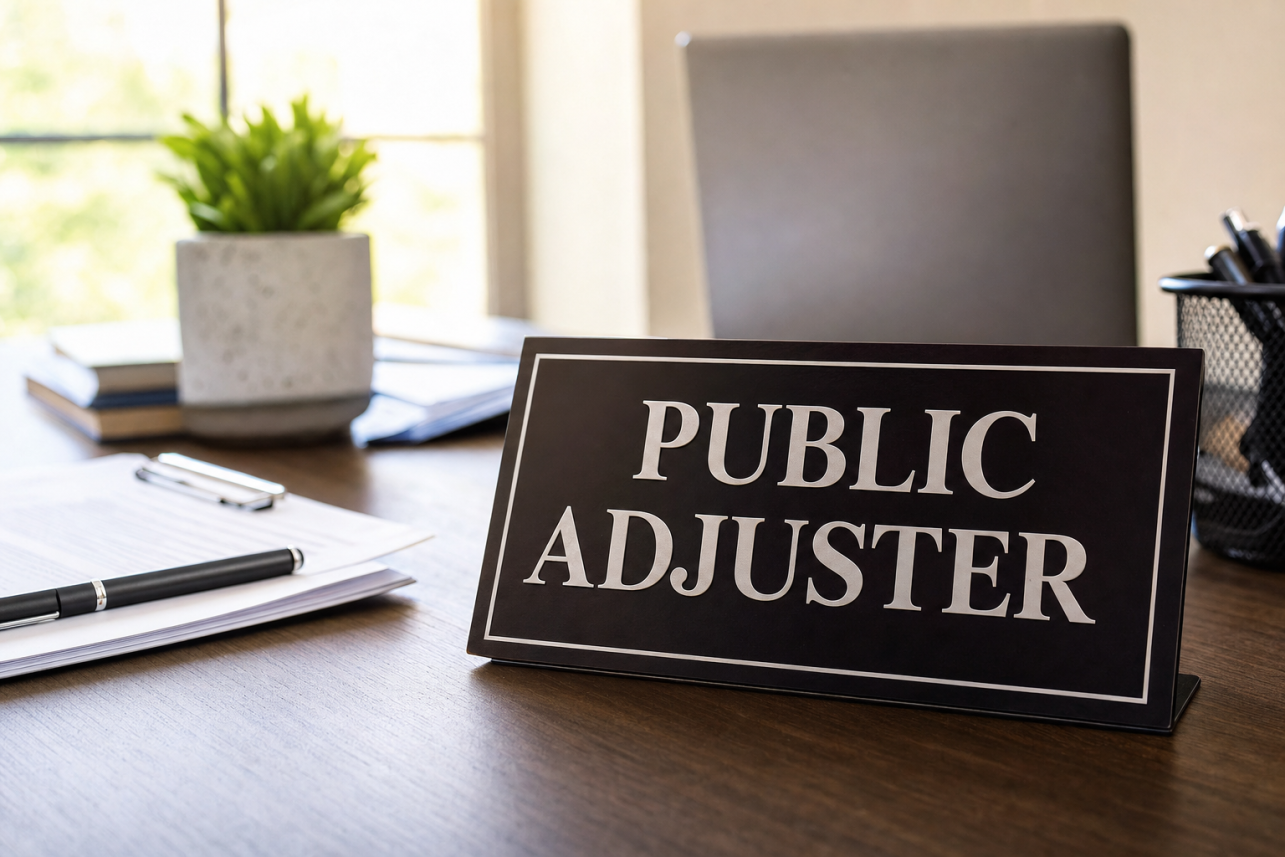
A public adjuster Fuquay-Varina NC homeowners hire works exclusively for the policyholder — never the insurance company — to document property damage, prepare the claim, and negotiate the settlement. For The Public Adjusters, Inc. is licensed and bonded, and we handle fire, smoke, water, tree, flood, and storm-related losses across Fuquay-Varina and Wake County. If your insurer has underpaid, delayed, or denied a claim, we can review your policy and your damage and tell you honestly where you stand.
What This Service Is
There are three kinds of adjusters in any property claim. The company adjuster and the independent adjuster both answer to the insurance carrier. A public adjuster is the only one licensed to represent you, the policyholder.
Our job starts with reading your policy the way it is actually written — coverages, endorsements, exclusions, and deadlines. Then we document the loss thoroughly: photographs, moisture readings, contents inventories, and line-item repair estimates using the same estimating standards carriers use.
From there, we present the claim, respond to the carrier's requests, attend inspections, and negotiate on your behalf. In North Carolina, public adjusters must be licensed, and the NCDOI Public Adjusters Guide explains what we can and cannot do for policyholders — including that our fee is a percentage of the recovery, agreed in writing before work begins.
We handle residential homeowners claims and commercial business claims alike: fire and smoke damage, water damage from burst pipes or roof leaks, tree strikes, vandalism, arson losses where the homeowner is the innocent victim, vehicles that hit a home, and flood claims including NFIP flood policies. We do not handle auto, health, life, or cell phone claims — buildings and their contents are our entire focus.
Common Problems
Is The Insurance Company's Offer Really All My Claim Is Worth?
Often it is not. Carrier estimates frequently miss hidden damage — smoke residue inside wall cavities, moisture trapped under flooring, or code-required upgrades that a bare-minimum repair scope ignores.
Depreciation is another common gap. Many policies pay actual cash value up front and hold back recoverable depreciation, and homeowners who don't know to claim it simply never receive it.
We rebuild the estimate line by line and compare it to your actual policy language. We never guarantee a specific outcome — no honest adjuster can — but we make sure nothing covered is left off the table.
What If My Public Adjuster Fuquay-Varina NC Claim Gets Delayed Or Denied?
Delays and denials usually come down to documentation, causation, or policy interpretation — and all three can be challenged. A denial letter is the carrier's position, not the final word.
Courts have repeatedly sided with policyholders in these disputes. In Corban v. United Services Automobile Association, the Mississippi Supreme Court ruled for homeowners on how wind and flood damage must be separated after a hurricane, rejecting the insurer's attempt to exclude covered wind damage. It's a reminder that carriers do not always read their own policies correctly.
When a claim stalls, we assemble the evidence the carrier says is missing, put disputes in writing, and use policy tools like appraisal where appropriate to move the claim forward.
Should I Just Handle The Claim Myself, Or Is Hiring Someone Worth It?
For a small, straightforward loss, you may be fine on your own. For a significant fire, water, or storm loss, you're negotiating against trained professionals while trying to keep your household running.
A good public adjuster does the technical work you'd otherwise guess at: scoping every trade, inventorying contents room by room, tracking deadlines, and applying coverages like additional living expenses that homeowners often overlook.
Before hiring anyone, verify the license — North Carolina requires it — ask about bonding, and get the fee agreement in writing. We're happy to answer all three questions before you sign anything.

Our Process
Free Policy And Damage Review
We start by reading your full policy and inspecting the damage ourselves — not relying on the carrier's photos. We'll tell you plainly whether we can add value or whether you're better off handling it alone. That assessment costs you nothing.
Documentation And Claim Preparation
We build the file the claim deserves: detailed repair estimates, contents inventories with values, moisture and smoke testing where needed, and proof-of-loss documents completed correctly and on time. Strong documentation is what separates paid claims from disputed ones.
Negotiation And Settlement
We present the claim to your carrier, attend every inspection, answer their questions, and negotiate the scope and price of repairs. You approve any settlement before it's accepted — the decision always stays with you.
| What Happens | Handling the Claim Yourself | With For The Public Adjusters, Inc. |
|---|---|---|
| Who documents the damage | You, with a phone camera and no scope standard | Licensed adjusters using moisture meters, thermal imaging, and carrier-grade estimating software |
| Who values the loss | The insurance company's adjuster, working for the carrier | An independent professional working exclusively for you |
| Negotiation | You accept, argue informally, or give up | Line-item supplements, re-inspections, and formal dispute processes |
| Hidden damage | Usually discovered mid-repair, after the claim is closed | Identified and documented before settlement, while it can still be paid |
| Your time investment | Dozens of hours of calls, paperwork, and estimates | We handle the carrier; you approve decisions |
| Typical result | The carrier's first or second offer | Settlements frequently multiples of the initial offer on underpaid claims |
Commonly Overlooked In The Public Adjusting Industry
- Code upgrade (ordinance & law) coverage — Carriers rarely volunteer it, so homeowners rebuild to current Wake County code at their own expense when the policy would have paid the difference.
- Matching requirements for shingles, siding, and flooring — Insurers approve spot repairs with discontinued or mismatched materials, and policyholders don't know North Carolina claims practice often supports replacing the full continuous run.
- Moisture inside wall cavities and insulation — If nobody puts a meter on the walls before the check is written, hidden saturation becomes mold — and a fight over whether it was ever part of the claim.
- Depreciation recoverable after repairs — Many homeowners never file for the recoverable depreciation holdback, leaving thousands with the carrier simply because no one explained the second payment.
- Additional living expenses beyond the first hotel bill — ALE covers meals, mileage, pet boarding, and increased rent for the whole displacement — but adjusters seldom itemize it unless the policyholder tracks and submits it.
- HVAC and ductwork contamination after fire or water losses — Soot and mold spores circulate through the system, yet ducts are almost never in the carrier's initial scope because they're out of sight.
- Policy deadlines for proof of loss and supplemental claims — Missing a contractual deadline can forfeit money that was otherwise owed, and carriers are under no obligation to remind you it's approaching.
- Contents priced at actual replacement cost, not garage-sale value — Carriers' contents software defaults to depressed pricing, and grieving or overwhelmed policyholders rarely challenge line items one by one.
Case Studies
Case Study #1
Situation: A family in the Ballentine Place neighborhood of Fuquay-Varina came home after a July thunderstorm to find water staining across their living room ceiling. Their insurer sent an adjuster within a week and issued a check for $4,200 to patch the roof and repaint the ceiling.
Problem: The homeowners felt the payout seemed low, but they had no way to verify it. The carrier's estimate covered only a small roof repair and one coat of paint — it ignored the saturated insulation, the wet drywall in an adjoining hallway, and the possibility of hidden moisture in the attic decking.
Investigation: Our team performed a full inspection using moisture meters and a thermal imaging camera. We mapped moisture migration from the roof penetration down through the attic, into the ceiling joists, and along the top plate of two interior walls. We also documented hail bruising across the entire south-facing roof slope, not just the visible leak point.
Findings: The damage was far more extensive than the carrier's scope acknowledged. Wet blown-in insulation had compressed and lost its R-value across roughly 400 square feet. Drywall in two rooms exceeded acceptable moisture readings, and the roof slope showed storm damage consistent with functional hail impact — meaning a slope replacement, not a patch, was warranted.
Solution: We prepared a line-item estimate in the same software the carrier uses, backed by photo documentation, moisture logs, and weather data confirming hail in the 27526 zip code on the date of loss. We then filed a supplemental claim and negotiated directly with the desk adjuster and their field re-inspector.
Outcome: The claim settled at $38,700 — more than nine times the original offer. That covered full slope replacement, insulation removal and replacement, drywall repairs in both affected rooms, and proper drying protocols instead of paint over damp material.
Lesson: The first check is an opening position, not a final answer. Water damage almost always travels farther than what's visible on the ceiling, and if nobody measures moisture before repairs begin, the homeowner absorbs the difference.
Case Study #2
Situation: A small restaurant owner near downtown Fuquay-Varina suffered a kitchen fire that started in a fryer hood. The fire itself was contained quickly, but smoke and suppression chemicals spread through the dining room, and the business had to close.
Problem: The carrier accepted the fire claim but disputed nearly everything else. They wanted to clean and reuse smoke-damaged dining furniture, denied most of the business interruption calculation, and pressured the owner to accept a fast settlement so he could reopen. Every week closed was costing him staff and regular customers.
Investigation: We brought in an independent industrial hygienist to test for soot and protein residue throughout the dining area and HVAC system. We also reconstructed the restaurant's true earnings picture using POS records, seasonal trends, and payroll data — not just the prior-year tax return the carrier had relied on.
Findings: Testing confirmed corrosive residue inside the ductwork and embedded in upholstered seating, which meant cleaning was not a safe or code-compliant option. The business interruption analysis showed the carrier had understated monthly revenue by roughly 30% because it ignored the restaurant's growth over the previous two quarters.
Solution: We presented the hygienist's report, a full contents inventory with replacement pricing, and a corrected business income worksheet. We also documented ongoing expenses — rent, key employee payroll, loan payments — that the policy covered during the closure period.
Outcome: The final settlement included full HVAC decontamination, replacement of affected furniture and equipment, and a business interruption payment nearly double the carrier's initial figure. The owner reopened without taking on debt to bridge the gap.
Lesson: Commercial claims are where carriers dispute the hardest, because the numbers are bigger and the accounting is complicated. Documented testing and a properly built income analysis change the conversation from opinion to evidence.
| Your Situation | Should You Get Help? | Why It Matters |
|---|---|---|
| Claim denied outright | Yes — immediately | Denials often rest on shaky causation arguments; independent evidence can reverse them, but deadlines to dispute run quickly |
| Offer feels low but you can't prove it | Yes — before you cash anything | A free claim review compares the carrier's scope against actual damage; accepting payment first can complicate supplements |
| Water damage with any ceiling or wall staining | Yes | Moisture travels inside walls and insulation; unmeasured damage is unpaid damage |
| Fire or smoke loss, even a small one | Yes | Soot residue is corrosive and spreads through HVAC; carriers routinely push cleaning where replacement is required |
| Storm damage, carrier approved partial roof repair | Usually yes | Mismatched shingles and single-slope repairs often violate manufacturer specs; full replacement may be owed |
| Commercial loss with business interruption | Yes — day one | Income calculations are where carriers underpay most; the earlier the documentation starts, the stronger the claim |
| Minor loss under your deductible | No | If repairs cost less than your deductible, filing a claim offers no benefit and a fee makes no sense |
| Claim already paid and fully repaired | Maybe | In North Carolina you may still reopen an underpaid claim within the policy's time limits — worth a free review |
Reviews
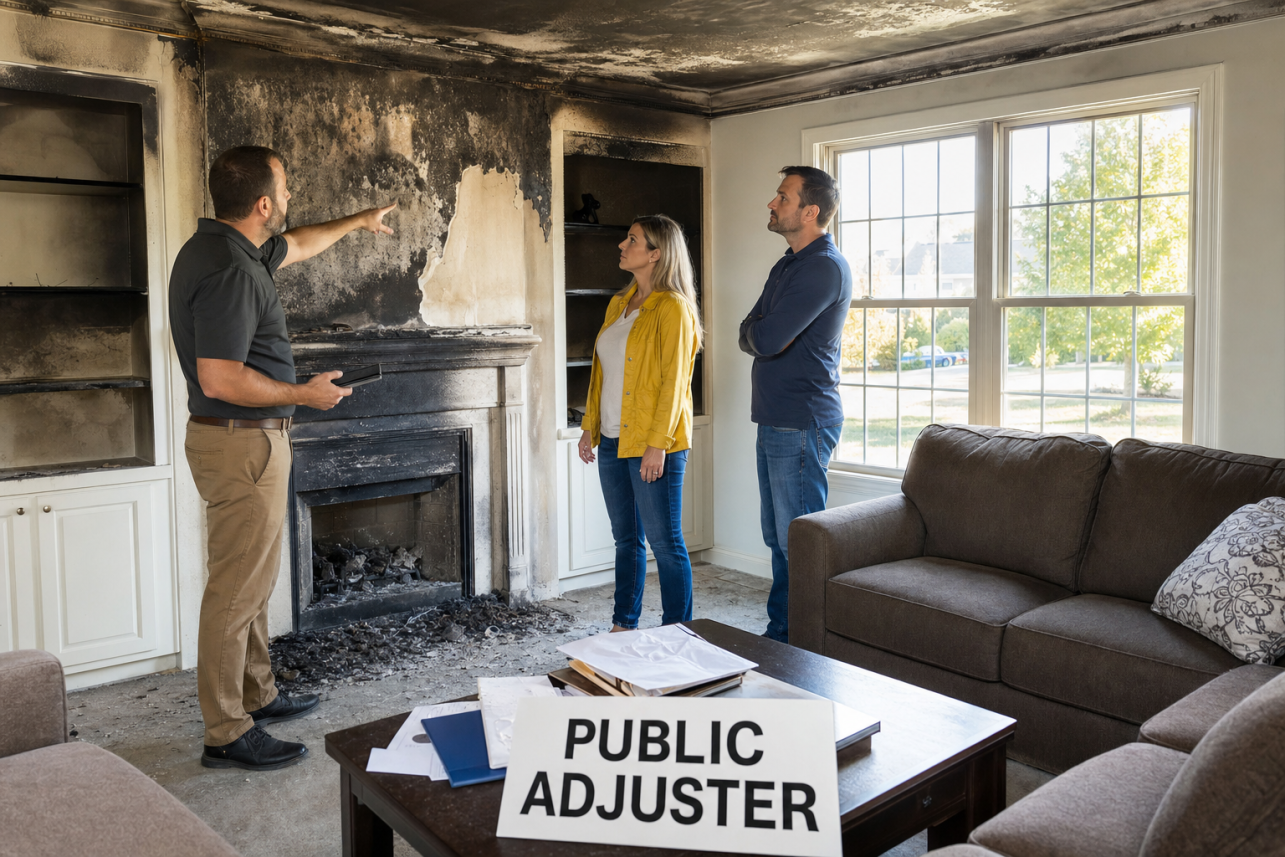
After the hailstorm last spring, our insurance company said our roof only needed 15 shingles replaced. For The Public Adjusters found impact damage on three slopes, documented everything with drone photos, and got the whole roof approved plus interior water damage we didn't even know about. Went from a $2,100 offer to a full replacement. I would never handle a storm claim alone again.
Melissa T., Fuquay-Varina
A pipe burst in our crawlspace while we were out of town and the carrier tried to blame it on 'long-term seepage' to deny the claim. These guys pushed back with plumber documentation and moisture readings that proved it was a sudden break. They handled every call with the insurance company so I didn't have to. Settled for enough to actually fix everything, including the hardwood floors.
Darnell W., Willow Spring
I was skeptical about paying a percentage, honestly. But my fire claim had been sitting for four months with the insurer lowballing my contents list. Within about eight weeks of hiring this team, the claim was reinventoried, re-priced at actual replacement cost, and settled for almost triple. The fee paid for itself many times over. Only wish I'd called them the week of the fire instead of trying to do it myself first.
Karen B., Fuquay-Varina
Frequently Asked Questions
What Does A Public Adjuster Fuquay-Varina NC Homeowners Hire Actually Do For My Insurance Claim?
A public adjuster works exclusively for you, the policyholder — never for the insurance company. When you hire For The Public Adjusters, Inc., we take over the entire claim process from documentation to final settlement negotiation.
That starts with a thorough inspection of your property. Wake County homes see a lot of wind and hail damage from summer storms rolling through, plus water damage from burst pipes during cold snaps. Insurance company adjusters often miss hidden damage — moisture trapped behind walls, compromised shingles that will fail later, or structural issues under the surface. We document everything with photos, moisture readings, and detailed line-item estimates.
Next, we review your policy language closely. Most homeowners in Fuquay-Varina have never read their full policy, and carriers count on that. We identify every coverage that applies to your loss, including additional living expenses, code upgrade coverage, and debris removal that policyholders frequently leave on the table.
Finally, we handle all communication and negotiation with your insurance carrier. You never have to argue with an adjuster on the phone or decipher a lowball estimate on your own. We present the evidence, push back on undervalued line items, and negotiate until the settlement reflects what it actually costs to restore your property in today's Triangle-area construction market — where labor and material costs have climbed sharply in recent years.
How Much Does It Cost To Hire A Public Adjuster In Fuquay-Varina, And Is It Worth It?
We work on a contingency fee basis, which means you pay nothing upfront and nothing out of pocket. Our fee is a percentage of the settlement we recover for you, and North Carolina law caps and regulates those fees to protect policyholders. If we don't recover money for you, you don't owe us anything.
For most homeowners, the math works strongly in their favor. Industry studies and our own experience across Wake County show that professionally represented claims routinely settle for significantly more than claims handled by the policyholder alone — often several times the initial carrier offer. That difference typically far exceeds the fee.
Here's a common local example: a hail storm damages a roof off Judd Parkway. The carrier's adjuster approves a partial repair covering one slope. We inspect, document damage across all slopes, invoke the matching provisions in the policy, and negotiate a full roof replacement plus interior water damage the first inspection missed. The revised settlement can be tens of thousands of dollars higher.
Beyond the money, there's the time and stress you save. Claims involve deadlines, proof-of-loss forms, recorded statements, and estimate disputes. Most people in Fuquay-Varina are juggling work and family — commuting to Raleigh or Holly Springs — and simply don't have hours to fight a carrier. We handle all of it, and our incentive is aligned with yours: the more your claim recovers, the better we've done our job.
When Should I Call A Claims Adjuster Who Works For Me Instead Of Handling The Insurance Claim Myself?
The best time to call is before you file the claim, or immediately after the damage occurs. Early involvement lets us document the loss properly from day one, help you meet your policy's notice requirements, and set the claim up correctly before the carrier's narrative takes hold.
That said, we're brought in at every stage. Many Fuquay-Varina clients call us after receiving a settlement offer that seems far too low to actually rebuild — a $12,000 offer on a kitchen fire that any local contractor quotes at $40,000, for instance. Others call after an outright denial, or when a claim has stalled for months with no response from the carrier.
You should strongly consider professional representation if any of these apply: the damage is significant (roof, fire, major water loss), the carrier is disputing the cause of loss, you've received an estimate that doesn't match contractor quotes, or the claim involves complicated issues like mold, code upgrades, or matching of siding and shingles.
One important note for North Carolina policyholders: reopening or supplementing a claim is often possible even after you've received a payment, as long as you're within the policy's time limits. If you settled a storm claim last year and later discovered your contractor can't complete repairs for the amount paid, it may not be too late. Bring us your paperwork and we'll review it at no cost and tell you honestly whether pursuing more recovery makes sense.
Does For The Public Adjusters, Inc. Handle Storm And Water Damage Claims Specific To The Fuquay-Varina Area?
Yes — storm and water losses are the most common claims we handle here, and knowing this area matters. As a public adjuster Fuquay-Varina NC property owners can rely on, we've inspected homes and businesses throughout southern Wake County, from established neighborhoods near downtown and the Varina district to newer subdivisions along NC-55 and Hilltop-Needmore Road.
This area sits in a corridor that regularly catches severe thunderstorms, straight-line winds, and hail moving across the Triangle. Remnants of tropical systems also push through, dumping heavy rain that overwhelms roofs, flashing, and grading. We know which storm dates carriers have on record, and we use weather data to tie your damage to a specific covered event — which is often the difference between approval and denial.
Newer construction here brings its own issues. Fast-built homes in growing subdivisions sometimes have marginal flashing or ventilation details, and when a storm exposes those weaknesses, carriers may try to blame "construction defect" or "wear and tear" instead of the covered wind or hail event. We push back with documentation and expert support.
Water claims are just as common: pipe failures in crawl spaces, water heater ruptures, and HVAC condensation losses. These claims frequently involve hidden damage inside walls and under flooring, plus mold concerns that develop quickly in North Carolina humidity. We scope the full extent of the loss, not just what's visible, so your settlement covers a complete and proper repair — including temporary housing if your home is unlivable during the work.
Can A Public Adjuster Fuquay-Varina NC Residents Trust Reopen A Claim That Was Already Denied Or Underpaid?
Yes, in many cases we can. A denial or a low settlement offer is rarely the final word. North Carolina policies generally allow supplemental claims, and insurers are required to reconsider when new documentation or a corrected scope of damage is presented.
When For The Public Adjusters, Inc. reviews a closed or underpaid claim, we start by reading the denial letter against the actual policy language. Carriers sometimes cite exclusions that don't apply to the specific loss, or their field adjuster missed damage entirely — hidden water intrusion behind drywall and wind-lifted shingles that look intact from the ground are two common examples in Wake County homes.
From there, we build a new damage estimate with photos, moisture readings, and line-item pricing based on local Fuquay-Varina contractor rates, not national averages. That documentation package becomes the basis for a formal supplement or dispute with the carrier.
Timing matters. Most policies give you a limited window — often one to three years from the date of loss in North Carolina — to pursue additional payment. If your claim was denied last storm season, you likely still have options, but don't wait. Bring us the denial letter, your policy declarations page, and any estimates you received, and we'll tell you honestly whether the claim is worth reopening before you commit to anything.
What Does The Claims Process Look Like From The First Phone Call To The Final Settlement Check?
It starts with a free consultation. We'll ask about the damage, the date of loss, and whether you've already filed. If the claim has merit, we schedule an on-site inspection of your property — whether that's a home off Judd Parkway, a business on Main Street, or a rental property elsewhere in southern Wake County.
During the inspection, we document everything: roof, siding, interior water paths, contents, and secondary damage the carrier's adjuster often overlooks. We photograph, measure, and take moisture readings where needed. Then we prepare a detailed, line-item estimate of the full loss.
Next, we notify your insurance company that we're representing you. From that point forward, we handle the calls, emails, inspections, and negotiations. You're kept informed at every step, but you're no longer the one arguing scope and pricing with a carrier adjuster.
Most residential claims resolve within 30 to 90 days, though complex losses — large fire claims, disputed water damage, or commercial properties — can take longer. Once the carrier issues payment, our fee comes out of the settlement as a pre-agreed percentage, so there's never a bill you have to pay out of pocket upfront.
Throughout the process, you make the final decisions. We advise, negotiate, and document, but no settlement is accepted without your approval. That's the whole point of hiring an adjuster who works for you rather than the insurance company.
Are Public Adjusters Licensed In North Carolina, And How Do I Verify A Company Before Hiring One?
Yes. North Carolina requires public adjusters to be licensed through the North Carolina Department of Insurance. Licensing involves passing a state examination, background screening, and posting a surety bond, and adjusters must complete continuing education to keep their license active.
Before you sign anything with any firm, verify the license. You can search the NC Department of Insurance licensee database online by name or company, or call the department directly. A legitimate adjuster will hand over their license number without hesitation — ours is available on request and in our contract paperwork.
Beyond the license, look for a few practical things. Ask how long the company has worked claims in Wake County specifically, because local building costs and common storm patterns in Fuquay-Varina differ from the coast or the mountains. Ask for references from recent clients in the Triangle. Read the fee agreement carefully — North Carolina caps public adjuster fees, and the percentage should be stated plainly in writing before any work begins.
Be cautious of anyone who knocks on your door immediately after a storm demanding a signature on the spot, or who guarantees a specific settlement amount. No honest adjuster can promise a dollar figure before inspecting the loss and reading your policy.
For The Public Adjusters, Inc. is fully licensed in North Carolina, and we encourage every prospective client to check our credentials before hiring us. An informed policyholder is exactly the kind of client we want.
Does Hiring A Fuquay-Varina Claims Adjuster On My Side Make Sense For Smaller Losses, Or Only Major Damage?
It depends less on the size of the loss and more on the gap between what the insurer offered and what repairs actually cost. A public adjuster Fuquay-Varina NC homeowners bring in for a "small" kitchen water leak often uncovers damage worth two or three times the carrier's initial estimate — saturated subfloor, cabinet toe-kicks, and insulation that the first inspection never touched.
As a general rule, claims under a few thousand dollars, or losses barely above your deductible, usually aren't worth professional representation. Our fee is a percentage of the recovery, so we'll tell you upfront if the math doesn't work in your favor. That honesty costs us jobs sometimes, but it's how we've built our reputation in Wake County.
Where representation earns its keep is the mid-size claim that carriers routinely underpay: hail damage across an entire roof slope priced as a partial repair, smoke damage limited to one room when soot traveled through the HVAC system, or water losses where drying costs were approved but reconstruction was lowballed.
For larger losses — house fires, fallen trees through the roof, major flooding from burst pipes — the case is straightforward. Those claims involve building code upgrades, contents inventories, and additional living expense coverage that most policyholders don't know how to document or claim fully.
If you're unsure which category your loss falls into, call us. The consultation is free, and we'll give you a straight answer about whether hiring us actually benefits you.
How Long Does A Claim Usually Take With A Public Adjuster Fuquay-Varina NC Property Owners Hire?
Most residential claims we handle in Fuquay-Varina settle within 30 to 90 days of our involvement, though the timeline depends on the size of the loss and how the carrier responds. North Carolina law requires insurers to acknowledge claims promptly and act in good faith, and we hold them to those deadlines.
Straightforward claims — a roof damaged in a spring hailstorm off Judd Parkway, or a burst supply line in a Sunset Lake area home — often wrap up faster because our documentation leaves little room for dispute. Larger losses, like a kitchen fire or extensive water damage requiring structural drying, can run longer simply because scoping, engineering reports, and contractor estimates take time to assemble properly.
One thing worth knowing: a claim handled well from the start almost always closes faster than one that gets underpaid and has to be reopened. When homeowners come to us after months of back-and-forth with their carrier, our first job is untangling what has already been said and documented. Bringing us in early avoids that.
We also keep momentum by controlling the schedule where we can. We meet the carrier's adjuster on site, submit complete estimates rather than piecemeal supplements, and follow up in writing on every deadline. If the insurer stalls, we escalate through their claims management and, when necessary, invoke the appraisal clause in your policy. Throughout the process, you get regular updates so you are never left wondering where things stand.
Will Hiring My Own Claims Adjuster Make My Insurance Company Treat Me Differently Or Raise My Rates?
No — and this is one of the most common worries we hear from Wake County homeowners. Hiring your own representation is a right protected under North Carolina law, and carriers deal with public adjusters every day. Your policy cannot be canceled and your claim cannot be denied simply because you brought in a licensed professional to advocate for you.
As for rates, premiums in North Carolina are driven by your claims history, your property's risk profile, and broader market factors like storm activity across the region. Filing a legitimate claim is what appears in your history — whether you handled it alone or had representation makes no difference to how it is recorded. A claim settled for a fair amount and a claim settled for an unfairly low amount count exactly the same on your record, which is one more reason to make sure you recover everything you are owed.
In practice, we find the process often becomes smoother once we are involved. The carrier's adjuster is now dealing with someone who speaks the same technical language, uses the same estimating software, and documents everything in writing. That tends to cut down on disputes rather than create them.
What does change is the balance of the conversation. Instead of a homeowner negotiating against a trained adjuster, it is professional versus professional. Around Fuquay-Varina, where hail, wind, and hurricane remnants generate waves of claims, that leverage matters — carriers are stretched thin during catastrophe season, and well-documented claims get resolved while poorly documented ones sit.
What Should I Do Right After Storm Or Water Damage, Before The Insurance Company's Adjuster Shows Up?
First, make the property safe and prevent further damage — your policy actually requires this. Tarp a damaged roof, shut off the water supply to a leaking line, and move undamaged belongings out of harm's way. Keep every receipt for tarps, fans, or emergency services, because those costs are typically reimbursable.
Second, document everything before anything gets moved, dried, or thrown away. Take wide photos of each affected room, then close-ups of individual damage. Video walkthroughs are even better. In Fuquay-Varina we see this matter constantly with water losses — once drying equipment runs for three days, the visible evidence changes, and the carrier's adjuster only sees the aftermath.
Third, be careful what you sign. Some restoration contractors who show up after a storm ask homeowners to sign assignments or work authorizations that limit your options later. Read anything put in front of you, and do not agree to a scope of repairs before the full extent of damage is known. Hidden damage — saturated insulation, wind-lifted shingles that look intact from the ground, moisture inside wall cavities — is exactly what gets missed in a quick inspection.
Finally, consider calling us before the carrier's inspection rather than after. When For The Public Adjusters, Inc. is involved from day one, we attend that inspection with you, point out damage the carrier's adjuster might otherwise walk past, and set the claim on the right footing from the first conversation. It is far easier to build a claim correctly than to fix one later.
Does A Public Adjuster Fuquay-Varina NC Businesses Can Call Handle Commercial Claims Too, Or Just Homes?
Yes — a public adjuster Fuquay-Varina NC business owners hire can represent commercial properties just as fully as residential ones, and we handle both. That includes retail spaces along Main Street and Broad Street, restaurants, offices, churches, warehouses, and rental properties throughout southern Wake County.
Commercial claims are often more complex than homeowner claims, which makes professional representation even more valuable. Beyond building damage, a business loss can involve business personal property, tenant improvements, code-upgrade requirements, and business interruption coverage — the income you lose while you cannot operate. Business interruption is where carriers most frequently underpay, because calculating lost revenue, continuing expenses, and extra expenses requires financial documentation most owners have never had to assemble for an insurer.
We build that documentation for you. We work from your profit-and-loss statements, sales records, and payroll to prove the true cost of the shutdown, and we scope the physical damage with commercial-grade estimating so nothing gets valued at residential shortcuts.
Landlords and property investors in the area also bring us claims involving rental loss coverage and multi-unit damage, where coordinating tenants, contractors, and the carrier gets complicated fast.
Our fee works the same way for commercial clients as residential ones — a percentage of the recovery, with nothing owed if we do not recover for you. For a business, the real cost of a claim is usually downtime, so our focus is documenting the loss thoroughly and pressing the carrier to fund repairs quickly enough that you can reopen your doors.
Can I Hire A Public Adjuster Fuquay-Varina NC Homeowners Recommend If I've Already Filed My Claim Myself?
Yes, and it happens all the time. Many of our clients in Fuquay-Varina call us weeks or even months after filing on their own, usually once they realize the insurance company's estimate doesn't come close to covering the actual repairs.
Bringing us in mid-claim is straightforward. We review everything that's already been submitted, request the carrier's full estimate and correspondence, and then re-inspect the property ourselves. In most cases we find damage the first inspection missed, whether that's hidden moisture behind drywall, matching issues on roofing shingles, or code-upgrade costs that were never accounted for.
Once we're formally designated as your representative, the insurance company is required to communicate through us. That alone takes a huge weight off homeowners who are tired of chasing return calls and re-explaining their situation to a new desk adjuster every few weeks.
The one thing to watch is timing. North Carolina policies contain deadlines for submitting proof of loss and disputing payments, so the sooner you bring in professional help, the more options we have. Even if you've already cashed a partial payment, that does not necessarily close your claim, and we can often pursue a supplement for the difference. If you're unsure where your claim stands, a quick review of your paperwork costs you nothing and tells you exactly what's still recoverable.
What Types Of Property Damage Claims Does For The Public Adjusters, Inc. Handle Besides Storm And Water Losses?
We handle nearly every category of property damage covered under a homeowners or commercial policy. Fire and smoke claims are a major part of our work, and they're among the most underpaid losses we see. Smoke penetrates HVAC systems, insulation, and personal contents in ways a quick walkthrough never captures, and carriers frequently lowball the cleaning and replacement costs.
We also represent policyholders on hail and wind claims, which are common in Wake County given the spring and summer storm patterns that roll through the Fuquay-Varina and Willow Spring area. Hail bruising on architectural shingles is easy for a carrier's adjuster to dismiss, so we document it with detailed photo evidence and test squares.
Beyond weather, we take on theft and vandalism claims, lightning strikes that damage electrical systems and appliances, tree-fall losses, and pipe bursts that lead to mold remediation disputes. For business owners, we also pursue business interruption and loss-of-income claims tied to a covered property loss.
The common thread in all of these is documentation. Whatever the cause of loss, our job is to build a complete, itemized claim that reflects the true cost of putting your property back the way it was. If you're not sure whether your situation qualifies, describe it to us and we'll give you an honest answer before you commit to anything.
How Does Recoverable Depreciation Work On My Claim, And Can A Fuquay-Varina Public Adjuster Help Me Collect It?
Recoverable depreciation trips up more homeowners than almost any other part of the claims process. If you have a replacement cost policy, the insurance company initially pays you the actual cash value of your damaged property, which is the replacement cost minus depreciation for age and wear. The withheld depreciation is money you're still owed, but you only collect it after the repairs are actually completed and documented.
Here's where people lose money. Carriers often calculate depreciation aggressively, applying steep age-based reductions to roofs, flooring, and cabinetry that don't reflect real-world condition. Then, once repairs are done, homeowners either forget to submit their invoices or miss the policy deadline for claiming the holdback, and that money simply stays with the insurer.
As your representative, we scrutinize the depreciation schedule line by line and challenge figures that don't hold up. We also track every deadline, submit the completion documentation, and follow up until the depreciation check is actually issued.
One more thing worth knowing: North Carolina case law and policy language matter here, and some items, like labor, are treated differently than materials when it comes to depreciation. We know how these distinctions apply and use them to your benefit. If you've already received an actual cash value payment and aren't sure what's still owed, bring us your estimate and we'll walk you through exactly what's recoverable.
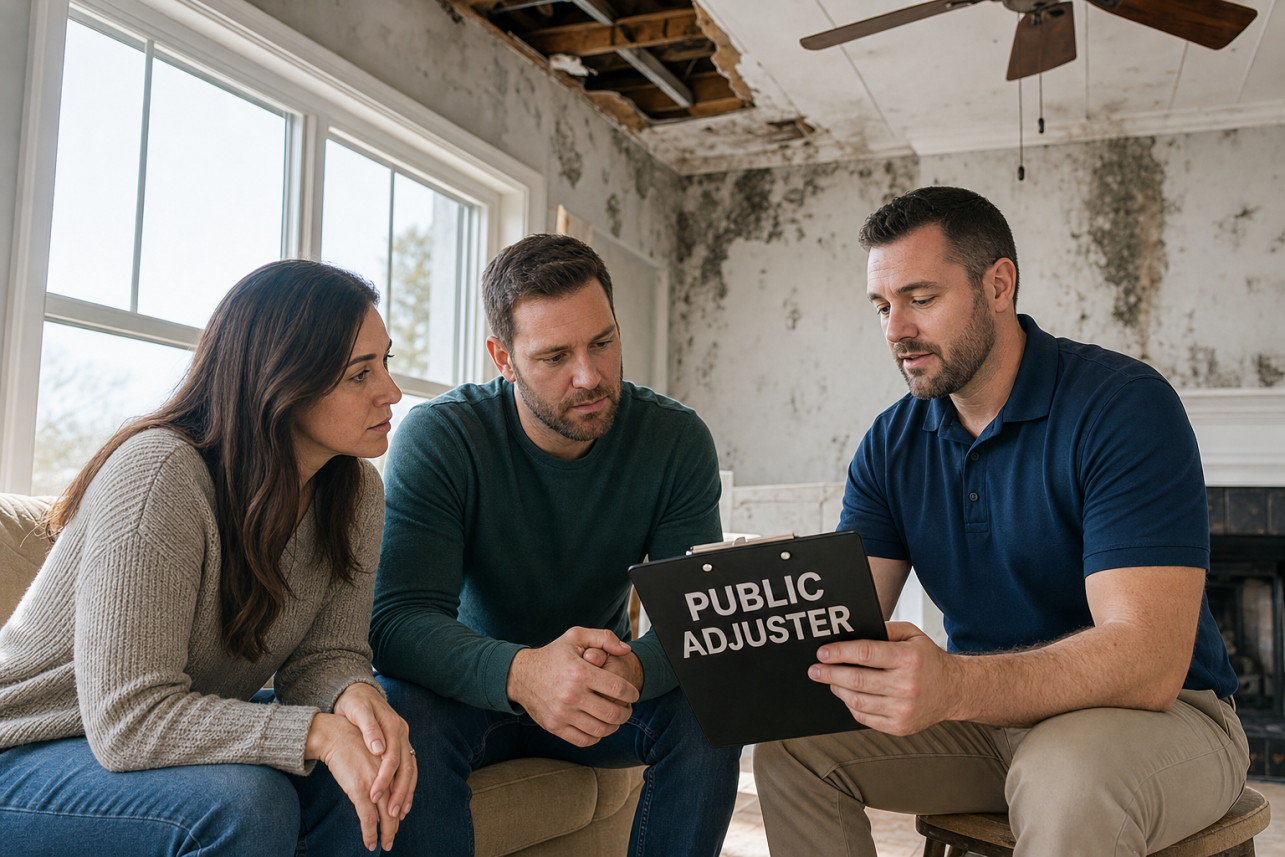
What Areas Around Town Does Your Team Serve, And Do You Know The Local Building Conditions Here?
For The Public Adjusters, Inc. serves all of Fuquay-Varina and the surrounding communities, including Holly Springs, Willow Spring, Angier, Garner, Apex, and the greater southern Wake County area. Because we work these neighborhoods regularly, we understand the local housing stock, from the older homes near downtown and the Varina district to the newer subdivisions built during the town's rapid growth over the past decade.
That local knowledge matters more than people realize. Newer construction in this area often involves builder-grade materials that carriers try to price at the low end, while older homes frequently trigger code-upgrade requirements during repairs, such as updated electrical or plumbing, that must be claimed under ordinance-or-law coverage. We know how to identify and document both.
We're also familiar with the weather patterns that drive claims here: severe thunderstorms and straight-line winds in spring, hurricane remnants pushing up from the coast in late summer, and the occasional ice event that leads to burst pipes and roof damage. When a public adjuster Fuquay-Varina NC property owners hire has handled dozens of claims from the same storm system, we can compare carrier behavior across claims and push back when one homeowner is being treated unfairly.
If your property sits anywhere in southern Wake County or just over the Harnett County line, we can inspect it, typically within a few days of your call. There's no charge for the initial damage assessment and policy review.
Local Relevance
Fuquay-Varina has grown from a quiet southern Wake County town into one of the fastest-growing communities in the Triangle, which means our claim work spans two very different kinds of housing. The older homes near the town's two historic downtowns often carry aging plumbing, original wiring, and mature hardwoods and pines standing close to the roofline — a recipe for water damage, electrical fires, and tree-strike claims. The newer subdivisions bring their own issues, from builder-grade roofing stressed by summer storms to finished basements vulnerable to water intrusion.
Weather drives much of the claim volume here. This part of North Carolina sits inland but squarely in the path of hurricane remnants moving up from the coast, and the region sees severe thunderstorms and the occasional tornado. Winter ice events, though less frequent, bring down limbs and freeze pipes. Heavy rain on the creeks and low-lying lots around town can also produce flooding that a standard homeowners policy excludes — which is why the Federal Emergency Management Agency administers separate flood coverage through the NFIP, and why we handle those claims under their distinct rules.
When a Fuquay-Varina homeowner faces a serious loss, the carrier sends an adjuster within days. We think the homeowner deserves someone equally experienced sitting on their side of the table.
Many Fuquay-Varina lots kept their mature loblolly pines when the area was developed, and after hurricane remnants pass through the Triangle we often see tree-strike claims underpaid because the estimate covers the roof hole but misses cracked framing, shifted trusses, and water that followed the tree into the walls — always insist the structure be opened and inspected, not just patched.
Talk To A Fuquay-Varina Public Adjuster Before You Accept The Carrier's Number
For The Public Adjusters, Inc. is licensed and bonded, and we work only for policyholders. Whether your claim involves fire, water, smoke, a fallen tree, vandalism, or flood damage, we'll review your policy and your damage at no cost and give you a straight answer about your options.
Request Your Free Claim Review
Call us: (919) 400-6440
Helpful Resources
- NCDOI Public Adjusters Guide
- Federal Emergency Management Agency (FEMA)
- National Flood Insurance Program (NFIP)
- North Carolina Department of Insurance — State regulator that licenses public adjusters and assists consumers
Our services in this city
- Arson Homeowners Claim Fuquay-Varina: When Your Insurance Company Accuses You Of Setting The Fire
- Fire Claims Adjuster Fuquay-Varina NC — Help After House Fires, Smoke Damage, And Firefighting Water Losses
- Smoke Damage Claim Help Fuquay Fuquay-Varina NC: Protein Smoke From Cooking Fires You Can Smell But Can't See
- Water Damage Coverage Insurance Fuquay-Varina: When A Burst Pipe Or Roof Leak Claim Gets Denied Or Underpaid
Last updated: August 16, 2026