
If the insurance company’s check won’t come close to covering your repairs, a public adjuster water damage apex NC homeowners can hire works for you — not the insurer — to re-document the loss and negotiate for a fair settlement. For The Public Adjusters, Inc. is licensed and bonded in North Carolina, and we handle exactly this situation: a burst pipe, a slow leak, or an appliance failure followed by an offer that feels insultingly small. We review your policy, build our own damage assessment and repair estimate, and present the insurer with evidence they can’t wave away.
What This Service Is
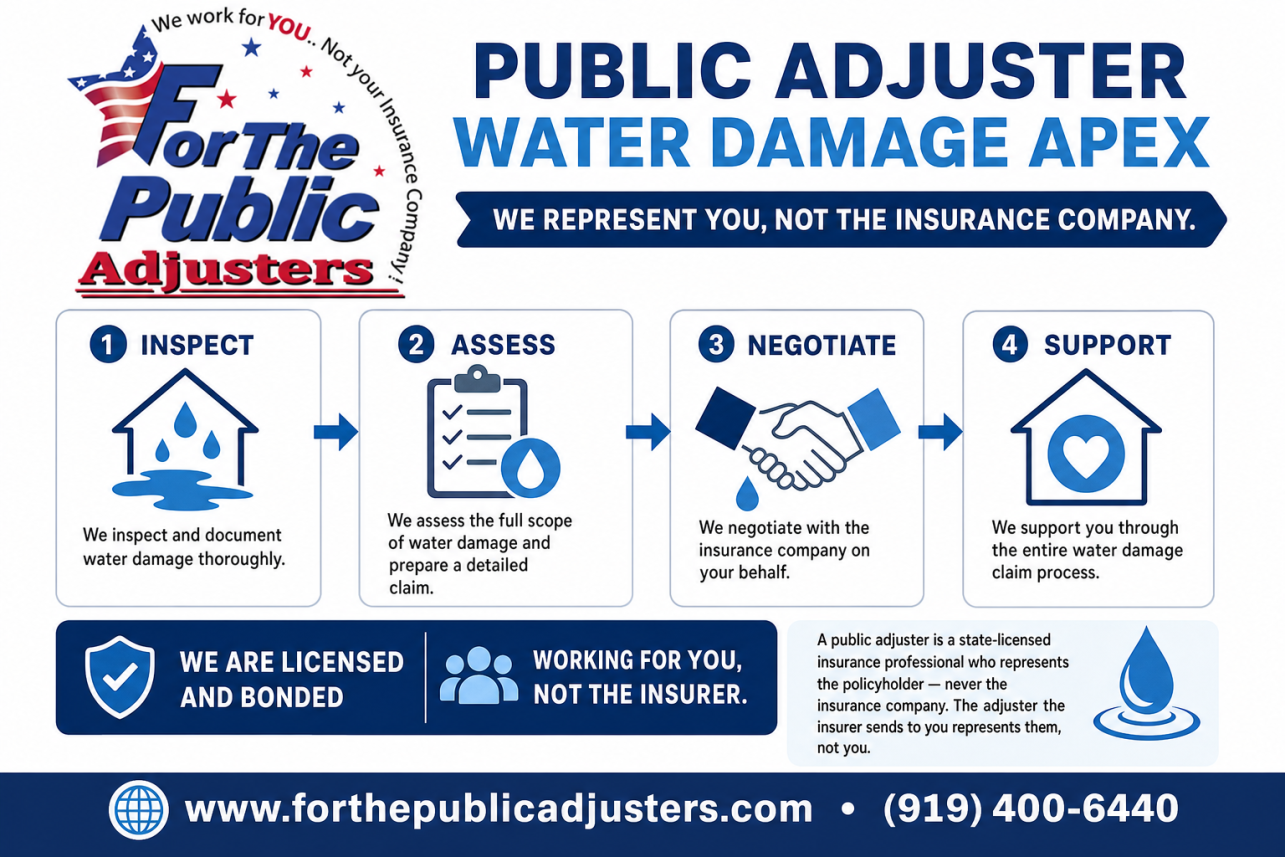
A public adjuster is a state-licensed insurance professional who represents the policyholder — never the insurance company. The adjuster the insurer sends to your Apex home is paid by the insurer, and their estimate reflects that relationship more often than most homeowners realize.
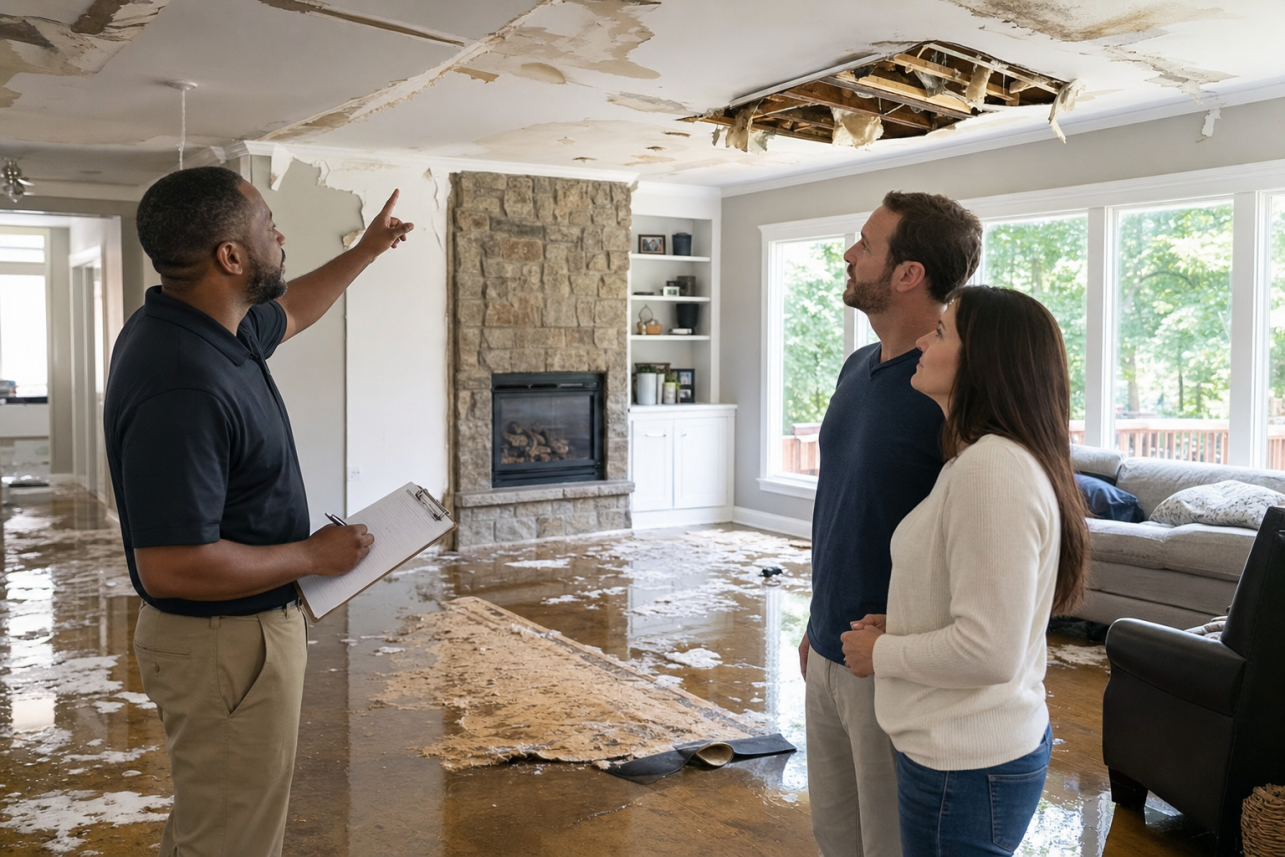
When we take on a water damage claim, we start with the policy itself: what’s covered, what’s excluded, your deductible, and your coverage limits for the structure and your belongings. Water losses hide problems — moisture wicks up drywall, soaks subfloors, and settles inside wall cavities where mold can start within days. A quick walk-through with a clipboard misses most of it.
We document all of it: moisture readings, photos, a room-by-room contents inventory, and a repair estimate built on real local labor and material costs. Then we prepare the proof of loss paperwork the insurer requires and negotiate directly with their adjuster so you don’t have to. The North Carolina Department of Insurance, through its NCDOI Public Adjusters Guide, explains that public adjusters must be licensed and work under a written contract — and that’s exactly how we operate, with our fee coming from the settlement rather than out of your pocket up front.
Beyond water losses, we handle fire, smoke, tree damage, vandalism, and both residential and commercial claims across Wake County. We do not handle claims involving vehicles, cell phones, health, or life insurance.
Common Problems
The Insurer’s Check Won’t Cover My Repairs — Why Is The Offer So Low?
Low offers usually come from three places: depreciation, scope, and pricing. If your policy pays actual cash value first, the insurer deducts depreciation from replacement cost — and some insurers deduct far more than they should. Courts have pushed back on this. In Lammert v. Auto-Owners Insurance, the Tennessee Supreme Court sided with homeowners, ruling the insurer could not depreciate labor costs when calculating the actual cash value of their damaged property.
Scope is the second problem: the insurer’s estimate may cover replacing two feet of drywall when the water actually traveled through the whole wall. Third is pricing — estimates built on software defaults that don’t reflect what Apex contractors actually charge.
We rebuild the estimate line by line, challenge improper depreciation deductions, and make sure your contents — furniture, flooring, electronics, clothing — are valued fairly, not guessed at.
Their Adjuster Spent Twenty Minutes Here And Says The Damage Is ‘minor’
This is the most common story we hear in Apex. A pipe bursts or a water heater fails, the insurance adjuster does a fast inspection, and the report calls for surface repairs only. Meanwhile you can smell dampness, the floor feels soft, and you’re worried about mold behind the baseboards.
Hidden moisture is the heart of most water claim disputes. If it isn’t documented before repairs begin, the insurer will later argue it was pre-existing or caused by your delay. Some claims get denied outright on exclusions like ‘gradual leakage’ even when the loss was sudden.
We re-inspect with proper moisture detection, document the full extent of saturation, and if secondary damage like mold has developed because the insurer dragged its feet, we make that part of the claim too. If your emergency mitigation — water extraction, drying equipment, tarping — cost you out of pocket, those receipts belong in the settlement as well.
Should I Hire A Public Adjuster Water Damage Apex NC Company, Or Keep Fighting The Insurer Myself?
You can absolutely negotiate your own claim, and for a small, clean loss with a cooperative insurer, you may not need help. The problem is that water claims are rarely clean. Once you’ve accepted a low settlement and signed off, reopening the claim is difficult.
A good public adjuster earns their fee by finding covered damage the first inspection missed and by knowing how proof of loss documentation, deadlines, and policy language actually work. Ask any adjuster you consider three things: are you licensed in North Carolina, are you bonded, and will you put your fee in writing before I sign anything. We answer yes to all three.
Be honest with yourself about time, too. Disputed claims mean weeks of calls, re-inspections, and paperwork. Most Apex homeowners we work with decided their evenings were worth more than fighting an insurer’s estimating software alone. No adjuster can promise a specific dollar outcome — anyone who guarantees a number is someone to walk away from.
Our Process
Free Review Of Your Policy And The Insurer’s Offer
We read your actual policy — coverage limits, deductible, exclusions, and whether you’re owed replacement cost or actual cash value. Then we compare the insurer’s estimate against the real damage. If the offer is fair, we’ll tell you. If it’s short, we’ll show you where.
Independent Damage Documentation
We inspect the property ourselves: moisture mapping, photos, structural assessment of subfloors and framing, and a complete inventory of damaged contents. From that we build a detailed repair estimate priced to what restoration work actually costs in the Apex and Raleigh market.
Proof Of Loss, Negotiation, And Settlement
We prepare and submit the formal proof of loss, present our documentation to the insurance company’s adjuster, and negotiate on your behalf. If mitigation invoices, temporary housing, or mold remediation belong in the claim, we pursue them. You stay informed at every step, and nothing settles without your approval.
| What Happens | Going It Alone with the Insurance Company | With For The Public Adjusters on Your Side |
|---|---|---|
| The inspection | The carrier’s adjuster does one brief walkthrough and documents what’s visible | Full moisture mapping, thermal imaging, and inspection openings to find hidden water |
| The estimate | Written by the insurer, often missing flooring, cabinets, insulation, and contents | Independent line-item estimate built to actual Apex repair and replacement costs |
| Cause-of-loss disputes | ‘Wear and tear’ or ‘seepage’ labels often go unchallenged | Expert reports, plumber documentation, and weather data proving a covered sudden loss |
| Negotiation | You argue your own claim against trained claims professionals | A licensed NC advocate who negotiates re-inspections and supplements for you |
| Low-ball offers | Most homeowners accept the first check | First offers treated as a starting point, not a final answer |
| Time and stress | Weeks of calls, paperwork, and recorded statements on your own | We manage the entire claim while you focus on your home and family |
Commonly Overlooked In The Public Adjusting Industry
- Moisture trapped inside wall cavities and under continuous flooring — Carrier adjusters typically meter only exposed surfaces, so water that wicked sideways under hardwoods or behind baseboards never makes it into the estimate.
- Matching coverage for continuous materials — Insurers price a patch repair, but when flooring or cabinets run through connected rooms, a partial fix leaves an obvious mismatch that policy and NC practice often require addressing.
- The ‘sudden vs. gradual’ causation fight — Adjusters frequently label a burst supply line or storm intrusion as long-term seepage, and homeowners accept that word without demanding the physical evidence behind it.
- Additional living expenses and business income — Carriers rarely volunteer that hotel stays, meals, or lost revenue during repairs are covered, so policyholders absorb costs their premium already paid for.
- A complete contents inventory with depreciation recovery — Damaged belongings are often paid at depreciated value only, and few homeowners know they can recover the withheld depreciation after replacing items.
- Secondary mold and microbial damage timelines — Mold that appears weeks after inadequate drying gets treated as a new, excluded problem instead of a consequence of the original covered water loss.
- Code upgrade and ordinance coverage on older Apex homes — Repairs in pre-2000 homes often trigger current Wake County code requirements, and estimates that price like-for-like replacement leave that cost on the homeowner.
- Preserving the failed component as evidence — Plumbers routinely discard the burst fitting or failed valve during emergency repair, throwing away the single best piece of proof that the loss was sudden and covered.
Case Studies
Case Study #1
Situation: A family on Salem Village Drive in Apex came home from a weekend trip to find their upstairs laundry supply line had burst, sending water through the ceiling into the kitchen and living room below.
Problem: The carrier’s staff adjuster spent twenty minutes on site, ran a moisture meter along two walls, and issued an estimate of $9,400 that covered drywall patching and carpet cleaning only. It ignored the hardwood flooring, the kitchen cabinets, and any contents damage.
Investigation: We performed a full moisture map of the home using thermal imaging and pin meters, opened inspection holes in the ceiling cavity, and documented saturated insulation the carrier’s adjuster never looked at. We also pulled the toe kicks on the lower cabinets and found swollen particleboard boxes.
Findings: Moisture readings showed water had wicked laterally under the hardwood far beyond the visibly cupped boards, and the cabinet boxes were structurally compromised. Because the flooring ran continuously through the first level, a patch repair would leave an obvious mismatch — North Carolina matching considerations supported replacement of the continuous run.
Solution: We prepared a line-item Xactimate estimate reflecting full flooring replacement, cabinet replacement with matching uppers, proper structural drying, and a contents inventory the homeowners had never been asked to complete. We then requested a joint re-inspection with the carrier.
Outcome: After the re-inspection and two rounds of negotiation, the claim settled at $71,200 — more than seven times the original offer — including additional living expenses for the three weeks the kitchen was unusable.
Lesson: A quick walkthrough with a moisture meter is not an inspection. Water travels where you can’t see it, and the first estimate almost always reflects only what was visible that day.
Case Study #2
Situation: The owner of a small dental practice near Apex’s Historic Downtown had a roof-related water intrusion during a heavy storm that soaked ceiling tiles, drywall, and two operatory rooms of equipment.
Problem: The insurer’s adjuster classified the loss as long-term seepage and wear, offered $4,100, and hinted the rest would be denied under the maintenance exclusion. The practice was losing revenue every day the operatories sat closed, and the owner felt pressured to sign a release just to reopen.
Investigation: We brought in a roofing consultant who documented wind-lifted membrane seams consistent with the storm date, pulled weather data showing recorded gusts over 55 mph in Wake County that night, and photographed clean, single-event water staining patterns inside the ceiling cavity.
Findings: The staining had no mineral rings or mold growth typical of chronic seepage — it was a sudden, storm-created opening, which is a covered peril. The carrier’s file contained no roof photos at all; their adjuster had never gone on the roof.
Solution: We submitted a rebuttal package with the engineer-supported causation report, a corrected building estimate, an equipment damage assessment, and a business income calculation covering the closure period. We requested the carrier reassign the file to a senior adjuster.
Outcome: The claim was re-opened and paid at $148,600, including business interruption. The practice reopened fully within six weeks instead of absorbing the loss out of pocket.
Lesson: “Wear and tear” is the most common reason water claims get low-balled or denied. If nobody physically inspected the roof and correlated the damage to the storm, that conclusion is an opinion — not evidence.
| Your Situation | What It Usually Means | Your Smartest Next Step |
|---|---|---|
| The estimate only covers drying and drywall, not flooring or cabinets | The adjuster documented surface damage but never checked what the water soaked into | Get an independent moisture inspection before signing anything or starting repairs |
| The carrier says the leak is ‘gradual’ or ‘wear and tear’ | They’re steering the claim toward a maintenance exclusion to deny it | Preserve the failed part, get the plumber’s written findings, and have causation reviewed |
| The offer arrived fast and feels low, but you’re not sure | Quick first offers are often based on incomplete scope | Request the itemized estimate and compare it line by line against real repair quotes |
| The insurer wants a recorded statement right away | Your words can be used to narrow or dispute coverage later | You have the right to have a licensed representative involved before you give one |
| You already cashed the first check | In most NC claims, that does not close the door | Supplements can still be filed for damage the original estimate missed |
| Mold has started showing up weeks after the loss | The initial drying was inadequate or hidden moisture was never found | Document it immediately and tie it back to the original water event in writing |
| The claim is denied outright | Denials are frequently based on a thin file, not the policy language | Have the denial letter and policy reviewed — many denials are overturned with evidence |
Reviews
Our insurance company offered us $6,800 after a pipe burst flooded our finished basement in Scotts Mill. It felt wrong but we didn’t know how to fight it. For The Public Adjusters found wet insulation behind the walls the first adjuster never checked and rebuilt the whole estimate line by line. Final settlement was over $52,000. I honestly didn’t know a homeowner could push back like this.
Melissa T., Apex NC
The carrier’s adjuster tried to blame our water heater leak on ‘gradual damage’ and pay almost nothing. These guys documented everything — moisture readings, photos, the plumber’s report — and proved it was a sudden failure. They handled every call with the insurance company so I didn’t have to argue with anyone. Worth every penny of their fee.
Darren K., Apex NC
After a storm sent water through our roof off Olive Chapel Road, we got a low-ball offer that wouldn’t have covered half the drywall, let alone the flooring. I called For The Public Adjusters for a second opinion and I’m glad I did. They found the ceiling insulation was soaked and the hardwoods were cupping, and the settlement ended up nearly four times the first number. Only wish I’d called them before I gave my recorded statement.
Priya R., Apex NC
Frequently Asked Questions
Why Should I Hire A Public Adjuster Water Damage Apex NC Homeowners Can Trust Instead Of Relying On My Insurance Company’s Adjuster?
The adjuster your insurance carrier sends works for the carrier, not for you. Their job is to close your claim quickly and within the company’s internal cost guidelines. That’s why so many first offers in Apex come in thousands of dollars below what a proper water damage repair actually costs.
A licensed public adjuster works exclusively for you, the policyholder. At For The Public Adjusters, Inc., we document the loss independently — moisture mapping behind walls, subfloor damage, insulation saturation, and secondary issues like mold amplification that carrier adjusters often skip or minimize.
We also read your policy the way it was written, not the way the carrier interprets it. Coverage for matching materials, code upgrades, and additional living expenses frequently gets left off initial estimates. We build a line-item claim using local Wake County contractor pricing, not the outdated software rates carriers lean on.
The difference shows up in the settlement. Industry studies consistently show represented policyholders recover significantly more than those who accept the first check. If your home off Apex Peakway or in Bella Casa took on water from a burst pipe, failed water heater, or roof leak, having your own advocate levels the playing field before you sign anything.
We only get paid a percentage of what we recover for you, so our interests are aligned with yours from day one. There is no hourly billing and no upfront fee to have us review your situation.
The Insurance Company’s Offer For My Water Damage Seems Low. How Do I Know If I’m Being Low-Balled?
There are a few reliable warning signs. First, compare the carrier’s estimate to a real repair bid from a licensed Apex or Wake County contractor. If the insurance estimate can’t actually fund the work, it’s low — full stop. Carriers often use pricing software with regional rates that lag behind what Triangle-area contractors actually charge.
Second, look for what’s missing. Water damage estimates are notorious for omitting line items: drying equipment days, baseboard and trim replacement, flooring removal under cabinets, drywall beyond the visibly wet area, paint matching for entire walls rather than patches, and content manipulation costs. Each omission might seem small, but together they can shave 30–50% off a fair settlement.
Third, watch for depreciation games. If you have replacement cost coverage, excessive or improperly applied depreciation on the initial check is a common tactic. Some homeowners never realize they’re owed recoverable depreciation after repairs are complete.
Finally, be skeptical of speed. An offer that arrives before anyone has opened a wall or run a moisture meter is almost certainly based on surface-level observations. Water travels — what looks like a small ceiling stain in a Scotts Mill home can mean saturated insulation and framing above it.
If any of this sounds familiar, get a second opinion before cashing the check. Our team reviews carrier estimates for Apex homeowners at no cost and tells you honestly whether the number is fair or whether there’s meaningful money being left on the table.
Can A Public Adjuster In Apex Still Help If I Already Filed My Water Damage Claim Or Received A Settlement Check?
Yes, in most cases. Filing the claim yourself doesn’t lock you into the carrier’s number, and even a received check isn’t necessarily the end of the road. North Carolina policies generally allow supplemental claims when additional damage is discovered or when the original estimate proves inadequate to complete repairs.
We regularly take over water damage claims for Apex homeowners mid-stream. A common scenario: the carrier pays for drying and a patch of drywall, then the homeowner’s contractor opens the wall and finds soaked insulation, warped subfloor, or early mold growth. That’s grounds for a supplement, and we know how to document and present it so the carrier takes it seriously.
Timing does matter, though. It’s much harder to prove damage after repairs are finished and the evidence is gone, so call us before demolition and rebuild if possible. North Carolina also has deadlines for disputing claims and filing suit, so an underpaid claim shouldn’t sit for years.
One important caution: cashing a check is usually not a final release in NC, but signing a release or settlement agreement can be. If the carrier has asked you to sign anything beyond a standard proof of loss, let us review it first.
Even denied claims can sometimes be reopened with better documentation, an engineer’s report, or a corrected interpretation of policy language. Bring us your claim file, the carrier’s estimate, and your policy, and we’ll tell you frankly what’s still recoverable.
What Does It Cost To Hire For The Public Adjusters For Water Damage In Apex, And How Does The Process Work?
We work on contingency, meaning our fee is a percentage of the insurance settlement we recover for you. There are no upfront costs, no hourly rates, and no fee at all if we don’t recover anything. The initial claim review and property inspection are free, whether you’re in downtown Apex, Salem Village, or out toward Friendship.
Here’s how a typical water damage claim unfolds with us. First, we inspect the property thoroughly — moisture readings, thermal imaging where useful, photos of every affected room, and documentation of damaged contents. Water losses in Wake County homes often hide behind cabinets, under LVP flooring, and inside wall cavities, so we look where carrier adjusters frequently don’t.
Next, we review your policy line by line to identify every applicable coverage: dwelling, contents, additional living expenses if you’ve had to relocate, and ordinance or law coverage for required code upgrades during repairs.
Then we prepare a detailed, defensible estimate using current local pricing and submit it to your carrier. From that point forward, we handle the negotiations, the adjuster meetings, and the paperwork. You’re kept informed, but the pressure is off your shoulders.
Most homeowners searching for a public adjuster water damage apex NC claim specialist find us after a frustrating first offer, and that’s fine — we can step in at any stage. Because our fee comes from the recovery, our incentive is simple: maximize your settlement and get your home properly repaired.
What Tactics Does The Insurance Company’s Adjuster Use To Justify A Low-Ball Water Damage Offer, And How Does A Public Adjuster Water Damage Apex NC Team Push Back?
The most common tactic we see in Wake County is scope-cutting. The carrier’s adjuster measures a water-stained wall and writes an estimate to paint one wall instead of the whole room, or approves drying out saturated drywall instead of replacing it. On paper it looks reasonable. In practice it leaves you with mismatched finishes and, worse, hidden moisture that turns into mold behind your baseboards.
Another favorite is misclassifying the water source. Water from a burst supply line, a slab leak, or a failed water heater is typically covered, but adjusters sometimes label damage as “long-term seepage” or “maintenance-related” to shrink or deny the claim. In Apex homes built on crawlspaces and slabs alike, that distinction can swing a claim by tens of thousands of dollars.
A public adjuster water damage apex NC homeowners hire flips that dynamic. We take moisture-meter readings, thermal imaging, and photographs before demolition, document the actual failure point, and write a line-item estimate using the same software carriers use. When the numbers are backed by evidence, the low offer becomes very hard for the insurance company to defend.
For The Public Adjusters, Inc. handles those negotiations directly, so you’re never on the phone arguing scope with someone who does this every day while you’re doing it for the first time.
Should I Let The Insurance Company’s Adjuster Inspect My Apex Home Before I Have My Own Representation?
You generally can’t refuse a reasonable inspection — your policy requires cooperation — but you absolutely should not go into that inspection unprepared or unrepresented. What happens in that first walkthrough often sets the tone for the entire claim.
Carrier adjusters in the Triangle are frequently handling dozens of files at once. They may spend twenty or thirty minutes in your home, photograph the obvious damage, and miss saturated insulation, wet subflooring under vinyl plank, or moisture wicking up interior walls. Once their report is written, everything not in it becomes something you have to fight to add later.
If you bring us in first, we attend that inspection with you. We point out every affected area, take our own readings, and make sure the water migration path — not just the visible stain — gets documented. Adjusters behave differently when a licensed professional is standing next to the homeowner taking notes.
One more caution: be careful with recorded statements. Innocent phrases like “it’s been leaking for a while” can be twisted into a long-term seepage exclusion. Stick to facts about when you discovered the loss, and let For The Public Adjusters, Inc. handle the detailed back-and-forth. There’s no cost to talk with our team before the carrier’s inspection, and it’s the single best time to get us involved.
What Water Damage Is Actually Covered Under A Typical Homeowners Policy In Apex, And Where Do Carriers Try To Draw The Line?
Most homeowners policies in North Carolina cover sudden and accidental water discharge — a burst pipe during a January freeze, a washing machine hose failure, a water heater that lets go in the garage, or an upstairs bathroom overflow. The resulting damage to drywall, flooring, cabinets, and personal property is generally covered, along with reasonable water mitigation.
Where carriers draw the line is around three exclusions: flood (rising surface water, which requires a separate flood policy), gradual leaks the homeowner “should have known about,” and wear-and-tear on the failed component itself. The pipe that burst usually isn’t covered, but everything it ruined usually is. Adjusters routinely blur these categories to reduce payouts.
Here’s the part Apex homeowners miss most often: even when coverage is granted, the scope gets shorted. Continuous flooring means if water ruined the LVP in your kitchen and it flows unbroken into the living room, matching rules may entitle you to replacement throughout — not a patch job. Cabinets that sat in water typically need replacement, not a fan pointed at them for three days.
Our Apex water damage adjusters read your specific policy language, apply North Carolina’s matching and valuation standards, and build the claim around what you’re actually owed rather than what the carrier volunteers. If you’ve already received a denial letter citing seepage or maintenance, don’t accept it at face value — bring it to us and we’ll tell you honestly whether it holds up.

How Long Does A Water Damage Claim Take In Apex, And Will Bringing In Your Team Slow Things Down?
A straightforward, well-documented water claim in Wake County typically resolves in 30 to 60 days. Claims that get disputed — which is exactly where low-ball offers live — can drag on for six months or more when a homeowner fights the carrier alone, sending emails that go unanswered and waiting weeks between responses.
Hiring representation usually speeds things up, not the reverse. The delays in most claims come from incomplete documentation: the carrier requests moisture logs, then an itemized contents list, then contractor invoices, and each request resets the clock by weeks. We front-load all of that. Our file goes to the insurance company complete — cause of loss, moisture mapping, line-item structural estimate, contents inventory, and mitigation records — which removes their most common reasons to stall.
North Carolina also gives carriers deadlines. They must acknowledge claims promptly and pay undisputed amounts within 30 days of agreement, and we hold them to those timelines in writing. When a Cary- or Apex-based field adjuster gets reassigned mid-claim — a constant frustration for homeowners — we bring the new adjuster up to speed so nothing gets lost in the handoff.
One honest caveat: if the carrier’s offer is badly deficient, getting you a fair settlement can take longer than cashing a bad check would have. Most of our clients find that trade worthwhile, because the difference between the first offer and the final settlement often covers repairs the original number never would have touched. For The Public Adjusters, Inc. keeps you updated at every stage so you always know where things stand.
What Should I Document Before The Insurance Company’s Adjuster Arrives At My Apex Home After Water Damage?
Document everything before anything gets moved, dried, or thrown away. Take wide photos of each affected room, then close-ups of waterlines on drywall, buckled flooring, soaked insulation, and damaged contents. Video walk-throughs are even better because they capture context the carrier can’t dispute later.
Keep every damaged item until it’s been photographed and inventoried, even ruined carpet and baseboards. Carriers in Wake County routinely reduce payouts by claiming there’s no proof an item existed or was actually damaged. Save receipts for emergency mitigation, hotel stays, and equipment rentals too.
Also note the source of the water and the date you discovered it, since coverage often turns on whether the loss was sudden or gradual. If a plumber or water mitigation company came out, get their written findings before the carrier’s adjuster shows up.
When we’re brought in early as your public adjuster water damage apex NC representative, we handle this documentation ourselves using moisture meters, thermal imaging, and detailed room-by-room inventories. That evidence becomes the foundation of the claim, and it’s much harder for the insurance company to argue with readings and photos taken by a licensed professional. If you’ve already started cleanup, don’t panic — call us anyway, because there’s almost always recoverable evidence, but the sooner we document, the stronger your position.
How Do You Find Hidden Water Damage That The Insurance Company’s Estimate Misses?
This is where most low settlements come from. The carrier’s adjuster typically inspects for twenty or thirty minutes, notes visible staining, and writes an estimate for surface repairs. Water doesn’t work that way — it wicks up drywall, saturates insulation inside wall cavities, travels under flooring, and pools in subfloors and crawl spaces.
Our team uses moisture meters and thermal imaging cameras to trace water beyond what the eye can see. In Apex homes, especially two-story houses in neighborhoods like Scotts Mill or Salem Village where an upstairs supply line fails, water often migrates through floor systems and shows up rooms away from the source. Crawl-space moisture is another chronic blind spot given how many Wake County homes sit on crawl foundations.
We also account for what proper repair actually requires. Matching flooring across continuous rooms, removing cabinets to dry the walls behind them, and addressing microbial growth that develops within 48 to 72 hours are all legitimate claim components that first estimates routinely leave out.
Every finding gets documented with readings, photos, and line-item pricing based on real Apex-area contractor costs, not the discounted software numbers carriers prefer. When the file shows exactly where the water went and what it will cost to fix correctly, the insurance company has very little room to hold the number down. That’s often the difference between a settlement that patches over damage and one that actually restores your home.
My Water Damage Claim Was Denied. Can A Public Adjuster Water Damage Apex NC Homeowner Hires Still Turn That Around?
Often, yes. A denial is the carrier’s opinion, not the final word, and denials on water losses are frequently built on shaky ground. The most common reasons we see in Apex are claims labeled as “long-term seepage,” “wear and tear,” or “maintenance issues” — categories that let the insurance company excuse itself from paying.
The first thing we do is pull the denial letter apart against your actual policy language. Carriers sometimes cite exclusions that don’t apply to the facts, or lean on a brief inspection that never established how long the water was actually present. A burst supply line that ran for hours can leave staining that a rushed adjuster mislabels as gradual damage.
From there, we rebuild the claim with evidence: plumber reports, moisture mapping, photos, and expert documentation establishing the loss was sudden and accidental. We then submit a formal, supported demand and negotiate directly with the carrier on your behalf.
North Carolina policyholders also have real leverage, including the right to dispute and, where the policy allows, invoke appraisal. Insurance companies know that a documented file handled by a licensed public adjuster is expensive to fight, and many denials get reversed once the evidence forces a second look.
Bring us the denial letter, your policy, and any photos you have. The review costs you nothing, and we’ll tell you honestly whether the denial can be challenged.
What Happens If The Insurance Company Won’t Budge On A Low Offer — Is There A Formal Way To Dispute It In North Carolina?
Yes, and this is where having professional representation matters most. Most homeowners policies issued in North Carolina include an appraisal clause. When the two sides agree that damage is covered but disagree on the dollar amount, either side can invoke appraisal, a binding process where each party names an appraiser and those appraisers select a neutral umpire.
Before it ever gets that far, we push through negotiation backed by evidence. Carriers move on numbers when the file contains moisture readings, engineer or plumber findings, and a line-item estimate they can’t credibly rebut. In our experience with Apex water losses, most disputed claims settle at this stage because the insurance company knows what appraisal will cost them.
If they still won’t pay fairly, we help you invoke appraisal and support your appraiser with the complete documentation package we’ve built. North Carolina also allows complaints to the Department of Insurance, which we can guide you through, and in cases of genuinely bad-faith handling, we’ll tell you plainly when it’s time to consult a policyholder attorney.
The key point: a low offer is a starting position, not a ceiling. Carriers count on Wake County homeowners accepting the first check because they don’t know these dispute tools exist. As your advocate in Apex, our job is to use every one of them until the settlement reflects what it actually costs to put your home back the way it was.
The Insurance Adjuster Wants A Recorded Statement And Keeps Sending Forms To Sign. Should I Do That Before Getting Help With My Apex Water Damage Claim?
Be very careful here. You do have a duty to cooperate with your insurer under a North Carolina homeowners policy, but that duty is narrower than most carrier adjusters make it sound. A recorded statement given days after a burst pipe or supply-line failure — while you’re stressed and haven’t inspected everything — can lock you into an incomplete description of the loss that gets quoted back to you later.
Common traps we see with Apex homeowners: being asked how long the leak ‘probably’ existed (an answer that can trigger the long-term seepage exclusion), or signing a proof of loss that lists only the visible damage before moisture readings reveal what’s inside the walls.
Our advice is simple. Don’t guess at anything, don’t speculate about timelines or causes, and don’t sign a proof of loss or any release until the full scope of damage has been documented. If you’ve already hired representation, the carrier should be directing those requests through us anyway.
When For The Public Adjusters takes over a claim, we prepare the proof of loss ourselves, based on actual moisture mapping, photographs, and a line-item estimate — not a rushed walkthrough. If a statement is genuinely required, we make sure you understand exactly what’s being asked and why before you say a word on the record. That single step often changes the entire trajectory of a claim.
My Insurer Only Paid Actual Cash Value And Is Holding Back Depreciation. How Does A Public Adjuster Water Damage Apex NC Homeowners Hire Help Me Recover The Full Replacement Cost?
This is one of the most misunderstood parts of a water damage settlement, and carriers count on that. Most Apex homeowners carry replacement cost coverage, but the initial check is issued at actual cash value — replacement cost minus depreciation. The withheld depreciation is recoverable, but only if you complete repairs and submit the right documentation within your policy’s deadline.
Two problems come up constantly. First, the depreciation itself is often inflated. We regularly see carriers depreciate five-year-old hardwood flooring or drywall as if it were at the end of its useful life, which shrinks both the ACV check and your incentive to rebuild. Second, homeowners spend the ACV payment, never file for the holdback, and quietly forfeit thousands of dollars.
A public adjuster water damage apex NC property owners work with attacks both issues. We challenge unreasonable depreciation percentages line by line, because North Carolina claims must be adjusted in good faith and depreciation has to be defensible, not arbitrary. Then we track your recoverable depreciation, make sure repair invoices and contractor documentation are submitted correctly, and press the carrier to release the holdback promptly.
If the repair costs come in higher than the carrier’s estimate — which happens often in Wake County given current labor and material pricing — we also prepare supplements so the released funds reflect what the work actually cost, not what the insurer’s software predicted.
The Carrier’s Adjuster Says Only The Wet Section Of My Flooring Gets Replaced, Even Though The New Boards Won’t Match. Can That Be Fought In Apex?
Yes, and this fight comes up in almost every significant water loss we handle in Apex — especially in homes with continuous hardwood or luxury vinyl plank running through open-concept floor plans, which are everywhere in newer Wake County construction.
The carrier’s position is usually that they only owe for what was physically damaged, so they’ll pay to replace flooring in the kitchen but not the connected dining and living areas. The result is a patchwork floor with a visible seam and mismatched color, which no reasonable homeowner would accept and which genuinely reduces your home’s value.
We push back on several fronts. Discontinued or unavailable product lines mean a true match often doesn’t exist — and if a reasonable match can’t be achieved, a strong argument exists for replacing the continuous flooring throughout the connected area. We document the flooring product, obtain manufacturer discontinuation evidence when it applies, and get matching assessments that show why a partial repair fails.
We make the same argument for cabinets, tile, and paint. If a water heater failure ruins the lower cabinets, spot-replacing three boxes in a fifteen-year-old kitchen with visibly different finishes isn’t a repair — it’s a downgrade.
Matching disputes are where low offers hide some of their biggest gaps. Line-of-sight and continuity arguments, backed by photos and product documentation, routinely move these claims significantly. It’s tedious, detail-heavy work, and it’s exactly what we do.
Once For The Public Adjusters Takes Over, Do I Still Have To Negotiate With The Insurance Company’s Adjuster Myself?
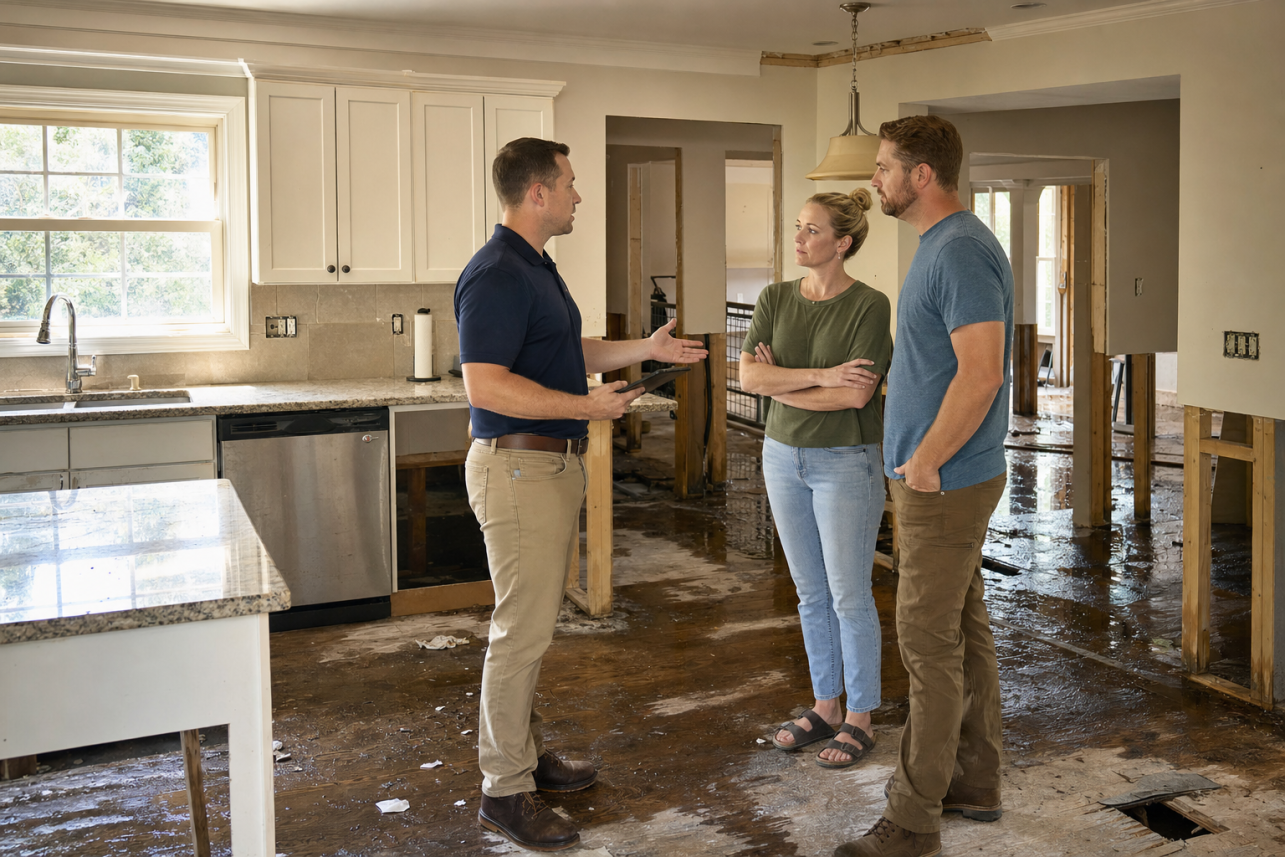
No — and for most of our Apex clients, that’s half the reason they call us. Once you sign our representation agreement, we notify the carrier in writing, and from that point forward the insurance company’s adjuster communicates with us. The phone calls, the emails requesting yet another document, the pressure to accept an offer before the end of the month — all of that comes to our desk instead of yours.
That matters for more than convenience. Carrier adjusters are trained negotiators handling dozens of claims; homeowners are usually negotiating a major loss for the first time. Every offhand comment you make can be used to narrow the scope of your claim. When a public adjuster water damage apex NC families rely on handles those conversations, nothing gets conceded by accident.
You stay fully informed and fully in control. We review every offer with you, explain what it covers and what it leaves out, and you make the final decision on whether to settle. We never accept anything on your behalf without your approval.
There are a few things only you can do — the carrier may require your signature on the final proof of loss, and if an examination under oath is ever demanded, you’d need to appear. But we prepare you thoroughly for both, and in the vast majority of water claims here in Wake County, our clients never sit across the table from the insurance company at all. You focus on your home and your family; the negotiating is our job.
Local Relevance
Apex sits in one of the fastest-growing corners of Wake County, and its housing reflects that — established neighborhoods from the 1980s and 1990s alongside newer subdivisions built during the last two decades of rapid growth. In the older homes, original supply lines, water heaters, and washing machine hoses are reaching the end of their service life, and those failures are the classic sudden water losses insurers should cover but often underpay.
Our climate does its part, too. Central North Carolina’s humid summers mean any water intrusion turns into a mold problem quickly, and the heavy rain that arrives with summer thunderstorms and the remnants of hurricanes finds every weak flashing detail and aging roof. Winter cold snaps, while short, catch pipes in unconditioned crawl spaces and garages.
One distinction matters enormously here: rising water from outside is flood damage, and standard homeowners policies exclude it. Flood losses go through the National Flood Insurance Program, which operates under FEMA — and yes, we handle NFIP flood claims too. Knowing which policy your loss belongs under is often the difference between a paid claim and a denied one, and it’s one of the first things we sort out for Apex homeowners.
Many Apex homes built during the town’s 1990s–2000s growth boom sit on slab foundations, where a supply-line or slab leak can run undetected for weeks — so by the time the insurer inspects, they often try to reclassify a covered sudden loss as excluded ‘long-term seepage,’ which is precisely where early, thorough moisture documentation protects your claim.
Got A Low Offer On Your Apex Water Claim? Get A Second Opinion Before You Sign.
For The Public Adjusters, Inc. is licensed and bonded in North Carolina. We’ll review your policy and the insurer’s estimate at no charge and tell you honestly whether the offer holds up. If it doesn’t, we go to work documenting what they missed and negotiating on your behalf.
Request Your Free Claim Review
Call us: (919) 400-6440
Helpful Resources
- NCDOI Public Adjusters Guide
- National Flood Insurance Program (NFIP)
- Federal Emergency Management Agency (FEMA)
- North Carolina Department of Insurance consumer resources — State regulator overseeing insurance and public adjuster licensing in NC
Last updated: August 16, 2026