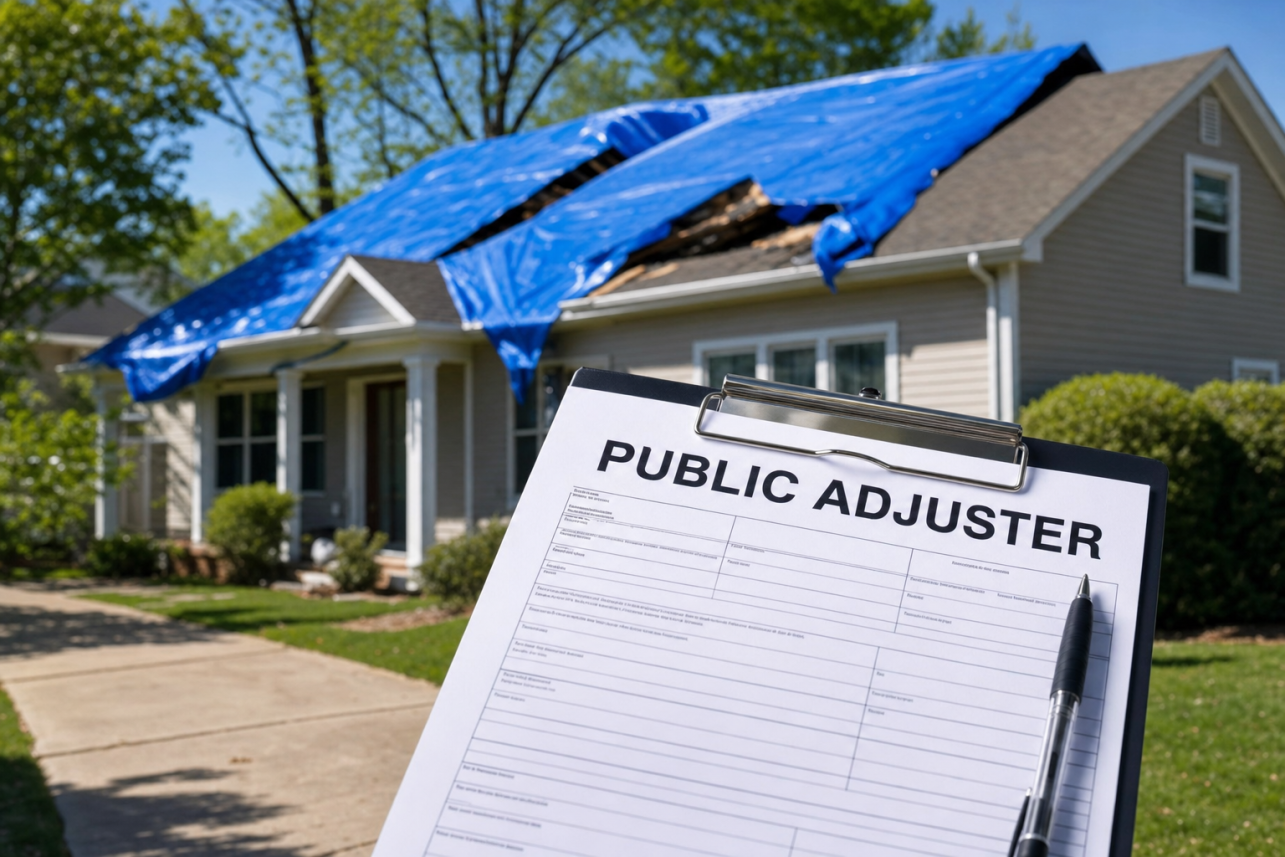
A public adjuster Raleigh NC policyholders hire works exclusively for you — not the insurance company — to document, value, and negotiate your property damage claim. For The Public Adjusters, Inc. is licensed and bonded, and we represent homeowners and business owners across Raleigh and Wake County on fire, water, smoke, hurricane, tree damage, and flood claims. Our job is to make sure the loss is fully scoped and fairly presented, because the insurer's adjuster answers to the insurer, not to you.
What This Service Is
When a fire, burst pipe, hurricane, or fallen oak damages your home or building, your insurance company sends its own adjuster to estimate the loss. That estimate protects the carrier's interests. A public adjuster is the licensed professional who sits on your side of the table instead.
We read the actual policy language, inventory damaged contents, measure and photograph structural damage, prepare a detailed independent estimate, and negotiate directly with the carrier's adjuster. In North Carolina, public adjusters are licensed and regulated, and the NCDOI Public Adjusters Guide explains the standards we must meet — including the written contract and fee disclosures you should always receive before signing anything.
For The Public Adjusters, Inc. handles residential homeowners claims and commercial business claims throughout Raleigh. That includes fire and smoke damage, water damage, hurricane and tornado wind losses, tree damage, vandalism, arson claims where the homeowner is the innocent victim, car-hits-home losses, and flood claims under NFIP policies. We do not handle auto, health, life, or cell phone claims — property damage to homes, buildings, and their contents is all we do.
Common Problems
Is The Insurance Company's Offer Actually What My Damage Is Worth?
Often it isn't, and the gap is rarely obvious to a homeowner. Carrier estimates frequently miss hidden damage — wet insulation behind drywall, smoke residue in HVAC systems, cracked roof decking under shingles that look intact from the ground.
Depreciation is another quiet money-loser. Many Raleigh policies pay replacement cost, but only after you document and complete repairs correctly; homeowners who don't know the procedure leave recoverable depreciation on the table. Our fee is a percentage of the recovery, disclosed in writing up front, so you know exactly what representation costs before we start. We never promise a specific dollar outcome — no honest adjuster can — but we do make sure every covered dollar of damage is actually in the claim.
My Claim Was Delayed, Underpaid, Or Denied. What Can I Do?
Denials and lowball payments are not the end of the road. You have the right to dispute the carrier's findings with your own documentation, invoke appraisal in many policies, and file complaints with state regulators when a carrier drags its feet.
Courts have backed policyholders in these fights. In Corban v. United Services Automobile Association, a homeowner case arising from hurricane damage, the Mississippi Supreme Court ruled that the insurer could not use its policy's anti-concurrent causation clause to escape paying for wind damage that occurred before floodwaters arrived — a significant win for property owners with mixed storm losses.
Most disputes never need a courtroom. A properly documented, professionally estimated claim, presented by someone who speaks the carrier's language, resolves most underpayments through negotiation.
How Do I Choose A Public Adjuster Raleigh NC Homeowners Can Actually Rely On?
Start with licensing. North Carolina requires public adjusters to be licensed, and you can verify any license through the state Department of Insurance. Ask whether the adjuster is bonded — we are — and insist on a written contract with the fee clearly stated.
Then ask about experience with your specific loss type. A fire claim with smoke and contents damage is a very different animal from an NFIP flood claim, which follows federal rules and strict deadlines. Ask who will actually work your file and how they document damage.
Can you handle a claim yourself? For a small, straightforward loss, sometimes. For a major fire, a tree through the roof, or a denied claim, professional representation usually pays for itself many times over — the carrier has trained adjusters on its side, and you deserve one on yours.

Our Process
Free Policy And Damage Review
We start by reading your actual policy — coverages, endorsements, exclusions, and deadlines — and walking the damage with you. Whether it's soot in a Five Points bungalow or storm damage to a North Raleigh two-story, we tell you honestly whether professional representation makes sense for your loss. If it doesn't, we say so.
Full Documentation And Independent Estimate
We photograph and measure everything, open up hidden damage where the policy allows, inventory contents room by room, and build a line-item estimate using the same software carriers use. For flood losses, we prepare the claim to meet National Flood Insurance Program documentation requirements, including the proof of loss the program demands within its deadline.
Negotiation And Settlement
We present the claim to the carrier's adjuster, attend inspections on your behalf, rebut lowball findings with evidence, and negotiate until the offer reflects the documented loss. You approve every settlement decision. Our fee comes from the recovery, so our interests stay aligned with yours from the first inspection to the final check.
| Factor | Filing on Your Own | With For The Public Adjusters |
|---|---|---|
| Who the estimate serves | The carrier's adjuster works for the insurance company | A licensed advocate works exclusively for you |
| Damage documentation | Visual walkthrough, often missing hidden moisture and soot | Thermal imaging, moisture mapping, and independent testing |
| Estimate pricing | Carrier software defaults, frequently below Wake County contractor rates | Line-item estimates built on real local labor and material costs |
| Negotiation leverage | Take-it-or-leave-it offers with little recourse | Supplemental claims, re-inspections, and appraisal when needed |
| Your time investment | Hours of calls, paperwork, and follow-up on your shoulders | We manage the entire claim from inspection to settlement |
| Typical settlement result | Studies show unrepresented claims settle significantly lower | Clients routinely recover multiples of the initial offer |
Commonly Overlooked In The Public Adjusting Industry
- Ordinance and law coverage for code upgrades — Carrier estimates often rebuild to the old code, ignoring the coverage that pays for the current Wake County building requirements a permit will actually demand.
- Hidden moisture in wall cavities and subfloors — Water travels laterally behind drywall and under flooring, so a claim closed on visible damage alone frequently reopens as mold six months later.
- Matching requirements for siding, shingles, and flooring — Insurers pay to patch the damaged section, but discontinued materials often mean the whole surface must be replaced for a uniform appearance — a point policyholders rarely know to raise.
- Depreciation recovery deadlines — Replacement cost policies hold back depreciation until repairs are done, and homeowners quietly forfeit thousands by missing the window to submit final invoices.
- HVAC and ductwork contamination after fire or smoke — Soot pulled through the return air system spreads to every room, but carrier scopes commonly stop at the rooms with visible damage.
- Additional living expense entitlements — Families crash with relatives or absorb hotel costs themselves, never realizing the policy owes them comparable housing for the entire repair period.
- Underpriced line items in carrier software — Default estimating databases lag behind what Raleigh-area contractors actually charge, so an estimate can look thorough while still being short by 20-30%.
- The proof-of-loss deadline in the policy — Missing this sworn-statement deadline can void an otherwise valid claim, and carriers are under no obligation to remind you it's coming.
Case Studies
Case Study #1
Situation: A homeowner in North Raleigh's Bedford neighborhood had a tree come through the roof during a summer thunderstorm. Water poured into the attic and down through two bedrooms before the tarp went on.
Problem: The carrier's initial estimate covered the roof decking and shingles but paid almost nothing for interior damage, claiming the ceiling stains were 'pre-existing.' The offer came in at $18,400 for a loss the homeowner suspected was far larger.
Investigation: Our adjuster performed a full moisture-mapping inspection with a thermal camera and pin meter, documenting elevated readings inside wall cavities the carrier's adjuster never opened. We pulled the storm data from the National Weather Service station at RDU to establish the exact date of loss.
Findings: Moisture had wicked into insulation, drywall, and hardwood flooring on the first floor below the impact point. We also found the carrier's estimate used a roofing unit price roughly 30% below what Wake County contractors were actually charging that season.
Solution: We wrote a line-item Xactimate estimate reflecting real local pricing, included code-required upgrades under the homeowner's ordinance and law coverage, and submitted a supplemental claim with photo documentation and lab-confirmed moisture readings.
Outcome: The claim settled at $87,200 — more than four times the original offer — covering full roof replacement, interior rebuild, flooring, and temporary housing during repairs.
Lesson: A carrier's first estimate is a starting point, not a verdict. Hidden moisture damage rarely shows up in a 20-minute walkthrough, and interior losses get denied as 'pre-existing' far more often when no one pushes back with hard evidence.
Case Study #2
Situation: A family-owned restaurant near Five Points suffered a kitchen fire that spread smoke and soot through the dining room. The owners filed the claim themselves and shut down while waiting on the carrier.
Problem: Six weeks in, the insurer had paid only a small advance for cleaning and was disputing the business income claim, arguing the restaurant could have reopened faster. Every week of delay was costing the owners staff, regulars, and vendor relationships.
Investigation: We brought in an independent hygienist to test for soot and protein residue contamination in the HVAC system and behind kitchen equipment. We also reconstructed the restaurant's revenue using POS records, seasonal trends, and reservation data.
Findings: Contamination had migrated through the ductwork into areas the carrier's vendor never cleaned, making a quick reopening impossible under Wake County health department standards. The business income calculation had also ignored the restaurant's busiest season, understating the loss significantly.
Solution: We presented the hygienist's report alongside a corrected business interruption model, documented the health code requirements that dictated the timeline, and negotiated directly with the carrier's large-loss unit.
Outcome: The final settlement covered full duct remediation, kitchen equipment replacement, and $214,000 in business income — nearly triple the carrier's working number. The restaurant reopened with its team intact.
Lesson: Business interruption claims live or die on documentation and timeline. If you can't prove why the closure lasted as long as it did, the insurer will assume it shouldn't have.
| Your Situation | Should You Get a Public Adjuster? | What It Depends On |
|---|---|---|
| Claim under $5,000 with a clear cause | Usually not necessary | If the offer covers full repair costs at current local prices, the fee may not be worth it |
| Carrier offer feels low but repairs haven't started | Yes — ideal timing | Nothing has been signed or rebuilt yet, so the full scope can still be documented and disputed |
| Claim denied for 'pre-existing damage' or 'wear and tear' | Yes, strongly | Denials often hinge on evidence the carrier never gathered; independent inspection can reverse them |
| Water or fire loss with possible hidden damage | Yes | Moisture and soot spread behind walls and through ducts — problems a visual inspection misses |
| Business interruption or commercial loss | Yes | Income loss calculations are complex, and carriers frequently understate the recovery period |
| Claim already settled and repairs complete | Possibly | NC generally allows supplemental claims within the policy's time limits if new damage is documented |
| Hurricane or major storm with regional damage | Yes, and early | After large events carriers are stretched thin, files move slowly, and lowball estimates spike |
| You've hit a wall after weeks of carrier delays | Yes | A licensed advocate can invoke policy deadlines and escalate the file when phone calls stop working |

Reviews
After the April hailstorm my insurance company said my roof only had 'cosmetic' damage and offered $3,100. For The Public Adjusters found hail bruising on every slope, documented it properly, and got the whole roof plus gutters and window screens covered. Final payout was over $28,000. I never would have known what to argue.
Marcus T., Wakefield
Our finished basement flooded when a pipe burst while we were out of town. The carrier tried to blame it on neglect and delay everything. This team handled every call, brought in their own moisture testing, and turned a lowball offer into a settlement that actually rebuilt the space. Worth every penny of the fee.
Denise H., Cary
We hired them after fighting our insurer alone for two months over smoke damage from a garage fire. Within three weeks they had a supplemental estimate submitted and the adjuster on site for a re-inspection. Communication was honest — they told us upfront what was realistic and then delivered more than that. Only wish we'd called on day one.
Rob and Karen S., North Hills
Frequently Asked Questions
How Much Does A Public Adjuster Raleigh NC Homeowners Hire Typically Charge?
Most Raleigh-area public adjusters, including For The Public Adjusters, Inc., work on contingency. That means you pay a percentage of the insurance settlement we recover for you — nothing upfront, and nothing at all if there's no recovery.
In North Carolina, contingency fees generally range from 10% to 25% depending on the size and complexity of the claim, whether it's a new claim or a reopened one, and how far along the insurance company already is. Smaller claims tend to sit at the higher end of that range; large-loss claims often come in lower.
Here's the part most Wake County homeowners don't realize: policyholders who use a licensed adjuster on their side typically recover significantly more than those who negotiate alone. When a fire, hurricane, or water loss claim is initially valued at $40,000 and a properly documented estimate brings it to $85,000, the fee pays for itself many times over.
Before we sign anything, we review your policy and your loss for free. If we don't believe we can add real value beyond what your carrier has already offered, we'll tell you that honestly. Every fee is spelled out in a written contract that complies with North Carolina Department of Insurance regulations, so there are no surprises later.
What Types Of Property Damage Claims Do You Handle In Raleigh And Wake County?
We handle the full range of losses that hit Triangle-area properties. Hurricane and wind damage is a big one — Raleigh sits far enough inland that people underestimate storm exposure, but systems like Fran, Florence, and more recent remnant storms have caused major roof, siding, and tree-impact damage across Wake County.
Water and pipe-burst claims are our most common call. Raleigh's mix of 1960s ranches in neighborhoods like North Hills and newer construction out toward Wake Forest and Apex means everything from failed polybutylene plumbing to slab leaks and HVAC condensation losses. These claims are frequently underpaid because carriers miss hidden moisture, mold implications, and code-upgrade costs.
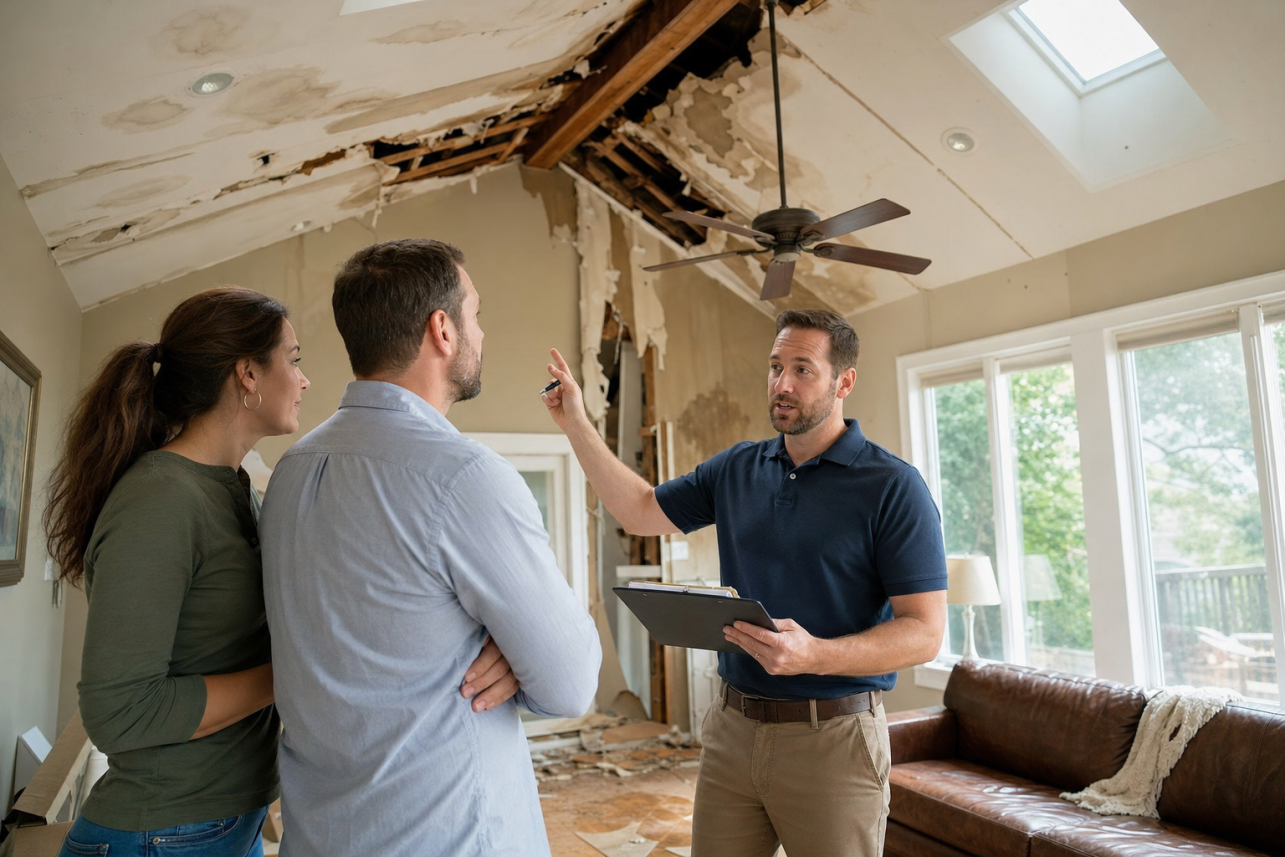
Fire and smoke losses are where a policyholder advocate matters most. Smoke migrates through HVAC systems and wall cavities, and contents inventories are enormous jobs that grieving families shouldn't do alone. We document every affected item and material.
We also handle hail damage to roofs (a recurring issue in northern Wake County), lightning strikes, fallen trees, vandalism, and commercial losses including business interruption claims for restaurants, offices, and retail spaces around downtown Raleigh, Glenwood South, and beyond.
If your claim was denied, delayed, or lowballed, we can also step in mid-stream. Reopening or supplementing an existing claim is often possible — North Carolina policies generally allow supplemental claims well after the initial payment, though deadlines apply, so call sooner rather than later.
My Insurance Company Already Sent Their Own Adjuster — Why Would I Need My Own?
The adjuster your insurance company sends works for the insurance company. They may be perfectly professional, but their job is to evaluate the claim on behalf of the carrier that pays their invoice. A public adjuster is the only type of adjuster licensed by the state of North Carolina to represent you, the policyholder, exclusively.
That difference shows up in the details. Carrier adjusters in the Raleigh market often spend 30 to 60 minutes on a residential inspection. We routinely spend several hours, moving insulation, testing moisture levels behind walls, photographing every elevation of the roof, and cataloging contents room by room. What gets documented gets paid; what gets missed gets absorbed by you.
It also shows up in the estimate itself. Insurance estimates frequently omit line items like matching requirements for siding and shingles, North Carolina building code upgrades, proper drying protocols, overhead and profit for general contractors, and additional living expenses you're entitled to while displaced.
Having your own representative doesn't mean the process turns hostile. Most of our claims settle through professional negotiation, documentation, and knowing the policy language better than the person across the table. We meet the carrier's adjuster on-site, walk the loss together, and resolve disagreements with evidence.
If you've already received an offer that feels low, that's actually a common starting point for us. A second opinion costs nothing, and there's no obligation to move forward after we review it.
How Long Does The Claim Process Take With A Public Adjuster Raleigh NC Property Owners Can Trust?
It depends on the size of the loss and how cooperative your carrier is, but here's a realistic picture for the Raleigh market. Straightforward residential claims — a burst pipe, a lightning strike, moderate roof damage — often resolve in 30 to 90 days from the date we're retained. Larger fire losses or heavily disputed hurricane claims can run four to eight months, sometimes longer if appraisal or litigation support becomes necessary.
North Carolina law works in your favor here. Insurers must acknowledge claims promptly and respond to communications within set timeframes, and we hold them to those deadlines in writing. When a Wake County carrier drags its feet, documented delays become leverage.
A common worry is that bringing in your own representative slows things down. In our experience, the opposite is usually true. Claims stall when documentation is incomplete or when the homeowner and carrier go back and forth without resolution. We front-load the work — full inspection, detailed Xactimate estimate, contents inventory, policy analysis — so the negotiation starts from a complete file instead of a partial one.
We also keep you living your life during the process. If your home is uninhabitable, we pursue additional living expense coverage immediately so you're not paying for a hotel near Crabtree out of pocket while waiting on the claim.
Every situation is different, so when we review your loss we'll give you an honest timeline estimate specific to your policy, your damage, and your insurer — not a one-size-fits-all promise.
Can A Public Adjuster Raleigh NC Residents Hire Reopen A Claim That Was Already Denied Or Underpaid?
Yes, in many cases we can. North Carolina policies generally allow supplemental claims, and a denial letter is rarely the final word. If your carrier underpaid a hail claim on your roof in North Raleigh or denied water damage in a Cary or Garner rental property, we start by reviewing the denial reasoning against your actual policy language.
Many denials hinge on the carrier's interpretation of exclusions like wear and tear or gradual damage. We re-inspect the property ourselves, document the loss with photos, moisture readings, and line-item estimates, and then present evidence the first adjuster may have missed entirely.
Timing matters. Most policies written in North Carolina give you a limited window to dispute or supplement a claim, and the statute of limitations for contract disputes here is typically three years. The sooner we review your file, the more options you have.
We've reopened claims across Wake County where homeowners were told hail damage was 'cosmetic' or that interior water staining was 'pre-existing.' In several of those cases, the difference between the original payout and the final settlement covered a full roof replacement rather than a patch job. Bring us your denial letter and the carrier's estimate, and we'll tell you honestly whether reopening the claim is worth pursuing.
Are You Licensed To Handle Insurance Claims In North Carolina, And Does That Matter?
Yes. For The Public Adjusters, Inc. is licensed by the North Carolina Department of Insurance, and that licensing matters more than most property owners realize. In this state, it is illegal for anyone to negotiate an insurance claim on your behalf for a fee without holding a public adjuster license. Contractors, roofers, and 'claim consultants' who offer to deal with your carrier are operating outside the law, and their involvement can actually jeopardize your claim.
Licensing also comes with real accountability. We're required to use state-compliant contracts with clear fee disclosures, maintain continuing education, and follow NCDOI regulations on how and when we can be paid. If a licensed adjuster mishandles your claim, you have recourse through the Department of Insurance. With an unlicensed operator, you have almost none.
For Raleigh homeowners, this is especially relevant after major storms. When hail or hurricane remnants roll through Wake County, out-of-state storm chasers flood neighborhoods from Wakefield to Fuquay-Varina promising to 'handle everything with insurance.' Ask anyone offering claim help for their North Carolina license number before signing anything. We're happy to provide ours, and you can verify it directly on the NCDOI website in about two minutes.
What Should I Do Immediately After Storm Or Water Damage Before Your Team Arrives?
First, make sure everyone is safe and the property is secure. Then take reasonable steps to prevent further damage — your policy actually requires this. Tarp a torn roof, shut off the water supply at the main if a pipe has burst, and move undamaged belongings out of harm's way. Keep every receipt for tarps, fans, plywood, or emergency services, because those mitigation costs are typically reimbursable.
Second, document everything before anything gets cleaned up or thrown away. Take wide shots of each affected room and close-ups of specific damage. In Raleigh's humid climate, water losses grow quickly, so photograph moisture staining, buckled flooring, and wet drywall the same day if you can.
Third, hold off on giving a recorded statement to the insurance company or accepting a quick settlement check until you understand the full scope of your loss. You can report the claim — you're required to give prompt notice — but you don't have to agree to numbers on the spot.
Finally, don't authorize permanent repairs yet. Once damaged materials are torn out and hauled away, proving the extent of the loss becomes much harder. We inspect properties across Wake County quickly after a loss, often within a day or two, and our documentation becomes the foundation of the entire claim. The less that's disturbed before we arrive, the stronger your position.

Is Hiring A Claims Professional Worth It For Smaller Losses, Or Only Major Disasters?
It depends less on the size of the loss and more on the gap between what your carrier offers and what repairs actually cost in the Triangle. A 'small' kitchen water leak in a Five Points bungalow can easily run $25,000 to $40,000 once you account for cabinet replacement, flooring continuity, and matching finishes — and initial carrier estimates on losses like these are often a fraction of that.
As a general rule, if your damage estimate is under a few thousand dollars or barely exceeds your deductible, our fee may not make sense, and we'll tell you that upfront during a free claim review. We'd rather point you in the right direction than take on a file that doesn't benefit you.
Where a public adjuster Raleigh NC property owners bring in really earns their fee is on claims with hidden or disputed scope: roof damage the carrier calls cosmetic, water intrusion behind walls, smoke damage that spread beyond the fire room, or business interruption losses for commercial properties along Capital Boulevard or in downtown Raleigh.
Raleigh construction costs have climbed sharply in recent years, and carrier pricing software doesn't always keep pace with what Wake County contractors actually charge. Our estimates reflect real local pricing, which is often the single biggest factor in closing the gap between the first offer and a fair settlement.
When Is The Best Time To Bring In A Public Adjuster Raleigh NC Property Owners Recommend — Before Or After Filing My Claim?
The short answer: the earlier, the better. Bringing us in before you file lets us document the loss properly from day one, frame the claim correctly, and avoid the recorded-statement missteps that insurers often use to limit payouts later.
In Raleigh, we see this play out constantly after hail events along the I-540 corridor or hurricane remnants pushing through Wake County. Homeowners file quickly, accept the carrier's first inspection, and only call us after receiving an estimate that won't come close to covering a licensed local contractor's actual pricing.
That said, it is never too late. We regularly step in mid-claim when negotiations stall, and North Carolina allows supplemental claims when new damage is discovered or the original settlement proves inadequate. Even after you've cashed a check, options often remain as long as your policy's deadline hasn't passed.
If you call us the same week the damage happens, we can attend the insurance company's inspection alongside their adjuster, point out damage they might otherwise walk past, and make sure the initial estimate reflects reality. That single step often shortens the entire claim by weeks because there's less to dispute afterward. A free consultation costs you nothing, so there's no reason to wait and see how the carrier treats you first.
Will Hiring Your Firm Upset My Insurance Company Or Cause Them To Cancel My Policy?
No. Hiring your own claims representative is a legal right protected under North Carolina law, and carriers deal with licensed adjusters representing policyholders every single day. Your insurer cannot cancel or non-renew your policy simply because you chose professional representation — that would violate state unfair claims practice regulations.
In practice, the opposite tends to happen. When we send a letter of representation, the claim usually gets handled more carefully. Desk adjusters know that our estimates are built line by line in the same software carriers use, backed by photos, moisture readings, and code citations specific to Raleigh and Wake County building requirements. Sloppy lowballing becomes harder to defend.
Some homeowners worry the relationship will turn adversarial. It rarely does. Most of our work is professional, document-driven negotiation between people who speak the same technical language. We handle the calls, emails, and inspections so you're not the one arguing with a claims department on your lunch break.
What can affect your future premiums is the claim itself — the loss, not who represented you. Filing a claim goes on your CLUE report either way, whether you settle for $8,000 or the $40,000 the repairs actually cost. Since the claim exists regardless, it makes sense to recover the full amount you're owed.
What Does The Appraisal Clause Mean, And Can You Use It If My Raleigh Claim Gets Stuck?
Almost every homeowner's policy issued in North Carolina contains an appraisal provision. It's a built-in dispute resolution tool: if you and the insurance company agree that damage is covered but disagree on the dollar amount, either side can demand appraisal instead of going to court.
Here's how it works. You select an appraiser, the carrier selects one, and those two appraisers choose a neutral umpire. Any amount agreed to by two of the three becomes binding. It's faster and far less expensive than litigation, and we've seen it resolve Wake County claims that had been stalled for months.
Our team both prepares clients for appraisal and serves as appraisers on residential and commercial losses across the Triangle. Winning at appraisal comes down to documentation — detailed scope sheets, local contractor pricing that reflects real Raleigh labor and material costs, and photographic evidence tied to each line item. Carriers' estimates often use pricing databases that lag behind what roofers and restoration companies in this market actually charge.
Appraisal isn't right for every situation. If the insurer is denying coverage outright rather than disputing the amount, appraisal generally can't force them to pay. That's a different fight requiring different tactics. Part of our job is knowing which lever to pull — negotiation, supplemental documentation, appraisal, or referral to counsel — and when.
What Documents Should I Gather Before Meeting With A Public Adjuster Raleigh NC Homeowners Can Call For A Free Review?
A public adjuster Raleigh NC families rely on will do most of the heavy lifting, but a few items speed things up considerably at the first meeting.
Start with your full insurance policy — not just the declarations page. The declarations page shows your limits and deductible, but the exclusions, endorsements, and conditions buried in the full document are where claims are won or lost. If you can't find it, we can request a certified copy from your carrier on your behalf.
Next, gather anything already exchanged with the insurance company: the claim number, denial or estimate letters, emails with the desk adjuster, and any checks issued. If their field adjuster left an estimate, bring it — comparing their scope against actual damage is often the fastest way to show where money was left on the table.
Photos and receipts help too. Pictures of your home before the loss, invoices for any emergency repairs like tarping or water extraction, and receipts for hotel stays or additional living expenses all support recovery. Don't throw away damaged items until we've documented them.
If you're missing some of this, don't let it stop you from calling. We've built successful claims for Wake County homeowners who arrived with nothing but a claim number. The consultation and inspection are free, and we'll tell you honestly whether your situation warrants representation or whether you're better off handling it yourself.
Do You Handle Commercial Property Claims In Raleigh, Or Only Residential Ones?
We handle both. For The Public Adjusters, Inc. represents homeowners as well as commercial property owners throughout Raleigh and Wake County, and the two types of claims demand very different skill sets.
On the residential side, we work with single-family homes, townhomes, and condos — everything from roof and siding losses to interior water damage and fire claims. Commercial work covers office buildings, retail spaces, restaurants, warehouses, churches, and multi-family properties like apartment complexes along Capital Boulevard or in North Hills.
Commercial claims add layers most property owners have never dealt with: business interruption coverage, extra expense provisions, loss of rents, code upgrade requirements under Raleigh's permitting rules, and tenant improvement questions. If your policy includes business income coverage, calculating that loss correctly can be worth as much as the physical damage itself — and it is one of the most commonly underpaid parts of a commercial settlement.
We also see mixed situations, such as a home-based business or a rental property in a landlord's personal name. Those claims often involve two coverage types on one policy, and sorting out which damage falls under which coverage matters enormously to the final payout.
Whether the loss is a hail-damaged shopping center roof or a burst pipe in a Cary rental home, the approach is the same: document everything, read the policy line by line, and build a claim the carrier cannot easily dispute. If you are unsure whether your property qualifies, call us — the initial review costs nothing either way.
What Happens During The First Inspection When I Hire A Public Adjuster Raleigh NC Property Owners Rely On?
The first inspection is where a public adjuster Raleigh NC homeowners bring in earns their keep, because everything that follows is built on what we find and document that day.
We start with a full walkthrough of the property — not just the obvious damage, but the areas insurance company adjusters routinely skip. After a hailstorm, that means getting on the roof itself, checking soft metals like gutters and window wraps, and inspecting the attic for daylight or moisture. After water damage, we use moisture meters to trace how far saturation traveled behind walls and under flooring, since hidden moisture is the single most underpaid item we see.
Everything gets photographed and measured. We document square footage, material types, and construction details, because Raleigh homes range from 1950s ranches inside the Beltline to new builds in Wake Forest, and replacement costs vary widely between them.
While on site, we also review your policy with you in plain English. We flag your deductible, coverage limits, and any endorsements that help or hurt you — things like matching provisions, ordinance and law coverage, or roof payment schedules that many homeowners have never read.
Before we leave, you will know three things: what we believe the damage is genuinely worth, what the claim strategy looks like, and what to expect from your carrier next. Most inspections take one to three hours depending on the size of the loss, and you owe nothing for that visit.
Do I Have To Accept The Insurance Company's First Settlement Offer?
No — and in our experience across Wake County, you usually shouldn't accept it without a second look. A first offer is a starting position, not a final verdict, and North Carolina policies give you the right to dispute it.
First offers are frequently built on incomplete inspections. The carrier's adjuster may have spent twenty minutes on your roof, missed water intrusion behind a wall, or used pricing software with outdated labor rates that do not reflect what Raleigh contractors actually charge in today's market. Depreciation is another common problem: carriers sometimes apply aggressive depreciation schedules that leave you far short of what repairs really cost.
Even if you have already cashed a check, the claim is not necessarily closed. Cashing a payment for the undisputed portion of your loss generally does not waive your right to pursue the rest, though you should have someone review the paperwork before signing anything labeled a release.
When we take on an underpaid claim, we prepare our own detailed estimate, document the items the carrier missed, and negotiate directly with them. If negotiation stalls, the appraisal provision in most policies gives us a formal path to resolve the disputed amount without a lawsuit.
The key is timing. North Carolina claims have deadlines, and evidence gets weaker as repairs begin and seasons change. If an offer feels low, get it reviewed quickly — a free second opinion costs you nothing, and the gap between first offers and fair settlements is often substantial.
Which Areas Around Raleigh Does Your Team Serve?
For The Public Adjusters, Inc. serves the entire Raleigh metro and all of Wake County. That includes Raleigh proper — from Five Points and Mordecai inside the Beltline out to Brier Creek, Midtown, and Southeast Raleigh — plus Cary, Apex, Wake Forest, Garner, Knightdale, Fuquay-Varina, Holly Springs, Morrisville, Rolesville, Wendell, and Zebulon.
We also travel beyond the county line regularly. Property owners in Durham, Chapel Hill, Clayton, and Smithfield call us often, and because we hold a North Carolina license, we can represent policyholders anywhere in the state when a major storm event hits.
Local coverage matters more than people realize. A public adjuster Raleigh NC property owners hire should know how area weather actually damages buildings here — the spring hailstorms that track through Wake County, the straight-line winds that peel shingles off homes in Wake Forest, the tropical remnants that push water into crawlspaces across Garner and Clayton. We have inspected properties after those exact events, so we know what carriers in this market tend to miss and dispute.
Being nearby also means faster response. When a pipe bursts or a tree comes through your roof, we can typically get to a Wake County property within a day, often the same day. Fast documentation protects your claim, because damage that gets cleaned up before it is properly recorded becomes damage the carrier can question later.
If you are outside the areas listed and unsure whether we cover you, just call. If we can help, we will; if another professional is better positioned, we will tell you honestly.
Local Relevance
Raleigh sits far enough inland to escape direct coastal hits, but not far enough to escape hurricanes. Storms like Fran and Florence proved that Wake County takes serious wind and water damage when tropical systems track through central North Carolina, and the city's canopy of mature oaks and loblolly pines turns saturated ground and hurricane-force gusts into tree-on-house claims by the hundreds.
The housing stock adds its own wrinkles. Inside the Beltline you'll find homes from the early and mid twentieth century with plaster walls, older wiring, and original framing — losses there are routinely underestimated because repairs cost more than modern tract construction. Meanwhile, the fast-growing suburbs of Wake County are full of newer homes where builder-grade materials and complex rooflines create their own claim disputes.
Add humid-subtropical summers that breed severe thunderstorms, the occasional tornado, ice storms that snap limbs onto roofs, and flash flooding along Raleigh's many creeks, and you have a market where fire, water, tree, and flood claims are a fact of life. For The Public Adjusters, Inc. works these claims across Raleigh and Wake County, and we know how local repair costs and local damage patterns should be reflected in a settlement.
Raleigh's mature loblolly pines and oaks stand over thousands of older ranch and bungalow homes, and when hurricane-remnant rain saturates the region's clay soil, trees tend to come down whole rather than losing limbs — so tree-on-house claims here often involve hidden fractures in roof framing and decking that a quick carrier inspection can miss. Insist that any tree damage estimate account for structural inspection, not just visible shingle and gutter repair.
Get A Free Claim Review Before You Accept The Carrier's Number
If your Raleigh home or business has fire, water, smoke, storm, tree, or flood damage — or your claim has already been delayed, underpaid, or denied — talk to us before you sign anything. For The Public Adjusters, Inc. is licensed and bonded, and the initial review costs nothing.
Call us: (919) 400-6440
Helpful Resources
- NCDOI Public Adjusters Guide
- National Flood Insurance Program (NFIP)
- North Carolina Department of Insurance — Verify adjuster licensing and consumer rights in NC
Our services in this city
- Fire Insurance Claim Dispute Raleigh: When The Insurer's Fire Payout Won't Rebuild Your Home
- Flood Insurance Claim Dispute Raleigh: Challenging Denied And Underpaid NFIP Flood Payouts In Wake County
- Insurance Water Damage Claim Raleigh: What To Do When A Burst Pipe Or Roof Leak Turns Into A Coverage Battle
- Public Adjusters Near Me Raleigh NC — Local Help With Fire, Water, Tree, And Hurricane Damage Claims On Wake County Homes
- Smoke Damage Insurance Claim Help Raleigh: When Soot, Odor, And Hidden Residue Get Undervalued
Last updated: August 12, 2026