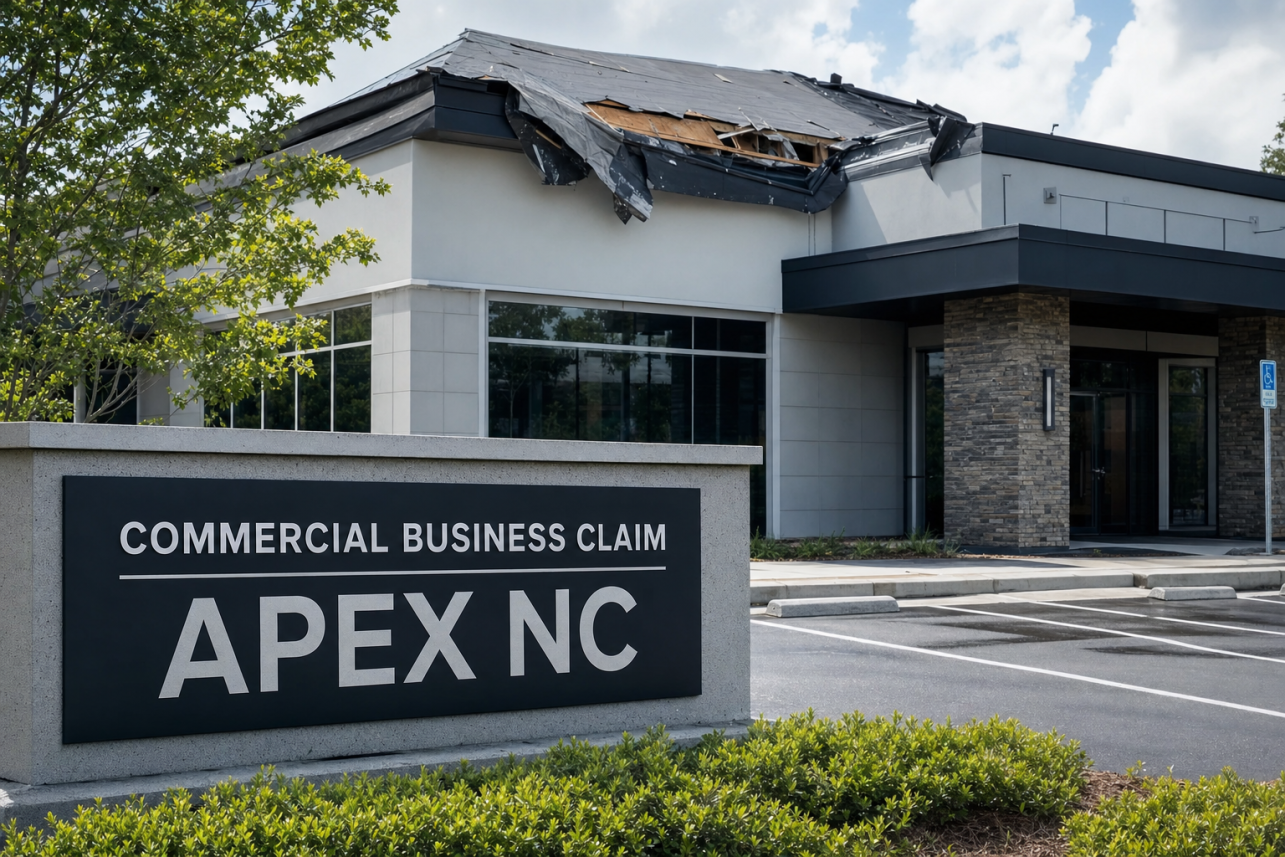
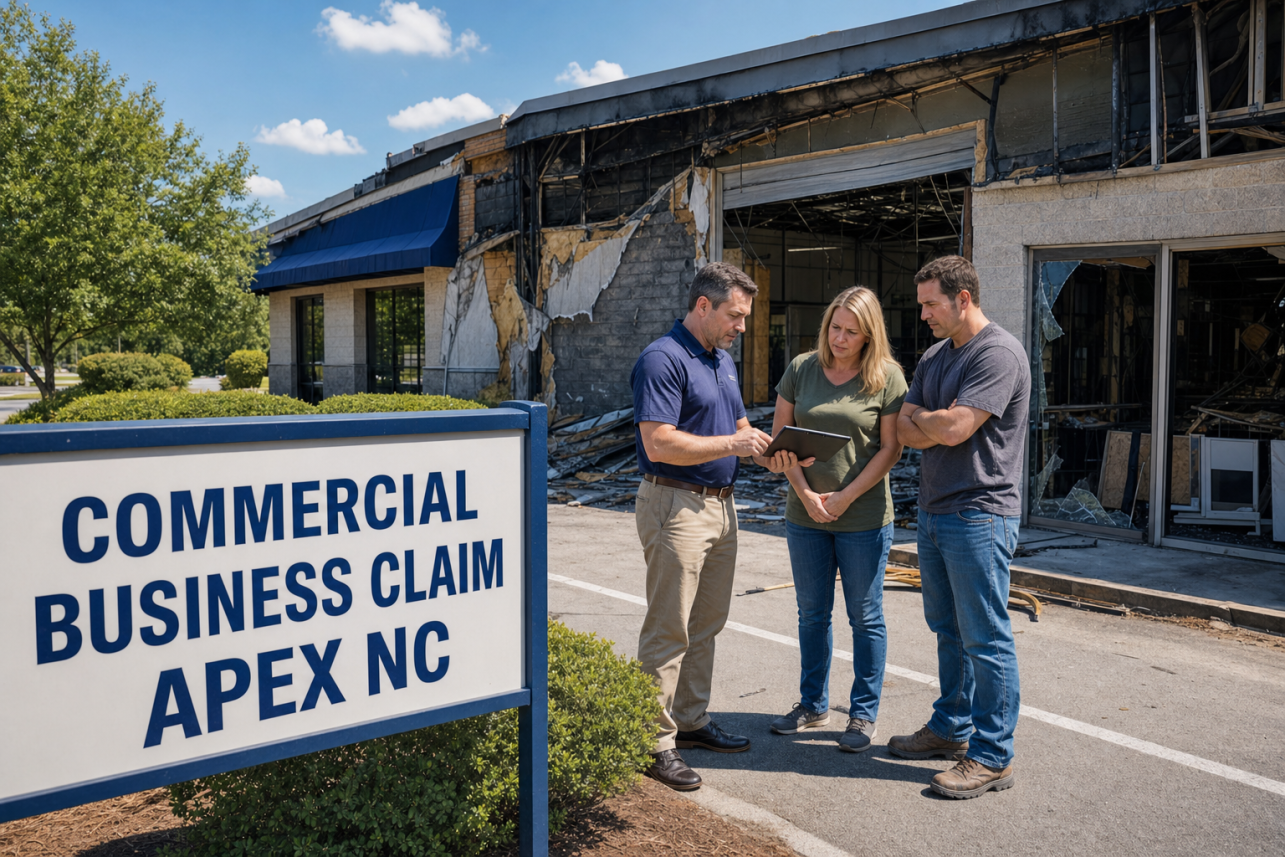
If you need help with a Commercial Business Claim Apex NC business owners can turn to For The Public Adjusters, Inc., a licensed and bonded public adjusting firm that works for the policyholder — never the insurance company. We document the full scope of your property damage, calculate your lost business income, prepare the proof of loss, and negotiate directly with the carrier on your behalf. From fire and smoke to burst pipes and tornado damage, our job is to make sure the settlement offer reflects what your policy actually owes you.
What This Service Is
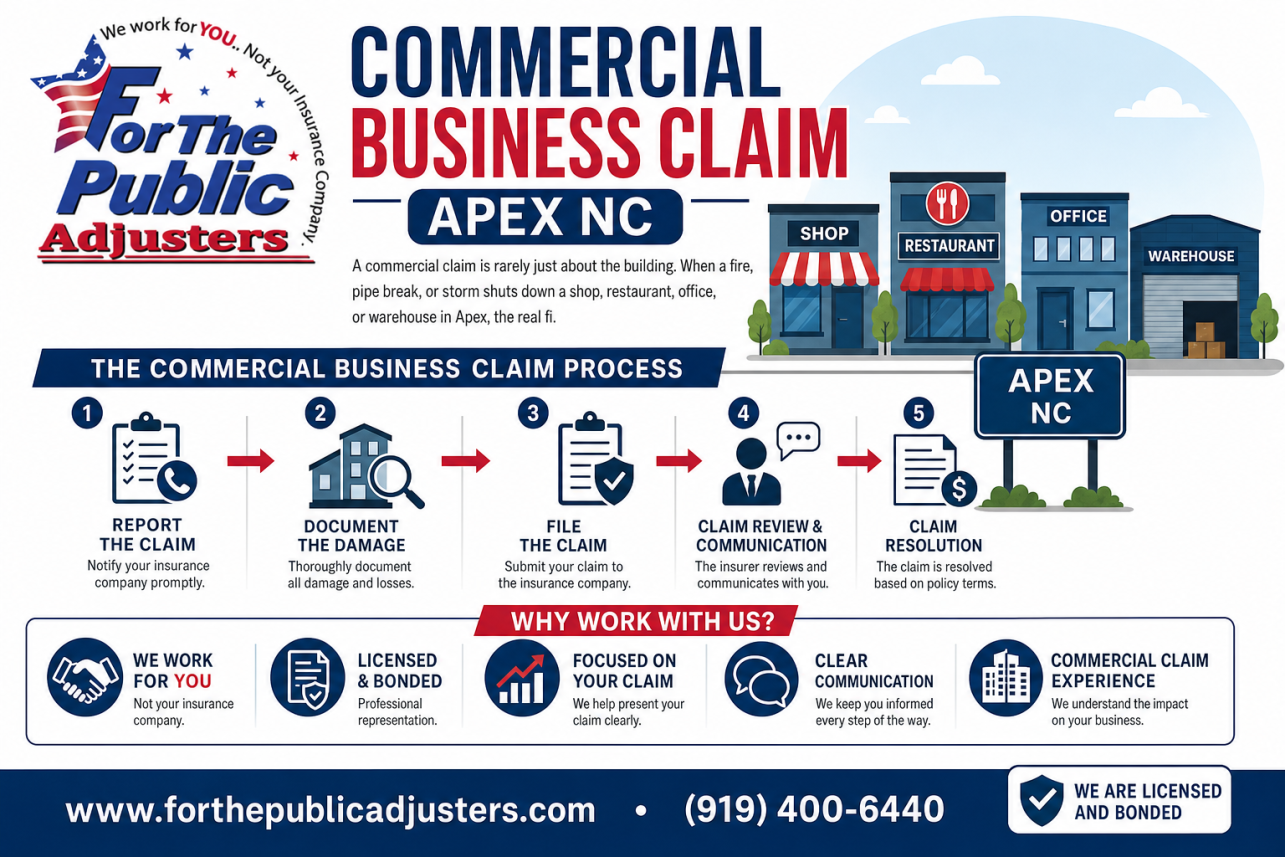
A commercial claim is rarely just about the building. When a fire, pipe break, or storm shuts down a shop, restaurant, office, or warehouse in Apex, the real financial hit usually comes from everything attached to the structure: ruined inventory, damaged equipment, payroll you still owe, rent you still pay, and revenue that stops the moment the doors close.
A public adjuster is a licensed professional who represents you — the insured — in that claim. We read your commercial property insurance policy line by line, identify every coverage that applies (including business interruption and extra expense coverage most owners don't realize they carry), and build the documentation the carrier requires before it will pay.
That documentation matters more than most people expect. Courts have sided with policyholders who could prove their losses: in Gregory Packaging, Inc. v. Travelers, a federal court ruled in favor of the insured business after an ammonia release made its facility unusable, finding the event was a direct physical loss that triggered coverage. The lesson for any Apex owner is that well-documented claims get paid; vague ones get disputed.
We handle the entire file — building damage, contents, equipment valuation, and the business income loss calculation — so you can focus on getting back open. Many owners also bring us in as their own Private Claims Adjuster in Apex NC when a claim has already stalled or been underpaid.
Common Problems
Why Is The Payout On My Commercial Business Claim Apex NC Carrier Offered So Low?
Lowball offers usually come from two places. First, the carrier's adjuster scopes only the obvious damage — the charred wall, the wet drywall — and misses smoke residue in HVAC systems, water that wicked into subfloors, or equipment that looks fine but failed internally.
Second, carriers often pay actual cash value (the depreciated worth of what you lost) when your policy may entitle you to replacement cost — what it actually takes to rebuild and restock today. On a commercial loss, that gap can be enormous.
Then there's lost income. If nobody calculates your business income loss correctly — using real financials, seasonal trends, and the true period of restoration — the carrier won't volunteer a bigger number. We build that calculation for you, the same way we do for every Commercial Business Claim in Cary NC and across Wake County.
The Insurance Company Keeps Delaying, Disputing, Or Denying — What Now?
Claims timeline delays are one of the most common complaints we hear from Apex business owners. Weeks pass, the carrier asks for the same documents twice, and meanwhile your rent, payroll, and loan payments don't stop.
Often the hang-up is the proof of loss — a sworn statement of what you're claiming and why. File it incomplete or late and the carrier gains leverage; file it thoroughly and the clock starts working in your favor. Coverage disputes and flat denials frequently hinge on exclusions the carrier reads broadly and the policyholder never pushes back on.
The NCDOI Public Adjusters Guide explains that public adjusters exist precisely for this situation: to represent the insured's interests in documenting and negotiating the claim. If a carrier's conduct crosses into bad faith — ignoring evidence, misrepresenting the policy, stalling without reason — building a clean, dated paper trail is what gives you options later.
Should I Hire A Commercial Public Adjuster Or Just Deal With The Carrier Myself?
You can handle a small, simple claim yourself. But a commercial loss involves overlapping coverages — building, contents, inventory, equipment, business interruption, extra expense — and the carrier's adjuster works for the carrier, no matter how friendly the conversation feels.
When owners search for a commercial public adjuster near me, what they're really asking is: who will stand on my side of the table? A good public adjuster is licensed by the state, bonded, works on a transparent fee, and gets paid only from the recovery — so our incentive is aligned with yours.
Judge any adjuster by their documentation. Ask to see how they scope damage, how they calculate lost revenue, and how they handle disputed exclusions. We've represented businesses from Apex to a Commercial Business Claim in Raleigh, and the pattern holds everywhere: thorough files settle better. We never guarantee a specific outcome — no honest adjuster can — but we do guarantee your claim will be fully presented.
Our Process
Policy Review And Full Damage Assessment
We start by reading your commercial property insurance policy in full — coverages, limits, deductibles, and exclusions — so we know exactly what the carrier owes before anyone talks numbers. Then we inspect and photograph everything: structure, contents, inventory, and equipment, including hidden damage a quick walkthrough misses.
Valuation, Lost Income Calculation, And Proof Of Loss
Next we price the rebuild at real local contractor costs, value your equipment and inventory properly, and document your lost revenue using sales records, tax filings, and seasonal data. All of it goes into a complete, sworn proof of loss filed on time and in the format the carrier cannot easily dispute.
Negotiation Through Final Settlement
We present the claim, respond to every carrier objection with documentation, and negotiate until the offer matches the evidence. You approve every decision, and you stay informed at each step. If the loss involves fire, the same rigor applies that we bring to a Fire Damage Claim Help in Garner file — smoke, soot, and contamination documented room by room.
| Claim Task | Business Owner Alone | With For The Public Adjusters |
|---|---|---|
| Damage documentation | Phone photos and the carrier's own estimate | Independent inspection, moisture mapping, hygienist testing, and a line-item estimate built for the policyholder |
| Business interruption claim | Often skipped or roughly guessed from last year's revenue | Reconstructed from POS data, tax returns, and seasonal trends, including extended period of indemnity |
| Policy interpretation | Dense policy language read under stress, exclusions taken at face value | Coverage provisions like ordinance-or-law and extra expense identified and applied |
| Negotiation | One conversation with the carrier's adjuster, usually accepting the first figure | Documented demand, reinspections, and challenges to improper labor depreciation |
| Deadlines and proof of loss | Easy to miss while running the business | Tracked and filed on time, protecting the claim from procedural denial |
| Who the adjuster works for | The carrier's adjuster is paid by the insurance company | A licensed, bonded adjuster representing only the policyholder |
Commonly Overlooked In The Public Adjusting Industry
- Extended period of indemnity for business income — Carriers often stop lost-income payments the day repairs finish, even though many policies cover the weeks or months it takes customers to come back.
- Ordinance-or-law coverage for code upgrades — Wake County code requirements triggered during repairs — sprinklers, insulation, electrical — get left off estimates because the original building didn't have them.
- Improperly depreciated labor costs — Insurers quietly depreciate labor along with materials, a practice policyholders have successfully challenged in cases like Lammert v. Auto-Owners (2019) and Sproull v. State Farm (2021).
- Smoke and soot contamination in HVAC systems — Ductwork spreads contamination into rooms far from a fire, but it's out of sight and rarely opened during a carrier's walkthrough.
- Tenant improvements and betterments — Build-outs a business paid for inside a leased space often fall through the gap between the landlord's building policy and the tenant's policy unless someone claims them correctly.
- Inventory valued at selling price under selling-price clauses — Damaged stock that was sold but not delivered may be covered at its sale value rather than cost, a distinction most estimates ignore.
- Extra expense coverage for staying operational — Costs like temporary space, equipment rental, and expedited shipping are often reimbursable, but owners absorb them without ever submitting them.
- Sworn proof of loss deadlines — Commercial policies set strict filing windows, and a missed deadline gives the carrier a procedural reason to deny an otherwise valid claim.
Case Studies
Case Study #1
Situation: A family-owned restaurant near Salem Street in downtown Apex suffered a kitchen fire that spread smoke through the dining room, the attic, and the shared HVAC system. The owners filed with their carrier and received an initial estimate within two weeks.
Problem: The insurer's estimate covered repainting the kitchen and replacing one hood, but it ignored smoke contamination in the ductwork, odor absorbed into drywall and booth upholstery, and the restaurant's lost income during closure. The carrier also withheld thousands in depreciation on labor, not just materials.
Investigation: Our team brought in an independent industrial hygienist to test for soot and char residue throughout the building, documented the HVAC contamination with photos and lab results, and reconstructed the restaurant's revenue history from POS reports and tax filings to build a proper business interruption claim.
Findings: Soot residue was present in rooms the carrier's adjuster never inspected. The ductwork could not be cleaned to a food-safe standard and needed replacement. The business income worksheet the carrier used understated seasonal revenue, and labor costs had been depreciated improperly.
Solution: We prepared a line-item estimate covering full duct replacement, odor remediation, protein-smoke cleaning protocols, code-required upgrades to the hood suppression system, and a corrected business income calculation with an extended period of indemnity while the restaurant rebuilt its customer base.
Outcome: After two rounds of negotiation and a joint reinspection, the carrier issued a revised settlement several times the original offer, including the business income shortfall and the improperly withheld labor depreciation.
Lesson: Carriers frequently depreciate labor, and courts have pushed back. In Lammert v. Auto-Owners Insurance Co. (Tennessee Supreme Court, 2019), policyholders with damaged buildings won a ruling that labor costs may not be depreciated when calculating actual cash value. If labor depreciation appears on your estimate, question it.
Case Study #2
Situation: A tornado-warned storm cell moved through western Wake County and damaged a two-story professional office building off US-64 in Apex. The roof membrane was torn open, and rainwater poured into suites occupied by a dental practice and an accounting firm.
Problem: The carrier accepted the roof damage but paid only to patch the membrane and dry two offices. It denied ceiling, flooring, and equipment damage in adjacent suites, arguing the water intrusion there was 'pre-existing,' and it offered nothing for the dental practice's canceled appointments.
Investigation: We performed moisture mapping across both floors, pulled weather service storm reports confirming the tornado-producing cell's path over Apex, and obtained the building's maintenance records showing the roof had passed inspection four months earlier. We also compiled the dental practice's scheduling data to quantify lost production.
Findings: Moisture readings traced a continuous water path from the roof breach into the 'denied' suites — the damage pattern matched a single storm event, not slow leakage. The maintenance records directly contradicted the pre-existing damage theory. Code upgrades to insulation were also required and covered under the ordinance-or-law provision.
Solution: We submitted a sworn proof of loss with the moisture map, weather data, maintenance history, and a business income claim for the dental tenant, then requested a reinspection with the carrier's adjuster present to walk the water path room by room.
Outcome: The carrier withdrew the pre-existing damage position, approved full membrane replacement rather than patching, paid the interior repairs in all affected suites, and funded the business interruption loss.
Lesson: Documentation beats assertion. Policyholders who build their evidence have prevailed even at the highest levels — in Sproull v. State Farm Fire & Casualty Co. (Illinois Supreme Court, 2021), insureds with damaged property won on the question of withheld labor depreciation because the policy language didn't clearly allow it. Make the carrier prove its position; don't accept it on faith.
| Type of Loss | Immediate First Step | What the Payout Often Turns On | When Policyholder Representation Helps Most |
|---|---|---|---|
| Fire and smoke | Secure the building and do not discard contents before documentation | How far smoke and soot contamination is traced beyond the burn area | When the carrier limits cleaning to visibly burned rooms |
| Tornado damage | Tarp openings and photograph everything before temporary repairs | Whether interior water damage is tied to the storm breach or called pre-existing | When the insurer pays to patch rather than properly repair the roof |
| Hurricane damage | Document wind-driven openings and water entry points immediately | Separating wind-caused damage from flood, which falls under NFIP policies | When coverage is disputed between the property policy and flood policy |
| Burst pipe / water | Stop the water, start drying, and keep the failed pipe section as evidence | Hidden moisture behind walls, cabinets, and flooring that drying logs miss | When the carrier scopes only visible damage |
| Flood (rising water) | File with your NFIP or private flood carrier and register with FEMA if a disaster is declared | NFIP policies have their own proof-of-loss deadlines and valuation rules | When damage spans both flood and non-flood causes on one property |
| Theft and vandalism | File a police report and inventory losses with purchase records | Valuation of stock, equipment, and tenant improvements | When the carrier disputes inventory values or ownership of improvements |
| Business interruption | Preserve sales records, payroll, and lease documents from day one | The accuracy of the income projection and the restoration period allowed | When lost income is calculated from the carrier's worksheet instead of your real books |
Reviews
Our print shop on Hunter Street had a fire in the back room, and the insurance company's first offer wouldn't have covered half the cleanup. For The Public Adjusters documented smoke damage in areas their adjuster never even opened, rebuilt our lost income numbers from our actual sales records, and the final settlement let us reopen properly instead of cutting corners. I had no idea how much the first estimate left out until they walked me through it line by line.
Marcus T., Apex
A pipe burst over a holiday weekend and flooded our medical office suite near Beaver Creek. The carrier wanted to pay for drying and some drywall and call it done. This team found moisture behind the cabinetry, got our damaged exam equipment on the claim, and handled every call with the adjuster so I could keep seeing patients. They also explained the difference between our burst-pipe coverage and flood insurance through the NFIP, which I'd always confused.
Priya R., Apex
After a tornado damaged the roof of our warehouse off Apex Peakway, the insurer dragged the claim out for months. For The Public Adjusters took over, filed a proper proof of loss, pushed back on the depreciation they withheld, and got movement within weeks of taking the file. The settlement included our business interruption losses, which the carrier had barely acknowledged before. Worth every penny of their fee.
Daniel K., Apex
Frequently Asked Questions
What Does A Public Adjuster Do For A Commercial Business Claim Apex NC Policyholders Can Rely On?
When you hire For The Public Adjusters, Inc. to handle a Commercial Business Claim Apex NC business owners get a licensed and bonded advocate who works exclusively for the policyholder, never the insurance company. That distinction matters, because the adjuster your insurer sends is paid by the carrier.
We start by reviewing your commercial property policy line by line — building coverage, business personal property, business income and extra expense, ordinance or law provisions, and any endorsements specific to your operation. Many Apex business owners along Salem Street or in the commercial corridors off US-1 and NC-55 discover coverage they did not know they had.
From there, we document the loss in detail. That means photographing and inventorying damaged contents, obtaining independent repair estimates for the structure, and calculating lost income using your actual financial records rather than the carrier's assumptions.
Finally, we prepare, file, and negotiate the claim on your behalf, handling all correspondence, inspections, and meetings with the insurance company's representatives. We cannot promise any specific outcome — no honest adjuster can — but we can promise that your claim will be thoroughly documented, professionally presented, and persistently pursued.
Please note we handle property and contents losses only. We do not take claims involving cell phones, motor vehicles, health, or life insurance.
What Types Of Commercial Losses Do You Handle For Businesses In Apex?
Our Apex commercial work centers on physical damage to buildings and their contents. The most common losses we see in Wake County businesses are fire and smoke damage, water damage from burst pipes or failed sprinkler systems, roof leaks that ruin inventory and equipment, hurricane damage when tropical systems push inland through central North Carolina, and tornado damage of the kind this region has experienced in past outbreaks.
We also handle business interruption claims that flow from those physical losses. If a kitchen fire closes your restaurant on Salem Street for three months, the lost revenue and ongoing expenses — rent, payroll, utilities — may be covered under your business income provisions. Documenting that loss correctly requires financial records, tax returns, and realistic projections, and it is one of the areas where carriers most often undervalue a claim.
For flood losses, coverage usually comes through a separate flood policy rather than your standard commercial package. Flood claims through the National Flood Insurance Program follow their own rules and deadlines, so we encourage Apex owners near creeks and low-lying drainage areas to review resources at FEMA.gov and FloodSmart.gov to understand their NFIP coverage before a storm arrives.
We do not handle claims involving motor vehicles, cell phones, health, or life insurance. Our focus is buildings, business contents, and the income those properties generate.
What Can I Do If My Insurance Company Underpays Or Denies My Commercial Property Claim?
An underpayment or denial is not the end of the road. Policyholders have real rights under North Carolina law, and the courts have repeatedly sided with insureds who stood their ground with proper documentation.
A good example is Corban v. United Services Automobile Association, 20 So. 3d 601 (Miss. 2009). After Hurricane Katrina destroyed the Corbans' home, their insurer tried to use an anti-concurrent causation clause to avoid paying for covered hurricane wind damage because flooding was also involved. The Mississippi Supreme Court ruled for the policyholders, holding that the insurer bore the burden of proving which damage was excluded and could not escape paying for the covered portion of the loss. It remains a landmark decision for property owners whose hurricane claims get tangled in wind-versus-water disputes — an issue North Carolina business owners know well after storms like Fran and Florence.
If your Apex business has received a lowball offer or a denial letter, the first steps are practical: request the carrier's position in writing, do not sign a release, preserve all damaged property and evidence, and get an independent assessment of the loss.
That is where we come in. As your public adjuster in Apex, For The Public Adjusters, Inc. can reopen or supplement a claim, challenge the carrier's estimate with independent documentation, and invoke the appraisal provision in your policy when negotiation stalls. We cannot guarantee a particular result, but a professionally rebuilt claim file frequently changes the conversation.
How Much Does It Cost To Hire A Public Adjuster For A Commercial Claim In Apex, And Is It Worth It?
We work on a contingency fee, meaning our fee is a percentage of the insurance settlement. There is no upfront cost and no hourly billing. If the claim pays nothing, you owe nothing for our adjusting services. The percentage is disclosed in writing before you sign anything, as required for licensed adjusters in North Carolina.
Is it worth it? Consider what is actually at stake in a commercial loss. A fire or major water event in an Apex business involves the building, specialized equipment, inventory, tenant improvements, code-upgrade costs, and weeks or months of lost income. Each category has its own policy provisions, valuation methods, and documentation requirements. Carriers routinely apply depreciation aggressively, overlook code-compliance costs, and project business income conservatively.
An experienced Apex public adjuster knows where those gaps hide. We measure the loss independently rather than accepting the carrier's scope, and we present business income claims built from your real financials. We are careful never to promise a specific dollar outcome — anyone who does is not being straight with you — but thorough documentation gives your claim its strongest possible footing.
For many Wake County business owners, the bigger value is time. Running a Commercial Business Claim Apex NC owners handle alone can consume hundreds of hours during the exact period they need to focus on reopening. We carry that burden so you can get back to running your business. Note that we are licensed and bonded, and we handle building and contents losses only — not vehicle, cell phone, health, or life claims.
How Long Does A Commercial Business Claim Apex NC Process Usually Take From Start To Settlement?
Timelines vary with the size and complexity of the loss, but most commercial claims we handle in Apex resolve in two to six months. Smaller, well-documented losses can close faster, while large fire losses or disputed business interruption claims may take longer.
North Carolina law gives insurers a framework for acknowledging, investigating, and paying claims, and we hold carriers to those deadlines. Delays usually come from incomplete documentation, slow carrier inspections, or disagreements over scope and pricing. Our job is to remove those bottlenecks by presenting a complete, professionally prepared claim package from the start.
For a typical commercial loss, that means a detailed building estimate, a full contents inventory, and financial records supporting any business interruption or extra expense claim. When the carrier receives a claim that is organized and defensible, there is far less back-and-forth.
It is worth remembering that policyholders who push back can prevail, even when it takes time. In DENC, LLC v. Philadelphia Indemnity Insurance Co., a North Carolina property owner sued after its insurer denied coverage for the collapse of a breezeway at an apartment building near Elon. The federal courts, including the Fourth Circuit in 2021, sided with the insured and affirmed that the damage was covered. Cases like that show why thorough documentation and persistence matter.
We are licensed and bonded, and while we never guarantee a specific outcome or timeline, we work to keep your claim moving so your Wake County business can reopen as quickly as possible.
Can You Help With Flood Or Water Damage To My Commercial Building In Apex?
Yes, with an important distinction. Water damage from burst pipes, roof leaks after a hurricane or tornado, sprinkler discharge, or appliance failures is typically covered under a standard commercial property policy, and we handle those claims regularly for Apex businesses.
Flood damage, meaning rising water from outside the building, is different. Standard commercial policies almost always exclude flood, so coverage usually comes through a separate flood policy, often written through the National Flood Insurance Program. If your building sits near Beaver Creek or in a low-lying part of western Wake County, it is worth confirming whether you carry flood coverage before a storm ever arrives.
If you do have a flood policy, we can help you document the loss properly. NFIP claims have strict proof-of-loss deadlines and specific documentation requirements, and missing them can jeopardize payment. Resources at FEMA.gov and FloodSmart.gov explain the program's rules, and we walk clients through them step by step.
For non-flood water losses, the biggest fights tend to be over the scope of tear-out and drying, hidden moisture behind walls, mold remediation, and whether damaged inventory and equipment are fully valued. We use moisture mapping, detailed contents inventories, and line-item estimates to support every dollar claimed.
As a licensed and bonded firm, we represent you, not the carrier. We cannot promise a particular result, but we can make sure your water or flood claim is presented completely and that no covered damage is overlooked.
When Is The Right Time To Bring In A Public Adjuster After A Commercial Loss In Apex?
The honest answer is as early as possible, ideally before you give the insurance company a recorded statement or sign anything beyond basic emergency mitigation authorizations.
The first days after a fire, pipe burst, or hurricane strike shape the entire claim. Decisions about what gets photographed, what debris is preserved, how the loss is described, and which policy provisions are invoked all happen early. When an Apex business owner calls us immediately, we can document the scene properly, notify the carrier correctly, and set up the claim for an accurate valuation from day one.
That said, it is never too late to get help. We regularly step in mid-claim when an owner realizes the carrier's estimate will not come close to covering repairs, or after a reservation of rights letter or partial denial arrives. We review the policy, re-inspect the property, rebuild the estimate, and reopen negotiations.
Policyholders who challenge lowball positions are not powerless. In DENC, LLC v. Philadelphia Indemnity, a North Carolina building owner fought a denied structural damage claim all the way through federal court and won, with the Fourth Circuit affirming coverage for the insured. Persistence, backed by evidence, changes outcomes.
One caution: watch your deadlines. Commercial policies impose time limits for proof of loss and for filing suit. We are licensed and bonded, and while no one can guarantee a specific recovery, getting a Wake County claims professional involved early protects every option you have.
How Do You Document Business Interruption Losses For A Commercial Business Claim Apex NC Owners Can Actually Prove?
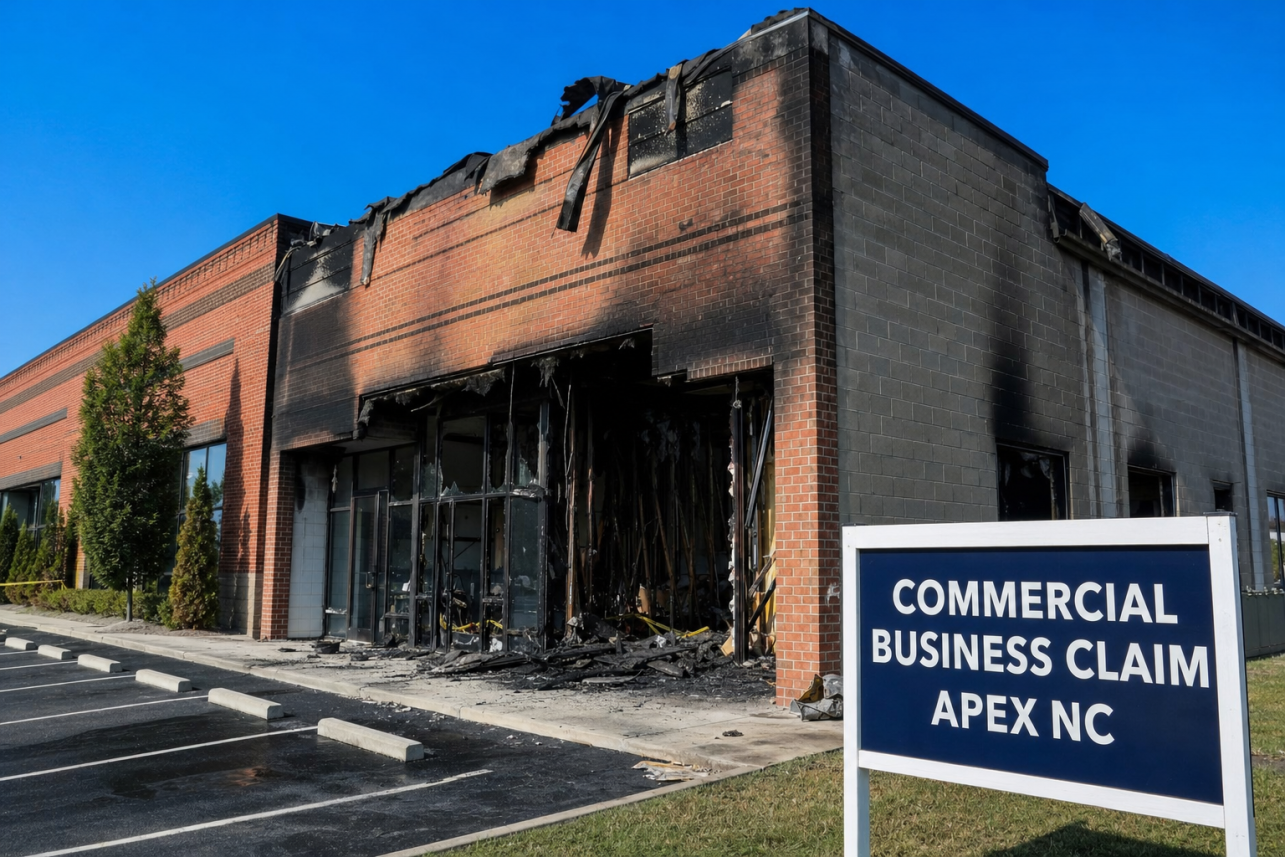
Business interruption is often the largest and most disputed part of a commercial claim, because it requires proving money you would have earned if the loss had never happened. Carriers scrutinize these figures closely, so the documentation has to be airtight.
We start with your financial records: profit and loss statements, tax returns, sales reports, payroll records, and lease or mortgage obligations. For an Apex restaurant, retailer, or professional office, we also account for seasonality and growth trends, so the projection reflects what your business was genuinely on track to earn, not just a flat historical average.
From there, we calculate the period of restoration, the time reasonably needed to repair the building and resume operations. Carriers often try to shorten this window. We push back with contractor timelines, permit schedules from the Town of Apex and Wake County, and documentation of supply or equipment lead times.
We also capture extra expenses many owners miss: temporary relocation costs, equipment rental, expedited shipping, overtime payroll, and expenses to retain key customers while you are closed. Each item is tied to receipts and invoices so nothing is dismissed as speculative.
Finally, we present the entire package, building damage, contents, and lost income, as one cohesive claim. We are licensed and bonded, and while we never guarantee a specific settlement amount, a professionally documented interruption claim is far harder for a carrier to discount than a stack of raw spreadsheets. That difference is often what determines whether your business survives the closure.
What Records Should I Gather Before Filing A Commercial Business Claim Apex NC Insurers Will Take Seriously?
Strong documentation is the backbone of any commercial loss recovery, and gathering it early makes a measurable difference in the outcome. Before you file, locate your complete insurance policy, including all endorsements and declarations pages, so the full scope of your coverage is clear from day one.
Next, pull together proof of what your business owned and earned. That means pre-loss photos or video of the building and contents, equipment inventories, purchase receipts, lease agreements, and at least two years of financial records such as profit-and-loss statements and tax returns. For Apex businesses along the Highway 55 and downtown corridors, where many buildings mix older construction with newer upfits, records of past renovations are especially valuable in proving the true replacement cost.
After the loss, photograph everything before any cleanup begins, keep damaged items whenever it is safe to do so, and save every receipt for emergency repairs, board-up work, and temporary relocation. A written timeline of events, starting the day the damage occurred, helps prevent disputes later.
When our team handles a commercial loss in Apex, we build this file alongside you, often uncovering coverage and losses the business owner did not realize were claimable, such as code-upgrade costs or spoiled inventory. Courts have repeatedly recognized the value of thorough proof. In Gaston County Dyeing Machine Co. v. Northfield Insurance Co., 351 N.C. 293 (2000), the North Carolina Supreme Court sided with the policyholder on a disputed property damage coverage question, a reminder that well-supported claims put the law on the insured's side.
Do Policyholders Ever Win When They Challenge An Insurance Company On A Commercial Property Claim?
Yes, and North Carolina case law proves it. Insurance carriers are not the final word on what a policy covers or what a loss is worth. When policyholders push back with solid evidence and a correct reading of the policy, courts in this state have ruled in their favor.
A leading example is Gaston County Dyeing Machine Co. v. Northfield Insurance Co., decided by the North Carolina Supreme Court in 2000. The insurer tried to limit coverage for property damage, but the court rejected the carrier's narrow interpretation and ruled for the insured, affirming that ambiguous policy language must be read in favor of the policyholder. That principle, that ambiguity benefits the insured, remains a powerful tool for Apex business owners today.
Most disputes never need to reach a courtroom, though. In our experience with commercial losses across Wake County, the majority of underpaid or wrongly denied claims are resolved through detailed re-inspection, proper damage estimates, and firm negotiation backed by the policy language itself. Carriers respond differently when the policyholder's position is documented to a professional standard.
We cannot promise any specific result, because every policy and every loss is different. What we can do is make sure your claim is measured, documented, and argued the way the law and your policy actually allow, so you are negotiating from strength rather than accepting the first number offered.
Is For The Public Adjusters, Inc. Licensed To Handle Commercial Claims In Apex And Wake County?
Yes. For The Public Adjusters, Inc. is licensed and bonded to represent policyholders in North Carolina, which includes Apex, Cary, Holly Springs, and every other community in Wake County. Licensing matters because North Carolina law regulates who may negotiate an insurance claim on behalf of an insured, and working with an unlicensed representative can put your recovery at risk.
Our licensing means we are accountable to the North Carolina Department of Insurance, and our bond provides an additional layer of protection for the business owners we serve. When you hire a licensed professional for a Commercial Business Claim Apex NC companies can verify through the state, you know the person negotiating with your carrier is operating under real oversight, not just a business card.
Local knowledge matters just as much as credentials. We understand how Apex commercial properties are built and valued, from the historic storefronts near Salem Street to the newer flex and warehouse space off NC-540. We also know the local permitting and code-upgrade requirements that often add legitimate, claimable costs to a rebuild, costs that carriers sometimes leave out of their estimates.
One honest limitation to note: we handle property losses to buildings, contents, and business income. We do not take claims involving motor vehicles, cell phones, health, or life insurance. If your loss involves fire, smoke, water, hurricane or tornado damage, theft, vandalism, or business interruption at a commercial property, we are equipped and credentialed to help.
My Commercial Claim Was Already Settled Or Closed. Can It Be Reopened In Apex?
In many situations, yes. A closed claim is not necessarily a finished claim. If you discover additional damage after settlement, received a payment that did not reflect the true cost of repairs, or your contractor found hidden problems once work began, North Carolina policies generally allow supplemental claims within the policy's time limits.
The first step is reviewing your policy's deadlines. Most commercial policies set specific time frames for submitting a proof of loss and for filing suit, often spelled out in the conditions section. Acting quickly preserves your options, so do not wait if you suspect your settlement fell short.
Common reasons Apex business owners reopen claims include hidden water damage behind walls discovered during reconstruction, smoke contamination in HVAC systems that was never tested, structural issues from a tornado that only became apparent over time, and business income losses that continued past the period the carrier originally paid. Each of these can support a supplemental demand when properly documented.
Our role is to re-inspect the property, compare what was paid against what the damage actually requires, and present the difference to the carrier with estimates, photographs, and expert reports. Courts have shown willingness to hold insurers to the full scope of their obligations, as in Gaston County Dyeing Machine Co. v. Northfield Insurance Co., where the North Carolina Supreme Court ruled for the insured on disputed property damage coverage. We make no guarantees about any particular outcome, but if your file shows an underpayment, there is a clear, lawful path to pursue what your policy owes.
What Steps Should I Take Right After A Fire, Tornado, Or Burst Pipe Damages My Apex Business?
First, make sure the property is safe and take reasonable steps to prevent further damage — board up openings, shut off water, and cover exposed areas. Your policy requires this mitigation, and insurers in Wake County routinely reduce payments when they believe damage worsened after the loss.
Second, document everything before anything is moved or thrown away. Photograph and video the building, equipment, and inventory from multiple angles, and keep damaged items whenever possible. Save every receipt for emergency repairs, tarping, and temporary relocation.
Third, report the loss to your carrier promptly, but be careful with recorded statements before you understand your coverage. Early statements are often used later to limit the claim.
If flooding is involved and you carry a flood policy through the National Flood Insurance Program, strict proof-of-loss deadlines apply — FEMA.gov and FloodSmart.gov explain those timelines, and we help Apex businesses meet them.
Finally, call a licensed public adjuster before the carrier's adjuster completes their inspection. For The Public Adjusters, Inc. is licensed and bonded, and getting us involved early means the initial damage assessment is built on a complete, well-documented scope rather than a rushed walkthrough. While no one can promise a specific outcome, a claim that starts with thorough documentation is far harder for an insurer to undervalue later.
Will The Insurance Company Treat My Commercial Business Claim Apex NC Differently If I Hire A Public Adjuster?
In our experience, yes — the tone of the claim changes when the carrier knows a licensed professional is reviewing their work. Insurance company adjusters handle large caseloads and work for the insurer. When a public adjuster represents the policyholder, every line of the estimate, every depreciation calculation, and every coverage interpretation gets checked.
That does not mean the process becomes adversarial. Most Apex commercial claims we handle settle through documentation and negotiation, not conflict. Carriers respond to detailed scopes of loss, verified inventory counts, and business-interruption figures backed by real financial records. Our job is to put that evidence in front of them so the claim stands on facts.
It is also worth knowing that North Carolina law protects your right to representation. Hiring a public adjuster cannot legally be used as a reason to deny or delay your claim, and carriers are required to handle claims in good faith regardless of who represents the insured.
We are licensed and bonded in North Carolina, and we never promise a specific dollar result — no honest adjuster can. What we can say is that commercial losses involving buildings, equipment, inventory, and lost income are complex, and policyholders who present a complete, professionally prepared claim are negotiating from a much stronger position than those relying on the carrier's numbers alone.
What Happens If My Insurer And I Disagree On The Value Of The Damage To My Commercial Building In Apex?
A disagreement on value is not the end of the road — it happens constantly, and your policy includes tools to resolve it. The first step is usually a detailed rebuttal: we prepare our own scope of loss with line-item pricing for Wake County contractors, then negotiate directly with the carrier's adjuster using that documentation.
If negotiation stalls, most commercial policies contain an appraisal clause. Each side selects an appraiser, the appraisers choose an umpire, and the panel sets the amount of loss. Appraisal often resolves valuation disputes without the cost of litigation, and we guide Apex business owners through that process regularly.
When coverage itself is denied, courts have sided with policyholders in significant building-damage disputes. In Hampton Foods, Inc. v. Aetna Casualty & Surety Co., 787 F.2d 349 (8th Cir. 1986), a grocery business lost the use of its building when the structure was in imminent danger of collapse. The insurer refused to pay, arguing no covered physical loss had occurred. The court ruled for the insured, holding the loss of the building and its contents was covered — a reminder that an insurer's first answer is not always the correct one.
Most disputes never need a courtroom. But knowing the escalation path — rebuttal, appraisal, and if necessary legal action through a policyholder attorney — keeps the pressure on the carrier to value the loss fairly from the start.
Do You Handle Smoke, Soot, And Contents Losses, And Are There Claims You Don't Take?
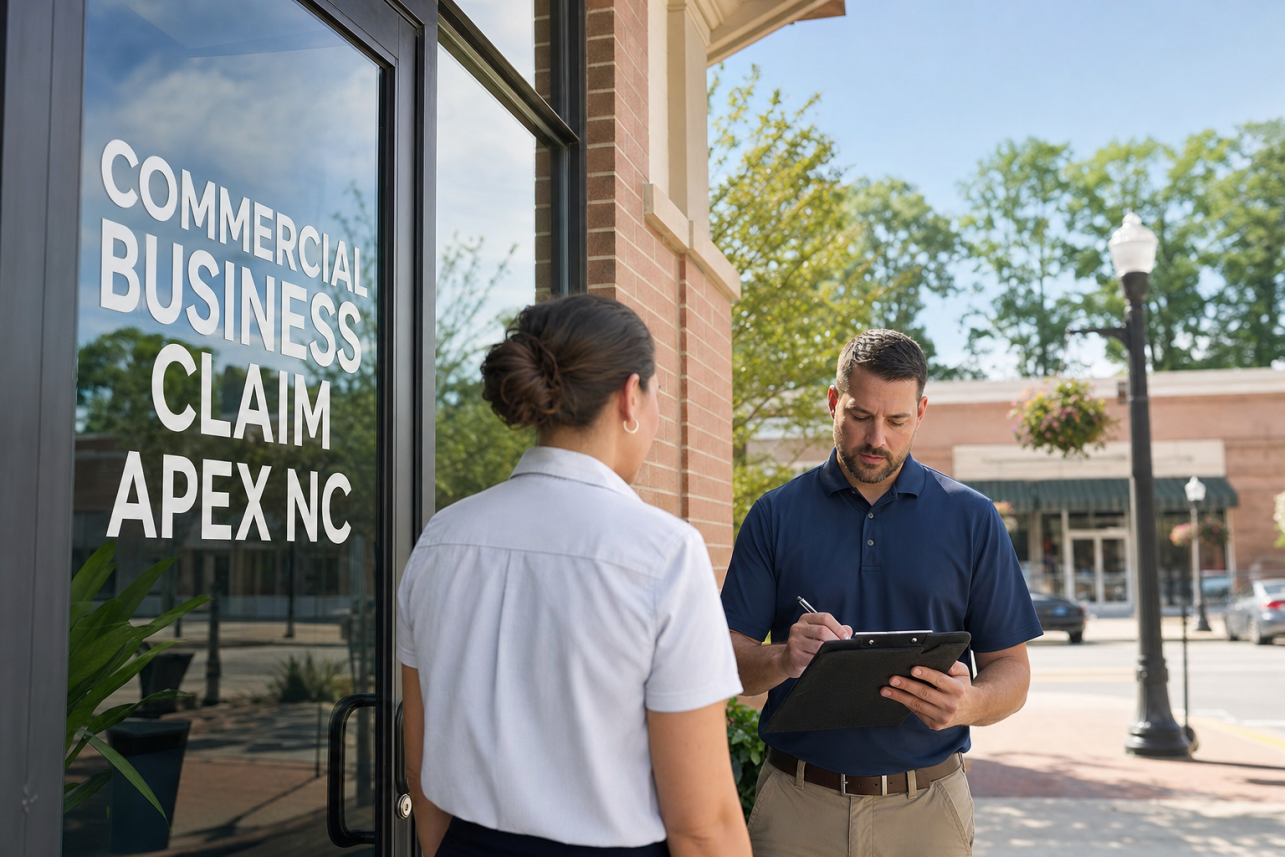
Yes — smoke and soot damage is one of the most underpaid categories we see in a Commercial Business Claim Apex NC owners file after a fire. Smoke travels far beyond the burn area, contaminating HVAC systems, inventory, electronics, acoustic ceilings, and soft goods. Carriers often approve cleaning for items that genuinely need replacement, and soot residue left behind can cause corrosion and odor problems months later.
We document contents losses room by room: detailed inventories, photographs, pre-loss values, and replacement pricing. For retail shops along Salem Street, restaurants near Beaver Creek, or warehouse and flex space off US-1, that inventory work frequently represents a substantial share of the total settlement.
We handle losses involving commercial buildings, business personal property, inventory, equipment, and lost business income from causes such as fire, smoke, water from plumbing failures, hurricanes, tornadoes, hail, theft, vandalism, and flood. For flood losses, note that NFIP policies have their own rules and deadlines — FEMA.gov is the best official resource alongside our guidance.
There are claims we do not take. We don't handle insurance matters involving cell phones, motor vehicles, health insurance, or life insurance. Our focus stays on property damage to buildings and their contents, which is where a public adjuster adds real value.
If you're unsure whether your situation fits, a short conversation will tell you. The review costs nothing, and we'll give you a straight answer about whether professional representation makes sense for your loss.
Local Relevance
Apex has grown fast, and its commercial stock shows it: strip centers and office parks built during the late-'90s and 2000s boom now sit alongside older downtown buildings near the historic core. Aging roofs, original plumbing, and builder-grade flashing mean water and pipe-failure claims are common — and carriers in this market push hard on 'wear and tear' arguments to shrink them.
The weather adds its own risks. Central North Carolina's spring storm season brings hail and occasional tornadoes that cut narrow paths — one shopping center takes roof and sign damage while the one across the road is untouched. Humid summers turn any slow leak into a mold and contents problem quickly, and remnants of tropical systems can drop flooding rain well inland. The National Fire Protection Association has long noted that cooking equipment is a leading cause of commercial fires, which is why Apex's growing restaurant scene sees more than its share of fire, smoke, and forced-closure losses.
For business owners here, the stakes compound: a closed storefront in a competitive Wake County market loses customers who may not come back. That's why documenting the full loss — building, contents, and interrupted income — matters so much locally. If your loss is at your home rather than your business, our Public Adjuster Apex NC team handles residential claims as well. And because standard commercial policies exclude flood, owners near low-lying creek corridors should verify whether they carry separate flood coverage through the National Flood Insurance Program before a storm, not after.
Much of western Wake County, Apex included, sits on Triassic Basin clay that drains poorly and shrinks and swells with the seasons — so slab cracks, sticking doors, and water intrusion in commercial buildings often get written off by out-of-area adjusters as 'settling' or 'age' when the soil behavior and a documented loss event tell a different story. Knowing which side of that soil line your building sits on can change how a water or foundation-related claim is built and defended.
Your Business Can't Afford An Underpaid Claim
Every day your claim sits stalled or undervalued is revenue you don't get back. For The Public Adjusters, Inc. is licensed and bonded in North Carolina, and we work only for policyholders — documenting your property damage, calculating your lost income, and negotiating with the carrier so your claim is fully presented. The policy review costs you nothing to start.
Call us: (919) 400-6440
Helpful Resources
- NCDOI Public Adjusters Guide
- National Fire Protection Association (NFPA)
- National Flood Insurance Program (NFIP)
- North Carolina Department of Insurance — State regulator overseeing insurance and licensed public adjusters in NC
Last updated: October 16, 2026