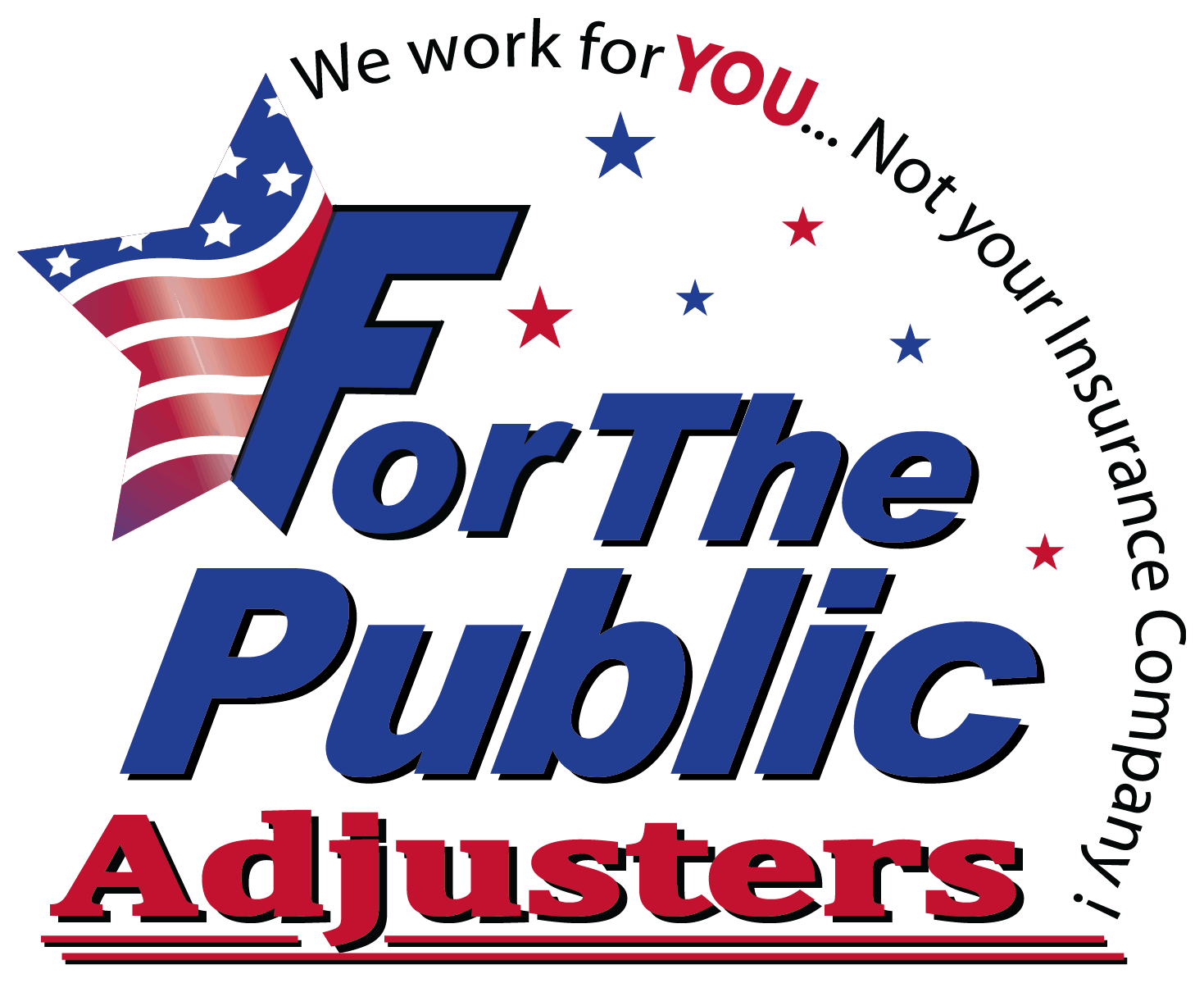

If your insurer has flagged your fire loss as suspicious, an Arson Homeowners Claim Garner specialist from For The Public Adjusters, Inc. steps in to protect your rights while the company investigates. When an insurance company suspects arson, it often shifts from paying your claim to building a case against you — scrutinizing your finances, delaying payment, and demanding sworn testimony. We represent you, not the insurer, documenting the loss independently and pushing the claim toward a fair resolution. You do not have to face their investigators alone.
What This Service Is
A suspected-arson homeowners claim is one of the most adversarial situations a policyholder can face. The moment your carrier’s cause-and-origin investigator labels the fire ‘incendiary’ or ‘undetermined,’ the tone changes. Suddenly you are answering questions about your mortgage balance, your credit cards, and where you were the night of the fire.
As licensed and bonded public adjusters, we work exclusively for the homeowner. We review your policy line by line, coordinate independent fire investigation when the carrier’s conclusions look thin, build a complete personal property inventory, and prepare a proper proof of loss so the insurer cannot claim your paperwork is deficient.
We also make sure the benefits you are entitled to keep flowing during the investigation — including temporary housing and loss-of-use payments — because a suspicion is not a denial. Homeowners across Wake County call us for this exact scenario, and we handle the same fights for an Arson Homeowners Claim in Raleigh NC and throughout the Triangle. If the fire also caused water and smoke damage from firefighting efforts, we document those losses too, since they are frequently undervalued in the rush to investigate the cause.
Common Problems
Who Pays For My Hotel, My Clothes, And Everything I Lost While They ‘investigate’?
This is where families in Garner get hurt first. The house is uninhabitable, the kids need school clothes, and the carrier says it cannot advance funds ‘pending investigation.’ In most homeowners policies, loss-of-use coverage exists precisely for this — reasonable additional living expenses while you cannot occupy the home.
An open investigation does not automatically erase that obligation. We push for advances, document every displacement cost, and build a room-by-room contents inventory so nothing gets left off the settlement. Underpayment on contents is common because grieving homeowners forget half of what they owned; a methodical inventory fixes that.
We also flag what the policy actually covers versus what the adjuster implies it excludes. Policyholders are often told ‘that’s not covered’ about items that plainly are.
My Arson Homeowners Claim Garner Investigation Feels Like An Accusation — What Now?
When a carrier suspects arson, it may demand an examination under oath — a formal, recorded interrogation under your policy’s cooperation clause. It may also comb through your bank records looking for a financial motive, and suspend the claim while a fire marshal’s inquiry runs its course. If criminal and civil tracks overlap, anything you say can matter in both.
Courts have made clear that suspicion does not license an insurer to mistreat its own policyholder. In Gruenberg v. Aetna Insurance Co., the California Supreme Court allowed an insured whose fire claim was denied amid arson suspicion — later cleared of any charges — to sue the insurer for bad faith handling of the building and contents loss. The insured ultimately prevailed in establishing that carriers owe a duty of good faith even while investigating.
We prepare you for the examination under oath, keep the paper trail clean, and watch for delay tactics that cross into bad faith. If the North Carolina Department of Insurance needs to hear about the carrier’s conduct, or if litigation becomes necessary, we coordinate with insurance dispute lawyers. We handled these same accusation-style investigations for a homeowner pursuing an Arson Homeowners Claim in Clayton, and the pattern rarely changes: pressure, delay, and hope the family gives up. Do not give up.
Can I Handle A Suspected-Arson Claim Myself, Or Do I Need Representation?
You can technically handle it alone — but this is not a hail-dent negotiation. The carrier has trained cause-and-origin investigators, special investigations unit staff, and attorneys. You have grief, displacement, and a mortgage lender demanding answers because they are named on the policy too.
A good public adjuster levels that field. Look for someone licensed in North Carolina — the NCDOI Public Adjusters Guide explains what public adjusters may and may not do, and it is worth reading before you sign anything with anyone. Ask how many suspected-arson fires they have worked, whether they can bring in an independent fire investigator, and how they prepare clients for sworn statements.
We never guarantee a specific outcome — no honest adjuster can — but we do guarantee you will not walk into the insurer’s process uninformed. Homeowners who searched for Arson Homeowners Claim Help in Apex found us for the same reason Garner families do: this fight requires someone in your corner.

Our Process
Free Review Of Your Policy And The Carrier’s Position
We start by reading your actual policy — the coverage limits, the exclusions, the cooperation clause, and the deadlines. North Carolina claims carry a statute of limitations, and some policies shorten the window to sue, so timing matters from day one.
We then assess what the insurer has actually said versus what it has merely implied. A ‘claim under investigation’ letter is not a denial, and we make sure you are not treated as if it were.
Independent Documentation Of The Fire And Your Losses
Where the carrier’s cause-and-origin findings look weak, we help arrange an independent fire investigation. Fire science follows recognized methodology — the National Fire Protection Association publishes the guide most investigators rely on — and conclusions that skip that rigor can be challenged.
At the same time, we photograph and scope the structure, document smoke and water damage from suppression, and build your sworn personal property inventory and proof of loss so the file is airtight.
Representation Through The Investigation To Settlement
We prepare you for any examination under oath, manage communications so nothing is taken out of context, and press for interim payments on undisputed portions of the loss, including temporary housing.
If the carrier delays unreasonably, lowballs the structure valuation, or denies without solid evidence, we escalate — including coordinating with insurance dispute lawyers when bad faith is on the table. We negotiate hard, and we keep you informed at every step.
| Stage of the Claim | Homeowner Alone | With For The Public Adjusters, Inc. |
|---|---|---|
| SIU document demands (bank records, tax returns, phone records) | Often over-produces or refuses outright — either can be used against the claim | Responds only to what the policy legally requires, with objections documented in writing |
| Examination Under Oath | Walks in unprepared; innocent memory gaps get framed as ‘material misrepresentation’ | Fully prepared beforehand, with the policy’s cooperation duties and limits explained |
| Cause-and-origin dispute | Relies on the carrier’s hired expert and the fire marshal’s summary | Independent cause-and-origin review, full investigative file obtained, competing accidental causes documented |
| Additional living expenses during the investigation | Frequently paused by the carrier; homeowner absorbs hotel and meal costs | ALE pursued in writing throughout, with retroactive payment demanded when wrongly withheld |
| Burden of proof | Assumes they must prove innocence and panics | Holds the carrier to Bryant v. Nationwide (N.C. 1985): the insurer must prove intentional burning |
| Dwelling and contents valuation | Accepts the carrier’s walkthrough estimate | Line-item structural estimate plus room-by-room contents inventory including smoke, soot, and water damage |
Commonly Overlooked In The Public Adjusting Industry
- The carrier’s burden of proof under Bryant v. Nationwide Mutual Fire Insurance Co. — Most homeowners assume they must prove they didn’t set the fire, when North Carolina’s Supreme Court put that burden squarely on the insurer.
- Retroactive additional living expenses withheld during the SIU investigation — Carriers quietly pause ALE payments during arson investigations, and homeowners rarely realize those months of hotel and meal costs remain owed once the claim is paid.
- The full investigative file behind the fire marshal’s one-page summary — The summary may say ‘undetermined’ while the underlying lab reports and photos actually undercut the carrier’s accelerant theory.
- Melted synthetics producing false accelerant readings — Burned carpet, foam, and plastics can chemically mimic ignitable liquids in lab samples, and carriers rarely volunteer that limitation.
- The 60-day proof of loss deadline running during the investigation — Policyholders assume the SIU process pauses their own deadlines, but a missed sworn proof of loss can sink an otherwise valid claim.
- Smoke and soot damage in rooms the fire never touched — Carrier estimates focus on the burn area, while corrosive soot in HVAC ducts, closets, and attic spaces gets left out of the settlement entirely.
- Over-answering at the Examination Under Oath — Nervous homeowners volunteer speculation beyond what was asked, and any later inconsistency can be reframed as material misrepresentation.
- Third-party arson still being a covered loss — If someone else set the fire, the claim is covered — yet homeowners often abandon claims simply because the word ‘arson’ appears in the report.
Case Studies
Case Study #1
Situation: A Garner homeowner off Timber Drive lost most of her house to a late-night fire while she was out of town visiting family. The fire marshal’s report listed the cause as undetermined, but noted possible ignitable liquid residue near the back porch.
Problem: Her insurance carrier opened a Special Investigations Unit (SIU) file and began treating her as a suspect instead of a policyholder. They demanded an Examination Under Oath, five years of bank statements, tax returns, and cell phone records, and quietly paused all payments — including additional living expenses — while she was paying for a hotel out of pocket.
Investigation: We reviewed the policy, the fire marshal’s report, and the carrier’s reservation of rights letter line by line. We coordinated with an independent cause-and-origin expert to re-examine the burn patterns and lab samples, and we prepared the homeowner for her Examination Under Oath so she understood exactly what the policy required of her and where the insurer’s questions were headed.
Findings: The independent expert found the suspected ‘ignitable liquid’ reading was consistent with a melted synthetic doormat, not an accelerant. We also documented that the homeowner had no financial motive: the mortgage was current, the home had recent equity, and her alibi was verifiable through toll records and hotel receipts.
Solution: We assembled a complete rebuttal package — expert report, financial documentation, alibi timeline — and reminded the carrier in writing that under Bryant v. Nationwide Mutual Fire Insurance Co., 313 N.C. 362 (1985), the North Carolina Supreme Court held that the insurance company, not the homeowner, bears the burden of proving an insured intentionally set the fire. We then submitted a fully documented estimate for the dwelling, contents, and additional living expenses.
Outcome: The SIU file was closed and the claim was paid, including retroactive additional living expenses for the months she had covered herself. The final settlement reflected the full scope of structural and smoke damage our estimate documented, not the carrier’s initial partial figure.
Lesson: An SIU investigation is not a denial. Insurers in North Carolina must prove arson by the insured — the homeowner does not have to prove innocence. But how you respond to document demands and the Examination Under Oath can make or break the claim, so get representation before you answer, not after.
Case Study #2
Situation: A couple near White Oak in Garner had a detached garage and part of their kitchen destroyed by fire. A neighbor told investigators he’d seen ‘someone’ near the property that evening, and the carrier’s adjuster began asking pointed questions about the couple’s recent job loss.
Problem: The carrier issued a reservation of rights letter citing the intentional-acts exclusion and the concealment-or-fraud provision. They delayed for months, re-interviewed the couple three separate times, and hinted that any inconsistency between interviews could void the entire policy — a pressure tactic designed to make them give up or accept a lowball offer.
Investigation: We took over all communication with the carrier immediately. We pulled the ATF-certified investigator’s full file rather than relying on the summary, obtained the neighbor’s actual statement, and had our own contents specialist inventory the fire-damaged, smoke-damaged, and water-damaged personal property room by room.
Findings: The neighbor’s statement described a figure who did not match either homeowner, and the electrical inspection showed a failed junction box in the garage as a competent accidental cause. The carrier’s ‘inconsistencies’ amounted to the couple estimating times differently from memory — normal for anyone recalling a traumatic night, not evidence of fraud.
Solution: We presented the electrical evidence, the corrected witness statement, and case law showing courts side with policyholders when insurers overreach on arson defenses. In Bryant v. Nationwide, North Carolina’s highest court made clear that suspicion and financial hardship alone are not proof of incendiarism. We paired that with a documented claim covering the garage rebuild, kitchen restoration, and a 40-page contents inventory.
Outcome: The carrier withdrew its reservation of rights and settled the dwelling, other structures, and contents portions of the claim. The contents recovery alone came in substantially above the carrier’s original walkthrough estimate because every smoke-affected item had been properly documented and valued.
Lesson: Financial hardship is not arson, and memory gaps are not fraud. Carriers know that, but they also know most homeowners don’t. Independent evidence — electrical inspections, full witness statements, professional inventories — is what shifts an investigation from suspicion back to what it should have been all along: paying a covered loss.
| What the Insurance Company Does | What It Usually Signals | Smart Response |
|---|---|---|
| Sends a reservation of rights letter | The carrier is preserving its ability to deny while still investigating — not a denial yet | Do not panic or go silent; get the letter reviewed by a licensed public adjuster before responding |
| Assigns the file to the Special Investigations Unit (SIU) | Something in the fire report or your finances triggered a fraud screen | Cooperate within the policy’s limits, but stop giving recorded statements without preparation |
| Demands bank statements, tax returns, and phone records | They are hunting for financial motive to build an arson defense | Provide only what the policy’s cooperation clause actually requires, and document every production |
| Schedules an Examination Under Oath | A formal, transcribed proceeding — inconsistencies can be used to void coverage | Prepare thoroughly beforehand; you may have counsel or your adjuster involved in preparation |
| Pauses additional living expense payments | Financial pressure to make you settle low or abandon the claim | Demand ALE in writing citing the policy; keep every hotel, meal, and mileage receipt for retroactive recovery |
| Cites an ‘undetermined’ cause as grounds for suspicion | Undetermined is not proof of arson — the burden stays on the insurer under N.C. law | Commission an independent cause-and-origin expert to evaluate accidental causes |
| Offers a fast, low settlement mid-investigation | They may know the arson theory is weak and want to close cheap | Do not sign anything until dwelling, contents, and ALE are fully documented and valued |
| Issues a denial based on the intentional-acts exclusion | The carrier believes it can prove you set the fire — a claim it must back up in court | Get the denial reviewed immediately; insureds have won these disputes, as in Bryant v. Nationwide (N.C. 1985) |
Reviews
After our house fire, the insurance company treated my husband and me like criminals. They wanted our bank records, tax returns, everything — and stopped paying our hotel bill while they ‘investigated.’ For The Public Adjusters stepped in, prepared us for the Examination Under Oath, and pushed back with actual evidence and North Carolina case law. The investigation closed and the claim finally got paid, including the living expenses we’d covered ourselves. I don’t know what we would have done without them.
Denise M., Garner
The fire marshal couldn’t determine a cause, so my carrier decided that meant arson and dragged their feet for months. This team brought in an independent cause-and-origin expert who traced it to an electrical fault. They handled every letter and phone call with the SIU so I didn’t say something that could be twisted. Professional, licensed, and honest with me about what to expect at every step. My home is rebuilt.
Robert T., Wake County
I called them after getting a reservation of rights letter that scared me half to death. They explained in plain English that in North Carolina the insurer has to prove arson — I didn’t have to prove my innocence. They documented every smoke-damaged item in my house, room by room, and the contents settlement ended up far beyond the carrier’s first offer. Worth every penny of their fee.
Angela P., Garner
Frequently Asked Questions
Why Is My Insurance Company Investigating Me After A House Fire, And How Does An Arson Homeowners Claim Garner Adjuster Help?
When a fire’s cause is listed as undetermined or incendiary, insurers in Wake County routinely open a special investigation. They may request an examination under oath, pull your financial records, and look for any motive to suggest you set the fire yourself. It is a standard defense tactic, because proving arson lets the carrier deny the entire payout.
An Arson Homeowners Claim Garner specialist from For The Public Adjusters, Inc. levels the field. We document the loss independently, help you prepare for the examination under oath, and hold the carrier to its actual burden of proof.
That burden matters. In Bryant v. Nationwide Mutual Fire Insurance Co., 313 N.C. 362 (1985), the North Carolina Supreme Court sided with a homeowner whose fire claim was denied on arson allegations. The Court made clear the insurer must prove its arson defense — the policyholder does not have to prove innocence. Suspicion, financial difficulty, or an unexplained fire origin alone is not enough.
We are licensed and bonded, and we manage the claim so the investigation stays focused on facts rather than pressure tactics. While no one can promise a specific outcome, having a professional advocate from the first interview forward often changes how seriously the carrier treats your file.
What Should I Avoid Saying Or Doing While The Insurer Investigates My Fire Loss In Garner?
First, never guess. If an adjuster or SIU investigator asks where you were, what appliances were running, or how the fire started, answer only what you actually know. Speculation gets written into the file and can be twisted later.
Second, do not sign broad authorizations without reading them. Carriers often request sweeping access to bank statements, tax returns, phone records, and credit history. Some requests are legitimate under the policy’s cooperation clause; others go far beyond it. A Garner public adjuster can help you comply with reasonable requests while pushing back on fishing expeditions.
Third, do not skip the examination under oath, but do not walk into it unprepared either. It is a formal, recorded proceeding, and inconsistent answers — even innocent memory lapses — are a common basis for denial.
Finally, preserve everything. Keep the fire department report, photos, receipts, and a running log of every call with the carrier. Do not authorize debris removal until the scene has been fully documented, because the physical evidence of origin and cause is often what clears a homeowner.
For The Public Adjusters, Inc. handles this documentation and communication for policyholders throughout Wake County. Our role is to keep your claim organized, accurate, and consistent so the investigation runs out of reasons to stall.
The Fire Report Says ‘incendiary’ — Does That Mean My Claim Will Be Denied?
No. An incendiary finding means investigators believe someone intentionally set the fire. It does not identify who set it, and it does not, by itself, defeat your coverage.
Under North Carolina law, an insurer raising an arson defense must prove two things: that the fire was intentionally set, and that you set it or procured it. Many Garner and Wake County fires labeled incendiary involve vandalism, break-ins, or unknown third parties — situations where the homeowner is a victim, not a suspect, and the policy still responds.
The Bryant v. Nationwide decision from the North Carolina Supreme Court reinforced that carriers cannot deny simply because a fire looks suspicious. The insurer carries the burden of connecting the homeowner to the act, and circumstantial hunches are not proof.
In practice, carriers sometimes lean on an incendiary label hoping the policyholder gives up. That is where our team comes in. We review the origin-and-cause report critically, gather evidence supporting your account — alibi records, alarm data, witness statements, signs of forced entry — and present a complete, well-documented claim covering the dwelling, other structures, contents, and additional living expenses.
We cannot guarantee any particular result, and no honest adjuster can. What we can do is make sure the carrier evaluates real evidence rather than an assumption, and that every category of your loss is properly measured before any settlement discussion begins.
How Does For The Public Adjusters, Inc. Handle An Arson Homeowners Claim Garner Homeowners Are Struggling To Get Paid On?
We start with the evidence. Our team reviews the fire department and origin-and-cause reports, walks the property, and photographs and inventories everything before it is disturbed. In a suspected-arson file, thorough early documentation is often the difference between a paid claim and a prolonged fight.
Next, we take over communication with the carrier. Every document request, recorded statement, and examination under oath gets reviewed first, so you respond accurately and only within what the policy actually requires. This prevents the inconsistencies investigators use to justify denials.
Then we build the full measure of your loss: dwelling repairs at real Garner-area construction costs, a room-by-room contents inventory with replacement values, smoke and soot remediation, and additional living expenses for the time you are displaced. Carriers investigating arson often underpay the undisputed portions of a claim while they stall on liability — we press on both fronts at once.
If the carrier denies without meeting its legal burden, the file we build supports your attorney if litigation becomes necessary. North Carolina courts have held insurers to that burden before; in Bryant v. Nationwide, the state Supreme Court ruled for the homeowner precisely because the carrier’s arson theory did not carry the weight of the evidence.
We are licensed and bonded, we work on your behalf rather than the insurer’s, and we never promise a specific dollar figure — only a professionally documented, fully advocated claim from a team that knows Garner and Wake County.
Can The Insurance Company Deny My Arson Homeowners Claim Garner Just Because I Had Financial Problems Before The Fire?
No. Financial pressure alone is not proof of arson, and the burden sits with the insurer, not with you. To deny a homeowners claim on an arson defense, the carrier generally has to establish three things: that the fire was intentionally set, that you had the opportunity to set it, and that you had a motive. Suspicion or an overdue mortgage payment does not meet that standard.
Courts have repeatedly held insurers accountable when they lean on weak evidence to avoid paying fire losses. In Bi-Economy Market, Inc. v. Harleysville Insurance Co. of New York, 10 N.Y.3d 187 (2008), a fire destroyed the insured’s building and contents, the carrier delayed and underpaid, and New York’s highest court ruled the policyholder could pursue consequential damages beyond the policy limits because the insurer failed to handle the claim in good faith. Decisions like that remind carriers that dragging out or denying a legitimate fire claim carries real consequences.
For Garner homeowners in this situation, the practical move is to stop guessing what the insurer is thinking and start building your own file: the origin-and-cause findings, your alibi timeline, financial records that put context around your situation, and a complete contents inventory. As licensed and bonded public adjusters, we help Wake County policyholders assemble that record so the carrier has to respond to documented facts rather than a theory. We never guarantee an outcome, but we make sure the insurer cannot quietly build a one-sided case against you.
What Is An Examination Under Oath, And Do I Have To Sit For One During A Suspected-Arson Fire Investigation?
An Examination Under Oath, or EUO, is a formal, recorded interview conducted by the insurance company’s attorney. If your homeowners policy contains an EUO provision, refusing to appear can give the carrier grounds to deny the claim for non-cooperation, so skipping it is rarely a good option.
That said, an EUO in a suspected-arson case is not a friendly conversation. The insurer’s attorney will ask detailed questions about your whereabouts on the day of the fire, your finances, prior claims, the condition of the home, and your contents inventory. Inconsistent answers, even innocent ones caused by stress or faulty memory, can later be framed as material misrepresentation, which is a separate basis for denial.
Before any Garner homeowner sits for an EUO, preparation matters. Review the timeline of the fire, gather bank statements, receipts, and photos before the session, and never estimate figures you have not verified. You are entitled to have representation present, and many policyholders retain an attorney for the EUO itself while a public adjuster handles the documentation of the loss.
Our role at For The Public Adjusters, Inc. is to make sure the facts you present are accurate and supported. We build the contents inventory, structural damage scope, and additional living expense records so your sworn answers line up with hard documentation from your Wake County property. When your testimony and your paperwork match, an arson theory becomes much harder for the carrier to sustain.
How Long Can The Insurer Delay Paying My Garner Fire Claim While It Investigates Suspected Arson?
North Carolina requires insurers to acknowledge, investigate, and resolve claims within a reasonable time, and the Department of Insurance’s claims regulations do not give carriers an open-ended pass just because they suspect arson. An investigation must be diligent and ongoing, not a stall tactic. If months pass with no interviews scheduled, no expert reports produced, and no payment on undisputed portions of the loss, that pattern can support an unfair claims practice complaint.
One thing many homeowners do not realize: even during an arson investigation, the carrier often owes you additional living expenses if the policy provides them and the home is uninhabitable. A pending investigation is not, by itself, a lawful reason to leave a Garner family with no housing money for half a year.
Delay also carries legal risk for insurers. In Bi-Economy Market v. Harleysville, the court allowed the insured to seek consequential damages after the carrier’s slow, inadequate handling of a fire loss to a building and its contents compounded the harm. The lesson is that foot-dragging is not a free strategy.
When we handle a suspected-arson homeowners claim in Garner, we document every request, every deadline, and every unanswered letter. That paper trail pressures the carrier to either pay, deny with stated reasons, or explain the delay in writing. We cannot promise a specific timeline or dollar amount, but a well-documented file usually moves faster than a homeowner navigating the process alone.

Am I Still Entitled To Payment For My Contents And Living Expenses While The Arson Investigation Is Open?
In most cases, yes, your right to recover destroyed contents and additional living expenses does not disappear simply because the carrier opened an investigation. Until the insurer formally denies the claim with a stated basis, your policy remains in force, and undisputed portions of the loss should still be evaluated and paid within a reasonable time.
Contents are often where suspected-arson investigations get contentious. Adjusters may challenge the existence, value, or condition of items, especially high-value electronics, jewelry, and furniture. The strongest response is a room-by-room inventory backed by photos, receipts, credit card statements, and pre-loss pictures pulled from your phone or social media. On an Arson Homeowners Claim Garner residents bring to us, that inventory frequently runs dozens of pages, and the detail is exactly what keeps the carrier honest.
Additional living expenses work the same way. Keep every receipt for hotels, short-term rentals near Garner or elsewhere in Wake County, restaurant meals above your normal grocery spending, and extra mileage. Submit them regularly rather than in one pile at the end.
As licensed and bonded public adjusters, we prepare and present these figures so the burden of documentation is met from day one. We never guarantee what a carrier will pay, but courts have shown little patience for insurers who withhold clearly owed benefits, as the policyholder victory in Bi-Economy Market v. Harleysville demonstrated after a fire destroyed a building and its contents. Thorough records protect you the same way.
Have Homeowners Ever Won In Court After Being Accused Of Arson On An Arson Homeowners Claim Garner Families Can Learn From?
Yes, and it happens more often than insurers would like policyholders to know. A frequently cited example is McGory v. Allstate Insurance Company, 527 So. 2d 632 (Miss. 1988). After a house fire destroyed the McGorys’ home and contents, Allstate refused to pay, alleging the fire was intentionally set. The homeowners sued, a jury found in their favor, and the Mississippi Supreme Court affirmed the judgment for the dwelling and personal property loss.
The lesson from cases like McGory is that suspicion is not proof. To win an arson defense, the carrier generally must establish an incendiary fire, plus the insured’s motive and opportunity, by credible evidence — not by innuendo about finances or timing.
That same standard protects Garner homeowners. When a carrier here in Wake County leans on a vague ‘undetermined’ or ‘suspicious’ cause finding to stall or deny, we push back with documentation, independent cause-and-origin analysis when warranted, and a properly supported proof of loss.
We can never promise a specific outcome — no honest adjuster or attorney can — but the case law makes one thing clear: accused homeowners who organize their evidence and refuse to fold have prevailed against major carriers in court. Having a licensed, bonded advocate building your file from day one puts you in a far stronger position if the dispute ever gets that far.
What Evidence Helps Disprove An Arson Accusation On My Garner Fire Claim?
The strongest files combine three things: proof of where you were, proof of what you owned, and proof of what actually caused the fire.
First, alibi and timeline evidence. Cell phone location records, work timecards, receipts, doorbell or business camera footage, and witness statements can establish you had no opportunity to set the fire. In Garner, nearby neighbors’ security cameras have helped our clients pin down exactly when a fire started.
Second, contents and condition evidence. Photos, videos, purchase receipts, and bank statements showing your belongings were in the home undercut the common insurer theory that valuables were removed before the fire. Utility records showing normal usage right up to the loss date help too.
Third, cause-and-origin evidence. The Garner Fire Department and Wake County investigators produce reports, but carriers often hire their own experts. When the carrier’s expert reaches for ‘incendiary’ without eliminating electrical faults, appliances, or accidental ignition, an independent fire investigator can document the flaws in that opinion.
As your public adjuster, we help gather, organize, and present all of this so the carrier’s special investigations unit cannot build a denial on gaps in your file. We prepare the inventory, coordinate experts, and make sure every submission is complete and consistent — because inconsistencies, even innocent ones, are exactly what SIU investigators look for.
Who Has The Burden Of Proof When The Insurer Suspects Arson — Me Or The Insurance Company?
The burden falls on the insurance company, and that distinction matters enormously. As the policyholder, you only have to show that a covered loss occurred — a fire damaged your insured home and contents. Once you do that, the carrier must prove its arson defense if it wants to avoid paying.
In North Carolina and most jurisdictions, that means the insurer must establish, by a preponderance of the evidence, that the fire was intentionally set and that you set it or arranged it. Courts have repeatedly held that suspicion, financial difficulty, or an ‘undetermined’ cause finding alone does not carry that burden. In McGory v. Allstate, the insurer’s arson defense failed precisely because accusation is not the same as proof, and the homeowners recovered for their dwelling and belongings.
Where Wake County homeowners get into trouble is by unintentionally helping the carrier build its case — giving inconsistent recorded statements, submitting an incomplete inventory, or missing policy deadlines that create a separate basis for denial.
Our job is to keep the burden where the law places it. We handle communications, prepare a documented proof of loss, and make sure your cooperation obligations are met without volunteering material the SIU can twist. We cannot guarantee any particular result, but we can make certain the carrier has to actually prove its theory rather than starve you into a lowball settlement.
Will Hiring A Public Adjuster Make The Insurance Company More Suspicious Of Me?
No — and in our experience handling fire losses across Garner and Wake County, it usually signals the opposite. Carriers know that policyholders with something to hide tend to avoid scrutiny, not invite a licensed professional to document every detail of the loss.
Hiring representation is your contractual and statutory right. North Carolina licenses public adjusters specifically so homeowners have an advocate who works only for them, the same way the carrier’s staff adjusters and SIU investigators work only for the insurer. For The Public Adjusters, Inc. is licensed and bonded, and everything we submit on your behalf is documented and verifiable.
What actually raises red flags with an SIU is a sloppy file: a contents inventory thrown together from memory, values that shift between statements, receipts that cannot be located, or missed deadlines for the sworn proof of loss. A professionally prepared claim eliminates those openings.
There is also a practical benefit. Once we are involved, requests for documents, inspections, and statements flow through us, so you are not fielding surprise phone calls designed to catch you off guard. You still must personally cooperate with things like an Examination Under Oath, but you walk in prepared rather than ambushed.
The earlier we are brought in after a suspected-arson fire, the more we can shape the record before the carrier locks in its theory. If your claim in Garner is already under investigation, it is not too late — but sooner is always better.
The Insurer’s Special Investigation Unit Is Now Handling My Arson Homeowners Claim Garner — What Does That Actually Mean?
When a fire claim gets transferred to a Special Investigation Unit, or SIU, it means the carrier has flagged your file for possible fraud. SIU investigators are trained to build a case that supports denial, not to help you get paid.
In practice, you’ll notice a change in tone. Requests become broader and more personal — tax returns, bank statements, credit reports, phone records, even divorce filings. Deadlines get vague, and the adjuster who was friendly last week stops returning calls.
An SIU referral does not mean you did anything wrong. Fires with an undetermined or incendiary cause are routinely referred, even when a neighbor, an intruder, or an electrical fault is the real explanation. What matters is how you respond from this point forward.
As your Garner public adjuster, we manage the flow of information. You still have a duty to cooperate under your policy, but that duty has limits. We help you provide what the policy actually requires, push back on fishing expeditions, and document the loss independently — a full contents inventory, structural damage scope, and additional living expense records — so the file reflects your losses, not just the insurer’s suspicions.
We’re licensed and bonded, and we’ve handled fire files across Wake County where the SIU was involved. Homeowners who face that process alone often say things or sign authorizations they later regret. Having a professional between you and the investigator changes the dynamic considerably.
My Fire Claim In Garner Was Already Denied For Suspected Arson — Is It Too Late To Fight Back?
No, a denial letter is not the end of the road. It is the insurance company’s position, not a court’s ruling, and insurers lose arson defenses regularly when the evidence is tested.
A well-known example is Weathers v. American Family Mutual Insurance Co., 793 F. Supp. 1002 (D. Kan. 1992). After a house fire, the insurer accused the homeowner of arson and refused to pay. The court found the carrier had conducted a biased investigation aimed at denial rather than a fair evaluation, and the insured won — including substantial punitive damages on top of the policy benefits. Courts take a dim view of insurers who decide the outcome first and investigate second.
On an Arson Homeowners Claim Garner policyholders have been denied on, we start by dissecting the denial letter and the carrier’s investigative file. Was the cause-and-origin work sound? Did they rule out electrical, appliance, or accidental causes? Can they actually tie you to the fire, or is the denial built on motive alone?
From there, we rebuild the claim: independent damage documentation, a complete contents inventory, and a properly supported proof of loss. That package becomes the foundation for reopening negotiations or, if needed, supporting an attorney in litigation.
We can’t promise a specific result — no honest professional can. But a denial based on thin or circumstantial evidence is often the beginning of the fight, not the finish.
I Was Never Charged With Arson — Can The Insurer Still Refuse My Garner House Fire Claim?
Unfortunately, yes. The criminal case and the insurance claim run on separate tracks. Prosecutors must prove arson beyond a reasonable doubt, while an insurer only needs to persuade a civil court by a preponderance of the evidence. So a carrier can deny your claim even when the Wake County District Attorney never files charges — and even after an acquittal.
That said, the absence of criminal charges is powerful evidence in your favor, and we make sure it’s front and center in the claim file. If fire marshals and law enforcement looked at the same scene and declined to act, the insurer’s private theory deserves hard scrutiny.
To deny for arson, the carrier generally has to establish three things: that the fire was intentionally set, that you had a motive, and that you had the opportunity to set it or arrange it. If any leg of that stool is weak — you were verifiably elsewhere, the origin analysis is sloppy, or the “motive” is nothing more than ordinary debt — the denial is vulnerable.
Our role as your public adjuster in Garner is to attack the weak legs. We gather alibi documentation, timeline evidence, security footage, and independent expert findings on cause and origin, then present a claim the carrier has to answer on the merits.
Meanwhile, we keep the damage side moving: structure, contents, and additional living expenses all get documented so that when the arson theory collapses, your payment isn’t delayed further by an incomplete file.
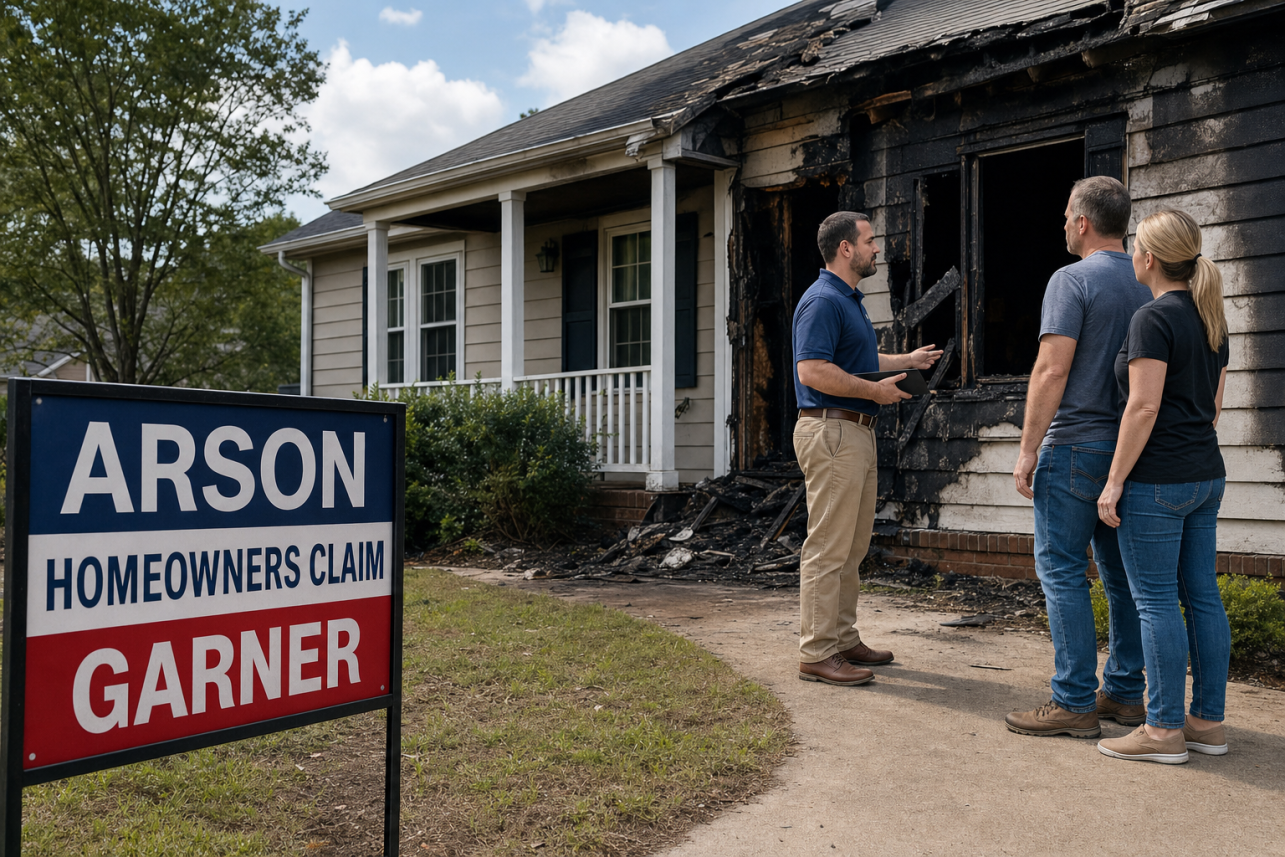
What If Someone Else Set The Fire — A Vandal, An Intruder, Or Even A Family Member — Does My Homeowners Policy Still Cover It?
In most cases, yes. Fire set by a third party — a burglar, a vandal, or a stranger — is a covered peril under standard homeowners policies. The arson exclusion insurers rely on applies to fires intentionally set by or at the direction of the insured, not fires set by someone else.
This matters in Garner fire investigations because carriers sometimes treat any incendiary finding as grounds for suspicion of the homeowner. An incendiary cause only tells you the fire was set on purpose. It says nothing about who set it. If there’s evidence of forced entry, threats against your family, prior vandalism, or a break-in reported to the Garner Police Department, that evidence points away from you — and it belongs in the claim file.
Fires involving household members are more complicated. North Carolina recognizes protections for innocent co-insureds in certain situations, so if one policyholder is accused, the other spouse or co-owner may still have rights under the policy. Those situations are fact-specific, and we coordinate with policyholder attorneys when the legal questions get thick.
Our job is the documentation side: proving the full scope of what you lost. We inventory contents room by room, scope the structural damage, track your temporary housing costs, and assemble a proof of loss that stands up to scrutiny.
We’re licensed and bonded, and while no adjuster can guarantee an outcome, presenting the third-party evidence properly — instead of letting the carrier’s theory go unchallenged — gives your claim its fairest hearing.
Local Relevance
Garner has grown fast as one of Wake County’s most active suburbs, which means the housing stock ranges from mid-century ranches near the older core to brand-new subdivisions still under construction. That mix matters in a fire investigation: aging wiring, older HVAC systems, and decades of homeowner modifications create legitimate accidental ignition sources that a rushed investigator can too easily label ‘undetermined’ — the finding that often triggers arson scrutiny.
Garner families also feel the region’s humid summers and occasional severe storms, so a single loss can layer fire, smoke, and water damage together. We separate and document each element so nothing gets absorbed into a disputed cause finding.
We serve homeowners throughout southern Wake County and beyond — including neighbors working with our Public Adjuster in Fuquay-varina NC team — and we know how local fire departments, fire marshals, and carriers typically handle suspicious-loss files in this market. If your fire was straightforward but the payout is not, we also provide Fire Damage Insurance Claim Help in Knightdale and across the Triangle.
Many of Garner’s older homes near the historic core still carry original or partially updated electrical systems, and fires that start in aging wiring are among the most frequently mislabeled as ‘suspicious’ when investigators cannot pinpoint an origin quickly — which is exactly when independent documentation of the scene, before cleanup, tends to make the biggest difference in how the claim is decided.
Under Investigation Instead Of Being Paid? Call Before You Give A Sworn Statement
If your insurer is treating your Garner house fire like a crime scene and treating you like a suspect, get representation before the next interview, deadline, or demand letter. For The Public Adjusters, Inc. is licensed and bonded, works only for policyholders, and the initial consultation costs you nothing.
Call us: (919) 400-6440
Helpful Resources
- NCDOI Public Adjusters Guide
- National Fire Protection Association (NFPA)
- North Carolina Department of Insurance — State regulator overseeing insurers and public adjuster licensing
Last updated: September 29, 2026