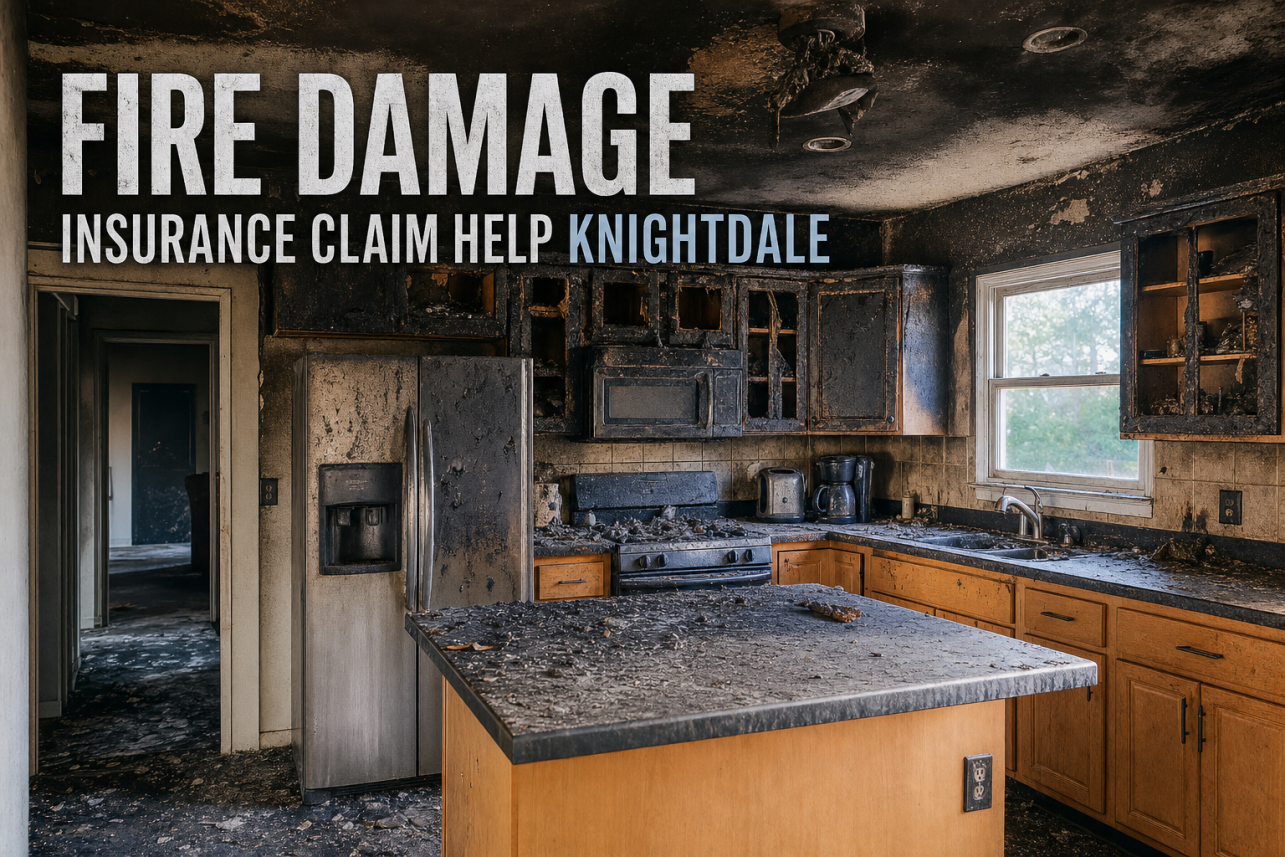
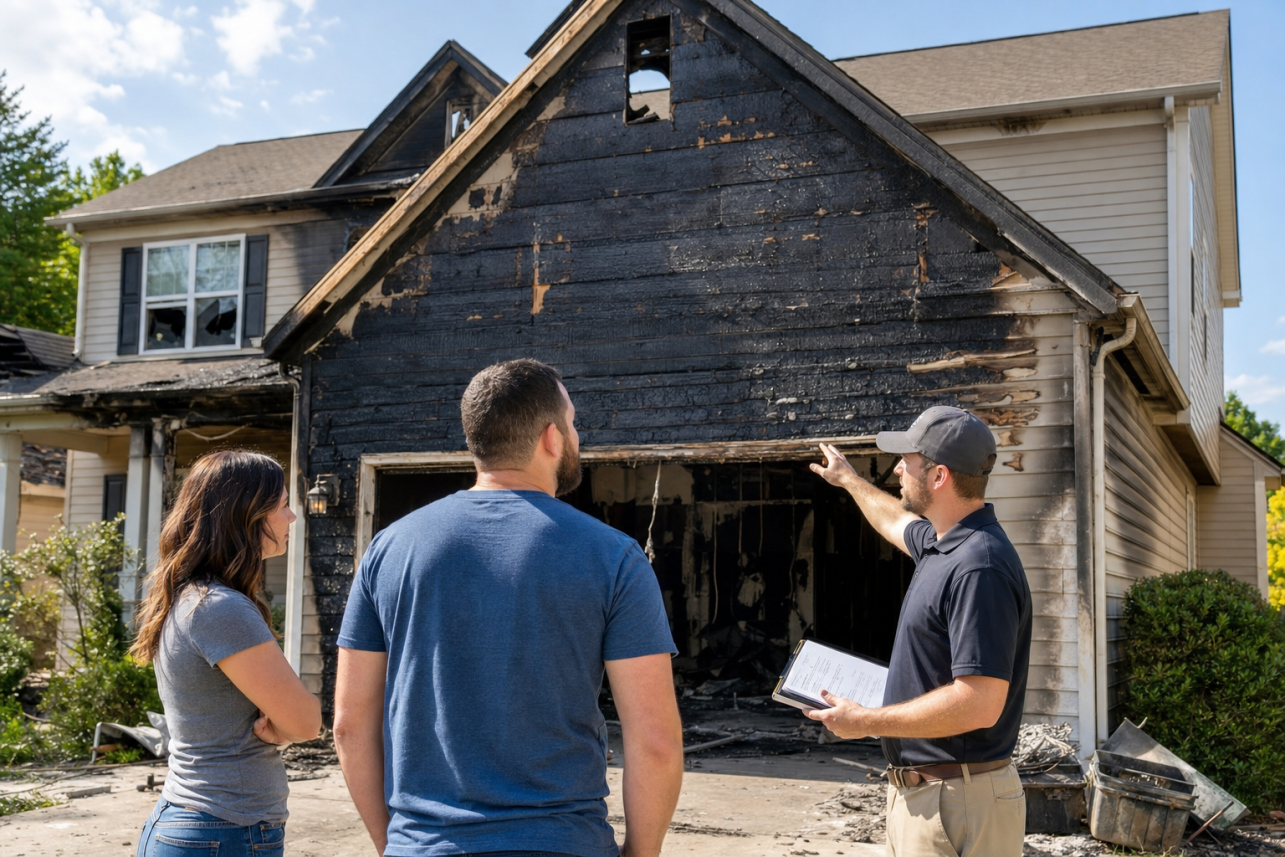
If you need fire damage insurance claim help Knightdale homeowners can actually rely on, a licensed public adjuster represents you — not the insurance company — from the first inspection through final settlement. For The Public Adjusters, Inc. documents the full scope of your loss, including smoke, soot, and the water damage left behind by firefighting, then negotiates directly with your insurer on your behalf. We are licensed and bonded in North Carolina, and there is no cost to have your situation reviewed.
What This Service Is
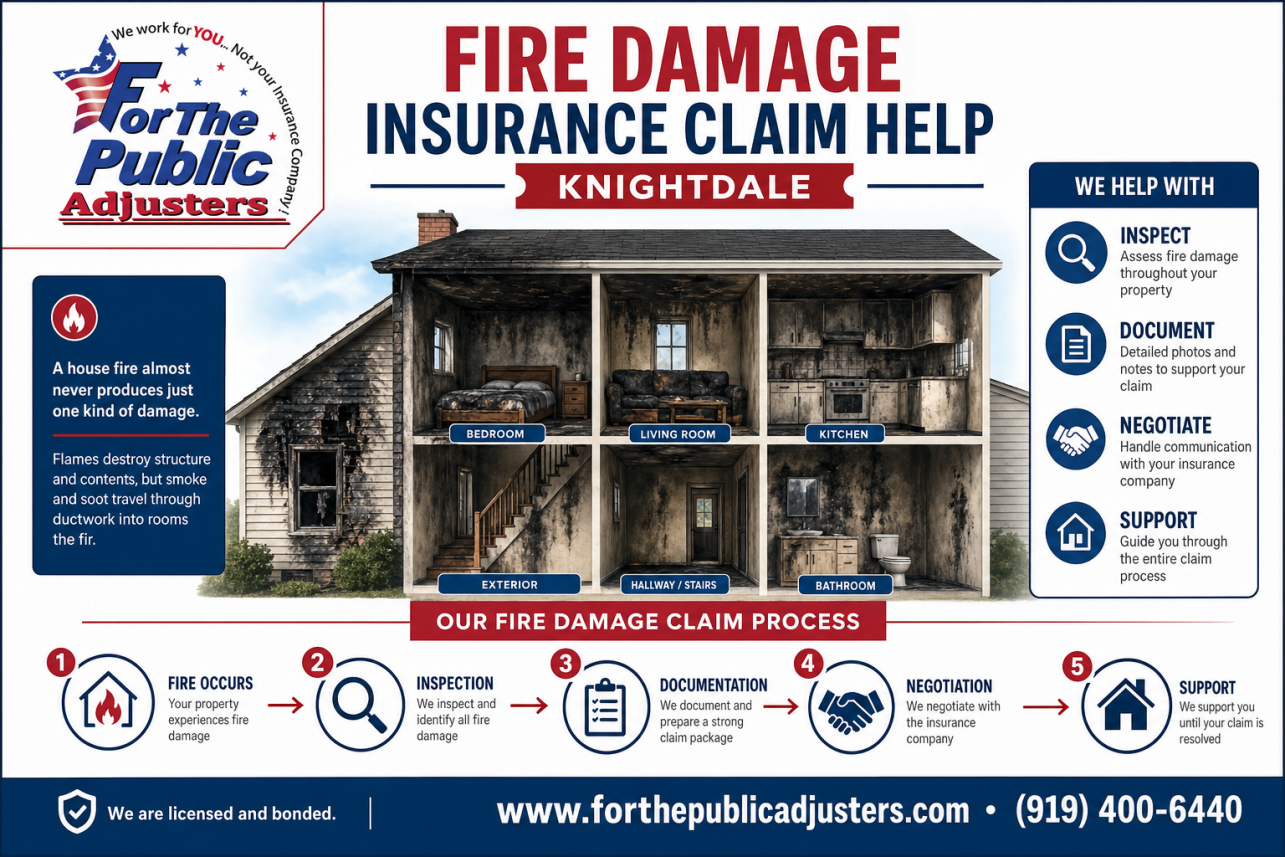
A house fire almost never produces just one kind of damage. Flames destroy structure and contents, but smoke and soot travel through ductwork into rooms the fire never touched, and the water used to put the fire out soaks flooring, drywall, and insulation. Your insurance policy typically covers all of it — but only if every piece of the loss is identified, measured, and documented before you sign off on a settlement.
That is the job of a public adjuster. We read your policy, assess the structure, build a room-by-room inventory of your damaged belongings, and prepare the proof of loss your insurer requires. We also account for things homeowners routinely miss: hidden damage behind walls, code-required upgrades during rebuilding, and the additional living expenses coverage that pays for temporary housing while your home is unlivable.
Because the insurance company’s adjuster works for the insurance company, having your own advocate changes the conversation. It is the same approach our fire damage claim adjuster in Cary NC clients see: we handle the claim so you can focus on your family.
Common Problems
Why Is The Insurance Company’s First Offer So Much Lower Than My Contractor’s Estimate?
This is the most common call we get after a Knightdale house fire. The insurer’s estimate is often built on depreciated values — actual cash value rather than replacement cost — and it frequently omits smoke remediation, duct cleaning, and firefighting water damage entirely.
Depreciation deductions can quietly strip thousands from a settlement. If your policy pays replacement cost, much of that depreciation is recoverable once repairs are done, but many homeowners never learn that and never collect it.
Policy coverage limits, your deductible amount, and how contents are valued all shape the final number. We compare what the policy actually promises against what the insurer offered, line by line, and pursue the difference.
What If My Claim Is Delayed, Underpaid, Or Denied Outright?
Delayed responses, repeated document requests, and lowball or denied claims are not the end of the road. North Carolina insureds have real remedies. In Guessford v. Pennsylvania National Mutual Casualty Insurance Co., a North Carolina homeowner whose house was destroyed by fire took the insurer to court over how the claim was handled — and the policyholder prevailed, with the jury finding the insurer’s claim practices improper.
Most disputes never need a courtroom. Thorough proof of loss documentation, a credible independent repair estimate, and firm negotiation resolve the majority of underpayments. When a carrier still won’t move, we work alongside insurance dispute lawyers.
We have taken the same approach to more than one fire insurance claim dispute in Raleigh, and the pattern holds: documentation wins arguments.
Fire Damage Insurance Claim Help Knightdale: Should I Handle The Claim Myself Or Hire Someone?
You can file on your own, and for very small losses that may be fine. But a fire claim involves structural estimates, contents inventories, smoke testing, temporary housing costs, and policy language most people have never read closely — while you’re also displaced and exhausted.
A legitimate public adjuster in North Carolina must be licensed; the NCDOI Public Adjusters Guide explains what adjusters may and may not do and how fees work. Ask any adjuster you interview for their license, their fee structure in writing, and examples of fire losses they have personally handled.
What a good adjuster actually does is simple to state: find every covered dollar of damage, prove it, and negotiate it. We never promise a specific outcome — no honest adjuster can — but we make sure nothing covered gets left off the table.
Our Process
Free Policy And Damage Review
We start by reading your homeowners policy and walking the loss with you. You learn what is covered — structure, contents, additional living expenses, code upgrades — and what obligations you have, such as protecting the property from further damage. There is no fee to find out where you stand.
Full Documentation Of The Loss
We build the claim file the insurer has to answer: a structural repair estimate, a room-by-room contents inventory with values, moisture readings where firefighting water intruded, and photographic evidence of smoke and soot migration. Hidden damage — charred framing behind intact drywall, contaminated ductwork — gets found now, not after you have settled. Our fire damage insurance claim adjuster in Clayton work follows the same standard.
Negotiation And Settlement
We present the documented claim, meet the insurer’s adjuster on site, and negotiate every disputed line — including recoverable depreciation and total loss determinations when a home cannot reasonably be repaired. You approve every decision. Our fee is a percentage of the settlement, so we are paid only from what we help you recover.
| What Happens During the Claim | Filing on Your Own | With For The Public Adjusters |
|---|---|---|
| Damage documentation | Photos on your phone; hidden smoke, soot, and structural damage often missed | Room-by-room inspection, soot testing, thermal imaging, and moisture mapping |
| Contents inventory | A rough list from memory, usually undervaluing hundreds of items | Itemized inventory with replacement-cost pricing for every damaged belonging |
| Additional living expenses | Often unclaimed or cut off early by the carrier | Housing, meals, and mileage documented and claimed for the full repair period |
| Negotiating the estimate | You against the carrier’s trained adjuster | Line-item rebuttal of the carrier’s estimate backed by evidence |
| Typical timeline pressure | Deadlines and proof-of-loss requirements easy to miss | All policy deadlines tracked and met on your behalf |
| Cost to you | Free, but settlements are frequently a fraction of the real loss | Contingency fee — we’re paid only from what we recover for you |
Commonly Overlooked In The Public Adjusting Industry
- Smoke contamination inside HVAC ductwork — Carrier adjusters rarely open the system, yet ducts redistribute soot into every room each time the air kicks on.
- Water and chemical damage from fire suppression — Homeowners fixate on the burn area while thousands of gallons of hose water have soaked walls and floors two rooms away.
- Ordinance and law (code upgrade) coverage — Wake County permitting can require updated wiring, panels, or egress during repairs, and carriers won’t pay for it unless the coverage is invoked by name.
- Charring and heat damage to framing behind intact drywall — Structural members can be compromised by heat without any visible surface damage, and nobody finds it without opening walls or using thermal imaging.
- Full additional living expense entitlements — Families claim the hotel but miss reimbursable meals, mileage, pet boarding, and laundry costs their policy actually covers.
- Depreciation holdback and recoverable depreciation — The first check is often actual cash value only, and homeowners never realize they can recover the withheld depreciation after repairs are completed.
- Protein and soot residue on ‘undamaged’ contents — Electronics, textiles, and mattresses absorb corrosive residue that causes failures and odor months later, long after the claim is closed.
- Proof-of-loss deadlines in the policy — Many policies require a sworn proof of loss within a set window, and missing it quietly can give the carrier grounds to deny an otherwise valid claim.
Case Studies
Case Study #1
Situation: A family off Old Knight Road came home to a kitchen fire that started in a countertop appliance. Flames were contained to the kitchen, but smoke traveled through the HVAC system into every bedroom upstairs.
Problem: The carrier’s adjuster wrote an estimate limited to the kitchen — cabinets, drywall, and paint — for roughly $28,000. Smoke and soot contamination in the ductwork, attic insulation, and soft goods throughout the home was left out entirely, and the family’s additional living expense coverage was never explained to them.
Investigation: Our team performed a room-by-room inspection with soot swab testing on walls two floors away from the fire’s origin, documented protein residue inside the supply ducts, and pulled thermal images showing heat damage behind an untouched wall the carrier’s adjuster never opened.
Findings: Chloride and soot residue levels confirmed contamination well beyond the kitchen. The HVAC system had actively distributed particulate through the home, insulation had absorbed smoke odor that could not be cleaned, and framing behind the range wall showed charring that compromised structural members.
Solution: We prepared a full line-item estimate covering duct cleaning and partial replacement, insulation removal and reinstallation, whole-home content cleaning with an itemized inventory of over 900 items, structural repairs, and four months of documented temporary housing under the additional living expense coverage.
Outcome: The claim settled at just over $147,000 — more than five times the original offer — and the family stayed in a comparable rental in Knightdale at the insurer’s expense while repairs were completed.
Lesson: Fire damage rarely stops where the flames stopped. If the carrier’s estimate only covers the room where the fire started, smoke and HVAC contamination have almost certainly been missed.
Case Study #2
Situation: The owner of a small retail plaza near Knightdale Boulevard suffered an electrical fire in one tenant space overnight. The fire department’s response left significant water damage in the two adjoining units.
Problem: The insurer treated the water-damaged units as a separate, lightly covered issue and disputed the business income claim, arguing the tenants could reopen within two weeks. The owner was staring at a $61,000 offer against real losses several times that size.
Investigation: We reviewed the fire marshal’s report, obtained the fire department’s suppression records showing where hoses were run, and brought in an electrician and a moisture-mapping technician to document damage across all three units. We also reconstructed the plaza’s rent rolls and tenant lease terms to build the business income loss.
Findings: The suppression water was a direct and inseparable consequence of the covered fire, meaning all three units fell under the same claim. Moisture readings showed saturation in shared demising walls that would have led to mold if the carrier’s two-week reopening timeline had been followed. Code upgrades to the electrical panel were also triggered by Wake County permitting requirements.
Solution: We submitted a consolidated claim tying the water damage to the fire peril, invoked the ordinance and law coverage for the required panel and wiring upgrades, and presented a month-by-month business income calculation supported by the actual leases and prior-year rent receipts.
Outcome: The final settlement came to approximately $312,000, including eleven weeks of documented business income loss, and every tenant space was restored to code and re-occupied.
Lesson: Water used to put out a fire is fire damage under the policy — and commercial claims almost always involve code-upgrade and income losses that carriers won’t volunteer to pay.
| Situation You’re Facing | Best First Move | What It Depends On |
|---|---|---|
| Home is unlivable after the fire | Keep every receipt and get temporary housing set up under your policy’s loss-of-use coverage | Your policy’s additional living expense limit and how long repairs will realistically take |
| Carrier’s estimate only covers the burn room | Get an independent damage assessment before accepting anything | Whether smoke traveled through HVAC, walls, or insulation into other areas |
| Insurer wants a recorded statement right away | You can politely delay until you understand your policy and your loss | Nothing requires same-day statements; rushed answers get used against claims |
| Contractor says the payout won’t cover repairs | Request the carrier’s full line-item estimate and have it reviewed | Gaps are usually in demolition, code upgrades, smoke remediation, and overhead |
| Smoke smell lingers after ‘cleaning’ | Insist on soot testing and duct inspection before closing the claim | Odor means contaminated materials remain — often insulation or ductwork |
| Claim already denied or underpaid | Have a public adjuster review the denial letter and policy language | In North Carolina you generally have three years from the loss to act, but sooner is far stronger |
| Business shut down by fire or suppression water | Document daily revenue losses and start a business income claim immediately | Your lease terms, prior sales records, and the realistic restoration timeline |
Reviews
Our garage fire spread smoke through the whole house and State Farm’s first offer barely covered repainting. For The Public Adjusters found soot in our ducts and attic that their adjuster never even looked for. The final settlement was almost four times the original number, and they handled every call with the insurance company so we didn’t have to.
Marcus T., Knightdale
After our kitchen fire I had no idea we were entitled to money for a rental house while repairs were done. They set up our additional living expenses, built a contents inventory of everything we lost down to the kids’ clothes, and caught structural charring behind a wall the insurer’s estimate skipped. Worth every penny of their fee.
Denise R., Wake County
I run a small restaurant and a grease fire shut us down. The carrier fought the business income portion hard. This team pulled our sales records, documented the smoke damage to equipment properly, and got us paid for the full closure period. Only wish I’d called them on day one instead of week three.
James O., Knightdale
Frequently Asked Questions
Where Can I Find Fire Damage Insurance Claim Help Knightdale Homeowners Can Actually Trust?
For The Public Adjusters, Inc. provides licensed public adjusting services to homeowners and business owners throughout Knightdale and the rest of Wake County. Unlike the adjuster your insurance company sends, we work exclusively for you, the policyholder, and our job is to document your loss thoroughly and negotiate the settlement your policy actually entitles you to.
After a house fire, most people are dealing with displacement, smoke-damaged belongings, and a claims process they have never navigated before. The carrier’s adjuster may spend an hour at your property. We spend as long as it takes, cataloging structural damage, smoke and soot migration into wall cavities and HVAC systems, water damage from fire suppression, and every damaged item in your contents inventory.
We know the local landscape too. Whether your loss is in an established neighborhood off First Avenue, a newer home near Knightdale Station, or a commercial space along the Highway 64 corridor, we understand current Wake County rebuild costs, which matters because carriers often price repairs using outdated or regionally averaged numbers.
Our fee is a percentage of the recovered settlement, so there is no upfront cost, and we only do well when you do. Many clients come to us after receiving a first offer that felt low, and in most of those cases we are able to identify covered damage the initial estimate missed entirely. Call us before you sign anything, and we will review your situation at no charge.
How Soon After A House Fire In Knightdale Should I Contact A Public Adjuster?
The honest answer is as early as possible, ideally before the insurance company’s adjuster completes their inspection. The first days after a fire are when the most consequential decisions get made: how the loss is documented, what temporary living arrangements are approved, and how the scope of damage gets defined. Once the carrier’s estimate is written, you are negotiating uphill against a number that is already on paper.
That said, it is never too late. We regularly take on Knightdale claims after homeowners receive a settlement offer that will not come close to covering the rebuild. Fires in Wake County trigger real costs, including debris removal, code-required upgrades on older homes, smoke remediation, and additional living expenses while your family is displaced, and any of those categories can be underpaid or overlooked.
One thing many policyholders do not realize: smoke and soot damage often extends far beyond the burn area. Soot travels through ductwork and settles in rooms that look untouched, and it is corrosive to electronics, wiring, and finishes over time. If the carrier’s inspection did not open walls, test the HVAC system, or evaluate rooms away from the fire’s origin, the estimate is almost certainly incomplete.
Before your first meeting with the insurance adjuster, avoid throwing anything away, take wide and close-up photos of every room, and do not accept a quick cash-out offer. Then call us. A free claim review early on frequently changes the outcome by tens of thousands of dollars.
What Does A Knightdale Public Adjuster Do That My Insurance Company’s Adjuster Doesn’t?
The core difference is who we answer to. The adjuster assigned by your carrier is paid by the insurance company, and their estimate reflects the company’s interests, cost guidelines, and time constraints. As your public adjuster, For The Public Adjusters, Inc. represents only you, and our compensation depends on maximizing your recovery under the policy.
In practice, that means we build the claim from the ground up. We prepare an independent, line-item estimate of structural repairs using current Wake County labor and material pricing, not software defaults. We create a complete contents inventory, room by room, with replacement values, which is tedious work most displaced families understandably cannot manage on their own. We also document smoke, soot, and water damage from firefighting efforts, which carriers frequently underscope.
We read your policy closely, and this is where real money often hides. Ordinance and law coverage can pay for code upgrades required when rebuilding an older Knightdale home. Additional living expense coverage should fund comparable housing, not just a bare-minimum arrangement, while repairs drag on. Debris removal, landscaping, and detached structures each have their own provisions.
Finally, we handle every communication and negotiation with the carrier, so you are not fielding calls, chasing paperwork, or being pressured into a fast, low settlement. Studies of fire losses consistently show that professionally represented claims settle for significantly more than unrepresented ones, and our local results reflect that same pattern.
How Much Does Fire Damage Insurance Claim Help Knightdale Families Receive From You Actually Cost?
We work on contingency, which means there is no upfront fee, no hourly billing, and no cost at all unless we recover money for you. Our fee is a percentage of the settlement, agreed to in writing before we begin, and it is regulated under North Carolina law. If we do not improve your outcome, you owe us nothing.
For most fire loss clients in Knightdale and greater Wake County, the math works strongly in their favor. First settlement offers on significant fire claims are routinely incomplete, whether from underscoped structural estimates, missed smoke remediation, undervalued contents, or unclaimed additional living expenses. When we rebuild the claim properly, the increase in recovery typically exceeds our fee many times over, meaning clients net substantially more even after paying us.
The initial consultation is free and carries no obligation. We will review your policy, walk your property if the loss is recent, or examine the carrier’s estimate if one has already been issued, and give you a straight assessment of whether the claim has been handled fairly. Sometimes we tell homeowners their offer is reasonable and representation is not worth the fee. When it is not reasonable, which is common with total or near-total fire losses, we will show you specifically where the gaps are.
If you are anywhere in Knightdale, from the neighborhoods near Mingo Creek to properties out toward the Business 64 corridor, reach out for that free review. It costs nothing to find out where your claim really stands.
Will Filing A Fire Damage Claim In Knightdale Cover Smoke And Water Damage Too, Or Just What Actually Burned?
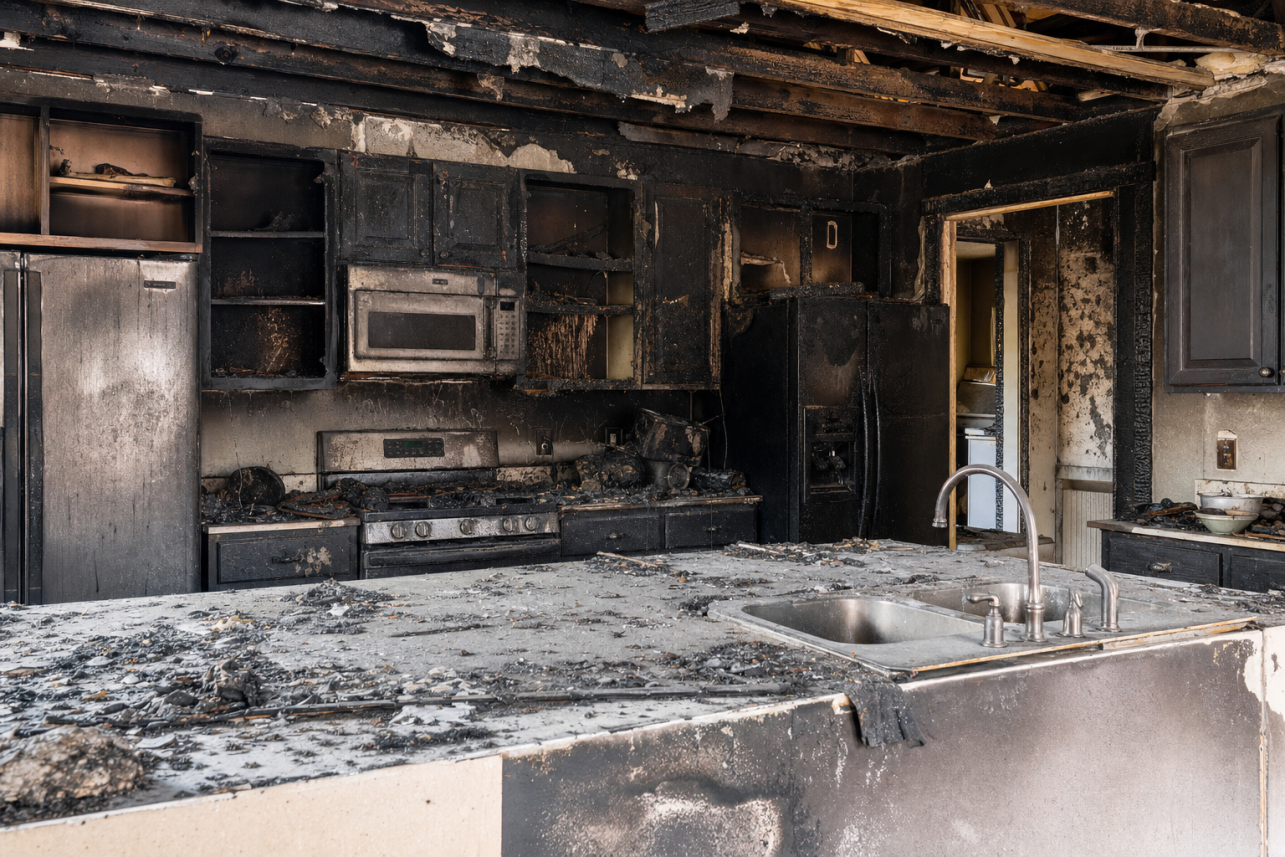
A properly documented fire claim should cover far more than the burned areas. Smoke residue travels through your HVAC system and settles into drywall, insulation, carpet, and even the studs behind your walls. Water and chemical suppressants used by the fire department frequently cause their own damage to flooring, cabinetry, and personal property two or three rooms away from the fire itself.
This is where many Knightdale homeowners get shortchanged. An insurance company adjuster may scope only the visibly charred rooms, while soot contamination in your ductwork, hidden moisture in wall cavities, and lingering odor in soft goods go unaddressed. Months later, homeowners discover corrosion on electronics or persistent smoke smell and find their claim is already closed.
When we handle fire losses in Wake County, we document everything: structural damage, smoke penetration, water intrusion, damaged contents, and additional living expenses if your home is uninhabitable. We often bring in testing to prove soot contamination in areas the carrier’s adjuster never inspected.
Your policy almost certainly covers these secondary damages, but coverage only matters if the damage is identified, documented, and included in the claim before settlement. That thorough scope of loss is the difference between a payout that truly restores your home and one that leaves you paying out of pocket for repairs the insurer should have funded.
My Insurer Already Made An Offer On My Knightdale Fire Loss. Is It Too Late To Get Fire Damage Insurance Claim Help Knightdale Residents Rely On?
No, it is not too late. Receiving an initial offer, or even cashing a first check, does not mean your claim is over in most cases. North Carolina policyholders generally retain the right to submit supplemental claims when additional damage is discovered or when the original settlement failed to account for the full scope of loss.
In fact, a large share of the fire damage insurance claim help Knightdale homeowners ask us for begins exactly this way. They received an offer that felt low, started getting contractor estimates, and realized the insurance payout would not come close to covering actual repair costs at current Wake County labor and material prices.
When we review a claim that has already been paid or offered, we start by comparing the carrier’s estimate line by line against the real damage. We look for missed items: code upgrade costs, smoke remediation, contents that were undervalued, overhead and profit for general contractors, and additional living expenses that were cut short.
If we find a gap, and we usually do on underpaid fire claims, we reopen negotiations with documentation the carrier cannot easily dismiss. The key is timing. Policies have deadlines for supplemental claims and proof of loss, so bring us your paperwork sooner rather than later, even if the fire happened months ago.
What Should I Avoid Doing After A House Fire In Knightdale Before My Claim Is Settled?
The days after a fire are when the most costly mistakes happen, and most are completely avoidable.
First, do not throw anything away until it has been documented. Burned furniture, ruined clothing, and smoke-damaged electronics are all evidence of your loss. Photograph everything, keep an inventory, and if items must be removed for safety, store them where they can still be inspected.
Second, be careful signing anything at the scene. Restoration companies and contractors often arrive quickly after Knightdale fires, and some present contracts with assignment-of-benefits clauses or open-ended pricing. Emergency board-up and water extraction are reasonable, but full repair contracts should wait until the scope of loss is established.
Third, avoid giving a recorded statement to the insurance company without preparation. You are obligated to cooperate with your insurer, but casual statements made under stress are sometimes used later to limit or question coverage.
Fourth, do not start permanent repairs before the damage is fully inspected. Once walls are closed up or debris is hauled off, proving the extent of the loss becomes much harder.
Finally, keep every receipt. Hotel stays, restaurant meals, replacement clothing, and pet boarding may all be reimbursable under your additional living expenses coverage. Homeowners across Wake County routinely leave thousands unclaimed simply because they did not track these costs. A public adjuster can guide you through each of these steps from day one.
How Long Does A Fire Damage Claim Usually Take To Settle In Wake County?
Timelines vary with the severity of the fire, but most residential fire claims in the Knightdale area settle within two to six months when they are handled properly. Smaller kitchen fires with limited smoke spread can resolve faster. Major structural fires, or claims where the carrier disputes the scope of damage, can stretch to a year or longer without strong advocacy.
Several factors drive the timeline. The insurance company must inspect the property, review your proof of loss, evaluate contents inventories, and approve estimates. Delays commonly happen when documentation is incomplete, when the carrier’s estimate conflicts with real-world Wake County repair costs, or when hidden damage is discovered mid-repair and triggers supplemental negotiations.
Our job is to compress that timeline by getting it right the first time. We prepare a complete, well-supported claim package: a detailed structural estimate, a room-by-room contents inventory with values, smoke and soot documentation, and additional living expense projections. When the carrier receives a professional claim file, there is less back-and-forth and fewer excuses for delay.
North Carolina also gives insurers specific obligations to acknowledge, investigate, and respond to claims in a reasonable timeframe. When a carrier drags its feet, we hold them to those obligations in writing. Homeowners who pursue fire damage insurance claim help Knightdale professionals provide early in the process almost always see faster, cleaner settlements than those who try to manage a complex fire loss alone.
What Documents Do I Need To Gather For Fire Damage Insurance Claim Help Knightdale Adjusters Will Ask About?
Start with your full insurance policy, including the declarations page and any endorsements. If your copy burned in the fire, we can request a certified copy from your carrier on your behalf — you’re entitled to it, and it’s the foundation of everything else.
Next, collect anything that proves what you owned and what your home looked like before the loss. Photos and videos on your phone, receipts, bank and credit card statements, appraisals for jewelry or collectibles, and even old real estate listing photos of your Knightdale home all help establish value.
Keep every receipt from the moment the fire happens forward: hotel stays, meals, replacement clothing, pet boarding, storage units. These support your additional living expense claim and are easy to lose track of during a stressful time. We give clients a simple tracking system on day one.
Finally, hold onto the fire department report, any communication from your insurance company, and estimates or invoices from contractors, board-up crews, or restoration companies. Don’t sign anything from a restoration firm without understanding it — some contracts assign your claim benefits away.
If that list feels overwhelming, that’s exactly why homeowners call us. When you bring in fire damage insurance claim help Knightdale families have used before, we take over the documentation burden, build the inventory, and package everything the way carriers require so nothing gets denied on a technicality.
My Family Can’t Live In Our Knightdale House After The Fire. Will Insurance Pay For Temporary Housing?
In most cases, yes. Nearly every homeowner’s policy includes Additional Living Expenses coverage, sometimes called Loss of Use. It pays the extra costs you incur because your home is uninhabitable — not your normal bills, but the difference between your usual cost of living and what you’re spending now.
That typically covers a comparable rental home or extended-stay hotel, increased grocery costs if you’re eating out more, laundry, pet boarding, extra mileage if your temporary housing adds to your commute, and storage for salvaged belongings. The key word is comparable: if you lived in a four-bedroom home near Knightdale Station, your carrier shouldn’t push your family of five into a single hotel room for eight months.
Insurers often lowball this coverage or pressure families to accept whatever’s cheapest and fastest. With rental inventory tight in eastern Wake County, finding a true like-for-like rental takes negotiation, and we handle that pressure for you. We document your pre-loss standard of living and hold the carrier to it.
Two warnings from experience. First, ALE has limits — either a dollar cap or a time cap, often twelve to twenty-four months — so the rebuild timeline matters and delays by the insurer shouldn’t burn through your benefit. Second, keep every receipt from day one, because carriers reimburse documented expenses, not estimates. Our team sets clients up with expense tracking immediately so no dollar of housing benefit is left unclaimed.
How Do You Handle The Contents Inventory For Everything We Lost Inside The House?
The contents inventory is where most self-filed fire claims fall apart, and it’s one of the most valuable things a public adjuster does for you. Your insurer will typically hand you a blank spreadsheet and ask you to list every item you owned — from memory, room by room, with age, brand, and price — while you’re still in shock.
We take a different approach. Our team walks the loss site with you when it’s safe, photographs and catalogs the debris, and uses sifting and layer-by-layer review to identify items that burned beyond recognition. Melted electronics, charred furniture frames, and even ash patterns tell us what was there.
Then we reconstruct the rest through interviews, old photos, purchase records, and room-by-room prompting. Most people forget entire categories — everything in the attic, the garage shelving, holiday decorations, the contents of every kitchen drawer. A thorough inventory for a Knightdale home routinely runs into the thousands of line items.
We also fight the depreciation battle. Carriers apply steep depreciation to arrive at actual cash value, and if you have replacement cost coverage, you’re owed the recoverable depreciation once items are replaced. We track and collect that second payment, which many homeowners never realize they’re entitled to.
The difference is real money. Inventories we prepare regularly come in significantly higher than what homeowners produce alone — not by inflating anything, but by making sure nothing you legitimately owned gets left off the list.
We Only Had A Kitchen Fire, Not A Total Loss. Is Fire Damage Insurance Claim Help Knightdale Homeowners Use Still Worth It For A Smaller Claim?
Often, yes — and sometimes smaller fires are the claims most likely to be underpaid. A kitchen fire that looks contained rarely is. Smoke travels through your HVAC system and deposits corrosive residue in ductwork, inside cabinets, behind walls, and into soft goods throughout the house. Protein smoke from a grease fire is nearly invisible but leaves a persistent odor that surface cleaning won’t fix.
Carrier adjusters frequently scope these losses as a clean-and-paint job in one or two rooms. Done properly, remediation may require duct cleaning or replacement, sealing and repainting well beyond the kitchen, cabinet replacement rather than refinishing, and professional cleaning or replacement of clothing and textiles. The gap between those two scopes can be tens of thousands of dollars.
When a Knightdale homeowner brings us in on a partial loss, we inspect areas the carrier’s adjuster skipped, test for smoke residue migration, and write a complete scope of repair. We also make sure hidden damage — heat-warped wiring, compromised insulation, water damage from firefighting efforts — makes it into the claim before you settle.
Because we work on a contingency fee, it costs nothing upfront to have us evaluate the loss. If the insurer’s offer is genuinely fair, we’ll tell you that honestly. But in our experience across Wake County, partial fire losses are underscoped more often than not, and having your own licensed adjuster reviewing the file usually pays for itself many times over.
What Happens If My Insurer Denies Or Lowballs My Claim — Can Fire Damage Insurance Claim Help Knightdale Providers Still Fight It?
Yes, and this is where a public adjuster earns their keep. A denial or a low offer is the insurance company’s opening position, not the final word. In North Carolina, you have the right to dispute it, and most policies include an appraisal clause that lets both sides bring in independent valuations when there’s a disagreement over the amount of loss.
Our first step is a full review of your policy and the carrier’s denial letter or estimate. Insurers frequently miss hidden smoke penetration in wall cavities, HVAC contamination, code-upgrade requirements under Knightdale’s building ordinances, and structural charring behind finishes that a quick walkthrough never catches.
We then build a documented counterclaim: line-item estimates using local Wake County contractor pricing, moisture and soot testing results, photographs, and a complete contents inventory. That documentation forces the carrier to respond to specifics rather than dismiss a general complaint.
If the insurer still won’t move, we can invoke appraisal on your behalf or, in cases involving bad-faith handling, refer you to an attorney we trust. Most disputed fire losses we handle settle without litigation once the carrier sees professional documentation. The key is acting before you sign a release or accept a final payment, so call us as soon as you receive a denial or an offer that feels wrong.
My Policy Pays ‘actual Cash Value’ First. How Do I Recover The Depreciation The Insurance Company Held Back On My Knightdale Fire Loss?
Most homeowners policies in North Carolina pay claims in two stages. First you receive the actual cash value — the replacement cost minus depreciation for age and wear. The withheld portion, called recoverable depreciation, is paid after you actually complete the repairs or replace the damaged items.
Here’s where Knightdale homeowners commonly lose money. Carriers often depreciate items too aggressively, applying steep percentages to roofing, cabinetry, and flooring that don’t reflect real-world lifespans. They may also fail to explain that you have a deadline — typically 180 days to two years depending on your policy — to complete repairs and claim that held-back money. Miss the window and it’s gone.
When we handle a fire claim, we challenge unreasonable depreciation schedules from the start, item by item. We also track every replacement receipt and contractor invoice so the recoverable depreciation demand is airtight when you submit it.
One more trap: if the insurer’s initial estimate undervalued the repair scope, your recoverable depreciation is undervalued too, because it’s calculated from that same flawed number. Fixing the estimate first is essential. Our team reviews the carrier’s line items against actual Wake County rebuild costs before you ever pull a permit, so both the upfront payment and the holdback reflect what your Knightdale home genuinely needs to be made whole.
Are Public Adjusters Licensed In North Carolina, And How Do I Verify One Before Hiring Them In Wake County?
Yes. North Carolina requires public adjusters to be licensed by the North Carolina Department of Insurance, and you should never hire anyone who can’t produce a license number on the spot. Verifying it takes two minutes on the Department of Insurance website, and any legitimate adjuster will encourage you to do exactly that.
North Carolina law also protects you in other ways. Public adjuster contracts must be in writing, must disclose the fee clearly, and give you a right to cancel within a set period after signing. Adjusters cannot solicit you during certain hours or misrepresent themselves as working for your insurance company.
Beyond the license, ask pointed questions. How many fire losses has the adjuster personally handled? Can they provide references from homeowners in Knightdale or the surrounding Wake County area? Do they understand local rebuild costs and Knightdale’s permitting and code-upgrade requirements, which directly affect what your claim should pay?
Be cautious of anyone who shows up at a fire scene unsolicited, pressures you to sign immediately, or promises a specific dollar outcome. Reputable adjusters assess the loss before making any projections.
For The Public Adjusters, Inc. is fully licensed in North Carolina, and we’re glad to walk you through our credentials, our fee agreement, and past fire claims we’ve settled in this area before you commit to anything. An informed client is our best client.
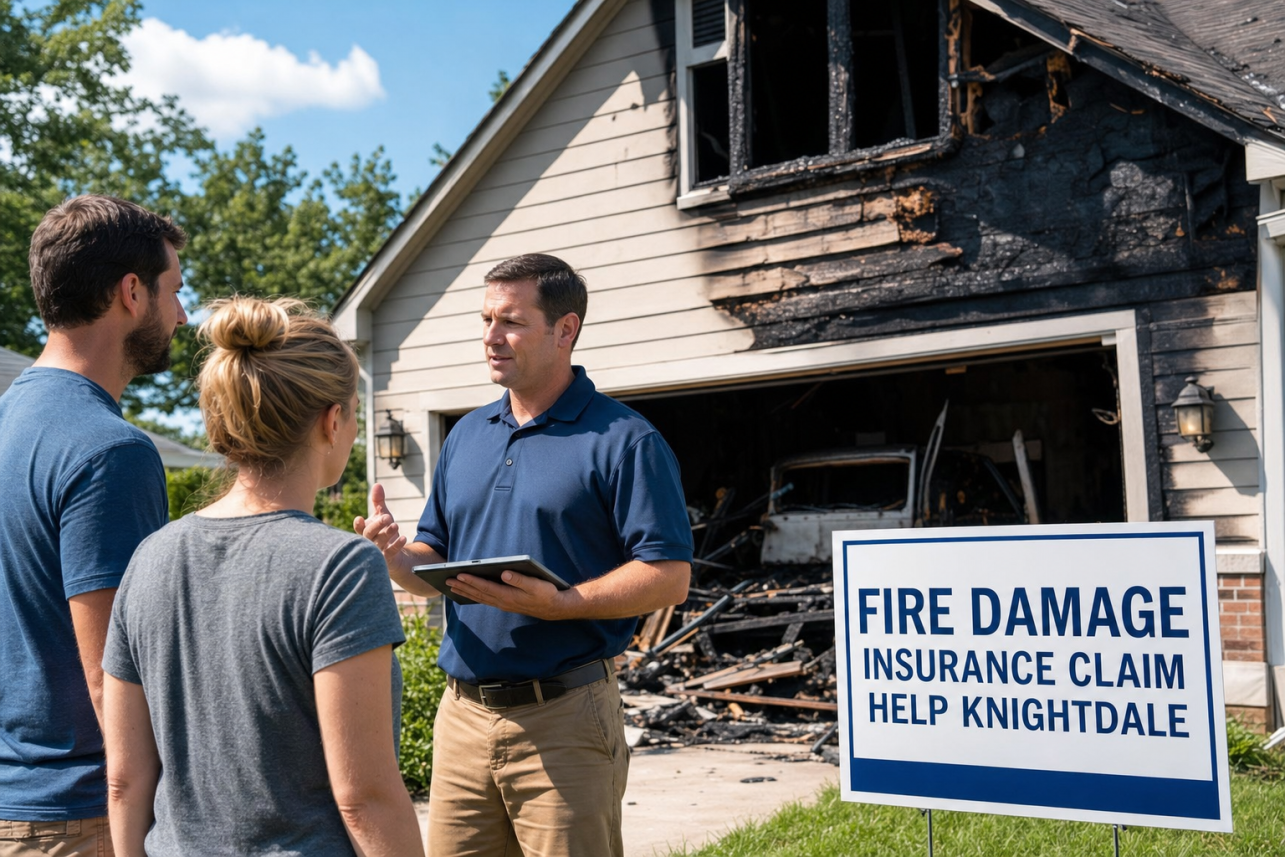
I Own A Rental House In Knightdale That Caught Fire. Does Fire Damage Insurance Claim Help Knightdale Landlords The Same Way It Helps Homeowners?
It does, though landlord claims have their own moving parts that make professional representation even more valuable. A dwelling fire policy on a rental property typically covers the structure, any landlord-owned contents like appliances, and — critically — loss of rental income while the property can’t be occupied.
That fair rental value coverage is where investors leave the most money behind. Carriers sometimes calculate lost rent using outdated figures or cut it off before the property is genuinely rentable again. We document current Knightdale market rents, your actual lease terms, and a realistic repair timeline so the income portion of your claim reflects reality, not the insurer’s optimistic schedule.
Structure claims on rentals also get scrutinized harder. Adjusters for the carrier may question maintenance history, tenant-caused damage, or vacancy clauses that can reduce or void coverage. We review your policy language before the carrier does, so we know exactly where the pressure points are.
There’s also coordination to manage: your tenant’s renters insurance covers their belongings, while your policy covers the building, and keeping those claims cleanly separated prevents delays. If the tenant needs relocation, that’s their carrier’s responsibility, not a deduction from yours.
Whether it’s a single rental off Smithfield Road or several doors across Wake County, our team handles the documentation, the estimates, and every negotiation with your insurer so the property gets back to producing income as fast as possible.
Local Relevance
Knightdale has grown quickly on the east side of Wake County, which means the housing stock runs from newer subdivision builds to older ranch homes closer to the town’s original core. Fires here follow the patterns the U.S. Fire Administration warns about statewide — kitchen and cooking fires above all, plus electrical fires in aging wiring and heating-related fires during cold snaps.
Newer construction brings its own claim complications. When a fire damages part of a recently built home, matching materials and meeting current building code during repairs can push costs well past the insurer’s first estimate, and code upgrade coverage becomes a real point of negotiation.
We work these claims throughout the Triangle. Homeowners looking for fire damage claim help in Garner face the same carriers and the same tactics, and a seasoned public adjuster in Raleigh NC sees the same underpayment patterns week after week. Local experience matters because we already know how these adjusters estimate — and where they cut.
Because so much of Knightdale was built in the last couple of decades, many homes have open floor plans and shared HVAC returns that let smoke and soot spread far beyond the room where a fire starts — so a “small kitchen fire” claim here often needs whole-house smoke remediation and duct cleaning that the insurer’s first estimate rarely includes. Insist that smoke migration be tested and scoped before you accept any settlement.
Talk To A Knightdale Fire Claim Advocate Before You Sign Anything
Once you accept a settlement, reopening the claim gets much harder. Let For The Public Adjusters, Inc. — licensed and bonded in North Carolina — review your policy and your damage for free. If we can add value, we’ll show you exactly how before you commit to anything.
Call us: (919) 400-6440
Helpful Resources
- NCDOI Public Adjusters Guide
- U.S. Fire Administration – Home Cooking Fire Safety
- U.S. Fire Administration home fire safety resources — Federal fire-safety and prevention information for homeowners
- North Carolina Department of Insurance — State regulator overseeing insurers and public adjuster licensing
Serving Knightdale · Wake
Last updated: September 4, 2026