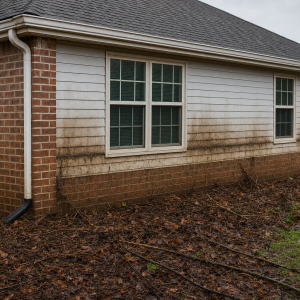

Why Was This NC Homeowner’s Underpaid Flood Claim So Common?
This homeowner received an underpaid flood claim because the insurance adjuster measured only to the visible high-water mark and paid for damage below that line — ignoring water that had wicked upward through drywall, insulation, and framing. This “flood line” shortcut is one of the most common reasons coastal North Carolina flood settlements come in thousands of dollars short.
Key takeaways
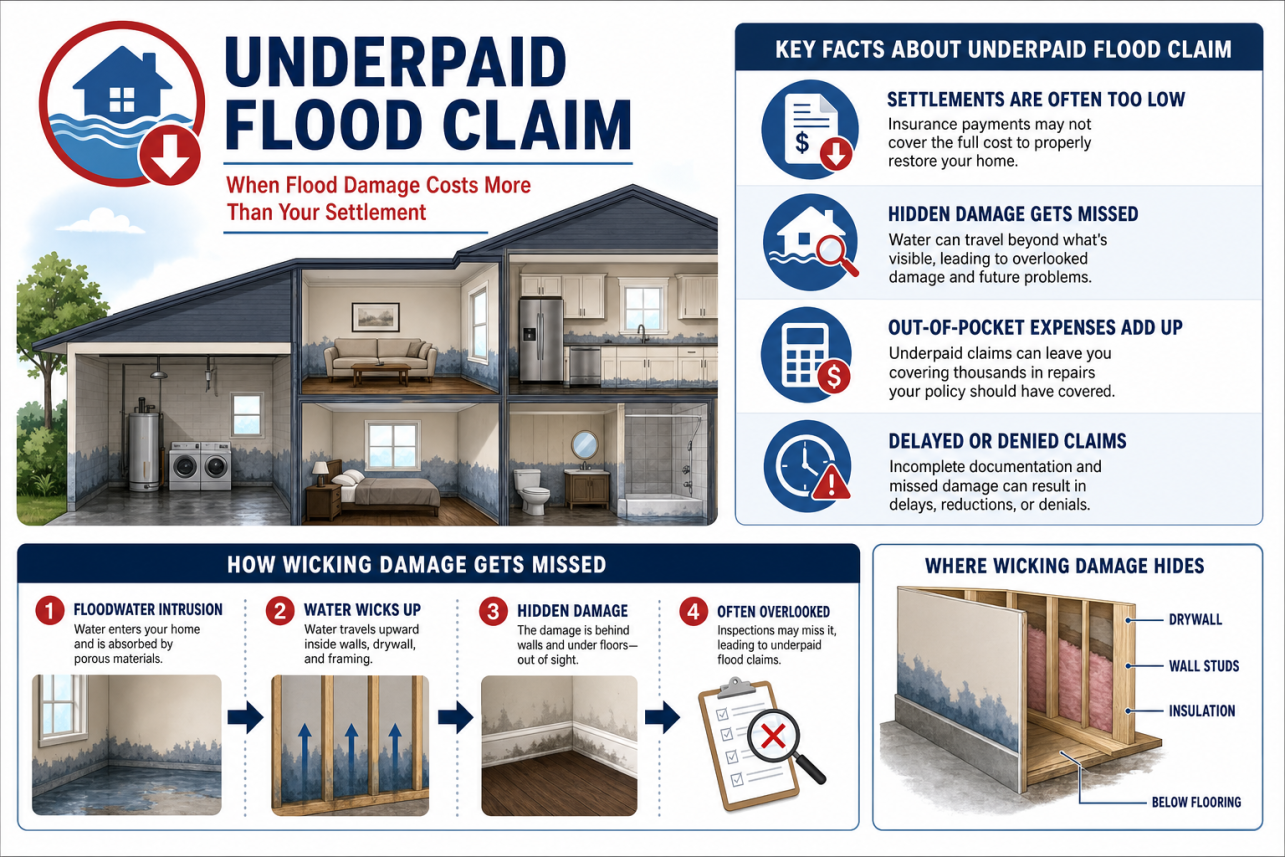
- Water wicks upward through drywall and insulation, often causing hidden damage 12–24 inches or more above the visible flood line.
- An adjuster who scopes damage only to the visible waterline will almost always produce an underpaid flood claim estimate.
- Moisture-meter mapping creates a room-by-room record of elevated moisture readings that carriers cannot easily dismiss.
- Drywall core sampling provides physical proof of saturation and microbial growth above the line the insurer drew.
- Homeowners in NC can hire a public adjuster or invoke appraisal to challenge a flood scope that ignores wicking damage.
Here’s how it played out. After a coastal storm pushed several inches of water into the home, the adjuster arrived, photographed the dirty ring left on the walls, and scoped the claim as if damage stopped exactly at that mark. The estimate covered flooring, baseboards, and a two-foot drywall cut. On paper, it looked reasonable. In reality, moisture readings taken later showed saturated drywall and wet insulation well above the visible line — damage the settlement never accounted for.
The “Flood Line” Shortcut, Explained
Standing water doesn’t stay where you can see it. Porous building materials pull water upward through capillary action — a process called wicking. But many adjusters, working quickly through dozens of claims after a major flood event, scope damage based on what’s visible rather than what a moisture meter would actually reveal. The result is an estimate built on an assumption instead of evidence.
What the Visible Water Line Doesn’t Show
- Drywall wicking: Gypsum board can draw moisture well above the standing-water level, weakening the material and feeding hidden mold growth.
- Saturated insulation: Fiberglass and cellulose insulation inside wall cavities hold water long after surfaces look dry, and typically must be removed and replaced.
- Wet framing and sill plates: Wood studs and plates absorb water that can lead to rot and structural issues if the affected sections aren’t dried or replaced.
- Trapped moisture behind cabinets and tubs: Areas the adjuster never opened up often stay wet the longest.
Why This Leaves Homeowners Holding the Bill
When the payout only covers a two-foot flood cut but the actual moisture damage extends higher, the homeowner faces a painful choice: pay the difference out of pocket, or leave wet materials in the walls and risk mold, odor, and bigger repairs down the road. Neither should be necessary when the policy covers the full scope of flood damage — the problem isn’t the coverage, it’s the incomplete inspection behind the estimate.
The good news is that an underpaid flood claim is not the final word. Moisture mapping, core sampling, and a properly documented supplemental claim can prove the true extent of wicking damage — topics we’ll cover in the sections below. If you’re dealing with a lowball flood settlement in North Carolina, our guide to flood damage insurance claim help and NFIP proof of loss deadlines explains what to watch for before you accept a payment.

What Is Wicking Damage and Why Do Insurance Adjusters Miss It?
Wicking damage occurs when porous building materials like drywall, insulation, and wood framing absorb floodwater through capillary action, pulling moisture 12 to 30 inches above the visible water line. Insurance adjusters miss it because a quick visual inspection only reveals the standing water mark — not the hidden saturation climbing inside your walls.
How Capillary Action Pulls Water Up Your Walls
Think of a paper towel touching a puddle. The water doesn’t stay at the bottom edge — it climbs. Your home’s building materials behave the same way. Floodwater sitting at four inches on your floor doesn’t stop at four inches inside the wall cavity. Gypsum drywall, fiberglass and cellulose insulation, wood studs, and baseboards all contain tiny pores and fibers that draw water upward against gravity.
The materials in a typical wall assembly wick moisture at different rates and heights:
- Drywall (gypsum board): Highly absorbent; moisture commonly rises well above the flood line, often a foot or more, and the paper facing supports mold growth quickly.
- Insulation: Fiberglass batts trap water and hold it against studs, while cellulose insulation acts like a sponge and rarely dries out on its own.
- Wood framing and sill plates: Studs absorb water through end grain and can hold elevated moisture levels for weeks, creating conditions for rot and mold long after surfaces look dry.
- Baseboards and trim: MDF trim swells and delaminates from moisture it pulls in from behind, even when the face looks fine.
Why a Visual-Only Inspection Systematically Underestimates the Loss
A carrier’s adjuster working through a heavy storm season may spend limited time at each property. If the inspection consists of photographing the water line and measuring the flooded square footage, the resulting estimate is built on what’s visible — not what’s actually wet. That gap produces predictable shortfalls:
- Flood cuts scoped too low: An estimate might allow drywall removal to two feet when the saturation actually reaches four feet, meaning the standard industry practice of cutting above the moisture line isn’t funded.
- Insulation left out entirely: Wet insulation hidden behind intact drywall never makes it into the scope if no one opens the wall or uses a meter.
- Framing drying and treatment omitted: Saturated studs need structural drying and often antimicrobial treatment — line items that don’t appear when the framing was never checked.
- Secondary damage ignored: Moisture trapped in wall cavities keeps migrating for days after the water recedes, so damage documented on day two understates what exists by day ten.
This is why wicking is one of the most common drivers of an underpaid flood claim: the damage is real, it’s covered, and it’s measurable — but it’s invisible to the naked eye. A thorough evaluation, like the kind described in our guide to water damage inspections, goes behind the surfaces instead of stopping at the water line. Without that deeper look, the estimate on your settlement check reflects only a fraction of what your walls actually absorbed.
How Do Moisture Meters and Core Sampling Prove an Underpaid Flood Claim?
Moisture meters and core sampling prove an underpaid flood claim by showing exactly how high water actually traveled inside walls — not just where the visible waterline sits. Meter readings map hidden saturation, while drywall core samples physically confirm wet gypsum above the insurer’s cut line, giving objective evidence that the original repair scope was too small.
In this case, the public adjuster didn’t argue opinions with the carrier — they built a data set. The insurer’s estimate assumed damage stopped at the visible flood line. The documentation process below demonstrated otherwise, wall by wall.
Grid-Pattern Moisture Mapping
Rather than spot-checking a few walls, the adjuster mapped every affected room in a grid pattern, taking meter readings at regular horizontal and vertical intervals. This approach produced a repeatable, room-by-room moisture map that showed:
- Readings taken at multiple heights on each wall — including well above the visible waterline
- Elevated moisture content in drywall and framing where wicking had pulled water upward
- A clear pattern of saturation, not isolated anomalies a carrier could dismiss
- Comparison readings from unaffected areas of the home to establish a dry baseline
That baseline matters. When the insurer sees a dry-standard reading from an untouched room next to elevated readings two feet above the flood line, the wicking argument stops being theoretical.
Core Samples That Settle the Argument
Meter readings can be challenged; a physical sample is harder to wave away. The adjuster cut small core samples from the drywall at and above the height where the carrier’s estimate stopped the flood cut. The samples showed gypsum that was visibly saturated and structurally compromised — soft, crumbling, and in some areas showing early microbial growth on the paper backing. Each sample was labeled by room, wall, and height so it tied directly back to a point on the moisture map.
Photo Logs That Connect the Dots
Every reading and every core cut was photographed with location context — wide shots showing the room, close-ups showing the meter display or sample, and measurements showing height off the floor. The photo log turned raw data into a narrative any desk reviewer could follow without setting foot in the house.
Rebuilding the Scope of Repairs
With the moisture map, core samples, and photo log assembled, the adjuster rebuilt the repair scope line by line: higher flush cuts on drywall, insulation removal in wicked cavities, antimicrobial treatment of framing, and the finish work — paint, trim, texture — that the larger demolition footprint required. The revised estimate wasn’t a negotiating posture; it was the documented cost of drying and repairing what the water actually touched. That’s the difference between disputing an underpaid flood claim with adjectives and disputing it with evidence.
Have Policyholders Won in Court When Insurers Lowballed Water Damage?
Yes. Courts have repeatedly sided with policyholders when insurers undervalued or misallocated water damage. In Corban v. United Services Automobile Ass’n, the Mississippi Supreme Court ruled in homeowners’ favor on how covered and excluded storm damage must be separated — and courts in other jurisdictions have rejected insurers’ overly narrow damage scoping when policyholders presented solid documentation.
These decisions matter to anyone fighting an underpaid flood claim, because they establish a principle that runs through water damage litigation nationwide: the insurer cannot simply declare part of your loss uncovered or minimal. The burden of proving what an exclusion actually excludes falls on the insurance company, and vague or convenient allocations don’t hold up under scrutiny.
What the Corban Decision Established
Corban arose from Hurricane Katrina, where homeowners suffered both wind damage (covered under their homeowners policy) and flood damage (excluded). The insurer tried to sweep large portions of the loss into the flood exclusion. The Mississippi Supreme Court disagreed, holding in substance that:
- Damage caused by a covered peril remains covered, even when an excluded peril also contributed to the overall loss.
- The insurer bears the burden of proving that damage falls within an exclusion — the homeowner does not have to disprove it.
- Losses must be allocated between covered and excluded causes based on actual evidence, not the adjuster’s assumptions.
While Corban is a Mississippi case, its reasoning has been influential, and the burden-of-proof principle it reflects appears in insurance law across many states, including in disputes over how high water actually reached and how far damage actually extended.
Why Courts Reject Narrow Damage Scoping
Beyond causation fights, policyholders have prevailed in disputes where insurers scoped damage too tightly — paying to replace only the visibly stained portion of a wall, for example, while ignoring saturation above the flood line. Courts and appraisal panels have found for policyholders when:
- Independent moisture readings or invasive testing contradicted the adjuster’s visual-only inspection.
- The insurer’s estimate ignored building code or industry drying standards that required broader removal of wet materials.
- The carrier failed to reasonably investigate hidden damage after being put on notice of it.
The Common Thread: Documentation Wins
In nearly every policyholder victory, the deciding factor wasn’t a clever legal argument — it was evidence. Homeowners who could show photographs, moisture logs, contractor estimates, and expert reports gave courts something concrete to weigh against the insurer’s estimate. Policyholders who relied only on their own testimony fared far worse.
The takeaway for anyone with an underpaid flood claim: the law is often on your side, but the law rewards proof. Building a documented record of the full extent of your water damage — before repairs erase the evidence — is what turns a lowball payment into a recoverable one.
What Should I Do If My Flood Claim Payment Seems Too Low?
If your flood claim payment seems too low, don’t sign a final release or cash a check marked “full and final settlement.” Preserve evidence before repairs begin, request the insurer’s complete estimate and adjuster notes, obtain independent moisture testing, and track your proof-of-loss and appeal deadlines carefully — they are strict and can end your claim if missed.
An underpaid flood claim is rarely fixed by a phone call alone. Insurers respond to documentation, so your job in the days after that disappointing payment is to build a paper trail that’s stronger than the one their adjuster created.
Don’t Sign Away Your Rights
Accepting a partial payment generally does not close your claim, but signing a release or settlement agreement can. Read anything the insurer asks you to sign, and if language suggests the payment is “final” or “in full satisfaction,” pause and get advice before signing. You can typically deposit an undisputed partial payment while continuing to pursue the difference — but confirm there’s no release language attached first.
Preserve the Evidence Before You Repair
- Photograph and video everything — waterlines, baseboards, drywall, insulation, and flooring — before demolition or drying.
- Keep damaged materials where safely possible, or cut and retain samples of drywall, flooring, and insulation showing the extent of saturation.
- Save receipts for emergency mitigation, tarping, drying equipment, and temporary living costs.
- Don’t let contractors haul away debris until it’s been documented — once it’s gone, it’s very hard to prove.
Request the Insurer’s Full File
Ask in writing for the complete adjuster’s estimate (with line items, not just a summary), the adjuster’s field notes, and any engineering or moisture reports relied upon. Comparing their line items to your contractor’s scope often reveals exactly where hidden damage — like moisture that traveled up walls — was left out.
Get Independent Testing and Estimates
Hire a qualified water damage professional or independent adjuster to perform moisture readings and document saturation above the visible waterline. Pair that with at least one detailed repair estimate from a licensed contractor familiar with flood restoration, not just cosmetic repair.
Know Your NFIP Deadlines
If your policy is through the National Flood Insurance Program — as many NC and VA flood policies are — deadlines are unforgiving:
- Proof of loss: NFIP policies generally require a signed, sworn proof of loss within 60 days of the date of loss, unless FEMA extends the deadline after a major event. If your damages exceed the payment, you may need to submit a supplemental proof of loss.
- Appeals: If you receive a written denial or partial denial, you generally have 60 days from the date of that letter to appeal to FEMA.
Put every request and dispute in writing, keep copies, and note the names and dates of every conversation. That record becomes the backbone of a successful supplemental claim or appeal.

How Can a Public Adjuster Help With an Underpaid Flood Claim in NC or VA?
A licensed, bonded public adjuster works only for the policyholder — not the insurance company. They re-inspect the property, document hidden wicking and moisture migration the original adjuster missed, prepare a corrected line-item estimate, and negotiate directly with the carrier to pursue the full amount your flood policy actually owes.
If you suspect an underpaid flood claim, the biggest advantage a public adjuster brings is time and thoroughness. Carrier adjusters often handle dozens of files at once, especially after a regional flood event. A public adjuster handles your claim as their client’s file, which means slower, more deliberate inspection — the kind that catches capillary wicking inside wall cavities before drywall gets patched over it.
What a Public Adjuster Actually Does on a Flood Re-Inspection
- Full re-inspection of the loss: Walking every affected room, checking above the visible waterline, and probing areas the first estimate skipped — baseboards, wall cavities, insulation, subfloors, and cabinetry toe-kicks.
- Documentation of hidden migration: Photographing, mapping, and logging moisture readings so the damage above the flood line is proven, not just claimed.
- A corrected, line-item estimate: Rebuilding the scope of repairs using current local pricing, then comparing it side by side against the carrier’s original estimate to show exactly what was omitted.
- Negotiation with the carrier: Presenting the evidence, requesting re-inspection where needed, and handling the back-and-forth so you aren’t arguing scope with a desk adjuster on your own.
- Deadline management: NFIP claims have strict proof-of-loss requirements, so having someone who tracks those timelines matters. You can review the federal claim process yourself through FEMA’s National Flood Insurance Program.
Licensing Matters in North Carolina and Virginia
Both states regulate public adjusters, and you should only work with one who is licensed and bonded in the state where your property sits. You can verify a North Carolina license through the North Carolina Department of Insurance, and Virginia licenses through the State Corporation Commission’s Bureau of Insurance. Licensing protects you: it means the adjuster is accountable to a regulator, carries a bond, and must follow state rules on fees and conduct.
What Happened in the NC Case
In the case study discussed throughout this article, a re-inspection documented wicking damage well above the visible waterline that the original estimate had left out entirely. Once that hidden damage was measured, photographed, and presented in a corrected estimate, the carrier revised the claim payment substantially upward from the original offer.
One honest caveat: every claim is different. Results depend on your policy language, the evidence available, and the specifics of your loss — no public adjuster can guarantee a particular recovery or promise a specific dollar outcome. What a good one can promise is a thorough, professionally documented claim presented on your behalf.
Underpaid Flood Claim: Insurer’s Visual Scope vs. Public Adjuster’s Moisture Documentation
| Factor | Carrier Adjuster (Visual Flood Line) | Public Adjuster (Instrument-Based) |
|---|---|---|
| How damage height is set | Eyeballs the visible stain or debris line | Maps actual moisture readings wall by wall |
| Wicking above the line | Typically excluded as ‘dry’ on sight | Documented with meter readings and core samples |
| Drywall removal scope | Often cut at 2 feet regardless of saturation | Cut height based on where materials actually test dry |
| Evidence in the file | Photos of the waterline only | Moisture maps, core photos, lab notes if needed |
| Typical outcome | Lower estimate, partial tear-out | Fuller scope supporting supplement or appraisal |
Illustrative Example: When the Flood Line Told Only Half the Story
Illustrative example
In this hypothetical composite scenario, a coastal North Carolina homeowner’s living room took on several inches of storm surge, and the carrier’s adjuster scoped damage only to the visible stain line on the drywall. Weeks later, the walls smelled musty and paint began bubbling well above that line. A public adjuster performed room-by-room moisture-meter mapping and pulled drywall core samples, documenting saturation and early microbial growth more than a foot above the insurer’s cut line. With that instrument-based evidence in the file, the homeowner submitted a supplemental claim for a full flood cut and insulation replacement, and the carrier revised its scope accordingly. The lesson: a visible waterline is a starting point, not the boundary of the loss.
Frequently asked questions
What is wicking damage, and why do flood adjusters often miss it?
Wicking is the capillary action that pulls floodwater upward through porous materials like drywall, insulation, and wood framing, causing moisture damage well above the visible waterline. Adjusters who measure only to the visible flood line often exclude this hidden damage, because staining above the line may be faint or invisible even though the material is saturated. Without moisture-meter readings or core samples, the estimate ends up covering only what can be seen from the surface.
How can I tell if I have an underpaid flood claim after a storm?
Common warning signs include an estimate that stops repairs at the visible waterline, no documented moisture-meter readings, drywall replacement limited to a low cut height even though water sat for an extended time, and no allowance for insulation, baseboards, or cabinets that absorbed water. If the payment seems far below realistic repair costs, or contractors’ bids exceed the insurer’s estimate, it’s worth having the damage independently documented before accepting the settlement.
How do moisture mapping and drywall core sampling prove hidden water damage?
Moisture mapping uses calibrated meters to record moisture levels at multiple heights and locations, creating a documented pattern of how far water actually migrated through walls. Core sampling removes a small plug of drywall so the inspector can directly examine the backside of the wallboard and insulation for saturation, staining, or microbial growth. Together, these produce objective evidence that damage extends above the insurer’s flood line, which can support a supplemental claim or dispute.
What can I do if my insurer refuses to pay for damage above the flood line?
You can request a re-inspection and submit your own documentation, such as moisture readings, photos, and contractor assessments. Hiring a licensed public adjuster is another option—they work for the policyholder, can perform detailed damage documentation, and negotiate directly with the carrier. Depending on your policy and whether it’s an NFIP or private flood policy, you may also have appraisal, appeal, or legal options, but deadlines apply, so act promptly and keep all correspondence in writing.
Related local pages
- Public Adjuster Cary NC: Navigating Insurance Claims When Insurance Companies Leave You Holding The Bill
- Public Adjuster Garner NC — Fight for the Full Settlement You Deserve
- Public Adjuster Holly Springs NC — Fight For The Full Settlement You Deserve
If your flood claim payment doesn’t match your damage, request a free claim review from our licensed and bonded public adjusters serving North Carolina and Virginia. Get in touch.
Last updated: October 2, 2026