

Flood Insurance Claim help Garner homeowners can count on comes from For The Public Adjusters, Inc., a licensed and bonded firm that represents you — not the insurance company — after rising water damages your home or business. We handle the documentation, the proof of loss, and the negotiation so your flood claim reflects what you actually lost. Whether your policy is through the National Flood Insurance Program or a private carrier, we work to move your claim toward a fair settlement.
What This Service Is
A flood claim is different from almost every other property claim you will ever file. If your policy was written through the NFIP, it runs on federal rules, strict deadlines, and a formal proof of loss requirement — miss a step and you can lose money you were otherwise owed. Most homeowners have never seen these rules until water is already in the house.
As public adjusters, we step in as your representative. We inspect the structure, measure the water line, document damaged flooring, drywall, cabinets, and mechanical systems, and build a room-by-room inventory of your personal property. Then we prepare the estimate and the sworn paperwork the carrier requires, and we negotiate from that evidence.
Flood is only one of the losses we handle. Homeowners who call us for rising water often learn we also provide Fire Damage Claim Help in Garner, along with smoke, tree, and vandalism claims across the Triangle. We work on a contingency fee, meaning our fee is a percentage of the recovery — there is no hourly bill while your claim is open.
Common Problems
Why Is The Insurance Company’s Flood Offer So Much Lower Than My Contractor’s Estimate?
This is the most common call we get. The carrier’s adjuster may have measured quickly, missed water that wicked up inside walls, or priced repairs at rates no local contractor will actually work for.
Depreciation is the other quiet culprit. Many flood policies pay actual cash value on certain items — the depreciated worth, not the cost to replace them — and if nobody challenges how that depreciation was calculated, the gap comes out of your pocket. We rebuild the estimate line by line so the numbers match real repair costs in Wake County, not a spreadsheet average.
Policyholders have won this fight before. In Corban v. USAA, the Mississippi Supreme Court sided with homeowners after hurricane damage, holding that the insurer bears the burden of proving its exclusion applies — a reminder that the carrier’s first position is not the final word.
Flood Insurance Claim Help Garner Residents Need When The Claim Stalls Or Gets Denied
Flood claims fail on paperwork more than on facts. NFIP policies generally require a signed, sworn proof of loss within a strict window — typically 60 days from the loss unless extended — and a denial letter often traces back to a missed form, an incomplete inventory, or damage the carrier says was pre-existing.
A denial or a stall is not the end. There is an appeal path, and a properly documented supplemental claim can reopen numbers that were settled too low. We have seen the same pattern in water losses across the region, including a Water Damage Claim Help Bynum matter where thorough re-documentation changed the outcome.
Speed matters too. Flood-soaked drywall and subfloors grow mold within days in our humid climate, and carriers sometimes argue that later mold was your failure to mitigate. Documenting the progression early protects you from that argument.
Should I Handle The Flood Claim Myself Or Hire A Public Adjuster?
You are allowed to handle it yourself, and for a very small loss that may be fine. But a flooded home involves structural drying, contents inventories, sworn statements, and valuation disputes — all while you are living somewhere else and paying out of pocket.
A good public adjuster is licensed by the state, bonded, and paid only from what is recovered, so our interests line up with yours. Ask any adjuster you interview for their license, their fee agreement in writing, and examples of flood work — not just fire or wind.
We answer those questions gladly, and our results travel with us. Homeowners who found us through a Public Adjuster Water Damage Bear Creek claim refer neighbors for the same reason: the file we build is one the carrier has to take seriously. We never guarantee a specific dollar outcome — no honest adjuster can — but we do guarantee your loss will be fully documented and professionally argued.

Our Process
Inspection And Damage Documentation
We come to your Garner property, photograph and measure the water line, and record every affected surface, system, and structure. We separate flood damage from unrelated wear so the carrier cannot blur the two, and we start your personal property inventory room by room while the evidence is fresh.
Estimate, Proof Of Loss, And Filing
We price the repairs at realistic local rates, value your contents, and prepare the sworn proof of loss and supporting documents the policy requires. The Federal Emergency Management Agency publishes the rules NFIP claims must follow, and we build your file to meet them the first time — deadlines included.
Negotiation And Settlement
We present the file to the carrier’s adjuster, challenge unsupported depreciation and pricing, and pursue additional living expenses where the policy provides them. If the first number is wrong, we push through supplements or the appeal process. You approve every step before anything is settled.
| Claim Step | Filing on Your Own | With For The Public Adjusters |
|---|---|---|
| Damage documentation | Photos of visible damage; hidden saturation in walls, subfloors, and ducts often missed | Moisture mapping, opened cavities, water-line evidence, and FEMA storm data supporting the full scope |
| Proof of loss (NFIP 60-day rule) | Easy to file late, incomplete, or undervalued — which can limit recovery | Complete, itemized, and filed on time in the format the flood program requires |
| Contents inventory | Discarded items frequently go unclaimed for lack of records | Inventory reconstructed from invoices, bank records, and pre-loss photos |
| Estimate review | Carrier’s scope accepted at face value | Line-by-line comparison against actual damage and standard flood remediation practice |
| Negotiation | Homeowner argues alone against a trained flood examiner | Licensed, bonded adjusters advocating solely for the policyholder |
| Flood vs. other perils | Confusion over what falls under the flood policy versus the homeowner policy | Damage correctly allocated so nothing falls through the gap between policies |
Commonly Overlooked In The Public Adjusting Industry
- Moisture wicking above the visible water line — Drywall and insulation pull water 20 to 30 inches higher than the flood line, so estimates based only on the stain shortchange the wall repair scope.
- The NFIP 60-day proof of loss deadline — Homeowners assume filing the initial claim is enough, but the flood program requires a signed, itemized proof of loss and missing it can forfeit unpaid amounts.
- Floodwater in HVAC ductwork and crawlspace systems — Ducts and mechanicals under Garner homes sit below floor level where nobody looks, yet contaminated floodwater inside them requires replacement, not cleaning.
- Subfloor delamination under intact flooring — Plywood and OSB subfloors soak and separate slowly, so floors that look fine at inspection fail weeks after the claim is closed.
- Contamination category of the water — Rising floodwater is treated as grossly contaminated, which changes what must be removed versus dried — a distinction quick estimates routinely ignore.
- Splitting damage between flood and homeowner policies after a hurricane — Rising water belongs on the flood policy while other hurricane damage may belong on the homeowner policy, and misallocating either side leaves covered losses unpaid.
- Depreciation applied to flood building payments — Many NFIP payments start at actual cash value, and policyholders often never pursue the recoverable amounts they may be entitled to after repairs.
- Electrical receptacles and wiring below the water line — Outlets and low wiring that took on floodwater are a latent fire hazard, but they get skipped because the damage isn’t visible from the surface.
Case Studies
Case Study #1
Situation: A family off Timber Drive near Swift Creek came home after a tropical storm pushed several inches of water through their crawlspace and first floor. They carried an NFIP flood policy and filed promptly, expecting the process to be straightforward.
Problem: The insurer’s adjuster spent under an hour on site and issued an estimate that covered drywall cuts and carpet removal but ignored saturated subflooring, wicking in the wall cavities, and damaged HVAC ductwork under the home. The proof of loss deadline was approaching and the family didn’t realize the burden was on them to document everything.
Investigation: Our team performed moisture mapping room by room, opened wall cavities where meter readings showed hidden saturation, photographed water lines inside and outside the home, and inventoried contents down to serial numbers. We also pulled FEMA high-water data for the storm to corroborate flood depth at the property.
Findings: Moisture had wicked 30 inches up interior walls, well above the visible water line. The subfloor was delaminating in three rooms, insulation in the crawlspace was ruined, and the ductwork had taken on floodwater. None of this appeared in the carrier’s original scope.
Solution: We prepared a detailed, line-item estimate matching NFIP requirements, filed a complete and timely proof of loss, and walked the property again with the carrier’s adjuster to show the moisture readings and opened cavities firsthand.
Outcome: The carrier revised its scope substantially to include subfloor replacement, full-height drywall in affected rooms, insulation, and duct replacement. The final payment was several times the original estimate. Every claim is different and results vary, but complete documentation changed this one entirely.
Lesson: Flood policies pay on what is proven, not what is obvious. The visible water line is almost never the true extent of the damage, and NFIP deadlines don’t wait while you figure that out. Courts have recognized policyholders’ rights here too — in Studio Frames, Ltd. v. Standard Fire Insurance Co., a North Carolina flood case that reached the Fourth Circuit, the insured business successfully pursued its flood claim against the carrier over damage to its building and contents.
Case Study #2
Situation: A small business owner near downtown Garner had flooding in a leased commercial building after heavy rains overwhelmed local drainage. Inventory, shelving, and equipment on the ground floor sat in a foot of water overnight before anyone could get inside.
Problem: The insurer questioned whether the contents claim was properly documented and initially declined large portions of it, arguing the owner couldn’t establish pre-loss condition or values. The owner had thrown out spoiled inventory quickly for health reasons, which the carrier used against the claim.
Investigation: We reconstructed the contents inventory using purchase invoices, supplier records, point-of-sale reports, bank statements, and pre-loss photos pulled from the business’s own marketing and social media. We documented flood cut lines, staining, and rust patterns on remaining fixtures to establish water depth and duration.
Findings: The records substantiated nearly the entire contents claim, including items disposed of before inspection. The building damage scope was also short — the carrier had missed water-damaged electrical receptacles, swollen door frames, and contaminated wall insulation that required removal under standard flood remediation practice.
Solution: We submitted a fully supported proof of loss with the reconstructed inventory, valuation backup, and a corrected building scope, then negotiated directly with the carrier’s flood examiner on each disputed line item.
Outcome: The carrier accepted the reconstructed inventory and the expanded building scope. The owner recovered enough to restock and reopen. As always, no two claims resolve the same way and no outcome is ever guaranteed — but the documentation did the heavy lifting.
Lesson: Never assume a discarded item is a lost item. Flood contents claims can often be rebuilt from invoices, banking records, and photos — but the earlier that work starts, the stronger the claim. Precedent supports policyholders who prove their losses: in Studio Frames, Ltd. v. Standard Fire Insurance Co., 483 F.3d 239 (4th Cir. 2007), a North Carolina insured prevailed in its flood coverage fight over building and contents damage.
| Decision Point | Safer Move | What It Depends On |
|---|---|---|
| Throwing out flood-soaked contents | Photograph, list, and keep samples or serial-number plates before disposal | Health hazards may force quick removal, but undocumented items are hard to recover — FEMA’s guidance at fema.gov covers safe documentation |
| Signing the carrier adjuster’s scope | Get an independent review before accepting it as final | How much hidden damage exists in walls, subfloors, insulation, and ductwork that a fast inspection can miss |
| Filing the NFIP proof of loss | File complete and early, not at the 60-day deadline | Extensions are sometimes issued after major disasters, but never assume one applies — verify through the NFIP at floodsmart.gov |
| Starting repairs before inspection | Mitigate only (dry out, prevent mold) and document everything first | Whether the carrier has inspected yet; repairs made before documentation can erase your evidence |
| Flood policy vs. homeowner policy | Report to both carriers when the cause is mixed, such as a hurricane | Rising water is flood; other storm damage may fall under the homeowner policy — misallocation can leave money on the table |
| Accepting a supplemental offer | Compare it line by line against your documented scope | Whether the revised estimate actually includes subfloor, insulation, electrical, and mechanical damage below the water line |
| Disputing a denial | Know that policyholders can and do prevail with proof | The strength of your documentation — in Studio Frames v. Standard Fire, a North Carolina insured won its flood coverage dispute over building and contents damage |


Reviews
After the creek behind our neighborhood flooded, the NFIP adjuster’s estimate didn’t even cover replacing our subfloor. For The Public Adjusters came out with moisture meters, found soaked insulation and wicking in walls the first inspection missed, and handled the proof of loss before the deadline. The revised settlement actually reflected the real damage. I’d never try flood insurance claim help in Garner on my own again.
Denise W., Garner
Our rental property near Lake Benson took on water during a hurricane remnant. The carrier kept going back and forth on what was flood damage versus ‘pre-existing.’ These adjusters documented the water line, pulled FEMA flood data for the storm, and itemized everything room by room. What impressed me most was how well they knew the NFIP rules — deadlines, proof of loss format, all of it.
Marcus T., Wake County
We lost most of our first-floor contents in a flash flood and had already thrown out ruined furniture before we knew we needed photos of everything. They rebuilt our contents list from receipts and old photos and got the carrier to accept it. The process still took a couple of months, but they kept us informed the whole way and the outcome was far better than the first offer.
Priya R., Garner
Frequently Asked Questions
What Does Flood Insurance Claim Help Garner Actually Include, And How Does A Public Adjuster Fit In?
When you hire For The Public Adjusters, Inc. for Flood Insurance Claim help Garner homeowners can expect us to manage the claim from first inspection to final settlement. That starts with documenting every inch of flood damage — waterlines, saturated drywall, buckled flooring, damaged HVAC systems, and ruined contents — before anything gets torn out or discarded.
From there, we prepare a detailed, line-item estimate of the loss, complete the sworn Proof of Loss your policy requires, and handle communication with the insurance company’s adjuster. Most flood policies in Wake County are written through the National Flood Insurance Program (NFIP), which has strict deadlines and documentation rules that trip up many policyholders. You can review those program rules yourself at FloodSmart.gov and FEMA.gov.
It matters because policyholders who push back can prevail. In Studio Frames Ltd. v. Standard Fire Insurance Co., 483 F.3d 239 (4th Cir. 2007), a North Carolina business whose building contents were destroyed by flooding fought its flood insurer over proof-of-loss requirements — and the Fourth Circuit sided with the policyholder, allowing the claim to move forward. Cases like that show why careful documentation and knowledge of the policy’s fine print make a real difference.
We are licensed and bonded, and we work only for you, never the insurance company. While no adjuster can guarantee a specific outcome, our job is to make sure every dollar of covered damage is properly documented, presented, and pursued under the terms of your policy.
My Garner Home Flooded But The Insurance Company’s Offer Seems Low. Can You Still Get Involved?
Yes. Many of our Garner clients call us after receiving an initial offer that doesn’t come close to covering the real cost of repairs. A low first offer is not the end of the claim — under most NFIP flood policies, you have the right to submit additional documentation and request additional payment, provided you meet the policy’s deadlines.
Our team re-inspects the property, compares the insurer’s estimate against the actual scope of damage, and identifies what was missed. Common gaps we find in Wake County flood claims include undervalued flooring replacement, overlooked damage behind baseboards and inside wall cavities, missed contents items, and inadequate allowances for drying and mold prevention.
Deadlines matter enormously here. The Standard Flood Insurance Policy typically requires a signed and sworn Proof of Loss within 60 days of the loss, unless FEMA extends that window after a major event. Missing it can jeopardize the entire claim, which is one reason the policyholder’s victory in Studio Frames Ltd. v. Standard Fire Insurance Co. — a North Carolina flood-contents case where the Fourth Circuit allowed the insured’s claim to proceed — is such an important reminder that these procedural rules are worth understanding and fighting over.
We are licensed and bonded, and we never promise a specific dollar amount — no honest adjuster can. What we do promise is a thorough, professionally documented claim presented in full, so the insurer is responding to the complete picture of your loss, not a rushed drive-by estimate.
Does Flood Damage From A Hurricane Get Handled Differently Than Damage From Heavy Rain In Wake County?
Often, yes — and this is where Garner homeowners can get caught in the middle. When a hurricane hits, a single property may suffer both wind damage and flood damage, and those two perils are usually covered by two different policies. Wind damage from the hurricane falls under your homeowners policy, while rising water falls under your separate flood policy, most commonly an NFIP policy backed by FEMA.
The problem is that each insurer may try to attribute the damage to the other peril. The flood carrier says the roof opening let rain in (wind), while the homeowners carrier says the water rose from the ground (flood). Without careful documentation, a policyholder can be shortchanged on both claims.
Our role as your public adjuster in Garner is to sort the damage accurately: establishing waterlines, photographing the sequence of damage, and preparing separate, properly supported estimates for each policy. Ordinary rainstorm flooding is simpler — it typically involves only the flood policy — but the documentation standards are just as strict.
Either way, resources like FEMA.gov and FloodSmart.gov are worth reviewing so you understand what the NFIP does and does not cover, such as the limited coverage for basements and the difference between building coverage and contents coverage. We walk clients through those distinctions before the claim is filed, so nothing covered gets left on the table. As always, we’re licensed and bonded, and we advocate solely for the policyholder — never the insurance company.
How Much Does Flood Insurance Claim Help Garner Cost, And When Should I Call For The Public Adjusters, Inc?
Public adjusters typically work on a contingency basis — a percentage of the claim settlement — so there is generally no large upfront fee to get professional representation. We explain our fee structure clearly in writing before you sign anything, and because we are licensed and bonded, our agreements comply with state public adjusting regulations.
As for timing: the best moment to call is before you file, or as early in the claim as possible. Flood claims are evidence-driven. Once wet drywall is torn out and contents are hauled to the curb, proving the full extent of the loss gets much harder. We can guide you on what to photograph, what to keep, and how to prevent further damage without destroying the proof your claim depends on.
That said, it’s rarely too late. Whether your claim was underpaid, delayed, or denied, there are often avenues to reopen or supplement it under the NFIP’s rules — and history shows policyholders can win when they hold insurers to the policy. In Studio Frames Ltd. v. Standard Fire Insurance Co., a North Carolina policyholder whose contents were destroyed by flooding took its flood insurer to court and prevailed at the Fourth Circuit on the right to pursue its claim.
We never guarantee a particular result — anyone who does should raise a red flag. What we offer Garner and Wake County homeowners is experienced, ethical representation, a fully documented claim, and someone in your corner who knows exactly how flood insurers evaluate losses.
What Deadlines Do I Need To Know Before Seeking Flood Insurance Claim Help Garner Homeowners Can Rely On?
Flood claims run on tighter clocks than most people expect. If your policy is written through the National Flood Insurance Program, you generally must submit a signed, sworn Proof of Loss within 60 days of the date of loss. FEMA sometimes extends that window after major declared disasters, but you should never assume an extension applies to your claim.
That 60-day deadline is not the same as simply reporting the flood. Reporting starts the process; the Proof of Loss is a formal, itemized statement of your damages, and an incomplete or late one is a common reason NFIP claims get denied or underpaid.
Private flood policies carry their own notice and documentation deadlines, which are spelled out in the policy conditions and can be even shorter. Garner homeowners near Swift Creek, Lake Benson, and the low-lying areas off Highway 50 often deal with both types of coverage, so it matters which one you hold.
When you bring us in early, we track every deadline for you, prepare the Proof of Loss with a full room-by-room and item-by-item valuation, and keep the paper trail organized so nothing lapses. We are licensed and bonded, and while no adjuster can promise a specific outcome, meeting every deadline with complete documentation removes the easiest excuses an insurer has to reduce or reject a claim. You can verify current NFIP deadline guidance directly at FEMA.gov or FloodSmart.gov, and we’re happy to walk you through how it applies to your specific policy.
What Should I Document In The First 48 Hours After Floodwater Enters My Garner Home?
Start with photos and video before you move or discard anything, if it’s safe to do so. Capture the high-water line on walls, standing water, saturated flooring, and every damaged room from multiple angles. Flood policies pay based on proof, and images taken before cleanup are some of the strongest evidence you’ll ever have.
Next, protect the property from further damage. Your policy requires reasonable steps like extracting water and drying the structure, but keep receipts for every fan rental, dehumidifier, and contractor invoice. Those mitigation costs are often reimbursable.
Do not throw away damaged contents until they’ve been photographed, listed, and ideally inspected. NFIP guidelines allow you to discard health hazards like soaked carpet and spoiled food, but cut and keep flooring samples and photograph serial numbers on appliances and electronics first.
Start a written inventory immediately: item, age, purchase price, and replacement cost. Memory fades fast, and a detailed contents list frequently accounts for a large share of what a Wake County homeowner ultimately recovers.
Finally, note the source and path of the water. In Garner, flooding often follows heavy rain overwhelming creeks and stormwater systems, and how the water entered can affect how the claim is evaluated. When our team handles your flood claim, we build this documentation into a complete, professionally valued submission rather than a stack of loose photos — which is exactly what carriers and NFIP examiners respond to. FEMA’s site also publishes helpful post-flood documentation checklists worth reviewing.
My NFIP Policy Paid Something, But Nowhere Near My Actual Damage. Do Policyholders Ever Win These Disputes?
Yes — policyholders challenge underpayments successfully, both through the NFIP appeal process and, in broader property-claim disputes, in court. A well-known example is Corban v. United Services Automobile Association, 20 So. 3d 601 (Miss. 2009), where the Mississippi Supreme Court sided with a homeowner after Hurricane Katrina destroyed her house. The insurer argued that its flood exclusion wiped out coverage for the entire loss, but the court held that damage caused by a covered peril remained covered even though flooding also struck the property — a major win for the insured on how home damage gets allocated.
That case matters for Garner homeowners because underpayment often comes down to allocation and valuation: what the water actually destroyed, what it costs to properly repair, and whether the adjuster’s scope missed damage hidden in wall cavities, subfloors, and insulation.
Before anything like litigation, NFIP policyholders have a formal appeal right through FEMA within 60 days of a written denial or partial denial. A strong appeal needs more than frustration — it needs a competing estimate, moisture documentation, engineering support where warranted, and a corrected Proof of Loss.
That’s where a Garner public adjuster earns their keep. We re-inspect the property, build an independent scope and valuation, and present the supplemental claim or appeal with the evidence examiners require. We never guarantee a particular result, but we make sure the true, documented loss is on the table instead of the shortcut version. FEMA’s appeal guidance is publicly available at FEMA.gov if you want to review the process yourself.

Does Flood Coverage Include My Finished Basement, Crawlspace, And Personal Belongings In Garner?
This is one of the most misunderstood parts of flood coverage, and it’s exactly where professional Flood Insurance Claim help Garner residents seek out proves its value. NFIP policies sharply limit what’s payable in basements and any area below the lowest elevated floor. Structural elements like the furnace, water heater, foundation walls, and required utility equipment are typically covered, but finished surfaces — carpet, drywall below grade in some configurations, paneling — and most personal property kept in a basement are not.
Crawlspaces, which are extremely common in Garner and across Wake County, follow similar rules. Insulation, ductwork, and mechanical systems down there are frequently damaged in a flood, and correctly categorizing each item determines whether it gets paid.
Contents coverage is also a separate purchase under the NFIP. Many homeowners carry building coverage only and don’t realize their furniture, clothing, and electronics have no flood protection at all until the claim comes back. If you do have contents coverage, note that NFIP pays actual cash value on belongings — depreciated value, not replacement cost — which makes accurate age and pricing documentation critical.
Private flood policies can be more generous on basements and contents, so the policy language governs everything. Our job is to read your specific policy, identify every covered item the field adjuster’s estimate missed or miscategorized, and value it properly. We can’t promise a particular payout, but we can make sure nothing covered gets left off the claim. FloodSmart.gov, the NFIP’s official site, has a useful summary of basement coverage limits if you want to compare it against your own policy.
How Long Does Flood Insurance Claim Help Garner Typically Take From First Call To Final Payment?
Every flood claim moves at its own pace, but most Garner homeowners see a straightforward NFIP claim resolve within 60 to 90 days when the file is complete and well documented. Complicated losses — extensive contents damage, disputes over pre-existing conditions, or supplemental claims — can take longer.
When you bring us in early, we compress that timeline wherever possible. We inspect the property quickly, often within days, and start building the damage estimate while the insurer’s adjuster is still scheduling. Since NFIP policies generally require a signed, sworn proof of loss within 60 days of the flood, having your documentation ready before that window closes prevents the single most common delay we see in Wake County claims.
If the carrier disputes our estimate, expect additional rounds of inspection and negotiation. That back-and-forth can add weeks, but it frequently changes the outcome. Courts have recognized that insurers who drag their feet can be held accountable — in Bi-Economy Market, Inc. v. Harleysville Insurance Co., the New York Court of Appeals allowed a policyholder to pursue consequential damages after the insurer delayed and underpaid a building and contents claim, and the insured prevailed.
We are licensed and bonded, and we cannot promise a specific timeline or dollar amount — no honest adjuster can. What we can do is keep your claim moving, meet every deadline, and make sure nothing sits in a file drawer while your home sits damaged. FEMA’s website also publishes helpful timelines for the NFIP claims process if you want to see the official framework.
My Flood Claim Was Denied Outright. Can For The Public Adjusters, Inc. Still Help Me Appeal?
Yes, in most cases a denial is the beginning of the process, not the end. NFIP policyholders have a formal appeal right through FEMA, and it must be exercised within 60 days of the date on the written denial letter. Providing Flood Insurance Claim help Garner residents can actually use after a denial means building that appeal properly the first time.
We start by reading the denial letter closely. Insurers often deny flood claims for fixable reasons — an incomplete proof of loss, damage attributed to earth movement or long-term seepage, or missing documentation of contents. Each of those has a specific answer, and we gather the evidence to respond: moisture readings, photographs, engineering opinions when needed, and a detailed line-item estimate.
Policyholders do win these fights. Beyond FEMA appeals, insureds have prevailed in court on wrongfully handled property claims — the Bi-Economy Market decision mentioned above is one example where an insured business recovered against its carrier after a mishandled building and contents loss, and it changed how courts view insurer delay.
We never guarantee an outcome, and some denials are legitimate under the policy language. But we will give you an honest read on whether your denial is worth challenging, and if it is, we handle the appeal package, the deadlines, and the communication with the carrier and FEMA. If your denial letter is sitting on the kitchen counter in Garner right now, call us before the 60-day clock runs out.
What’s The Difference Between The Insurance Company’s Adjuster And A Public Adjuster Working For Me In Garner?
The adjuster your flood carrier sends is paid by the insurance company. They may be courteous and professional, but their scope of work, their estimating software settings, and their instructions all come from the insurer. A public adjuster works exclusively for you, the policyholder, and owes you that duty by law.
In practice, the difference shows up in the details. A carrier adjuster walking a flooded home near Swift Creek or Lake Benson might measure the waterline, note visible damage, and move to the next appointment. Our team opens wall cavities where permitted, tests moisture behind baseboards, inventories damaged contents item by item, and prices repairs at what Wake County contractors actually charge — not at a database average.
We also read your policy the way it should be read. NFIP dwelling forms have specific rules about basements, contents valuation, and covered building elements, and carrier adjusters do not always apply the more favorable interpretation. Courts have repeatedly sided with policyholders when insurers read coverage too narrowly on building and contents losses, which is exactly why an independent review of the estimate matters.
For The Public Adjusters, Inc. is licensed and bonded, and we work on your behalf from the first inspection through the final payment. We can’t promise a bigger check — nobody legitimately can — but we can promise that someone with real flood-claim experience is checking the insurer’s math, scope, and coverage decisions instead of taking them at face value.
Can You Handle Flood Claims For Rental Properties And Small Businesses In Garner Too?
Yes. We represent owners of rental houses, duplexes, and small commercial buildings throughout Garner and the surrounding Wake County area, not just owner-occupied homes. Flood losses at income properties bring extra layers — tenant belongings versus landlord property, loss of rental income questions, and commercial NFIP forms that read differently from the dwelling policy most homeowners carry.
For landlords, the key distinction is that your flood policy covers the building and your own contents, such as appliances you supplied, but generally not your tenant’s furniture or clothing — tenants need their own contents coverage. We sort out what belongs on your claim, document it, and prepare the proof of loss so nothing eligible is left off.
For small business owners along Highway 70 or near downtown Garner, the General Property Form covers the building and business contents, including inventory and equipment damaged by floodwater. These claims often turn on detailed inventories and depreciation calculations, which is where an experienced adjuster earns their keep. Business owners have prevailed against carriers who mishandled these losses — the Bi-Economy Market case involved a small business’s building and contents claim, and the insured won the right to pursue damages caused by the insurer’s own claim handling.
We do not handle claims involving vehicles, health, or life insurance — our work is buildings and contents, period. If your rental or commercial property took on water, FEMA and the NFIP publish useful guidance on commercial flood coverage, and we’re glad to walk you through how it applies to your specific loss. As always, we’re licensed, bonded, and make no guarantees about outcomes — only about effort.
What Is A Proof Of Loss, And How Does Flood Insurance Claim Help Garner Homeowners Get It Right?
A proof of loss is a sworn statement listing the amount you are claiming for your flood damage, and under NFIP rules it generally must be submitted within 60 days of the loss. It is one of the most common places Garner policyholders stumble, because signing a proof of loss based on the insurance company’s own low estimate can lock you into that number.
Our adjusters prepare the proof of loss from our own independent scope of damage, not the carrier’s. We measure and document every affected room, the structure, and covered contents, then price the repairs at realistic Wake County construction costs before anything gets signed.
If you already signed one, that is not necessarily the end. Courts have sided with policyholders on proof-of-loss disputes. In Studio Frames Ltd. v. Standard Fire Insurance Co., 483 F.3d 239 (4th Cir. 2007), a North Carolina business whose building and contents were flood-damaged prevailed when the Fourth Circuit found the insurer had waived strict proof-of-loss requirements through its own conduct. That case is a good reminder that the paperwork rules cut both ways.
We cannot promise any specific outcome, but getting the proof of loss documented thoroughly and filed on time removes the insurer’s easiest reason to underpay or deny. FEMA publishes the Standard Flood Insurance Policy requirements at fema.gov, and it is worth reviewing them before you sign anything.
Will My Flood Policy Pay For Temporary Housing While My Garner Home Is Repaired?
This surprises a lot of homeowners: the standard NFIP flood policy does not include additional living expenses. Unlike a typical homeowners policy, it will not pay for a hotel, a rental in Garner, or meals while your house is torn out and dried. Coverage is limited to the building and, if you purchased it, your contents.
That makes it even more important that the building and contents portions of your claim are paid fully and accurately, because those dollars are what actually fund your recovery. When drywall, flooring, cabinets, HVAC systems, and personal property are undervalued, you end up covering the gap out of pocket on top of your housing costs.
There are other resources worth knowing about. After a federally declared disaster, FEMA Individual Assistance can sometimes help with temporary housing needs even for insured homeowners, since flood policies exclude living expenses. You can check declarations and apply at disasterassistance.gov, and general flood program information is available at floodsmart.gov, the official NFIP site.
If you carry a private flood policy rather than an NFIP one, read it carefully, because some private policies do include loss-of-use coverage. We review the actual policy language during our initial evaluation so you know exactly which benefits exist. As a licensed and bonded firm, we work only for you, and part of that job is making sure no available coverage in your policy goes unclaimed.
The Town Says My Flooded House Has To Be Elevated Or Brought Up To Code. Does Insurance Pay For That?
Possibly, through a benefit many Garner homeowners have never heard of: Increased Cost of Compliance, or ICC coverage. Most NFIP policies include up to $30,000 in ICC funds, separate from your building coverage, to help pay for elevating, demolishing, relocating, or floodproofing a home that local officials declare substantially damaged.
Here is how it typically works in Wake County. If floodwater damages your home and the local floodplain administrator determines the damage equals 50 percent or more of the home’s market value, you may be required to bring the structure into compliance with current floodplain ordinances. That is when ICC money becomes available.
The catch is that ICC claims involve their own paperwork, their own deadlines, and coordination between the insurer, the town, and your contractor. The substantial damage determination itself matters enormously, and the numbers behind it deserve scrutiny. An artificially low damage estimate from the carrier can affect both your main claim and your ICC eligibility.
We handle the flood claim and the ICC component together so the figures are consistent and properly supported. We cannot guarantee a particular result, but we can make sure the determination is based on a complete and accurate scope of damage rather than a rushed drive-by inspection. FEMA explains ICC coverage in detail at fema.gov, and we walk clients through how it applies to their specific property during the claim.
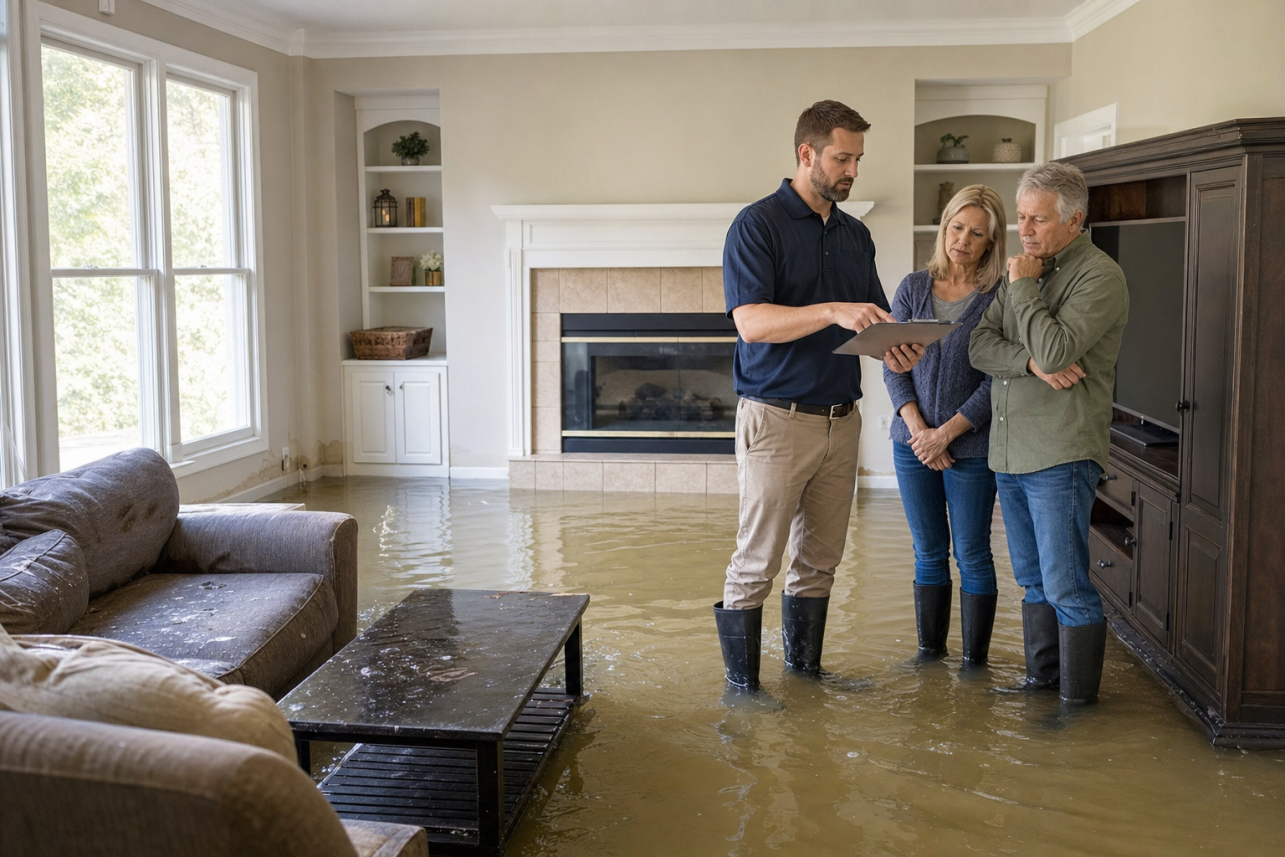
Can I Get Flood Insurance Claim Help Garner Residents Trust If My Damage Came From Both Floodwater And A Burst Pipe Or Sewer Backup?
Yes, and mixed-cause losses are exactly where professional Flood Insurance Claim help Garner homeowners hire us for pays off. Flood policies cover rising surface water; homeowners policies may cover sudden pipe failures; sewer or drain backup often requires a separate endorsement. When a storm causes more than one of these at once, each insurer has an incentive to point at the other policy.
The result is a coverage tug-of-war where the homeowner gets caught in the middle. The flood carrier says the water came from the drain, the homeowners carrier says it was rising floodwater, and neither pays fully. Sorting this out requires documenting the water’s source, its path through the home, and which damage belongs to which policy.
We inspect the property, trace the water intrusion, and build separate, clearly supported damage scopes for each applicable policy. That prevents double-dipping accusations while making sure nothing falls through the cracks between the two claims. NFIP’s definition of flood is specific, and you can read it at floodsmart.gov, which helps explain why the source of water matters so much.
Policyholders are not powerless in these disputes. Courts have repeatedly held insurers to their coverage promises when water damages a building and its contents, as the Fourth Circuit did for the insured business owner in Studio Frames v. Standard Fire. We make no promises about specific dollar amounts, but we do promise the water damage gets properly attributed and both claims get pursued the right way.
Local Relevance
Garner sits in a fast-growing corner of Wake County where creek corridors, heavy summer thunderstorms, and the remnants of tropical systems moving up from the coast can put water in homes that never expected it. Our region’s dense red clay drains slowly, so runoff from a hard storm often pools against foundations and finds its way into crawl spaces, garages, and finished lower levels.
The housing mix matters too. Garner has everything from older ranch homes on crawl spaces to newer slab-built subdivisions, and each floods differently — crawl space homes hide damage to joists and ductwork, while slab homes wick water up through drywall fast. A generic estimate rarely captures either correctly.
As a Public Adjuster Garner homeowners can reach quickly, we know these construction types, the local repair market, and how carriers tend to evaluate flood losses here. That local footing is often the difference between an underpaid claim and a fair one, and it is the same standard we bring to clients who first found us through a Water Damage Adjuster Haw River engagement.
Many Garner-area losses come not from named hurricanes but from ordinary summer downpours overwhelming slow-draining clay soil near creek corridors — and because standard homeowners policies exclude rising water, the deciding factor in these claims is often proving exactly how the water entered and what it touched, which is precisely the documentation a public adjuster builds.
Water Came In. Now Make The Claim Come Out Right.
For The Public Adjusters, Inc. is licensed and bonded, and we work on contingency — no recovery, no fee. Before you sign the carrier’s proof of loss or accept a first offer, let us review your flood claim at no obligation. The sooner we document the damage, the stronger your position.
Call us: (919) 400-6440
Helpful Resources
- Federal Emergency Management Agency (FEMA)
- National Flood Insurance Program (NFIP)
- FEMA flood insurance and claims guidance — Federal agency overseeing flood insurance and disaster recovery
Last updated: September 14, 2026