
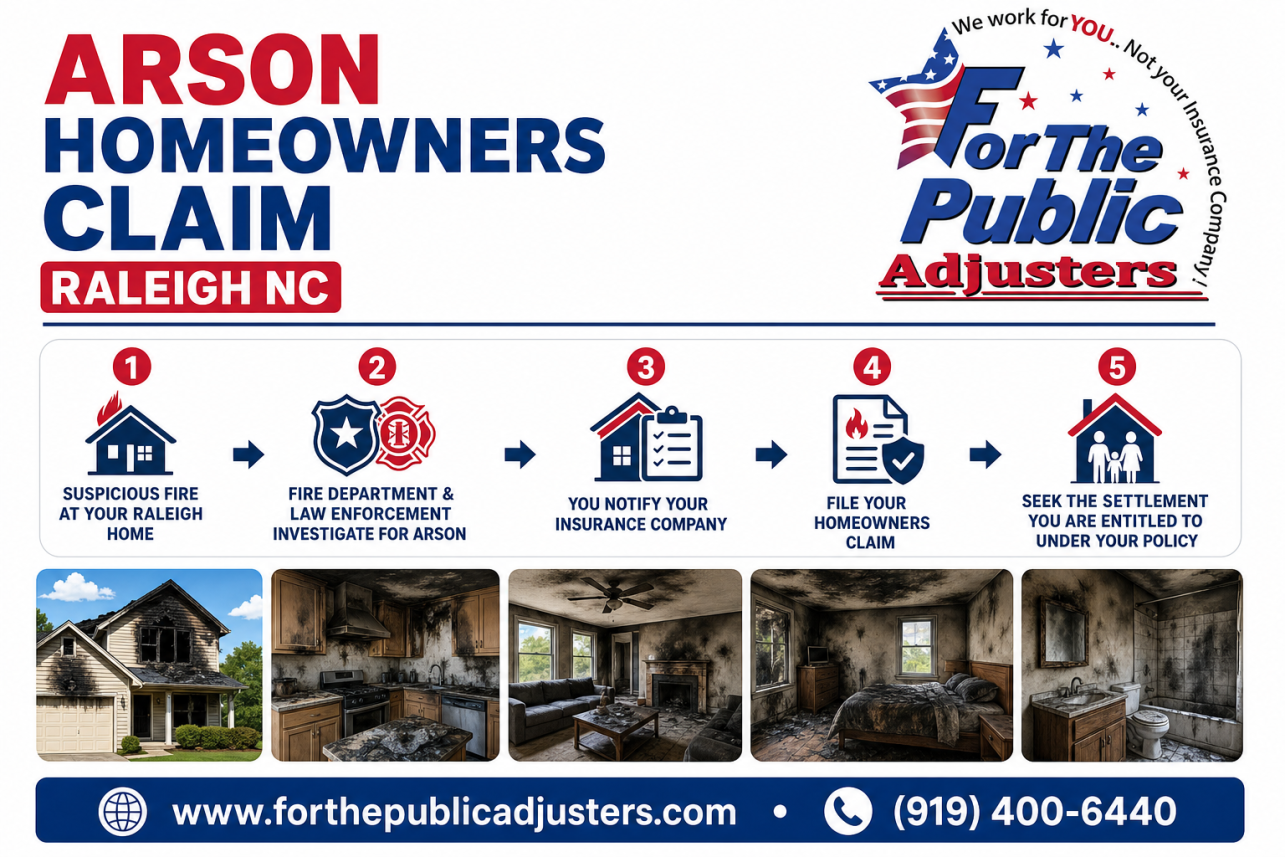
An Arson Homeowners Claim Raleigh NC is a fire loss claim where the insurance company suspects the fire was intentionally set — and yes, arson committed by someone other than the policyholder is covered by standard homeowners insurance. The problem is that once the word arson enters the file, insurers slow everything down, open a cause and origin investigation, and often treat the homeowner as a suspect. For The Public Adjusters, Inc. represents Raleigh policyholders through that investigation, documents the full loss, and pushes the claim toward a fair settlement.
What This Service Is
When a fire in your Raleigh home is labeled suspicious, two things happen at once. The fire department and law enforcement run a criminal investigation, and your insurance company runs its own civil investigation into the cause and origin of the fire. Those are separate tracks with separate rules, and innocent homeowners get caught between them all the time.
Fire investigators generally follow methods published by the National Fire Protection Association (NFPA) to determine where a fire started and what ignited it. If the finding points to an intentional act, your insurer will look hard at you — your finances, your whereabouts, your recent policy changes — before it pays anything. That scrutiny is legal, but it does not suspend your rights under the policy.
As licensed and bonded public adjusters, we work only for the policyholder, never the insurance company. We handle the fire damage assessment, the smoke and water damage that firefighting leaves behind, the personal property inventory, the proof of loss paperwork, and the negotiation. We handle these losses across the Triangle, including every arson insurance claim in Durham and throughout Wake County. We cannot promise a specific dollar outcome — no honest adjuster can — but we can make sure your claim is documented, defended, and taken seriously.
Common Problems
Does Homeowners Insurance Cover Arson — And What Won’t It Pay For?
If someone else set fire to your home — a vandal, an intruder, even an estranged family member who is not on the policy — the loss is covered the same as any accidental fire. The exclusion insurers rely on is for intentional acts by the insured. In plain terms: you are covered unless they can prove you did it or arranged it.
What homeowners often miss is everything beyond the structure. Smoke damage, water damage from the fire hoses, destroyed contents, and loss of use benefits that pay for a hotel or rental while your home is uninhabitable are all part of the claim. Insurers rarely volunteer those numbers, and underpayment on contents and temporary housing is where most families lose the most money.
Why Is My Arson Homeowners Claim Raleigh NC Investigation Taking So Long?
Once a fire is flagged as suspicious, insurers commonly suspend payment while they investigate. You may be asked to sit for an examination under oath, turn over bank records and phone records, and answer questions about your mortgage and finances. It can feel like being accused of insurance fraud in your own living room, and the delay itself puts pressure on families who need money for housing now.
Delay is not a blank check for the insurer. Courts have long held that companies cannot use an investigation as a weapon. In Gruenberg v. Aetna Insurance Co., a California case that shaped bad faith law nationwide, the insured’s building burned, the insurer suspected arson and refused to pay — and the court sided with the policyholder, holding the insurer could be liable for handling the fire claim in bad faith. Whether the loss is here in Raleigh or a fire damage insurance claim help in Knightdale matter, the lesson is the same: a suspicion is not a denial, and you do not have to wait quietly.
Should I Face The Insurance Company’s Investigators Alone, Or Get Representation?
The insurance company sends trained investigators, an independent fire investigator, and often outside counsel. Homeowners who go it alone frequently say the wrong thing at an examination under oath, miss a proof of loss deadline, or accept the first structure estimate without ever inventorying their contents. Any of those mistakes can shrink or sink a valid claim.
A public adjuster levels that field. We prepare you for what the insurer will ask, build the documentation before they demand it, and keep the claim moving. If the dispute hardens into an accusation, we work alongside insurance dispute lawyers so the civil claim is protected while any criminal question resolves. We provide the same representation across Wake County, including arson homeowners claim help in Apex, so you are never negotiating against professionals by yourself.
Our Process
Review The Policy And The Investigation Status
We start by reading your actual policy — coverage limits, exclusions, loss of use benefits, and deadlines, including the statute of limitations on your claim. We also find out exactly where the fire investigation stands, because how we present your claim depends on whether the cause is still undetermined or has been ruled intentional. The NCDOI Public Adjusters Guide explains what licensed adjusters in North Carolina may do for policyholders, and we operate squarely within it.
Document The Full Loss, Not Just The Burn Area
We perform an independent fire damage assessment covering structure, smoke penetration, water damage from suppression, and hidden damage inside walls and HVAC systems. We build a room-by-room personal property inventory and prepare a complete proof of loss. If your home is a total loss, we address the mortgage lender’s role in the payout so the funds actually reach your rebuild.
Negotiate, And Escalate If The Insurer Acts In Bad Faith
We present the documented claim, respond to the insurer’s investigators, and negotiate every category — dwelling, contents, temporary housing, and code upgrades where the policy allows. If the company stalls without cause, lowballs the settlement, or denies based on thin suspicion, we push back with evidence, and when necessary we coordinate with attorneys who handle insurance company bad faith. You stay informed at every step.
| Stage of the Claim | Homeowner Handling It Alone | With For The Public Adjusters |
|---|---|---|
| SIU investigation & examination under oath | You answer sworn questions unprepared; one confused answer can be used to build a fraud defense. | You go in prepared, with your documents organized and your rights under the policy clearly understood. |
| Burden of proof | Many homeowners assume an arson ruling automatically kills the claim and give up or accept a low offer. | We hold the carrier to its legal burden: it must connect you to the fire, not just prove the fire was set. |
| Scope of damage | Carrier estimates often stop at charred rooms and miss smoke, soot, and heat damage throughout the home. | Full room-by-room documentation of structure, contents, smoke penetration, and code-required upgrades. |
| Additional living expenses | Hotel and food costs pile up with no clear reimbursement plan while the investigation drags on. | ALE is tracked, documented, and claimed from day one so displacement doesn’t drain your savings. |
| Denial or reservation of rights | A denial letter feels final, and most homeowners never learn about innocent co-insured rulings like Watson v. USAA. | We respond in writing with policy language, documentation, and supporting case law where it applies. |
Commonly Overlooked In The Public Adjusting Industry
- The carrier’s burden to prove the insured’s connection to the fire — Homeowners hear ‘arson’ and assume the claim is dead, when in reality the insurer must tie the policyholder to the fire before it can lawfully deny.
- Innocent co-insured rights when a spouse or family member set the fire — Denial letters cite the intentional-acts exclusion without mentioning rulings like Watson v. USAA that protected an innocent wife’s recovery after her estranged husband burned the home.
- Smoke and soot damage in rooms far from the point of origin — Carrier estimates focus on the burned area while acidic soot quietly corrodes HVAC ducts, electronics, and finishes two floors away.
- Additional living expense documentation from day one — Arson investigations run long, and families who don’t keep hotel, meal, and mileage receipts from the start leave months of reimbursable costs unclaimed.
- Preparation before the examination under oath — Most policyholders treat the EUO like a casual interview, not realizing every sworn word becomes evidence the SIU can use against the claim.
- Code-upgrade coverage on fire rebuilds in Wake County — Rebuilding a fire-damaged Raleigh home triggers current building code requirements, and ordinance-or-law coverage that pays for those upgrades often goes unclaimed.
- The difference between the fire marshal’s cause finding and the carrier’s coverage decision — An ‘incendiary’ classification identifies how the fire started, not who is at fault, yet adjusters sometimes lean on it as if it were a coverage denial.
- Deadlines buried in the reservation-of-rights letter — Proof-of-loss and document-production deadlines keep running during the investigation, and missing one hands the carrier an easy technical defense.
Case Studies
Case Study #1
Situation: A homeowner in the Five Points neighborhood of Raleigh came home from a weekend at the coast to find her back porch and kitchen destroyed by fire. Raleigh Fire Department investigators found pour patterns and an accelerant, and the fire was officially classified as incendiary — someone had deliberately set it.
Problem: Because the fire was ruled arson, her insurance carrier immediately shifted from adjusting the loss to investigating her. She was asked to sit for an examination under oath, produce two years of bank statements, and explain her whereabouts hour by hour. Meanwhile, no money was moving, her family was paying out of pocket for a hotel, and the carrier’s tone made her feel like a suspect in her own home.
Investigation: Our Raleigh team reviewed the fire marshal’s report, the carrier’s reservation-of-rights letter, and every request the SIU (Special Investigations Unit) had sent her. We documented the kitchen, porch, smoke-damaged upstairs bedrooms, and contents room by room, and we pulled her policy to confirm exactly what the carrier was required to prove before it could deny.
Findings: The fire origin evidence pointed to entry through a rear gate with a broken latch, and neighbors on the Nextdoor thread had reported a string of break-ins that same month. Nothing in her financials suggested motive. The carrier’s own file, once we pressed for it, showed the SIU had no evidence tying her to the fire — only the fact that the fire was intentionally set by someone.
Solution: We prepared her thoroughly for the examination under oath, organized her financial documents so there were no surprises, and submitted a complete, independently priced estimate for the structure, smoke remediation, and contents. We reminded the carrier in writing that under North Carolina law, an arson defense requires proof the insured was connected to the fire — not just proof of arson itself.
Outcome: Eleven weeks after we were retained, the carrier withdrew its reservation of rights and paid the structure, contents, and additional living expense claims in full based on our documented estimate — several times the figure discussed in the carrier’s early conversations with her.
Lesson: An arson finding is not the same as an accusation against the homeowner. Carriers must prove involvement, and an organized, well-documented policyholder with professional representation is far harder to stall or lowball.
Case Study #2
Situation: A couple going through a separation owned a rental-turned-primary home off New Bern Avenue in East Raleigh. During the divorce, the estranged husband set fire to the detached garage and part of the main house. He was later charged. The wife, who still lived in the home with her children, filed the homeowners claim.
Problem: The carrier denied the entire claim, arguing that because a named insured intentionally caused the fire, coverage was void for everyone on the policy — including the innocent spouse who had nothing to do with it.
Investigation: We reviewed the policy language word by word, focusing on whether the intentional-acts exclusion said ‘an insured’ or ‘the insured,’ and gathered the criminal file, protective order history, and witness statements showing the wife was at work when the fire started.
Findings: The policy language and the facts strongly supported an innocent co-insured claim. Courts have repeatedly protected policyholders in this exact situation — in Watson v. United Services Automobile Association, 566 Pa. 335 (2001), the court held that an innocent wife could recover under the homeowners policy after her estranged husband intentionally burned the marital home, because her interest in the property was separate from his wrongdoing.
Solution: We presented the innocent co-insured argument in writing with the supporting case law, submitted a full structural and contents estimate for the garage and fire-damaged portion of the house, and documented her additional living expenses while she and the children stayed with family in Knightdale.
Outcome: The carrier reversed its denial as to the wife’s insurable interest and settled her portion of the structure, contents, and additional living expense claim. She was able to rebuild the garage and repair the home rather than sell it at a loss mid-divorce.
Lesson: A denial letter is a legal position, not the final word. When one insured sets a fire, the innocent co-insured often still has a valid claim — but someone has to know the law well enough to make that argument.
| Your Situation | Likely Carrier Response | What the Outcome Depends On |
|---|---|---|
| Fire ruled incendiary, arsonist unknown (break-in or vandalism) | Reservation of rights, SIU interview, requests for financial records | Alibi documentation, absence of financial motive, police/fire marshal findings on forced entry |
| Third party charged with setting the fire | Claim usually payable once your non-involvement is confirmed | How quickly the criminal file, witness statements, and charging documents reach the carrier |
| Spouse or co-insured set the fire; you are innocent | Often a full denial citing the intentional-acts exclusion | Exact policy wording (‘an insured’ vs. ‘the insured’) and innocent co-insured case law such as Watson v. USAA |
| Tenant or occupant set the fire at your rental property | Coverage typically applies but valuation disputes are common | Whether the policy is a landlord/dwelling form and how well the loss and lost rents are documented |
| You are asked to give an examination under oath | Sworn transcript that can support or sink your claim | Preparation, complete records, and consistent answers — never attend one unprepared |
| Claim denied outright with arson as the stated reason | Carrier is betting you will not challenge the denial | Whether the carrier can actually prove motive, opportunity, and connection to the fire — not just that arson occurred |
Reviews
After our house fire was ruled intentionally set, State-side investigators treated us like criminals even though we were out of town when it happened. For The Public Adjusters walked us through the examination under oath, organized every document the insurance company demanded, and kept pushing until the arson suspicion was dropped and the claim was paid. I honestly don’t think we’d have gotten through the SIU process without them.
Danielle W., North Hills, Raleigh
My rental property near WakeMed was set on fire by a vandal who broke in through the crawl space. The carrier’s first offer didn’t even cover the smoke damage upstairs, let alone the structural repairs. This team re-scoped the whole loss, itemized my tenant’s displaced contents, and the final settlement was more than double the initial number. Worth every penny of the fee.
Marcus T., Southeast Raleigh
The fire marshal classified our garage fire as incendiary and our insurer immediately went quiet — weeks with no updates while we lived in a hotel. Once we hired For The Public Adjusters, everything changed. They handled the reservation-of-rights letter, documented our additional living expenses down to the receipt, and got the claim moving again. My only wish is that we’d called them the day of the fire instead of two months later.
Priya S., Cary / Wake County
Frequently Asked Questions
What Happens With An Arson Homeowners Claim Raleigh NC If I’m A Victim And Had Nothing To Do With The Fire?
When an Arson Homeowners Claim Raleigh NC involves a fire that investigators determine was intentionally set, insurance companies often shift into a defensive posture — even when the homeowner is clearly the victim. You can expect a Special Investigations Unit (SIU) to get involved, and you may be asked to sit for an examination under oath, produce financial records, and document your whereabouts at the time of the fire.
None of that means you did anything wrong. Vacant-lot fires, break-ins, neighborhood disputes, and random acts of vandalism happen in Wake County just like anywhere else, and your policy still covers fire damage caused by a third party’s criminal act.
Our role as licensed and bonded public adjusters is to make sure the investigation doesn’t overshadow the claim itself. While the insurer focuses on cause and origin, we document the structural damage, smoke and soot contamination, and your personal property losses so the valuation is complete and accurate.
Courts have repeatedly held insurers accountable when they wrongly deny property claims. In DENC, LLC v. Philadelphia Indemnity Insurance Co. (4th Cir. 2021), a North Carolina property owner won against its insurer after the company refused to pay for serious building damage, and the courts found the denial unjustified. Cases like that show policyholders can and do prevail when the facts and documentation are on their side. We can’t guarantee any specific outcome, but thorough preparation puts you in the strongest possible position.
How Long Does An Arson-Related Fire Claim Take To Settle In Raleigh?
Arson-related claims almost always take longer than accidental fire losses. In Raleigh, the Fire Department’s investigators and sometimes the SBI or ATF will conduct a cause-and-origin investigation, and most carriers won’t move toward settlement until that investigation has progressed. Realistically, you should expect several months, and complex cases can run longer.
The insurer’s timeline is not open-ended, though. North Carolina’s Unfair Claim Settlement Practices statute requires carriers to acknowledge and act on claims with reasonable promptness and to affirm or deny coverage within a reasonable time. Delay tactics without a legitimate investigative reason can expose an insurer to bad-faith liability.
What helps most is running the documentation on a parallel track. While the fire investigation proceeds, we inventory your damaged contents, obtain repair estimates for the structure, document smoke and soot migration into areas that look untouched, and track your additional living expenses if you’ve been displaced from your home in Wake County.
That way, the moment the carrier confirms coverage, a fully supported claim is already on the table instead of the clock starting over. We also push back — in writing — when requests for documents become repetitive or when review periods stretch without explanation.
Every loss is different, and no one can promise a specific settlement date or amount. But homeowners who present organized, well-documented claims consistently move through the process faster than those who wait for the insurance company to set the pace.
Can My Insurer Deny My Claim Just Because The Fire Was Intentionally Set?
No. An intentional-acts exclusion only applies when the insured — the policyholder — set the fire or arranged for it to be set. If a stranger, an intruder, or even a known third party started the fire, your homeowners policy covers the loss the same as any other fire.
The practical problem is proof and posture. Carriers sometimes treat every arson finding as a reason to slow down, demand extensive documentation, or issue a reservation-of-rights letter. Under North Carolina law, the burden is on the insurance company to prove an insured intentionally caused the loss — not on you to prove your innocence. Suspicion alone is not evidence.
Policyholders have won these fights in court. In DENC, LLC v. Philadelphia Indemnity Insurance Co., the Fourth Circuit — applying North Carolina law — affirmed a judgment for the insured after the carrier improperly denied a building-damage claim, and the insurer was held liable for its refusal to pay. Decisions like that reinforce that a denial must rest on actual evidence, not assumptions.
As your public adjuster, we make sure the claim file reflects the full scope of your loss: structural repairs, smoke and heat damage, contents, and additional living expenses. We’re licensed and bonded, we work only for you — never the carrier — and while we never guarantee a specific result, we make it much harder for an insurer to justify an unfair denial. If a denial does come, a complete, professionally documented file is exactly what your attorney would need to challenge it.
How Does For The Public Adjusters, Inc. Handle An Arson Homeowners Claim Raleigh NC Differently Than I Could On My Own?
The biggest difference is documentation and leverage. Most homeowners facing an arson loss in Raleigh are dealing with displacement, a police investigation, and an insurer’s Special Investigations Unit all at once. It’s easy to accept the carrier’s first estimate just to make it stop — and first estimates on fire losses are frequently incomplete.
We start with an independent inspection of the entire home, not just the burn area. Smoke, soot, and heat travel through wall cavities, HVAC ductwork, and attic spaces in ways a quick walkthrough misses. We document char depth, structural compromise, and contamination room by room.
Next comes the contents inventory. Fire and the water used to extinguish it destroy furniture, clothing, electronics, and irreplaceable personal items. We build an itemized inventory with replacement values so nothing is left off the claim. We also track your additional living expenses — temporary housing in Wake County, increased food costs, storage — which many homeowners never fully claim.
Then we prepare you for the insurer’s investigation. If an examination under oath is requested, you’ll understand the process before you walk in, and we coordinate with your attorney when one is involved.
We are licensed and bonded, and we work on your behalf from the first inspection through final settlement. We never promise a specific dollar figure — no honest adjuster can — but a claim built on complete evidence is far harder for a carrier to underpay than one built on a homeowner’s rough list and the insurer’s own numbers.
What Should I Do If My Insurer Demands An Examination Under Oath During An Arson Homeowners Claim Raleigh NC?
An Examination Under Oath, or EUO, is a formal, recorded interview your insurance company can require under most homeowners policies. When arson is suspected, carriers in Raleigh almost always invoke this right, and refusing to appear can jeopardize your entire recovery.
That said, you should never walk into an EUO unprepared. Adjusters and defense attorneys use these sessions to probe your finances, your whereabouts on the night of the fire, and any inconsistencies in your prior statements. Innocent homeowners can hurt their own claims simply by guessing at answers or misremembering dates.
Before your EUO, gather documents the carrier will likely request: mortgage statements, utility bills, receipts for major contents, and your inventory of damaged property. Review your recorded statement, if you gave one, so your testimony stays consistent. You have the right to have representation present, and many Wake County policyholders bring an attorney alongside their public adjuster’s documentation.
As licensed and bonded public adjusters, we help Raleigh homeowners assemble the proof of loss, the contents inventory, and the repair estimates that support truthful, consistent answers. Courts have repeatedly held that carriers cannot use the EUO process as a fishing expedition to manufacture a denial. In Rawlings v. Apodaca, a fire-loss case, the Arizona Supreme Court ruled for the insured homeowners and held that an insurer owes its policyholder a duty of good faith that goes beyond simply paying eventually — a principle that shapes how fire claims should be handled everywhere, including North Carolina.
How Does The Raleigh Fire Department Or Wake County Investigation Affect My Insurance Payout?
When a fire is flagged as suspicious, the Raleigh Fire Department’s investigators — sometimes joined by the Wake County Fire Marshal or the SBI — will work to determine origin and cause. Your insurance company runs its own parallel investigation, often hiring a private cause-and-origin expert, and the two do not always reach the same conclusion.
Here is what matters for your claim: the official investigation determines whether a crime occurred and who may be charged. Your insurer’s obligation to pay turns on your policy language and whether the carrier can actually prove you were involved. A finding of incendiary origin alone does not identify the person who set the fire.
Cooperate fully with fire officials and request a copy of the incident report once it is released. That report becomes a key document in your claim file. If the fire is attributed to an intruder, a vandal, or an unknown third party, that finding strongly supports coverage for an innocent policyholder.
While investigators do their work, your carrier should still be moving your claim forward — inspecting the dwelling, reviewing your contents inventory, and addressing additional living expenses if your home is uninhabitable. A public adjuster in Raleigh keeps that pressure on, documenting every delay and making sure the criminal investigation is not used as an open-ended excuse to stall your payment. We cannot promise a specific outcome, but we can make sure the insurer meets its obligations at every step.
Does My Homeowners Policy Still Cover My Contents And Living Expenses After An Intentionally Set Fire?
Yes — fire is a covered peril under virtually every North Carolina homeowners policy, and that includes fires that were deliberately set, as long as the policyholder did not set or arrange the fire. Coverage typically extends across three areas.
First, dwelling coverage pays to repair or rebuild the structure itself, including smoke, soot, and water damage from firefighting efforts, which in older Raleigh neighborhoods like Boylan Heights or Five Points can be extensive even when flames were contained to one room.
Second, personal property coverage pays for damaged contents — furniture, clothing, electronics, and household goods. This is where many claims fall short, because homeowners underestimate what they owned. A room-by-room inventory with replacement pricing routinely uncovers tens of thousands of dollars in items a rushed carrier estimate missed.
Third, additional living expenses, sometimes called loss of use, pays for temporary housing, increased food costs, and other expenses while your home is uninhabitable. In the Raleigh rental market, documenting comparable housing costs matters, because carriers sometimes propose allowances well below what a family actually needs.
Be aware that arson-suspected files often get slower, more skeptical handling in each of these categories. Keep every receipt, photograph everything before cleanup, and do not discard damaged items until the carrier’s inspection is complete. Note that we handle homes, buildings, and contents only — vehicle losses from the same fire fall outside a homeowners policy and outside our services.

Have Homeowners Ever Beaten An Insurance Company In Court After Being Wrongly Suspected Of Setting A Fire?
Yes, and those cases are worth knowing about if you are facing an Arson Homeowners Claim Raleigh NC that has stalled under a cloud of suspicion. Courts across the country have held insurers accountable when they leaned on an arson theory without real proof.
A leading example is Rawlings v. Apodaca, decided by the Arizona Supreme Court in 1986. The Rawlings family’s home was destroyed by fire, and their insurer, Farmers, delayed and withheld information from its own investigation while the family pursued their claim. The court sided with the homeowners, holding that an insurer owes its policyholder a duty of good faith and fair dealing that it breaches when it puts its own interests ahead of the insured’s. The insureds prevailed, and the decision remains one of the most cited property-insurance rulings in the country.
The legal standard that protects innocent homeowners is straightforward: an insurer asserting an arson defense generally must prove the fire was incendiary, that the insured had motive, and that the insured had opportunity. Suspicion, financial hardship, or a fire of undetermined cause is not enough.
For Wake County homeowners, the practical lesson is to build a documented, well-supported file from day one — because carriers settle strong files and fight weak ones. That is exactly what a licensed, bonded public adjuster does on your behalf. We cannot guarantee any particular result, but a properly documented claim gives the insurer far less room to hide behind an unproven accusation.
What Evidence Should I Gather To Support An Arson Homeowners Claim Raleigh NC?
Start with documentation that proves what you owned and what the fire destroyed. Photos and videos of your home before the loss, receipts, bank and credit card statements, and even old real estate listing photos of your Raleigh property all help establish the value of the structure and contents.
Next, preserve everything connected to the fire itself. Get copies of the Raleigh Fire Department incident report and any Wake County or SBI investigative findings once they are released. Do not throw away burned items until the insurer and your adjuster have inspected them — the debris itself is evidence.
Keep a written timeline of where you were before, during, and after the fire, along with names of anyone who can confirm it. In arson-related claims, insurers look closely at opportunity and motive, so records showing your finances were stable — mortgage statements, pay stubs, absence of recent policy increases — can quietly dismantle a suspicion of fraud before it takes root.
Finally, track every expense after the loss: hotel bills, meals, storage, pet boarding, and replacement clothing all matter for additional living expenses coverage. Our team at For The Public Adjusters, Inc. builds this file with you, organizes it the way carriers expect to see it, and presents it so the burden of proving an arson defense stays where North Carolina law puts it — on the insurance company, not on you.
What If The Fire Was Set By My Spouse Or Someone Else Living In My Raleigh Home?
This is one of the hardest situations a homeowner can face, and North Carolina law offers real protection for the innocent party. In Lovell v. Rowan Mutual Fire Insurance Co., 302 N.C. 150 (1981), the North Carolina Supreme Court ruled that a wife whose husband intentionally burned their home could still recover her own interest under the policy. The court refused to let one spouse’s wrongdoing destroy the other’s coverage.
That decision still shapes how these claims are handled across Wake County. If you had no knowledge of and no involvement in the fire, the insurer generally cannot deny your share of the proceeds simply because a co-insured set it. The details matter, though — how the policy is worded, how title to the home is held, and how your interest is calculated all affect the outcome.
Carriers sometimes lump the innocent spouse in with the wrongdoer and issue a blanket denial, hoping the family is too overwhelmed to push back. That is exactly where an experienced Raleigh public adjuster earns their keep: separating your legal interest from the arsonist’s, documenting your lack of involvement, and citing the case law that supports payment.
We cannot promise any particular result — no one honestly can — but we can make sure the insurer evaluates your claim under the correct legal standard rather than the one that saves them money. If you are in this situation, call us before you give any recorded statement.
Can I Still Get Paid If The Arsonist Is Never Identified Or Charged?
Yes, in most cases you can. Your homeowners policy covers fire as a named peril, and the identity of whoever set it is largely irrelevant to your right to recover — unless the insurer can prove you were involved. Many intentionally set fires in Raleigh and across Wake County are never solved, and those claims still get paid every year.
What the carrier must show to deny you is different from what a prosecutor must show in criminal court. To use an arson defense against a policyholder, the insurance company generally has to prove the fire was incendiary, that you had motive, and that you had opportunity. If the investigation goes cold and points to an unknown third party, the insurer’s defense usually goes cold with it.
Be aware that an unsolved fire can slow things down. Adjusters sometimes hold claims open while the fire marshal’s investigation is pending, and delays can stretch for months if nobody presses them. Under North Carolina’s fair claims practices rules, carriers cannot stall indefinitely without a reasonable basis.
Our role as your licensed and bonded representative is to keep the claim moving: requesting status in writing, documenting the structure and contents losses independently, and reminding the carrier that a suspect-less investigation is not grounds for nonpayment. Cooperate fully with investigators, keep your receipts, and do not let an open criminal file become the insurer’s excuse for an unpaid claim.
What Does It Cost To Hire For The Public Adjusters, Inc. For An Arson Homeowners Claim Raleigh NC?
We work on a contingency fee, which means our compensation is a percentage of what the insurance company actually pays on your claim. There is no upfront charge, no hourly billing, and no fee if there is no recovery. For a Raleigh homeowner already displaced by a fire and facing hotel bills, that structure matters — you are not writing checks to get help.
The percentage is set out clearly in a written contract before we begin, as North Carolina law requires of every licensed public adjuster. We are licensed and bonded in the state, and our fee agreement will never contain surprises buried in fine print.
Homeowners sometimes worry that a fee means ending up with less. In arson-suspected fire losses, the opposite is often true. These claims involve detailed structural estimates, room-by-room contents inventories, additional living expense tracking, and pushback against fraud investigators — work most policyholders have never done. A thoroughly documented claim frequently uncovers covered damage the carrier’s adjuster missed entirely, from smoke and soot migration to code-upgrade costs on older Raleigh homes.
We never guarantee a specific dollar outcome — anyone who does should not be trusted. What we do promise is that your claim will be measured, documented, and argued by professionals who handle fire losses in Wake County every week. Call us for a free review of your denial letter or reservation-of-rights notice before you sign anything the insurer sends you.
Should I Keep Paying My Mortgage And Premiums While My Arson Homeowners Claim Raleigh NC Is Pending?
Yes, absolutely. Even when a fire investigation drags on for months, your mortgage obligation to your lender continues, and so does your duty to keep the policy in force. Missing payments can create problems that are completely separate from the fire itself, including foreclosure risk and a lapse in coverage for the undamaged portions of your property.
Most Raleigh homeowners carry a mortgage, which means the lender is named on the policy and will be listed on any settlement checks. Under the standard mortgage clause used in North Carolina policies, your lender may still have rights to insurance proceeds even in disputed arson cases, but you protect your own position by staying current.
We also recommend keeping the property secured and mitigated. Board up openings, keep utilities addressed safely, and document every expense. Your policy typically requires reasonable steps to protect the home from further damage, and those receipts are recoverable costs when the claim resolves.
Courts have sided with policyholders who kept their obligations while insurers stalled. In Robinson v. North Carolina Farm Bureau Insurance Co., 86 N.C. App. 44 (1987), a North Carolina jury found the insurer acted in bad faith in handling a fire loss and awarded damages to the insured, and the appellate court upheld the result. Cases like that turn in part on the homeowner having done everything right while the carrier did not.
If the pending claim strains your finances, tell us early. We can push for advance payments on undisputed portions of the loss, such as additional living expenses, though no adjuster can promise a specific outcome or amount.
What Deadlines Apply In North Carolina If My Arson-Related Fire Claim Is Delayed Or Underpaid?
North Carolina gives homeowners a limited window to act, and fires labeled as suspicious burn through that window faster than most people realize. The standard fire policy language used in this state generally requires any lawsuit against the insurer to be filed within three years, and some policies attempt to shorten that period, so read your specific contract carefully.
On top of the suit limitation, your policy contains earlier deadlines: prompt notice of loss, a signed sworn proof of loss (often due within 60 days of the carrier’s demand), and cooperation with document requests. Miss one of these and the carrier may argue you forfeited coverage, even if you had nothing to do with the fire.
Here is the trap we see in Wake County claims. The insurer opens a lengthy arson investigation, requests round after round of records, and the homeowner assumes the clock is paused. It usually is not. The limitation period keeps running while the carrier investigates, which is one reason delayed claims quietly die.
A public adjuster in Raleigh tracks every one of these dates from day one, gets the proof of loss submitted correctly, and creates a paper trail showing you met each obligation. That record matters enormously if the dispute ever reaches litigation. In Zoppo v. Homestead Insurance Co., 71 Ohio St. 3d 552 (1994), a property owner whose insurer denied a fire claim on an arson theory won at trial, including punitive damages, largely because the insurer failed to conduct a fair investigation while the insured had complied with the policy. Meeting your deadlines keeps you in that strong position.
Does The Insurance Company’s Cause-And-Origin Investigator Work For Me Or Against Me?
The cause-and-origin investigator is hired and paid by your insurance carrier, and while many are competent professionals, their findings are delivered to the party that benefits from a denial. You should treat that inspection as an adversarial part of the process, not a neutral one, especially when arson is suspected.
In a typical Raleigh fire loss, the carrier’s investigator examines burn patterns, electrical systems, accelerant evidence, and points of origin, then writes a report the carrier uses to accept or contest coverage. You generally have the right to be present, to have your own representative present, and to receive relevant findings. You also have the right to hire an independent cause-and-origin expert, and in disputed arson cases we often recommend it.
For The Public Adjusters, Inc. coordinates that independent review, preserves evidence before the scene is disturbed, and cross-checks the carrier’s conclusions against the Raleigh Fire Department’s official report and any NC SBI findings. When those sources conflict, the disagreement becomes powerful leverage for the homeowner.
History shows why independent scrutiny matters. In Robinson v. North Carolina Farm Bureau Insurance Co., the insured prevailed after showing the carrier’s handling of a fire claim was unreasonable, and the North Carolina Court of Appeals affirmed the verdict against the insurer. A one-sided investigation that ignores contrary evidence is exactly the kind of conduct courts have punished.
We are licensed and bonded in North Carolina, and while we cannot guarantee any result, making sure the science is examined by someone in your corner levels a field that is otherwise tilted toward the carrier.
Should I Speak With The Insurance Company’s Special Investigations Unit Before Getting Representation?
You are required to cooperate with your insurer, but you are not required to walk into a Special Investigations Unit interview unprepared. SIU investigators are trained to build a coverage-denial file, and innocent homeowners frequently hurt their own claims through casual answers about finances, timelines, or whereabouts that later get framed as inconsistencies.
Before any recorded statement, get your facts organized. Know the timeline of the fire, who was home, when you bought major contents, and the general state of your household finances, because motive is one of the three pillars insurers use to build an arson defense, alongside opportunity and incendiary origin. In Wake County claims, SIU will often pull your mortgage history, credit records, and utility records, so surprises help no one.
Hiring representation early on an Arson Homeowners Claim Raleigh NC changes the dynamic. As your public adjuster, we cannot act as your attorney, but we prepare the documentation side of the claim, attend inspections, manage the flow of records so requests stay reasonable and relevant, and refer you to experienced insurance counsel if the questioning turns accusatory or an Examination Under Oath is demanded.
Policyholders who cooperate carefully and completely tend to fare well when carriers overreach. In Zoppo v. Homestead Insurance Co., the insured cooperated fully while the carrier ran a shoddy arson investigation, and a jury ultimately found for the property owner and against the insurer. Nothing about that outcome is guaranteed in any case, but a clean, well-documented record of cooperation is the strongest foundation a Raleigh homeowner can build.
Local Relevance
Raleigh’s housing stock runs from mid-century brick ranches near downtown to brand-new construction on the edges of Wake County, and both ends of that spectrum see suspicious fires. Older homes are sometimes blamed for fires that were actually set, while homes sitting vacant during renovation or between owners — common in a market growing this fast — are frequent targets for vandalism and intentional fires.
Homeowners here also search for their carrier by name, asking about a USAA homeowners claim or hunting for the State Farm homeowners claims phone number after a fire. Whoever your carrier is, the arson playbook is similar: investigate, delay, scrutinize. We represent policyholders against all of them, in Raleigh and nearby communities, whether it is an arson homeowners claim in Clayton or an arson homeowners claim Fuquay-Varina family needs handled.
Because fires displaced from a Raleigh home mean paying Triangle rental prices for months, we press hard on loss of use benefits — an area insurers routinely underpay in this market.
With Raleigh’s rapid turnover of homes — properties sitting empty between sale, renovation, or tenant changes — many suspicious fires here involve vacant houses, and insurers often reach for vacancy clauses to limit or deny those claims; documenting occupancy status early is one of the most valuable things a policyholder can do.
Under Investigation After A House Fire? Talk To Someone On Your Side
Call us: (919) 400-6440
Helpful Resources
- NCDOI Public Adjusters Guide
- National Fire Protection Association (NFPA)
- North Carolina Department of Insurance — State regulator overseeing insurers and licensed public adjusters
Last updated: September 28, 2026