If you need help with a Commercial Business Claim Cary NC business owners can hire For The Public Adjusters, Inc., a licensed and bonded public adjusting firm that works only for the policyholder — never the insurance company. We handle fire, smoke, water, hurricane and tornado damage to commercial buildings, plus the business income and inventory losses that follow. From the first damage inspection to the final negotiation, we document what your carrier's adjuster often misses and press for a settlement that reflects your actual loss.
What This Service Is
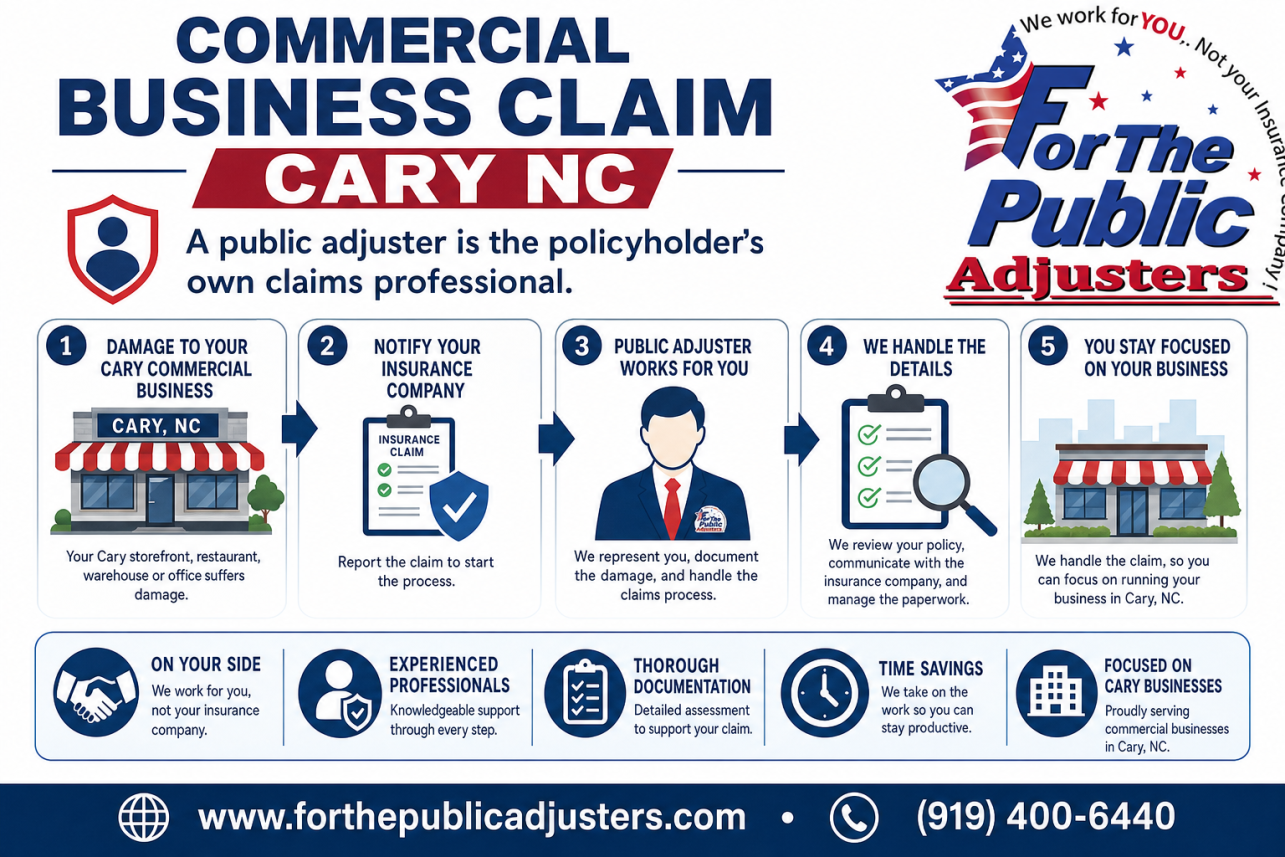
A public adjuster is the policyholder's own claims professional. When your Cary storefront, restaurant, warehouse or office suffers damage, your insurance company sends its adjuster to measure the loss. That person works for the carrier. We do the opposite job: we read your commercial property policy line by line, measure the full scope of damage, price the real rebuilding cost, and negotiate directly with the insurer on your behalf.
Commercial losses are more complicated than residential ones because the building is only part of the claim. There is usually business interruption coverage for the revenue you lose while closed, extra expense coverage for the cost of operating from a temporary location, inventory that must be counted and valued, and equipment that has to be appraised at either actual cash value or replacement cost depending on your policy language. Missing any one of those pieces can leave a six-figure gap in your settlement.
We prepare the proof of loss, build the lost-revenue documentation from your own books, and challenge lowball repair estimates with detailed rebuilding costs. The same approach we bring to a Commercial Business Claim in Raleigh applies here in Cary — the carrier has professionals on its side of the table, and you should too. The North Carolina Department of Insurance, through its NCDOI Public Adjusters Guide, licenses and regulates public adjusters precisely so policyholders have a vetted professional they can put in their corner.
Common Problems
Is The Insurance Company's Offer Actually Enough To Reopen My Doors?
This is the question that matters, and the honest answer is that first offers are frequently built on the carrier's numbers, not yours. A desk adjuster pricing drywall and paint does not capture code-required upgrades, commercial-grade finishes, or the true cost of local contractors in Wake County's busy construction market.
Then there is the money that isn't about the building at all. Business income loss has to be calculated from your actual financials — sales records, payroll, ongoing expenses — and carriers routinely undercount it. Inventory losses need itemized counts and valuations, and equipment claims turn on whether your policy pays replacement cost or depreciated actual cash value. We rebuild all of these numbers independently so you know what the claim is genuinely worth before you accept anything.
Our fee is a percentage of what we recover, so you know the cost going in. We never guarantee a specific outcome — no honest adjuster can — but we make sure every covered dollar is documented and claimed.
What If My Commercial Business Claim Cary NC Carrier Denies, Delays Or Disputes Coverage?
Denials and slow-walked claims are where business owners feel most powerless. Every week of delay is another week of lost revenue, and carriers know a closed business is under pressure to take whatever is offered. Common tactics include blaming damage on wear and tear or maintenance, invoking coverage exclusions that don't actually fit the facts, or endlessly requesting documents to stall the timeline.
You are not without leverage. North Carolina courts have backed policyholders who push back: in Guessford v. Pennsylvania National Mutual Casualty Insurance Co., a federal court in North Carolina allowed a property owner's bad-faith and unfair-practices claims to go forward after the insurer repeatedly underpaid a storm damage claim on his home — a clear signal that carriers can be held accountable for lowball conduct.
Our job is to make that fight unnecessary by building a claim file the insurer can't easily dispute: photographs, moisture readings, contractor estimates, financial records and a properly executed proof of loss. We've taken the same approach on a Commercial Business Claim in Burlington, and when a carrier still won't move, we can coordinate with insurance dispute attorneys.
Should I Just Handle The Claim Myself, Or Search For A Commercial Public Adjuster Near Me?
Plenty of owners start out handling it themselves, and for a small, clean loss that can work. The trouble starts when the claim involves lost income, smoke contamination, structural questions or a disagreement over scope. At that point you're negotiating against trained adjusters while also trying to run — or reopen — a business.
When you compare adjusters, check three things. First, licensing: North Carolina requires public adjusters to be licensed, and we are licensed and bonded. Second, commercial experience: ask specifically about business interruption and inventory claims, because residential-only adjusters often miss them. Third, local knowledge: an adjuster who knows Triangle construction costs and Wake County permitting realities prices your rebuild accurately.
Timing matters too. Bringing us in before you sign the proof of loss or accept a settlement preserves the most options, though underpaid claims can often be reopened. If your loss sits outside Cary, our Public Adjuster Raleigh NC team covers the wider Triangle as well.
Our Process
Free Policy Review And Damage Inspection
We start by reading your commercial property insurance policy in full — the declarations, the endorsements, and the exclusions. Then we walk the property and document everything: structure, finishes, equipment, inventory and contents.
Fire losses get special attention because smoke and soot travel far beyond the burn area. Standards published by the National Fire Protection Association reflect how far-reaching fire and smoke damage can be, and we document contamination that a quick carrier inspection often overlooks.
Build The Claim: Scope, Valuation And Proof Of Loss
Next we price the full rebuilding cost using current local labor and material rates, not a software default. We assemble your business income loss calculation from sales history and expense records, itemize inventory and equipment, and track every extra expense you incur to keep operating.
All of it goes into a properly prepared proof of loss filed within your policy's deadlines. Missed deadlines and incomplete filings are among the most common reasons commercial claims get delayed or denied, and we make sure neither happens to yours.
Negotiate The Settlement On Your Behalf
We present the claim to your carrier, attend the joint inspections, and answer the insurer's questions so you can focus on your business. When the carrier's estimate comes in low, we respond with line-item documentation rather than frustration.
Most claims resolve through this negotiation. If a genuine dispute remains, we advise you on appraisal and other options under your policy, and we can work alongside insurance dispute lawyers when litigation becomes the right path.
| Claim Stage | Business Owner Alone | With Our Licensed Adjusters |
|---|---|---|
| Damage documentation | Relies on the carrier's adjuster to find and scope all damage | Independent inspection with moisture mapping, inventory counts, and photo evidence before anything is discarded |
| Policy review | Reads the policy cold, often missing ordinance-and-law, extra expense, and tenant improvement coverage | Full policy analysis identifying every applicable coverage, endorsement, and condition |
| Business interruption | Rough estimate the carrier can easily challenge | Documented calculation built from financial records, seasonality, and a defensible period of restoration |
| Negotiation | One offer, little leverage, pressure to close quickly | Line-by-line rebuttals, re-inspections, and appraisal preparation when the carrier won't move |
| Time cost | Weeks of calls and paperwork while trying to run the business | We manage the claim so the owner can focus on reopening |
Commonly Overlooked In The Public Adjusting Industry
- Ordinance-and-law (code upgrade) coverage — Carrier estimates often price repairs to pre-loss condition, ignoring that Cary and Wake County code now requires upgrades the policy may actually pay for.
- Soot and smoke contamination inside HVAC systems — Ductwork looks fine from the outside, so it gets left out of the scope until air sampling proves the contamination spread building-wide.
- Business interruption period of restoration — Carriers tend to assume an optimistic rebuild timeline, quietly cutting weeks or months of lost income from the calculation.
- Recoverable depreciation holdback — Many owners never realize the withheld depreciation can be claimed back after repairs, leaving that money with the insurer by default.
- Tenant improvements and betterments — Confusion over whether the landlord's or tenant's policy covers built-out finishes means this damage frequently goes unclaimed by both.
- Coinsurance penalty exposure — If a building is insured below the required percentage of its value, the settlement gets reduced — and most owners discover this only after the loss.
- Hidden moisture in wall cavities and under flooring — Quick visual estimates skip thermal imaging and moisture meters, so saturated insulation and subfloors are missed until mold appears months later.
- Spoilage and contaminated inventory — Perishable stock and smoke-exposed goods are often thrown out before being inventoried, destroying the proof needed to get paid for them.
Case Studies
Case Study #1
Situation: A family-owned restaurant near downtown Cary suffered a kitchen fire that started in a fryer line after close. The flames were contained quickly, but smoke and suppression chemicals spread through the dining room, HVAC system, and dry storage.
Problem: The carrier's adjuster scoped the loss as a cleaning job plus limited kitchen repairs and offered a settlement that ignored smoke-saturated ductwork, contaminated food inventory, and the weeks of lost revenue while the kitchen stayed dark. The owner was told business interruption would be 'handled later' with no numbers attached.
Investigation: Our team performed a full top-to-bottom inspection, pulled air and surface samples showing soot migration into the HVAC trunk lines, inventoried every item of contaminated stock, and reconstructed the restaurant's revenue using two years of POS reports, tax returns, and seasonal sales patterns specific to Cary's dining traffic.
Findings: Soot had penetrated well beyond the kitchen, requiring duct replacement rather than surface cleaning. The health department would not allow reopening with contaminated dry goods, making full inventory disposal a covered necessity. The business interruption exposure was more than four times what the carrier's rough estimate suggested, and ordinance-and-law coverage applied because Cary's current code required hood and suppression upgrades during the rebuild.
Solution: We rewrote the scope of repair line by line, submitted the sampling data, the certified inventory, and a documented business interruption calculation with supporting financials, then negotiated directly with the carrier's large-loss adjuster through two re-inspections.
Outcome: The claim settled for substantially more than the initial offer, with the structural repairs, ductwork, code-required upgrades, destroyed inventory, and a properly calculated period of restoration all addressed. The restaurant reopened with its kitchen brought up to current Wake County code.
Lesson: Smoke travels far beyond where flames stop, and business interruption is a documented calculation, not an afterthought. North Carolina courts have long held that ambiguous policy language must be read in the policyholder's favor — in Gaston County Dyeing Machine Co. v. Northfield Insurance Co., 351 N.C. 293 (2000), the North Carolina Supreme Court ruled for the insured on coverage for sudden equipment and property damage because the policy terms were ambiguous. A documented, well-argued commercial claim stands on that same principle.
Case Study #2
Situation: A two-story professional office building off Kildaire Farm Road in Cary experienced a burst sprinkler supply line during a January hard freeze. Water ran overnight through the second floor, soaking ceilings, walls, flooring, electronics, and client files on the floor below.
Problem: The insurer reserved rights and suggested the loss might fall under a maintenance or freezing exclusion, arguing the building owner failed to keep adequate heat. Meanwhile, the first repair estimate covered drying and paint but excluded the saturated insulation, warped millwork, and damaged tenant improvements, and said nothing about the tenants' lost use of their suites.
Investigation: We retained documentation of the building's thermostat settings and utility records showing heat was maintained, obtained the plumber's report identifying a defect in the pipe coupling, performed moisture mapping with thermal imaging on both floors, and catalogued damage to tenant improvements and betterments suite by suite.
Findings: The evidence showed the owner had complied with the policy's heat-maintenance condition, so the freezing exclusion did not apply. Moisture readings revealed saturation inside wall cavities the carrier's estimate never opened, creating a mold risk if left untreated. The tenant improvements were covered under the building owner's policy terms, and rental value coverage applied for the suites that could not be occupied during repairs.
Solution: We presented a formal coverage position with the utility and maintenance records, submitted a revised scope including full cavity drying, insulation and millwork replacement, and documented the rental value loss for each affected suite, then pushed the claim through appraisal preparation until the carrier agreed to re-inspect with our documentation in hand.
Outcome: The carrier withdrew its reservation of rights and the claim settled to include the hidden wall-cavity damage, tenant improvements, and loss of rents. The building was fully restored without the owner absorbing the gap the first estimate would have created.
Lesson: Exclusions are only as strong as the facts behind them. When a policyholder can document compliance with policy conditions, the burden shifts, and courts in North Carolina construe policy ambiguities against the drafter — the insurer. Never accept a reservation-of-rights letter as the final word on a building loss.
| Type of Loss | Key Coverage Considerations | What the Outcome Usually Depends On | Smart First Step |
|---|---|---|---|
| Fire and smoke | Building, contents, business interruption, code upgrades | How thoroughly soot migration, HVAC contamination, and inventory loss are documented | Do not discard anything; get an independent inspection before cleanup |
| Burst pipe / water damage | Sudden-and-accidental water coverage, tenant improvements | Proof the loss was sudden and that policy conditions (like heat maintenance) were met | Photograph the source, save the failed part, and start moisture mapping fast |
| Hurricane damage | Wind-driven rain provisions, roof scope, spoilage, lost income | Separating wind-created openings from other water intrusion and documenting the full roof system | Tarp and mitigate, but document everything before temporary repairs |
| Tornado damage | Structural coverage, debris removal, extra expense | Complete structural scoping, including racking and connections a quick walkthrough misses | Request an engineer's evaluation, not just a visual estimate |
| Flood (rising water) | Covered under a separate NFIP flood policy, not standard commercial property insurance | Whether an NFIP policy is in force and how precisely the flood line and damage are documented | Confirm your flood policy and review FEMA and NFIP claim guidance at fema.gov and floodsmart.gov |
| Theft and vandalism | Contents, inventory, building damage from forced entry | Police report, inventory records, and proof of ownership for stolen items | File the police report immediately and preserve all entry-point damage |
| Business interruption (any cause) | Lost net income plus continuing expenses and extra expense | Quality of financial records and a realistic, defended period of restoration | Gather two years of sales data, tax returns, and payroll before the carrier asks |
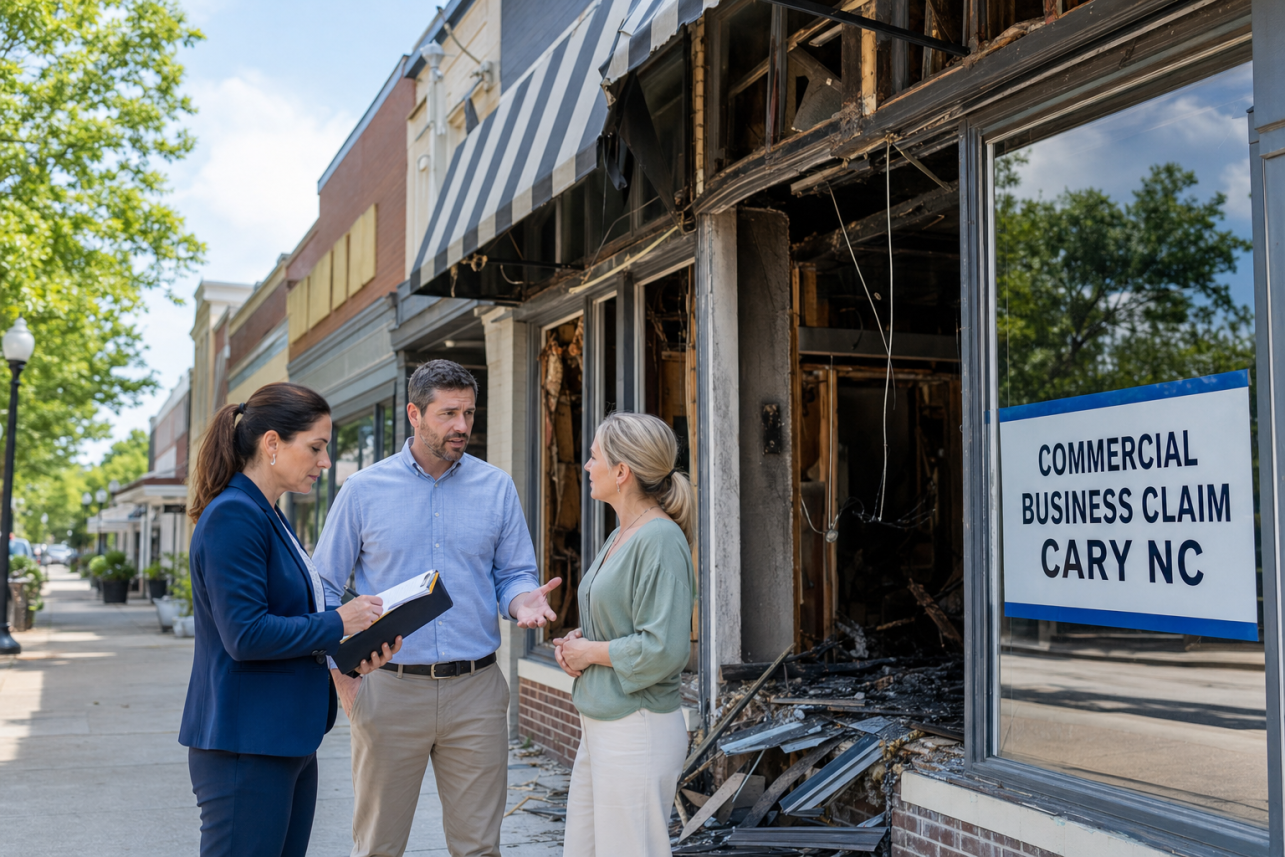
Reviews
After the fire in one of my retail units, the insurance company's first number wouldn't have covered half the rebuild. For The Public Adjusters found smoke damage in units the carrier never even inspected and documented my lost rental income month by month. The final settlement let me rebuild the right way and bring the space up to current Cary code. I would never handle a commercial loss without them again.
Marcus T., Cary retail plaza owner
A pipe burst above our exam rooms over a weekend and the carrier kept going back and forth about what was covered. Their team moisture-mapped the whole suite, itemized our damaged equipment and tenant improvements, and handled every call with the adjuster so I could focus on relocating patients. The difference between the first offer and where we ended up was significant, and they explained every step in plain English.
Priya S., medical office manager, Cary
Hurricane remnants put a tree through our roof and rain soaked the dining room and walk-in. The insurer's estimate missed the spoiled inventory and lowballed the time we'd be closed. These adjusters rebuilt our business interruption numbers from our actual sales records and fought for the full scope of roof and interior repairs. Professional, licensed, and relentless on the details. Worth every bit of the fee.
Dale R., restaurant owner near Crossroads
Frequently Asked Questions
What Does A Public Adjuster Do For A Commercial Business Claim Cary NC Property Owners File After A Fire Or Water Loss?
When you hire For The Public Adjusters, Inc. to handle a Commercial Business Claim Cary NC businesses typically see a far more organized, documented, and professionally presented claim than they could assemble on their own. We work only for you, the policyholder — never for the insurance company.
Our team starts by reading your entire commercial policy, including endorsements, co-insurance clauses, and business income provisions that many owners have never reviewed. We then document the loss in detail: structural damage to the building, damaged inventory and equipment, and the income your business loses while operations are interrupted.
From there, we prepare the estimates, inventories, and proof-of-loss paperwork, meet the insurance company's adjuster at your property, and negotiate on your behalf. North Carolina courts have repeatedly sided with policyholders when insurers wrongly narrow coverage. In Gaston County Dyeing Machine Co. v. Northfield Insurance Co., 351 N.C. 293 (2000), the North Carolina Supreme Court ruled in favor of the insured on a property damage coverage dispute, rejecting the insurer's attempt to escape its obligations. Cases like that show why thorough documentation and policy knowledge matter.
We are licensed and bonded, and we handle commercial property losses throughout Cary and the rest of Wake County. We cannot promise a specific dollar outcome — no honest adjuster can — but we can promise that your claim will be measured, documented, and argued thoroughly.
Can You Help With Business Interruption Losses On A Commercial Claim In Cary?
Yes. Business interruption — often called business income coverage — is one of the most undervalued parts of a commercial property claim, and it is an area where our Cary clients frequently need the most help.
If a fire, pipe burst, hurricane, or tornado forces your Cary business to close or scale back, your policy may cover lost net income, continuing expenses like rent and payroll, and sometimes extra expenses you incur to keep operating from a temporary location. The challenge is proving those numbers. Insurers often push back on revenue projections, seasonal trends, and the length of the restoration period.
We work with your financial records — profit and loss statements, tax returns, sales data — to build a defensible income loss calculation. For a retail shop near Crossroads Plaza or a restaurant in downtown Cary, we account for local factors like seasonal foot traffic that a generic spreadsheet would miss.
North Carolina law supports policyholders who hold insurers to the policy language. In Gaston County Dyeing Machine Co. v. Northfield Insurance Co., the state Supreme Court found in favor of the insured business on a disputed property damage claim, a reminder that coverage disputes are winnable when the facts and documents are in order.
We never guarantee a particular recovery, but we make sure every category of covered loss is identified, calculated, and presented. Note that we handle property and business losses only — we do not work on vehicle, health, life, or cell phone claims.
Does Commercial Coverage In Cary Include Flood Damage, And What Should I Do If My Building Floods?
Most standard commercial property policies in North Carolina exclude flood — meaning rising surface water from heavy rain, overflowing creeks, or storm surge. That surprises many Cary business owners, especially those near low-lying areas along Crabtree Creek or Walnut Creek where runoff can pool quickly during severe storms.
Flood coverage for a business usually comes through a separate policy under the National Flood Insurance Program (NFIP) or a private flood carrier. If your building took on rising water, your first steps should be to document everything with photos and video, report the loss to your flood carrier promptly, and review your NFIP proof-of-loss deadlines, which are stricter than standard policies. You can learn more at FEMA.gov and FloodSmart.gov, the official NFIP site.
Where it gets complicated is a mixed loss. A hurricane can drive rain through a damaged roof (typically a wind peril under your commercial policy) while floodwater enters at ground level (a flood peril under NFIP). Properly separating and documenting those two causes of damage is critical, because each policy pays only for its own peril.
For The Public Adjusters, Inc. helps Cary and Wake County businesses sort out exactly that — identifying which policy responds to which damage, documenting both losses correctly, and meeting every deadline. We are licensed and bonded, and while we cannot promise any specific settlement amount, we make certain no covered portion of your loss goes unclaimed.
How Much Does It Cost To Hire For The Public Adjusters, Inc. For A Commercial Business Claim Cary NC Companies Are Filing, And When Should I Call?
We work on a contingency fee, meaning our fee is a percentage of the claim settlement. There are no upfront costs, no hourly billing, and if there is no recovery, you owe us nothing for our adjusting work. That structure keeps our interests aligned with yours from day one.
The best time to call is immediately after the loss — ideally before you give a recorded statement or sign anything from the insurance company. Early involvement lets us document the damage before cleanup alters the scene, guide emergency mitigation so you comply with your policy duties, and set the claim up correctly from the start. That said, we also take over claims that have stalled, been underpaid, or been denied.
For a Commercial Business Claim Cary NC owners should understand that the insurance company's adjuster, however pleasant, works for the carrier. You are entitled to your own licensed representative. North Carolina's courts have shown that insureds who push back can prevail — in Gaston County Dyeing Machine Co. v. Northfield Insurance Co., the North Carolina Supreme Court ruled for the insured in a property damage coverage dispute after the insurer tried to deny its obligation.
We are licensed and bonded, and we serve business owners throughout Cary, Morrisville, Apex, and greater Wake County. We will never promise a specific result, because no reputable adjuster can — but we will put the full weight of professional documentation and negotiation behind your claim.
What Documentation Should I Gather Before Starting A Commercial Business Claim Cary NC Insurers Will Actually Pay Attention To?
Strong documentation is the backbone of any commercial property claim, and gathering it early makes a measurable difference. Start with your complete policy, including all endorsements and declaration pages. Many Cary business owners only have the declarations page on hand, and the endorsements often contain the provisions that determine what gets paid.
Next, photograph and video everything before any cleanup begins. Capture wide shots of each affected room or area, then close-ups of damaged equipment, inventory, finishes, and structural elements. Date-stamped images carry real weight during negotiations.
For the building itself, pull together construction records, prior appraisals, lease agreements, and any maintenance logs. For contents and inventory, collect purchase invoices, depreciation schedules, and point-of-sale records. If your operations were disrupted, preserve profit-and-loss statements, tax returns, and payroll records from at least the past two years.
When our team handles a commercial loss in Cary, we build the inventory and estimate for you, line by line, using contractor-grade pricing for the Wake County market. We are licensed and bonded, and we document the claim the way the policy language requires, which is often different from how a business owner would naturally present it.
One caution: do not throw anything away until it has been documented and, ideally, inspected. Discarded materials cannot be scoped, and insurers frequently dispute items they never saw. Secure the property, mitigate further damage as your policy requires, and keep receipts for every emergency expense along the way.
What Happens If The Insurance Company Underpays Or Denies My Commercial Claim In Cary?
An underpayment or denial is not the end of the road. North Carolina policyholders have real leverage, and the courts have backed that up. In Gray v. North Carolina Insurance Underwriting Association, 352 N.C. 61 (2000), coastal property owners whose buildings were damaged by hurricanes sued after the insurer failed to handle their claims properly. The North Carolina Supreme Court allowed the insureds' bad-faith and unfair-practices claims to proceed, confirming that carriers in this state can be held accountable for mishandling legitimate property damage claims.
What that means for a Cary business owner is simple: a lowball offer is a negotiating position, not a final word. The first step is a detailed review of the denial letter or the carrier's estimate against the actual policy language. Denials frequently rest on a single exclusion read out of context, and underpayments often come from missed scope, outdated pricing, or improper depreciation.
When we take over a Commercial Business Claim Cary NC carriers have shortchanged, we re-inspect the property, rebuild the estimate from scratch, and present the supplemental demand with photographic and documentary support. If the dispute continues, your policy likely contains an appraisal clause, a formal process for resolving valuation disagreements without litigation.
We cannot promise a specific outcome, and no honest adjuster can. What we can do is make sure every covered dollar of damage is identified, documented, and pursued through every avenue the policy and North Carolina law provide.
How Long Does A Commercial Property Claim In Cary Typically Take To Settle?
Timelines vary widely depending on the size of the loss, the complexity of the policy, and how the carrier responds. A straightforward water loss at a small Cary office might resolve in six to twelve weeks. A major fire at a restaurant or warehouse, with structural damage, contents inventory, and lost income, can run six months or longer, particularly if code upgrades come into play under Cary's current building requirements.
Several factors drive the schedule. The carrier must inspect, which can take weeks after a large regional event like a hurricane moving through Wake County. Then come the estimate exchanges, where most delays actually happen. Every round of disagreement over scope or pricing adds weeks.
A properly prepared claim moves faster. When the documentation package is complete on day one, with a detailed estimate, supported contents inventory, and organized financials for any income loss, the carrier has fewer reasons to stall and fewer requests for additional information.
Our role as your Cary public adjuster includes managing that timeline actively. We track every deadline the policy imposes on the insurer, follow up in writing, and escalate when responses lag. North Carolina's Unfair Claims Settlement Practices rules require carriers to act within reasonable timeframes, and we hold them to it.
Partial payments are also worth knowing about. On larger losses, we routinely request undisputed advances so the business can begin repairs and stabilize operations while the remaining items are negotiated, rather than waiting for one lump settlement at the very end.
What Types Of Commercial Damage Do You Handle For Cary Businesses, And Is Flood Included?
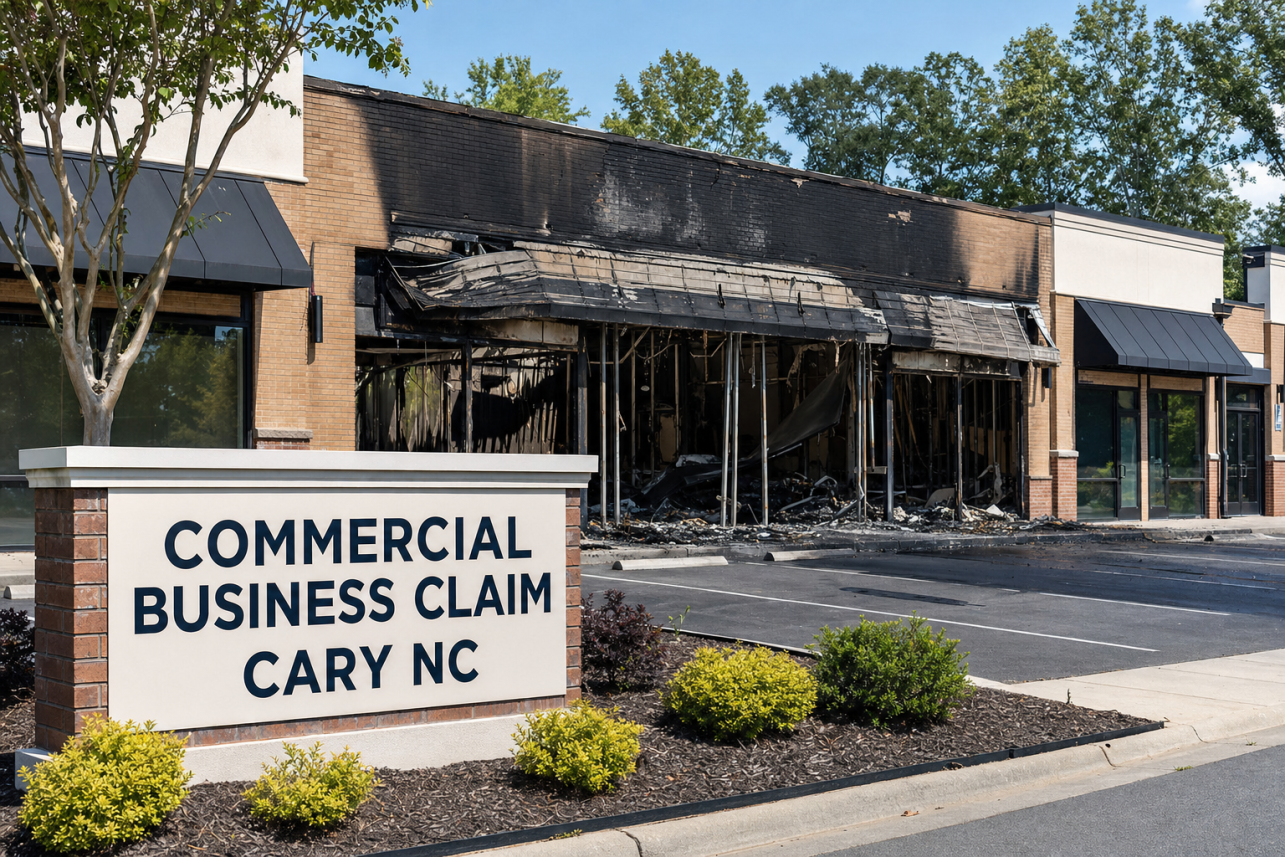
We represent Cary business owners on claims involving fire and smoke, water damage from burst pipes or roof leaks, hurricane and tornado damage, hail, theft and vandalism, and the business income losses that follow a covered event. That covers most of what affects commercial buildings in Wake County, from retail spaces along Kildaire Farm Road to office parks and warehouses near the US-1 corridor.
Flood is a special category. Standard commercial property policies almost always exclude rising water, which is covered instead through the National Flood Insurance Program (NFIP) or a private flood policy. If your Cary building took on floodwater, check whether you carry a separate flood policy, and visit FEMA.gov or FloodSmart.gov to understand how NFIP commercial claims work. We can help you evaluate the damage and determine which policy, or combination of policies, applies, since storms often cause both wind-driven damage and flooding at the same property, and sorting out which policy owes what is a frequent point of dispute.
A few honest limits: we do not handle claims involving motor vehicles, cell phones, health, or life insurance. Our focus is damage to buildings, business contents, and the resulting loss of income.
Every engagement starts with a no-obligation review of your policy and your damage. We are licensed and bonded in North Carolina, and we will tell you plainly whether professional representation makes sense for your situation, because on smaller, uncomplicated losses, it sometimes does not.
I Already Accepted A Settlement Check For My Cary Commercial Property Loss. Is It Too Late To Get Help?
Not necessarily. In North Carolina, accepting an initial payment does not automatically close the door on your claim. Many commercial policies allow supplemental claims when additional damage is discovered or when the original estimate missed real costs, and the state's statute of limitations on property claims often leaves room to act.
We regularly review settled files for Cary business owners and find overlooked items: code-upgrade costs under ordinance-or-law coverage, undervalued business personal property, missed demolition and debris removal, or depreciation that was never recovered after repairs were completed.
The first step is a no-cost review of your policy, the carrier's estimate, and the actual condition of your building. If the numbers do not line up, we document the gap with our own detailed estimate and present a supplemental demand to the insurer. Courts have repeatedly backed policyholders who push back on lowball valuations. In Corban v. United Services Automobile Association (Mississippi Supreme Court, 2009), the insured prevailed after the carrier tried to use causation language to avoid paying for covered hurricane damage to the property, and the court held the insurer could not escape its obligation for the covered portion of the loss.
We cannot promise a specific additional recovery, and no honest adjuster can. What we can do is make sure every covered dollar is actually claimed, properly documented, and professionally argued. Bring us your closing paperwork and the carrier's estimate, and we will tell you honestly whether reopening makes sense.
Do You Handle Hurricane And Tornado Damage As Part Of A Commercial Business Claim Cary NC Property Owners Need To File?
Yes. Hurricane and tornado losses are among the most common and most underpaid commercial claims we see in Wake County. Cary sits far enough inland that owners sometimes assume hurricanes are a coastal problem, but storms like Fran and Florence proved that Triangle-area buildings take serious roof, structural, and water-intrusion damage when these systems track through central North Carolina.
Hurricane claims are complicated because carriers often try to separate covered storm damage from excluded flood damage, and the two frequently occur in the same event. If rising water contributed to your loss, flood coverage typically comes through a separate policy under the National Flood Insurance Program, and resources at FEMA.gov and FloodSmart.gov explain how NFIP claims work alongside your commercial policy.
Tornado claims bring their own fights, usually over whether roof and structural damage is storm-related or "pre-existing wear." We counter that with engineering-level documentation, moisture mapping, and line-item estimates that account for hidden damage inside walls, roof decking, and HVAC systems.
Policyholders who stand their ground often prevail. In Corban v. USAA (2009), the court sided with the insured and refused to let the carrier use an anti-concurrent causation clause to deny the covered storm damage portion of a hurricane loss to the property. That principle — the insurer pays for what the policy covers, period — guides how we build every file. We make no guarantees about outcomes, but we do guarantee your damage will be fully documented and professionally presented.
What Is The Appraisal Clause, And When Would You Recommend It For A Commercial Claim In Cary?
Appraisal is a dispute-resolution process written into most commercial property policies. When you and the insurance company agree the loss is covered but disagree on the dollar amount, either side can invoke appraisal. You select an appraiser, the carrier selects one, and the two choose a neutral umpire. Agreement by any two of the three sets the amount of loss — usually without a lawsuit.
For a Cary business owner, appraisal can be a powerful tool when the carrier's estimate is tens of thousands of dollars below real-world repair costs from local contractors. It is typically faster and far less expensive than litigation, and North Carolina courts generally enforce appraisal awards.
That said, timing matters. Invoking appraisal too early, before the scope of damage is fully documented, can lock in a number that misses hidden damage. We prepare the complete file first — detailed estimates, contractor bids, inventory valuations, and business income calculations — so the appraisal starts from a position of strength.
It is worth remembering that courts take a dim view of carriers who undervalue losses in bad faith. In Bi-Economy Market, Inc. v. Harleysville Insurance Co. (New York Court of Appeals, 2008), a family business destroyed by fire won its case after the insurer delayed and underpaid the building and business claim, and the court held the carrier liable for the consequential damages its conduct caused. Insurers know these precedents, which is exactly why a well-documented appraisal demand so often moves negotiations.
Is For The Public Adjusters, Inc. Licensed In North Carolina, And Are There Claims You Do Not Take?
Yes. We are licensed public adjusters in North Carolina and we are bonded, as the state requires. That licensing means we are legally authorized to represent you — the policyholder, never the insurance company — in preparing, documenting, and negotiating your property claim. You can verify any adjuster's license through the North Carolina Department of Insurance, and we encourage every business owner to do exactly that before signing anything.
Our focus is property: commercial buildings, business contents, inventory, equipment, and the business income losses that follow fire, water, hurricane, tornado, and similar covered events. If you are preparing a Commercial Business Claim Cary NC carriers will scrutinize closely, that is squarely the work we do every day across Wake County.
There are claims we do not handle. We do not take cell phone, motor vehicle, health, or life insurance claims — those fall outside public adjusting for property losses, and we would rather tell you that upfront than waste your time.
One more point of honesty: no legitimate public adjuster can guarantee a specific settlement amount, and anyone who does should raise a red flag. What a licensed adjuster provides is thorough documentation, accurate valuation, and experienced negotiation. Court history shows that preparation matters — in Bi-Economy Market v. Harleysville (2008), the insured business prevailed because the record clearly showed the carrier failed to pay what the fire loss to the building and contents was actually worth. Building that kind of record is precisely our job.
Can My Business Stay Open While A Commercial Business Claim Cary NC Adjusters Are Working On Gets Resolved?
In many cases, yes — and keeping your doors open in Cary is often one of our first priorities. When For The Public Adjusters, Inc. steps in, we evaluate which areas of your building are safe and usable, then work with the carrier to document the loss without forcing a full shutdown.
Your policy almost certainly includes a duty to mitigate, which means you are expected to take reasonable steps to prevent further damage. That might mean tarping a tornado-damaged roof section, drying out a water-soaked stockroom, or isolating a fire-affected wing while the rest of the property operates. We help you document those mitigation costs so they can be submitted as part of the claim rather than absorbed out of pocket.
If partial operation is possible, we also track the difference between your normal revenue and your reduced revenue, because many commercial policies cover that gap under business income provisions. If a full or partial shutdown is unavoidable, we document extra expenses like temporary locations, equipment rental, and expedited repairs.
The key is coordination. Carriers sometimes delay inspections while a business owner sits idle, losing customers every day. Our team pushes the timeline, schedules joint inspections efficiently, and keeps a written record of every delay. We cannot guarantee a specific outcome, but we can make sure your operational losses are measured, supported, and presented properly — not estimated loosely by someone who has never run a business in Wake County.
What Is The Difference Between Actual Cash Value And Replacement Cost On A Cary Commercial Claim, And Why Does It Matter?
Actual cash value (ACV) is the cost to replace damaged property minus depreciation. Replacement cost value (RCV) is the full cost to repair or replace with materials of like kind and quality, without that deduction. On a commercial loss in Cary, the gap between the two can be enormous — sometimes hundreds of thousands of dollars on a building with an older roof, aging HVAC systems, or well-used equipment.
Many commercial policies pay ACV first, then release the depreciation holdback only after repairs are completed. Business owners who do not understand this sequence often leave recoverable money on the table because they never submit the paperwork to claim the holdback.
How depreciation is calculated is also contested territory. In Sproull v. State Farm Fire & Casualty Co. (2021), the Illinois Supreme Court sided with the policyholder, ruling the insurer could not depreciate the cost of labor when calculating actual cash value — labor does not wear out the way shingles or drywall do. Courts reaching conclusions like that show why depreciation figures on a carrier's estimate should never be accepted at face value.
For The Public Adjusters, Inc. reviews your Wake County policy language, audits the carrier's depreciation line by line, and documents the true replacement cost of your building and contents. We are licensed and bonded in North Carolina, and while no one can promise a particular dollar figure, we make sure every recoverable dollar under your policy is properly claimed and supported.
How Do You Create A Contents Inventory For A Damaged Cary Business, Including Equipment, Stock, And Furnishings?
A contents inventory is one of the most undervalued parts of a commercial loss, and it is where Cary business owners most often get shortchanged. Carriers frequently rely on a quick walkthrough and a rough spreadsheet. We build a defensible, item-by-item inventory instead.
The process starts with a physical inspection of everything damaged — office furniture, point-of-sale systems, specialized machinery, shelving, inventory stock, tools, and tenant improvements. We photograph each item, record model and serial numbers where they survive, and note the age and condition. For destroyed items, we reconstruct the inventory from purchase records, vendor invoices, bank statements, tax depreciation schedules, and even photos from your website or security footage.
Valuation comes next. Replacement pricing is sourced from actual suppliers, not generic databases that lowball commercial-grade equipment. Perishable stock, custom fixtures, and industry-specific machinery each get valued according to how your policy defines covered property, since business personal property and improvements-and-betterments can fall under different limits.
We also separate contents from building damage carefully, because misclassifying items can push losses against the wrong limit and reduce what you collect. Throughout, we keep the documentation organized so the carrier's adjuster cannot dismiss items as unsupported.
For The Public Adjusters, Inc. handles this for fires, water losses, hurricane and tornado damage, and theft or vandalism losses across Wake County. We do not handle claims involving motor vehicles, cell phones, health, or life insurance — our focus is buildings, contents, and the businesses that depend on them.
Are There Deadlines I Need To Worry About When Filing A Commercial Property Claim In Cary, North Carolina?
Yes, and missing them can be fatal to an otherwise valid claim. The first deadlines come from your own policy. Most commercial policies require prompt notice of loss, and many require a sworn proof of loss within a set window — sometimes 60 days after the carrier requests it. Blowing a proof-of-loss deadline gives the insurer an easy reason to deny.
Beyond the policy, North Carolina law generally allows three years to file suit for breach of an insurance contract, but some policies contain shorter suit-limitation clauses, so the contract language controls and should be reviewed early. If your loss involves a hurricane or tornado, documentation deadlines matter even more because weather-event claims attract heavy scrutiny over when damage occurred.
Policyholders who hold insurers to the contract can and do prevail. In Salvatore v. State Farm Fire & Casualty Co., a New Jersey appellate court ruled for homeowners after a fire loss, finding the insurer could not use technical proof-of-loss arguments to escape payment where the policyholders had substantially complied and the carrier suffered no prejudice. Decisions like that underscore that deadlines cut both ways — carriers have obligations too, including timely acknowledgment and investigation of a Commercial Business Claim Cary NC owners submit in good faith.
Our recommendation: report the loss immediately, calendar every date in writing, and bring For The Public Adjusters, Inc. in early. We track every deadline, prepare the sworn documentation correctly the first time, and document any carrier delays. We cannot promise a specific result, but we can make sure a missed date never becomes the reason your recovery falls short.
Local Relevance
Cary's commercial corridors grew fast, and much of that construction is now twenty to thirty years old — right at the age where carriers start attributing roof and envelope damage to wear and tear instead of the hail, hurricane remnants and tornado events that actually caused it. Spring hail and tornado paths in the Triangle are notoriously narrow, so the fact that the business next door didn't file a claim says nothing about yours.
Summer thunderstorms and tropical-system rain also drive a steady stream of commercial water losses here, from roof leaks over retail space to backed-up drainage flooding ground-floor suites. Note that rising surface water is typically a separate flood policy matter rather than a standard commercial property claim — a distinction that catches many owners off guard.
We work this market constantly. Beyond Cary we handle losses across Wake County, including Fire Damage Claim Help in Garner and claims throughout the Raleigh metro, so our rebuilding costs reflect what Triangle contractors actually charge right now — not a statewide average.
Much of western Cary and neighboring Morrisville sits on Triassic Basin clay that drains poorly and shrinks and swells with the seasons, so commercial slabs and foundations here show cracking and settlement that out-of-area carrier adjusters tend to dismiss as age — knowing the soil under your building often changes how a water or structural claim should be argued.
Get A Second Opinion On Your Cary Business Loss
Before you accept the carrier's number, let a licensed and bonded public adjuster review your policy and your damage at no cost. Whether your claim was underpaid, denied or hasn't been filed yet, For The Public Adjusters, Inc. will tell you honestly where you stand and what your options are.
Request Your Free Claim Review
Call us: (919) 400-6440
Helpful Resources
- NCDOI Public Adjusters Guide
- National Fire Protection Association (NFPA)
- North Carolina Department of Insurance — State regulator that licenses public adjusters and assists policyholders
Last updated: October 9, 2026