
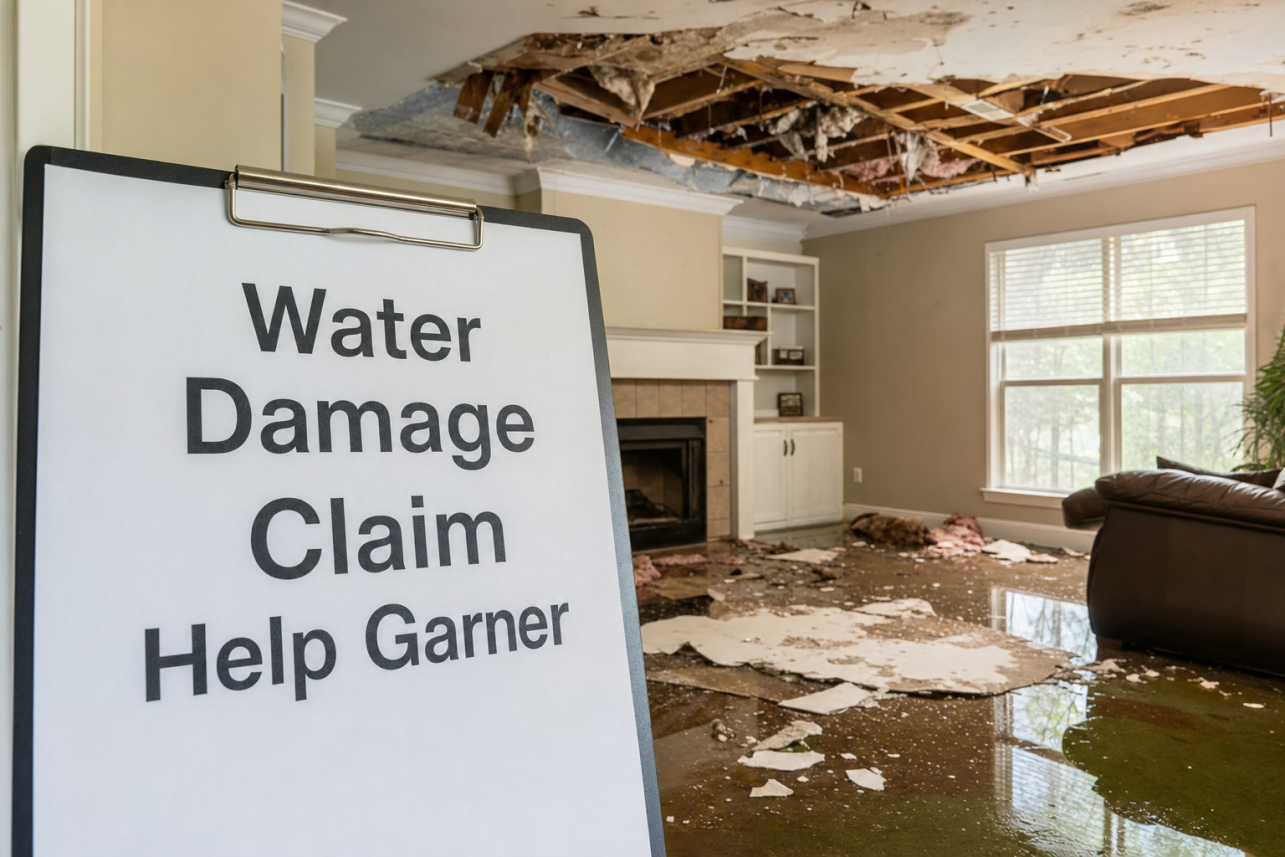
Water Damage Claim Help Garner NC homeowners can rely on comes from For The Public Adjusters, Inc. — licensed and bonded public adjusters who work for you, not the insurance company. We handle the entire claim from documentation to negotiation, whether the water came from a burst pipe, a roof leak after a summer thunderstorm, or a water heater that let go while you were at work. You pay nothing out of pocket up front, and we only get paid when your claim does.
What This Service Is
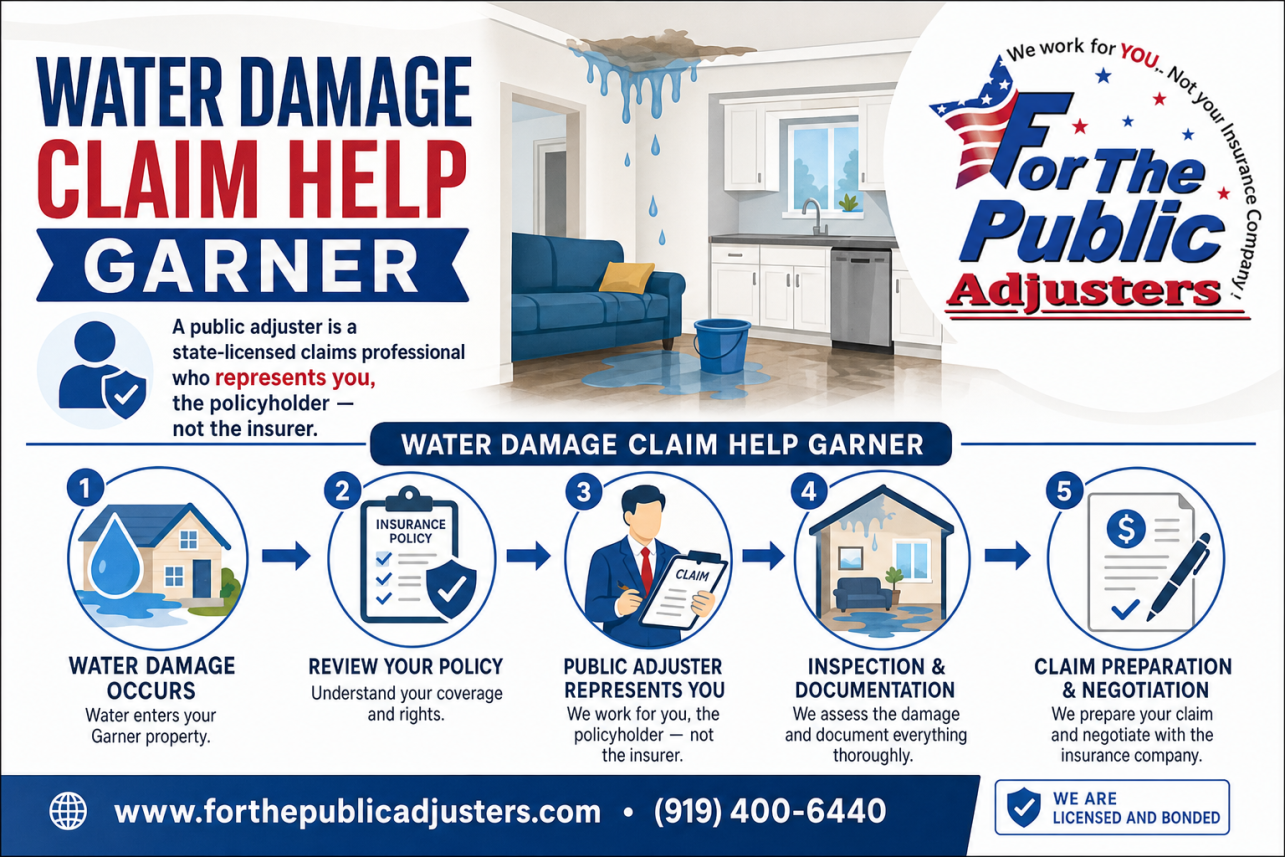
A public adjuster is a state-licensed claims professional who represents you, the policyholder — not the insurer. When water gets into your Garner home, the insurance company sends its own adjuster to assess the damage. That person is trained, experienced, and paid by the insurer. Most homeowners have never read their full policy and have no idea what a fair estimate looks like.
That's the gap we fill. Our adjusters inspect the property ourselves, including the places water hides — under flooring, inside wall cavities, in crawl spaces and subfloors. We read your policy line by line, prepare a detailed repair estimate, assemble the proof of loss documentation your insurer requires, and negotiate directly with the company on your behalf.
The North Carolina Department of Insurance publishes the NCDOI Public Adjusters Guide, which explains exactly what licensed public adjusters can and cannot do in this state — and we operate strictly within it. We handle residential and commercial water losses across Garner and Wake County, along with related fire, smoke, tree damage, and hurricane claims. If your loss involves rising water rather than water from above or inside the home, we also handle NFIP flood claims, which follow their own separate rules.
Common Problems
Denied Or Lowballed? The Water Damage Claim Help Garner NC Homeowners Actually Need
Two things happen constantly with water claims: outright denials and settlement offers that won't come close to covering repairs. Insurers may argue the leak was 'long-term seepage,' blame poor maintenance, or lean on a policy exclusion you didn't know existed.
A denial letter is not the end of the road. Policyholders can and do prevail — in Sproull v. State Farm Fire & Casualty Co., the Illinois Supreme Court sided with the homeowner and ruled the insurer could not depreciate the cost of labor when calculating an actual cash value payout. That single issue — depreciation quietly carved out of your check — shortchanges homeowners every day.
We review your denial or low offer against the actual policy language, rebuild the estimate correctly, and push back with documentation the insurer has to answer.
The Damage You Can't See Is Usually The Expensive Part
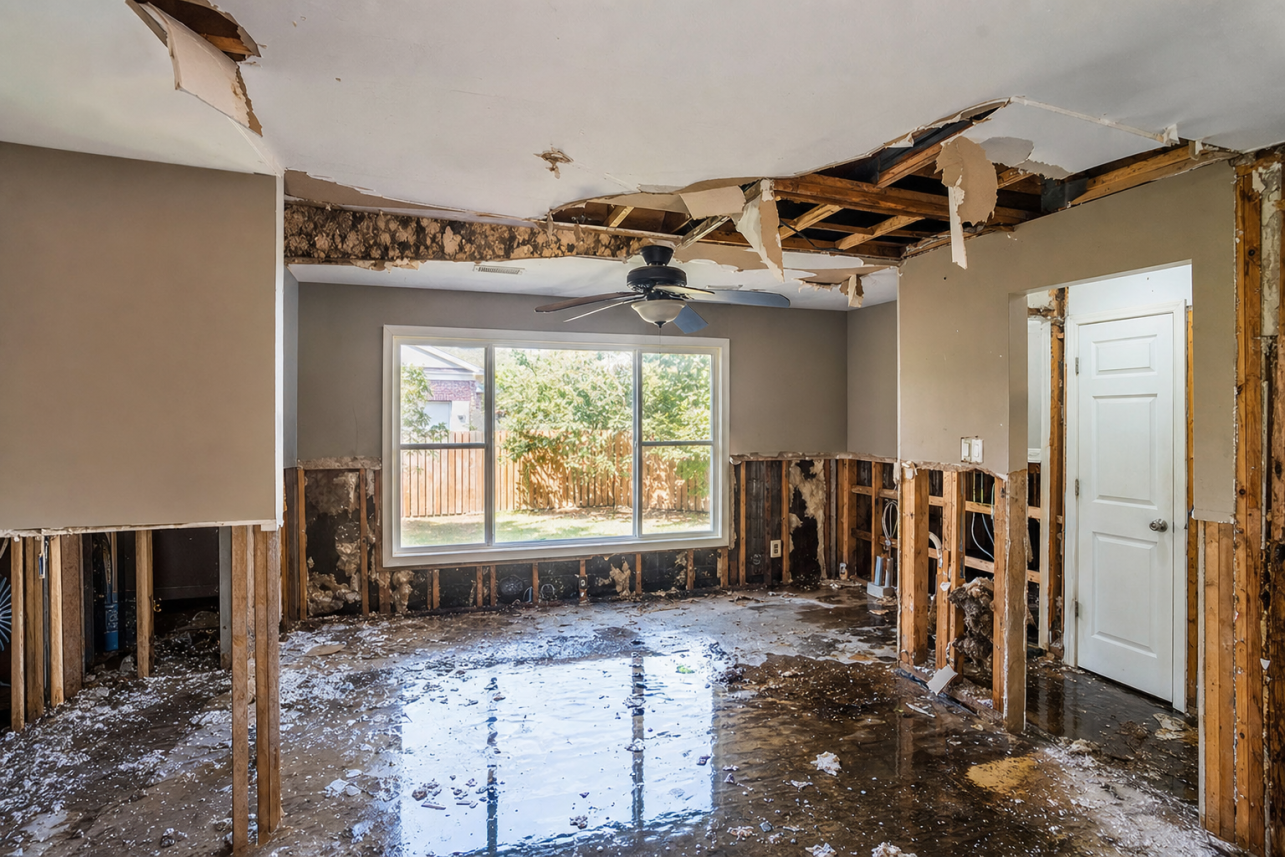
Water travels. A supply line that fails in an upstairs bathroom can soak the framing, insulation, and subfloor two rooms away before you see a stain on the ceiling. The insurer's adjuster may write an estimate for the visible drywall and stop there.
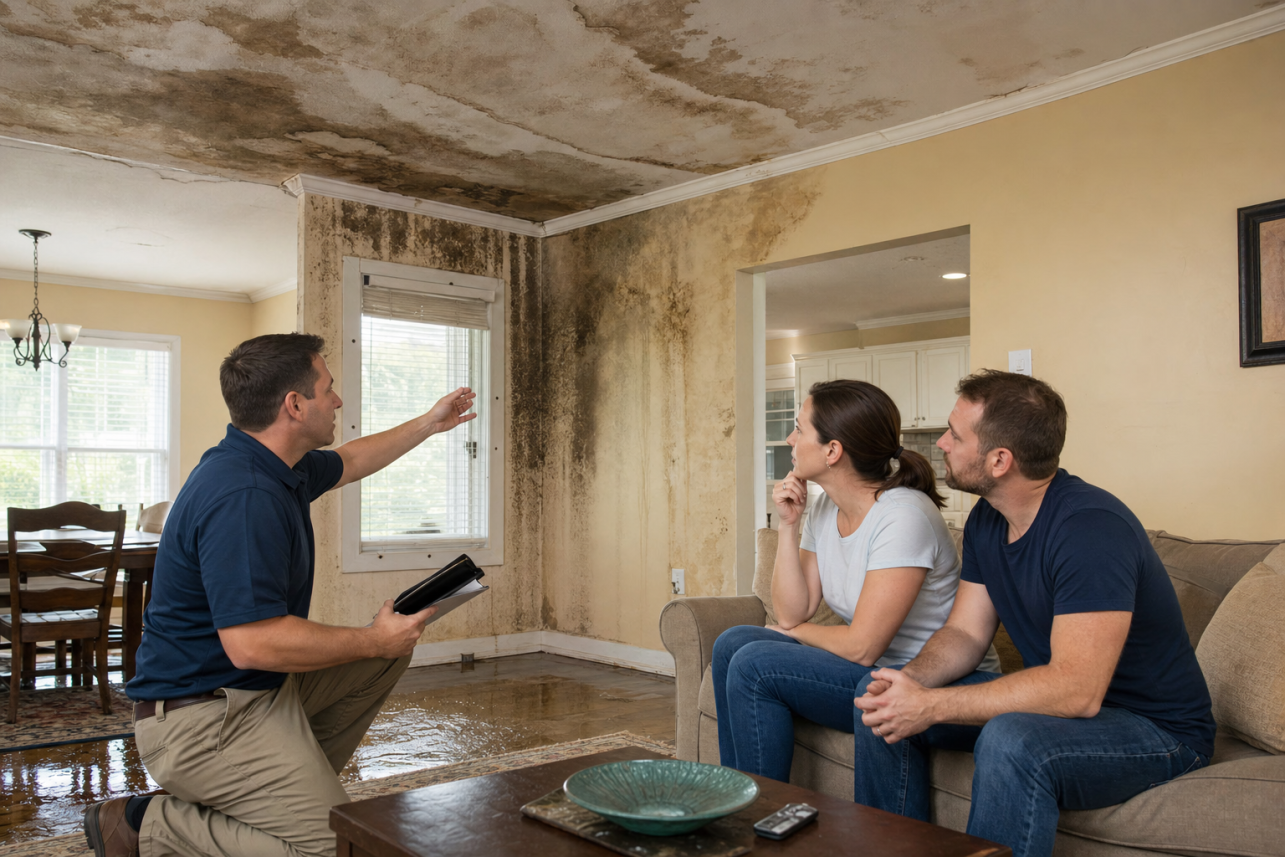
In Garner's humid summers, that hidden moisture becomes mold fast — sometimes within days. If the original claim didn't account for saturated materials, you're left arguing later about whether the mold is a 'new' problem the policy won't cover.
We document moisture damage thoroughly at the start, so structural drying, tear-out, and secondary damage are part of the claim — not a surprise you pay for yourself.
Water Damage Vs. Flood Damage: Getting The Coverage Question Right
Here's a distinction that decides claims: water that comes from inside the home or from above (a burst pipe, a roof opened up by a storm) is typically a homeowners claim. Water that rises from the ground — a creek out of its banks, storm runoff pouring in at grade — is flood damage, and standard homeowners policies exclude it.
When tropical-storm remnants push through Wake County, a single house can have both: wind-driven rain through a damaged roof and rising water in the crawl space. Insurers sometimes use the flood exclusion to deny the entire loss, including the parts that are covered.
We separate the loss correctly, pursue the homeowners claim on its merits, and if you carry a flood policy, we handle the NFIP flood claim under its distinct deadlines and documentation rules.
Our Process
Free Policy Review And Damage Inspection
We start by reading your actual policy — coverage limits, deductible, exclusions, and endorsements — so you know what you're entitled to before anyone talks numbers. Then we inspect the property ourselves, including crawl spaces, wall cavities, and flooring systems where water hides. This inspection stands on its own; it does not depend on what the insurance company's adjuster chose to look at.
Documentation, Estimate, And Proof Of Loss
We photograph and measure everything, inventory damaged contents room by room, and build a line-item repair estimate that reflects real replacement costs — not an estimate with labor depreciated away or emergency drying costs left out. We prepare and submit the formal proof of loss and keep every deadline, so the insurer never gets to slow the settlement timeline because of missing paperwork.
Negotiation Through Settlement
We deal with the insurance company's adjusters directly, respond to disputes over scope or pricing, and press the claim toward a fair resolution. If a contractor's repair bid conflicts with the insurer's numbers, we reconcile it with documentation. We're licensed and bonded, we work on a contingency basis, and while no one can promise a specific outcome, our job is to make sure the offer reflects what your policy actually owes.
| What Happens | Handling It Yourself | With For The Public Adjusters |
|---|---|---|
| Damage documentation | Photos of visible damage only; hidden moisture usually missed | Thermal imaging, moisture mapping, and full photo/video evidence of concealed damage |
| Repair estimate | You rely on the carrier's estimate and pricing | Independent line-item estimate built on current Wake County labor and material costs |
| Negotiating with the carrier | You argue against a trained adjuster with no leverage | Licensed NC public adjusters negotiate scope and pricing line by line |
| Denials and lowball offers | Often accepted because you don't know what else to do | Rebutted with policy language, causation evidence, and re-inspections |
| Additional living expenses / business income | Frequently forgotten or under-claimed | Documented and claimed in full alongside the property damage |
| Time and stress | Weeks of calls, emails, and paperwork on your own | We manage the entire claim from inspection through final settlement |
Commonly Overlooked In The Public Adjusting Industry
- Moisture trapped inside wall cavities and under continuous flooring — Carrier adjusters rarely open walls or take pin-meter readings, so they estimate only what's visible on the surface.
- Flooring and cabinet matching provisions — Carriers pay to replace only the wet boards or one cabinet run, ignoring that a partial replacement leaves an obvious mismatch the policy may require them to fix.
- The failed component itself as evidence — Homeowners let the plumber haul away the burst pipe or hose, destroying the proof that separates a covered sudden failure from an excluded gradual leak.
- Additional living expenses during drying and repairs — Families absorb hotel and meal costs themselves because the carrier never volunteers that ALE coverage exists on their policy.
- Recoverable depreciation on replacement-cost policies — The first check is the depreciated amount, and thousands in held-back depreciation go unclaimed when owners don't submit repair completion documentation.
- Category 3 water protocols on sewage and long-standing losses — Contaminated water requires removal of porous materials, not just drying, and estimates written for clean water dramatically undercount the scope.
- Code-upgrade coverage during the rebuild — Repairs in Wake County must meet current building code, and the ordinance-or-law coverage that pays for those upgrades is almost never included in the carrier's first estimate.
- Secondary mold growth from incomplete drying — When the initial drying scope is too small, mold appears weeks later and carriers try to treat it as a new, excluded loss instead of a consequence of the original one.
Case Studies
Case Study #1
Situation: A family in the Adams Point neighborhood of Garner came home from a weekend at the coast to find their upstairs supply line had burst, sending water through the second floor, down the stairwell, and into the kitchen ceiling below.
Problem: Their carrier's adjuster inspected quickly, wrote an estimate for drying and paint, and issued a check for $9,400. The homeowners knew that number couldn't be right — cabinets were swelling, the hardwood floors were cupping, and the ceiling drywall was sagging — but they didn't know how to push back.
Investigation: Our adjusters performed a full moisture-mapping inspection with thermal imaging and pin meters, documenting saturation inside wall cavities the carrier's adjuster never opened. We pulled the plumbing failure documentation, photographed hidden damage behind the kitchen cabinets, and built a line-item estimate using current Wake County labor and material pricing.
Findings: Moisture readings showed elevated levels in six wall assemblies and under the site-finished oak flooring across two rooms. Because the flooring was continuous, partial replacement would have left a visible mismatch — the policy's matching provisions supported replacing the connected flooring. The kitchen base cabinets had wicked water and were delaminating, which the original estimate ignored entirely.
Solution: We filed a supplemented claim with the complete scope, moisture documentation, and photo evidence, then met the carrier's re-inspection adjuster on site to walk every reading and line item. We negotiated flooring continuity, full cabinet replacement, and proper containment and drying protocols.
Outcome: The claim settled at $61,200 — more than six times the original offer — including additional living expenses for the three weeks the family stayed elsewhere during repairs.
Lesson: A fast first check on a water loss almost always reflects what's visible, not what's wet. Hidden moisture inside walls and under floors is where the real cost lives, and it has to be documented before it's covered.
Case Study #2
Situation: The owner of a small dental practice off Timber Drive in Garner discovered a slow water heater leak in a back utility closet had been seeping into the slab-adjacent walls and flooring of two operatories for weeks.
Problem: The carrier initially denied the claim, calling the damage 'long-term seepage' excluded under the policy. The practice was facing an out-of-pocket repair bill north of $40,000 plus lost revenue from closed treatment rooms.
Investigation: We reviewed the exact policy language, retained a plumber's report establishing when the tank fitting actually failed, and separated the sudden discharge damage from any pre-existing wear. We also documented the business income loss with production schedules and revenue records from the practice's management software.
Findings: The plumbing evidence showed the fitting failure was a sudden event, not gradual deterioration — the water simply hadn't been discovered quickly because the closet was rarely opened. The seepage exclusion the carrier cited didn't apply to the resulting damage under this policy's language, and business interruption coverage was clearly triggered.
Solution: We submitted a formal rebuttal to the denial with the plumber's causation report, policy citations, and a complete building and business income claim. When the carrier held firm, we requested a second inspection with their large-loss adjuster and walked the evidence in person.
Outcome: The denial was reversed. The final settlement covered $47,800 in building repairs plus $22,000 in business income and extra expense, letting the practice reopen both operatories without absorbing the loss.
Lesson: An initial denial is a position, not a verdict. When a carrier labels a water loss 'seepage' or 'wear and tear,' the actual cause of the failure and the precise policy wording decide the claim — not the first adjuster's opinion.
| Type of Water Loss | Typically Covered? | What It Depends On | What You Should Do First |
|---|---|---|---|
| Burst supply pipe or fitting | Usually yes | Whether the failure was sudden vs. carrier arguing long-term corrosion | Keep the failed pipe or fitting — never throw it away before the claim settles |
| Washing machine or dishwasher hose failure | Usually yes | Sudden discharge language; maintenance history of the appliance | Photograph the failed hose in place before anything is moved |
| Water heater leak | Often yes, with a fight | Sudden failure vs. 'gradual seepage' exclusion arguments | Get a plumber's written statement on the cause and timing of the failure |
| Roof leak from a storm | Often yes | Proof of storm-created opening vs. carrier claiming worn roofing | Document the roof damage and interior damage separately, with dates |
| Sewer or drain backup | Only with an endorsement | Whether your policy includes water backup coverage and its limit | Check your declarations page for a water backup endorsement before filing |
| Slab leak under the foundation | Partially, often | Access/tear-out to reach the pipe is usually covered; the pipe itself often isn't | Get leak detection done and keep the report — it defines the covered scope |
| Groundwater or surface flooding | No, not under homeowners | Requires separate flood insurance (NFIP or private) | Determine the water's entry point — the source decides which policy applies |
| HVAC condensate line overflow | Frequently yes | Sudden overflow vs. alleged lack of maintenance | Photograph the drain line and pan before the HVAC tech repairs anything |

Reviews
Our washing machine hose failed while we were at work and flooded half the first floor. State Farm's first offer wouldn't have covered the flooring, let alone the drywall. For The Public Adjusters found moisture in walls the insurance adjuster never even checked and got our settlement raised from about $11,000 to over $48,000. Worth every penny of their fee.
Denise M., Garner
Pipe burst under our kitchen slab and the carrier tried to say it was 'gradual damage' and deny most of it. I called these guys after a neighbor in Heather Hills recommended them. They brought in documentation from our plumber, cited the actual policy language, and got the denial overturned. The whole kitchen was rebuilt properly. I would never handle a water claim alone again.
Marcus T., Garner
After our water heater leak, I spent weeks going in circles with the insurance company on my own before hiring For The Public Adjusters. They took over every call and email, redid the estimate with real Wake County pricing, and even got our hotel costs covered while the floors were replaced. My only regret is not calling them the day it happened.
Angela R., Garner
Frequently Asked Questions
What Does Water Damage Claim Help Garner NC Actually Include When I Hire For The Public Adjusters, Inc.?
When you bring us in on a water loss, we take over the entire claim from documentation to settlement. That starts with a thorough inspection of your Garner home or business, including moisture mapping behind walls and under flooring where insurance company adjusters often stop looking.
We photograph and catalog every damaged item, from hardwood floors and drywall to cabinets, HVAC ductwork, and personal contents. Then we write a detailed, line-item estimate using the same pricing software carriers use, so there is no arguing over whether our numbers are realistic.
From there, we handle all communication with your insurance company. We attend every inspection, respond to every request for documentation, and push back when the carrier's estimate leaves out demolition, drying equipment, code upgrades, or matching materials. Wake County has specific building code requirements that can add real cost to a repair, and we make sure those are included.
We also review your policy for coverage you may not know you have, such as additional living expenses if you need to move out during repairs, or ordinance and law coverage for required upgrades. Finally, we negotiate the settlement directly. You are never on the phone arguing with a desk adjuster in another state.
Our fee is a percentage of the recovery, so we only get paid when you do. For most water losses in this area, homeowners who hire a public adjuster early recover significantly more than the carrier's first offer.
My Insurance Company Already Sent An Adjuster To My Garner Home. Is It Too Late To Get Help With My Water Damage Claim?
No, it is not too late. In fact, this is one of the most common points at which Garner homeowners call us, usually because the carrier's estimate came back far lower than the actual cost to repair.
The adjuster your insurance company sent works for the insurance company. That person's estimate is a starting point, not a final word. As licensed public adjusters, we represent you, and North Carolina law gives you the right to dispute, supplement, and reopen claims that were underpaid.
When we take over a claim mid-stream, we start by comparing the carrier's estimate against the real scope of damage. Water losses are notorious for hidden problems: saturated insulation, wet subfloor, moisture wicking up interior walls, and mold growth that starts within 48 to 72 hours in our humid Wake County climate. Carrier estimates frequently miss all of it.
We then file a supplemental claim with our own documentation, moisture readings, and a corrected estimate. If the carrier resists, we can invoke the appraisal clause in your policy, which forces a formal dispute resolution process.
Even claims that were already paid and closed can often be reopened. In North Carolina, you generally have three years from the date of loss to pursue additional payment, though acting quickly always helps. If you have a settlement check sitting on your counter that will not come close to covering repairs, do not cash it before talking to us. Call for a free review of what the carrier offered versus what your policy actually owes you.
What Types Of Water Losses In Garner Qualify For A Claim, And Which Ones Do Insurance Companies Typically Deny?
Most homeowners policies in North Carolina cover sudden and accidental water damage. That includes burst pipes, water heater failures, washing machine and dishwasher supply line breaks, ice maker line leaks, toilet overflows, and roof leaks caused by storm damage. These are the losses we handle most often for Garner families, especially pipe bursts during hard January freezes and supply line failures in homes built in the 1990s and 2000s.
What carriers typically deny or fight is damage they classify as gradual. A slow leak under a sink that rotted the cabinet over months, long-term seepage around a shower pan, or ongoing roof leaks are frequently denied as maintenance issues. Flood damage, meaning water rising from outside the home, is also excluded from standard policies and requires separate flood insurance, which matters for properties near Swift Creek and low-lying areas off Highway 50.
Here is where experienced representation matters: carriers often mislabel covered sudden losses as gradual ones to justify a denial. A pipe that failed suddenly may have left staining that an adjuster points to as evidence of a long-term problem. We know how to document the actual cause of loss, bring in plumbers or engineers when needed, and challenge wrongful denials.
Even in genuine gradual-leak situations, the resulting damage is sometimes partially covered depending on your policy language, particularly tear-out costs to access the failed component. Before you accept a denial letter at face value, have us read your policy. The exclusions are rarely as absolute as the denial makes them sound.
How Much Does Professional Water Damage Claim Help Cost In Garner, And Is It Worth It For A Smaller Loss?
For The Public Adjusters, Inc. works on contingency, meaning our fee is a percentage of what we recover for you. There is no upfront cost, no hourly billing, and no fee at all if we do not secure a payment. North Carolina caps public adjuster fees by law, so the structure is regulated and transparent, and we put it in writing before any work begins.
Whether it is worth it depends less on the size of the loss and more on the gap between what the carrier wants to pay and what repairs actually cost. A kitchen supply line break that a carrier estimates at $8,000 can easily be a $25,000 repair once you account for cabinet replacement, matching flooring throughout connected rooms, proper drying, and Wake County permit and code requirements. On losses like that, our involvement typically pays for itself many times over.
For very small claims near your deductible, we will tell you honestly if hiring us does not make financial sense. We would rather give you fifteen minutes of free advice than take a fee that does not benefit you. Our reputation in Garner depends on that.
If you are unsure, start with a free claim review. We look at the damage, the carrier's position, and your policy, then give you a straight answer about whether professional Water Damage Claim Help Garner NC homeowners rely on will actually move the number. Many of our clients started with that one phone call after the carrier's first offer left them short.
How Long Does The Process Take Once I Request Water Damage Claim Help Garner NC From For The Public Adjusters, Inc.?
Most water damage claims we handle in Garner resolve in 30 to 90 days, though the timeline depends on the size of the loss and how cooperative the insurance carrier is. North Carolina requires insurers to acknowledge a claim promptly and act in good faith, and we hold them to those deadlines from day one.
Here is the typical flow. Within 24 to 48 hours of your call, we inspect the property, document moisture readings, and photograph every affected area before anything gets torn out or dried. Within the first week, we prepare a detailed scope of damage and submit our estimate to your carrier.
The middle stretch is where delays usually happen. The insurance company may schedule a re-inspection, request additional documentation, or dispute line items in the estimate. Because we handle those negotiations directly, homeowners in Garner rarely have to attend those meetings or field those calls themselves.
A straightforward pipe-break claim with clear coverage might settle in a month. A claim involving hidden mold behind drywall, disputed causation, or a carrier lowballing the first offer can stretch to three or four months. Underpaid claims we take over after a bad initial settlement often take longer because we are reopening a file the insurer considers closed.
We give every client a realistic timeline after the first inspection, and we push the carrier at every stage. Slow responses cost you money in continued drying, temporary housing, and repair delays, so speed matters as much as the settlement amount.
What Should I Do In The First 24 Hours After Finding Water Damage In My Garner Home, Before Anyone Files Anything?
First, stop the water if you safely can. Shut the main supply valve, which in most Garner homes is near the water heater, in the crawl space, or at the meter box by the street. If the source is a roof leak or storm intrusion, place a tarp or buckets to limit the spread.
Second, document everything before you clean up. Take wide photos of each room, then close-ups of standing water, soaked flooring, stained ceilings, and damaged belongings. Video is even better because it captures the extent in a way the insurance company cannot dispute later. This step matters more than most homeowners realize, because carriers routinely reduce payouts when damage was removed before it was recorded.
Third, take reasonable steps to prevent further damage. Your policy actually requires this. Move furniture off wet carpet, run fans, and pull up rugs. Keep receipts for anything you buy, including dehumidifiers, tarps, or a wet vac, because those costs are typically reimbursable.
What you should not do is sign a contract with the first restoration company that shows up, give a recorded statement to the insurer without preparation, or accept a quick settlement check. Water losses in Wake County homes frequently involve hidden damage inside wall cavities and under subfloors that does not show up for days.
Calling For The Public Adjusters before you file lets us shape the claim correctly from the start, which is far easier than fixing a claim that started off wrong.
My Water Damage Claim In Garner Was Denied Or Came Back Way Lower Than My Repair Estimates. Can This Still Be Fixed?
Yes, and this is actually one of the most common situations we take on for Garner homeowners. A denial or a low settlement offer is not the final word. It is the carrier's opening position, and it can be challenged with better documentation and a properly built claim.
With underpaid claims, we start by comparing the insurer's estimate line by line against the actual scope of damage. Carriers frequently omit things like baseboard and drywall replacement beyond the visibly wet area, matching flooring across continuous rooms, proper mold remediation protocols, and code-required upgrades during repair. Those gaps often add up to thousands of dollars on a single Wake County claim.
With denied claims, we examine the stated reason for denial against your actual policy language. Denials based on "long-term seepage," "wear and tear," or "maintenance issues" are often overbroad. A sudden supply-line failure or an appliance leak may be fully covered even when the carrier initially frames it as gradual damage. We bring in moisture mapping, plumber reports, and photographic evidence to establish what actually happened.
North Carolina policies also include an appraisal provision that lets us formally dispute the amount of loss, and we know when invoking it makes sense versus continued negotiation.
Timing matters. Most policies give you a limited window to dispute or supplement a claim, so do not sit on a denial letter. Bring us the carrier's estimate or denial and your policy, and we will tell you honestly whether the file is worth reopening.
What Documents And Evidence Will For The Public Adjusters Need From Me To Build A Strong Water Damage Claim?
Less than you might expect, because we gather most of the evidence ourselves during our inspection. But a few items from you make the claim significantly stronger.
The most important document is your full insurance policy, including the declarations page and all endorsements, not just the summary card. Coverage for water losses in Garner homes often hinges on specific endorsement language around water backup, sump pump failure, or mold limits, and we read every page before we submit anything.
Next, any photos or videos you took when you first discovered the damage. Timestamped images of standing water or an actively leaking pipe are powerful evidence of a sudden loss, which is the kind carriers must cover. If a plumber came out, their invoice and written findings help establish the cause.
We also ask for receipts tied to the loss, including emergency mitigation costs, hotel stays if the home was unlivable, and replacement of damaged belongings. For contents claims, a simple list of damaged items with approximate ages and purchase prices lets us build an accurate personal property inventory.
Finally, keep any letters, emails, or estimates the insurance company has already sent. Those documents show us exactly what the carrier has acknowledged and where they are trying to limit the claim.
Everything else, including moisture readings, scope of damage, repair estimates, and negotiation with the carrier, is our job. That is the whole point of hiring Water Damage Claim Help Garner NC homeowners can rely on: you hand us the paperwork, and we handle the fight.
Will Hiring For The Public Adjusters For Water Damage Claim Help Garner NC Cause My Insurance Company To Raise My Rates Or Drop Me?
Hiring a public adjuster does not, by itself, affect your premium. In North Carolina, rate changes are driven by the claim itself — the fact that a loss occurred and what it ultimately paid out — not by who represented you during the process. Insurers cannot legally penalize you for exercising your right to professional representation.
What homeowners in Garner should actually weigh is whether to file at all, and that's something we help with before anything goes to the carrier. If the damage is minor and close to your deductible, we'll tell you honestly that filing may not make sense. If the loss is significant — soaked subfloors, saturated drywall, damaged cabinetry — leaving money on the table to protect a rate is almost always the worse trade.
It's also worth knowing that a poorly handled claim can hurt you more than a well-handled one. Underdocumented losses sometimes get reopened, supplemented, or disputed for months, and multiple touchpoints on the same claim look worse in your claims history than one thorough, properly settled file.
Our job is to get the claim documented right the first time, settled fully, and closed cleanly. Non-renewal decisions in Wake County are typically tied to claim frequency, not to whether a licensed adjuster advocated for you. One well-managed water loss is rarely the reason a carrier walks away from a policyholder.
I Found Mold Weeks After My Water Leak Was Repaired. Can That Still Be Added To My Garner Claim?
In many cases, yes. Mold that grows as a direct result of a covered water loss is often payable under your policy, even when it shows up weeks later. Garner's humidity makes this scenario common — moisture trapped in wall cavities, under vinyl plank flooring, or in a vented crawl space can feed mold growth long after the visible water is gone.
The key is establishing the connection between the original leak and the mold. We use moisture mapping, thermal imaging, and the timeline of the initial loss to show the carrier that the mold is a consequence of the covered event, not a pre-existing maintenance issue. That distinction is exactly where insurers push back, and it's where documentation wins or loses the argument.
Be aware that most North Carolina homeowner policies carry a mold sublimit, often $5,000 or $10,000, though some policies exclude it entirely or offer endorsements that raise the cap. We read your specific policy language before promising anything, because those details change the strategy.
If your claim was already settled, we can pursue a supplement to reopen it for the newly discovered damage. Carriers handle supplements every day; the fact that a check was already issued does not close the door. The sooner you call after spotting mold, the stronger the causation argument, so don't wait for it to spread before getting it inspected and documented.
The Water Damage Made Part Of My Home Unlivable. Does My Policy Pay For A Hotel Or Rental While Repairs Happen?
Most homeowner policies include Additional Living Expenses coverage, often called ALE or Loss of Use, and it applies exactly to this situation. If a burst pipe or appliance failure makes your Garner home uninhabitable — no working kitchen, no usable bathroom, floors torn out for drying — ALE pays the reasonable extra costs of living elsewhere during repairs.
That can mean a hotel near White Oak or a short-term rental, plus increased food costs if you're eating out because you have no kitchen, pet boarding, extra mileage, and even laundry expenses. The coverage pays the difference between your normal living costs and what you're spending because of the loss.
Here's what most policyholders miss: carriers rarely volunteer ALE, and they frequently dispute whether a home is truly "uninhabitable." A family with drying equipment running in the only bathroom for ten days has a legitimate claim, but the carrier may argue otherwise unless someone documents the conditions properly.
When we handle a claim, we photograph and log the livability issues, track every displacement expense with receipts, and build ALE into the total demand rather than treating it as an afterthought. We also push back when a carrier tries to cut off ALE before repairs are actually complete — a common tactic when contractor schedules in Wake County run long. Keep every receipt from day one, even if you're not sure it counts. It's far easier to include an expense than to reconstruct it later.
My Insurer Only Wants To Pay To Patch The Damaged Section Of Flooring, But It Won't Match The Rest. Can Water Damage Claim Help Garner NC Fix That?
This is one of the most common disputes we resolve, and yes — matching problems are exactly where professional Water Damage Claim Help Garner NC earns its fee. Carriers love to pay for the six damaged boards in a continuous hardwood or luxury vinyl floor and ignore the fact that discontinued planks or visible seams leave you with a mismatched, devalued home.
North Carolina claims practice generally supports repairing a loss so the result is reasonably uniform. When flooring runs continuously through a kitchen, dining area, and hallway — a layout found in homes all over Garner, from established neighborhoods off Timber Drive to newer builds near Highway 42 — a patch in the middle often isn't a reasonable repair. The same logic applies to cabinets, tile, and paint.
We fight these disputes with evidence: documentation that the original material is discontinued, contractor statements confirming a patch can't blend, photos showing the continuous flooring run, and line-item estimates in Xactimate that reflect full replacement of the affected continuous area. When the facts are laid out that way, carriers frequently revise their position rather than defend an obviously inadequate repair.
If you've already received a lowball flooring estimate, don't sign off or cash anything marked as final settlement until it's reviewed. Bring us the carrier's estimate and we'll tell you plainly whether there's room to push — in matching disputes, there usually is, and the difference can run into thousands of dollars.
The Leak In My Garner Home Was Hidden Inside A Wall For Months. My Insurer Says It's 'gradual Damage' And Won't Pay. Is That Final?
Not necessarily. The gradual-damage argument is one of the most overused denial reasons we see in Wake County, and it often doesn't hold up under scrutiny.
Here's the distinction that matters: most homeowner policies exclude damage caused by long-term neglect, but they still cover sudden pipe failures and the resulting damage — even when that damage stayed hidden behind drywall, under a slab, or beneath flooring until it became visible. A pinhole leak in a copper line inside a wall cavity is not something any reasonable Garner homeowner could have caught early, and courts and appraisal panels recognize that.
When we take on a hidden-leak claim, we bring in evidence the insurance company's adjuster rarely gathers: plumber's reports identifying the failure point, moisture mapping showing the migration path of the water, and photos documenting that the pipe failure itself was sudden even if discovery was delayed. Many policies in North Carolina also include specific 'hidden water damage' language that carriers conveniently overlook.
We've reopened claims like this in Garner neighborhoods from Adams Point to Heather Hills, particularly in homes built in the 1980s and 90s where aging polybutylene and early copper plumbing fails inside walls. If your denial letter cites wear, tear, deterioration, or gradual seepage, send it to us before you accept it. A denial letter is the insurer's opening position, not a verdict, and the policy language frequently supports coverage the carrier didn't acknowledge.
Does Water Damage Claim Help Garner NC Apply If Rainwater Came In During A Storm, Or Is That Only Covered By Flood Insurance?
This is one of the most important distinctions in any water claim, and getting it wrong costs Garner homeowners real money. The short version: water that enters through a storm-damaged roof, siding, or window is typically a covered peril under your homeowner policy. Water that rises from the ground up — a swollen creek, saturated soil, or street runoff pooling into your home — is 'flood' and requires separate flood coverage.
Where it gets contentious is the gray area. Wind-driven rain during the severe thunderstorms and tropical remnants that roll through Wake County often enters through openings the storm itself created. Carriers sometimes label that damage 'flood' or 'surface water' to push it outside the policy. Our job is to document the actual entry point — lifted shingles, a compromised flashing detail, a wind-blown window seal — and prove the water came from above, not below.
We also see mixed-cause losses in Garner, especially in lower-lying areas near Swift Creek and Lake Benson, where a single storm produces both roof intrusion and ground water. In those cases we separate and document each source, because the storm-caused portion remains covered even if the rising-water portion isn't.
If your insurer has already used the word 'flood' to deny a rain-related loss, don't assume they classified it correctly. Bring us the denial and photos of where the water came in. Proper cause-of-loss documentation reverses these decisions more often than most homeowners expect.
My Settlement Check Mentions 'recoverable Depreciation' That Was Held Back. How Do I Actually Get That Money For My Garner Repairs?
Recoverable depreciation trips up more homeowners than almost any other part of the water claim process, so you're asking the right question.
If you carry replacement cost coverage — and most Garner homeowners do — your insurer initially pays the actual cash value of the damage: the replacement cost minus depreciation for age and wear. The depreciated portion is 'held back' until you actually complete the repairs and prove it, usually with contractor invoices or receipts. Only then does the carrier release the remaining funds.
Where people lose money is in the details. There are deadlines, often 180 days to two years depending on your policy, to complete repairs and submit for the holdback. Miss the window and the insurer keeps that money. Carriers also depreciate items they shouldn't, like labor, which North Carolina policyholders can frequently challenge, and they base depreciation on inflated age estimates for flooring, cabinets, and drywall.
When we provide Water Damage Claim Help Garner NC clients rely on, recovering held-back depreciation is built into the engagement — we track the deadlines, package the completion documentation the carrier requires, and audit the depreciation schedule line by line before you ever sign off on the initial payment. On a typical kitchen or bathroom water loss, the recoverable amount can be twenty to forty percent of the total claim value.
If you have an old settlement with unclaimed depreciation sitting on it, contact us promptly. Depending on your policy dates, that money may still be within reach.
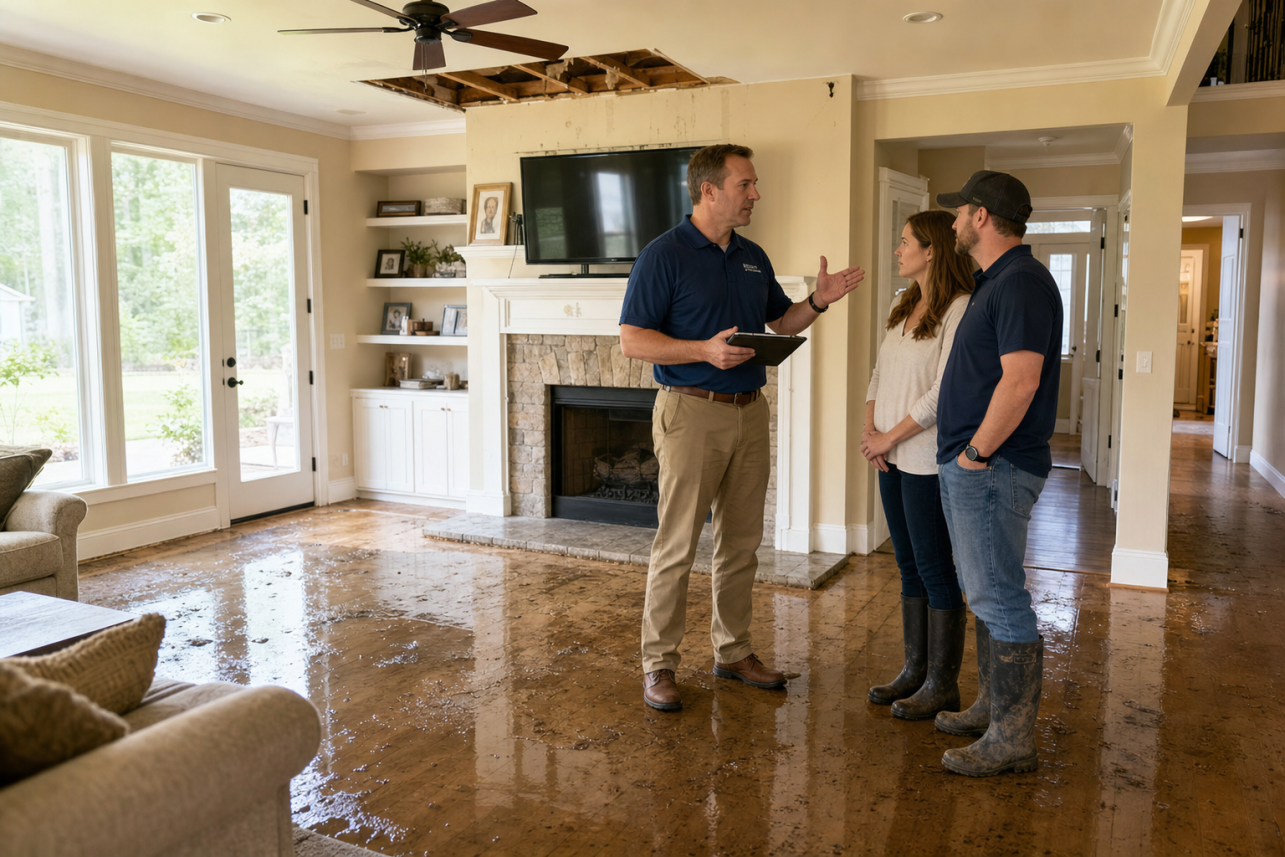
My Contractor's Repair Estimate Is Thousands Higher Than What The Insurance Adjuster Wrote. Who's Right, And How Does That Gap Get Closed?
In our experience across Garner and the rest of Wake County, the contractor is usually closer to reality — and the gap is closeable if you know the mechanisms.
Insurance adjusters typically write estimates using pricing software with settings the carrier controls, and those settings often lag behind actual Triangle-area labor and material costs. Their scopes also tend to be thin: they'll pay to replace the wet drywall but skip the detach-and-reset of cabinets needed to reach it, omit content manipulation, undercount drying equipment days, or leave out code-required upgrades that Garner's permit inspectors will enforce during the rebuild.
Closing the gap starts with a line-by-line comparison. We reconcile the two estimates item by item, then submit a documented supplement showing exactly what the carrier's scope missed, backed by photos, moisture readings, and local pricing data. Most gaps resolve at this stage because the omissions are demonstrable, not debatable.
When a carrier digs in, your policy almost certainly contains an appraisal clause — a formal dispute process where each side names an appraiser and a neutral umpire resolves the difference. We prepare and present appraisal cases regularly, and the results routinely land far closer to the contractor's number than the insurer's.
One caution: don't sign a final release or start major repairs based on the low estimate. Once work begins, evidence disappears with the demolition. Get the scope disputed and documented first; the difference on a whole-home water loss in Garner is often five figures.
Local Relevance
Garner sits in the heart of Wake County's humid subtropical climate, which means water finds its way into homes here in more ways than most places. Summer brings intense afternoon thunderstorms that overwhelm gutters and drive rain under shingles, and hurricane season regularly sends tropical remnants inland with hours of soaking rain and wind-damaged roofs.
The housing stock adds its own risks. Garner has a real mix — older ranch homes on crawl spaces alongside newer subdivisions built during the Triangle's growth boom. Older homes carry aging plumbing, original water heaters, and roofs near the end of their lifespan; newer homes aren't immune either, since a single failed washing machine hose or PEX fitting can flood a finished lower level in an hour.
And because North Carolina summers are so humid, drying out a water-damaged home is harder here than in drier climates. The Federal Emergency Management Agency advises that mold can begin growing on wet materials within 24 to 48 hours, which is why a claim that skips proper drying and tear-out almost always costs the homeowner later. Local knowledge of how these losses unfold — and how carriers respond to them — matters when your claim is on the line.
Many Garner homes, especially the older ranches, sit over vented crawl spaces where a slow supply-line leak or storm runoff can saturate insulation and subflooring for weeks before anyone notices — so by the time a floor feels soft, the real damage is often far larger than what the insurer's first estimate covers. Insisting on a full under-floor moisture inspection before you settle is one of the most valuable steps a local homeowner can take.
Water In Your Garner Home? Talk To An Adjuster Who Works For You
Before you accept the insurance company's number — or their denial — get a free, no-obligation review from For The Public Adjusters, Inc. We're licensed and bonded in North Carolina, we know how water losses play out in Wake County homes, and we don't get paid unless your claim does. The sooner we see the damage, the stronger your claim will be.
Call us: (919) 400-6440
Helpful Resources
- NCDOI Public Adjusters Guide
- Federal Emergency Management Agency (FEMA)
- National Flood Insurance Program (NFIP)
- North Carolina Department of Insurance consumer resources — State regulator's guidance for policyholders on claims and adjusters
Last updated: July 18, 2026