
For The Public Adjusters, Inc. provides smoke damage insurance claim help Garner homeowners can rely on when soot, odor, and residue have spread through a home after a fire. We are licensed and bonded public adjusters who work for you — not the insurance company — documenting the full extent of the damage and negotiating your claim on your behalf. Smoke rarely stays in one room, and the first offer from an insurer rarely accounts for everything it touched.
What This Service Is
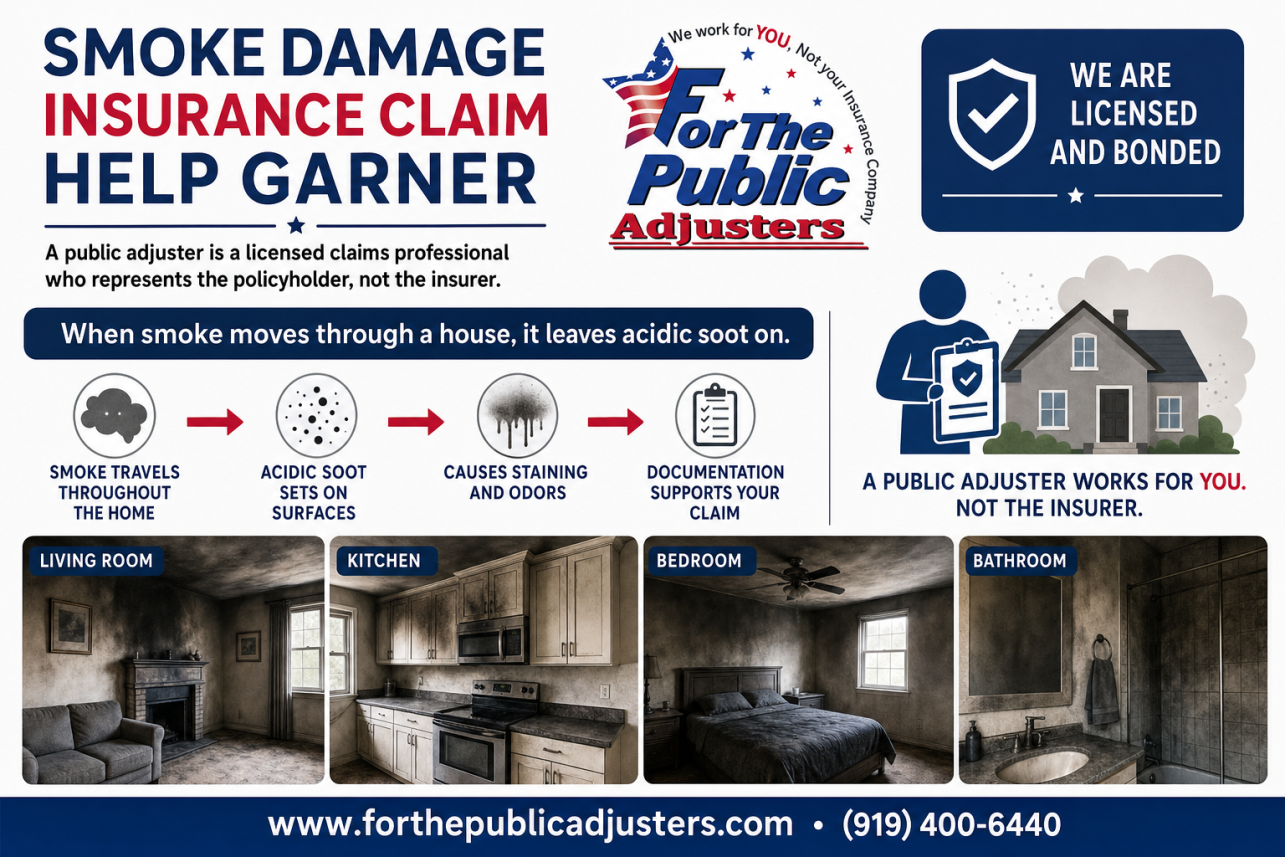
A public adjuster is a licensed claims professional who represents the policyholder, not the insurer. When smoke moves through a house, it leaves acidic soot on walls, inside ductwork, behind cabinets, and deep in soft materials like carpet, upholstery, and clothing. The insurance company’s adjuster works for the carrier, and their inspection is often limited to what is plainly visible.
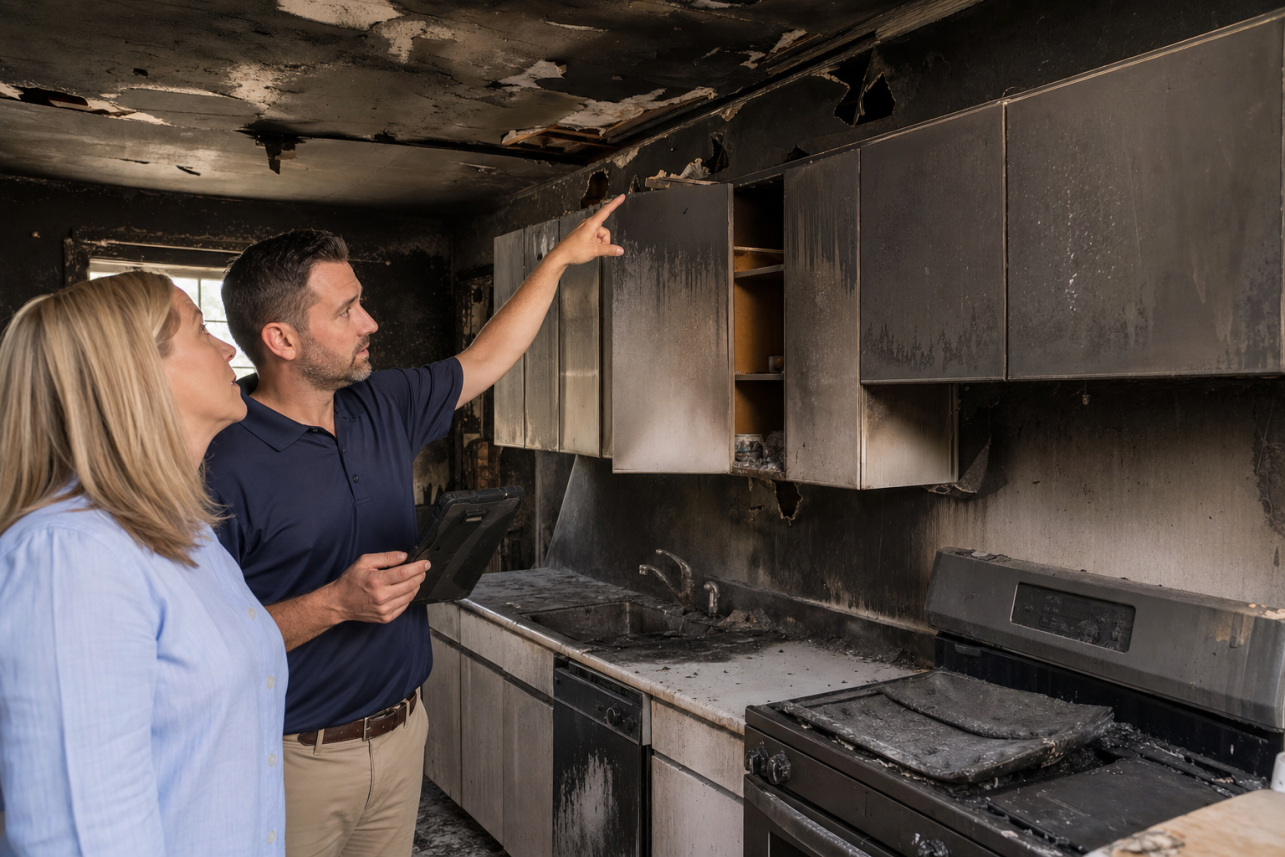
Our job is different. We read your policy line by line, perform a thorough damage assessment that includes hidden smoke penetration into wall cavities and HVAC systems, build a room-by-room inventory of damaged contents, and prepare the proof of loss the insurer requires. Then we negotiate directly with the carrier so you are not stuck arguing over cleaning costs, odor removal, or the difference between what an item is worth used and what it costs to replace.
We handle smoke claims alongside related losses — fire damage, secondary water damage from firefighting efforts, and full residential and commercial property claims. We follow the standards described in the NCDOI Public Adjusters Guide, which explains how licensed public adjusters in North Carolina must operate and what policyholders should expect from us. The same approach we use here also serves nearby homeowners, including anyone pursuing a smoke damage claim in Cary or elsewhere in Wake County.
Common Problems
The Insurance Company’s Offer Barely Covers Repainting — Is That Really All My Claim Is Worth?
Almost never. Lowball offers on smoke claims usually happen because the carrier’s estimate stops at surface cleaning and a coat of paint, while ignoring duct cleaning, odor sealing, and contents that cannot be salvaged.
There is also the actual cash value trap. Many first offers pay the depreciated value of your damaged belongings — what a five-year-old sofa would sell for used — when your policy may entitle you to replacement cost once items are actually replaced. That difference alone can be thousands of dollars.
Don’t forget your living costs, either. If smoke and odor make the home unlivable during cleanup, most homeowner policies include coverage for temporary housing and additional living expenses. We make sure those dollars are claimed, not left on the table.
My Claim Was Delayed, Disputed, Or Denied — What Can I Actually Do About It?
A denial or a stalled claim is not the end of the road. Insurers sometimes argue the smoke damage is ‘cosmetic,’ dispute whether odor removal is necessary, or let a claim sit for weeks without a decision. Each of those situations can be challenged with better documentation and a properly prepared proof of loss.
Policyholders do win these fights. In Gaston County Dyeing Machine Co. v. Northfield Insurance Co., the North Carolina Supreme Court sided with the insured in a disputed property damage coverage case — a reminder that a carrier’s initial reading of the policy is not the final word.
Also keep your deadlines in mind. Policies impose time limits for filing and supplementing claims, so waiting to ‘see how it goes’ can cost you leverage. We have reopened and rebuilt underpaid claims across the county, including smoke damage claim help in Knightdale, and the earlier we get involved, the more options you have.
Where Can I Find Smoke Damage Insurance Claim Help Garner Homeowners Actually Trust?
Look for three things: a North Carolina public adjuster license, bonding, and specific experience with smoke and fire losses — not just general claims work. Anyone can promise a bigger settlement; no honest adjuster can guarantee one. What a good one does guarantee is a complete, defensible claim file.
Can you handle it yourself? You can, but the carrier’s adjuster does this every day and you don’t. Homeowners who go it alone commonly miss hidden smoke inside wall cavities and duct systems, undervalue their contents, and accept depreciation deductions they could have recovered.
A capable public adjuster tests for residue in places you would never think to look, prices restoration at real local costs, and handles the negotiation so you are not learning insurance procedure while your house sits damaged.
Our Process
Free Policy Review And Damage Assessment
We start by reading your actual policy — coverage limits, contents coverage, additional living expenses, and any exclusions. Then we inspect the property, including areas insurers often skip: attic spaces, duct interiors, closets, electronics, and rooms far from where the fire started. Soot is acidic, and what looks like light film today can corrode finishes and wiring over time.
Documentation, Inventory, And Valuation
We photograph and record every affected surface and build a detailed contents inventory with realistic replacement values — not guesses. That includes smoke-damaged electronics and appliances, HVAC contamination, and water damage left behind by firefighting. This is the file the insurer must respond to, and its thoroughness drives the outcome. We prepared a similar claim recently while providing a smoke damage insurance claim in Holly Springs where duct contamination doubled the initial scope.
Proof Of Loss And Settlement Negotiation
We prepare and file the formal proof of loss on time, present the full documented claim to the carrier, and negotiate every disputed line item — cleaning versus replacement, depreciation, odor treatment, and living expense reimbursement. If a claim requires legal escalation, we work alongside insurance dispute attorneys. You stay informed at every step, and you make the final call on any settlement.
| What Happens | Filing On Your Own | With For The Public Adjusters, Inc. |
|---|---|---|
| Damage scope | Limited to what the carrier’s adjuster sees on a single visit | Full inspection including ducts, attic, wall cavities, and hidden soot pathways |
| Odor and residue proof | Your word against the insurer’s — odor claims often denied | Independent hygienist testing and lab results that document invisible residue |
| Contents inventory | A rushed list from memory, items missed or undervalued | Room-by-room photographed inventory with replacement-cost pricing |
| Additional living expenses | Often unaware you’re entitled to them, or reimbursed late | Documented and claimed from day one, including extended displacement |
| Negotiation | Take the first offer or argue without evidence | Line-item negotiation backed by contractor protocols and testing data |
| Your time | Hours of calls, paperwork, and follow-up while displaced | We manage the claim; you focus on your family and getting home |
Commonly Overlooked In The Public Adjusting Industry
- Smoke type identification (protein vs. synthetic vs. natural) — Each residue requires a different cleaning protocol, and carrier adjusters rarely identify the burn type before pricing a generic wipe-down.
- Soot inside the HVAC coil and supply lines — The system pulls smoke through the whole house during a fire, but nobody opens the air handler unless someone insists on it.
- Attic insulation saturation — Insulation acts like a sponge for smoke and can’t be cleaned, yet it’s out of sight and almost never included in the first scope.
- Corrosive soot on electronics circuit boards — Acidic residue causes failures weeks or months later, long after the claim is closed and the deadline to supplement has passed.
- Smoke migration through outlets, top plates, and shared walls — Smoke follows air pathways into cavities that look untouched from the room side, so surface inspections miss it entirely.
- Additional living expense entitlements during odor remediation — Homeowners assume ALE only applies when a house burns, not when thermal fogging or air scrubbing makes it temporarily unlivable.
- The supplement window after the first payment — Many owners believe the first check is final, when North Carolina policies allow documented supplemental claims for damage found later.
- Depreciation recovery on replaced contents — Replacement-cost policies pay the withheld depreciation only after receipts are submitted, and thousands go unclaimed because no one explains the second step.
Case Studies
Case Study #1
Situation: A family off Timber Drive in Garner had a kitchen fire that was contained quickly, but smoke traveled through the HVAC returns and settled throughout the two-story home.
Problem: The carrier’s adjuster scoped only the kitchen and adjacent hallway, offering roughly $11,400 for cleaning and paint. The homeowners could still smell smoke upstairs weeks later, and their insurer insisted odor alone wasn’t covered damage.
Investigation: We brought in an independent industrial hygienist to take surface wipe samples and air quality readings on both floors. We also opened the supply and return ducts, photographed soot loading on the coil and plenum, and tested attic insulation for absorbed combustion residue.
Findings: Lab results confirmed char and soot particulate in every bedroom, on the HVAC coil, and saturated into the blown-in attic insulation. The kitchen fire was a protein and synthetic burn, which produces a thin, nearly invisible film that standard wiping does not remove.
Solution: We rewrote the scope to include full duct cleaning and coil replacement, attic insulation removal and replacement, sealing and repainting of smoke-affected drywall, contents cleaning by an ultrasonic specialist, and pack-out costs. We presented the lab data and code-supported line items to the carrier and negotiated each category.
Outcome: The claim settled at just over $87,000 — nearly eight times the original offer — including additional living expenses for the three weeks the family stayed out during remediation.
Lesson: Smoke doesn’t stay in the room where the fire started. If a scope stops at the visible burn area, it’s almost certainly missing insured damage that lab testing can prove.
Case Study #2
Situation: A Garner townhome owner near White Oak filed a claim after a neighboring unit’s fire pushed heavy smoke through shared wall cavities and the attic space.
Problem: Because the fire itself never touched her unit, the insurance company classified the loss as minor and issued $4,200 for ‘general cleaning.’ Her clothing, upholstered furniture, and electronics all carried a persistent odor, and her asthma made the unit uninhabitable.
Investigation: We documented soot infiltration at outlet boxes, top plates, and the attic hatch — the classic pathways smoke follows between attached units. We inventoried her contents room by room with photos and replacement pricing, and obtained a written remediation protocol from a certified fire restoration contractor.
Findings: Soot residue was present inside wall cavities and on the attic side of her ceiling drywall, meaning surface cleaning alone could never resolve the odor. Roughly 60% of her soft-goods contents were rated non-salvageable by the restoration contractor due to porous-material saturation.
Solution: We submitted a supplemental claim with the contractor’s protocol calling for selective drywall removal, cavity cleaning, thermal fogging, and HEPA air scrubbing, plus a detailed contents inventory separating cleanable items from total losses. We also documented her medically necessary temporary housing.
Outcome: The carrier reissued payment at $46,800 for the structure and contents combined, plus additional living expenses covering a two-month displacement. She returned to a unit with no detectable odor.
Lesson: A unit doesn’t need flames to have a serious smoke loss. Smoke migration through shared cavities is real, measurable damage — and it’s routinely underpaid when no one opens the walls to look.
| Item or Material | Usually Cleanable? | What It Depends On | Common Claim Mistake |
|---|---|---|---|
| Painted drywall and ceilings | Sometimes | Type of smoke — protein and synthetic residues penetrate paint and require sealing or removal, not just washing | Carriers pay for one coat of paint when odor-blocking primer or drywall replacement is needed |
| HVAC ducts and coil | Rarely as-is | Soot loading on the coil and inside flex duct; coils often can’t be fully cleaned | Scopes skip the HVAC system entirely, so odor returns every time the system runs |
| Attic insulation | No | Blown-in and batt insulation absorb smoke permanently and cannot be washed | Insulation is left in place and blamed later for ‘lingering odor’ the insurer won’t cover |
| Clothing and soft goods | Sometimes | Porosity and smoke type — ozone or specialty laundering works for light exposure only | Everything gets a flat ‘cleaning’ allowance instead of separating total losses |
| Upholstered furniture and mattresses | Rarely | Foam and batting trap odor; deep saturation makes cleaning uneconomical | Paid to clean items that should be replaced, then denied when odor persists |
| Electronics | Case by case | Whether corrosive soot reached internal boards; requires specialist evaluation | Adjusters approve exterior wiping only, missing internal corrosion that fails later |
| Hardwood floors and cabinets | Often | Finish condition — soot can etch and stain finishes if not addressed quickly | Refinishing costs are cut to ‘clean and buff’ when the finish is already damaged |
| Wall cavities and framing | No, must be treated | Whether smoke migrated through outlets, top plates, or shared walls | Nobody opens the walls, so the biggest hidden source of odor never gets scoped |
Reviews
After our garage fire, the insurance company said the smoke smell in the house would ‘air out’ and paid almost nothing. For The Public Adjusters had testing done that proved soot was in our ductwork and insulation. The final settlement paid for full remediation, and our house finally smells like a home again.
Denise M., Garner
I honestly didn’t know smoke damage insurance claim help Garner homeowners could actually hire was a thing until my neighbor recommended this team. Their contents inventory alone found thousands of dollars the first adjuster skipped — clothes, my kids’ mattresses, even the electronics that had soot inside them.
Trevor B., Wake County
Our kitchen fire was small but the smoke ruined way more than the carrier admitted. This team walked every room, opened the returns, and fought for duct cleaning and repainting the whole downstairs. Settlement went from $9k to over $50k. Worth every bit of their fee.
Angela P., Garner
Frequently Asked Questions
Why Should I Get Smoke Damage Insurance Claim Help Garner Homeowners Can Rely On Instead Of Filing On My Own?
Smoke damage is one of the most underpaid claim types in Wake County, largely because so much of the damage is invisible at first glance. Smoke residue migrates through HVAC ductwork, settles inside wall cavities, and bonds to porous surfaces like drywall, insulation, and upholstered furniture. An insurance company’s field adjuster may spend thirty minutes in your home and scope only what’s visibly stained.
When you work with For The Public Adjusters, Inc., we document what the carrier’s adjuster misses. That includes chloride and pH testing on surfaces, thermal imaging where appropriate, and a room-by-room inventory of affected contents. In many Garner homes, especially those built with tighter modern construction off Timber Drive or in newer subdivisions near White Oak, smoke gets trapped and penetrates deeper than owners expect.
We also handle the policy side. Most homeowners don’t realize their policy may cover professional deodorization, duct cleaning, repainting with sealant-based primers, and replacement of items that can’t be safely restored. Carriers rarely volunteer these coverages.
The practical difference is significant. Self-filed smoke claims often settle for the cost of a surface cleaning, while a properly documented claim accounts for restoration, contents, and additional living expenses if you need to relocate during the work. We represent you, not the insurance company, and our fee comes from the settlement we recover — so our interests are aligned with getting your home genuinely restored, not just wiped down.
How Long Does A Smoke Damage Claim Take To Settle In Garner, And What Slows Things Down?
A straightforward smoke claim in Garner typically resolves in 30 to 90 days once it’s properly documented and submitted. North Carolina requires carriers to acknowledge claims promptly and to pay undisputed amounts within 30 days of reaching an agreement, but the real timeline depends on how complete and well-supported your claim file is from the start.
What slows claims down is almost always documentation gaps. If the carrier’s adjuster scopes only visible soot and you later discover odor returning from the ductwork or attic insulation, you’re now filing supplements — and each supplement restarts the review clock. Disputes over whether contents can be cleaned versus replaced are another common delay, particularly with electronics, mattresses, and children’s items where corrosive residue is a legitimate health concern.
Our approach front-loads the work. We inspect and test before the carrier’s adjuster arrives when possible, build a complete estimate using the same pricing software insurers use, and present a claim package that’s difficult to dispute. That usually shortens the timeline rather than lengthening it, because there’s less back-and-forth.
If your claim has already stalled — maybe you filed weeks ago and the carrier’s offer barely covers a cleaning crew — we can step in mid-claim. We review what’s been paid, identify what was missed, and negotiate the difference. Homeowners across Wake County bring us claims at every stage, and a stalled claim is often more recoverable than people assume.
My Fire Was Small And Mostly Contained — Is It Still Worth Hiring A Public Adjuster In Garner?
Yes, and in many cases a small kitchen or garage fire produces a larger legitimate claim than homeowners expect. Fire size and smoke damage are not proportional. A grease fire that lasted two minutes can push acidic protein smoke through an entire single-story home, and that type of residue is nearly invisible while being one of the hardest to remove. It corrodes metal fixtures, yellows paint over time, and leaves a persistent odor that returns on humid North Carolina summer days if it isn’t professionally remediated.
Carriers often treat small fires as small claims. The initial offer might cover repainting one room and a general cleaning. What it typically omits: HVAC system decontamination, replacement of insulation that absorbed odor, sealing and priming of studs and subfloor, contents cleaning or replacement, and additional living expenses if the work makes part of your home unusable.
For The Public Adjusters, Inc. evaluates whether the gap between the carrier’s offer and the true scope justifies our involvement — and we’ll tell you honestly if it doesn’t. There’s no fee to have us review your claim or the carrier’s estimate.
One more Garner-specific note: many homes here have vented crawlspaces and attic returns that pull smoke into areas owners never check. We routinely find damage in those spaces that the carrier’s adjuster never inspected. If your home still smells like smoke after the cleaning the insurer paid for, that’s a strong sign the original scope was incomplete.
What Does Smoke Damage Insurance Claim Help Garner Residents Get From For The Public Adjusters Cost, And How Are You Paid?
We work on contingency, which means there is no upfront cost and no hourly billing. Our fee is a percentage of the settlement we recover for you, agreed to in writing before we start. In North Carolina, public adjuster fees are regulated and capped by state law, and every contract we use complies with those rules. If we recover nothing for you, you owe nothing.
The initial consultation and claim review are free. We’ll inspect your property, look at your policy, and — if you’ve already received an estimate or offer from your carrier — tell you plainly whether we believe there’s meaningful money being left on the table. If the carrier’s offer is genuinely fair, we’ll say so.
On smoke claims specifically, the contingency model works in your favor because the recoverable gap is usually wide. When the difference between a surface-level cleaning payout and a fully documented restoration claim can run into tens of thousands of dollars, our fee is covered many times over by the additional recovery. Homeowners who hire us typically net substantially more even after our fee than they would have accepting the first offer.
We’re licensed to represent policyholders throughout North Carolina and handle claims across Wake County regularly, so we know the local carriers, their adjusters, and the restoration contractors working in the Garner area. That familiarity matters during negotiation. If you’re weighing whether professional representation makes sense for your situation, a phone call costs nothing and usually answers the question quickly.
What Kinds Of Smoke Damage Do Garner Insurance Companies Commonly Overlook Or Underpay?
The most frequently missed items are the ones you can’t see at first glance. Smoke residue migrates through HVAC systems, wall cavities, attic insulation, and soft goods like upholstery, mattresses, and clothing. An insurance company’s initial estimate often covers visible soot on walls and a basic cleaning, then stops there.
In Wake County homes, we routinely find corrosive protein and synthetic soot residue on electronics, kitchen appliances, and metal fixtures — damage that shows up weeks later as pitting, discoloration, or component failure. If it isn’t documented early, the carrier may argue it was pre-existing.
Odor is another battleground. Proper remediation frequently requires sealing or replacing porous materials, thermal fogging, or ozone treatment, not just wiping surfaces. Carriers sometimes approve a surface clean and deny the follow-up work when the smell returns.
We also see ductwork cleaning, insulation replacement, and full contents inventories left out of settlements entirely. Contents alone can represent tens of thousands of dollars in a typical Garner home, and policyholders rarely have the time or expertise to inventory, photograph, and price every affected item.
When our team handles a smoke claim, we bring in testing where appropriate, document residue in hidden areas, and build a line-item estimate the carrier has to respond to specifically. That documentation is usually the difference between a partial payment and a settlement that actually restores your home.
Can I Get Smoke Damage Insurance Claim Help Garner Adjusters Trust If My Claim Was Already Denied Or Underpaid?
Yes, and this is one of the most common situations we take on. A denial or a low settlement offer is not the end of your claim in North Carolina. Most policies allow you to dispute the carrier’s findings, submit supplemental documentation, and reopen the claim — often for a significant period after the initial decision.
The first step is a thorough policy review. Denials frequently hinge on how the carrier interpreted policy language around smoke, soot, and odor, or on gaps in the original documentation. We read the actual policy, not the summary letter the adjuster sent you.
Next, we re-inspect the property. In many Garner cases, the original inspection missed residue inside ductwork, behind cabinets, or in the attic. We document those findings with photos, moisture and residue evidence, and a detailed line-item estimate that directly rebuts the carrier’s scope.
From there, we present a formal supplemental claim or dispute package and negotiate with the insurance company on your behalf. Because we work only for policyholders — never for carriers — there’s no divided loyalty in that negotiation.
Providing smoke damage insurance claim help Garner homeowners can lean on after a denial is often where a public adjuster adds the most value, because we know exactly what evidence carriers need to see before they’ll change position. If you have a denial letter or a settlement that felt short, bring it to us before you sign anything or cash a final check.
What Should I Do In The First 48 Hours After Smoke Damage Before The Insurance Adjuster Arrives?
The first two days shape the entire claim, so a few careful steps matter enormously.
First, photograph and video everything before anyone cleans. Capture soot on walls, ceilings, and floors, residue on countertops and electronics, and any staining inside closets, cabinets, and the HVAC returns. Wide shots plus close-ups are ideal. Once cleaning starts, that evidence is gone forever.
Second, don’t throw anything away. Damaged contents are part of your claim, and the carrier may want to inspect them. Bag and label items if you must move them, but keep them on the property when possible.
Third, limit DIY cleaning. Wiping soot with the wrong products can grind residue into drywall and finishes, turning cleanable surfaces into replacements — and giving the carrier room to argue you made things worse. Ventilate the home, but leave remediation to professionals.
Fourth, review your policy for additional living expense coverage before you book a hotel. If the home is unsafe or the odor is severe, those costs are typically reimbursable, but only with receipts.
Finally, be cautious with recorded statements. You’re required to cooperate with your insurer, but you’re not required to guess at causes or estimate damage on the spot. Stick to facts you know.
Many Garner homeowners call us during this window, and it’s honestly the best time. When we’re involved before the carrier’s adjuster inspects, we can document the loss properly, attend that inspection, and set the claim on the right track from day one.

Does Smoke Damage From A Neighbor’s Fire Or A Nearby Wildfire Qualify For A Claim On My Garner Home?
In most cases, yes. Smoke is generally a covered peril under standard North Carolina homeowners policies even when the fire itself happened somewhere else — a neighboring townhome, an adjacent unit, or a brush fire nearby. What matters is that your property sustained direct physical damage from smoke or soot.
These claims are trickier than they sound, though. Because there’s no burned structure on your property, carriers sometimes minimize the loss or attribute the odor and residue to ordinary household sources. That’s why documentation and, in some cases, laboratory testing of soot samples become important. Testing can establish that the residue chemically matches combustion from the nearby fire rather than everyday cooking or candle use.
Townhome and closely-spaced neighborhoods around Garner — where homes sit near shared fences and short setbacks — see this scenario more than people expect. Smoke infiltrates through soffits, attic vents, window seals, and HVAC intakes, contaminating insulation, ductwork, and contents in a home that never saw a flame.
You may also have a potential claim against the responsible party’s liability coverage, depending on how the fire started. We can help you understand which policy should respond and in what order, since pursuing the wrong avenue first can delay payment for months.
If your house smells of smoke, your belongings are coated in residue, or your family is experiencing irritation after a nearby fire, have the damage professionally documented promptly. As Garner public adjusters, we’ve handled secondary smoke claims and know how to prove damage that carriers would prefer to call cosmetic.
What Documentation Do I Need For Smoke Damage Insurance Claim Help Garner Professionals Can Actually Use?
Start with photos and video before anything gets cleaned or moved. Capture soot lines on walls, discoloration around vents, residue on countertops, and staining inside closets and cabinets. Smoke settles in patterns, and those patterns are evidence.
Next, pull together your policy declarations page, any prior inspection reports, and receipts for emergency expenses like board-up services, air purifiers, or a hotel stay. Keep every receipt, even small ones — they add up and most are reimbursable.
A contents inventory is where most Garner homeowners fall short. Walk room by room and list affected items with approximate purchase dates and values. Clothing, electronics, upholstered furniture, and anything porous absorbs smoke and belongs on that list, even if it looks fine at a glance.
When we take over a claim, we build on this foundation with professional documentation the carrier can’t easily dismiss: hydroxide and soot residue testing, thermal imaging where appropriate, and detailed line-item estimates written in the same software insurance companies use. That’s the difference between a homeowner’s photo album and a claim package that forces a fair number.
If you’ve already thrown items away or started cleaning, don’t panic. We can often reconstruct losses through bank statements, credit card records, and replacement research. But from today forward, document first and dispose second. The more evidence preserved early, the stronger your position when the carrier’s adjuster starts questioning what was really damaged.
Will Insurance Pay To Clean My HVAC System And Remove Smoke Odor, Or Just Wipe Down Surfaces?
A properly handled claim should cover far more than surface wiping — and this is exactly where carriers cut corners. Smoke particles travel through your ductwork and settle in the air handler, coils, and insulation lining the ducts. If the HVAC system isn’t professionally cleaned or, in heavier cases, partially replaced, it will recirculate odor and soot through your Garner home for months.
Insurance company estimates often include a line for ‘general cleaning’ and stop there. That ignores thermal fogging, ozone or hydroxyl treatment, sealing and repainting of smoke-permeated drywall, and duct decontamination. Porous materials like carpet pad, attic insulation, and unfinished wood in wall cavities can hold odor permanently and frequently need replacement, not cleaning.
Your policy language matters here. Most homeowner policies in Wake County cover restoration to pre-loss condition, and lingering odor is not pre-loss condition. We hold carriers to that standard by bringing in industrial hygienists or restoration specialists to test for residue in the system and document what cleaning alone cannot fix.
One warning sign: if the insurance adjuster’s estimate for your smoke loss fits on a page or two, odor remediation and HVAC work were almost certainly left out. We routinely find that the true scope is two to four times the carrier’s first offer once the mechanical systems, wall cavities, and porous contents are properly accounted for. Don’t accept a wipe-down settlement for a whole-house problem.
Can I Stay Somewhere Else While My Garner Home Is Being Cleaned, And Who Pays For It?
Yes — most homeowner policies include Additional Living Expenses (ALE) or Loss of Use coverage, which pays for temporary housing when smoke contamination makes your home unsafe or unreasonable to occupy. This is one of the most underused coverages we see in Wake County claims.
Smoke exposure is a legitimate health concern, especially for children, older adults, and anyone with asthma or respiratory conditions. Soot contains fine particulates and chemical residue from burned plastics and synthetics. If treatment like ozone or hydroxyl generation is happening, you generally can’t be in the house anyway — those processes require vacancy.
ALE typically covers hotel or short-term rental costs, the increase in your food expenses if you can’t cook, pet boarding, laundry, and extra mileage. The key word is ‘increase’ — the carrier pays the difference between your normal living costs and your displaced living costs, so keep receipts for everything.
Where homeowners get hurt is when the carrier’s adjuster declares the home ‘habitable’ prematurely to cut off ALE payments. We push back with air quality documentation and remediation timelines that justify continued displacement until the work is genuinely complete. We also make sure ALE gets claimed retroactively if you were displaced before you knew the coverage existed.
If you’re currently living in a smoke-contaminated house near Garner because you didn’t think insurance would pay for a hotel, call us. There’s a strong chance your policy has been covering that expense all along.
Should My Smoke-Damaged Belongings Be Cleaned Or Replaced, And How Does For The Public Adjusters Value Them?
It depends on the material, the severity of exposure, and honest cost comparison — and this is a fight carriers pick constantly. Insurance companies push cleaning because it’s cheaper, even when cleaning won’t actually restore the item.
Hard, non-porous items like glass, metal, and sealed wood often clean successfully. Porous and absorbent items are a different story. Mattresses, upholstered furniture, carpet and pad, stuffed animals, books, and many textiles absorb smoke deep into their fibers. Electronics are especially tricky: acidic soot corrodes circuit boards over time, so a TV that works today may fail in six months. We document those items for replacement, not a wipe-down.
The rule we hold carriers to is simple: if cleaning cannot return an item to pre-loss condition, or if cleaning costs approach replacement cost, replacement is owed. We also watch the depreciation game closely. Many policies pay actual cash value first and release recoverable depreciation after you replace items — money Garner homeowners often never collect because nobody explained the process.
When we provide smoke damage insurance claim help Garner families count on, we build a room-by-room contents inventory with current replacement pricing, challenge excessive depreciation, and track recoverable depreciation so nothing gets left on the table. We’ve seen contents settlements double or triple once every affected item is properly listed and valued.
Before you let a restoration vendor haul everything off for ‘cleaning,’ get an independent opinion on what should actually be replaced. Once items are cleaned and returned, arguing for replacement becomes much harder.
Will Filing A Smoke Damage Claim Raise My Premiums, And Is It Still Worth Getting Smoke Damage Insurance Claim Help Garner Homeowners Recommend?
This is one of the most common concerns we hear from Garner homeowners, and it deserves an honest answer. In North Carolina, a single fire or smoke claim on an owner-occupied home rarely triggers a dramatic premium increase on its own, especially when the loss was clearly accidental. Insurers weigh claim frequency far more heavily than a one-time event.
What actually costs homeowners money is filing a claim and then settling for far less than the damage is worth. Once you accept a payment and sign a release, that money is what you have to work with — whether it covers proper soot removal, odor remediation, and content replacement or not. An underpaid claim can leave you with lingering smoke odor and residue that damages your home’s value for years.
That is exactly where smoke damage insurance claim help Garner residents can trust makes the difference. For The Public Adjusters, Inc. documents the full scope of the loss, negotiates directly with the carrier, and works to recover the amount your policy actually owes you. You pay the same premium whether your settlement is fair or lowballed, so it makes sense to pursue every dollar you are entitled to.
If you are on the fence about filing at all, we can review the damage first. In cases where the loss falls close to your deductible, we will tell you plainly that a claim may not be worth it. That kind of straight advice is part of the job.
What Happens If Hidden Smoke Damage Shows Up After My Claim Is Already Settled?
It happens more often than people expect. Soot particles are microscopic and travel through wall cavities, attic insulation, ductwork, and behind cabinets. Weeks or months after cleanup, homeowners in Garner discover yellowed paint, recurring odor on humid days, or corrosion on electronics and metal fixtures that was not visible during the original inspection.
The good news is that a settlement is not always the end of the road. In North Carolina, you can typically file a supplemental claim for damage that was part of the original loss but discovered later, as long as you are within the policy’s time limits and did not sign a full and final release covering unknown damage. The language in that release matters enormously, which is one reason we urge people not to sign anything without a careful read.
When a Garner client comes to us with newly discovered damage, For The Public Adjusters, Inc. starts by pulling the original claim file, the settlement documents, and the carrier’s estimate. We then document the new findings — often with professional testing that identifies soot residue on surfaces the insurer never checked — and present a supplement tying the damage back to the covered event.
Carriers frequently push back on supplements, arguing the damage is new or was already paid for. Having someone who knows how to counter those arguments, with lab results and detailed scope documentation, is usually the difference between a reopened claim and a closed door.
My Contractor’s Repair Estimate Is Much Higher Than What The Insurance Company Offered. What Can I Do?
A large gap between your contractor’s estimate and the carrier’s offer is one of the clearest signs your claim is being underpaid — and it is one of the most common reasons Garner homeowners call us for smoke damage insurance claim help.
Insurance company estimates are usually written in software using regional pricing that often lags behind what Wake County contractors actually charge. Worse, the carrier’s scope frequently omits entire categories of smoke-related work: sealing and priming smoke-stained surfaces before painting, cleaning duct systems, thermal fogging or hydroxyl treatment for odor, and detailed cleaning of contents. Your contractor sees the real work required; the carrier’s estimate often does not.
Do not simply accept the lower number or pay the difference out of pocket. Under most North Carolina homeowner policies, you have the right to dispute the carrier’s scope and pricing. For The Public Adjusters, Inc. prepares a line-by-line rebuttal estimate, backs it with photos, moisture and residue documentation, and current local pricing, then negotiates directly with the insurance adjuster.
If negotiation stalls, most policies include an appraisal clause — a formal dispute process where each side selects an appraiser and disagreements go to a neutral umpire. We guide clients through that process regularly, and often the mere invocation of appraisal motivates the carrier to return to the table with a realistic number. The gap between estimates is not your problem to absorb; it is a dispute to be won.
Can For The Public Adjusters Handle Smoke Damage Claims For Rental Properties Or Businesses In Garner, Not Just Homes?
Yes. We represent owners of rental houses, small multi-family properties, and commercial buildings throughout Garner and the surrounding Wake County area, and these claims often benefit even more from professional representation than a standard homeowner claim.
Rental and commercial smoke losses involve coverages many owners never think about until disaster strikes. Beyond the building repair itself, a landlord policy typically includes loss of rents — reimbursement for the income you lose while units are uninhabitable during soot removal and repairs. Commercial policies often carry business interruption coverage, which pays for lost revenue and ongoing expenses while your doors are closed. Carriers rarely volunteer these numbers, and calculating them correctly requires rent rolls, profit-and-loss statements, and a defensible restoration timeline.
Smoke losses in tenant-occupied buildings also raise scope questions homeowners never face: who owns the damaged contents, whether tenant improvements are covered, and how quickly units can be certified safe for re-occupancy. Along busy corridors like US-70 and NC-50, where many Garner businesses operate in older buildings, smoke can also expose code-upgrade issues that trigger ordinance and law coverage.
For The Public Adjusters, Inc. builds the entire claim — structure, contents, lost rents or business income, and code upgrades — into one documented package and negotiates it as a whole. If your investment property or storefront has taken smoke damage, contact us before you give the carrier a recorded statement, so we can make sure every coverage in your policy is put to work.
Local Relevance
Garner sits just south of Raleigh in Wake County, and its housing stock tells two stories: established neighborhoods of mid-century ranches and split-levels near the town center, and fast-growing newer subdivisions on the outskirts. Both present smoke-claim challenges. Older homes often have original ductwork and plaster or paneling that absorb soot deeply, while newer open-floor-plan builds let smoke travel freely from a kitchen fire into every living space.
Winter heating fires, space heaters, and cooking fires are the common ignition sources we see across the Triangle — the National Fire Protection Association consistently identifies cooking as the leading cause of home fires nationwide, and Garner is no exception. Our humid North Carolina climate adds another wrinkle: moisture helps smoke odor bind into drywall, insulation, and fabrics, which makes fast, properly scoped odor removal essential rather than optional.
We serve homeowners throughout the area, from clients needing smoke damage insurance claim help in Raleigh to families working with a public adjuster in Fuquay-Varina NC. Being local means our repair pricing reflects what Wake County contractors actually charge — not a national database average.
Many of Garner’s older ranch and split-level homes still run on original or aging duct systems, and after a fire those ducts often carry soot into rooms the flames never touched — so a smoke claim scoped only to the visibly damaged rooms tends to significantly understate the real loss.
Smoke Touched More Than You Can See — Let’s Prove It
Before you accept the insurance company’s number, get a second opinion from a licensed and bonded Garner public adjuster who works only for you. The consultation and policy review are free, and you owe nothing unless we recover for you. Whether your claim is brand new, stalled, or already underpaid, we can step in at any stage.
Call us: (919) 400-6440
Helpful Resources
- NCDOI Public Adjusters Guide
- National Fire Protection Association (NFPA)
- North Carolina Department of Insurance — State regulator overseeing insurance and public adjuster licensing
Last updated: September 12, 2026