
A public adjuster Cary NC property owners hire works for you — not the insurance company — to document, value, and negotiate your fire, water, smoke, or storm damage claim. For The Public Adjusters, Inc. is licensed and bonded, and we represent homeowners and business owners across Cary and Wake County. If your claim has been underpaid, delayed, or denied, we step in to build the evidence and handle the negotiation so you don't face the carrier's adjusters alone.
What This Service Is
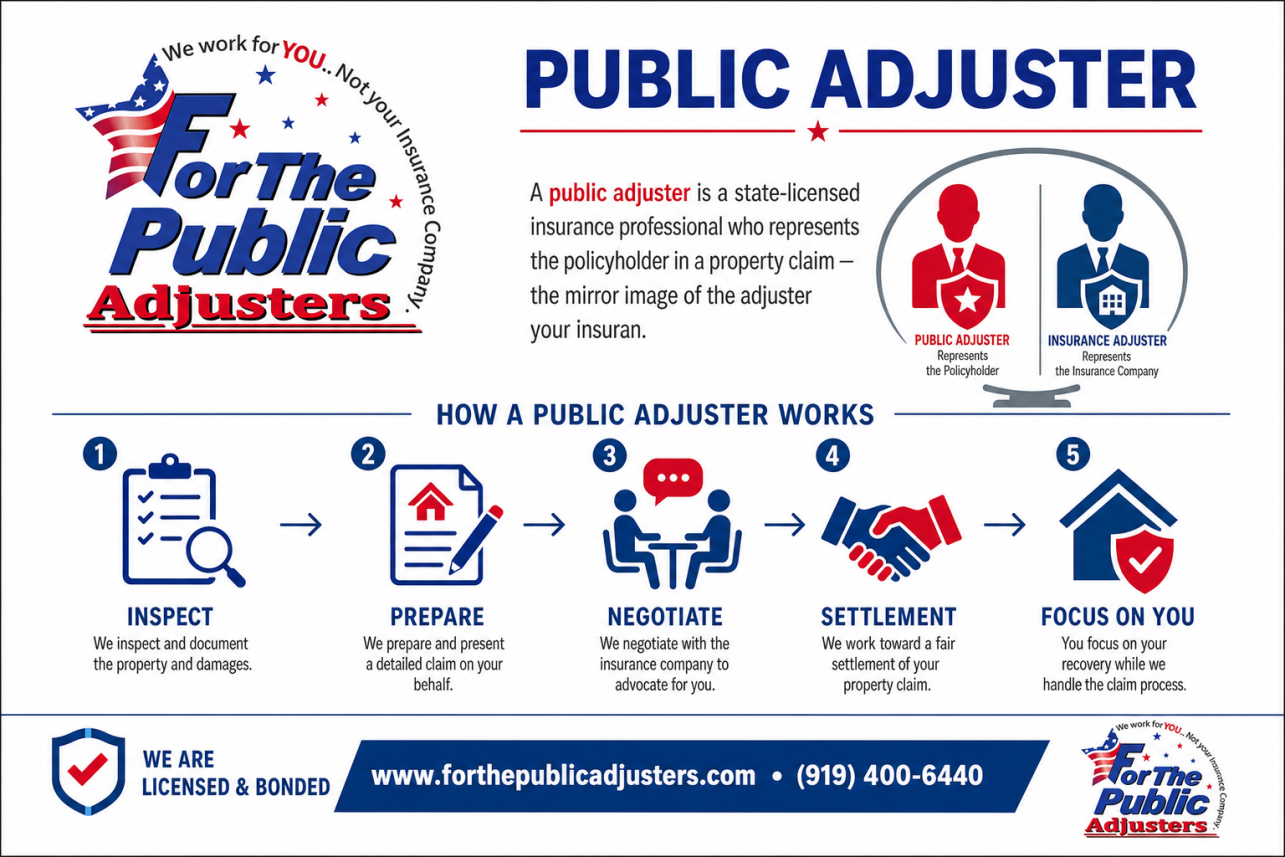
A public adjuster is a state-licensed insurance professional who represents the policyholder in a property claim — the mirror image of the adjuster your insurance company sends out. The carrier's adjuster works for the carrier. We work for you.
In practice, that means reading your policy line by line, inspecting the damage ourselves, preparing a detailed estimate of the loss, inventorying damaged contents, and negotiating directly with the insurance company. We handle residential homeowners claims and commercial business claims alike: fire and smoke damage, water damage, hurricane and tornado damage, tree strikes, vandalism, and even the rare but chaotic situation where a car hits a home.
The scope of a loss is almost always larger than it first appears. Smoke migrates into HVAC systems and wall cavities. Water wicks up drywall and under flooring long after the surface looks dry. Our job is to make sure the claim reflects the full loss, not just the visible portion. That's the same approach our fire claims adjuster in Fuquay-Varina clients see on structure fires — the difference between a surface estimate and a complete one is often substantial.
We do not handle claims involving cell phones, motor vehicles, health, or life insurance. Our work is buildings, homes, and the contents inside them.
Common Problems
What Does Hiring A Cary Public Adjuster Cost — And Is It Worth It On My Claim?
Public adjusters in North Carolina typically work on a contingency fee — a percentage of what the insurance company pays on the claim. There is no hourly bill and no upfront retainer, so if the claim pays nothing, you owe nothing for the adjusting work.
Whether it's worth it depends on the size and complexity of the loss. A small, clean claim the carrier is paying fairly may not need us, and we'll tell you that in a free review. But on fires, significant water losses, and hurricane damage, the gap between the carrier's first offer and the true cost of proper repairs is frequently large enough that professional representation makes financial sense.
We never guarantee a specific outcome or dollar amount — no honest adjuster can. What we can promise is that your claim will be documented and argued the way the policy language actually allows, rather than the way the carrier's estimate software summarized it.
My Insurance Company Is Delaying, Lowballing, Or Denying My Claim. What Now?
This is the most common reason Cary homeowners call us. The carrier's estimate ignores hidden damage, the claim sits for weeks between adjuster reassignments, or a denial letter cites a policy exclusion that doesn't actually fit the facts.
You have real options. Claims can be disputed, supplemented, and in many cases reopened with better documentation. Courts have repeatedly sided with policyholders when carriers misapply exclusions — in Corban v. USAA, the Mississippi Supreme Court ruled in the homeowners' favor on how their insurer had applied the anti-concurrent causation clause to Hurricane Katrina damage to their home, a decision that reshaped how those clauses are read against insurers.
We've reopened underpaid losses like a water damage insurance claim in Rolesville where the original estimate missed saturation behind the walls entirely. When a dispute needs to escalate further, we also coordinate with insurance dispute lawyers so nothing falls through the cracks.
How Do I Choose A Public Adjuster Cary NC Property Owners Can Actually Verify?
Start with licensing. The NCDOI Public Adjusters Guide explains that public adjusters must be licensed by the state, and you can verify any adjuster's license before signing anything. We are licensed and bonded, and we encourage every prospective client to check.
Then ask about experience with your specific type of loss. Fire claims, flood claims, and tree-strike claims each involve different policy provisions and different documentation. A firm that handles a fire damage claim dispute in Chapel Hill one week and a Cary water loss the next should be able to explain, in plain language, exactly how it would approach yours.
Finally, be wary of anyone who promises a specific settlement figure before inspecting the property and reading the policy. That's not expertise — that's salesmanship. A good adjuster earns your trust with a clear plan, not a big number.
Our Process
Free Policy And Damage Review
We start by reading your actual policy — coverages, endorsements, deductibles, and exclusions — and inspecting the damage in person. If the claim is small or the carrier is already treating you fairly, we'll say so. If there's a meaningful gap, we'll show you exactly where it is before you sign anything.
Full Documentation And Valuation
We photograph and measure the loss, test for hidden moisture and smoke migration, inventory damaged contents room by room, and build a line-item estimate using the same industry pricing tools carriers use. On flood losses, we prepare documentation to the standards the National Flood Insurance Program expects, because flood claims live or die on paperwork. This is the step most homeowners simply can't do alone — and the step the carrier's estimate most often shortchanges.
Negotiation And Settlement
We present the claim to your insurance company, attend the carrier's reinspections, respond to every pushback in writing, and negotiate until the settlement reflects the documented loss. Clients across Wake County — from Cary to homeowners working with our public adjuster in Garner — deal with us directly throughout, so you always know where your claim stands.
| Claim Factor | Handling It Yourself | With Our Representation |
|---|---|---|
| Damage scope | Limited to what the carrier's adjuster writes down | Independent inspection, moisture mapping, and forensic documentation of hidden damage |
| Estimate detail | Carrier's estimate, often missing code upgrades and matching costs | Full Xactimate line-item estimate including NC code-upgrade and matching provisions |
| Policy knowledge | You interpret the policy alone | We identify overlooked coverages like ALE, ordinance & law, and business income |
| Negotiation | Carrier controls the timeline and the numbers | Documented supplements, deadline enforcement, and appraisal clause when needed |
| Time burden | Weeks of calls, paperwork, and inspections on you | We manage the entire claim while you focus on your home or business |
| Typical result | First-offer settlements, frequently underpaid | Settlements based on the full documented loss, not the initial offer |
Commonly Overlooked In The Public Adjusting Industry
- Matching requirements for continuous flooring and siding — Carriers pay to patch one room while ignoring that hardwood or siding runs continuously, leaving homeowners with mismatched materials the policy actually covers replacing.
- Ordinance and law (code upgrade) coverage — Cary's current building codes often require upgrades during repairs, and carriers routinely omit that cost unless the policyholder specifically invokes the coverage.
- Additional living expenses claimed retroactively — Families pay for hotels and meals out of pocket during repairs without realizing those receipts are reimbursable even months after the fact.
- Moisture trapped behind cabinets, baseboards, and wall cavities — Field adjusters rarely pull toe kicks or use moisture meters beyond the visible stain, so hidden saturation and future mold get left out of the estimate.
- Contractor overhead and profit on multi-trade losses — When three or more trades are needed, general contractor O&P is owed, but carriers frequently leave the 20% off unless it's demanded with documentation.
- The appraisal clause as an alternative to lawsuits — Most policyholders think a disputed claim means hiring a lawyer, not knowing their policy contains a faster, cheaper dispute-resolution mechanism.
- Depreciation recovery deadlines on replacement cost policies — Homeowners cash the actual-cash-value check and never file for the withheld depreciation, forfeiting thousands when the recovery window quietly closes.
- Business income losses from partial closures — Commercial owners assume interruption coverage only applies to full shutdowns, missing recoverable losses from reduced capacity, tenant concessions, or restricted access.
Case Studies
Case Study #1
Situation: A family in Cary's Lochmere neighborhood came home from a July vacation to find their upstairs supply line had failed, sending water through two floors and into the finished basement.
Problem: The carrier's field adjuster wrote a $28,400 estimate that covered visible drywall and flooring but treated the hardwood in the adjoining rooms as repairable and excluded the kitchen cabinets, which had wicked water at the toe kicks. The homeowners were being pushed toward a quick settlement while mold risk was growing.
Investigation: We brought in moisture mapping across all three levels, pulled cabinet toe kicks to document hidden saturation, and reviewed the policy's matching provisions under North Carolina's continuous-flooring standards. We also documented elevated humidity readings in wall cavities the carrier never opened.
Findings: Moisture had traveled under the continuous hardwood into the dining room and hallway, meaning spot repairs would leave mismatched flooring. Three cabinet bases were delaminated. Microbial growth was already present behind the basement baseboards, triggering the policy's mold sublimit and remediation coverage.
Solution: We prepared a line-item Xactimate estimate reflecting full flooring replacement across connected areas, cabinet replacement rather than refacing, professional mold remediation, and additional living expenses for the two weeks the kitchen was unusable.
Outcome: The claim settled at $96,700 — more than three times the original offer — including ALE the family didn't know they were entitled to claim.
Lesson: Water travels farther than it looks, and carriers rarely open walls or pull toe kicks on their own. Documenting hidden moisture early is often the difference between a partial repair and a proper restoration.
Case Study #2
Situation: The owner of a two-story office condo near Cary Towne Boulevard sustained hail and wind damage during a spring storm that swept through Wake County, affecting the roof membrane, rooftop HVAC units, and exterior EIFS cladding.
Problem: The insurer's engineer attributed the membrane punctures to 'wear and tear' and offered $11,000 for minor patching. Two tenants were threatening to break their leases over ongoing leaks, and the owner's business income coverage claim had been ignored entirely.
Investigation: We commissioned an independent forensic inspection with core samples of the TPO membrane, pulled certified hail reports for the storm date, and photographed spatter marks on the HVAC condenser fins that matched the storm's hail signature. We also compiled the tenants' leak complaints tied to dates after the storm.
Findings: Core samples showed fresh fracture patterns inconsistent with age-related deterioration, and the condenser fin damage was datable to the event. The policy included code-upgrade coverage that applied because Cary's current commercial roofing code required updated insulation values on replacement.
Solution: We submitted a supplemental claim with the forensic report, code documentation, and a business income calculation covering the tenant rent concessions the owner had granted during the leak period. When the carrier stalled, we invoked the policy's appraisal clause.
Outcome: The appraisal award came in at $214,000 for full roof replacement with code-compliant insulation, HVAC coil replacement, EIFS repair, and $18,500 in recovered lost rental income.
Lesson: An engineer hired by the carrier is not the final word. Independent forensic evidence and the appraisal clause exist precisely for disputes like this — but most commercial owners never learn about either until a claim goes sideways.
| Your Situation | Should You Hire One? | What It Depends On |
|---|---|---|
| Claim under ~$5,000 with a fair offer already in hand | Usually not worth it | The fee percentage may outweigh any additional recovery on a small, well-paid claim |
| Water damage with possible hidden moisture or mold | Yes, and quickly | Moisture spreads within 48–72 hours; documentation done now determines what gets covered later |
| Fire or smoke loss with contents damage | Strongly yes | Contents inventories are the most underpaid part of fire claims and carriers rarely build them thoroughly |
| Carrier's offer feels low but you can't say why | Get a free claim review first | A second scope often reveals missing code upgrades, matching costs, or overhead and profit |
| Claim partially or fully denied | Yes | Denials citing wear-and-tear or seepage are frequently reversible with independent expert evidence |
| Commercial loss with business interruption | Almost always yes | Business income calculations require documentation most owners have never assembled for a claim |
| Storm damage across roof, siding, and interiors | Yes | Multi-trade losses are where carrier estimates most often miss whole categories of damage |
| Claim already settled and check cashed | Maybe — ask about supplements | In North Carolina you can often reopen a claim within the policy period if new damage is documented |

Reviews
After a tree came through our roof during a storm, State Farm offered us barely enough to tarp and patch. For The Public Adjusters re-scoped everything — trusses, insulation, the water damage in the ceiling below — and the final settlement was almost four times the first offer. They handled every call with the carrier so I didn't have to.
Melissa T., Preston area
Our kitchen fire claim was stuck for three months before we hired them. Within weeks they had a full contents inventory done, documented the smoke damage in rooms the insurance adjuster never even entered, and got our additional living expenses paid retroactively. Worth every penny of the fee.
Raj P., Cary Park
I was skeptical about hiring a public adjuster, but the carrier had denied part of our water damage claim citing 'long-term seepage.' They brought in a plumber's report and moisture documentation that proved the leak was sudden, and the denial was reversed. Only knock is the process still took a couple of months, but that was the insurer dragging, not them.
Diane W., MacGregor Downs
Frequently Asked Questions
What Does A Public Adjuster Cary NC Homeowners Hire Actually Do For My Insurance Claim?
A licensed public adjuster works exclusively for you, the policyholder — never for the insurance company. When you hire For The Public Adjusters, Inc., we take over the entire claims process: documenting the damage, reading your policy line by line, preparing a detailed estimate, and negotiating directly with the carrier's adjuster on your behalf.
Here in Cary, the claims we handle most often involve wind and hail damage from spring and summer storms, water damage from burst pipes or failed water heaters, roof leaks in neighborhoods like Preston and Lochmere where homes are now 25 to 35 years old, and fire or smoke losses.
The key difference is who's measuring the loss. The insurance company's adjuster is trained to settle claims efficiently for the carrier. We build our own independent scope of damage — photographs, moisture readings, contractor-grade estimates using the same Xactimate software carriers use — and then push back when the insurer's numbers come in low.
Most Wake County homeowners we work with have never filed a major claim before, so they don't know what their policy actually covers: code upgrade coverage, matching requirements for siding and shingles, additional living expenses if you have to move out. We identify every dollar you're entitled to under the policy you've been paying for. You stay informed at every step, but you're no longer the one arguing with the insurance company at 4 p.m. on a Tuesday.
How Much Does It Cost To Hire A Cary Public Adjuster, And Is It Worth It?
We work on contingency, which means there's no upfront cost and no hourly billing. Our fee is a percentage of the settlement we recover for you, agreed to in writing before we start. In North Carolina, public adjuster fees are regulated by the Department of Insurance, and if we don't recover anything, you owe us nothing.
That structure matters because it aligns our interests with yours completely. We only get paid when your claim gets paid, so we have every reason to document your loss thoroughly and fight for the full value.
Is it worth it? In our experience across Wake County, initial carrier offers on significant losses frequently miss real, covered damage — hidden moisture behind drywall, code-required upgrades on older Cary homes, matching issues on discontinued roofing materials, or underestimated additional living expenses. Even after our fee, homeowners typically net substantially more than the insurer's first number, often by a wide margin on complex fire and water claims.
There's also the time factor. A serious claim can consume dozens of hours of phone calls, inspections, paperwork, and follow-up. Handing that to a professional who does it every day means you're not learning the claims process under pressure while also dealing with a damaged home.
We'll review your claim at no charge first. If we don't believe we can meaningfully improve your outcome, we'll tell you honestly and you can proceed on your own.
When Should I Call A Public Adjuster In Cary — Before Or After Filing My Claim?
The best time to call is before you file, or as early in the process as possible. When we're involved from day one, we control how the loss is documented, what gets said to the carrier, and how the initial scope of damage is presented. That first impression shapes the entire claim.
That said, most people call us after something has already gone wrong: a lowball offer, a partial denial, a claim that's dragged on for months, or an insurance adjuster who spent fifteen minutes on a roof and missed half the hail damage. We take over claims at every stage, including reopening claims that were underpaid within the policy's allowable window.
A few situations where calling early makes an especially big difference in this area: hail and wind events that sweep through western Wake County, where carriers get flooded with claims and rush inspections; water losses, where fast, proper moisture documentation determines whether hidden damage gets covered; and fire or smoke damage, where contents inventories and additional living expense claims are easy to get wrong.
One practical tip for Cary homeowners: don't sign anything from a contractor or accept a settlement check marked "final" before you understand your policy rights. Cashing certain checks or signing assignment-of-benefits paperwork can limit your options. A quick, free consultation with For The Public Adjusters, Inc. before you make those decisions costs you nothing and can protect tens of thousands of dollars in coverage.
Can For The Public Adjusters, Inc. Help If My Claim Was Already Denied Or Underpaid In Wake County?
Yes — denied and underpaid claims are a large part of what we do. A denial letter from your insurance company is not the final word. It's the carrier's position, based on their adjuster's inspection and their interpretation of the policy, and both are frequently open to challenge.
Our first step is a full review of your policy, the denial or settlement letter, and the carrier's estimate. We then conduct our own inspection of your property. On Cary homes we routinely find damage the original adjuster missed: hail bruising that only shows under close inspection, wind-lifted shingles with broken seals, water migration into wall cavities, and interior damage attributed to "wear and tear" that's actually storm-related.
From there, we build a supplemental or disputed claim with photographic evidence, a detailed independent estimate, and policy language supporting coverage. North Carolina policyholders also have the right to invoke the appraisal clause in most homeowner policies — a formal dispute-resolution process that resolves disagreements over the amount of loss without going to court. We guide clients through appraisal when negotiation stalls.
Timing matters. North Carolina policies contain deadlines for supplementing and disputing claims, so don't let a denial sit in a drawer for a year. If you're in Cary, Apex, Morrisville, or anywhere in Wake County and your settlement didn't come close to covering your repairs, bring us the paperwork. As the public adjuster Cary NC property owners call after a bad outcome, we'll tell you plainly whether the claim can be reopened and what it's realistically worth.
What Types Of Insurance Claims Does A Public Adjuster Cary NC Residents Rely On Typically Handle?
In Cary, the most common claims we handle involve wind and hail damage, water losses, and fire and smoke damage. Wake County sits squarely in the path of severe spring and summer storms, and hail events regularly damage roofs in neighborhoods from Preston to Amberly — often in ways homeowners cannot see from the ground.
Water claims are just as frequent. Burst supply lines, water heater failures, and slow leaks behind walls cause significant hidden damage, and insurers often try to limit these payouts by disputing whether the loss was sudden or gradual. We document moisture readings, affected materials, and code-required repairs so nothing gets left out of the estimate.
Fire and smoke losses are another major category. Even a small kitchen fire can contaminate HVAC systems, insulation, and personal property throughout the home. Carriers frequently underestimate the true scope of smoke remediation, and our job is to prove the full extent of it.
We also handle tree-strike damage, lightning claims, and business interruption losses for commercial properties along the Cary Parkway and Weston corridors. Whether the loss is residential or commercial, the approach is the same: independent inspection, detailed documentation, and a professionally prepared estimate that reflects what it actually costs to restore your property in today's Triangle-area construction market.
If you are unsure whether your type of loss qualifies, call us. We review claims at no charge and will tell you honestly whether professional representation makes sense for your situation.
How Is A Public Adjuster In Cary Different From The Adjuster My Insurance Company Sends?
The adjuster your insurance company sends works for the carrier. They may be courteous and professional, but their job is to settle the claim within the company's guidelines — which often means the lowest defensible number. A public adjuster works exclusively for you, the policyholder, and is paid based on what you recover, not what the insurer saves.
That difference shows up in the details. A company adjuster might spend twenty minutes at your home, photograph the obvious damage, and generate an estimate from standardized pricing software. Our team spends hours on site, inspecting the roof deck, attic, wall cavities, and building systems that a quick walkthrough misses.
We also read your policy the way it should be read. Homeowners in Cary often have coverage for code upgrades, matching materials, additional living expenses, and debris removal that never gets applied because no one asked. We know where those provisions live in the policy language and how to invoke them.
Finally, we handle the negotiation. Carrier adjusters deal with hundreds of claims and know most homeowners will accept the first offer. When a licensed professional presents a line-item estimate backed by photos, measurements, and local contractor pricing, the conversation changes.
You are never required to accept the carrier's numbers, and having independent representation levels a playing field that is otherwise tilted heavily toward the insurance company. That is the entire reason our profession exists.
How Long Does The Claim Process Take When I Hire A Cary Public Adjuster?
Most claims we handle in Cary resolve within 30 to 90 days from the date we take over, though the timeline depends on the size of the loss, the carrier involved, and whether the claim was already disputed when you called us.
Here is how it typically unfolds. Within the first few days, we inspect your property, review your policy, and begin building the documentation package — photographs, moisture maps, measurements, and a detailed repair estimate. For a straightforward hail or water claim, that package is usually ready within one to two weeks.
North Carolina law then gives insurers specific deadlines. Carriers must acknowledge claims promptly and either pay or deny within a reasonable period after receiving proof of loss. We track those deadlines and push when a carrier drags its feet, which is one of the quiet advantages of professional representation.
Larger or contested claims take longer. A major fire loss or a claim requiring appraisal or engineering reports can run four to six months. Even then, we often secure partial or advance payments along the way so you can start emergency repairs and cover additional living expenses without waiting for the final check.
One thing worth knowing: hiring representation rarely slows a claim down. In our experience across Wake County, well-documented claims actually move faster because the carrier receives everything it needs in one organized submission instead of a months-long back-and-forth with a frustrated homeowner.

Are Public Adjusters Licensed In North Carolina, And How Do I Verify One Before Hiring?
Yes. North Carolina requires every practicing public adjuster to be licensed through the NC Department of Insurance, which involves passing a state examination, completing continuing education, and carrying a surety bond for consumer protection. Anyone offering to negotiate your claim for a fee without that license is operating illegally.
Verification is simple. Ask for the adjuster's license number and check it on the Department of Insurance website, which shows license status and any disciplinary history. For The Public Adjusters, Inc. provides license information upfront, before you sign anything, and we encourage every homeowner to look us up.
There are a few other things worth checking. Confirm the fee is a percentage of the recovery with no upfront charges, since reputable firms in this field do not ask for money before you are paid. Ask how many claims they have handled in Wake County specifically, because local experience with Triangle-area carriers, contractors, and building codes matters. And ask who will actually work your file — some outfits sign clients locally and hand the work to out-of-state processors.
Be especially cautious after major storms, when unlicensed operators canvass Cary neighborhoods knocking on doors. A legitimate public adjuster Cary NC homeowners can trust will never pressure you to sign on the spot and will always give you time to review the contract.
If you would like to verify our credentials or ask about our track record, call us. We are happy to walk you through all of it before you make any decision.
What Should I Have Ready Before Meeting With A Public Adjuster Cary NC Property Owners Recommend?
Start with your full insurance policy — not just the declarations page. The endorsements, exclusions, and conditions buried in the back are where most coverage disputes are won or lost, and our team reads every page before advising you.
Next, gather anything that documents the loss itself. Photos and videos taken right after the damage occurred are extremely valuable, especially for storm and water claims common in Wake County. If you've already communicated with your insurance company, bring copies of every letter, email, estimate, and claim number they've issued.
Receipts matter too. If you've paid for emergency tarping, water extraction, tree removal, or temporary lodging, keep those invoices. North Carolina policies typically reimburse reasonable emergency mitigation costs, but only if you can prove them.
Don't worry if your records are incomplete. Many Cary homeowners come to us after a fire or major water loss with almost nothing in hand, and we help reconstruct inventories using bank statements, credit card records, old photos, and manufacturer lookups. Part of what a licensed adjuster working on your behalf does is build the documentation the carrier will actually accept.
One thing you should not do before the meeting: don't sign anything from the insurance company, and don't accept a settlement check marked as final payment. Once we review your policy and inspect the damage, we can tell you whether the carrier's numbers are fair — and in our experience across the Triangle, they frequently are not.
Will Using A Cary Public Adjuster Raise My Insurance Premiums Or Get My Policy Cancelled?
No. Hiring your own claim representative does not affect your premiums, and it is not grounds for cancellation or non-renewal in North Carolina. Premiums are driven by your claims history, your property's risk profile, and market-wide factors — not by who negotiates the claim.
This is one of the most common worries we hear from homeowners in Cary and across Wake County, and it's understandable. Nobody wants to feel like they're picking a fight with their insurer. But advocating for full payment under a policy you've been paying for is not a fight — it's simply enforcing the contract as written.
Your insurer already has trained adjusters, estimators, and sometimes attorneys working on their side of every claim. Bringing in a licensed professional on your side levels the field, and carriers deal with policyholder representatives every day. It's a normal, regulated part of the claims process under North Carolina law.
What can affect your premiums is the claim itself — filing a claim of any size may factor into future rates regardless of who handles it. That's why we give honest guidance up front. If the damage is minor and close to your deductible, we'll tell you it may not be worth filing at all.
In short: the decision to file affects your record. The decision to be properly represented does not. For The Public Adjusters, Inc. works these claims throughout the Triangle, and we've never seen a policyholder penalized simply for hiring representation.
Does A Public Adjuster Cary NC Businesses Use Handle Commercial Claims, Or Only Residential?
Both. Commercial property claims are actually where professional representation often makes the biggest financial difference, because these claims involve layers that residential losses don't — business interruption, loss of income, extra expense coverage, tenant improvements, and equipment or inventory valuation.
Cary's commercial corridors along Cary Parkway, Kildaire Farm Road, and the growing office parks near Weston and downtown include restaurants, medical practices, retail shops, and multi-tenant buildings. When a fire, roof leak, burst pipe, or storm shuts one of these down, the building damage is only part of the loss. Every day the doors stay closed costs revenue, and business interruption calculations are notoriously contested by carriers.
We prepare those calculations properly: documenting historical revenue, projecting the loss period realistically, and accounting for continuing expenses like payroll and rent. Insurance companies frequently lowball the restoration timeline to shrink the interruption payout, and pushing back requires detailed, defensible numbers.
For landlords and property managers in Wake County, we also handle loss of rents, code upgrade coverage under ordinance-or-law provisions, and coordination between multiple tenants' claims on a single loss.
Residential work remains a core part of what our firm does — hail-damaged roofs, kitchen fires, slab leaks, fallen trees. But if you own or operate a business here, don't assume you have to accept the carrier's first number. Commercial policies are complex, and the gap between an initial offer and a properly documented settlement is often substantial.
What Happens During The Free Claim Review, And Am I Obligated To Hire Your Team Afterward?
The review starts with a conversation about what happened and what your insurer has said or paid so far. Then we do two things: inspect the damage in person and read your policy carefully.
The inspection is thorough. For a hail claim, that means getting on the roof — not eyeballing it from the driveway — and checking soft metals, gutters, window screens, and siding for impact evidence. For water or fire losses, we look behind the visible damage for hidden moisture, smoke migration, and structural issues that carrier estimates routinely miss. Cary's mix of 1990s subdivisions and newer construction means building materials and code requirements vary street to street, and that affects what a proper repair actually costs.
After reviewing the policy, we give you a straight assessment. Sometimes that means telling you the carrier's offer is fair, or that a claim isn't worth filing. When that's the case, we say so — it costs you nothing and you walk away with peace of mind.
If there's a meaningful gap between what you were paid and what you're owed, we'll explain what we found, what we believe the claim is worth, and how our contingency fee works. Everything is in writing before you sign anything.
There is no obligation. No pressure, no hard sell, no fee unless we recover money for you. Plenty of Wake County homeowners have used our review simply to confirm they were treated fairly — and plenty of others discovered they were owed tens of thousands more than the carrier offered.
Can A Public Adjuster Cary NC Homeowners Trust Reopen A Claim After I Already Accepted A Settlement Check?
In many cases, yes. Cashing a settlement check in North Carolina does not automatically close your claim or waive your rights, unless you signed a full release — which is uncommon in standard property claims. If new damage is discovered or the original payment fell short of actual repair costs, the claim can often be reopened or supplemented.
This comes up constantly in Cary. A homeowner accepts a payout for storm damage, then a roofer or contractor opens the walls and finds hidden water intrusion, damaged decking, or code-required upgrades the insurer never accounted for. Those items can be presented as a supplemental claim with proper documentation.
Our team starts by reviewing your policy, the insurer's estimate, and the paperwork you signed. We then re-inspect the property, document everything the first estimate missed, and prepare a detailed supplement with photos, measurements, and line-item pricing that reflects real Wake County construction costs — not outdated software defaults.
Timing matters. North Carolina policies typically require claims and supplements to be pursued within specific timeframes, so the sooner you call after realizing the payment was short, the stronger your position. Even if the insurer has told you the file is closed, that is frequently a negotiating stance rather than a legal reality.
Bring us the check stub, the adjuster's estimate, and any correspondence. We will tell you honestly whether there is money left on the table and what it will take to recover it.
What Deadlines Apply To Property Insurance Claims In North Carolina, And Can You Still Help If Time Is Running Short?
North Carolina gives policyholders a three-year statute of limitations to bring legal action on a property insurance claim, but your individual policy almost always imposes shorter, stricter deadlines. Most policies require prompt notice of loss, a signed proof of loss within a set window (often 60 days when requested), and cooperation with inspections and document requests.
Miss one of those contractual deadlines and the insurer may deny the claim outright — even if the damage is legitimate. We see this happen to Cary homeowners who waited because they assumed the damage was minor, or who got stuck in back-and-forth with a slow-moving carrier and let dates slip.
If your deadline is approaching, call us immediately. Our adjusters can often preserve your claim by filing formal notice, submitting a compliant proof of loss, and demanding the insurer acknowledge receipt in writing. Getting the paperwork right at the eleventh hour is very different from getting it right casually, and it is where professional help earns its keep.
Even on older losses, do not assume you are out of options. Some claims involve ongoing or progressive damage — a roof leak that worsened over time, for example — where the date of loss is arguable. Others were denied improperly in the first place, which can affect how deadlines are calculated.
Bring us your policy declarations page and any letters from the carrier. We will map out exactly what dates apply to your situation and move fast if the clock is ticking.
What Kinds Of Storm Damage Are Most Common In Cary, And How Do You Document Them Differently Than The Insurance Company?
Cary sits in a corridor that gets hit from multiple directions: hail and straight-line winds in spring, tropical remnants and hurricanes pushing up from the coast in late summer, and occasional ice storms that snap limbs onto roofs in winter. Each type of loss demands a different documentation approach, and this is where a public adjuster Cary NC property owners hire earns the fee.
Hail damage is the most frequently underpaid. Carrier adjusters often spot-check a few shingles and call it cosmetic. We inspect every roof slope, photograph test squares, check soft metals like gutters and vents for strike patterns, and document collateral damage to screens, siding, and HVAC fins that proves the storm's severity.
Wind and hurricane losses hide damage where quick inspections never look — lifted shingle seals, cracked sheathing, and water intrusion behind brick veneer common in Wake County construction. We use moisture meters and, when warranted, thermal imaging to trace water paths the naked eye misses.
Tree and ice losses raise structural questions: was the framing compromised, not just the shingles? We document impact points down to the rafters and push for engineering evaluations when the carrier tries to scope only surface repairs.
The difference in outcome is rarely about whether damage exists. It is about whether someone took the time to prove it, measure it, and price it correctly for local labor and material costs. That thorough record is what forces a fair settlement.
Will My Mortgage Company Be Involved In My Insurance Settlement, And How Do You Handle That?
If you have a mortgage, yes — your lender will almost certainly be named on any significant settlement check. Lenders are listed as loss payees on homeowner policies, which means the insurer makes checks payable to both you and the mortgage company. Many Cary homeowners are surprised by this and lose weeks navigating it alone.
Here is how it typically works. Once the carrier issues payment, the check goes to your lender's loss draft department. For larger claims, the lender holds funds in escrow and releases them in stages: an initial disbursement, a mid-repair inspection, and a final release once work is verified complete. Each lender has its own forms, inspection requirements, and endorsement procedures.
As your Cary public adjuster, we factor the lender into the process from day one. We make sure the settlement is structured and documented so the loss draft department has what it needs — the adjuster's estimate, contractor agreements, and W-9s — which prevents the frustrating cycle of resubmitted paperwork that delays repairs.
We also watch for a common problem: lenders sitting on funds longer than necessary. North Carolina lenders must follow their servicing agreements, and a well-documented file with a clear scope of work gives them little reason to stall.
One practical tip: contact your lender's loss draft department early and ask for their claim packet in writing. When you hire our team, share that packet with us and we will align the settlement paperwork with the lender's requirements so your repair money flows without unnecessary holdups.
Local Relevance
Cary sits in the heart of Wake County, and its property risks reflect the region. The Piedmont's humid subtropical climate brings intense summer thunderstorms, remnants of Atlantic hurricanes tracking inland, and occasional tornado activity — all of which drive roof damage, water intrusion, and tree strikes on Cary homes.
Cary's mature tree canopy is one of its best features and one of its biggest claim generators. Tall pines and hardwoods saturated by heavy rain come down in tropical-storm winds, and a tree through a roof creates a layered claim: structure, water intrusion, and contents all at once. We handle these regularly, including tree damage insurance claim help in Carrboro and throughout the Triangle.
Much of Cary's housing stock was built during the area's rapid growth from the 1980s through the 2000s. Homes of that era are now reaching the age where original roofing, water heaters, supply lines, and washing machine hoses fail — a major source of sudden water damage claims. And in low-lying pockets near creeks, heavy tropical rainfall can produce flood losses that fall under separate flood policies with their own rules and deadlines, which is why we handle flood insurance claims as their own specialty.
Many Cary neighborhoods built during the 1980s–2000s growth boom are now hitting the 25-to-40-year mark, when original polybutylene-era plumbing, water heaters, and first-generation roofs tend to fail — so water losses here often involve hidden damage inside wall cavities and under flooring that a quick carrier inspection can easily miss. Insist on moisture mapping before any estimate is finalized.
Get A Free Claim Review Before You Accept The Carrier's Number
If your Cary home or business has fire, water, smoke, or storm damage — or your claim has already been underpaid or denied — talk to us before you sign anything. For The Public Adjusters, Inc. is licensed and bonded, the review costs nothing, and you'll leave the conversation knowing exactly where your claim stands.
Call us: (919) 400-6440
Helpful Resources
- NCDOI Public Adjusters Guide
- National Flood Insurance Program (NFIP)
- North Carolina Department of Insurance — Verify public adjuster licensing and consumer resources
Our services in this city
- Best Public Adjuster Cary — When Aging Builder-Grade Roofs And Storm Losses Get Dismissed As Wear And Tear
- Car Hit My House Insurance Claim Cary: When A Vehicle Strikes Your Home, Two Policies Collide — Here's Who Actually Pays
- Commercial Business Claim Cary NC — Fire, Water And Lost-Income Claims For Wake County Business Owners
- Fire Damage Claim Adjuster Cary NC: When Your Insurance Company's Numbers Don't Add Up
- Fire Damage Claim Help For Homeowner Cary NC: Fighting Back When The Insurance Company Offers Too Little
- Flood Damage Insurance Claim Help Cary — Navigating NFIP Proof Of Loss Deadlines And Underpaid Flood Settlements
- Flood Insurance Claim Cary NC — When Rising Creek Water Hits Homes Outside The Mapped Flood Zone
- Insurance Dispute Lawyers Cary: Why Hiring A Public Adjuster First Usually Settles Your Property Claim Without A Lawsuit
- Private Claims Adjuster Cary NC — Independent Help For Underpaid Fire, Water, And Storm Claims
- Public Adjuster For Arson Claim Cary NC — When You're The Homeowner Wrongfully Accused Of Setting The Fire
- Public Adjuster Near Me Cary NC: Licensed Local Help For Fire, Water, And Flood Claims In Wake County
- Residential Homeowners Claim Cary: Help After Fire, Water, Smoke, Or Storm Damage To Your Cary Home
- Smoke Damage Claim Cary NC: When A Kitchen Cooking Fire Leaves More Damage Than It Looks
- Tree Damage Insurance Claim Help Cary: When A Fallen Tree Causes Severe House Damage
- Vandalism Homeowners Claim Cary: Help After Break-Ins, Graffiti, And Malicious Property Damage
- Water Damage Insurance Claim Cary NC: What To Do When A Burst Pipe, Roof Leak, Or Storm Soaks Your Home
- Wind Damage Claim Cary NC: When A Hurricane Remnant Or Tornado Tears Into Your Roof
Last updated: September 5, 2026