If your insurance company is treating you like a suspect after a house fire, Arson Homeowners Claim Help Apex homeowners can rely on starts with one thing: proving you did nothing wrong and getting your claim paid. For The Public Adjusters, Inc. represents policyholders — never the insurance company — when a fire loss turns into an accusation. We are licensed and bonded, we know how these investigations work, and we know how to hold insurers to the terms of the policy you paid for.
What This Service Is
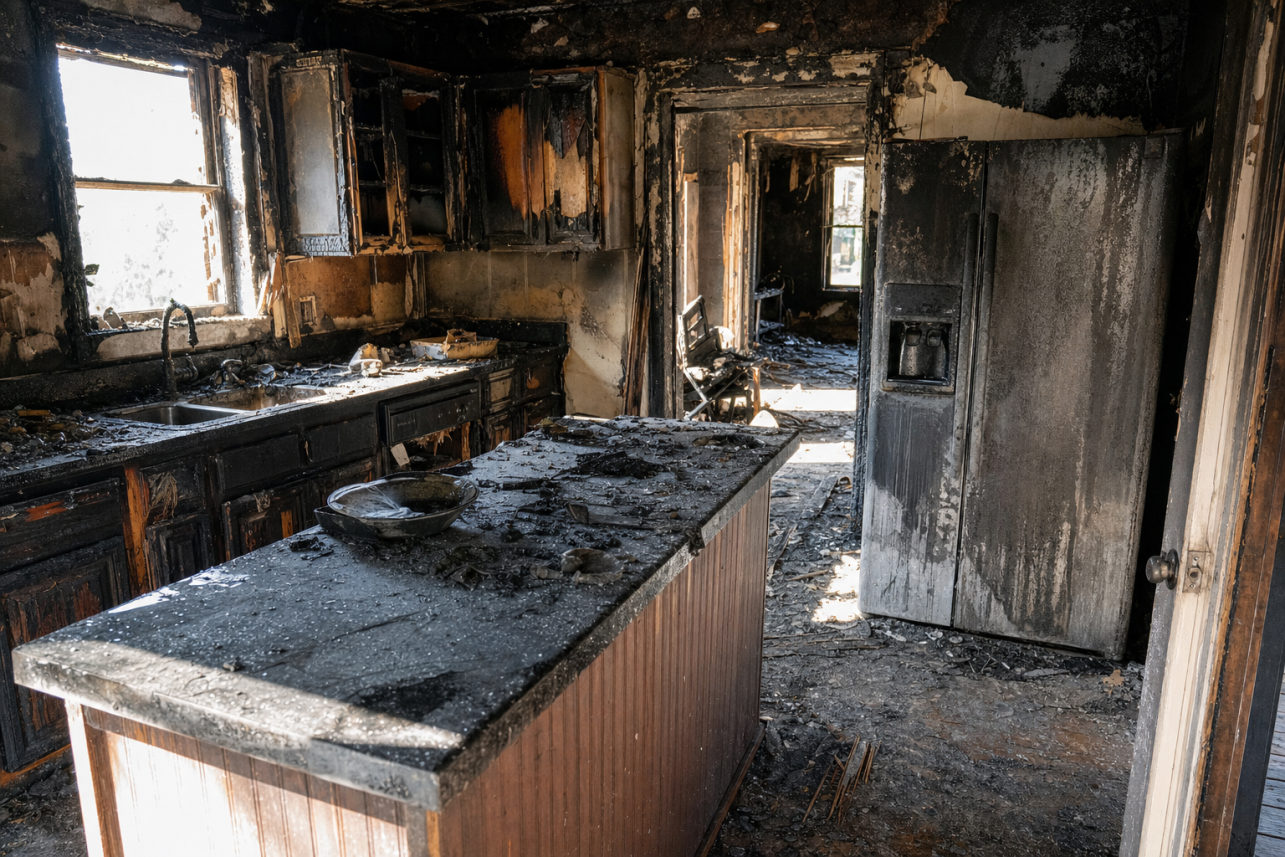
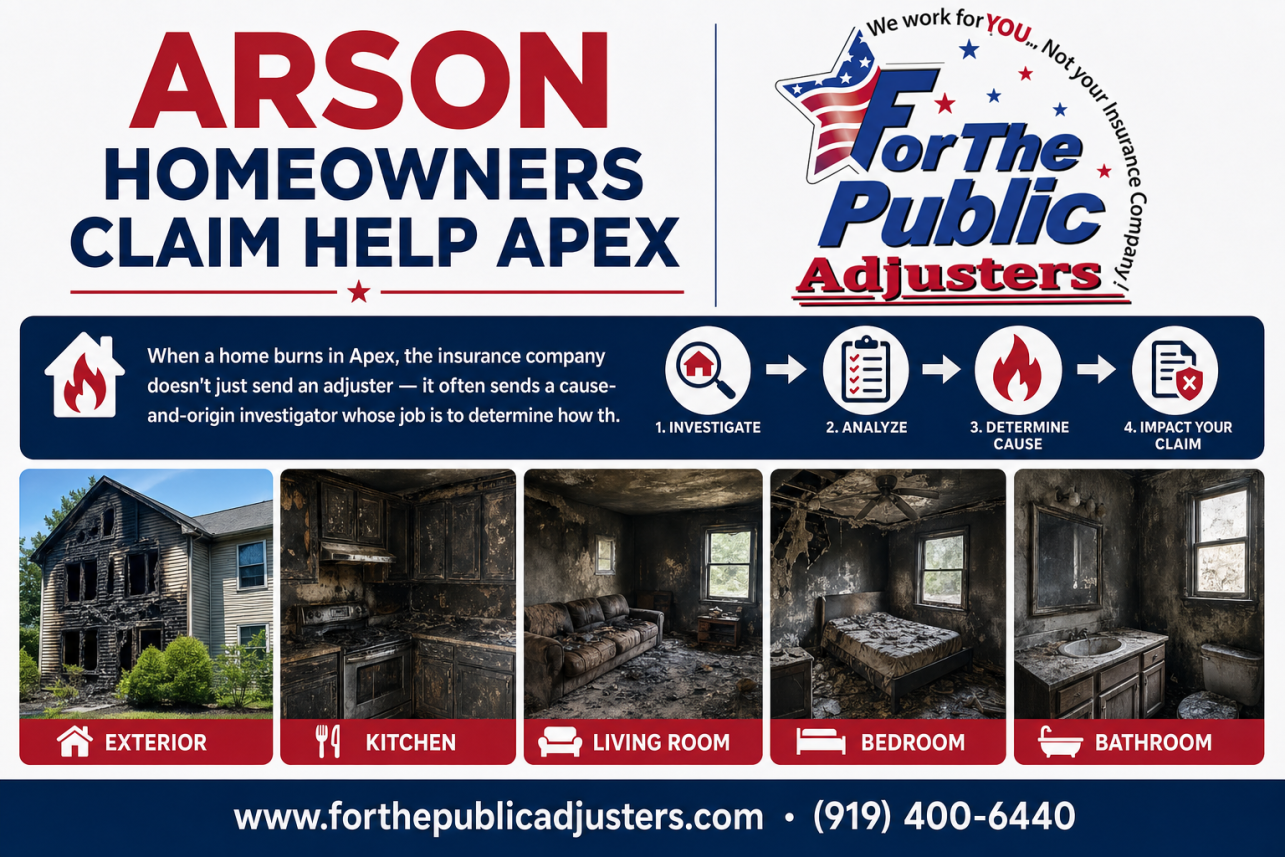
When a home burns in Apex, the insurance company doesn’t just send an adjuster — it often sends a cause-and-origin investigator whose job is to determine how the fire started. If that investigator suggests the fire was intentional, everything changes. Your claim can be suspended, your payments delayed, and suddenly you’re being asked about your finances, your mortgage balance, and where you were that night.
That’s where we come in. A public adjuster works exclusively for you, the policyholder. We review the insurer’s fire investigation, bring in independent experts when the findings don’t hold up, document every dollar of your loss, and manage the claim so the insurer can’t quietly starve you into accepting less — or nothing.
Innocent homeowners do win these fights. In Bryant v. Nationwide Mutual Fire Insurance Co., the North Carolina Supreme Court sided with homeowners whose fire claim Nationwide had refused to pay, allowing them to pursue damages beyond the policy itself for the insurer’s bad-faith conduct. That case is a reminder that in North Carolina, an insurance company that wrongly accuses its own customer can be held accountable. We’ve handled these disputes across the Triangle, including an arson insurance claim in Durham and matters involving arson in Chapel Hill, and we bring that experience to every Apex homeowner we represent.
Common Problems
What Is My Fire Claim Actually Worth — And Will The Accusation Shrink It?
A serious house fire in Apex can easily be a six-figure loss once you count the structure, smoke damage throughout the home, ruined belongings, and the cost of living somewhere else during repairs. An arson accusation doesn’t change what you’re owed under the policy — but it gives the insurer cover to delay, underpay, or deny all of it.
We build the full value of the claim: a detailed room-by-room inventory of your personal property, a proper damage assessment of the structure, and documentation of your temporary housing and living costs, which most homeowner policies cover under loss of use. If your home is a total loss, we make sure it’s valued that way — not patched on paper to save the insurer money.
Our fee is a percentage of what’s recovered, so our interests line up with yours. We never guarantee a specific outcome — no honest adjuster can — but we make sure nothing you’re entitled to gets left off the table.
Arson Homeowners Claim Help Apex: What To Do When Your Claim Is Suspended Or Denied
The insurer’s playbook in a suspected-arson case is predictable. They suspend the claim ‘pending investigation.’ They demand mountains of financial records. They may require you to sit for an examination under oath — a formal, recorded interview where your answers can be used against you. Months pass, and no check arrives while your mortgage lender still expects payment.
Here’s what many homeowners don’t realize: the insurance company must actually prove the fire was intentional and that you were connected to it. Suspicion isn’t proof. Financial stress isn’t proof. And even if there’s a criminal investigation running alongside the claim, being questioned is not the same as being charged — and the civil claim has its own, separate standards.
Don’t let a suspension become permanent silence. There are deadlines for filing your proof of loss and time limits for suing on the policy, and we protect both. When a denial does land, it can be fought — we’ve helped homeowners after an arson insurance claim denied help Burlington situation, and when a dispute needs to go further, we work alongside insurance dispute lawyers.
Should I Handle This Myself, Or Bring In A Public Adjuster?
For a small kitchen fire with a cooperative insurer, some homeowners manage fine on their own. An arson accusation is a different animal. The insurer has fire investigators, attorneys, and staff adjusters on its side. You have your word and whatever documentation survived the fire.
A good public adjuster levels that field. Look for someone licensed in North Carolina — the NCDOI Public Adjusters Guide explains exactly what public adjusters can and can’t do, and it’s worth reading before you hire anyone. Then ask about their experience with accusation cases specifically, because these claims turn on investigation evidence, not just repair estimates.
What we actually do: review the cause-and-origin report for flaws, retain independent fire investigators when needed, prepare you before any examination under oath, assemble the proof of loss correctly, and negotiate from documented facts. Homeowners across Wake County call us for everything from a straightforward fire damage claim help Garner case to a full-blown arson dispute.
Our Process
Free Claim Review And Policy Analysis
We start by reading your policy the way the insurer will — looking for exclusions, deadlines, and conditions they might use against you. Then we review whatever the insurance company has told you so far. If your claim has been suspended or you’ve received a reservation-of-rights letter, bring it. We’ll tell you plainly where you stand.
Independent Investigation And Full Documentation
We examine the insurer’s fire findings and, when the science is shaky, bring in independent fire investigators who follow recognized methodology — the National Fire Protection Association publishes the standards professional fire investigators are measured against, and reports that ignore them can be challenged. Meanwhile, we document your entire loss: structure, smoke damage, contents inventory, and additional living expenses.
Negotiation, And Escalation If The Insurer Won’t Move
We present the claim, answer the insurer’s questions through proper channels, and prepare you for any examination under oath so you’re never blindsided. Most disputes settle once the insurer sees the accusation won’t hold. If yours doesn’t, we coordinate with insurance dispute lawyers so a bad-faith denial can be taken to court — where North Carolina homeowners have won before.
| Stage of the Claim | Facing the Insurer Alone | With For The Public Adjusters, Inc. |
|---|---|---|
| Cause-and-origin investigation | The carrier’s investigator is the only expert at the scene, and their report drives the accusation | An independent, certified fire investigator examines the scene and debris before evidence is destroyed |
| Recorded statements and examination under oath | Homeowners answer alone, and stray or nervous answers get used to build a fraud theory | Full preparation before every statement, with documentation ready to counter motive and opportunity claims |
| Financial ‘motive’ allegations | Bank and tax records get interpreted in the worst possible light by the SIU | A forensic accounting review presents the real financial picture and dismantles the motive argument |
| Proof of loss and valuation | Incomplete inventories and estimates give the carrier reasons to delay or underpay | A sworn, line-item claim for dwelling, contents, and additional living expenses filed on deadline |
| Delay tactics | Months of silence with no leverage to force a decision | Documented timelines and formal demands invoking North Carolina claim-handling standards |
Commonly Overlooked In The Public Adjusting Industry
- Preserving the fire scene before demolition — Homeowners eager to clean up and rebuild let contractors haul away the very debris that could prove the fire was accidental.
- Getting the fire department and Wake County fire marshal reports early — Most people assume the insurer will share these, but the official cause findings often contradict the carrier’s private investigator and nobody checks.
- The insurer’s burden to prove incendiary origin, motive, AND opportunity — Accused homeowners exhaust themselves trying to prove innocence when North Carolina law puts the proof burden on the carrier for all three elements.
- Sworn proof of loss deadlines during an SIU investigation — Homeowners think the claim is ‘on hold’ while they are under investigation, then miss the policy’s filing deadline and hand the insurer a clean denial.
- Additional living expense benefits accruing during the delay — Families front hotel and rental costs for months without documenting them, not realizing those expenses are owed back to the date of loss.
- How casual recorded-statement answers get weaponized — An offhand comment about money stress or a home listing feels harmless in the moment but becomes the centerpiece of a fraud file.
- Independent lab testing of debris for accelerants — A negative accelerant test is often the single strongest piece of exonerating evidence, yet almost no homeowner knows it can be ordered independently.
- Documenting the insurer’s delay timeline in writing — Verbal follow-up calls leave no record, while a dated paper trail of unanswered demands creates real leverage under unfair claims practices standards.
Case Studies
Case Study #1
Situation: A homeowner off Olive Chapel Road in Apex suffered a kitchen and attic fire while the family was out of town for a weekend soccer tournament. The insurer’s cause-and-origin investigator flagged the fire as ‘suspicious’ within days.
Problem: The carrier issued a reservation of rights letter, then demanded an examination under oath, five years of tax returns, cell phone records, and bank statements. The homeowner had recently listed the house for sale, and the insurer treated that as a motive for arson. The claim sat unpaid for months while the family lived in a hotel on their own dime.
Investigation: Our team retained an independent, IAAI-certified fire investigator to re-examine the origin scene before the carrier could push for demolition. We pulled the Apex Fire Department incident report, the Wake County fire marshal’s notes, and the electrical inspection history on the home. We also documented the homeowner’s whereabouts with hotel receipts, toll transponder records, and tournament check-in logs.
Findings: The independent investigation traced the origin to a failed connection in a junction box above the range hood — an electrical fault, not an ignitable-liquid pour pattern as the carrier’s investigator had claimed. Lab testing of debris samples came back negative for accelerants. The ‘pour patterns’ were actually flow marks from melted roofing material dripping through the attic.
Solution: We prepared the homeowner for the examination under oath, presented the competing origin-and-cause report to the carrier’s counsel, and submitted a fully documented sworn proof of loss covering the dwelling, contents, and additional living expenses. We made clear the carrier’s arson theory could not survive scrutiny under North Carolina’s requirement that the insurer prove incendiary origin, motive, and opportunity.
Outcome: The carrier withdrew the arson defense and paid the claim in full — roughly $312,000 for the dwelling, plus contents and fourteen months of additional living expenses. The family rebuilt and closed the sale of the home the following spring.
Lesson: Never let the insurer’s investigator be the only expert who examines the fire scene. Once debris is hauled away, the physical evidence that clears you is gone forever.
Case Study #2
Situation: A retired couple in the Scotts Mill area of Apex lost their garage and part of their home to a nighttime fire. Because the husband had filed a smaller kitchen-fire claim six years earlier, the insurer’s special investigations unit took over the file almost immediately.
Problem: The SIU adjuster implied in recorded statements that the couple had financial trouble and had ‘a history of fires.’ The carrier delayed for over 120 days without paying or denying, and the couple’s mortgage company began asking questions. They felt they were being treated as suspects in their own loss.
Investigation: We audited every recorded statement the couple had given, obtained the complete claim file through a formal request, and hired a forensic accountant to rebut the supposed financial-motive theory. The couple’s finances were actually solid — the SIU had misread a temporary balance dip tied to a planned HVAC replacement.
Findings: The Wake County fire investigator’s own report listed the cause as ‘undetermined,’ not incendiary. The carrier’s motive theory collapsed under the forensic accounting review, and the prior kitchen fire had been a documented appliance failure with a manufacturer recall on record. There was no evidence of ignitable liquids, forced entry staging, or opportunity.
Solution: We compiled a rebuttal package pairing the cause report with the financial analysis and the recall documentation, then invoked the appraisal and demand provisions of the policy to force movement. We also documented the delay timeline in detail, which mattered under North Carolina’s unfair claims settlement practices standards.
Outcome: Within six weeks of our demand package, the insurer paid the dwelling claim at $187,000, plus $41,000 in contents and full additional living expenses back-dated to the date of loss. No arson referral was ever made.
Lesson: An ‘undetermined’ cause is not proof of arson, and a prior claim is not a motive. Insurers must prove their accusation — homeowners should never have to disprove one alone.
| Insurer Signal or Demand | What It Usually Means | Smart Response |
|---|---|---|
| Reservation of rights letter | The carrier is investigating whether it can deny the claim, often on arson or misrepresentation grounds | Do not panic, but stop giving informal statements and get representation before responding |
| File transferred to the Special Investigations Unit (SIU) | You are being treated as a fraud suspect, not a policyholder | Preserve the fire scene, request the fire department report, and retain an independent origin expert |
| Demand for an examination under oath | The insurer’s attorney will probe motive, opportunity, and finances under sworn testimony | Never attend unprepared — every answer becomes evidence, and you are contractually required to appear |
| Request for tax returns, bank records, and phone records | They are building a financial-motive theory | Provide what the policy legitimately requires, with context, ideally through a forensic accounting summary |
| ‘Undetermined’ cause in the fire report | There is no proof of arson — but the carrier may still stall or imply suspicion | Push back in writing; undetermined origin does not satisfy the insurer’s burden of proof in North Carolina |
| Pressure to authorize immediate demolition or debris removal | Once the scene is gone, so is the physical evidence that can clear you | Refuse until your own investigator has documented the origin area and taken samples |
| No payment or denial after 90+ days | Delay is being used as leverage to pressure a low settlement or a walk-away | Document every date and communication; the delay record itself becomes powerful leverage |

Reviews
After our house fire near Beaver Creek, the insurance company’s investigator basically accused my wife and me of setting it ourselves. We were terrified. For The Public Adjusters brought in their own fire investigator who proved it started at a faulty dryer outlet. They sat with me through the examination under oath and never let the carrier’s lawyer twist my words. The claim was paid in full four months after we hired them.
Marcus T., Apex
My claim was stuck in the SIU department for almost half a year because I had listed my home for sale before the fire. The adjuster kept hinting I had a motive. This team pulled the Wake County fire marshal report, got debris samples tested — no accelerants, exactly like I said — and forced the carrier to drop the arson angle. I finally got my dwelling and living expense checks. I only wish I had called them the week of the fire instead of trying to handle it alone.
Denise W., Apex
Being wrongfully accused of burning your own home is something you can’t understand until it happens. The insurer demanded our bank records, phone records, everything. For The Public Adjusters organized it all, hired a forensic accountant to shut down the ‘financial motive’ nonsense, and documented every delay. The settlement covered the rebuild and fourteen months in a rental. Professional, calm, and relentless.
Raymond and Carla P., Apex
Frequently Asked Questions
What Does Arson Homeowners Claim Help Apex Actually Involve If My Insurer Suspects I Set The Fire?
Arson Homeowners Claim Help Apex means having a licensed public adjuster manage your fire claim while the insurance company investigates you as a suspect. When an insurer raises an arson defense, they are building a case to deny your claim entirely, and everything you say or submit becomes evidence.
Our role starts with protecting the claim itself. We document the fire scene independently, photograph and inventory every damaged item before it is discarded, and secure the cause-and-origin evidence the carrier’s investigators will scrutinize. We also review the fire department report from the Apex Fire Department and any SBI or Wake County fire marshal findings, because insurers often lean on preliminary reports that later get revised.
From there, we handle the paperwork that trips up wrongly accused homeowners: the proof of loss, the sworn statement requirements, and the demand for financial records. Carriers use recorded statements and examinations under oath to find inconsistencies, so we prepare you thoroughly and coordinate with your attorney if one is involved.
Most importantly, we push the burden of proof back where it belongs. In North Carolina, the insurer must prove both that the fire was intentionally set and that you had a hand in it. Suspicion, financial stress, or an undetermined cause is not proof. We hold them to that standard while pursuing the full replacement value of your home and contents.
Can My Insurance Company Deny My Apex Fire Claim Just Because I Was In Financial Trouble?
No, and this is one of the most common misconceptions we correct for Apex homeowners. An insurance carrier cannot lawfully deny a fire claim just because you are behind on the mortgage, carry credit card debt, or recently listed the house. Financial difficulty is something insurers use to suggest motive, but motive alone does not prove arson under North Carolina law.
To sustain an arson defense, the carrier generally has to show the fire was incendiary in origin, that you had the opportunity to set it, and that there is evidence connecting you to the act. If the cause-and-origin report comes back undetermined, or if you were verifiably elsewhere, their case weakens considerably.
What actually happens in practice is that insurers request years of bank statements, tax returns, and loan documents during the examination under oath, hoping to build a circumstantial picture. As your public adjuster, we make sure those requests stay within the policy’s actual requirements and that your financial situation is presented with context rather than left open to the worst interpretation.
We have seen Wake County homeowners nearly lose six-figure claims because they answered financial questions casually, without preparation. Being organized, accurate, and consistent matters enormously. If you are in this position anywhere in Apex, from Scotts Mill to Bella Casa to older neighborhoods near downtown, get representation before your examination under oath, not after. The record you create early in the claim is the record the insurer will use for the life of the dispute.
The Fire Marshal Listed The Cause As Undetermined. Why Is My Insurer Still Treating Me Like A Suspect?
An undetermined cause is frustratingly common, and insurers sometimes treat it as an open door rather than a closed one. When the Wake County fire marshal or a private cause-and-origin investigator cannot pinpoint an accidental cause, some carriers shift toward an incendiary theory by process of elimination, then start examining the homeowner’s finances, whereabouts, and statements.
Here is what matters: undetermined is not incendiary. NFPA 921, the standard fire investigators are supposed to follow, does not allow an investigator to call a fire intentional simply because accidental causes were not identified. When a carrier’s hired expert stretches that standard, we challenge the methodology directly and, when needed, bring in an independent cause-and-origin expert to re-examine the scene and the evidence.
We also make sure the scene is preserved. Homeowners in Apex often feel pressure to clear debris quickly, especially with HOA expectations in planned communities, but discarding fire debris before both sides have examined it can badly hurt your position. We coordinate the timing so nothing is lost.
While the cause dispute plays out, we keep the rest of your claim moving. That means pushing for additional living expense payments so your family has housing, documenting the structure and contents losses in full, and holding the carrier to North Carolina’s fair claims handling requirements. An investigation is not a license for the insurer to stall indefinitely, and we do not let an undetermined finding become a quiet denial.
How Do I Get Started With Arson Homeowners Claim Help In Apex, And Is It Too Late If I’ve Already Given A Recorded Statement?
Getting started is straightforward: contact For The Public Adjusters, Inc. for a consultation, and we will review your policy, the fire report, and any correspondence from the carrier before you owe us anything. Our fee is a percentage of what we recover, so representation does not require money up front at a time when your finances are already strained.
It is not too late if you have already given a recorded statement. Many Apex homeowners call us after that first interview, worried they said something wrong. We request a copy of the statement, identify anything the carrier might misread, and address it proactively through corrected documentation rather than letting it sit unexplained in the file. The examination under oath, if one is demanded, is usually the more consequential event, and preparing for it properly can offset earlier missteps.
Once engaged, we take over communication with the adjuster and the carrier’s special investigations unit, so you are no longer fielding calls designed to catch inconsistencies. We build the affirmative side of your claim in parallel: a room-by-room contents inventory, repair estimates from contractors who know Wake County construction costs, and documentation of your temporary housing expenses.
If the situation escalates toward denial or litigation, we work alongside your attorney and hand over a fully documented claim file. Homeowners searching for Arson Homeowners Claim Help Apex are usually overwhelmed and scared; our job is to replace that with a clear plan, a protected record, and a claim the insurer cannot dismiss on suspicion alone.
My Insurer Cut Off My Additional Living Expenses While They Investigate The Fire. Can Arson Homeowners Claim Help Apex Get Those Payments Restarted?
In many cases, yes. Your policy’s additional living expense (ALE) coverage doesn’t automatically disappear because the carrier opened an arson investigation. Unless and until the insurer formally denies the claim with documented grounds, most policies still obligate them to keep you housed and fed while your Apex home is uninhabitable.
What carriers often do instead is quietly stall — no denial letter, no payments, just silence while the investigation drags on. That pressure is deliberate. A homeowner sleeping on a relative’s couch in Cary or paying out of pocket for a hotel off US-1 is far more likely to accept a lowball settlement just to make it stop.
Our team pushes back on that tactic directly. We send written demands citing the specific policy provisions that require ongoing ALE payments, document your actual displacement costs, and put the carrier on notice that withholding benefits without a formal coverage decision can expose them to bad-faith liability under North Carolina law.
We also help you track every receipt — temporary rent, mileage, pet boarding, extra meal costs — so the carrier can’t later claim your expenses were undocumented. In several Wake County cases, simply forcing the insurer to commit to a position in writing has been enough to restart payments within weeks.
If you’ve been wrongfully accused and cut off, don’t assume you have to wait out the investigation broke and displaced. The policy still works for you until the carrier proves otherwise, and we make sure they honor it.
Do I Need A Lawyer, A Public Adjuster, Or Both When My Insurer Accuses Me Of Setting The Fire?
It depends on where things stand, and getting this sequence right matters. A public adjuster handles the claim itself — documenting your losses, valuing the damage to your Apex home, managing communication with the carrier, and building the factual record that undermines a wrongful arson accusation. An attorney becomes essential if the carrier formally denies the claim, if you receive an examination under oath demand, or if there’s any hint of a criminal referral.
For most wrongfully accused homeowners in Wake County, the smart move is bringing in claim help early, before the file hardens against you. Much of what carriers use to justify arson denials — inconsistent statements, gaps in documentation, missed deadlines — happens in the first weeks after the fire, when the homeowner is navigating alone. We prevent those mistakes from ever entering the record.
We also work alongside attorneys constantly, and we know the fire-loss litigators in the Triangle. If your situation calls for legal counsel, we’ll say so plainly and coordinate with them rather than duplicate their work. The adjuster builds the damage valuation and claim file; the lawyer handles legal strategy and any courtroom fight. Neither replaces the other.
One more point on cost: attorneys in these cases often charge hourly or take a large contingency on the full recovery. Public adjuster fees in North Carolina are capped by statute and come only from what we actually recover for you. For many families, resolving the claim correctly at the adjusting stage means never needing litigation at all — which is the cheapest and fastest outcome available.
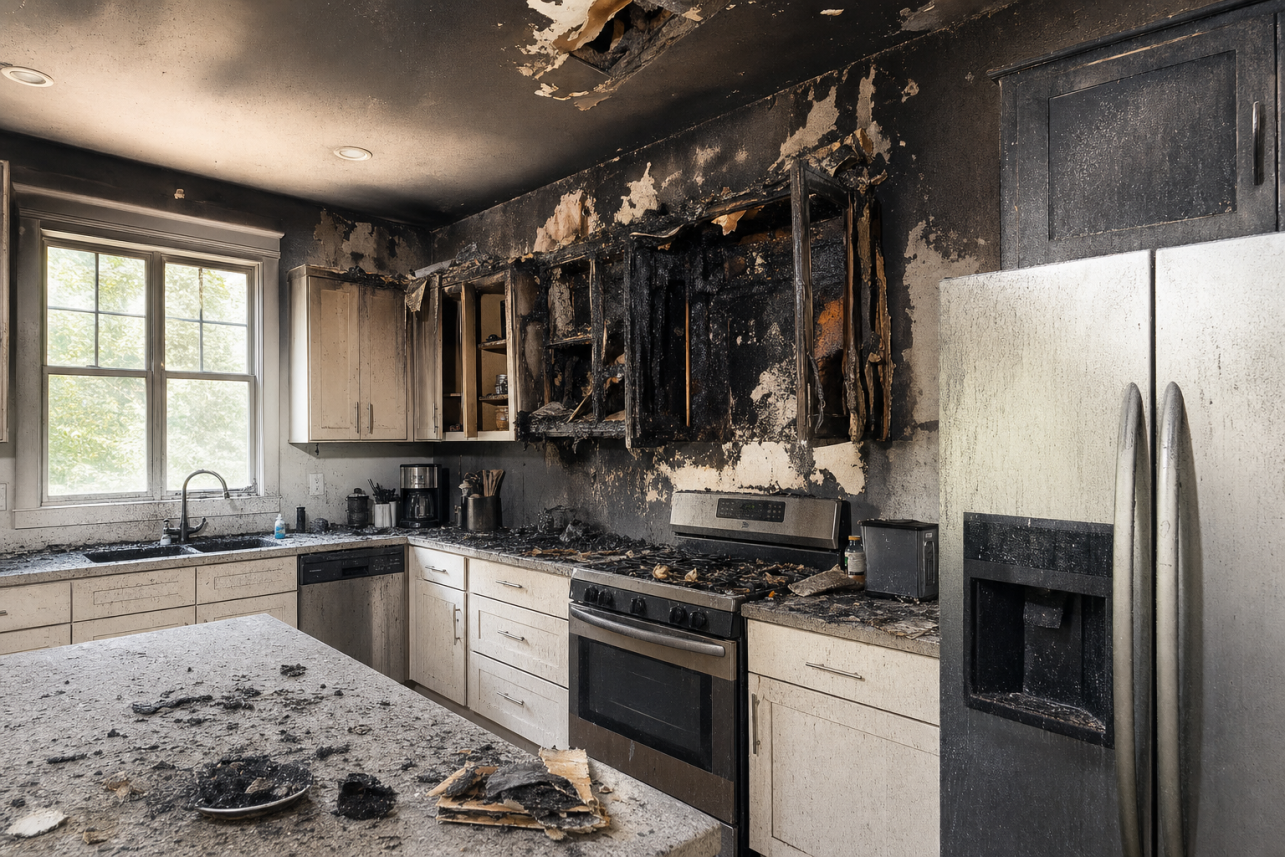
What Kind Of Evidence Actually Clears A Wrongfully Accused Homeowner During Arson Homeowners Claim Help In Apex?
The strongest defense is a documented timeline the carrier can’t poke holes in. That means establishing where you were before and during the fire — cell phone location data, toll records from NC-540, credit card transactions, doorbell camera footage from neighbors, work badge swipes, even a receipt from a Peak City restaurant. Small, boring records win these disputes.
Second is independent cause-and-origin analysis. Insurers hire their own fire investigators, and those reports sometimes lean toward conclusions that favor denial. We bring in independent, certified fire investigators to examine the scene, review the burn patterns, and evaluate whether accidental causes — electrical faults, appliance failures, HVAC issues common in newer Apex construction — were properly ruled out. Often they weren’t.
Third is dismantling the supposed motive. Carriers lean heavily on financial-pressure theories, so we counter with context: home equity that exceeded any insurance payout, a mortgage in good standing, no policy changes before the fire, personal property you’d never destroy. When the numbers show you’d lose money by burning your own house, the motive argument collapses.
Finally, we scrutinize the carrier’s own investigation for shortcuts — evidence handled improperly, alternative causes never tested, witness statements taken out of context. Under North Carolina law, the insurer bears the burden of proving arson by the insured. Our job during Arson Homeowners Claim Help Apex engagements is making that burden impossible to meet, then pressing the claim forward to full payment for the structure, contents, and living expenses you’re owed.
Will Hiring A Public Adjuster Make My Insurance Company Think I’m Guilty Or Treat My Claim Worse?
No — and in wrongful accusation cases, the opposite is usually true. Carriers deal with licensed public adjusters every day. Bringing in professional representation signals that you understand your rights, that every interaction will be documented, and that stall tactics or aggressive interrogation-style questioning will be met with pushback. Innocent people hire representation precisely because they have nothing to hide and everything to lose.
What actually makes homeowners look worse is what happens without representation: agreeing to open-ended recorded statements, signing broad authorizations that hand over years of financial records, missing proof-of-loss deadlines, or giving inconsistent answers under stress. Those unforced errors are what special investigation units build denial files from — not the presence of an adjuster.
Once we’re involved on a claim for an Apex homeowner, all carrier communication routes through our office. We schedule interviews on reasonable terms, ensure document requests are limited to what the policy actually permits, and keep a written record of every commitment the carrier makes. That paper trail alone changes how the insurer behaves, because they know shortcuts will be visible later.
There’s also a practical benefit: while we’re defending you against the accusation, we’re simultaneously building the full damage claim — structure, smoke and soot damage, contents inventory, code-upgrade costs under Wake County requirements, and displacement expenses. Wrongfully accused homeowners often get so focused on clearing their name that the claim itself gets undervalued. We make sure that when the accusation falls apart, the payment waiting on the other side reflects everything you actually lost.
What Should I Expect During An Examination Under Oath, And How Does Arson Homeowners Claim Help Apex Prepare Me For It?
An examination under oath, or EUO, is a formal, recorded interview where the insurer’s attorney questions you under penalty of perjury. When arson is suspected, it is not a friendly fact-finding session. The questions are designed to lock you into statements about your finances, your whereabouts, your relationship with the property, and anything that could later support a denial.
Before your EUO, we go through your entire claim file the way the insurer’s lawyer will. We review your mortgage history, utility records, timeline on the day of the fire, and the document demands attached to the EUO notice. Many homeowners in Apex get denied not because of what happened, but because of an innocent inconsistency between their recorded statement and their EUO testimony.
Our team helps you organize the documents you are required to produce, flags requests that are overly broad, and coordinates with your attorney if one is needed. North Carolina policies typically require you to attend, so refusing is rarely an option. But being prepared is.
We also make sure the record works for you, not just against you. That means documenting your cooperation in writing, submitting proof of loss materials correctly, and preserving evidence that supports your side, like alarm data, witness names, and photos of the property before the fire. Homeowners who walk into an EUO prepared usually walk out with a claim that is much harder to deny.
My Apex Fire Claim Was Already Denied For Suspected Arson. Is There Anything A Public Adjuster Can Still Do?
Often, yes. A denial letter is the insurer’s position, not the final word. The first thing we do is demand the specific policy language and factual basis for the denial. In North Carolina, an insurer cannot simply say “suspicious fire.” To deny for arson, it generally needs evidence of an incendiary cause, a motive, and opportunity, and it carries the burden of proving that.
We then re-examine the fire investigation itself. Many denials rest on an origin-and-cause report that does not hold up under NFPA 921 standards, the recognized methodology for fire investigation. If the insurer’s investigator ruled out accidental causes too quickly, or never tested debris samples for accelerants, that weakness becomes leverage.
A denied homeowner in Apex still has options: a formal rebuttal supported by an independent fire expert, a complaint to the North Carolina Department of Insurance, invoking appraisal if the dispute involves the amount of loss, or litigation with a policyholder attorney we can refer you to.
Timing matters. North Carolina fire policies contain suit-limitation deadlines, so a denial should be challenged quickly rather than shelved. We have seen wrongfully accused homeowners recover full policy benefits after a denial, sometimes with interest, because the carrier’s file could not survive scrutiny. Bring us the denial letter, the investigator’s report if you have it, and your policy, and we will give you an honest read on whether the denial can be overturned.
How Long Can My Insurer Drag Out The Investigation, And Does Arson Homeowners Claim Help Apex Speed Things Up?
Arson investigations can stretch six months to a year or longer if nobody pushes back, and delay itself becomes a weapon. While the file sits with the special investigations unit, your mortgage still comes due, your Wake County property keeps deteriorating, and your temporary housing costs pile up.
North Carolina insurers are bound by fair claims handling standards. They must acknowledge communications promptly, investigate with reasonable diligence, and either pay or deny within a reasonable time once they have what they need. “We’re still investigating” is not an unlimited license to stall.
When you bring in Arson Homeowners Claim Help Apex, we put the carrier on a documented timeline. Every request they make gets answered in writing with proof of delivery, which removes their favorite excuse — that the homeowner has not cooperated. We then demand status updates at regular intervals and identify which parts of the claim are undisputed.
That last point matters. Even during an arson investigation, insurers can often be pressed to advance payments on clearly covered items, such as securing the property or portions of your contents. We also prepare the full damage estimate in parallel, so the moment the investigation clears, payment is not delayed another three months while scope is argued.
If the delay crosses into bad faith territory, we document it thoroughly, which supports a Department of Insurance complaint or strengthens your attorney’s hand later. Most carriers move faster once they realize someone is keeping a record.
What Does It Cost To Hire For The Public Adjusters, Inc. When I’ve Been Wrongfully Accused Of Setting My Own Fire?
We work on contingency, which means our fee is a percentage of what we actually recover for you. There is no retainer, no hourly billing, and no upfront cost — which matters enormously for accused homeowners, because arson suspicion often follows a period of financial stress, and insurers know most people cannot afford to fight back.
The percentage is agreed to in writing before we start, and North Carolina regulates public adjuster contracts, so you will see the exact terms, your cancellation rights, and our license information up front. If we recover nothing, you owe nothing.
For a wrongfully accused homeowner in Apex, the math usually works strongly in your favor. Fire losses involve structure, contents, additional living expenses, code upgrades, and debris removal, and carriers routinely underscope every one of those categories even after liability is resolved. Our job is to document the full loss, so the settlement we negotiate typically exceeds what the insurer would have paid an unrepresented policyholder — often by enough that our fee is covered many times over.
One honest caveat: a public adjuster handles the insurance claim, not criminal exposure. If law enforcement is actively involved, you may also need a criminal defense attorney, and their fees are separate. We coordinate with counsel regularly and can point you to attorneys in Wake County who understand fire cases. The initial consultation with us is free, and we will tell you plainly whether your situation is one we can genuinely help with.
Someone Else Set The Fire — A Break-In Or Vandalism — But My Insurer Is Still Investigating Me. Can Arson Homeowners Claim Help Apex Address That?
Yes, and this situation is more common in Wake County than most homeowners realize. When a fire is intentionally set by a third party — an intruder, a vandal, even a disgruntled acquaintance — the policy still covers you, because arson by someone other than the insured is a covered peril. The problem is that insurers often start from the assumption that the policyholder is the most likely suspect.
Our job is to redirect that narrative with evidence. We work with independent fire investigators to document points of entry, accelerant patterns inconsistent with your access, and timeline evidence like cell records, work logs, or neighbors’ doorbell footage showing you were elsewhere. In Apex neighborhoods with newer construction and security systems, that footage frequently exists — it just has to be preserved quickly before it’s overwritten.
We also coordinate with the Apex Police Department and Town of Apex fire investigation findings. If law enforcement identifies forced entry or a third-party suspect, we make sure that record lands squarely in your claim file, because carriers do not always seek it out on their own.
The key is acting fast. Exterior camera systems typically overwrite in days, and physical evidence at the scene degrades with weather. Arson Homeowners Claim Help Apex begins with a preservation checklist on day one so nothing that proves your innocence disappears while the insurer’s investigation drags on.
My Insurance Company Is Demanding My Bank Statements, Tax Returns, And Phone Records. Do I Really Have To Hand All Of That Over?
Under a standard North Carolina homeowners policy, you have a duty to cooperate — but that duty has limits, and insurers routinely push past them when arson is suspected. A carrier can request documents reasonably related to the claim. It cannot go on an unlimited fishing expedition through your entire financial life and then deny the claim for ‘non-cooperation’ when you push back without guidance.
As your Apex public adjuster, we review every document demand before you respond. Some requests are legitimate: proof of ownership for damaged contents, mortgage statements, or records tied to the property itself. Others — years of tax returns, a spouse’s separate accounts, full phone data dumps — often deserve a narrowed, written response rather than blanket compliance or blanket refusal.
We help you produce what’s genuinely required, in an organized format with a cover letter documenting your cooperation. That paper trail matters. If the insurer later claims you failed to cooperate, we can show exactly what was provided and when.
Just as important, we help you understand what your own records show before the insurer sees them. If a bank statement reflects a temporary shortfall or a large withdrawal with an innocent explanation, we attach context up front instead of letting an investigator draw the worst conclusion. Wrongfully accused homeowners in Apex lose claims not because the evidence is bad, but because it’s handed over raw and unexplained. We make sure yours never is.
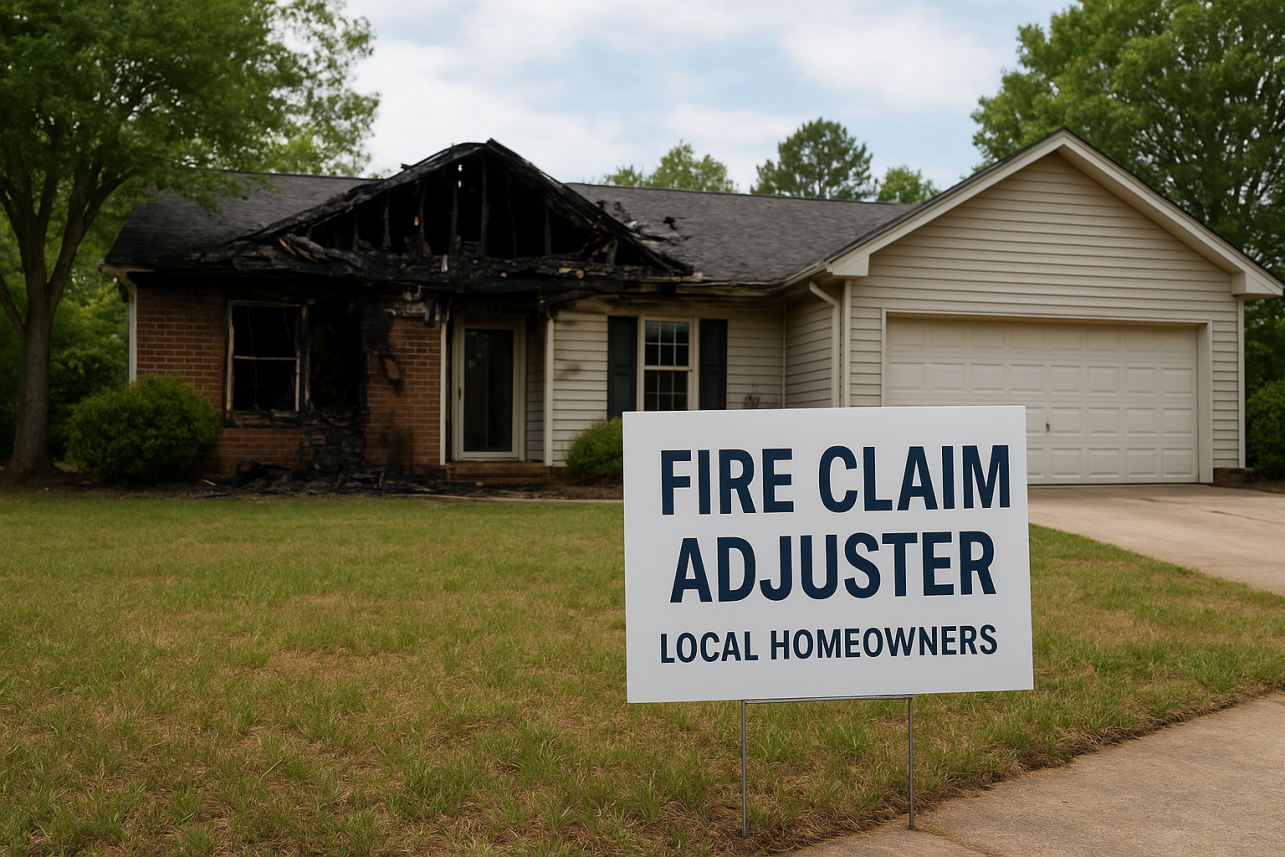
Can I Clean Up The Debris Or Start Repairs On My Apex Home While The Arson Investigation Is Still Open?
Be very careful here. You have a policy duty to protect the property from further damage — tarping the roof, boarding windows, shutting off utilities — and you should do those things promptly and keep receipts. But demolishing, gutting, or hauling away fire debris before the insurer completes its cause-and-origin inspection can seriously hurt you.
If the scene is altered before the carrier’s investigator examines it, the insurer may claim ‘spoliation’ — that you destroyed evidence — and use that as an independent reason to deny the claim. For a homeowner already wrongfully suspected, that accusation lands twice as hard. It can look like you had something to hide, even when you were simply trying to move forward.
Our approach for Apex homeowners is to document everything first. We photograph and video the entire scene, get our own independent origin-and-cause investigator through the property, and send the carrier written notice of any urgent work with a deadline to inspect. Once both sides have examined the scene and it’s documented, we push in writing for release of the property so real repairs can begin.
We also make sure the mitigation work you do perform is billed to the claim, not out of your pocket. Emergency board-up, water extraction from firefighting efforts, and temporary fencing are all recoverable costs. The rule of thumb: protect, document, notify — but don’t erase the scene until the investigation phase is genuinely closed and you have that in writing.
My Mortgage Company Is Named On The Policy. What Happens To My Loan And Their Payout While The Insurer Investigates Me For Arson?
Your lender’s position is one of the least understood parts of a disputed fire claim, and it can actually work in your favor. In North Carolina, the standard mortgage clause in a homeowners policy gives your lender rights that are independent of yours. Even if the insurer ultimately accuses you of setting the fire, the carrier may still owe the mortgagee up to the loan balance — which means the lender has a real financial interest in the claim being handled fairly.
That said, you still owe your mortgage payments while the claim is pending. A fire doesn’t pause the loan, and missed payments during a long investigation can add foreclosure risk on top of everything else. If the delay is straining your budget, we document that hardship as part of the pressure we put on the carrier to resolve the claim, and we can help you communicate with your servicer about forbearance options.
When payment does come, structural checks are typically made out jointly to you and the lender, then held in escrow and released in draws as rebuilding progresses. We manage that draw process so inspections and releases don’t stall your contractor in the middle of reconstruction.
For a wrongfully accused homeowner, keeping the mortgage company informed — in writing, with copies of your cooperation — also builds a record that you acted in good faith throughout. Arson Homeowners Claim Help Apex includes coordinating all three parties: you, your carrier, and your lender, so no one’s silence slows down your recovery.
Local Relevance
Apex has grown from a quiet railroad town into one of Wake County’s most sought-after suburbs, with everything from historic downtown homes to large newer subdivisions. That mix matters in a fire claim: older homes near downtown may have aging wiring that investigators too quickly dismiss as a cause, while newer homes carry big mortgages that insurers scrutinize when they’re hunting for a financial motive.
We’ve also seen how transition periods raise red flags — a home sitting between owners, a family temporarily relocated, a house listed for sale. None of that is evidence of arson, but insurers sometimes treat it that way. Our job is to separate suspicion from proof and keep your claim moving.
We serve homeowners throughout the Triangle, from Apex and Cary to fire damage insurance claim help Knightdale cases on the east side of the county. If your dispute involves a Raleigh property as well, our public adjuster Raleigh NC team covers it.
Because so many Apex homes are newer builds carrying substantial mortgages, insurers investigating a fire here often lean hard on the financial-motive angle — reviewing loan balances and equity before they ever finish the fire science. Homeowners who organize their financial records early, before the insurer demands them, tend to defuse that line of attack much faster.
Accused Of A Fire You Didn’t Set? Talk To Us Before You Talk To Their Investigator
Every statement you give and every document you hand over shapes your claim. Before the insurance company’s next move, get someone in your corner who works only for you. For The Public Adjusters, Inc. is licensed and bonded, and the initial claim review for Apex homeowners costs nothing.
Call us: (919) 400-6440
Helpful Resources
- National Fire Protection Association (NFPA)
- NCDOI Public Adjusters Guide
- North Carolina Department of Insurance — State regulator overseeing insurers and public adjusters
Last updated: September 13, 2026