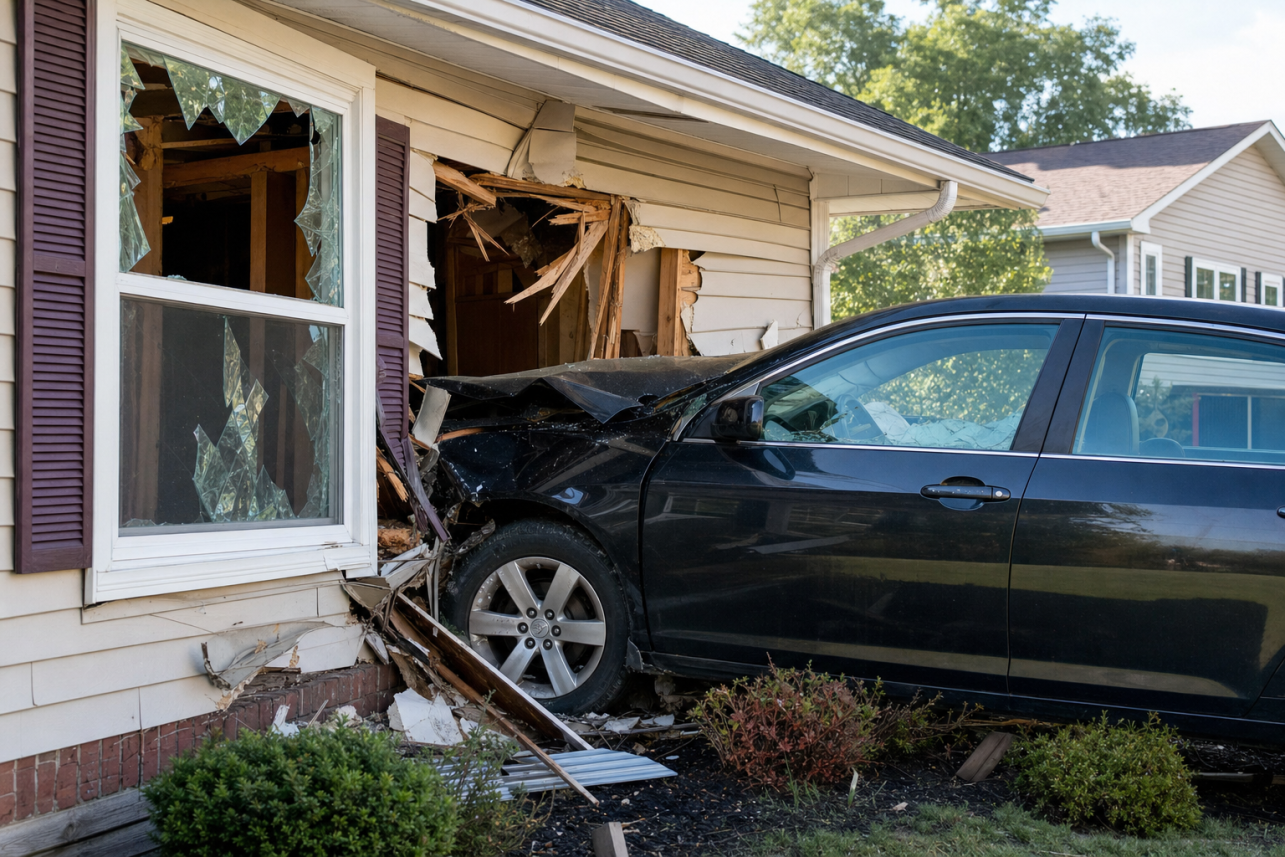
If you need help with a car hit my house insurance claim Burlington policyholders can turn to For The Public Adjusters, Inc., a licensed and bonded public adjusting firm serving Alamance County. When a vehicle strikes a home, the damage often reaches far beyond the visible hole in the wall — foundations, framing, plumbing, and electrical systems can all be compromised. We work exclusively for you, the homeowner, documenting the full scope of structural damage and negotiating with the insurance company so nothing gets overlooked or undervalued.
What This Service Is
When a car crashes into a house, the resulting claim is one of the most complex a homeowner will ever face. There are usually two policies in play: the driver’s auto liability coverage and your own homeowners policy. Deciding which to pursue, in what order, and how to document the loss for each can dramatically affect the outcome.
A public adjuster is a state-licensed professional who represents the policyholder — not the insurance company. As the Insurance Information Institute explains, vehicle impact is a covered peril under standard homeowners policies, but coverage on paper and a full, fair payment in practice are two different things. Our job is to close that gap.
For a vehicle-impact loss, that means arranging structural evaluations, documenting hidden damage to load-bearing walls, foundations, gas lines, and utilities, preparing a detailed estimate, and handling every conversation with the carrier’s adjuster. We also assist with related losses that often accompany these events, such as water damage from ruptured supply lines or fire and smoke damage if the collision sparked a fire. Courts have repeatedly sided with policyholders when insurers underpaid documented structural losses — but the strength of your documentation is what makes that leverage real, and building that record from day one is exactly what we do.
Common Problems
Will Insurance Really Pay To Rebuild, Or Just Patch The Hole In My Wall?
This is the fear we hear most often, and it is justified. Carriers frequently scope vehicle-impact losses as cosmetic repairs — patch the brick, replace some siding, repaint. But an impact strong enough to breach a wall often shifts framing, cracks foundations, and racks door and window openings elsewhere in the house.
A proper claim values the structural repair, code-required upgrades, matching materials for older brick or siding, temporary shoring, engineering fees, and additional living expenses if you cannot safely stay in the home. When those items are missing from the estimate, the settlement can fall tens of thousands of dollars short of the actual cost to restore your home. We cannot guarantee any specific outcome, but we can make sure every legitimate dollar of damage is documented and claimed.
Car Hit My House Insurance Claim Burlington Delays: The Auto Insurer And My Homeowners Carrier Are Pointing At Each Other
This is the classic obstacle in vehicle-impact claims. The driver’s auto carrier may stall while liability is investigated, and your homeowners carrier may drag its feet hoping the auto policy pays first. Meanwhile, your home sits open to the weather with tarps and plywood.
The practical answer is usually to file under your homeowners policy immediately so repairs can begin, then let your carrier pursue subrogation against the at-fault driver — which is often how your deductible gets recovered. We manage that sequence, keep both files moving, respond to every request for documentation, and push back when adjusters delay inspections or issue lowball estimates on a home that clearly needs structural work.
Do I Actually Need A Public Adjuster, Or Can I Handle This Myself?
You can file on your own, and for a minor scrape to a porch railing you might be fine. Severe structural damage is a different matter. The insurance company sends its own trained adjuster whose estimate protects the carrier’s interests. Without your own expert, you are negotiating against a professional with no one reading the fine print on your side.
The NCDOI Public Adjusters Guide explains how public adjusters are licensed and regulated in North Carolina, and it is worth reviewing before you hire anyone. Look for a firm that is licensed and bonded, works on your behalf only, puts its fee agreement in writing, and has real experience with structural losses — not just roof claims. That is precisely how we operate at For The Public Adjusters, Inc.
Our Process
Emergency Documentation And Damage Assessment
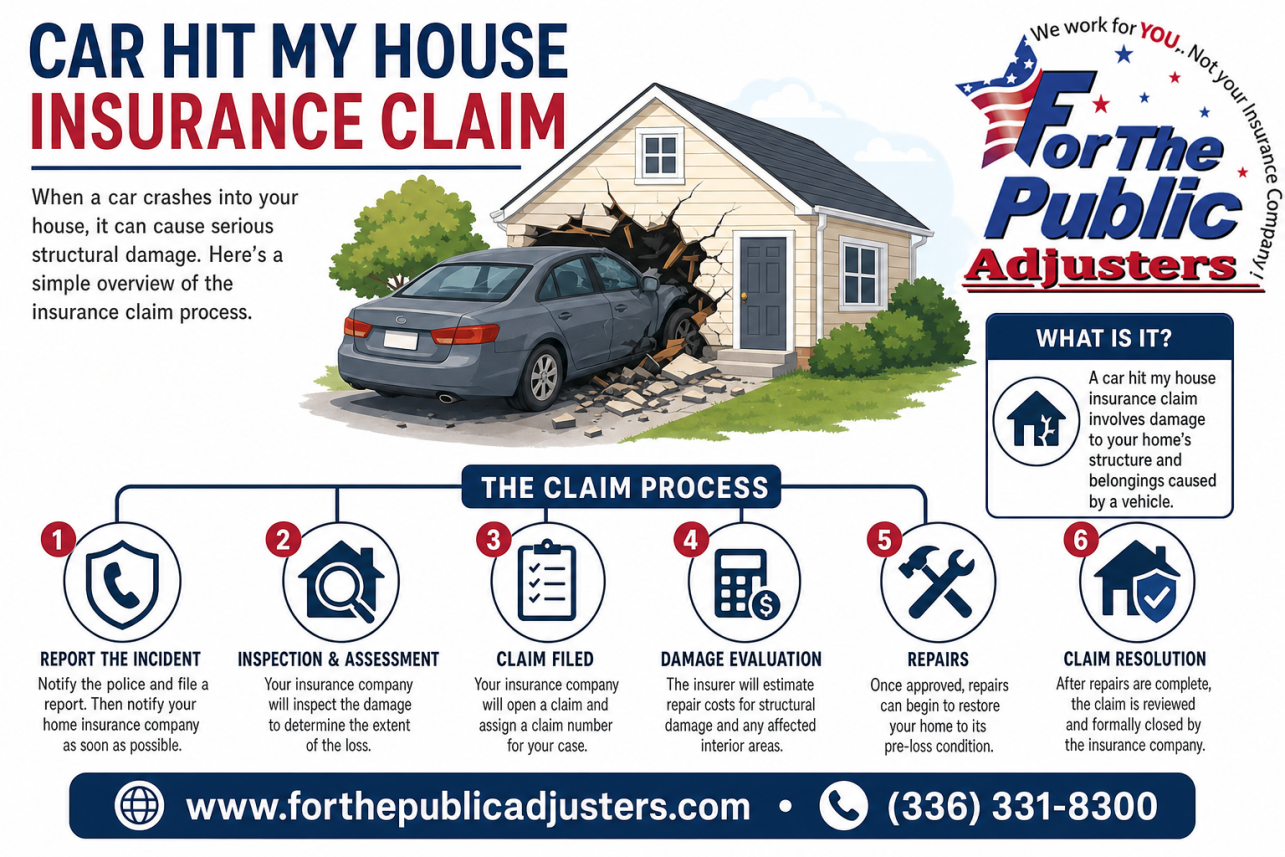
We start with a thorough inspection before anything is repaired or hauled away. That includes photographing the impact zone, cracked foundations, shifted framing, and damaged utilities, and coordinating structural engineering evaluations where needed. This early record is the backbone of the entire claim.
Claim Preparation And Filing
We prepare a complete, itemized estimate covering structural repairs, code upgrades, matching materials, contents damage, and additional living expenses if the home is unsafe to occupy. Then we file with your homeowners carrier and, where appropriate, present the loss to the at-fault driver’s auto insurer so nothing falls between the two policies.
Negotiation Through Settlement
We attend the carrier’s inspections, respond to every dispute over scope or pricing, and negotiate line by line until the settlement reflects what it actually costs to restore your home in the Burlington market. You are kept informed at every stage, and no offer is accepted without your approval.
| What Gets Evaluated | Insurance Company’s Adjuster | For The Public Adjusters, Inc. |
|---|---|---|
| Structural impact assessment | Visual look at the point of impact; rarely checks foundation, framing, or load transfer | Structural engineer inspection, crawlspace and framing evaluation, laser-level checks for racking and settlement |
| Scope of repairs | Patch-and-paint estimate limited to visible damage | Full trade-by-trade scope: foundation, framing, electrical, plumbing, gas lines, matching materials, code upgrades |
| Who they work for | The insurance company that pays the claim | You — our fee is a percentage of what we recover for you |
| Handling the at-fault driver’s carrier | Not their job; homeowners often get bounced between companies | We coordinate both policies, get your homeowners carrier to pay first, and preserve subrogation for your deductible |
| Additional living expenses | Often unmentioned unless you ask | Documented and claimed if the home is unsafe or uninhabitable during repairs |
| Hidden and consequential damage | Typically excluded from the first estimate | Water intrusion, shifted piers, cracked joists, and delay-caused damage identified and claimed |
Commonly Overlooked In The Public Adjusting Industry
- Foundation pier and footing displacement — Carrier adjusters rarely enter the crawlspace, so a corner pier knocked an inch out of place gets written up as a brick repair.
- Load transfer damage away from the impact point — Force from a vehicle strike travels through the frame, cracking joists and racking walls in rooms nobody thinks to inspect.
- Matching discontinued brick and siding — Estimates price a small patch, but North Carolina matching rules can require replacing entire elevations when materials no longer exist.
- Code upgrades triggered by structural reconstruction — Rebuilding a wall to current Alamance County code costs more than the original construction, and carriers won’t volunteer ordinance-or-law coverage.
- Filing under the homeowners policy while liability is disputed — Families wait months on the driver’s insurer when their own carrier owed payment immediately — subrogation is the insurer’s fight, not yours.
- Consequential water damage during coverage delays — Rain entering a tarped impact hole while the carrier stalls is itself a compensable loss, but almost nobody claims it.
- Garage door systems, panels, and buried utilities in the strike zone — Attention goes to the wall, while crushed gas lines, damaged electrical panels, and bent door tracks quietly get left out of the scope.
- Additional living expense coverage for an unsafe structure — Homeowners tough it out in a compromised house not realizing the policy pays for temporary housing when engineers deem it unsafe.
Case Studies
Case Study #1
Situation: A retired couple on Church Street in Burlington was home when a pickup truck jumped the curb and slammed into the corner of their brick ranch, punching through the living room wall and shifting the front porch slab.
Problem: The homeowners’ carrier sent a field adjuster within a week and issued an estimate of $28,400 covering brick replacement, drywall, and paint. The couple felt the house ‘didn’t sit right’ afterward — doors upstairs stopped latching and a hairline crack appeared in the ceiling two rooms away from the impact.
Investigation: We brought in a structural engineer to evaluate the load path from the point of impact. We also opened the wall cavity, measured foundation displacement at the corner pier, and documented racking in the roof framing with laser levels — none of which the carrier’s adjuster had examined.
Findings: The impact had displaced a corner foundation pier nearly an inch and cracked two floor joists, transferring stress through the frame. The ‘cosmetic’ upstairs cracks were symptoms of structural movement. Actual repair scope included underpinning, sistered joists, partial re-framing, and matching discontinued brick — not just patching the hole.
Solution: We submitted a supplemental claim with the engineer’s report, itemized structural repair estimates from a licensed Alamance County contractor, and a code-upgrade demand for current seismic strapping requirements triggered by the reconstruction.
Outcome: The claim settled at $147,600 — more than five times the original offer — plus additional living expenses for the eleven weeks the couple stayed elsewhere during foundation work.
Lesson: Vehicle impacts transfer force far beyond the visible hole. If a carrier’s estimate stops at brick and drywall, the structural damage almost certainly hasn’t been evaluated.
Case Study #2
Situation: A young family near Elon in Alamance County had a driver lose control on a wet night and crash through their attached garage, striking the wall shared with the kitchen and rupturing a gas line and the main electrical panel.
Problem: Two insurance companies were involved — the driver’s auto liability carrier and the family’s homeowners policy — and each pointed at the other. Six weeks passed with no payment while the family lived with a tarped garage, no working range, and a temporary panel. The driver’s liability limit was only $25,000 in property damage, nowhere near the real cost.
Investigation: We reviewed both policies line by line, documented every trade affected — electrical, gas, framing, garage door system, kitchen cabinetry, and flooring warped by rain intrusion during the coverage dispute — and established the correct order of payment between the two carriers.
Findings: The homeowners policy owed the full covered loss immediately regardless of the liability fight; subrogation against the driver was the carrier’s problem, not the family’s. The delay had also caused secondary water damage that was itself compensable because the carrier failed to authorize timely emergency mitigation.
Solution: We filed the complete claim under the homeowners policy with a demand letter citing North Carolina’s prompt-payment requirements, included the water intrusion as consequential damage, and negotiated directly with both adjusters so the family never had to.
Outcome: The homeowners carrier paid $96,800 within five weeks of our involvement, including the rain damage caused by the delay. The family recovered their deductible later through subrogation.
Lesson: When a driver’s insurance is involved, homeowners often wait on the wrong company. Your own policy usually pays first — and delay damage is claimable too.
| Situation | What to Do | Why It Matters to Your Claim |
|---|---|---|
| First hour after impact | Call 911, get everyone out, and request a police report | The crash report identifies the driver and their insurer — essential evidence you can’t recreate later |
| Gas or electrical near the impact zone | Have utilities shut off and inspected before anyone re-enters | Ruptured lines are common in wall strikes; damage found later is easier to claim if documented immediately |
| Home has a visible hole or unstable wall | Get emergency board-up and shoring, keep every receipt | Your policy covers reasonable emergency protection, and it prevents the carrier from denying later rain damage |
| Doors sticking or new cracks appearing rooms away | Do not accept a cosmetic-only estimate; request a structural evaluation | These are classic signs the impact shifted the foundation or frame — the most undervalued part of vehicle-strike claims |
| Driver’s insurer offers a quick settlement | Don’t sign a release before the full repair scope is known | Liability limits are often $25,000 or less; signing early can waive damage discovered during demolition |
| Both insurers pointing at each other | File under your own homeowners policy and let it subrogate | Your carrier owes the covered loss now regardless of fault disputes; waiting costs you weeks and risks secondary damage |
| Carrier’s estimate feels low or repairs seem rushed | Get an independent review before cashing any check | Once repairs begin on an incomplete scope, hidden structural damage becomes far harder to prove and recover |

Reviews
A car came off Maple Avenue and took out the front of our den at 2 a.m. Our insurance company offered $19,000 like it was a fender repair. For The Public Adjusters found cracked foundation footings and roof truss damage their guy never even looked at. Final settlement was over $110,000. They also handled the driver’s insurance company so we didn’t get stuck in the middle.
Marcus T., Burlington NC
After a truck hit our house, the adjuster the carrier sent spent maybe twenty minutes and never went in the crawlspace. This team brought a structural engineer, documented the shifted sill plate, and rewrote the whole scope. The difference between the first offer and what we actually received paid for the entire foundation repair and then some. If a car hits your home, do not sign anything until you talk to them.
Deborah H., Alamance County
Honest and thorough. When a driver crashed into our garage, we filed a car hit my house insurance claim Burlington homeowners like us had no idea how to fight — two insurance companies both stalling. Rob’s team sorted out which policy owed what, got emergency board-up covered, and pushed the settlement from $31,000 to $89,500. They earned their fee several times over.
James R., Burlington
Frequently Asked Questions
Who Pays When A Car Hits My House In Burlington — My Homeowners Insurance Or The Driver’s Auto Policy?
In most cases, both policies can come into play, and the order matters. The at-fault driver’s auto liability coverage should ultimately pay for the damage to your home, but liability claims move slowly. The driver’s insurer may dispute fault, question the repair scope, or take weeks to complete its investigation while your house sits with a hole in the wall.
That’s why most Alamance County homeowners file first under their own homeowners policy. Your carrier pays for covered structural repairs right away, then pursues the driver’s insurer through subrogation to recover what it paid — including, in many cases, your deductible.
The complication is that vehicle-impact damage is rarely as simple as it looks. A car striking a brick veneer or a load-bearing wall in an older Burlington home can shift the foundation, crack framing members, and damage plumbing or electrical lines inside the wall cavity. Insurance adjusters often scope only the visible damage.
As public adjusters, we represent you — not the insurance company — and document the full extent of the loss before repairs begin. That includes structural engineering concerns, code-upgrade requirements under North Carolina building code, and additional living expenses if the home is unsafe to occupy. Getting the scope right at the start is far easier than reopening an underpaid claim later.
How Do I Start A Car Hit My House Insurance Claim Burlington Homeowners Can Actually Win?
A strong car hit my house insurance claim Burlington residents can rely on starts in the first 48 hours. Call 911 so a police report documents the driver, the vehicle, and the circumstances — that report becomes critical evidence for both your homeowners claim and the liability claim against the driver.
Photograph everything before anyone touches the scene: the vehicle position, skid marks, debris, the point of impact, and interior damage. If the wall is breached, arrange emergency board-up and shoring right away. Your policy requires you to protect the property from further damage, and Piedmont weather won’t wait for an adjuster’s schedule.
Next, notify your insurance carrier promptly, but be careful with recorded statements about the cause and extent of damage before the full scope is known. Vehicle impacts frequently cause hidden structural problems — racked framing, cracked footings, compromised gas or water lines — that don’t show up until an engineer or experienced adjuster opens things up.
This is where we come in. For The Public Adjusters, Inc. handles the claim from documentation through settlement: we prepare the detailed estimate, coordinate structural inspections, meet the carrier’s adjuster on site, and negotiate the payout. Homeowners who handle severe structural claims alone often accept the insurer’s first number, which is rarely the right one. Our job is to make sure the settlement actually covers rebuilding your home properly, not just patching it.
The Insurance Company’s Estimate Only Covers The Wall The Car Hit. What About Hidden Structural Damage?
This is the single most common problem we see with vehicle-into-house claims in Burlington and across Alamance County. A carrier’s field adjuster spends an hour on site, measures the visible hole, and writes an estimate for brick, drywall, and paint. But a vehicle traveling even 25 miles per hour delivers enormous force into a structure.
That impact can travel through the framing and cause damage well beyond the point of contact: cracked or shifted foundation footings, racked wall studs, separated roof trusses, broken sill plates, and damaged plumbing, electrical, or HVAC lines running through the affected walls. In older homes near downtown Burlington or in Glen Raven, unreinforced masonry and aging framing make hidden damage even more likely.
North Carolina building code also matters. If a significant portion of the structure must be rebuilt, repairs generally have to meet current code — which can mean upgraded framing, anchoring, and electrical work the original estimate never contemplated. Ordinance-and-law coverage in your policy may pay for those upgrades, but only if someone claims them.
When we take over a claim, we bring in structural engineers when warranted, open up concealed areas with the carrier’s adjuster present, and rewrite the scope line by line. It is not unusual for a properly documented vehicle-impact claim to settle for two or three times the carrier’s initial estimate. You paid premiums for full repair — not a cosmetic patch over a compromised structure.
How Long Does A Car Hit My House Insurance Claim Burlington Take, And Can I Live In My Home During Repairs?
Timelines vary with severity. A straightforward claim with limited structural damage might settle in four to eight weeks. Severe damage involving foundation work, engineering reports, or a dispute with the driver’s liability carrier can run several months. North Carolina requires insurers to acknowledge claims promptly and pay undisputed amounts within a reasonable time, but ‘undisputed’ is where fights happen — which is exactly what a Burlington public adjuster is there to manage.
Whether you can stay in the home depends on what the impact compromised. If a load-bearing wall is breached, utilities are damaged, or the city building inspector flags the structure as unsafe, you’ll need to relocate temporarily. Your policy’s Additional Living Expenses (Loss of Use) coverage should pay for a comparable rental, hotel stays, extra mileage, and increased food costs while your home is uninhabitable.
Many homeowners don’t realize ALE exists, or they under-claim it. We track and document those expenses from day one so nothing is left on the table.
Our other timeline advantage is preparation. When For The Public Adjusters, Inc. submits a claim, the estimate, photos, engineering findings, and code-upgrade documentation arrive as a complete package. Carriers have less to question, fewer reasons to delay, and a clearly supported number to respond to. Homeowners handling severe structural claims alone often face rounds of supplemental requests that drag on for months. Thorough documentation up front is the fastest path to a full and fair settlement.
What Should I Do In The First 24 Hours After A Car Crashes Into My Burlington Home?
Your first priority is safety. If a vehicle struck a load-bearing wall, gas line, or electrical panel, keep everyone out of that section of the house until the Burlington Fire Department or a structural engineer clears it. Vehicle impacts can leave a home standing but unstable.
Call 911 and get a police report even if the driver stays and cooperates. That report becomes the backbone of your claim, documenting the driver’s identity, insurance information, and the circumstances of the crash. In Alamance County, the responding agency’s report number is something both insurers will ask for immediately.
Before anything is moved, photograph everything: the vehicle position, skid marks, debris field, interior cracking, and displaced framing. Once the tow truck pulls the car out, critical evidence about the force and angle of impact disappears.
Next, arrange emergency board-up and shoring, but keep every receipt. Your homeowners policy covers reasonable steps to protect the property from further damage, and you are actually required to take them. Just don’t authorize permanent repairs yet — that can lock in an undervalued scope before the full damage is understood.
Finally, notify your homeowners carrier and the driver’s auto insurer, but stick to the facts. Avoid guessing at repair costs or saying the damage “looks minor.” Early statements get quoted back later. Many Burlington homeowners bring in a public adjuster at this stage precisely so every conversation with the insurance companies is handled by someone who negotiates these losses for a living.
Do I Really Need A Public Adjuster For A Car Hit My House Insurance Claim Burlington Homeowners File, Or Can I Handle It Myself?
You can handle it yourself, but vehicle-impact losses are among the most underpaid claims we see, and the reasons are structural. A car striking a house delivers a sudden lateral force that homes simply aren’t built to absorb. The visible hole is often the smallest part of the loss — the impact travels through framing, racks walls out of plumb, cracks foundations, and shifts rooflines several rooms away.
Insurance company adjusters in this area frequently scope only what they can see: the punctured brick veneer, the broken studs, the damaged siding. They rarely order the engineering evaluation needed to trace the force path, and homeowners who accept that first estimate often discover cracked footings or separated connections months later, after the claim is closed.
A public adjuster works only for you, not the carrier. For The Public Adjusters, Inc. documents the full scope — structural, cosmetic, code-required upgrades, and additional living expenses if part of your home is unusable — then negotiates directly with the insurer. We also sort out the coordination between your homeowners policy and the at-fault driver’s auto liability coverage, which is where these claims commonly stall.
There’s another practical benefit: time. A severe impact claim involves engineers, contractors, permit requirements through Alamance County inspections, and often two insurance companies pointing at each other. Managing that while living in a damaged home is a second job. Our fee comes from the recovery we negotiate, so our interest is aligned with yours — a fully documented, fully paid claim.
A Vehicle Destroyed A Load-Bearing Wall In My Home. Will Insurance Pay For Engineering And Code Upgrades, Not Just Patching The Hole?
It should — but usually only if you push for it. When a car takes out a load-bearing wall, the repair is never as simple as rebuilding what was there. North Carolina building code has changed significantly over the decades, and Alamance County inspections will require the reconstruction to meet current code, not the code from when your house was built.
That can mean new headers, updated framing connections, upgraded electrical in the affected walls, and sometimes foundation reinforcement. These costs are real, and they’re covered — if your homeowners policy includes ordinance or law coverage, which most do at some level. The problem is that initial carrier estimates almost never include them.
Engineering is the other gap. A structural engineer’s evaluation is often essential to prove the impact damaged more than the wall itself: shifted trusses, cracked slab sections, or racked adjacent walls. Insurers rarely volunteer to pay for that evaluation up front, yet they’ll use the absence of an engineer’s report to deny hidden damage later. We routinely bring in independent engineers on severe losses in Burlington precisely to close that loop.
In a car hit my house insurance claim Burlington homeowners bring to us, the difference between the carrier’s first offer and the properly documented settlement often comes down to exactly these items — engineering, code compliance, and matching materials for brick or siding that can no longer be sourced. Don’t sign off on a scope until every one of those categories has been addressed in writing.
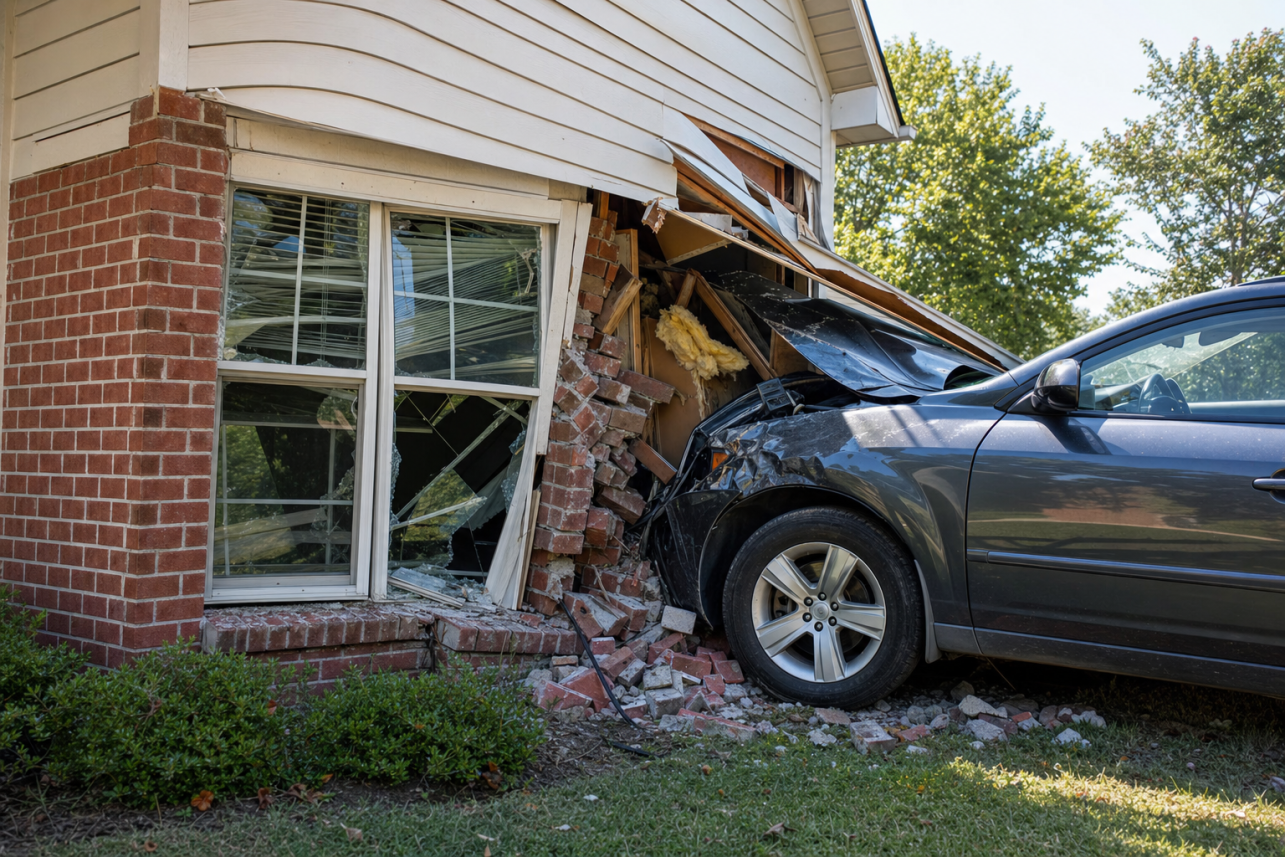
The Driver Who Hit My House Was Uninsured — Or Drove Off. Can I Still Recover For Severe Damage?
Yes. This scenario is more common than people expect, and it’s exactly why your homeowners policy matters. Vehicle damage to your dwelling is a covered peril under standard homeowners policies, and that coverage doesn’t depend on the driver being identified, insured, or cooperative. Your carrier pays your claim, then pursues the driver through subrogation if there’s anyone to pursue.
With a hit-and-run, the police report becomes even more important. File one immediately with Burlington PD or the Alamance County Sheriff’s Office, and preserve every piece of physical evidence — paint transfer on your brick, vehicle parts left in the yard, doorbell or security camera footage. Neighbors’ cameras along your street may have caught the vehicle even if yours didn’t.
The catch with going through your own homeowners policy is your deductible and, sometimes, a carrier that treats the loss less urgently because there’s no other insurer to bill. If the driver is later identified, your deductible can often be recovered through subrogation, and we track that on our clients’ behalf.
The severity issue doesn’t change either way: uninsured or not, a vehicle impact still demands a full structural evaluation, code-compliant reconstruction, and coverage for living expenses if part of your home is unsafe. For The Public Adjusters, Inc. handles these losses across Burlington and the rest of Alamance County, and our job is the same regardless of who was behind the wheel — document everything, prove the full scope, and make sure your policy pays what it promises.
The Car Cracked My Brick Veneer And The Insurer Wants To Patch It, But The New Brick Won’t Match. Can I Demand Full Replacement In A Car Hit My House Insurance Claim Burlington?
Matching disputes come up constantly in these losses, and they matter more than most homeowners realize. Many Burlington homes — especially older properties near downtown and in established Alamance County neighborhoods — were built with brick runs that are no longer manufactured. A spot patch on the impact zone leaves a visibly mismatched wall that hurts your home’s value.
North Carolina does not have a strict statutory matching requirement, but most homeowners policies promise to return your property to its pre-loss condition. Adjusters and appraisers routinely argue that a checkerboard patch of mismatched brick or siding fails that standard, particularly on a continuous, unbroken elevation like a front facade.
The key is documentation. We photograph the full elevation, obtain written confirmation from masonry suppliers that the original brick is discontinued, and get contractor statements explaining why a partial repair produces a visibly inferior result. With that evidence, carriers frequently agree to replace the entire affected elevation rather than just the hole the vehicle left.
The same logic applies to vinyl siding faded by years of North Carolina sun, discontinued stone veneer, and specialty trim. If the insurer refuses, the policy’s appraisal clause gives you a formal path to dispute the scope, and a public adjuster in Burlington can invoke and manage that process for you. Don’t accept a patch quote until someone has actually verified the material is still available — in our experience handling vehicle-impact losses across Alamance County, it often isn’t.
The Vehicle Knocked My House Off Its Foundation Footing. How Is Severe Foundation Damage Handled Differently From Surface Repairs?
Foundation and footing damage is the most underpaid category in vehicle-impact claims, because it’s invisible in the carrier’s initial walk-through and expensive to fix correctly. When a car strikes a home at speed, the impact energy travels through the wall system into the sill plate, band joist, piers, and footings. Many Burlington homes sit on crawl space foundations, which are especially vulnerable to shifted piers and cracked block.
A field adjuster with a clipboard cannot diagnose this. It requires a licensed structural engineer to inspect the crawl space, check the home for racking and level, and produce a written repair protocol. Your policy generally covers reasonable engineering costs when they’re necessary to determine the scope of a covered loss — but carriers rarely volunteer to pay for one.
Proper foundation repair may involve helical piers, rebuilt block piers, sistered framing, and re-leveling the affected section of the house. In Alamance County, that work also has to pass structural inspection under the current North Carolina building code, which can trigger upgrade costs your ordinance-or-law coverage should absorb.
We bring in the engineer, translate the repair protocol into a line-item estimate the carrier must respond to, and push back when the insurer’s scope stops at cosmetic block patching. Signs you may have foundation involvement include doors that suddenly stick, new drywall cracks radiating from corners, sloping floors near the impact side, and gaps at baseboards. If you’re seeing any of those after a vehicle strike, insist on an engineering inspection before you accept any settlement.
The Impact Ruptured A Gas Line And Damaged My Plumbing And Electrical. Does A Car Hit My House Insurance Claim Burlington Cover Utility And System Damage Too?
Yes — a car hit my house insurance claim Burlington homeowners file should cover far more than the wall itself. Vehicle strikes routinely sever or damage gas lines, water supply lines, drain pipes, electrical panels, wiring runs inside the wall cavity, and HVAC equipment mounted on the impacted side of the home. All of it is part of the same covered loss.
The problem is that these systems hide inside walls and crawl spaces, so the carrier’s first estimate almost never includes them. A crushed wall cavity can pinch wiring that fails months later, and a hairline crack in a drain line under the slab won’t show up until you have a moisture problem. That’s why we insist on plumber pressure tests, electrician inspections of every affected circuit, and — where gas is involved — documentation from the utility or a licensed gas fitter before scope is finalized.
Code compliance matters here too. When damaged wiring or plumbing is opened up for repair, Alamance County inspections typically require the work to meet current North Carolina code, not the code from when the house was built. Panel upgrades, GFCI/AFCI protection, and re-piped sections are commonly required, and your policy’s ordinance-or-law coverage is designed to pay for exactly that.
Also remember related costs: loss of use if the gas or power must stay off, spoiled food from an extended outage, and emergency service calls the night of the crash. Keep every receipt. We fold all of these items into one complete, documented demand so nothing gets left out of the settlement.
My Insurer Paid The Claim, But I’m Out My Deductible And Other Expenses. Can I Get That Money Back From The Driver Who Hit My Burlington Home?
Usually, yes. When a driver crashes into your home, they — and their auto liability carrier — are legally responsible for the damage. If your homeowners insurer pays your claim first, it will typically pursue the at-fault driver’s insurance through a process called subrogation to recover what it paid. When that subrogation succeeds, you’re generally entitled to reimbursement of your deductible from the recovery.
The catch is that homeowners often have out-of-pocket costs beyond the deductible: uncovered landscaping, a portion of tree or fence damage, temporary lodging above policy limits, or depreciation the carrier held back. Those amounts can be pursued directly against the driver’s auto liability policy. North Carolina’s minimum property damage liability limit is $25,000 per accident, and many drivers carry more — often enough to close the gap on a severe structural loss.
Timing matters. Get the crash report from the Burlington Police Department or the responding agency right away, because it identifies the driver and their insurer. Notify that auto carrier in writing that you have a property damage claim, even while your homeowners claim moves forward. Don’t sign any release from the auto insurer until every cost is known, since severe structural damage frequently reveals additional problems during repairs.
As licensed public adjusters serving Burlington and the rest of Alamance County, we document the full loss once and use that same evidence package on both fronts — your homeowners claim and the driver’s liability claim — so the two settlements together actually make you whole instead of leaving you paying for someone else’s accident.
The Car Destroyed Furniture, Appliances, And Belongings Inside My Home. Does A Car Hit My House Insurance Claim Burlington Include My Personal Property Too?
Yes. When a vehicle penetrates a wall, the impact and debris often destroy far more than the structure — sofas, televisions, kitchen appliances, and stored items are frequently crushed or contaminated with glass, insulation, and drywall dust. Your homeowners policy carries separate personal property coverage (Coverage C) specifically for these losses, in addition to the dwelling coverage that pays for the building itself.
The catch is documentation. Insurers in Alamance County routinely undervalue contents because homeowners submit vague lists like ‘living room furniture.’ You need an itemized inventory with brand, model, age, and replacement cost for every damaged item, supported by photos taken before anything is discarded. Never throw items away until the adjuster has documented them or given written permission.
Watch how the carrier calculates value. Many initial contents offers are based on actual cash value — depreciated worth — even when your policy includes replacement cost coverage. If you have replacement cost on contents, you’re entitled to what it costs to buy those items new today, though part of that may be held back until you actually replace them.
For The Public Adjusters, Inc. builds room-by-room inventories for Burlington homeowners, prices items at current retail, and challenges excessive depreciation. On severe vehicle-impact losses, a properly documented contents claim often adds thousands of dollars the carrier’s first estimate simply left out.
My Insurer Says Part Of My Payment Is ‘recoverable Depreciation’ Being Held Back. How Does That Work After A Vehicle-Impact Loss?
If your policy pays on a replacement cost basis, the insurer typically issues two payments. The first is the actual cash value — the replacement cost minus depreciation for age and wear. The second, called recoverable depreciation, is released only after you complete the repairs and prove what you spent.
Here’s a simple example. Say rebuilding your damaged wall, roofline, and porch costs $60,000 and the carrier applies $15,000 in depreciation. You’d receive $45,000 up front (minus your deductible), then the remaining $15,000 once you submit final invoices showing the work was done.
Problems arise in two places. First, some carriers apply depreciation aggressively — depreciating labor as well as materials, which North Carolina law and many policies restrict. Second, homeowners in Burlington often don’t realize there’s a deadline, commonly 180 days to two years from the loss date, to complete repairs and request the holdback. Miss it and that money can be forfeited.
Severe structural damage complicates timing further, because engineering, permits through Alamance County or the City of Burlington, and contractor scheduling can eat months. If repairs will run past the deadline, a written extension request must go to the carrier before it expires.
Our team reviews how depreciation was calculated, disputes improper labor depreciation, tracks every holdback deadline, and submits the documentation that gets the full recoverable amount released — so nothing you’re owed stays in the insurer’s pocket.
The Insurance Check For My Structural Damage Has My Mortgage Company’s Name On It. Why, And How Do I Get The Money Released?
This surprises almost every homeowner filing a car hit my house insurance claim Burlington carriers pay out on. Because your lender has a financial interest in the property, your policy’s mortgagee clause requires the insurer to name the mortgage company on any dwelling payment above a small threshold — often anything over a few thousand dollars. You cannot cash that check alone.
The lender deposits the funds into an escrow account and releases them in draws as repairs progress. Expect them to require a signed contractor agreement, a W-9 from the contractor, lien waivers, and periodic inspections before each disbursement. On a severe vehicle-impact loss involving framing, foundation, or roof structure, most lenders use a three-draw schedule: a portion up front, a portion at mid-completion, and the balance after a final inspection.
Delays here are common and painful. Endorsement paperwork gets lost, inspection appointments lag, and contractors won’t start without a deposit. Get your lender’s loss draft department contact information immediately and confirm their exact requirements in writing before repairs begin.
For The Public Adjusters, Inc. coordinates this process for homeowners across Burlington and Alamance County — packaging the estimate, contractor documents, and inspection reports the lender needs so draws release on schedule. When the settlement is documented properly from the start, the mortgage company’s involvement becomes a formality instead of a months-long bottleneck that stalls your rebuild.
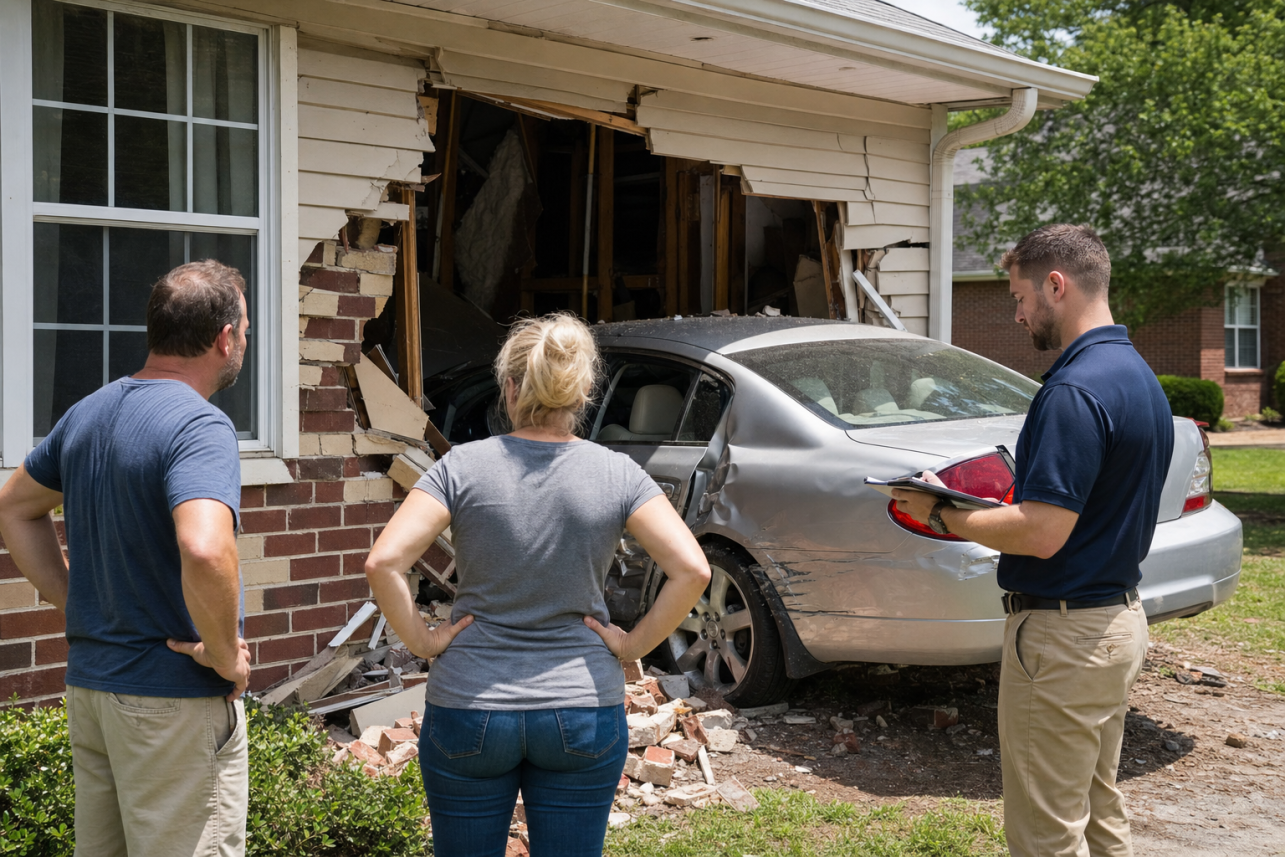
A Driver Crashed Into My Detached Garage And Fence Instead Of The House Itself. Is That Covered The Same Way?
It’s covered, but under a different — and smaller — part of your policy. Detached garages, fences, storage buildings, carports, and retaining walls fall under Coverage B, ‘Other Structures,’ which is typically capped at just 10% of your dwelling limit. If your home is insured for $300,000, you’d have only $30,000 for all other structures combined.
That limit matters more than people expect. A vehicle that plows through a fence and into a detached garage in a Burlington neighborhood can easily cause damage exceeding the cap once you account for demolition, new footings, framing, garage doors, electrical service to the building, and concrete slab repair. If the driver was at fault, their auto liability coverage becomes critical for recovering amounts above your Coverage B limit, plus your deductible.
Don’t overlook secondary damage either. Vehicles that hit outbuildings often destroy what’s stored inside — lawn equipment, tools, bicycles — which falls under your personal property coverage, not the structure limit. Document everything before cleanup.
The measurement issues are the same as with a house strike: hidden racking of the garage frame, cracked slab, and code-required upgrades when rebuilding. Our public adjusters in Burlington scope the full loss, allocate damage correctly between Coverage B and contents, and pursue the at-fault driver’s carrier when policy limits fall short — so a ‘minor’ outbuilding claim doesn’t leave you paying the difference yourself.
Local Relevance
Burlington’s housing stock spans a wide range of eras, from early-twentieth-century mill-village homes to mid-century brick ranches and newer subdivisions spreading across Alamance County. Many of these homes sit close to busy roads and corner lots, which is exactly where vehicle-into-home accidents tend to happen.
Older Burlington homes present particular claim challenges after a vehicle impact. Original brick may be difficult to match, plaster walls crack far beyond the point of impact, and outdated wiring or plumbing disturbed by the collision may trigger code-upgrade requirements the carrier’s first estimate ignores. Getting those items into the claim requires documentation and persistence.
Our team handles the full range of severe homeowners losses across Alamance County — car-hits-home claims, fire and smoke damage, water damage, tree damage, and vandalism — so when a vehicle impact causes secondary damage like a burst supply line or an electrical fire, one firm manages the entire loss from start to finish.
Because so many of Burlington’s older mill-era and mid-century homes were built with solid masonry or plaster-over-frame construction, a vehicle impact often transmits cracking well beyond the strike point — which is why we routinely find claimable damage in rooms the carrier’s adjuster never inspected.
A Vehicle Hit Your Home? Get Your Own Adjuster On The Case
For The Public Adjusters, Inc. is licensed and bonded, and we represent Burlington homeowners — never the insurance company. The sooner we document your structural damage, the stronger your claim. Your consultation costs nothing, and you owe us nothing unless your claim is paid.
Call us: (336) 331-8300
Helpful Resources
- NCDOI Public Adjusters Guide
- Insurance Information Institute (III)
- North Carolina Department of Insurance — State regulator overseeing insurance and public adjuster licensing in NC
- Insurance Information Institute homeowners coverage basics — Consumer education on what standard homeowners policies cover
Serving Burlington · Alamance
Last updated: October 7, 2026