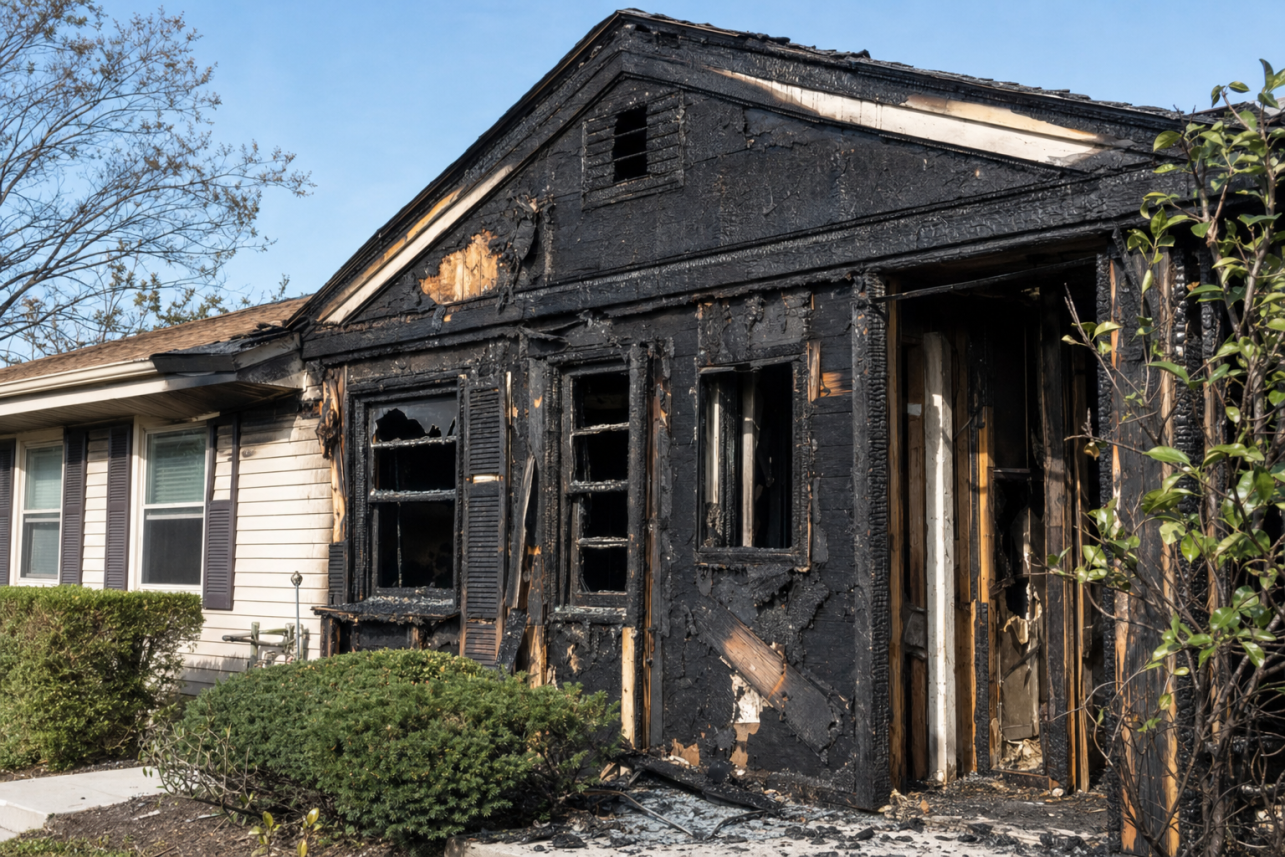
If your fire claim has stalled because the insurer suspects arson, an Arson Homeowners Claim Clayton policyholders file deserves professional representation from day one. Being questioned about the origin of your own house fire does not make you guilty, and it does not erase your right to be paid under your policy. For The Public Adjusters, Inc. is licensed and bonded, and we represent you — not the insurance company — through the investigation, the paperwork, and the settlement negotiation.
What This Service Is
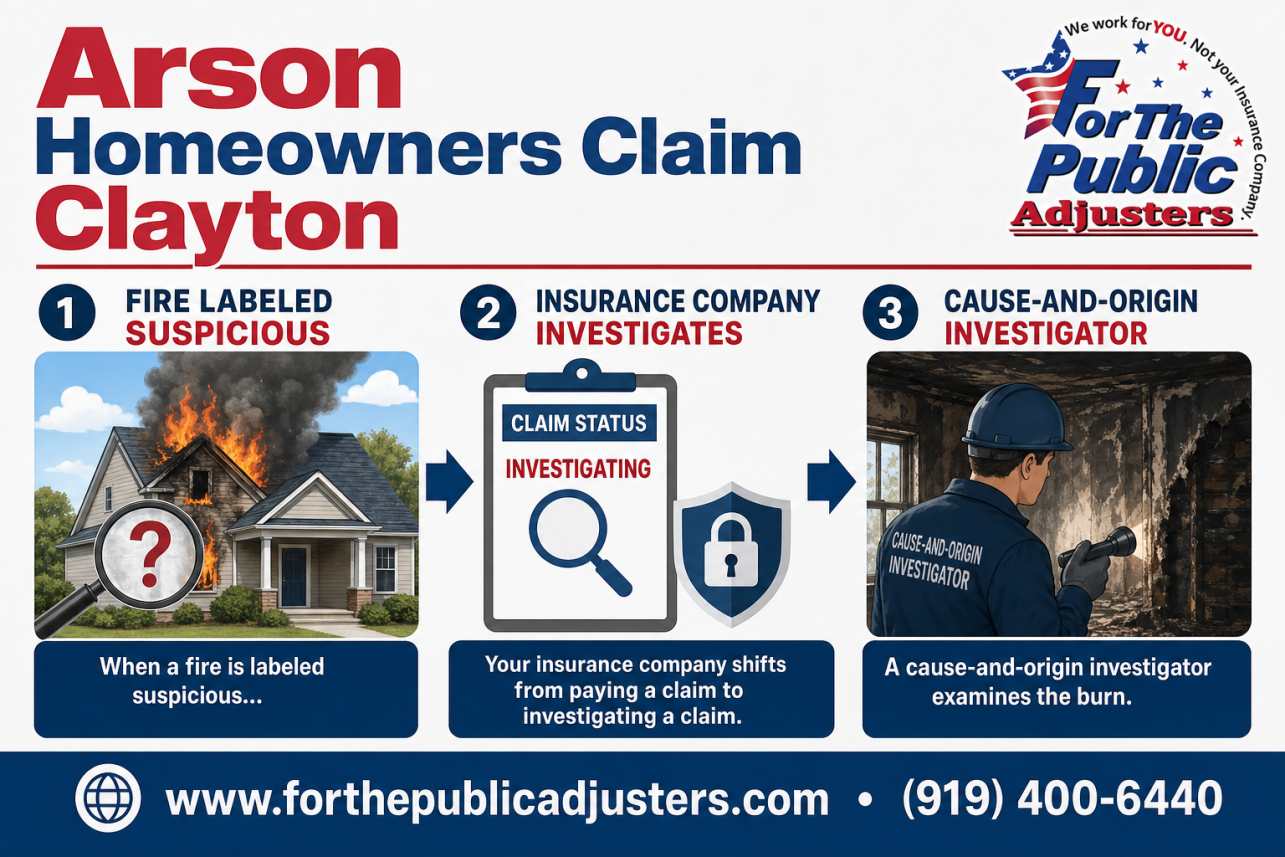
When a fire is labeled suspicious, your insurance company shifts from paying a claim to investigating a claim. A cause-and-origin investigator examines the burn patterns. The carrier pulls your financial records to look for a money motive. You may be asked to sit for a formal recorded interview under oath and to sign a sworn statement listing everything you lost.
Most homeowners have never been through anything like it, and one poorly worded answer can be twisted into a reason to deny. Our job is to level that field. We review your policy, manage the documentation, prepare your personal property inventory room by room, and push back when the carrier’s fire theory does not match the evidence.
We handle these cases across the Triangle, from an arson insurance claim in Durham to suspicious-fire files right here in Johnston County. If the fire turns out to be accidental rather than intentional, the work overlaps with a standard fire damage claim — and we handle those too, along with the smoke damage claim that almost always comes with them.
Common Problems
The Fire Wasn’t My Fault — So Why Is The Payout So Much Smaller Than My Losses?
Even when arson by a stranger is proven, carriers often underpay the rebuild estimate, lowball your contents, or forget the living expenses your policy owes while you’re out of the house. Those temporary housing and meal costs — what your policy calls loss of use — are frequently left off the first check entirely.
Smoke and water from the fire hoses also damage far more than the burned rooms, and a rushed damage assessment misses it. We document every category of loss and price the repair the way it will actually cost in today’s market, not the way the carrier’s software says it should. We never guarantee a specific dollar outcome, but we make sure nothing you are owed is quietly left out.
Why Is My Arson Homeowners Claim Clayton Investigation Taking So Long?
Carriers routinely suspend payment while a suspicious-origin investigation runs, and some let that suspension drag on for months. Meanwhile your mortgage lender still expects payments on a house you cannot live in. A criminal fire investigation by authorities and the insurer’s civil investigation are separate tracks — being cleared by one does not automatically move the other, and you should never assume silence means progress.
Courts have punished insurers who wrongly deny homeowners on thin arson theories. In Weathers v. American Family Mutual Insurance Co., a federal court sided with homeowners whose fire claim was denied on arson allegations, awarding them substantial damages after finding the insurer’s denial was unjustified. Cases like that exist because policyholders fought back with documentation.
If your claim has already been refused, the same principles apply that drive our arson insurance claim denied help in Burlington — a denial letter is a position, not a verdict, and it can be challenged.
Should I Just Cooperate On My Own, Or Do I Need Someone In My Corner?
You are contractually required to cooperate — but cooperating alone is where homeowners get hurt. The examination under oath is conducted by the insurer’s attorney, who does this every week. Answering casually about your finances, your whereabouts, or your policy history can create contradictions the carrier later calls fraud.
A public adjuster prepares you for what will be asked, assembles your proof of loss correctly the first time, and keeps the file moving. The NCDOI Public Adjusters Guide explains that public adjusters are licensed to represent the policyholder’s interest exclusively — the opposite role of the adjuster your carrier sends.
If the dispute hardens into an accusation of fraud, we work alongside insurance dispute lawyers so the legal and adjusting sides of your case pull in the same direction. Homeowners who brought us in early on a fire insurance claim dispute in Raleigh tell us the biggest relief was simply not facing the carrier’s investigators by themselves.
Our Process
Policy And Investigation Review
We start by reading your full policy — including the exclusions and conditions the carrier will lean on — and reviewing everything the insurer has requested or claimed so far. If a cause-and-origin report already exists, we scrutinize whether its conclusions actually follow recognized fire-science methodology. The National Fire Protection Association publishes the standards professional fire investigators are expected to follow, and reports that skip those steps can be challenged.
Documentation And Proof Of Loss
We build your claim file the way it should have been built from the start: a room-by-room inventory of your belongings, a detailed structural repair estimate, receipts for your temporary housing, and a properly completed sworn proof of loss filed within your policy’s deadline. Deadlines matter — waiting too long can cost you your right to sue, so we track every date from the day you hire us.
Negotiation Through Settlement
We present the documented claim to the carrier, respond to their engineer and investigator reports point by point, and negotiate each category — dwelling, contents, and additional living expenses — separately so nothing gets averaged away. If your lender is named on the settlement check, we help coordinate the mortgage company’s sign-off so repair funds are not stuck in escrow. If the carrier refuses to move, we advise you honestly on next steps, including when it is time to involve counsel.
| Stage of the Claim | Homeowner Handling It Alone | With For The Public Adjusters, Inc. |
|---|---|---|
| Recorded statement & Examination Under Oath | Answers unprepared; innocent speculation gets used to justify further investigation | Prepared in advance, documents organized, statements limited to accurate facts |
| Origin-and-cause evidence | Relies entirely on the carrier’s hired investigator, who reports to the insurer | Independent fire investigator retained to test or rebut the carrier’s origin theory |
| Financial records demands | Hands over raw bank and credit files that get cherry-picked for ‘motive’ | Records submitted with a written analysis showing no financial distress or motive |
| Delay tactics during the SIU file | Waits indefinitely with no leverage while living costs pile up | Written demands tied to North Carolina claims-handling standards and documented deadlines |
| Additional living expenses | Often unpaid for months because the claim is ‘under review’ | ALE advances demanded and backdated to the date of loss |
| Valuation of dwelling and contents | Accepts the carrier’s estimate once coverage is finally accepted | Independent scope, contents inventory, and code-upgrade costs documented in full |
Commonly Overlooked In The Public Adjusting Industry
- Requesting the full fire marshal and police file through public records — Homeowners assume the insurer will share what investigators found, but carriers rarely volunteer reports that undercut their arson theory.
- Preserving the fire scene before the carrier’s investigator finishes — Once debris is hauled away, the homeowner loses the physical evidence needed to rebut an incendiary-origin finding, and spoliation can even be used against them.
- The difference between ‘undetermined’ and ‘incendiary’ cause — An undetermined finding legally is not arson, but insurers often treat the two the same and policyholders don’t push back on the distinction.
- Backdated additional living expenses during the SIU investigation — Families pay for rentals and meals out of pocket for months and forget those costs are recoverable from the date of loss once coverage is accepted.
- The insurance agent’s own underwriting and renewal file — Coverage increases the carrier flags as a ‘motive’ were often recommended in writing by its own agent, and nobody thinks to pull that file.
- Preparation before the Examination Under Oath — Honest people assume telling their story casually is enough, not realizing every estimate, guess, and inconsistency in the transcript can be cited in a denial.
- The context around financial records the insurer demands — Raw bank statements get cherry-picked for signs of ‘financial distress’ unless someone submits them with an analysis showing the full picture.
- North Carolina’s deadlines and unfair claims practices standards — Carriers count on policyholders not knowing that open-ended SIU delays can be challenged in writing, so the investigation drags on unchecked.
Case Studies
Case Study #1
Situation: A family on Amelia Church Road in Clayton lost most of their home to a fire that started in the detached garage while they were out of town. The fire marshal’s preliminary report noted ‘suspicious origin,’ and the insurer immediately opened a Special Investigations Unit (SIU) file instead of processing the loss as a standard fire claim.
Problem: The carrier demanded an Examination Under Oath, three years of bank statements, cell phone records, and both spouses’ work schedules. Payments were frozen while the family paid for a rental out of pocket. The insurer’s investigator kept implying the couple’s recent refinance was a financial motive for arson.
Investigation: We pulled the full fire marshal file through a public records request, hired an independent origin-and-cause investigator, and documented the electrical history of the garage, including a prior breaker issue the homeowners had reported to their electrician months earlier. We also prepared the couple thoroughly before their Examinations Under Oath so they answered accurately without volunteering speculation.
Findings: Our independent expert traced the origin to a failed battery charger left plugged into a compromised circuit — an accidental cause the carrier’s investigator had dismissed. The refinance documents actually showed the family had substantial equity and no financial distress, undercutting the motive theory entirely.
Solution: We submitted a rebuttal origin-and-cause report, a complete financial packet with a cover analysis showing no motive, and a formal demand that the carrier either accept coverage or state its denial grounds in writing under North Carolina’s claims-handling standards.
Outcome: The SIU file was closed without a denial. The claim paid out $312,000 for the dwelling, $94,000 in contents, and additional living expenses backdated to the date of loss — roughly $61,000 more than the carrier’s initial internal reserve.
Lesson: A ‘suspicious origin’ notation is not a finding of arson. Homeowners who wait passively while the insurer investigates often lose the evidence battle; an independent origin-and-cause expert hired early can change the entire trajectory of the claim.
Case Study #2
Situation: A retired homeowner near Flowers Plantation had her Clayton home set on fire by a former tenant with a documented grudge. Police arrested the tenant, yet the insurance company still treated the homeowner herself as a suspect because the policy had been increased eight months before the fire.
Problem: The carrier’s SIU sat on the claim for five months, citing an ‘open investigation,’ even after the tenant was formally charged. The homeowner, living on a fixed income, was staying with relatives and had received nothing — not even an advance on additional living expenses.
Investigation: We obtained the arrest warrant, the district attorney’s charging documents, and the detective’s incident narrative naming the third-party arsonist. We then audited the claim file timeline against North Carolina’s prompt-payment expectations and documented every unanswered communication from the homeowner.
Findings: The policy increase the carrier flagged as suspicious was recommended in writing by the insurer’s own agent during a routine renewal review — a fact buried in the agency file. There was no legitimate basis to keep investigating the policyholder once a third party had been charged.
Solution: We delivered a demand package pairing the criminal case documents with the agent’s own replacement-cost worksheet, and put the carrier on written notice that continued delay after a third-party arrest could support a bad-faith and unfair-practices claim.
Outcome: Within three weeks the carrier issued a $40,000 ALE advance, and the claim settled at full policy limits: $278,000 dwelling, $139,000 contents, and 14 months of housing costs. Total recovery exceeded $455,000.
Lesson: Even when someone else is arrested for the fire, insurers may keep the homeowner under investigation to justify delay. Getting the criminal file and the agent’s underwriting records into the claim file forces the carrier to confront its own evidence.
| Fire Marshal / Investigator Finding | What the Insurer Typically Does | What You Should Do |
|---|---|---|
| Accidental cause (electrical, appliance, cooking) | Claim proceeds, but scope and pricing disputes are still common | Document everything before cleanup and get an independent estimate before accepting any figure |
| Undetermined origin | Often routed to SIU; carrier treats ‘undetermined’ as if it were suspicious | Hire an independent origin-and-cause expert quickly — the burden should stay on the insurer |
| Suspicious / incendiary, no suspect named | Full SIU investigation of the policyholder: EUO, financial records, delayed payments | Get representation before any recorded statement and preserve alibi and financial records |
| Incendiary, third party arrested or charged | Some carriers still delay, citing an ‘open investigation’ | Push the arrest records and charging documents into the claim file and demand a coverage decision |
| Incendiary, policyholder accused | Denial likely, framed around motive, opportunity, and incendiary origin | Do not give statements without counsel; challenge each element — motive alone is not proof |
| Fire report delayed or incomplete | Carrier uses the missing report to justify indefinite hold | File a public records request yourself; you don’t have to wait for the insurer to act |
| EUO requested of you or your spouse | Transcript is mined for inconsistencies to support denial | Prepare thoroughly with a professional; comply fully but never guess or estimate under oath |

Reviews
After our house fire, the insurance company’s investigator treated my wife and me like criminals — subpoenaed our bank records, scheduled an Examination Under Oath, everything. For The Public Adjusters got their own fire investigator out to our property, prepped us for the EUO, and turned the whole thing around. The SIU closed the file and we got paid in full, including the months of rent we’d covered ourselves.
Marcus T., Clayton
My claim sat frozen for four months because the fire marshal wrote ‘undetermined’ on the report and the insurer decided that meant arson. This team pulled records I didn’t even know existed, documented the electrical fault that actually caused it, and forced a decision. Settlement came in far above what the adjuster first hinted at. I only wish I’d called before I sat through that first recorded statement alone.
Denise W., Johnston County
Someone deliberately set fire to our back porch — the police even made an arrest — and our carrier still investigated US for over a year while we bounced between rentals. For The Public Adjusters compiled the criminal case documents, held the insurance company to deadlines, and got us policy limits on the dwelling and contents. Four stars only because the process still took time, but that was the carrier’s doing, not theirs.
Robert & Kayla H., Clayton
Frequently Asked Questions
What Happens With An Arson Homeowners Claim Clayton Insurers Flag For Investigation?
When a fire in Clayton shows signs of being intentionally set, your insurance carrier will almost always open a Special Investigations Unit (SIU) inquiry before paying anything. That means a longer timeline, a recorded statement, an Examination Under Oath, and detailed document requests covering your finances, phone records, and whereabouts on the day of the fire.
Here is what many policyholders don’t realize: being the victim of arson does not disqualify you from coverage. Arson committed by a third party — a vandal, a disgruntled neighbor, even an unknown person — is a covered peril under standard homeowners policies. The carrier only has grounds to deny if it can prove the insured intentionally caused or procured the fire.
The problem is that during an arson investigation, the insurer’s questions are often designed to build a case for denial, not to help you recover. Innocent homeowners routinely say things in recorded statements that get twisted later — vague answers about finances, inconsistent timelines, or guesses stated as facts.
As your public adjuster in Clayton, we prepare you for every stage of the SIU process, coordinate with your attorney if one is needed, document the full scope of your fire and smoke damage, and keep the carrier accountable to North Carolina’s claim-handling deadlines. Our job is to make sure a legitimate claim gets paid in full, no matter how aggressively the insurer investigates.
Do I Have To Give A Recorded Statement Or Examination Under Oath After A Suspicious House Fire?
In most cases, yes — your homeowners policy contains a cooperation clause requiring you to submit to a recorded statement and, if the carrier demands it, an Examination Under Oath (EUO). Refusing outright can give the insurer grounds to deny the claim for non-cooperation, which is the last thing you want when arson is suspected.
But cooperating does not mean walking in unprepared. An EUO is conducted by the insurance company’s attorney, under oath, with a court reporter present. Every answer becomes part of the permanent claim record. Homeowners in Johnston County have had legitimate claims denied because they guessed at dates, misremembered financial details, or contradicted something they said in an earlier statement.
Before any statement, we help you organize the facts: the timeline of the fire, your mortgage and financial records, the condition of the home beforehand, and a complete inventory of damaged personal property. Accurate, consistent, well-documented answers take away the ammunition an SIU investigator is looking for.
We also review the scope of what the carrier is asking. Insurers sometimes demand documents far beyond what the policy entitles them to, and pushing back appropriately is part of protecting your claim. If the investigation escalates, we’ll tell you honestly when it’s time to bring in a policyholder attorney — and we work alongside counsel regularly.
For a Clayton homeowner facing an arson inquiry, preparation is everything. Handled correctly, the EUO becomes a step toward payment rather than a trap.
How Long Does An Arson-Related Fire Claim Take To Settle In Clayton, And Can The Insurer Just Delay Forever?
An ordinary fire claim in Johnston County might resolve in 60 to 90 days. Once arson is suspected, expect four months to a year or more, because the carrier will wait on the fire marshal’s cause-and-origin report, run its own investigation, and complete the EUO process before making a coverage decision.
That said, the insurer cannot stall indefinitely. North Carolina’s Unfair Claim Settlement Practices statute requires carriers to acknowledge communications promptly, investigate with reasonable diligence, and either pay or deny within a reasonable time once the investigation is complete. Open-ended silence is not allowed, and documented delay can support a bad-faith claim later.
We keep pressure on the timeline in practical ways. We submit a complete, professionally documented proof of loss early — structural damage estimates, smoke and soot remediation costs, a room-by-room contents inventory, and additional living expense records. When the file is thorough, the carrier loses its most common excuse for delay: ‘we’re still waiting on documentation.’
We also track every request the insurer makes and every deadline it misses, in writing. That paper trail matters if the claim is wrongfully denied and litigation follows.
One more point specific to arson files: even while the investigation is open, most policies still owe you additional living expenses if the home is uninhabitable. Many Clayton families don’t realize they can collect ALE payments for temporary housing during the investigation, and we make sure those benefits start flowing rather than sitting frozen with the rest of the claim.
Why Hire For The Public Adjusters, Inc. For An Arson Homeowners Claim Clayton Residents Are Fighting To Get Paid?
Because an arson investigation flips the normal claim dynamic. Instead of adjusting your loss, the carrier is effectively building a case against you — and you need someone on your side who knows how these files are actually worked.
For The Public Adjusters, Inc. represents policyholders only. We never work for insurance companies. On suspected-arson fires in Clayton and across Johnston County, we handle both fronts at once: the investigation and the money.
On the investigation side, we prepare you for recorded statements and Examinations Under Oath, help assemble the financial and timeline documentation the SIU will demand, and push back when the carrier’s requests exceed what your policy actually requires. If the fire marshal’s report is inconclusive or points to a third party, we make sure that evidence is front and center in the claim file.
On the damages side, we build the valuation the insurer should have built: structural repair estimates at real local contractor pricing, smoke and soot testing throughout the home, a detailed contents inventory with replacement-cost values, and full additional living expense tracking while your family is displaced.
Our fee is a percentage of what we recover, so we only get paid when you do — and we typically recover substantially more than homeowners negotiating alone under investigative pressure.
If your fire claim has been flagged, delayed, or denied, call us before you give another statement. The earlier we’re involved in an arson homeowners claim, the more leverage you keep.
Can My Insurer Deny An Arson Homeowners Claim Clayton Fire Investigators Labeled ‘incendiary’?
Not automatically. An incendiary finding from the Johnston County Fire Marshal or a private cause-and-origin investigator only means the fire was intentionally set by someone. It does not prove you set it, and North Carolina law requires the insurance company to prove much more before it can deny your claim.
To sustain an arson defense, the carrier generally has to show three things: the fire was incendiary, you had a motive (usually financial distress), and you had the opportunity to set it or arrange it. Missing any one of those elements weakens a denial significantly. Plenty of Clayton-area house fires ruled incendiary turn out to be vandalism, a break-in gone wrong, or a fire set by someone with no connection to the policyholder.
This is where documentation matters. Bank records showing you were current on your mortgage, cell phone location data, work schedules, and witness statements can dismantle a motive-and-opportunity theory. We help homeowners assemble that evidence before the carrier locks in its position.
If the insurer denies anyway, that denial is not the end. Denials built on thin circumstantial evidence are routinely reversed through appraisal, negotiation with the carrier’s counsel, or litigation where bad-faith exposure changes the math for the insurance company. The key is responding strategically from the moment the investigation starts rather than waiting for a denial letter to arrive.
What Should I Avoid Doing While The Insurance Company Investigates My House Fire In Clayton?
First, do not guess. When an adjuster or SIU investigator asks a question you cannot answer precisely — where you were at a specific minute, what an item cost, when a smoke detector was last tested — say you will confirm and follow up. Innocent guesses that later conflict with records are the single most common thing carriers use to build a misrepresentation defense.
Second, do not throw anything away or let anyone haul off debris, even damaged contents that seem worthless. Fire debris is evidence. If you dispose of it, the insurer can argue spoliation and claim you destroyed proof of the fire’s true cause.
Third, do not sign broad authorizations without reading them. Carriers investigating a suspicious Johnston County fire often present sweeping releases for tax returns, phone records, and financial history. Some of that may be reasonable; some of it is a fishing expedition. Scope matters, and you can negotiate it.
Fourth, keep paying your premium and secure the property. Failing to protect the home from further damage or letting coverage lapse gives the carrier separate grounds to reduce or deny payment.
Finally, do not vent on social media about the fire, the insurer, or your finances. Investigators pull those posts. A frustrated comment about money troubles can be twisted into a motive argument. Route your communication through a licensed public adjuster so every statement to the carrier is accurate, consistent, and documented.
I’m An Innocent Co-Insured — My Spouse Or Ex Is Suspected Of Setting The Fire. Can I Still Recover?
Often, yes. North Carolina courts look closely at policy language when one insured is accused of intentionally causing a loss and the other had nothing to do with it. Under the standard fire policy language required in this state, an innocent co-insured frequently retains the right to recover their interest in the property, particularly where the policy refers to ‘the insured’ rather than ‘any insured.’
This situation comes up more than people expect in Clayton — separations, contentious divorces, and estranged family members with access to the home. The carrier may try to deny the entire claim based on one person’s alleged conduct. That blanket denial is not always legally supportable.
Your recovery may be limited to your ownership share, and lienholders like your mortgage company typically get paid under the mortgagee clause regardless of any arson defense. That mortgagee protection can actually help you, because it forces the carrier to engage with the loss rather than walk away.
Practically, an innocent co-insured needs to establish separation from the act: where you were, your lack of knowledge, and your independent financial position. You should also expect to sit for your own Examination Under Oath, separate from the accused party.
We prepare Johnston County homeowners for exactly this scenario — documenting your ownership interest, itemizing your personal property separately, and pressing the carrier on why your recovery should not be forfeited for conduct you did not commit and could not prevent.
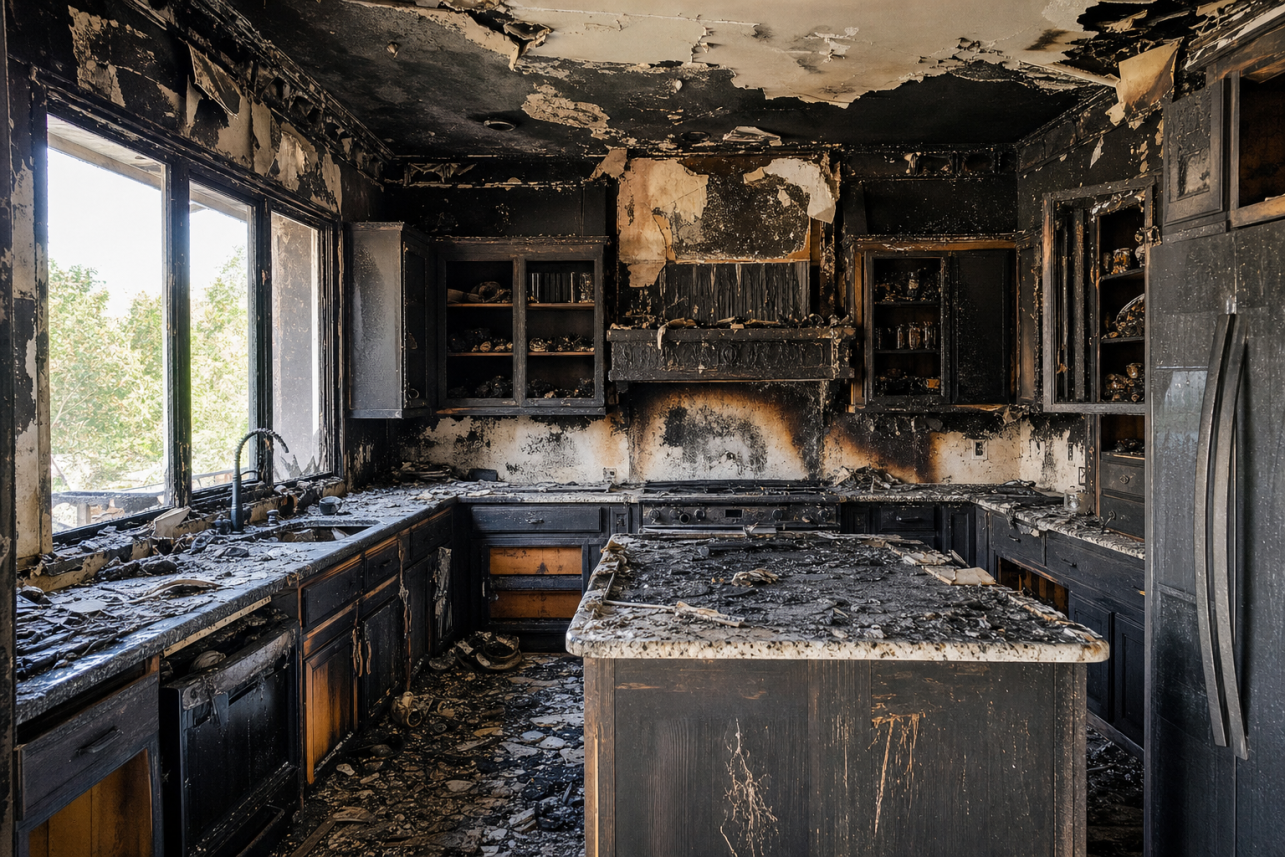
What Proof Do I Need To Gather For An Arson Homeowners Claim Clayton Insurers Are Scrutinizing?
Start with proof of where you were. For an Arson Homeowners Claim Clayton carriers have referred to their Special Investigations Unit, your timeline is everything. Preserve cell phone location history, toll and gas station receipts, work badge-in records, doorbell camera footage from neighbors, and the names of anyone who saw you around the time of the fire.
Next, gather financial records that undercut a motive theory. Mortgage statements showing you were current, recent bank statements, pay stubs, and evidence of any recent improvements to the home all contradict the ‘burned it for the money’ narrative. Homeowners who just installed a new HVAC system or renovated a kitchen rarely torch the house a month later, and adjusters know it.
Document the property itself. Pull together photos and videos of the home before the fire, receipts for major purchases, and a room-by-room contents inventory. In an arson investigation, an inflated or vague contents list becomes ammunition, so accuracy beats optimism every time.
Also preserve evidence pointing to other explanations: prior break-ins reported to the Clayton Police Department or Johnston County Sheriff’s Office, neighborhood vandalism, threats from anyone, or electrical problems you had reported to a contractor.
Finally, keep a log of every contact with the insurance company — dates, names, and what was said. Our team organizes all of this into a documented claim file that anticipates the carrier’s arson checklist and answers it point by point, which is usually what moves these files from ‘under investigation’ to paid.
What Does My Insurer Actually Have To Prove To Deny An Arson Homeowners Claim Clayton Policyholders File?
In North Carolina, the burden sits squarely on the insurance company. To lawfully deny an Arson Homeowners Claim Clayton homeowners submit, the carrier must prove three things: the fire was intentionally set, the insured had a motive, and the insured had the opportunity to set it or arrange it. Suspicion alone doesn’t cut it.
That’s a much higher bar than most Johnston County policyholders realize. A fire marshal’s ‘incendiary’ finding only addresses the first element — how the fire started. It says nothing about who set it. Carriers frequently lean on financial-motive theories, pointing to a late mortgage payment or credit card debt, but courts have repeatedly held that money troubles alone don’t establish arson by the insured.
Opportunity is where alibis, cell phone records, work schedules, and witness statements matter. If you were at a Friday night game at Clayton High or having dinner on Main Street when the fire started, documented proof of that timeline undercuts the carrier’s theory fast.
Our job as your public adjuster is to hold the insurer to its burden at every step. We demand the carrier’s cause-and-origin reports, challenge speculative motive claims with actual financial documentation, and build a timeline that answers the opportunity question before it’s ever raised. When the insurer can’t carry all three elements, the claim must be paid — and we make sure they know we know that.
Will Criminal Charges — Or Being Cleared By The Fire Marshal — Change The Outcome Of My Fire Claim In Clayton?
They’re related but separate tracks, and that surprises a lot of homeowners. The Johnston County fire marshal and law enforcement decide whether a crime occurred and who to charge. Your insurance company runs its own civil investigation, and it can deny a claim even when no criminal charges are ever filed, because the civil standard of proof is lower.
That said, the criminal outcome absolutely matters as evidence. If investigators close the case with no charges, or you’re formally cleared, that fact weakens the carrier’s arson defense significantly, and we put it front and center in our demand. If someone else is charged — a vandal, an ex, a neighbor — that typically confirms coverage, since arson by a third party is a covered peril under standard homeowners policies.
If charges are pending against you, things get delicate. Anything you say in the insurance claim, including an Examination Under Oath, can surface in the criminal case. In that situation we coordinate with your defense attorney on timing and strategy so the claim moves forward without compromising your rights.
The key takeaway for Clayton policyholders: don’t assume being cleared automatically triggers payment, and don’t assume an open investigation means automatic denial. The claim has to be worked either way — documented, valued, and pressed. That’s exactly what we do while the criminal side runs its course.
My Family Is Displaced — Can I Get Additional Living Expenses Paid While The Arson Investigation Drags On?
Yes, and this is one of the most under-used pressure points in a suspicious-fire claim. Your homeowners policy includes Additional Living Expenses (ALE) coverage — sometimes called Loss of Use — that pays for a rental, hotel, extra mileage, and increased food costs while your home is uninhabitable. An open investigation is not a legal reason to freeze that coverage.
Carriers investigating a possible arson defense often slow-walk ALE, hoping financial pressure forces a cheap settlement. We push back immediately by submitting a documented ALE demand: rental comps for the Clayton and greater Johnston County market, receipts, and a monthly budget the carrier has to respond to in writing. Under North Carolina’s claims-handling standards, the insurer must either pay, deny with a stated reason, or explain the delay — silence isn’t an option once we put it on the record.
Practical tips while you’re displaced: keep every receipt, even small ones. Rent something comparable to your home, not a downgrade, because ALE is meant to maintain your normal standard of living. If you’re staying with relatives in the area, you may still be able to claim fair rental value and increased costs — ask us before assuming you can’t.
For The Public Adjusters, Inc. treats ALE as a claim within the claim. Getting your family stable housing quickly also removes the leverage the carrier is counting on, which strengthens your hand on the larger structure and contents settlement.
My File Was Transferred To The Insurer’s Special Investigations Unit — Is That Different From A Regular Arson Homeowners Claim Clayton Adjusters Handle?
Yes, and the difference matters. A routine fire loss is handled by a field adjuster whose job is estimating damage. When a file moves to the Special Investigations Unit, the carrier has assigned people whose entire role is finding reasons not to pay — former law enforcement, fraud examiners, and cause-and-origin experts working for the insurance company.
An SIU referral doesn’t mean you did anything wrong. Fires with certain characteristics get flagged automatically: multiple points of origin, accelerant indicators, a recent policy increase, a vacant home, or financial red flags in your file. It’s a screening system, and innocent Johnston County homeowners get caught in it regularly.
What changes for you is the tone and the stakes. SIU investigators conduct detailed interviews, request years of bank statements and tax returns, and often schedule an Examination Under Oath. Every answer is compared against every other document you’ve provided, looking for inconsistencies they can characterize as misrepresentation — which is itself a ground for denial under your policy’s concealment-or-fraud clause.
This is exactly where an Arson Homeowners Claim Clayton residents are pursuing benefits from professional representation. We manage document production so you comply fully without over-producing, prepare you for every interview, attend proceedings alongside you, and keep the damage valuation moving so the investigation doesn’t become an excuse to ignore the actual loss. SIU plays a specialized game; you should have a specialist on your side of the table too.
Should I Hire My Own Cause-And-Origin Expert For An Arson Homeowners Claim Clayton Insurers Are Investigating?
In many cases, yes — and sooner than most homeowners realize. When a Clayton house fire gets labeled suspicious, the insurer immediately retains its own cause-and-origin investigator. That expert works for the carrier, and their findings often lean toward conclusions that support denying or limiting your claim.
An independent cause-and-origin expert reviews the same physical evidence — burn patterns, electrical systems, appliance failures, accelerant testing — but answers to you. We’ve seen fires initially called ‘incendiary’ reclassified as electrical or accidental once a qualified independent investigator examined the scene under NFPA 921 standards, which is the recognized guide for fire investigation.
Timing matters enormously. Fire scenes in Johnston County get released, cleaned, or demolished quickly, and once evidence is gone, it’s gone. If your insurer’s investigator has already examined the property, you have the right to have your own expert do the same before anything is disturbed. Send the carrier a written request to preserve the scene.
As the public adjusting firm handling your file, we coordinate this directly — identifying credentialed fire investigators, scheduling joint scene examinations, and making sure spoliation of evidence doesn’t happen. The cost of an independent expert is often modest compared to what’s at stake on a total-loss home. When the carrier knows a qualified expert is challenging its theory, the negotiating dynamic changes fast, and settlements that seemed impossible suddenly get discussed seriously.
How Does My Mortgage Company Get Involved When My Clayton House Fire Is Under Arson Investigation?
Your mortgage lender is almost certainly named on your homeowners policy as a loss payee, which gives it real rights in your claim — and those rights don’t disappear because the fire is being investigated.
Here’s what surprises many Clayton homeowners: under the standard mortgage clause in most policies, the lender can often collect insurance proceeds even if the carrier denies the homeowner’s claim for arson. The lender’s interest is treated separately. So while the investigation drags on, your mortgage company may be pushing the insurer for payment on the loan balance while you’re still fighting for your share.
Meanwhile, your mortgage payments don’t stop. You still owe them every month even if the house is uninhabitable, and missing payments during an investigation can add foreclosure risk on top of everything else. Contact your servicer early, explain the situation in writing, and ask about forbearance options.
When settlement checks do arrive, they’re typically made out jointly to you and the lender. The mortgage company then holds funds in escrow and releases them in draws as repairs are completed — a process with its own inspections and paperwork.
We manage this three-way relationship for policyholders throughout Johnston County: keeping the lender informed so it doesn’t force-place insurance or escalate, structuring the settlement so rebuild funds flow properly, and making sure the carrier doesn’t use lender complications as another excuse to stall your recovery.
What Does It Cost To Hire A Public Adjuster For A Suspicious Fire Claim In Johnston County?
Public adjusters in North Carolina work on contingency — a percentage of what the insurance company actually pays on your claim. There’s no upfront fee, no hourly billing, and if the claim pays nothing, you owe nothing for the adjusting work. North Carolina law caps public adjuster fees and requires the fee agreement to be in writing before work begins, so you’ll know the exact percentage from day one.
For a fire claim under investigation, that structure matters. These claims can run months, involve multiple recorded statements, document demands, and expert disputes — and you’d never be able to predict hourly costs in advance. Contingency aligns our interest with yours: we only do well if you get paid properly.
What does that fee buy on a claim like this? A complete independent damage estimate for the structure, a line-by-line contents inventory, documented additional living expenses, coordination with cause-and-origin experts, preparation for any Examination Under Oath, and direct negotiation with the carrier’s Special Investigations Unit so you’re not facing trained investigators alone.
Industry studies and our own Clayton-area files consistently show that professionally represented fire claims settle for substantially more than what carriers first offer — often enough that the net recovery after our fee exceeds what the homeowner would have received on their own. Separate costs, like an independent fire investigator or an attorney if litigation becomes necessary, are discussed with you before anyone is retained. Nothing happens without your approval.
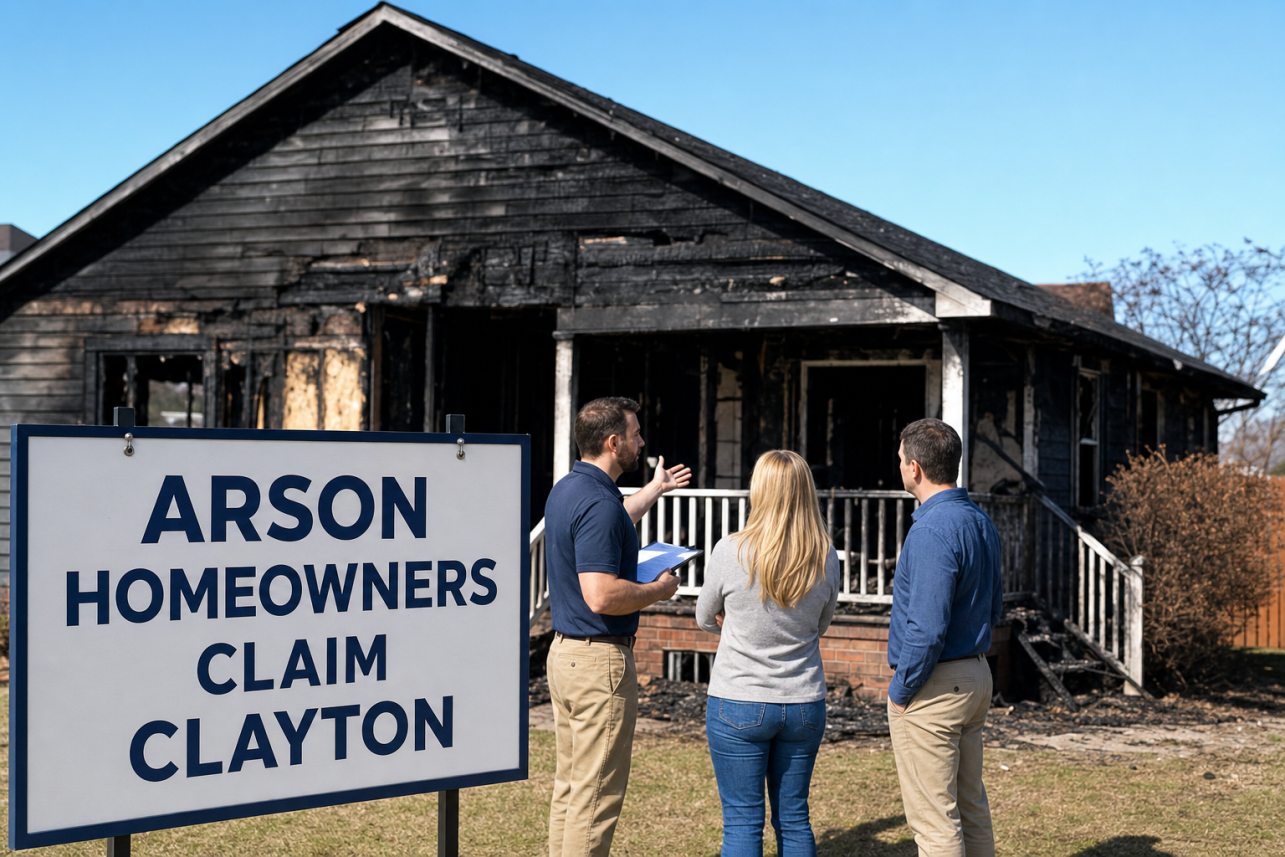
How Do I Document My Personal Property When The Insurer Suspects The Fire Was Set Intentionally?
Contents documentation gets far more scrutiny in an Arson Homeowners Claim Clayton carriers are investigating than in an ordinary fire loss. Investigators specifically look for signs that valuables were removed before the fire or that the inventory is inflated — both are treated as red flags. That means your inventory needs to be accurate, consistent, and backed by proof wherever possible.
Start room by room. List every item with its age, brand, where you bought it, and replacement cost. Don’t guess high — an exaggerated inventory can be used against you as evidence of misrepresentation, which is grounds for denying the entire claim in North Carolina, not just the padded items.
Then gather corroboration: receipts, credit card statements, bank records, photos and videos from before the fire (check your phone, cloud backups, and social media), owner’s manuals, warranty registrations, and even Amazon or store purchase histories. For high-value items like jewelry, firearms, or electronics, appraisals and serial numbers carry real weight.
Don’t throw anything away, even badly burned items. Damaged remains prove the property existed and was in the home — exactly what an investigation questions. Photograph debris before any cleanup.
Our team builds these inventories professionally, cross-referencing every line against available documentation so the submission holds up under Special Investigations Unit review. A clean, verifiable contents claim doesn’t just get you paid for your belongings — it strengthens your credibility on the entire loss, which is worth a great deal when the carrier is looking for reasons to doubt you.
Local Relevance
Clayton has grown fast, but that growth cuts both ways for fire claims. The town still has plenty of older homes near its historic core with aging wiring and framing that burns differently than new construction — and when investigators see fast, hot fire spread, older houses are sometimes wrongly flagged as suspicious. At the same time, rapid turnover means more vacant homes between owners and tenants, and vacant-property fires draw automatic arson scrutiny from carriers.
Johnston County homeowners also deal with insurers headquartered far away who have never seen the property. We inspect in person, whether the loss is in Clayton itself or nearby communities where we serve as a public adjuster near Archer Lodge NC. Across the region — including arson insurance claim work in Pittsboro — we see the same pattern: local documentation beats a distant desk adjuster’s assumptions.
Because so many Clayton properties change hands during the area’s rapid growth, houses often sit briefly vacant between closings — and carriers treat any fire in a vacant or recently purchased home with heightened arson suspicion, which makes early, thorough documentation of the sale timeline and your whereabouts especially valuable here.
Under Investigation For A Fire You Didn’t Set? Talk To Us First.
For The Public Adjusters, Inc. is licensed and bonded, and we work only for policyholders — never for insurance companies. Before you sit for a recorded statement or sign anything the carrier sends, get a free review of your claim from a Johnston County team that has been on the other side of these investigations. There is no obligation, and the conversation is confidential.
Call us: (919) 400-6440
Helpful Resources
- NCDOI Public Adjusters Guide
- National Fire Protection Association (NFPA)
- U.S. Fire Administration — Federal fire safety and arson education resource
- North Carolina Department of Insurance — State regulator with consumer claim resources
Last updated: September 2, 2026