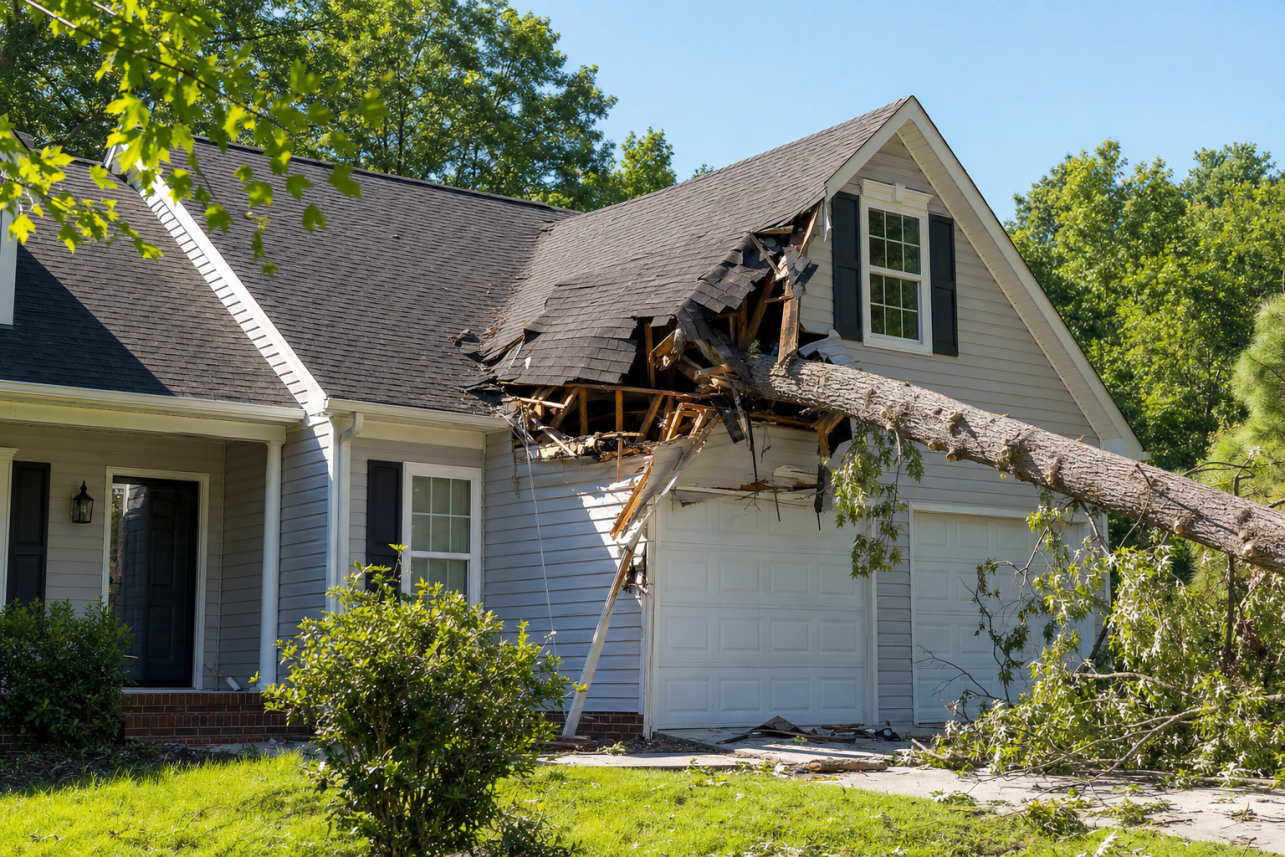
If you typed Public Adjuster Near Me Garner after a fire, burst pipe, or storm, the short answer is that a licensed public adjuster works for you — not the insurance company — to document your loss, value it correctly, and negotiate the settlement. For The Public Adjusters, Inc. is licensed and bonded and represents homeowners and business owners throughout Garner and Wake County. We handle the claim from first inspection to final payment so you aren't relying on the carrier's adjuster to tell you what your own damage is worth.
What This Service Is
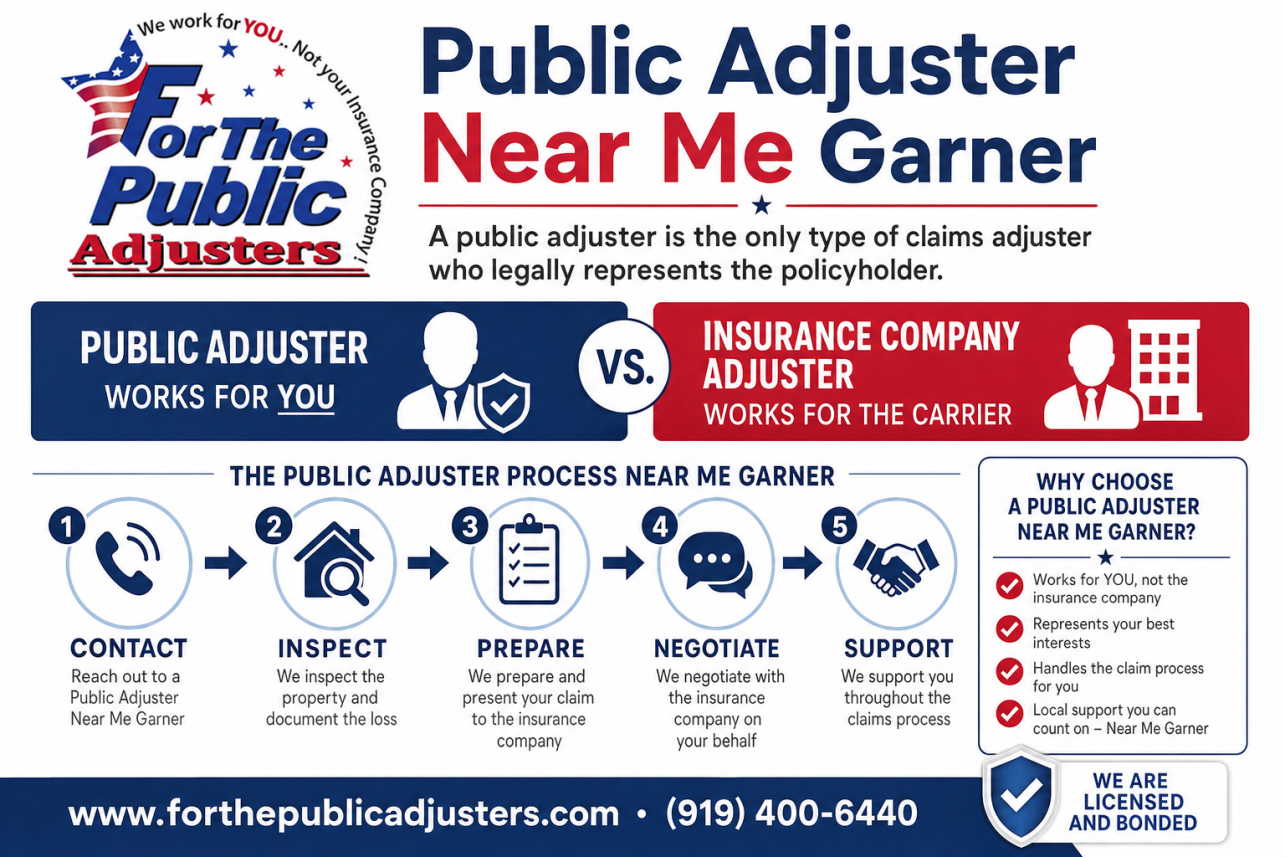
A public adjuster is the only type of claims adjuster who legally represents the policyholder. The adjuster your insurance company sends works for the carrier; an independent adjuster is hired by the carrier. We sit on your side of the table.
In North Carolina, public adjusters are licensed and regulated, and the NCDOI Public Adjusters Guide explains what we can and cannot do — including the rule that we are paid a percentage of the recovery, not an hourly fee. If your claim doesn't pay, we don't get paid.
For a typical Garner loss, that means we read your full policy, photograph and inventory the damage, write our own line-item estimate, and negotiate directly with the carrier's representatives. We handle fire, smoke, water, tree strikes, vandalism, arson defense for innocent homeowners, flood claims, and commercial losses. You can see the full range of what our Public Adjuster Garner office handles for both homes and businesses.
We never guarantee a specific dollar outcome — no honest adjuster can. What we can promise is that your claim will be measured, documented, and argued the same way the carrier builds its side of the file.
Common Problems
What Does A Public Adjuster Cost, And Is It Worth It On A Garner Claim?
Public adjusters in North Carolina work on contingency — a capped percentage of what the claim actually pays. There is no retainer and no hourly billing, so the question is really whether professional documentation changes the number.
On most significant losses, it does, because carrier estimates routinely miss scope: smoke residue inside wall cavities, moisture that migrated under flooring, code-required upgrades, and contents that were tossed before anyone inventoried them. Those line items are where underpayment hides.
The math only favors you on a real loss, though. If your damage is a few hundred dollars above your deductible, we'll tell you so honestly rather than sign you up.
The Carrier Underpaid Or Denied My Claim — Do I Have To Accept It?
No. A first offer is a starting position, not a verdict, and a denial letter is an opinion you are allowed to challenge with better evidence. Policyholders win these disputes when the documentation is stronger than the carrier's file.
Courts have backed homeowners in exactly these fights. In Sebo v. American Home Assurance Co., the Florida Supreme Court sided with a homeowner whose house suffered combined water and storm damage, rejecting the insurer's attempt to deny the loss because multiple causes contributed to it. The lesson travels: how a loss is framed and documented decides what gets paid.
We reopen and supplement underpaid claims regularly, and the same approach works on smaller town losses too — the way our Smoke Damage Claim Help in Rolesville cases often uncover contamination the first estimate never tested for.
How Do I Choose Well When I Search Public Adjuster Near Me Garner?
Verify the license first — North Carolina requires public adjusters to be licensed, and you can confirm any license through the state insurance department. Ask whether the firm is bonded. We are both.
Then ask who will actually inspect your property. Some outfits sell leads or subcontract the work; you want the person negotiating your claim to have stood in your damaged kitchen. Ask how they document a loss: a firm that can't describe moisture mapping, contents inventories, or line-item estimating is guessing.
Finally, be wary of anyone who promises a specific settlement amount. That's a sales pitch, not adjusting. A legitimate adjuster promises process and evidence, and lets the documented loss drive the number.
Our Process
Free Inspection And Policy Review
We walk the property, photograph everything, and read your actual policy — endorsements, exclusions, and deductibles — before anything is filed or supplemented. Many Garner homeowners have never seen their full policy, only the declarations page. Coverage you didn't know you had is often where recovery starts.
Independent Damage Documentation
We build our own estimate rather than marking up the carrier's. That means moisture readings behind walls, smoke and soot testing beyond the visible burn area, structural review after a tree strike, and a room-by-room contents inventory. The same rigor applies whether it's a kitchen fire here or the Fire Insurance Claim Help Siler City losses we work across the region.
Negotiation Through Final Payment
We present the documented claim to the carrier, attend the re-inspection, answer every pushback in writing, and negotiate until the file reflects the real loss. If the dispute hardens, we prepare the claim for appraisal or coordinate with insurance dispute attorneys. You make the decisions; we do the fighting.
| Claim Task | Handling It Yourself | With For The Public Adjusters, Inc. |
|---|---|---|
| Damage documentation | Phone photos and a handwritten list, often missing hidden damage | Moisture mapping, soot testing, full photo logs, and room-by-room scoping |
| Policy interpretation | Relying on the carrier adjuster's reading of your own policy | Independent, line-by-line review of coverages, endorsements, and exclusions |
| Contents inventory | Estimated from memory after the loss | Itemized inventory with replacement pricing and supporting records |
| Negotiation | One homeowner vs. an experienced claims department | A licensed, bonded Garner public adjuster negotiating on documented facts |
| Depreciation and code upgrades | Frequently accepted as presented, leaving money unclaimed | Reviewed and challenged when the policy supports recovery |
| Your time | Weeks of calls, paperwork, and re-inspections | We manage the process so you can focus on your family or business |
Commonly Overlooked In The Public Adjusting Industry
- Soot and smoke residue in HVAC ductwork — It's invisible behind the registers, so carrier estimates often stop at repainting walls while contaminated ducts keep recirculating odor and corrosive particles.
- Ordinance and law (code upgrade) coverage — Many policyholders don't know their policy may pay for required code upgrades during rebuild, and carriers rarely volunteer it.
- Recoverable depreciation — Homeowners frequently treat the actual-cash-value check as the final payment and never file for the depreciation holdback they're entitled to recover after repairs.
- Moisture trapped under subfloors and inside wall cavities — Surface readings look dry within days, so quick inspections miss saturation that later causes mold and structural problems.
- Additional living expenses and loss of use — Displaced families focus on the house and forget hotels, meals, mileage, and pet boarding are often reimbursable under the policy.
- Contents in attics, crawl spaces, garages, and storage — Inventories built from memory concentrate on living areas, leaving thousands of dollars of stored belongings unclaimed.
- NFIP proof-of-loss deadlines on flood claims — Flood claims run under federal NFIP rules with strict filing windows, and missing them can forfeit recovery even when the damage is obvious — FEMA's site outlines the requirements.
- Matching requirements for roofing and siding — Carriers may pay to patch one slope or wall, overlooking policy and repair standards that can support replacing materials so the property matches.
Case Studies
Case Study #1
Situation: A family off Timber Drive in Garner suffered a kitchen fire that spread smoke and soot through most of their two-story home. The fire department knocked it down quickly, but the damage went far beyond the kitchen.
Problem: The insurance carrier's adjuster scoped the claim as a 'kitchen-only' loss and offered a settlement that covered cabinet replacement and repainting two rooms. It ignored smoke infiltration in the HVAC ductwork, soot residue in the attic insulation, and hundreds of contents items with smoke odor.
Investigation: Our team performed a room-by-room inspection, pulled HVAC registers to document soot in the duct runs, took surface wipe samples showing chloride residue on walls two rooms away from the kitchen, and built a full contents inventory with photographs and replacement pricing.
Findings: Smoke and corrosive soot residue had migrated through the return-air system into every conditioned room. The attic insulation held odor that no amount of cleaning would remove. The carrier's estimate had missed roughly two-thirds of the actual loss, including code-required electrical work in the rebuilt kitchen.
Solution: We prepared a detailed line-item estimate, a documented contents inventory, and supporting photos and test results, then negotiated directly with the carrier's adjuster through two re-inspections.
Outcome: The carrier revised its position substantially, agreeing to duct cleaning and sealing, full insulation replacement, whole-home smoke remediation, and payment on the documented contents list. The family also recovered additional living expenses for the weeks they couldn't occupy the home.
Lesson: Fire damage rarely stops where the flames stopped. North Carolina courts have long sided with policyholders when carriers read coverage too narrowly — in Gaston County Dyeing Machine Co. v. Northfield Insurance Co., 351 N.C. 293 (2000), the North Carolina Supreme Court ruled for the insured on a disputed property-damage coverage question, a reminder that a carrier's first interpretation of your policy is not the final word.
Case Study #2
Situation: A small commercial property owner near White Oak in Garner had significant roof and interior water damage after a hurricane's remnants pushed through Wake County. Water entered through storm-created openings and soaked ceilings, drywall, and inventory on the sales floor.
Problem: The carrier accepted the roof opening but attributed much of the interior damage to 'pre-existing wear' and depreciated the roof heavily. The initial offer wouldn't have covered the roof replacement, let alone the interior build-back or the ruined stock.
Investigation: We documented the storm date against National Weather Service records, photographed the hurricane-created openings, moisture-mapped the interior to show the water path from those openings, and inventoried the damaged merchandise with purchase records.
Findings: The moisture pattern tracked directly from the storm damage, not from any prior condition. The depreciation applied to the roof was inconsistent with the policy's replacement-cost provisions, and the contents loss had been almost entirely unaddressed in the first estimate.
Solution: We submitted a revised, fully supported claim package, requested re-inspection with the carrier's adjuster on site, and walked the loss line by line, tying each interior item to the documented hurricane openings.
Outcome: The carrier reversed its wear-and-tear position on the interior, corrected the depreciation treatment on the roof, and paid on the documented contents inventory — a settlement several times the original offer.
Lesson: Causation disputes decide hurricane claims. If the policyholder can't prove the water path, the carrier's 'pre-existing damage' theory usually wins by default. Thorough documentation, gathered early, changes that outcome.
| Type of Loss | Why Claims Get Underpaid | What a Garner Public Adjuster Does | When to Call |
|---|---|---|---|
| House or building fire | Smoke, soot, and odor damage beyond the burn room is routinely left out of carrier estimates | Tests residue spread, scopes every affected room, inventories contents | Before you accept any scope or sign off on repairs |
| Hurricane damage | Carriers often split storm damage from 'wear and tear' and depreciate roofs aggressively | Ties interior damage to storm-created openings with weather records and moisture mapping | As soon as it's safe to document the property |
| Tornado damage | Structural racking and hidden framing damage get missed in fast drive-by inspections | Documents structural movement and pushes for proper engineering review | Immediately — evidence disappears once cleanup starts |
| Burst pipe / water damage | Estimates stop at visible drywall and skip subfloors, insulation, and mold prevention | Moisture-maps the full water path and scopes hidden saturation | Within days, before materials dry and evidence fades |
| Smoke damage from a nearby fire | Carriers may deny because flames never touched the home | Documents soot and corrosive residue with testing, not guesswork | When any odor or residue is present after a neighboring fire |
| Flood damage | Flood is handled under separate NFIP policies with their own rules and deadlines | Helps document the loss; FEMA (fema.gov) and FloodSmart (floodsmart.gov) explain NFIP coverage | Promptly — NFIP proof-of-loss deadlines are strict |
| Theft or vandalism of contents | Homeowners undervalue contents and lack receipts, so payouts shrink | Builds a priced, documented inventory the carrier must respond to | Before submitting any contents list to the carrier |
Reviews
After our house fire on Vandora Springs Road, the insurance company's offer didn't come close to covering the smoke damage upstairs. For The Public Adjusters inventoried everything, found soot in places we never would have checked, and handled every call with the carrier. The final settlement let us actually rebuild instead of patching things.
Melissa T., Garner
Hurricane remnants tore part of our roof open and the carrier tried to blame the ceiling damage on 'old leaks.' These folks moisture-mapped the whole house and proved where the water came from. They were straight with us from day one — no promises, just hard work and documentation. The difference in the payout was significant.
Darnell W., Garner
A burst supply line flooded our finished basement in Garner. We were overwhelmed until a neighbor recommended this team. They caught that the carrier's estimate skipped the subfloor and all our stored contents. Professional, licensed, and they explained the policy in plain English. Worth every penny of the fee.
Priya S., Wake County
Frequently Asked Questions
What Does A Public Adjuster Near Me Garner Search Actually Get Me, And How Is It Different From The Insurance Company's Adjuster?
When you search Public Adjuster Near Me Garner, you're looking for a licensed professional who works exclusively for you, the policyholder — not for the insurance company. The adjuster your insurer sends is employed or contracted by the carrier, and their job is to evaluate the claim from the company's perspective. A public adjuster flips that dynamic.
At For The Public Adjusters, Inc., we are licensed and bonded, and we represent Garner homeowners and business owners through every stage of a property claim. That means documenting the full scope of damage to your home, building, and contents, preparing a detailed estimate, reviewing your policy language, and negotiating directly with the carrier's adjuster on your behalf.
The difference matters because policy language is dense and damage is easy to undervalue. Courts have repeatedly sided with policyholders who pushed back. In Sproull v. State Farm Fire & Casualty Co. (Illinois Supreme Court, 2021), the insured challenged the carrier's practice of depreciating labor costs when paying actual cash value on a home damage claim — and won, with the court ruling that labor does not depreciate. Cases like that show why having someone who understands these issues on your side can change the outcome.
We never guarantee a specific result, because no honest adjuster can. What we do promise is a thorough, professional presentation of your claim from Garner to anywhere in Wake County.
What Types Of Property Claims Does Your Garner Team Handle — And What Won't You Take On?
Our Garner public adjusters handle damage to homes, commercial buildings, and the contents inside them. Common claims in Wake County include fire and smoke damage, water damage from burst pipes or appliance failures, roof and structural damage from hurricanes and tornadoes, hail damage, and theft or vandalism losses.
Hurricane claims deserve special mention here. Garner sits far enough inland that homeowners sometimes assume tropical systems won't reach them, but storms like Fran and Matthew proved otherwise, leaving significant roof, tree, and water intrusion damage across the Triangle. Tornado activity in central North Carolina is also a real and recurring risk, and those claims often involve complicated disputes over structural scope.
Just as important is what we don't handle. We do not work on claims involving motor vehicles, cell phones or other mobile devices, health insurance, or life insurance. Our focus is strictly real property and contents — houses, commercial structures, and the belongings and business property within them.
For flood damage, coverage typically comes through the National Flood Insurance Program rather than a standard homeowners policy. If flooding is part of your loss, we recommend reviewing resources at FEMA (fema.gov) and the NFIP (floodsmart.gov) to understand how those claims work. Our team can help you sort out which damage falls under which policy, which is often one of the most confusing parts of a storm-related loss.
My Insurance Company Already Made An Offer On My Garner Home Claim. Is It Too Late To Bring In A Public Adjuster?
In most cases, no — it is not too late. Many of our Garner clients call us after receiving an initial offer that felt low, after a partial denial, or after weeks of unreturned phone calls from the carrier. As long as your claim hasn't been fully settled and released, there is usually room to reopen the conversation, and even some settled claims can be supplemented if new damage is discovered within the policy's time limits.
Low initial offers are common because carrier estimates frequently miss hidden damage: moisture trapped behind drywall after a pipe break, smoke residue in HVAC systems after a kitchen fire, or structural issues beneath hurricane-damaged roofing. A second, independent evaluation often identifies scope the first inspection skipped.
Policyholders who challenge inadequate payments have a real track record of success. In Lammert v. Auto-Owners (Mutual) Insurance Co. (Tennessee Supreme Court, 2019), homeowners disputed the insurer's deduction of labor depreciation from their hail-damaged property payout — and the court ruled in the insureds' favor, holding the policy language had to be read in the policyholders' favor.
We can't promise a specific dollar outcome, and we're careful never to. What we can do is review your policy, re-inspect your Garner property, document everything the first estimate missed, and present a complete, well-supported claim to your insurer. If you're unsure whether your offer is fair, a review costs you nothing but a phone call.
How Much Does It Cost To Hire A Public Adjuster Near Me Garner Homeowners Can Trust, And How Does Payment Work?
If you've been comparing options after searching Public Adjuster Near Me Garner, the fee question is probably top of mind — and the answer is simpler than most people expect. For The Public Adjusters, Inc. works on a contingency basis. Our fee is a percentage of the claim settlement, agreed to in writing before we begin. There are no upfront costs, no hourly billing, and no payment if there's no recovery.
This structure matters for Garner families dealing with a fire, water loss, or hurricane damage, because a major claim usually arrives at the worst possible financial moment. You shouldn't have to pay out of pocket to get professional help with the claim itself.
Contingency fees also align our interests with yours. We only do well when your claim is documented thoroughly and presented completely — every damaged room, every affected content item, every covered cost under your policy. That said, we never guarantee any particular settlement amount. Every policy, every loss, and every carrier is different, and anyone who promises you a specific number should raise a red flag.
North Carolina regulates public adjusters through the Department of Insurance, and we are fully licensed and bonded in the state. Before you sign anything with any adjuster, ask to see their license, their bond, and a written fee agreement. We provide all three to every Wake County client as a matter of standard practice, and we'll walk you through the contract line by line before you commit.
How Long Will My Garner Property Claim Take Once Your Team Gets Involved?
Every claim moves at its own pace, but most residential losses in Garner and the surrounding Wake County area resolve within 60 to 120 days once we take over. Simpler claims, like a contained kitchen fire with clear documentation, can settle faster. Large losses with structural damage, contents inventories, and additional living expense claims typically take longer.
North Carolina insurance regulations require carriers to acknowledge claims promptly and to act in good faith throughout the process. When an insurer drags its feet, courts have held them accountable. In Gray v. North Carolina Insurance Underwriting Association, 352 N.C. 61 (2000), the North Carolina Supreme Court upheld a verdict for homeowners whose hurricane-damaged house was badly underpaid — the jury awarded both compensatory and punitive damages after finding the insurer acted in bad faith. Cases like that are a reminder that policyholders have real leverage when their claim is handled fairly and documented thoroughly.
Our job as your Garner public adjuster is to remove the delays that come from incomplete paperwork, missed deadlines, and back-and-forth disputes over scope. We prepare the estimate, the contents inventory, and the supporting documentation the carrier needs before they ask for it.
We never promise a specific timeline or a specific dollar outcome — no honest adjuster can. What we can promise is that your claim will be presented completely, pursued persistently, and that you'll always know where things stand.
A Storm Hit Garner — Can You Handle Hurricane Or Tornado Damage To My Home?
Yes. Hurricane and tornado claims are among the most common losses we handle for Garner homeowners, and they're also among the most frequently underpaid. When a hurricane tracks through central North Carolina or a tornado touches down in Wake County, carriers are flooded with claims at once, and rushed inspections often miss damage.
Roof systems are the biggest problem area. A field adjuster may approve a small repair when the entire roof covering has been compromised. We also look closely at hidden water intrusion behind siding, damaged decking, interior ceiling and insulation damage, and debris impact to outbuildings and fences — items that routinely get left off initial estimates.
North Carolina homeowners have won significant verdicts when insurers lowballed storm claims. In Gray v. North Carolina Insurance Underwriting Association, the insureds' coastal home was damaged by Hurricane Fran, the carrier paid a fraction of the actual loss, and the courts ultimately upheld a judgment against the insurer that included punitive damages for bad faith. That decision remains one of the strongest policyholder-rights cases in this state.
As a licensed and bonded firm, we document hurricane and tornado losses room by room and shingle by shingle, then negotiate from evidence rather than estimates built in a hurry. We can't guarantee any particular settlement amount, but we can make sure nothing about your loss goes unseen or unargued.
I'm Searching Public Adjuster Near Me Garner Because My Home Flooded. Is Flood Damage Something You Handle?
A Public Adjuster Near Me Garner search is a smart starting point for flood losses, because flood claims follow different rules than standard homeowners claims — and we do handle them. Most flood coverage in Garner comes through the National Flood Insurance Program (NFIP), which is administered by FEMA, rather than through your regular homeowners policy.
NFIP claims have strict requirements that trip up many policyholders. You must submit a signed, sworn Proof of Loss within the deadline — typically 60 days from the date of loss, though FEMA sometimes extends it after major events. Miss it, and you can lose your right to payment entirely, no matter how legitimate the damage is.
We prepare that Proof of Loss, build the line-item estimate for structural damage, and document your contents losses with the detail NFIP reviewers expect. We also help you understand what flood policies exclude, like most basement contents and additional living expenses, so there are no surprises.
If you're not sure whether your loss qualifies as flood damage under federal definitions, FEMA's website (fema.gov) and the NFIP's consumer site (floodsmart.gov) are useful resources, and we're glad to walk you through it in plain language.
One honest caveat: we never guarantee a specific recovery on any claim, flood or otherwise. What we offer is experienced, licensed, bonded representation that makes sure your claim is complete, compliant, and pursued on time.

How Do I Verify That Your Firm Is Legitimate Before I Sign Anything?
You should verify any adjuster you're considering — and we encourage it. For The Public Adjusters, Inc. is licensed and bonded, and you can confirm our licensing directly through the North Carolina Department of Insurance. The Department maintains a public lookup tool where you can search any adjuster's name or license number and see their current status.
Beyond the license check, here's what we suggest for any Garner homeowner vetting a claims representative. First, ask for the license number up front; a legitimate professional offers it without hesitation. Second, read the contract carefully — the fee percentage, the scope of work, and your cancellation rights should all be spelled out in plain language. Third, be wary of anyone who shows up uninvited after a storm demanding you sign on the spot. Reputable firms give you time to decide.
It also helps to ask what kinds of claims the firm actually works. We handle property losses to homes, commercial buildings, and their contents — fire, smoke, water, hurricane, tornado, hail, theft, and flood. We do not take claims involving motor vehicles, cell phones, health insurance, or life insurance, and we'll tell you that honestly rather than take a case outside our expertise.
Finally, ask how the adjuster documents a loss. Our answer: a full inspection, a detailed line-item estimate, a complete contents inventory, and written communication with your carrier at every step. That paper trail protects you — and it's exactly what North Carolina courts have looked for when policyholders prevail against insurers who underpaid.
My Garner Fire Claim Feels Underpaid — What Can A Public Adjuster Do About Smoke And Contents Damage?
Fire losses are among the most commonly undervalued claims we see in Wake County, and the gap usually isn't the structure itself — it's smoke, soot, and contents. Insurance carriers often approve surface cleaning when smoke residue has actually penetrated HVAC systems, insulation, wall cavities, and personal property that can't be safely restored.
When you start a Public Adjuster Near Me Garner search after a fire, what you're really looking for is someone to rebuild the claim from the ground up. Our team documents every affected room, prepares a line-item structural estimate, and creates a full contents inventory with replacement values instead of the depreciated lump sums carriers tend to offer.
We also review your policy for coverages homeowners frequently miss — additional living expenses while you're displaced, debris removal, code upgrade coverage, and landscaping. Courts have repeatedly held that policy language must be read in the policyholder's favor when it's ambiguous. In Gaston County Dyeing Machine Co. v. Northfield Insurance Co., 351 N.C. 293 (2000), the North Carolina Supreme Court sided with the insured on a disputed property damage claim, construing the policy's ambiguous terms against the insurer that drafted them.
We can't promise a specific outcome — no honest adjuster can — but we can promise your fire loss will be measured completely and presented professionally. For The Public Adjusters, Inc. is licensed and bonded, and we work only for you, never the carrier.
What Should I Do In The First 48 Hours After Property Damage To My Garner Home, Before Your Team Arrives?
The first two days after a loss shape the entire claim, so a few simple steps protect you enormously. First, make the property safe and prevent further damage — your policy actually requires reasonable mitigation, so tarping an opening or shutting off a burst supply line matters.
Second, photograph and video everything before anything is moved, cleaned, or thrown away. Wide shots of each room, then close-ups of individual damage. If items must be discarded for health reasons, photograph them first and keep a written list.
Third, save every receipt. Hotel stays, meals above your normal spending, tarps, fans, emergency board-up — these may fall under additional living expenses or mitigation coverage, and receipts are how they get paid.
What we'd ask you not to do: don't give a recorded statement to the carrier before speaking with a professional, don't sign any assignment-of-benefits paperwork from a contractor under pressure, and don't accept a quick settlement check framed as 'final.' Once a Garner public adjuster from our office is involved, we handle carrier communication, inspections, and documentation for you.
If your loss involves flooding, note that flood coverage typically runs through the National Flood Insurance Program rather than your homeowners policy, and FEMA (fema.gov) and NFIP (floodsmart.gov) publish useful guidance on immediate post-flood steps. We can help you sort out which policy responds to which part of the damage.
Can A Public Adjuster Near Me Garner Search Actually Help If My Claim Was Flat-Out Denied?
Yes — a denial is a position the carrier has taken, not necessarily the final word. Many denials we review in Garner and across Wake County rest on thin inspections, misapplied exclusions, or causation arguments that fall apart under proper documentation.
Our first step is reading the denial letter against your actual policy language. Carriers sometimes cite exclusions that don't fit the facts, or treat a covered cause of loss as excluded because the two look similar on a quick walkthrough. A burst pipe behind a wall, hurricane-driven rain through a storm-damaged roof, or hidden smoke migration after a kitchen fire all get denied more often than they should.
From there, we build the evidence the original inspection skipped: detailed photos, moisture readings, expert reports where needed, and a complete estimate. We then present that package through the carrier's own reconsideration process, and where the policy allows, we can invoke appraisal to resolve disputes over the amount of loss.
Policyholders do prevail when they push back with proper support. In Gaston County Dyeing Machine Co. v. Northfield Insurance Co., the North Carolina Supreme Court ruled for the insured on a contested property damage claim, holding that ambiguities in the policy had to be resolved in the policyholder's favor.
We never guarantee a denial will be reversed — the facts and the policy control. But we can tell you honestly whether your denial looks weak, and if it does, we know how to challenge it. The review costs you nothing.
Do You Handle Water Damage From Burst Pipes Or Roof Leaks At Homes And Businesses In Garner?
Yes. Sudden water losses — burst supply lines, failed water heaters, overflowing appliances, and interior damage after a hurricane or tornado compromises a roof — are a large share of the claims our Garner clients bring us.
These claims get undervalued in predictable ways. Carriers often pay to dry visible surfaces while missing moisture trapped in wall cavities, subfloors, and insulation, which leads to mold and secondary damage months later. We use thorough documentation, including moisture mapping where appropriate, so the full extent of saturation is on record before repairs begin.
The cause of the water also matters enormously. Sudden pipe bursts are typically covered under a homeowners policy, while rising surface water is a flood loss handled under a separate NFIP policy. Getting that distinction right — and documented correctly — can be the difference between a paid claim and a dispute. If flooding is part of your loss, FEMA and the National Flood Insurance Program are worth reviewing, and we handle NFIP flood claims as well.
One clarification on scope: For The Public Adjusters, Inc. works exclusively on property claims — homes, commercial buildings, and the contents inside them. We don't handle claims involving motor vehicles, cell phones, health, or life insurance, so if your loss touches one of those areas, a different kind of professional handles that portion.
For the structure and contents, though, a public adjuster in Garner from our licensed and bonded team will document the loss completely and negotiate directly with your carrier on your behalf.
Does A Public Adjuster Near Me Garner Search Help Business Owners Too, Or Only Homeowners?
Business owners benefit just as much as homeowners, sometimes more. For The Public Adjusters, Inc. represents commercial policyholders throughout Garner and the rest of Wake County, including restaurants along the US-70 corridor, retail shops near White Oak Crossing, offices, churches, and warehouse or light-industrial properties.
Commercial claims are more complicated than residential ones. Beyond the building itself, you may have business personal property, tenant improvements, equipment, inventory, and business interruption coverage in play. Each of those has its own valuation rules, and insurers frequently undervalue lost income and extra expense claims because the documentation requirements are strict.
We prepare the building estimate, inventory the damaged stock and equipment, and work with your financial records to document the interruption loss properly. North Carolina courts have shown they will hold insurers to the plain language of their policies in commercial property disputes. In Gaston County Dyeing Machine Co. v. Northfield Insurance Co., 351 N.C. 293 (2000), the North Carolina Supreme Court ruled in favor of the insured on coverage for property damage, rejecting the insurer's narrow reading of its own policy.
That case is a good reminder that policy wording matters and that insurers do not get the final word. We are licensed and bonded, and we handle the claim so you can focus on keeping your Garner business running. We do not handle claims involving motor vehicles, cell phones, health, or life insurance — our work is strictly damage to buildings, homes, and their contents.
How Does The Contents Inventory Work, And Do I Really Have To List Every Damaged Item?
Yes, a detailed contents inventory is usually required, and it is one of the most underestimated parts of a property claim. After a fire, tornado, or major pipe burst in a Garner home, insurers typically ask for an itemized list with descriptions, quantities, ages, and replacement costs. Most policyholders undervalue their contents badly because they work from memory and forget entire categories — closets, garages, attics, pantries, and kids' rooms.
Our team handles this differently. We walk the property room by room, photograph everything, and build a line-item inventory using current replacement pricing. We also push back when insurers apply excessive depreciation to items like furniture, clothing, and electronics.
If your policy pays replacement cost, we track the recoverable depreciation so you can collect the full amount after items are replaced, not just the depreciated first payment. Many Wake County homeowners never collect that second check simply because no one explained the process.
Smoke-affected contents are a frequent fight. Insurers often propose cleaning items that are permanently damaged by soot or odor. We document which items are restorable and which must be replaced, and we support that position with testing and photos where needed.
We cannot promise a specific outcome on any claim, but a professionally built inventory almost always captures far more than a handwritten list made at the kitchen table. If you are in Garner and staring at a blank contents form, call us before you submit anything — once a sworn inventory is filed, it is harder to correct.
Will My Insurance Company Cancel My Policy Or Raise My Rates Because I Hired A Garner Public Adjuster?
This is one of the most common fears we hear from homeowners in Garner, and the short answer is that hiring your own representation is a legal right, not a red flag. North Carolina licenses public adjusters specifically so policyholders can have professional help on their side of a claim. Insurers deal with licensed adjusters like us every day.
Your premiums are driven by factors like the size of your loss, your claims history, your location in Wake County, and broader market trends — not by who prepared your claim paperwork. Filing the claim itself is what appears on your record, and that happens whether you handle it alone or with our help.
It is also worth remembering that courts take a dim view of insurers who retaliate or act in bad faith. In Sparks v. Union Underwear/Liberty Mutual-type bad-faith disputes and in property cases like Gaston County Dyeing Machine Co. v. Northfield Insurance Co., 351 N.C. 293 (2000), North Carolina's highest court sided with the insured and enforced the coverage the policyholder paid for. Insurers know they can be held accountable when they mishandle a claim.
For The Public Adjusters, Inc. is licensed and bonded, and we keep every interaction with your carrier professional and well documented. That paper trail protects you. We never guarantee a particular settlement amount — no honest adjuster can — but you should never avoid getting qualified help out of fear your insurer will punish you for it.

What Makes A Public Adjuster Near Me Garner Result Better Than Hiring A Big National Claims Firm?
When you search Public Adjuster Near Me Garner, you are really asking who knows this area, and that local knowledge matters more than most people realize. Our team works claims in Garner neighborhoods like Heather Hills, Adams Point, Forest Landing, and the older homes near downtown, and we know how construction styles and ages in these areas affect repair scopes and pricing.
A national call center cannot tell the difference between a 1970s ranch off Vandora Springs Road and new construction near Timber Drive, but that difference changes everything — plaster versus drywall, framing dimensions, roofing materials, and code-upgrade requirements under Wake County permitting. Local pricing matters too. Repair costs in the Triangle market are not the same as national averages, and estimates built on the wrong pricing database shortchange homeowners.
We also meet you in person. We inspect the damage ourselves rather than relying on photos uploaded to an app, and we attend the carrier's inspections so nothing gets minimized while you are not looking.
When disputes escalate, documentation built on-site carries weight. North Carolina courts have repeatedly enforced policyholder rights in property disputes — Gaston County Dyeing Machine Co. v. Northfield Insurance Co., 351 N.C. 293 (2000), is a leading example of the insured prevailing on a property coverage question before the state Supreme Court.
We are licensed and bonded, and we limit our practice to damage involving homes, buildings, and contents. We cannot promise any specific result, but we can promise a Garner-based advocate who actually shows up at your door.
Local Relevance
Garner's housing stock grew fast from the late 1990s through the mid-2000s, and those subdivisions are aging together. Builder-grade shingles and flashing from that era are now exactly old enough for carriers to stamp "wear and tear" on storm claims that are actually hail or tornado damage. Documenting the storm date and the hail reports is frequently the difference between a denial and a paid roof.
Eastern Wake also deals with water in ways the maps undersell. Creeks feeding the Neuse can push water into homes that sit outside the high-risk flood zones, and rapid development means more pavement and runoff than older floodplain maps accounted for. The Federal Emergency Management Agency (FEMA) is clear that standard homeowners policies exclude flood, and plenty of owners learn that distinction only after the water is in the house — the same hard lesson behind the Flood Insurance Claim Help Hillsborough work we do.
Because we're local, we also see how one street gets hammered while the next is untouched. We cover the surrounding towns too, from Garner south toward our Public Adjuster Smithfield NC territory, so we know what storms actually crossed this ground.
Hail and tornado paths through this part of Wake County tend to be narrow — the April 2011 outbreak proved one block can take totaled roofs while the next shows nothing — so when a carrier says "nobody else in your neighborhood filed," that argument carries far less weight than homeowners assume. Tying your damage to the documented storm track matters more than what the neighbors did.
Get A Second Opinion Before You Cash That Check
If your Garner fire, water, smoke, or storm claim came back lower than the damage in front of you — or came back denied — let a licensed, bonded adjuster who works only for policyholders review the file. The inspection and policy review cost nothing, and you'll know exactly where your claim stands before you sign anything.
Request Your Free Claim Review
Call us: (919) 400-6440
Helpful Resources
- NCDOI Public Adjusters Guide
- Federal Emergency Management Agency (FEMA)
- North Carolina Department of Insurance — State regulator where you can verify a public adjuster's license
- FloodSmart, the National Flood Insurance Program — Official federal resource on flood coverage homeowners policies exclude
Last updated: October 6, 2026