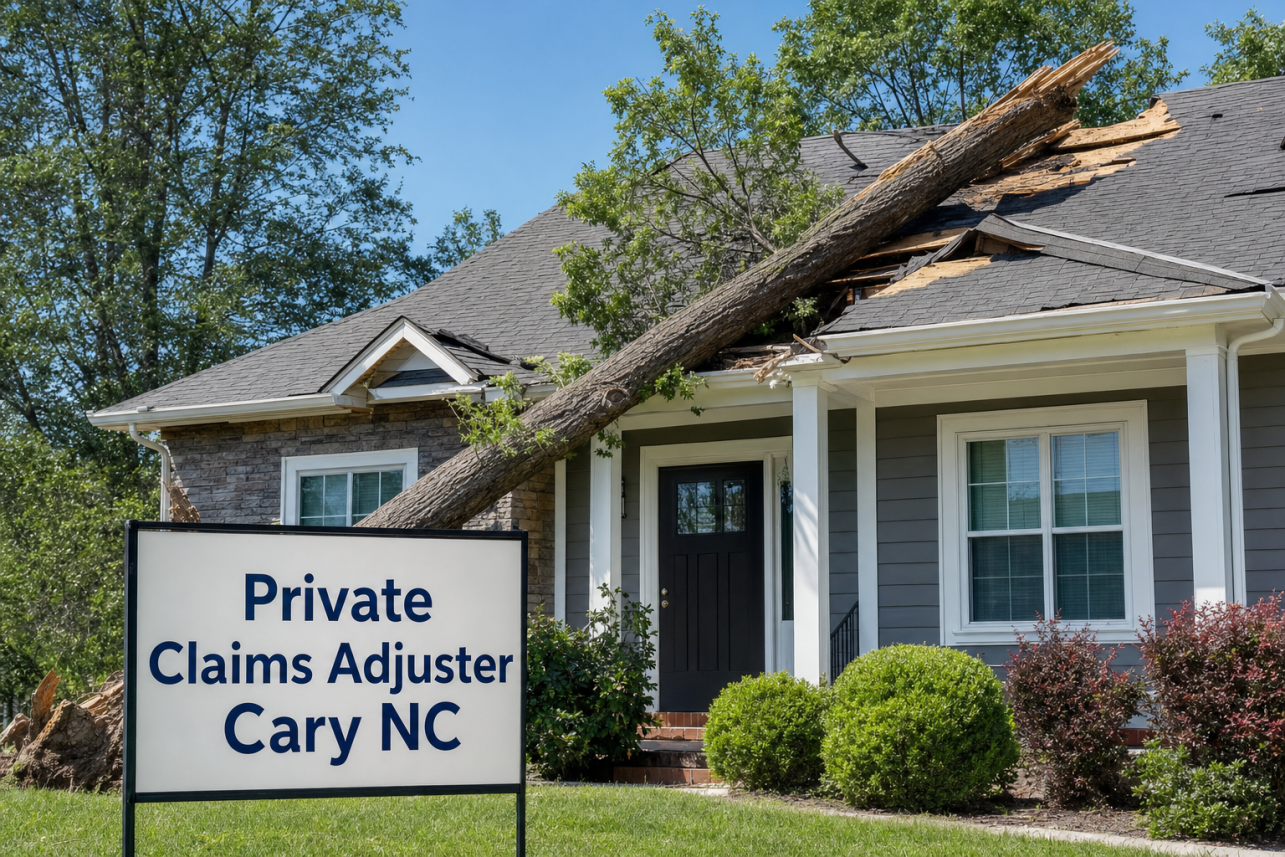
A Private Claims Adjuster Cary NC policyholders hire works for you — never for the insurance company — to document your property damage, prepare a detailed estimate, and negotiate your settlement. For The Public Adjusters, Inc. is licensed and bonded in North Carolina and handles fire, water, smoke, tree, and storm-related claims for Cary homeowners and business owners. If your claim has been delayed, denied, or paid for less than the repairs actually cost, an independent review of your file is the logical next step.
What This Service Is
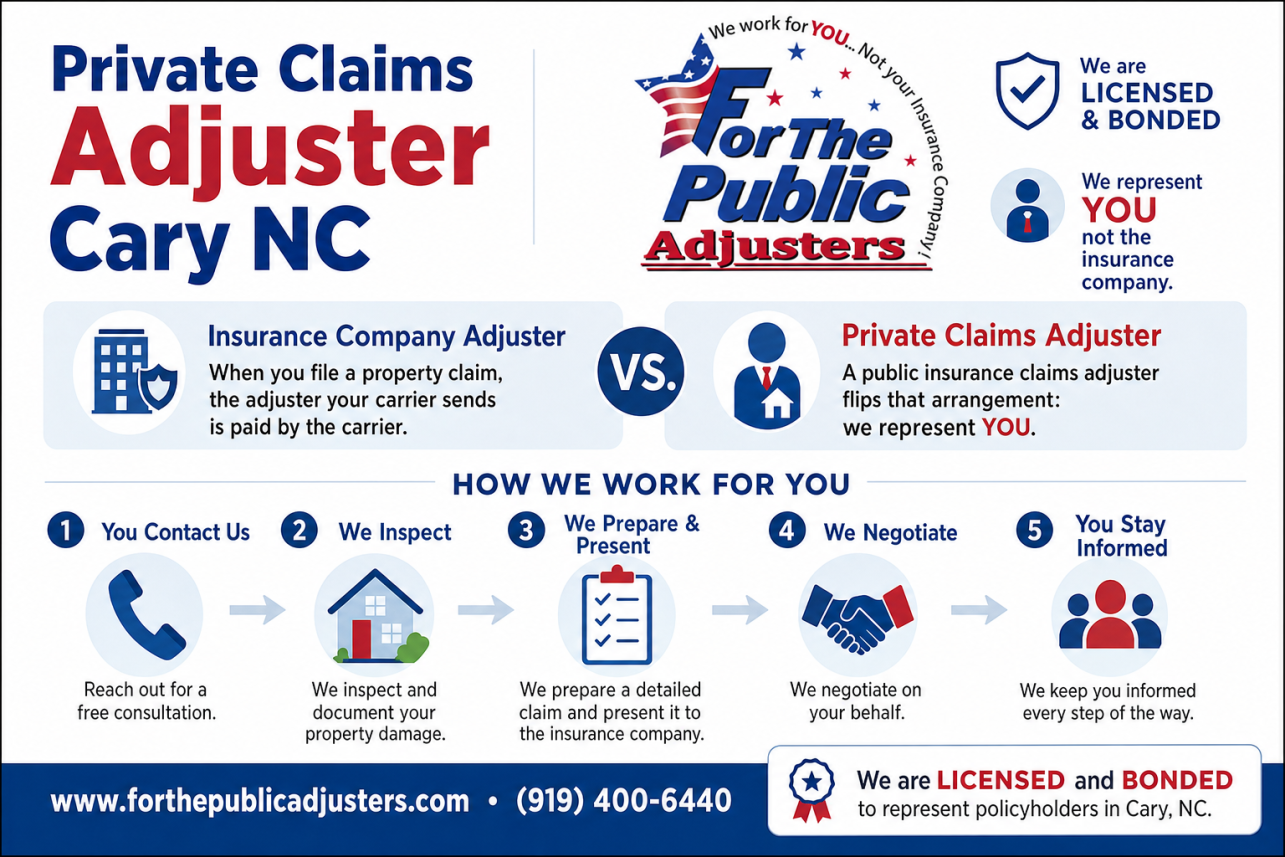
When you file a property claim, the adjuster your carrier sends is paid by the carrier. A public insurance claims adjuster flips that arrangement: we represent the policyholder, and only the policyholder, from the first inspection to the final check.
That means reading your full policy — including the endorsements and exclusions most people never see — then measuring, photographing, and pricing every element of the loss. Fire damage claims, water damage claims, smoke and soot contamination, tree strikes, vandalism, and even a car hitting your home all fall within what we handle for residential and commercial clients.
Courts have long recognized that policyholders can and do prevail when carriers fall short. In Bi-Economy Market, Inc. v. Harleysville Insurance Co. of New York, a family business destroyed by fire took its insurer to court over a badly underpaid building and business-interruption claim, and New York's highest court sided with the insured, allowing it to pursue consequential damages for the carrier's handling of the loss. You should not need a lawsuit to be treated fairly — thorough documentation and a professional estimate up front usually prevent one. Many of our Wake County clients first find us while searching for the Best Public Adjuster in Cary, usually after a first offer that doesn't come close to real repair costs.
Common Problems
What Does A Public Claims Adjuster Cost — And Is It Worth It On My Claim?
Public adjusters in North Carolina work on a contingency percentage of the settlement, so there is no upfront fee and no hourly billing. If the claim doesn't pay, we don't get paid.
The real question is what the carrier's estimate left out. Hidden water migration behind walls, smoke residue in HVAC systems, code-upgrade costs, matching for discontinued shingles or siding — these line items are routinely missing from first offers. The NCDOI Public Adjusters Guide explains how licensed public adjusters operate in this state, including the fee rules that protect consumers. We never guarantee a specific outcome, but we do guarantee that every covered item gets documented and claimed.
The Insurance Company Denied, Delayed, Or Lowballed My Claim. Now What?
A denial letter is a position, not a verdict. Most disputed claims come down to documentation: the carrier's adjuster spent forty minutes on site, and the file reflects that.
An independent insurance claims adjuster rebuilds the file properly — moisture readings, line-item estimates on the same pricing software carriers use, storm-date verification, and policy language that supports coverage. We've reopened supposedly closed files across the region, including Water Damage Insurance Claim Help in Bennett, where the original scope missed saturated subfloor entirely.
If a dispute hardens into bad faith, we work alongside insurance dispute lawyers. But in most cases, a professionally supported supplement moves the number without litigation.
How Do I Choose A Private Claims Adjuster Cary NC Homeowners Can Actually Trust?
Verify three things before signing anything: a current North Carolina public adjuster license, bonding, and a contract with the fee percentage stated plainly. Anyone who dodges those questions is not someone to hand your claim to.
Then ask about local experience. An adjuster who has worked Triangle claims knows how carriers in this market respond to roof age arguments, how to document hail and tornado swaths, and how Wake County building practices affect repair scopes. Our team handles claims throughout the Triangle — we also work as a Public Adjuster in Raleigh NC — so we see the same carrier tactics across hundreds of files, not one at a time.
Doing it yourself is legal, but you're negotiating against trained professionals using software and policy language you've never seen. Representation levels that field.
Our Process
Free Policy Review And Damage Inspection
We start by reading your actual policy — declarations, endorsements, exclusions — so we know exactly what coverage exists before anyone talks numbers. Then we inspect the property ourselves, from roof decking to crawlspace, photographing and measuring everything the loss touched.
Full Documentation And Independent Estimate
We build a line-item estimate using industry-standard pricing, document contents losses room by room, and pull supporting evidence such as storm reports and material-matching documentation. This file is what the negotiation stands on, so nothing gets skipped.
Negotiation Through Final Settlement
We present the claim to your carrier, attend every re-inspection, answer every pushback in writing, and file supplements when hidden damage surfaces during repairs. You approve any settlement before it's accepted — the decision is always yours.
| Factor | Handling It Yourself | With a Cary Private Adjuster |
|---|---|---|
| Who the adjuster works for | The carrier's adjuster is paid by the insurance company | A licensed, bonded adjuster who represents only you, the policyholder |
| Damage documentation | Phone photos and the carrier's quick inspection | Moisture readings, slope-by-slope roof inspections, soot testing, full photo logs |
| Contents inventory | A stressful DIY spreadsheet, often incomplete | Item-by-item inventory with pricing support and correct depreciation |
| Policy knowledge | Reading dense policy language for the first time | Daily experience with matching, ordinance-or-law, ALE, and recoverable depreciation provisions |
| Negotiation | Taking the first offer or arguing without evidence | Line-item rebuttals, re-inspections, and documented supplements |
| Your time | Dozens of hours of calls, paperwork, and deadlines | Your adjuster manages the claim while you manage your life |
Commonly Overlooked In The Public Adjusting Industry
- Matching for discontinued shingles and siding — Carriers often pay to patch one slope or wall, and homeowners don't realize that discontinued materials can make a uniform repair impossible and support a larger scope.
- Recoverable depreciation left unclaimed — Many policyholders cash the first actual-cash-value check and never submit the paperwork to collect the depreciation holdback they're owed after repairs.
- Ordinance-or-law (code upgrade) coverage — Wake County building code can require upgrades during repairs, and the coverage that pays for them is buried in the policy where most people never look.
- Smoke and soot migration through HVAC ductwork — Fire estimates focus on the burn room, while contaminated ducts quietly recirculate soot and odor into rooms the carrier never scoped.
- Hidden moisture behind walls and under hardwood — Surfaces can look dry within days, so without meter readings taken early, wet insulation and subfloor damage get dismissed as unrelated.
- Additional living expense (ALE) coverage going unused — Displaced families often stay with relatives or pay for hotels themselves, not realizing the policy reimburses comparable housing and extra living costs.
- Proof-of-loss and documentation deadlines — Policies impose strict filing windows that quietly expire while homeowners wait on contractors, and missing one can jeopardize an otherwise valid claim.
- Undervalued contents inventories — Inventories built from memory during a crisis routinely miss hundreds of items and accept depreciation far steeper than the policy actually allows.
Case Studies
Case Study #1
Situation: A homeowner in Cary's Lochmere neighborhood had a spring hailstorm pound her 12-year-old architectural shingle roof. Water later stained a bedroom ceiling, and she filed a claim with her carrier expecting a straightforward repair.
Problem: The insurance company's staff adjuster spent twenty minutes on the roof, approved a handful of shingle replacements, and issued a check for $3,400. The estimate ignored the ceiling damage entirely and paid nothing toward interior repairs.
Investigation: Our team performed a full slope-by-slope inspection with photo documentation, used moisture meters on the ceiling and attic decking, and pulled the storm's hail-swath data for Wake County. We also reviewed her policy for matching and ordinance-or-law coverage.
Findings: Hail bruising was present on all four slopes, not just the one the carrier scoped. The decking showed active moisture intrusion, the attic insulation was saturated in two areas, and discontinued shingles meant partial repair could not produce a uniform roof.
Solution: We prepared a line-item estimate covering full roof replacement, decking repair, insulation, interior drywall and paint, and submitted it with the moisture readings, storm data, and policy language supporting our position. We then negotiated directly with the carrier's adjuster through two re-inspections.
Outcome: The carrier revised its position and the claim settled at a figure covering the full roof replacement and all interior repairs — many times the original offer. The homeowner's contractor completed the work without her paying out of pocket beyond her deductible.
Lesson: A quick rooftop glance rarely tells the whole story of a hail claim. North Carolina courts have backed policyholders who push back: in Guessford v. Pennsylvania National Mutual Casualty Insurance Co., a North Carolina homeowner with an underpaid hail-damage claim took the insurer to federal court in the Middle District of North Carolina and prevailed, with the case recognizing the insurer's unfair claims handling. Documentation and persistence matter.
Case Study #2
Situation: A family near downtown Cary suffered a kitchen fire that started in a countertop appliance. Flames were contained quickly, but smoke traveled through the HVAC system into every room of the two-story home.
Problem: The carrier's estimate paid to rebuild the kitchen but treated the rest of the house as a light cleaning job. The contents settlement was based on a rushed inventory the family filled out while still displaced, and it deeply depreciated nearly everything they owned.
Investigation: We walked the entire home room by room, swab-testing surfaces for soot and smoke residue, inspecting ductwork, and photographing every affected item. We rebuilt the contents inventory from receipts, photos, and retail pricing rather than guesswork.
Findings: Soot residue was measurable on walls and inside ducts two floors away from the kitchen. Smoke odor had penetrated soft goods, cabinetry throughout the first floor, and the attic insulation. The original contents list missed more than 300 items and applied depreciation far beyond the policy's terms.
Solution: We submitted a revised structural estimate including whole-home cleaning, duct remediation, sealing, repainting, and odor treatment, along with a documented 40-page contents inventory. We also flagged the policy's additional living expense coverage, which the family had barely used.
Outcome: The settlement grew substantially across all three coverages — dwelling, contents, and additional living expenses — and the family stayed in comparable housing until the home was fully restored rather than moving back into a smoke-damaged house.
Lesson: Fire claims are almost never just about the burn room. Smoke, soot, and odor damage spread far beyond the flames, and contents inventories done under stress nearly always shortchange the policyholder.
| Claim Scenario | Is a Private Adjuster Worth It? | What It Depends On |
|---|---|---|
| Hail damage to roof and siding | Usually yes | Whether all slopes were inspected, shingle availability for matching, and hidden interior water intrusion |
| Kitchen or electrical fire | Almost always yes | Smoke and soot spread beyond the burn area, HVAC contamination, and the size of the contents loss |
| Burst pipe or appliance water leak | Yes if damage spans multiple rooms | Hidden moisture in walls and flooring, mold potential, and whether drying was documented |
| Hurricane or tornado damage | Yes, especially for large losses | Separating covered wind damage from excluded flood damage and tracking widespread, multi-trade repairs |
| Flood damage (rising water) | Depends on your flood policy | Flood claims fall under the NFIP through FEMA; we can help with documented NFIP claims, and FEMA.gov and FloodSmart.gov explain that program's rules |
| Small claim near your deductible | Often no | If repairs barely exceed your deductible, a fee-based adjuster may not add value — we'll tell you honestly |
| Carrier denied or heavily underpaid a claim | Yes, review it promptly | Policy language, the quality of the carrier's inspection, and remaining deadlines such as proof-of-loss requirements |
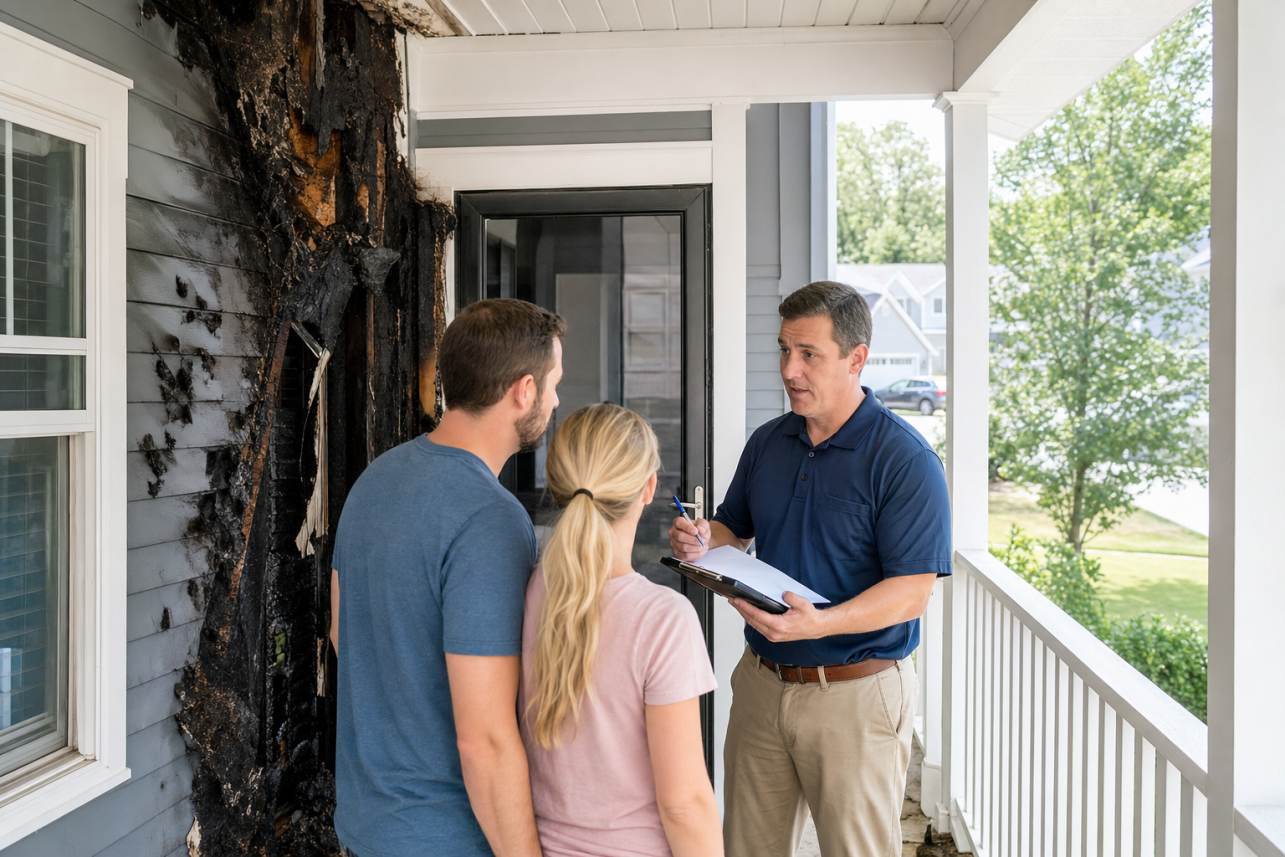
Reviews
After hail hit our neighborhood, our insurer offered a partial roof repair even though our shingles were discontinued. For The Public Adjusters documented every slope, cited the matching issue, and the final settlement covered a full replacement plus the water-stained ceilings inside. I would never handle a property claim alone again.
Melissa T., Preston area, Cary
A supply line burst upstairs while we were traveling and soaked two floors. The carrier's first estimate missed the hardwood cupping and the wet insulation behind the walls. This team brought moisture readings and a real scope of repairs, and the difference in the settlement was significant. Professional, responsive, and they explained every step.
Raj P., Cary NC
Our kitchen fire claim felt hopeless — the insurance company kept saying the smoke damage in the bedrooms was 'pre-existing odor.' The adjusters here tested surfaces, documented the soot in our ductwork, and rebuilt our contents list from scratch. The claim settled fairly and we didn't have to argue with the carrier ourselves. Worth every penny of their fee.
Donna W., west Cary
Frequently Asked Questions
What Does A Private Claims Adjuster Cary NC Homeowner Hires Actually Do?
A private adjuster — often called a public adjuster — works exclusively for you, the policyholder, never for the insurance company. When your Cary home or commercial building suffers damage, the insurer sends its own adjuster to evaluate the loss. That person's job is to protect the carrier's bottom line. Ours is to protect yours.
For The Public Adjusters, Inc. reviews your policy line by line, documents every element of the damage, prepares a detailed estimate using the same professional software carriers use, and negotiates directly with the insurance company on your behalf. We handle the inspections, the paperwork, the proof-of-loss filings, and the back-and-forth so you can focus on getting your life back to normal.
In a growing area like Cary, where homes range from older established neighborhoods near downtown to newer construction out toward Panther Creek and Amberly, repair costs and material standards vary widely. We know local rebuild costs in Wake County and push back when a carrier's estimate uses unrealistic pricing or overlooks hidden damage, like moisture trapped behind walls after a pipe burst.
We are licensed and bonded in North Carolina, and we only get involved in claims for homes, buildings, and their contents. We do not handle claims involving motor vehicles, cell phones, health, or life insurance. While no one can promise a specific outcome, having a trained advocate who understands policy language almost always changes the conversation with your insurer.
What Kinds Of Property Damage Claims Do You Handle In Cary And Wake County?
We represent Cary policyholders on claims involving fire and smoke damage, water damage from burst pipes or appliance failures, hurricane damage, tornado damage, and hail losses affecting homes, commercial buildings, and personal contents.
Fire and water claims are among the most common losses we see in Wake County. Smoke contamination often spreads far beyond the visibly burned area, and water losses frequently hide mold or structural saturation that a quick carrier inspection misses. Hurricane remnants moving inland from the coast have also caused significant roof and interior damage in Cary over the years, and tornado activity in the Triangle is a real risk — residents remember the April 2011 outbreak that tore through Wake County.
Flood losses are handled differently. Flooding is typically covered under a separate flood policy through the National Flood Insurance Program rather than your homeowners policy. If rising water from Crabtree Creek, Swift Creek, or heavy storm runoff damaged your property, we recommend reviewing resources at FEMA.gov and FloodSmart.gov to understand how NFIP claims work, and we can discuss whether our services fit your situation.
To be clear about what we don't do: we never handle claims involving cell phones, motor vehicles, health insurance, or life insurance. Our focus is strictly damage to homes, buildings, and the contents inside them — and that focus is exactly why Cary property owners call us.
Can A Policyholder Really Stand Up To An Insurance Company And Win?
Yes — courts have repeatedly sided with property owners when insurers wrongly denied or underpaid legitimate claims. A well-known example is State Farm Fire & Casualty Co. v. Simmons, 963 S.W.2d 42 (Tex. 1998). In that case, a family's home was destroyed by fire, and the insurer denied the claim by accusing the homeowners of arson despite conducting what the courts found to be an outcome-driven investigation. A jury found the carrier acted in bad faith, and the Texas Supreme Court upheld the judgment for the insured.
Cases like Simmons matter because they show the imbalance policyholders face: the insurance company controls the investigation, the estimate, and the timeline unless someone pushes back with documentation and policy knowledge. That is precisely the gap a Private Claims Adjuster Cary NC property owners bring in is meant to close — long before a dispute ever reaches a courtroom.
Most claims we handle in Cary are resolved through thorough documentation and firm, professional negotiation, not litigation. When we present a carrier with a properly supported estimate, photographs, moisture readings, contents inventories, and the exact policy provisions that apply, disputes often narrow quickly.
We can never guarantee any particular settlement amount — no honest adjuster can. What we can promise is that your claim will be prepared and presented the way the policy and North Carolina law allow, so the insurer evaluates your actual loss rather than a rushed first impression.
How Are Fees Structured, And Is A Private Claims Adjuster Cary NC Families Hire Actually Licensed?
For The Public Adjusters, Inc. works on a contingency basis for most residential and commercial property claims in Cary. That means our fee is a percentage of the claim settlement, agreed to in writing before we begin. If there is no recovery, you owe us nothing for our adjusting work. There are no upfront costs to have us review your situation.
The initial consultation and policy review are free. We'll look at your homeowners or commercial policy, inspect the fire, water, hurricane, tornado, or hail damage, and give you an honest assessment of whether hiring us makes financial sense. Sometimes a claim is small or straightforward enough that you're better off handling it yourself — and we'll tell you that.
On licensing: yes. We are licensed public adjusters in North Carolina and we are bonded, as state law requires. The North Carolina Department of Insurance regulates our profession, caps certain fees, and requires written contracts, which protects you as the consumer. You can verify any adjuster's license directly through the Department of Insurance before signing anything — and you should.
One important note on expectations: we will never promise a specific dollar outcome, and you should be skeptical of anyone who does. Every policy, every loss, and every negotiation is different. What we offer Cary and Wake County policyholders is experienced, licensed representation focused entirely on damage to homes, buildings, and contents — with our interests aligned with yours from day one.
My Insurance Company Already Denied Or Underpaid My Claim — Can A Private Claims Adjuster Cary NC Policyholders Rely On Still Help?
Yes, in many situations a denied or underpaid claim is exactly where we do our most important work. A denial letter is the carrier's position, not the final word. North Carolina law allows policyholders to dispute a settlement, submit new documentation, and reopen claims within the time limits stated in the policy.
When For The Public Adjusters, Inc. reviews a denied claim, we start by reading the full policy, not just the denial letter. We compare the carrier's stated reasons against the actual policy language, then re-inspect the property, document the damage with photos and detailed estimates, and prepare a supplemental or disputed claim package.
North Carolina courts have long sided with policyholders when policy language is unclear. In Gaston County Dyeing Machine Co. v. Northfield Insurance Co., the North Carolina Supreme Court held that ambiguous terms in a property policy must be construed in favor of the insured, and the policyholder prevailed in that property-damage coverage dispute. That principle protects Cary homeowners and building owners every day, because carriers cannot simply pick the reading of the policy that costs them the least.
We are licensed and bonded, and we cannot guarantee any specific outcome — no honest adjuster can. What we can promise is a thorough, documented, professionally argued claim presented to the insurer on your behalf, whether the loss is fire, water, hurricane, tornado, or theft damage to your home, building, or contents here in Wake County.
Do You Handle Flood Damage Claims In Cary, And How Do FEMA And NFIP Policies Work?
We do assist Cary property owners with flood losses, and it's important to understand upfront that flood damage is almost never covered by a standard homeowners policy. Flooding from rising water — overflowing creeks like Crabtree Creek or Swift Creek, or heavy runoff during a tropical system — typically falls under a separate flood policy purchased through the National Flood Insurance Program (NFIP) or a private flood carrier.
NFIP claims follow their own rules, deadlines, and proof-of-loss requirements, which are stricter than typical homeowners claims. A signed, sworn proof of loss is generally due within 60 days of the flood, and missing that deadline can jeopardize payment. You can review program details directly at FloodSmart.gov (the official NFIP site) and FEMA.gov.
Our role is to document the flood damage to your structure and contents, prepare the detailed line-item estimate, complete the proof of loss correctly, and present the claim so nothing covered gets left out. We also help separate flood damage from other covered causes — for example, when a hurricane causes both rising water and water intrusion from above, which may fall under two different policies.
If your home flooded during a federally declared disaster and you lack flood coverage, FEMA disaster assistance may be available as a separate resource. We handle structure and contents losses only — not vehicles, phones, health, or life claims. We're licensed and bonded, and while we never promise a specific dollar result, careful documentation makes a real difference in how flood claims get paid.
How Long Does A Property Insurance Claim Take To Settle In Cary, And Can You Speed It Up?
Most straightforward residential claims in Wake County resolve in 30 to 90 days, while larger losses — major fires, hurricane damage, extensive water losses — can take several months. The timeline depends on the severity of the damage, how complete the documentation is, and how responsive the insurance carrier chooses to be.
North Carolina does give policyholders some protection here. Once a carrier receives a properly documented claim, the Department of Insurance expects timely acknowledgment, investigation, and payment, and unreasonable delay can constitute an unfair claims practice under state law.
The single biggest cause of delay we see in Cary is incomplete documentation. When a homeowner submits a vague estimate or a partial contents list, the carrier responds with requests for more information, and weeks disappear. Our approach is to front-load the claim: a room-by-room inspection, moisture readings where relevant, a line-item repair estimate built on current Triangle-area construction pricing, and a complete contents inventory with values.
A claim presented that thoroughly is harder to delay and harder to dispute. We also handle every call, email, and inspection request from the carrier so you're not chasing responses between work and family life.
We can't guarantee a specific timeline — no one controls the insurance company's internal process — but we can keep steady, documented pressure on the file and escalate when deadlines slip. For most clients, having a professional manage the back-and-forth is the difference between a claim that moves and one that stalls.
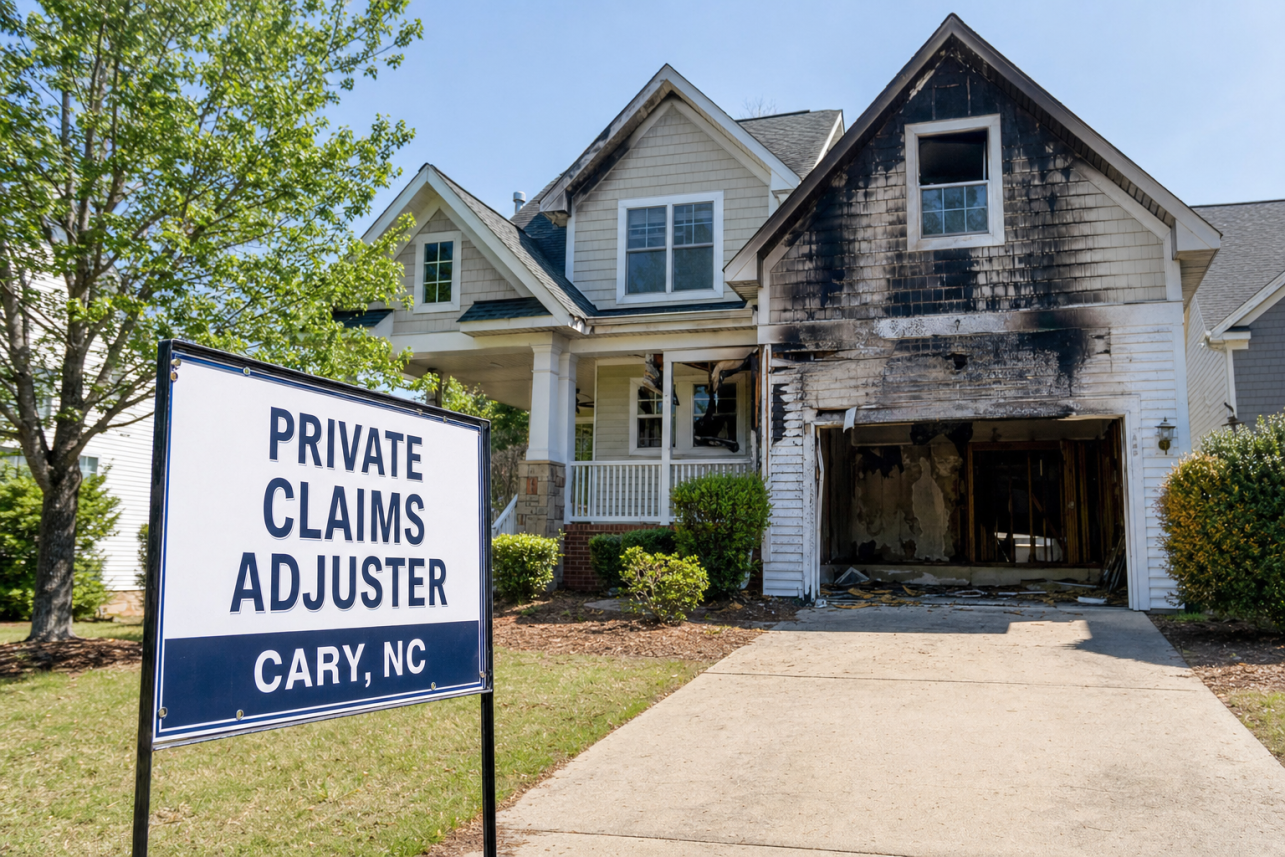
When Should I Call A Private Claims Adjuster Cary NC Homeowners Trust — Before Or After I File With My Insurance Company?
Ideally, before you file. The first statements you make to your carrier, the first photos you submit, and the way the loss is initially described all shape how the claim is handled from day one. Bringing in a professional at the start means the claim is framed correctly, documented thoroughly, and filed with the right coverage provisions in mind.
That said, it is never too late to get help. We regularly step in after the carrier's adjuster has already inspected, after a lowball estimate has arrived, or after a denial letter has landed in a Cary mailbox. At each of those stages there are still tools available: supplemental claims, re-inspections, appraisal provisions, and disputed-claim submissions.
Here's a practical guide. Call immediately if the loss is large — a house fire, a tornado or hurricane strike, a burst pipe that flooded multiple rooms. Call before accepting any settlement if the carrier's number seems low. And call before signing anything beyond the basic claim forms, especially a release.
For The Public Adjusters, Inc. serves homeowners and commercial property owners throughout Cary, Apex, Morrisville, and the rest of Wake County. We handle structural, contents, and loss-of-use claims — not vehicle, phone, health, or life claims. We're licensed and bonded, we work on your behalf rather than the insurer's, and while we make no promises about specific dollar amounts, we make sure every covered dollar is properly claimed and professionally argued.
What Steps Should I Take Right After Fire Or Water Damage Before A Private Claims Adjuster Cary NC Residents Call Can Inspect My Home?
First, make sure everyone is safe and the property is secure. Your policy requires you to take reasonable steps to prevent further damage, so board up openings, shut off the water source, or tarp exposed areas if it is safe to do so. Keep every receipt for emergency work — those costs are typically reimbursable under your policy.
Second, document everything before anything is moved or thrown away. Photograph and video each room, including closets, crawl spaces, and the contents of cabinets. In water losses especially, Cary homeowners often discard soaked belongings quickly, and that makes proving the loss much harder later.
Do not sign anything from a restoration contractor or the insurance company without understanding it. Assignment-of-benefits forms and early release documents can limit your options before the full scope of damage is even known. Smoke residue, moisture inside wall cavities, and HVAC contamination are frequently missed in the first walkthrough.
Finally, call us before giving a recorded statement. As a licensed and bonded firm, For The Public Adjusters, Inc. can be present for inspections, prepare the inventory, and build the estimate using the same software insurers use. We cannot promise a specific dollar outcome — no honest adjuster can — but early involvement means the claim is documented correctly from day one, which is where most underpayments are prevented in Wake County homes.
Do You Handle Hurricane And Tornado Damage Claims For Cary Homeowners?
Yes. Although Cary sits well inland, Wake County has seen serious storm losses — Hurricane Fran in 1996 tore through this area, and the April 2011 tornado outbreak caused major damage across Raleigh and surrounding communities. Remnants of hurricanes still push heavy rain and destructive gusts into the Triangle regularly.
Hurricane and tornado claims are among the most frequently underpaid. Insurers often approve shingle replacement on one slope of a roof while denying the rest, overlook interior ceiling and insulation damage from water intrusion, or attribute storm damage to pre-existing wear. Tree impacts are another common Cary issue given the mature oaks and pines in neighborhoods like Lochmere, MacGregor Downs, and Preston — structural damage from a fallen tree often extends beyond what is visible from the ground.
When you hire a Private Claims Adjuster Cary NC storm victims work with, we inspect the entire property — roof system, gutters, siding, windows, fencing, detached structures, and interior finishes — and prepare a line-item estimate that reflects the true scope of repairs at current local labor and material pricing.
We also track deadlines. Hurricane claims in North Carolina sometimes involve separate hurricane deductibles and proof-of-loss requirements, and missing those can jeopardize recovery. Our job is to present a documented, policy-supported claim so the carrier pays what the contract actually owes, not what a rushed first inspection suggested.
Will Hiring A Public Adjuster In Cary Cause My Insurance Company To Raise My Rates Or Cancel My Policy?
No. Your premium is driven by the loss itself, your claims history, and broader underwriting factors — not by who represents you during the claim. Filing a covered claim may affect future rates whether you handle it alone or with professional help, but adding a licensed representative to the file does not change that calculation.
North Carolina law also protects you here. Public adjusters are licensed and regulated by the North Carolina Department of Insurance, and policyholders have a clear legal right to representation. An insurer cannot lawfully retaliate against you for exercising that right, and in our experience with Cary and Wake County claims, carriers treat represented files as routine business.
In fact, professional representation often makes the process smoother for everyone. We submit organized documentation, respond to information requests promptly, and speak the carrier's language — estimating software, policy provisions, proof-of-loss forms. Claims that stall usually do so because something is missing or disputed, not because an adjuster is involved.
What changes most is the balance of the conversation. The insurance company's adjuster works for the insurance company. For The Public Adjusters, Inc. works only for you, as a licensed and bonded advocate reviewing the policy, measuring the damage, and negotiating on your behalf. We never guarantee a particular result, but we do make sure your claim is presented completely and that nothing covered gets quietly left off the estimate.
How Does A Private Claims Adjuster Cary NC Families Hire Put A Value On Damaged Furniture, Clothing, And Other Contents?
Contents are usually the most undervalued part of a Cary property claim. After a fire or major water loss, insurers often hand homeowners a blank spreadsheet and ask them to list everything they owned from memory. Most people recall less than half, and they underprice what they do remember.
Our approach is systematic. We walk the home room by room, photograph and catalog every item — including smoke-contaminated clothing, electronics exposed to soot, and furniture with hidden moisture damage — and research current replacement pricing. We also apply the correct valuation standard from your policy, whether that is replacement cost or actual cash value, and track the recoverable depreciation you can claim back after replacing items.
Policy language matters enormously in contents disputes, and North Carolina courts have repeatedly sided with policyholders when that language is unclear. In Gaston County Dyeing Machine Co. v. Northfield Insurance Co., 351 N.C. 293 (2000), the North Carolina Supreme Court ruled in favor of the insured in a property damage coverage dispute, reinforcing the principle that ambiguous policy terms are construed against the insurer who drafted them. We use that same principle when carriers try to read coverage narrowly.
We should be clear: we handle homes, buildings, and the contents inside them. We do not handle claims involving motor vehicles, cell phones, health, or life insurance. For the personal property inside your Cary home, though, a thorough inventory backed by documentation is the difference between a token payment and a settlement that reflects what you actually lost.
Have Policyholders Ever Actually Won In Court Against An Insurance Company Over Damage To A Home Or Building?
Yes, and the case law matters because it shapes how insurers behave at the negotiating table. One well-known example is Mighty Midgets, Inc. v. Centennial Insurance Co., decided by New York's highest court in 1979. A fire destroyed the insured's building, and the carrier tried to escape payment by arguing the policyholder gave notice too late. The court sided with the insured, found the notice was reasonable under the circumstances, and the policyholder recovered for the fire loss — plus the court addressed the insurer's obligation to cover litigation expenses the insured was forced to incur.
Decisions like that one are a reminder that an insurance policy is a contract, and courts will hold carriers to it when a denial doesn't hold up. That said, the vast majority of homeowner and commercial claims never need to reach a courtroom.
Our job as your Cary public adjuster is to build the claim so thoroughly — documented damage, line-item estimates, policy language mapped to each item of loss — that the carrier has little room to lowball or deny. A well-supported file usually resolves disputes long before litigation becomes necessary.
If a claim does reach a genuine impasse, we can invoke tools inside the policy itself, such as the appraisal clause, and we work alongside policyholder attorneys in Wake County when a legal remedy becomes the right move. We never promise a specific outcome, because no honest professional can, but we make sure the insurance company has to answer a fully documented claim rather than an unrepresented homeowner.
Does A Private Claims Adjuster Cary NC Business Owners Hire Handle Commercial Property Claims Too?
Yes. For The Public Adjusters, Inc. represents commercial policyholders as well as homeowners throughout Cary and Wake County. That includes retail shops, restaurants, offices, medical practices, warehouses, and multi-tenant buildings along corridors like Kildaire Farm Road, Chatham Street, and the business parks near Weston Parkway.
Commercial claims tend to be more layered than residential ones. Beyond the building itself, there is business personal property — inventory, equipment, furnishings, tenant improvements — and often business interruption coverage, which pays for lost income and continuing expenses while the property is unusable. Insurers scrutinize interruption claims heavily, and documenting them correctly requires financial records, projections, and a clear timeline of the restoration period.
We handle fire and smoke losses, burst pipes and other water damage, hail damage to roofing systems, and hurricane or tornado damage to commercial structures. For each claim, we inventory the loss, prepare detailed repair and replacement estimates, calculate the interruption period, and negotiate directly with the carrier's adjusters and consultants.
For a Cary business, time is the real enemy. Every week a storefront stays closed or a kitchen stays dark, revenue walks away. Having a licensed and bonded adjuster managing the claim lets the owner focus on employees and customers while we focus on moving the insurance company. We also keep the carrier accountable to the deadlines in the policy, so the claim does not drift for months without a decision.
What Happens During Your First Inspection Of My Damaged Cary Home?
The first visit is a working inspection, not a sales call. A Private Claims Adjuster Cary NC property owners bring in should start by reading your actual policy — the declarations page, endorsements, and exclusions — because the policy defines what can be claimed. We do that before we ever talk numbers.
Next comes the physical inspection. We walk the entire property, not just the obvious damage. After a kitchen fire, for example, smoke and soot often travel through HVAC ducts into bedrooms two floors away. After a pipe break, moisture wicks into wall cavities and subfloors that look dry on the surface. We photograph everything, take moisture readings where appropriate, and note structural, cosmetic, and contents damage room by room.
We also begin the contents inventory on day one, flagging damaged furniture, clothing, electronics, and personal items so nothing gets discarded before it is documented. If your home is unlivable, we review your additional living expense coverage so temporary housing and meals are tracked for reimbursement from the start.
Before we leave, you will know what your policy covers, what documentation we still need from you, and what the next steps look like. There is no obligation at that first meeting. Many Cary homeowners simply want a second set of trained eyes on the loss before deciding how to proceed, and we are glad to provide that. If you hire us, we take over communication with the carrier from that point forward.
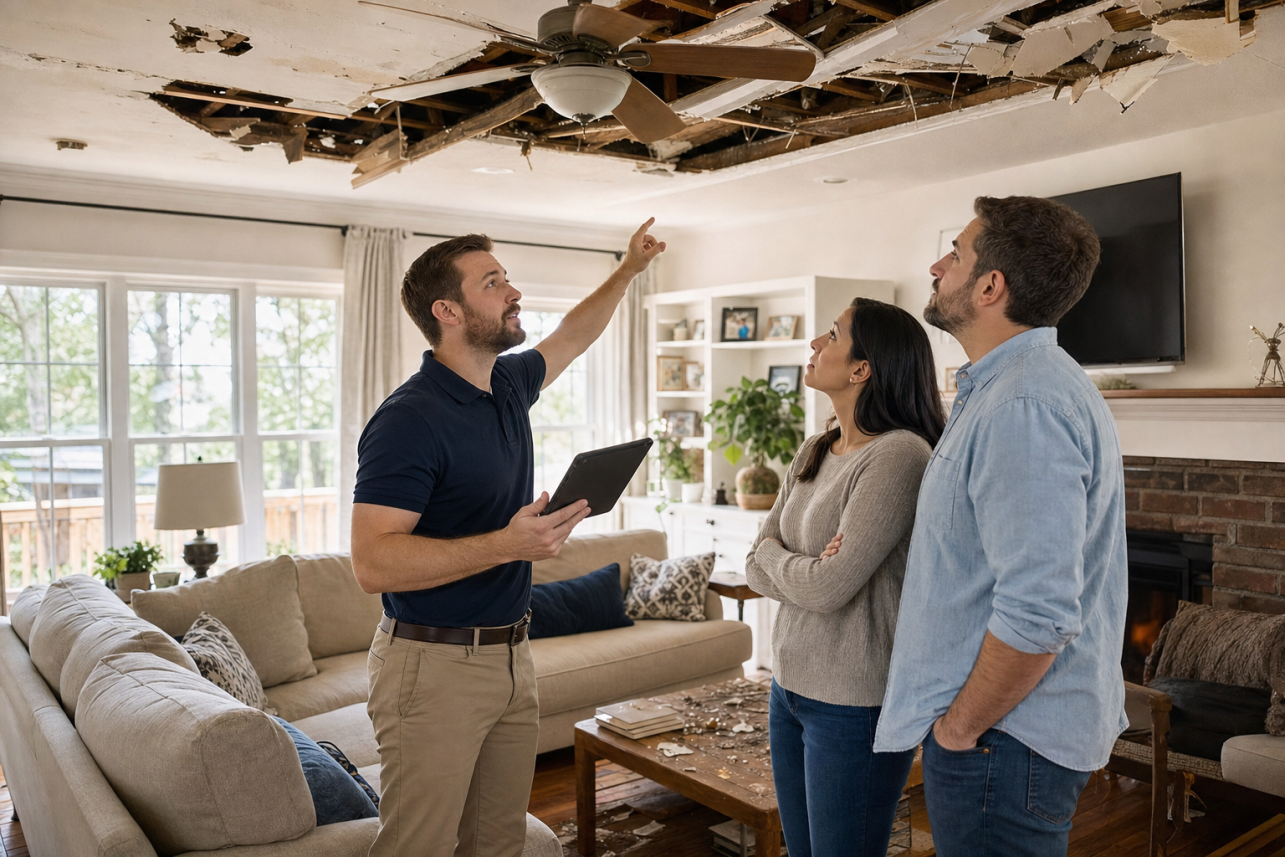
Are There Any Insurance Claims For The Public Adjusters, Inc. Does Not Take On?
Yes, and we are upfront about it because it saves everyone time. Our practice is devoted entirely to property claims — damage to homes, commercial buildings, and the contents inside them. We do not handle claims involving motor vehicles, cell phones or personal electronics claimed under device protection plans, health insurance, or life insurance. Those fall under completely different policy types and regulatory rules.
Within property claims, our Cary and Wake County work centers on fire and smoke losses, water damage from plumbing failures and appliance leaks, hail damage, hurricane and tornado destruction, lightning strikes, theft and vandalism, and flood losses. For flood claims specifically, coverage usually runs through the National Flood Insurance Program rather than a standard homeowners policy, and resources at FEMA.gov and FloodSmart.gov explain how those federal policies work. We help policyholders document and present NFIP claims under their distinct rules.
There is a practical reason for this focus. Building damage, contents valuation, and policy interpretation are specialized skills, and staying inside that lane is exactly why clients hire us. A firm that claims to handle every kind of insurance dispute is rarely deep in any of them.
We are licensed in North Carolina and bonded, and we work only for policyholders — never for insurance companies. If your situation falls outside what we handle, we will tell you so on the first phone call and, where we can, point you toward the right kind of help instead.
Local Relevance
Cary's housing stock tells the story of its growth: whole subdivisions built in the late 1990s through the mid-2000s are now reaching the age where builder-grade shingles and original flashing fail. Carriers lean hard on "wear and tear" for these roofs, which is why tying damage to a specific hail event or hurricane remnant matters so much here.
Water is the other recurring theme. Crabtree Creek and the smaller Neuse tributaries push water into homes that sit outside the mapped high-risk zones, and rapid development has added far more pavement and runoff than older flood maps anticipated. The Federal Emergency Management Agency (FEMA) notes that flooding regularly occurs outside designated high-risk areas, and standard homeowners policies exclude flood — a distinction many Cary owners discover only after a storm. Narrow hail and tornado paths add another wrinkle: one street can take totaled roofs while the next is untouched, so "nobody else in the neighborhood filed" proves nothing about your home.
We serve all of western Wake County, from Cary and Morrisville down to our clients who reach us as a Public Adjuster in Holly Springs, and east through Garner — where cases like an Arson Homeowners Claim in Garner show how complex residential losses can get.
Much of Cary sits on the Triassic Basin, where poorly draining clays shrink and swell with the seasons — producing cracked slabs, sticking doors, and settlement that out-of-town adjusters tend to write off as "age." Knowing whether a Cary home sits on Triassic clay or Piedmont red clay genuinely changes how a foundation or water claim should be documented and argued.
Get A Free Claim Review Before You Accept The Carrier's Number
For The Public Adjusters, Inc. is licensed and bonded in North Carolina and works only for policyholders. Whether your Cary claim is brand new, stalled, or already underpaid, we'll review your policy and damage at no cost and tell you honestly whether representation makes sense. No upfront fees — we're paid only as a percentage of what your claim recovers.
Request Your Free Claim Review
Call us: (919) 400-6440
Helpful Resources
- NCDOI Public Adjusters Guide
- Federal Emergency Management Agency (FEMA)
- North Carolina Department of Insurance — State regulator that licenses public adjusters
- FEMA's FloodSmart program — Official National Flood Insurance Program resource
Last updated: October 7, 2026