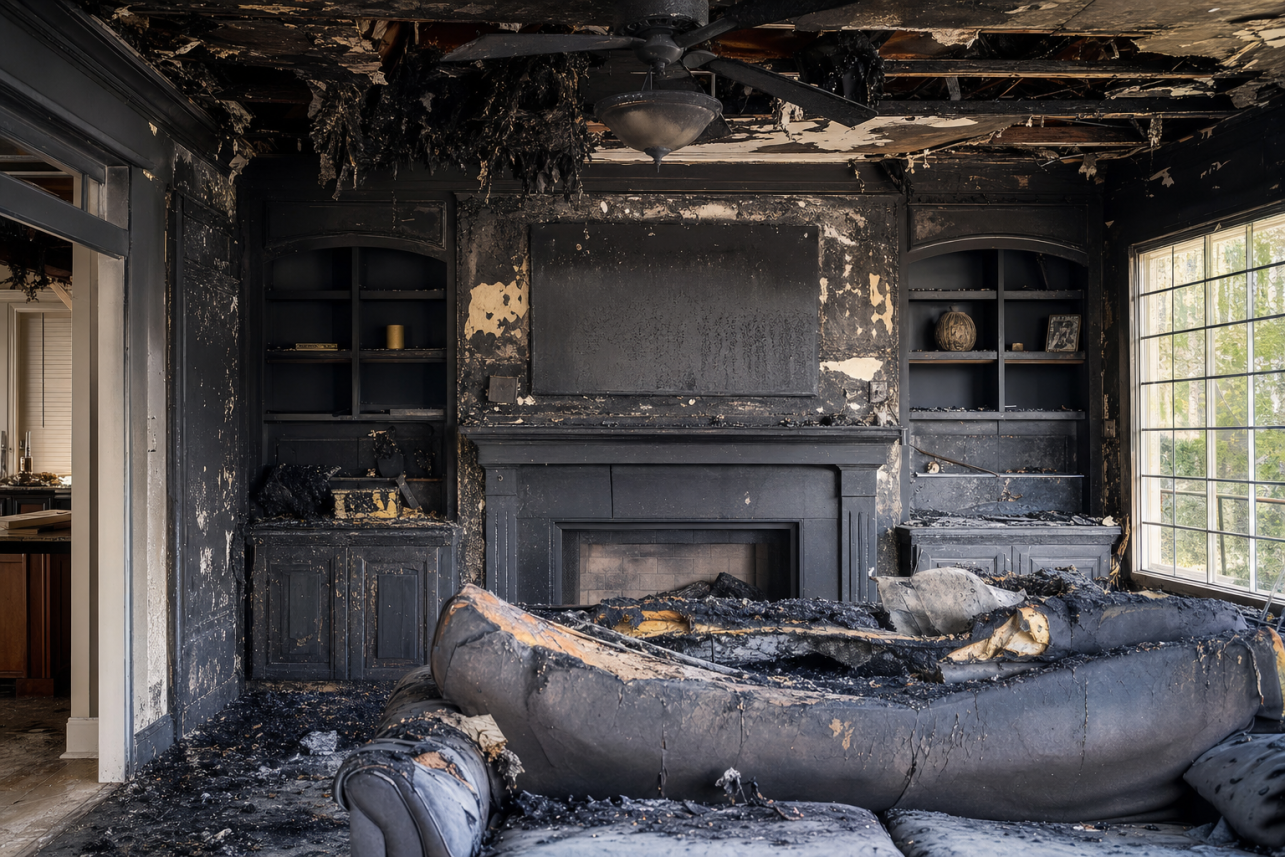
Fire damage claim help for homeowner cary nc means having a licensed public adjuster on your side who documents the full loss, prepares the proof your policy requires, and negotiates directly with the insurance company so you are not stuck accepting their first number. For The Public Adjusters, Inc. works only for policyholders — never for insurers. We handle the structure, the smoke and soot, the water left behind by firefighting, your personal belongings, and the cost of living somewhere else while your home is repaired.
What This Service Is
After a house fire in Cary, your insurance company sends its own adjuster to estimate the damage. That person works for the insurer, and the estimate often reflects it — surface repairs get priced, while smoke that traveled through ductwork, water soaked into subfloors, and heat-warped framing behind the drywall get missed or minimized.
A public adjuster does the same job in reverse. We inspect the home ourselves, build a room-by-room repair estimate, inventory every damaged item you own, and calculate what your policy actually owes — including additional living expenses if your family can't stay in the home.
We also read the policy language carefully. Many homeowners don't realize the difference between replacement cost and actual cash value until the insurer deducts depreciation from the check. Or that code upgrade coverage may apply when an older home has to be rebuilt to current standards. Those details routinely change the value of a fire claim, and they're exactly where insurers cut corners.
North Carolina licenses and regulates public adjusters, and the NCDOI Public Adjusters Guide explains what we're permitted to do on your behalf. For The Public Adjusters, Inc. is licensed and bonded, and our fee comes from the settlement we help recover — we don't get paid unless you do.
Common Problems
The First Offer Rarely Covers What A Fire Actually Destroys
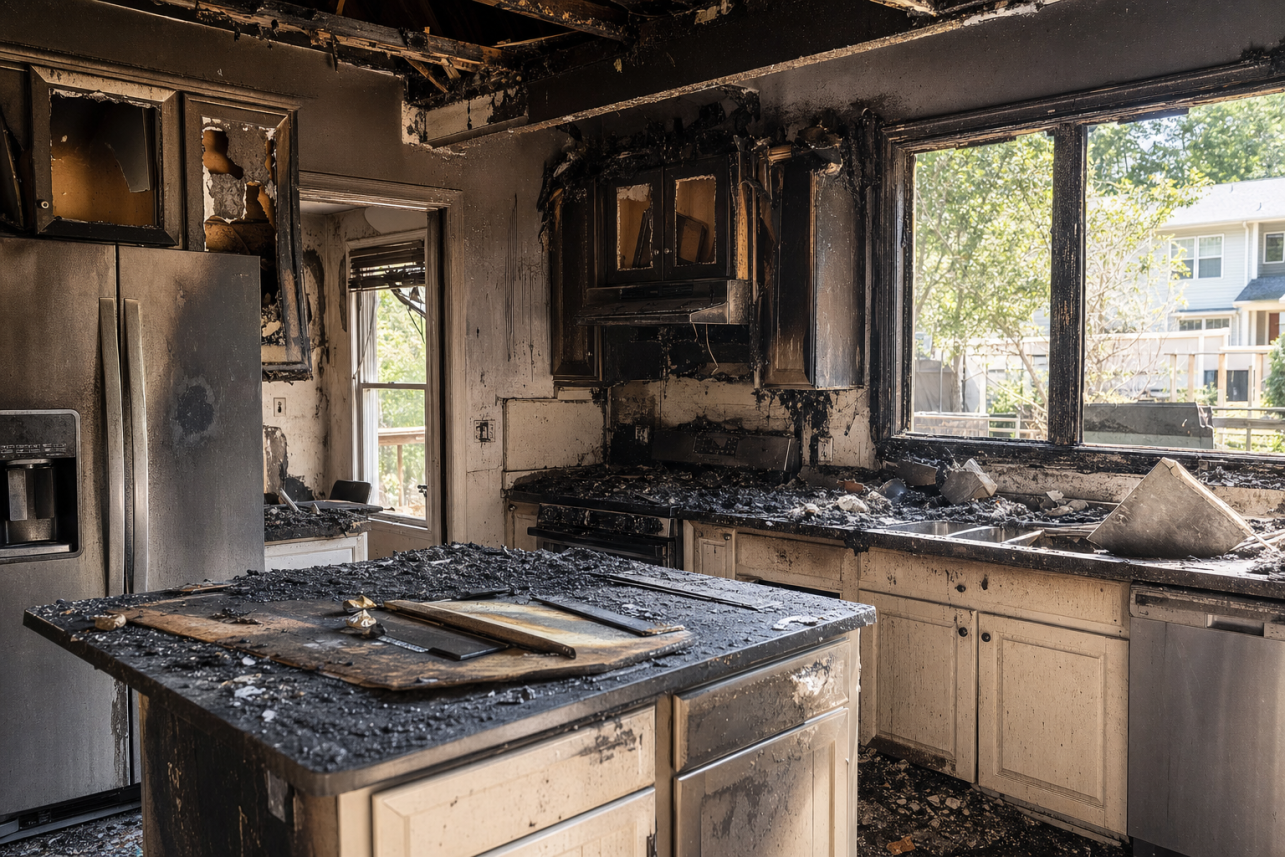
Fire damage is layered. The visible burn area is only the start — smoke residue bonds to walls, insulation, and HVAC systems throughout the house, and the thousands of gallons of water used to put the fire out can rot subfloors and feed mold in Cary's humid summers.
Insurance company estimates frequently price the char and skip the rest. When the contractor's real bid comes in far above the settlement, the homeowner is left covering the gap out of pocket. A thorough independent assessment before you settle is the only reliable way to prevent that.
Why Fire Damage Claim Help For Homeowner Cary NC Often Means Disputing The Insurer's Numbers
When we're brought in, the most common problems we find are steep depreciation deductions, personal property valued at garage-sale prices instead of what it costs to replace, and denied or delayed line items for hidden structural damage.
Policyholders do win these fights. In Bi-Economy Market, Inc. v. Harleysville Insurance Co. of New York, the insured suffered a fire loss to its building and contents, and New York's highest court ruled the policyholder could pursue consequential damages after the insurer badly delayed and underpaid the claim. Courts recognize that insurers owe their customers prompt, fair handling — but you have to document and press the claim to get it.
Deadlines, Paperwork, And Proof Of Loss Traps
Your policy requires a sworn proof of loss, a detailed contents inventory, and cooperation with the insurer's investigation — all on their timeline, while you're displaced from your home. Miss a deadline or submit an incomplete inventory, and the insurer has grounds to underpay or deny.
Meanwhile, temporary housing costs pile up, and many homeowners don't know their policy's additional living expenses coverage should be paying for that hotel or rental. We manage the paperwork, track every deadline, and make sure displacement costs get claimed instead of absorbed.
Our Process
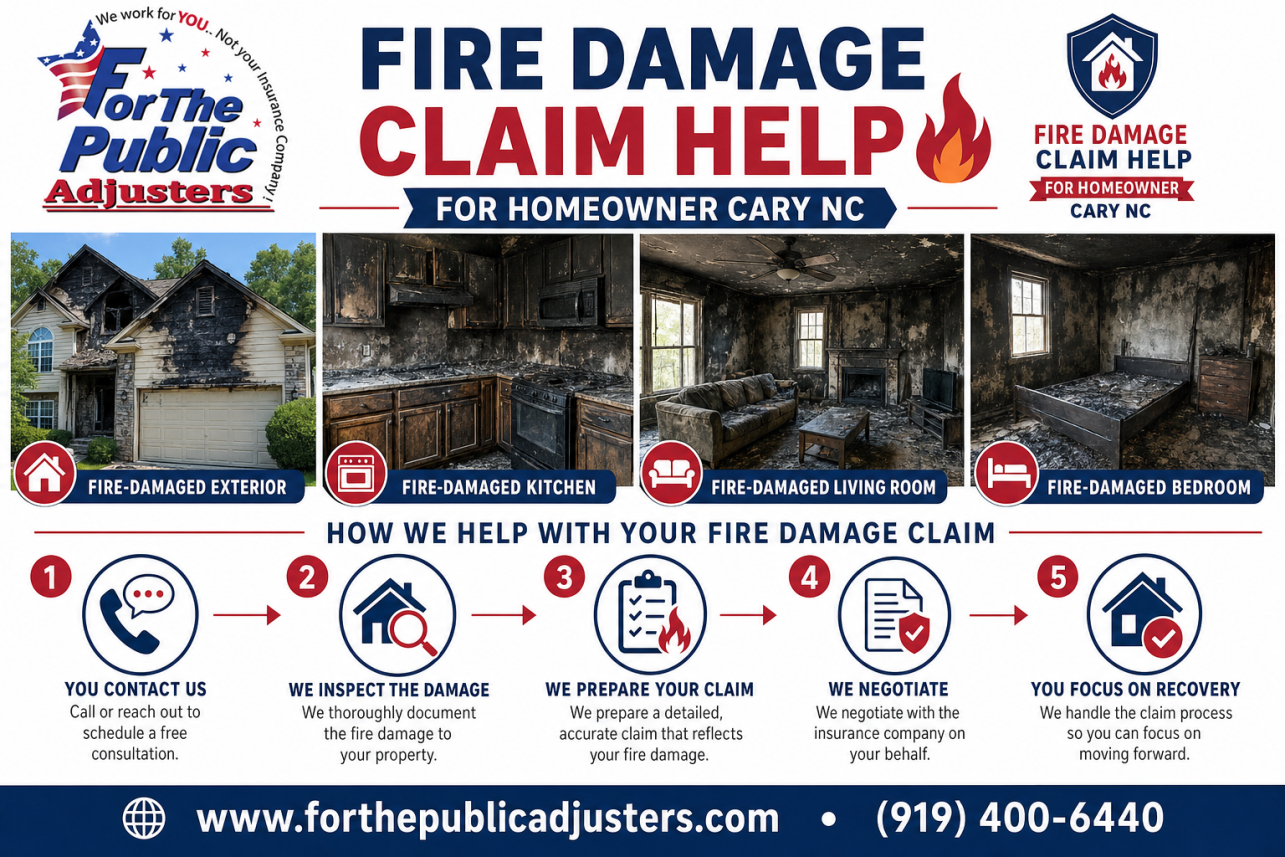
Free Policy Review And Damage Inspection
We start by reading your actual policy — coverage limits, deductible, replacement cost provisions, code upgrade coverage, and ALE benefits. Then we inspect the property ourselves, looking past the burn area for smoke migration, firefighting water damage, and structural issues hiding behind finished surfaces.
Full Documentation And Claim Preparation
We build a detailed repair estimate using current Wake County construction costs, photograph and catalog the damage, and prepare a complete contents inventory with replacement values. This becomes your proof of loss — the evidence package the insurer must respond to, filed correctly and on time.
Negotiation Until The Settlement Reflects The Loss
We present the claim, meet the insurance company's adjuster at the property, and challenge every undervalued or omitted line item. If the insurer delays, lowballs, or denies without justification, we escalate — including through the complaint channels North Carolina provides policyholders. We can't promise a specific dollar outcome, but we can promise the insurer sees the full, documented loss.
| Claim Stage | Homeowner Alone | With For The Public Adjusters |
|---|---|---|
| Damage documentation | Relies on the carrier's 40-minute inspection and their photos | Independent inspection, soot/smoke testing, room-by-room photo and moisture logs |
| Repair estimate | Accepts the carrier's estimate, often priced below real Wake County contractor rates | Full line-item estimate at actual local labor and material costs |
| Contents (personal property) | Homeowner guesses from memory, misses hundreds of items | Detailed contents inventory with replacement-cost pricing for every item |
| Additional Living Expenses | Often unaware ALE exists; pays for hotel out of pocket | ALE claimed from day one, budgeted for the full realistic repair timeline |
| Code upgrades | Rarely applied; carrier stays silent about Ordinance or Law coverage | Coverage identified in the policy and enforced with town permit requirements |
| Negotiation | One homeowner vs. a trained claims department | Licensed NC adjuster negotiating with documentation the carrier can't dismiss |
Commonly Overlooked In The Public Adjusting Industry
- Soot inside HVAC ductwork — Carrier adjusters rarely open the duct system, so smoke residue keeps circulating through the home long after 'repairs' are done.
- Ordinance or Law (code upgrade) coverage — Carriers almost never volunteer this benefit, and rebuilding a 1970s or 80s Cary home to current NC code can add tens of thousands the homeowner ends up eating.
- Recoverable depreciation — Homeowners often don't realize the depreciation holdback is money they can claim back after repairs, so it simply goes unclaimed.
- Additional Living Expenses beyond the first few weeks — Carriers budget ALE for an optimistic timeline, and homeowners quietly absorb months of rent when the rebuild inevitably runs long.
- Smoke and char inside wall cavities — Damage hidden behind intact drywall doesn't show up in a walk-through inspection, but the odor and contamination surface after the claim is closed.
- A complete contents inventory — Grieving homeowners inventory from memory and routinely leave hundreds of items — clothing, kitchenware, garage tools — off the claim entirely.
- Protein and third-party smoke residue testing — Without lab results, the carrier's 'it will air out' position is hard to fight, and most homeowners don't know independent testing exists.
- Water and firefighting damage from the suppression itself — Everyone focuses on the burn area while the water used to fight the fire soaks framing and flooring two floors below, breeding mold weeks later.
Case Studies
Case Study #1
Situation: A family in the Lochmere area of Cary had a kitchen fire that spread into the attic before Cary Fire Department knocked it down. Smoke traveled through the HVAC ductwork into every room of the two-story home.
Problem: The insurance carrier's adjuster spent forty minutes on site and issued an estimate of $61,000 — enough to gut the kitchen and repaint a few rooms, but nothing for the duct system, insulation, or smoke-saturated contents upstairs. The family was told the odor would 'dissipate.'
Investigation: We brought in an independent industrial hygienist to test for char, soot, and protein residue throughout the house. We also opened wall cavities adjacent to the kitchen and pulled attic insulation samples, then documented every room with moisture readings and photo logs.
Findings: Soot and combustion byproducts were present in all supply ducts, inside wall cavities two rooms away from the fire origin, and throughout the attic insulation. The carrier's estimate had also priced drywall and cabinetry at rates no Wake County contractor would actually accept.
Solution: We prepared a full line-item estimate reflecting complete duct replacement, attic insulation removal, sealing of framing, a whole-home contents inventory, and Additional Living Expenses for the six months the family could not safely occupy the home. We presented the hygienist's lab results alongside it and negotiated directly with the carrier's large-loss adjuster.
Outcome: The claim settled at $284,000 — more than four and a half times the original offer — including a fully funded ALE budget so the family stayed in a comparable rental in Cary rather than a hotel off Highway 55.
Lesson: Smoke damage almost never stops where the flames stopped. If the carrier's estimate only covers rooms with visible char, the estimate is wrong, and testing will usually prove it.
Case Study #2
Situation: A retired homeowner near downtown Cary had an electrical fire start in the garage of her 1978 brick ranch. The fire was contained quickly, but the garage, laundry room, and roof structure above them were badly damaged.
Problem: The carrier accepted the claim but applied a steep depreciation holdback and refused to pay for code-required upgrades — arc-fault breakers, updated wiring, and hurricane clips required when the roof section was rebuilt under current Town of Cary and NC building code. The homeowner was left roughly $47,000 short of what her contractor needed.
Investigation: We reviewed her policy line by line and found she carried Ordinance or Law coverage the desk adjuster had never applied. We also audited the depreciation schedule, which had depreciated brand-name cabinetry and a three-year-old water heater as if they were forty years old.
Findings: The policy provided up to 10% of dwelling coverage for code upgrades — money the carrier simply never mentioned. The depreciation was inconsistent with the actual age and condition of the damaged items, and recoverable depreciation procedures had not been explained to her at all.
Solution: We submitted a supplemental claim invoking the Ordinance or Law provision with the town's permit requirements attached, corrected the depreciation schedule with purchase records and photos, and set a clear paper trail so recoverable depreciation would be released as repairs were completed.
Outcome: The carrier paid the code-upgrade costs in full and revised the depreciation, adding $52,300 to the settlement. Her home was rebuilt to current code with no out-of-pocket shortfall.
Lesson: Coverage you paid for does you no good if nobody applies it. Carriers rarely volunteer Ordinance or Law benefits — someone has to know the policy well enough to demand them.
| Your Situation | Smartest Next Step | What It Depends On |
|---|---|---|
| Fire just happened, no claim filed yet | Get a public adjuster involved before the carrier's first inspection | Everything documented in week one shapes the entire claim — this is the best time to call |
| Carrier's adjuster inspected, no offer yet | Do not sign anything; have the damage independently documented now | Whether hidden smoke, duct, and structural damage gets recorded before the estimate is written |
| Received an offer that feels low | Have the estimate audited line by line before accepting | Depreciation applied, rooms excluded, pricing vs. real Cary contractor rates |
| Claim partially paid, repairs stalled | File a supplement for code upgrades and uncovered damage | Whether your policy includes Ordinance or Law coverage and recoverable depreciation |
| Carrier delaying or ignoring you | Put every request in writing and escalate under NC claims-handling rules | How long the delay has run and whether deadlines under NC law have passed |
| Claim denied outright | Get the denial letter reviewed against your actual policy language | The stated denial reason — many denials rely on exclusions that don't hold up |
| Already accepted a settlement | Ask whether the claim can be reopened for supplemental damage | Whether new damage was discovered and how long ago the claim closed |

Reviews
After our attic fire off Kildaire Farm Road, State-side adjuster offered us $38k and acted like that was generous. For The Public Adjusters found smoke damage in rooms the insurance company never even walked into and got the settlement to over $140k. They handled every call with the carrier so I never had to argue with anyone. Worth every penny of their fee.
Denise M., Cary
Our insurer kept stalling on our house fire claim for months — every submission got a request for 'more documentation.' These folks took over, built a complete contents inventory of everything we lost, and cited the NC prompt-payment rules in writing. The check that had been 'in review' since spring arrived within weeks. I only wish we'd called them the day of the fire.
Raj P., Cary
The carrier said the smoke smell in our bedrooms would fade and refused to pay for cleaning beyond the kitchen where the fire started. For The Public Adjusters brought in testing that proved soot was in our ductwork and closets. The final settlement covered full duct replacement and professional contents cleaning. Our house actually smells like a home again. Honest, patient, and they explained everything in plain English.
Karen and Tom W., Cary
Frequently Asked Questions
What Does Fire Damage Claim Help For Homeowner Cary NC Actually Include?
When you hire For The Public Adjusters, Inc., we take over the entire claim process from the moment you call. That starts with a full inspection of your home — not just the rooms where flames were visible, but attic spaces, HVAC systems, wiring, and areas affected by smoke, soot, and the water used to put the fire out. Insurance company adjusters routinely miss or minimize these secondary damages, and they often account for a large portion of what you're owed.
From there, we build a complete, line-item estimate using the same software carriers use, document your personal property losses room by room, and calculate your Additional Living Expenses so your temporary housing in the Cary area is covered while repairs happen.
We then handle every conversation with the insurance company. We attend their inspections, respond to their engineers and adjusters, push back on lowball estimates in writing, and negotiate until the settlement reflects the true cost of restoring a Wake County home at real local contractor prices — not the discounted numbers carriers like to plug in.
You get regular updates in plain English, and you never have to argue with an adjuster yourself. Our fee is a percentage of what we recover, so there is no upfront cost, and our interests are aligned with yours: the more we recover for you, the better we do. Most homeowners tell us the biggest relief is simply not carrying the fight alone.
My Insurance Company Already Sent An Adjuster And Made An Offer. Is It Too Late To Bring In A Public Adjuster?
No — in most cases it is not too late, and this is actually one of the most common situations where Cary homeowners call us. An initial offer from the carrier is exactly that: an opening number, and it is almost always based on the insurance company's own adjuster's scope, which tends to be narrow.
We regularly re-open and supplement fire claims after a first payment has been issued. North Carolina policies allow you to submit additional documentation when new damage is discovered or when the original estimate was incomplete. Smoke odor embedded in insulation, warped framing behind drywall, contaminated ductwork, and code-upgrade requirements under Wake County permitting are frequently left off first estimates entirely.
What matters is timing. Your policy has deadlines — typically for filing proof of loss and for legal action, often within two to three years in North Carolina, though it varies by policy. The sooner we review your claim file, the more leverage we have. If you've cashed a check, that usually does not close your claim or waive your rights, but read anything before you sign it, and don't sign a release.
Bring us the carrier's estimate and your policy, and we'll do a free review. If the offer is fair, we'll tell you honestly. If it's short — and after a house fire, it usually is — we'll show you exactly where, in writing, and fight for the difference.
How Is A Public Adjuster Different From The Adjuster My Insurance Company Sends After A House Fire?
The difference comes down to one word: loyalty. The adjuster your insurance company sends works for the insurance company. No matter how friendly or professional they are, their job is to settle your claim within the carrier's guidelines, which naturally pull toward paying less. A public adjuster works only for you, the policyholder, and is licensed by the North Carolina Department of Insurance to represent your interests.
In practice, that changes everything about how a fire claim in Cary gets handled. The carrier's adjuster may spend an hour or two at your home and write a scope based on quick visual observations. We spend as long as it takes — documenting smoke migration through wall cavities, testing for soot residue in HVAC systems, photographing and inventorying damaged contents, and pricing repairs at what Wake County contractors actually charge in today's market.
We also read your policy the way it should be read: to find every coverage that applies, including ordinance and law coverage for code upgrades, debris removal, tree and landscaping provisions, and Additional Living Expenses. Carrier adjusters rarely volunteer coverages you didn't ask about.
Finally, we handle the negotiation. When the carrier's estimate comes in low, we respond with documentation, comparable pricing, and policy language — not just frustration. For The Public Adjusters, Inc. is paid a percentage of the recovery, so homeowners pay nothing out of pocket, and independent studies have consistently shown that represented policyholders recover significantly more than those who go it alone.
How Long Does Fire Damage Claim Help For Homeowner Cary NC Take, And What Should I Do First While I Wait?
Every fire is different, but here's an honest timeline. Straightforward claims with cooperative carriers can resolve in 60 to 90 days. Larger losses — significant structural damage, disputed smoke contamination, or a carrier dragging its feet — can run six months or longer. North Carolina requires insurers to acknowledge and respond to claims promptly, and part of our job is holding them to those obligations so your claim doesn't sit in a queue.
Before anything else, make sure your family is safe and the property is secured. Your policy requires you to prevent further damage, so board-up and tarping are appropriate — keep every receipt, because those costs are reimbursable.
What you should not do is start throwing damaged items away or authorize major repairs before everything is documented. Once evidence is gone, it's nearly impossible to get paid for it. Take wide photos and video of every room, even areas that look untouched, since smoke and soot travel far beyond the burn area.
Be careful with restoration companies that show up unsolicited asking you to sign work authorizations at the curb — some contracts assign away your rights or lock you into inflated pricing. Call us first for fire damage claim help for homeowner Cary NC and we'll walk you through those documents before you sign.
From your first call, For The Public Adjusters, Inc. typically has your claim documented and formally presented within a few weeks, and we push the carrier at every stage after that.
How Much Does Fire Damage Claim Help For Homeowner Cary NC Cost, And Do I Pay Anything Upfront?
You pay nothing upfront. For The Public Adjusters, Inc. works on a contingency fee, which means our fee is a percentage of the settlement we recover for you. If we don't get you paid, you don't owe us anything.
North Carolina regulates public adjuster fees, and everything is spelled out in a written contract before we touch your claim. There are no hourly bills, no retainers, and no surprise charges buried in the fine print.
Here's why the math usually works in your favor: on fire claims in Cary and across Wake County, we routinely find damage the insurance company's adjuster missed — smoke infiltration in HVAC ductwork, heat damage to roof decking, code-upgrade costs, and personal property that was never fully inventoried. Even after our fee, homeowners typically walk away with substantially more than the carrier's original offer.
We also handle the parts of the claim most people never think to pursue, like Additional Living Expenses while you're out of your home. If you're staying in a hotel off Cary Parkway or renting temporarily while repairs happen, those costs should be covered by your policy — and we make sure they are.
Before you sign anything, we'll sit down with you, review your policy, and give you an honest assessment of whether your claim is worth pursuing. If we don't think we can add real value, we'll tell you that too. That first consultation is always free.
The Insurance Company Denied My House Fire Claim Or Is Blaming Me For The Fire. Can You Still Help?
Yes, and this is exactly the situation where a Cary public adjuster earns their keep. A denial is not the final word — it's the insurance company's opening position, and it can be challenged.
Carriers deny fire claims for all kinds of reasons: alleged arson or negligence, claimed policy lapses, arguments that the damage falls under an exclusion, or accusations that you misrepresented something on your application. Some of these denials hold up under scrutiny. Many do not.
Our first step is pulling apart the denial letter and comparing it against your actual policy language and the fire department's report. Insurance policies are contracts, and the burden is often on the carrier to prove an exclusion applies — not on you to prove it doesn't. We've seen denials in Wake County reversed simply because the carrier misread its own policy or relied on an incomplete cause-and-origin investigation.
We then build a documented rebuttal: independent inspections, photographs, repair estimates, expert reports where needed, and a formal written response that forces the carrier to reopen the file. If the fire marshal's findings support you, we make sure that evidence is front and center.
One important note: if the carrier is accusing you of intentionally setting the fire, you should also speak with an attorney, and we can work alongside one. But for the majority of denied or underpaid fire claims in Cary, an experienced advocate who knows how to fight the insurance company on the facts is what turns a denial into a settlement.
Will Hiring A Public Adjuster Make My Insurance Company Angry Or Cause Them To Cancel My Policy?
No. Hiring your own adjuster is a legal right in North Carolina, and your insurance company cannot cancel your policy, raise your rates, or retaliate against you for exercising it. Public adjusters are licensed by the NC Department of Insurance specifically to represent policyholders — that's the entire purpose of the license.
Think of it this way: the insurance company brought its own trained professional to your loss. You're simply doing the same thing. Carriers deal with public adjusters every single day, and the adjusters who handle claims in Cary and the broader Triangle know us and know we document our work thoroughly.
In practice, having professional representation often makes the claim go more smoothly, not worse. We speak the carrier's language — Xactimate estimates, line-item scopes, policy provisions cited by section. That precision removes a lot of the back-and-forth that stalls claims when a homeowner is negotiating alone.
What homeowners really fear is being labeled 'difficult.' But being difficult isn't the risk — being underpaid is. The claims process is adversarial by design, even when everyone stays polite. The carrier's adjuster answers to the carrier. Yours should answer to you.
One thing to keep in mind: your rates after a fire are influenced by the fact that you had a loss, not by how well you were paid for it. Accepting a lowball settlement doesn't protect your premium. It just means you absorb repair costs your policy was supposed to cover.
Where Do I Even Start With Fire Damage Claim Help For Homeowner Cary NC If The Fire Just Happened?
Call us before you give a recorded statement or sign anything from the insurance company. The first 72 hours after a house fire shape the entire claim, and early missteps are hard to undo.
Here's what matters right away. First, make sure the property is secured — boarding up openings and tarping the roof is your duty under the policy, and we can coordinate that. Second, do not throw anything away, even items that look destroyed. Burned contents are evidence, and the carrier may deny payment for property it never got to inspect. Third, keep every receipt from the moment you leave the house: hotel nights, meals, clothing, pet boarding. Those fall under your Additional Living Expenses coverage.
When you bring in For The Public Adjusters, Inc., we take over from there. We notify the carrier that we represent you, handle all communication, and start our own documentation — a full photographic record, a room-by-room contents inventory, and an independent repair estimate that accounts for smoke, soot, heat, and water damage from firefighting, not just the charred areas.
We also flag Cary-specific issues early, like Town of Cary permit requirements and building-code upgrades that older homes in neighborhoods around downtown or Kildaire Farm may trigger during rebuild. Those code costs are often covered under your policy's ordinance-or-law provision, but only if someone claims them.
One phone call gets the process moving, and the consultation costs you nothing. The sooner we're involved, the stronger your position from day one.
My House Fire Was Small, But Smoke And Soot Spread Everywhere. Does Fire Damage Claim Help For Homeowner Cary NC Cover That Too?
Yes, and this is one of the most common reasons Cary homeowners get underpaid. Insurance carriers love to scope a "small" kitchen or garage fire as a single-room repair, when in reality smoke, soot, and corrosive residue travel through your HVAC system into rooms that never saw a flame.
Soot is acidic. It etches metal fixtures, discolors paint, embeds in drywall, and settles inside electronics, ductwork, and insulation. In the humid Wake County climate, that acidity works faster, which means damage that looks cosmetic today can become permanent in weeks. A proper claim accounts for professional soot remediation, duct cleaning or replacement, odor sealing with the right primers, and testing of affected electronics and appliances.
When For The Public Adjusters, Inc. handles fire damage claim help for homeowner Cary NC, we document every affected surface, not just the burn area. We use moisture and particulate readings, room-by-room photo logs, and line-item estimates written in the same software the carriers use, so they cannot dismiss the scope as inflated.
We also make sure your contents claim reflects smoke-damaged items, not just burned ones. Clothing, upholstered furniture, mattresses, and children's items often cannot be safely deodorized and must be replaced, and your policy typically covers that. If the insurance company's estimate stops at the room where the fire started, that is exactly the kind of shortfall we fight to correct.
The Insurance Company Says I Can't Live In My Home During Repairs. Who Pays For Temporary Housing In Cary?
Your homeowner policy almost certainly includes Additional Living Expenses coverage, often called ALE or Loss of Use. It pays the extra costs of living elsewhere while your home is uninhabitable after a fire — but carriers rarely explain how much you're actually entitled to, and homeowners routinely leave thousands unclaimed.
ALE covers more than a hotel bill. It includes short-term rental costs comparable to your home, increased mileage if your temporary housing is farther from work or your kids' schools in the Wake County school system, restaurant meals above your normal grocery budget, pet boarding, laundry, and even storage for salvaged belongings. The standard is maintaining your normal lifestyle, not the cheapest option the carrier can find.
In Cary, comparable rental housing is not cheap, and insurers sometimes push families into undersized apartments or distant hotels to save money. We push back with local rental comps and insist on housing that genuinely matches what you lost — square footage, bedrooms, and location.
Our team also tracks the ALE clock. Carriers may try to cut off payments before repairs are actually complete, especially when their own delays slowed the rebuild. We document every carrier-caused delay so the timeline works in your favor, not theirs.
Keep every receipt from day one, even for small purchases like toiletries and phone chargers. Those receipts become the backbone of your reimbursement, and we help you organize and submit them so nothing gets rejected on a technicality.
Do I Have To Accept My Insurance Company's Preferred Contractor For The Fire Repairs?
No. In North Carolina, you have the right to choose your own contractor. The insurance company can recommend a vendor from its "preferred" network, but it cannot force you to use one, and it cannot cancel your claim because you hired someone else.
Here's why this matters after a house fire. Preferred contractors work on volume pricing negotiated with the carrier. Their incentive is to keep the estimate low and the carrier happy, because that relationship is where their next hundred jobs come from. Your incentive is a complete, code-compliant rebuild — and those two goals often conflict.
We regularly see network estimates in Cary that skip required code upgrades, reuse smoke-damaged framing that should be replaced, or price finishes below what your home actually had. Wake County permitting and current building codes frequently require electrical, structural, or egress upgrades during fire repairs, and your policy's ordinance-or-law coverage usually pays for them — if someone puts them in the claim.
As your Cary public adjuster, For The Public Adjusters, Inc. builds an independent scope of repairs first, then you choose a contractor you trust to execute it. We negotiate the settlement based on what the rebuild genuinely costs in this market, not what a network vendor agreed to accept.
One caution: do not sign an assignment-of-benefits agreement or a repair contract in the chaotic first days after a fire. Get the claim scoped and valued properly before you commit to anyone, so the money matches the work.
How Do I Get Fire Damage Claim Help For Homeowner Cary NC When The Insurance Company Keeps Delaying And Asking For More Paperwork?
Endless document requests are one of the oldest delay tactics in the industry, and there is a real process for stopping it. North Carolina insurance regulations require carriers to acknowledge, investigate, and pay claims within reasonable timeframes, and repeated requests for information they already have can cross the line into unfair claims practices.
The first step is putting everything in writing. When For The Public Adjusters, Inc. takes over communication, every request, response, and deadline gets documented. Carriers behave differently when they know a licensed public adjuster is building a paper trail that could end up in front of the North Carolina Department of Insurance.
Second, we submit a complete, professionally prepared claim package — a detailed structural estimate, a full contents inventory with values, ALE documentation, and supporting photos — all at once. That eliminates the carrier's excuse that they're "still waiting on information." Most delay tactics collapse when there is nothing left to request.
Third, we follow up on a schedule and escalate when deadlines slip, whether that means a supervisor, an appraisal demand under your policy, or a formal complaint. Homeowners fighting alone often wait weeks between responses; we don't allow the file to sit.
If your fire happened months ago and you're still living in limbo, that alone is a sign the claim needs professional intervention. Reach out for fire damage claim help for homeowner Cary NC before frustration pushes you into accepting a low settlement just to end the ordeal — that's exactly what the delays are designed to do.
How Do I Document Everything I Lost In The Fire? I Can't Remember All Of My Belongings.
This is one of the most common struggles we see with Cary homeowners after a fire, and it's exactly where fire damage claim help for homeowner Cary NC makes the biggest financial difference. Insurance companies typically hand you a blank contents inventory form and expect you to recall every item from memory. Most people recover only a fraction of what they're owed because of this.
Our team approaches it differently. We walk the property room by room, photographing and cataloging damaged contents before anything gets thrown away. For items destroyed beyond recognition, we use prompts that trigger memory: old photos on your phone, credit card statements, Amazon order histories, holiday pictures showing what was on shelves and walls.
We also make sure items are valued correctly. A soot-damaged leather sofa isn't a garage-sale item; if you have replacement cost coverage, you're owed what it costs to buy a comparable sofa today at a Cary-area retailer, not a depreciated guess.
One critical tip: don't let a cleanup crew haul away debris before it's documented. Once your belongings are in a dumpster, proving what you owned becomes far harder. If disposal has already happened, we can still rebuild your inventory through records and witness statements, but call us before the dumpster leaves your driveway if you can. A thorough contents claim in Wake County often adds tens of thousands of dollars compared to what the homeowner would have listed alone.
The Insurance Company Wants A Recorded Statement About The Fire. Should I Give One?
Be careful here. A recorded statement is not a friendly conversation, even when the adjuster sounds pleasant on the phone. Everything you say becomes part of the claim file, and innocent misstatements — guessing at a time, estimating a value you're unsure of, speculating about how the fire started — can be used later to dispute or reduce your payout.
Your policy may require you to cooperate with the investigation, so refusing outright usually isn't the answer. But you have the right to prepare first, and you have the right to have a representative involved. As licensed public adjusters in North Carolina, we help Cary homeowners get ready for these statements: reviewing the facts, gathering documents so you're not guessing, and making sure you understand what's actually being asked.
If the insurer escalates to an Examination Under Oath, which sometimes happens when a carrier suspects a problem with a house fire claim, take that seriously. That's a formal proceeding, and you should never walk into one unprepared.
The safest move is simple: before you schedule any recorded statement, talk to someone who represents you rather than the insurance company. We've sat through these interviews with homeowners across Wake County, and preparation consistently changes the outcome. Say what you know, never guess, and don't sign or record anything under pressure. The carrier's deadline urgency is almost never as urgent as they make it sound.
The Fire Damaged Part Of My Roof And Siding. Does The Insurance Company Have To Replace All Of It So Everything Matches?
This is called the matching issue, and it's one of the most frequent fights we take on for homeowners in Cary. Say fire and heat destroyed siding on one side of your house, but that siding line was discontinued years ago. The insurer may offer to patch the damaged section with something "similar," leaving you with a home that visibly doesn't match — and a resale problem in a market like Wake County where curb appeal directly affects value.
North Carolina claim practice and most policy language support a reasonable match. When a true match isn't available, there's a strong argument the carrier owes for replacing the full continuous surface — the entire elevation of siding, the full roof slope, the complete run of flooring — so the repair restores your home, not just covers a hole.
Insurance adjusters rarely volunteer this. Their estimates often quietly assume a patch will do. When we take over a house fire claim, we inspect for discontinued materials, get documentation from suppliers proving the product is unavailable, and rewrite the scope to reflect what an actual matching repair costs.
The same logic applies to code upgrades. Cary and Wake County building codes have changed over the years, and fire repairs must meet today's requirements. If your policy includes ordinance or law coverage, those upgrade costs are owed too — and they're another item carriers routinely leave out until someone pushes back on your behalf.
Is There A Deadline For Getting Fire Damage Claim Help For Homeowner Cary NC, Or Can I Dispute My Settlement Later?
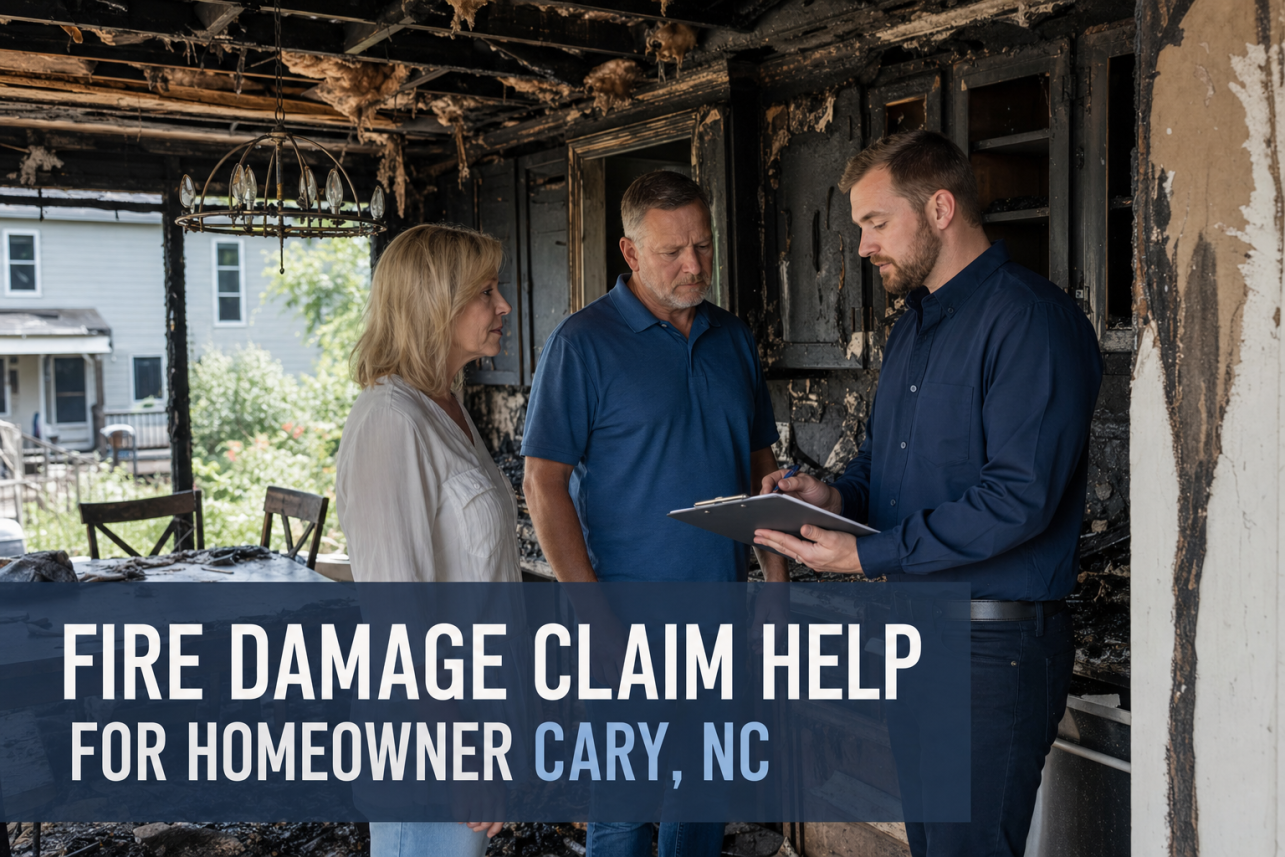
There are deadlines, and they matter more than most homeowners realize. In North Carolina, the statute of limitations for a breach of an insurance contract is generally three years, but many homeowner policies shorten the window for filing suit — sometimes to as little as one or two years from the date of loss. Your policy also contains internal deadlines for submitting a proof of loss and supporting documentation.
The practical takeaway: the sooner you get a Cary public adjuster involved, the more options you have. Evidence is a deadline of its own. Once demolition starts, soot gets cleaned, or debris is hauled off, proving the full extent of your fire loss becomes much harder.
That said, a settlement you've already received usually isn't final. If you accepted a payment and later discovered hidden smoke damage, structural charring, or contents you forgot to list, you can typically file a supplemental claim as long as you're within the policy and legal time limits. We regularly reopen underpaid house fire settlements for homeowners across Wake County — sometimes months after the carrier considered the file closed — and recover significant additional funds.
One caution: watch for anything the insurer asks you to sign. A general release can waive your right to further payment, which is very different from simply cashing a claim check. Before signing any release, have someone who works for you review it. A quick call to our office costs nothing and can preserve rights you didn't know you had.
Local Relevance
Cary sits in the middle of North Carolina's summer storm corridor. Severe thunderstorms roll through Wake County regularly from June onward, and lightning strikes remain one of the more common causes of attic and roof fires here. Add the strain summer heat puts on air conditioning systems and older electrical panels, and fire risk in the Triangle doesn't take a season off.
Much of Cary's housing stock went up during the growth waves of the 1980s and 1990s. Rebuilding a fire-damaged home from that era often triggers current building code requirements — updated wiring, egress, and materials the original construction didn't have. If your policy includes ordinance or law coverage, those upgrade costs should be part of your claim, and it's one of the items insurers most often leave off the first estimate.
There's also the aftermath problem unique to our climate: a fire-damaged home opened to Cary's summer humidity can develop secondary water and mold damage fast. The National Fire Protection Association (NFPA) has long emphasized that a home fire's total impact goes well beyond the flames themselves — and your claim should reflect all of it, not just the room where the fire started.
Because so many Cary homes were built in the 1980s and 1990s, fire rebuilds here often collide with modern code requirements the insurer's first estimate ignores — homeowners with ordinance or law coverage frequently have thousands in upgrade costs that never get claimed unless someone catches it.
Don't Sign The Insurance Company's First Offer
Once you accept a settlement, reopening the claim is an uphill battle. Before you cash that check, let For The Public Adjusters, Inc. review your policy and inspect the damage — the consultation costs nothing, and our licensed, bonded team only gets paid from what we help you recover.
Call us: (919) 400-6440
Helpful Resources
- NCDOI Public Adjusters Guide
- National Fire Protection Association (NFPA)
- North Carolina Department of Insurance consumer resources — State regulator overseeing insurers and public adjusters in NC
- U.S. Fire Administration home fire safety information — Federal agency resource on home fires and recovery
Last updated: July 27, 2026