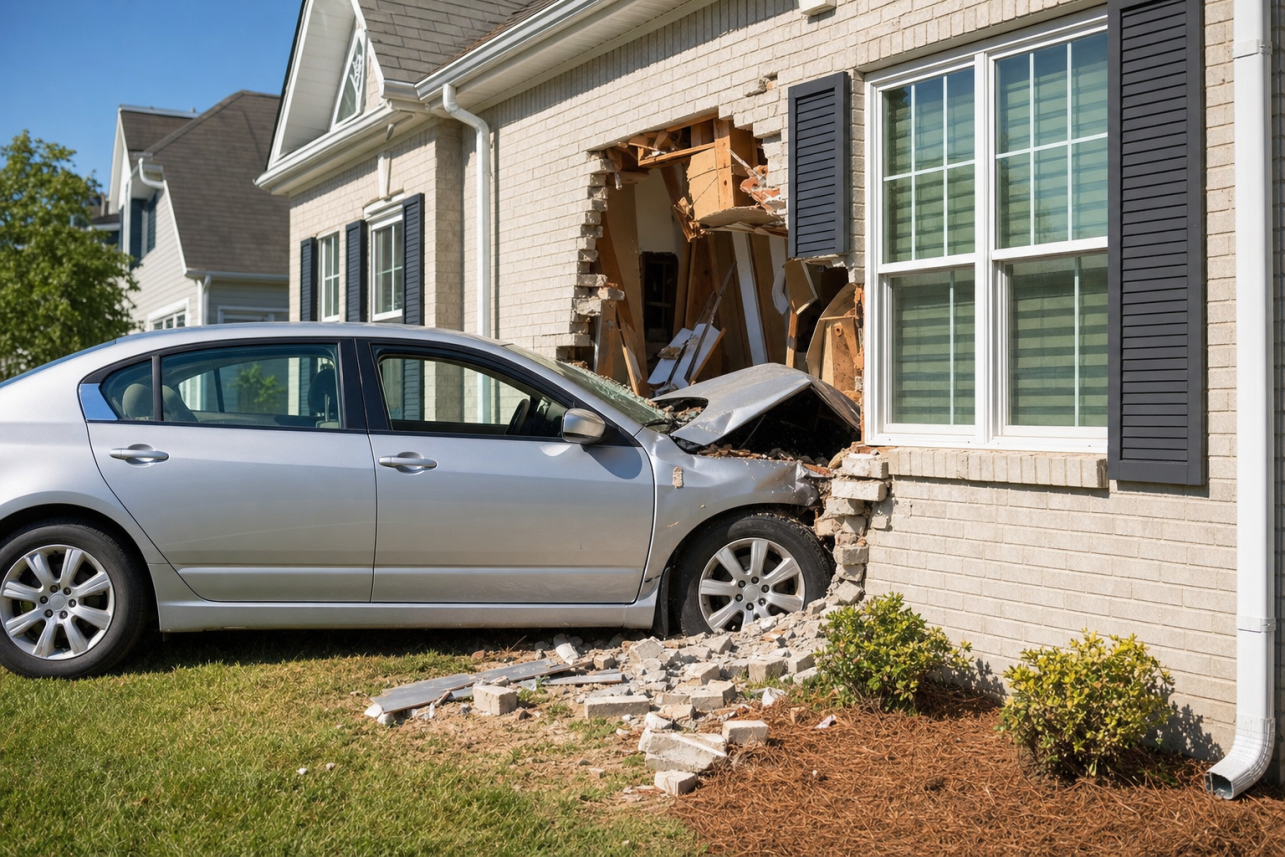
If you need help with a car hit my house insurance claim Cary homeowners typically start with the driver's auto liability coverage, then fall back on their own homeowners policy if the driver is uninsured, underinsured, or unknown. Either way, the burden of proving the full scope of structural damage falls on you, not the insurance company. For The Public Adjusters, Inc. is a licensed and bonded public adjusting firm that represents you — the policyholder — documenting hidden impact damage and negotiating the property claim on your behalf. We handle the building and contents side of the loss only; we do not handle auto, health, or life claims.
What This Service Is
When a vehicle crashes into a home, the visible hole in the wall is rarely the whole story. Impact forces travel through brick veneer, wall studs, sill plates, and foundations, and they can shift load-bearing framing well beyond the point of contact. A public adjuster is a state-licensed professional who works exclusively for the policyholder, inspecting and documenting that damage, preparing a detailed repair estimate, and negotiating directly with the insurance carrier.
That matters because the adjuster the insurance company sends works for the insurer. Our job is to make sure the claim reflects everything the loss actually involves — structural repairs, matching brick or siding, damaged plumbing and electrical runs inside the wall, interior finishes, and displaced contents.
Courts have repeatedly backed policyholders on scope disputes like these. In Windridge of Naperville Condominium Association v. Philadelphia Indemnity Insurance Co. (7th Cir. 2019), the insurer wanted to replace only the individually damaged siding panels; the court sided with the insured, holding the policy required replacing siding across the damaged elevations so the building would actually match. That same matching logic comes up constantly in vehicle-impact claims, where carriers try to patch a section of brick that no longer exists in the same color or size.
The NCDOI Public Adjusters Guide explains how public adjusters are licensed and regulated in North Carolina, and we encourage every homeowner to verify any adjuster's license before signing anything — including ours. We are licensed and bonded, and we work on the property claim from first inspection through final settlement negotiation.
Common Problems
The Insurer's First Estimate Only Covers The Hole, Not The House
The carrier's adjuster often scopes the obvious opening and stops there. Vehicle impacts routinely crack brick ties, rack framing out of plumb, and fracture footings — damage that only shows up with careful inspection.
If that hidden damage isn't in the estimate, it isn't in the check. We bring in the documentation, photos, and repair pricing needed to prove the full scope before you settle.
Car Hit My House Insurance Claim Cary: Whose Policy Pays — Yours Or The Driver's?
In most cases the at-fault driver's auto liability coverage should pay for damage to your home. But liability limits are often too low for serious structural repairs, drivers sometimes flee, and liability carriers move slowly while your wall stands open.
Many Cary homeowners end up filing under their own homeowners policy so repairs can start, with the insurer pursuing the driver's carrier afterward. We help you understand both paths and make sure the homeowners claim is documented properly from day one.
Matching Brick, Siding, And Finishes On An Older Elevation
Much of Cary's housing stock features brick veneer and vinyl siding installed twenty or thirty years ago, and those exact materials frequently can't be sourced today. Carriers often propose patching a visibly mismatched section and calling it done.
Matching is one of the most contested issues in vehicle-impact claims, and case law like Windridge shows policyholders can prevail. We push for a repair that restores your home's appearance and value, not just its weather seal.
Our Process
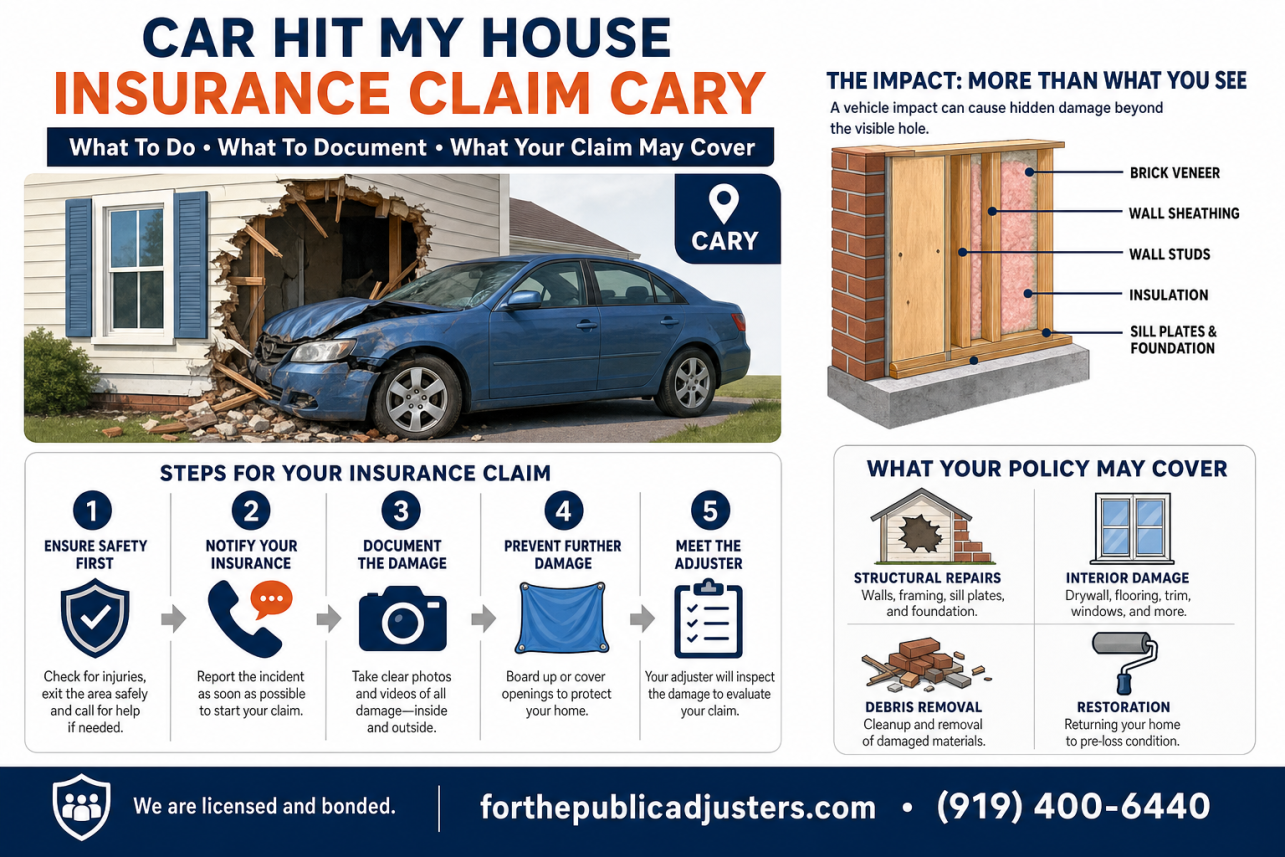
Emergency Documentation And Securing The Structure
We photograph and document the damage before temporary repairs alter the scene, then coordinate board-up and shoring so the opening is protected. That's especially urgent during summer, when an afternoon thunderstorm or a tropical system moving through Wake County can turn an impact loss into a water damage claim overnight.
Full Structural Scope And Independent Estimate
We inspect beyond the point of impact — framing alignment, foundation, brick ties, in-wall plumbing and wiring, and interior finishes — and prepare a line-item repair estimate at current local construction pricing. This becomes the foundation for every negotiation with the carrier.
Negotiation Through Settlement
We present the claim, respond to the carrier's pushback, handle supplements when hidden damage surfaces during repairs, and negotiate toward a settlement that reflects the documented loss. We never guarantee a specific outcome — no honest adjuster can — but you'll have a licensed professional on your side of the table for the entire process.
| What Happens | Filing On Your Own | With For The Public Adjusters |
|---|---|---|
| Damage scope | Carrier appraiser scopes visible damage — brick, siding, drywall — in one short visit | Engineer-backed inspection opens walls and checks framing, sill plates, piers, and foundation edge |
| Which policy pays | You're left guessing between the driver's auto liability and your homeowners coverage | We coordinate both policies, sequence the claims, and close coverage gaps when the driver is underinsured |
| Hidden structural damage | Often labeled 'pre-existing settlement' and denied | Documented with pre-loss records and crack-pattern analysis tied directly to the impact |
| Displacement costs | Loss-of-use frequently refused because the home is called 'livable' | Habitability argued in writing; hotel and living expenses claimed from the date of loss |
| Typical outcome | Quick, low settlement covering cosmetic repairs | Full-scope settlement covering structure, code upgrades, matching materials, and living expenses |
Commonly Overlooked In The Public Adjusting Industry
- Sheared or bent sill-plate anchor bolts — They sit hidden behind brick veneer and sheathing, so a curbside inspection never catches them even when the wall has shifted off its foundation connection.
- Racked framing several feet away from the impact point — Impact force travels through the structure, pushing headers and corners out of plumb in rooms the appraiser never enters.
- Cracked or spalled foundation and slab edge at the strike zone — The bumper hits low, but debris and landscaping usually cover the concrete, so nobody looks under the mulch line.
- Brick and siding matching across the whole elevation — Carriers scope a small patch, but discontinued brick or faded siding means a proper repair requires redoing the full wall face — a difference of tens of thousands of dollars.
- Ordinance and law upgrades triggered by the repair — Once the wall is opened, current Wake County code requirements apply, and that added cost is only paid if it's claimed under the right coverage.
- Gas, water, and electrical lines running inside the struck wall — A shifted stud bay can kink a gas line or crack a pipe joint that doesn't leak visibly for weeks after the settlement check clears.
- The gap between the driver's liability limit and the real repair cost — North Carolina minimum property-damage limits can run out fast on structural work, and homeowners rarely realize their own policy should cover the shortfall.
- Loss-of-use benefits when the home is technically standing — Carriers call a tarped, breached wall 'livable' to avoid hotel costs, and most homeowners never push back with a written habitability argument.
Case Studies
Case Study #1
Situation: A homeowner in the Lochmere area of Cary called us two days after a sedan jumped the curb, crossed their front lawn, and slammed into the corner of their brick-veneer garage. The driver's carrier had already sent an appraiser who looked at the wall for fifteen minutes.
Problem: The at-fault driver's auto carrier offered $14,200 — enough to re-lay the visibly cracked brick and patch drywall inside the garage. The homeowner felt the house 'didn't sound right' when the garage door ran, and the offer said nothing about the framing behind the brick.
Investigation: We brought in a structural engineer and opened the wall from the interior. We photographed the sill plate, king studs, and the corner post, then ran a level survey on the garage door header and checked the slab edge where the bumper made contact.
Findings: The impact had sheared the anchor bolts on eight feet of sill plate and racked the corner framing roughly three-quarters of an inch out of plumb. The garage door header had dropped, which is why the door bound up. None of this was visible from outside, and none of it was in the carrier's estimate.
Solution: We rewrote the scope with the engineer's report attached: temporary shoring, framing replacement, new anchor bolts epoxied into the slab, full brick-veneer rebuild on that elevation so the new masonry matched, garage door and opener replacement, and code-required upgrades under the homeowner's own policy's ordinance coverage.
Outcome: The claim settled at $87,400 between the driver's liability policy and the homeowner's own carrier, plus additional living expense for the two weeks the family relocated during shoring. That's more than six times the original offer.
Lesson: Vehicle impacts almost always damage what you can't see. Never accept a settlement for a car-into-structure loss until someone has opened the wall and checked the framing, sill plate, and foundation edge.
Case Study #2
Situation: A pickup truck lost control on a wet night off Kildaire Farm Road and hit the front porch and living-room wall of a 1990s two-story home. The driver was uninsured, so the homeowners filed under their own policy with a large national carrier.
Problem: The carrier's adjuster scoped the porch posts and siding but treated the interior cracking upstairs as 'pre-existing settlement.' The family was also told their policy wouldn't cover a hotel because the home was 'still livable' — with a tarp over a hole in the front wall in February.
Investigation: We pulled the homeowners' pre-loss listing photos and a home-inspection report from their purchase three years earlier, which showed no cracking. We then documented crack patterns radiating from the impact wall up through the second-floor drywall and had a foundation contractor measure differential movement at the crawlspace piers nearest the strike.
Findings: Two crawlspace piers had shifted, the band joist was split along six feet, and the upstairs cracks lined up exactly with the load path from the impact — not with any settlement pattern. The tarped opening also failed any reasonable habitability standard for a family with two young kids in winter.
Solution: We submitted a rebuttal package tying every crack to the impact using the pre-loss documentation, demanded pier and band-joist repairs in the scope, and formally invoked the loss-of-use coverage with a written habitability argument. When the carrier stalled, we requested a re-inspection with their staff engineer present.
Outcome: The carrier reversed its pre-existing-damage position, approved $63,900 in structural and interior repairs, and paid $6,800 in additional living expenses retroactive to the date of loss. The family moved back in eleven weeks later with the home fully restored.
Lesson: When a driver is uninsured, your own homeowners policy is the claim — and carriers scrutinize it harder. Pre-loss photos and inspection reports are gold, so gather them before the carrier labels your damage 'pre-existing.'
| Scenario | Which Policy Typically Pays | What It Depends On | Your First Move |
|---|---|---|---|
| Driver is identified and insured | Driver's auto liability (property damage) | Whether their PD limit covers the full repair — NC minimums can be far below structural repair costs | Get the police report and their carrier info, then have the full damage scoped before any offer |
| Driver is underinsured | Driver's policy up to its limit, then your homeowners for the gap | Your deductible and how the two carriers coordinate; your insurer may subrogate against the driver | File with both carriers early so neither can blame delay on the other |
| Driver is uninsured or fled the scene | Your own homeowners policy | Vehicle impact is a named peril on standard HO-3 policies; documentation quality decides the payout | Report to police immediately — a police report protects your claim even with no driver found |
| Your own car or a household member's car hit the house | Your homeowners policy in most cases, sometimes auto | Standard homeowners policies commonly exclude vehicles owned by the insured; policy language controls | Have both policies reviewed before filing so the claim goes under the right one |
| Delivery or commercial vehicle hit the house | The company's commercial auto policy | Company carriers fight scope hard and move slowly; higher limits mean more room to recover fully | Document everything before their adjuster arrives and don't give a recorded statement unprepared |
| Home is unsafe or has an open wall | Loss-of-use coverage under your homeowners policy | Whether the home meets a reasonable habitability standard — a tarped hole in winter usually doesn't | Keep every hotel and meal receipt from day one; these expenses are recoverable |
Reviews
A teenager backing out too fast put their SUV through our dining room wall in Preston. The insurance company offered us $9,000 and we honestly almost took it. For The Public Adjusters brought an engineer out who found broken studs and a cracked footing the first adjuster never even looked at. Final settlement was over $52,000 and the wall was rebuilt right, not patched.
Denise M., Cary NC
The driver who hit our house had minimum coverage and his carrier dragged their feet for weeks. These guys sorted out which policy paid what — his liability, our homeowners, the gap between them — and handled every phone call. We went from a tarped hole in our brick to a fully rebuilt front wall without me arguing with a single adjuster.
Robert T., Cary NC
After a car hit the corner of our garage near Green Hope, our own insurer said the interior cracks were 'settling.' For The Public Adjusters proved otherwise with our old inspection report and photos. Took a bit longer than I hoped, but they got the framing, brick, and garage door all covered plus our hotel costs. Worth every bit of the fee.
Karina S., Cary NC
Frequently Asked Questions
Who Pays When A Car Hit My House Insurance Claim Cary Situation Involves Both The Driver's Auto Policy And My Homeowners Policy?
In most vehicle-into-home cases in Cary, you have two potential sources of recovery: the at-fault driver's auto liability coverage and your own homeowners policy. North Carolina's minimum property damage liability limit is often not enough to cover serious structural damage, so many homeowners end up filing under their own policy and letting their carrier pursue the driver's insurer through subrogation.
The practical problem is coordination. The auto carrier may delay while it investigates fault, and your homeowners carrier may lowball the structural scope in the meantime. We frequently see Wake County claims where a load-bearing wall, foundation section, or gas line was compromised and neither carrier's initial estimate accounted for engineering, permitting, or code-required upgrades under Cary's building ordinances.
As public adjusters, we document the full damage first — structural, cosmetic, and consequential — then present that scope to whichever carrier owes the money. If the driver was uninsured or fled the scene, we help you maximize your homeowners recovery and document everything for any later legal action.
The key is not to accept a quick settlement from the auto carrier before the true repair cost is known. Once you sign a release, recovering additional money is extremely difficult, even if hidden structural damage surfaces later.
What Should I Do In The First 48 Hours After A Vehicle Crashes Into My Home In Cary?
First, make sure everyone is safe and call 911. The police report from the Cary Police Department or Wake County Sheriff's Office becomes critical evidence, so get the report number and the driver's insurance information at the scene if possible.
Second, do not let anyone move debris or start repairs until the damage is photographed thoroughly. Take wide shots and close-ups of the impact point, interior cracks, shifted framing, and anything the vehicle struck on the way in — fences, gas meters, HVAC units, landscaping.
Third, if the structure is compromised, the Town of Cary may require an inspection before the home can be occupied. Board-up and temporary shoring are covered emergency measures under most homeowners policies, so keep every receipt. You have a duty to protect the property from further damage, but that does not mean starting permanent repairs.
Fourth, notify your insurance carrier promptly, but be careful with recorded statements. Stick to facts and avoid guessing about the extent of damage — much of it is often hidden behind drywall and won't be visible for weeks.
Finally, consider bringing in a public adjuster before the carrier's adjuster inspects. When we're involved early, we control the scope documentation from day one, which typically means a stronger settlement and fewer disputes about what the vehicle actually damaged.
Why Would My Insurance Company Underpay After A Car Crashed Into My Cary Home?
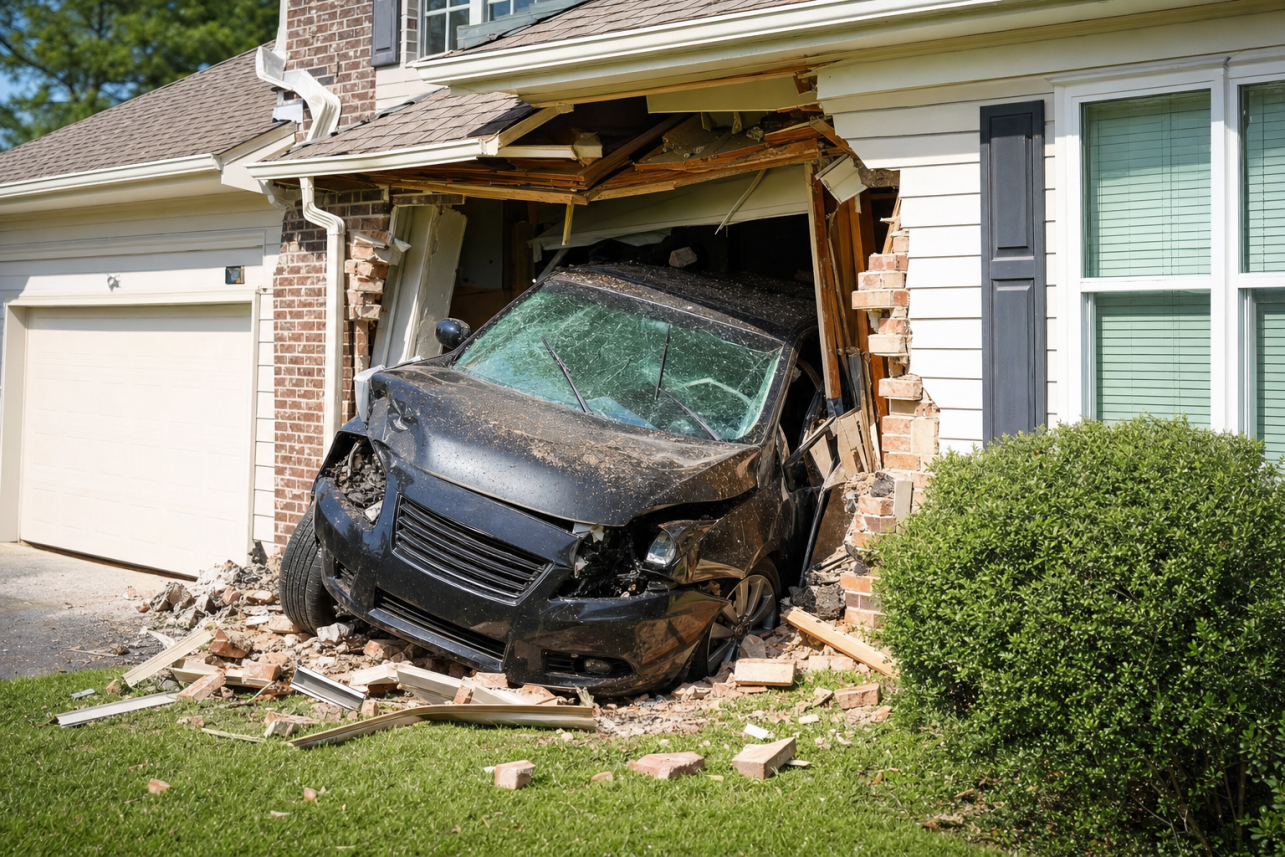
Vehicle impact claims are underpaid more often than homeowners expect, usually because the carrier's adjuster scopes only the visible damage. A car striking brick veneer or a garage wall transmits force through the framing, and cracked studs, shifted headers, and foundation movement often hide behind intact drywall.
Carrier estimates in Wake County also frequently miss code-upgrade costs. If your home was built decades ago, current Town of Cary and North Carolina building codes may require upgraded framing connections, electrical work, or egress changes during repair. Ordinance-or-law coverage exists in most policies to pay for this, but it's rarely included unless someone pushes for it.
Another common gap is matching. If the vehicle destroyed a section of brick or siding that can no longer be matched, you may be entitled to broader replacement so the home doesn't look patched. Carriers resist this, but North Carolina claims practice supports reasonable matching arguments when properly documented.
Finally, additional living expenses get overlooked. If the impact made part of your home unsafe or uninhabitable during repairs, temporary housing and related costs are typically covered.
Our job as public adjusters is to build a complete, defensible scope — often with structural engineers — and negotiate from documentation rather than accept the carrier's first number. On vehicle-impact losses, the difference between the initial offer and the properly documented claim is often substantial.
How Does A Public Adjuster Help With A Car Hit My House Insurance Claim Cary Homeowners Are Filing, And What Does It Cost?
For The Public Adjusters, Inc. represents you — not the insurance company — from the first inspection through final payment. On a car hit my house insurance claim Cary property owners face several moving parts at once: structural assessment, emergency mitigation, coordination between auto and homeowners carriers, and Town of Cary permit and inspection requirements. We manage all of it.
Our process starts with a detailed damage inspection, often alongside a structural engineer, because vehicle impacts routinely cause hidden framing and foundation damage. We then prepare a line-item estimate using the same software carriers use, so there's no dispute over methodology — only over what's actually damaged, which we prove with photos, measurements, and engineering reports.
We handle all communication with the adjusters, attend every inspection, and negotiate the settlement. If the at-fault driver's auto carrier is involved, we make sure any release you sign reflects the full repair cost, not a preliminary guess.
We work on a contingency fee — a percentage of the settlement, capped by North Carolina regulation. There are no upfront costs, and if we recover nothing, you owe nothing. In practice, professionally documented vehicle-impact claims tend to settle for significantly more than the carrier's initial offer, which is why homeowners across Cary and greater Wake County bring us in before accepting any payment.
The initial consultation and claim review are free, so you can find out where your claim stands before making any commitment.
What Hidden Structural Damage Should Be Inspected After A Car Hit My House Insurance Claim Cary Homeowners Often Overlook?
Vehicle impacts rarely stop at the visible hole in the wall. The force of a car traveling even 20 mph transfers through the framing, and we routinely find cracked studs, shifted sill plates, and racked wall sections several feet away from the point of impact in Cary homes.
Brick veneer is a common trouble spot here. Many homes in Cary neighborhoods like Preston, Lochmere, and along Kildaire Farm Road have brick facades, and impact energy travels along the brick ties, loosening veneer far beyond the crash zone. If an insurer only pays to patch the obvious hole, the loose brick becomes your problem later.
Foundation and slab damage matters too. When a vehicle jumps a curb and strikes at foundation level, the concrete footing can crack or shift. That requires a structural engineer's evaluation, not a quick visual check by a field adjuster. Plumbing lines, electrical runs, and HVAC ducts inside the struck wall also need to be opened up and verified.
Before accepting any settlement, insist on documentation of the full load path of the impact. As part of a car hit my house insurance claim Cary residents bring to us, we bring in engineers when warranted and scope every affected system so nothing gets left off the estimate. Wake County will also require permits for structural repairs, and the repair scope must satisfy current code, which the initial insurance estimate frequently ignores.
Will My Homeowners Insurance Cover A Hotel Or Rental If The Crash Makes My Cary Home Unsafe To Live In?
Yes, in most cases. Nearly every homeowners policy written in North Carolina includes Additional Living Expenses coverage, sometimes called Loss of Use. If a vehicle strike leaves your home uninhabitable, this coverage pays for a hotel, short-term rental, extra mileage, restaurant meals above your normal grocery spending, and even pet boarding while repairs are underway.
The key word is uninhabitable, and insurers interpret it narrowly. If the impact breached an exterior wall, compromised a load-bearing element, damaged the gas line, or knocked out power, you have a strong case that the home is not safe to occupy. A Wake County building inspector or fire marshal notice declaring the structure unsafe makes that argument nearly airtight, so get any official finding in writing.
Keep every receipt from day one. We see Cary families lose thousands in reimbursable expenses simply because they paid cash for meals or forgot to log hotel nights. A simple folder or phone photo of each receipt is enough.
One more point: if the at-fault driver's auto liability carrier ultimately pays the claim, your displacement costs should be included in that recovery too. We track both policies so temporary housing gets paid from whichever coverage responds first, and we push back when a carrier tries to end housing payments before repairs are genuinely complete rather than merely started.
How Long Does A Car Hit My House Insurance Claim Cary Property Owners File Typically Take To Settle?
A straightforward vehicle-into-home claim in Cary usually resolves in 30 to 90 days, but the range is wide because these claims involve moving parts most losses do not: two insurance companies, possible police reports, structural engineering, and Wake County permitting.
The first variable is which carrier pays. If you file under your homeowners policy, North Carolina rules require insurers to acknowledge and investigate promptly, and payment often comes faster because your carrier then pursues the driver's auto insurer through subrogation. Waiting on the at-fault driver's liability carrier instead can take longer, since they may investigate fault, verify the police report, and confirm policy limits before paying anything.
The second variable is repair complexity. Cosmetic siding and drywall damage settles quickly. Foundation cracks, brick veneer replacement, or load-bearing wall reconstruction require engineering reports and detailed estimates, which can add weeks. Wake County structural permits and inspections add time to the repair phase, though not necessarily to the settlement itself.
What slows a car hit my house insurance claim Cary homeowners handle alone is usually documentation gaps: missing engineer reports, incomplete scopes, or a lowball first estimate that triggers rounds of back-and-forth. When we handle the claim, we front-load the documentation so the carrier has little room to delay. If a carrier stalls without good cause, North Carolina's unfair claims settlement practices statute gives us leverage to demand movement, and we use it.
Do I Get My Deductible Back If The Driver Who Crashed Into My Home Was At Fault?
Usually yes, though not automatically and not always immediately. When you file through your own homeowners policy, you pay your deductible up front. Your insurance company then pursues the at-fault driver's auto liability carrier through a process called subrogation to recover what it paid, and your deductible is supposed to ride along with that recovery.
In North Carolina, when your carrier recovers from the responsible driver's insurer, you're generally entitled to reimbursement of your deductible from those proceeds. The catch is timing and follow-through. Subrogation can take months, and some carriers are slow to cut the deductible check even after they recover. It pays to ask for status updates in writing and to confirm your deductible is included in the subrogation demand.
There's a second path worth knowing. You can skip your homeowners policy entirely and claim directly against the driver's auto liability coverage. No deductible applies that way, but you wait on their carrier's fault investigation and you negotiate the repair scope with an insurer that owes you no contractual duty of good faith the way your own carrier does.
For most Cary homeowners with significant structural damage, we recommend filing with your own carrier for speed, then making sure the deductible recovery actually happens. If the driver was uninsured, which happens more often than people expect on busy corridors like Cary Parkway and Tryon Road, your homeowners policy is likely your only realistic source of recovery, and the deductible may not be recoverable at all.
What Happens With A Car Hit My House Insurance Claim Cary Homeowners File If The Driver Was Uninsured Or Fled The Scene?
If the driver who struck your home had no insurance, or it was a hit-and-run, you are not out of options. Your homeowners policy still responds, because vehicle impact is a named peril under virtually every HO-3 policy sold in North Carolina. You file with your own carrier first, and they handle the repair costs subject to your deductible.
When the driver is later identified, your insurer can pursue subrogation against them personally, which may eventually recover your deductible. With a true hit-and-run in Cary, a police report from the Cary Police Department is essential — file one immediately, even if the crash happened overnight and you only discovered the damage in the morning.
The complication we see most often is that carriers sometimes handle these claims less urgently because there is no auto insurer to bill. That is when scope gets trimmed: cracked foundation blocks get called pre-existing, or shifted framing gets dismissed as settling. We document the impact damage thoroughly, tie it directly to the collision, and push the claim forward on your homeowners coverage without waiting on a driver who may never be found.
One more note for Wake County homeowners: if the vehicle damaged detached structures like a fence, mailbox, or garage, those fall under Coverage B of your policy and should be itemized separately. We make sure nothing gets lumped together or left off the estimate simply because the at-fault driver disappeared.
Will My Insurance Pay For Code Upgrades When Repairing Crash Damage To My Cary Home?
It depends on your policy, and this is one of the most commonly missed dollars in a vehicle-into-home claim. When a car takes out a load-bearing wall or a section of foundation, the Town of Cary will require the rebuild to meet the current North Carolina Residential Code — not the code in place when your house was built. That can mean upgraded headers, modern anchor bolts, updated electrical in the damaged wall, and engineered repairs your original construction never had.
Standard replacement cost coverage only pays to put back what was there. The gap is covered by Ordinance or Law coverage, which most Cary homeowners carry at 10% of their dwelling limit, sometimes more, often without realizing it.
Insurance carriers rarely volunteer this coverage. Their initial estimate typically prices a like-for-like repair, and the code-required extras only surface once your contractor pulls permits through Wake County or the Town of Cary inspections department. By then, many homeowners have already accepted a settlement.
When we handle a claim where a vehicle struck a home, we review the policy for Ordinance or Law coverage on day one, get a structural engineer's repair specification early, and build code-upgrade costs into the demand before the carrier issues payment. In older Cary neighborhoods — think homes built before the mid-1990s along Maynard Road or in MacGregor Downs — code upgrades on a wall rebuild can add thousands to a proper settlement. Make sure that money is on the table before you sign anything.
Can I Hire My Own Contractor To Repair The Damage, Or Do I Have To Use The Insurance Company's Preferred Vendor?
You have the legal right to choose your own contractor in North Carolina. Your insurer may recommend a preferred vendor from its managed repair program, and adjusters sometimes present that as the required path — it is not. The carrier's obligation is to pay the fair cost of proper repairs; who performs them is your decision.
There are real trade-offs to think through. Preferred vendors typically work at pre-negotiated rates and warranty their work through the carrier, which is convenient. But their scope is often written to match the insurer's estimate, not necessarily everything the structure actually needs. With vehicle impact damage, that matters, because proper repair frequently involves structural engineering, temporary shoring, and masonry work that a general program vendor may underprice or skip.
An independent Cary contractor who works for you answers to you, and their estimate becomes evidence of what the repair genuinely costs. When there is a gap between your contractor's number and the carrier's, that is precisely where a public adjuster earns their keep — we reconcile the two scopes line by line and negotiate the difference.
Our advice for Wake County homeowners: get at least one independent estimate from a contractor experienced in structural crash repairs before accepting any settlement, verify their NC general contractor license, and never let anyone start permanent repairs until the full scope of damage is documented. Once walls are closed up, proving what was broken becomes much harder.
Will Filing A Claim After A Vehicle Crashed Into My Home Raise My Homeowners Insurance Rates?
This is the fear that keeps some homeowners from filing at all, and it deserves a straight answer. A car hit my house insurance claim Cary residents file is a not-at-fault, sudden-peril claim — you did nothing to cause it, and insurers know that. In North Carolina, carriers generally cannot non-renew you solely for a single weather or third-party loss, and vehicle impact falls squarely into that category.
That said, the claim will appear on your CLUE report, the industry database insurers check when pricing policies. Some carriers apply claim-frequency surcharges regardless of fault, while others exclude not-at-fault losses from rating entirely. If your carrier successfully subrogates against the driver's auto insurer and recovers what it paid, many companies then code the claim as closed with full recovery, which further reduces any rating impact.
Here is the practical math: crash damage to a home in Cary routinely runs $30,000 to $100,000 or more once structural repairs, engineering, and code upgrades are counted. Even a worst-case premium increase over three to five years is a small fraction of that. Absorbing a five-figure repair out of pocket to protect a premium almost never makes financial sense.
If you are worried about it, ask your agent in writing how your carrier treats not-at-fault property claims for rating purposes before renewal. And make sure the claim file clearly documents the driver's fault — that paper trail is what supports subrogation and protects you when the policy renews.
What Documentation Do I Need To Support A Car Hit My House Insurance Claim Cary Adjusters Will Actually Pay In Full?
Start with the police report. The Cary Police Department or Wake County Sheriff's Office will document the driver, their insurance carrier, and the circumstances of the impact. That report is the foundation of everything that follows, so request a copy right away.
Next, photograph everything before any cleanup begins. Capture the vehicle's resting position if possible, the point of impact, cracked brick or siding, shifted framing, interior wall cracks, and any damaged belongings. Take wide shots and close-ups, and keep the timestamps intact.
Beyond photos, gather your homeowners policy declarations page, receipts for emergency board-up or tarping, and any invoices for temporary repairs. If you had recent renovations, pull those contracts too — they prove your home's pre-loss condition and value.
The piece most homeowners miss is an independent damage assessment. A structural engineer's report carries far more weight with insurers than a carrier adjuster's walkthrough, especially when the impact may have compromised load-bearing walls or the foundation. Our team coordinates these inspections regularly for Cary homeowners and knows which local engineers document vehicle-impact damage thoroughly.
Finally, keep a written log of every phone call, email, and adjuster visit, including names and dates. If the carrier later disputes what was said or delays the claim, that paper trail becomes leverage. Well-organized documentation is often the difference between a fast, fair settlement and months of back-and-forth.
Does Coverage Extend To My Fence, Mailbox, Garage, Or Landscaping If The Vehicle Hit Those Instead Of The House Itself?
Yes, in most cases. Standard homeowners policies in North Carolina include coverage for "other structures" — typically detached garages, fences, sheds, retaining walls, and similar features — usually up to 10% of your dwelling coverage limit. So if a driver plows through your fence or clips your detached garage in a Cary neighborhood, that damage is generally covered even though the main house was untouched.
Landscaping is trickier. Trees, shrubs, and plants damaged by a vehicle are usually covered, but policies often cap payouts at around $500 per tree or plant and 5% of your dwelling limit overall. Mature landscaping common in established Cary subdivisions like Lochmere or Preston can be worth far more than those caps, which is one reason we push to recover from the at-fault driver's auto liability policy first — auto liability has no such landscaping cap.
Hardscaping matters too. Driveways, walkways, irrigation systems, and low brick walls are frequently damaged in these incidents and frequently left off the carrier's initial estimate. We document every element of the property, not just the obvious structural hit.
One more note: if the vehicle damaged both the house and detached structures, those losses draw from separate coverage buckets, and the math on deductibles and limits gets complicated fast. Reviewing the full policy before accepting any payment protects you from leaving covered damage on the table.
Should I Give A Recorded Statement To The Driver's Auto Insurance Company After A Crash Into My Cary Home?
Be very careful here. You are not required to give a recorded statement to the at-fault driver's auto insurer, and doing so without preparation can hurt your recovery. Their adjuster's job is to minimize what that carrier pays, and recorded statements are often mined for anything that shifts blame or downplays the damage.
Common traps include questions about pre-existing cracks in your foundation or walls, whether the home "seems fine" to live in, and casual estimates of repair costs before any professional inspection has happened. An offhand comment like "it doesn't look too bad" can resurface months later to justify a lowball offer, even after an engineer finds shifted framing behind the drywall.
Your own homeowners policy is different — it typically requires cooperation, which may include a statement. But even then, you're entitled to have a licensed public adjuster present and to prepare beforehand so you describe the loss accurately and completely.
Our recommendation for Wake County homeowners is simple: report the facts of the incident promptly, but decline recorded statements to the third-party auto carrier until you've had the property professionally inspected and understand the full scope of damage. Once we're representing a homeowner, insurers direct those communications through us, which removes the pressure entirely. There's no penalty for saying "I'd like my representative involved before any recorded interview." A legitimate adjuster will respect that — and it protects the value of your claim.
Can I Reopen The Claim If Contractors Find More Damage After The Settlement Check Arrives?
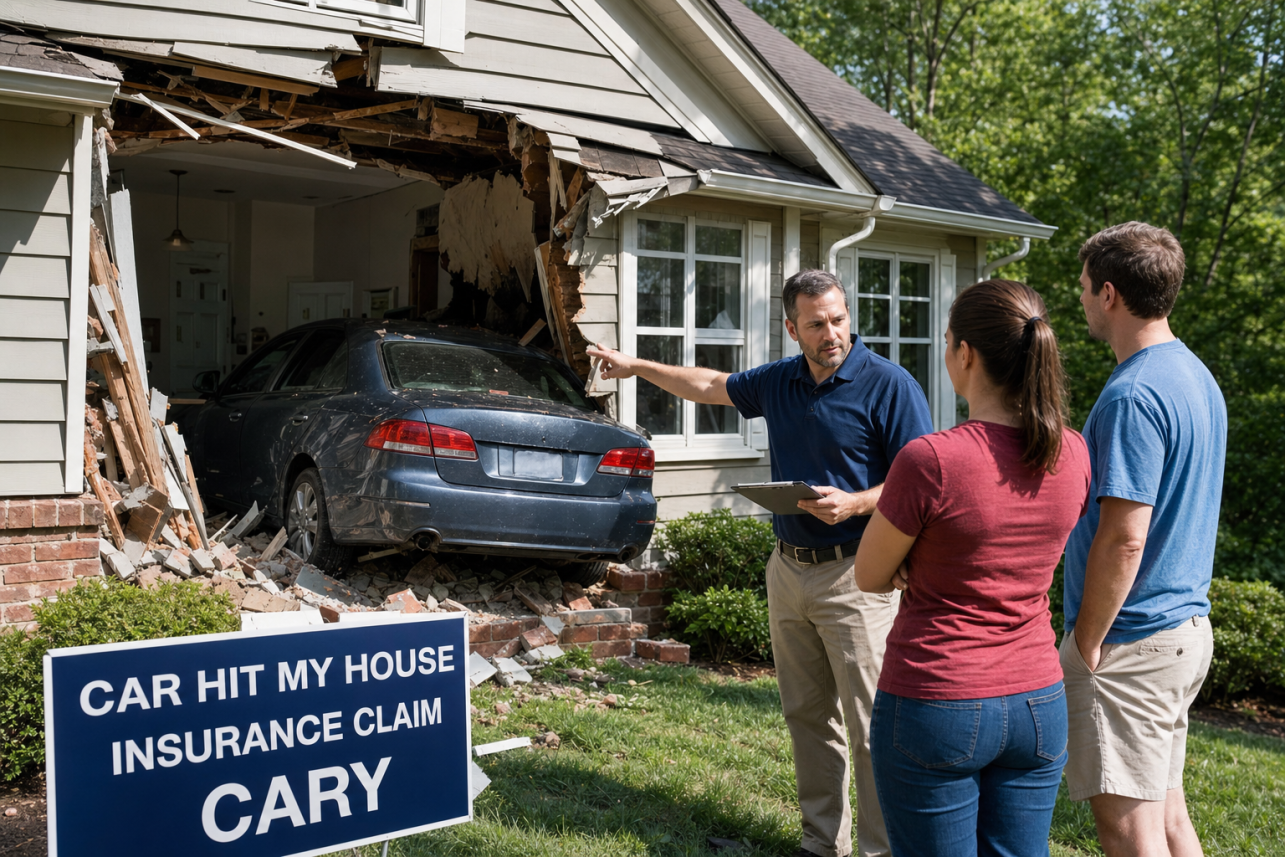
Usually, yes — through what's called a supplemental claim. Vehicle impacts are notorious for hidden damage: cracked footings, racked wall framing, sheared anchor bolts, and plumbing or electrical lines damaged inside the wall cavity. Much of this only surfaces once demolition begins, well after the carrier's first estimate was written.
When your contractor opens up the wall and finds more, document it immediately with photos and a written scope from the contractor, then notify the insurer in writing before that damage gets repaired or covered up. Carriers will want to inspect the newly discovered damage themselves, and repairing it first can give them grounds to deny the supplement.
Be aware of deadlines. North Carolina policies typically require claims and supplements to be pursued within the timeframe stated in the policy, and cashing a check marked as "final settlement" can complicate things — though it rarely closes the door completely, despite what some adjusters imply. Read any release language carefully before signing anything.
This is one of the most common reasons Cary homeowners call us after trying to handle things alone. A car hit my house insurance claim Cary carriers initially settled for $30,000 can legitimately grow to double that once concealed structural damage is properly scoped. For The Public Adjusters, Inc. prepares supplemental claims with engineering documentation and line-item estimates the carrier can't easily dismiss, and we handle the negotiation so the additional payment reflects what the repair actually costs — not what the first drive-by estimate assumed.
Local Relevance
Cary has grown fast, and that growth means busy suburban corridors running right past established neighborhoods. Homes near collector roads, corner lots at cul-de-sac entrances, and houses with garages facing the street see most of the area's vehicle-into-home incidents — often a driver misjudging a turn, a medical event, or a summer storm making pavement slick.
The region's building stock adds complications. Many Cary homes were built from the 1980s through the 2000s with brick veneer or vinyl siding that's since been discontinued, which makes matching a central fight in these claims. And because we're squarely in hurricane and severe-thunderstorm territory, an unsecured impact opening in July or August can invite wind-driven rain and turn one claim into two.
We handle the related losses that often follow — water damage, tree damage, wind damage, and residential homeowners claims — so a single incident doesn't fragment into three underpaid claims. North Carolina policyholders can also confirm any public adjuster's license through the state's Department of Insurance before hiring anyone.
Because so many Cary subdivisions were built in waves during the 1980s–2000s, the brick and siding on impact-damaged elevations often can't be matched from today's suppliers — which means a proper claim frequently needs to cover re-cladding a full wall section, not just patching the hole, and that scope difference is where most of these settlements are won or lost.
A Vehicle Hit Your Home? Get Your Own Adjuster Before You Settle
The insurance company has professionals working the claim from day one — you should too. For The Public Adjusters, Inc. is licensed and bonded, and we represent Cary homeowners on the property side of vehicle-impact losses, from emergency documentation through final negotiation. The initial consultation is a conversation, not a commitment.
Call us: (919) 400-6440
Helpful Resources
- NCDOI Public Adjusters Guide
- Insurance Information Institute (III)
- National Association of Insurance Commissioners (NAIC)
- North Carolina Department of Insurance — Verify public adjuster licensing and consumer guidance for NC policyholders
- Insurance Information Institute — Plain-language education on homeowners coverage and the claims process
Last updated: July 18, 2026