
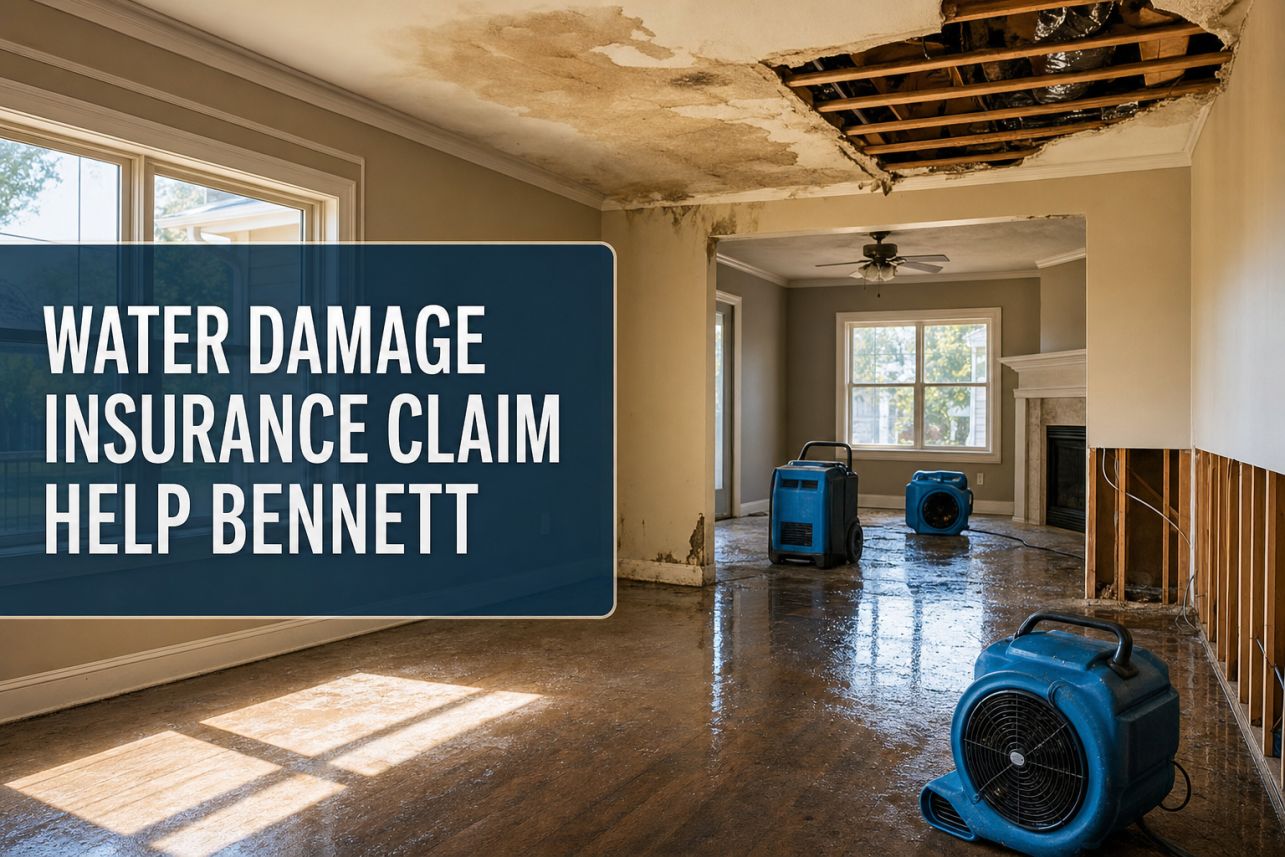
Water damage insurance claim help Bennett homeowners can count on starts with a licensed public adjuster who works for you, not the insurance company. For The Public Adjusters, Inc. documents the full scope of your loss — including the damage hiding under floors and behind walls — prepares the proof of loss your policy requires, and negotiates directly with your insurer. If your claim has been denied, delayed, or underpaid, we step in at any stage. We are licensed and bonded, and we only get paid when you do.
What This Service Is
A public adjuster is the policyholder’s own claims professional. When a pipe bursts, a water heater lets go, or a roof leak soaks your ceiling, your insurance company sends its own adjuster to inspect the damage. That person works for the insurer. We do the opposite: we read your policy line by line, measure and photograph every affected room, price the repairs at real local costs, and build the documentation your carrier must respond to.
Water losses are deceptive. Water travels down and sideways, wicking into wall cavities, subfloors, and insulation where a quick visual inspection never looks. In Bennett’s climate, damp building materials can start growing mold within days, turning a modest leak into a much larger loss. We assess structural damage, contents damage, and the emergency drying costs you paid out of pocket, so nothing gets left off the claim.
We also make sense of the fine print — your deductible, your coverage limits, and the difference between actual cash value and replacement cost. Many policies pay a depreciated amount first and hold back the rest until repairs are done, and homeowners routinely leave that recoverable money on the table. Courts have pushed back on aggressive depreciation, too: in Lammert v. Auto-Owners Insurance Co., the Tennessee Supreme Court sided with policyholders whose buildings were damaged, ruling the insurer could not depreciate labor costs when calculating actual cash value.
That is exactly the kind of policy-language fight where having your own adjuster matters. We handle water damage claims alongside fire, smoke, tree damage, and flood insurance claims, for both homes and commercial buildings, throughout Chatham County — the same work our team does on a public adjuster water damage in Bear Creek file just up the road.
Common Problems
Why Is My Insurance Offer Thousands Less Than My Contractor’s Repair Estimate?
This gap is the single most common complaint we hear. The insurer’s estimate often prices repairs at rates no working contractor in rural Chatham County will actually accept, omits tear-out and drying steps, and applies a heavy depreciation deduction to what’s left.
Then your deductible comes off the top, and suddenly a $22,000 repair becomes an $8,000 check. That difference is your out-of-pocket cost unless someone challenges the numbers. We rebuild the estimate item by item — demolition, drying, materials, labor, contents — and push for what the policy actually owes. The same underpayment pattern shows up in nearly every water insurance claim in Siler City and across the county.
Water Damage Insurance Claim Help Bennett Homeowners Need When A Claim Is Denied Or Stalled
Denials usually hinge on a few arguments: the damage was “gradual” rather than sudden, the water came from outside (flood, which most homeowners policies exclude), or the paperwork wasn’t filed correctly. A denial letter is not the end of the road — it’s the insurer’s opening position.
We review the denial against your actual policy language, gather the evidence the first inspection missed, and file a proper proof of loss. If your claim is stuck in limbo instead of denied outright, we press the carrier on the settlement timeline so months of silence don’t become the norm. If the water truly was rising floodwater, that’s a separate claim under the National Flood Insurance Program, and we handle those too. When negotiation isn’t enough, we can bring in insurance dispute lawyers — the same escalation path we use on a water damage claim dispute in Clayton.
Can’t I Just Deal With The Insurance Company Myself?
You can — and for a very small, simple loss, you might be fine. But water claims are rarely simple. Hidden moisture, mold, disputed causes, and depreciation math all favor the side that handles claims every day, and that isn’t the homeowner.
When you’re choosing help, verify the adjuster is licensed by the state. The NCDOI Public Adjusters Guide explains what public adjusters may and may not do in North Carolina, including caps on fees — read it before you sign anything with anyone. A good adjuster shows you their scope of loss, explains your policy in plain English, and never promises a specific dollar outcome, because no honest professional can. We’re licensed, bonded, and paid a percentage of what you recover, so our interests line up with yours from day one.

Our Process
Free Policy And Damage Review
We start with a no-cost look at your policy and your loss. We identify what’s covered, what exclusions the carrier might raise, your coverage limits, and whether you’re insured on a replacement-cost or actual-cash-value basis. You’ll know where you stand before committing to anything.
Full Documentation And Proof Of Loss
We inspect and measure every affected area, including crawl spaces, wall cavities, and subfloors where moisture hides. We photograph the damage, inventory ruined contents, capture your emergency mitigation receipts, and prepare a detailed repair estimate and the formal proof of loss your policy requires.
Negotiation And Settlement
We present the claim to your insurer, attend the company adjuster’s inspection alongside you, and negotiate every disputed line item. If the carrier lowballs or stalls, we escalate — supplemental claims, appraisal, or referral to insurance dispute attorneys when the facts call for it. You stay informed at every step.
| What Happens | Filing on Your Own | With For The Public Adjusters |
|---|---|---|
| Damage documentation | Photos on your phone; hidden moisture usually missed | Moisture mapping, thermal imaging, and readings inside wall cavities |
| Estimate scope | Whatever the carrier’s adjuster writes in one visit | Independent line-item estimate covering every wet assembly |
| Policy interpretation | You take the carrier’s word on exclusions | Coverage arguments built on the actual policy language |
| Negotiation | You against a trained claims professional | Licensed adjuster negotiating on your behalf at every stage |
| Denials and lowball offers | Often accepted as final | Formal rebuttals, re-inspections, and appraisal when needed |
| Your time | Weeks of calls, emails, and re-inspections | We handle the carrier; you handle your life |
Commonly Overlooked In The Public Adjusting Industry
- Moisture trapped inside wall cavities and under flooring — Carrier adjusters typically inspect only visible surfaces, so water sitting behind drywall or under vinyl plank never makes it into the estimate.
- Matching coverage for continuous flooring — Insurers offer to patch one wet room, ignoring policy provisions that may require replacing connected flooring so the finished result matches.
- The difference between ‘sudden discharge’ and ‘gradual seepage’ — Carriers lean on the seepage exclusion whenever a leak isn’t discovered immediately, even when the actual failure was a single sudden break.
- Crawlspace joists, subfloor, and insulation — Water follows gravity, but nobody crawls under the house during a quick inspection, so structural drying below the floor gets left out entirely.
- Cabinet toe kicks and box bottoms that wicked water — Particleboard cabinets absorb water from below and swell later, long after the estimate was written around cabinets that ‘looked fine.’
- Premature closeout of drying equipment — Mitigation companies paid by the carrier sometimes pull dehumidifiers on schedule rather than at dry standard, leaving hidden moisture that becomes mold.
- Code-upgrade and ordinance coverage during rebuild — Repairs that trigger current code requirements cost more than like-for-like replacement, and that gap is only paid if someone claims it under the ordinance provision.
- Additional living expenses during tear-out — Homeowners don’t realize the policy may pay for temporary housing and extra costs while their kitchen or bathrooms are unusable, so they never file for it.
Case Studies
Case Study #1
Situation: A family on a wooded lot off Bennett’s main crossroads came home from a weekend away to find their upstairs bathroom supply line had failed. Water had run for nearly two days, soaking the hall, two bedrooms, and the kitchen ceiling below.
Problem: Their carrier’s adjuster inspected quickly, wrote an estimate for drying and repainting, and offered just under $9,400. The offer ignored buckled hardwood in the hallway, saturated insulation in the ceiling cavity, and cabinets that had wicked water up through the toe kicks.
Investigation: We brought in moisture meters and a thermal camera and mapped every wet assembly, room by room. We pulled baseboard in three locations to document moisture readings inside the wall cavities, photographed the swollen cabinet boxes, and reviewed the policy for matching and code-upgrade provisions.
Findings: Moisture readings behind the drywall were well above dry standard even after the mitigation company left, meaning the drying scope had been closed out too early. The hardwood could not be spot-repaired without a visible mismatch, and the kitchen cabinets were particleboard that had already delaminated.
Solution: We wrote a complete replacement estimate covering continuous hardwood flooring, full lower-cabinet replacement, ceiling insulation, and proper containment for the tear-out. We then presented the moisture documentation to the carrier and requested a re-inspection with our findings in hand.
Outcome: The claim settled at $46,800 — roughly five times the original offer. The family replaced the flooring throughout the connected areas instead of patching one hallway, and the kitchen was rebuilt with matching cabinetry.
Lesson: The first estimate after a pipe burst almost always reflects what an adjuster could see in a twenty-minute walkthrough, not what the water actually touched. Documented moisture readings change the conversation entirely.
Case Study #2
Situation: A retired couple outside Bennett, near the Chatham County line, discovered a slow leak under their kitchen sink had been dripping into the crawlspace for weeks. Subfloor was soft underfoot and a musty smell had spread through the house.
Problem: The insurance company denied the claim outright, calling it long-term seepage excluded under the policy. The couple assumed the denial was final and were preparing to pay out of pocket for repairs they couldn’t easily afford.
Investigation: We reviewed the denial letter against the actual policy language and had a plumber document the failed compression fitting. We established a timeline showing the fitting failure was a sudden event, then separated the resulting damage from any pre-existing wear.
Findings: The policy excluded gradual seepage, but the plumber’s report showed a distinct fracture point in the fitting — a sudden and accidental discharge, which was covered. The carrier’s denial had also never addressed the crawlspace, where joists and insulation were damaged and mold growth had started.
Solution: We filed a formal rebuttal with the plumbing report, photos, and policy citations, and demanded a re-inspection that included the crawlspace. We scoped subfloor replacement, joist sistering, insulation, mold remediation, and refinishing of the kitchen above.
Outcome: The denial was reversed and the claim paid at $31,200, including the remediation work. The couple’s out-of-pocket cost was limited to their deductible.
Lesson: A denial letter is an opening position, not a verdict. The difference between excluded ‘seepage’ and covered ‘sudden discharge’ often comes down to who documents the failure point first.
| Scenario | Typically Covered? | What It Depends On | First Step |
|---|---|---|---|
| Burst pipe or supply line failure | Usually yes | Whether damage is called ‘sudden’ vs. ‘gradual’ — and who proves it | Shut off water, keep the failed part, photograph everything before cleanup |
| Water heater or appliance leak | Often yes | How long it leaked and whether the carrier claims neglect | Save the appliance and any failed fitting as evidence |
| Slow leak found weeks later | Frequently disputed | Pinpointing a sudden failure point rather than accepting ‘seepage’ | Get a plumber’s written report before the carrier inspects |
| Roof leak after a storm | Usually yes for interior damage | Proving storm-created opening vs. wear and tear on the roof | Document the roof breach and the interior damage the same day |
| Sewer or drain backup | Only with an endorsement | Whether your policy carries a water backup rider and its limit | Check your declarations page before assuming denial is correct |
| Groundwater or rising flood water | No — standard policies exclude it | Whether a separate flood policy exists | Identify the true water source; carriers sometimes mislabel plumbing losses as ‘flood’ |
| Mold following a covered leak | Often, within a sublimit | Whether mold traces back to the covered water event | Get moisture and mold documented before remediation removes the proof |


Reviews
Our water heater let go in the middle of the night and flooded half the downstairs. The insurance company’s first number wouldn’t have covered the flooring, let alone the drywall. For The Public Adjusters found wet insulation the carrier’s guy never checked and got the whole scope rewritten. The final settlement was more than triple the first offer.
Denise H.
I called them after my claim for a burst pipe in Bennett got denied as ‘gradual damage.’ They read the policy line by line, got a plumber’s report on the actual break, and had the denial overturned in about six weeks. I honestly thought the denial was the end of it. It wasn’t.
Marcus T.
Washer supply hose failed while we were at work — laundry room, hallway, and the ceiling of the garage below all soaked. The adjuster they sent handled every call with the carrier and every re-inspection so I didn’t have to argue with anyone. Only wish I’d found them before I spent two weeks going back and forth on my own.
Karen W.
Frequently Asked Questions
How Soon Should I Look For Water Damage Insurance Claim Help Bennett Homeowners Can Actually Rely On?
The honest answer is immediately — ideally before you file the claim, and certainly before you accept any settlement offer. The first 48 to 72 hours after a pipe burst, roof leak, or appliance failure are when the most important documentation happens, and it’s also when insurers start building their version of events.
When you bring us in early, we photograph and moisture-map the damage before drying equipment alters the evidence, inventory affected contents room by room, and make sure your mitigation steps meet the policy’s requirements so the carrier can’t argue you failed to protect the property.
That said, it’s never too late. Many Bennett and Chatham County homeowners call us after receiving a lowball estimate or an outright denial, and we regularly reopen and supplement those claims. Under North Carolina rules, you generally have time to dispute a settlement, and claims can often be supplemented when hidden damage — like saturated subflooring or mold behind drywall — surfaces weeks later.
If water is actively entering your home right now, stop the source, take wide and close-up photos of everything, keep damaged materials rather than throwing them out, and then call us. We serve Bennett and the surrounding rural Chatham County area, and we know how the carriers that write most policies around here tend to handle water losses. Early involvement almost always means a stronger claim and a faster, fairer payout.
What Does A Public Adjuster In Bennett Actually Do That My Insurance Company’s Adjuster Won’t?
Your insurance company’s adjuster works for the carrier. That’s not an accusation — it’s simply their job. They evaluate the loss with the insurer’s interests in mind, and their estimates often rely on pricing software settings and scope decisions that favor a lower payout.
A public adjuster works exclusively for you, the policyholder. When For The Public Adjusters, Inc. handles a water loss in Bennett, we start by reading your actual policy — including endorsements, water damage sublimits, and mold caps that most homeowners have never seen. Then we build an independent damage estimate.
That estimate is where the difference shows up. Carrier adjusters frequently miss moisture that has wicked up into wall cavities, insulation that must be replaced rather than dried, hardwood flooring that will cup weeks after the loss, and code-upgrade costs common in older Chatham County homes. We use moisture meters and thermal imaging to document what the eye can’t see, and we price the repair scope at real local contractor rates.
We also handle every phone call, letter, inspection, and negotiation, so you’re not spending your evenings arguing with a claims department. Fees are contingency-based — a percentage of what we recover — so our incentive is aligned with yours. For most water losses we handle, the difference between the initial offer and the final settlement more than covers our fee.
My Water Damage Claim In Bennett Was Denied Or Underpaid. Can That Decision Be Reversed?
In many cases, yes. A denial letter is the carrier’s opinion, not the final word, and underpaid water claims are among the most common files we successfully rework for Chatham County homeowners.
The first step is figuring out why the claim came up short. Common reasons around Bennett include the carrier labeling a sudden pipe failure as “long-term seepage” (which most policies exclude), disputing whether the water source is covered, applying a water damage sublimit incorrectly, or simply scoping the repairs too narrowly — drying a floor that actually needs replacement, or painting over drywall that should come out.
Once we identify the weak point in the carrier’s position, we build the counter-case. That may mean bringing in a leak-detection specialist or plumber to document that the failure was sudden, pulling moisture readings that contradict the carrier’s inspection notes, or producing a line-item estimate that exposes everything their scope left out. We then submit a formal supplement or dispute and negotiate directly with the adjuster or their supervisor.
If negotiation stalls, most North Carolina policies include an appraisal clause — a formal dispute-resolution process that resolves pricing disagreements without a lawsuit. We prepare and present appraisal cases regularly.
Bring us your denial letter, the carrier’s estimate, and your photos. The review costs you nothing, and we’ll tell you plainly whether the claim is worth pursuing. Many of the denials we see are reversible with the right documentation.
How Much Does Professional Water Damage Insurance Claim Help Bennett Residents Hire Actually Cost?
For The Public Adjusters, Inc. works on contingency, which means there is no upfront cost and no hourly billing. Our fee is a percentage of the insurance settlement we recover for you, agreed to in writing before we start. If we don’t recover anything, you owe us nothing.
That structure matters for water losses in particular, because they’re the claims carriers most often underpay. Water spreads into places a quick walkthrough won’t catch — under vinyl flooring, behind baseboards, into crawlspaces common in Bennett-area homes. When the initial offer covers only the visible damage, the gap between that offer and the true cost of repair can run into the tens of thousands of dollars. Our fee comes out of the additional recovery, and in the large majority of files we handle, homeowners net significantly more even after paying us.
The percentage varies with the size and complexity of the claim, and North Carolina regulates public adjuster contracts, so everything is disclosed and signed before any work begins. There are no hidden charges, and you can review the agreement with anyone you like first.
The initial consultation is free. We’ll look at your policy, your damage, and any carrier correspondence, then tell you honestly whether your claim is being handled fairly. Sometimes the answer is that the offer is reasonable and you don’t need us — and we’ll say so. When the numbers are off, we’ll show you exactly where and by how much before you commit to anything.
What Types Of Water Damage Does Homeowners Insurance Typically Cover In Bennett, And What Gets Excluded?
Most homeowners policies in Chatham County cover sudden, accidental water damage. That includes burst pipes, water heater failures, washing machine hose ruptures, and wind-driven rain entering through storm-damaged roofs. If the event was abrupt and unexpected, you generally have a valid claim.
What carriers exclude is where disputes start. Gradual leaks, long-term seepage, groundwater intrusion, and flooding from rising surface water are usually not covered under a standard policy. Flood damage requires a separate NFIP or private flood policy, which matters in low-lying areas around Bennett where heavy summer storms can push water toward foundations.
The gray areas are where a Bennett public adjuster earns their fee. Insurers frequently label a sudden pipe failure as “long-term seepage” to deny the claim, or blame pre-existing wear and tear. We inspect the plumbing, review moisture readings, and document the actual failure point to prove the loss was sudden and accidental as the policy requires.
We also make sure covered consequential damage isn’t missed. Even when the leaking pipe itself isn’t covered, the resulting damage to drywall, flooring, cabinets, and insulation often is. Reading the policy language carefully, endorsement by endorsement, is how families in this area recover what they’re actually owed instead of what the carrier volunteers.
What Documentation Should I Gather Before Filing, And Can Water Damage Insurance Claim Help Bennett Providers Handle That For Me?
Yes. Handling documentation is the core of what water damage insurance claim help Bennett homeowners receive from our team, and it starts the moment you call. Before anything is thrown away or dried out, we want photos and video of standing water, saturated materials, the source of the leak, and every affected room from multiple angles.
Beyond photos, strong claims in Chatham County are built on moisture mapping, thermal imaging, and a detailed inventory of damaged contents with approximate purchase dates and values. Keep every receipt, including emergency plumber invoices, water extraction bills, fans and dehumidifiers, and hotel stays if the home was unlivable.
Do not discard damaged items before the insurance company has had a chance to inspect them, or before we’ve documented them thoroughly on your behalf. Tossing a failed water heater or a section of burst pipe can give the carrier an excuse to question the cause of loss.
When For The Public Adjusters, Inc. takes over a claim, we compile all of this into a professional damage estimate using the same estimating software carriers use. That means the adjuster on the other side can’t dismiss your numbers as guesswork. Homeowners who document poorly in the first 48 hours routinely leave thousands unclaimed, so the earlier we’re involved, the stronger your file.
How Long Does A Water Damage Claim In Bennett Usually Take From Filing To Final Payment?
Straightforward claims with cooperative carriers often resolve in 30 to 60 days. That timeline assumes clear coverage, complete documentation, and no dispute over the scope of repairs. Unfortunately, many Bennett homeowners experience something slower, especially after regional storms when carriers are juggling high claim volumes across Chatham County.
Contested claims run longer. If the insurer disputes the cause of loss, demands multiple inspections, or lowballs the repair estimate, the process can stretch to four to six months without professional pressure. Delays often come from the carrier requesting the same documents repeatedly or letting the file sit between adjuster reassignments.
Our involvement typically shortens that timeline, not lengthens it. We submit a complete, software-based estimate up front, respond to carrier requests the same week, and cite specific policy provisions and state prompt-payment requirements when the insurer stalls. A well-documented claim gives the carrier fewer reasons to delay.
One timing detail that catches people off guard: many policies pay in stages. You may receive an actual cash value payment first, with recoverable depreciation released only after repairs are completed and documented. We track those holdback amounts for Bennett clients so no portion of the settlement is quietly left on the table. If your claim has already dragged past 60 days with no clear answer, that’s usually a sign it needs professional intervention.
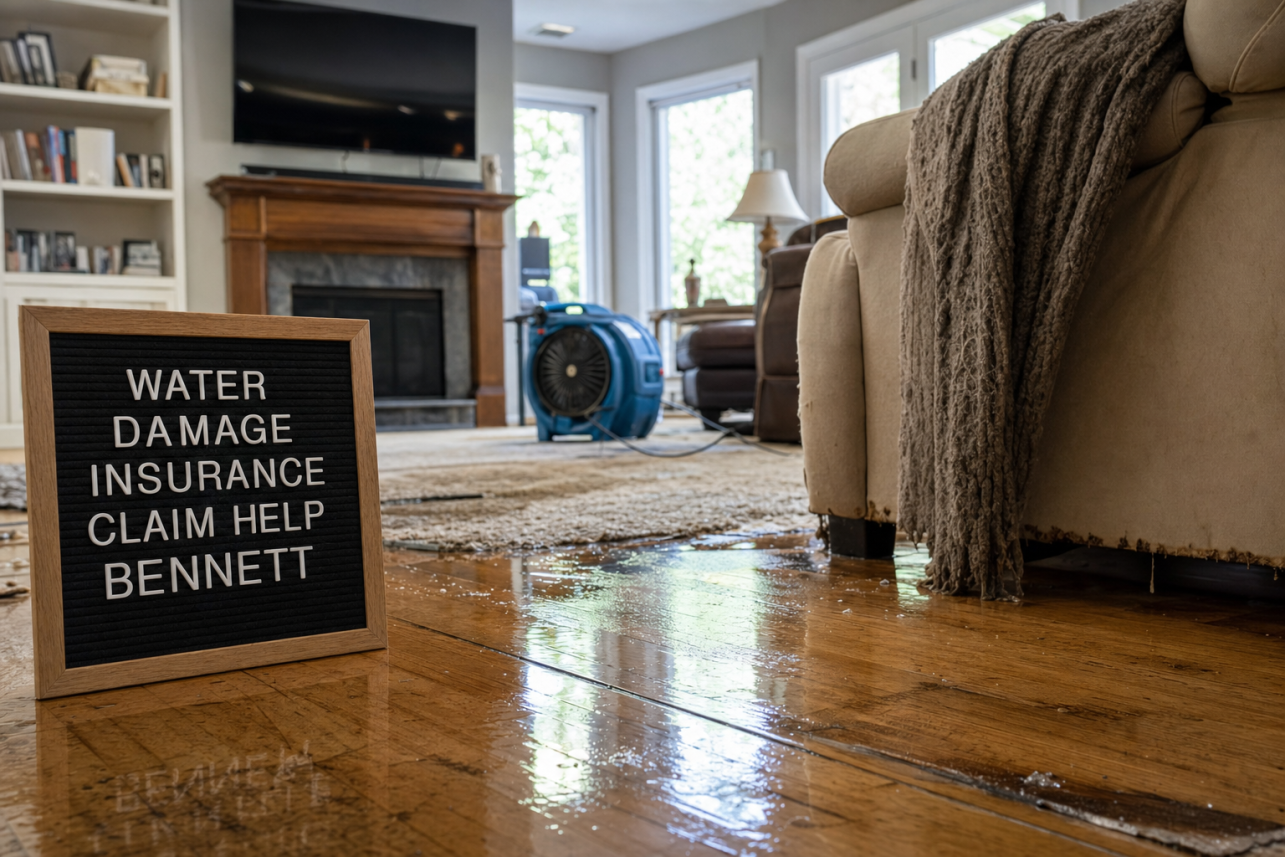
Water Sat In My Bennett Home Before It Was Found. Will Mold And Hidden Damage Still Be Covered?
Often yes, but these claims require careful handling. When a pipe leaks behind a wall or a slow drip runs while you’re away, water wicks into framing, subfloors, and insulation long before anyone notices. Carriers frequently try to deny these losses as “gradual damage,” even when the underlying pipe failure was sudden.
The key legal and technical question is when the failure occurred, not when you discovered it. A pipe that burst suddenly is still a covered event even if the water sat for days. We use moisture meters, thermal cameras, and where needed, plumbing experts to establish that the cause of loss fits your coverage.
Mold is its own battleground. Many policies in this area include mold coverage but cap it, sometimes at $5,000 or $10,000, and carriers try to funnel as much of the loss as possible under that cap. Part of the water damage insurance claim help Bennett families get from For The Public Adjusters, Inc. is separating true mold remediation costs from the water damage repairs, so the cap only applies where the policy actually says it does.
Bennett’s humid summers make hidden moisture especially dangerous, since mold can develop within 48 to 72 hours. If you suspect concealed damage, don’t open walls yourself. Let us document conditions properly first so nothing about the discovery can be used against your claim.
Should I Start Emergency Repairs On My Bennett Home Before The Insurance Adjuster Arrives?
Yes — in fact, your policy requires it. Every homeowners policy includes a duty to mitigate, which means you must take reasonable steps to stop the damage from getting worse. Shutting off the water supply, extracting standing water, and setting up drying equipment are all expected of you, and the insurer can reduce your payout if you don’t.
What you should NOT do is make permanent repairs or throw anything away before the loss is documented. Photograph everything first: the source of the leak, the water line on walls, soaked flooring, damaged belongings. Keep every receipt for tarps, fans, dehumidifiers, and any emergency plumbing work, because those costs are typically reimbursable.
This is where professional water damage insurance claim help Bennett homeowners bring in early makes a real difference. We coordinate with your mitigation contractor so the drying process doesn’t accidentally destroy evidence the claim depends on, like moisture readings and material samples. Around Chatham County, where many homes have crawlspaces and older subfloors, that documentation often reveals damage the carrier’s adjuster would never crawl under the house to find.
A good rule of thumb: stabilize, document, then repair. If a restoration company pressures you to sign a work authorization for full reconstruction before the claim is scoped, slow down. Once materials are ripped out and hauled away, proving the full extent of your loss becomes much harder, and the insurer knows it.
My Insurance Company Wants Me To Use Their Preferred Restoration Contractor In Bennett. Do I Have To?
No. In North Carolina, you have the right to choose your own contractor, and the carrier cannot require you to use a vendor from their preferred network. Those programs exist primarily to control the insurer’s costs — the contractor answers to the company sending them steady referrals, not necessarily to you.
That doesn’t mean every network contractor does bad work. But we’ve seen scopes from preferred vendors around Chatham County that skip things a homeowner-hired contractor would insist on: full drying of wall cavities instead of surface drying, matching replacement flooring throughout a continuous space rather than patching one room, or proper treatment under cabinets where water wicked in.
When you hire your own contractor, the estimate reflects what your home actually needs, not what keeps the claim cheap. As Bennett public adjusters, we then compare that independent estimate line by line against the carrier’s scope and negotiate the gaps — drying time, material quality, code upgrades, and overhead and profit where multiple trades are involved.
One caution: be wary of any contractor who shows up unsolicited after a loss and asks you to sign an assignment of benefits or a contingency contract on the spot. Get the claim scoped properly first. You keep far more leverage when the settlement is negotiated before you’re locked into anyone’s pricing, and you stay in control of who works on your home.
What’s The Difference Between Actual Cash Value And Replacement Cost On A Bennett Water Damage Claim?
Actual cash value (ACV) is the cost to replace damaged materials minus depreciation for age and wear. Replacement cost value (RCV) is the full cost to repair or replace with materials of similar kind and quality, without that deduction. Most homeowners policies in our area pay RCV — but not all at once.
Here’s how it typically works. The insurer issues a first check for the ACV amount. The withheld depreciation, called recoverable depreciation, is released only after you complete the repairs and submit proof, usually invoices and photos. Many Bennett homeowners never realize they’re owed that second check and leave thousands unclaimed.
Depreciation is also negotiable, though carriers rarely say so. We routinely see adjusters depreciate hardwood flooring or drywall far more aggressively than the materials warrant, or apply depreciation to labor when the policy language doesn’t clearly allow it. Pushing back on those calculations is a normal part of how we handle claims for homeowners in Bennett and across Chatham County.
One more wrinkle: if your damaged flooring, cabinets, or trim came from an older Chatham County farmhouse or a discontinued product line, matching becomes an issue. When a reasonable match isn’t available, you may be entitled to replacement of the entire continuous run — the whole floor, not just the wet corner. That single argument often changes a claim’s value more than anything else, and it’s exactly the kind of detail a carrier’s adjuster won’t volunteer.
I Already Filed My Claim On My Own. Is It Too Late To Get Water Damage Insurance Claim Help Bennett Professionals Can Provide?
It’s not too late. A public adjuster can step in at almost any stage — after you’ve filed, after the carrier’s inspection, after a lowball offer, and in many cases even after a denial. The only hard limits are your policy’s deadlines and North Carolina’s statute of limitations, so the main risk in waiting is running out the clock, not losing the right to representation.
Many of the Bennett homeowners we work with come to us mid-claim. They filed in good faith, the insurer’s adjuster walked through in twenty minutes, and the estimate that arrived covered a fraction of what their contractor quoted. From there, we obtain the carrier’s full estimate and the policy, re-inspect the property ourselves, and document what was missed — wet insulation in wall cavities, damaged subfloor under vinyl, cabinet boxes that wicked water and will fail.
We then submit a supplemental claim with our own detailed estimate and negotiate directly with the carrier on your behalf. If you’ve already accepted a partial payment, that usually doesn’t close the door either; cashing an ACV check is rarely a final settlement unless you signed a release.
One honest caveat: the earlier we’re involved, the stronger the file. Once repairs are finished and materials are gone, we’re negotiating from photos instead of physical evidence. So if your claim already feels off track, don’t wait for a formal denial. A quick review of your paperwork costs nothing and tells you exactly where you stand.
Should I Even File A Water Damage Claim In Bennett, Or Will It Raise My Premiums Too Much?
It depends on the size of the loss relative to your deductible, and that’s exactly the kind of judgment call we help Bennett homeowners make before anything gets reported. Once a claim is filed, it typically goes into the CLUE database and stays there for up to seven years, whether it pays out or not. Filing a claim that barely clears your deductible is often a mistake.
The problem is that water damage is notorious for looking smaller than it is. What appears to be a $2,000 drywall repair can turn into a $20,000 loss once you open the wall and find saturated insulation, damaged subfloor, and moisture wicking into adjacent rooms. Homes around Bennett and the surrounding parts of Chatham County often have crawlspaces where water travels unseen for weeks.
Before you decide, get the damage properly scoped. We can inspect the loss, use moisture meters and thermal imaging to find hidden saturation, and give you an honest estimate of what the claim is actually worth. If it’s genuinely a minor repair, we’ll tell you it may not be worth filing. If it’s a five-figure loss disguised as a small one, you’ll know that before you make an irreversible decision.
One caution: don’t call your insurer ‘just to ask a question.’ Many carriers log those calls as claim inquiries even if you never formally file. Talk to an independent professional first, then decide.
My Insurer Is Asking For A Recorded Statement About My Bennett Water Loss. Do I Have To Give One?
Read your policy before you agree to anything. Most homeowners policies require you to cooperate with the investigation, which can include a recorded statement, but the timing, format, and preparation are largely up to you. You are not obligated to give one on the spot, unprepared, over the phone the day after your loss.
Recorded statements matter because adjusters use them to lock in your version of events. Innocent guesses become problems later. If you say the leak ‘probably started a few weeks ago’ when you actually don’t know, the carrier may argue the damage is long-term seepage, which many policies exclude. Vague answers about maintenance, prior repairs, or when you first noticed moisture can all be used to limit or deny the claim.
As licensed public adjusters representing Bennett and Chatham County policyholders, we prepare clients before any statement. That means reviewing the facts, establishing the actual timeline with evidence like plumber invoices and photos, and making sure you answer only what you know rather than speculating. In many cases we can attend or coordinate the statement so you’re not facing the carrier’s representative alone.
If your insurer escalates to an examination under oath, take that seriously. It’s a formal proceeding, often signaling the carrier is building a basis for denial, and you should have professional representation before you sit for it. Getting guidance early is far easier than repairing damage done by an unprepared statement.
Are There Deadlines I Could Miss On My Claim, And Does Water Damage Insurance Claim Help Bennett Homeowners With Those Time Limits?
Yes, and missed deadlines are one of the most common reasons legitimate claims fail. Handling those time limits is a core part of the water damage insurance claim help Bennett policyholders get from our team, because the clock starts running the moment the loss occurs.
Your policy contains several buried deadlines. Most require ‘prompt’ notice of the loss, and courts have held that unexplained delays of even a few weeks can jeopardize coverage. Many policies require a signed, sworn proof of loss within 60 days of the carrier’s request, a document that must be accurate and complete or it can be used against you. There are also contractual limits on how long you have to file suit if the claim is wrongly denied, often shorter than North Carolina’s standard statute of limitations.
On top of policy deadlines, there are practical ones. Wet materials grow mold within 24 to 72 hours, and carriers routinely argue that mold or secondary damage resulted from your failure to mitigate rather than the original loss. Documenting conditions before drying begins protects you from that argument.
When we take on a claim, we build a compliance calendar from day one: notice dates, proof of loss deadlines, inspection scheduling, and response windows for carrier requests. We also document every communication in writing, so the insurer can never claim you failed to cooperate. For homeowners in Bennett juggling repairs, displacement, and daily life, having someone track those deadlines is often the difference between a paid claim and a forfeited one.

I Own A Rental House Near Bennett That Had A Pipe Burst While It Was Between Tenants. Is That Water Damage Still Covered?
Possibly, but vacancy and occupancy clauses make these claims tricky, and carriers scrutinize them hard. Most landlord and homeowners policies restrict or exclude certain water losses if the property was vacant or unoccupied beyond a stated period, commonly 30 or 60 days. Some require you to maintain heat or shut off the water supply during winter months, and failure to do so can void coverage for freeze-related pipe bursts.
The good news is that ‘vacant’ and ‘unoccupied’ have specific legal meanings, and carriers frequently apply them incorrectly. A house between tenants with furniture, utilities on, and regular visits from the owner is often ‘unoccupied’ rather than ‘vacant,’ which can preserve coverage. The facts matter enormously, which is why documentation of your visits, utility records, and listing activity can save the claim.
Rental claims around Bennett also involve losses beyond the physical repair. If the damage makes the property unrentable, fair rental value coverage may pay the lost income while repairs are completed. Carriers rarely volunteer that, and many landlords never claim it.
Our adjusters review the exact policy language, establish the occupancy facts, document the full scope of damage including lost rents, and negotiate directly with the carrier. If your insurer has already suggested the vacancy clause bars your claim, don’t accept that at face value. Get the policy and the denial reasoning reviewed by someone whose job is representing you, not the insurance company.
Local Relevance
Bennett sits in the quiet southwestern corner of Chatham County, a farming community where many houses are older frame homes built over vented crawl spaces. That construction is honest and durable, but it’s also where water problems love to hide — a slow supply-line leak or a winter pipe burst can soak insulation and floor joists for weeks before anyone smells it.
North Carolina’s freeze-thaw winters are a real burst-pipe risk out here, especially in crawl spaces and outbuildings with exposed plumbing. Then the long, humid summers take over, and any material left damp becomes a mold problem fast. Add roof leaks driven by heavy summer thunderstorms and the occasional tree brought down onto a roofline, and rural homeowners face the same water losses as anyone in the Triangle — often with fewer local contractors available to write competitive repair estimates, which makes it easier for insurers to undervalue the work.
We know this county well. Beyond Bennett, we serve homeowners through our public adjuster in Goldston NC service, and we regularly handle questions about water damage coverage insurance in Pittsboro at the county seat. One thing worth knowing anywhere in Chatham County: standard homeowners policies do not cover rising water from creeks or storm runoff. That protection comes only through a separate flood policy backed by the Federal Emergency Management Agency, so if your loss involves outside water, the type of claim you file matters enormously.
Many homes around Bennett are older farmhouses and ranches on crawl-space foundations with plumbing runs exposed to winter cold, so pipe bursts and long-hidden under-floor leaks tend to be the water claims we see most here — and because that damage is out of sight, the insurer’s first estimate often misses much of it.
Talk To Bennett’s Policyholder Advocate Before You Accept That Check
Whether your water claim was just filed, lowballed, or flat-out denied, a second opinion costs you nothing. For The Public Adjusters, Inc. is licensed and bonded, we review your policy and damage for free, and we only earn a fee when you recover. One conversation could change what your claim is worth.
Call us: (919) 400-6440
Helpful Resources
- NCDOI Public Adjusters Guide
- Federal Emergency Management Agency (FEMA)
- National Flood Insurance Program (NFIP)
- North Carolina Department of Insurance — State regulator that licenses public adjusters and assists consumers
- FEMA flood insurance information — Official guidance on flood coverage through the NFIP
Last updated: August 31, 2026