
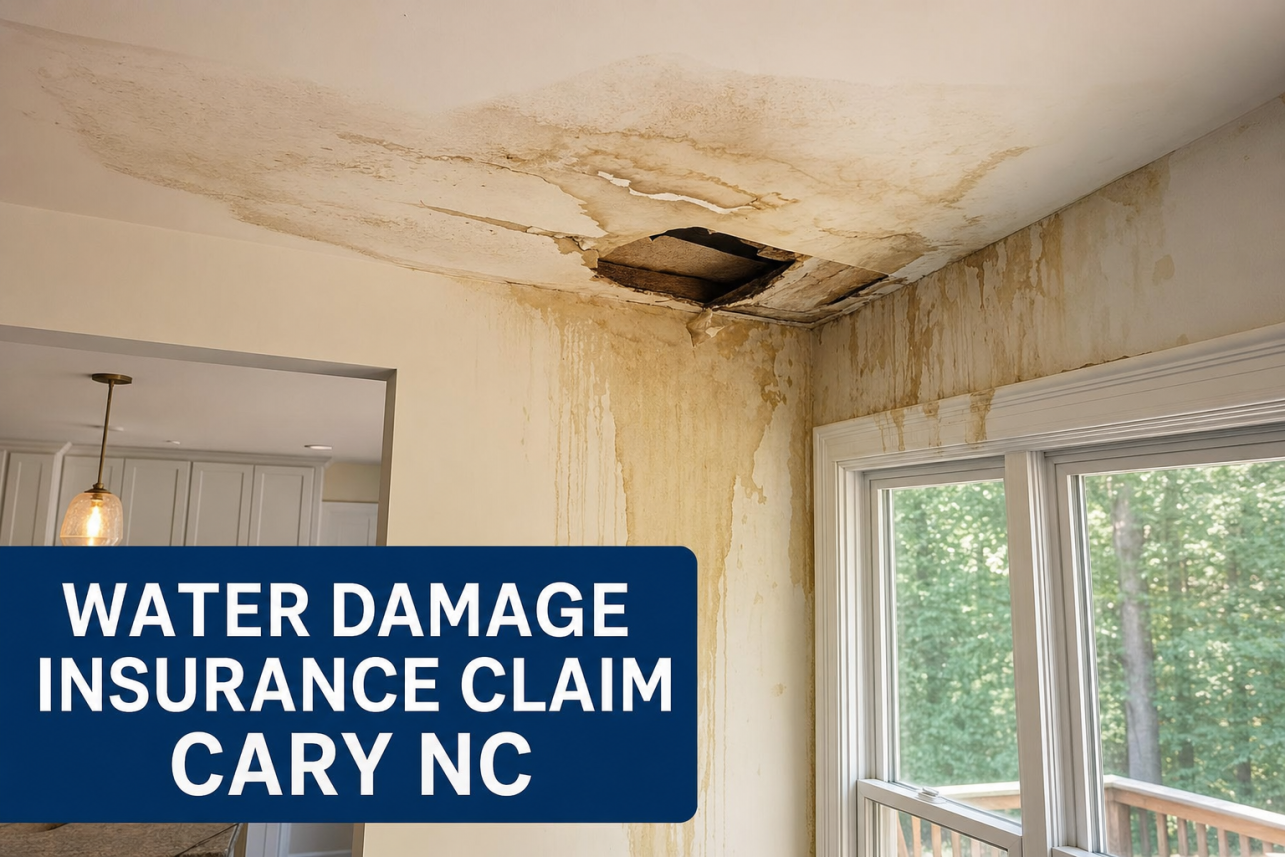
If you're facing a water damage insurance claim Cary NC homeowners typically have far more damage than the insurance company's first estimate reflects — water travels behind walls, under flooring, and into insulation where a quick inspection never looks. For The Public Adjusters, Inc. is a licensed and bonded public adjusting firm that works for you, not the insurance company, documenting the full scope of your loss and negotiating the settlement on your behalf. Whether the water came from a burst pipe, a roof leak during a summer thunderstorm, or a failed water heater, we handle the claim so you don't have to argue with the insurer alone.
What This Service Is
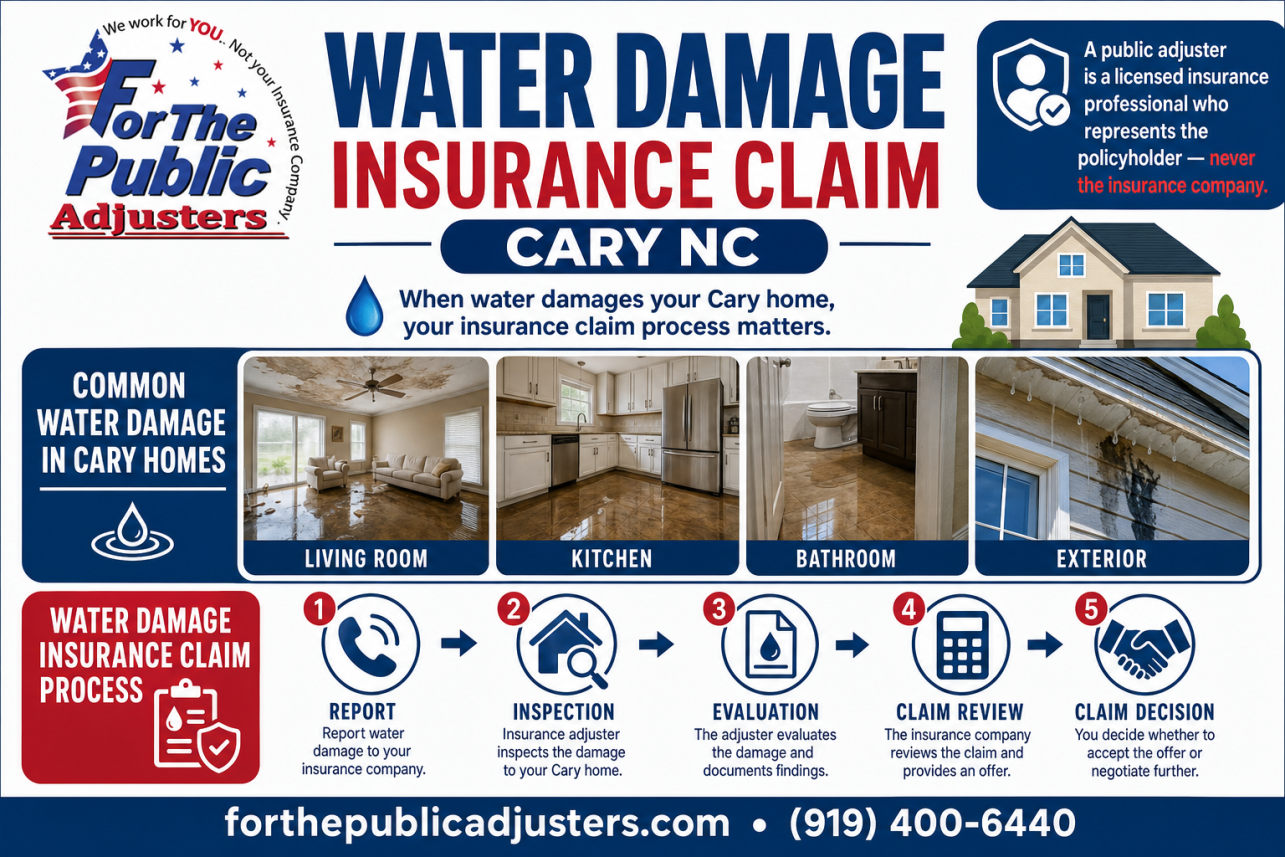
A public adjuster is a licensed insurance professional who represents the policyholder — never the insurance company. When water damages your Cary home, your insurer sends its own adjuster to estimate the loss. That person works for the carrier, and their estimate often reflects what's visible on the surface, not what's soaked behind it.
Our job is different. We read your policy line by line, inspect the property for hidden moisture and secondary damage like mold, prepare the detailed repair estimate and proof of loss documentation your insurer requires, and negotiate directly with the company's adjuster until the settlement reflects the real cost of putting your home back the way it was.
We handle residential and commercial water losses across Wake County, along with related claims — wind damage, tree damage, fire and smoke, vandalism, and flood claims through the National Flood Insurance Program. We do not handle claims involving vehicles, health, or life insurance. And to be clear: no adjuster can promise a specific dollar outcome, and we never will. What we can promise is a thorough, professionally documented claim presented by someone on your side.
Common Problems
The First Offer On A Water Damage Insurance Claim Cary NC Is Often Too Low
Insurance company estimates frequently cover drying out the room and patching drywall — and stop there. But water wicks up wall cavities, warps subfloors, and saturates insulation you can't see. If the estimate doesn't account for what's behind the finishes, you end up paying the difference out of pocket.
A low offer isn't the end of the negotiation. It's the beginning. Policyholders have the right to dispute an estimate, and courts have backed them up. In one North Carolina case, Guessford v. Pennsylvania National Mutual Casualty Insurance Co., a homeowner whose storm-damaged house was repeatedly underpaid took the insurer to federal court — and a jury sided with the homeowner. You don't have to accept the first number.
Hidden Moisture And Mold Turn A Small Loss Into A Big One
Cary's humid summers make this worse. Once water gets into a wall or crawlspace, mold can begin growing within days — and by the time you smell it, the damage has spread well beyond the original leak.
Insurers sometimes push back on mold and secondary damage, arguing it developed later or wasn't caused by the covered event. Thorough moisture readings and documentation early in the claim connect that damage to the original loss, which is exactly what our inspections are built to do.
Denials, Depreciation, And The Flood Question
Some denials hinge on how the water got in. A pipe that bursts suddenly is typically covered; rising water from outside is usually a flood, which falls under a separate NFIP flood policy, not your homeowners policy. Carriers sometimes blur that line — and a wrongly categorized loss can mean a wrongful denial.
Depreciation is the other quiet money-loser. If your policy pays actual cash value, the insurer deducts for age and wear; if you have replacement cost coverage, you may be owed that depreciation back once repairs are done. Many homeowners never recover it simply because no one told them how. We track it and pursue it.
Our Process
Free Claim And Policy Review
We start by reading your actual policy — coverage limits, your deductible, exclusions, and whether you carry replacement cost or actual cash value coverage. Then we look at what the insurer has offered or denied so far. You'll know where you stand before you commit to anything.
Full Damage Documentation
We inspect the property the way the loss deserves: moisture readings behind walls and under floors, photos, an itemized structural repair estimate, and a room-by-room inventory of damaged contents. We also document emergency mitigation costs — the tarping, water extraction, and drying you paid for to stop the damage from spreading, which your policy generally expects you to do and should reimburse.
Negotiation And Settlement
We submit the proof of loss, meet the insurance company's adjuster on site, and negotiate the differences item by item. If the carrier drags its feet on the settlement timeline, we push. You stay informed at every step, and the final decision to accept any settlement is always yours.
| Stage of the Claim | Filing Alone | With For The Public Adjusters |
|---|---|---|
| Initial documentation | Photos of visible damage only; hidden moisture usually missed | Moisture mapping, thermal imaging, and cavity readings recorded before demolition |
| Scope of repairs | Carrier's adjuster writes the estimate; patches and partial repairs are common | Independent Xactimate estimate including flooring continuity, matching, and code items |
| Policy interpretation | Homeowner takes the carrier's coverage position at face value | Exclusion arguments (seepage, wear, freeze) tested against the actual policy language and evidence |
| Negotiation | One-sided; most homeowners accept the first or second offer | Documented rebuttals, re-inspections, and appraisal invoked when the carrier won't move |
| Typical outcome on underpaid water losses | Settlement anchored to the carrier's opening number | Cary water losses we handle commonly settle at multiples of the initial offer |
Commonly Overlooked In The Public Adjusting Industry
- Moisture readings inside wall cavities before demolition — Carrier adjusters typically only meter visible surfaces, and once the walls are opened and dried the proof of hidden saturation is gone forever.
- Flooring continuity and matching across connected rooms — Insurers scope only the wet square footage, ignoring that a patch of new hardwood or LVP in one room will never match continuous flooring running through a Cary open-concept floor plan.
- Cabinet bases and toe kicks — Particleboard cabinet bottoms wick water and swell out of sight, so estimates routinely list cabinets as 'clean and salvage' when they actually need replacement.
- Additional living expenses (ALE) entitlement — Homeowners tough it out in a torn-up house because nobody tells them the policy pays for comparable temporary housing while the home is uninhabitable.
- The mold sublimit clock — Mold coverage often caps at $5,000–$10,000, and delayed or poorly documented drying lets the carrier shove tens of thousands of remediation costs under that small limit.
- Code upgrade coverage on older Cary homes — Repairs in pre-2000 homes frequently trigger current Wake County code requirements — GFCI circuits, updated plumbing connections — that ordinance-or-law coverage pays for but estimates rarely include.
- Contents inventory done room by room, not from memory — Weeks after a flood, homeowners forget half of what was in soaked closets and cabinets, and undocumented contents are simply never paid.
- The difference between 'sudden discharge' and 'seepage' in the same loss — Most slow-leak claims contain both covered and excluded damage, and if nobody separates them with evidence, carriers deny the entire claim under the seepage exclusion.
Case Studies
Case Study #1
Situation: A homeowner in the Lochmere neighborhood of Cary came home from a week at the beach to find a failed supply line under the master bathroom sink had been running for days. Water had traveled through the subfloor into the kitchen ceiling below and soaked the hardwoods across half the first floor.
Problem: Her carrier's adjuster spent forty minutes on site, approved drying equipment and a small drywall patch, and issued a check for $9,400. The estimate ignored the cupped hardwoods, treated the kitchen cabinets as salvageable, and made no allowance for matching flooring that ran continuously through the foyer, dining room, and hallway.
Investigation: We brought in moisture mapping equipment and documented elevated readings inside the wall cavities behind the kitchen cabinets, readings the carrier's adjuster never took. We pulled toe kicks and found saturated particleboard cabinet bases already swelling. We also photographed the continuous hardwood runs room to room.
Findings: The cabinets were water-damaged beyond repair at the bases, and North Carolina's line-of-sight and matching considerations meant a small patch of new hardwood would never blend with fifteen-year-old site-finished oak. The scope needed full lower-cabinet replacement and refinishing or replacement of the continuous flooring, plus proper containment during demo.
Solution: We rewrote the estimate in Xactimate with the moisture documentation attached, invoked the policy's appraisal-friendly language during negotiation, and walked the carrier's re-inspection adjuster through every reading and photo on site.
Outcome: The claim settled at $61,200 — more than six times the original offer — covering cabinet replacement, continuous flooring, contents cleaning, and additional living expenses for the two weeks the kitchen was out of service.
Lesson: A carrier's first estimate on a water loss almost always scopes only what is visible. Moisture readings inside cavities and flooring continuity are where most of the money hides, and if nobody documents them before demolition, that leverage is gone.
Case Study #2
Situation: A family near Green Hope High School in west Cary discovered water stains spreading across their finished basement ceiling after a February cold snap. A pipe in the exterior wall of the bonus room above had frozen and split, releasing water intermittently for at least two days before they noticed.
Problem: The insurance company initially denied the claim, arguing the loss resulted from the homeowners' failure to maintain heat — a common exclusion argument in freeze losses. The denial letter arrived nine days after the inspection with no detailed explanation of the evidence relied on.
Investigation: We pulled the family's smart thermostat history, which showed the home was heated to 68 degrees the entire week. We then had the wall opened and photographed the pipe's location: it sat outboard of the insulation in an exterior chase, an installation condition, not a maintenance failure. We also obtained NWS temperature records showing Cary hit 11 degrees that week.
Findings: The freeze occurred despite reasonable heat because of how the pipe was routed, which meant the policy's freeze exclusion did not apply. The heated-home documentation directly contradicted the basis for the denial.
Solution: We submitted a written rebuttal with the thermostat data, weather records, photographs, and a plumber's statement, and requested the carrier's re-inspection under the policy's duties-after-loss provisions.
Outcome: The denial was reversed within three weeks. The claim ultimately paid $38,750 for the bonus room, the basement ceiling and walls below, wet insulation replacement, and rerouting documentation the family used to prevent a repeat freeze.
Lesson: A denial letter is a position, not a verdict. Freeze denials in particular often collapse when someone actually gathers thermostat logs, weather data, and evidence of how the pipe was installed.
| Situation You're Facing | Usually Safe to Handle Yourself | Bring in a Cary Public Adjuster When |
|---|---|---|
| Small, contained leak (single cabinet, one wall) | Damage is fully visible, dried within 48 hours, and the check covers a contractor's real quote | Moisture readings stay elevated, cabinets or flooring are affected, or the offer only covers a patch |
| Burst pipe or supply line flood | Rarely — water travels farther than it appears | Multiple rooms or floors are involved, or the estimate skips flooring, cabinets, or contents |
| Slow or hidden leak discovered late | Almost never — these get denied as 'seepage' by default | The carrier cites long-term damage or lack of maintenance; the sudden-discharge portion needs to be proven |
| Claim denied outright | Only if you're comfortable rebutting the denial in writing with evidence | Any freeze, seepage, or maintenance-based denial — these are frequently reversible with documentation |
| Carrier's check seems low | The gap is under a few hundred dollars | A licensed contractor's quote exceeds the payment, or matching flooring/paint isn't included |
| Mold found during drying or demo | Never — mold sublimits and remediation protocols get mishandled fast | Immediately, before remediation destroys the evidence tying mold to the covered water event |
| Displaced from your home | ALE is being paid promptly at real Cary rental rates | The carrier delays ALE, lowballs comparable housing, or pressures an early move-back |

Reviews
Our dishwasher line leaked slowly for months behind the cabinets and the insurance company tried to call it all 'long-term seepage' and pay almost nothing. For The Public Adjusters separated the sudden discharge damage from the wear-and-tear items with actual documentation, and the settlement went from $3,100 to just under $27,000. They also caught mold remediation coverage we didn't know our policy had.
Melissa T., Cary (Preston area)
Water heater in the attic let go while we were at work — ceilings down in two bedrooms and the hallway. The carrier's estimate didn't include matching the ceiling texture or repainting whole walls, just spot patches. These guys rewrote the scope line by line and handled every call with the insurance company so I didn't have to. Final payment was more than double the first check.
Daniel R., Cary
Honest review: the process took longer than I hoped, about eleven weeks, but that was the carrier dragging its feet, not the adjusters. What impressed me was the moisture documentation before demo and how they pushed back when the insurer's engineer claimed our slab leak was 'pre-existing.' We would have accepted a $6,000 check on our own. We received $34,500.
Priya S., Cary (Amberly)
Frequently Asked Questions
How Much Is A Water Damage Insurance Claim Cary NC Homeowners Typically Settle For, And Can A Public Adjuster Increase That Amount?
There is no single average because payouts depend on the source of the water, how long it sat, and what it touched. A burst supply line behind a refrigerator in a Preston or Lochmere home can easily run $15,000 to $40,000 once you account for hardwood flooring, drywall, cabinetry, and drying costs. Slab leaks and second-story pipe failures often run higher.
What we consistently see is that the insurance company's first estimate misses items. Common omissions include matching flooring across continuous rooms (which North Carolina policyholders can often argue for), proper containment and equipment charges, code-required upgrades in older Cary homes, and hidden moisture behind baseboards and inside wall cavities that a quick visual inspection never catches.
As licensed public adjusters, we document the loss with moisture mapping, detailed line-item estimates written in the same software carriers use, and photographs that support every dollar claimed. On water losses, it is common for our clients' final settlements to come in significantly higher than the carrier's opening offer — sometimes double or more when hidden damage was missed.
Our fee is a percentage of the recovery, so we only benefit when you do. If you have already received an estimate from your insurer and something feels light, we can review it at no cost and tell you honestly whether it is worth reopening or supplementing.
What Should I Do In The First 24 Hours After Finding Water Damage In My Cary Home?
First, stop the water. Shut off the main valve — in most Cary homes it is in the garage, crawl space, or near the water heater. If the source is a roof leak or appliance, contain what you can with buckets and towels.
Second, document everything before you clean up. Take wide photos of each affected room, close-ups of damaged flooring and drywall, and video showing standing water or active dripping. Photograph the failed component itself — the burst pipe, the cracked supply line, the water heater tank. Do not throw that part away; carriers frequently ask to inspect it.
Third, mitigate. Your policy requires you to take reasonable steps to prevent further damage, so extracting water and starting airflow is appropriate. What you should not do is authorize a full tear-out or sign a broad work authorization with a restoration company before you understand your coverage. Some contracts assign your claim rights or lock you into pricing the insurer may dispute.
Fourth, report the loss to your carrier promptly, but keep your description factual and brief. Say what happened and when you discovered it — nothing speculative about how long it may have been leaking, since carriers use gradual-damage language to deny claims.
Finally, call us before the insurer's adjuster inspects if you can. For The Public Adjusters, Inc. serves Cary and all of Wake County, and getting involved early lets us set the scope correctly from day one rather than fighting an undervalued estimate later.
Why Do Insurance Companies Deny Or Underpay Water Damage Claims In Wake County?
The most common denial reason we see in Cary is the 'gradual damage' or 'long-term seepage' exclusion. Most homeowner policies cover sudden and accidental water discharge but exclude damage that occurred slowly over weeks or months. Carriers will point to staining, rot, or mold as evidence the leak was ongoing — even when the homeowner had no way of knowing about a pipe hidden inside a wall or under a slab.
Another frequent issue is the wear-and-tear argument. If a water heater or washing machine hose fails from age, the insurer will not pay to replace the failed appliance itself, which is fair — but some adjusters improperly extend that logic to deny the resulting damage too, which is usually covered.
Underpayment is even more common than outright denial. We regularly see estimates that dry out a room but pay nothing to remove wet drywall or insulation, that patch three boards of hardwood in a continuous floor instead of addressing the whole surface, or that skip code items required by Wake County inspections during repairs.
A denial letter is not the final word. Under North Carolina law, you have the right to dispute the carrier's position, present your own evidence, and invoke the appraisal clause in most policies when the disagreement is about value. We handle those disputes daily, and we know how local carriers evaluate these losses. If your claim was denied or the check will not come close to covering repairs, have us review the file before you accept the outcome.
How Long Does A Water Damage Insurance Claim Cary NC Take From Filing To Final Payment?
A straightforward, well-documented water damage insurance claim Cary NC residents file might resolve in 30 to 60 days. North Carolina requires insurers to acknowledge claims promptly and to pay within a reasonable time once liability and amount are agreed — but 'agreed' is the key word, and that is where timelines stretch.
Here is a realistic sequence. The carrier assigns an adjuster within a few days of your report, and an inspection usually happens within one to two weeks. Their estimate follows within another week or two. If you accept it, payment typically arrives shortly after — but accepting a first offer on a water loss is often a mistake, because hidden moisture damage frequently surfaces during repairs.
When we represent a Cary homeowner, we typically add a short front-end period for our own inspection, moisture readings, and estimate preparation. That investment usually shortens the back end of the claim because disputes get resolved with documentation instead of drawn-out back-and-forth. Most of our water losses in Wake County settle within 60 to 120 days, with complex claims involving mold, slab leaks, or coverage disputes running longer.
One timing note that matters: if you carry a mortgage, larger settlement checks will name your lender as a payee, and the lender's draw process can add two to four weeks before funds are usable. We help clients navigate that step too, so repairs are not stalled waiting on paperwork. If your claim has already dragged past 90 days with no resolution, that alone is worth a conversation with us.
What Types Of Water Damage Does Homeowners Insurance Actually Cover In Cary, NC?
Most homeowners policies in Cary cover sudden and accidental water damage. That includes burst pipes, supply-line failures under sinks, water heater ruptures, washing machine hose breaks, and HVAC condensation overflows — all common in Wake County homes, especially in neighborhoods with slab foundations or aging copper plumbing.
What's typically excluded is gradual damage. If a pipe leaked slowly behind a wall for months, insurers often argue it was a maintenance issue you should have caught. Flood damage from rising surface water — like what some Cary homeowners saw during Hurricane Fran and later tropical systems — requires a separate flood policy through the NFIP or a private carrier.
The gray areas are where claims get contested. Was the damage from a sudden pipe break or long-term seepage? Did the water come from inside the home or push in from outside? Carriers frequently lean on these distinctions to deny or reduce payment, and the answer often depends on how the loss is documented and presented.
This is where our adjusters earn their keep. We inspect the loss, review your specific policy language — not the summary, the actual endorsements and exclusions — and build the claim around what your coverage genuinely provides. Many Cary homeowners are surprised to learn their policy covers tear-out costs, code upgrades, mold remediation sublimits, and additional living expenses they were never told about. Reading the policy correctly is often the difference between a partial payment and a full recovery.
How Much Does It Cost To Hire A Public Adjuster For A Water Damage Insurance Claim Cary NC Homeowners Are Filing?
For The Public Adjusters, Inc. works on contingency, which means you pay nothing upfront and nothing out of pocket. Our fee is a percentage of the settlement we recover for you, and North Carolina law caps what licensed public adjusters can charge, so the structure is regulated and transparent.
If we recover nothing, you owe nothing. That aligns our interests with yours completely — we only get paid when your claim gets paid, and we're motivated to document every dollar of covered damage.
Here's the math that matters for a water damage insurance claim Cary NC residents should understand: industry studies and state-level data have repeatedly shown that policyholders represented by public adjusters recover significantly more than those who handle claims alone. Water losses are especially prone to underpayment because so much of the damage hides behind drywall, under flooring, and inside wall cavities. A carrier's adjuster may scope visible staining while missing saturated insulation, compromised subfloor, and moisture that leads to mold weeks later.
When we handle a claim in Cary, we use moisture meters, thermal imaging, and detailed line-item estimates written in the same software carriers use. That documentation typically increases the settlement by far more than our fee.
Before you sign anything, we offer a free claim review. We'll look at your policy, your damage, and any offer already on the table, and tell you honestly whether we can add value. If your claim is straightforward and fairly paid, we'll say so.
Can I Still Bring In A Public Adjuster If I Already Filed My Claim Or Received A Low Offer?
Yes. A large share of the Cary homeowners who call us have already filed, already met with the insurance company's adjuster, and already received an offer that doesn't come close to covering the actual repairs. Hiring your own adjuster at that stage is completely normal and often exactly the right move.
When we take over an open claim, we start by comparing the carrier's estimate against the real scope of damage. On water losses in Wake County, we routinely find missing line items: baseboard and drywall tear-out, flooring that can't be patch-matched, cabinet boxes with swollen particleboard, antimicrobial treatment, containment, and equipment costs for proper drying. Each omission might seem small, but together they can add tens of thousands of dollars.
We then prepare a supplemental claim with our own documentation — moisture readings, photographs, and a detailed estimate — and negotiate directly with the carrier on your behalf. Under North Carolina insurance regulations, the carrier must respond to properly supported supplements, and most disputes resolve without litigation.
Even a denied claim isn't necessarily final. Denials based on "gradual damage" or "wear and tear" can often be challenged with plumber reports, engineering opinions, or a closer reading of the policy language. We've reopened claims in Cary that homeowners had written off entirely.
The one thing to watch is your policy's deadline for disputing a claim or filing suit, which in North Carolina is typically three years but can be shortened by policy terms. The sooner you get a second opinion, the more options you have.
Should I Let The Insurance Company's Preferred Contractor Handle My Water Damage Repairs In Cary?
You're never required to use the carrier's preferred vendor, and it's worth thinking carefully before you do. In North Carolina, you have the right to choose your own contractor, and the insurer must pay the reasonable cost of proper repairs regardless of who performs them.
Preferred vendors work under pricing agreements with the insurance company. That relationship can create pressure to keep scopes lean — drying structures in place instead of removing wet materials, patching flooring instead of replacing continuous runs, or skipping moisture testing inside wall cavities. In Cary's humid climate, incomplete drying is how a manageable water loss turns into a mold problem six months later.
Our recommendation is to separate the two decisions. First, get the claim scoped and valued correctly. That's our job: we document the full extent of the loss, including hidden moisture, and negotiate a settlement based on what proper restoration actually costs in the Raleigh-Cary market, where labor and material prices have risen sharply in recent years.
Then, with an accurate settlement in hand, hire whichever licensed contractor you trust. Many of our Cary clients use local restoration companies they've vetted themselves, and the funded claim gives contractors a clear, agreed scope to work from.
One more caution: don't sign an assignment of benefits or a broad work authorization under pressure in the first chaotic days after a loss. Emergency mitigation is fine and expected, but signing away control of your claim before it's been properly valued rarely works in the homeowner's favor.
What Documentation Do I Need To Support A Water Damage Insurance Claim Cary NC Adjusters Will Actually Pay?
Start with photos and video before anything is moved or dried. Capture the water source, standing water, saturated flooring, baseboards, drywall, and any damaged contents. Wide shots establish the scope; close-ups prove severity. Timestamped images from your phone are fine.
Next, save the physical evidence when it's safe to do so. Keep the burst supply line, the failed water heater fitting, or the cracked washing machine hose. Insurers in Wake County frequently dispute the cause of loss, and the failed part is often the single most persuasive piece of proof you have.
Document the timeline in writing. Note when you discovered the water, when you shut off the supply, when you called the carrier, and who you spoke with. Keep every receipt: emergency mitigation, fans and dehumidifiers, tarps, hotel stays, and meals if you're displaced. Loss-of-use coverage only pays what you can prove.
Finally, get an independent moisture map and scope of repairs, not just the carrier's version. Moisture meters and thermal imaging reveal water inside walls and under floors that a visual inspection misses. When For The Public Adjusters, Inc. handles a claim, we build a line-item estimate using the same software carriers use, so every square foot of affected material is accounted for. Thorough documentation is the difference between a payment that covers cosmetic patching and one that funds a complete, code-compliant repair of your Cary home.
Does Homeowners Insurance Cover Mold That Develops After Water Damage In A Cary Home?
Sometimes, and the details matter enormously. Most North Carolina homeowners policies exclude mold as a standalone peril but cover it when it results directly from a covered water loss, like a burst pipe or appliance failure. Many policies then cap that mold coverage at a sublimit, often $5,000 or $10,000, which can be far less than actual remediation costs.
Cary's humid climate works against you here. In our experience with Wake County homes, mold can begin colonizing wet drywall and subflooring within 24 to 72 hours, especially in summer. That speed is exactly why carriers scrutinize how quickly you reported the loss and started mitigation. If they can argue the mold grew because you delayed, they'll deny that portion of the claim.
The strategic point most homeowners miss: how the damage is categorized affects what the sublimit applies to. Tearing out mold-contaminated drywall is arguably water damage repair, not mold remediation, and shouldn't always be charged against the mold cap. Carriers routinely lump everything under the sublimit to shrink the payout.
As public adjusters, we review the specific policy language, separate covered water repairs from true remediation costs, and push back when the carrier misapplies the sublimit. We also coordinate air quality testing and protocol-driven remediation documentation, because a certified mold assessment carries far more weight in negotiations than a contractor's opinion. If you're seeing discoloration or smelling that musty odor after a leak, get it documented before it spreads further.
What's The Difference Between Water Damage And Flood Damage For Insurance Purposes In Wake County?
This distinction decides whether your policy pays anything at all. In insurance terms, water damage means water that originated inside your home or from above: a burst supply line, a failed water heater, an overflowing tub, an appliance leak, or rain entering through storm-created roof damage. Flood damage means surface water rising from outside and entering at ground level — overflowing creeks, storm runoff, or pooling rainwater seeping under doors.
Standard homeowners policies cover many interior water losses but exclude flood entirely. Flood requires a separate NFIP or private flood policy, which most Cary homeowners outside mapped flood zones don't carry. Yet neighborhoods near Swift Creek, Crabtree Creek, and low-lying areas around older stormwater systems see genuine flooding during heavy storms, and hurricanes moving through the Triangle blur the line badly.
Here's where disputes arise. After a major storm, carriers often classify ambiguous losses as flood to avoid paying under the homeowners policy. If wind tore shingles off and rain poured through your ceiling, that's a covered wind-driven water loss — but you'll need evidence of the roof opening to prove it. Water entering a basement can involve both hydrostatic pressure (usually excluded) and a failed interior pipe (usually covered) at the same time.
We investigate the actual entry point and mechanism of the water, document it thoroughly, and hold the carrier to the correct classification. When causation is mixed, North Carolina's concurrent causation rules can still support coverage, and knowing how to argue that is a large part of what a public adjuster brings to the table.
Will Filing A Water Damage Insurance Claim Cary NC Carriers See On My Record Raise My Premiums Or Affect Future Coverage?
It can, so it's worth thinking through before you file. Every claim you report — even one that results in no payment — typically gets logged in the CLUE database, which insurers check for seven years. Multiple water losses in a short window can trigger a premium increase, a water damage exclusion at renewal, or in some cases non-renewal.
That said, the fear of premiums shouldn't stop you from filing a legitimate claim. A serious water loss in a Cary home routinely runs $10,000 to $50,000 or more once you account for flooring, drywall, cabinetry, and drying. Absorbing that yourself to save a few hundred dollars a year in premium rarely makes financial sense. Insurance exists for exactly this situation.
The smarter question is whether the loss clears your deductible by enough to justify the claim. If the damage is $3,000 and your deductible is $2,500, filing may not be worth the CLUE entry. If it's a major loss, file promptly — North Carolina policies require timely notice, and delay gives the carrier grounds to deny.
One important caution: calling your agent just to ask about coverage can sometimes be recorded as a claim inquiry. If you're unsure whether a water damage insurance claim Cary NC homeowners like you should even pursue, talk to us first. For The Public Adjusters, Inc. offers free claim evaluations, and we'll give you an honest read on whether the numbers justify filing — before anything hits your record.
My Water Damage Happened Weeks Ago And I Just Discovered It — Can I Still File A Water Damage Insurance Claim Cary NC Carriers Will Accept?
Yes, in most cases you can. North Carolina homeowners policies generally give you a reasonable window to report a loss, and courts here recognize that hidden leaks — inside walls, under slab foundations, or beneath the flooring common in Cary's newer subdivisions off Kildaire Farm Road and in older Lochmere homes — often go unnoticed for weeks.
The critical issue is how the carrier classifies the loss. Insurers frequently argue that a slow leak is 'gradual damage' or 'wear and tear,' which policies exclude. But there's an important distinction: the resulting damage from a sudden pipe failure is typically covered even if you found it late, while long-term seepage the homeowner reasonably should have noticed may not be.
That's why documentation matters so much on a late-discovered claim. Photograph everything before repairs, keep the failed pipe or fitting, and get a plumber's written statement about the cause and likely duration of the leak. A moisture-mapping report showing the spread pattern can also help establish that the damage stems from a covered event.
Our adjusters at For The Public Adjusters, Inc. regularly handle late-discovery losses across Wake County, and we know how to frame the cause-of-loss evidence so the carrier can't lean on the gradual-damage exclusion unfairly. Report the loss promptly once you find it — delay after discovery is what actually hurts a claim, not the fact that the leak started before you knew about it.
The Insurance Company Wants A Recorded Statement About My Cary Water Loss — Do I Have To Give One?
Most homeowners policies contain a 'duties after loss' clause requiring you to cooperate with the investigation, and that can include a recorded statement or, in disputed claims, an examination under oath. Refusing outright can jeopardize coverage. But you are not required to give one unprepared, alone, or on the carrier's timeline.
Recorded statements are where good water claims go bad. An innocent phrase — saying the leak 'had probably been going on a while' or that you 'noticed a stain last year' — can hand the carrier grounds to invoke the gradual-damage or neglect exclusion. Adjusters ask questions designed to elicit exactly those admissions, and Cary homeowners answer them casually because the conversation feels routine.
Before any statement, know precisely what happened: the date of discovery, the plumber's findings on the cause, and what mitigation steps you took. Answer only what's asked. Don't speculate about timelines, causes, or prior conditions you're not certain of. 'I don't know' is a complete and acceptable answer.
When For The Public Adjusters, Inc. represents a Wake County policyholder, we prepare our clients before any recorded statement and can be present during it. We also handle the day-to-day carrier communications, so offhand phone remarks never become claim evidence. If your insurer has escalated to a formal examination under oath, that's a strong signal they're building toward a denial — get professional representation on your side before you sit for it.
How Does Depreciation Work On A Water Damage Claim, And How Do I Recover The Full Replacement Cost?
Most Cary homeowners carry replacement cost value (RCV) coverage, but insurers don't pay it all upfront. The first check is for actual cash value (ACV) — replacement cost minus depreciation based on the age and condition of your flooring, drywall, cabinets, and other damaged materials. The withheld amount is called recoverable depreciation, and you only get it after completing repairs and submitting proof.
This catches people off guard. If your kitchen loss is estimated at $40,000 RCV, the carrier might depreciate 30% and cut an initial check near $28,000, minus your deductible. Homeowners who don't understand the process sometimes accept the ACV payment as final and leave five figures on the table.
To recover the held-back depreciation, you typically must finish repairs within a policy deadline — often 180 days to two years, depending on your carrier — and submit contractor invoices or receipts showing what you actually spent. Watch the depreciation percentages themselves, too. Carriers frequently over-depreciate items like hardwood flooring that, properly maintained, holds value far longer than their software assumes.
We review every line of the carrier's estimate for Wake County clients, challenge excessive depreciation, confirm the scope actually reflects local Cary contractor pricing rather than generic database rates, and track the deadlines so recoverable depreciation is never forfeited. If your insurer paid ACV and you're unsure how to claim the rest, that gap is often the difference between patching your home and truly restoring it.
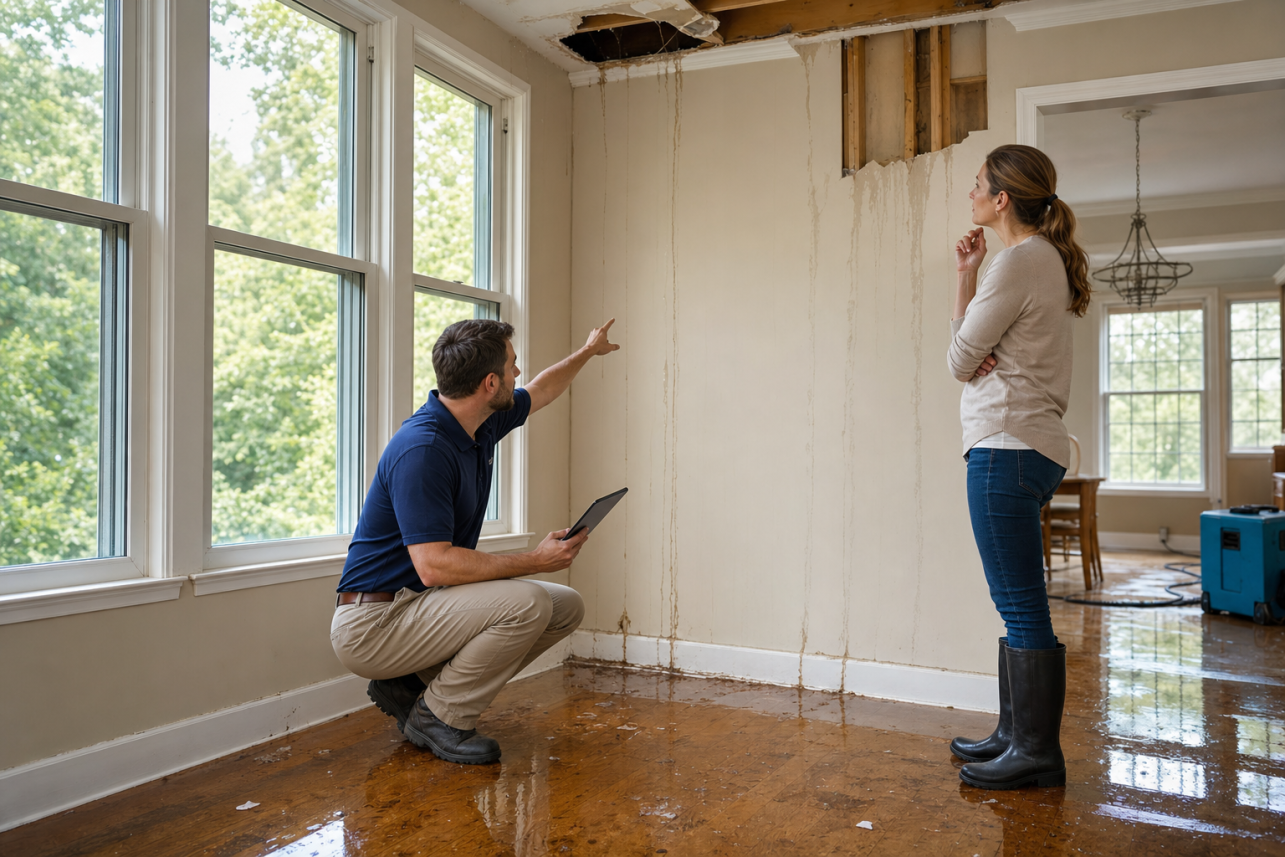
Do I Need To Be Present When The Insurance Adjuster Inspects My Home For A Water Damage Insurance Claim Cary NC Residents Are Filing?
You don't legally have to be there, but you absolutely should be — or have someone representing your interests attend. The carrier's field inspection often determines the entire trajectory of a water damage insurance claim Cary NC homeowners submit, because the adjuster's report becomes the foundation for the coverage decision and the payment estimate.
Here's the problem: the staff or independent adjuster works for the insurance company. Their inspection may last thirty minutes, and anything they don't see, they don't write. Water travels — a supply line failure in an upstairs bathroom in a two-story Preston or Amberly home can saturate wall cavities, subfloor, and the ceiling below in ways a quick visual walkthrough misses entirely. Damage that isn't documented at that first inspection is difficult to add later.
Before the inspection, don't throw anything away. Keep damaged flooring, cut-out drywall, and the failed plumbing component. Have your own photos, moisture readings from your mitigation company, and the plumber's cause-of-loss statement ready to hand over.
When For The Public Adjusters, Inc. handles a claim, we attend the carrier inspection alongside our client. We point out hidden moisture migration, insist affected areas get tested rather than eyeballed, and make sure the scope reflects everything the loss actually touched. Policyholders who let the carrier's adjuster inspect alone frequently receive estimates covering half the real damage — and spend months fighting for supplements that proper representation at the first walkthrough would have prevented.
Local Relevance
Cary sits squarely in the path of summer's worst water threats: intense afternoon thunderstorms, and the remnants of hurricanes and tropical storms that push inland across Wake County dumping several inches of rain in a matter of hours. Roof leaks, wind-driven rain, and overwhelmed gutters send water into attics and behind siding — often unnoticed until a ceiling stain appears weeks later.
The housing stock matters too. Much of Cary was built during the growth boom of the 1980s and 1990s, which means plenty of homes now have plumbing, water heaters, and washing machine supply lines reaching the age where failures become common. A supply line that lets go while you're away for a summer weekend can put water through two floors of a home.
North Carolina licenses public adjusters through the North Carolina Department of Insurance, and NCDOI's consumer guidance explains policyholders' rights when disputing a claim. As a licensed and bonded firm, we work within that framework every day for homeowners and business owners across Cary, Apex, Morrisville, and the rest of the Triangle.
Many Cary neighborhoods date to the 1980s and 1990s, so original polybutylene-era plumbing, aging water heaters, and 30-year-old roofs tend to fail around the same time summer storms hit hardest — which is why local water claims often involve two overlapping causes, and why insurers sometimes try to pin the loss on the excluded one. Documenting which source did what is often the difference between a paid claim and a denied one.
Get A Second Opinion Before You Accept The Insurer's Number
If your Cary home has water damage and the insurance company's estimate feels thin — or the claim was denied outright — talk to us before you sign anything. For The Public Adjusters, Inc. is licensed and bonded, and the initial claim review costs you nothing. Let someone who works for you look at the file.
Request Your Free Claim Review
Call us: (919) 400-6440
Helpful Resources
- NCDOI Public Adjusters Guide
- Federal Emergency Management Agency (FEMA)
- National Flood Insurance Program (NFIP)
- North Carolina Department of Insurance consumer resources — State regulator's guidance on policyholder rights and claim disputes
- FEMA's flood insurance information — Explains NFIP flood coverage and how it differs from homeowners insurance
Last updated: July 17, 2026