
If your insurer underpaid your Commercial Business Claim raleigh business owners have the right to dispute that settlement, submit their own documentation, and negotiate for the full amount the policy actually promises. A low first check is a starting offer, not a final verdict. For The Public Adjusters, Inc. is licensed and bonded in North Carolina, and we work exclusively for policyholders — never for insurance companies — to re-document the loss, correct the carrier's numbers, and push the claim back open.
What This Service Is
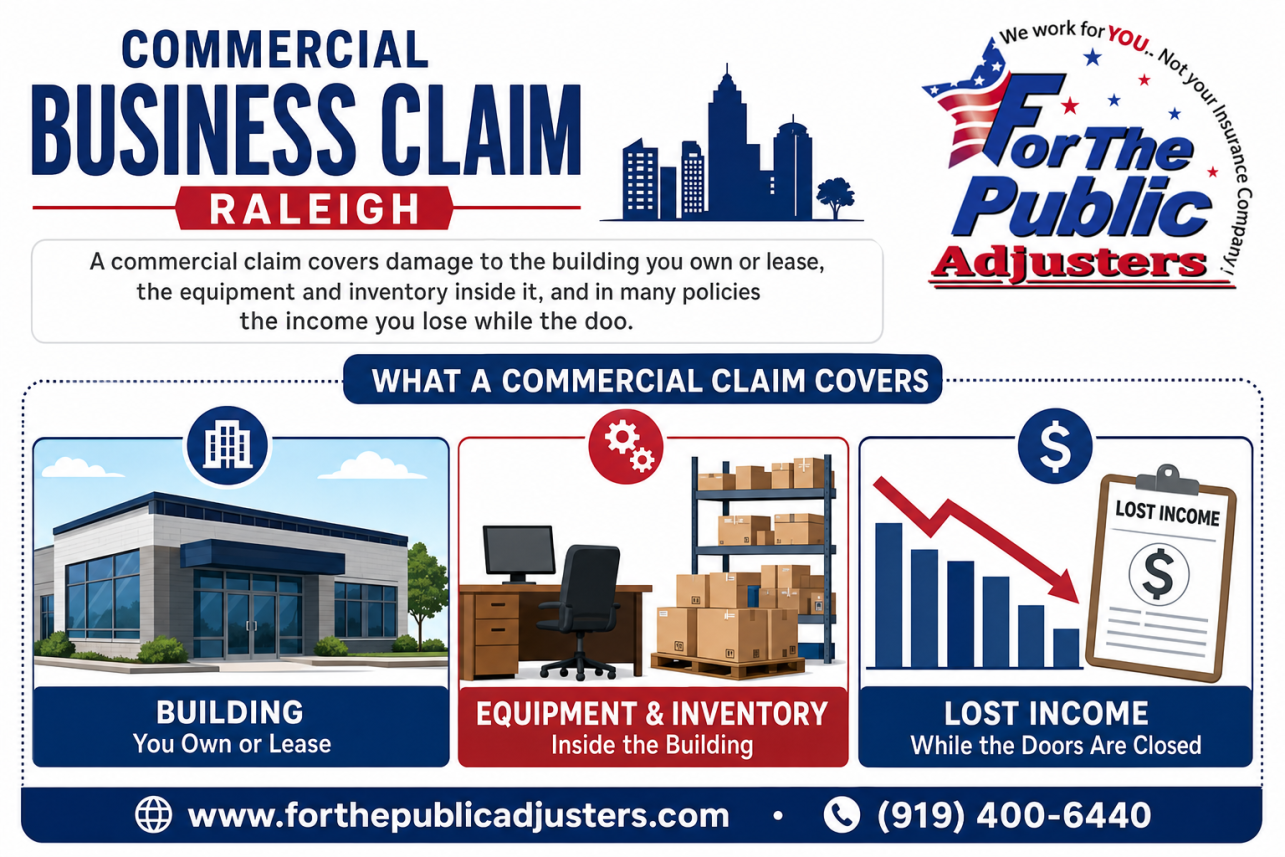
A commercial claim covers damage to the building you own or lease, the equipment and inventory inside it, and in many policies the income you lose while the doors are closed. When a fire, burst pipe, hailstorm, or fallen tree shuts down a Raleigh business, the insurance company sends its own adjuster to measure the damage and calculate what it owes. The problem is that adjuster works for the carrier, and the carrier's numbers often come in low.
As your public adjuster, we work the other side of the table. We read the full policy — including business interruption and extra expense coverage most owners never knew they bought — build an independent estimate of the physical damage, document lost revenue and payroll, and negotiate directly with the insurer on your behalf. We handle the same disputes for restaurants, retail shops, offices, warehouses, and medical practices, just as we do on every Commercial Business Claim in Elon and across the Triangle.
The North Carolina Department of Insurance licenses public adjusters for exactly this reason, and the NCDOI Public Adjusters Guide explains the role plainly: a public adjuster represents the insured, not the insurer. That distinction is the whole point. If the only professional who has measured your loss so far is the one paid by the insurance company, you have only heard one side of the story.
Common Problems
Why Was My Commercial Business Claim Raleigh Payout So Much Lower Than My Contractor's Estimates?
Short checks usually come from three places. First, the carrier's scope of damage is incomplete — their adjuster measured the obvious damage but skipped things like smoke contamination in HVAC systems, water that traveled under flooring, or code upgrades the rebuild will legally require. Smoke in particular is routinely underscoped; we see it in homes and businesses alike, which is why pages like our Smoke Damage Claim Help in Rolesville resource exist.
Second, the carrier may have paid actual cash value — the depreciated worth of your ten-year-old roof or five-year-old equipment — when your policy entitles you to replacement cost once repairs are done. Owners who don't know the difference leave that second payment on the table forever.
Third, business income is often calculated badly or skipped entirely. Lost revenue, ongoing payroll, rent, and the extra expenses of operating from a temporary location can all be covered, but only if someone documents them properly. If your check doesn't cover your real out-of-pocket repair costs plus what the closure cost you, the claim was underpaid.
The Insurance Company Keeps Stalling — And Every Week Closed Is Money I Can't Get Back
Delay is its own form of underpayment. Every week your Raleigh storefront or office sits closed, customers find somewhere else to go, and some never come back. Carriers know this, and a slow-walked claim pressures owners into accepting whatever is offered just to reopen.
You are not powerless here. You can demand decisions in writing, submit a formal proof of loss, and file a complaint with state regulators. Courts have also long recognized that insurers owe policyholders fair treatment: in Gruenberg v. Aetna Insurance Co., the insured owner of a fire-damaged business ultimately prevailed, with the court holding that an insurance company can be held liable for bad faith when it unreasonably withholds payment owed under the policy. That principle — that the carrier must deal with you fairly — underpins claim disputes nationwide.
Our job is to take the fight off your desk so you can run what's left of your business. We document every delay, answer every document request fast enough that the carrier can't blame us for the timeline, and keep written pressure on until the claim moves.
Should I Fight The Underpayment Myself, Or Is Hiring A Public Adjuster Worth It?
Some owners can and do push back alone, especially on small, simple losses. But a commercial dispute means reading a policy that runs dozens of pages, building a line-item rebuilding cost estimate, calculating business income loss from your financials, and negotiating with an adjuster who does this every day. Most owners are experts in their business — not in insurance claims — and it shows in the results.
A good public adjuster is licensed by the state, bonded, works on the policyholder's side only, and gets paid a percentage of what is recovered — so our interests line up with yours. Be wary of anyone who promises a specific dollar outcome; no honest adjuster can guarantee what a carrier will pay. What we can promise is a complete, documented, professionally argued claim.
If the dispute hardens into a true legal fight — a flat denial, or evidence of bad faith — we also work alongside insurance dispute attorneys. Many Wake County owners find us the same way homeowners find our Public Adjuster Garner team: after the first offer arrives and the math doesn't work.
Our Process
Free Review Of Your Policy And The Carrier's Settlement
We start by reading your commercial property policy cover to cover and comparing it against what the insurance company actually paid. This is where we find paid-at-depreciation items that should be replacement cost, business interruption coverage that was never triggered, extra expense benefits nobody mentioned, and exclusions the carrier applied more broadly than the policy language allows. You'll know quickly whether the settlement is defensible or short.
Independent Damage Scope And Loss Documentation
Next we build your side of the file: a full inspection and estimate of the physical damage, an inventory loss count with values, equipment damage valuations, and a business income calculation pulled from your sales records, tax returns, and payroll. The National Association of Insurance Commissioners advises policyholders to document losses thoroughly and in writing — and in practice, the claim with the better paperwork wins. We make sure that's yours.
Proof Of Loss, Negotiation, And Resolution
We prepare and submit a formal proof of loss, then negotiate directly with the carrier's adjuster, line by line, until the numbers reflect the real cost to rebuild and the real income you lost. If the carrier won't move, we pursue the dispute tools built into your policy, such as appraisal, and coordinate with attorneys when a claim denial or bad-faith conduct demands it. You stay informed at every step, and nothing settles without your approval.
| Step After an Underpayment | Handling It Yourself | With For The Public Adjusters |
|---|---|---|
| Reviewing the carrier's estimate | Hard to spot omitted line items, wrong pricing, or excessive depreciation without estimating experience | Line-by-line audit against commercial construction pricing and your actual policy language |
| Documenting the full scope of loss | Easy to miss hidden damage like soot in ductwork, moisture behind walls, or code-upgrade costs | Inspections with contractors, engineers, and moisture specialists to capture everything |
| Business income and extra expense claims | Carriers often undervalue lost income when owners lack forensic accounting support | Income loss rebuilt from your financial records, tax returns, and seasonal sales history |
| Negotiating the supplement | One business owner against trained company adjusters and desk reviewers | A licensed and bonded advocate who negotiates these claims every day |
| Invoking appraisal or disputing a denial | Most policyholders don't know the appraisal clause exists or how to use it | Strategic use of appraisal and dispute tools, as the insured did successfully in Gaston County Dyeing Machine Co. v. Northfield Insurance Co. |
Commonly Overlooked In The Public Adjusting Industry
- Business income loss during partial operations — Owners and carrier adjusters often calculate losses only for full closure days and miss the reduced revenue during weeks of limited operation.
- Ordinance and law (code upgrade) coverage — Carriers rarely volunteer that the policy pays for bringing electrical, plumbing, and accessibility up to current Raleigh code during repairs.
- Smoke and soot migration through HVAC systems — Contamination travels far beyond the visible fire area, and a quick visual inspection won't catch what's coating the inside of ductwork.
- Tenant improvements and betterments — Buildouts paid for by the business often fall through the cracks because neither the landlord's nor the tenant's claim initially accounts for them.
- Recoverable depreciation holdback — Many business owners never collect the depreciation withheld from the first check because no one tells them it's claimable after repairs are complete.
- Extra expense coverage for temporary relocation — Costs to keep operating — rented space, equipment, expedited shipping — are frequently absorbed by the owner instead of billed to the policy.
- Hidden moisture behind finished walls after water losses — Surface drying looks complete while saturated framing and insulation quietly develop mold, turning an underpaid claim into a second, bigger loss.
- Proof of loss and supplement deadlines — Policies set strict time limits that quietly expire while owners wait on contractors, cutting off their right to pursue the money they're owed.
Case Studies
Case Study #1
Situation: A family-owned restaurant on Glenwood South in Raleigh suffered a kitchen fire that spread smoke and soot through the dining room, HVAC system, and dry storage. The owner filed promptly and cooperated fully with the carrier's adjuster.
Problem: The insurance company issued a settlement that covered little more than repainting and a surface cleaning. It left out HVAC duct decontamination, smoke-permeated drywall and insulation, ruined food inventory, and nearly all of the business income loss during the shutdown.
Investigation: Our team performed a room-by-room inspection with a licensed contractor, pulled soot samples from the ductwork, inventoried every piece of damaged equipment and stock, and rebuilt the business income claim using the restaurant's POS records and prior-year sales from the same months.
Findings: Soot contamination had traveled well beyond the visible burn area, the carrier's estimate used residential-grade pricing instead of commercial kitchen rates, and the business interruption calculation ignored peak-season revenue entirely. The policy also included extra expense coverage the owner was never told about.
Solution: We prepared a detailed line-item estimate, a documented contents inventory, and a forensic-grade income loss statement, then presented a formal supplement demanding the carrier re-inspect with us on site.
Outcome: After the re-inspection and negotiation, the carrier revised its position substantially upward, funding full duct remediation, code-required kitchen upgrades, inventory replacement, and months of lost income and extra expenses. The restaurant reopened without taking on debt.
Lesson: A first offer is a starting position, not a final answer. North Carolina courts have long sided with policyholders on these disputes — in Gaston County Dyeing Machine Co. v. Northfield Insurance Co., the North Carolina Supreme Court ruled for the insured business on coverage for property damage the carriers had tried to deny. Documentation and policy knowledge change outcomes.
Case Study #2
Situation: A commercial office building near Capital Boulevard took heavy water damage when a tropical storm remnant pushed hurricane-driven rain through a compromised roof section, soaking two floors of tenant space, electrical rooms, and a records archive.
Problem: The carrier underpaid by classifying most of the interior damage as 'long-term wear' and pre-existing deterioration, paying for a roof patch and minimal drywall replacement while denying the electrical, flooring, and tenant improvement losses.
Investigation: We brought in a structural engineer and a moisture-mapping specialist, documented storm-date weather data for Wake County, photographed the roof breach pattern, and cross-referenced the building's maintenance logs to prove the roof had been inspected and sound before the storm.
Findings: Moisture readings and the damage pattern matched a single sudden storm event, not gradual leakage. The carrier's estimate also omitted code-upgrade requirements for the electrical panels and ignored the ordinance and law coverage the owner was paying premiums for.
Solution: We assembled the engineering report, weather documentation, and a corrected scope of repairs, then invoked the policy's appraisal clause when the carrier refused to move meaningfully off its position.
Outcome: The appraisal process resulted in an award many times the original payment, covering full roof replacement, both damaged floors, electrical code upgrades, and the owner's lost rental income while tenants were displaced.
Lesson: Carriers often lean on 'wear and tear' language to shrink storm claims. Independent engineering evidence, weather data, and the appraisal clause are powerful tools — and a Raleigh public adjuster knows when and how to use each one.
| Your Situation | Best Next Step | What It Depends On |
|---|---|---|
| Carrier's payment is far below contractor bids | Request the carrier's full estimate in writing, then have it independently reviewed | The gap between real repair bids and the carrier's scope — large gaps usually mean omitted items or wrong pricing |
| Carrier blames 'wear and tear' for storm damage | Get independent engineering or moisture evidence before accepting anything | Whether the damage pattern and weather records support a sudden event, as with hurricane-driven rain |
| Business income loss was denied or lowballed | Rebuild the income claim from POS data, tax returns, and prior-year revenue | Your policy's business interruption and extra expense limits and the quality of your financial records |
| Depreciation deductions seem excessive | Check whether your policy is replacement cost and whether holdback is recoverable | Policy type, the age and condition of damaged property, and how the carrier calculated depreciation |
| Carrier won't budge after your supplement | Consider invoking the appraisal clause in your policy | Whether the dispute is about the amount of loss rather than coverage itself |
| Loss involves flood water from rising water | Confirm whether you have an NFIP or private flood policy and review FEMA's flood claim guidance at FEMA.gov and FloodSmart.gov | Flood is typically excluded from standard commercial property policies and handled under separate flood coverage |
| You signed nothing yet but feel pressured to settle | Pause — accepting payment doesn't always close the claim, but get professional review first | Your policy's proof of loss deadlines and whether the carrier's release language limits future supplements |

Reviews
Our carrier offered $84,000 after a fire damaged our distribution warehouse off Rock Quarry Road. Something felt off, so I called For The Public Adjusters. They found smoke damage in racking systems and inventory the insurance adjuster never even looked at, plus business income coverage I didn't know I had. The final settlement was several times the original offer. I'd never negotiate a commercial loss alone again.
Marcus T., Raleigh warehouse owner
A burst pipe flooded my boutique overnight and the insurance company's first check wouldn't have covered half my inventory, let alone the buildout. The team documented every damaged item, challenged the depreciation the carrier applied, and rebuilt my lost sales numbers from my own records. They were honest from day one that nothing is guaranteed, but their work spoke for itself when the revised settlement came in.
Priya S., downtown Raleigh retail owner
After hurricane remnants tore through the roof of a commercial building we manage, the carrier tried to call most of the interior damage 'maintenance issues.' For The Public Adjusters brought in an engineer, proved it was storm damage, and handled the appraisal process start to finish. Communication was excellent and the outcome let us make our tenants whole. Worth every penny of the fee.
David L., Wake County property manager
Frequently Asked Questions
What Should I Do First If My Insurance Company Underpays My Commercial Business Claim Raleigh?
Do not cash the check with any language suggesting it is a final settlement, and do not sign a release until you understand the full scope of your loss. Accepting an underpayment too quickly can make it harder to recover the rest of what your policy owes you.
Start by requesting the insurer's complete estimate and the adjuster's report in writing. Compare it line by line against your own documentation: photos of the damage, contractor bids, inventory lists, and business income records. Underpayments on Raleigh commercial losses often come from missed line items, depreciated pricing that doesn't reflect Wake County labor and material costs, or an incomplete inspection of the building.
Then bring in an independent professional. For The Public Adjusters, Inc. is licensed and bonded, and we work only for the policyholder, never the insurance company. We re-inspect the property, build our own detailed estimate, and negotiate directly with the carrier on your behalf.
North Carolina courts have shown they will hold insurers to the plain terms of their policies. In Gaston County Dyeing Machine Co. v. Northfield Insurance Co., 351 N.C. 293 (2000), the North Carolina Supreme Court sided with the insured in a dispute over property damage coverage, rejecting the insurer's narrow reading of its own policy. While every claim is different and no outcome can ever be promised, that case shows policyholders who document and press their position can prevail.
How Do I Know Whether My Raleigh Commercial Property Claim Was Actually Underpaid?
The most reliable test is an independent, line-item estimate prepared by someone who answers to you, not the carrier. If the insurer's number is built on a 20-minute walkthrough while yours reflects a full inspection of the roof, interior, mechanical systems, and contents, the gap usually tells the story.
Common signs of underpayment we see on commercial buildings in Raleigh and across Wake County include: pricing pulled from generic databases that lag behind real local contractor bids, missing code-upgrade costs required by the City of Raleigh or Wake County inspections, overlooked hidden damage behind walls or under flooring, and business interruption calculations that ignore seasonal revenue patterns.
Another red flag is heavy depreciation. If your policy provides replacement cost coverage, large depreciation holdbacks should be recoverable once repairs are completed, yet insurers do not always make that clear.
Our team documents every element of the loss — structure, contents, and lost income — and presents a properly supported claim to the carrier. We are licensed and bonded, and we handle commercial property, fire, water, hurricane, tornado, and similar building losses. We do not handle motor vehicle, health, life, or cell phone claims.
If your loss involves flooding, note that flood coverage typically runs through the National Flood Insurance Program rather than your standard commercial policy, so reviewing resources at FEMA.gov and FloodSmart.gov (the NFIP site) is worthwhile before assuming your payment was complete.
Can A Public Adjuster Reopen Or Dispute An Underpaid Commercial Claim In Raleigh After I've Already Received A Check?
In many situations, yes. Receiving a payment does not automatically close your claim. Unless you signed a full release, most commercial policies allow supplemental claims when additional damage is discovered or when the original estimate left items out.
The key is timing and documentation. North Carolina policies contain deadlines for providing proof of loss and limitation periods for taking legal action, so the sooner you act after noticing a shortfall, the more options remain open. We review your policy's specific conditions before anything else.
From there, the process typically involves a fresh inspection of the building and contents, a new independent estimate, and a formal supplement submitted to the insurer with supporting photos, invoices, and expert reports where needed. If the carrier still refuses to pay fairly, many policies contain an appraisal clause — a dispute-resolution process where each side appoints an appraiser and an umpire resolves the difference.
Policyholders have real leverage when they push back with evidence. In Gaston County Dyeing Machine Co. v. Northfield Insurance Co., the North Carolina Supreme Court ruled for the insured business in a coverage dispute over damaged property, a reminder that carriers do not get the final word on what a policy means.
For The Public Adjusters, Inc. is licensed and bonded, and we cannot guarantee any specific recovery — no honest adjuster can. What we can do is make sure every dollar of documented damage is properly presented and vigorously negotiated.
What Types Of Commercial Losses In Wake County Lead To Underpaid Claims Most Often?
In our experience handling a Commercial Business Claim raleigh business owners bring to us, a few loss types are underpaid more than others.
Fire and smoke losses top the list. Carriers frequently pay for visible charring but shortchange smoke and soot contamination in HVAC systems, inventory, and electronics — damage that is costly but easy to miss on a quick inspection.
Water damage from burst pipes or roof leaks is another frequent source of disputes, especially when moisture travels into wall cavities and subflooring. Hurricane and tornado damage can also be underpaid when the insurer attributes part of the loss to excluded causes or applies the wrong deductible.
Business interruption is where Raleigh companies often lose the most. Insurers may calculate lost income using off-season months or ignore ongoing expenses like payroll and rent that your policy may cover during restoration.
Flood losses deserve special mention. Standard commercial policies usually exclude flood, and flood claims run through the National Flood Insurance Program instead. If rising water affected your building, review your NFIP policy carefully and consult FEMA.gov and FloodSmart.gov for program rules — flood claims have their own strict proof-of-loss deadlines.
Whatever the cause, the pattern is the same: the carrier's estimate reflects the carrier's interests. Our job is to document the full scope of your building, contents, and income loss and negotiate from evidence. We're licensed and bonded, and we work exclusively for policyholders throughout Raleigh and Wake County.
How Does The Appraisal Clause Work For An Underpaid Commercial Business Claim Raleigh Owners Should Know About?
Most commercial property policies sold in North Carolina include an appraisal provision, and it can be one of the strongest tools when a carrier lowballs a loss. Either side can invoke it when the dispute is about the amount of the loss, not whether coverage exists.
Once invoked, you select your appraiser, the insurer selects theirs, and the two agree on a neutral umpire. The appraisers each value the damage, and any two of the three can set a binding figure. For a Raleigh business, that often means a far more careful look at roofing systems, HVAC, interior finishes, inventory, and equipment than the carrier's original estimate contained.
Appraisal works best when your side of the valuation is thoroughly documented. That is where our team earns its keep: we prepare line-item estimates, contents inventories, and code-upgrade costs before the clause is ever triggered, so the dispute is fought with evidence rather than opinion.
Courts have shown little patience for insurers who shortchange commercial policyholders. In Bi-Economy Market, Inc. v. Harleysville Insurance Co. of New York, 10 N.Y.3d 187 (2008), a family-owned market suffered a major fire, and the insurer delayed and underpaid the building, contents, and business interruption claim. New York's highest court ruled the insured could recover consequential damages caused by the carrier's failure to honor the policy, because prompt payment after a disaster is the very reason a business buys coverage.
We cannot promise any particular outcome, but as licensed and bonded public adjusters we can make sure the appraisal process starts from a complete, defensible valuation rather than the carrier's shortcut estimate.
How Long Does A Raleigh Business Have To Dispute An Underpaid Commercial Insurance Settlement?
Deadlines matter, and they come from two places: your policy and North Carolina law. Most commercial property policies require a lawsuit on the claim to be filed within a stated period, often two or three years from the date of loss, and some impose shorter windows for submitting a sworn proof of loss or invoking appraisal. North Carolina's general contract limitations period is three years, but the policy language can shorten your practical timeline considerably.
The important point for Wake County business owners is that cashing a check rarely closes the door by itself. Partial payments are common, and supplemental claims are a normal part of the process when additional damage or costs are documented after the first payment.
That said, waiting works against you. Damaged materials get repaired or discarded, tenants move, financial records get harder to reconstruct, and the carrier's file hardens around its original numbers. The sooner an underpaid Commercial Business Claim raleigh property owners bring to us is reviewed, the more evidence we can preserve — photographs, moisture readings, contractor scopes, inventory counts, and profit-and-loss records for business interruption.
When we take on a dispute, we first map every deadline in your specific policy, then build the supplemental claim or appraisal demand around those dates. We are licensed and bonded, and while no adjuster can guarantee a particular recovery, insureds who act within their deadlines keep every legal and contractual option open. If your loss happened months ago and you suspect the payment was short, a policy review now costs you nothing but a phone call and may protect rights you did not know you had.
Will Bringing In A Public Adjuster To Fight An Underpaid Commercial Claim Hurt My Relationship With My Insurer Or My Future Coverage?
This is one of the most common worries we hear from Raleigh business owners, and the short answer is no — asserting your contractual rights is not a black mark. Your policy is a contract, and provisions like appraisal, proof of loss, and supplemental claims exist precisely because disputes over value are expected.
Insurers deal with public adjusters every day. In our experience, carriers often become more careful and more responsive once a professional is documenting the file, because every estimate, denial letter, and delay is now being reviewed by someone who knows the policy as well as they do.
The courts have repeatedly affirmed that policyholders who push back are entitled to do so. In Bi-Economy Market, Inc. v. Harleysville Insurance Co. of New York, the insured market fought its insurer's underpayment of a fire loss to its building, contents, and income stream — and won, with the court holding the carrier liable for the additional harm its delay caused the business. Policyholders who stood down would never have seen that result.
As for future coverage, premiums and renewals are driven by your loss history — the fact that a claim occurred and what was ultimately paid — not by whether you had professional representation. A fire or burst pipe affects your record whether you accept the first check or pursue full value.
We handle the measuring, documenting, negotiating, and deadline tracking so you can run your business. We never promise a specific dollar figure, but we do promise the claim will be presented completely, professionally, and on time.
Are Business Interruption And Flood Losses Underpaid Too, And Can Your Firm Handle Those For My Raleigh Building?
Yes, and business interruption is arguably the most frequently shortchanged part of any commercial loss. Carriers often undervalue lost income by using the wrong revenue period, ignoring seasonal trends, or cutting off the restoration period too early. For a Raleigh restaurant, retail shop, or office tenant, a few weeks of miscalculated downtime can mean tens of thousands of dollars left on the table.
We rebuild these claims from your actual financials — profit-and-loss statements, payroll records, tax returns, and continuing expenses — so the income calculation reflects what your business genuinely lost while repairs were underway. Extra expense coverage for temporary locations, equipment rental, and expedited repairs is frequently overlooked by carriers as well, and we include it when the policy provides it.
Flood losses follow different rules. Most flood coverage in Wake County runs through the National Flood Insurance Program, which has its own proof-of-loss deadlines and valuation standards. We recommend every commercial property owner near a creek or low-lying corridor review FEMA's resources at fema.gov and the NFIP site at floodsmart.gov to understand their flood zone and coverage options before a storm arrives.
When carriers underpay these losses, policyholders can and do prevail. In Bi-Economy Market v. Harleysville, the insurer's refusal to properly pay a business interruption claim after a fire ultimately destroyed the business — and the court held the insurer accountable for those consequential damages.
If your Commercial Business Claim raleigh carrier has settled feels incomplete on the income side, we will review the calculation at no obligation. We are licensed and bonded, and while results vary by claim, a documented loss is always harder to underpay.
How Much Does It Cost To Hire For The Public Adjusters For An Underpaid Commercial Business Claim Raleigh Owners Are Struggling With?
We work on a contingency fee basis, which means our fee is a percentage of the additional funds recovered on your claim. There are no upfront costs, no hourly billing, and no retainer to get started. If we review your settlement and believe the insurer's number is fair, we will tell you that honestly rather than take on a file that will not benefit you.
This structure matters for Raleigh business owners because it aligns our interests with yours. We only do well when your recovery improves, so we have every reason to document the loss thoroughly, scrutinize the carrier's estimate line by line, and negotiate hard on scope and pricing.
It is also worth knowing that we are licensed and bonded, which is a legal requirement for public adjusters and a protection for you as the policyholder. Before you sign anything, you will see the fee percentage in writing in a clear contract.
One honest caveat: no reputable adjuster can promise a specific dollar outcome, and you should be wary of anyone who does. What we can commit to is a complete, professionally documented presentation of your commercial loss, from the building envelope to equipment, inventory, and lost income, and persistent negotiation until the insurer addresses every legitimate item. For many underpaid commercial losses in Wake County, the gap between the first offer and the properly documented value of the damage is substantial, and that gap is exactly what we are hired to close.
My Insurer Applied Depreciation And A Coinsurance Penalty To My Raleigh Commercial Loss. Can Those Deductions Be Challenged?
Often, yes. These two deductions are among the most common reasons a commercial settlement comes in low, and both deserve a hard second look.
Depreciation is the amount the carrier withholds for the age and condition of damaged materials. If you carry replacement cost coverage, much of that holdback is recoverable once repairs are completed, yet many Raleigh business owners never collect it because no one explains the process. We track recoverable depreciation, document completed work, and submit for those funds so money you are entitled to does not sit unclaimed. We also challenge depreciation rates that are simply too aggressive, such as heavy depreciation applied to a roof membrane or HVAC system that was recently replaced.
Coinsurance penalties are trickier. If the carrier claims your building was insured below the required percentage of its value, it may reduce your payout proportionally. But that penalty depends entirely on the insurer's valuation of the building, and those valuations are frequently inflated or based on flawed square-footage data. We independently verify the replacement cost calculation and push back when the math does not support a penalty.
Courts have repeatedly sided with policyholders when carriers misapply policy provisions to reduce payments. In Sebo v. American Home Assurance Co., the Florida Supreme Court ruled in favor of a property owner whose insurer had denied coverage for extensive water damage to his home, holding that when multiple causes combine to create a loss and at least one is covered, the insurer must pay. The lesson for Wake County business owners is simple: the carrier's interpretation of your policy is not the final word.
Have Policyholders Actually Won In Court Against Insurance Companies That Underpaid Building Damage Claims?
Yes, and those victories shape how carriers behave at the negotiating table. A good example is Sebo v. American Home Assurance Co., 208 So. 3d 694 (Fla. 2016). The insured's property suffered severe water intrusion and structural damage, and the insurer refused to pay, arguing that excluded causes contributed to the loss. The Florida Supreme Court ruled for the property owner, adopting the concurrent cause doctrine: when a covered peril and an excluded peril combine to destroy a building, the insurer cannot escape payment. The policyholder prevailed, and the decision strengthened the position of building owners everywhere.
Cases like that matter even if you never set foot in a courtroom. Carriers know policyholders have won significant judgments over underpaid building and contents losses, and a well-documented claim backed by a licensed public adjuster signals that you understand your rights. Most disputes we handle are resolved through negotiation or the policy's appraisal provision precisely because the insurer would rather settle fairly than risk litigation.
For an underpaid Commercial Business Claim raleigh businesses should know that litigation is the last resort, not the first move. Our role is to build the kind of evidence file, with detailed repair estimates, engineering input where needed, and complete contents and income documentation, that makes the strength of your position obvious. If a dispute ever does require an attorney, that same file becomes the foundation of the legal case. No outcome can be guaranteed, but a thoroughly documented claim is always in a stronger position than a thin one.
What Records Should I Gather Before Disputing An Underpaid Commercial Settlement In Wake County?
Start with everything the insurance company has given you: the carrier's written estimate, the settlement letter, any denial or reservation-of-rights correspondence, and a complete certified copy of your policy with all endorsements. The policy is the contract, and disputes are won or lost on its exact language.
Next, collect your own damage evidence. That means dated photos and video of the building, roof, interior finishes, equipment, and inventory, ideally from before any repairs or cleanup. Pull contractor estimates, invoices for emergency work like board-up or water extraction, and receipts for anything you have already replaced. For a fire or water loss, keep damaged contents until they have been fully documented; discarding them too early is one of the most common mistakes we see from Raleigh business owners.
If lost income is part of your loss, gather profit-and-loss statements, tax returns, payroll records, and sales data covering at least the twelve months before the damage. These documents let us build a credible business interruption calculation rather than accepting the carrier's rough figure.
For flood losses, your documentation requirements are stricter because flood coverage typically runs through the National Flood Insurance Program. FEMA publishes proof-of-loss deadlines and claim guidance at fema.gov, and NFIP policy details are available at floodsmart.gov; both are worth reviewing early. Once you have assembled what you can, bring it to us. We organize the file, identify the gaps, and compare every line of the insurer's estimate against the real scope of your commercial property damage.
What Tactics Do Insurers Commonly Use To Underpay A Commercial Business Claim Raleigh Businesses Should Watch For?
The most common tactic we see across Wake County is scope reduction — the carrier's adjuster writes an estimate that leaves out damaged items entirely. A hail-damaged roof gets written up as a partial repair, smoke-contaminated inventory gets listed as cleanable, or code-required upgrades are omitted even though the policy includes ordinance and law coverage.
Pricing is the second lever. Carrier estimates often use unit costs that no licensed contractor in the Raleigh market will actually accept, especially after a major storm when labor and materials spike. If three contractors tell you the carrier's number won't cover the work, that's a strong signal the estimate was built on stale pricing.
We also see aggressive depreciation on commercial roofing, HVAC systems, and interior finishes, plus narrow readings of business income coverage that cut the restoration period short. Each of these can shave tens of thousands of dollars off a legitimate loss.
When For The Public Adjusters reviews an underpaid file, we compare the carrier's estimate line by line against our own inspection, local contractor pricing, and your actual policy language. As licensed and bonded adjusters, we document every gap and present it formally so the carrier has to respond to evidence rather than opinion. While no one can promise a specific outcome, identifying exactly what was left out is the first step toward a properly documented supplemental claim.
Has A North Carolina Policyholder Ever Won In Court After An Insurer Lowballed A Property Damage Claim?
Yes, and the leading example came out of our own state's highest court. In Gray v. North Carolina Insurance Underwriting Association, 352 N.C. 61 (2000), the Grays' coastal property was damaged by Hurricane Fran. The insurer paid far less than the documented cost of repairs, and the policyholders sued.
The North Carolina Supreme Court held that an insurer's unfair claim settlement practices under N.C. Gen. Stat. § 58-63-15(11) can support a claim under the state's Unfair and Deceptive Trade Practices Act — which allows treble damages. In other words, an insurer that unreasonably underpays a building damage claim in North Carolina can end up owing three times the actual damages, not just the shortfall.
That case matters for every Raleigh business owner staring at a settlement check that won't cover repairs. It confirms that carriers operating here have a legal duty to investigate and pay claims fairly, and that courts will hold them accountable when they don't.
Most disputes never need to reach a courtroom. In our experience, a thoroughly documented supplemental claim — complete photos, itemized estimates, engineering reports where needed, and correct policy application — resolves many underpayments at the adjuster level. But knowing the law is on the policyholder's side changes the tone of every negotiation, and we build each file as though it may eventually be reviewed by an appraiser, umpire, or judge.
My Raleigh Warehouse Had Fire And Smoke Damage, And The Payout Won't Cover Restoration. How Do You Build A Stronger Estimate?
Fire and smoke losses are among the most frequently shortchanged commercial claims we handle, because so much of the damage is invisible on a quick walkthrough. Soot migrates through HVAC ductwork, smoke residue corrodes electronics and machinery, and structural steel can lose temper from heat exposure even when it looks intact.
We start with a full re-inspection of the property, not a review of the carrier's photos. That means testing for smoke contamination in areas the carrier's adjuster skipped, documenting damage to racking, inventory, and equipment, and bringing in specialists — industrial hygienists or structural engineers — when the evidence calls for it.
From there we build an independent line-item estimate using current Raleigh-area contractor pricing, including demolition, code-required upgrades under Wake County permitting, and proper cleaning protocols for commercial contents. We also audit the business income and extra expense calculation, since carriers routinely cut the restoration period shorter than real-world reconstruction timelines allow.
The finished package is presented to the carrier as a formal supplemental claim with supporting documentation for every line. Because our estimate is built on inspection evidence and verifiable local costs, the carrier must either pay the difference or explain, item by item, why it won't — which opens the door to appraisal or other remedies if they refuse. We can't guarantee a particular dollar figure, but we can make sure nothing legitimate is left off the table.
Does For The Public Adjusters Handle Every Kind Of Underpaid Commercial Business Claim Raleigh Companies Might Face, Including Flood Losses?
We handle underpaid commercial property and contents claims across Raleigh and Wake County — fire, smoke, hurricane and tornado damage, hail, water losses from burst pipes or roof failures, theft, vandalism, and the business income losses that follow. If the damage is to your building, your equipment, or your inventory, it falls squarely within what we do every day.
Flood is a special case worth understanding. Most flood coverage for Raleigh businesses runs through the National Flood Insurance Program, which operates under federal rules that differ sharply from standard commercial policies — different deadlines, a mandatory proof of loss, and distinct dispute procedures. You can review those rules directly at FEMA.gov and FloodSmart.gov, the official NFIP site. We assist policyholders in documenting flood damage and navigating those federal requirements, where strict timelines make early action especially important.
There are a few things we don't do: we never handle claims involving motor vehicles, cell phones, health insurance, or life insurance. Our focus is strictly damage to buildings and their contents, which is exactly where underpayments do the most financial harm to a business.
If you've received a settlement that won't restore your operation, bring us the carrier's estimate and your policy. We're licensed and bonded in North Carolina, we work on a contingency basis, and the initial review costs you nothing. From there you'll know precisely where the carrier's numbers fall short and what your realistic options are.
Local Relevance
Raleigh's commercial losses follow the region's weather and its building stock. Summer thunderstorms and the remnants of hurricanes soak the ground until mature pines and oaks come down on roofs — the same physics behind every tree damage to house in Pittsboro claim we handle, except a crushed commercial roof also closes a business. Spring hail and the occasional tornado cut narrow paths through Wake County, and winter ice storms snap limbs and open roofs to water.
Much of the metro's commercial space went up during the late-1990s and 2000s building boom, which means roofs, flashing, and mechanical systems are now at the age where carriers reach for 'wear and tear' to shrink a storm claim. Separating storm damage from age is exactly where independent documentation earns its keep.
Water is the other quiet problem. Heavy rain overwhelms creeks and storm drains in low-lying commercial corridors, and standard commercial property policies exclude flood — that requires separate coverage, as owners discover on every Flood Insurance Claim in Burlington we work. Knowing which policy responds, and holding each carrier to its own language, is half the battle in this market.
Hail and tornado paths through Wake County run narrow — one block of a commercial strip gets totaled roofs while the next is untouched — so when a carrier's adjuster says 'nobody else nearby filed a claim,' it proves nothing. Documenting the storm date and the specific path over your building is often the difference between a wear-and-tear denial and a paid roof.
The Check Doesn't Match The Loss? Let's Look At The File
Before you cash a settlement that won't cover the rebuild or the revenue you lost, let us review it. For The Public Adjusters, Inc. is licensed and bonded in North Carolina, we work only for policyholders, and the review costs you nothing. We can't promise a specific number — no one honestly can — but we can promise your claim will finally be fully documented and professionally argued.
Call us: (919) 400-6440
Helpful Resources
- NCDOI Public Adjusters Guide
- National Association of Insurance Commissioners (NAIC)
- North Carolina Department of Insurance — State regulator for insurance and public adjuster licensing
- National Association of Insurance Commissioners — Consumer guidance on claims and insurer conduct
Last updated: October 1, 2026