
The Best Public Adjuster Cary homeowners can hire is one who works only for the policyholder, documents the loss independently, and negotiates directly with the insurance company on your behalf. For The Public Adjusters, Inc. is licensed and bonded, and we represent Cary families and business owners on fire, water, smoke, flood, tree, and storm-related claims. We never represent the carrier — our fee comes from the settlement we help you recover, so our interest and yours point the same direction.
What This Service Is
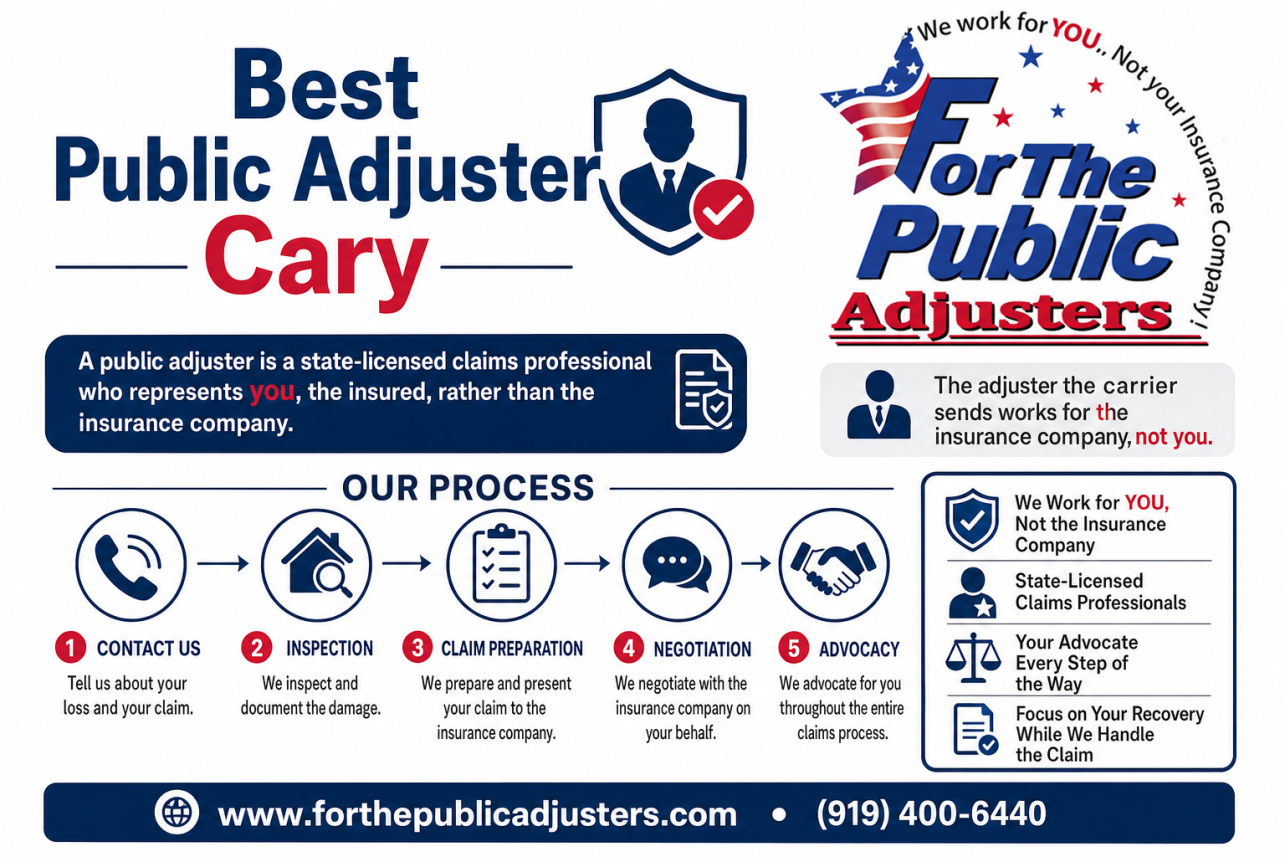
A public adjuster is a state-licensed claims professional who represents you, the insured, rather than the insurance company. The adjuster the carrier sends works for the carrier. We measure, photograph, and price the damage ourselves, read your policy line by line, and present a documented claim the company has to answer on its merits.
In Cary we handle residential homeowners claims, commercial business claims, fire and smoke losses, water and flood damage, tree strikes, vandalism, and arson defense when a carrier wrongly suspects the policyholder. If your family is displaced after a kitchen or electrical fire, our fire damage claim help for homeowner Cary NC covers that situation in depth. We also handle structural impact losses, like the kind documented in a car hits home claim in Raleigh NC, where hidden framing damage is routinely missed.
We do not handle claims involving cell phones, motor vehicles, health, or life insurance. Our work is buildings, structures, and the contents inside them.
Courts have long recognized that policyholders can prevail when carriers read coverage too narrowly. In French v. Assurance Company of America, the Fourth Circuit — the federal appeals court covering North Carolina — sided with homeowners, holding that water damage to their home resulting from defectively installed synthetic stucco was covered even though the defective workmanship itself was not. The lesson is simple: how a loss is framed and documented can decide whether it is paid.
Common Problems
What Will A Public Adjuster Cost Me — And Is My Loss Even Worth Fighting For?
We work on a contingency fee, a percentage of what the claim actually pays. There is no hourly bill and no upfront charge, so a homeowner with a damaged roof or a flooded crawlspace is not gambling money to find out what the claim is worth.
The bigger question is value. Carrier estimates in Cary routinely miss code-upgrade costs, matching issues on discontinued shingles or siding, smoke contamination in HVAC systems, and contents losses the homeowner never thought to list. An independent scope of loss often looks very different from the first estimate the carrier hands you. We cannot promise a specific outcome — no honest adjuster can — but you deserve a claim built from a complete inventory of the damage, not a drive-by estimate.
The Carrier Keeps Delaying, Lowballing, Or Blaming Everything On Age — Now What?
This is the most common call we get. The claim drags for weeks, the estimate will not cover an actual contractor’s bid, or the denial letter says “wear and tear” on a roof that was fine until the storm came through.
The answer is evidence. We document storm dates, hail and wind reports, pre-loss condition, and manufacturer specifications, then rebut the carrier’s position in writing. We see the same playbook across Wake County — the tactics a public adjuster in Raleigh NC confronts are the same ones used in Cary. When a claim is genuinely stuck, we also know when it is time to involve insurance dispute lawyers, and we prepare files so attorneys can act on them quickly.
How Do I Know I’m Hiring The Best Public Adjuster Cary Has Available?
Check three things before you sign anything. First, licensing: North Carolina requires public adjusters to be licensed, and the NCDOI Public Adjusters Guide explains your rights, fee rules, and what a legitimate contract must contain. Ask for the license and verify it.
Second, bonding and experience with your claim type — a fire loss, a flood claim, and an arson accusation are very different fights. We are licensed and bonded, and we handle all three. Third, local knowledge. An adjuster who understands Cary’s housing stock, soil, and storm history will spot covered damage that an out-of-area adjuster writes off. Handling it yourself is legal, but you will be negotiating against trained professionals with your own money on the line.
Our Process
Free Policy And Damage Review
We start by reading your policy — the declarations, the endorsements, and the exclusions — and walking the property. Many Cary homeowners discover coverage they did not know they had, and some discover gaps, like learning a homeowners policy excludes flood. This review costs nothing and tells you honestly whether a claim is worth pursuing.
Independent Documentation And Scope Of Loss
We photograph and measure everything, trace hidden damage behind walls and under floors, inventory contents, and price the repair at real local construction costs. Moisture losses are a specialty — the same thorough mapping we bring to water damage insurance claim help in Bennett is applied to every Cary slab leak, burst pipe, and roof intrusion we take on.
Presentation, Negotiation, And Settlement
We submit the documented claim to the carrier, meet their adjuster on site, and answer every pushback point with evidence. If the carrier’s position does not move, we escalate — appraisal, re-inspection, or referral to counsel. You are kept informed at every step, and nothing settles without your approval.
| Claim Task | Going It Alone | With For The Public Adjusters, Inc. |
|---|---|---|
| Damage documentation | Phone photos and a verbal walkthrough with the carrier’s adjuster | Moisture mapping, thermal imaging, soot testing, and room-by-room photo logs |
| Estimate and scope | You rely on the carrier’s estimate, written by the party paying the claim | Independent line-item estimate using the same software carriers use, built to the full policy scope |
| Contents inventory | A rough list from memory, often missing depreciation and replacement pricing | Itemized inventory with condition, age, and replacement cost documentation |
| Policy interpretation | Exclusion language taken at face value | Coverage positions supported by North Carolina precedent, including policyholder wins like Gaston County Dyeing v. Northfield Insurance |
| Negotiation | One homeowner against a trained claims department | Licensed, bonded adjusters who handle re-inspections and supplements for a living |
| Your time | Weeks of calls, emails, and meetings during an already stressful period | We manage the claim file so you can manage your household |
Commonly Overlooked In The Public Adjusting Industry
- Soot and smoke residue inside HVAC ductwork — It’s invisible from the living space, so carrier estimates routinely stop at the rooms with visible fire damage while the duct system keeps recirculating contamination.
- Flooring and siding matching across continuous runs — Carriers often pay to patch a damaged section, overlooking that discontinued or weathered materials can’t be matched and the continuous run may need full replacement.
- Ordinance and law (code upgrade) coverage — Repairs in Wake County must meet current building code, but the extra cost of bringing older construction up to code is frequently left out of first estimates even when the policy covers it.
- Recoverable depreciation left unclaimed — Many policyholders accept the actual-cash-value check and never realize they can recover the withheld depreciation after completing repairs.
- Additional living expenses beyond the first hotel stay — Homeowners often don’t track meals, mileage, pet boarding, and extended rental costs, so months of legitimate ALE go unreimbursed.
- Hidden moisture behind walls and under flooring — Surface drying can pass a visual check while cavities stay wet, leading to mold disputes later that are harder to tie back to the original covered loss.
- Ensuing damage wrongly swept into an exclusion — Carriers sometimes read exclusions broadly, even though North Carolina’s Supreme Court sided with the insured on ensuing-loss coverage in Gaston County Dyeing v. Northfield Insurance.
- Proof-of-loss and documentation deadlines — Policies and NFIP flood claims carry strict filing windows that grieving or displaced homeowners miss simply because no one told them the clock was running.
Case Studies
Case Study #1
Situation: A family in Cary’s Lochmere neighborhood had a kitchen fire that started in a countertop appliance. The flames were out within minutes, but smoke traveled through the HVAC system into every room of the two-story home.
Problem: The insurance carrier’s adjuster scoped the loss as a single-room cleanup. The estimate covered repainting the kitchen and wiping down nearby surfaces, but ignored soot in the ductwork, odor absorbed into soft contents, and protein residue on walls two floors away.
Investigation: Our team brought in independent hygienist testing to document soot and char particulate in the duct system and on surfaces throughout the house. We photographed every room under raking light, swab-tested painted surfaces, and built a room-by-room contents inventory with replacement pricing.
Findings: Lab results confirmed combustion byproducts well beyond the kitchen, including inside the air handler and supply runs. Dozens of contents items — upholstered furniture, clothing, electronics — could not be restored to pre-loss condition through cleaning alone.
Solution: We prepared a detailed line-item estimate covering duct cleaning and sealing, whole-home deodorization, selective drywall replacement, and a documented contents claim separating cleanable items from total losses. We then presented the file to the carrier and negotiated through two re-inspections.
Outcome: The carrier revised its position substantially and funded a whole-home remediation scope rather than a single-room cleanup, along with a contents settlement supported by our inventory. The family also recovered additional living expenses for the time the home was uninhabitable during work.
Lesson: Smoke doesn’t respect room boundaries, and neither should a fire claim. Independent testing and a documented contents inventory changed this from a cosmetic repair into the full remediation the policy actually covered.
Case Study #2
Situation: A homeowner near Kildaire Farm Road returned from a winter weekend trip to find a second-floor supply line had burst, sending water through ceilings, hardwood flooring, and the finished basement below.
Problem: The carrier accepted the pipe break but tried to carve out large portions of the resulting damage, arguing that mold found behind baseboards and swelling in the engineered hardwood fell under policy exclusions. Their offer covered drying and patching, not replacement of continuous flooring runs.
Investigation: We performed moisture mapping with thermal imaging across all three levels, opened inspection points at wet wall cavities, and documented the timeline showing the mold was a direct result of the sudden pipe failure — not long-term neglect. We also researched how North Carolina courts treat ensuing damage from a covered event.
Findings: The moisture mapping showed water migration far beyond the carrier’s drying scope. North Carolina’s Supreme Court addressed a comparable dispute in Gaston County Dyeing Machine Co. v. Northfield Insurance Co., 351 N.C. 293 (2000), where the insured prevailed and the court held that damage ensuing from a covered cause remained covered despite the insurer’s reading of its exclusions.
Solution: We rebuilt the claim around a complete scope: full flooring replacement where continuous runs were damaged, cavity remediation, and ceiling replacement below — supported by the moisture documentation and the legal framework North Carolina courts apply to ensuing-loss language.
Outcome: After reviewing our documentation and position, the carrier withdrew its exclusion argument on the resulting damage and settled on a scope that allowed the homeowner to restore all three affected levels properly, including matched flooring rather than patched sections.
Lesson: Policy exclusions are not the last word. North Carolina case law has sided with policyholders on ensuing damage before, and a claim backed by moisture data and legal precedent carries far more weight than a homeowner’s objection alone.
| Claim Scenario | Is Professional Help Usually Worthwhile? | What It Depends On |
|---|---|---|
| Kitchen or house fire with smoke spread | Yes, almost always | Smoke and soot migrate through HVAC and into contents; carrier scopes frequently stop at the visibly burned rooms |
| Burst pipe or appliance water loss | Yes, if damage crosses rooms or floors | Whether hidden moisture, flooring matching, and resulting mold are fully scoped — areas where ensuing-damage disputes often arise |
| Hurricane damage to roof and interior | Yes, for anything beyond a few shingles | Whether interior water intrusion, decking, and code-upgrade costs are included, not just surface roofing |
| Tornado or fallen-tree structural damage | Yes | Structural movement and hidden framing damage are easy for a quick inspection to miss |
| Flood from rising water | Different path — flood is a separate NFIP policy | Flood claims run through the National Flood Insurance Program with their own proof-of-loss deadlines; start with FEMA.gov and FloodSmart.gov resources |
| Claim already denied | Yes, worth a policy and file review | Whether the denial rests on an exclusion reading that North Carolina courts have rejected in past policyholder cases |
| Settlement offer feels low | Yes, before you sign anything | The gap between the carrier’s scope and documented actual damage; supplements are routine when evidence supports them |
| Minor single-room loss under your deductible range | Usually not | If the documented damage barely exceeds the deductible, professional representation may not add enough value |

Reviews
After a tornado-warned storm dropped part of a pine onto our roof, the carrier’s first estimate barely covered shingles over the hole. For The Public Adjusters documented the fractured decking, interior ceiling staining, and the attic insulation nobody had even looked at. The revised settlement actually matched what our contractor said the repair would cost. Night and day difference.
Marcus T., Preston area
Our dishwasher line failed while we were at work and ruined the kitchen, hallway hardwoods, and the ceiling below. The insurance company wanted to ‘blend in’ new boards next to twelve-year-old flooring. These adjusters pushed back with photos, moisture readings, and manufacturer specs showing the flooring couldn’t be matched. We were able to replace the continuous run properly. Worth every bit of their fee.
Deepa R., Cary
Searched for the Best Public Adjuster Cary had after a garage fire and I’m glad I landed here. The smoke damage to our stored furniture and tools was almost entirely missing from the carrier’s contents list. Their team built a full inventory, item by item, with replacement pricing. Took a few months of back and forth, but the final contents settlement was several times the original offer. They were upfront that nothing was promised — just thorough.
Glenn W., MacGregor Downs
Frequently Asked Questions
Why Should I Hire The Best Public Adjuster Cary Homeowners Recommend Instead Of Handling My Claim Alone?
Insurance carriers employ trained adjusters whose job is to settle claims efficiently for the company. A policyholder negotiating alone is often at a serious disadvantage when it comes to documenting damage, interpreting policy language, and valuing repairs at real Wake County construction costs.
Courts have repeatedly recognized how one-sided this process can be. In Dickerson v. Lexington Insurance Co., a homeowner whose house was destroyed during Hurricane Katrina sued after the carrier drastically undervalued the loss. The Fifth Circuit upheld a judgment for the full policy limits plus statutory penalties, finding the insurer had arbitrarily lowballed the claim. Cases like that show what can happen when a policyholder pushes back with proper documentation and representation.
Our Cary team works only for you, never the insurance company. We inspect the damage ourselves, prepare a detailed line-item estimate, handle every communication with the carrier, and negotiate until the settlement reflects what your policy actually owes. For The Public Adjusters, Inc. is licensed and bonded, and while no one can promise a specific dollar outcome, having a professional advocate levels the playing field from day one.
If you own a home or commercial building in Cary and your claim feels undervalued, delayed, or denied, a consultation costs you nothing and may change the entire direction of your claim.
What Types Of Property Damage Claims Does Your Team Handle In Cary?
We represent homeowners and commercial property owners throughout Cary and Wake County on claims involving fire and smoke damage, water damage from burst pipes and appliance failures, hurricane damage, tornado damage, hail damage, lightning strikes, theft and vandalism, and damage to building contents such as furniture, equipment, and inventory.
Flood losses deserve a special note. Standard homeowners policies almost never cover rising water, so flood claims typically run through the National Flood Insurance Program (NFIP), administered by FEMA. These claims have strict proof-of-loss deadlines and their own rules, and we can help you navigate them. Policyholders should also review FEMA’s resources at fema.gov and floodsmart.gov to understand their coverage before a storm hits.
There are a few things we do not handle. We never take claims involving motor vehicles, cell phones, health insurance, or life insurance. Our focus is strictly damage to homes, buildings, and the contents inside them, because that is where deep expertise makes the biggest difference for a policyholder.
Whether it is a kitchen fire in a Preston home, pipe damage in a downtown Cary office, or roof and interior damage after a hurricane tracks through the Triangle, our adjusters document the full scope of the loss, including items the carrier’s adjuster may overlook, such as code-upgrade costs, hidden moisture damage, and business contents.
How Much Does It Cost To Hire A Public Adjuster In Cary, And How Are Fees Structured?
For The Public Adjusters, Inc. works on a contingency-fee basis, meaning we are paid a percentage of the settlement your insurance company pays, and only when it pays. There are no upfront costs, hourly bills, or hidden charges, so our interests stay aligned with yours from the first inspection to the final check.
The exact percentage is agreed to in writing before any work begins, and it varies based on the size and complexity of the loss. North Carolina regulates public adjuster contracts, and as a licensed and bonded firm we follow every requirement, including clear written agreements and your statutory right to cancel.
Many Cary policyholders find the fee pays for itself. When the Best Public Adjuster Cary property owners can find is reviewing the claim, items frequently surface that an initial carrier estimate missed, such as matching requirements for roofing and siding, code-compliance upgrades required by the Town of Cary, hidden water migration behind walls, and full contents inventories. We cannot and do not guarantee any specific recovery amount, but a thorough, professionally documented claim gives you the strongest possible negotiating position.
Before you sign anything, we review your policy and your damage at no charge and tell you honestly whether professional representation makes sense. If the claim is small or already fairly paid, we will say so.
My Insurer Already Made An Offer On My Cary Home. Is It Too Late To Bring In A Public Adjuster?
In most situations, no. As long as your claim has not been fully closed and released, a public adjuster in Cary can still step in, reinspect the property, and reopen negotiations with supplemental documentation. Even claims the carrier considers settled can often be supplemented when additional damage is discovered, which is common with water losses where moisture spreads behind drywall and under flooring.
Timing still matters. North Carolina policies contain deadlines for proof of loss, suit limitations, and appraisal demands, so the sooner we review your file, the more options remain open. If your claim was underpaid or denied, bring us the carrier’s estimate and denial letter and we will compare them line by line against your actual policy language and the real cost of repairs in Wake County.
Policyholders who challenge low offers are not powerless. In Dickerson v. Lexington Insurance Co., the court affirmed a full policy-limits award plus penalties after an insurer arbitrarily undervalued a destroyed home, a reminder that carriers are legally obligated to pay what the policy owes.
Our adjusters handle reopened claims, supplemental claims, and disputed valuations regularly. While results depend on the facts of each loss and no outcome can be guaranteed, a second professional opinion from our team costs nothing, and it is often the first time a Cary homeowner sees what their claim is genuinely worth.
How Long Will My Claim Take Once A Cary Public Adjuster Gets Involved?
Every claim is different, but most residential losses we handle in Cary resolve within 60 to 120 days from the date we submit a complete, documented claim package. Straightforward kitchen fires or burst-pipe losses in neighborhoods like Preston or Lochmere can move faster; large structural losses or hurricane claims after a storm like Florence often take longer because carriers are flooded with files across Wake County.
What we control is the front end. We inspect the property, photograph and inventory every damaged item, obtain contractor estimates built on local Cary labor and material pricing, and submit a claim the carrier cannot easily dispute. Incomplete claims are the number one cause of delay, and we eliminate that problem on day one.
North Carolina law also works in your favor. Once the insurer receives a satisfactory proof of loss, it is expected to act on the claim promptly, and the Department of Insurance takes unreasonable delay seriously. If an adjuster goes quiet, we escalate in writing and keep the file moving.
We never promise a specific dollar outcome or a guaranteed closing date — no honest adjuster can. What we do promise is a fully documented claim, persistent follow-up, and a negotiation handled by licensed professionals rather than left to chance.
Does Homeowners Insurance Cover Flood Damage In Cary, And Can You Still Help If I Have An NFIP Policy?
Standard homeowners policies in North Carolina exclude flooding — rising water from Crabtree Creek, Swift Creek, or storm runoff after a hurricane is not covered unless you carry a separate flood policy, usually through the National Flood Insurance Program (NFIP) administered by FEMA. Many Cary homeowners near low-lying areas discover this distinction at the worst possible time.
Yes, we help with flood claims. NFIP claims have strict rules that trip up policyholders constantly, including a signed, sworn Proof of Loss that is generally due within 60 days of the loss unless FEMA extends the deadline after a major disaster. Miss it, and recovery becomes far harder. We prepare that paperwork, document the structure and contents line by line, and deal directly with the NFIP adjuster.
We also sort out the coverage puzzle hurricanes create. Wind-driven rain entering through a tornado- or hurricane-damaged roof may fall under your homeowners policy, while rising water falls under flood coverage. Carriers sometimes point at each other, and the homeowner gets caught in the middle. We allocate the damage properly so each policy pays what it should.
For current flood maps, disaster declarations, and NFIP policy details, FEMA.gov and FloodSmart.gov are worth bookmarking. For the claim itself, bring in professional representation before you sign anything.
Have North Carolina Policyholders Actually Won In Court Against Their Insurance Companies?
Yes, and it is worth knowing because carriers count on policyholders assuming the fight is hopeless. A notable example is Gaston County Dyeing Machine Co. v. Northfield Insurance Co., 351 N.C. 293 (2000), where the North Carolina Supreme Court sided with the insured in a dispute over property damage coverage. The insurers had argued the damage fell outside their policy periods; the Court rejected that reading and held that coverage applied, confirming that North Carolina courts will enforce policies as written rather than as insurers wish they were written.
The lesson for a Cary homeowner or business owner is simple: a denial letter is an insurance company’s opinion, not a final verdict. Policy language is interpreted under North Carolina law, and ambiguities are generally construed in favor of the policyholder.
That said, litigation is slow and expensive, and the vast majority of claims we handle never need a courtroom. Our job as your public adjuster is to build a claim so thoroughly documented — measurements, photographs, code requirements, contents inventories, local repair pricing — that the carrier’s most economical path is simply to pay what the policy owes.
When a carrier digs in anyway, a properly prepared claim file becomes the foundation an attorney can build on. Either way, the documentation we create in those first weeks after a fire, flood, or hurricane protects you.

Is The Best Public Adjuster Cary Residents Rely On Actually Licensed And Bonded In North Carolina?
Yes. For The Public Adjusters, Inc. is licensed by the North Carolina Department of Insurance and fully bonded, as state law requires of every legitimate public adjusting firm. You can verify any adjuster’s license directly through the Department’s online lookup, and we encourage you to do exactly that before hiring anyone — including us. If someone knocking on your door after a storm cannot produce a North Carolina license number, send them away.
Being earning the reputation as the Best Public Adjuster Cary property owners recommend comes with knowing our lane. We represent policyholders on claims involving damage to homes, commercial buildings, and their contents — fire and smoke, water and plumbing failures, hurricanes, tornadoes, hail, theft, and vandalism. We do not handle claims involving motor vehicles, cell phones, health insurance, or life insurance, and we will tell you so upf
What Should I Do Right After A Fire, Hurricane, Or Tornado Damages My Cary Home Before Filing A Claim?
Your first priority is safety. Once the property is secure, take extensive photos and video of every damaged area before anything is moved, cleaned, or repaired. Insurance carriers scrutinize documentation, and images taken in the first 24 to 48 hours often become the strongest evidence in your file.
Next, take reasonable steps to prevent further damage, such as tarping a roof opened by a tornado or boarding broken windows after a fire. Keep every receipt. Most policies require mitigation, and those costs are typically reimbursable. What you should not do is throw away damaged contents, sign repair contracts under pressure, or give a recorded statement before you understand your policy.
This is also the ideal moment to call a Cary public adjuster. For The Public Adjusters, Inc. can step in before the carrier’s adjuster ever walks the property, which means the claim is documented to your benefit from day one rather than reconstructed after the fact.
We inspect the structure, inventory contents room by room, read the full policy including endorsements, and prepare a detailed estimate using the same software insurers use. Hurricane and tornado claims in Wake County often involve hidden damage, like water intrusion behind siding or lifted shingles that fail months later, and catching it early matters. We are licensed and bonded in North Carolina, and while no one can promise a specific outcome, early professional involvement gives your claim the strongest possible foundation.
My Insurance Company Denied Or Underpaid My Claim. Can A Cary Public Adjuster Still Help?
Yes, in many cases a denial or lowball payment is the beginning of the process, not the end. For The Public Adjusters, Inc. regularly reviews denied and underpaid claims for Cary and Wake County property owners, and we frequently find grounds to reopen or supplement them.
We start by comparing the carrier’s denial letter against the actual policy language. Insurers sometimes rely on exclusions that do not apply to your specific facts, or they miss coverage buried in endorsements. We then re-inspect the property, document damage the first adjuster overlooked, and submit a formal supplement or demand for re-evaluation backed by evidence.
North Carolina law favors policyholders when policy language is unclear. In Gaston County Dyeing Machine Co. v. Northfield Insurance Co., 351 N.C. 293 (2000), the North Carolina Supreme Court held that ambiguous terms in a property insurance policy must be construed in favor of coverage, and the insured ultimately prevailed on its damage claim. That principle is a powerful tool when a carrier leans on vague wording to deny payment.
Many policies also include an appraisal clause, which allows disputes over the amount of loss to be resolved without litigation. We can represent your interests through that process. We never guarantee a particular result, but a denial reviewed by an experienced, licensed professional often looks very different from the one the insurer hoped you would simply accept.
How Is The Best Public Adjuster Cary Offers Different From The Adjuster My Insurance Company Sends?
The difference comes down to one question: who does the adjuster work for? The adjuster your carrier sends is employed or contracted by the insurance company. However professional they may be, their estimate is prepared within the carrier’s guidelines, and their job is to resolve the claim at a cost the insurer approves.
A public adjuster works exclusively for you, the policyholder. For The Public Adjusters, Inc. is licensed and bonded in North Carolina, and our only client in your claim is you. We owe no duty to the insurance company.
In practice, that changes everything about how the loss is handled. We read the entire policy, not just the declarations page, looking for coverage the carrier’s adjuster may never mention, such as code upgrade coverage, additional living expenses, or debris removal. We prepare our own independent estimate rather than reacting to theirs, and we inventory contents line by line instead of accepting a rough allowance.
It also changes the negotiation. Carrier adjusters handle hundreds of files and move on quickly. We stay on your claim, respond to every pushback with documentation, and escalate through supplements or appraisal when the numbers do not reflect the real cost of repairs in the Cary market.
We cannot promise a specific dollar figure, and anyone who does should raise a red flag. What we offer is experienced, licensed representation on your side of the table, which is something the insurance company’s adjuster can never be.
Do You Handle Commercial Property Claims For Cary Businesses, Or Only Residential Homes?
We handle both. For The Public Adjusters, Inc. represents homeowners as well as business owners, landlords, condo associations, and commercial property managers throughout Cary and Wake County. Many people assume public adjusters only work on houses, but commercial losses are often where professional representation matters most.
Commercial claims are more complex than residential ones. A fire at a restaurant on Chatham Street or hurricane damage to an office building near Weston Parkway involves more than structural repairs. There is business personal property, tenant improvements, inventory, equipment, and often business interruption coverage that pays for lost income while you rebuild. Carriers calculate business interruption using financial records, projections, and policy-specific formulas, and errors in that math can cost an owner significantly.
Our team documents the physical damage, builds a detailed contents and equipment inventory, and works through the income-loss calculation with supporting financials so the claim reflects what the interruption actually cost your operation. We also review lease obligations and ordinance-and-law coverage, which frequently applies when Cary’s current building codes require upgrades during repairs.
One important note on scope: we handle claims involving damage to homes, buildings, and their contents. We do not take claims involving motor vehicles, cell phones, health, or life insurance.
Whether your loss is a townhome in Lochmere or a warehouse off NC-54, the approach is the same. That commitment to thorough, policyholder-side representation is why many owners consider us the Best Public Adjuster Cary businesses can bring to a complicated claim.
How Do You Document And Value My Damaged Contents And Personal Property After A Loss In Cary?
Contents are one of the most underpaid parts of a property claim, and it is where careful documentation makes the biggest difference. After a fire, hurricane, tornado, or water loss at your Cary home or business, our team conducts a room-by-room inventory of everything that was damaged or destroyed — furniture, clothing, electronics, tools, kitchenware, and specialty items like heirlooms or collections.
We photograph items, record model numbers and ages where possible, and research replacement costs at current retail prices rather than accepting the carrier’s generic pricing software. Many policies pay replacement cost only after you document the loss properly, so an incomplete inventory can cost a policyholder thousands.
We also review your policy for contents sub-limits — jewelry, firearms, and business property kept at home often have caps you may not know about — and we account for depreciation holdback and how to recover it. For smoke and soot losses, we evaluate whether items can genuinely be restored or should be replaced, since cleaning estimates from the insurer’s vendors sometimes understate the true damage.
One note on scope: we handle claims for damage to homes, buildings, and the contents inside them. We do not handle claims involving cell phones, motor vehicles, health, or life insurance. If your Wake County loss involves a structure and the belongings in it, that is exactly the kind of claim we work every day, and thorough contents documentation is a core part of how we build it.
Does The Best Public Adjuster Cary Residents Call Also Serve Nearby Wake County Neighborhoods And Towns?
Yes. While Cary is home base for many of our clients, For The Public Adjusters, Inc. represents policyholders throughout Wake County and the surrounding Triangle area. That includes Cary neighborhoods like Preston, Lochmere, Amberly, MacGregor Downs, and Carpenter Village, plus nearby communities such as Apex, Morrisville, Holly Springs, Fuquay-Varina, Garner, and Raleigh.
Working locally matters more than people realize. Rebuilding costs in western Wake County are not the same as statewide averages — labor rates, permit requirements through the Town of Cary or Wake County inspections, and material pricing all affect what a proper settlement should look like. An adjuster who knows this market can challenge a carrier estimate that was built on outdated or out-of-area pricing.
It also matters for the types of losses we see here. Hurricane remnants pushing up from the coast, tornado outbreaks like the ones that have crossed the Triangle, hail, lightning strikes, burst pipes during winter cold snaps, and kitchen fires are the claims that come through our door most often. We know how local carriers’ field adjusters tend to scope these losses and where their estimates commonly fall short.
We are licensed and bonded in North Carolina, and we handle both residential and commercial building claims across the county. If you are outside Cary proper but within the Triangle, call us — chances are good we have already worked claims on streets near yours.
What Happens If My Insurance Company And My Public Adjuster Disagree On The Value Of My Cary Claim?
Disagreement over value is common, and your policy and North Carolina law both give you tools to resolve it — you are not stuck with the carrier’s number.
First, we negotiate. A detailed, line-item estimate backed by photos, moisture readings, and local Wake County contractor pricing often moves a carrier significantly on its own. If negotiation stalls, most policies contain an appraisal clause: you select an appraiser, the insurer selects one, and a neutral umpire resolves the difference. It is a structured process that frequently produces a better outcome than accepting a lowball figure.
If a carrier wrongly denies or underpays, policyholders can and do prevail in court. In Gaston County Dyeing Machine Co. v. Northfield Insurance Co., 351 N.C. 293 (2000), the North Carolina Supreme Court sided with the insured in a dispute over property damage coverage, rejecting the insurers’ narrow reading of when the damage occurred and which policies had to respond. Cases like that are a reminder that North Carolina courts will hold carriers to the language of their own policies.
To be clear, no one can promise a specific result, and we never guarantee what any policyholder will recover — anyone who does should raise a red flag. What the Best Public Adjuster Cary policyholders can hire will do is document the loss thoroughly, know the policy better than the carrier’s field adjuster does, and use every lever — negotiation, appraisal, and referral to coverage counsel when needed — to pursue what the policy actually owes.

Is A Burst Pipe Or Appliance Leak In My Cary Home Treated As Water Damage Or Flood Damage, And Does It Matter?
It matters enormously, because the two are covered by completely different policies. A burst pipe, failed water heater, leaking washing machine supply line, or an overflow from inside the home is typically sudden and accidental water damage, which most homeowners policies cover. Flood — rising surface water from outside, like a swollen creek or storm runoff — is excluded from standard homeowners policies and is covered only by a separate flood policy, usually through the National Flood Insurance Program.
Carriers sometimes blur this line to a policyholder’s disadvantage. After heavy tropical rain in Wake County, an insurer may argue that water intrusion was flood-related and deny the homeowners claim, even when the real cause was a plumbing failure or hurricane-created roof opening that let rain inside. Determining the actual cause of loss — and documenting it before repairs erase the evidence — is central to getting the right policy to pay.
For burst-pipe and appliance claims in Cary, we scope not just the visible damage but hidden moisture in wall cavities, subfloors, and insulation, plus mold prevention costs and damaged contents. Carrier estimates often cover drying but shortchange tear-out and rebuild.
If your loss truly is flood, we can still represent you on an NFIP or private flood claim, and we encourage homeowners to review resources at FEMA.gov and FloodSmart.gov to understand their coverage. Either way, getting the cause of loss classified correctly from day one protects your claim.
Local Relevance
Cary’s claims landscape is shaped by its geology and its growth. Much of western Wake County sits on Triassic Basin clay that drains poorly and shrinks and swells with the seasons, so cracked slabs, sticking doors, and foundation movement often get blamed on “settling” when the real trigger was a water event. Knowing the difference changes how a claim is written.
Flood risk here hides off the map. Crabtree Creek and other Neuse tributaries have flooded homes that sit outside the high-risk zones shown on Federal Emergency Management Agency (FEMA) flood maps, and rapid development has added more pavement and runoff than those maps were drawn for. Too many owners learn after the water rises that homeowners insurance excludes flood and they never bought a separate policy.
Storms cut narrow paths through the Triangle. Hurricane remnants, spring hail, and the occasional tornado can total roofs on one street and leave the next untouched — so “nobody else in the neighborhood filed” means nothing. Ice storms deserve respect too; limb strikes and ice-dam leaks are frequently underpaid as one-off events. We see the same patterns a few miles south, where our work as a public adjuster in Holly Springs involves the same soil, the same storms, and the same carrier arguments.
Whole Cary subdivisions went up together in the late 1990s through mid-2000s with builder-grade shingles and minimal flashing, and those roofs are now exactly the age where carriers push “wear and tear” on every claim. Documenting the specific storm date and the local hail or wind reports is often the difference between a denial and a full replacement.
Get A Free Claim Review Before You Accept The Carrier’s Number
Whether your Cary home took a t
Call us: (919) 400-6440
Helpful Resources
- NCDOI Public Adjusters Guide
- Federal Emergency Management Agency (FEMA)
- North Carolina Department of Insurance — State regulator that licenses public adjusters and protects consumers
- FEMA flood maps — Official flood zone maps and flood risk information
Last updated: October 13, 2026