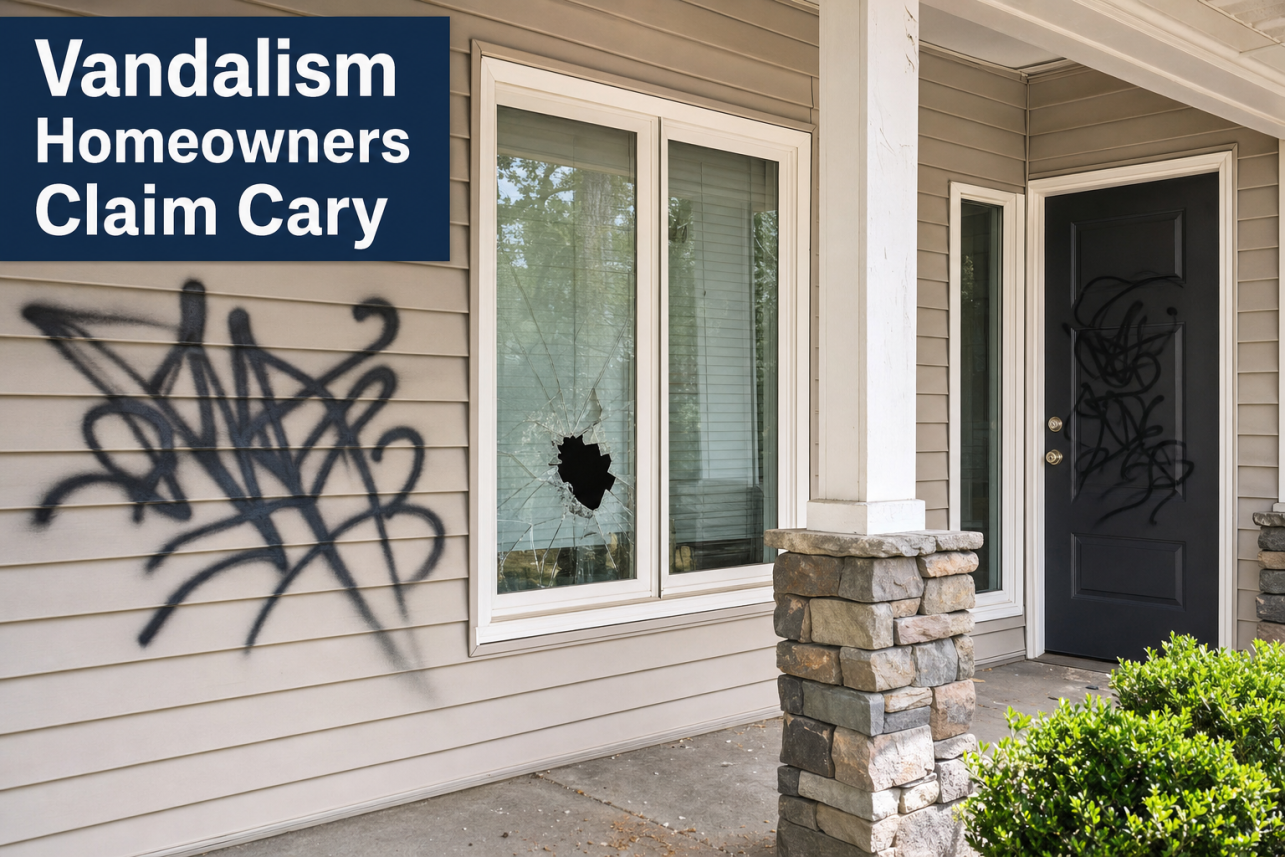
If you need help with a Vandalism Homeowners Claim Cary policyholders can hire For The Public Adjusters, Inc. to document the damage, prepare the claim, and negotiate directly with the insurance company on their behalf. Vandalism — broken windows, kicked-in doors, graffiti, destroyed landscaping, or interior destruction after a break-in — is covered under most standard homeowners policies, but insurers frequently dispute the cause, depreciate the payout, or delay payment. As licensed and bonded public adjusters, we work only for you, the homeowner, never for the insurance company.
What This Service Is
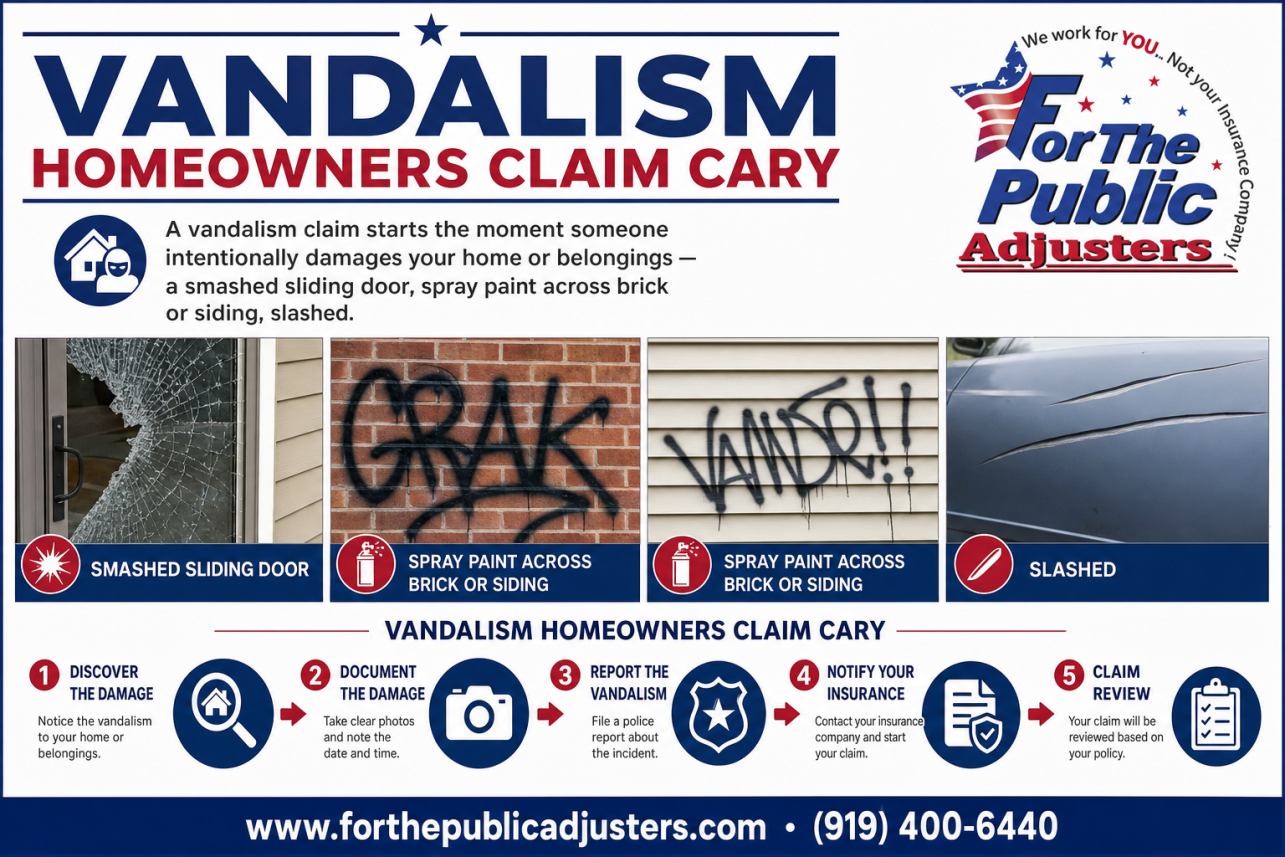
A vandalism claim starts the moment someone intentionally damages your home or belongings — a smashed sliding door, spray paint across brick or siding, slashed screens, a torn-up interior after a burglary, or destruction at a home sitting vacant during a sale or renovation. Your homeowners policy almost certainly covers it, but coverage on paper and a fair check in hand are two different things.
Our job is to close that gap. We read your policy line by line, photograph and inventory every item of damage, obtain realistic repair pricing from the Cary market, prepare the proof of loss statement your insurer requires, and negotiate the settlement. Homeowners often don’t realize that graffiti removal from brick or specialty siding, matching discontinued windows, or rekeying and repairing forced-entry doors can cost several times what the insurer’s first estimate allows.
We handle vandalism claims across the Triangle, including a dedicated Homeowners Vandalism Insurance Claim in Durham practice, so we know how regional carriers evaluate — and undervalue — this specific type of loss. We also handle related losses such as fire, smoke, water, and arson claims, so if the vandalism involved more than one kind of damage, one team manages it all.
Common Problems
Why Is The Insurer’s Offer So Much Lower Than My Contractor’s Estimate?
This is the most common call we get. The insurance company’s adjuster often prices repairs at actual cash value — the depreciated worth of your ten-year-old door or window — while your contractor quotes what it actually costs to replace it today.
If your policy includes replacement cost coverage, you may be entitled to recover that depreciation after repairs are done, but many homeowners never claim it because nobody explains the process. Graffiti is another sore spot: carriers may pay for a coat of paint when the surface actually needs professional cleaning, sealing, or full siding replacement to restore it.
We rebuild the estimate from scratch using real local repair pricing, then push back on every deduction — including your deductible being applied correctly — so the settlement reflects what restoration genuinely costs in Wake County.
What If My Vandalism Homeowners Claim Cary Gets Denied, Delayed, Or Disputed?
Insurers deny or stall vandalism claims for predictable reasons: no police report was filed promptly, the home was vacant longer than the policy allows, or the carrier argues the damage is really wear and tear rather than a deliberate act. A slow response from the company is not something you simply have to accept — you have rights, and North Carolina law expects claims to be handled fairly.
North Carolina courts have backed homeowners on this. In Gray v. North Carolina Insurance Underwriting Association, the state’s Supreme Court sided with policyholders whose dwelling damage claim was mishandled, recognizing that unfair claims practices in settling property losses can expose an insurer to liability well beyond the original claim amount.
We’ve helped clients reopen and appeal denied claims from Cary to Alamance County, where a Vandalism Homeowners Claim in Burlington often runs into the same vacancy and cause-of-loss disputes. Documentation, deadlines, and a properly prepared proof of loss are usually what turn a stalled claim around.
Should I Just Handle The Claim Myself, Or Is Hiring A Public Adjuster Worth It?
You can absolutely file on your own, and for a small loss barely above your deductible, that may make sense. But vandalism claims get complicated fast: proving the damage was intentional, itemizing stolen or destroyed contents, and countering an adjuster who works for the insurance company — not for you.
A public adjuster is the only licensed professional in the claims process who represents the policyholder exclusively. The NCDOI Public Adjusters Guide explains how our license works and confirms that our fee is a percentage of the settlement — we are paid from the recovery, not upfront, so our interests are aligned with yours.
When you evaluate any adjuster, verify the license, ask about experience with your specific loss type, and expect a clear written contract. We are licensed and bonded, and we can never guarantee a specific dollar outcome — anyone who promises one should be a red flag.
Our Process
Secure The Property And Review Your Policy
First, file a police report right away — most policies require it for vandalism, and it anchors your claim. Make reasonable temporary repairs, like boarding a broken window, and keep every receipt, because those out-of-pocket costs are typically reimbursable.
Then we sit down with your actual policy. We identify your coverage limits, deductible, vacancy clauses, and any exclusions before the insurance company frames the claim on their terms.
Document Everything And Build The Claim
We photograph and video the full scope of damage, inventory destroyed or stolen contents, and obtain independent repair estimates that reflect real Cary-area pricing — not a software default. Where cleaning or restoration standards matter, such as graffiti on masonry or smoke residue from a vandalism-related fire, we document why proper remediation costs what it does.
We then prepare and submit the sworn proof of loss statement correctly and on time. Errors here are one of the most common reasons claims get delayed or denied.
Negotiate The Settlement And See It Through
We meet the insurance company’s adjuster on site, walk them through the damage item by item, and challenge every improper depreciation deduction, exclusion argument, or lowball line item.
If the carrier delays payment or acts in bad faith, we escalate — and when a claim needs legal firepower, we coordinate with insurance dispute lawyers. You stay informed at every step, and you make the final decision on any settlement offer.
| Claim Stage | Policyholder Handling It Alone | With For The Public Adjusters, Inc. |
|---|---|---|
| Damage documentation | Photos of visible damage only; hidden damage to ducts, drains, and wall cavities often missed | Room-by-room documentation plus borescope, plumbing scope, and specialty inspections where warranted |
| Contents inventory | Handwritten list from memory, frequently undervalued and incomplete | Itemized inventory rebuilt from receipts, photos, and replacement-cost research |
| Vacancy and intent disputes | Carrier’s interpretation often accepted without challenge | Occupancy timelines, police reports, and case law like Gaston County Dyeing Machine Co. v. Northfield Ins. Co., 351 N.C. 293 (2000), used to push back |
| Estimate review | Carrier’s estimate taken at face value | Line-item comparison against contractor pricing, matching provisions, and code-upgrade requirements |
| Negotiation | One person against a trained claims department | Licensed, bonded professionals negotiating on your behalf from first inspection to settlement |
Commonly Overlooked In The Public Adjusting Industry
- Paint and chemical migration into HVAC ductwork — Nobody looks past the first vent grille, so paint poured or sprayed into supply runs gets written up as a cleaning line instead of the duct replacement it usually requires.
- Matching provisions for discontinued cabinets, tile, and countertops — Carrier estimates replace only the smashed section, missing that a discontinued product line can support replacing the full run to achieve a uniform appearance.
- The vacancy clause start date — Adjusters often assume vacancy from the last rent payment rather than actual occupancy, and utility records or eviction filings frequently prove the vacancy clock never ran.
- Sub-slab drain damage from concrete, grease, or debris poured into plumbing — It is invisible without a camera scope, so five-figure excavation and pipe replacement costs never make it into the first estimate.
- Stain-blocking primer and full-surface repainting for graffiti — One coat of standard paint gets estimated, but spray paint and markers bleed through without sealing primer, and partial repaints leave visible mismatch.
- Loss of rental income and additional living expenses during repairs — Policyholders focus on the physical damage and forget these coverages exist, and carriers rarely volunteer them.
- Resulting water damage from vandalized plumbing fixtures — When vandals rip out fixtures or leave water running, the water damage is part of the vandalism loss, but it is often miscoded or blamed on maintenance neglect.
- The proof-of-loss deadline and its formal requirements — Missing or incorrectly completing this sworn document can jeopardize an otherwise valid claim, and few homeowners know it exists until the deadline is close.
Case Studies
Case Study #1
Situation: A family in the Lochmere area of Cary returned from a two-week summer trip to find their home had been broken into and deliberately trashed. Intruders had spray-painted interior walls, smashed granite countertops with a hammer, poured paint down HVAC vents, and destroyed built-in cabinetry.
Problem: Their homeowners carrier assigned a field adjuster who estimated the damage at just under $19,000, treating the graffiti as a repaint job and the countertop damage as a partial replacement. The estimate ignored the paint that had migrated through the duct system and made no allowance for matching the discontinued cabinetry line.
Investigation: Our team documented every room with photographs, moisture readings where paint had soaked into drywall, and a borescope inspection of the supply and return ducts. We pulled the police report, interviewed the responding officer, and inventoried destroyed contents with purchase records the homeowners retrieved from email receipts.
Findings: The duct inspection showed oil-based paint had traveled past the first elbow in three supply runs, meaning cleaning was not feasible and duct replacement was warranted. The cabinet manufacturer confirmed the line was discontinued, which under the policy’s matching considerations supported replacement of the full kitchen run, not one damaged bank.
Solution: We prepared a line-item estimate covering full duct replacement, complete cabinet replacement to achieve a uniform appearance, slab replacement for the countertops, sealing and repainting of graffiti-stained drywall with stain-blocking primer, and a documented contents inventory. We then negotiated directly with the carrier’s adjuster and their reinspection team.
Outcome: After reinspection and two rounds of negotiation, the claim settled at roughly four and a half times the original estimate, with the contents inventory paid at replacement cost. The family completed repairs without taking on debt.
Lesson: Vandalism damage is rarely limited to what you can see from the doorway. Hidden migration of paint, chemicals, or debris into building systems is one of the most commonly underpaid parts of these claims, and North Carolina courts have long held that ambiguous policy language is read in the policyholder’s favor — the state Supreme Court reaffirmed that principle in a property-damage coverage dispute in Gaston County Dyeing Machine Co. v. Northfield Insurance Co., 351 N.C. 293 (2000), where the insured prevailed.
Case Study #2
Situation: A Cary homeowner near the Kildaire Farm corridor rented her house while working out of state. Shortly before the tenants were evicted, the property was severely vandalized: fixtures ripped from walls, concrete poured into toilets and drains, doors kicked off hinges, and appliances gutted for copper.
Problem: The insurance company initially leaned toward denying the claim, arguing the damage was ‘tenant wear and tear’ and questioning whether the home qualified as vacant under the policy’s vacancy provision, which can restrict vandalism coverage after a set number of consecutive days.
Investigation: We built a timeline proving the home was continuously occupied until days before the damage occurred, using utility records, the eviction filing in Wake County court, and neighbor statements. A licensed plumber scoped the drain lines and documented hardened concrete in the main sanitary line, and we photographed intentional destruction patterns inconsistent with ordinary wear.
Findings: The occupancy timeline defeated the vacancy argument outright — the vacancy clock had never run. The plumber’s scope confirmed the drain system required excavation and partial replacement, a five-figure item the carrier’s first walkthrough never identified. The destruction was plainly intentional, which is the definition of vandalism, not wear and tear.
Solution: We submitted a documented proof of loss with the timeline evidence, the drain scope video, a contractor’s repair estimate, and case support noting that North Carolina courts construe coverage-restricting language narrowly against the insurer when the policyholder’s reading is reasonable, as in Gaston County Dyeing Machine Co. v. Northfield Insurance Co., 351 N.C. 293 (2000).
Outcome: The carrier withdrew the vacancy position and paid the claim, including the sub-slab drain replacement, door and fixture replacement, and loss of rental income during repairs. The homeowner avoided litigation entirely.
Lesson: When a carrier raises vacancy or tenant-caused-damage defenses on a vandalism loss, the facts and the timeline decide everything. Documenting occupancy and the intentional nature of the damage early can be the difference between a denial and a fully paid claim.
| Your Situation | First Step | What the Outcome Usually Depends On |
|---|---|---|
| Break-in with graffiti and smashed interiors | File a Cary Police report immediately, then photograph everything before touching it | Whether hidden damage (ducts, plumbing, wall cavities) is documented before repairs begin |
| Damage discovered after tenants left | Preserve the eviction record and utility bills proving occupancy dates | Defeating the ‘wear and tear’ and vacancy arguments with a clear timeline |
| Home was vacant or listed for sale when vandalized | Check your policy’s vacancy provision and how many consecutive days it allows | Exact vacancy dates, any vacancy endorsement, and evidence of periodic occupancy or checks |
| Contents stolen along with the vandalism | Separate the theft items from the destruction items in your inventory | Receipts, photos, and whether your policy pays replacement cost or actual cash value |
| Carrier’s estimate seems far too low | Do not sign a release; request the full line-item estimate in writing | An independent scope of damage and whether matching and code items were included |
| Vandalism claim denied outright | Request the denial in writing citing the specific policy language | Whether the cited exclusion actually fits the facts — North Carolina courts read ambiguous terms in the policyholder’s favor |
| Vandals also caused water discharge (broken pipes, open faucets) | Shut off water, mitigate promptly, and keep all mitigation invoices | Documenting the water damage as resulting from the vandalism, not neglect or flood (flood is separate — see FEMA and NFIP for flood coverage) |

Reviews
Our home was vandalized during a weekend away — spray paint on the brick, broken windows, and someone had taken a bat to our kitchen. The insurance estimate barely covered the windows. For The Public Adjusters found paint damage inside our ductwork that nobody else even looked for and handled every call with the carrier. The final settlement covered a real restoration, not a patch job. I hope we never need them again, but I’d call them first if we did.
Melissa T., Preston area, Cary
After an eviction, our rental house in Cary was destroyed on purpose — concrete in the drains, doors ripped off, wiring pulled out. The insurer tried to call it tenant wear and tear and hinted the vacancy clause might apply. This team built a timeline with utility bills and the court eviction record that shut that argument down. They were straight with me the whole way and never promised numbers they couldn’t back up. The claim got paid, including the plumbing excavation.
Darnell W., Cary (Wake County)
Teenagers broke into our home while it was listed for sale and wrecked it — graffiti, smashed bathroom tile, ruined furniture we’d staged. I was overwhelmed by the contents inventory alone. Their adjuster sat with me and rebuilt the entire list from receipts and photos, then documented the tile matching issue the carrier’s estimate ignored. The only reason it’s four stars and not five is the process took longer than I expected, though they warned me negotiations take time. Worth every bit of the fee.
Grace P., near downtown Cary
Frequently Asked Questions
What Does A Vandalism Homeowners Claim Cary Typically Cover?
A Vandalism Homeowners Claim Cary generally covers intentional, malicious damage to your home and personal property — think spray paint on brick or siding, smashed windows and doors, destroyed landscaping fixtures, damaged HVAC units, and interior destruction if someone breaks in and wrecks flooring, cabinetry, or furnishings.
Most standard homeowners policies in Wake County list vandalism and malicious mischief as a named peril. That means the damage itself is usually covered, but the fight is often over scope and valuation. Insurers may argue that certain damage was pre-existing wear, that graffiti removal only requires spot painting rather than matching an entire elevation, or that broken security systems and smart-home equipment fall under lower sub-limits.
Contents are frequently undervalued too. If vandals destroyed electronics, artwork, or furniture, the carrier may apply steep depreciation or push actual cash value when your policy entitles you to replacement cost after repairs are made.
Be aware of common exclusions: vandalism to a home that has been vacant beyond the policy’s stated period (often 30 to 60 days) is typically excluded, which matters for Cary homeowners with a property on the market or between tenants. Damage to motor vehicles is handled under auto policies, not homeowners coverage, so we do not handle that portion.
Our role is to document every item of damage, apply the correct policy provisions, and present a complete, well-supported claim. We are licensed and bonded, and while no one can promise a specific outcome, thorough documentation almost always changes the conversation with the carrier.
What Should I Do Immediately After Discovering Vandalism At My Cary Home?
First, make sure the property is safe and call the Cary Police Department to file a report. A police report number is essentially mandatory for a vandalism claim — nearly every homeowners policy requires you to report criminal acts to law enforcement promptly.
Second, document everything before touching it. Photograph and video the damage from multiple angles: graffiti, broken glass, forced entry points, destroyed contents, damaged fixtures. Capture close-ups and wide shots so the full context is clear.
Third, take reasonable steps to prevent further damage — board broken windows, secure doors, cover exposed openings before rain gets in. Keep every receipt for emergency repairs, because your policy requires you to mitigate and typically reimburses those costs. Do not make permanent repairs until the damage has been inspected and documented.
Fourth, review your policy before you give a recorded statement or accept an early estimate. Wording around vacancy, contents sub-limits, and replacement cost conditions can significantly affect what you recover, and offhand comments during a recorded statement are sometimes used to narrow coverage.
Finally, consider bringing in a Cary public adjuster early rather than after a dispute develops. We prepare the inventory, scope the repairs, and manage communication with the carrier from the start, which tends to prevent the lowball first offer rather than trying to undo it later. If the vandalism also involved water release — vandals opening faucets or cutting supply lines is more common than people think — that resulting water damage should be scoped carefully as part of the same loss.
Have Homeowners Ever Won In Court When An Insurer Wrongly Denied Vandalism Damage?
Yes, and one instructive example is Cresthill Industries, Inc. v. Providence Washington Insurance Co., 53 A.D.2d 488 (N.Y. App. Div. 1976). In that case, workers deliberately flooded a building by opening water lines, causing extensive damage to the structure and its contents. The insurer denied the claim, arguing the destruction did not qualify as vandalism under the policy.
The court disagreed and ruled for the insured. It held that willful and malicious destruction of property fits squarely within vandalism and malicious mischief coverage, even when the damage is done through water rather than, say, a sledgehammer or spray paint. The identity or motive of the vandal did not erase the policyholder’s coverage.
Why does a decades-old building-damage case matter to a homeowner in Cary today? Because carriers still make the same category arguments — claiming that damage caused indirectly (opened valves, tampered wiring, sabotaged plumbing) is not “true” vandalism, or attempting to shift it into a more restrictive part of the policy. Cresthill shows courts will look at the malicious act itself, not the insurer’s preferred label.
We cannot promise any particular result on your claim — no honest adjuster can — but knowing how courts have interpreted vandalism coverage helps us frame the facts of your loss correctly from day one. When the damage, the policy language, and the case law all point the same direction, a denial or underpayment becomes much harder for a carrier to sustain.
How Does For The Public Adjusters, Inc. Handle A Vandalism Homeowners Claim Cary From Start To Finish?
For a Vandalism Homeowners Claim Cary, our work starts with a full inspection of your property — exterior surfaces, entry points, interior rooms, and every damaged item of personal property. Vandalism losses are detail-heavy, and missed items are money left on the table.
Next, we build the claim file: a line-item repair estimate using current Wake County labor and material pricing, a documented contents inventory with photos and valuations, and a coverage analysis matching each item of damage to the specific policy provisions that apply. We also verify the police report and timeline, since carriers scrutinize those closely on malicious-damage losses.
Then we handle the carrier. We attend the insurance company’s inspection, respond to their adjuster’s questions, challenge any improper depreciation or scope reductions, and negotiate the settlement on your behalf. You are kept informed at every stage, but you are not the one arguing over paint-matching standards or drywall square footage.
A few honest boundaries: we are licensed and bonded public adjusters representing policyholders only. We never guarantee a specific dollar outcome — anyone who does should raise a red flag. And we do not handle claims involving motor vehicles, so if vandals damaged your car in the driveway, that portion belongs with your auto carrier.
What we can commit to is a professionally documented, aggressively presented claim for your Cary home. Most homeowners deal with vandalism once in a lifetime; the insurance company handles these claims every day. Our job is to level that field.
How Long Do I Have To File A Vandalism Homeowners Claim Cary After The Damage Happens?
Most homeowners policies in North Carolina require you to give “prompt notice” of the loss, and many carriers interpret that as within days, not months. Beyond the notice requirement, North Carolina generally allows a limited window — often stated in the policy itself — to bring legal action if a dispute arises, so waiting is risky on every front.
For vandalism specifically, timing matters even more than with other losses. Spray paint cures and stains deeper into brick and siding, broken windows let rain into wall cavities, and slashed screens or damaged doors leave the home exposed to further loss. Insurers sometimes argue that damage worsened because the homeowner delayed, and they may try to reduce payment for that portion.
Our recommendation for Cary and Wake County homeowners is simple: report the vandalism to the Cary Police Department the same day you discover it, notify your carrier within 24 to 48 hours, and photograph everything before touching it. Then take reasonable steps to protect the property — board a broken window, tarp an opening — and keep every receipt, because emergency protection costs are typically reimbursable.
If you are already past the first few days, do not assume the claim is lost. We regularly help policyholders document why a delay was reasonable and assemble the evidence carriers need. As licensed and bonded public adjusters, we can step in at any stage, though earlier involvement almost always makes the process smoother.
Will My Insurer Treat Vandalism Differently If My Cary Home Was Vacant Or Unoccupied?
Yes, and this is one of the most common friction points we see. Most homeowners policies contain a vacancy provision that excludes or limits vandalism coverage if the dwelling has been vacant beyond a set period — often 30 or 60 consecutive days. Carriers scrutinize vacancy closely on these claims, especially for homes listed for sale, in probate, or between tenants.
The good news is that “vacant” has a specific legal meaning, and courts have pushed back when insurers stretch these provisions. In Battishill v. Farmers Alliance Insurance Co., the New Mexico Supreme Court sided with a homeowner whose vacant dwelling was destroyed by intentionally set fire. The insurer argued the vacancy exclusion for vandalism barred the claim; the court held that the intentional destruction fell within the policy’s vandalism and malicious mischief language as the insured reasonably understood it, and the homeowner recovered.
That case illustrates a broader point: policy language is construed in favor of coverage when it is ambiguous, and an insurer’s first reading is not the final word. A house that still contains furniture, receives regular visits, or is being renovated is often “unoccupied” rather than “vacant” — a distinction that can preserve coverage.
If your Wake County property was empty when it was vandalized, gather proof of activity: utility bills, contractor invoices, showing schedules from your realtor, or dated photos. We review the exact vacancy wording in your policy and build the factual record before the carrier locks in a denial. No outcome can ever be guaranteed, but a well-documented occupancy timeline changes many of these conversations.
How Much Does It Cost To Hire A Public Adjuster For A Vandalism Homeowners Claim Cary?
For The Public Adjusters, Inc. works on a contingency basis, meaning our fee is a percentage of what the insurance company pays on your claim. There are no upfront costs, no hourly billing, and no fee if there is no recovery. The percentage is stated clearly in a written agreement before any work begins, as North Carolina regulations require.
Because vandalism losses in Cary can range from a few thousand dollars in graffiti removal to six-figure interior destruction, the contingency model keeps our interests aligned with yours. We only do well when your settlement reflects the true scope of damage — every damaged surface, fixture, and item of personal property, plus code-required upgrades and proper cleanup.
Homeowners sometimes ask whether the fee is worth it on a smaller loss. Our honest answer: it depends on the gap between what the carrier offers and what the repair actually costs. Vandalism claims are frequently underscoped — an insurer may pay to paint over graffiti when the masonry actually needs media blasting and sealing, or pay for one window when the frame and surrounding trim are also damaged. We inspect first and tell you plainly whether we believe our involvement adds value.
We are licensed and bonded, and we never promise a specific dollar result — no ethical adjuster can. What we commit to is a documented, itemized claim presented under the actual terms of your policy, and persistent negotiation until the carrier addresses every element of the loss.
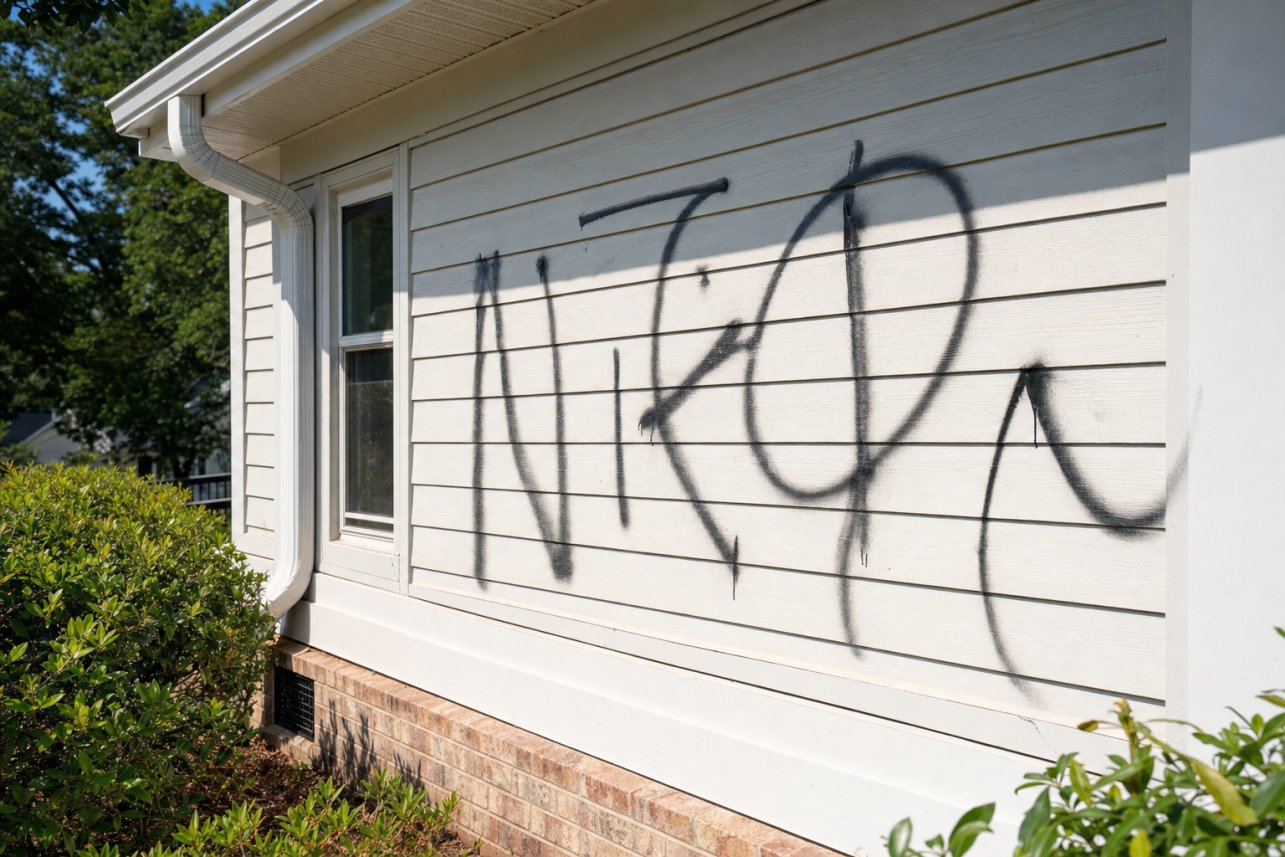
Can I Clean Up Or Start Repairs Before The Insurance Adjuster Inspects The Vandalism?
You can — and in some cases you must — but only after you document everything. Your policy obligates you to protect the property from further damage, so boarding a shattered slider, securing a kicked-in door, or covering an opening is expected. Those are temporary protective measures, and receipts for them are typically reimbursable.
Permanent repairs are a different matter. If you repaint over graffiti, replace flooring, or haul away destroyed contents before the loss is documented, you make it far harder to prove the extent of the damage. Insurers routinely reduce or dispute payment when the evidence is gone.
Before touching anything at your Cary property, take wide shots of every affected room and elevation, then close-ups of each damaged item — walls, doors, cabinetry, appliances, electronics, landscaping, outbuildings. Capture serial numbers and model tags where you can. Keep damaged items until the carrier has inspected or given written permission to dispose of them; stage them in the garage if needed. Get a copy of the Cary Police report number, since carriers require a police report for vandalism losses.
When we handle a vandalism claim for a Wake County homeowner, we prepare our own photographic inventory and scope of repairs before the carrier’s adjuster arrives, so the inspection is a walkthrough of documented facts rather than a first look. If cleanup has already happened, we work with what remains — receipts, photos on your phone, contractor observations — to reconstruct the loss as completely as possible.
Why Do Insurance Companies Underpay Or Deny A Vandalism Homeowners Claim Cary?
Insurers often dispute vandalism losses because the damage can look, to them, like wear and tear, theft-only loss, or something excluded under the policy. Common tactics include arguing the property was vacant, questioning whether the act was truly “malicious,” or paying only for cosmetic patches instead of full restoration of matching materials.
Courts have pushed back on this. In Cresthill Industries, Inc. v. Providence Washington Insurance Co., 53 A.D.2d 332 (N.Y. App. Div. 1976), the insurer refused to pay for extensive damage intruders caused to a building while stripping out copper piping, claiming it was theft rather than covered vandalism. The court sided with the insured, holding the destruction qualified as vandalism and malicious mischief even though the intruders’ motive was stealing materials — a ruling adjusters still lean on when carriers try to recast smashed walls and torn-out fixtures as excluded theft.
Here in Cary, we see the same disputes on a residential scale: graffiti removal priced at a fraction of real cost, broken-out windows scoped without matching the remaining panes, or interior destruction lumped under an exclusion. As licensed and bonded public adjusters, we document the malicious nature of the damage, tie it to the policy language, and present a complete repair scope. While no one can promise a specific outcome, a properly built file makes it much harder for a carrier to lowball a legitimate loss.
What Documentation Strengthens A Vandalism Claim On A Cary Home?
Strong documentation starts with the police report. The Town of Cary Police Department will issue a report number, and your insurer will almost certainly require it, since vandalism is a criminal act. File that report before anything else.
Next, photograph and video everything before cleanup: spray paint, broken glass, kicked-in doors, damaged fencing, destroyed landscaping, and any interior destruction. Capture wide shots that show location and close-ups that show severity. If contents were destroyed — electronics, furniture, artwork — photograph each item and gather receipts, credit card statements, or even old photos showing the items in your home.
Keep every receipt for emergency measures like boarding up windows or securing a door, because reasonable protective costs are typically reimbursable under a homeowners policy. Get written repair estimates from contractors familiar with Wake County pricing rather than relying solely on the carrier’s numbers.
Finally, write down a timeline: when you last saw the property undamaged, when you discovered the loss, and who you spoke with at the police department and insurance company. Adjusters for the carrier will look for gaps and inconsistencies, and a clean, dated record removes those openings.
When For The Public Adjusters, Inc. handles a vandalism loss in Cary, we build this file for the homeowner — inventory, photos, estimates, and correspondence — so the claim is presented completely the first time instead of trickling in piece by piece.
Does Homeowners Insurance Cover Vandalism Committed By A Tenant, Family Member, Or Someone I Know?
It depends on who caused the damage and what your policy says. Most homeowners policies exclude intentional damage caused by an “insured” — meaning you or residents of your household. So if a family member living in the home caused the destruction, the carrier will likely deny that portion of the loss.
Tenants are a different story. If you own a rental property in Cary and a tenant maliciously destroys it, coverage turns on your specific policy. Standard homeowners forms often exclude vandalism by tenants because a tenant is a permitted occupant, while landlord or dwelling-fire policies may treat it differently. Some policies cover the malicious damage but not simple neglect or excessive wear. Reading the exact policy language matters enormously here, and this is where a Cary public adjuster earns their fee.
Damage by an ex-partner who no longer lives in the home, a neighbor, or a stranger is generally treated as covered vandalism, provided the act was willful and malicious. A police report identifying — or at least describing — the perpetrator helps establish that.
Our team reviews the policy definitions of “insured,” “resident,” and “vandalism and malicious mischief” before the carrier frames the narrative. We cannot guarantee a particular result, but we can make sure a valid claim isn’t denied simply because the adjuster assumed the wrong relationship between the homeowner and the person who caused the damage.
Can For The Public Adjusters, Inc. Reopen An Underpaid Vandalism Homeowners Claim Cary That Was Already Settled?
In many cases, yes. In North Carolina, accepting an initial payment from your insurer does not automatically close the door on additional money, unless you signed a full release. If the carrier’s payment on your vandalism loss didn’t cover the actual cost of repairs, a supplemental claim is often possible.
The first step is a review of the carrier’s estimate against the real damage. On Cary vandalism losses, we frequently find missing line items: paint that won’t match unless whole walls or elevations are redone, tempered or specialty glass priced as standard glass, hardwood flooring scoped for spot repair when the damaged boards can’t be matched, and no allowance for debris removal or securing the property. Contents are often undervalued too, especially electronics and custom items.
Once we identify the gaps, we prepare a documented supplement with photos, contractor pricing appropriate for Wake County, and the policy provisions that support each item, then negotiate directly with the carrier on your behalf. As licensed and bonded public adjusters working on a percentage of what’s recovered, we only benefit when you do.
Be mindful of deadlines. Your policy sets time limits for submitting documentation and for legal action, so don’t sit on a payment that feels short. Bring us the carrier’s estimate and your repair bids, and we’ll give you an honest assessment of whether reopening the claim makes sense. We can’t promise a specific dollar amount, but we can tell you quickly whether the numbers justify pursuing more.
Do I Need A Police Report To File A Vandalism Homeowners Claim Cary?
Yes, in nearly every case. Insurance carriers treat vandalism as a criminal act, and most policies require you to notify law enforcement as a condition of coverage. Skipping this step gives the insurer an easy reason to delay or deny payment.
In Cary, you can file a report with the Cary Police Department, and if the property sits in an unincorporated part of Wake County, the Wake County Sheriff’s Office handles it. Ask for the report number and the responding officer’s name before they leave. Your carrier will request both.
The report does more than satisfy a policy requirement. It creates an independent, third-party record of the date, the damage observed, and the fact that the loss was intentional destruction rather than wear and tear. That distinction matters, because adjusters sometimes try to reclassify vandalism as maintenance-related deterioration, which is excluded.
When we handle a vandalism loss for a Cary homeowner, we make sure the police report, our photo documentation, and the repair estimates all tell the same consistent story. Courts have shown they will hold insurers accountable when documentation supports the policyholder. In TRB Investments, Inc. v. Fireman’s Fund Insurance Co. (2006), the California Supreme Court ruled for the insured after the carrier denied a vandalism loss to a building under renovation, rejecting the insurer’s strained reading of the vacancy exclusion. Strong records made that outcome possible, and the same principle applies to every claim we prepare.
Can I Still Recover On My Claim If The Vandal Is Never Identified Or Arrested?
Yes. Your homeowners policy covers the damage itself, not the outcome of a criminal investigation. Whether Cary police make an arrest has no bearing on your right to be paid for a covered vandalism loss.
What the insurer will focus on instead is proof that the damage was intentional and caused by a third party. Broken windows, pried doors, spray paint, slashed screens, and interior destruction all carry physical signatures that differ from accidental damage or deterioration. We photograph and document those signatures carefully before anything is repaired.
That said, some carriers use an unsolved investigation as an excuse to drag their feet, implying the homeowner might be responsible. This is where an experienced Wake County public adjuster earns their fee. We push back with the police report, timestamped photos, witness statements from neighbors, and any doorbell or security camera footage from your street. Many Cary neighborhoods have active camera networks, and footage from a neighbor two doors down has helped resolve more than one dispute.
One important note: if the vandal is later caught and convicted, the insurance company may pursue restitution from that person through subrogation. That happens after you are paid and does not delay your settlement. Your job is to prove the loss occurred and document its cost. Ours is to make sure the carrier honors the policy language rather than the investigation’s status.
How Is The Payout Calculated On A Vandalism Homeowners Claim Cary — Replacement Cost Or Actual Cash Value?
It depends on your policy, and the difference can be thousands of dollars. Most Cary homeowners carry replacement cost coverage on the dwelling, which pays what it actually costs to repair or rebuild with materials of similar kind and quality at today’s Wake County labor and material prices. Actual cash value policies, by contrast, subtract depreciation from that figure.
Here is where homeowners get shortchanged on a Vandalism Homeowners Claim Cary: many replacement cost policies initially pay only the depreciated amount, then release the recoverable depreciation after repairs are completed and receipts are submitted. If nobody tells you that second payment exists, it often goes unclaimed.
Contents are frequently valued at actual cash value unless you purchased a replacement cost endorsement, so check your declarations page. Vandalized electronics, furniture, and clothing can be depreciated aggressively by carrier adjusters, and we routinely challenge those depreciation schedules with documented replacement pricing.
Specialty items damaged by vandals — graffiti on brick or specialty siding, etched glass, damaged hardwood, custom cabinetry — often require trade-specific pricing that generic estimating software understates. Graffiti removal from porous masonry, for example, may require media blasting or full sealing and repainting, not a quick pressure wash.
As licensed and bonded public adjusters, we prepare our own line-item estimate rather than accepting the carrier’s numbers, then negotiate from documented costs. We never promise a specific dollar figure, but we do make certain every covered item is priced completely and correctly under your policy.
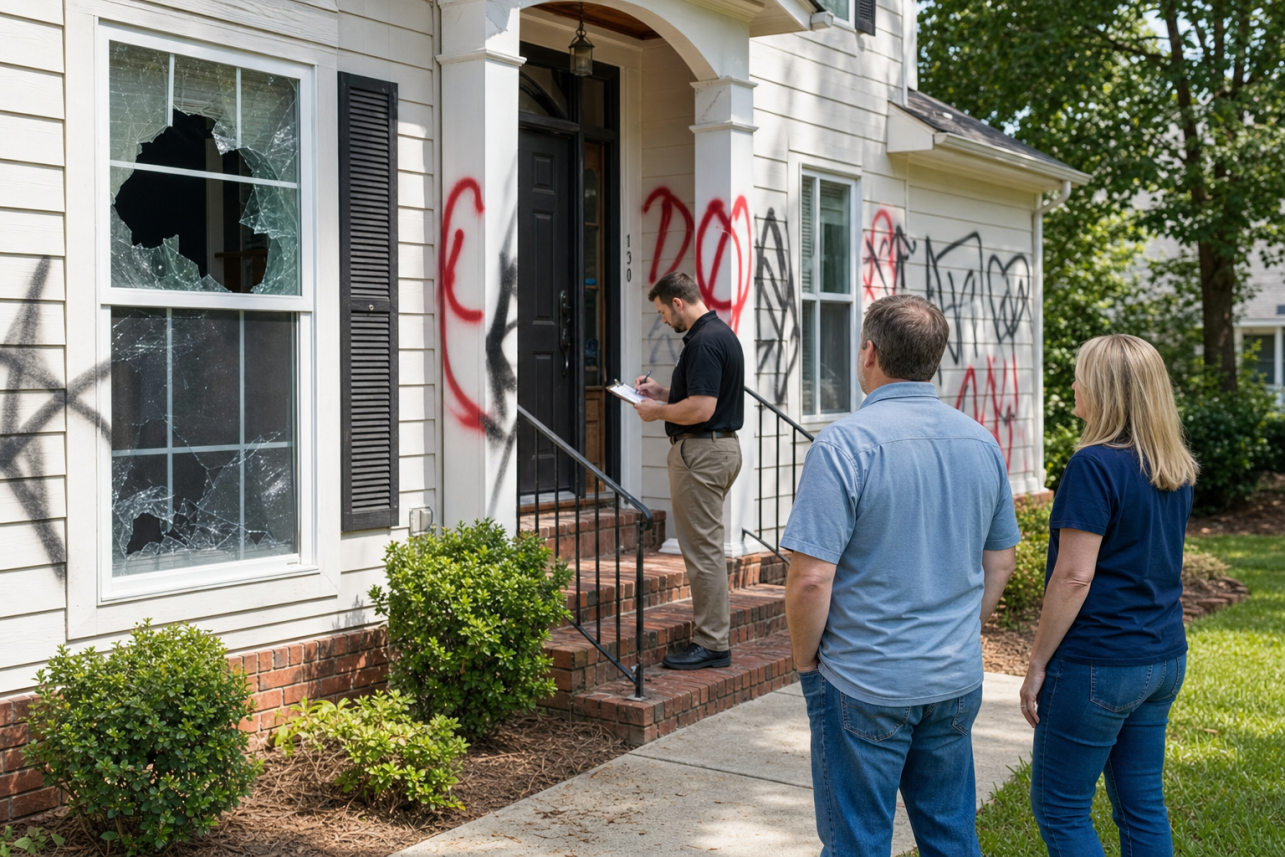
Will Filing A Vandalism Claim Raise My Insurance Rates Or Get My Cary Policy Cancelled?
It is a fair concern, and the honest answer is that vandalism claims are generally treated more favorably than claims where the homeowner played a role. Vandalism is a criminal act committed against you, and most carriers weigh not-at-fault losses differently when setting renewal terms.
That said, any claim gets recorded in the CLUE database, which insurers check at renewal and when you shop for new coverage. A single vandalism loss on an otherwise clean history rarely causes serious problems for a Cary homeowner. A pattern of repeated claims in a short window is what triggers non-renewals.
North Carolina also gives policyholders some protection here. Carriers must follow state notice requirements before non-renewing a homeowners policy, and they cannot cancel mid-term simply because you filed a legitimate claim.
Our practical advice: run the numbers before filing. If the damage barely exceeds your deductible, paying out of pocket may make sense. If vandals caused substantial damage — broken entry doors, interior destruction, ruined flooring, extensive graffiti — the claim is almost certainly worth pursuing, and underreporting the loss to keep it small helps no one but the insurer.
We review the full scope of damage with Cary homeowners before a claim is ever filed, so the decision is made with real figures instead of guesswork. Once you decide to move forward, we handle the documentation and negotiation so the claim is presented completely the first time, which also shortens the process and reduces friction with your carrier.
Local Relevance
Cary is one of the fastest-growing towns in Wake County, with everything from 1980s and 1990s subdivisions to brand-new construction going up alongside them. That growth creates the exact conditions where vandalism claims spike: homes sitting vacant between sale and closing, houses mid-renovation, and new builds in active construction phases are all common targets for break-ins, graffiti, and malicious damage.
Cary is a safe community by any measure, but that can work against homeowners at claim time — carriers sometimes treat vandalism here with extra skepticism, questioning whether damage was intentional or just deterioration. According to the Insurance Information Institute, vandalism and malicious mischief are standard covered perils on typical homeowners policies, so the issue is rarely whether coverage exists — it’s whether the insurer pays fairly.
We serve homeowners throughout Wake County. When vandalism includes deliberately set fires, our arson claim experience matters, and neighbors just south of town rely on our Fire Damage Claim Help in Garner team for exactly those overlapping losses. Homeowners in the southern part of the county also work with our Fire Claims Adjuster in Fuquay-Varina when vandalism and fire damage occur together.
Because so many Cary homes are in transition — listed for sale, awaiting new owners, or under renovation in a fast-moving market — vacancy clauses trip up local vandalism claims more often than homeowners expect; many policies restrict or reduce vandalism coverage once a home has been empty beyond a set period, so documenting occupancy and notifying your insurer before a home sits vacant can protect your claim before anything ever happens.
Vandalized Property? Talk To An Adjuster Who Works For You
Before you accept the insurance company’s number, get a free review of your policy and your damage from a licensed, bonded public adjuster who represents only you. We handle the documentation, the deadlines, and the negotiation — and we’re paid from the settlement, not upfront. Call For The Public Adjusters, Inc. today.
Call us: (919) 400-6440
Helpful Resources
- NCDOI Public Adjusters Guide
- Insurance Information Institute (III)
- North Carolina Department of Insurance — State regulator overseeing insurers and public adjuster licensing
- Insurance Information Institute — Consumer education on homeowners coverage and claims
Last updated: September 22, 2026