
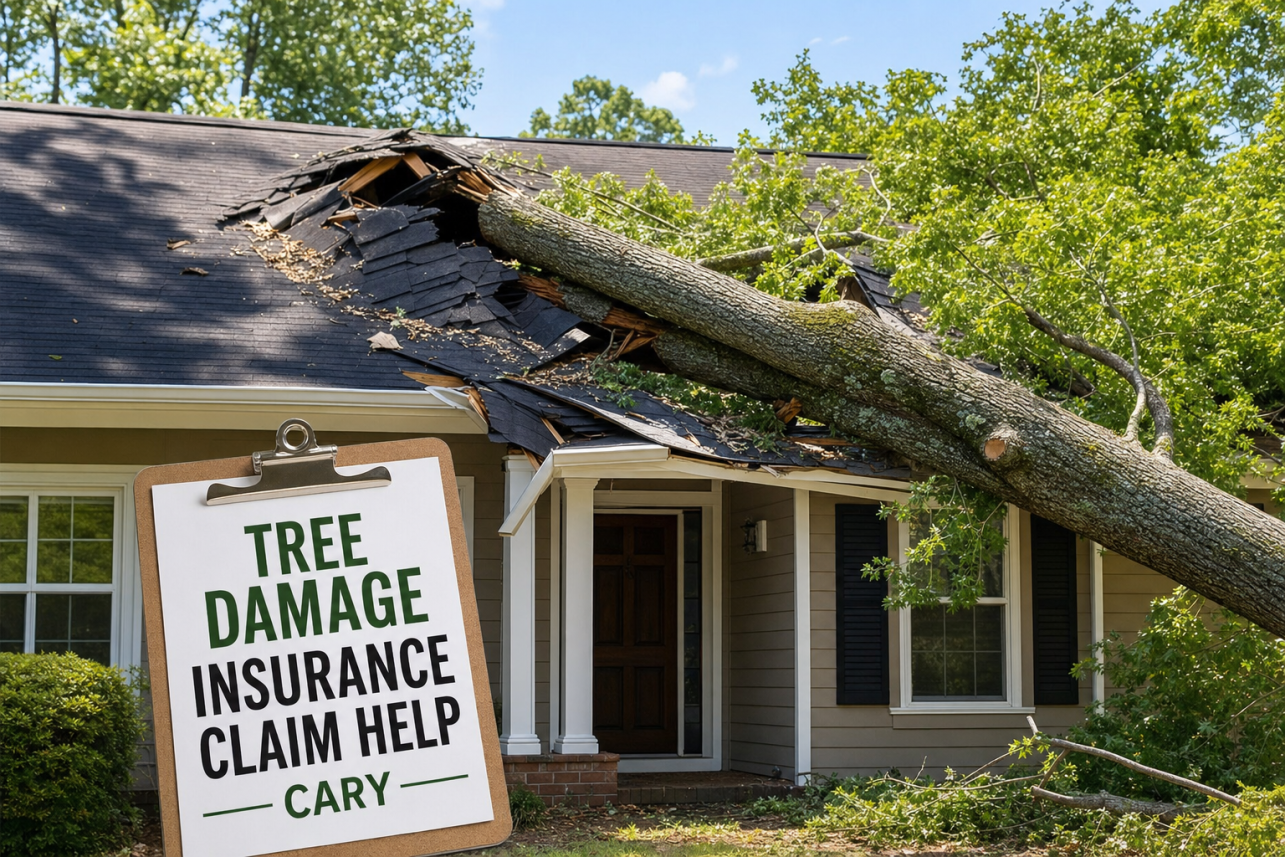
Tree damage insurance claim help Cary homeowners need most often starts the moment a large oak or pine comes through the roof and the insurance company’s first offer doesn’t come close to the real cost of repairs. For The Public Adjusters, Inc. is a licensed and bonded public adjusting firm that works only for you, the policyholder — never the insurance company. We document the full scope of severe house damage, prepare your proof of loss, and negotiate the claim on your behalf so you aren’t left absorbing repair costs your policy should cover.
What This Service Is
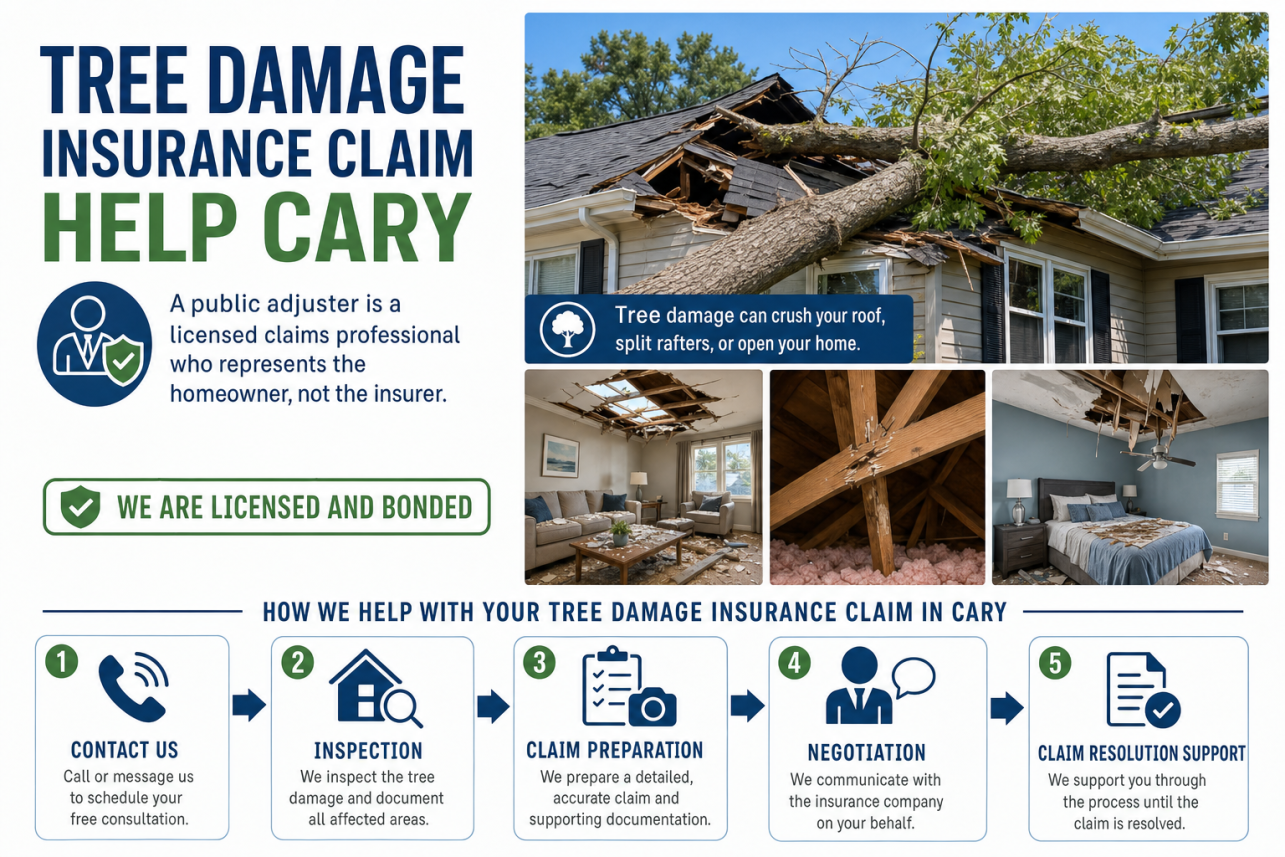
A public adjuster is a licensed claims professional who represents the homeowner, not the insurer. When a tree crushes your roof, splits rafters, or opens your home to rain in the middle of a summer thunderstorm, the insurance company sends its own adjuster to assess the damage. That person works for the carrier.
We do the opposite. For The Public Adjusters, Inc. inspects the damage independently, builds a detailed damage estimate, and handles the back-and-forth with your insurer — from emergency tarping documentation through final settlement negotiation.
Severe tree strikes rarely stop at shingles. They often involve wind damage, water intrusion, cracked framing, damaged contents, and sometimes weeks where the home isn’t livable. Each of those pieces has its own coverage rules under a typical homeowners policy, and each is easy for a carrier to undervalue if nobody pushes back with documentation. That’s the work we do. The North Carolina Department of Insurance licenses public adjusters in this state, and the NCDOI Public Adjusters Guide explains exactly what firms like ours are permitted to do for policyholders.
Common Problems
The Insurer’s Estimate Doesn’t Match What A Fallen Tree Actually Did To Your House
A tree through the roof looks dramatic from the street, but the worst damage is often hidden — cracked trusses, shifted framing, wet insulation, and water tracking down inside walls. A quick inspection by the carrier’s adjuster can miss all of it.
When the insurer’s estimate only covers patching the visible hole, you’re set up for out-of-pocket costs later. A thorough structural damage assessment, done before repairs begin, is the difference between a claim that pays for the real damage and one that pays for the obvious damage.
Courts have sided with homeowners on this exact issue. In Windridge of Naperville Condominium Association v. Philadelphia Indemnity Insurance Co. (7th Cir. 2019), the insured won when the court held the insurer had to pay to replace undamaged siding so repairs would actually match — the building had to be made whole, not patched into a mismatched mess. The principle matters for tree claims too: partial fixes that leave a home visibly or structurally compromised aren’t a fair settlement.
Tree Damage Insurance Claim Help Cary Homeowners Ask For After A Denial Or Lowball Offer
Denials and underpayments on tree claims usually hinge on a few recurring arguments: the carrier says part of the damage was pre-existing, applies policy exclusions you didn’t know existed, or pays actual cash value — the depreciated worth of your old roof — instead of what it costs to replace it.
Tree removal is another common fight. Many policies cap what they’ll pay to remove the tree itself, and carriers sometimes lump removal, roof repair, and interior damage together in ways that shortchange each one.
A denial letter is not the end of the claim. Policies give you the right to dispute the damage estimate, submit additional documentation, and demand the insurer justify its position in writing. We handle those disputes regularly, and when a carrier’s conduct crosses into unreasonable delay or refusal to pay a clearly covered loss, North Carolina law provides remedies for that too. We never guarantee an outcome — no honest adjuster can — but a documented, professionally presented claim is far harder to deny.
The Neighbor’s Tree Fell On Your House — Whose Insurance Pays?
This surprises almost everyone: when your neighbor’s healthy tree falls on your home in a storm, your own homeowners policy typically pays, subject to your deductible. Storms are generally considered nobody’s fault.
The exception is negligence. If the tree was visibly dead or dying and the neighbor was warned and did nothing, their liability coverage may come into play — but proving that takes documentation, photos, and sometimes arborist records.
Either way, you shouldn’t be sorting out liability while rain is coming through your ceiling. We help Cary homeowners get emergency repairs and temporary protection documented and covered first, then pursue the correct policy for the full loss.
Our Process
Immediate Damage Review And Emergency Protection
We start with a walkthrough of the entire property — roof, attic, framing, interior, and contents — not just the point of impact. Photos, moisture readings, and measurements go into the file before anything is moved or repaired.
We also make sure emergency steps like tarping and board-up are documented properly. Most policies require you to prevent further damage, and those costs are usually reimbursable when they’re recorded correctly.
Full Scope Estimate And Proof Of Loss
Next we build a line-by-line estimate covering structural repairs, water damage, contents, tree removal within your policy limits, and additional living expenses if you can’t stay in the home.
We prepare and submit your proof of loss — the sworn statement your policy requires — accurately and on time. Missed claim filing deadlines and incomplete paperwork are among the most common reasons legitimate claims stall or get denied.
Negotiation Through Final Settlement
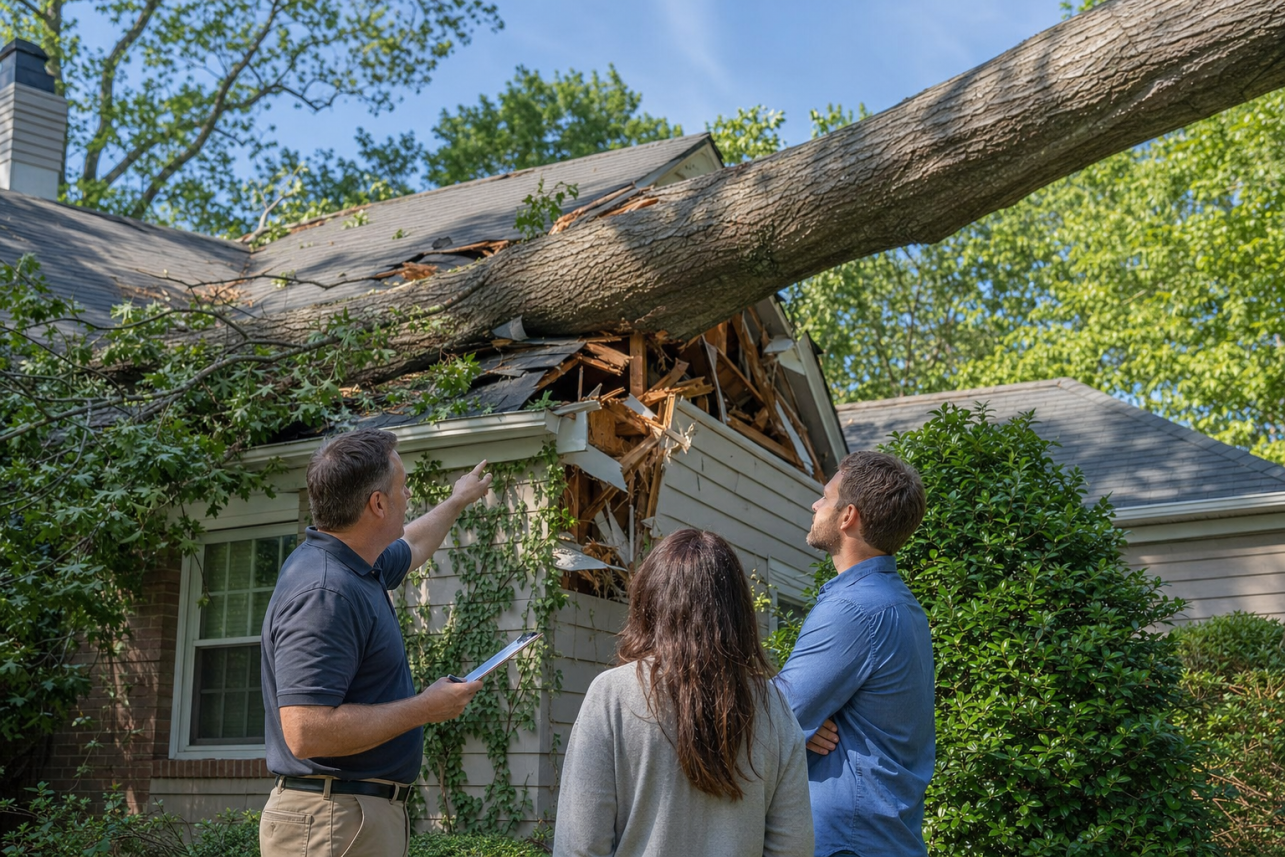
We attend the insurance adjuster’s inspection, walk them through every item of damage, and respond point-by-point when their scope comes back short.
If the carrier pays actual cash value up front, we track the recoverable depreciation so you receive the replacement cost holdback once repairs are done. Our job isn’t finished until the claim is fully resolved.
| What’s Involved | Handling the Claim Yourself | With For The Public Adjusters |
|---|---|---|
| Damage documentation | Whatever the carrier’s adjuster photographs in one visit | Full inspection including attic framing, moisture mapping, and structural engineering when a tree strikes the home |
| Estimate accuracy | Carrier’s estimate, often limited to visible roof and drywall repair | Independent line-item estimate covering framing, hidden water damage, and code-required upgrades |
| Debris removal payment | Often paid at a single $500 cap regardless of tree count | Per-tree limits applied correctly, frequently doubling or tripling debris recovery |
| Additional living expenses | Easy to underclaim or exhaust while repairs drag on | Documented, budgeted, and extended when structural repairs make the home uninhabitable |
| Negotiation leverage | Homeowner vs. trained carrier adjusters | Licensed NC public adjusters negotiating with engineering reports and policy language |
| Typical outcome | Settlement anchored to the carrier’s first estimate | Settlements routinely two to four times the initial offer on severe house damage claims |
Commonly Overlooked In The Public Adjusting Industry
- Cracked rafters and trusses still hidden under the tarp — Field adjusters rarely climb into the attic, so framing that’s fractured but still standing gets scoped as a simple shingle repair.
- Per-tree debris removal limits — Most homeowners and even some adjusters apply the $500 cap once per storm when the policy actually pays it for each tree that hit the structure.
- Water tracking down wall cavities from the impact hole — Rain that entered during the hours before tarping travels far from the hole, and nobody runs moisture meters on walls that look dry.
- Ordinance and law coverage for Wake County code upgrades — Rebuilt roof sections must meet current code, but carriers only pay for those upgrades if someone specifically invokes the ordinance and law provision.
- Racked or shifted framing away from the impact point — A heavy trunk strike can knock a whole wall section out of plumb, and without an engineer’s inspection it reads as an old settling issue.
- Additional living expenses during structural repairs — Homeowners tough it out in a damaged house not realizing the policy owes them housing when framing work makes the home unsafe to occupy.
- Matching requirements for roofing and siding — Carriers pay to patch one slope, but North Carolina claims practice often supports replacing enough material for a reasonably uniform appearance.
- The carrier’s subrogation right when a neighbor’s tree caused the damage — Homeowners waste weeks chasing the neighbor’s insurer when their own policy pays first and the carrier recovers from the neighbor afterward.
Case Studies
Case Study #1
Situation: A family in Cary’s Lochmere neighborhood had a mature willow oak crash through their roof during a spring thunderstorm, punching into the master bedroom and splitting a load-bearing ridge beam. Rain poured in for hours before emergency tarping arrived.
Problem: Their carrier’s field adjuster wrote an estimate for roof patching and drywall repair totaling about $38,000. It ignored the fractured ridge beam, saturated insulation in three rooms, and the fact that the impact had shifted the second-floor framing out of plumb.
Investigation: We brought in a structural engineer to document the beam failure and racked framing, ran moisture mapping through the ceilings and exterior walls, and photographed hidden crush damage to rafters that were still holding the tarp up but were cracked through.
Findings: The engineer’s report confirmed the ridge beam and six rafters required full replacement, which meant opening a much larger section of roof than the carrier scoped. Moisture readings showed water had traveled down interior wall cavities into the first floor, and Wake County code required updated hurricane strapping on the rebuilt sections.
Solution: We rebuilt the claim from the framing outward: structural repairs per the engineer’s specifications, full moisture remediation, code-upgrade costs under the policy’s ordinance and law coverage, and additional living expenses since the home was unsafe to occupy during framing work.
Outcome: The claim settled at just over $147,000, nearly four times the original estimate, plus five months of additional living expenses so the family could rent nearby while the structural work was completed properly.
Lesson: When a tree hits a house hard enough to break framing, the visible hole is rarely the real damage. If the carrier’s estimate doesn’t include an engineer’s evaluation of the structure, it’s almost certainly incomplete.
Case Study #2
Situation: A retired couple near Kildaire Farm Road had a neighbor’s dying pine fall across their garage and kitchen addition during a winter ice storm, collapsing part of the roof and cracking the addition’s foundation slab where the trunk landed.
Problem: The carrier initially tried to push the couple toward the neighbor’s liability policy, delaying payment for weeks. When it finally accepted the claim, it denied the slab damage as ‘pre-existing settlement’ and offered nothing for tree removal beyond the policy’s $500 debris cap per tree.
Investigation: We pulled dated photos from the couple’s own records showing the slab intact months earlier, hired a forensic engineer to correlate the crack pattern with the trunk’s point of impact, and documented that three separate trunk sections had fallen, each qualifying for its own debris removal allowance.
Findings: The engineer confirmed the fresh, impact-consistent fracture in the slab, disproving the settlement theory. Policy review showed debris removal applied per tree, not per event, and the collapsed roof section had crushed the kitchen’s plumbing supply lines inside the wall, which the field adjuster never opened up.
Solution: We submitted the engineering report, a corrected debris removal calculation, a plumbing repair scope with wall access and restoration, and a formal demand citing North Carolina’s prompt-payment requirements to end the stalling over whose policy applied.
Outcome: The couple’s own carrier paid $94,000 covering slab repair, full roof and kitchen reconstruction, tripled debris removal, and the hidden plumbing damage. The carrier then pursued the neighbor’s insurer separately through subrogation, which was never the homeowners’ burden to carry.
Lesson: A tree that falls from a neighbor’s yard is still your own carrier’s claim to pay first in North Carolina. Don’t let a ‘go ask the neighbor’ response stall your repairs, and never accept ‘pre-existing damage’ without independent engineering proof.
| Scenario | Likely Coverage Situation | Biggest Risk If Mishandled | Smart First Move |
|---|---|---|---|
| Tree punched through the roof into living space | Covered structural claim, usually with ALE for temporary housing | Carrier scopes a patch instead of framing replacement | Get emergency tarping, then an independent structural inspection before agreeing to any scope |
| Tree fell on the house from a neighbor’s yard | Your own policy pays first; carrier may subrogate against the neighbor | Weeks of delay while insurers point at each other | File with your own carrier immediately and put the delay tactics in writing |
| Tree fell in the yard, no structure hit | Debris removal often not covered unless it blocks a driveway or ramp | Paying thousands out of pocket assuming it’s covered | Read the debris removal clause before hiring a tree service |
| Trunk cracked the foundation or slab where it landed | Covered impact damage, but often denied as ‘settlement’ | Accepting a pre-existing-damage denial without proof | Hire a forensic engineer to tie the crack pattern to the impact |
| Multiple trees down in one storm | Debris removal limits usually apply per tree, not per storm | Accepting a single $500 debris payment | Count and photograph every tree before cleanup begins |
| Roof damaged but house still occupied | Repair claim plus interior water damage as rain continues | Hidden moisture in walls leading to denied mold claims later | Demand moisture mapping now; mold found months later is much harder to claim |
| Carrier’s check seems low but repairs haven’t started | You can still dispute; cashing a check rarely closes the claim in NC | Contractor discovering underpaid scope mid-rebuild | Have the estimate reviewed by a public adjuster before signing any contractor agreement |

Reviews
A red oak took out half our roof and the insurance company’s first check wouldn’t have covered the framing, let alone the water damage inside. For The Public Adjusters found cracked trusses their adjuster never looked at and got the settlement raised from $41k to over $130k. We could not have fought that on our own.
Denise M., Preston area of Cary
Our carrier called the tree damage ‘cosmetic’ even though the wall of our sunroom was visibly bowed. This team brought in an engineer, documented everything, and turned a denial into a full structural rebuild payout. They also caught the $500-per-tree debris removal detail that tripled what we got for cleanup.
Rob T., Cary NC
After a pine crushed our second story during Hurricane season, we were living in a hotel with no idea what our policy actually owed us. They handled the additional living expense claim, the contents inventory, and every carrier call. The final settlement covered everything including code upgrades Wake County required. Worth every penny of the fee.
Amara J., near Bond Park
Frequently Asked Questions
How Does A Tree Damage Public Adjuster Help Homeowners After A Tree Crushes Part Of The House?
When a tree comes through your roof or wall in Cary, the first hours matter. Professional tree damage insurance claim help Cary homeowners rely on starts with documenting everything before cleanup crews arrive — photos of the tree on the structure, interior water intrusion, cracked framing, and damaged belongings.
As public adjusters, we work only for you, not the insurance company. We inspect the full scope of damage, including issues carriers often minimize: shifted rafters, cracked trusses, compromised load-bearing walls, and water damage that spreads behind drywall in the days after impact. A tree strike rarely damages just the visible hole.
We then prepare a detailed, line-item estimate using local Wake County construction pricing, submit it to your carrier, and negotiate directly with their adjuster. Homeowners who accept the insurer’s first offer on severe structural damage frequently receive settlements that cover cosmetic repairs but not the engineering, framing, and code-upgrade work Cary building permits actually require.
Our fee is a percentage of the recovered settlement, so there is no upfront cost. For a tree strike causing severe house damage — a punctured roof deck, collapsed porch, or breached exterior wall — the difference between a carrier-driven estimate and a properly documented claim is often tens of thousands of dollars. Given how many mature oaks and pines surround older neighborhoods off Kildaire Farm Road and in Lochmere, these claims are common here, and we know exactly what local carriers push back on.
My Neighbor’s Tree Fell On My Cary Home During A Storm. Whose Insurance Pays, And Do I Still Need Tree Damage Insurance Claim Help?
In North Carolina, the general rule surprises people: if a healthy tree falls in a storm, your own homeowner’s policy pays for damage to your house — even if the tree grew on your neighbor’s property. Storms are treated as acts of nature, so the tree’s owner usually isn’t liable.
The exception is negligence. If the tree was visibly dead, diseased, or leaning, and your neighbor was warned or reasonably should have known, their liability coverage may apply instead. Proving that requires evidence: prior photos, arborist reports, HOA correspondence, or written complaints. We help gather and present that documentation.
Either way, professional tree damage insurance claim help in Cary matters because these claims get complicated fast. Your carrier may pay your claim and then pursue the neighbor’s insurer through subrogation, which can eventually return your deductible. We track that process so you don’t lose money that’s rightfully yours.
Severe structural damage adds another layer. If the tree breached your roof or exterior wall, you’re dealing with emergency tarping, temporary housing under your Additional Living Expenses coverage, structural engineering assessments, and Town of Cary permit requirements for major repairs. Carriers sometimes dispute whether pre-existing conditions contributed to the collapse, especially on homes built before the 1990s in established neighborhoods like MacGregor Downs.
We handle the entire claim — coverage analysis, documentation, estimating, and negotiation — so you’re not caught between two insurance companies pointing at each other while your home sits exposed to the next round of weather.
The Insurance Company’s Adjuster Already Inspected My Tree Damage. Why Is Their Estimate So Much Lower Than My Contractor’s Quote?
This is the most common call we get in Cary after a serious tree strike. The gap usually comes down to scope, not pricing games. The carrier’s adjuster may have spent thirty minutes on site and written an estimate for the visible hole — some shingles, decking, and drywall.
Severe house damage from a tree impact goes far deeper. The force of a mature pine or oak hitting a roof can crack trusses several feet from the impact point, shift wall framing, separate connections, and open gaps that let water travel into insulation and wall cavities. Contractors quoting the real repair see all of this. The initial insurance estimate often doesn’t.
There are also items carriers routinely omit: structural engineering reports, debris removal beyond the small policy sublimit, matching requirements for roofing and siding, code upgrades required by Wake County inspections, and temporary living costs if the home is unsafe. Each omission shrinks your settlement.
As your public adjuster, we re-inspect the property, often with moisture meters and, where warranted, an engineer. We build a complete estimate line by line and submit a formal supplement or dispute. Insurance estimates are not final offers — North Carolina policyholders have the right to challenge them, invoke appraisal if negotiations stall, and recover the full cost of proper repairs.
On severe tree-strike claims we handle in Cary, revised settlements are frequently two to four times the carrier’s initial figure. That difference is what separates a patched roof from a home actually restored to pre-loss condition.
What Should I Do In The First 48 Hours After A Tree Causes Severe Damage To My Cary Home?
First, keep everyone out of the damaged area. A tree strike can compromise framing in ways that aren’t visible, and ceilings or walls near the impact can fail hours later. If there’s any doubt about safety, stay elsewhere — your policy’s Additional Living Expenses coverage typically pays for a hotel.
Second, document before anything is moved. Take wide shots and close-ups of the tree on the structure, every damaged room, wet flooring, and personal property. Video walkthroughs are excellent evidence. Once the tree removal crew starts cutting, that proof is gone forever.
Third, arrange emergency mitigation. Your policy requires you to prevent further damage, so get the roof tarped and standing water extracted. Keep every receipt — tarping, tree removal, water mitigation, and hotel costs are all typically reimbursable. Reputable tree crews serving Cary and greater Wake County can usually respond same-day after a storm, but demand spikes, so call early.
Fourth, report the claim to your carrier, but keep your description factual and brief. Don’t speculate about the tree’s condition or agree to a recorded statement before you understand your coverage.
Finally, get independent representation involved early. Bringing in tree damage insurance claim help Cary residents can trust before the carrier’s inspection means the damage gets scoped correctly the first time, rather than fighting an inadequate estimate for months afterward. For The Public Adjusters, Inc. can meet the insurance adjuster on site, walk the damage with them, and make sure hidden structural issues are documented from day one.
How Much Does Fighting A Tree Damage Insurance Claim In Cary Cost, And How Do Public Adjusters Get Paid?
For The Public Adjusters, Inc. works on a contingency fee, which means we’re paid a percentage of the insurance settlement we recover for you. There’s no upfront cost, no hourly billing, and if we don’t recover anything, you owe nothing.
In North Carolina, public adjuster fees are regulated by the Department of Insurance, and the percentage is agreed to in writing before any work begins. You’ll know exactly what the arrangement is before you sign anything.
Homeowners sometimes worry that the fee will leave them with less money for repairs. In practice, the opposite is usually true with severe tree damage. When a mature oak or pine punches through a roof in Cary, the visible damage is only part of the story. Cracked rafters, shifted trusses, torn sheathing, water intrusion into insulation and drywall, and damaged electrical runs are routinely missed or undervalued in the carrier’s first estimate.
Our job is to document all of it, price it at real Wake County contractor rates, and negotiate until the settlement reflects the actual scope of repairs. The difference between a carrier’s initial offer and a fully documented claim on a severe house-damage loss is often substantial, well beyond the fee.
You can call us for a free review of your situation before committing to anything. We’ll look at your policy, the damage, and any estimate the insurer has already issued, then tell you honestly whether professional representation makes sense for your claim.
Does My Homeowners Policy Cover Tree Removal, Or Just The Damage To My House?
Most homeowners policies cover tree removal, but only under specific conditions, and the limits catch many Cary homeowners off guard. Generally, if the tree fell on and damaged a covered structure, your home, garage, fence, or deck, the policy pays to remove the portion of the tree from that structure as part of the repair.
Removal of the rest of the tree from your yard is a different matter. Many policies cap debris removal for trees at a set amount, often $500 to $1,000 per tree with an overall limit per storm. Given that removing a large fallen oak in Wake County can run several thousand dollars, that cap matters.
There are important exceptions. Some policies pay for removal even without structure damage if the tree blocks a driveway or a wheelchair ramp. And if the tree damaged the house severely, removal costs tied directly to accessing and repairing the structure are typically part of the main dwelling claim, not the capped debris allowance.
How those costs get categorized makes a real difference in what you’re paid. Insurers sometimes lump structural-access removal under the small debris cap when it should fall under the dwelling coverage.
This is one of the details For The Public Adjusters, Inc. reviews closely on every tree claim in Cary. We read the actual policy language, not just the summary, and make sure removal, crane costs, and debris hauling are assigned to the right coverage so you aren’t absorbing thousands in costs the policy should pay.
The Tree Damage Made Part Of My Home Unlivable. Will Insurance Pay For Us To Stay Somewhere Else During Repairs?
Yes, in most cases. Nearly every homeowners policy includes Additional Living Expenses coverage, often called ALE or Loss of Use. When severe tree damage makes your Cary home uninhabitable, this coverage pays the reasonable extra costs of living elsewhere while repairs are completed.
That can include a hotel or short-term rental in the Cary or Raleigh area, the difference between your normal grocery bill and restaurant meals, extra commuting mileage, pet boarding, and even laundry costs if your washer and dryer are inaccessible. The key word is ‘additional’ — it covers costs above what you’d normally spend.
Where homeowners run into trouble is documentation and duration. Insurers may push families back into a home that still has open roof structure, active mold growth, or no functioning kitchen. Whether a home is truly habitable is often a point of dispute, especially when a tree has compromised the roof over bedrooms or the main living area.
Keep every receipt from day one, including the emergency hotel stay the night the tree fell. ALE claims are frequently underpaid simply because homeowners don’t track expenses or don’t know what qualifies.
For The Public Adjusters, Inc. handles the ALE portion alongside the structural claim. We document why the home is unlivable, establish a realistic repair timeline based on actual Wake County contractor availability, and push back when the carrier tries to cut off living-expense payments before the house is genuinely ready for your family to return.
I Already Accepted A Settlement, But Repairs Uncovered More Structural Damage From The Tree. Can I Still Get The Help I Need For Additional Damages?
Usually, yes. Accepting a settlement payment is not the same as closing the door on your claim. In North Carolina, most homeowners policies allow you to submit supplemental claims when additional covered damage is discovered during repairs, and this happens constantly with severe tree strikes.
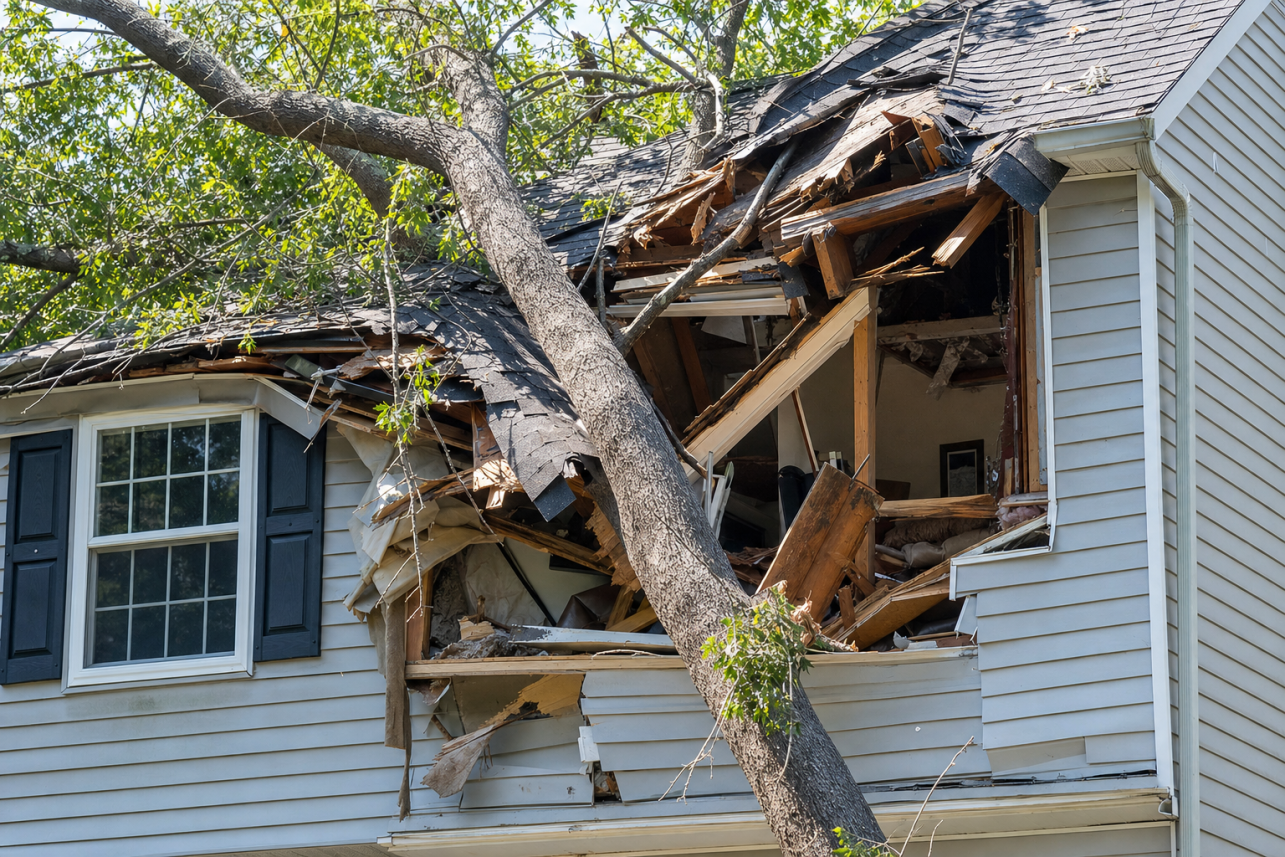
Here’s why: the full extent of tree damage often isn’t visible until contractors open up the structure. A tree that hit your roof may have cracked rafters three feet away from the impact point, shifted a load-bearing wall out of plumb, or driven water into wall cavities that only shows up when drywall comes down. The carrier’s original estimate was based on what could be seen at inspection, not what was hidden.
Timing matters. Policies contain deadlines for supplemental claims and for filing suit, so don’t let months slip by while you debate whether it’s worth reopening. Photograph the newly discovered damage before anything is repaired, have your contractor document it in writing, and pause work in that area if possible until it’s inspected.
Be prepared for the insurer to argue the new damage is pre-existing, wear and tear, or unrelated to the tree. That’s where professional representation earns its keep.
For The Public Adjusters, Inc. regularly takes on underpaid and reopened tree claims across Cary and Wake County. We’ll review your original settlement, document the supplemental damage properly, and present the carrier with evidence tying it directly to the tree strike, so the second payment reflects what the repair actually requires.
A Tree Punched Through My Roof And The Framing Looks Bent. How Do You Find Hidden Structural Damage During The Inspection?
When a mature oak or pine comes down on a Cary home, the visible hole in the roof is rarely the whole story. The impact force travels through rafters, trusses, load-bearing walls, and sometimes into the foundation. We routinely find cracked truss chords, shifted ridge beams, and separated wall plates that the insurance company’s initial inspection missed entirely.
Our process starts in the attic, not on the roof. We trace the impact path from the point of entry down through the framing, looking for compression cracks, nail pops, racked walls, and drywall seams that opened after the strike. We also check for doors and windows that suddenly stick, which often signals the structure shifted.
Where warranted, we bring in a structural engineer to document damage in a report the insurance company cannot easily dismiss. In Wake County, engineer-documented framing damage frequently turns a $20,000 roof-patch estimate into a properly scoped claim covering truss replacement, decking, and interior repairs.
The danger of skipping this step is real. Homeowners who accept a surface-level settlement often discover sagging ceilings or bowing walls a year later, and reopening the claim becomes an uphill fight. Getting the full scope documented before you settle is exactly what tree damage insurance claim help in Cary should deliver, and it is the difference between a repaired home and a compromised one.
The Tree Damaged Part Of My Roof, But The Insurer Will Only Pay To Patch That Section. Can I Get Matching Shingles Or A Full Replacement For My Cary Home?
This is one of the most common disputes we handle in Cary. Many roofs here are 10 to 20 years old, and the original shingle color or product line has been discontinued. When an insurer approves a patch, the repaired slope often looks visibly different from the rest of the roof, hurting both appearance and resale value.
North Carolina does not have a strict matching statute like some states, but that does not mean you are stuck. Most policies promise to return the home to its pre-loss condition, and a mismatched roof arguably fails that standard. We build the argument with manufacturer discontinuation letters, supplier confirmations that a reasonable match is unavailable, and photo documentation of the mismatch.
We also look at whether the repair itself is even feasible. Brittle, aged shingles often crack when adjacent tabs are lifted during a patch, which can justify replacing the entire slope or the full roof. A brittleness test performed during a joint inspection is powerful evidence.
The same logic applies to siding on Cary homes, especially discontinued vinyl profiles common in neighborhoods built in the 1990s and 2000s. When a fallen limb shears off siding that can no longer be matched, we push for replacement of the affected elevation or beyond, depending on policy language. The gap between a patch and a proper match is often tens of thousands of dollars, and it is worth fighting for.
Will My Insurance Claim Cover Bringing My Cary Home Up To Current Building Code During Tree Damage Repairs?
Often yes, but only if your policy includes ordinance or law coverage and someone actually claims it. This is one of the most overlooked pieces of severe tree damage claims in Cary, and it can be worth a significant amount of money.
Here is why it matters. Many Cary homes, particularly in established neighborhoods, were built under older codes. When a tree destroys a roof section or wall, the Town of Cary and Wake County inspections departments will require the rebuilt portions to meet current code. That can mean upgraded hurricane clips and framing connections, modern sheathing and underlayment requirements, updated electrical where walls are opened, and current energy code standards.
The insurance company’s initial estimate almost never includes these costs. Their software prices a like-for-like replacement of what was there before, not what code now requires. If your policy includes ordinance or law coverage, typically 10 to 25 percent of your dwelling limit, those upgrade costs are recoverable, but you have to identify them, document the code requirement, and demand them.
We review your policy for this coverage at the start of every claim, then work with your contractor and local permit requirements to itemize every code-driven cost. On a severe tree strike requiring structural rebuilding, ordinance and law recovery in Cary commonly adds five figures to a settlement. Leaving it unclaimed means paying those mandatory upgrades out of your own pocket.
How Long Does A Severe Tree Damage Claim Take In Cary, And What Slows The Process Down?
For severe house damage, a realistic timeline in Cary runs from a few weeks for straightforward claims to several months when structural damage, engineering disputes, or underpayment fights are involved. North Carolina regulations require insurers to acknowledge claims promptly and act in good faith, but there is no hard statutory deadline forcing a fast payout, which is why claims can drag.
The most common delays we see after major storms hit Wake County are predictable. Adjuster backlogs after a widespread wind event can push initial inspections out for weeks. Lowball first estimates trigger rounds of supplements and re-inspections, each adding time. Disagreements over structural scope often stall until an engineer weighs in. And if you have a mortgage, your lender must endorse settlement checks, which adds its own processing steps.
Homeowners can unintentionally slow things down too, usually by giving incomplete documentation or recorded statements that create coverage questions the insurer then investigates.
Our job is to compress that timeline. We document the full scope in one thorough package rather than piecemeal supplements, meet the insurer’s adjuster on site to resolve disputes in person, and keep written pressure on the carrier when deadlines slip. We also coordinate the mortgage endorsement paperwork early so checks are not sitting unusable.
A well-managed severe tree damage claim in Cary should have emergency funds released within days for tarping and mitigation, with the full structural settlement following once the complete scope is agreed. If your claim has stalled past 60 days with no clear reason, that is a strong signal to get professional help involved.
Rain Poured Through The Hole The Tree Left In My Roof. Does My Policy Cover The Water Damage Inside My Home Too?
Yes, and this is one of the most undervalued parts of severe tree damage claims in Cary. When a tree opens the roof, the resulting water intrusion is covered because the storm created the opening. That includes soaked insulation, sagging drywall ceilings, warped hardwood flooring, damaged cabinetry, and ruined furniture below the breach.
The problem is that carriers often scope the roof puncture carefully but treat the interior water damage superficially. We routinely see estimates in Wake County that allow for painting a ceiling but ignore saturated insulation in the attic, wet framing, or moisture that migrated down wall cavities to lower floors.
When For The Public Adjusters, Inc. handles tree damage insurance claim help Cary homeowners need, we use moisture meters and thermal imaging to map exactly how far the water traveled. In Cary’s humid climate, trapped moisture becomes a mold problem within days, so documenting it early protects both your health and your claim.
We also document time-sensitive damage before drying equipment removes the evidence. Photographs, moisture readings, and a room-by-room inventory of affected contents all go into the claim file. If mold remediation becomes necessary, we address your policy’s mold sublimits and push to have the underlying water damage paid under the full dwelling coverage rather than squeezed into a small mold cap.
The short answer: the water damage is usually covered, but only the damage you can prove. Thorough documentation in the first week often means the difference between a ceiling patch and a properly restored home.
The Tree Also Flattened My Fence, Deck, And Detached Shed. Are Those Covered Under The Same Claim As My Cary House?
They are typically covered, but under a different part of your policy, and that distinction matters for how much you recover. Your dwelling coverage (Coverage A) pays for the house itself and anything attached to it, like an attached deck or porch. Detached structures such as fences, sheds, detached garages, and freestanding gazebos fall under other structures coverage (Coverage B), which is usually capped at 10 percent of your dwelling limit.
For most Cary homes, that Coverage B limit is adequate, but severe storms can test it. A large detached garage plus extensive fencing around a typical Wake County lot can approach or exceed the cap, so it is important to scope every structure accurately from the start rather than let items get lumped together or missed.
We walk the entire property, not just the house. Trees that fall in a Cary storm rarely damage only one thing. Limbs crack fence rails three sections away from the main impact, gutters and downspouts get torn from detached structures, and concrete pads under sheds can crack from the impact.
One practical tip: North Carolina policies often apply a single deductible per occurrence, so damage to your house, fence, deck, and shed from the same storm should all fall under one deductible, not several. For The Public Adjusters, Inc. consolidates everything into a properly organized claim so each structure is valued correctly and nothing gets left off the estimate.
My Insurer Says The Tree Was Dead Or Diseased And Is Denying My Cary Claim As Neglected Maintenance. Can A Public Adjuster Fight That?
This denial can absolutely be challenged, and it should not be accepted at face value. Insurers sometimes point to a dead or declining tree and argue the loss was preventable, framing it as a maintenance issue rather than a covered event. But under most North Carolina homeowners policies, the cause of loss that matters is what damaged your house, typically windstorm, and wind is a covered peril whether the tree was healthy or not.
The carrier bears the burden of proving an exclusion applies. A vague note in the adjuster’s report saying the tree “appeared rotted” is not proof that you knew about a hazard and ignored it. Many trees in Cary’s established neighborhoods, especially mature oaks and pines around Kildaire Farm, Lochmere, and Preston, show internal decay that is invisible from the ground even to attentive homeowners.
When For The Public Adjusters, Inc. takes on a denied or disputed claim like this, we examine the actual failure point of the tree, gather weather data showing wind speeds on the date of loss, and when needed bring in a certified arborist to evaluate whether the defect was detectable. If a storm with documented high winds moved through Wake County that day, the argument that wind caused the loss is strong.
We then present that evidence in a formal rebuttal and, if necessary, invoke the appraisal provision or escalate through the North Carolina Department of Insurance. A neglect denial is an argument, not a verdict, and arguments can be answered with better evidence.
Will Filing A Severe Tree Damage Claim Raise My Premiums Or Get My Cary Policy Canceled?
This worry keeps a lot of Cary homeowners from pursuing what they are owed, so here is the honest picture. In North Carolina, a single weather-related claim rarely triggers cancellation, and insurers generally cannot non-renew you solely for filing one claim from a covered storm. Tree damage from wind is classified as an act-of-nature loss, which carriers treat very differently from claims suggesting homeowner negligence.
Could your premium rise at renewal? Possibly, but premiums across Wake County have been rising anyway due to regional storm activity and construction costs. Homeowners who never filed a claim are seeing increases too. What you should weigh is the math: a modest premium bump over a few years versus tens of thousands of dollars in structural repairs paid out of your own pocket.
Severe house damage is exactly what your policy exists for. Paying premiums for years and then absorbing a crushed roof, broken rafters, and interior water damage yourself to protect a rate makes no financial sense. Underinsuring the repair, or skipping the claim entirely, also creates disclosure problems if you later sell the home with unrepaired structural damage.
One more point worth knowing: hiring For The Public Adjusters, Inc. does not affect your standing with your insurer. North Carolina licenses public adjusters specifically to represent policyholders, and carriers deal with us routinely. Our involvement signals that the claim will be documented properly, which typically leads to a cleaner, better-supported settlement rather than any mark against you.
Local Relevance
Cary sits squarely in the path of what’s left of Atlantic hurricanes and tropical storms after they come ashore, and summer here brings severe thunderstorms with straight-line winds strong enough to bring down mature trees. Wake County’s tall pines and hardwood canopy are a big part of why people love living here — and a big part of why tree-on-house claims are so common.
Saturated ground after day’s of summer rain makes even healthy trees vulnerable to uprooting. A loblolly pine that stood through twenty storms can come down in the twenty-first, and when it does, the damage to a roof and the rooms below is rarely simple.
Many Cary neighborhoods were built out in waves from the 1980s through the 2000s, and the trees planted or preserved around those homes are now full-grown giants standing close to rooflines. That combination — mature canopy, aging roofs, and active storm seasons — is exactly why local homeowners end up needing an advocate when a claim gets complicated. When a claim involves storm-driven flooding rather than the tree itself, separate flood coverage through the National Flood Insurance Program applies, and we handle those NFIP claims as well.
Cary’s fast growth decades ago means many neighborhoods pair 20-to-40-year-old roofs with pines and oaks that have grown far larger than anyone planned — so when a summer storm drops one, carriers often try to attribute part of the damage to roof age rather than the tree, and pushing back on that distinction is frequently where a fair settlement is won or lost.
Get Tree Damage Insurance Claim Help In Cary Before You Accept The First Offer
If a tree has caused severe damage to your Cary home, don’t sign off on the insurance company’s numbers until someone on your side has looked at them. For The Public Adjusters, Inc. is licensed and bonded in North Carolina, and the initial claim review costs you nothing. Call today and let us tell you honestly whether your claim is being handled fairly.
Request Your Free Claim Review
Call us: (919) 400-6440
Helpful Resources
- NCDOI Public Adjusters Guide
- National Flood Insurance Program (NFIP)
- Insurance Information Institute (III)
- Ready.gov severe thunderstorm preparedness — Federal guidance on preparing for the storms that bring trees down
- North Carolina Department of Insurance — State regulator overseeing homeowners insurance and public adjusters in NC
Last updated: July 15, 2026