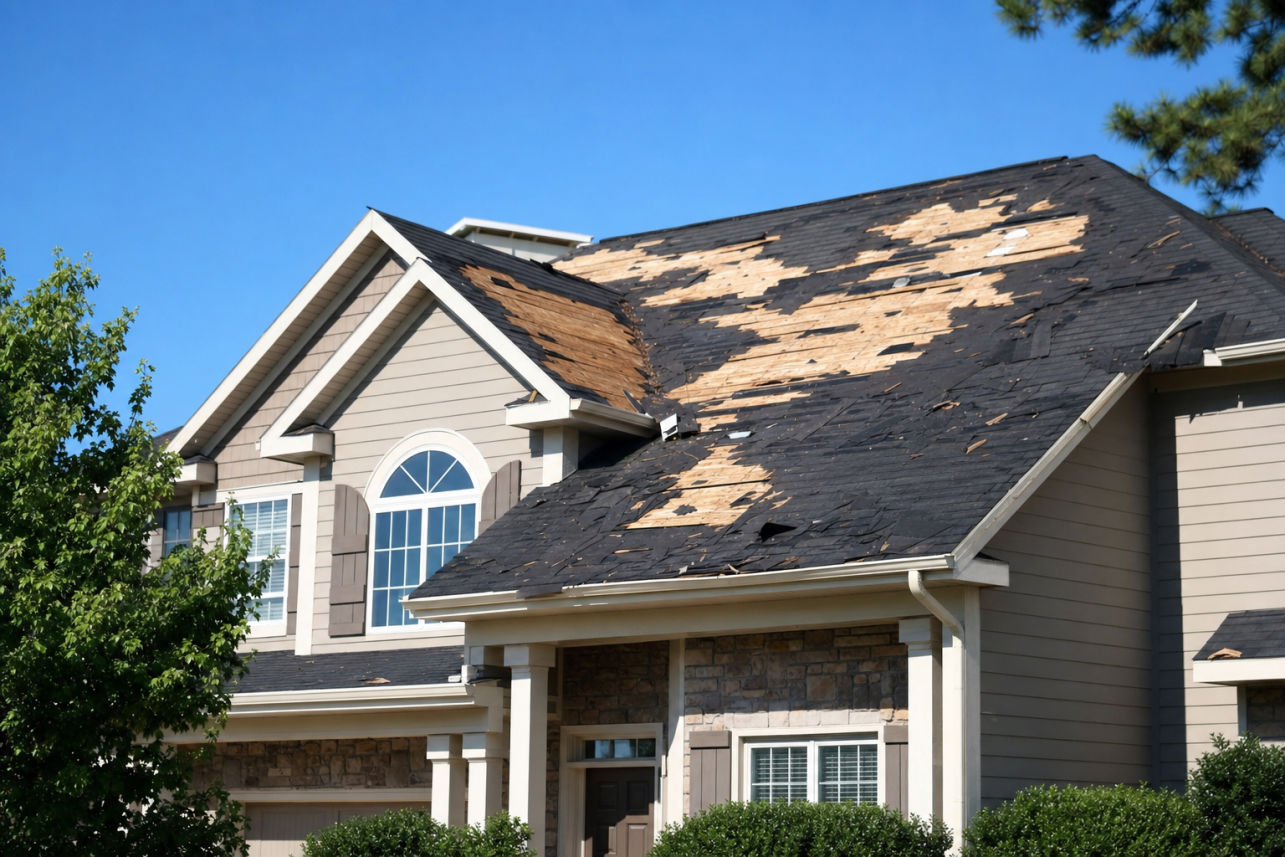
If you’re facing a Residential Homeowners Claim cary homeowners can lean on For The Public Adjusters, Inc. — a licensed, bonded public adjusting firm that works only for you, never the insurance company. We handle the paperwork, document the full scope of your damage, and negotiate directly with your insurer. From fire and smoke to water, tree, and hurricane-related damage, we build the claim your carrier’s adjuster won’t build for you.
What This Service Is
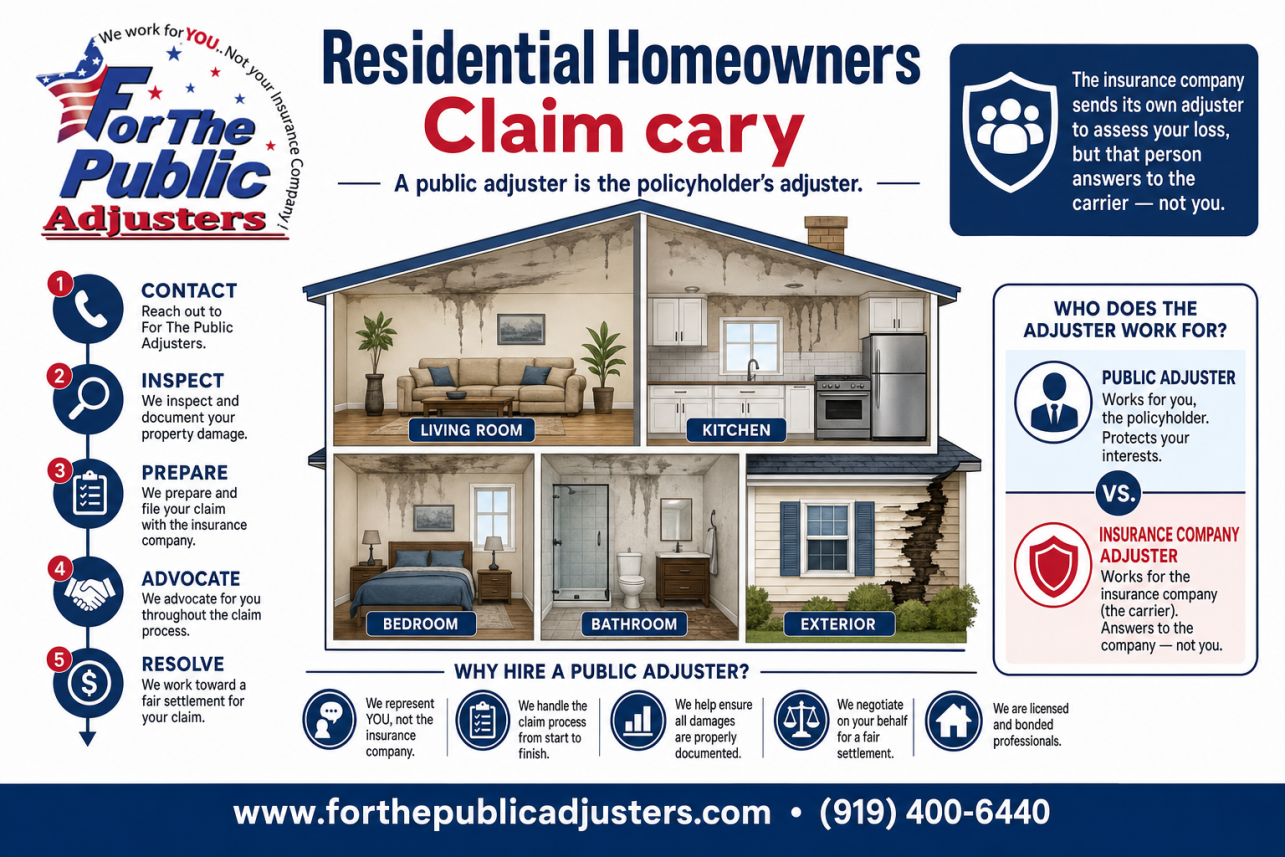
A public adjuster is the policyholder’s adjuster. The insurance company sends its own adjuster to assess your loss, but that person answers to the carrier — not to you. We level the field by reading your policy line by line, measuring and photographing every bit of damage, preparing a detailed repair estimate, and handling the settlement negotiation from start to finish.
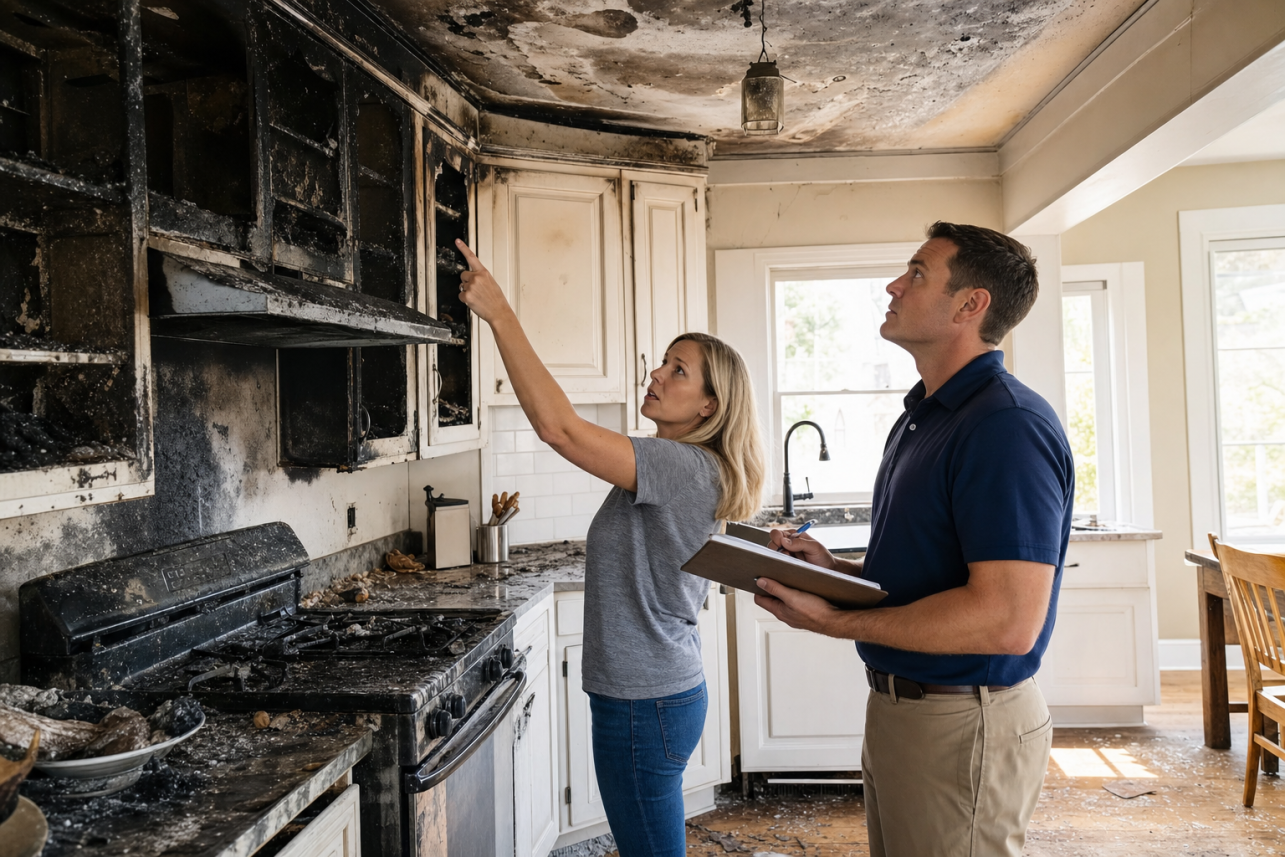
For Cary homeowners, that typically means claims for burst pipes and hidden water intrusion, kitchen fires and the smoke damage that spreads far beyond the flames, trees down on roofs after summer storms, vandalism, and even the rare car-hits-home loss. When a fire loss is involved, we bring the same depth of documentation we apply to every Fire Damage Claim Help Garner file — structure, contents, and the cost of living elsewhere while repairs happen.
The NCDOI Public Adjusters Guide makes an important point: public adjusters in North Carolina must be licensed and represent the policyholder alone. That’s exactly the arrangement here. We only get paid as a percentage of what your claim recovers, so our interests are aligned with yours from day one.
Common Problems
Why Is The Insurance Company’s Offer So Much Lower Than My Contractor’s Estimate?
This is the single most common call we get from Cary homeowners. The carrier’s estimate often misses trades entirely — no drywall matching, no paint blending, no code-required upgrades — and then subtracts depreciation on top of it.
Many policies pay actual cash value first, which is replacement cost minus depreciation for age and wear. You may be entitled to recover that depreciation after repairs, but carriers rarely walk you through how. The Insurance Information Institute (III) publishes plain-language explanations of the difference, and it matters: on a roof or a whole-kitchen fire repair, depreciation can be tens of thousands of dollars.
Add your deductible and the gaps in scope, and the first check can leave you paying serious money out of pocket. Our job is to rebuild the estimate correctly and pursue the difference through negotiation and supplemental claims — before you cash a check that doesn’t cover the work.
What If My Residential Homeowners Claim Cary Insurer Denies Or Stalls For Months?
Denials and delays usually trace back to documentation the insurer says it never received, disputes over what caused the damage, or a sworn proof of loss that wasn’t filed the way the policy demands. Miss a filing deadline in your policy and the carrier may argue you’ve forfeited coverage entirely.
A denial is not the end of the road. Policyholders can demand a written explanation, submit new evidence, and dispute the decision — and courts have backed homeowners who pushed. In Vazquez v. Citizens Property Insurance Corp., a Florida appellate court sided with the homeowners in their roof damage dispute, rejecting the insurer’s attempt to limit what it owed under the policy. Cases like that are a reminder that the carrier’s first answer isn’t the final word.
We reopen underpaid claims, assemble the proof of loss properly, and keep written pressure on adjusters who go quiet. If a dispute needs to escalate, we work alongside insurance dispute lawyers so nothing falls through the cracks.
Should I Handle The Claim Myself, Or Is Hiring A Public Adjuster Worth It?
For a small, clean loss well under your deductible’s neighborhood, you may not need help. But when the damage is significant — fire, major water intrusion, a tree through the roof — you’re negotiating against trained professionals who do this every day, while you’re doing it for the first time under stress.
A good public adjuster does three things you likely can’t do alone: reads the policy for coverages you don’t know exist (like additional living expenses while you’re displaced), documents damage to the standard insurers actually respond to, and negotiates from a written, line-item estimate rather than a feeling that the offer seems low.
Check licensing, ask how fees work, and ask who actually handles your file. We’re licensed and bonded, we work on a percentage of the recovery, and we serve homeowners across Wake County — Cary families get the same hands-on representation our Public Adjuster Garner clients do.
Our Process
Free Policy And Damage Review
We start by reading your actual policy — coverage limits, deductibles, deadlines, and the fine print that decides what gets paid. Then we inspect the damage ourselves, including the areas the carrier’s adjuster walked past. There’s no fee to find out where your claim stands.
Documentation And Proof Of Loss
We photograph and measure everything, inventory damaged contents room by room, and prepare a detailed, trade-by-trade repair estimate. We assemble and submit the sworn proof of loss correctly and on time, so the insurer can’t use paperwork as a reason to deny or delay.
Negotiation And Settlement
We present the documented claim, meet the carrier’s adjuster on site, and negotiate every disputed line item in writing. If new damage surfaces during repairs, we file supplemental claims to capture it. We can’t promise a specific dollar outcome — no honest adjuster can — but we can promise your claim will be fully built and firmly argued.
| What Happens | Filing on Your Own | With Our Cary Team |
|---|---|---|
| Damage documentation | Whatever the carrier’s adjuster notes in a brief walkthrough | Independent inspection with moisture mapping, thermal imaging, and slope-by-slope roof testing |
| Estimate accuracy | Carrier’s software pricing, often missing code upgrades and matching costs | Line-item estimate built on real Wake County contractor pricing and NC building code |
| Negotiation | Homeowner argues alone against a trained claims professional | Licensed adjuster who negotiates carrier estimates for a living manages every discussion |
| Hidden damage | Concealed moisture, smoke residue, and structural issues frequently go unclaimed | Cavities, HVAC systems, and continuous finishes are inspected and documented before settlement |
| Your time | Weeks of calls, emails, and re-explaining your loss to rotating adjusters | We handle all carrier communication; you review and approve |
| Typical result | First offer accepted, supplements rarely pursued | Settlements routinely two to seven times the initial offer, based on documented scope |
Commonly Overlooked In The Public Adjusting Industry
- Matching coverage for continuous flooring and siding — Carriers pay to replace only the damaged section, and homeowners don’t realize North Carolina matching arguments can force replacement of the entire connected run.
- Ordinance and law (code upgrade) coverage — Wake County code changes since the home was built add real cost to rebuilds, but this coverage sits unused because no one itemizes the required upgrades.
- Moisture trapped under cabinets and behind baseboards — Surface readings look dry within days while cavities stay saturated, and desk adjusters approve scope based only on what the photos show.
- Smoke residue inside HVAC ductwork and closed cabinetry — It’s invisible in a walkthrough, so cleaning and duct remediation get left off the estimate until odors return months later.
- Recoverable depreciation left unclaimed — Many homeowners never submit completion documentation, permanently forfeiting the depreciation holdback the policy owes them.
- Loss of use and additional living expenses — Homeowners absorb hotel, meal, and pet boarding costs out of pocket without knowing the policy reimburses them during repairs.
- Soft-metal evidence in hail disputes — Dented vents, screens, and condenser fins prove hail size and direction, yet inspections that never leave the ladder ignore them completely.
- Policy deadlines for supplements and proof of loss — Claims quietly time out while homeowners wait on contractors, and carriers rarely remind anyone the clock is running.
Case Studies
Case Study #1
Situation: A family in the Lochmere neighborhood of Cary came home from a weekend trip to find their kitchen ceiling sagging and water pooling on the hardwoods. A supply line to the upstairs bathroom had failed while they were away.
Problem: Their carrier’s field adjuster spent twenty minutes on site and issued a payment of $9,400 — enough to dry the structure and patch drywall, but nothing close to the real cost of replacing continuous hardwood flooring, matching custom cabinetry, or addressing moisture that had migrated into wall cavities.
Investigation: Our team performed thermal imaging and moisture mapping across the kitchen, dining room, and the bathroom above. We opened the toe-kicks under the cabinets, documented water staining inside the cabinet boxes, and pulled the insurer’s estimate line by line to compare it against actual Wake County contractor pricing.
Findings: Moisture readings showed saturation extending twelve feet beyond the visible damage. The hardwood ran continuously into the dining room and foyer, which under North Carolina matching considerations meant partial replacement would leave a visible mismatch. The insurer’s estimate had also omitted cabinet detach-and-reset, content manipulation, and code-required electrical work.
Solution: We prepared a supplemental estimate with photo documentation, moisture logs, and flooring continuity diagrams, then presented it to the carrier’s desk adjuster. When they pushed back on the flooring scope, we requested a joint re-inspection and walked their adjuster through the readings room by room.
Outcome: The claim settled at $67,800 — more than seven times the original offer — covering full flooring replacement through the connected areas, cabinet replacement, and proper structural drying.
Lesson: The first check after a water loss is almost never the final number. Hidden moisture and continuous finishes are where Cary homeowners lose the most money when no one is documenting on their behalf.
Case Study #2
Situation: A retired couple in Preston had a spring hailstorm move through western Wake County. Their roof was fifteen years old, and after neighbors began getting roof replacements, they filed a claim with their homeowner’s carrier.
Problem: The carrier’s inspector found ‘insufficient hail damage’ and denied the roof entirely, offering only $1,200 for two bent gutter sections. Meanwhile, three surrounding homes with the same storm exposure had approved full replacements.
Investigation: We ordered a certified weather report confirming 1.25-inch hail at their address, then conducted a full roof inspection with chalk-marked test squares on every slope. We also inspected soft metals — vents, flashing, window screens, and the AC condenser fins — which record hail impacts more reliably than shingles.
Findings: Every slope showed eight or more qualifying impacts per test square, with granule displacement and mat bruising visible in close-up photography. The soft-metal damage corroborated the hail size and direction. The original inspection had been conducted from a ladder at the eave, never on the roof itself.
Solution: We filed a formal dispute with the documentation package and invoked a re-inspection with the carrier, attending in person so the new adjuster examined our marked test squares slope by slope rather than starting from scratch.
Outcome: The denial was reversed. The carrier approved full roof replacement plus gutters, downspouts, window screens, and a fence stain allowance — a settlement of $31,400 against an initial payout of $1,200.
Lesson: A denial is an opinion, not a verdict. When the inspection never actually reached the roof, an independent, documented re-inspection changes everything.
| Your Situation | Handle It Yourself? | Call a Public Adjuster? | Why It Matters |
|---|---|---|---|
| Claim under ~$5,000 with obvious, visible damage | Usually fine | Optional | Small, simple losses rarely justify a fee; a quick consultation can confirm you’re not missing anything |
| Water damage inside walls, floors, or ceilings | Risky | Yes | Moisture spreads far beyond what’s visible, and undocumented saturation leads to mold and denied supplements later |
| Roof claim denied or paid as ‘repair only’ | Rarely works | Yes | Reversing a denial requires test squares, weather data, and a formal re-inspection most homeowners can’t produce |
| Fire or smoke loss with contents damage | Very difficult | Strongly yes | Smoke migrates through HVAC and closed cabinets, and contents inventories are where carriers underpay most |
| Carrier’s offer feels low but you can’t say why | Hard to prove | Yes | A line-item review against local pricing usually reveals omitted trades, code items, and matching costs |
| Claim already settled and check cashed | Depends | Ask first | In North Carolina you can often reopen or supplement a claim within the policy’s time limits if new damage is documented |
| Large loss with displacement from your home | No | Immediately | Loss-of-use benefits, emergency mitigation, and scope decisions in the first week shape the entire settlement |

Reviews
After a pipe burst behind our laundry room wall, our insurance company offered us $6,000 and called it done. For The Public Adjusters found moisture in three rooms the insurance adjuster never even checked. Final settlement was over $40,000 and they handled every phone call so I didn’t have to fight with the carrier while working full time. Worth every penny of their fee.
Melissa T., Cary (Amberly)
Our hail claim was denied twice before we called them. They got a weather report, climbed the roof themselves, and marked out the damage square by square. At the re-inspection the carrier’s adjuster couldn’t argue with the evidence. We got a full roof plus gutters approved. I honestly didn’t know homeowners could hire their own adjuster until a neighbor in Wake County recommended it.
Raj P., Cary
A kitchen fire left smoke damage through half our house and the insurance estimate treated it like a paint job. This team documented smoke residue in the HVAC system and inside cabinets, itemized our damaged contents, and even got our hotel stay covered under loss of use. Communication was excellent — we always knew what stage the claim was in. The settlement more than tripled.
Diane H., Cary (MacGregor Downs)
Frequently Asked Questions
How Does A Public Adjuster Help With A Residential Homeowners Claim Cary Homeowners Are Filing After Storm Or Water Damage?
When you hire For The Public Adjusters, Inc., we take over every part of the claim so you are not negotiating against your insurance company alone. That starts with a full, room-by-room inspection of your home, including areas insurance company adjusters often rush past, such as attic decking, crawlspaces, and hidden moisture behind drywall.
From there, we document everything with photos, moisture readings, and a detailed line-item estimate written in the same software most carriers use. That matters, because a claim in Cary is only as strong as its documentation. Wake County homes see everything from hail-damaged architectural shingles to burst supply lines and tree strikes during hurricane remnants, and each type of loss requires different proof.
We then file or reopen the claim, handle all calls and correspondence with the carrier, meet their adjuster on site, and negotiate the settlement. If the first offer is low, and first offers usually are, we push back with documentation rather than opinions.
Most homeowners tell us the biggest relief is simply not having to learn insurance language overnight while their house is torn apart. You approve the strategy and the final settlement; we do the rest. Our fee is a percentage of what we recover, so we only get paid when you do, and it is in our interest to maximize every legitimate dollar your policy owes you.
What Kinds Of Home Damage Do You Handle For Cary Homeowners, And What Losses Come Up Most Often In Wake County?
We handle virtually every type of loss covered under a standard homeowners policy. In and around Cary, the most common claims we see are wind and hail damage to roofs, water damage from failed water heaters and washing machine supply lines, tree falls during tropical-storm remnants moving up from the coast, lightning strikes, kitchen fires, and pipe breaks during the occasional hard freeze.
Hail is a big one here. Wake County sits in a corridor that catches severe spring thunderstorms, and hail bruising on shingles is easy for a carrier’s adjuster to minimize or miss entirely. We inspect roofs slope by slope and document every impact, along with collateral damage to gutters, screens, and soft metals that helps prove the storm’s severity.
Water losses are the other frequent category. Many Cary neighborhoods, from older sections near downtown to newer builds out toward Highway 55, have homes reaching the age where original plumbing and appliances begin to fail. These claims often involve hidden damage inside walls and under flooring, which is exactly where undervalued settlements come from.
We also handle fire and smoke losses, which involve contents inventories, smoke remediation scopes, and additional living expenses if your family has to relocate during repairs. Whatever the cause, the process is the same: thorough documentation, a complete estimate, and firm negotiation until the settlement reflects the true cost of putting your home back the way it was.
My Insurance Company Already Made An Offer On My Homeowners Claim. Is It Too Late To Bring In A Public Adjuster In Cary?
No, it is usually not too late, and a low first offer is actually the most common reason homeowners call us. As long as your claim has not been formally closed past the deadlines in your policy, we can step in, review the carrier’s estimate, and pursue a supplement or a full renegotiation.
Here is what typically happens. The insurance company’s adjuster spends a short time at your home, writes an estimate based on what was visible that day, and issues payment. Weeks later, your contractor opens up a wall or gets on the roof and finds the real scope is far larger. That gap between the paid estimate and the actual repair cost is where we do most of our work.
When we take over an underpaid claim, we re-inspect the property, identify everything the original estimate missed, and rebuild the scope line by line, including code-upgrade items North Carolina building requirements may trigger during repairs. We then present the supplemented claim to the carrier with supporting documentation and negotiate the difference.
Even claims that were denied outright can often be reopened if the denial was based on incomplete information or a misapplied exclusion. If you are in Cary or anywhere in Wake County and something about your settlement feels short, send us the carrier’s estimate. We will review it at no charge and tell you honestly whether there is money left on the table worth pursuing.
How Much Does It Cost To Hire For The Public Adjusters, Inc., And How Long Does A Residential Homeowners Claim Cary Residents File Usually Take To Settle?
We work on a contingency fee, meaning our compensation is a percentage of the settlement we recover for you. There are no upfront charges, no hourly billing, and no fee at all if we do not recover money on your behalf. The percentage is agreed to in writing before we begin, so there are never surprises.
Homeowners sometimes worry the fee will leave them worse off, but industry studies consistently show professionally represented claims settle for significantly more than unrepresented ones. In our experience with Cary properties, the increase in recovery routinely exceeds the fee many times over, particularly on roof, fire, and hidden-water losses where scope disputes are common.
As for timing, a straightforward claim with cooperative carrier handling often resolves in 30 to 60 days from the date we submit our documentation. More complex situations, such as large fire losses, disputed causation, or claims requiring engineering reports, can run 90 days or longer. Reopened or supplemented claims vary depending on how the carrier responds to the new evidence.
What we can promise is that the file never sits idle on our end. North Carolina regulations require insurers to respond to claim communications within set timeframes, and we hold carriers to those deadlines. Throughout the process you will know exactly where things stand, what the carrier has said, and what happens next, so the timeline is never a mystery to you.
What Should I Do In The First 48 Hours After Discovering Damage To My Cary Home, Before The Claim Is Even Filed?
The first two days matter more than most homeowners realize. Start by preventing further damage — shut off water at the main if a pipe has burst, tarp roof openings after a storm, and move undamaged belongings out of harm’s way. Your policy actually requires reasonable steps to mitigate, and insurers in Wake County routinely reduce payouts when they believe damage was allowed to spread.
Next, document everything before you clean up or throw anything away. Take wide photos of each room, close-ups of damaged materials, and video walkthroughs with timestamps. Keep damaged items like soaked drywall cutouts or shingle fragments if you safely can — physical evidence often settles disputes later.
Save every receipt for emergency repairs, hotel stays, and even meals if you’re displaced, since additional living expense coverage may reimburse those costs. Do not sign contracts with restoration companies that include assignment-of-benefits language without reading them carefully.
Finally, consider calling us before you call the insurance company. When For The Public Adjusters, Inc. is involved from day one, we handle the notice of loss, control the inspection schedule, and make sure your recorded statements don’t accidentally undercut coverage. Homeowners who bring us in early in Cary typically avoid the back-and-forth that drags claims out for months, because the file is built correctly from the start rather than repaired after the insurer has already staked out a low position.
My Homeowners Claim Was Denied. Can For The Public Adjusters, Inc. Still Help Me In Cary?
Yes, and denials are one of the most common reasons homeowners contact us. A denial letter is the insurance company’s opinion, not the final word. Most policies give you the right to dispute the decision, request re-inspection, and invoke appraisal — and many denials in Wake County fall apart once the loss is properly documented.
Our first step is a line-by-line review of your policy and the denial letter itself. Insurers frequently cite exclusions like wear and tear, faulty workmanship, or long-term seepage when the actual cause of loss is a covered sudden event, such as wind-driven rain or a pipe failure. Proving the true cause is often the entire fight.
From there, we build the evidence the original adjuster never gathered: moisture mapping, roof measurements, contractor scopes, engineering opinions when needed, and a detailed estimate in the same software insurers use. We then present a formal supplement or dispute package and negotiate directly with the carrier so you don’t have to.
Many denied claims we handle in Cary end up paid in part or in full. Water losses in older neighborhoods near downtown and hail-damaged roofs in newer subdivisions are two categories where we see wrongful denials most often. There are deadlines, though — North Carolina policies typically limit how long you have to dispute or file suit — so bring us the denial letter promptly. The consultation costs nothing, and you’ll know quickly whether the decision is worth challenging.
How Is A Public Adjuster Different From The Adjuster My Insurance Company Sends To My Cary Home?
The difference comes down to who each adjuster works for. The adjuster your insurance company sends — whether a staff adjuster or an independent contractor — is paid by the carrier and answers to the carrier. Their estimate reflects the insurer’s interests, guidelines, and pricing preferences. That’s not an accusation of bad faith; it’s simply how the system is built.
A public adjuster is licensed by the North Carolina Department of Insurance to represent you, the policyholder, and only you. We owe you a fiduciary duty. When we inspect your home, we’re looking for every item of covered damage, not the minimum needed to close the file.
In practice, that difference shows up in the details. Carrier adjusters in the Cary area often spend twenty or thirty minutes on site. We spend hours — checking attics for hidden moisture, measuring every roof slope, testing materials for matching issues, and scoping code-required upgrades that Wake County inspections will demand during repairs.
We also handle the entire process: preparing the estimate, submitting documentation, negotiating supplements, and pushing back when the carrier’s numbers don’t reflect real Cary construction costs. You still own the claim and make the final decisions, but you’re no longer negotiating alone against professionals who handle claims every day. That leverage is exactly why homeowners who felt stuck for months often see movement within weeks of hiring us.

What Documentation Do I Need For A Residential Homeowners Claim Cary Insurance Companies Will Actually Pay Fairly On?
A well-documented Residential Homeowners Claim cary insurers can’t easily dispute starts with three things: proof of what was damaged, proof of what caused it, and proof of what repairs genuinely cost. Gaps in any of these give the carrier room to underpay.
For the damage itself, photos and video are essential — before cleanup, from multiple angles, in every affected room. Don’t forget hidden areas like attics, crawlspaces, and behind baseboards, where moisture often travels unseen. If contents were destroyed, an itemized inventory with approximate ages and replacement costs is critical, and old receipts, credit card statements, or even photos showing items in the background all help establish ownership.
For causation, keep evidence of the event: weather reports for the storm date, the failed pipe or appliance part, or a plumber’s invoice describing what broke. Wake County saw significant hail and wind events in recent years, and tying your loss to a specific date strengthens the file considerably.
For cost, insurer estimates often lag behind actual Cary-area labor and material pricing. Independent contractor bids and a professionally prepared line-item estimate close that gap.
The honest answer, though, is that most homeowners shouldn’t have to build this alone. When we take over your claim, our team handles the inspections, inventory, estimating, and policy analysis — presenting the carrier with a package that’s difficult to dismiss. That documentation is usually the single biggest factor separating a fair settlement from a frustrating one.
My Insurance Company Paid Actual Cash Value On My Residential Homeowners Claim Cary — How Do I Recover The Depreciation They Held Back?
Most homeowners policies in North Carolina pay claims in two stages. The first check is the actual cash value, which is the replacement cost minus depreciation. The second payment, called recoverable depreciation, is released only after you complete the repairs and prove it.
This is where a lot of Cary homeowners leave money on the table. If the initial estimate was low, the depreciation holdback is calculated from that low number, and the final payment shrinks with it. We frequently see roof and siding claims in Wake County where the carrier depreciated materials far more aggressively than their actual age and condition justified.
For The Public Adjusters, Inc. reviews how depreciation was applied line by line. Was your seven-year-old architectural shingle roof depreciated as if it were fifteen years old? Was labor depreciated when your policy doesn’t allow it? These details change the payout meaningfully.
We also handle the recoverable depreciation release itself. That means submitting contractor invoices, completion certificates, and photos in the format the carrier requires, and following up until the funds are issued. Deadlines matter here — many policies require repairs to be completed within a set window, often 180 days to two years, or the depreciation is forfeited.
If you’ve already received an ACV payment and something feels off, bring us the estimate and your policy. On a Residential Homeowners Claim cary carriers process, the difference between the first check and what you’re actually owed is often substantial, and it’s rarely too late to correct it.
Will My Homeowners Policy Cover A Hotel Or Rental While My Cary Home Is Being Repaired?
In most cases, yes. Nearly every homeowners policy sold in Wake County includes Additional Living Expenses coverage, sometimes called Loss of Use or Coverage D. It pays the extra costs you incur when damage makes your home unfit to live in.
That can include a hotel near Cary Towne Center while your kitchen is gutted after a pipe burst, a short-term rental in Apex or Morrisville during a major fire restoration, extra mileage if you’re now commuting farther, pet boarding, and even the increased cost of restaurant meals compared to your normal grocery budget.
The catch is the word ‘extra.’ Carriers only pay the amount above your normal living costs, and they scrutinize every receipt. They also decide whether your home is truly ‘uninhabitable,’ and their bar is often higher than yours. A house with no working kitchen, active mold remediation, or no HVAC during a Carolina summer can absolutely qualify, but you may have to push for it.
Our team documents the habitability issue with photos, contractor letters, and remediation reports so the carrier can’t argue you should have stayed in the home. We track your ALE spending, keep it organized, and make sure the coverage runs for the full repair period rather than being cut off arbitrarily after a few weeks.
There are policy limits, usually a percentage of your dwelling coverage or a set time period, so it pays to plan the temporary housing budget early. If you’re already displaced and paying out of pocket, save every receipt and call us — those costs are often reimbursable even after the fact.
What Happens When Hidden Damage Like Mold Or Rotted Framing Shows Up After The Insurance Estimate Is Done?
It’s one of the most common calls we get from Cary homeowners. The carrier’s adjuster spends forty-five minutes at the house, writes an estimate, and issues payment. Then your contractor opens the wall and finds saturated insulation, mold on the studs, or rot the original inspection never touched.
The good news: your claim isn’t closed just because a check was cashed. Under North Carolina practice, you can submit a supplemental claim for damage that’s related to the original covered loss but wasn’t visible or included in the first estimate. Carriers pay supplements regularly — but only when they’re documented properly.
That’s the hard part. The insurer will want proof the newly discovered damage came from the covered event, not from long-term neglect or a separate cause. Mold claims in particular get pushback, because many policies cap mold coverage or exclude it unless it resulted directly from a covered water loss.
For The Public Adjusters, Inc. builds that causation case for you. We bring in moisture mapping, photograph the damage as it’s uncovered, coordinate with your contractor before demolition continues, and write the supplement in the same estimating format the carrier’s adjusters use, so there’s less room for dispute.
We also flag code-upgrade costs. Wake County building requirements have changed over the years, and if your policy includes ordinance or law coverage, the insurer may owe for bringing electrical, framing, or ventilation up to current code — not just replacing what was there. Don’t let your contractor absorb hidden damage or upgrade costs that the policy was written to pay.
The Insurance Company And I Disagree On The Value Of My Residential Homeowners Claim Cary Policyholders Have Appraisal Rights — How Does That Work?
When you and your carrier agree the loss is covered but can’t agree on the dollar amount, most North Carolina homeowners policies include an appraisal clause. It’s a structured way to resolve the pricing dispute without filing a lawsuit, and for many claims in Cary it’s the fastest path to a fair number.
Here’s how it works. You select your appraiser, the insurance company selects theirs, and the two appraisers choose a neutral umpire. Each side presents its estimate and supporting documentation. When any two of the three agree on an amount, that figure becomes binding on the value of the loss.
Appraisal is powerful, but it’s only as strong as the estimate behind it. If your appraiser walks in with a thin, poorly documented file, you can lose ground. Before we ever invoke appraisal on a Residential Homeowners Claim cary carriers have underpaid, we make sure the estimate is airtight — measured room by room, priced with current Wake County labor and material costs, and backed by photos, moisture readings, and engineering reports where needed.
We also help homeowners decide whether appraisal is even the right move. Sometimes a well-documented supplement or a negotiated re-inspection gets the same result faster and without the umpire’s fee. If the dispute is about coverage rather than value — the carrier saying the loss isn’t covered at all — appraisal isn’t the right tool, and we’ll tell you that honestly.
Either way, you don’t have to accept a lowball number as final. There’s a defined process for challenging it, and we handle it start to finish.
How Long Do I Have To File A Residential Homeowners Claim Cary Insurance Carriers Will Still Accept, And Are There Deadlines In North Carolina?
Most homeowners policies issued in North Carolina require you to report a loss “promptly” or “as soon as practicable,” and North Carolina’s statute of limitations generally gives you three years from the date of loss to bring suit on a property claim — though your specific policy may shorten certain deadlines, so read it carefully.
The practical answer is simpler: report the damage as soon as you find it. Carriers routinely argue that delayed reporting made it impossible to verify the cause of loss, especially with water damage in Cary crawl spaces or slow roof leaks that go unnoticed for months. The longer you wait, the more ammunition they have.
There are also internal deadlines inside the claim itself. Proof of loss forms often must be submitted within 60 days of the carrier’s request. Replacement cost holdback typically must be claimed within a set window — often 180 days to two years after the loss — or you forfeit the depreciation.
When we take on a homeowners claim in Cary, one of the first things we do is map every deadline in the policy and calendar it. We handle the proof of loss, the supplement submissions, and the recoverable depreciation demand so nothing lapses. If you discovered damage months ago and haven’t filed yet, don’t assume you’re out of options — call us and we’ll review the policy language before you write the claim off. Time matters, but a late start is rarely a lost cause.
My Mortgage Company Is Listed On The Insurance Check For My Cary Home. How Do I Actually Get The Money Released For Repairs?
This surprises a lot of Wake County homeowners: when a claim payment exceeds a certain threshold — often around $10,000 to $40,000 depending on the servicer — the insurer makes the check payable to both you and your mortgage lender. The lender then controls disbursement through its loss draft department.
Typically the servicer holds the funds in escrow and releases them in stages: an initial draw to start repairs, a second draw at roughly 50% completion after an inspection, and the balance when the work passes a final inspection. You’ll usually need to submit the adjuster’s estimate, a signed contractor agreement, a W-9 from the contractor, and sometimes lien waivers.
Where this goes wrong is when the insurance payment is too low to begin with. If the carrier’s estimate won’t actually cover the repairs, the lender’s inspections will stall the draws and you’ll be stuck fronting the difference. That’s why getting the settlement right on the front end matters so much.
As your public adjuster in Cary, we prepare the detailed estimate the carrier pays from, and we can coordinate directly with your servicer’s loss draft department so the paperwork moves. We’ve walked plenty of homeowners through the endorsement and draw process for houses in Cary Park, Lochmere, and across town. It’s tedious but manageable — and it goes much faster when the claim was documented and valued correctly from day one.
The Insurer Only Wants To Pay For Part Of My Roof Or Siding, But Nothing Matches. Can I Make Them Replace The Whole Thing?
Often, yes — and this is one of the most contested issues we see on a Residential Homeowners Claim cary carriers try to settle cheaply. Insurers love to pay for a “slope repair” or a handful of siding squares, leaving you with a patchwork of mismatched shingles or discontinued vinyl on an otherwise uniform home.
The fight usually comes down to two things: whether matching materials are still available, and what your policy says about matching. Many shingle lines and siding profiles common in Cary subdivisions built in the 1990s and 2000s have been discontinued. If the material can’t be reasonably matched, there’s a strong argument the carrier owes for continuous, adjoining surfaces — sometimes the entire elevation or the entire roof.
How we build that argument matters. We pull manufacturer discontinuation letters, order independent shingle and siding matching reports from testing labs, and document the visible mismatch with photos from the street — the same view an appraiser or buyer would see. That evidence changes the conversation with the carrier’s adjuster.
We also check for local repair ordinances and code upgrade coverage, since bringing a partial repair up to current code can push the scope wider than the carrier’s original estimate. If you’ve been offered a partial roof or siding payment on your Cary home, get a second opinion before you accept. The difference between a patch and a full replacement is often tens of thousands of dollars, and the policy language frequently supports the full replacement.
The Insurance Company Wants A Recorded Statement About My Homeowners Claim. Should I Give One, And Can You Be There With Me?
Be careful here. A recorded statement is not a casual chat — it’s an investigative tool, and everything you say becomes part of the claim file. Carriers use statements to lock in details about when damage started, prior conditions, and maintenance history, then hold any inconsistency against you later.
Most policies do require you to cooperate with the investigation, so refusing outright can jeopardize coverage. But cooperation doesn’t mean going in unprepared. Homeowners in Cary often hurt their own claims innocently — guessing at dates, speculating about causes, or volunteering that a roof was “getting old.” A vague guess can become the basis for a wear-and-tear denial.
Before any statement, we prepare our clients thoroughly. We review the timeline of the loss, the documentation, and the policy provisions likely to come up. We help you understand which questions call for a precise answer and which deserve a simple “I don’t know” instead of a guess. As your representative, we can attend the statement with you, and where the carrier escalates to an Examination Under Oath, we help you coordinate with an attorney, since an EUO is a formal legal proceeding.
One more tip: never give a recorded statement in the first chaotic days after a loss if you can schedule it later. You’re entitled to reasonable time. If a carrier is pressing you for a statement on your Cary claim, call For The Public Adjusters, Inc. first — a half-hour of preparation can prevent months of coverage disputes.
Local Relevance
Cary sits in a humid subtropical climate where summer thunderstorms, occasional ice storms, and the remnants of Atlantic hurricanes all take a toll on homes. The town’s mature tree canopy is beautiful until a saturated oak comes down on a roofline — tree losses are among the most disputed claims we see, and we handle them across the Triangle, including Tree Damage Insurance Claim Help Carrboro files where the fight was over structural scope, not just debris removal.
Much of Cary’s housing stock went up during the rapid growth of the 1980s through the 2000s, which means plenty of homes now have aging roofs, original plumbing supply lines, and water heaters at the end of their lifespan. Slow leaks behind walls and sudden pipe failures drive a steady stream of water damage claims here, and carriers frequently underpay the hidden portion of that damage.
Heavy rain events raise a separate issue: standard homeowners policies exclude flood, which requires its own coverage. If rising water reached your home, we can help you sort out which policy responds — the same way we do on every Flood Insurance Claim Help Apex case just next door.
Because so much of Cary was built in the same few decades of rapid growth, many neighborhoods are hitting roof, plumbing, and water-heater replacement age at the same time — which means insurers here often lean hard on depreciation and ‘wear and tear’ arguments to shrink water and storm-related payouts. Documenting the sudden, covered cause of the loss, not just the damage itself, is frequently what decides these claims.
Ready To Get Started?
Reach out today for a free, no-obligation conversation about your situation.
Call us: (919) 400-6440
Helpful Resources
- NCDOI Public Adjusters Guide
- Federal Emergency Management Agency (FEMA)
- National Flood Insurance Program (NFIP)
- Insurance Information Institute (III)
- National Association of Insurance Commissioners (NAIC)
- Weather Underground
- The Weather Channel
- Hurricane Center
- National Fire Protection Association (NFPA)
- American Red Cross Fire Prevention
- U.S. Fire Administration – Home Cooking Fire Safety
- North Carolina Department of Insurance — State regulator overseeing insurers and public adjuster licensing
Last updated: September 11, 2026