
If a hurricane remnant or tornado has damaged your home, a public adjuster can manage your Wind Damage Claim Cary NC from the first inspection to the final check — and we work for you, not the insurance company. For The Public Adjusters, Inc. is licensed and bonded in North Carolina, and we document, estimate, and negotiate storm claims so homeowners are not stuck accepting whatever the carrier's adjuster says the damage is worth. You pay nothing out of pocket for us to review a denial or a low offer.
What This Service Is
A public adjuster is a licensed claims professional who represents the policyholder — the opposite of the adjuster your insurance company sends out. When a tropical system or tornado rips shingles off your roof, drives rain into the walls, or drops a tree across the ridge, we read your homeowners policy line by line, inspect the damage ourselves, build a complete repair estimate, and negotiate the settlement on your behalf.
That matters because hurricane and tornado damage is rarely as simple as missing shingles. Wind-driven rain can soak insulation and drywall weeks before you see a stain. Uplift can break the seal on shingles that still look attached from the ground. A quick drive-by inspection misses most of it, and a missed item is money you never receive.
North Carolina requires public adjusters to be licensed, and the NCDOI Public Adjusters Guide explains exactly what we are allowed to do for policyholders — a protection worth knowing before you sign anything with anyone. We handle wind claims across the Triangle and beyond; homeowners who found us through our Wind Damage Claim Help Burlington work often tell us they had no idea how much their first offer left out.
Common Problems
Why Did The Insurance Company Only Pay A Fraction Of What My Roof Costs To Replace?
The usual culprit is depreciation. Many policies first pay actual cash value — the depreciated worth of your old roof — and only release the rest after repairs are done. If nobody explains that, homeowners assume the first check is the whole settlement and absorb the gap themselves.
The other culprit is the estimate itself. Carrier estimates routinely price a patch instead of a replacement, skip underlayment and flashing, and ignore matching problems when your shingle color was discontinued years ago. In many Cary subdivisions, HOA appearance rules can actually strengthen the argument for full replacement rather than a mismatched patch.
Also check your windstorm deductible. Some policies carry a separate, percentage-based deductible for wind events, and knowing that number before you negotiate keeps surprises off the final check.
What If My Wind Damage Claim Cary NC Was Denied Or Blamed On 'wear And Tear'?
A denial is an opinion, not a verdict. Carriers lean hard on the age of a roof, and much of Cary's housing went up in the late 1990s through the mid-2000s with builder-grade shingles — exactly the age where 'pre-existing wear' becomes the default answer to every storm claim. Tying the damage to a specific wind event with weather records and physical evidence is how that answer gets reversed.
Courts have long held that insurers must deal with policyholders in good faith. In Gruenberg v. Aetna Insurance Co., the California Supreme Court allowed a building owner whose fire claim was wrongly denied to sue his insurer for bad faith — a landmark that still shapes how carriers are expected to treat property claims nationwide.
You do not have to start with a lawsuit. A properly documented re-inspection and a supplemental claim resolve most disputes. When homeowners near Garner bring us denials, our Public Adjuster Garner team follows the same playbook: evidence first, argument second.
Do I Need A Wind Damage Public Adjuster, Or Can I Just Trust The Insurance Adjuster?
The insurance company's adjuster is paid by the insurance company. That person may be perfectly pleasant, but their estimate protects the carrier's bottom line, not yours. A public adjuster is the only type of adjuster licensed to represent you.
Handling it yourself is possible, but after a hurricane remnant the carrier's adjusters are juggling hundreds of files, and the homeowner without documentation is the easiest file to close cheap. We photograph everything, measure everything, and price repairs at real local contractor rates.
When you compare adjusters, ask for a North Carolina license number, proof of bonding, and the fee in writing. Anyone who promises a specific dollar outcome before inspecting your roof is someone to avoid — no honest adjuster guarantees results.
Our Process
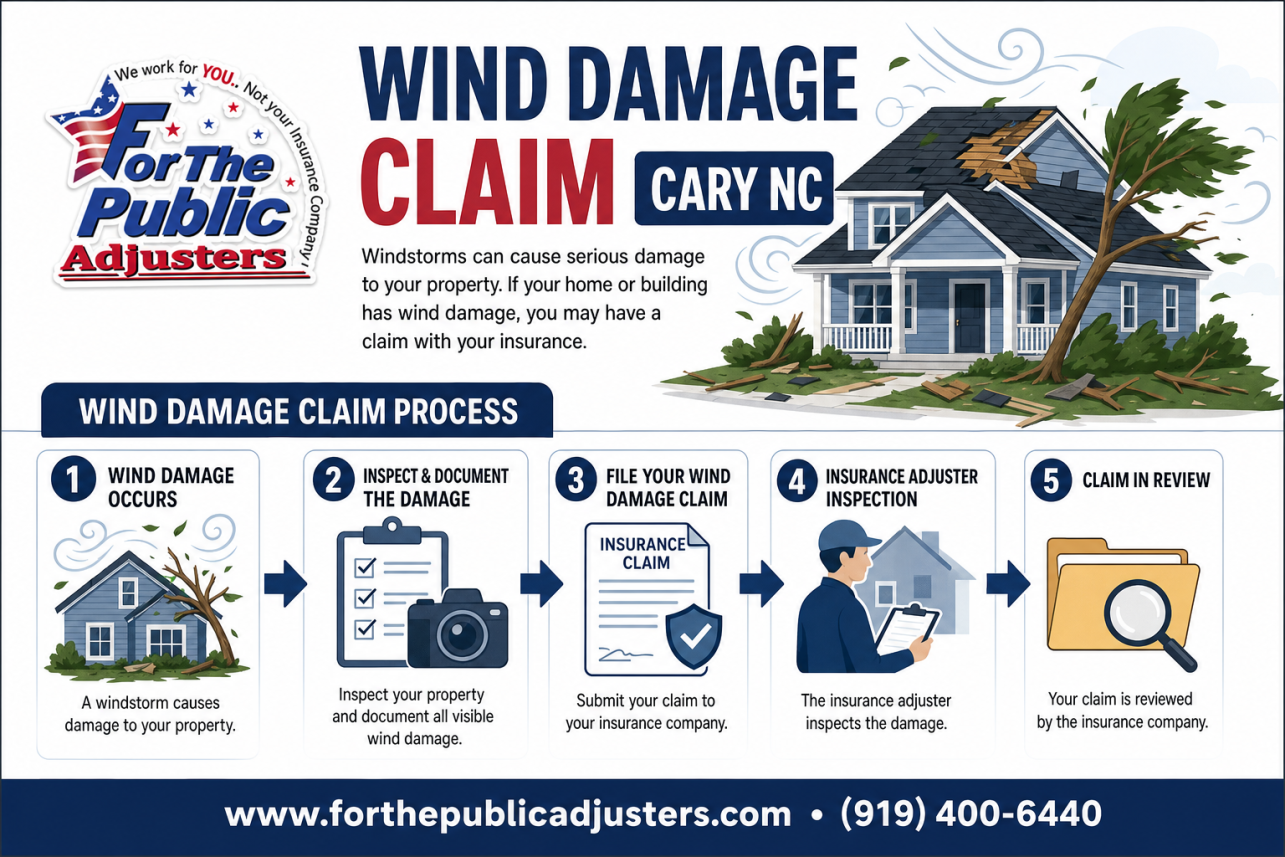
Policy Review And Full Property Inspection
We start by reading your actual homeowners policy — coverage limits, the windstorm deductible, replacement cost versus actual cash value provisions, and any filing deadlines. Then we inspect the whole property, not just the obvious roof damage: attic, siding, gutters, fencing, and interior ceilings where wind-driven rain hides.
Documentation, Storm Evidence, And A Real Repair Estimate
We tie your damage to the storm with dated photos, weather data, and a structural assessment, then build a line-item repair estimate at current local pricing. If a tree came down with the wind, that gets folded in too — the same documentation approach behind every Tree Damage Home Insurance Claim in Mebane we handle. We also advise on temporary repairs so the carrier cannot blame you for letting damage spread.
Negotiation, Supplements, And Settlement
We present the claim, meet the carrier's adjuster on your roof, and negotiate every disputed line. If hidden damage surfaces during repairs, we file a supplemental claim rather than letting you eat the cost. If the claim was already closed or underpaid, we can often reopen it — closed does not mean finished.
| Claim Stage | Policyholder Alone | With For The Public Adjusters, Inc. |
|---|---|---|
| Damage documentation | Phone photos of visible damage only | Slope-by-slope inspection, moisture mapping, uplift and seal-failure testing, NWS storm data |
| Scope of loss | Relies on the carrier's estimate | Independent line-item estimate including matching, code upgrades, and interior damage |
| Causation disputes | Hard to rebut 'wear and tear' or 'defect' opinions | Independent engineering support and burden-of-proof arguments backed by case law like Corban v. USAA |
| Negotiation | One offer, take it or appeal blindly | Documented supplements, re-inspections, and direct negotiation with the carrier |
| Time and stress | Policyholder manages calls, deadlines, and paperwork | Licensed, bonded adjusters manage the claim from inspection to settlement |
Commonly Overlooked In The Public Adjusting Industry
- Unsealed shingles that are still lying flat — Tornado and hurricane winds can break the adhesive seal without removing the shingle, so the roof looks fine from the ground but will fail in the next storm.
- Matching requirements for discontinued shingles and siding — Carriers price a small patch, but if the material is no longer manufactured, a patch creates a mismatched roof or wall that many policies and state guidance say should be addressed more broadly.
- The insurer's burden to prove an exclusion — Policyholders assume a denial letter is final, but courts — including the Mississippi Supreme Court in Corban v. USAA, a Hurricane Katrina home-damage case — have held the carrier must prove an excluded cause, not just assert one.
- Ordinance-or-law coverage for code upgrades — Wake County building code may require upgraded roof fastening or decking during repairs, and that extra cost is often covered but almost never volunteered in a first estimate.
- Hidden water migration behind walls and under insulation — Storm water travels along framing far from the entry point, and a surface-only inspection misses saturation that leads to mold and rot months later.
- Separating wind-driven rain from flood water — Flood damage belongs on an NFIP flood policy through FEMA, not the homeowners policy, and lumping the two together gives the wind carrier an opening to deny everything.
- Detached structures, fencing, and soft metals — Carports, sheds, gutters, window wraps, and HVAC fins take tornado damage too, but first inspections frequently scope only the main roof.
- Deadlines buried in the policy conditions — Proof-of-loss, appraisal demand, and suit-limitation windows quietly expire while a policyholder waits on hold, and missing one can end an otherwise valid claim.
Case Studies
Case Study #1
Situation: A homeowner in Cary's Lochmere neighborhood had three-tab shingles torn from the south slope of her roof during a tornado-warned storm cell that moved through Wake County. Rain followed for two days before a tarp went up.
Problem: Her carrier's adjuster approved a small repair allowance for 22 shingles and denied interior ceiling staining in two bedrooms, claiming the water intrusion was 'pre-existing wear.' The settlement offer didn't come close to covering a roofer's actual bid.
Investigation: Our team performed a full slope-by-slope inspection, documented creased and lifted shingles that were unsealed but still attached, pulled National Weather Service storm reports confirming the tornado warning and recorded gusts, and moisture-mapped the interior ceilings with a thermal camera.
Findings: Over 60% of the shingles on two slopes showed sealant-bond failure consistent with the storm event, not age. The manufacturer had also discontinued that shingle profile, making a patch repair impossible under North Carolina's matching considerations. Interior moisture readings traced directly to the breached slope.
Solution: We prepared a supplemental claim with photo documentation, weather data, a licensed roofer's brittleness test results, and a line-item estimate covering full slope replacement, interior drywall, paint, and insulation. We then negotiated directly with the carrier's desk adjuster and field re-inspector.
Outcome: The carrier reversed the partial denial and issued a revised settlement covering roof replacement on the damaged slopes plus interior repairs — a substantially larger figure than the original offer. Every claim is different, and results depend on the policy and the facts, but thorough documentation changed this one.
Lesson: Carriers often scope only what is missing, not what is damaged. Creased and unsealed shingles after a tornado-warned storm can be compensable damage, and policyholders in Cary should get an independent assessment before accepting a first offer.
Case Study #2
Situation: A small commercial property owner near downtown Cary had rooftop HVAC curbs, membrane roofing, and a brick parapet damaged when the remnants of a hurricane pushed sustained winds through the Triangle. Tenants reported leaks within a week.
Problem: The insurance company's engineer attributed the membrane uplift to 'faulty installation' and the parapet cracking to 'long-term settling,' then denied the bulk of the claim. The owner was facing six figures in repairs and unhappy tenants.
Investigation: We brought in an independent engineer, documented uplift patterns consistent with hurricane-force wind vortices at the roof corners, photographed displaced coping metal, and compared pre-storm aerial imagery against post-storm conditions to establish the building's prior state.
Findings: The directional pattern of membrane peeling matched the storm's recorded wind direction, and pre-storm imagery showed an intact parapet and coping line. The 'installation defect' theory could not explain damage concentrated on the windward corners. Courts have long sided with policyholders when carriers overreach on causation — in Corban v. USAA Insurance Co. (Mississippi Supreme Court, 2009), a Hurricane Katrina case, the court held the insurer bears the burden of proving a loss falls within an exclusion, and the policyholders prevailed on their wind damage to the home.
Solution: We submitted a rebuttal report, demanded a re-inspection with our engineer present, and presented a complete repair estimate including code-required upgrades to the roof attachment system under the ordinance-or-law provision of the policy.
Outcome: After re-inspection, the carrier withdrew the installation-defect position and paid for membrane replacement, parapet repair, coping metal, and code upgrades. The owner avoided litigation entirely. No outcome is ever guaranteed, but the documentation left little room for dispute.
Lesson: A causation denial is an opinion, not a verdict. When an insurer blames construction defects or age after a hurricane, an independent engineering review and the legal burden-of-proof framework can change the conversation.
| Situation After the Storm | Act Within | What It Depends On |
|---|---|---|
| Active roof leak or open roof deck | 24–48 hours (tarp/mitigation) | Your policy's duty to mitigate — delays can give the carrier grounds to deny secondary water damage |
| Shingles creased or unsealed but not missing | Before the first carrier inspection | Whether a brittleness test and seal-bond documentation are done — this damage is invisible from the ground |
| Carrier approves a small 'repair only' scope | Before cashing any check | Discontinued materials and matching issues may support replacement instead of patching |
| Denial blaming age, wear, or faulty installation | Within your policy's appraisal/suit window | Independent engineering evidence and the insurer's burden to prove an exclusion applies |
| Interior ceiling or wall staining after the storm | Before repainting or repairing | Moisture mapping that ties interior damage to the storm breach — repairs destroy the evidence |
| Wind-driven rain mixed with rising water | Immediately — separate the claims | Flood losses fall under NFIP/FEMA flood policies, not your homeowners wind coverage; document which water came from where |
| Tree impact to roof, fence, or detached structure | Before debris removal | Photos of the tree in place establish the point of impact and the storm's wind direction |


Reviews
A tornado-warned storm ripped shingles off our roof in April and our insurer offered barely enough to patch one slope. For The Public Adjusters documented every creased shingle, pulled the weather data, and handled the re-inspection. The revised settlement covered full replacement of both damaged slopes and our water-stained ceilings. I never would have known what to argue on my own.
Melissa T., Preston area, Cary
After the hurricane remnants came through Wake County, our carrier's engineer blamed our roof leaks on 'old installation.' This team brought in their own engineer, showed the wind-direction evidence, and got the denial reversed. They were upfront that nothing is guaranteed, which I respected — but their documentation did the talking.
Raj P., Carpenter Village
I called after a tornado damaged our gutters, siding, and part of the roof. They explained the claim process in plain English, met the insurance adjuster at my house, and caught items the first inspection missed completely — including matching issues with discontinued siding. Communication was steady the whole way through. Four months from storm to final check.
Donna W., Lochmere
Frequently Asked Questions
What Does A Public Adjuster Do For A Wind Damage Claim Cary NC Homeowners File After A Hurricane Or Tornado?
A public adjuster works for you, not the insurance company. When a hurricane or tornado tears shingles off your roof, drives rain into wall cavities, or drops a tree through your garage, we document every element of the loss, prepare a detailed estimate, and negotiate directly with your carrier's adjuster.
Cary homes have been hit hard before. Hurricane Fran in 1996 damaged thousands of roofs across Wake County, and the remnants of Hurricane Florence in 2018 pushed tropical-storm-force gusts through the Triangle. Tornado outbreaks, like the one that struck the Raleigh area in April 2011, remind us that violent wind events are not rare here.
After a storm like that, the carrier's adjuster may spend thirty minutes on your property. We spend hours. We inspect the roof deck, flashing, siding, gutters, interior ceilings, insulation, and personal property, because hurricane damage often hides behind what looks like a few missing shingles.
For The Public Adjusters, Inc. is licensed and bonded in North Carolina. We handle residential and commercial property claims, including structures and contents. We do not handle claims involving motor vehicles, cell phones, health, or life insurance. While no one can promise a specific outcome, having a professional who knows how policies are written, and how carriers evaluate hurricane and tornado losses in Wake County, puts you on far more equal footing.
My Cary Home Was Damaged By Both Hurricane Wind And Flooding. How Is That Handled?
This is one of the most disputed situations in all of property insurance, and it comes up every time a hurricane moves through central North Carolina. Your homeowners policy typically covers damage caused by wind, while flooding from rising water is excluded and must be covered through a separate flood policy, usually through the National Flood Insurance Program (NFIP).
Carriers sometimes try to attribute as much damage as possible to flooding so it falls outside the homeowners policy. The courts have pushed back on this. In Dickerson v. Lexington Insurance Co., 556 F.3d 290 (5th Cir. 2009), a Hurricane Katrina case, the court upheld a judgment for the homeowner and confirmed that once the insured shows a covered loss, the insurer bears the burden of proving how much of the damage falls under the flood exclusion. Lexington could not carry that burden, and the policyholder won.
That principle matters for Cary and Wake County homeowners after a hurricane. Our job as your public adjuster is to document the wind-caused damage precisely, so the carrier cannot lump everything under an exclusion.
If you had rising water, you should also file under your flood policy and review resources at FEMA (fema.gov) and the NFIP (floodsmart.gov). We cannot guarantee any particular recovery, but we can make sure the wind portion of your loss is fully documented and fairly presented.
How Long Do I Have To File A Claim After A Tornado Or Hurricane Hits Wake County?
Report the loss to your carrier as soon as you reasonably can. Most North Carolina homeowners policies require "prompt" notice, and waiting months gives the insurer an opening to argue the delay prejudiced its investigation or that the damage came from something else.
North Carolina generally allows three years to bring a legal action on a property insurance contract, but many policies shorten that window with their own suit-limitation language, so read your policy carefully. The claim itself should be opened within days or weeks of the storm, not years.
There is a practical reason for speed, too. After a hurricane or tornado sweeps through Cary, contractors, tarping crews, and tree-removal services book up fast across Wake County. Early documentation also matters: photograph the damage before temporary repairs, keep every receipt for tarps, board-up work, and hotel stays, and do not throw away damaged contents until they have been photographed and inventoried.
If you already filed on your own and the storm was within the last couple of years, it is usually not too late to bring in a licensed professional. We frequently review claims where the policyholder settled for a roof repair when the hurricane actually compromised the decking, underlayment, and interior finishes. A supplemental claim can often be pursued where the policy and the facts support it, though no outcome can ever be guaranteed.
The Insurance Company Underpaid Or Denied My Wind Damage Claim Cary NC Claim After A Hurricane. Can Anything Be Done?
Often, yes. A denial or low payment is the carrier's opinion, not the final word. Policyholders have the right to dispute the decision, present additional evidence, invoke the appraisal clause in many policies, or ultimately take the matter to court, where insureds do win.
Common problems we see after hurricanes and tornadoes in Cary include adjusters who only inspected from the ground, estimates that pay to patch a roof that actually needs full replacement, overlooked damage to gutters, siding, fencing, and screened porches, and depreciation applied far too aggressively. Interior moisture damage from wind-driven rain is missed constantly because it hides above ceilings and inside walls.
When For The Public Adjusters, Inc. takes on a denied or underpaid Wind Damage Claim Cary NC property owners bring to us, we start from scratch: a full inspection, moisture readings where appropriate, a line-item estimate, and a careful comparison against your actual policy language rather than the carrier's summary of it.
Courts have shown they will hold insurers to their burden. In the Dickerson Hurricane Katrina litigation, the homeowner prevailed because the insurer could not prove its exclusion applied to the damage it refused to pay. We are licensed and bonded, and while we never promise a specific result, we can tell you honestly after our inspection whether your hurricane or tornado claim appears to have been shorted, and what your realistic options are in Wake County.
What Documentation Should I Gather Before Filing A Wind Damage Claim Cary NC After A Hurricane Or Tornado?
Start with photographs and video of everything the storm touched — roof shingles, siding, gutters, fencing, windows, and any interior ceilings or walls showing water staining from wind-driven rain. Take wide shots first, then close-ups, and timestamp them if your phone allows it.
Next, locate your full homeowners policy, not just the declarations page. In North Carolina, carriers must provide a complete copy on request, and the endorsements often contain the wind deductible language that determines how much you pay out of pocket. Many Wake County policies carry a separate named-storm or hurricane deductible calculated as a percentage of your dwelling coverage.
Keep every receipt tied to the storm: tarping, board-up services, hotel stays if the home was unlivable, and emergency tree removal from the structure. These fall under additional living expenses and reasonable emergency repairs, and insurers in Cary routinely overlook them unless they are documented.
Finally, write down a timeline while it is fresh — when the hurricane or tornado hit, when you discovered each area of damage, and every conversation with your carrier, including names and dates. If a public adjuster gets involved, that record becomes the backbone of the claim file. For The Public Adjusters, Inc. is licensed and bonded in North Carolina, and we build this documentation into a formal, itemized estimate before it ever reaches the insurance company. Strong records do not promise a specific outcome, but they make it far harder for a carrier to undervalue what the storm actually did to your home.
How Does A Public Adjuster Get Paid On A Hurricane Or Tornado Claim In Cary, And Is It Worth The Cost?
Public adjusters in North Carolina work on a contingency fee — a percentage of the claim settlement, agreed to in writing before any work begins. There are no upfront charges and no hourly billing. If the claim recovers nothing, you owe nothing, which keeps our interests aligned with yours from the first inspection forward.
North Carolina law caps and regulates these fees, and every contract must be disclosed to your insurance carrier. For The Public Adjusters, Inc. is licensed and bonded in the state, so the fee structure is transparent and reviewable before you sign anything.
Whether it is worth it depends on the complexity of your loss. A tornado that peeled back a section of roof decking in a Cary neighborhood near Kildaire Farm or Lochmere often causes hidden damage — saturated insulation, compromised sheathing, interior moisture — that a carrier's quick inspection can miss. Hurricane remnants pushing through Wake County create similar problems, where wind-driven rain enters through damaged roofing and the water trail is not obvious for weeks.
A public adjuster documents those layers of damage, prices them against current Triangle-area construction costs, and negotiates directly with the carrier's adjuster so you are not arguing scope and pricing yourself. We cannot promise any particular dollar amount — no honest adjuster can — but we can promise the claim will be fully documented and professionally presented rather than accepted at the carrier's first number. For many homeowners, that difference in thoroughness is exactly why they hire us.
I Accepted A Settlement, But My Contractor Just Found Hidden Tornado Damage. Can The Claim Be Reopened?
In many cases, yes. Accepting an initial payment on a hurricane or tornado loss does not automatically close the door in North Carolina. If your contractor opens up the roof or walls and discovers damage the carrier's adjuster never saw — cracked rafters, lifted decking, wet insulation from wind-driven rain — you can submit a supplemental claim with the new evidence.
This happens constantly in Cary. A field adjuster spends forty-five minutes on a roof after a storm, writes a surface-level estimate, and months later the repair crew finds structural damage underneath. The key is documenting the discovery properly: photos of the exposed damage, the contractor's written findings, and an itemized estimate connecting the damage to the original storm date.
Timing matters. North Carolina's standard policy language and the statute of limitations give you a window measured in years, not weeks, but waiting weakens the causation argument. The longer the gap, the easier it is for the carrier to blame wear and tear instead of the tornado.
North Carolina courts have shown they will hold insurers to their policy language when disputes like this escalate. In Gaston County Dyeing Machine Co. v. Northfield Insurance Co., the North Carolina Supreme Court sided with the insured on coverage for ensuing property damage, rejecting the carrier's narrow reading of its own policy. Most supplemental claims never need to go that far — but a well-documented reopening, handled by a licensed and bonded public adjuster, gives the carrier every reason to resolve it at the negotiation stage.

My Cary Home Sits Under Mature Oaks. If A Hurricane Drops A Tree On My Roof, How Is That Handled Differently From Other Storm Damage?
Tree impacts are their own category within a Wind Damage Claim Cary NC homeowners file, and they are handled differently in three ways. First, your policy typically covers removal of the tree only when it strikes a covered structure — the house, a detached garage, a fence. A tree that falls harmlessly in the yard during the same hurricane may carry little or no coverage, which surprises a lot of people in older Cary neighborhoods with heavy canopy.
Second, the structural damage runs deeper than it looks. A trunk striking a roofline can crack trusses, shift framing, and break the roof-to-wall connection well beyond the visible hole. Carriers often scope only the puncture point. A thorough claim requires opening the attic, inspecting the framing, and sometimes bringing in a structural engineer — something we coordinate as part of our work.
Third, there is the question of whose tree it was. If a neighbor's oak lands on your house during a tornado or hurricane, your own policy generally responds first, and North Carolina negligence rules only shift responsibility in limited situations, such as a tree the neighbor knew was dead or dangerous.
If the same storm also pushed floodwater into your home, remember that flood damage falls under a separate flood policy through the NFIP, and FEMA assistance may be available after a federally declared disaster — that portion is handled apart from the wind and tree claim. For the wind side, we document every layer of the loss so the settlement reflects the full repair, not just the hole in the roof.
My Insurer Says The Hurricane Damage To My Cary Roof Is Just "Wear And Tear." How Do I Fight That On A Wind Damage Claim Cary NC Homeowners Commonly Face?
This is one of the most common denial tactics we see after hurricanes and tornadoes move through Wake County. The carrier's adjuster attributes missing or creased shingles to age, improper installation, or deterioration rather than storm winds, which shifts the cost back onto you.
The answer is evidence of causation. We document wind patterns from the specific storm, photograph directional damage consistent with hurricane-force gusts, inspect the attic decking for fresh uplift and nail withdrawal, and compare your roof's condition against pre-storm records like inspection reports or real estate photos.
Courts have sided with policyholders when insurers misapply causation. In Corban v. United Services Automobile Association (Mississippi Supreme Court, 2009), a Hurricane Katrina case, the court ruled in favor of the homeowner, holding that the insurer could not use flood exclusions to escape paying for damage that wind caused before any water arrived. The insurer bears the burden of proving an exclusion applies — it is not enough to simply say "wear and tear" and close the file.
As licensed and bonded public adjusters, we build the factual record that forces the carrier to evaluate the actual storm damage. We cannot guarantee any particular outcome, but a properly documented claim supported by weather data and a thorough inspection is far harder for an insurer to dismiss than a homeowner's phone call disputing the denial.
What Hidden Damage Should I Look For After A Tornado Passes Near My Cary Neighborhood?
Tornado and hurricane winds cause far more than the obvious missing shingles. In our inspections across Cary and Wake County, the costliest damage is often the damage nobody sees from the driveway.
Start with the roof system beneath the shingles. Wind uplift can break the seal strips on shingles that still look attached, leaving them loose and prone to leaking months later. Flashing around chimneys and vents pulls away, and ridge vents crack. Inside the attic, look for daylight through decking, lifted nails, and water staining.
Next, check siding and windows. Vinyl siding in Cary subdivisions frequently cracks or unlocks from its track without falling off, and window seals can fail from pressure changes during a tornado, leading to fogged glass and water intrusion. Fences, gutters, screened porches, and HVAC condenser fins also take damage that adjusters overlook.
Finally, document interior clues: new drywall cracks, doors that suddenly stick, and ceiling stains. These can indicate structural racking from wind forces.
The reason this matters: once you settle, recovering money for damage you did not claim becomes much harder. We perform a complete inspection before the insurance company's adjuster writes a single number, so the full scope of hurricane or tornado damage is on the record from day one. We are licensed and bonded, and while no one can promise a specific settlement amount, a complete damage inventory is the foundation of every properly paid claim.
Does My Homeowners Policy Have A Separate Hurricane Or Windstorm Deductible In North Carolina, And How Does It Affect A Wind Damage Claim Cary NC Residents File?
Many North Carolina homeowners policies carry a separate windstorm or named-storm deductible, and it works very differently from your standard deductible. Instead of a flat dollar amount like $1,000, it is typically a percentage of your dwelling coverage — often 1% to 5%.
On a Cary home insured for $450,000, a 2% hurricane deductible means $9,000 comes out of your settlement before the insurer pays anything. That is a significant number, and it is one reason thorough documentation matters so much on a Wind Damage Claim Cary NC property owners pursue after a named storm. If the full scope of damage is not captured, a claim that should clear the deductible comfortably can end up paying little or nothing.
There are important details worth checking. Some policies only trigger the percentage deductible for named hurricanes, while straight-line winds or a tornado may fall under your standard deductible instead. The specific trigger language in your policy controls, and insurers sometimes apply the wrong deductible — we review this on every file.
Also remember that wind and flood are separate perils. Your homeowners policy addresses hurricane wind damage; flooding requires a separate policy through the National Flood Insurance Program. If your Cary property also took on water, FEMA and NFIP resources at floodsmart.gov explain that coverage.
We review your declarations page, confirm the correct deductible was applied, and scope the full damage so the deductible does not swallow a legitimate claim. We make no guarantees of outcome, only a commitment to a complete and accurate presentation of your loss.
Should I Start Repairs On My Hurricane-Damaged Cary Home Before The Claim Settles?
You should make temporary repairs immediately, but hold off on permanent repairs until the damage is fully documented and the scope is agreed upon.
Your policy actually requires you to protect the property from further damage after a hurricane or tornado. That means tarping the roof, boarding broken windows, and removing water before mold sets in. Keep every receipt — reasonable costs for emergency protection are typically reimbursable under your policy. Photograph and video everything before and after the temporary work.
Permanent repairs are a different matter. If you replace the roof or rebuild a wall before the insurance company inspects it, you have destroyed the evidence of your own claim. Carriers in Wake County regularly dispute scope, and once the damage is gone, the dispute becomes your word against theirs.
Policyholders have prevailed in court when insurers wrongfully delayed or underpaid storm claims. In Fortson v. St. Paul Fire & Marine Insurance Co. (11th Circuit, 1985), the court upheld a judgment for the insured on a building damage claim, confirming that an insurer cannot escape its obligations by disputing a properly supported loss. The lesson: preserve the evidence and present the claim correctly from the start.
Our team in Cary documents the loss, prepares the detailed estimate, and negotiates the scope with your carrier before you commit to a contractor. As a licensed and bonded firm, we cannot promise a specific result, but we can make sure nothing is torn out, covered up, or repaired before it has been counted.
My Insurer Will Only Pay To Patch A Few Shingles After A Hurricane, But The New Shingles Won't Match My Cary Roof. Do They Have To Replace More?
This is one of the most common disputes we see on hurricane and tornado claims in Cary, and the answer often favors the homeowner. Many shingle lines are discontinued or weathered to a different shade, so a spot repair leaves an obvious mismatched patch that reduces your home's value and curb appeal.
Courts have sided with policyholders on this exact issue. In Windridge of Naperville Condominium Association v. Philadelphia Indemnity Insurance Co. (7th Cir. 2019), a storm damaged siding on only some elevations of the buildings, but matching replacement siding was no longer available. The court ruled the insurer had to pay to replace siding on all sides so the property was restored to a uniform, pre-loss condition — the insured won.
North Carolina claims can be argued along similar lines, especially when your policy promises repair with materials of "like kind and quality." If the only way to achieve like kind and quality is a full slope or full roof replacement, that argument belongs in your claim file with photos, manufacturer discontinuation letters, and supplier statements.
As a licensed and bonded firm, we document mismatch issues in Cary neighborhoods from Preston to Lochmere, where HOA appearance standards can strengthen the argument further. We can never promise a specific outcome, but presenting the matching issue properly often changes the scope of what the carrier owes.
What Is The Appraisal Process, And When Should I Use It For A Wind Damage Claim Cary NC Homeowners Can't Get Fairly Settled?
Appraisal is a dispute-resolution tool written into most North Carolina homeowners policies. It's designed for situations where you and the insurer agree the hurricane or tornado damage is covered but disagree on how much the repairs should cost.
Here's how it works. You invoke appraisal in writing. You select your own appraiser, the insurance company selects theirs, and the two appraisers choose a neutral umpire. Each side presents its estimate and documentation. If the appraisers can't agree, the umpire decides, and agreement by any two of the three sets the amount of loss.
Appraisal makes sense when the gap is significant — for example, the carrier prices a Cary roof at partial repair while your contractor's estimate calls for full replacement, new decking, and code-required upgrades. It's usually faster and far less expensive than litigation.
Timing matters, though. Appraisal locks in a number, so it shouldn't be invoked until all damage is fully scoped. Hidden tornado damage like cracked trusses or wind-lifted but unbroken shingles must be documented first, or it won't be included.
For The Public Adjusters, Inc. prepares homeowners for appraisal by building a complete, line-item estimate before the process begins. We can't guarantee the panel's final figure, but on a disputed Wind Damage Claim Cary NC policyholders who arrive at appraisal with thorough documentation are in a far stronger position than those relying on the carrier's one-page estimate.
A Tornado Made My Cary Home Unlivable. Will Insurance Pay For A Hotel Or Rental While Repairs Are Done?
Most North Carolina homeowners policies include Additional Living Expenses coverage, often called ALE or Loss of Use. If tornado or hurricane damage makes your home uninhabitable, ALE pays the reasonable increase in your living costs while repairs are underway.
That can include a hotel near Crossroads or a short-term rental in Cary or Apex, restaurant meals above your normal grocery spending, pet boarding, laundry service, and extra mileage if your temporary housing lengthens your commute. The key word is "increase" — the carrier pays the difference between your normal costs and your displaced costs.
Two things trip homeowners up. First, documentation: keep every receipt from day one, because carriers routinely deny undocumented ALE. Second, duration: insurers sometimes cut off ALE before repairs are actually complete, arguing the home became livable earlier than it did. A home without a functioning kitchen, safe electrical service, or a weather-tight roof is generally not habitable, and we push back on premature cutoffs with contractor timelines and inspection records.
ALE limits vary — some policies cap it at a percentage of your dwelling coverage, others at 12 or 24 months. In Cary's rental market, temporary housing is not cheap, so knowing your limit early helps you budget the displacement period.
We review your Loss of Use coverage at the start of every claim and track ALE alongside the structural damage so neither gets shortchanged. No outcome can be guaranteed, but documented ALE claims are paid far more reliably than reconstructed ones.
The Insurer Paid "Actual Cash Value" For My Hurricane Roof Damage. How Do I Collect The Depreciation They Held Back?
If you carry replacement cost coverage — and most Cary homeowners do — the carrier typically pays in two stages after a hurricane or tornado. First comes the actual cash value payment, which is the replacement cost minus depreciation for the age and condition of your roof or siding. The withheld depreciation, called recoverable depreciation, is paid after you complete the repairs and submit proof.
Many homeowners never collect that second check. They assume the first payment was the full settlement, or they miss the policy deadline for completing repairs, which in many policies is 180 days to two years from the date of loss. On a Wind Damage Claim Cary NC families file after a major storm, the recoverable depreciation can be tens of thousands of dollars — money you are contractually owed once the work is done.
To collect it, submit your signed contractor agreement, final invoices, and proof of payment to the carrier. If you did some work yourself, documented material receipts and reasonable labor values can also support recovery.
Watch for a second problem: carriers sometimes over-depreciate. A 10-year-old architectural shingle roof with a 30-year rated lifespan should not be depreciated by half. Depreciation percentages are negotiable and should reflect actual condition before the storm.
For The Public Adjusters, Inc. tracks recoverable depreciation on every claim we handle in Wake County, calendars the repair deadlines, and challenges excessive depreciation with maintenance records and pre-loss photos. We can't promise a specific figure, but we make sure nothing you're entitled to gets left on the table.
Local Relevance
Cary sits far enough inland to escape the worst of a landfalling hurricane, but close enough that the remnants arrive with real force. Storms like Fran and Florence pushed damaging wind and soaking rain well into Wake County, and the National Hurricane Center's inland wind forecasts exist precisely because towns like ours take hits long after landfall.
Tornadoes are the other threat, and the April 2011 outbreak that crossed the Triangle proved how narrow those paths are — one street loses entire roofs while the next block looks untouched. That is why 'nobody else in your neighborhood filed' means nothing when your shingles are in the yard.
Cary's housing stock adds a wrinkle. Whole subdivisions built during the late-'90s and 2000s boom are aging out together, and carriers increasingly answer those roof claims with 'wear and tear.' We see the same pattern across the region, from a Wind Damage Claim in Elon to storm files here in Wake County, and the counter is always the same: document the storm date and the physical evidence before the carrier writes the narrative. One more local note — wind drives rain, and rain finds creeks. Standard homeowners policies exclude rising water, so if Crabtree Creek backup reached your home, that is a separate flood insurance claim and we can help you sort which policy owes what.
Tornado and hurricane-remnant wind paths through Wake County are remarkably narrow — the April 2011 storms totaled roofs on one Cary street and spared the next — so adjusters who dismiss a claim because 'the neighborhood looks fine' are using evidence that proves nothing about your roof.
Storm Damage In Cary? Get A Second Opinion Before You Cash That Check
Whether your claim was denied, underpaid, or you have not filed yet, a licensed and bonded Cary public adjuster can review your policy and your damage at no upfront cost. We only get paid when your claim does, and you keep control of every decision. Hurricane remnants and tornadoes do not wait — neither should your claim.
Call us: (919) 400-6440
Helpful Resources
- NCDOI Public Adjusters Guide
- Hurricane Center
- North Carolina Department of Insurance — State regulator that licenses public adjusters and assists consumers
- National Hurricane Center — Official federal source for hurricane tracking and inland wind forecasts
Last updated: October 6, 2026