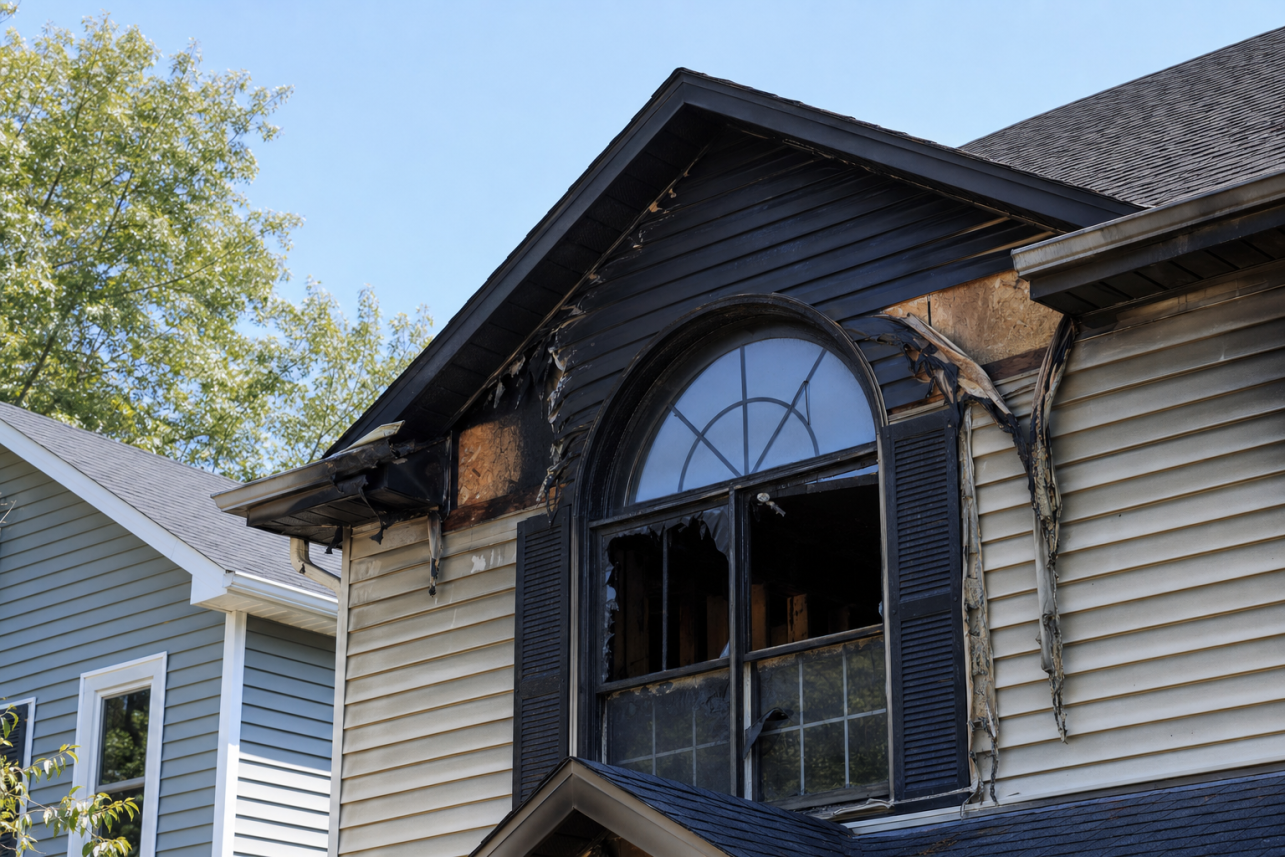
A Smoke Damage Claim Apex homeowner files after a fire is rarely as simple as the insurance company makes it sound, because smoke travels far beyond the burn area and much of the damage hides inside walls, ductwork, and belongings. For The Public Adjusters, Inc. is a licensed and bonded public adjusting firm that works only for you, the policyholder — never the insurer. We inspect, document, and value the full extent of smoke and soot damage, then negotiate directly with your insurance company on your behalf.
What This Service Is
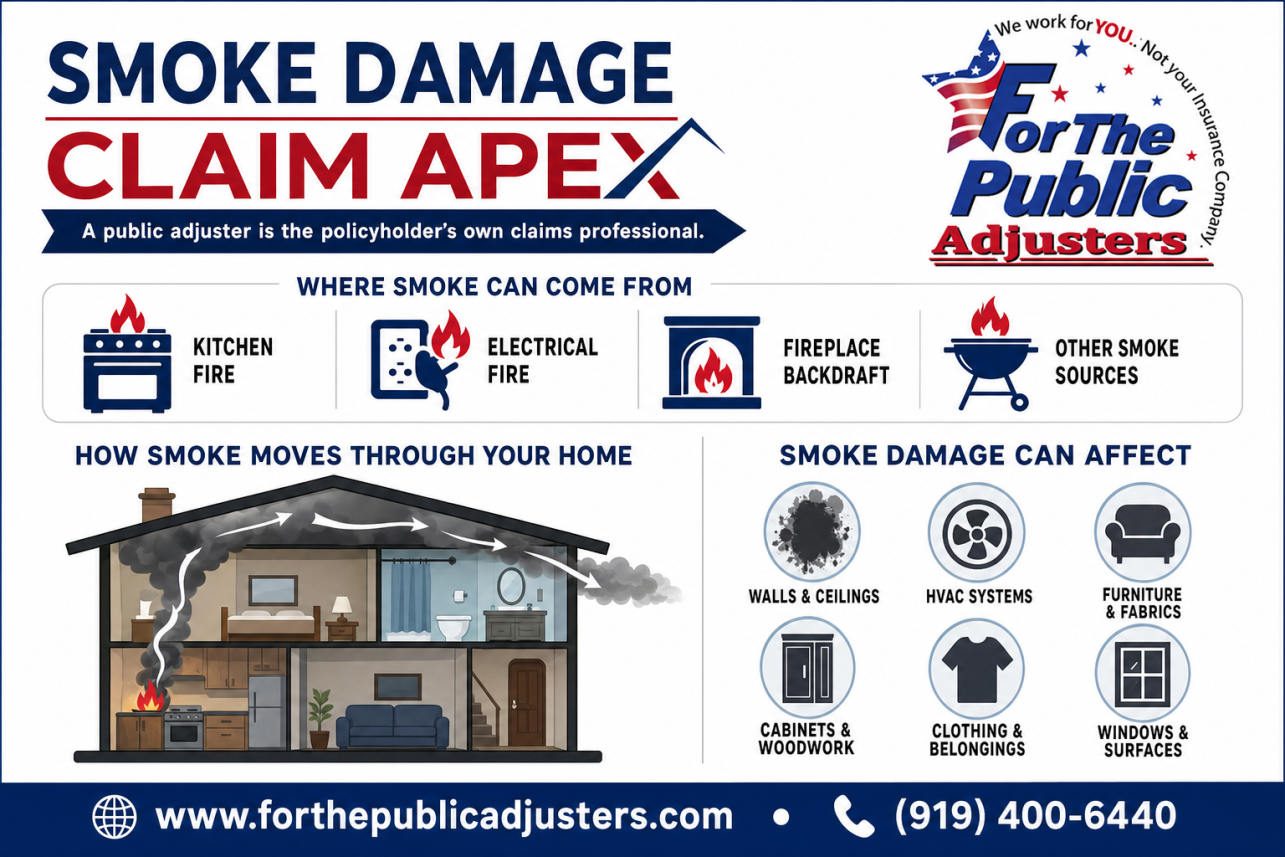
A public adjuster is the policyholder’s own claims professional. When smoke moves through your home — from a kitchen fire, an electrical fire, a fireplace backdraft, or even a neighbor’s fire — the insurance company sends its adjuster to assess the loss. That person works for the insurer. We work for you.
Smoke losses are among the most underpaid claims we see, because so much of the damage isn’t visible from the doorway. Soot residue settles inside cabinets, closets, electronics, and appliances. Odor bonds into drywall, insulation, carpet pad, and clothing. Smoke pulled through your HVAC system coats the ducts and gets redistributed every time the air kicks on.
Our job is to find all of it, document it properly, prepare the proof of loss, and negotiate a settlement that reflects what restoration actually costs — not what a quick walkthrough suggests. We handle the same work across the Triangle, including Smoke Damage Insurance Claim Help in Raleigh, and we often pair smoke claims with related losses like a fire damage claim or the water damage left behind by firefighting.
Common Problems
Will Insurance Pay To Actually Fix This — Or Just Repaint And Deodorize?
This is the number-one cost worry we hear. The insurer’s first estimate often covers a wipe-down, a coat of paint, and an air scrubber for a few days. Real smoke restoration frequently requires removing and replacing porous materials, professionally cleaning or replacing HVAC components, and cleaning or replacing contents item by item.
Your payment also depends on how your policy handles actual cash value versus replacement cost. Actual cash value deducts depreciation — so a smoke-ruined sofa gets valued as a used sofa, not what a new one costs. Many policies pay replacement cost, but only after you actually replace the items, and only if the claim is documented well enough to support it.
We build a room-by-room contents inventory with values, push back on excessive depreciation deductions, and make sure things like additional living expenses — hotel and meal costs if your home isn’t livable — are claimed too. Policy limits matter here, and we read every line of your coverage before we negotiate.
Denied, Delayed, Or Lowballed: When Your Smoke Damage Claim Apex Insurer Pushes Back
Insurers commonly argue that smoke damage is ‘cosmetic,’ that odor doesn’t count as physical damage, or that pre-existing wear explains the discoloration. Others simply slow-walk the file, requesting document after document while your home sits contaminated and your out-of-pocket costs climb.
Policyholders can and do win these fights. In Windridge of Naperville Condominium Association v. Philadelphia Indemnity Insurance Co., a federal appeals court sided with the insured property owner, ruling the insurer had to pay to replace undamaged building siding so repairs would actually match — not just patch the visibly damaged sections. The same principle matters in smoke losses, where insurers try to pay for spot-cleaning when the whole affected area needs uniform restoration.
When a claim stalls or a denial arrives, we re-document the loss, file a formal proof of loss, and negotiate from evidence. We recently outlined the same approach for a Smoke Damage Insurance Claim in Holly Springs, and if a dispute requires legal escalation, we coordinate with insurance dispute lawyers. We never guarantee a specific outcome — no honest adjuster can — but we make sure your claim is presented at full documented value.
Can I Just Handle The Claim Myself?
You can — and for a very small, contained loss, you might be fine. But smoke claims punish do-it-yourselfers in two ways. First, hidden damage: soot inside wall cavities, attic insulation, and duct runs is easy to miss, and once you sign a release, reopening the claim is difficult. Second, valuation: most homeowners have never priced professional soot cleanup, odor sealing, or electronics restoration, so they accept the insurer’s number without knowing it’s low.
The NCDOI Public Adjusters Guide explains what a licensed public adjuster does and confirms that public adjusters in North Carolina must be licensed — which we are, and bonded. That licensing matters: it’s how you separate qualified representation from storm-chasing operators.
A good public adjuster inspects before the insurer does when possible, documents everything with photos and testing, prepares the inventory and estimates, handles every call and letter, and negotiates the settlement. You stay informed; we do the work. That’s what our Smoke Damage Claim Help in Wake Forest clients experience, and Apex homeowners get the same representation.
Our Process
Free Inspection And Full Damage Assessment
We walk your entire property, not just the room where the fire started. That means checking behind appliances, inside HVAC ducts and returns, in attics and crawlspaces, and inside cabinets and closets where soot settles. We also look for secondary water damage from firefighting, which is often left out of the insurer’s estimate entirely.
Documentation, Inventory, And Proof Of Loss
We photograph and record every affected surface and item, build a detailed contents inventory with replacement values, and prepare the formal proof of loss your policy requires. North Carolina claims come with deadlines, and missing one can jeopardize your recovery — we track every date so nothing lapses while you focus on your family.
Negotiation And Settlement
We present the documented claim to your insurance company, respond to their adjuster’s pushback with evidence, and negotiate the settlement on your behalf. If the insurer’s offer doesn’t reflect the documented loss, we keep negotiating — through supplemental claims, re-inspections, and appraisal when appropriate. You approve every step before it happens.
| What Happens | Filing Alone | With For The Public Adjusters |
|---|---|---|
| Damage assessment | Carrier’s visual walkthrough; hidden soot in ducts, wall cavities, and attics often missed | Independent testing — surface wipes, air sampling, and HVAC inspection to prove full scope |
| Contents inventory | Homeowner lists items from memory; smoke-affected soft goods frequently undervalued or excluded | Room-by-room documented inventory with replacement-cost pricing and odor/residue test results |
| Odor as damage | Often dismissed as a ‘nuisance’ rather than physical loss | Documented as direct physical damage, supported by lab data and case law where insureds prevailed |
| Scope of cleaning | Wipe-down and repaint of visible surfaces only | Sealing, odor-blocking primer, duct decontamination, insulation removal where contaminated |
| Negotiation | Policyholder responds to carrier’s estimate with no leverage | Line-by-line rebuttal of the carrier’s estimate by licensed, bonded adjusters working only for you |
Commonly Overlooked In The Public Adjusting Industry
- Soot inside the HVAC system and behind supply registers — Carrier adjusters rarely open ductwork, so the mechanism that spread smoke through the whole house gets left out of the estimate entirely.
- Chloride corrosion on electronics that still power on — Devices that work today can fail months later from acidic residue eating circuit contacts, and by then the claim is closed.
- The difference between protein, synthetic, and natural smoke residues — Each type requires different cleaning chemistry, and treating protein smoke like ordinary soot is why odor keeps returning after a ‘completed’ cleaning.
- Odor documented as direct physical loss, not a nuisance — Insurers often minimize smell as subjective, even though courts like the one in Farmers Insurance Co. of Oregon v. Trutanich sided with the insured in treating pervasive odor as physical damage.
- Contaminated attic insulation above the fire area — Nobody climbs into the attic during a quick walkthrough, yet insulation soaks up smoke compounds and can re-contaminate the home through air movement.
- Photographing and inventorying spoiled food, medicine, and cosmetics before disposal — Homeowners understandably throw contaminated consumables away immediately, destroying the proof needed to get paid for them.
- Additional living expense entitlements during odor remediation — Families assume they must stay in a smoke-filled house while it’s treated, when the policy may owe temporary housing until clearance testing passes.
- Final clearance testing before signing off on repairs — Without lab-verified clearance, a claim can close while residue remains, leaving the policyholder to pay for the second round of remediation themselves.
Case Studies
Case Study #1
Situation: A family in the Scotts Mill neighborhood of Apex had a kitchen fire that was extinguished within minutes. The flames were contained to the stove area, but smoke traveled through the return-air ducts into every room of the two-story home.
Problem: The carrier’s adjuster wrote an estimate for repainting the kitchen and cleaning visible soot in adjacent rooms, totaling just under $9,400. The homeowners could still smell smoke upstairs weeks later, and their children’s clothing and bedding carried the odor even after laundering.
Investigation: We brought in an independent industrial hygienist to take surface wipe samples and air samples throughout the home. We also opened the HVAC system, inspected wall cavities above the fire origin, and tested soft contents room by room rather than accepting a visual-only assessment.
Findings: Lab results confirmed soot and char particulate in the ductwork, inside upstairs closets, and within insulation above the kitchen ceiling. Protein and synthetic smoke residues had bonded to painted surfaces upstairs, which is why odor kept returning after basic cleaning. Roughly 60 percent of soft contents failed odor and residue testing.
Solution: We prepared a revised scope that included full duct cleaning and partial replacement, sealing and repainting of affected surfaces with odor-blocking primer, removal of contaminated insulation, thermal fogging and hydroxyl treatment, and a properly documented contents inventory with replacement-cost pricing.
Outcome: After we presented the lab data and the corrected scope, the claim settled at a figure more than five times the original estimate, and the family’s home passed a final clearance test with no detectable smoke odor.
Lesson: Smoke residue that you can smell but cannot see is still physical damage. Courts have recognized this principle — in Farmers Insurance Co. of Oregon v. Trutanich (1993), the Oregon Court of Appeals ruled in favor of a homeowner, holding that a persistent odor that permeated a house was direct physical damage the policy had to cover. Visual inspections alone routinely miss the true scope.
Case Study #2
Situation: The owner of a small professional office building near downtown Apex suffered smoke intrusion when a fire broke out in the neighboring suite. His own unit never burned, but smoke migrated through shared attic space and the common HVAC system overnight before the fire was discovered.
Problem: The insurance company initially took the position that because there was no fire in his suite, the loss was minimal — an odor issue, not property damage. They offered a small cleaning allowance and declined to address electronics, acoustic ceiling tiles, or business contents.
Investigation: We documented soot tracking patterns above the drop ceiling, had the electronics evaluated by a restoration electronics specialist for corrosive chloride residue, and gathered lab confirmation that acidic smoke residue had settled on wiring, office furniture, and inventory of paper records.
Findings: The chloride residue on circuit boards was actively corroding contacts, meaning computers and phone systems faced progressive failure. Ceiling tiles and fiberglass insulation had absorbed odor compounds that could not be cleaned economically. Smoke had also penetrated files and upholstered furnishings throughout the suite.
Solution: We built a claim package covering electronics restoration and replacement where restoration failed cost tests, full tear-out of contaminated ceiling and insulation, HVAC decontamination, contents cleaning with itemized documentation, and business income for the period the office could not safely operate.
Outcome: The carrier reversed its position and paid for the full remediation scope plus lost income during the closure. The owner reopened with restored equipment and a clearance letter he could show his tenants and clients.
Lesson: Contamination is damage even when nothing in your unit burned. In Western Fire Insurance Co. v. First Presbyterian Church (Colo. 1968), the court sided with the insured, holding that a building rendered unusable by vapor contamination had sustained a direct physical loss. The same logic applies when smoke from a neighboring fire makes your space unsafe or unusable.
| Item or Material | Often Restorable | Usually Needs Replacement | What It Depends On |
|---|---|---|---|
| Painted walls and ceilings | Light soot film on sealed paint | Heavy protein or synthetic residue that bleeds through | Whether odor-blocking primer and repaint can pass a smell test after cleaning |
| HVAC ductwork | Sheet metal ducts after professional decontamination | Flex duct and internal duct liner that absorbed soot | Porosity of the duct material and how long the system ran during the fire |
| Attic and wall insulation | Rarely | Fiberglass or cellulose exposed to smoke | Insulation traps odor compounds and cannot be effectively cleaned |
| Electronics | Units treated quickly by a restoration specialist | Anything showing chloride corrosion on boards | Acidic smoke residue corrodes contacts over time, so speed of testing matters |
| Clothing and bedding | Items that pass odor testing after ozone or specialty laundering | Items that fail testing after two cleaning attempts | Type of smoke — protein smoke bonds to fibers far more stubbornly |
| Upholstered furniture and mattresses | Occasionally, with deep extraction cleaning | Most items with direct smoke exposure | Foam and padding absorb odor that surface cleaning cannot reach |
| Solid wood furniture | Sealed hardwood pieces | Unfinished or raw wood surfaces | Whether the finish kept residue on the surface or the wood absorbed it |
| Food, medicine, cosmetics | Never — do not attempt to salvage | All exposed items | Smoke contamination makes consumables unsafe regardless of appearance; document before disposal |
Reviews
Our insurance company told us a kitchen fire only needed a repaint and a cleaning crew. For The Public Adjusters brought in an actual hygienist who found soot in our ducts and attic insulation that the carrier’s adjuster never even looked at. The final settlement covered everything, including our kids’ bedding and clothes that never lost the smell no matter how many times we washed them. Night and day difference.
Denise R., Apex
Fire two doors down filled my townhome with smoke through the shared attic. The carrier called it a ‘minor odor issue.’ This team documented the residue on my electronics and walls with lab testing and turned a lowball cleaning offer into a real settlement that paid for proper remediation. They handled every call with the insurance company so I didn’t have to argue with anyone.
Marcus T., Wake County
I had no idea protein smoke from a stovetop fire was even a thing until it yellowed our cabinets and the odor kept coming back. For The Public Adjusters knew exactly what testing to order and what the policy actually owed us. The process took a couple of months, but they kept us informed the whole way and the outcome was far better than what we were offered on our own.
Priya S., Apex
Frequently Asked Questions
How Does A Smoke Damage Claim Apex Homeowner Files Actually Get Handled By A Public Adjuster?
When you bring a Smoke Damage Claim Apex property owners often assume is straightforward to For The Public Adjusters, Inc., the first thing we do is a full, independent inspection — not just of the burn area, but of every room, closet, attic space, and HVAC run where smoke and soot travel.
Smoke residue is acidic and keeps corroding metals, electronics, and finishes for weeks after the fire is out. We document all of it with photos, moisture and residue readings, and detailed room-by-room inventories before anything gets cleaned or discarded.
From there, we review your homeowner’s or commercial policy line by line: dwelling coverage, contents, additional living expenses, and any ordinance-or-law provisions that apply to older Apex homes near downtown or in established neighborhoods like Scotts Mill and Haddon Hall. We prepare a complete estimate using the same pricing software carriers use, then present and negotiate the claim directly with the insurance company’s adjuster.
You stay informed at every step, but you’re no longer the one arguing with the carrier. We are licensed and bonded, and we work only for policyholders — never for insurance companies.
One honest note: no adjuster can promise a specific dollar outcome, and you should be wary of anyone who does. What we can promise is that every item of damage — visible and hidden — is documented, valued, and presented so the insurer has to respond to the full scope of your loss, not just the obvious char marks.
My Fire Was Small, But The Smoke Smell Won’t Go Away. Is That Really Covered Under My Policy?
In most cases, yes. Smoke and soot contamination is typically a covered peril under standard homeowner’s policies, even when the flames were contained to one room or a neighboring unit. The problem is that carriers often scope these losses far too narrowly.
A kitchen fire in an Apex home can push soot through the return-air ducts into every bedroom. Protein smoke from burnt food is nearly invisible but bonds to painted surfaces and cabinetry, and the odor returns every humid North Carolina summer if it isn’t professionally remediated. Synthetic smoke from burning plastics leaves corrosive residue on electronics, appliances, and HVAC coils.
We frequently see initial insurer estimates that pay to repaint one room when the honest answer is sealing and repainting several, replacing insulation, cleaning or replacing ductwork, and running a full contents cleaning or replacement analysis. Clothing, upholstered furniture, mattresses, and children’s items often can’t be reliably deodorized and should be claimed as losses, not “cleaned.”
Our job as your Apex public adjuster is to prove that scope. We use residue sampling, chamber testing on contents when needed, and detailed documentation so the carrier can’t dismiss lingering odor as a maintenance issue.
If you’ve already received a settlement offer that only covers surface cleaning and the smell persists, the claim likely isn’t closed the way you think it is. Supplemental claims are common in smoke losses, and we handle those regularly for Wake County homeowners.
What If My Insurance Company Denies Or Lowballs My Smoke Damage Claim — Do Policyholders Ever Win Against Insurers?
They do, and the case law proves it. A good example is Mosley v. Pacific Specialty Insurance Co. (2020), decided by the California Court of Appeal. The Mosleys’ rental house was severely damaged by a fire, and the insurer denied the claim outright. The trial court initially sided with the insurance company, but the appellate court reversed, holding the denial couldn’t stand and sending the case back — a clear win for the policyholders on a fire loss to their home.
Courts have repeatedly held that insurers must honor the actual language of the policy rather than their own restrictive interpretation of it. That principle matters enormously in smoke losses, where carriers often try to distinguish “direct fire damage” from smoke, soot, and odor contamination in ways the policy language doesn’t support.
That said, litigation should be a last resort, and most disputes never need to get that far. As your public adjuster in Apex, our first move is building a claim file the carrier can’t reasonably reject: independent testing, a complete Xactimate estimate, a documented contents inventory, and written correspondence that creates a clear record.
If the insurer still refuses to pay fairly, that same file becomes powerful evidence for appraisal — a dispute-resolution process built into most North Carolina policies — or for an attorney if it comes to that. We can’t guarantee any particular result, but a thoroughly documented claim changes the negotiation from your word against theirs to evidence against an underpaid estimate.
How Much Does Hiring For The Public Adjusters, Inc. Cost, And How Long Do These Claims Take In Wake County?
We work on a contingency fee, meaning our fee is a percentage of the insurance settlement. There are no upfront costs, no hourly billing, and if there’s no recovery, you owe us nothing. The exact percentage is spelled out in writing before we start, so there are never surprises.
Timelines vary with the size of the loss. A moderate smoke loss in an Apex home — say, a garage or kitchen fire with soot migration through the house — often resolves in roughly 60 to 120 days once we submit the full claim package. Larger losses involving structural repairs, extensive contents inventories, or additional living expense claims while you’re displaced can run longer, particularly if the carrier disputes scope and we move to the appraisal process.
What we can’t do is promise a specific dollar amount or a specific closing date; anyone who guarantees results in this business isn’t being straight with you. What we can control is the quality and completeness of the claim, which is the single biggest factor in both the size and speed of the settlement.
One more thing worth knowing: we handle property claims only — homes, commercial buildings, and their contents. We don’t take claims involving vehicles, cell phones, health, or life insurance. And if your loss also involves flooding, that’s typically covered under a separate flood policy through the National Flood Insurance Program, so resources like FEMA.gov and FloodSmart.gov are worth reviewing alongside your smoke claim.
What Should I Document Before Cleaning Up After A Smoke Damage Claim Apex Homeowners Typically File?
Document everything before you touch anything. Photograph every room, even ones that look untouched, because smoke migrates through HVAC systems and wall cavities in ways that show up weeks later. In Apex homes with open floor plans and shared ductwork, soot from a kitchen fire routinely settles in upstairs bedrooms and closets.
Take wide shots of each wall and ceiling, then close-ups of soot webs in corners, discolored outlets, and residue on window sills. Wipe a white cloth across a surface and photograph the result — that simple test often proves contamination the insurer’s adjuster missed. Open cabinets, drawers, and the attic access, and photograph inside all of them.
Inventory your contents room by room. Clothing, upholstered furniture, mattresses, books, and lamp shades absorb smoke residue and odor, and many cannot be fully restored. Note brand, age, and approximate replacement cost where you can.
Keep every receipt for emergency expenses: hotel stays, meals, air scrubbers, and any cleaning you pay for out of pocket. Additional living expense coverage typically reimburses these, but only with documentation.
What you should not do is let a restoration company start aggressive cleaning before the loss is fully documented and measured. Once surfaces are wiped down, the evidence is gone, and disputes over scope become much harder to win. Our team at For The Public Adjusters, Inc. prefers to inspect and test before cleanup begins, so the full extent of the loss is on record from day one.
My Insurer Says Smoke Odor Isn’t ‘physical Damage.’ Is That Actually True?
No, and courts have rejected that argument directly. In Farmers Insurance Co. of Oregon v. Trutanich, 858 P.2d 1332 (Or. Ct. App. 1993), a homeowner’s house was permeated by a persistent odor, and the insurer argued there was no covered physical loss because nothing was visibly broken. The court disagreed and held that a pervasive odor that damages the house constitutes direct physical loss to the property — and the insured won, including the cost of professionally removing the odor.
That reasoning matters for every smoke loss in Apex. Smoke residue is made of acidic particulates and volatile compounds that bond to drywall, insulation, ductwork, and framing. It corrodes metal finishes, etches glass, and continues off-gassing long after visible soot is wiped away. That is physical alteration of the property, not a cosmetic complaint.
Insurers sometimes offer a light ‘wipe and paint’ scope and call the job done. In older homes off Salem Street or newer builds near Bella Casa, we regularly find that odor returns within weeks when duct cleaning, sealing, or insulation replacement was left out of the estimate.
As licensed and bonded public adjusters, we build the case with testing, moisture and residue readings, and a detailed line-item scope so the carrier has to respond to evidence, not opinion. We can never guarantee a specific outcome, but a properly documented odor and residue claim stands on far stronger legal and factual ground than most policyholders realize.
A Fire At A Neighboring Property Filled My House With Smoke. Can I File A Claim On My Own Policy?
Yes. Your homeowner’s policy covers smoke as a named peril in most standard forms, and it does not matter that the fire started next door. If smoke from a neighboring townhome, garage, or brush fire infiltrated your property, you file under your own policy first — that is exactly what it exists for.
This comes up more than people expect in Wake County. Townhome communities around Apex have shared walls and tight lot lines, so a fire two doors down can push smoke through soffits, attic vents, and shared attic spaces. Your unit may look fine at eye level while the attic insulation and ductwork are saturated with soot and odor.
A Smoke Damage Claim Apex residents file in this situation is often underestimated by the carrier precisely because there is no burned structure to point at. The visible damage is minimal, so the first offer tends to cover surface cleaning only. The real cost sits in HVAC decontamination, insulation replacement, sealing, and contents restoration.
Your insurer may later pursue the responsible party’s carrier through subrogation to recover what it paid, but that is their process and it should not delay or reduce your settlement.
Our job at For The Public Adjusters, Inc. is to inspect the hidden areas, test for residue, inventory affected contents, and present a complete claim to your carrier. We handle the documentation and negotiation so the scope reflects what actually happened to your home, not just what is visible from the front door.

Which Of My Belongings Are Covered Under A Smoke Damage Claim, And How Are They Valued?
Your personal property coverage — usually Coverage C on a homeowner’s policy — applies to contents damaged by smoke, and the list is longer than most Apex homeowners expect. Clothing, bedding, curtains, rugs, upholstered furniture, books, artwork, toys, and pantry food exposed to smoke are all potentially claimable. Porous and soft goods absorb odor and acidic residue that professional cleaning cannot always remove.
Valuation depends on your policy. Replacement cost coverage pays what it costs to buy the item new today, often in two steps: actual cash value first, then the recoverable depreciation after you replace the item. Actual cash value policies pay the depreciated amount only. Reading those provisions correctly can change a contents settlement significantly, which is one reason a detailed, itemized inventory matters so much.
Carriers frequently push ‘clean and deodorize’ pricing on items that restoration vendors quietly acknowledge cannot be saved — think leather furniture, mattresses, or children’s stuffed animals. If an item cannot be restored to its pre-loss condition, you are generally entitled to replacement under the policy terms, not a cleaning fee.
One note on our scope: we handle claims for homes, buildings, and their contents. We do not handle claims involving motor vehicles, health, or life insurance.
When For The Public Adjusters, Inc. works a contents loss in Apex, we build the inventory room by room with photographs, condition notes, and replacement pricing, then negotiate each disputed line. No outcome can be promised, but a thorough inventory consistently changes the conversation with the carrier.
Can Hidden Smoke Residue In My HVAC System And Wall Cavities Be Included In A Smoke Damage Claim Apex Residents File?
Yes, and this is one of the most commonly missed items we see when reviewing settled claims in Wake County. Smoke follows airflow, which means your ductwork often acts like a highway carrying soot into every room — including areas the fire never touched.
When we inspect a home in Apex after a fire, we test inside supply and return ducts, behind outlet covers, above drop ceilings, and inside insulation. Acidic soot residue in these spaces continues to corrode metal, etch finishes, and re-release odor every time the system runs. An insurer’s quick visual walkthrough rarely accounts for any of it.
A proper estimate should include duct cleaning or replacement where contamination is confirmed, sealing or replacing affected insulation, and treating framing inside wall cavities where residue is documented. In many of the newer Apex subdivisions with tightly sealed, energy-efficient construction, smoke actually lingers longer because there is less natural air exchange — which strengthens the argument for thorough remediation.
Courts have long recognized that contamination you cannot see is still physical damage. In Western Fire Insurance Co. v. First Presbyterian Church, 437 P.2d 52 (Colo. 1968), the insured church won when the court held that gasoline vapors that penetrated the building and made it unusable constituted direct physical loss, even without visible structural harm. The same logic supports paying for smoke infiltration inside mechanical systems and concealed spaces.
Before accepting any settlement, make sure someone has actually opened up and tested these hidden areas. Once you cash a check based on surface cleaning alone, recovering money later becomes much harder.
The Insurance Company Sent Its Own Cleaning Company To My House. Do I Have To Use Their Vendor?
No. In North Carolina, you have the right to choose your own contractors and restoration professionals. Insurer-preferred vendors work under pricing agreements with the carrier, and their scope of work is often written to match the insurer’s budget rather than what your home actually needs.
That matters enormously with smoke and soot. A vendor motivated to keep costs down may wipe surfaces and run an ozone machine, then declare the job complete. Weeks later — usually on the first humid Apex summer day — the odor returns because residue inside insulation, ducts, or subflooring was never addressed. By then, the claim may already be closed.
As your public adjuster, we prepare an independent scope of loss before any vendor locks in a cheaper one. That scope documents soot testing results, identifies which materials can be cleaned versus which must be replaced, and prices the work at real local market rates rather than negotiated carrier rates.
You can absolutely let the insurer’s vendor perform emergency mitigation — boarding up, tarping, initial air scrubbing — since prompt mitigation is your duty under the policy. Just do not sign anything authorizing full restoration or agreeing to a final scope until you understand the complete extent of the damage.
For The Public Adjusters, Inc. is licensed and bonded, and we work only for you, never the carrier. Our job is to make sure the scope reflects your loss, not the vendor’s contract terms. While we can never promise a specific outcome, an independent, well-documented scope consistently puts policyholders in a far stronger negotiating position.
Are There Deadlines I Need To Worry About When Filing A Smoke Damage Claim In North Carolina?
Yes, several — and missing them can seriously hurt or even bar your recovery, so this deserves your attention early.
First, your policy requires ‘prompt notice’ of the loss. Report the smoke damage to your carrier as soon as reasonably possible, even if you have not yet assessed the full extent. Waiting weeks gives the insurer room to argue that delay prejudiced its investigation.
Second, most homeowner policies require a signed, sworn Proof of Loss, often within 60 days of the insurer’s written request. This document states the amount you are claiming under oath, so submitting a rushed or incomplete figure can lock you into a low number. This is one of the most valuable places a public adjuster in Apex earns their fee — we compile the full inventory, testing results, and repair estimates before that sworn statement goes in.
Third, North Carolina policies typically contain a contractual limitation period for filing suit against the carrier, commonly three years from the date of loss under the standard fire policy provisions. Supplemental claims for damage discovered later — like odor returning after initial cleaning — should be opened well before any deadline approaches.
Finally, replacement cost policies usually require you to actually complete repairs or replace contents within a set window, often 180 days to two years, to recover the depreciation holdback.
If your loss happened months ago and you are only now realizing the settlement was inadequate, do not assume it is too late. Many Wake County claims can be reopened or supplemented, and we can review your timeline at no obligation.
My Home Is Uninhabitable From Smoke. Does A Smoke Damage Claim Apex Policyholders File Cover Hotel Costs And Extra Living Expenses?
In most cases, yes. Nearly every homeowner policy includes Additional Living Expense coverage, often called ALE or Loss of Use. If smoke contamination makes your home unfit to live in — because of health concerns, ongoing remediation, or unbearable odor — ALE pays the reasonable increase in your living costs while repairs are completed.
That can include a hotel or short-term rental comparable to your home, restaurant meals above your normal grocery spending, pet boarding, additional commuting mileage, and even laundry costs if your machines are out of service. The key word is ‘increase’ — you are reimbursed for the difference between your normal expenses and what displacement actually costs you.
Here is where Apex families frequently get shortchanged: adjusters sometimes declare a smoke-damaged home ‘habitable’ prematurely, cutting off ALE while soot residue and odor still pose real problems, especially for children, elderly residents, or anyone with asthma or respiratory sensitivity. Documented air quality testing and a contractor’s remediation timeline are powerful tools for keeping that coverage in place until the home is genuinely livable again.
Keep every receipt from day one — hotels, meals, mileage, storage units, everything. We organize those expenses into a running ALE ledger and submit them on a schedule so you are reimbursed as you go rather than floating thousands of dollars for months.
Rental comparables around Apex and the greater Triangle can be expensive, and carriers sometimes propose housing that is not truly comparable to what you lost. Part of our role is documenting what a fair equivalent actually costs in this market.
What Kind Of Testing Proves Smoke And Soot Damage That Isn’t Visible To The Naked Eye?
This is one of the most common battlegrounds we see with Apex homeowners. After a fire, the insurance company’s adjuster walks through, sees clean-looking walls, and declares the damage minimal. Meanwhile, the home still smells like a campfire and residents are dealing with headaches or irritated eyes.
Professional testing settles the argument. We coordinate industrial hygienists who take wipe samples, tape lifts, and air samples throughout the property. Those samples go to an independent laboratory that identifies char fragments, soot particles, and combustion byproducts under a microscope — evidence that’s hard for an insurer to wave away.
Chloride testing is another important tool, especially for electronics, appliances, and HVAC components. Certain fires release corrosive chlorides that quietly eat away at circuit boards and metal contacts for months after the loss. A chloride swab test can show contamination on items the carrier initially refused to include.
We also use particle counters and inspect concealed areas — attic insulation, wall cavities, ductwork, and crawl spaces common in Wake County construction — because smoke travels through pressure differentials and settles far from the fire’s origin.
The key is having this testing done before major cleanup, and having it interpreted by someone working for you rather than the insurance company. As your public adjuster in Apex, we build the file so the scope of damage rests on lab data and documented findings, not on a five-minute visual walkthrough.
Is Exterior Smoke And Soot Damage To My Siding, Roof Shingles, Or Windows Covered Too?
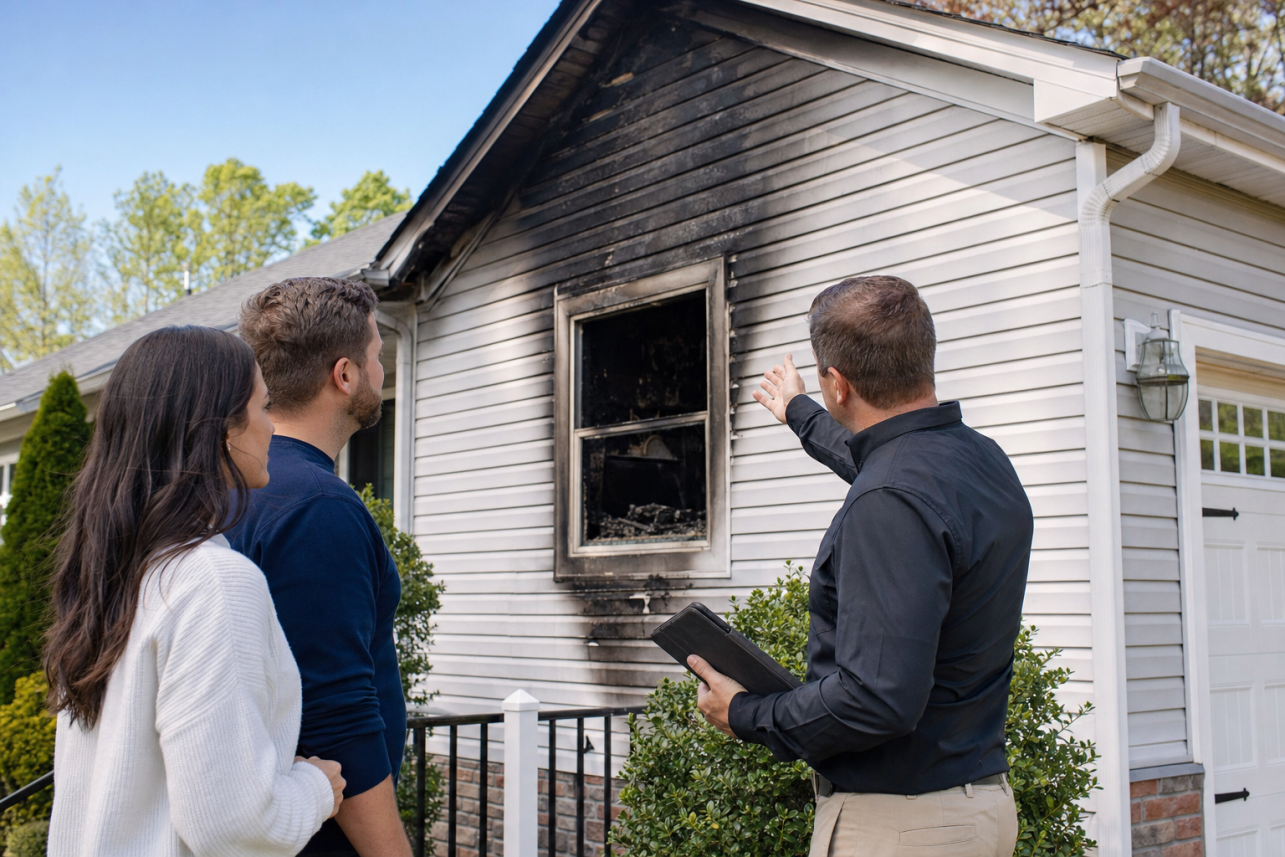
Usually yes, and it’s routinely overlooked. When a fire produces heavy smoke — whether from your own structure, an attached garage, or a nearby property — soot doesn’t stop at the front door. It settles on vinyl siding, brick, roof shingles, gutters, window frames, and outdoor HVAC condensers.
Soot is acidic. Left on vinyl siding, it can etch and permanently discolor the surface so that no amount of pressure washing restores it. On asphalt shingles, soot and heat exposure can degrade the protective granules and shorten the roof’s life. Aluminum and painted metal fixtures can pit and corrode. These are physical damages to covered property, and they belong in the claim.
The problem is that carrier adjusters often photograph the interior, write an estimate for cleaning and repainting a few rooms, and never walk the exterior with a critical eye. In Apex neighborhoods where homes sit close together, we’ve seen soot fallout on properties several lots away from the fire itself.
When our team inspects, we document the exterior methodically: close-up photos of etching and staining, wipe tests on siding, and evaluation of the outdoor condenser coil, which acts like a filter and traps smoke residue. If cleaning can’t restore a surface to its pre-loss condition, we push for replacement rather than a cosmetic wipe-down.
Every policy differs, and no adjuster can promise a particular outcome — but exterior damage should never be left off the estimate simply because nobody looked for it.
Can A Smoke Damage Claim Apex Homeowners Already Settled Be Reopened If The Payout Was Too Low?
In many cases, yes. Accepting a payment from your insurance company does not automatically close the door, and homeowners are often surprised to learn this. Most payments are for the undisputed portion of the loss — cashing that check generally doesn’t waive your right to pursue more, unless you signed a specific release.
The mechanism is called a supplemental claim. If cleaning didn’t remove the odor, if soot keeps reappearing on surfaces, if contractors found contamination inside walls or ductwork that the original estimate missed, or if damaged contents were undervalued, those items can be presented to the carrier with supporting documentation.
Timing matters. In North Carolina, the statute of limitations for most property insurance disputes is three years from the date of loss, and some policies contain their own suit-limitation clauses — sometimes shorter — so it pays to act promptly rather than sit on an underpayment. Your policy may also require repairs to be completed within a set window to recover depreciation that was withheld from the first payment.
When Wake County homeowners bring us a settled-but-inadequate file, we start by comparing the carrier’s estimate against the actual condition of the home. Line by line, we identify what was missed: HVAC decontamination, sealing and encapsulation, contents inventory gaps, additional living expenses that were cut short.
We’re licensed and bonded, and we work on these reopened files the same way we work new ones — building evidence the carrier can’t easily dismiss. We can’t guarantee a specific result, but an underpaid claim reviewed by a professional often looks very different the second time around.

Have Courts Actually Ruled That Smoke And Odor Count As Real Physical Damage To A Building?
Yes — and these rulings are useful leverage when an insurer tries to treat lingering smoke as a mere nuisance. Two decisions come up often in this fight.
In Farmers Insurance Co. of Oregon v. Trutanich, 858 P.2d 1332 (Or. Ct. App. 1993), a homeowner’s property was permeated with a persistent odor, and the insurer argued it wasn’t covered physical damage. The court sided with the insured, holding that odor that infiltrates a house and requires professional remediation is physical damage to the property — and the insured recovered the cost of removing it.
Even earlier, in Western Fire Insurance Co. v. First Presbyterian Church, 437 P.2d 52 (Colo. 1968), a church building was saturated with gasoline vapors that made it unusable. The Colorado Supreme Court ruled for the policyholder, finding that contamination rendering a building uninhabitable constitutes direct physical loss even without visible structural harm.
Why does this matter in Apex? Because the same argument gets recycled here: the carrier says your home ‘just smells’ and offers an air freshener-level solution. Courts have repeatedly recognized that absorbed combustion residue in drywall, insulation, and framing is genuine damage requiring genuine remediation.
When For The Public Adjusters, Inc. handles a Smoke Damage Claim Apex property owners bring to us, we document contamination the way these cases teach — with testing, expert findings, and a remediation scope tied to the evidence. While no one can promise what any carrier will pay, well-established case law makes it much harder for an insurer to pretend smoke saturation isn’t real damage.
Local Relevance
Apex has grown fast, and that shows in its housing: charming older homes near the historic downtown sit alongside large waves of 1990s-to-recent construction across town. Both create smoke-claim complications. Older homes have plaster, original woodwork, and layered finishes that absorb odor deeply, while newer open-floor-plan builds let smoke from a single kitchen fire spread through the entire main level in minutes.
Cooking fires remain the leading cause of home fires nationally according to the National Fire Protection Association, and busy Apex households are no exception. Central air is nearly universal here, so smoke routinely gets pulled into ductwork and pushed into rooms far from the fire — damage insurers frequently undervalue.
We represent policyholders throughout Wake County and the wider Triangle. Homeowners can also find our Smoke Damage Insurance Claim Help in Garner, and we serve neighboring communities as a Public Adjuster in Durham NC as well. Wherever the loss happens, the approach is the same: document everything, claim everything, and negotiate from strength.
Because nearly every Apex home relies on central air conditioning to handle the region’s long, humid summers, smoke from even a small fire tends to circulate through the ductwork — and that same humidity can reactivate soot odor months later if the HVAC system and porous materials weren’t properly cleaned and claimed the first time.
Get A Free Smoke Damage Inspection In Apex
Before you accept the insurance company’s number, let a licensed and bonded public adjuster show you what your loss is actually worth. For The Public Adjusters, Inc. inspects your home at no cost, explains your coverage in plain language, and only gets paid if you recover. Serving Apex and all of Wake County.
Call us: (919) 400-6440
Helpful Resources
- NCDOI Public Adjusters Guide
- National Fire Protection Association (NFPA)
- North Carolina Department of Insurance consumer resources — State regulator’s guidance for policyholders
- NFPA home fire safety information — Nonprofit fire-safety education resource
Last updated: September 24, 2026