
If you need help with a Residential Homeowners Claim Garner NC, For The Public Adjusters, Inc. works for you — the policyholder — not the insurance company. We are licensed and bonded, and we handle the inspection, documentation, and negotiation for roof, water, fire, smoke, and storm losses on Garner homes. You pay nothing to find out where your claim stands, and we only get involved if it makes financial sense for you.
What This Service Is
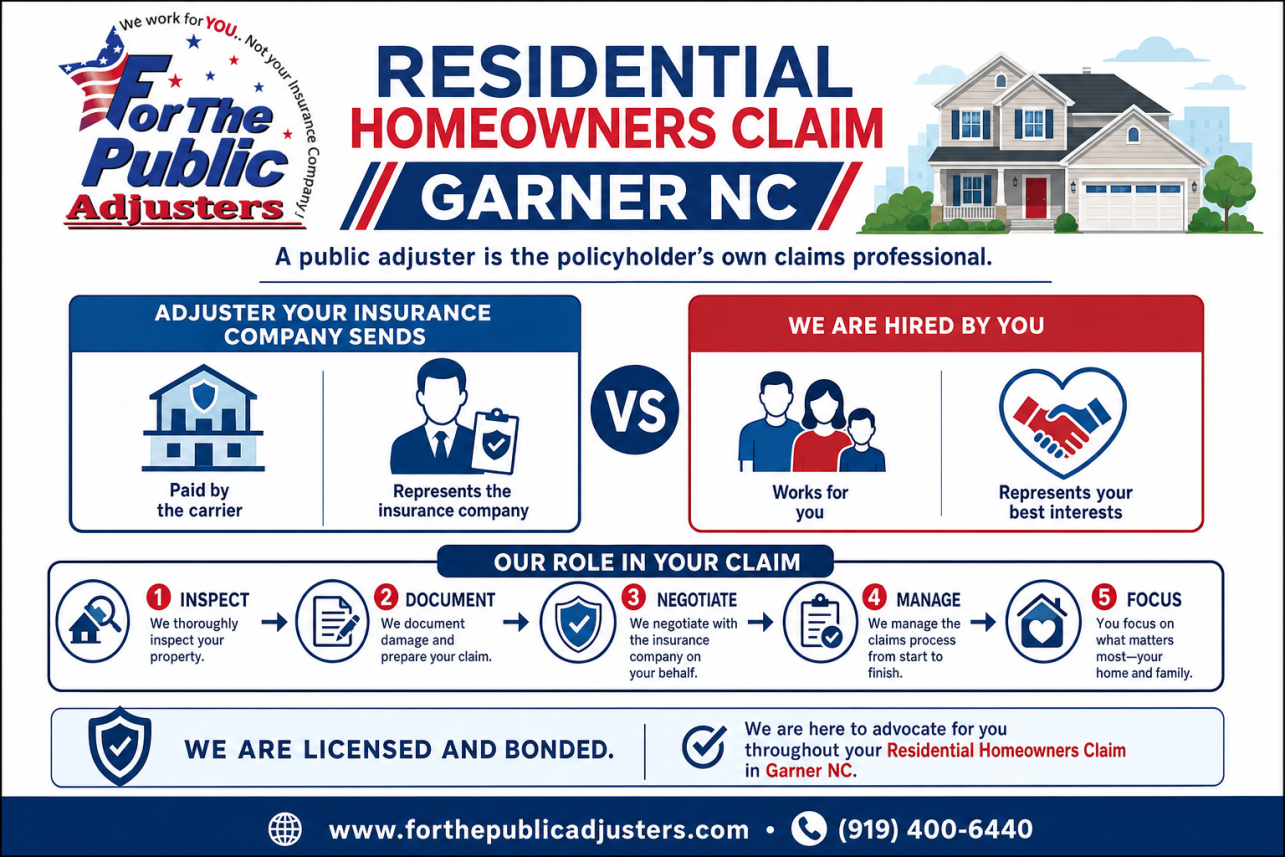
A public adjuster is the policyholder's own claims professional. The adjuster your insurance company sends is paid by the carrier; we are hired by you, and our job is to read your policy, measure the full scope of damage, and present a documented claim the insurer has to take seriously.
For Garner homeowners, that usually means roof damage after hail or tornado-strength wind, water damage from burst pipes or roof leaks, and fire and smoke losses that reach far beyond the room where the fire started. It also means catching the things carriers quietly leave out — matching discontinued shingles, hidden moisture behind walls, smoke residue in HVAC systems, and the cost of living elsewhere while repairs are done.
The North Carolina Department of Insurance explains in its NCDOI Public Adjusters Guide that public adjusters must be licensed by the state and work exclusively for the insured, never the insurer. We hold that license, we carry the required bond, and we do this work across Wake County — from Garner to a Residential Homeowners Claim in Cary on the other side of the county.
Common Problems
Why Is The Insurance Company's Check So Much Smaller Than My Contractor's Repair Estimate?
This is the most common call we get. The carrier's estimate often uses lower labor rates, skips tear-out and haul-away, and deducts depreciation — paying you the "actual cash value" of a fifteen-year-old roof instead of the replacement cost your policy may actually owe.
After your deductible comes off the top, that first check can leave you thousands short of what a real contractor will charge. Many of those deductions are recoverable once the work is done, but only if someone tracks them and demands them. We rebuild the estimate line by line so the settlement reflects what repairs cost in Wake County today, not a software default.
What Can I Do When My Residential Homeowners Claim Garner NC Is Delayed, Underpaid, Or Denied?
A denial letter is not the end of the road. You have the right to dispute the carrier's decision, submit new evidence, demand a re-inspection, and file a supplemental claim when hidden damage surfaces mid-repair. There are also deadlines in your policy for filing and for submitting proof of loss, so waiting is the one move that genuinely hurts you.
Courts have held insurers accountable for mishandling property claims. In Bi-Economy Market v. Harleysville, New York's highest court ruled that a policyholder whose building burned could pursue consequential damages after the insurer delayed and underpaid the fire claim — a reminder that carriers have a legal duty to handle your claim in good faith.
We build the paper trail that makes a dispute winnable: dated photos, moisture readings, weather records, and a sworn proof of loss. The same approach applies to unusual losses too, like a Car Hits Home Claim Garner NC, where structural damage is routinely underestimated on the first inspection.
Should I Handle The Claim Myself, Or Is Hiring A Garner Public Adjuster Worth It?
For a small, clearly covered loss, you may do fine on your own. But if the damage is significant, the carrier is disputing cause, or the first offer will not cover the actual repairs, you are negotiating against trained professionals with no one trained on your side.
When you compare public adjusters, check the state license, ask whether they are bonded, and ask who actually inspects your home. We cannot guarantee any specific outcome — no honest adjuster can — but we can guarantee your claim is documented, valued, and argued by someone whose fee depends on your recovery, not the carrier's savings. People searching for home insurance claim help near me are usually one bad carrier letter away from needing exactly that.
Our Process
Free Policy Review And Damage Walkthrough
We start by reading your actual policy — coverage limits, deductibles, replacement-cost language, and additional living expenses coverage if your home is unlivable. Then we walk the property and assess the damage ourselves, including the attic, crawlspace, and roof areas the carrier's adjuster often skips. If the claim is not worth pursuing, we tell you plainly.
Documentation And Proof Of Loss
Next we build the file: photographs, measurements, moisture mapping for water losses, storm-date verification for roof damage, and a room-by-room contents inventory for fire and smoke claims. We prepare the sworn proof of loss your policy requires and submit it on time, because a missed deadline can sink an otherwise valid claim.
Negotiation, Re-Inspection, And Settlement
We present the full claim to your carrier, attend the re-inspection, and negotiate every disputed line — including recoverable depreciation and supplemental damage found during repairs. If your mortgage lender must endorse the settlement check, we help manage that process too. This is the same approach our Public Adjuster Raleigh NC clients rely on throughout the Triangle.
| Claim Stage | Handling It Yourself | With Our Licensed & Bonded Adjusters |
|---|---|---|
| Damage documentation | Phone photos of visible damage only | Moisture mapping, thermal imaging, room-by-room photo logs, and contents inventory |
| Estimate scope | You rely on the carrier's adjuster to find everything | Independent line-item estimate including hidden damage, code upgrades, and matching materials |
| Policy interpretation | Dense exclusion language read on your own | Coverage reviewed by professionals who know NC law construes ambiguity in the insured's favor (Gaston County Dyeing Machine Co. v. Northfield Ins. Co., 351 N.C. 293 (2000)) |
| Negotiation | Accept, argue informally, or give up | Documented supplements, reinspections with the carrier, and formal dispute options like appraisal |
| Deadlines and paperwork | Easy to miss proof-of-loss and depreciation deadlines | All filings tracked and submitted on time |
| Your time | Weeks of calls, emails, and meetings | We manage carrier communication while you focus on your family and home |
Commonly Overlooked In The Public Adjusting Industry
- Recoverable depreciation left unclaimed — Many Garner homeowners don't realize the first check holds back depreciation they can collect after repairs, and carriers rarely chase them down to pay it.
- Matching of continuous flooring, siding, and roofing — Carriers often pay to patch one section even when the material runs unbroken through the home, leaving an obvious mismatch the homeowner never agreed to.
- Ordinance or law (code upgrade) coverage — Wake County code changes can require upgrades during repairs, and this coverage sits unused because no one tells the homeowner to invoke it.
- Moisture trapped inside wall cavities and under flooring — A visual-only inspection misses saturation that meters and thermal imaging reveal, so the paid scope stops at the drywall surface.
- Smoke and soot migration through the HVAC system — Ductwork spreads contamination into rooms far from a fire, and it gets skipped because those rooms look clean to the naked eye.
- Additional living expenses during displacement — Hotel stays, extra mileage, and meal costs are reimbursable under most policies, but families rarely track them from day one.
- A complete room-by-room contents inventory — Policyholders list what they remember instead of what they owned, and the difference can be thousands of dollars on a single claim.
- Policy deadlines like proof of loss and supplement windows — These dates pass quietly while a homeowner waits on the carrier, and missing them can weaken an otherwise valid claim.
Case Studies
Case Study #1
Situation: A family off Timber Drive in Garner came home from a weekend trip to find a second-floor supply line had burst, sending water through the kitchen ceiling, hardwood floors, and finished basement.
Problem: Their carrier's adjuster spent twenty minutes on site, approved drying equipment and a small drywall patch, and offered roughly $11,400. The estimate ignored the continuous hardwood flooring that ran through the kitchen, dining room, and hallway, and it wrote off the warped cabinet boxes as 'pre-existing swelling.'
Investigation: Our team performed moisture mapping with thermal imaging and pin meters, documented readings inside wall cavities the carrier never opened, and pulled baseboards to show saturation lines. We also photographed the cabinet toe kicks, which showed fresh delamination consistent with a single sudden water event.
Findings: Moisture had migrated under the hardwood well beyond the visible cupping, and the flooring could not be partially replaced without an obvious mismatch. Two lower cabinet runs were structurally compromised, and insulation in the basement ceiling was holding water against the joists.
Solution: We prepared a line-item estimate covering continuous flooring replacement, cabinet replacement, insulation removal, and proper containment, then presented the moisture documentation to the carrier. We pointed to North Carolina's long-standing rule, affirmed in Gaston County Dyeing Machine Co. v. Northfield Insurance Co., 351 N.C. 293 (2000), that ambiguous policy language must be construed in favor of the insured — a case the policyholder won at the North Carolina Supreme Court over damaged property.
Outcome: The carrier reinspected with our adjuster present and issued a revised settlement of just over $64,000, covering the full flooring run, cabinetry, and basement repairs. The family's contractor completed the work without out-of-pocket shortfalls on the covered scope.
Lesson: Water travels farther than it looks. A homeowners claim in Garner should never be settled off a visual-only inspection when moisture meters tell a different story.
Case Study #2
Situation: A homeowner near White Oak in Garner had shingles torn away and decking exposed when the remnants of a hurricane tracked through Wake County, letting wind-driven rain soak the attic, two bedrooms, and the HVAC ductwork.
Problem: The insurer approved a roof repair but denied most of the interior damage, labeling the ceiling stains 'long-term seepage' and excluding them as wear and tear. The initial check was about $8,900 against a loss that clearly exceeded that several times over.
Investigation: We obtained weather data for the storm's path over Garner, matched the dates to the homeowner's photos taken the morning after, and had the attic inspected while the staining was still active. We also separated true wind-driven rain damage from any question of rising water, since flood losses belong under a separate NFIP policy — homeowners dealing with flooding can confirm their coverage and resources at FEMA.gov and FloodSmart.gov.
Findings: The staining pattern radiated from the exact roof planes that lost shingles, the insulation was wet only beneath the storm-created openings, and there was no evidence of chronic leakage. The 'seepage' theory did not survive the physical evidence.
Solution: We filed a detailed supplement with dated photos, meteorological records, and a corrected scope that included the interior tear-out, duct cleaning, and attic insulation. We reminded the carrier that North Carolina courts resolve genuinely ambiguous coverage language in the policyholder's favor, as the insured property owner proved in Gaston County Dyeing Machine Co. v. Northfield Insurance Co.
Outcome: The denial of the interior scope was reversed. The revised settlement came to approximately $47,500, funding the roof, both bedrooms, insulation, and duct remediation.
Lesson: After a hurricane, 'wear and tear' is one of the most common denial labels in Wake County. Storm-path data and same-day photos are often what turn a denied interior claim into a paid one.
| Your Situation | Smart Next Step | What It Depends On |
|---|---|---|
| Carrier's offer seems low but you're not sure | Get the estimate reviewed line by line before cashing anything beyond undisputed amounts | Whether the scope missed hidden damage, matching, code upgrades, or recoverable depreciation |
| Claim was denied as 'wear and tear' or 'maintenance' | Gather dated photos and storm records, then have the denial challenged with physical evidence | Whether the damage pattern matches a sudden event like a burst pipe, fire, hurricane, or tornado |
| Water damage from a burst pipe or appliance | Document moisture readings immediately, before drying hides the evidence | How far water migrated into walls, flooring, and cavities the carrier never opened |
| Hurricane or tornado damage to roof and interior | Separate storm-created openings from any pre-existing conditions with same-day photos | Storm-path weather data and whether rain entered through openings the storm created |
| Rising water or flooding | File under your NFIP flood policy and consult FEMA.gov and FloodSmart.gov | Flood is excluded from standard homeowners policies; the water's source determines which policy responds |
| Fire or smoke loss | Insist on testing beyond the burn room before agreeing to scope | Soot and smoke travel through HVAC systems into rooms that look untouched |
| Large loss or carrier delays stretching for months | Bring in a licensed public adjuster to take over documentation and negotiation | Claim size, policy deadlines, and whether appraisal or other dispute tools apply |

Reviews
After a kitchen fire, our insurance company offered to repaint and clean the kitchen only. For The Public Adjusters documented smoke residue in the HVAC system and soot in bedrooms upstairs that we hadn't even noticed. The reworked claim covered duct cleaning, contents cleaning, and repainting rooms the first adjuster never walked into. They handled every call with the carrier so I didn't have to.
Melissa T., Garner NC
A hurricane that came through Wake County peeled part of our roof back and rain ruined two ceilings. The insurer blamed 'old leaks' and cut the interior out of the estimate. These adjusters pulled storm data, got up in the attic with moisture meters, and proved the damage matched the storm. The difference between the first check and the final settlement paid for the entire interior repair.
Darnell W., Garner NC
A pipe burst behind our laundry room wall while we were at work. The carrier's number wouldn't have replaced half the flooring. For The Public Adjusters measured everything, built a full inventory of our damaged contents, and even caught the recoverable depreciation we would have left on the table. Honest, licensed, and they explained each step before taking it.
Karen S., Garner NC
Frequently Asked Questions
What Does A Public Adjuster Do For A Residential Homeowners Claim Garner NC Policyholders File After Property Damage?
When you file a Residential Homeowners Claim Garner NC insurance companies send their own adjuster — someone who works for the carrier, not for you. A public adjuster is the licensed professional who works exclusively on your side of the table.
For The Public Adjusters, Inc. starts by reading your full policy, including endorsements and exclusions most homeowners never see explained. We then document the loss ourselves: detailed photos, moisture readings where relevant, room-by-room contents inventories, and line-item repair estimates built on local Wake County labor and material pricing rather than the carrier's software defaults.
From there, we prepare and present the claim, meet the insurance company's adjuster at your home off Timber Drive, in Heather Hills, Adams Point, or anywhere in the 27529 area, and negotiate the settlement on your behalf. If the carrier disputes the amount of loss, we can invoke the appraisal clause found in most North Carolina homeowner policies.
We are licensed and bonded in North Carolina, and we handle residential property losses — dwellings, other structures, contents, and additional living expenses. We do not handle claims involving cell phones, motor vehicles, health, or life insurance.
One honest note: no adjuster can promise a specific dollar outcome, and you should be wary of anyone who does. What we can promise is a thoroughly documented claim, a complete reading of your coverage, and an advocate who answers to you alone.
What Types Of Home Damage Claims Do You Handle For Garner Homeowners?
We represent Garner homeowners on the losses that do the most damage to houses in this part of Wake County.
Fire and smoke claims are among the most complex we handle, because smoke and soot migrate far beyond the burn area and carriers frequently underscope cleaning, contents losses, and structural repairs. Water damage from burst pipes, failed water heaters, and supply-line leaks is another constant here, especially during hard January freezes when pipes in crawl spaces along older streets near downtown Garner give way.
We also handle hurricane and tornado claims. Garner sits far enough inland that homeowners sometimes assume hurricanes are a coastal problem, but storms like Fran and Matthew pushed damaging conditions well into Wake County, and the April 2011 tornado outbreak tore directly through this area. Hail damage to roofs, siding, and gutters is common after spring storms as well, and lightning strikes that destroy electronics and wiring are covered under most policies.
Flood damage is different. Standard homeowner policies exclude flooding, and flood losses are typically paid through the National Flood Insurance Program. If rising water from Swift Creek or a nearby tributary damaged your home, start with FEMA at fema.gov and the NFIP at floodsmart.gov, and we can help you understand where your homeowner policy still responds — for example, to wind-driven rain damage that occurred during the same storm.
We do not handle cell phone, vehicle, health, or life insurance claims of any kind.
Have North Carolina Homeowners Actually Won In Court Against Their Insurance Companies?
Yes, and one of the most important examples came out of a hurricane property loss right here in North Carolina.
In Gray v. North Carolina Insurance Underwriting Association, 352 N.C. 61 (2000), the Supreme Court of North Carolina sided with policyholders whose buildings were damaged by Hurricane Fran in 1996. The insurer had relied on an engineering report to limit payment, but the policyholders proved the carrier's handling of the structural damage claim violated North Carolina's prohibition on unfair and deceptive claim practices. The insureds won, and the court upheld meaningful damages against the insurance association.
Why does a decades-old case matter to a homeowner in Garner today? Because it confirms something many policyholders don't realize: North Carolina law requires insurers to investigate and pay claims fairly, and when they don't, the insured can hold them accountable. That legal backdrop changes the tone of negotiations. Carriers know that lowballing a well-documented residential loss carries real risk under state law.
Our job is to build your claim so thoroughly — scoped repairs, contents inventories, code-upgrade costs, additional living expenses — that disputes get resolved at the negotiating table rather than a courtroom. Most do. But the Gray decision is a reminder that the law stands behind homeowners who are treated unfairly, whether the loss happened in a beach town or on a quiet street in Garner.
To be clear, no one can guarantee any particular result on your claim. Every loss, policy, and set of facts is different.
How Much Does It Cost To Hire For The Public Adjusters For A Garner Homeowners Claim, And When Should I Call?
We work on a contingency fee, which means our fee is a percentage of the insurance settlement rather than an hourly rate or upfront charge. If the claim doesn't pay, you don't owe us a fee for adjusting it. The exact percentage is spelled out in a written contract before any work begins, as North Carolina licensing rules require — and yes, we are licensed and bonded in the state.
The best time to call is early, ideally before you've given a recorded statement or accepted the carrier's first estimate. Early involvement lets us document the damage before repairs disturb the evidence, photograph everything from the roofline to the crawl space, and shape the claim correctly from day one. That matters whether your home is in Vandora Springs, South Garner, or out toward White Oak.
That said, it is not too late if you've already filed. Many Garner homeowners contact us after receiving a settlement offer that doesn't come close to covering actual repair bids from local contractors. North Carolina policies generally allow supplemental claims, and we regularly reopen underpaid fire, water, hail, hurricane, and tornado losses when the policy and facts support it.
A Residential Homeowners Claim Garner NC families depend on to rebuild their lives deserves a professional advocate from the start. We offer a free review of your policy and your situation — if we don't believe we can add value, we'll tell you plainly. We never promise a specific dollar outcome, only honest, thorough representation.
How Long Does A Residential Homeowners Claim Garner NC Take To Settle, And Can A Public Adjuster Speed It Up?
Timelines vary with the size and complexity of the loss. A straightforward water damage claim in Garner might resolve in four to eight weeks, while a large fire loss with structural repairs and extensive contents inventories can take several months.
North Carolina insurers are expected to acknowledge, investigate, and respond to claims within reasonable timeframes under the state's unfair claims settlement practices rules. When a carrier drags its feet, documented follow-up and properly formatted demands tend to move things along.
Where our team helps most is preventing the delays homeowners cause unintentionally. Incomplete contents lists, missing repair estimates, and vague proof-of-loss statements all give adjusters a reason to pause the file. We prepare the full documentation package up front — scope of damage, line-item estimates using local Wake County pricing, and photographic evidence — so the carrier has fewer excuses to stall.
We also handle every call, email, and inspection request, which keeps the file active instead of sitting in a queue. While we never guarantee a specific timeline or outcome, a complete, professionally presented claim almost always moves faster than one a busy homeowner tries to assemble between work and family obligations. If your claim has already stalled, we can often identify exactly where it is stuck and press for a written status and resolution.
My Garner Homeowners Claim Was Denied Or Underpaid — Is It Too Late To Bring In A Public Adjuster?
No, it is usually not too late. Many of our Garner clients call us only after receiving a denial letter or a settlement check that does not come close to covering real repair costs. In most policies, you retain the right to dispute the carrier's position, submit supplemental documentation, and invoke appraisal if the disagreement is about the amount of loss.
North Carolina courts have repeatedly sided with policyholders when insurers wrongly limited coverage. In Gaston County Dyeing Machine Co. v. Northfield Insurance Co., 351 N.C. 293 (2000), the North Carolina Supreme Court ruled in favor of the insured in a dispute over property damage coverage, rejecting the insurers' narrow reading of their own policy language. That precedent reflects a broader principle in NC law: ambiguities in an insurance policy are construed against the company that wrote it.
When we take over a denied or underpaid file, we start by reading the full policy — not the summary, the entire contract — and comparing the denial reasoning against the actual language and the physical evidence. We then re-document the loss, obtain independent repair estimates, and present a formal supplemental or disputed claim.
Be mindful of deadlines. Policies contain time limits for suits and proof-of-loss submissions, so the sooner you act after a denial, the more options remain open. We cannot promise a reversal, but we can make sure your claim is judged on complete and accurate evidence rather than the carrier's first impression.
Does Flood Damage Fall Under My Homeowners Policy In Garner, Or Is That A Separate Claim?
Flood damage — rising water from heavy rain, creek overflow, or storm surge — is excluded from nearly every standard homeowners policy. In Garner, where neighborhoods near Swift Creek and low-lying areas off Timber Drive can see significant runoff during tropical systems, this catches a lot of homeowners off guard.
Flood coverage comes through the National Flood Insurance Program (NFIP) or a private flood carrier. You can learn about coverage options at FloodSmart.gov, the official NFIP site, and FEMA.gov provides flood maps and disaster assistance information for Wake County properties.
The distinction matters because a single storm can produce two separate claims. If a tropical system pushes water into your crawl space while a failed sump pump floods the basement, those losses may fall under different policies with different adjusters and different rules. Sorting out which policy owes for which damage is exactly the kind of dispute where professional representation earns its keep.
We handle homeowners claims for water damage from plumbing failures, appliance leaks, and roof penetrations, and we can help you organize and present a flood claim under an NFIP or private flood policy you already hold. We do not sell insurance, so we have no stake in which policy responds — only in making sure the damage is documented correctly and attributed to the right coverage. If a federally declared disaster affects Garner, FEMA assistance may also be available alongside your insurance recovery.
What Should I Do In The First 48 Hours After Discovering Damage To My Garner Home?
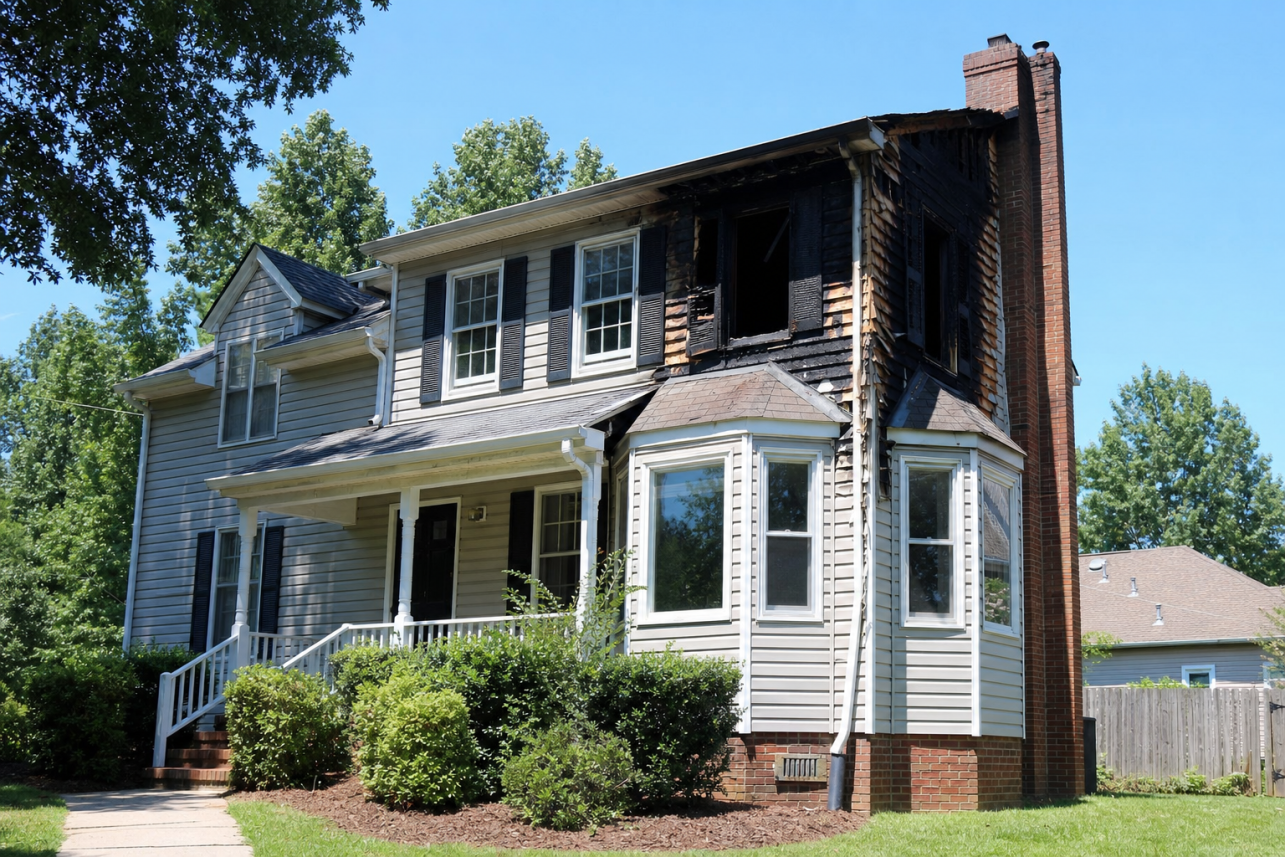
First, make the property safe and prevent further damage. Your policy requires reasonable steps to mitigate — shut off water at the main if a pipe burst, tarp a fire-damaged roof opening, and move undamaged belongings away from the affected area. Keep every receipt, because emergency mitigation costs are typically reimbursable.
Second, document everything before cleanup. Photograph and video the damage from multiple angles, including close-ups of damaged contents and wide shots showing room context. Do not throw anything away until it has been documented and, ideally, inspected. Discarded evidence is one of the most common reasons carriers reduce payments.
Third, report the loss promptly, but be careful what you say. Give the basic facts — date, cause if known, and general scope — without guessing at details or speculating about causes. Statements made in that first call become part of your file.
Fourth, consider calling us before the insurance company's adjuster inspects. Getting independent representation early on a Residential Homeowners Claim Garner NC families file means the initial scope of damage is set by someone working for you, not the carrier. We frequently find damage the company adjuster's quick walkthrough missed — hidden moisture in wall cavities, smoke residue in HVAC systems, or compromised insulation.
Finally, do not sign repair contracts or accept quick settlement offers under pressure. You have time to understand the full extent of the loss, and early checks are often based on incomplete estimates. As licensed and bonded public adjusters serving Wake County, we review everything before you commit.
What Documentation Do I Need To Support A Residential Homeowners Claim Garner NC Adjusters Will Take Seriously?
Strong documentation is the backbone of any homeowners claim in Garner. Start with wide-angle and close-up photos or video of every damaged area before anything is moved, cleaned, or repaired. Date-stamped images carry real weight when an insurer questions the timeline of a loss.
Next, pull together your policy declarations page, any endorsements, and your mortgage information. For contents losses, build a room-by-room inventory with approximate purchase dates and replacement costs. Receipts help, but they are not required for every item — credit card statements, product manuals, and even photos of the item in older family pictures can establish ownership.
Keep every receipt for emergency expenses: tarping, water extraction, board-up services, and hotel stays if your home is unlivable. These often fall under Additional Living Expenses coverage, and policyholders in Wake County routinely leave this money unclaimed simply because they didn't save receipts.
Finally, keep a written log of every phone call and email with your insurance company, including names, dates, and what was said. When For The Public Adjusters, Inc. takes over a file, that log frequently reveals delays or misstatements that strengthen your position. We are licensed and bonded, and we prepare the full documentation package — estimates, inventories, and the sworn proof of loss — so nothing is left for the carrier to pick apart. While no one can promise a specific outcome, a thoroughly documented claim is consistently harder for an insurer to undervalue.
My Insurer And I Disagree On The Repair Estimate For My Garner Home — What Is The Appraisal Process, And Does It Actually Work For Policyholders?
Nearly every North Carolina homeowners policy contains an appraisal clause, and it can be a powerful tool when you and the carrier are far apart on the cost of repairs. Either side can invoke it. You choose an appraiser, the insurer chooses one, and the two select a neutral umpire. Agreement between any two of the three sets the amount of loss.
Policyholders have real legal backing here. In Accardi v. Hartford Underwriters Insurance Company, the North Carolina Supreme Court sided with homeowners whose house suffered water damage from a plumbing failure. Hartford argued the fight was about coverage and refused appraisal; the Court held that the dispute over the scope and cost of repairs was an 'amount of loss' question and ordered the appraisal to proceed — a significant win for insured homeowners across the state, including right here in Wake County.
That said, appraisal has to be handled carefully. The scope of damage must be fully documented before the process starts, because items left off the estimate are hard to add later. A Garner public adjuster can prepare the detailed line-item estimate, serve as or recommend your appraiser, and make sure code-upgrade costs and hidden damage are captured.
Appraisal is binding on the dollar amount, so going in unprepared is risky. We cannot guarantee any particular award, but entering appraisal with professional documentation gives you a fair, evidence-based fight instead of simply accepting the carrier's number.
Does For The Public Adjusters Handle Hurricane And Tornado Damage Claims In Garner, And What Should I Watch For After A Storm?
Yes. Garner sits squarely in the path of inland hurricane remnants — residents here still remember Fran in 1996, and more recently Matthew and Florence pushed heavy rain and destructive gusts through Wake County. Tornadoes are a genuine threat too; the April 2011 outbreak that tore through the Raleigh area proved how fast a storm can devastate local neighborhoods.
After a hurricane or tornado, the most common problems we see on homeowners claims are roof damage, torn siding, broken windows, fallen trees on structures, and the water intrusion that follows. Watch for subtle signs the carrier's adjuster may miss: lifted or creased shingles, nail pops in ceilings, stained drywall weeks after the storm, and musty odors that signal hidden moisture in wall cavities.
One critical distinction: rising water is not covered by a standard homeowners policy. If floodwater entered your home, that falls under a separate flood policy through the National Flood Insurance Program. FEMA (fema.gov) and the NFIP (floodsmart.gov) are the right resources for that portion of a loss, and we can help you sort out which damage belongs to which policy.
As licensed and bonded public adjusters, we document storm damage thoroughly, separate covered wind-driven rain from excluded flood damage, and negotiate directly with your carrier. We never promise a specific dollar figure, but we make sure every covered item — from the ridge cap to the crawl space — appears on the claim.
Are There Any Insurance Claims For The Public Adjusters Does Not Handle For A Residential Homeowners Claim Garner NC Homeowner Might Bring To You?
We focus exclusively on property damage to homes, buildings, and their contents, and that focus is deliberate — it is where deep expertise actually moves the needle on a settlement. For Garner homeowners, that means fire and smoke, water and plumbing failures, hurricane and tornado damage, hail, theft, vandalism, and the contents and additional living expense losses that come with them.
There are several categories we do not handle. We do not work on claims involving motor vehicles, so damage to your car — even if a tree fell on it in your own driveway — goes through your auto carrier. We also do not handle cell phone claims, health insurance claims, or life insurance claims. Those involve entirely different policy types, regulations, and claims processes.
One gray area worth clarifying: if a vehicle crashes into your house, the damage to the structure itself is something we absolutely handle, because the building is the insured property. Likewise, if a storm destroys a detached garage, fence, or shed, those structures typically fall under Coverage B of your homeowners policy and are within our wheelhouse.
Flood losses from rising water are insured separately through the National Flood Insurance Program rather than your homeowners policy. If flooding affected your home, FEMA and NFIP resources can guide the flood portion while we address the covered homeowners portion. If you are unsure whether your situation fits, call us. We will tell you honestly — as licensed and bonded professionals — whether your loss is one we can represent.
What Is The Difference Between Actual Cash Value And Replacement Cost On A Residential Homeowners Claim Garner NC Policies Typically Pay?
Most homeowners policies in Garner pay on one of two bases: actual cash value (ACV) or replacement cost value (RCV). ACV is the cost to repair or replace your damaged property minus depreciation for age and wear. RCV is the full cost to repair or replace with materials of like kind and quality, without that deduction.
Here is where many Wake County homeowners get shortchanged. Even on an RCV policy, the insurer usually issues the ACV amount first and holds back the depreciation. You only recover that withheld money — called recoverable depreciation — after completing the repairs and submitting proof, and there are deadlines for doing so.
We frequently see depreciation applied too aggressively on a Residential Homeowners Claim Garner NC families file after fire, water, or storm damage. A fifteen-year-old roof might be depreciated as if it had no remaining life, or interior finishes depreciated at rates that do not reflect their actual condition.
When our team reviews your policy, we confirm which valuation applies to the structure versus your contents, challenge unreasonable depreciation line by line, and track the recoverable depreciation so none of it is left on the table. We also watch for roofing payment schedules and cosmetic-damage exclusions that some carriers have added to policies in this area.
Understanding which number you are actually entitled to — and when — often changes a settlement by thousands of dollars. That review costs you nothing up front, since we work on a contingency basis as a licensed and bonded firm.
My Garner Home Is Unlivable After A Fire — Will My Policy Pay For Temporary Housing And Extra Living Costs?
In most cases, yes. Nearly every standard homeowners policy includes Additional Living Expenses (ALE) coverage, sometimes called Loss of Use. It pays the reasonable increase in your living costs while your Garner home is uninhabitable due to a covered loss like fire or significant water damage.
ALE typically covers a rental home or extended-stay hotel, the difference between your normal grocery bill and the cost of eating out, pet boarding, laundry, extra mileage if you are displaced farther from work or your kids' schools, and storage for salvageable belongings. The key word is increase — the carrier pays costs above what you normally spend, not your entire monthly budget.
Two things trip up local families. First, ALE has limits, usually a percentage of your dwelling coverage or a time cap such as twelve or twenty-four months. On a major fire loss, rebuilding can take longer than expected, so pacing that benefit matters. Second, carriers sometimes pressure displaced homeowners into housing that does not match their normal standard of living, even though North Carolina policies generally entitle you to comparable accommodations.
Keep every receipt from day one, including that first emergency hotel night. Our team documents your pre-loss living expenses, establishes the increase, and pushes back when an adjuster tries to cut off ALE before your home is genuinely ready to occupy. For a Garner family of four, properly managed loss-of-use coverage can be the difference between stability and financial strain during a long rebuild.
What Happens If My Insurance Company Acts In Bad Faith On My Homeowners Claim In Garner?
North Carolina law gives policyholders real teeth when an insurer refuses to deal fairly. Beyond the contract itself, carriers can face liability under the state's Unfair and Deceptive Trade Practices Act, which allows damages to be tripled, and for bad-faith refusal to settle, which can support punitive damages.
Homeowners have won these fights. In Guessford v. Pennsylvania National Mutual Casualty Insurance Co., a North Carolina homeowner whose house suffered serious structural damage fought his insurer for years over an underpaid Residential Homeowners Claim Garner NC residents would find all too familiar. The case, litigated in the Middle District of North Carolina, ended with a jury finding the insurer had acted in bad faith and awarding the policyholder substantially more than the carrier had ever offered. The court recognized that lowballing and delay tactics are not just frustrating — they can be legally actionable.
Signs of potential bad faith include unexplained months-long delays, repeated requests for documents you already provided, estimates that ignore obvious damage, misrepresenting what your policy says, or denying a claim without a reasonable investigation.
We are not attorneys and cannot promise any particular outcome, but documenting the carrier's conduct from the start builds the record that matters. As public adjusters, we create a detailed, dated paper trail of every estimate, inspection, and communication. If the carrier's behavior crosses the line, that file becomes valuable evidence, and we can point you toward policyholder attorneys in Wake County when litigation is the right next step.

Why Is My Mortgage Company Listed On My Claim Check, And How Do I Get Those Funds Released For Repairs?
If you carry a mortgage on your Garner home, your lender is named on your policy as a loss payee. That means any significant structure payment from the insurer will be made out jointly to you and the mortgage company. The lender has a financial interest in the house and wants assurance the money actually goes into repairs.
The process usually works like this: you endorse the check and send it to the lender's loss-draft department, which holds the funds in escrow and releases them in stages — often a third up front, a third mid-repair, and the balance after a final inspection confirms the work is complete.
This is where Wake County homeowners hit friction. Lenders have their own paperwork, including contractor W-9s, lien waivers, signed repair contracts, and inspection scheduling, and each servicer runs the process differently. Delays in fund releases can stall your contractor and stretch a two-month repair into six.
Our team helps keep that pipeline moving. Because we prepare a thorough, well-documented estimate for the insurer, the same documentation satisfies most lender requirements the first time. We can also help you sequence draw requests so your contractor is never waiting on money that is sitting in escrow.
One note: contents and additional living expense payments are typically made to you alone — only structure funds involve the lender. If a carrier lumps everything into one joint check, we ask them to split the payments correctly, which puts your personal property money in your hands faster.
Local Relevance
Garner sits in southeastern Wake County, where humid summers, violent spring thunderstorms, hail, winter ice, and the remnants of Atlantic hurricanes all take turns working on a house. Tornado and hail paths here are notoriously narrow — one street can lose every roof while the next block looks untouched — so "nobody else in the neighborhood filed" means nothing about your claim.
Much of Garner's housing went up during the Triangle's growth years, and those homes are now old enough that carriers lean on "wear and tear" and "maintenance" to shrink roof and water claims. Tall pines and mature hardwoods add tree-strike risk every time a storm rolls through.
Flood is its own trap. Standard homeowners policies exclude flood, and creek flooding in Wake County regularly reaches homes outside the mapped high-risk zones. The Federal Emergency Management Agency administers the separate flood program most owners never purchased — worth checking before the next storm, not after. We see the same patterns across the county, whether it is a Garner roof claim or a Residential Homeowners Claim Morrisville NC on the western side.
A large share of Garner-area subdivisions were built in the late '90s through mid-2000s with builder-grade shingles and minimal flashing, and those roofs are now exactly the age where carriers argue "wear and tear" on every claim. Pinning the damage to a documented storm date — hail reports, wind records, neighbor losses — is often the difference between a denial and a full roof replacement.
Get A Straight Answer About Your Garner Claim
Before you accept the carrier's number or give up on a denial, let a licensed, bonded public adjuster read your policy and inspect the damage. The review costs you nothing, and you will know exactly where your claim stands and what it is realistically worth pursuing.
Call us: (919) 400-6440
Helpful Resources
- NCDOI Public Adjusters Guide
- Federal Emergency Management Agency (FEMA)
- North Carolina Department of Insurance — State regulator that licenses public adjusters and handles consumer complaints
- FEMA flood insurance resources — Federal source for flood coverage, which standard homeowners policies exclude
Last updated: November 22, 2026