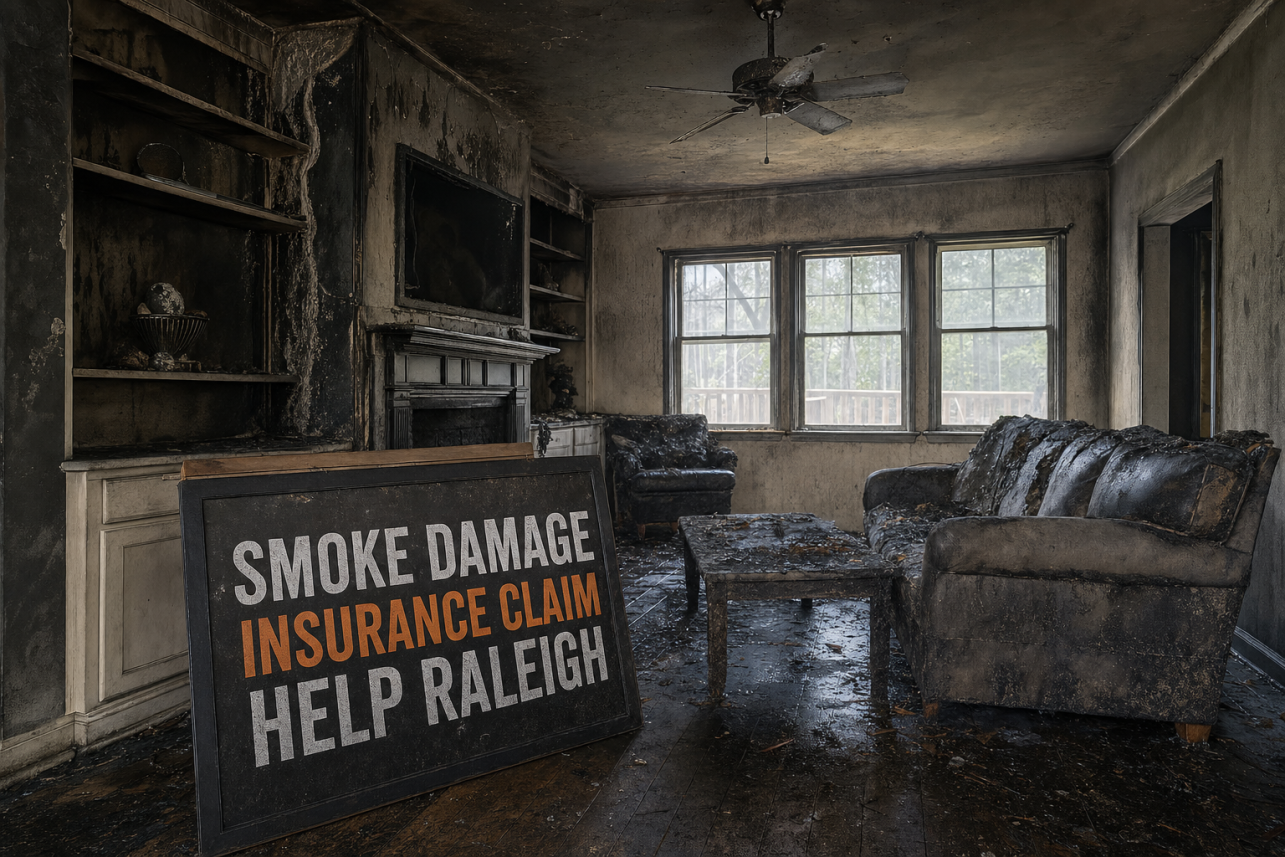
Smoke Damage insurance Claim help Raleigh homeowners need starts with one truth: smoke travels far beyond the flames, and insurers routinely underestimate what it costs to remove. For The Public Adjusters, Inc. is a licensed and bonded public adjusting firm that works only for you — never the insurance company — documenting soot, odor, residue in your HVAC system, and contents damage room by room. We then negotiate the settlement based on that evidence, so the payout reflects what proper restoration actually costs.
What This Service Is
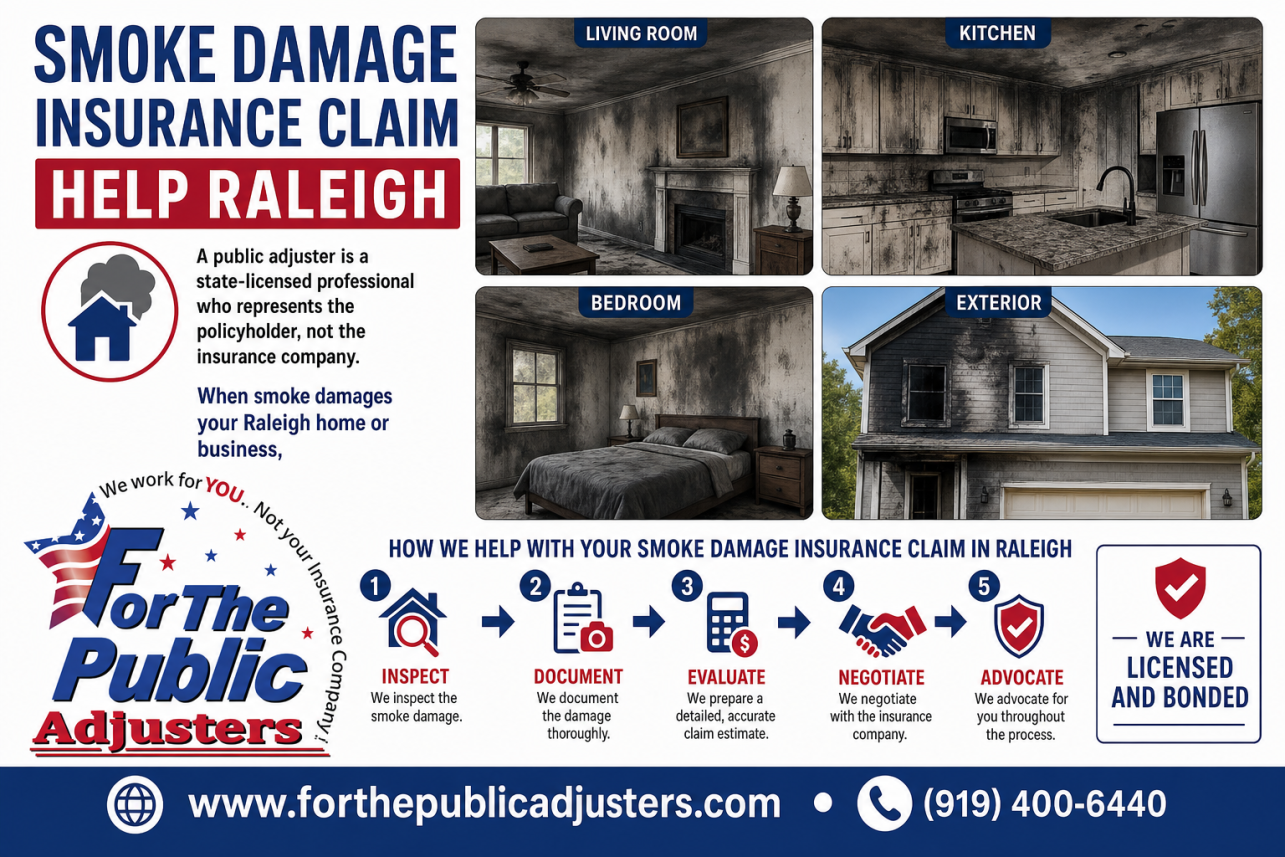
A public adjuster is a state-licensed professional who represents the policyholder, not the insurance company. When smoke damages your Raleigh home or business, we read your policy line by line, inspect the property for both visible and hidden damage, prepare the detailed documentation and proof of loss your insurer requires, and negotiate the settlement on your behalf.
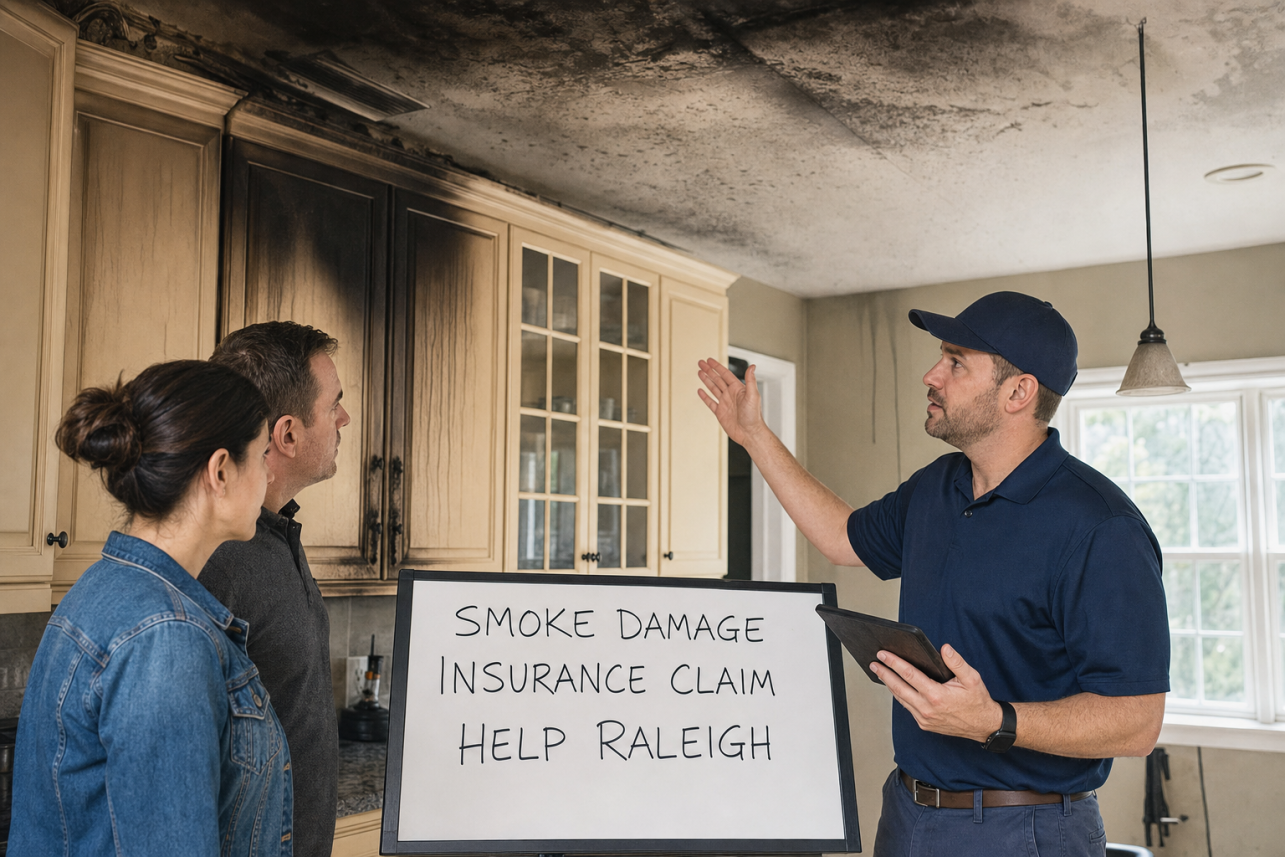
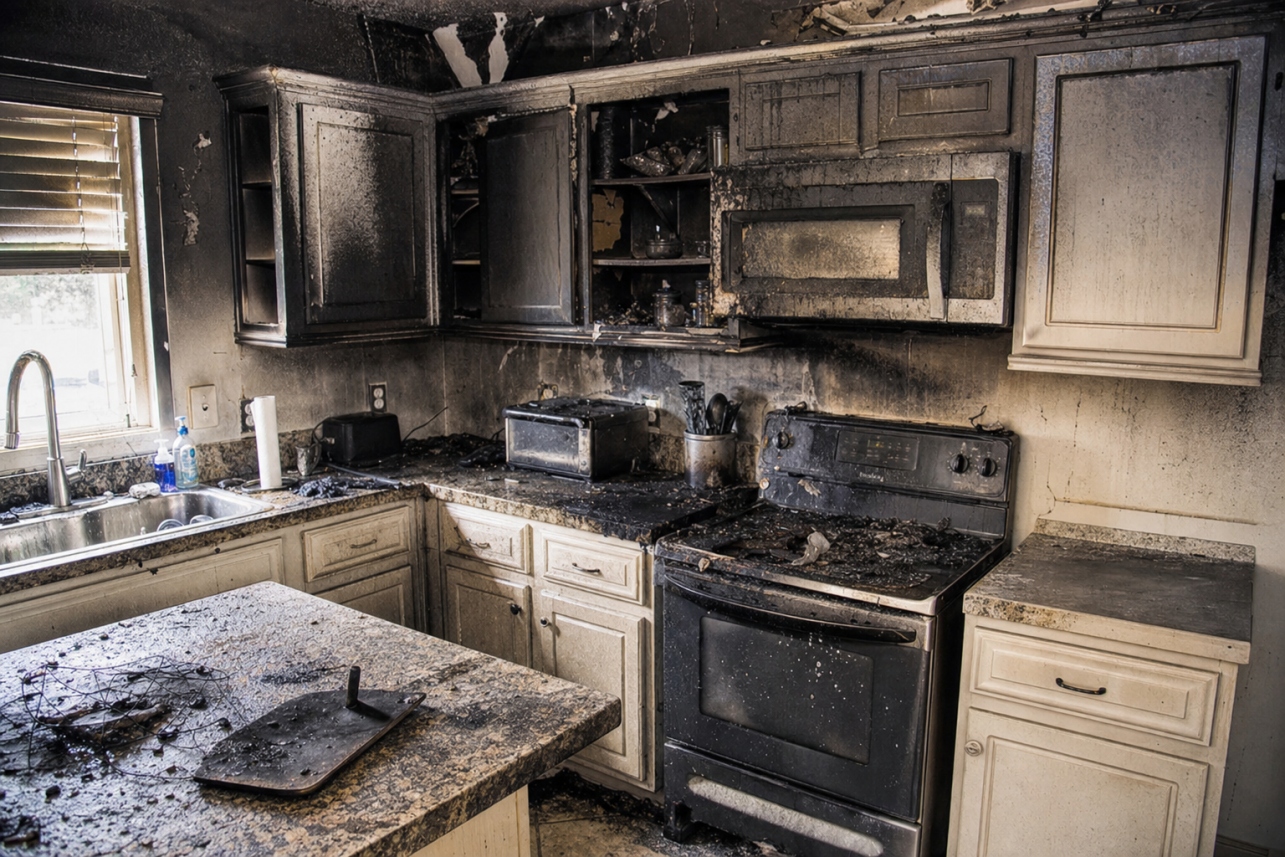
Smoke claims are deceptively complicated. Soot is acidic and keeps corroding metals, electronics, and finishes for weeks after the fire is out. Odor bonds into drywall, insulation, ductwork, and soft furnishings. A quick walkthrough by the insurance company’s adjuster often misses all of it — which is why the first offer on a smoke claim is so frequently too low.
We handle the full scope: structural cleaning and repairs, a complete contents inventory with fair valuation, damage to appliances and electronics, HVAC contamination, and temporary living expenses if odor or health concerns make the home unlivable during cleanup. Because smoke rarely arrives alone, we also fold in related losses — a fire damage claim help Garner file we handled, for example, combined char damage, smoke penetration, and water left behind by firefighting into a single properly valued claim.
The North Carolina Department of Insurance’s NCDOI Public Adjusters Guide explains that public adjusters must be licensed by the state and work under a written contract with the policyholder. We meet those requirements, and we never make promises about a specific dollar outcome — what we promise is thorough documentation and a professional fight for the full value your policy provides.
Common Problems
Is My Payout Really Enough To Clean And Restore Everything Smoke Touched?
This is the most common gap we find. The insurer’s estimate covers wiping down visible soot, but not sealing and repainting odor-soaked walls, cleaning every duct in the HVAC system, or replacing electronics whose circuit boards are corroding from acidic residue.
Watch for two other quiet reductions. Depreciation deductions can shrink a check dramatically — if you have replacement cost coverage, you may be owed the difference back after repairs, and many policyholders never collect it. And contents are often paid at a fraction of what replacing them actually costs because no one built a proper inventory with real valuations.
We price the claim from what qualified restoration actually costs in the Triangle, then push the numbers up to your policy’s coverage limits where the evidence supports it — never beyond what the policy allows, and never based on the insurer’s shortcut estimate.
My Claim Was Denied, Delayed, Or The Offer Is Insultingly Low — Now What?
Insurers sometimes argue smoke damage is “cosmetic,” that odor isn’t physical damage, or that pre-existing wear explains the residue. Courts have pushed back on that thinking. In Western Fire Insurance Co. v. First Presbyterian Church, the insurer refused to pay after vapor and odor contamination made a building unusable — and the court sided with the insured, holding that contamination rendering a property unfit for use is a real, compensable physical loss.
A denial or lowball offer is a position, not a verdict. It can be challenged with better documentation, an independent damage assessment, a formal proof of loss, and structured negotiation. When a dispute hardens, the appraisal process in your policy — or, in rare cases, insurance dispute attorneys we work alongside — provides further leverage.
Delays matter too. North Carolina policies carry deadlines for filing and for submitting proof of loss, and slow-walked claims leave families paying restoration costs out of pocket. We manage the timeline so nothing lapses, the same way our Smoke Damage Insurance Claim Help Durham clients have seen stalled files move once documented pressure was applied.
Do I Need Smoke Damage Insurance Claim Help Raleigh, Or Can I Handle The Claim Myself?
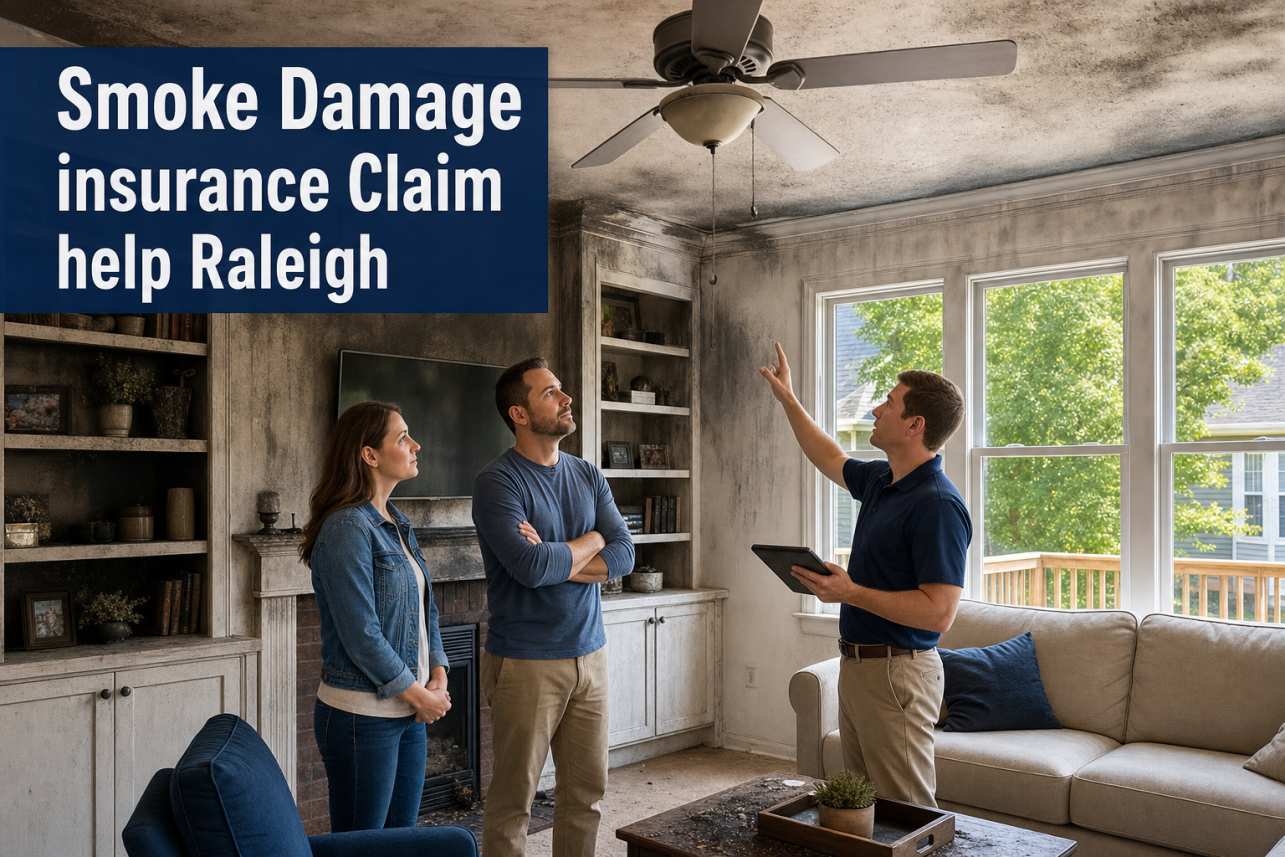
You can file on your own — but understand the mismatch. The insurance company sends a trained adjuster whose job is to control claim costs. You get one chance to document damage before cleanup destroys the evidence, and most homeowners don’t know that soot behind walls, inside ducts, and in attic insulation counts, or how to prove it.
A good public adjuster does three things you can verify before hiring: shows you a current North Carolina license, puts fees in writing as a percentage of the recovery (no upfront cost), and walks the property with testing and photos rather than glancing from the doorway. Be wary of anyone who promises a specific settlement figure — no honest adjuster can guarantee an outcome.
We’ve represented Wake County policyholders on files from a smoke damage claim in Cary to kitchen-fire losses across Raleigh’s older neighborhoods. If your loss is significant, having your own licensed advocate typically pays for itself in the difference between the first offer and the final settlement.
Our Process
Free Inspection And Policy Review
We walk your property looking for what quick estimates miss: soot migration into ductwork, odor absorption in porous materials, residue on electronics, and secondary water damage from firefighting. At the same time, we review your policy to map every coverage that applies — structure, contents, additional living expenses, and code-upgrade provisions.
Documentation And Proof Of Loss
We photograph and test affected areas, build a room-by-room contents inventory with fair replacement values, and prepare a professional damage estimate. Then we assemble and file the formal proof of loss correctly and on time, because a weak or late filing is one of the fastest ways a legitimate claim gets underpaid or denied.
Negotiation And Settlement
We present the documented claim to your insurer, respond to their adjuster’s pushback point by point, and negotiate toward the full value your policy supports. If they dig in, we escalate through re-inspections, the appraisal clause, or coordination with attorneys. You stay informed at every step, and our fee comes only from the recovery.
| What Happens | Filing on Your Own | With For The Public Adjusters |
|---|---|---|
| Damage documentation | You rely on the carrier’s adjuster, who works for the insurance company | Independent scoping, photos, lab testing, and room-by-room contents inventory done for you |
| Hidden smoke damage | Ducts, attic insulation, and wall cavities are often left off the estimate | HVAC systems, insulation, and concealed residue tested and included in the scope |
| Contents and soft goods | Cleaning offered for items that can never be fully deodorized | Restore-vs-replace decisions backed by salvage assessments and replacement cost pricing |
| Negotiation | Take-it-or-leave-it offers with little leverage | Line-item negotiation, supplements, and appraisal invoked when the carrier won’t move |
| Your time | Weeks of calls, paperwork, and estimate disputes | We manage the claim start to finish; you approve decisions |
| Typical result | Settlements frequently scoped to the visible damage only | Our smoke claims routinely settle for multiples of the initial offer |
Commonly Overlooked In The Public Adjusting Industry
- Soot inside HVAC ductwork and air handlers — Carrier adjusters rarely open the system, so contaminated ducts keep recirculating smoke odor long after the walls are repainted.
- Attic insulation acting as a smoke sponge — Blown-in insulation absorbs and holds smoke odor permanently, but it’s out of sight and almost never appears on the initial estimate.
- Corrosive residue on electronics and appliances — Acidic soot slowly destroys circuit boards over months, so items that ‘still work’ at inspection fail after the claim closes.
- Smoke penetration into wall and ceiling cavities — Residue travels through outlets, can lights, and gaps in framing, and only shows up when surfaces are tested or opened.
- Protein smoke from kitchen fires — Protein residue is nearly invisible but bonds to surfaces and produces a stubborn odor that standard cleaning quotes don’t address.
- Sealing and priming before repainting — Painting over smoke-stained drywall without an odor-blocking sealer causes bleed-through and smell to return, forcing a second repair on your own dime.
- Restore-versus-replace math on soft goods — Carriers default to cleaning mattresses, upholstery, and clothing even when restoration costs approach replacement cost and can’t remove the odor.
- Additional living expense documentation from day one — Hotel, meal, and mileage costs go unreimbursed when they aren’t logged in real time, and carriers won’t reconstruct them for you later.
Case Studies
Case Study #1
Situation: A family in North Raleigh’s Bedford neighborhood had a kitchen fire that was extinguished within minutes. The flames never left the kitchen, but smoke traveled through the HVAC system into every room of the two-story home.
Problem: The insurance carrier’s adjuster scoped the loss as a single-room event and offered $18,400 — enough to repaint the kitchen and replace some cabinets, but nothing for the rest of the house. The family could still smell smoke in the upstairs bedrooms weeks later.
Investigation: Our team brought in an industrial hygienist to take surface wipe samples and air quality readings throughout the home. We tested the ductwork, attic insulation, soft goods, and wall cavities on both floors.
Findings: Lab results confirmed protein and synthetic smoke residue in every room, heavy soot loading inside the supply ducts, and contaminated blown-in attic insulation. The carrier’s scope had never addressed the HVAC system at all.
Solution: We rewrote the scope of loss to include full duct cleaning and partial replacement, attic insulation removal and reinstall, thermal fogging, sealing and repainting of affected surfaces, and contents cleaning for textiles and upholstered furniture. We presented the lab data alongside line-item pricing and negotiated directly with the carrier’s large-loss unit.
Outcome: The claim settled at $147,000 — roughly eight times the original offer — and covered temporary housing while the remediation work was completed.
Lesson: Smoke doesn’t respect room boundaries. If a carrier scopes only the room where the fire started, the settlement will almost always fall short of what restoration actually costs.
Case Study #2
Situation: The owner of a small retail shop off Capital Boulevard suffered smoke intrusion when a fire broke out in the adjoining unit of the strip center. His own space never burned, but smoke poured through shared ceiling plenums overnight.
Problem: The carrier initially argued that because there was no fire damage in his unit, the loss was cosmetic. They offered cleaning of visible surfaces and a few days of lost income — about $9,200. Meanwhile, inventory reeked of smoke and customers were complaining.
Investigation: We documented odor and residue on inventory, fixtures, and the drop-ceiling cavity, and pulled the lease to confirm the tenant’s responsibility for interior finishes and business personal property. We also built a business interruption calculation using twelve months of sales records rather than the carrier’s two-month snapshot.
Findings: Soot residue was present above the ceiling grid and inside display cases. Roughly 60% of the soft-goods inventory could not be restored to sellable condition, and the carrier’s income projection had ignored the shop’s strong fall season.
Solution: We submitted a revised inventory loss schedule with photographic documentation and salvage assessments, a corrected business interruption model, and a remediation scope that included the ceiling plenum. When the carrier pushed back on inventory, we invoked the appraisal provision of the policy.
Outcome: The claim resolved for $94,500 before appraisal concluded, including full inventory replacement value and four months of business income coverage.
Lesson: Smoke-only losses are real losses. Commercial policyholders should never accept a ‘cosmetic damage’ framing without independent testing and a proper business interruption analysis.
| Situation | What To Do | Why It Matters |
|---|---|---|
| Smoke smell lingers after cleaning | Request independent air and surface testing before signing off | Persistent odor usually means residue in ducts, insulation, or wall cavities the estimate missed |
| Carrier offers cleaning only, no replacement | Get a salvage assessment on textiles, mattresses, and electronics | Porous items and circuit boards often can’t be restored; cleaning money is wasted money |
| Fire started in a neighbor’s unit | File under your own policy and document immediately | Smoke-only losses are covered perils; waiting on the neighbor’s carrier can blow your deadlines |
| First offer arrives within days | Don’t sign a release — have the scope reviewed first | Fast offers are almost always scoped to visible damage in the fire room only |
| Carrier calls odor ‘pre-existing’ or ‘cosmetic’ | Get lab-verified soot sampling tied to your loss date | Chemical signatures of smoke residue can prove causation and defeat the denial |
| You need to live elsewhere during remediation | Confirm ALE (additional living expense) coverage in writing before booking | Carriers often underpay temporary housing when the displacement timeline isn’t documented |
| Remediation company asks you to sign their contract | Have the scope and assignment language reviewed first | Some contracts assign your insurance rights or lock in pricing the carrier won’t fully pay |
| Settlement feels low but carrier won’t budge | Invoke the appraisal clause in your policy | Appraisal is a built-in dispute tool most policyholders never use — and carriers know it |
Reviews
After our attic fire, the insurance company said smoke odor in the bedrooms was ‘pre-existing.’ For The Public Adjusters brought in a hygienist, proved the soot came from our fire, and got the settlement up from $22k to over $110k. They handled every call with the carrier so I didn’t have to.
Denise M., Five Points
Grease fire in the kitchen, smoke everywhere. The adjuster the carrier sent spent 20 minutes and offered next to nothing for our clothes and furniture. This team inventoried our contents room by room, documented the odor damage, and nearly quadrupled the payout. Worth every penny of the fee.
Carlos R., Garner / Wake County
I didn’t even know public adjusters existed until a neighbor’s fire filled our townhome with smoke and our carrier tried to deny the claim. They pushed back with actual lab testing and policy language. We got our ducts, insulation, and repainting fully covered. Only wish I’d called them week one instead of week six.
Tanya W., Brier Creek
Frequently Asked Questions
How Does Smoke Damage Insurance Claim Help Raleigh Homeowners Recover More Than Filing On Their Own?
Professional Smoke Damage insurance Claim help Raleigh residents rely on starts with a complete, independent damage assessment — something most policyholders never receive from their carrier alone. Insurance company adjusters often document only visible soot and charring, missing the deeper damage smoke actually causes.
Smoke residue penetrates HVAC ductwork, insulation, drywall cavities, upholstery, and even the wiring behind your walls. Acidic soot continues corroding metals, electronics, and finishes for weeks after a fire. At For The Public Adjusters, Inc., we test surfaces, document odor migration room by room, and inventory affected contents so nothing is left off the claim.
We then prepare a detailed estimate using proper restoration protocols — thermal fogging, ozone treatment, duct cleaning, sealing, and repainting — rather than the surface wipe-down carriers frequently propose. In Wake County homes, especially older properties inside the Beltline with plaster walls and original hardwoods, cleaning costs can be substantially higher than a standard estimate reflects.
Because we work exclusively for you, not the insurance company, our job is to negotiate until the settlement actually covers what restoration will cost in the Raleigh market. Homeowners who bring us in early routinely avoid the lowball first offer entirely. If you’ve already received an offer that seems thin, we can review it at no obligation and tell you honestly whether it’s worth reopening.
What Does Smoke Damage Typically Include That Raleigh Insurance Companies Try To Exclude?
Carriers frequently narrow a smoke claim to the room where the fire occurred, but smoke doesn’t respect walls. Some of the most commonly underpaid items we see across Wake County include HVAC contamination, hidden soot in wall and ceiling cavities, and persistent odor that requires sealing and repainting rather than simple cleaning.
Your ductwork is a major one. Once your system cycles smoke through the house, every register, filter, and length of duct can carry residue. Proper remediation often means full duct cleaning or replacement — not a filter swap.
Contents are another battleground. Clothing, mattresses, books, electronics, and children’s items absorb smoke odor and acidic particles. Insurers may offer a flat cleaning allowance when many items are actually non-salvageable and should be paid at replacement cost under your policy.
We also see disputes over protein smoke from kitchen fires, which leaves a nearly invisible film with a stubborn odor, and over damage in adjacent rooms, attics, and crawlspaces common in Raleigh’s ranch and two-story construction. Additional living expenses matter too — if odor makes your home unlivable during remediation, your policy likely owes for temporary housing.
As your public adjuster, we document each of these categories with photos, testing, and line-item estimates so the carrier can’t dismiss them as speculation. The difference between a surface-level claim and a fully documented one is often tens of thousands of dollars.
When Should I Call A Public Adjuster In Raleigh After A Fire — Before Or After Filing My Claim?
Ideally, call before you file or within the first few days afterward. The early stage of a smoke claim is when the most consequential decisions get made — what gets documented, what gets discarded, and how the loss is framed to the carrier.
If you file first and the insurance company’s adjuster inspects before we do, their scope of damage often becomes the baseline you have to fight uphill against. When For The Public Adjusters, Inc. is involved from day one, we control the documentation: we photograph and test every affected surface, inventory contents before anything is thrown out, and set expectations with the carrier from the first conversation.
That said, it is never too late. Many of our Wake County clients call us after receiving a settlement offer that won’t come close to covering restoration, or after their claim stalls for weeks without answers. North Carolina policies generally allow supplemental claims, and we regularly reopen and increase settlements that homeowners assumed were final.
One practical warning for the Raleigh area: after any reported house fire, restoration companies and contractors may show up at your door quickly. Don’t sign work authorizations or assignments before you understand your policy and the true scope of damage. A short conversation with us first — reviews and initial consultations cost you nothing — can protect your leverage for the entire claim.
How Much Does Smoke Damage Insurance Claim Help Raleigh Policyholders Pay, And How Are Your Fees Structured?
For The Public Adjusters, Inc. works on a contingency fee, meaning we’re paid a percentage of the insurance settlement we recover for you — nothing upfront and nothing out of pocket. If we don’t recover money on your claim, you don’t owe us a fee. That structure keeps our interests aligned with yours: the better your settlement, the better our outcome.
The percentage is agreed upon in writing before we begin, in accordance with North Carolina’s public adjuster licensing rules, so there are never surprises. In practice, the increase we achieve on a smoke claim typically exceeds our fee many times over, because so much smoke damage goes undocumented in the carrier’s initial estimate.
Consider a typical Raleigh kitchen fire. The insurer might scope cleaning and paint for two rooms. A full assessment often reveals HVAC contamination, soot in adjacent rooms, damaged contents throughout the home, and odor remediation requiring sealants and specialty cleaning — items that can multiply the claim’s true value.
We handle everything the fee covers: inspection and testing, the contents inventory, the repair estimate, all correspondence and negotiation with the carrier, and coordination of any required inspections at your property in Wake County. You get a single point of contact instead of a maze of adjusters and vendors.
If you’re weighing whether smoke damage insurance claim help in Raleigh makes financial sense for your situation, we’ll review your policy and the carrier’s estimate for free and give you a straight answer before you commit to anything.
How Do You Prove Smoke Damage That My Insurance Company Says Isn’t Visible?
This is one of the most common disputes we handle in Wake County. Carriers often send a field adjuster who does a quick visual walkthrough, sees no charring, and writes up a light cleaning estimate. Smoke doesn’t work that way — soot particles migrate through HVAC systems, settle inside wall cavities, and bond to porous surfaces like drywall, insulation, and fabric.
We document what the carrier’s adjuster missed. That includes soot swab testing on walls and ceilings, chemical sponge sampling to distinguish protein smoke from synthetic smoke residue, and inspection of duct interiors, attic insulation, and closet contents that a walkthrough never touches. Protein smoke from kitchen fires is especially deceptive — it’s nearly invisible but leaves a persistent odor and a film that corrodes metal and electronics over time.
We also photograph and inventory every affected room and pull air quality or particulate readings when odor is the main issue. In older Raleigh homes — think Five Points, Boylan Heights, or Mordecai — plaster walls and original hardwoods absorb smoke differently than new construction, and we make sure the estimate reflects proper restoration methods, not a generic wipe-down.
All of that becomes a documented, line-item claim package the carrier has to respond to specifically. It’s much harder for an insurer to deny damage that’s been tested, measured, and photographed than damage a homeowner simply says they can smell. That evidence gap is usually the difference between a token cleaning payment and a settlement that actually restores your home.
Can I Get Smoke Damage Insurance Claim Help Raleigh If The Fire Started In A Neighbor’s Home Or Nearby Property?
Yes, and these claims come up more often than people expect — especially in denser Raleigh neighborhoods and townhome communities where units share walls or sit close together. If a neighbor’s fire pushed smoke into your home, you generally have two paths: a claim under your own homeowner’s policy, or a liability claim against the neighbor’s policy if their negligence caused the fire.
In most cases, filing under your own policy is faster and more reliable, and your carrier can pursue the neighbor’s insurer afterward through subrogation. Smoke infiltration is covered damage under standard HO-3 policies, but carriers frequently minimize these claims because there’s no fire origin on your property. They’ll argue the smell will dissipate or that surface cleaning is enough.
We’ve worked with homeowners in townhome and condo settings around North Hills, Brier Creek, and downtown Raleigh where smoke traveled through shared attic spaces and wall assemblies. Those situations require inspecting shared building components, coordinating with HOA master policies, and documenting exactly which damage belongs to which policy — something most homeowners understandably don’t know how to untangle.
For The Public Adjusters, Inc. handles that sorting for you. We identify every applicable coverage, document the smoke migration path, and present the claim so nothing falls into the gap between your policy, the neighbor’s policy, and the association’s coverage. If you’re dealing with secondhand smoke damage, don’t assume it’s too small or too complicated to pursue — these claims are legitimate and often significantly undervalued at first offer.
How Long Does A Smoke Damage Claim Usually Take To Settle In Raleigh?
Timelines vary, but here’s a realistic picture. North Carolina requires insurers to acknowledge a claim promptly and investigate within a reasonable period, and most straightforward smoke claims resolve in 30 to 90 days. Claims involving disputed scope — which describes most smoke claims — commonly stretch to four to six months when homeowners handle them alone, largely because of back-and-forth over what needs cleaning versus replacement.
Professional representation usually shortens that, not lengthens it. When the initial claim package already includes soot testing, a room-by-room contents inventory, and a detailed restoration estimate, the carrier has less room to request endless re-inspections. We front-load the documentation so the negotiation starts from a complete file rather than building it piecemeal over months.
A few factors specific to this area affect timing. After major storm seasons, carriers serving Wake County get backlogged and desk adjusters juggle heavy caseloads, which slows responses. Older homes inside the Beltline sometimes trigger disputes over matching original materials, and that can add negotiation rounds. Claims involving additional living expenses — if smoke made your home temporarily unlivable — also add a layer the carrier reviews separately.
Our role throughout is keeping the file moving: meeting the carrier’s adjuster on site, responding to document requests same-week, and escalating when deadlines slip. If a carrier drags its feet unreasonably, North Carolina’s unfair claims settlement practices rules give us leverage to push. Most clients find the process moves noticeably faster once the insurer knows a licensed adjuster is tracking every deadline.
My Insurer Already Paid Something For Smoke Cleanup. Is It Too Late To Get Help?
It’s usually not too late. Accepting an initial payment does not close your claim in North Carolina — you can request a supplemental payment when the original settlement didn’t cover the full scope of damage. We reopen and supplement underpaid smoke claims regularly, and they’re often our strongest cases because the shortfall is easy to demonstrate.
The typical pattern looks like this: the carrier paid for surface cleaning and maybe some repainting, the homeowner cashed the check, and weeks later the smoke odor returned or soot reappeared on walls. That happens because residue trapped in HVAC ductwork, insulation, and wall cavities was never addressed. When the paid scope didn’t match the actual damage, you’re entitled to pursue the difference.
We start by reviewing your policy, the carrier’s estimate, and what was actually done. Then we document what remains — testing, photos, and a corrected restoration estimate — and file a formal supplement. Check your policy’s deadlines: most give you at least a year from the date of loss to pursue additional amounts, and some longer, so acting sooner preserves more options.
This is exactly the situation where Smoke Damage insurance Claim help Raleigh homeowners call us about most often — after the first check, when they realize the problem isn’t fixed. Bring us the carrier’s paperwork and we’ll tell you honestly whether a supplement is worth pursuing. If the original payment was fair, we’ll say so. If it wasn’t, we build the case to recover what the first estimate left out.
What Should I Do In The First 48 Hours Before Getting Smoke Damage Insurance Claim Help Raleigh Homeowners Can Rely On?
The first two days after a fire or smoke event matter more than most people realize. Start by documenting everything before anyone cleans or moves items. Take wide photos of every room, then close-ups of soot lines on walls, discolored ceilings, film on windows, and residue inside cabinets and closets. Smoke travels through wall cavities and ductwork, so photograph vents and register covers too.
Do not wipe down walls or run your HVAC system. Dry soot smears when wiped with household cleaners, and running the air handler pushes contaminated particles through the entire duct system. Both mistakes make damage harder to prove and harder to remediate.
Keep every receipt. If you stay at a hotel near Crabtree or eat out because your kitchen is unusable, those costs typically fall under your policy’s additional living expenses coverage. Insurers rarely volunteer that information.
Report the loss to your carrier promptly, but keep your description factual and brief — the date, the cause if known, and the areas affected. Avoid guessing at severity or repair costs, because early statements get used to frame the claim later.
Then call us. For The Public Adjusters, Inc. can inspect before the carrier’s adjuster arrives, which means the damage gets scoped correctly from day one instead of being negotiated back up later. Wake County homeowners who bring us in early consistently avoid the lowball first offer that anchors so many claims below their true value.
Does Homeowners Insurance In Raleigh Cover Smoke Odor In Clothing, Furniture, And Personal Belongings?
In most cases, yes — but carriers frequently underpay this part of the claim. Standard homeowners policies in North Carolina cover direct physical loss, and courts and industry standards have long recognized smoke contamination and odor as physical damage, not a cosmetic nuisance.
The problem is how insurers value it. A carrier will often approve basic ozone treatment or a single round of laundering, then close the contents portion. But smoke penetrates porous materials deeply. Upholstered furniture, mattresses, leather goods, books, and children’s toys often cannot be fully deodorized, and industry restoration standards call for replacement when cleaning cannot return items to pre-loss condition.
Raleigh’s humidity makes this worse. Moisture in the air reactivates smoke residue trapped in fabrics, which is why homeowners sometimes notice odor returning weeks after a supposedly successful cleaning — especially during our muggy summer months.
Our team inventories contents room by room, separates what can genuinely be restored from what must be replaced, and prices replacements at actual Raleigh retail costs rather than the depreciated software figures carriers prefer. We also make sure specialty items — rugs, artwork, electronics with soot-contaminated circuit boards — get evaluated by the right restoration vendors instead of being lumped into a general cleaning line item.
If your carrier told you a quick cleaning solves everything, get a second opinion before you sign anything. The gap between a cleaned-and-closed contents settlement and a properly documented one is often tens of thousands of dollars.
Will Hiring A Public Adjuster For My Smoke Claim Slow Things Down Or Make My Insurer Treat Me Differently?
This is one of the most common worries we hear from Wake County policyholders, and the honest answer is no — a properly handled claim usually moves faster, not slower. Delays happen when documentation is incomplete, when the carrier’s scope misses damage and the estimate has to be revised repeatedly, or when the homeowner and adjuster go back and forth without a clear damage inventory.
We eliminate most of that. When For The Public Adjusters, Inc. submits a claim package, it arrives complete: photographs, moisture and residue testing results, a line-item estimate built on the same pricing software carriers use, and a full contents inventory. Desk adjusters can approve a well-documented file far faster than one they have to piece together themselves.
As for retaliation, North Carolina law prohibits insurers from penalizing you for exercising your policy rights, and hiring licensed representation is exactly that. Carriers deal with public adjusters every day. What actually changes is the tone of the negotiation — the insurer knows the file is being reviewed by someone who understands smoke remediation standards and policy language, so unsupportable positions tend to disappear early.
Your premiums are driven by the loss itself and regional rating factors, not by whether you had professional help. The claim was going on your record the moment you reported the fire. The only question is whether that claim pays what your policy actually owes, and that is where representation makes the difference for homeowners across Raleigh.
My Insurer Says The Smoke Damage Is Limited To One Room. How Do I Know If They’re Right?
In our experience, they usually aren’t. Smoke behaves like a gas under pressure — it rises, follows air currents, and travels through open doorways, HVAC ductwork, attic spaces, and even electrical outlets into wall cavities. A kitchen fire in a Raleigh ranch home routinely contaminates bedrooms at the far end of the house, and in two-story homes the upstairs often takes worse odor damage than the room where the fire started.
Carrier adjusters typically perform a visual walkthrough. If a room looks clean, it gets excluded. But soot particles measuring fractions of a micron settle invisibly on surfaces and inside duct runs, and acidic residue keeps etching finishes and corroding metals long after the visible mess is gone. Chemical sponge testing, particulate sampling, and duct inspections reveal what a flashlight walkthrough misses.
This is exactly where professional Smoke Damage insurance Claim help Raleigh residents deserve makes a measurable difference. We test adjacent rooms, attic insulation, HVAC systems, and closets — insulation in particular acts like a sponge for smoke and almost always needs replacement, yet it’s one of the most commonly omitted items in carrier estimates.
Older homes in neighborhoods like Five Points, Boylan Heights, and Hayes Barton are especially vulnerable because balloon framing and less-sealed construction let smoke migrate freely between floors. If your settlement covers one room and your nose tells you otherwise, trust your nose. We’ll inspect, document what the carrier missed, and reopen the scope with evidence they can’t dismiss.
Can Smoke Damage Insurance Claim Help Raleigh Homeowners Recover The Cost Of HVAC And Ductwork Contamination?
Yes, and this is one of the most commonly missed items in a settlement. When a fire produces smoke, your HVAC system acts like a distribution network — the blower pulls soot particles into the return, coats the coil and plenum, and pushes contamination into every duct run in the house. Insurers frequently pay for a basic duct cleaning and call it done.
That is often not enough. Soot is acidic and abrasive. Once it settles on an evaporator coil, blower motor, or flex duct lining, standard cleaning may not restore the system. In many Raleigh homes we inspect, flex ductwork has to be replaced entirely because the interior lining traps particulate that recontaminates the home every time the system cycles on.
Our team documents this with a licensed HVAC contractor’s inspection, particulate testing where appropriate, and photographs of the coil and duct interiors. We then present the carrier with a line-item scope that separates what can be cleaned from what must be replaced, priced at actual Wake County contractor rates rather than the software defaults adjusters lean on.
If your family has noticed a smoke odor returning whenever the heat or air conditioning runs, that is a strong sign the system was never properly addressed. It is worth having us take a look, even if the carrier has already issued a payment for cleaning.
If Smoke Makes My Home Unlivable During Cleanup, Will My Policy Pay For Me To Stay Somewhere Else?
In most cases, yes. Nearly every homeowners policy written in North Carolina includes Additional Living Expense coverage, often called ALE or Loss of Use. It pays the extra costs you incur when smoke contamination makes your home uninhabitable — hotel stays, a short-term rental, restaurant meals beyond your normal grocery budget, laundry, pet boarding, and even extra mileage if your temporary housing is farther from work or school.
The fight is usually over the word “uninhabitable.” Carriers sometimes argue that if the structure is standing, you can live in it. But heavy soot exposure is a legitimate health concern, particularly for children, older adults, and anyone with asthma or respiratory conditions. If ozone treatment, thermal fogging, or sealing and repainting is underway, staying in the home during that work is often unreasonable.
As your Raleigh public adjuster, we document why the home cannot be safely occupied, secure the carrier’s written approval for temporary housing, and track every receipt so nothing is disputed later. We also push back when an insurer tries to cut off ALE before restoration is genuinely complete.
One practical tip: keep every receipt from day one, even before coverage is confirmed. Photograph hotel folios, meal receipts, and mileage. It is far easier to recover these costs with contemporaneous records than to reconstruct them months later, and we can often recover expenses you did not realize were reimbursable.
My Smoke Claim Was Denied Outright. Is There Anything A Public Adjuster Can Actually Do At That Point?
Often, yes — a denial is the carrier’s opinion, not the final word. Many of the denied claims we see in Wake County fall apart under scrutiny because they rest on a thin inspection, a misapplied exclusion, or a field adjuster who spent twenty minutes in the home and never opened a wall or tested a surface.
The first thing we do is request the complete denial letter and the specific policy language the insurer relied on. Then we conduct our own inspection. Smoke damage is frequently invisible to a quick walkthrough: soot migrates into wall cavities, attic insulation, closets, and electronics. Chemical sponge testing and lab analysis can prove contamination that a visual inspection missed entirely.
With that evidence, we prepare a formal rebuttal and demand the claim be reopened. North Carolina policyholders also have the right to invoke the appraisal clause in most policies, which moves the dispute to a neutral valuation process rather than leaving the carrier as judge and jury.
This is exactly the situation where professional Smoke Damage insurance Claim help Raleigh residents can lean on makes the difference, because carriers respond differently when documentation arrives from a licensed adjuster than from a frustrated homeowner. Bring us your denial letter — the review costs you nothing, and we will tell you honestly whether the denial has merit or deserves a fight. Timing matters, though, since policies impose deadlines for disputing decisions and filing suit, so do not sit on it.
Do You Handle Smoke Damage Claims For Rental Properties And Businesses In Wake County, Or Only Owner-Occupied Homes?
We handle all three, and each comes with its own complications. Rental property owners in Raleigh face a layered claim: the dwelling policy covers the structure, but there is often a separate loss-of-rents component that carriers underpay or quietly ignore. If your tenants had to move out during soot remediation, that lost rental income is typically recoverable, and we calculate it based on your actual lease terms rather than a generic market estimate.
For businesses — restaurants, retail shops, offices along Glenwood Avenue or in downtown Raleigh — smoke claims involve business personal property, tenant improvements, inventory contamination, and business interruption. A restaurant that absorbs smoke odor into its dining room may lose weeks of revenue even after cleaning, and interruption coverage exists precisely for that gap. Documenting it correctly requires financial records, projections, and a clear causal link that most carriers will not assemble for you.
Tenants have claims too. If you lease your space and a fire in an adjacent unit contaminated your inventory or equipment, your commercial policy likely responds even though you do not own the building.
For The Public Adjusters, Inc. represents landlords, business owners, and commercial tenants throughout Wake County on exactly these losses. The fee structure is the same contingency arrangement we use for homeowners — we are paid a percentage of what we recover, so there is no retainer and no hourly billing. If we do not improve your outcome, you owe nothing.
Local Relevance
Raleigh’s housing stock spans everything from early-1900s homes inside the Beltline to fast-built subdivisions across north Raleigh and Wake County. Older homes often have plaster walls, original hardwoods, and balloon framing that let smoke travel into cavities where it hides for months — while newer construction relies on shared HVAC ductwork that spreads soot through every room in minutes.
Cooking fires remain a leading cause of home fires nationwide, a pattern the National Fire Protection Association documents year after year, and Raleigh is no exception. Add space-heater and fireplace incidents during our cold snaps, plus long humid summers that lock smoke odor into damp building materials, and Triangle smoke claims tend to be larger and more stubborn than they first appear.
We work these claims across Wake County and the surrounding Triangle every week — from Raleigh proper to a Smoke Damage Insurance Claim Help Morrisville file near RTP to homeowners working with a public adjuster in Knightdale NC. That local footprint means we know what restoration genuinely costs in this market, and we hold insurers to those real numbers rather than a national pricing database.
Raleigh’s humid climate works against smoke-damaged homes: moisture in the air helps acidic soot keep etching metal fixtures and electronics, and traps odor deeper in drywall and insulation the longer cleanup waits. That’s why we push insurers to approve full remediation scopes quickly here — a delayed or partial cleaning in a Triangle summer often means the damage quietly grows.
Get A Free Smoke Damage Claim Review In Raleigh
Before you accept the insurance company’s number — or give up on a denied claim — let a licensed, bonded public adjuster look at your policy and your property. The inspection and review cost nothing, and we only get paid if you recover. Serving Raleigh and all of Wake County.
Request Your Free Claim Review
Call us: (919) 400-6440
Helpful Resources
- NCDOI Public Adjusters Guide
- National Fire Protection Association (NFPA)
- U.S. Fire Administration home fire safety resources — Federal fire prevention and recovery guidance
- North Carolina Department of Insurance consumer services — State regulator overseeing insurers and adjuster licensing
Last updated: September 3, 2026