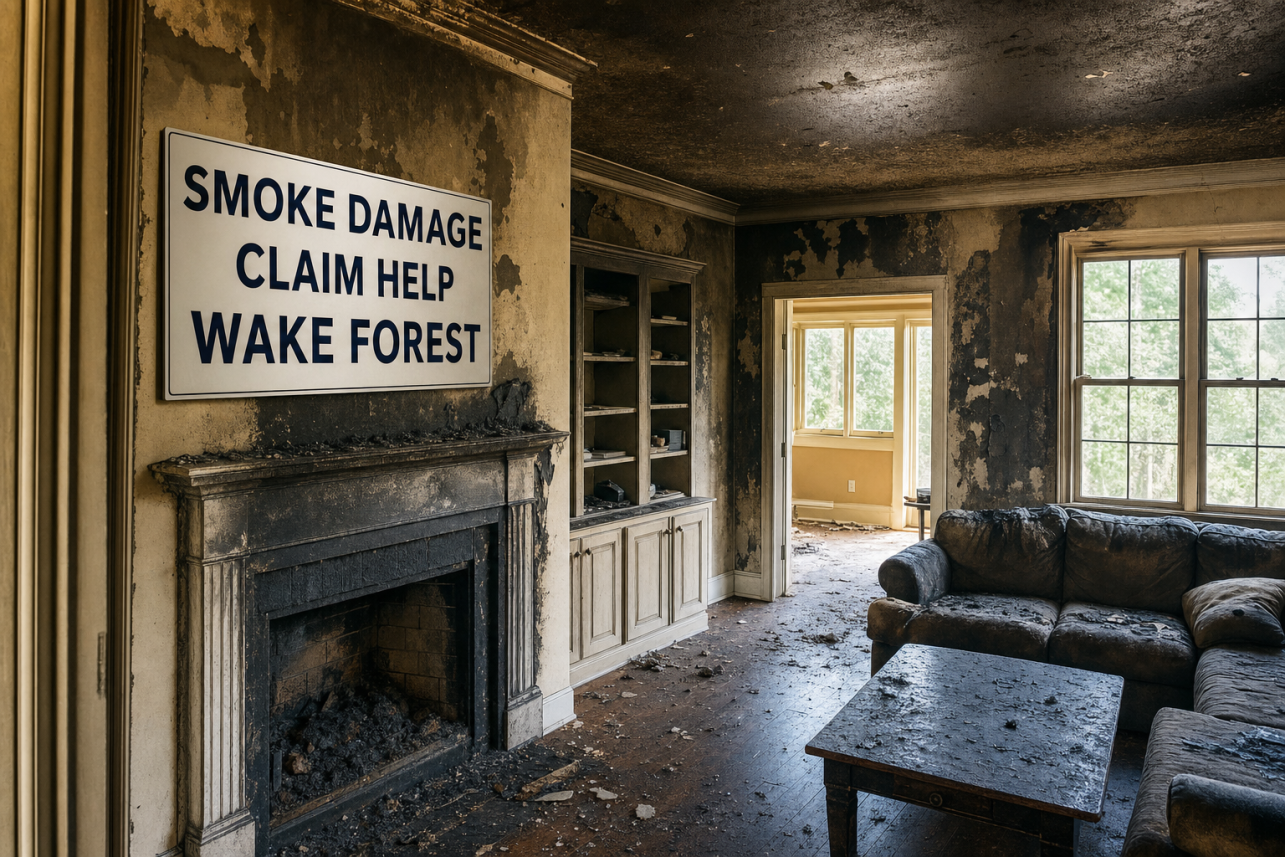
For Smoke Damage Claim Help Wake Forest homeowners can count on, For The Public Adjusters, Inc. represents you — not the insurance company — from the first inspection through the final settlement check. Smoke rarely stays where the fire started, and insurers often pay only for what is visibly charred. Our licensed and bonded team documents the soot, odor, and residue that spread through walls, ductwork, and personal belongings, then negotiates directly with your carrier so the claim reflects the full loss.
What This Service Is
A public adjuster is a licensed insurance professional who works exclusively for the policyholder. When smoke moves through a house — even from a small kitchen fire or a neighboring structure fire — it leaves acidic soot on surfaces, penetrates soft goods and electronics, and settles into the HVAC system where it recirculates every time the blower runs.
Our job is to prove that damage. We assess every affected room, test for residue in places the carrier’s adjuster may never open, build a room-by-room inventory of damaged contents, and prepare the formal proof of loss your policy requires. We handle this same work across the Triangle, including smoke damage insurance claim help in Raleigh, so we know how area carriers evaluate — and undervalue — these losses.
We also address the losses people forget: secondary water damage from firefighting efforts, temporary living expenses if odor makes the home unlivable, and out-of-pocket costs you have already paid for emergency cleanup. The National Fire Protection Association (NFPA) has long emphasized that smoke and heat cause damage well beyond the flame area itself, and a properly built claim has to reflect that reality.
Common Problems
Why Is The Insurer’s Offer So Much Lower Than My Cleanup Estimates?
This is the most common call we get. The carrier’s adjuster spends an hour in the home, scopes only the visibly damaged room, and prices the work at rates no local restoration contractor will actually accept.
Two things usually drive the gap. First, depreciation: if your policy pays actual cash value up front, the insurer deducts for the age of your carpet, cabinets, and furniture, and you only recover that money later — if you know to claim it. Second, scope: hidden smoke damage inside wall cavities, attic insulation, and ductwork simply is not on their estimate.
We rebuild the estimate line by line, at real market pricing, and we make sure recoverable depreciation and policy coverage limits are applied correctly. Homeowners with a smoke damage claim in Cary and across Wake County see the same pattern, and the fix is the same: independent documentation the carrier cannot wave away.
Smoke Damage Claim Help Wake Forest: What If My Claim Is Denied Or Stalled?
Denials and delays usually rest on paperwork, not facts. Carriers may argue the odor is ‘cosmetic,’ that residue is ordinary household dust, or that you missed a claim filing deadline or submitted an incomplete proof of loss.
Courts have repeatedly sided with policyholders on this issue. In Western Fire Insurance Co. v. First Presbyterian Church, the Colorado Supreme Court held that contamination that made a building unusable qualified as direct physical loss even without visible structural destruction — the insured won, and that reasoning is regularly cited in smoke and odor disputes today.
We respond to denials with lab-supported evidence, corrected filings, and firm negotiation. If a dispute hardens, we can coordinate with insurance dispute lawyers. And if your carrier is simply sitting on the file, the North Carolina Department of Insurance provides a complaint process we help clients understand and use.
Should I Handle The Claim Myself Or Hire Someone — And How Do I Choose?
You can file on your own, and for a truly minor loss that may be fine. But smoke claims are where do-it-yourself filings go wrong, because the damage you can see is a fraction of the damage that exists.
A good public adjuster is licensed by the state, bonded, works on the policyholder’s side only, and puts the fee agreement in writing before any work begins. The NCDOI Public Adjusters Guide is worth reading before you sign with anyone — it explains exactly what a legitimate adjuster in North Carolina can and cannot do.
Ask any candidate how they document hidden residue, how they inventory contents, and whether they have handled odor-based disputes with your specific carrier. We answer those questions daily here and for clients working with a public adjuster in Durham NC, and we never promise a specific dollar outcome — no honest adjuster will.
Our Process
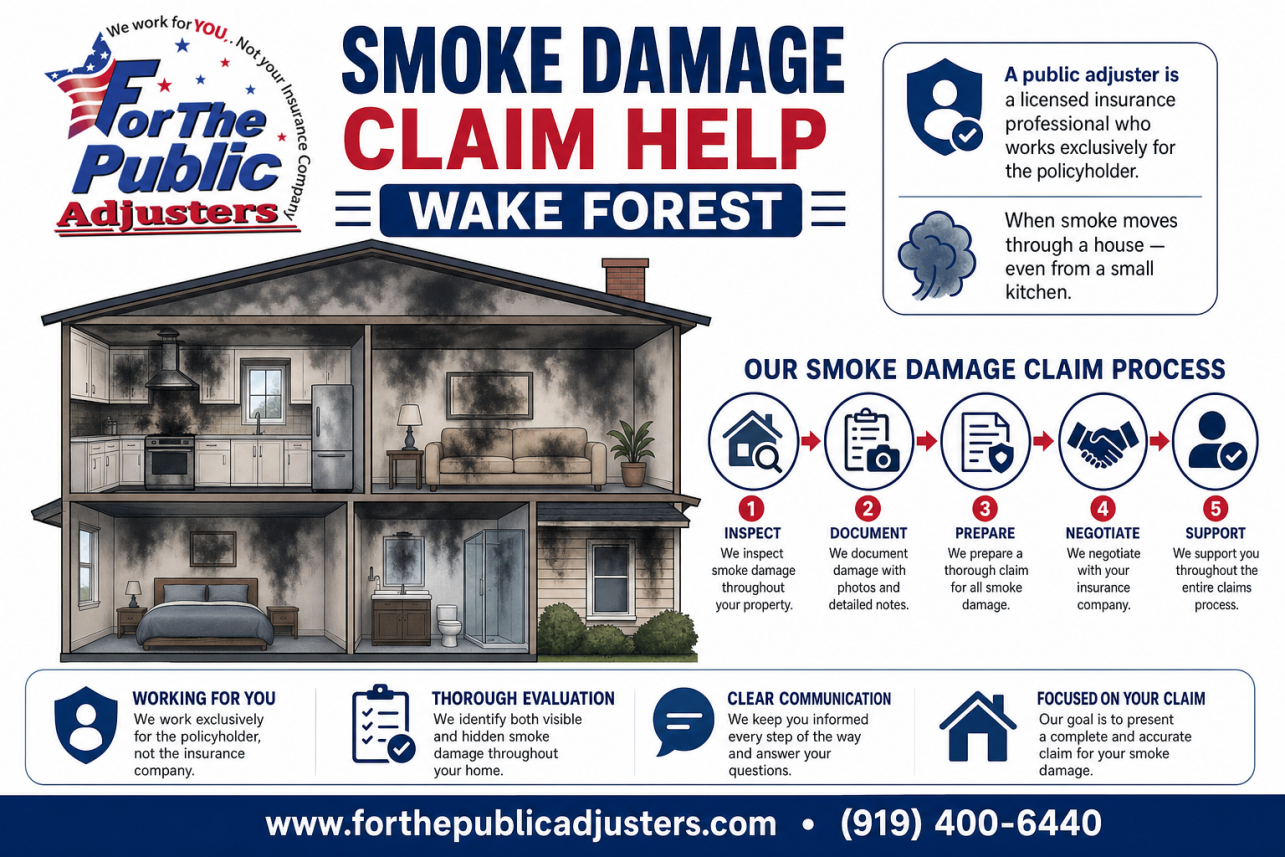
Free Policy Review And On-Site Smoke Assessment
We start by reading your actual policy — coverage limits, replacement cost versus actual cash value provisions, additional living expense coverage, and deadlines. Then we walk the property, including rooms far from the fire, testing surfaces for soot and inspecting the HVAC system, attic, and closets where residue hides.
Documentation, Contents Inventory, And Proof Of Loss
We photograph and log every affected item, build a valued contents inventory, and price the structural cleaning and repairs at real local rates. We prepare and submit the sworn proof of loss correctly and on time, so the carrier has no procedural excuse to delay. It is the same disciplined file we build for smoke damage claim help in Knightdale and throughout the county.
Negotiation Through Final Settlement
We meet the carrier’s adjuster on site, challenge low line items with evidence, and negotiate supplements as hidden damage is uncovered during cleanup. If the home is unlivable, we pursue temporary living expense reimbursement in parallel so your family is not floating those costs. You approve every settlement decision — we advise, you decide.
| What Happens | Filing on Your Own | With For The Public Adjusters |
|---|---|---|
| Scope of damage identified | Usually limited to what the carrier’s adjuster sees on a quick walkthrough | Full inspection including HVAC, attic, wall cavities, and contents, backed by residue testing |
| Contents inventory | Homeowner lists items from memory, often missing 40-60% of affected belongings | Room-by-room documented inventory with replacement cost values and photos |
| Odor and soot proof | Carrier may dismiss lingering smoke smell as subjective | Independent hygienist testing and lab results that carriers can’t argue with |
| Negotiation | You negotiate against a trained claims professional alone | Licensed adjuster negotiates on your behalf, citing policy language and code requirements |
| Typical outcome | First offers on smoke claims are frequently a fraction of the true loss | Documented settlements routinely 3-5x initial carrier offers on underscoped smoke claims |
| Your time invested | Dozens of hours of calls, paperwork, and re-inspections | We handle the claim; you review and approve |
Commonly Overlooked In The Public Adjusting Industry
- Soot inside HVAC ductwork and air handlers — It’s invisible without opening the system, so carrier adjusters routinely skip it and homeowners keep recirculating contaminated air.
- Smoke-saturated attic insulation — Nobody climbs into the attic during a quick walkthrough, yet fiberglass holds odor permanently and almost always needs replacement.
- Delayed corrosion on electronics — Acidic soot damages circuit boards over weeks, so a TV that works at inspection can fail after the claim is closed if it wasn’t documented.
- Additional living expense entitlement during deodorization — Families assume ALE only applies to fires that destroy the home, but a house that’s unsafe or unlivable during ozone treatment qualifies too.
- Contents in closets, drawers, and storage areas — Smoke migrates through gaps into enclosed spaces, and memory-based inventories miss most of what’s inside them.
- Residue testing before cleaning begins — Once remediation starts, the physical evidence of how far smoke traveled is gone forever, and the carrier’s lowball scope becomes hard to dispute.
- Smoke intrusion claims from a neighbor’s fire — People assume it’s the neighbor’s problem, but their own policy covers smoke damage regardless of where the fire originated.
- Depreciation recoverable after repairs — Carriers pay actual cash value up front, and policyholders who don’t submit final invoices leave the withheld depreciation unclaimed.
Case Studies
Case Study #1
Situation: A family in the Heritage neighborhood of Wake Forest had a kitchen fire that was contained quickly. The flames damaged one wall and the range hood, but smoke traveled through the HVAC system into every room of the two-story home.
Problem: The insurance carrier’s adjuster estimated the loss at roughly $18,000 — mostly wall repair and repainting the kitchen. The estimate ignored the smoke odor embedded in the upstairs bedrooms, the attic insulation, and the ductwork, and the family was still smelling smoke three weeks after the settlement offer.
Investigation: We brought in an independent industrial hygienist to take air quality samples and surface wipe tests upstairs and inside the HVAC trunk lines. We also documented soot residue on soft goods — mattresses, upholstered furniture, and clothing — using chemical sponge testing that showed carbon transfer far from the kitchen.
Findings: Lab results confirmed protein and soot residue throughout the second floor and inside the supply ducts. The attic insulation had absorbed smoke odor and could not be cleaned economically. Roughly 60% of the home’s soft contents required professional deodorization or replacement, none of which appeared in the carrier’s estimate.
Solution: We rewrote the scope of loss to include full duct cleaning and sealing, attic insulation removal and replacement, thermal fogging and ozone treatment of affected rooms, and a room-by-room contents inventory with cleaning and replacement values. We presented the lab data alongside the revised estimate and negotiated directly with the carrier’s large-loss desk.
Outcome: The claim settled at just over $94,000 — more than five times the original offer — including additional living expenses for the two weeks the family stayed elsewhere during remediation.
Lesson: Smoke doesn’t stay where the fire was. If the carrier’s estimate only covers the burn room, the claim is almost certainly underscoped, and testing is the fastest way to prove it.
Case Study #2
Situation: A small business owner running a boutique off South Main Street in downtown Wake Forest suffered smoke intrusion when a fire broke out in the adjacent unit. Her own space never caught fire, but smoke poured in through shared wall cavities and the ceiling plenum overnight.
Problem: Her commercial policy carrier initially treated it as a light cleaning claim and offered $6,500. That figure ignored the smoke-saturated retail inventory, which couldn’t legally or practically be sold, and made no allowance for lost income while the store sat closed.
Investigation: We photographed and cataloged every inventory item, pulled her purchase records to establish cost basis, and documented visible soot filtration lines along the shared wall. We also reviewed her policy and found business interruption coverage the carrier’s adjuster had never mentioned to her.
Findings: The soot type was oily synthetic residue from burning plastics next door — the kind that permanently stains fabric and leather goods. Over $40,000 of inventory was unsellable. The business income worksheet showed she was losing roughly $1,800 a week while closed, and the shared wall cavity required opening and cleaning, not just surface wiping.
Solution: We submitted a full contents inventory with supporting invoices, a business interruption calculation backed by twelve months of sales records, and a building scope that included wall cavity remediation and HVAC plenum cleaning. We coordinated a re-inspection with the carrier’s adjuster and walked him through the residue testing on site.
Outcome: The final settlement came to approximately $71,000 across the contents, building, and business income coverages — and she reopened within six weeks instead of absorbing the loss herself.
Lesson: Smoke damage from a neighboring fire is still your claim under your policy, and business interruption coverage is worthless if nobody calculates it. Never accept a first offer built on a walkthrough that took twenty minutes.
| Item or Material | Usually Cleanable? | What It Depends On |
|---|---|---|
| Painted drywall and ceilings | Sometimes | Light dry soot can be sponge-cleaned and sealed; oily synthetic soot typically requires priming with a smoke sealer and repainting, or replacement if odor penetrated |
| HVAC ducts and coils | Yes, but professionally | Requires NADCA-standard duct cleaning; running the system before cleaning spreads soot house-wide and expands the claim |
| Attic and wall insulation | Rarely | Fiberglass and cellulose absorb smoke odor permanently — replacement is the standard, and carriers routinely leave it out of estimates |
| Clothing and fabrics | Often | Ozone or specialty laundering works for light exposure; heavy protein or synthetic smoke usually means replacement, itemized at replacement cost |
| Mattresses and upholstered furniture | Rarely | Porous fill traps odor and residue; most carriers owe replacement once residue testing confirms contamination |
| Electronics and appliances | Sometimes | Acidic soot corrodes circuit boards over weeks — a certified electronics restorer should assess before the carrier writes them off as fine |
| Food, medications, cosmetics | No | Anything consumable exposed to smoke should be claimed for disposal and replacement per health guidance |
| Hardwood floors and cabinetry | Usually | Sealed surfaces clean well, but smoke trapped under finishes or inside cabinet boxes may require refinishing, which belongs in the estimate |

Reviews
After our garage fire, the insurance company offered us barely enough to repaint. For The Public Adjusters proved the smoke had gotten into our ductwork and attic, and the final settlement was almost four times the first offer. They handled every call with the carrier so we didn’t have to.
Melissa T., Wake Forest
I didn’t even know soot residue on our HVAC coils was claimable until these folks tested for it. They found smoke damage in rooms the insurance adjuster never walked into. The whole process took about seven weeks and the payout covered real remediation, not just cosmetic cleanup.
Darnell W., Heritage area
Our neighbor’s fire filled our house with smoke and our carrier tried to call it ‘minor odor.’ This team documented everything — clothes, mattresses, insulation — and got the claim reopened. Only reason for four stars is I wish I’d called them on day one instead of week three.
Karen S., near Joyner Park
Frequently Asked Questions
How Does Smoke Damage Claim Help Wake Forest Work, And What Does A Public Adjuster Actually Do For Me?
When you call For The Public Adjusters, Inc. for Smoke Damage Claim Help Wake Forest, we start with a free review of your policy and a walkthrough of your property. Smoke damage is one of the most underpaid claim types because so much of it is invisible at first glance — soot settles inside HVAC ducts, behind cabinetry, in attic insulation, and deep into fabrics and finishes.
Our job is to document everything the insurance company’s adjuster is likely to miss. We use professional testing to identify soot residue and protein-based smoke films, photograph and inventory affected contents, and price the cleanup and restoration using the same estimating software carriers use.
From there, we prepare and file the claim, handle every phone call and email with the insurer, attend all inspections on your behalf, and negotiate the settlement. You never have to argue with an adjuster or decode policy language on your own.
We represent you — not the insurance company. Carrier adjusters work for the insurer, and their estimates often reflect that. As licensed public adjusters serving Wake Forest and the rest of Wake County, we work on a contingency basis, meaning we’re only paid a percentage of what we recover for you. If your settlement doesn’t increase, you owe us nothing, which keeps our interests fully aligned with yours from the first inspection to the final check.
My House Didn’t Burn, But Smoke Got In From A Nearby Fire. Can I Still File A Claim In Wake Forest?
Yes, and this is one of the most common situations we handle in Wake Forest. Smoke from a neighboring house fire, a garage or outbuilding fire, or even a large brush fire off Highway 98 or near Falls Lake can infiltrate your home through soffits, attic vents, and HVAC intakes — no flames required.
Most homeowners policies cover smoke damage as a named peril, separate from fire damage. That means soot on your walls, smoke odor embedded in carpet and drywall, contaminated ductwork, and damaged personal belongings are all potentially compensable, even if your structure never ignited.
The challenge is proof. Insurance carriers frequently push back on smoke-only claims, arguing the residue is ‘just dust’ or that odor is a maintenance issue. That’s where professional documentation matters. Our team arranges surface sampling and lab testing that distinguishes fire-related soot from ordinary household dust, which shifts the conversation from opinion to evidence.
We also see cases in older Wake Forest homes — including properties in the historic district — where plaster walls and original hardwoods absorb smoke deeply and require specialized restoration that carriers rarely price correctly on their own.
If your home smells like smoke, has a gray or yellow film on surfaces, or your family experienced irritation after a nearby fire, don’t clean anything yet. Call us first so the evidence is preserved and documented before it’s wiped away.
The Insurance Company Already Made An Offer On My Smoke Claim. Is It Too Late To Get Help?
It’s almost never too late. As long as you haven’t signed a final release and your claim is within the policy’s deadlines, we can typically step in — even after the carrier has inspected, issued an estimate, or cut a first check.
In fact, a large share of our Wake Forest smoke damage cases start exactly this way. A homeowner receives an offer that covers surface cleaning and a coat of paint, then discovers the estimate ignored the HVAC system, insulation, contents cleaning, soft goods, and odor remediation. Smoke penetrates far beyond what a twenty-minute carrier inspection captures, and supplemental claims exist for precisely this reason.
When we take over an underpaid claim, we re-inspect the property from scratch, bring in testing where needed, and build a line-item estimate that reflects the true scope of restoration. We then file a supplement with the supporting documentation and negotiate directly with the carrier’s adjuster. Cashing an initial check generally does not close your claim, though we recommend letting us review the paperwork before you deposit anything.
One caution: North Carolina policies contain time limits for filing suit and for submitting proof of loss, so the sooner you involve us, the more leverage we have. If you’re staring at an offer that doesn’t come close to covering what a reputable Wake Forest restoration contractor quoted you, that gap is exactly what we’re built to close.
What Does Smoke Damage Claim Help Wake Forest Cost, And What Should I Do Before You Arrive?
Smoke Damage Claim Help Wake Forest from For The Public Adjusters, Inc. costs nothing upfront. We work on contingency, taking an agreed-upon percentage of the settlement we recover. The initial consultation and property review are free, and if we don’t believe we can meaningfully improve your outcome, we’ll tell you honestly and you’ll owe nothing.
Homeowners sometimes worry the fee means less money in their pocket, but industry studies and our own case history show the opposite: professionally represented smoke claims routinely settle for multiples of the carrier’s initial offer, because the full scope — duct cleaning, contents restoration, odor sealing, repainting, textile cleaning — finally gets included.
Before we arrive, do a few simple things. First, don’t clean. Wiping soot off walls or shampooing carpets destroys the very evidence that proves your claim. Second, take wide photos and close-ups of visible residue, discoloration, and any damaged belongings, with timestamps if possible. Third, keep every receipt for hotel stays, meals, and emergency purchases — those may be reimbursable under your policy’s additional living expenses coverage.
Finally, limit what you say to the insurance company beyond reporting the loss. You’re required to report the claim promptly, but you’re not required to give a recorded statement or accept the first inspection date offered before you have representation. Once we’re engaged, we handle those communications for you, and we can typically be on-site anywhere in Wake Forest or greater Wake County within a day or two of your call.
What Hidden Smoke Damage Do Insurance Inspectors Typically Miss In Wake Forest Homes?
Smoke behaves differently than fire, and that’s exactly where quick insurance inspections fall short. Smoke follows air currents, so residue collects inside HVAC ductwork, behind baseboards, inside wall cavities, in attic insulation, and in closets far from where the fire actually occurred. A carrier’s adjuster on a tight schedule often documents visible soot in one or two rooms and stops there.
Our team looks deeper. We test surfaces throughout the home, including areas that appear clean, because certain smoke residues are nearly invisible until they corrode metal, discolor paint, or reactivate odor during humid North Carolina summers. Protein smoke from kitchen fires is a common example — it leaves a thin, hard-to-see film that permanently stains cabinets and trim if it isn’t professionally cleaned.
We also evaluate the HVAC system carefully. In many Wake Forest homes, the system was running when smoke entered, which means contamination spread through the ductwork into every conditioned room. Cleaning or replacing duct runs, coils, and filters is a legitimate claim cost that frequently gets left off initial estimates.
Finally, we document contents that absorbed odor: upholstered furniture, mattresses, clothing, drapes, and even books. Odor-impregnated items often can’t be restored with surface cleaning alone, and replacement or specialized ozone treatment should be included in your settlement. Identifying all of this before you settle matters, because once you sign off, reopening a claim for damage you didn’t document is an uphill fight.
Does Smoke Damage Claim Help Wake Forest Cover Personal Property Like Electronics, Clothing, And Furniture?
Yes — Smoke Damage Claim Help Wake Forest includes a full contents inventory, and personal property is often where the biggest money gets left behind. Homeowners tend to focus on walls and ceilings, but the contents portion of a smoke claim can rival or exceed the structural portion.
Electronics are a major category. Smoke residue is acidic and conductive, and it works its way into TVs, computers, gaming systems, and appliances even when they look fine on the outside. Corrosion can cause failures weeks or months later. We push for professional evaluation or replacement rather than letting the carrier simply wipe items down and call them restored.
Textiles are another. Clothing, bedding, rugs, and upholstered furniture absorb odor deep into their fibers. Some items respond to specialized cleaning; many don’t, and insurance should pay to replace what can’t be genuinely restored. We inventory these items room by room, photograph them, and price replacements at current retail — not the lowball unit prices carriers sometimes apply.
We also account for things people forget: pantry food exposed to smoke, medications, children’s toys, holiday decorations in the attic, and items stored in garages or crawl spaces where smoke settled. If your policy includes replacement cost coverage, we make sure you understand how to recover the depreciation the insurer withholds initially.
A thorough, well-documented contents claim regularly adds thousands of dollars compared to the quick walkthrough estimate most homeowners in Wake County would otherwise accept.
How Long Does A Smoke Damage Claim Take To Settle In Wake Forest, And Does Hiring An Adjuster Slow It Down?
Most smoke claims we handle in the Wake Forest area resolve within 30 to 90 days, depending on the severity of the damage and how the insurance company responds. North Carolina law requires carriers to acknowledge claims promptly and act in good faith on payment once liability and value are established, and we hold them to those timelines.
Hiring a public adjuster does not slow the process — in most cases it speeds it up. Delays usually happen because documentation is incomplete: the carrier requests more photos, questions the scope, or sends a second inspector, and weeks disappear while the homeowner scrambles to respond. We front-load the claim with thorough testing results, a detailed line-item estimate, and a complete contents inventory, which removes most of the reasons an insurer has to stall.
That said, a fast settlement isn’t the goal if it’s a low one. Carriers sometimes issue a quick check hoping you’ll cash it and move on before discovering odor problems or HVAC contamination. We’d rather spend an extra few weeks negotiating and get you a settlement that actually covers professional smoke remediation than watch you accept early money that runs out mid-project.
Throughout the process, we handle the calls, emails, inspections, and paperwork so you’re not taking time off work to chase the insurance company. You’ll get regular updates, and nothing gets signed or accepted without your approval.
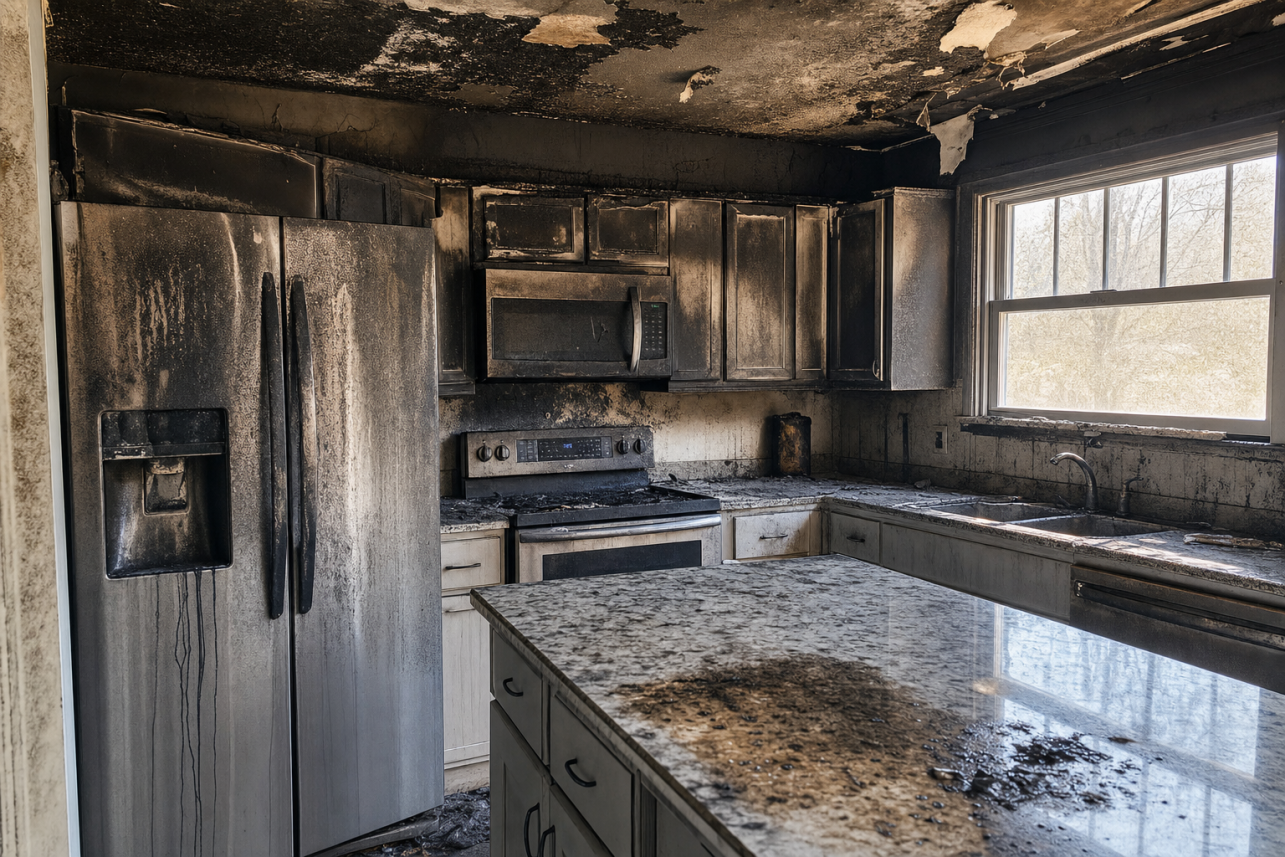
The Insurance Company Says My Smoke Damage Is Just Cosmetic Or Blames A Pre-Existing Odor. What Can I Do?
This is one of the most common pushbacks we see on smoke claims in Wake County, and it’s rarely accurate. Calling soot staining or smoke odor ‘cosmetic’ ignores what smoke residue actually does — it’s acidic, it corrodes wiring and metal fixtures over time, it degrades finishes, and odor compounds embed in porous materials like drywall, subfloor, and insulation. That’s physical damage, and your policy covers it.
The ‘pre-existing odor’ argument is a tactic, too. Insurers sometimes suggest the smell came from cooking, pets, or cigarettes rather than the fire event. We counter this with objective evidence: surface residue sampling, chemical sponge testing that identifies fire-specific soot, and documentation tying the contamination pattern directly to the loss date and the fire’s location.
As your Wake Forest public adjuster, we build the file the carrier can’t easily dismiss. We bring in independent testing when needed, write a remediation scope based on industry restoration standards rather than the insurer’s minimized version, and put every dispute in writing so there’s a paper trail if the claim needs to escalate.
If the carrier still won’t move, North Carolina policies include an appraisal provision that allows disputed values to be decided by independent appraisers — a formal process we can guide you through. Most claims never get that far once the insurer sees the documentation is airtight. The key is not accepting the ‘cosmetic’ label at face value, because settling on those terms means paying out of pocket for remediation your policy should have covered.
Do I Really Need Smoke Damage Claim Help Wake Forest For A Small Kitchen Fire?
Small kitchen fires are one of the most underpaid claim types we see, so yes — even a minor stovetop or oven fire deserves a serious look. The reason is protein smoke. When food burns, it releases a nearly invisible residue that bonds to painted surfaces, cabinets, and ductwork throughout the house, not just in the kitchen.
Protein residue often has no visible soot, so a quick walkthrough by the carrier’s adjuster tends to end with a small payment for repainting one room. Weeks later, homeowners notice the odor returning every time the HVAC kicks on, because the residue migrated through the return vents into rooms that were never inspected.
When we handle a Wake Forest kitchen fire claim, we test surfaces well beyond the visible damage, document contamination in the duct system, and scope the cleaning method the residue actually requires — protein smoke usually demands specialized degreasing agents and sometimes sealing and repainting, not a wipe-down.
We also inventory affected contents. Dishes, small appliances, pantry items, and textiles near the kitchen frequently need cleaning or replacement, and those items add up quickly. A claim the insurer values at a few thousand dollars can legitimately be several times that once the full scope is documented.
If your fire seemed minor but the smell keeps coming back, that is your home telling you the claim was scoped too narrowly. It costs nothing to have us evaluate it, and our fee only applies to what we recover for you.
Will My Policy Pay For A Hotel Or Rental While My Wake Forest Home Is Being Cleaned Of Smoke?
In most cases, yes. Nearly every homeowners policy sold in Wake County includes Additional Living Expenses coverage, often called ALE or Loss of Use. It pays the reasonable increase in your living costs when smoke contamination makes your home uninhabitable or unsafe to occupy during remediation.
That can include a hotel or short-term rental, restaurant meals above your normal grocery spending, pet boarding, laundry costs, and even added mileage if your temporary housing is farther from work or your kids’ schools. Families with respiratory conditions, infants, or elderly members often qualify for relocation even when the carrier initially says the home is livable.
The catch is that insurers rarely volunteer this coverage, and they frequently push families to stay in a smoke-contaminated house to save money. We see it constantly: a carrier approves cleaning but never mentions that the family is entitled to stay elsewhere while ozone treatment or thermal fogging is underway — processes you genuinely should not be home for.
As part of our work on smoke claims in Wake Forest, we document why the home is uninhabitable, notify the carrier in writing, and track every reimbursable expense so nothing is left off the settlement. We also fight the common tactic of cutting off ALE before repairs are actually finished.
Keep every receipt from day one, even if you have not filed yet. Hotel folios, food receipts, and mileage logs are the evidence that turns this coverage from theoretical into a real check.
My Smoke Claim Was Denied. Can Smoke Damage Claim Help Wake Forest Get It Reopened?
Very often, yes. A denial is the insurance company’s position, not the final word. In North Carolina, you generally retain the right to dispute a claim decision within your policy’s contractual limitation period — typically three years from the date of loss for most homeowners policies, though your specific policy language controls.
The first thing we do is get the denial letter and your full policy, then compare the carrier’s stated reason against what the policy actually says. Smoke denials in this area tend to fall into a few buckets: the carrier calls the damage pre-existing, claims the source of smoke is excluded, argues the damage falls under a maintenance issue, or simply says their inspector found nothing significant.
Each of those has a counter. We bring independent evidence — surface residue testing, photographs under proper lighting, contractor scopes, and documentation of the smoke source — that the original inspection usually never gathered. A denial built on a ten-minute walkthrough rarely survives a properly documented rebuttal.
Our team of Wake Forest public adjusters presents that evidence formally, requests reconsideration in writing, and if the carrier holds its position, we can invoke the appraisal clause in your policy or refer you to counsel for further options. Many denials reverse at the reconsideration stage once the insurer sees the file is being handled professionally.
Bring us the denial letter as soon as you can. The sooner we see it, the more evidence we can preserve before cleaning, weather, or time erases it.
The Insurance Company Wants To Send Their Own Cleaning Company. Should I Let Them Start Before My Claim Is Settled?
Be careful here. You have the legal right in North Carolina to choose your own contractor — you are never required to use the carrier’s preferred vendor, no matter how the offer is phrased.
There are two problems with letting the insurer’s vendor start early. First, that company works from a scope the insurance company approved, which means they clean only what the carrier agreed to pay for. If the scope missed smoke residue in the attic, the ductwork, or inside wall cavities, the vendor will not touch it, and once surfaces look clean, proving the missed damage becomes much harder.
Second, cleaning destroys evidence. Soot patterns, residue samples, and odor sources are the proof that supports your claim’s full value. If everything is wiped down before the loss is properly documented, you may never recover what the damage was actually worth.
Our recommendation for homeowners in Wake Forest is to document first, remediate second. Take mitigation steps to prevent further damage — that is your policy duty — but hold off on full cleaning until the loss has been photographed, tested, and scoped. That usually takes days, not weeks, so you are not delaying real recovery.
When For The Public Adjusters, Inc. handles the claim, we coordinate the timing: evidence preserved, scope agreed, and then a contractor of your choosing does the work at pricing the settlement actually supports. You end up with a properly cleaned home instead of a fast, shallow job that leaves odor behind.
How Do You Actually Prove Smoke Damage To An Insurance Company? Can Smoke Damage Claim Help Wake Forest Include Lab Testing?
Yes, and testing is often the difference between a lowball offer and a full settlement. Smoke Damage Claim Help Wake Forest starts with a room-by-room inspection, but when an insurer pushes back, we escalate to objective proof they can’t argue with.
That proof typically includes chemical sponge (chem sponge) wipe tests that show soot residue on walls and ceilings that look clean to the naked eye, plus laboratory analysis of surface samples for char, ash, and combustion byproducts. For HVAC systems, we document soot inside ductwork and on coils with photos and, when needed, third-party hygienist reports.
We also build a written narrative connecting the fire event to the damage: the date of loss, wind direction if smoke came from outside, and the migration path through the home. Soot travels on air currents and settles behind furniture, inside closets, and in attic insulation, so we photograph those areas specifically.
For personal property, we create a detailed inventory with photos, model numbers, and replacement pricing rather than accepting the insurer’s flat cleaning allowance. Fabrics, electronics, and porous items like books and mattresses often can’t be restored, and we document why.
Wake Forest homeowners frequently tell us their insurer’s inspector spent twenty minutes on site and declared the damage cosmetic. Our inspections regularly take several hours because that documentation is what forces a fair number. If your carrier has questioned whether real damage exists, independent testing puts the burden of proof back where it belongs.
My Furnace Puffed Back And Blew Soot Through The Whole House. Is That Covered Like A Fire Claim?
In most cases, yes. A puff-back — when a furnace or oil burner misfires and forces soot and smoke through the duct system — is generally a covered peril under standard homeowners policies, and it deserves to be handled with the same seriousness as a fire claim.
The problem is that puff-back damage is deceptively widespread and insurers routinely underestimate it. The soot is oily, sticky, and travels through every register in the house. It coats walls, ceilings, curtains, clothing in closets, and the inside of cabinets. Standard cleaning products often smear it and make it worse, which is why proper restoration usually requires specialized degreasers, sealing primers, and sometimes repainting entire rooms.
Carriers frequently offer a light cleaning estimate for a puff-back when the correct scope includes duct cleaning or replacement, HVAC servicing, contents cleaning or replacement, and repainting. We’ve seen initial offers in the low thousands on losses that legitimately scoped out several times higher once every affected surface was documented.
If this happened in your home here in Wake Forest, don’t run the HVAC system — that recirculates soot and spreads contamination further. Photograph the registers, the furnace area, and visible soot patterns before anything is touched. Then have a Wake County public adjuster inspect before you accept the insurer’s estimate. Puff-backs are one of the most consistently underpaid claim types we see, and thorough documentation early makes a significant difference in the outcome.
The Estimate Mentions Depreciation And ‘actual Cash Value.’ Why Isn’t The Insurance Company Paying The Full Amount Up Front?
Most homeowners policies pay smoke and fire losses in two stages, and understanding this prevents a lot of money from being left on the table.
The first check is usually the actual cash value (ACV) — the replacement cost minus depreciation for age and wear. The withheld depreciation, called recoverable depreciation, is paid later once you actually complete the repairs or replace the damaged items and submit proof, typically receipts or a contractor’s invoice.
Here’s where Wake Forest homeowners get shortchanged. First, insurers sometimes apply aggressive depreciation — depreciating a five-year-old painted wall as if it were twenty, or knocking 60% off contents that were nearly new. Second, many people never file for the recoverable depreciation at all because nobody explained they were entitled to it, and it quietly expires under policy deadlines. Third, some items shouldn’t be depreciated the way they were, and those line items can be challenged.
As your public adjuster, we review every depreciation calculation, push back on unreasonable percentages, and track the deadlines so the second payment actually gets collected. We also make sure the replacement cost basis is right in the first place — if the initial scope undervalues the repair, both checks come up short.
If you’re holding an ACV check right now and aren’t sure what you’re still owed, bring us the estimate. Recovering withheld depreciation and correcting undervalued line items is one of the most common ways we increase a settlement, even on claims the homeowner assumed were finished.
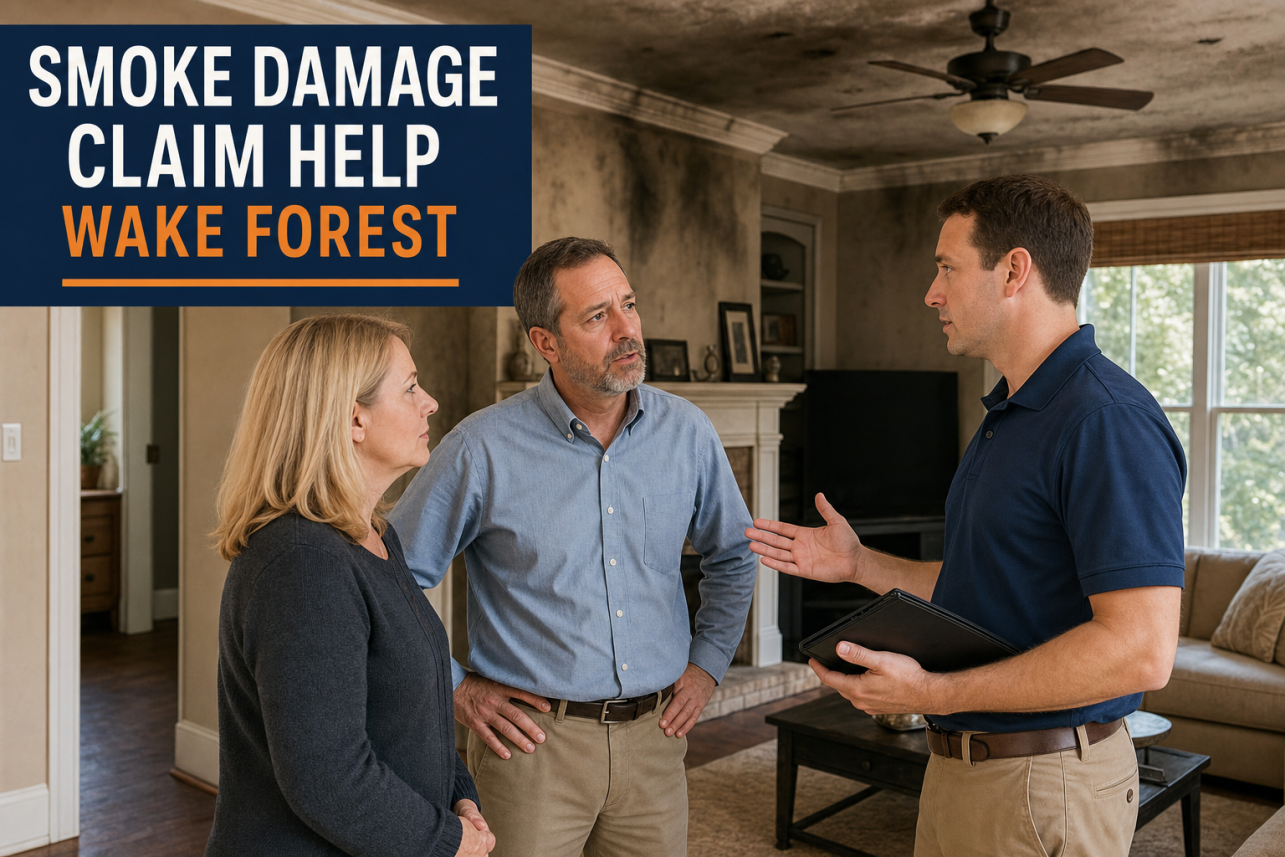
My Mortgage Company’s Name Is On The Settlement Check. How Does Smoke Damage Claim Help Wake Forest Deal With That?
This surprises almost everyone, but it’s standard: if you have a mortgage, your lender is listed on your policy and will be named as a payee on structural damage checks. The lender has a financial interest in the home, so they get a say in how repair funds are released. Smoke Damage Claim Help Wake Forest includes guiding you through that lender process so your money doesn’t sit in escrow longer than it should.
Here’s how it typically works. You endorse the check and send it to the mortgage company’s loss draft department. For smaller amounts, many lenders endorse and return it quickly. For larger settlements, they usually hold the funds and release them in installments tied to repair progress, often requiring a signed contractor agreement, a W-9, and inspections at set milestones.
Where Wake Forest homeowners run into trouble is paperwork delays — a missing form or an inspection that never got scheduled can stall funds for weeks while your contractor waits. We help you assemble the loss draft package correctly the first time, coordinate the required inspections, and follow up with the lender so releases happen on schedule.
Two things worth knowing: checks for personal property and additional living expenses are typically made out to you alone, without the lender, so those funds are yours to use directly. And the lender’s involvement doesn’t change what the insurer owes — it only affects how structure money flows. If a check with your mortgage company’s name on it has you stuck, call us and we’ll walk you through the exact steps for your lender.
Local Relevance
Wake Forest’s housing stock is a real mix: older homes with original plaster, hardwoods, and balloon-framed walls near the historic downtown, and fast-built subdivisions from the past few decades on the town’s edges. Both create smoke problems insurers underestimate — older wall cavities let soot travel between floors, while newer open floor plans and shared HVAC returns spread residue through the entire house in minutes.
Our humid North Carolina climate makes it worse. Moisture in the air binds with smoke residue and drives odor deeper into drywall, insulation, and fabrics, which is why a home that ‘aired out’ in October can smell like the fire again on the first muggy day of spring.
We work these claims all over Wake County, from a smoke damage insurance claim in Holly Springs to fire losses in Garner, so we know how the carriers writing policies in this market scope, price, and push back on Triangle smoke losses.
Because so much of Wake Forest was built in the last twenty-five years with open floor plans and centrally ducted HVAC, even a contained kitchen fire often pushes soot and odor into every room of the house — which is why we test and document the whole home, not just the space the carrier’s adjuster wants to scope.
Smell Smoke Long After The Fire? Let’s Look At Your Claim
For The Public Adjusters, Inc. is licensed and bonded, and we work only for policyholders — never for insurance companies. Before you accept the carrier’s number or sign anything, get a free review of your policy and your damage from a Wake Forest local who handles these losses every week. There is no obligation, and no fee unless we recover for you.
Call us: (919) 400-6440
Helpful Resources
- National Fire Protection Association (NFPA)
- NCDOI Public Adjusters Guide
- North Carolina Department of Insurance — State regulator overseeing insurers and public adjusters
Serving Wake Forest · Wake
Last updated: September 11, 2026