
A Tree Fell on House and Roof — Here’s the Quick Answer for NC Homeowners
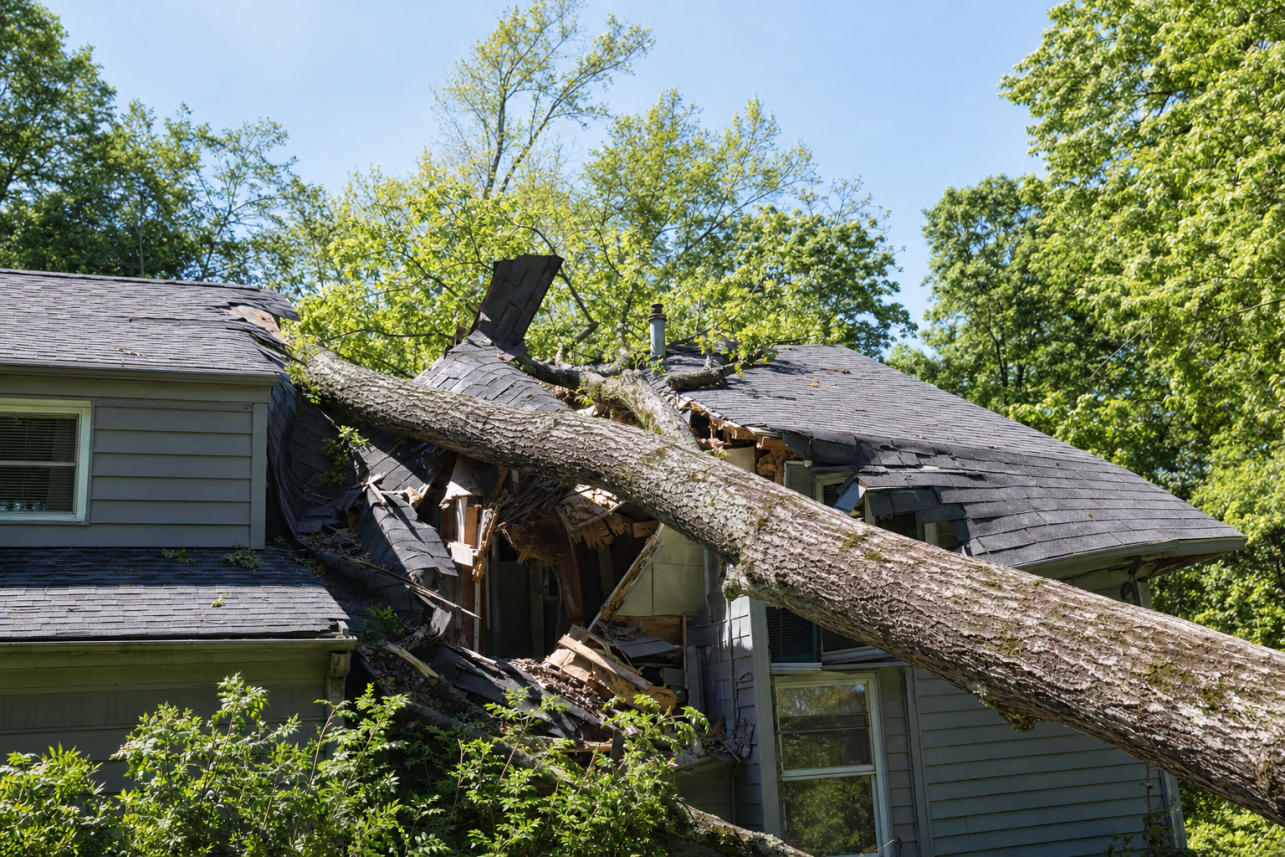
If a tree fell on house or roof structures you own in North Carolina, a standard HO-3 homeowners policy covers the damage on an open-perils basis — meaning the insurer must point to a specific written exclusion to deny your claim. Removing the tree itself is paid separately under debris removal coverage, which carries per-tree and per-occurrence caps.
Key takeaways
- If a tree fell on house structures, your HO-3 covers the building on an open-perils basis, meaning the insurer must point to a specific policy exclusion to deny the claim.
- Under North Carolina law, once you show a sudden, accidental loss under an open-perils policy, the burden shifts to the insurer to prove an exclusion applies — a principle affirmed in Avis v. Hartford Fire Insurance Co., 283 N.C. 142 (1973), where the policyholder prevailed.
- Removing the fallen tree itself is a separate ‘debris removal’ additional coverage with its own per-tree and per-occurrence caps that many NC homeowners never claim.
- A neighbor’s healthy tree that falls on your home is generally your own policy’s claim to file — you do not have to wait on the neighbor or their insurer.
- Read your declarations page before accepting a denial: structure repair, debris removal, and additional living expenses are separate buckets, and each one may owe you something.
That two-part answer surprises a lot of homeowners. The repair to your roof, walls, deck, or attached garage falls under Coverage A (Dwelling), and because HO-3 is a “special form” policy, everything is covered unless the policy explicitly says otherwise. The cost of cutting up and hauling away the tree is a different bucket of money — debris removal — and it is money many North Carolina homeowners never claim because no one tells them it exists.
Why Fall Is Peak Season for Fallen Trees in NC
Autumn in North Carolina sets up trees to fail. Weeks of rain leave soil saturated and loose around root systems, limbs are still heavy with leaves, and the first cold-snap winds of the season arrive before trees have shed that weight. The combination brings pines and hardwoods down onto roofs from the coast to the Piedmont. Homeowners who work with a public adjuster in Garner and across the Triangle see the same pattern every fall: sudden, dramatic damage — and a claim that gets more complicated than it should.
The Key Points, at a Glance
- Structure damage: Covered under your dwelling coverage on an open-perils basis. The burden is on the insurer to cite an exclusion, not on you to prove a covered cause.
- Tree removal: Paid under separate debris removal coverage, typically subject to a per-tree limit and a per-occurrence cap. Ask for this in writing — it’s frequently left off settlements.
- Whose tree it was usually doesn’t matter: Even if a neighbor’s tree landed on your home, your own policy generally responds first.
- Additional living expenses: If the damage makes your home unlivable, your policy may pay for temporary housing while repairs are made.
North Carolina courts have long held insurers to their promises. In Gray v. North Carolina Insurance Underwriting Association, the North Carolina Supreme Court allowed homeowners to pursue claims against their insurer for bad-faith handling of a claim for storm damage to their dwelling — a reminder that policyholders here have real legal footing when a carrier drags its feet or lowballs a structural loss.
The sections below walk through exactly how the coverage works, the debris removal limits, and what to do in the first hours after impact. If you’re already staring at a tarp on your roof, a licensed and bonded public adjuster in Archer Lodge NC or your local area can review your policy before you accept the insurer’s first number.
How Does an HO-3 ‘Special Form’ Policy Cover Tree Damage When a Tree Fell on House Structures?
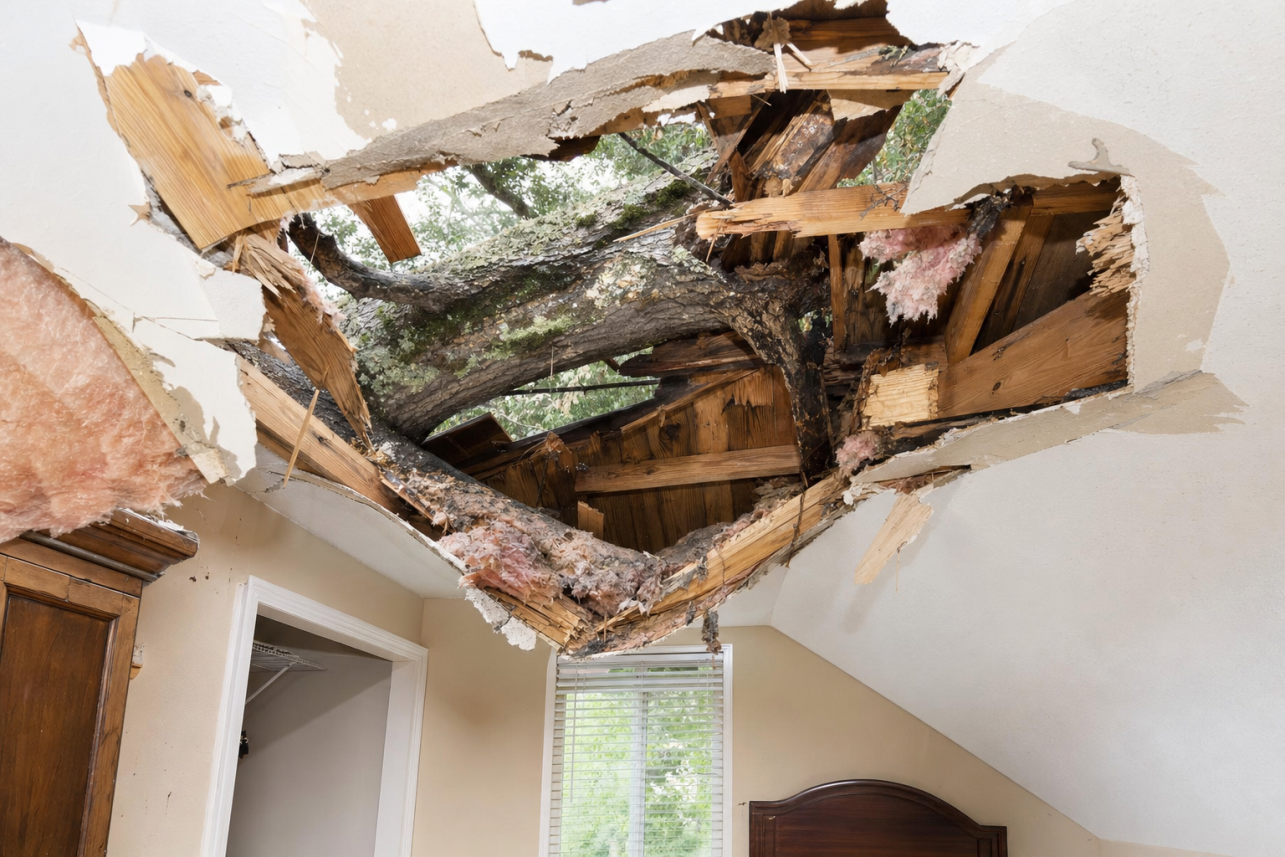
An HO-3 policy covers your dwelling on an “open perils” (special form) basis, meaning tree damage to your home is covered unless the insurer can point to a specific written exclusion. The burden of proof rests on the insurance company — not you — to show why a tree-on-house claim should not be paid.
This distinction matters more than most homeowners realize. Many people assume they must prove exactly what caused their loss before the insurer owes anything. With an HO-3, the opposite is true for the structure itself. If a tree fell on house framing, your roof, siding, gutters, or an attached garage, the starting presumption is that the damage is covered.
Open Perils vs. Named Perils: Why the Difference Matters
- Dwelling (Coverage A) and other structures (Coverage B): Insured on an open-perils basis — everything is covered except what the policy specifically excludes.
- Personal property (Coverage C): Usually insured on a named-perils basis, and “falling objects” is one of the listed perils — so contents crushed when a tree comes through the roof are typically covered too.
- Common exclusions insurers cite: wear and tear, rot, and neglect. But the insurer must actually prove the exclusion applies to your specific loss, not simply assert it.
North Carolina Courts Put the Burden on the Insurer
North Carolina law backs this up. In Avis v. Hartford Fire Insurance Co. (1973), the North Carolina Supreme Court considered an all-risk property policy and held that the policyholder prevailed because, under all-risk (open-perils) coverage, it is the insurance company that must prove an exclusion applies — the homeowner does not have to disprove every possible excluded cause. That principle still shapes how special form claims should be evaluated in NC today, and it’s a powerful tool when an adjuster tries to shift the burden back onto you. Policyholders who understand this — often with help from a licensed public adjuster in Pittsboro NC or elsewhere in the Triangle — are in a much stronger position to push back on a vague or unsupported denial.
What This Means for Your Tree Damage Claim
Practically speaking, if your carrier wants to deny or reduce your claim by blaming pre-existing rot or deferred maintenance, it must produce actual evidence that the exclusion caused the loss. A healthy tree toppled by a storm onto your roof is a textbook covered event under an HO-3. Where disputes arise is in the gray areas — partial rot, older roofs, or mixed causes — and that’s where documentation and policy knowledge become critical. Homeowners working with a public adjuster near Archer Lodge NC often find that simply holding the insurer to its legal burden of proof changes the conversation.
The bottom line: under a special form policy in North Carolina, coverage is the rule and exclusion is the exception — and the insurer has to prove the exception.
Who Pays to Remove the Tree — and What Are the Debris Removal Limits After a Tree Fell on House?
Your homeowners insurance typically pays to remove a fallen tree under a separate “debris removal” additional coverage — but only in certain situations, and with modest caps. Many policies allow up to $500 per tree and $1,000 per occurrence, and removal is generally covered only when the tree struck a covered structure or blocked access.
This is one of the most misunderstood line items in a property claim. Debris removal is not part of your dwelling coverage — it is an additional coverage with its own rules and its own dollar limits. Knowing how it works helps you make sure every dollar you are owed actually shows up in the settlement.
When Tree Removal Is Usually Covered
Most standard homeowners policies pay to remove a fallen tree from your property when at least one of these conditions is met:
- The tree hit a covered structure — the house itself, a detached garage, a fence, a shed, or another insured building.
- The tree is blocking a driveway, preventing a vehicle from entering or leaving the property.
- The tree is blocking a ramp or other fixture designed to assist a handicapped person.
If a tree simply falls in the yard without touching a structure or blocking access, most policies will not pay to haul it away — even if the cleanup is expensive. That distinction surprises a lot of North Carolina homeowners after a storm.
Typical Dollar Limits to Watch For
- Per-tree cap: often around $500 for any one tree.
- Per-occurrence cap: often around $1,000 total, no matter how many trees came down in the same event.
Check your own declarations page and policy forms, because some carriers offer higher limits by endorsement. If several large trees fell in one storm, the per-occurrence cap can fall well short of the actual cleanup bill — worth knowing before you sign a contract with a tree service.
Why This Coverage So Often Goes Unclaimed
In practice, debris removal money is frequently missed or mishandled in one of two ways. First, homeowners never claim it because they do not know it exists as a separate coverage. Second, adjusters sometimes lump tree removal into the structural repair estimate, where it gets absorbed into the dwelling limit and deductible rather than paid as the additional coverage it is. Claims professionals like a Public Adjuster in Chapel Hill NC routinely find debris removal listed incorrectly — or not at all — when reviewing carrier estimates after a tree fell on a house.
The fix is straightforward: keep your tree removal invoice separate from your repair invoices, ask the carrier to identify exactly which coverage each payment comes from, and confirm the debris removal line item appears in the settlement breakdown. If the paperwork is confusing or the payment does not add up, a licensed Public Adjuster in Pittsboro NC can review the estimate and make sure this additional coverage is applied correctly under your policy’s terms.
What Should I Do After a Tree Fell on House and Roof in North Carolina?
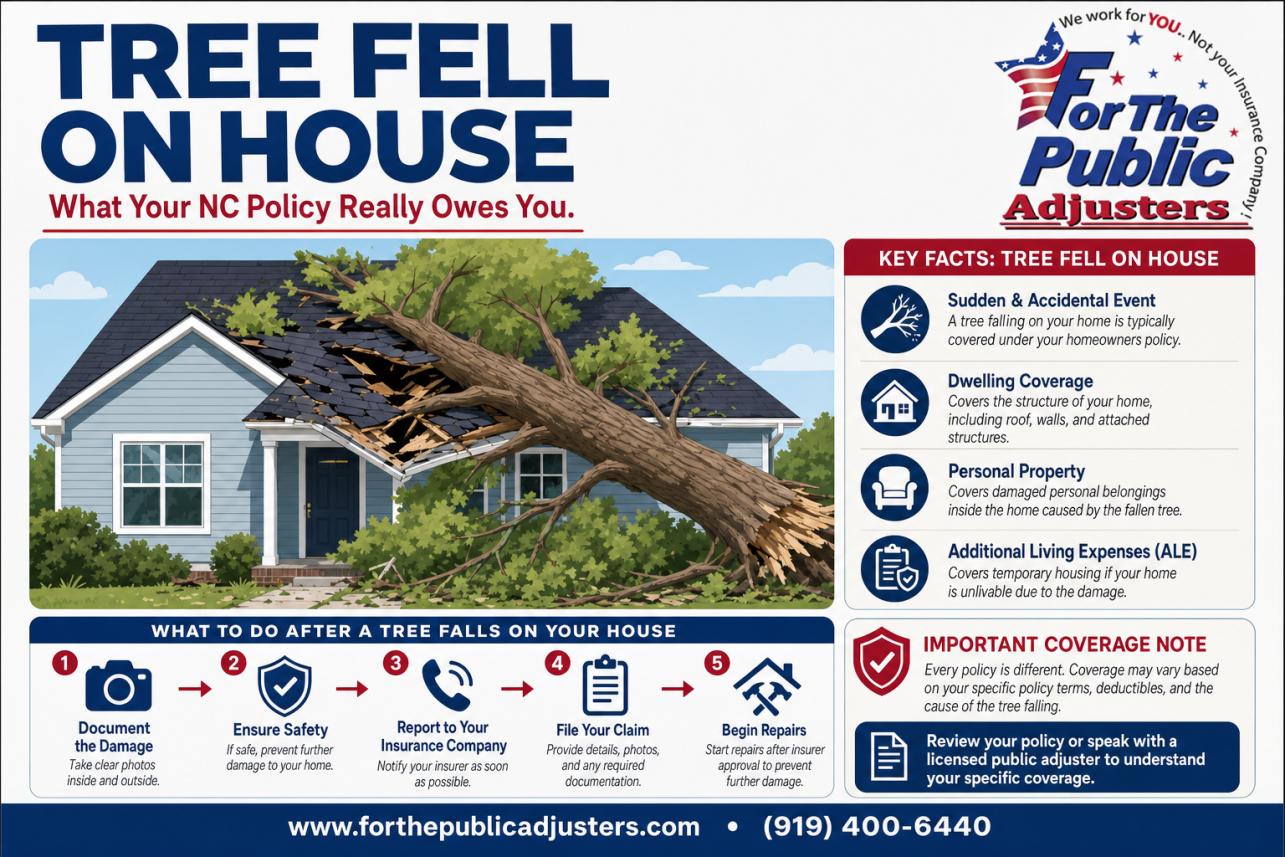
Get everyone out safely, photograph all damage before anything is moved, tarp or board up to prevent further water damage, save every receipt — including tree service invoices — and report the claim to your insurer in writing. Be cautious with recorded statements and don’t accept a fast, first-offer settlement before the full scope of damage is known.
Step 1: Safety Comes First
A tree strike can crack rafters, sever electrical lines, and rupture gas lines. Evacuate the affected rooms, and if you smell gas or see downed power lines, leave the house and call 911 and your utility company. Do not climb onto the roof — leave that to professionals with proper equipment.
Step 2: Photograph Everything Before Cleanup
Once it’s safe, document the scene exactly as the storm left it. Take wide shots and close-ups of:
- The tree on the structure, from multiple angles, showing where it originated
- Roof, siding, gutter, and window damage — inside and out
- Interior ceilings, walls, floors, and any wet or damaged contents
- Attic damage, if you can access it safely
Once a tree crew removes the trunk, that evidence is gone forever. Adjusters rely heavily on photos, and homeowners who document thoroughly are far harder to underpay. Serious wind-driven losses — like the hurricane and tornado damage handled in a wind damage claim in Raleigh NC — are often won or lost on the strength of early documentation.
Step 3: Mitigate Further Damage
Your policy requires you to take reasonable steps to protect the property from additional harm. In North Carolina, fall rain and sudden cold snaps can turn a punctured roof into a soaked, mold-prone interior within days. Have the opening tarped or boarded promptly. Mitigation is not the same as permanent repair — don’t let anyone push you into full repairs before the insurer inspects.
Step 4: Keep Every Receipt
Save invoices for tarping, tree removal, emergency board-up, hotel stays if the home is unlivable, and anything else the loss forces you to spend. These costs are frequently reimbursable, but only if you can prove them.
Step 5: Report the Claim in Writing
Notify your insurer promptly and follow up in writing — email creates a record that a phone call doesn’t. Two cautions: recorded statements can be used to narrow your claim, so answer factually without guessing at causes, and be wary of quick lowball checks issued before hidden structural or water damage is uncovered. Courts have repeatedly sided with policyholders when insurers read coverage too narrowly — in Balandran v. Safeco Insurance Co., the Texas Supreme Court held that ambiguous homeowners policy language must be construed in the insured’s favor, a principle NC courts also follow. If the process starts feeling adversarial, an experienced Public Adjuster in Chapel Hill NC can review the insurer’s position before you sign anything.
Why Do Insurers Underpay or Deny Claims After a Tree Fell on House?
Insurers most often underpay tree damage claims by blaming pre-existing rot or “neglect,” scoping only the visible roof hole while missing framing and interior water damage, skipping debris removal coverage, and over-depreciating repairs. Because an HO-3 is an open-perils policy, the insurer — not you — must prove an exclusion applies, which gives homeowners real leverage.
None of these tactics means your claim is hopeless. It usually means the carrier’s first offer is a starting point, not the final word. Here are the patterns NC homeowners see most often.
Blaming Rot, Decay, or “Neglect”
Adjusters sometimes point to a soft spot in the trunk and argue the tree was diseased, so the loss was “preventable” and excluded under a neglect or maintenance provision. But a rotten tree does not automatically defeat coverage — the covered peril is typically the windstorm that pushed the tree onto your home, not the tree’s condition. Unless the carrier can prove the damage was caused by an excluded condition rather than the storm, the exclusion should not stick.
Paying for the Hole, Ignoring What’s Underneath
A tree strike rarely stops at the shingles. Common under-scoped items include:
- Cracked or shifted rafters, trusses, and ridge beams that a rooftop-only inspection misses
- Interior water damage to insulation, drywall, and flooring from rain entering before the tarp went on
- Damaged gutters, fascia, siding, chimneys, and attached structures like porches or carports
- Hidden moisture that can lead to mold if repairs are delayed
If the estimate reads like a simple roof patch after a large tree came through your ceiling, the scope is almost certainly incomplete.
Omitting Debris Removal and Over-Depreciating
Some estimates leave out debris removal coverage entirely, even though the policy provides it. Others apply aggressive depreciation to roofing and structural repairs, shrinking the actual cash value check far below what contractors actually charge. Reviewing the estimate line by line against your policy language frequently uncovers money that was simply left off. Homeowners dealing with hurricane or tornado losses — like a wind damage claim in Raleigh NC — run into these same shortfalls.
The Burden of Proof Is on Your Side
Under an open-perils HO-3 policy, you only need to show that a sudden physical loss occurred. The insurer then carries the burden of proving a specific exclusion applies. The North Carolina Supreme Court reinforced this in Avis v. Hartford Fire Insurance Co. (1973), holding that under an all-risk policy the insured’s burden is simply to show the loss happened — the insurer must prove the loss falls within an exclusion. That framework is powerful: vague talk of “rot” or “wear and tear” is not proof.
Pushing back effectively often comes down to documentation and policy knowledge. A licensed public adjuster in Chapel Hill NC or elsewhere in the Triangle can hold the carrier to that burden and ensure the full scope of damage is on the table.
When Should an NC Homeowner Call a Public Adjuster After a Tree Fell on House?
Call a licensed public adjuster when the damage is significant, when you suspect hidden structural or interior problems, or when the insurer’s estimate feels low or the claim stalls. A public adjuster works only for you — documenting the loss, preparing a complete estimate, and negotiating with the carrier on your behalf.
What a Licensed, Bonded Public Adjuster Actually Does
Unlike the adjuster your insurance company sends, a public adjuster represents the policyholder. In North Carolina, public adjusters are licensed and regulated by the North Carolina Department of Insurance, and reputable firms are also bonded. When a tree fell on house and roof structures, a public adjuster typically handles:
- Independent documentation — a thorough inspection that goes beyond what’s visible from the street, including attic framing, rafters, decking, ceilings, and interior finishes.
- A complete estimate — one that captures hidden structural damage, water intrusion, and every additional coverage your policy provides, such as debris removal and code-upgrade allowances.
- Claim management and negotiation — handling communications, meeting the carrier’s adjuster on site, and pressing for a settlement that reflects the full scope of the loss.
Signs It’s Time to Get Independent Help
- The insurer’s estimate covers shingles but ignores cracked rafters, shifted framing, or interior water damage.
- Debris removal, temporary repairs, or additional living expenses were left out of the settlement.
- Your claim has been delayed, disputed, or partially denied without a clear explanation.
- The damage is large enough that a mistake in the estimate could cost you thousands.
Courts have repeatedly recognized that policyholders can — and do — prevail when insurers read coverage too narrowly. In Western Fire Insurance Co. v. First Presbyterian Church, the Colorado Supreme Court sided with the insured, holding that damage rendering a building unusable qualified as a direct physical loss even though the carrier had resisted the claim. The lesson for homeowners is simple: an insurer’s first answer is not always the final word.
If you’re in the Triangle area and dealing with a tree loss, a local Public Adjuster in Clayton NC can inspect the property, review your policy language, and tell you honestly whether the carrier’s offer holds up.
Why a Free Policy Review Costs You Nothing
Most public adjusters offer a no-cost, no-obligation review of your policy and the insurer’s estimate. If everything checks out, you’ve lost nothing but a little time. If something was missed, you’ll know before you cash a settlement check. To be clear — no one can guarantee a specific outcome on any claim, and you should be wary of anyone who promises one. You can also verify any adjuster’s license through resources like the National Association of Insurance Commissioners. Homeowners in Wake County can reach an experienced Public Adjuster in Apex NC for that same free review before making any final decisions on a tree damage claim.
Tree Fell on House: Which Coverage Pays for What Under an HO-3
| What Was Damaged or Needed | Policy Coverage That Responds | How Coverage Works | What to Watch For |
|---|---|---|---|
| Roof, walls, and attached structures | Coverage A (Dwelling) — open perils | Covered unless the insurer proves a specific exclusion applies | Insurer bears the burden of proof, not you |
| Detached garage, shed, or fence | Coverage B (Other Structures) | Typically a percentage of your dwelling limit | Limit is often around 10% of Coverage A — check your declarations |
| Hauling away the fallen tree | Debris Removal (additional coverage) | Separate allowance with per-tree and per-occurrence caps | Routinely left unclaimed; typically capped in the hundreds per tree |
| Furniture and belongings damaged inside | Coverage C (Personal Property) | Usually named-perils; falling objects are a listed peril | Document everything with photos and an inventory |
| Temporary housing during repairs | Coverage D (Loss of Use / ALE) | Pays reasonable extra living costs if the home is unlivable | Keep receipts; this is separate from repair dollars |
Illustrative Example: A Storm-Felled Oak in the Piedmont
Illustrative example
This is a hypothetical composite, not a real client matter. Imagine a Piedmont homeowner whose mature oak came through the roof during a summer thunderstorm — the insurer paid for the roof decking but said nothing about the tree still lying across the back porch. Because the HO-3 covers the dwelling on an open-perils basis, the structural repair was owed unless the carrier could point to a specific exclusion, and the debris removal additional coverage separately addressed hauling the tree away, subject to its per-tree and per-occurrence caps. Once the homeowner claimed each coverage bucket by name and documented the loss thoroughly, the settlement addressed the roof, the porch, and the removal — not just the hole in the shingles. The lesson: the tree and the house are two different claims living inside one policy, and it pays to pursue both.
Frequently asked questions
A tree fell on my house — what should I do first?
Make sure everyone is safe and stay out of any room under the damage. Then take photos and video of the tree, the roof, and any interior damage before anything is moved. Cover openings with a tarp to prevent further water damage — your policy requires reasonable steps to protect the home, and those emergency costs are typically reimbursable. Report the claim promptly and keep every receipt.
Can my insurance company deny my claim by saying the tree was rotten or I neglected it?
They can try, but under an open-perils HO-3 policy the burden is on the insurer to prove a specific exclusion applies — not on you to prove the tree was healthy. Courts have enforced this burden in homeowners’ favor; in Corban v. USAA (Miss. 2009), a Hurricane Katrina home-damage case, the court held the insurer must prove an exclusion applies. If you get pushback, an arborist’s report can be powerful evidence.
My neighbor’s tree fell on my house — does my insurance or theirs pay?
In most cases, your own homeowners policy pays for damage to your house, regardless of whose tree it was. Your insurer may then pursue the neighbor’s carrier if the neighbor was negligent — for example, if they ignored written warnings about a visibly dead tree. Don’t delay your own claim waiting on the neighbor; file with your carrier first and let subrogation sort out fault later.
Does homeowners insurance pay to remove the tree, or just fix the house?
Both, but under different parts of the policy. Repairs to the structure fall under your main dwelling coverage. Hauling away the fallen tree falls under a separate debris removal provision with its own dollar limits. A practical tip: ask your tree service and contractor for separate, itemized invoices so removal costs and repair costs are applied to the correct coverage instead of getting lumped together and shortchanged.
What if the tree fell in my yard but missed the house — is removal still covered?
Usually not, if nothing insured was damaged. Most policies only pay debris removal when the tree damages a covered structure, though many forms make an exception if the tree blocks your driveway or a handicap-access ramp. Read your policy’s debris removal language carefully — the wording varies by insurer, and this is one area where homeowners often assume coverage that isn’t there, or miss coverage that is.
How long does a tree damage insurance claim take in North Carolina?
A straightforward claim — clear damage, cooperative adjuster — can resolve in a few weeks. Claims involving structural damage, disputes over rot or maintenance, or disagreement about repair costs can stretch to several months. You can keep things moving by documenting everything early, responding to requests quickly, and getting your own contractor estimate rather than waiting on the insurer’s numbers alone. Slow, unexplained delays can be reported to the NC Department of Insurance.
The insurance payout isn’t enough to fix my roof — what are my options?
First, ask for the adjuster’s full estimate and compare it line by line with your contractor’s. Submit a supplement with photos and pricing for anything missed — hidden decking damage is common. If you’re still apart, most policies include an appraisal clause for disputes over the amount of loss, and you can file a complaint with the NC Department of Insurance or consult a licensed public adjuster or attorney.
Should I hire a public adjuster after a tree hits my house?
It depends on the size and complexity of the loss. For minor, clearly documented damage, handling it yourself is often fine. For significant structural damage, interior water intrusion, a lowball estimate, or a denial, a licensed and bonded public adjuster can document the full scope of loss and negotiate on your behalf. No one can guarantee a specific outcome, but professional documentation frequently uncovers damage the first estimate missed.
What mistakes do homeowners make with tree damage claims?
The big ones: having the tree hauled off before photographing it and the damage, throwing away receipts for tarps and emergency work, accepting the first estimate without a contractor’s second opinion, forgetting to claim debris removal as its own coverage, and signing repair contracts with door-knocking crews right after a storm. Also, don’t give a recorded statement guessing about the tree’s condition — stick to facts you actually know.
Will filing a claim for a fallen tree raise my homeowners insurance rates?
It can be a factor, since claims history affects pricing, but a single weather-related claim generally carries less weight than multiple claims or liability losses. Weigh the repair cost against your deductible: if the damage barely exceeds it, paying out of pocket may make sense. For serious structural damage, filing is almost always the right call — that protection is exactly what you’ve been paying premiums for.
Arson Homeowners Claim help near you
Related local pages
Get a free claim review from a licensed, bonded NC public adjuster before you accept the insurance company’s number. Get in touch.
Last updated: November 11, 2026