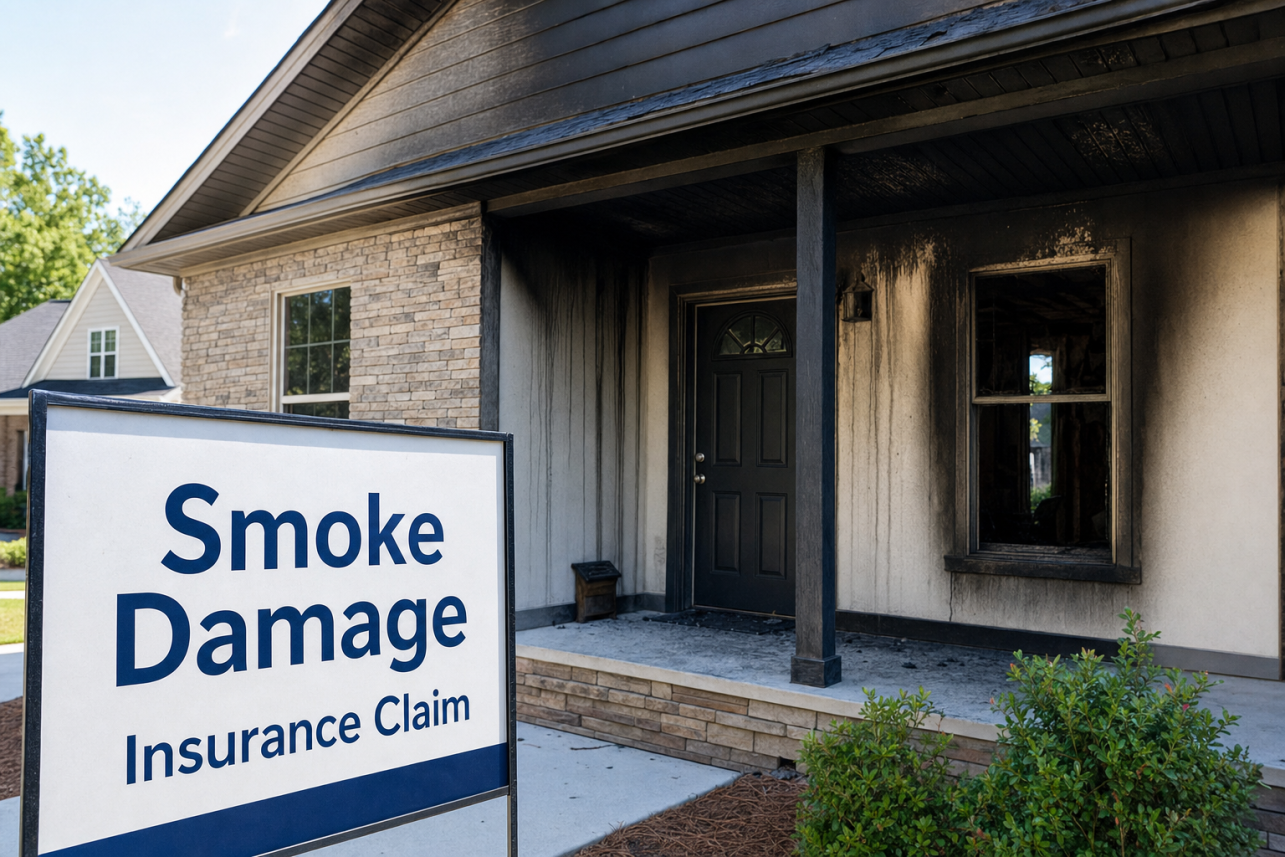
A Smoke Damage insurance Claim Holly Springs homeowners file after a kitchen fire, furnace malfunction, or nearby blaze often gets undervalued because smoke travels far beyond what the eye can see. For The Public Adjusters, Inc. represents you — not the insurance company — documenting soot in duct systems, odor absorbed into drywall and furnishings, and contents damage room by room. We are licensed and bonded in North Carolina, and we handle the claim from inspection through settlement negotiation so nothing gets left off the estimate.
What This Service Is
Smoke damage is its own category of loss, separate from the flames themselves. Even a small cooking fire can push acidic soot through an entire home, corroding electronics, staining walls, and embedding odor in carpet, insulation, and closets two floors away.
A public adjuster is a state-licensed professional who works exclusively for the policyholder. The North Carolina Department of Insurance regulates our license, and its NCDOI Public Adjusters Guide explains the role plainly: we assess the damage, prepare and document the claim, and negotiate with your insurer on your behalf.
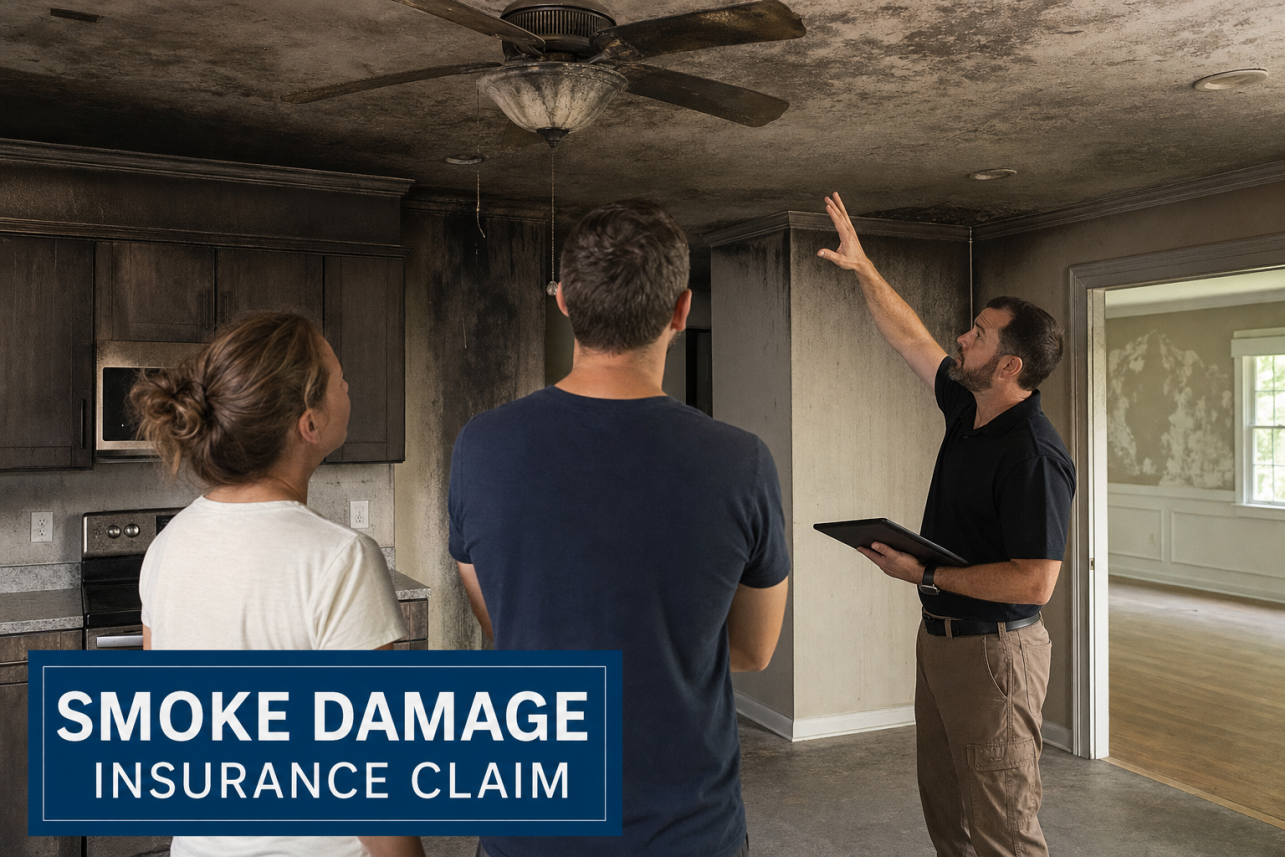
For smoke losses in the Holly Springs area, that means a full assessment — testing surfaces for residue, inspecting the HVAC system where soot collects, building a room-by-room contents inventory with valuations, and preparing the proof of loss your policy requires. We also flag secondary water damage from firefighting efforts, which insurers frequently treat as an afterthought.
Because smoke claims sit alongside fire, water, and other residential losses, our team handles the related pieces too — from a full fire damage claim to disputes that need escalation. If a claim involved a cell phone, vehicle, health, or life policy, that would fall outside our work; buildings, homes, and their contents are what we do.
Common Problems
The Insurance Company’s Offer Only Covers Repainting — Is That Really All My Smoke Damage Is Worth?
Almost never. A quick walk-through by the insurer’s adjuster tends to price visible staining and stop there. But smoke penetrates wall cavities, attic insulation, and ductwork, and acidic soot keeps corroding metals and electronics for weeks after the fire is out.
There is also a valuation trap in your own policy: actual cash value versus replacement cost. If depreciation deductions are applied to your furniture, clothing, and appliances, a lowball figure can look official while leaving you paying out of pocket to actually restore your home. We calculate personal property loss item by item, at the values your policy genuinely allows, and check your coverage limits so you know the real ceiling before negotiating.
Smoke Damage Insurance Claim Holly Springs Delays And Denials — What Do You Do When The Insurer Says No?
Denials and slow-walked claims usually hinge on documentation, and that is fixable. Common excuses include ‘pre-existing conditions,’ ‘cleaning is sufficient,’ or a proof of loss the insurer says was incomplete or late. Every policy has claim filing deadlines, and missing one can genuinely hurt you — which is why we manage the paperwork and the clock.
Courts have sided with policyholders who push back. In Bi-Economy Market, Inc. v. Harleysville Insurance Co. of New York (2008), a family business destroyed by fire and smoke fought its insurer’s delays and lowball handling all the way to New York’s highest court — and won the right to pursue damages beyond the policy limits caused by the insurer’s own conduct. You should not need a lawsuit to be treated fairly, but that case shows insurers can be held accountable. When a dispute does escalate, we coordinate with insurance dispute lawyers so your claim keeps moving.
Can I Just Handle The Claim Myself, And What Does A Good Public Adjuster Actually Do Differently?
You can file on your own, and for a very small loss that may be fine. The problem with smoke is that most of the damage is hidden — in the HVAC system, behind cabinets, inside upholstered furniture — and if it never makes it into the written claim, it never gets paid.
A capable public adjuster brings an independent damage appraisal, knows what restoration by trained technicians actually costs, and understands standards like those the Institute of Inspection Cleaning and Restoration Certification sets for soot and odor removal. Ask any adjuster you consider three things: Are you licensed in North Carolina? Will you inspect the ducts and test for residue? Will you prepare the contents inventory yourself? We answer yes to all three, we are bonded, and we never promise a specific dollar outcome — no honest adjuster can.

Our Process
Free Inspection And Hidden-Damage Assessment
We walk your home the way smoke actually moved through it — testing surfaces for soot residue, checking the HVAC system and ducts, and looking for water damage left behind by firefighting. We also review your policy so you understand coverage limits, temporary living expense benefits, and deadlines before anything is filed.
Documentation, Inventory, And Proof Of Loss
We photograph and record every affected area, build a room-by-room contents inventory with valuations for damaged electronics, appliances, clothing, and furnishings, and prepare a complete, professionally supported proof of loss. Thorough documentation up front is what prevents denials and delays later.
Negotiation Through Settlement
We present the full claim to your insurer, respond to their adjuster’s questions, and negotiate line by line — challenging unfair depreciation deductions and pushing back on offers that ignore hidden damage. You stay informed at every step, and you decide whether to accept any settlement.
| What Happens | Filing on Your Own | With For The Public Adjusters, Inc. |
|---|---|---|
| Damage scope | Limited to what the carrier’s adjuster sees in one visit — usually visible soot only | Full inspection including HVAC, attic, wall cavities, and lab-tested residue on both floors |
| Contents inventory | Homeowner-built list, often missing hundreds of affected textiles and porous items | Room-by-room documented inventory with photos and replacement cost pricing |
| Odor and residue proof | Your word against the carrier’s opinion that it ‘cleans up fine’ | Industrial hygienist wipe samples and air testing that carriers cannot dismiss |
| Negotiation | First offer often accepted under pressure or exhaustion | Line-by-line scope rebuttals and direct negotiation until the estimate is complete |
| Additional Living Expenses | Frequently never claimed because homeowners don’t know it exists | Documented and claimed from day one when the home is unlivable |
| Typical result | Underpaid claim and lingering smoke odor months later | Settlements that fund full remediation — often multiples of the first offer |
Commonly Overlooked In The Public Adjusting Industry
- Soot inside the HVAC system and duct runs — Carrier adjusters rarely open the air handler or pull registers, so contamination that recirculates through the whole house never makes it into the estimate.
- Smoke migration into attic insulation — Nobody climbs into the attic during a quick inspection, yet insulation absorbs odor permanently and is one of the largest missed line items in smoke claims.
- Third-party smoke claims when the fire started next door — Homeowners assume no fire on their property means no coverage, when most policies list smoke as its own covered peril.
- Lab testing to prove residue exists — Without hygienist wipe samples, a claim becomes your nose against the carrier’s opinion — and the carrier’s opinion usually wins.
- Delayed corrosion damage to electronics — Acidic soot destroys circuit boards over weeks and months, long after most people have signed off on a settlement.
- Additional Living Expenses during remediation — Families tough it out in a smoke-filled home because no one told them their policy pays for temporary housing.
- Odor-sealing primer before repainting — Standard paint over soot lets odor bleed back through within months, and carriers routinely omit sealing from their repaint scope.
- Contents that left the home for cleaning — Items sent out by restoration companies often go untracked and unpriced, so losses vanish from the claim before anyone counts them.
Case Studies
Case Study #1
Situation: A family in the 12 Oaks neighborhood of Holly Springs had a kitchen fire that was extinguished within minutes, but smoke traveled through the HVAC system into every room of their two-story home.
Problem: The insurance carrier’s adjuster inspected for 20 minutes, approved cleaning for the kitchen and adjacent hallway only, and issued a first offer of $9,400. The family could still smell smoke in upstairs bedrooms and closets weeks later.
Investigation: We brought in a certified industrial hygienist to take surface wipe samples and air quality readings on both floors. We also opened the HVAC air handler and pulled supply-register samples, documented soot in wall cavities behind switch plates, and inventoried every textile, mattress, and porous item in the home.
Findings: Lab results confirmed protein and synthetic soot residue in all four bedrooms, inside ductwork, and embedded in attic insulation. The carrier’s scope had missed duct cleaning, attic insulation replacement, sealing and repainting of affected walls, and roughly 340 contents items that needed specialized deodorization or replacement.
Solution: We rewrote the scope line by line using the lab data, submitted a detailed contents inventory with replacement cost documentation, and negotiated directly with the carrier’s large-loss adjuster. We also secured Additional Living Expenses for the family to stay elsewhere during remediation.
Outcome: The claim settled at $87,200 — more than nine times the original offer — covering full HVAC remediation, insulation replacement, thermal fogging, repainting, contents restoration, and six weeks of temporary housing.
Lesson: Smoke follows air pathways, not sight lines. If a carrier’s scope stops at the rooms where you can see soot, the estimate is almost certainly incomplete.
Case Study #2
Situation: A homeowner near Sunset Lake Road had no fire at all — a neighboring townhome burned, and smoke infiltrated her unit through shared attic space and around window seals overnight.
Problem: Her carrier initially denied the claim, arguing there was no direct physical damage to her property since the fire occurred next door. She was left with acrid odor throughout the home, yellowed ceilings, and clothing that smelled of smoke even after washing.
Investigation: We reviewed her HO-3 policy language, which covered smoke as a named peril without requiring the fire to originate on her premises. We then documented soot staining on ceilings and window frames, photographed the shared attic pathway, and had char and ash particulate testing performed on her insulation and soft goods.
Findings: Testing confirmed combustion byproducts consistent with the neighboring structure fire throughout her attic, on second-floor ceilings, and saturated into carpets, drapes, and upholstered furniture. The denial contradicted the plain terms of her own policy.
Solution: We submitted a formal rebuttal citing the policy’s smoke peril language alongside the lab evidence, demanded a re-inspection with our adjuster present, and presented a complete remediation and contents estimate before the carrier’s re-inspection even occurred.
Outcome: The denial was reversed within three weeks. The claim paid $41,600 for attic insulation removal, ceiling sealing and repainting, carpet replacement, professional contents cleaning, and ozone treatment of the entire unit.
Lesson: A smoke claim does not require flames on your property. Policy language matters more than an adjuster’s first opinion, and a denial letter is the start of a conversation, not the end of one.
| Item Affected by Smoke | Usually Cleanable? | What It Depends On |
|---|---|---|
| HVAC ductwork and air handler | Sometimes | Whether the system ran during the fire; soot inside supply lines usually requires professional duct remediation, not filter changes |
| Attic insulation | Rarely | Insulation absorbs odor permanently — if smoke reached the attic, removal and replacement is almost always required |
| Painted walls and ceilings | Sometimes | Light residue can be cleaned; protein or heavy synthetic soot requires soot removal, an odor-sealing primer, and repaint |
| Mattresses and upholstered furniture | Rarely | Porous materials trap combustion particles deep inside; most carriers should pay to replace, not deodorize |
| Clothing and textiles | Sometimes | Restorable via specialized ozone or wet cleaning — but count and document every item before anything leaves the house |
| Electronics and appliances | Test first | Acidic soot corrodes circuit boards over months; get them evaluated before the carrier closes the claim |
| Pantry food and medications | No | Anything porous or heat-exposed should be replaced — a commonly denied line item that your policy typically covers |
| Hardwood floors and cabinetry | Case by case | Sealed surfaces may clean; smoke absorbed into unsealed wood or cabinet interiors often means refinishing or replacement |
Reviews
After our garage fire, the insurance company offered us barely enough to repaint two walls. For The Public Adjusters found soot in our ductwork and attic that the carrier’s adjuster never even looked at. They handled the hygienist testing, the contents list, everything. Our final settlement was almost five times the first offer, and the house genuinely doesn’t smell like smoke anymore.
Marcus T., Holly Springs
Our claim was denied because the fire started in the unit next to ours. I honestly thought we were stuck paying out of pocket. This team read our policy, proved smoke was a covered peril, and got the denial overturned in about three weeks. They knew exactly what documentation the carrier needed to see. I would never handle a Smoke Damage insurance Claim Holly Springs carrier dispute on my own again.
Denise R., Wake County
The stovetop fire itself was small but the smoke ruined more than we realized — mattresses, kids’ clothes, even food in the pantry the carrier said was fine. Their contents inventory was 30 pages long and every item was documented with photos and replacement pricing. The process took patience, but the difference in the payout paid for their fee many times over.
Jim and Paula H., Holly Springs
Frequently Asked Questions
How Do I File A Smoke Damage Insurance Claim Holly Springs Homeowners Can Actually Get Paid On?
Start by documenting everything before you clean anything. Photograph soot patterns on walls and ceilings, wipe a white cloth across surfaces to show residue, and list every affected item, including clothing, upholstery, electronics, and HVAC components. Smoke travels far beyond the visible fire area, and insurers routinely underestimate that spread.
Next, report the loss to your carrier promptly, but be careful with the recorded statement. Stick to facts: date, cause if known, and a general description. Avoid guessing at the extent of damage, because early estimates tend to anchor the claim low.
Then get an independent assessment. Smoke residue is chemically corrosive, and protein smoke from kitchen fires or synthetic smoke from burning plastics each require different testing and remediation. A carrier’s field adjuster may spend thirty minutes at your home; a thorough smoke inspection in a typical Holly Springs house near Sunset Lake or Twelve Oaks can take several hours, including attic insulation, ductwork, and wall cavities.
Finally, insist on a scope of work that addresses odor sealing, duct cleaning, and content restoration, not just repainting. Many homeowners in Wake County accept a first offer that covers cosmetic cleanup only, then discover lingering odor and corrosion months later. For The Public Adjusters, Inc. prepares the full documentation package, negotiates directly with the insurer, and pushes for a settlement that reflects the true cost of professional smoke remediation, not a quick wipe-down.
My Kitchen Fire Was Small, But Smoke Got Everywhere. Will Insurance Cover The Whole House?
In most cases, yes, and this is exactly where homeowners leave money on the table. Standard HO-3 policies common in Holly Springs cover smoke as a named peril, and that coverage follows the damage wherever it went, not just the room where the fire started.
A small stovetop fire can push protein smoke through your HVAC system in minutes. That residue is nearly invisible but leaves a persistent odor and a greasy film that bonds to painted surfaces, cabinet interiors, and fabrics. Insurers often scope only the kitchen, offering a few thousand dollars for cleaning and paint, while the actual remediation may involve duct cleaning, thermal fogging, sealing, and off-site content cleaning throughout the home.
The key is proof. We use surface sampling and detailed room-by-room inspection to demonstrate how far the smoke traveled, then build an estimate the carrier cannot dismiss. In newer Holly Springs construction, open floor plans and shared return-air systems make whole-house contamination even more likely, and we document that in terms adjusters understand.
Also remember additional living expenses. If odor or remediation work makes your home temporarily unlivable, your policy typically pays for comparable housing nearby. Don’t let anyone tell you a small fire means a small claim. The size of the flame has very little to do with the cost of proper smoke restoration, and your settlement should reflect the real scope, not the visible one.
The Insurance Company Already Made An Offer On My Smoke Claim. Is It Too Late To Bring In A Public Adjuster?
No. An offer is not a final settlement, and in North Carolina you generally have the right to dispute, supplement, or reopen a claim while your policy’s contractual deadlines are still open. Many of the Wake County homeowners we help come to us after an offer that felt too low, and in most of those cases it was.
Here’s why first offers on smoke losses run short. Carrier estimates often price basic cleaning and repainting while omitting HVAC decontamination, odor sealing with shellac-based primers, insulation replacement, electronics restoration, and textile cleaning. Each of those line items is legitimate, standard remediation work, and each one adds real money to the settlement.
When we take over, we perform our own inspection, write a complete estimate using the same pricing software insurers use, and submit a supplement with photographic and testing evidence. If the carrier resists, we negotiate directly, and if needed we invoke the appraisal clause in your policy, a formal dispute process that resolves the difference without a lawsuit.
One caution on timing: don’t sign a full release or accept a check marked as final settlement without understanding what it closes out. Cashing an actual-cash-value check is usually fine, since replacement-cost holdbacks remain recoverable, but a signed release can end your rights. If you’re anywhere in the Holly Springs area and unsure what you’ve been offered, have us review it first. The consultation costs nothing, and our fee only applies to what we recover.
What Does For The Public Adjusters, Inc. Charge To Handle A Smoke Damage Insurance Claim Holly Springs Residents Can Trust?
We work on contingency, meaning our fee is a percentage of the settlement we recover for you. There are no upfront costs, no hourly billing, and no fee at all if we don’t recover money. That structure keeps our interests aligned with yours: the better your outcome, the better ours.
For a typical smoke loss, the math strongly favors professional representation. Industry studies and our own case files consistently show that professionally managed claims settle significantly higher than self-managed ones, often several times higher, because smoke damage is one of the most underscoped loss types in the industry. Corrosive residue in ductwork, hidden soot in wall cavities, and long-term odor issues simply don’t appear in a quick carrier inspection.
Handling a Smoke Damage insurance Claim Holly Springs property owners face means knowing local factors too. We understand Wake County remediation costs, local contractor pricing, and how the carriers active in this market typically scope smoke losses, which lets us anticipate and counter lowball tactics before they take hold.
Our process starts with a free review of your policy and damage. We explain your coverages, deductibles, and deadlines in plain language, then give you an honest assessment of whether representation makes financial sense. If your loss is small enough to handle yourself, we’ll tell you that too. When we do take a claim, we manage everything: documentation, estimates, correspondence, inspections, and negotiation, so you can focus on getting your home and routine back to normal.
How Long Does A Smoke Damage Insurance Claim Holly Springs Homeowners File Typically Take To Settle?
Most smoke damage claims in Holly Springs settle within 60 to 120 days when they are documented properly from the start. Simple claims involving one or two rooms can wrap up faster, while whole-house contamination with contents cleaning, HVAC remediation, and temporary relocation can stretch past four months.
The biggest delays we see in Wake County come from incomplete documentation. If the insurer’s first inspection misses soot inside wall cavities, ductwork, or attic insulation, you end up in a cycle of supplemental claims that adds weeks or months. North Carolina insurers are required to acknowledge claims promptly and act in good faith, but the clock only works in your favor if the file is complete.
When our team handles a claim, we front-load the process: independent testing for soot and residue, a room-by-room contents inventory, and a repair estimate built on local Holly Springs contractor pricing rather than generic software numbers. That thoroughness usually shortens the timeline because the carrier has fewer reasons to push back.
One more timing note: your policy and North Carolina law set deadlines for filing suit if a claim is disputed, often three years but sometimes shorter depending on policy language. Do not let a slow adjuster run out your options. If your claim has stalled past the 90-day mark with no clear explanation, that is a strong signal to get professional representation involved.
What Smoke Damage Is Commonly Missed During The Insurance Company’s Inspection?
The most expensive misses are the ones you cannot see from the middle of the room. Smoke behaves like a gas until it cools, so it travels through HVAC returns, wall cavities, electrical penetrations, and attic spaces, then settles as acidic soot far from the fire’s origin.
In Holly Springs homes, we routinely find residue the carrier’s adjuster never checked for: soot coating the evaporator coil and ductwork, protein residue bonded to kitchen cabinets and semi-gloss paint, contamination in closets where clothing absorbed odor, and film on attic insulation above the fire room. Insulation cannot be cleaned; it has to be removed and replaced, and that line item alone can be thousands of dollars.
Electronics are another blind spot. Soot is corrosive and conductive, and it shortens the life of TVs, computers, and appliances even when they still power on today. A proper claim accounts for testing or replacement, not just a wipe-down.
We also see carriers approve cleaning when the correct scope is sealing and repainting. Once soot etches into porous drywall or unsealed wood, cleaning alone leaves odor that returns every humid North Carolina summer. Odor sealing with a shellac-based primer, followed by repainting, is the industry-standard fix, and it should be in your estimate.
Before you accept any scope of work, ask whether the adjuster tested surfaces with a chem sponge, opened the HVAC system, and looked in the attic. If the answer is no, the estimate is almost certainly incomplete.
Should I Start Cleaning Up Smoke And Soot Myself Before The Claim Is Resolved?
Do only what is necessary to protect the property, and document everything before you touch it. Your policy requires you to prevent further damage, so reasonable steps like ventilating the home or covering undamaged furniture are fine. Aggressive cleaning is not.
Here is why. Soot is acidic and continues etching metal, marble, grout, and finished surfaces for days after a fire. Wiping it with household cleaners often smears residue deeper into porous materials and can turn a cleanable surface into one that must be replaced. Worse, if you clean away the evidence before the carrier and your representative inspect, you weaken your own claim.
Instead, take wide photos and close-ups of every affected room, including inside cabinets, closets, and the HVAC returns. Save damaged items rather than throwing them out; the insurer has the right to inspect discarded contents, and tossing them can create coverage disputes. Keep receipts for anything you spend on emergency measures, because those costs are typically reimbursable.
If the odor is strong or you have family members with asthma or respiratory issues, relocating temporarily is reasonable, and your additional living expense coverage usually pays for it. Get that authorized in writing when possible.
Once the damage is fully documented, professional smoke remediation by a certified fire restoration contractor is the right path. We help Holly Springs homeowners sequence this correctly so cleanup never gets ahead of the paper trail that funds it.

Does Homeowners Insurance Cover Smoke Damage From A Neighbor’s Fire Or Nearby Brush Fire In Wake County?
Usually yes. Standard homeowners policies in North Carolina cover smoke as a named peril, and that coverage is not limited to fires that start on your own property. If a neighbor’s house fire, a nearby structure fire, or a brush fire off one of the wooded corridors around Holly Springs pushes smoke into your home, resulting damage to the structure and your contents is generally covered.
There are two common friction points. First, carriers sometimes argue the damage is cosmetic or that odor alone is not physical damage. Independent testing that identifies soot particulate on surfaces and inside the HVAC system usually resolves that argument, because measurable residue is physical damage under the policy.
Second, watch for exclusions. Most policies exclude smoke from agricultural smudging or industrial operations, and some carve out gradual exposure. A sudden event like a neighboring fire almost never falls under those exclusions, but adjusters occasionally cite them anyway. Do not accept a denial letter at face value.
You may also have a subrogation angle: your insurer can pursue the responsible party’s carrier after paying you, which means your deductible is often recoverable later.
If you are pursuing a Smoke Damage insurance Claim Holly Springs carriers are pushing back on, For The Public Adjusters, Inc. can review the denial language, order testing, and build the documentation that turns a disputed claim into a paid one. These neighbor-fire claims are winnable far more often than homeowners are led to believe.
What Documentation Strengthens A Smoke Damage Insurance Claim Holly Springs Homeowners Are Preparing To File?
Strong documentation is what separates a fully paid Smoke Damage insurance Claim Holly Springs policyholders deserve from a lowball settlement. Start with photos and video of every affected room, taken before any cleaning happens. Capture soot lines on walls, discolored ceilings, film on windows, and residue inside cabinets and closets — smoke travels far beyond the room where the fire occurred.
Next, create a room-by-room inventory of damaged contents. Clothing, upholstered furniture, mattresses, electronics, and children’s toys absorb smoke and soot, and each item belongs on the list with its age, brand, and estimated replacement cost. Keep receipts for anything you purchase during displacement, including hotel stays, meals, and emergency supplies, since those may be reimbursable.
Request a copy of the fire department report if crews responded, and hold onto any communication from your insurance carrier. If a restoration company has already evaluated the home, ask for their written scope of work in full detail.
When For The Public Adjusters, Inc. takes over a claim in Holly Springs, we build this file for you. We use professional testing to prove soot and smoke residue in areas the carrier’s adjuster never checked — inside HVAC ducts, attic insulation, and wall cavities. That evidence is often the difference between a partial cleaning payment and a settlement that covers full remediation. The earlier the documentation starts, the harder the claim is to dispute.
Will My Policy Pay For Us To Stay Somewhere Else While Smoke Damage In Our Holly Springs Home Is Cleaned Up?
In most cases, yes. Nearly every homeowners policy written in North Carolina includes Additional Living Expenses coverage, sometimes called Loss of Use. If smoke contamination makes your home unsafe or unlivable — and lingering soot, odor, and airborne particulates often do, especially for children, older adults, or anyone with asthma — the carrier should pay for comparable temporary housing.
Comparable is the key word. If you live in a four-bedroom home near Holly Springs Towne Center, the insurer cannot push you into a single hotel room across Wake County for weeks and call it even. Coverage typically extends to increased food costs, pet boarding, additional commuting mileage, and laundry expenses beyond what you’d normally spend.
The problem we see most often is carriers cutting off these benefits too early, declaring a home ‘habitable’ while ozone treatments are still running or ducts remain contaminated. A home is not livable just because the walls have been wiped down.
Our team documents why the property remains unsafe, gets written support from remediation contractors, and pushes back when an insurer tries to end housing benefits prematurely. We also make sure every reimbursable expense is tracked from day one, because insurers rarely volunteer what qualifies. Keep every receipt, even for small purchases, and let us fight for the full duration of coverage your policy actually promises.
Smoke Got Into Our HVAC System — Does Insurance Cover Duct Cleaning Or Replacement?
It should, and this is one of the most undervalued parts of smoke claims we handle in Wake County. Your HVAC system acts like a distribution network during a fire. The blower pulls in smoke, soot, and corrosive residue, then pushes it through every duct run and vent in the house. Even a brief kitchen or garage fire can contaminate the entire system.
Carrier adjusters frequently write these claims as a simple ‘duct cleaning’ line item for a few hundred dollars. That’s rarely adequate. Flexible ductwork, which is common in Holly Springs homes built over the past twenty-five years, often cannot be fully decontaminated — the inner liner absorbs odor and traps soot, and industry standards call for replacement rather than cleaning. Blower motors, evaporator coils, and filters may also need replacement because acidic soot corrodes metal components over time.
Insulation surrounding ducts in the attic and crawlspace can hold smoke odor as well, and it usually has to come out. If contaminated components stay in place, the system re-releases odor and particulates every time it runs, sometimes for years.
We bring in HVAC specialists and industrial hygienists to test the system and document contamination the carrier’s ten-minute inspection missed. Then we present that evidence with a properly scoped estimate. Homeowners are often surprised to learn the HVAC portion alone can add thousands of dollars to a settlement — money the insurer never offers unless someone proves the damage exists.
The Insurance Adjuster Says Our Damage Is ‘just Odor’ And Not Covered. Is That True For A Smoke Damage Insurance Claim Holly Springs Policies Are Written Under?
No — and this is one of the most common denial tactics we challenge. When a carrier reviews a Smoke Damage insurance Claim Holly Springs homeowners submit, some adjusters try to classify persistent smoke smell as a nuisance rather than physical damage, arguing the policy only covers what you can see.
Here’s the reality: smoke odor is caused by physical particulates and volatile compounds that have penetrated porous materials — drywall, wood framing, carpet padding, insulation, and fabric. That contamination is measurable. Industrial hygienists can test for soot and char particles, and the results establish physical damage even where nothing looks visibly stained.
North Carolina policies generally cover direct physical loss from fire and smoke, and courts have repeatedly recognized that pervasive smoke contamination qualifies. An insurer saying ‘it’s just a smell’ is offering an opinion, not a policy interpretation you have to accept.
Odor problems also tend to worsen. Humid summers in the Triangle reactivate smoke compounds trapped in building materials, which is why homes that seemed fine in March can smell like a campfire by July. If the claim closes before that happens, reopening it becomes harder.
For The Public Adjusters, Inc. counters the ‘just odor’ argument with lab testing, thermal fogging and sealing scopes, and documented replacement of materials that cannot be deodorized. If your carrier has minimized odor-related damage, get a second opinion before you sign anything — our review costs you nothing.
Does Insurance Pay To Clean Or Replace Smoke-Damaged Clothing, Furniture, And Electronics In My Holly Springs Home?
Yes — your personal property coverage (Coverage C on most homeowners policies) applies to contents affected by smoke, and this is often the largest under-scoped part of the claim. Smoke residue is acidic and corrosive, so items that look salvageable on day one may not be.
Soft goods like clothing, bedding, drapes, and upholstered furniture absorb odor deeply. Some can be professionally cleaned or ozone-treated, but many cannot, and the policy should pay replacement cost when cleaning fails or costs more than the item is worth. Electronics are a bigger problem than most homeowners realize: soot conducts electricity and corrodes circuit boards, so TVs, computers, and appliances exposed to smoke frequently fail weeks later. We push carriers to test or replace them now, not after the claim closes.
A thorough contents claim requires a room-by-room inventory with photos, quantities, ages, and replacement prices. Insurance companies rarely build that list for you — and if you leave items off, they simply aren’t paid. Our team inventories everything, separates cleanable items from total losses, and prices replacements at current Wake County retail costs, not depreciated guesses.
One caution: don’t discard anything until it’s documented and, ideally, until the carrier has had a chance to inspect. Throwing out smoke-damaged property too early is one of the most common ways Holly Springs homeowners lose money on these claims.
My Smoke Damage Insurance Claim Holly Springs Carrier Denied Was Labeled ‘maintenance’ Or ‘pre-Existing.’ Can That Decision Be Reversed?
Often, yes. A denial is the insurance company’s opinion, not the final word, and smoke claims are denied or minimized on questionable grounds more than almost any other loss type we see. Carriers sometimes attribute soot staining to candle use, cooking residue, or ‘household soiling’ to avoid paying for a covered event.
The way to overturn a denial is with evidence the original adjuster didn’t gather. That can include laboratory analysis of surface samples — testing distinguishes fire-related soot (char, ash, specific combustion byproducts) from ordinary dust or grime. It can also include documentation tying the residue pattern to the specific fire event, whether that was a kitchen fire, an electrical fire, a fireplace malfunction, or smoke intrusion from outside.
When we take over a denied claim, we review the full policy, the denial letter, and the carrier’s inspection notes, then rebuild the file: proper testing, photographs, a detailed scope of damage, and a written rebuttal citing the actual policy language. In North Carolina, you also have the right to invoke appraisal on disputed amounts and to file a complaint with the NC Department of Insurance if the carrier isn’t handling the claim in good faith.
Most denials we see aren’t airtight — they’re built on a quick walkthrough by an adjuster handling dozens of files. A properly documented challenge changes the conversation. If your claim in Holly Springs was denied, have it reviewed before you accept that answer; the consultation costs nothing.
My Settlement Check Was Reduced For ‘depreciation.’ How Does That Work On A Smoke Damage Claim?
Most homeowners policies in North Carolina pay claims in two stages. First, the carrier issues the actual cash value (ACV) — the cost to repair or replace, minus depreciation for age and wear. Then, after you complete the repairs or replacements, you can recover the withheld depreciation, called recoverable depreciation, up to the full replacement cost.
On smoke losses, this trips people up in two ways. First, homeowners sometimes accept the ACV check as the final payment and never claim the depreciation they’re owed — which can be thousands of dollars on repainting, flooring, cabinetry, and contents. Second, carriers occasionally apply depreciation too aggressively, depreciating labor or cleaning services that shouldn’t be depreciated at all under many policy forms and North Carolina case law.
There are also deadlines. Policies typically require you to complete repairs and request the depreciation within a set window, often 180 days to a year from the date of loss or the ACV payment. Miss it, and the carrier may refuse to release those funds.
When we handle a smoke claim for a Holly Springs family, we track every line of withheld depreciation, challenge improper deductions, and make sure the supplemental request goes in on time with the receipts and documentation the carrier requires. The goal is simple: you collect the full replacement cost your premiums paid for, not just the depreciated first check.
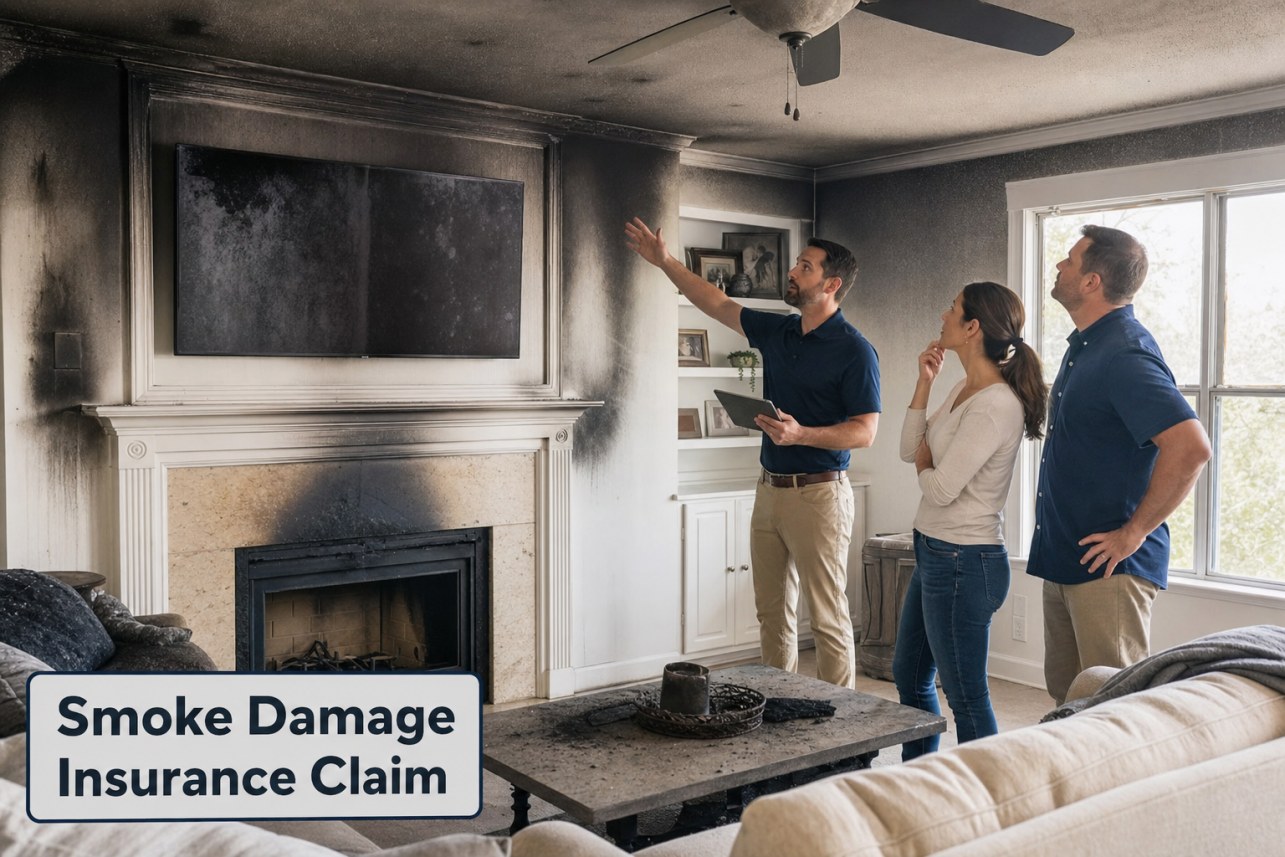
Do I Need Professional Soot Or Air-Quality Testing Before Settling A Smoke Damage Insurance Claim Holly Springs Adjusters Are Reviewing?
In many cases, yes — and it’s one of the smartest investments you can make before signing off on a settlement. Smoke residue isn’t just cosmetic. Soot contains fine particulates and combustion byproducts that settle inside wall cavities, attic insulation, HVAC ductwork, and porous materials where a visual inspection will never find them.
An independent industrial hygienist or environmental testing firm can take surface wipe samples and air samples throughout the home. Lab results confirm where fire-related residue actually traveled, which frequently proves the damage extends well beyond the rooms the insurance company scoped. We’ve seen testing turn a two-room estimate into a whole-house remediation because soot was confirmed upstairs, inside ducts, and in the attic.
Testing also protects your family’s health. Children, older adults, and anyone with asthma or respiratory issues are especially sensitive to lingering combustion particulates. Clearance testing after cleanup verifies the remediation actually worked before you move back in — something a quick wipe-down and a coat of paint can’t guarantee.
As your public adjuster in Holly Springs, we coordinate qualified, independent testing when the loss warrants it, and the reasonable cost is typically claimable as part of the loss itself. The carrier’s adjuster works from what’s visible; lab data works from what’s actually there. That difference is often the gap between a lowball offer and a settlement that restores your home completely.
Local Relevance
Holly Springs has grown fast, and much of its housing stock is newer construction from the 1990s onward — open floor plans, two-story foyers, and central HVAC in nearly every home. Those same features let smoke from a single kitchen fire spread through the whole house in minutes, and the duct system quietly carries soot into rooms the fire never touched.
The National Fire Protection Association has long identified cooking as the leading cause of home fires nationwide, and that pattern holds in busy Wake County households. Add the region’s humid summers, which can lock smoke odor into drywall, insulation, and fabrics if remediation is delayed, and a ‘minor’ smoke event becomes a whole-home restoration project.
We serve homeowners and business owners throughout Holly Springs and greater Wake County. Whether the loss started as a stovetop fire, a furnace or fireplace issue, or smoke drifting in from a neighboring structure, we document what the insurer’s quick inspection misses — and we handle related residential and commercial claims when the loss goes beyond smoke alone.
Because so many Holly Springs homes are newer builds with open layouts and shared return-air systems, smoke from one room often contaminates ductwork serving the entire house — yet duct cleaning and HVAC decontamination are among the most commonly omitted line items on insurer estimates here. Insist that the duct system be inspected before any smoke settlement is finalized.
Get A Free Smoke Damage Claim Review Before You Accept Any Offer
Once you sign a settlement, reopening the claim is an uphill battle. Let For The Public Adjusters, Inc. inspect the damage, review your policy, and tell you honestly where your claim stands — at no cost and with no obligation. We are licensed and bonded in North Carolina, and we only get paid when you do.
Call us: (919) 400-6440
Helpful Resources
- National Fire Protection Association (NFPA)
- NCDOI Public Adjusters Guide
- North Carolina Department of Insurance — State regulator for insurance and public adjuster licensing
Serving Holly Springs · Wake
Last updated: August 19, 2026