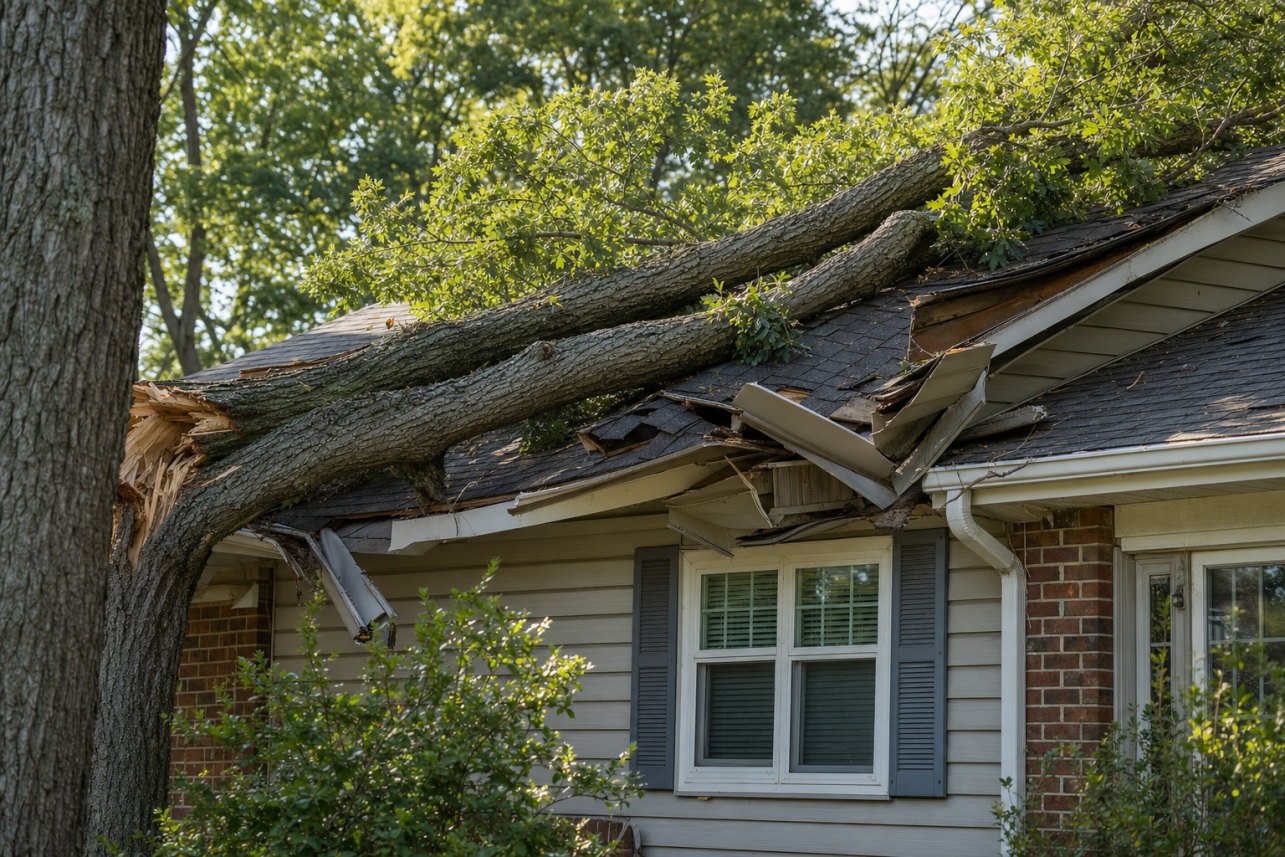
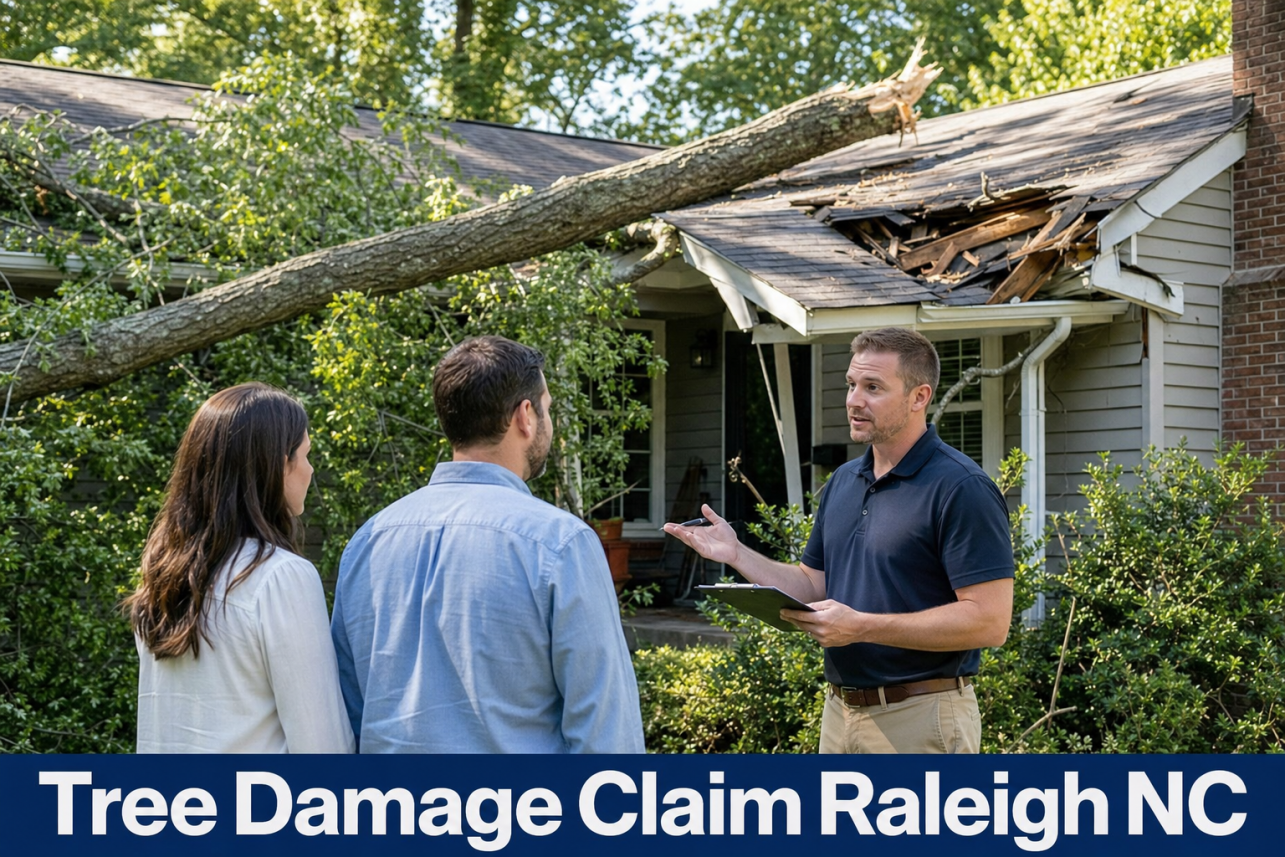
If you need help with a Tree Damage Claim Raleigh NC homeowners can turn to For The Public Adjusters, Inc., a licensed and bonded public adjusting firm that works for you, not the insurance company. When a tree falls on your house, your homeowners policy generally covers the structure, your contents, removal of the tree from the home, and temporary repairs — but the first offer is often far less than the real cost to rebuild. We document the full scope of damage, prepare the proof of loss, and negotiate directly with your carrier so you are not left paying out of pocket.
What This Service Is
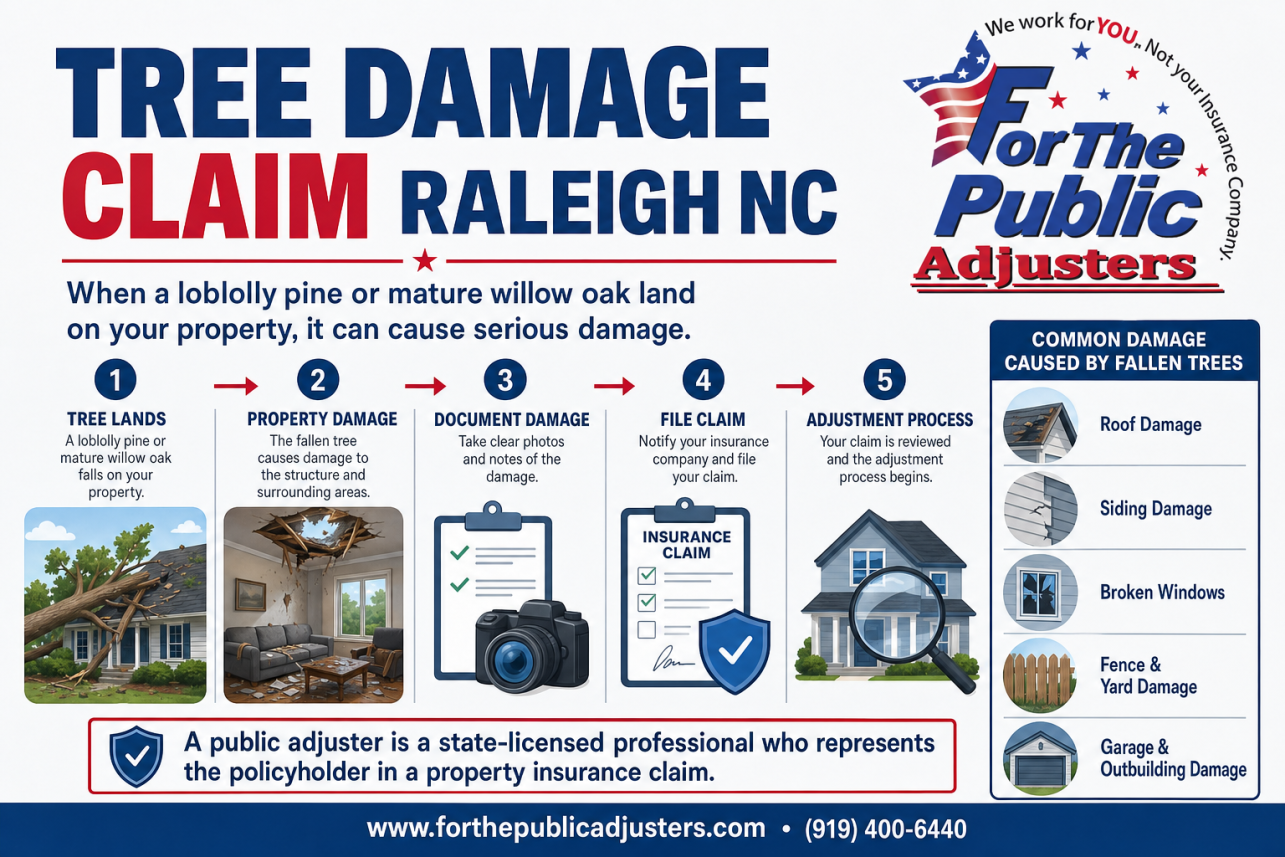
A public adjuster is a state-licensed professional who represents the policyholder in a property insurance claim. When a loblolly pine or mature willow oak lands on your roof, the insurance company sends its own adjuster — someone paid by the carrier. We are the other side of that equation.
Our team inspects the home the way a builder would, not the way a claims office would. That means tracing the impact beyond the obvious hole: cracked rafters and trusses, shifted framing, torn flashing, punctured decking, and the water damage that follows a tree strike during a storm. A roof that 'looks fine from the ground' often hides broken structure underneath.
We then build the full damage estimate, handle every call and letter with your carrier, and negotiate the settlement. The Insurance Information Institute notes that standard homeowners policies typically cover tree damage to the dwelling from windstorms, with limits on debris removal — and those limits and sub-limits are exactly where claims get shortchanged. We handle the same work across the Triangle, including tree damage insurance claim help in Cary and the surrounding Wake County towns.
Common Problems
Will My Insurance Actually Pay To Remove The Tree And Fix The Roof?
Usually yes — but not automatically, and not in full without pushback. When a tree hits the dwelling, policies generally cover repairs to the structure, damaged contents, and removal of the tree from the home, subject to your deductible. Tree removal from the yard alone, with no structure damage, is often capped at a small amount or excluded entirely.
The bigger money problem is how the carrier values the repair. If your settlement is based on actual cash value, depreciation is subtracted from everything — your ten-year-old shingles, your framing, your fence. Recovering that depreciation under replacement cost coverage requires documentation and follow-through most homeowners never get told about.
If the home is unsafe to live in while repairs happen, additional living expenses coverage should pay for temporary housing. Carriers rarely volunteer that. We make sure every coverage you paid premiums for is actually applied, just as we do on a tree damage insurance claim in Durham or anywhere else in the Triangle.
Why Was My Tree Damage Claim Raleigh NC Underpaid Or Denied?
The most common reasons we see: the carrier's inspection missed structural damage under the shingles, the estimate priced repairs below what Raleigh contractors actually charge, or the adjuster blamed part of the damage on 'wear and tear' or pre-existing rot. On older roofs — and whole Raleigh subdivisions built in the late '90s and 2000s are hitting that age together — that argument shows up on nearly every claim.
A denial or lowball offer is not the end of the claim. Policyholders can dispute the scope, demand a re-inspection, invoke appraisal, and in bad-faith situations pursue the carrier in court. Courts have sided with homeowners in these fights: in State Farm Fire & Casualty Co. v. Von Der Lieth, the California Supreme Court ruled in favor of homeowners whose insurer had refused to pay for damage to their house, holding that the covered cause of the loss controlled coverage despite the policy exclusions the carrier relied on.
The NCDOI Public Adjusters Guide explains that licensed public adjusters exist precisely so policyholders have professional representation in disputes like these. We reopen and renegotiate underpaid claims regularly, including situations like a tree fell on house claim in Morrisville where the first offer didn't come close to the structural repair cost.
Should I Just Handle The Claim Myself?
You can — the question is whether you should. The insurance company's adjuster handles tree strikes every week. You will handle one, while also dealing with a tarped roof, a removal crew, and possibly a hotel. That mismatch is why so many storm damage tree removal claims settle for less than the real repair cost.
A good public adjuster earns their fee by finding damage the carrier's inspection missed, pricing repairs at real local rates, and handling the negotiation so you don't accept a number out of exhaustion. We work on a percentage of the recovery, so our interests line up with yours. We can never guarantee a specific outcome — no honest adjuster can — but you will know the full value of your loss before you settle.
When you're choosing, verify the license, ask whether the firm is bonded, and ask who actually inspects your home. For The Public Adjusters, Inc. is licensed and bonded, and the person climbing on your roof is a trained adjuster, not a salesperson.
Our Process
Emergency Protection And Free Claim Review
First, we make sure the home is protected — tarping, board-up, and safe removal of the tree from the structure are covered emergency repairs, and skipping them can hurt your claim. Keep every receipt. Then we review your policy at no cost and tell you honestly whether the claim is worth pursuing with our help.
Full Damage Documentation And Proof Of Loss
We inspect the roof, attic, framing, interior, and contents, photographing everything and measuring the true scope of damage — including the hidden structural issues a quick carrier inspection misses. We prepare a detailed estimate and the formal proof of loss, filed within your policy's deadlines so nothing is forfeited on a technicality.
Negotiation And Settlement
We meet the insurance company's adjuster at your property, walk them through our documentation line by line, and negotiate the settlement on your behalf. If they dig in, we know the dispute tools available under North Carolina policies and we use them. We handle this same process across Wake County, including every tree damage house claim in Holly Springs we take on.
| Claim Step | On Your Own | With For The Public Adjusters, Inc. |
|---|---|---|
| Initial inspection | Carrier's adjuster documents visible damage, often in one short visit | Independent inspection of framing, attic, interior, and grounds — the impact zone, not just the surface |
| Tree removal costs | Often paid only up to a small debris-removal cap ($500–$1,000 is common) | Crane and rigging documented as part of the covered structural repair where the policy allows, not just capped debris |
| Hidden structural damage | Cracked rafters and shifted ridge lines frequently go unexamined | Structural engineers and arborists brought in when the facts call for it |
| Estimate and negotiation | You respond to the carrier's numbers with little leverage | A line-item estimate built independently, then negotiated on your behalf — we work only for policyholders |
| Matching materials | Spot patches with discontinued shingles or siding | Matching arguments pressed using policy language and case law such as Cedar Bluff v. American Family, where the policyholders prevailed |
| Your time | Weeks of calls, emails, and paperwork | We manage the file; you review and approve the big decisions |
Commonly Overlooked In The Public Adjusting Industry
- Fractured rafters and trusses under the impact point — Most field adjusters inspect from the roof surface or the yard, and cracked framing is only visible from inside the attic directly beneath where the trunk landed.
- The per-tree debris removal cap being wrongly applied to crane work — Carriers often pay the $500–$1,000 tree-removal sublimit when lifting a trunk off a live roof is actually part of the covered structural repair, which can be worth thousands more.
- Matching discontinued shingles and siding — Homeowners accept spot patches without knowing policyholders have won on this issue — in Cedar Bluff Townhome Condominium Ass'n v. American Family, the court required a reasonable match across the structure, not a visible patchwork.
- Ordinance or law (code upgrade) coverage on older Raleigh homes — Pre-1990s framing and decking often can't legally be repaired to the old standard, and the extra cost to meet current Wake County code is a separate coverage people never claim.
- Moisture trapped in wall cavities after the roof is tarped — The tarp stops new rain but insulation and drywall that got wet in the first hours stay wet, and mold shows up months after the claim is closed.
- Shifted chimneys, flashing, and gutter systems near the strike zone — The eye goes to the hole in the roof, so a chimney knocked a half-inch out of plumb or crushed gutter runs get left off the estimate entirely.
- Preserving the stump and trunk before the tree crew hauls it away — If the carrier later argues the tree was rotten or neglected, the wood itself is the best evidence of a healthy storm fracture — and most people let it leave in the chipper.
- The 'other structures' sublimit on garages, sheds, and fences — Coverage B is typically only a fraction of the dwelling limit, and nobody checks whether the combined garage, fence, and outbuilding damage exceeds it until the check comes up short.
Case Studies
Case Study #1
Situation: A homeowner off Six Forks Road in North Raleigh had a mature willow oak come down on the rear slope of her roof when the remnants of a hurricane pushed through Wake County. The trunk punched through the decking over the kitchen and a bedroom.
Problem: Her insurer's field adjuster spent about twenty minutes on site, approved the emergency tarp, a patch of shingles, and $1,000 toward tree removal. The first check didn't come close to what the crane company alone quoted, and nothing was allowed for the interior.
Investigation: Our team opened the attic, moisture-mapped the kitchen ceiling and bedroom walls, and brought in a structural engineer to evaluate the roof framing where the trunk made impact. We also photographed the crushed gutter line, bent fascia, and the split rafters the carrier's adjuster never looked at.
Findings: Two rafters were fractured and a section of ridge had deflected. Moisture readings showed water had tracked down an interior wall into the kitchen. The removal estimate the carrier used assumed ground-level cutting, not the crane work actually required to lift the trunk off a live roof.
Solution: We rebuilt the claim line by line: engineered framing repairs, full slope replacement where shingles could not be matched, interior drywall, insulation, paint, and documented crane and rigging costs as part of the covered repair, not just capped debris removal. Then we negotiated directly with the carrier's desk adjuster.
Outcome: The claim settled at roughly nine times the original payment. The homeowner was able to hire the contractor she wanted instead of accepting a patch over broken framing. Every file is different, and past results never promise a specific outcome, but documentation changed this claim entirely.
Lesson: A tree strike is a structural event, not a shingle event. If no one looks at the framing under the impact point, the first offer will almost always reflect only what's visible from the driveway.
Case Study #2
Situation: A family near Garner, in southern Wake County, had their neighbor's loblolly pine snap during a confirmed EF-1 tornado and land across their detached garage and privacy fence. Vinyl siding on one wall of the house was also gouged by limbs.
Problem: The carrier initially leaned toward denial, suggesting the pine was 'in decline' and the loss was a maintenance issue. When it did offer payment, it proposed patching three courses of siding with a product that no longer matched anything on the market.
Investigation: We retained a certified arborist who examined the stump and documented a green, living crown and sound wood at the break point — classic storm fracture, not rot. We pulled the National Weather Service survey confirming the tornado track and collected dated photos of the tree standing healthy weeks earlier.
Findings: The arborist's report dismantled the 'neglected tree' theory. On the siding, the manufacturer had discontinued the profile, which meant a spot repair would leave one wall visibly mismatched against the rest of the elevation.
Solution: We pressed the matching issue the way courts have: in Cedar Bluff Townhome Condominium Ass'n v. American Family Mutual Insurance Co., the Minnesota Supreme Court sided with the policyholders, holding that when storm-damaged siding couldn't be color-matched, replacement-cost coverage required a reasonable match across the structure — not a patchwork. We presented that reasoning alongside the arborist findings and a complete garage and fence estimate.
Outcome: The carrier withdrew the maintenance argument and paid for the garage roof structure, the fence, and siding on the affected elevations rather than a three-course patch. The family didn't have to chase their neighbor's insurer or accept a checkerboard wall. As always, results vary by policy and facts.
Lesson: Who the tree belonged to matters less than why it fell and what the policy says. And when materials can't be matched, policyholders have real arguments — ones courts have accepted — for a uniform repair.
| Scenario | Typical Coverage Question | What It Depends On | Smart First Step |
|---|---|---|---|
| Tree falls on your house or attached porch | Dwelling coverage generally applies for storm-caused strikes | Cause of loss (hurricane, tornado, lightning), policy deductible, condition of the tree | Photograph everything before removal; tarp to prevent further damage and keep receipts |
| Tree hits a detached garage, shed, or fence | Usually falls under 'other structures,' a separate (smaller) limit | Your Coverage B limit, which is often only 10% of the dwelling limit | Check your declarations page before accepting any figure |
| Neighbor's tree lands on your property | Your own policy typically responds first | Whether the neighbor had written notice the tree was hazardous; your carrier may pursue theirs later | File with your own insurer; save any prior emails or letters about the tree |
| Tree down in the yard, nothing structural hit | Often limited or excluded; small debris allowances may apply | Whether the tree blocks a driveway or handicap access, and the cause of the fall | Read the debris-removal provision before paying a tree crew out of pocket |
| Rain enters through the hole after impact | Interior water damage from a storm-created opening is generally covered | Proving the opening came first and documenting moisture quickly | Get moisture readings fast — wet insulation and drywall hide behind paint |
| Tree falls during flooding or the fall is blamed on saturated flood waters | Flood itself is excluded from standard homeowner policies | Whether you carry a separate flood policy through the NFIP | Review FEMA.gov and FloodSmart.gov (the NFIP site) for flood coverage questions |
| Carrier says the tree was dead or neglected | Maintenance exclusions can defeat an otherwise valid claim | Arborist evidence: crown condition, wood at the break, and weather records | Preserve the stump and trunk sections until the cause has been documented |
Reviews
A red oak split our roof open during the tail end of a hurricane and the insurance company offered barely enough to cover the crane bill. For The Public Adjusters found cracked rafters in the attic that nobody else even checked and got an engineer involved. The final settlement covered the framing, the whole roof slope, and the ceiling damage inside. I would never go through a tree claim alone again.
Marcus T., Five Points, Raleigh
Our neighbor's pine crushed our screened porch during the tornado that came through. The adjuster the company sent said half the damage was 'wear and tear,' which was insulting. This team documented everything — arborist report, photos, measurements — and walked me through the debris removal limits in my policy I didn't know existed. The difference between the first offer and the final number was significant.
Deborah L., Cary, Wake County
Honest and thorough. A sweetgum came through our garage roof and the carrier wanted to patch shingles that haven't been manufactured in years. For The Public Adjusters pushed the matching issue hard and handled every call with the insurance company so I didn't have to. It took a couple of months, but we ended up with a proper repair instead of a mismatched patch. Only reason it's not faster is the insurance company, not them.
James R., Knightdale, NC
Frequently Asked Questions
What Does A Tree Damage Claim Raleigh NC Homeowner Files Actually Cover?
When a tree comes down on your home in Raleigh, your homeowners policy typically covers damage to the structure itself — the roof, framing, gutters, siding — plus damage to contents inside, debris removal from the dwelling, and often additional living expenses if the house is unlivable during repairs.
What surprises most Wake County homeowners is what gets disputed. Insurers frequently lowball roof replacement by paying for a patch instead of matching shingles across the slope, cap tree removal at a small dollar limit, or miss hidden damage like cracked rafters and compromised decking under the impact point.
Coverage also depends on the cause. If the tree fell during a hurricane like Fran or Florence, or during a tornado such as the one that tore through Raleigh in April 2011, the loss is generally covered under your standard policy. If rising water pushed the tree over or flooded the home afterward, that portion falls under flood insurance instead — a separate NFIP policy administered through FEMA (floodsmart.gov is the place to verify your coverage).
Our team reviews the full policy, documents every component of the loss, and negotiates the claim on your behalf. We're licensed and bonded in North Carolina, and we work only for policyholders — never for insurance companies.
The Insurance Company Offered Me Far Less Than My Contractor's Estimate After A Tree Hit My Raleigh Home. Can I Fight That?
Yes, and homeowners do win these disputes. A low first offer is a starting position, not a final answer. You have the right to challenge the carrier's scope, demand re-inspection, invoke the appraisal clause in most policies, and bring in your own licensed adjuster to document the loss properly.
North Carolina courts have backed policyholders in exactly these kinds of coverage fights. In Gaston County Dyeing Machine Co. v. Northfield Insurance Co., the North Carolina Supreme Court ruled in favor of the insured on a disputed property damage claim, holding that ambiguous policy language must be construed in favor of the policyholder. That principle matters every time a Raleigh carrier tries to read a tree-related exclusion or limit more broadly than the policy actually says.
In practice, the gap between a carrier's estimate and the real cost of repair usually comes from missing line items: structural engineering inspections after a heavy impact, matching materials, code upgrades required by Wake County permitting, and interior water damage from the breach in the roof.
A public adjuster in Raleigh builds the complete file — photos, moisture readings, engineer reports, itemized estimates — before negotiating. We can't promise a specific dollar outcome, and no honest adjuster should, but a fully documented claim is in a far stronger position than a homeowner's phone call disputing a number.
Does My Policy Pay To Remove The Tree Itself After A Hurricane Or Tornado In Wake County?
Usually yes, but with limits that catch people off guard. If a hurricane or tornado drops a tree onto a covered structure — your house, detached garage, or fence — most policies pay to remove it as part of the repair. The trouble starts when the tree falls in the yard without touching a structure. Many policies then cap removal at $500 to $1,000 per tree, sometimes with a total limit per storm, even though crane-assisted removal of a mature Raleigh oak or loblolly pine can run several thousand dollars.
There are exceptions worth knowing. If the fallen tree blocks your driveway or a handicap-access ramp, some policies restore removal coverage even without structural damage. And if a neighbor's dead or visibly diseased tree fell on your property, their liability coverage may come into play — negligence changes the picture.
After major storms move through Wake County, we also see carriers bundle tree removal into the dwelling estimate at unrealistic prices, leaving homeowners to cover the difference. Getting the removal properly scoped and allocated under the right coverage section often changes what the policy pays.
We read the exact language in your policy — tree removal provisions vary significantly between carriers — and make sure every applicable coverage is applied before you accept a settlement.
What Should I Do In The First 48 Hours After A Tree Falls On My House In Raleigh?
Safety comes first. Stay out of any room under the impact area until the structure is checked, and if power lines are involved, call Duke Energy and keep everyone away.
Once it's safe, photograph everything before anything is moved — the tree on the structure, the point of impact, interior damage, and wet contents. Then make reasonable emergency repairs to prevent further damage, like tarping the roof opening, and keep every receipt. Your policy requires you to mitigate, and those costs are generally reimbursable.
Report the loss to your carrier promptly, but be careful with recorded statements and don't speculate about the cause. Say what you know, not what you guess. Avoid signing an assignment-of-benefits contract with a tree service or roofer under pressure in your driveway — those agreements can complicate your claim.
Before the insurance company's adjuster inspects, consider having your own representative involved. Handling a Tree Damage Claim Raleigh NC carriers will scrutinize means documenting hidden damage early: cracked trusses, shifted framing, and water intrusion don't always show up in a twenty-minute rooftop walk.
For The Public Adjusters, Inc. handles the inspection, documentation, and negotiation from day one, so decisions made in those first chaotic hours don't cost you later. We're licensed and bonded in North Carolina, and consultations are straightforward — we review the damage and the policy, then tell you honestly whether professional representation makes sense for your loss.
Why Should I Hire A Public Adjuster For A Tree Damage Claim Raleigh NC Homeowners Typically Handle Themselves?
Tree losses look simple on the surface, but they rarely are. A trunk that punches through a roof deck in Raleigh often causes hidden damage — cracked rafters, shifted trusses, torn underlayment, and moisture intrusion that shows up weeks later. Insurance company adjusters frequently scope only what is visible from the ground or the attic hatch, which leads to settlements that fall short of real repair costs.
As licensed and bonded public adjusters, For The Public Adjusters, Inc. works only for you, the policyholder — never the insurance company. We document the full scope of structural, interior, and contents damage, prepare a detailed estimate using the same pricing platforms carriers use, and negotiate directly with the insurer on your behalf.
North Carolina courts have long held that ambiguous policy language must be read in favor of the insured. In Gaston County Dyeing Machine Co. v. Northfield Insurance Co., 351 N.C. 293 (2000), the North Carolina Supreme Court sided with the insured on a disputed property damage claim, reinforcing that coverage questions are resolved against the carrier that drafted the policy. We lean on that principle when carriers try to narrow what your policy actually says.
We can never guarantee a specific outcome, but we can promise that your claim will be fully documented, professionally presented, and pursued by someone whose only client is you. For hurricane- or tornado-driven tree losses across Wake County, that difference often matters most.
My Neighbor's Oak Fell On My House During A Tornado In Raleigh — Whose Insurance Pays?
This surprises most Wake County homeowners: in nearly every case, your own homeowner's policy pays, even though the tree belonged to your neighbor. Insurance follows the damaged property, not the tree's owner. When a tornado or hurricane brings a neighbor's oak down on your roof, you file with your carrier, pay your deductible, and your insurer handles the repairs under your dwelling coverage.
There is one important exception. If your neighbor knew the tree was dead, diseased, or dangerously leaning — and you can prove they were warned, ideally in writing — your insurer may pursue their carrier through subrogation. If that recovery succeeds, you may get your deductible back. This is why we tell Raleigh clients to keep any emails, letters, or arborist reports about a hazardous tree before it ever falls.
When a Tree Damage Claim Raleigh NC policyholders file involves a neighbor's tree, documentation becomes even more critical. Photos of the tree's condition, the point of impact, and all resulting damage should be captured before any cleanup begins.
For The Public Adjusters, Inc. handles this entire process for you: we build the damage file, prepare the estimate, flag any negligence evidence for subrogation, and negotiate with your carrier. We cannot promise a particular dollar figure, but we make sure nothing your policy owes you gets overlooked in a neighbor-tree situation, which carriers sometimes treat as routine when it is anything but.
How Long Do I Have To File After A Tree Hits My Home In Wake County, And How Long Does The Claim Take?
Your policy sets the first deadline. Most North Carolina homeowner policies require 'prompt' notice of loss — practically speaking, you should report a tree strike within days, not months. Separately, North Carolina law generally gives policyholders three years to bring a legal action on a property insurance contract, though your specific policy may impose shorter contractual deadlines for suit. Read your policy carefully, because missing a deadline can forfeit an otherwise valid claim.
Once the claim is filed, North Carolina insurers must acknowledge it promptly and investigate within a reasonable time. A straightforward tree loss in Raleigh — a limb through the roof with contained interior damage — might resolve in four to eight weeks. A major loss from a hurricane or tornado, with structural damage, engineering inspections, and contents inventories, can run several months, especially when thousands of Wake County claims hit carriers at once after a named storm.
Delays usually come from disputed scope: the carrier's adjuster sees a roof patch, while the actual repair requires decking replacement, framing work, and interior restoration. Our role at For The Public Adjusters, Inc. is to front-load the claim with thorough documentation so there is less to argue about later.
If part of your damage involves rising water or flooding rather than the tree itself, that falls under separate flood coverage — visit FEMA.gov or FloodSmart.gov, the official National Flood Insurance Program site, to understand how NFIP claims and their deadlines work.
Can The Insurance Company Deny A Tree Damage Claim Raleigh NC Residents File By Saying The Tree Was Rotten Or Neglected?
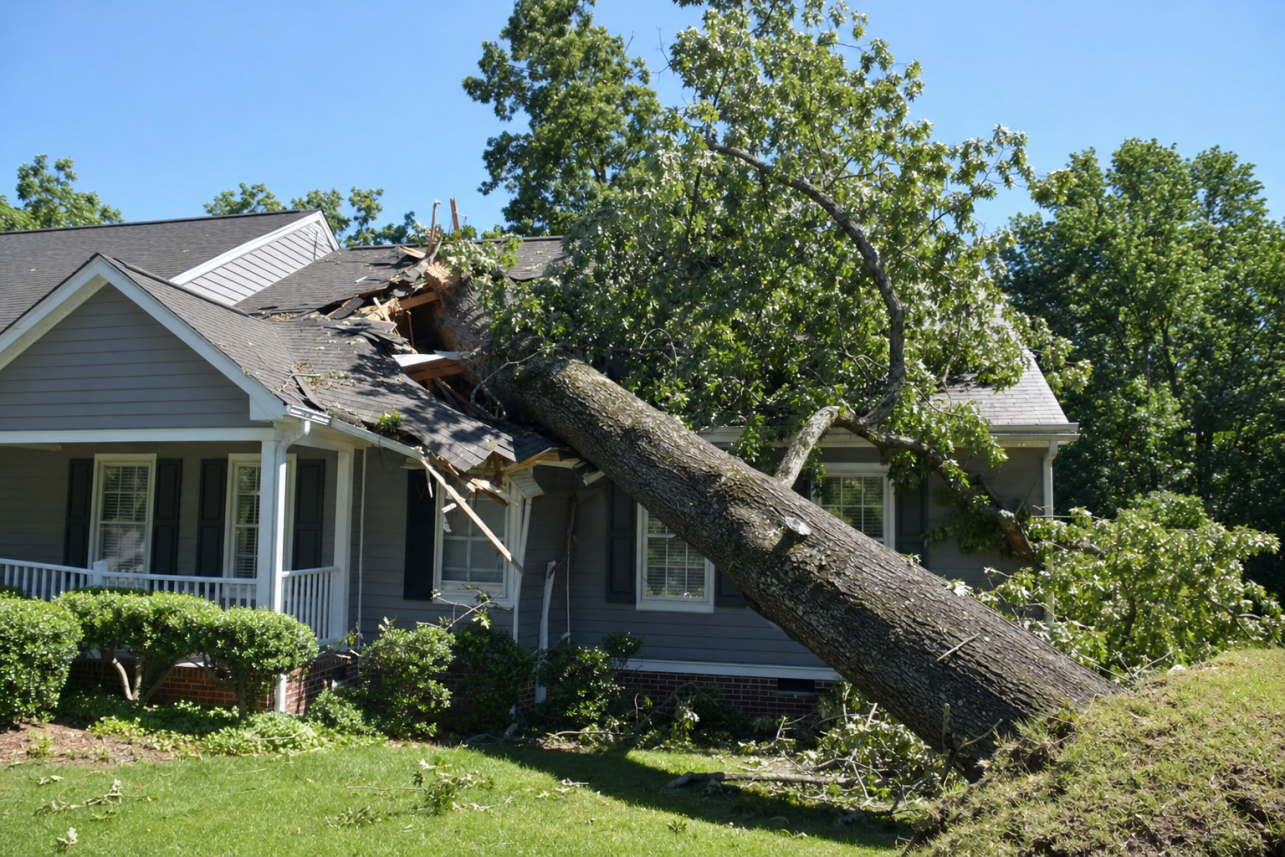
Carriers sometimes raise this defense, arguing the loss resulted from rot, decay, or deferred maintenance rather than a covered peril. Here is the key distinction: most homeowner policies exclude damage caused by rot itself, but they still cover damage caused by a covered event — like a hurricane or tornado — even if the tree that fell was partially decayed. The storm, not the rot, is typically the proximate cause of your roof damage.
Raleigh's mature willow oaks and pines frequently have some internal decay that homeowners could never detect. An insurer pointing to a soft spot in the trunk does not automatically defeat your claim. North Carolina courts resolve genuine ambiguity in coverage language in favor of the policyholder, and the carrier bears the burden of proving an exclusion actually applies to your facts.
If you receive a denial or lowball offer on this basis, do not accept it as final. Request the denial in writing with the specific policy language cited. Preserve the tree debris if possible — cross-sections of the trunk can show whether the wood was sound. An arborist's assessment can rebut a carrier's decay theory.
For The Public Adjusters, Inc. reviews denials like this regularly for Wake County homeowners. We examine the policy language, gather the physical and expert evidence, and present a documented rebuttal to the carrier. While no one can guarantee a reversal, a properly challenged denial often gets a very different second look than the first one did.
How Much Does It Cost To Hire A Public Adjuster For A Tree Damage Claim Raleigh NC Homeowners Are Filing?
For The Public Adjusters, Inc. works on a contingency fee, which means we are paid a percentage of what the insurance company actually pays on your claim. There is no upfront charge, no hourly billing, and no fee at all if there is no recovery. The exact percentage is spelled out in a written contract before we lift a finger, as required by North Carolina law.
We are licensed by the North Carolina Department of Insurance and bonded, and our fee agreement follows the state's rules for public adjuster contracts. You also have a legal right to cancel the contract within the window the statute provides, so there is no pressure to commit on the spot.
Because our fee comes out of the settlement, our interests line up with yours: a more complete, better-documented claim benefits both of us. On tree damage losses in Raleigh, that often means capturing items an initial carrier estimate misses — roof decking and framing repairs, interior water staining, debris removal within policy limits, matching issues with shingles or siding, and code-required upgrades under ordinance or law coverage.
We can never promise a specific dollar outcome, and you should be wary of anyone who does. What we can promise is a thorough, professionally documented claim and an advocate who handles the carrier so you can focus on getting your Wake County home put back together.
A Tree Hit My Fence, Detached Garage, And Deck In Raleigh — Is That Covered The Same Way As My House?
Usually yes, but under a different part of your policy. Most homeowners policies in North Carolina split property into Coverage A for the dwelling itself and Coverage B for "other structures" — fences, detached garages, sheds, gazebos, and in many cases decks that are not attached to the home. Coverage B is typically capped at about 10% of your dwelling limit, which matters when a large oak flattens several structures at once.
That cap is one of the most common friction points we see on tree losses across Raleigh and Wake County. A carrier may lump everything together, apply the wrong limit, or depreciate a custom cedar fence or stamped-concrete patio as if it were basic builder-grade material. Each structure deserves its own line-item estimate with accurate materials and labor pricing for the Triangle market.
Debris removal for the tree itself is a separate, limited coverage, and it is often paid in addition to the structure repairs rather than carved out of them — a distinction adjusters sometimes get wrong in the insurer's favor.
When we handle a tree loss in Raleigh, we inventory every damaged structure separately, photograph and measure each one, and apply the correct coverage and limit to each. One falling tree can trigger three or four different coverage parts, and sorting them out correctly is often the difference between a disappointing check and a settlement that actually rebuilds what you lost.
Rain Got Into My House Through The Hole The Tree Made. Is The Water Damage And Mold Covered Too?
In most cases, yes. When a tree punches an opening in your roof or wall, the rain that enters through that opening is generally covered as part of the same loss, along with the resulting damage to drywall, insulation, flooring, and personal contents. The key legal concept is that the tree created the opening — water entering through a storm-created breach is treated very differently from gradual seepage.
Mold is where carriers push back hardest. Many North Carolina policies cap mold remediation at a small sublimit, and insurers sometimes argue the mold resulted from the homeowner's delay rather than the tree. That is why fast tarping and drying, documented with dated photos and receipts, is so important in Raleigh's humid climate, where mold can bloom inside wall cavities within days.
One important distinction: rising water is not the same as rain through a hole. If your home also took on floodwater from a creek or storm surge during a hurricane, that portion of the loss falls under flood insurance through the National Flood Insurance Program, not your homeowners policy. FEMA and NFIP resources at floodsmart.gov explain that coverage, and we can help you understand which damage belongs to which policy.
We document the moisture migration path from the point of entry down through the structure, use moisture readings and thermal imaging where appropriate, and make sure the carrier pays for proper drying and remediation — not just a coat of paint over a wet wall.
Have North Carolina Homeowners Actually Won In Court Against Insurance Companies, Or Is Fighting A Lowball Offer Pointless?
Policyholders absolutely win, and North Carolina courts have backed them. In Robinson v. North Carolina Farm Bureau Mutual Insurance Co., the North Carolina Court of Appeals upheld a verdict for the insured after the carrier wrongfully refused to pay a covered property loss, and the insurer was held liable beyond the policy amount because of its bad-faith claim handling. Cases like that exist precisely because some carriers count on homeowners giving up after the first low offer.
North Carolina also has strong consumer-protection tools. The Unfair Claim Settlement Practices provisions of the insurance code prohibit carriers from failing to conduct a reasonable investigation or forcing policyholders to sue to recover amounts plainly owed. An insurer that violates those duties can face liability well above the claim itself.
The good news is that most disputes never need a courtroom. On a Tree Damage Claim Raleigh NC homeowners bring to us, the leverage usually comes from documentation: a detailed independent estimate, structural inspection findings, photos of hidden framing and decking damage, and a clear coverage analysis the carrier cannot dismiss. Appraisal — a dispute-resolution process built into most policies — resolves many valuation fights without any lawsuit at all.
We cannot guarantee any particular result, and no honest adjuster can. But the record in North Carolina shows that insureds who push back with evidence and professional representation are far from powerless, whether the tree came down in a hurricane, a tornado, or a quiet Tuesday ice storm in Wake County.
What Documentation Should I Gather To Support A Tree Damage Claim Raleigh NC Insurers Will Actually Take Seriously?
Start with photos and video before anything is moved. Capture the tree where it landed, the point of impact, interior damage, and wide shots showing the whole scene. Date-stamped phone photos are fine, and roof-level or drone shots are even better.
Save every receipt. Emergency tarping, tree removal invoices, hotel stays, and board-up costs all matter. If an arborist or removal crew hauls the tree away, ask them to photograph the trunk and root ball first — the condition of the wood can become important if the carrier later questions the tree's health.
Next, pull your full policy, including the declarations page and all endorsements, and request a certified copy from your agent if you can't find it. Pair that with a line-item contractor estimate, not a lump-sum quote. Adjusters negotiate line by line, so your documentation should too.
Finally, document the storm itself. National Weather Service reports for the Raleigh-Durham station and local news coverage of the hurricane, tornado, or ice storm that brought the tree down help tie the loss to a covered event. Keep a simple log of every call with the insurance company — date, name, and what was said. Our team organizes all of this into a single claim package so nothing gets overlooked or disputed later.
The Insurer Wants To Patch Three Shingles Where The Tree Hit My Roof. Do They Have To Match The Rest Of My Shingles?
This is one of the most common fights we see on tree losses in Raleigh, and homeowners have real leverage here. Many roofs in Wake County neighborhoods are 10 to 20 years old, and the original shingle color or profile has often been discontinued. A patch in a mismatched shingle can leave a visible scar across your roofline and affect resale value.
When the original material can't be reasonably matched, there is a strong argument that the carrier owes more than a spot repair — sometimes the full slope, sometimes the entire roof, depending on your policy language and the visibility of the damage. We routinely order independent laboratory testing of a shingle sample to prove the product is discontinued, which is difficult for a carrier to argue against.
North Carolina courts have shown they will hold insurers to their policy language in property disputes. In Gaston County Dyeing Machine Co. v. Northfield Insurance Co., 351 N.C. 293 (2000), the North Carolina Supreme Court sided with the insured in a property damage coverage dispute, rejecting the insurer's narrow reading of its own policy.
We can't promise a specific outcome — no one honestly can — but we can promise the matching issue gets raised, documented, and argued properly instead of being waved off with a three-shingle patch.
I Already Cashed The Insurance Company's Check For My Tree Damage. Is It Too Late To Get More?
Usually not. Reopening a Tree Damage Claim Raleigh NC homeowners settled too quickly is often possible, because cashing a claim check is not the same as signing a release. Unless you signed a document explicitly releasing the carrier from further liability, most policies allow supplemental claims when additional damage or costs are discovered.
This matters because tree losses frequently reveal hidden damage weeks later. Cracked rafters and trusses behind the drywall, shifted framing, damaged sheathing under shingles that looked intact, and slow moisture intrusion around the impact point often don't show up until a contractor opens things up.
North Carolina generally gives policyholders three years from the date of loss to pursue a property claim, though your specific policy may set its own deadlines, so it's worth acting quickly rather than waiting. If your carrier paid on an actual cash value basis, you may also be owed recoverable depreciation once repairs are completed — money many Raleigh homeowners never collect simply because they didn't know to ask.
We review closed and underpaid files at no obligation. We're licensed and bonded in North Carolina, and if we find legitimate unpaid damage, we prepare the supplemental demand with photos, estimates, and policy
Does A Tree Damage Claim Raleigh NC Homeowners File Cover Hotel Costs And Living Expenses If The House Is Unlivable During Repairs?
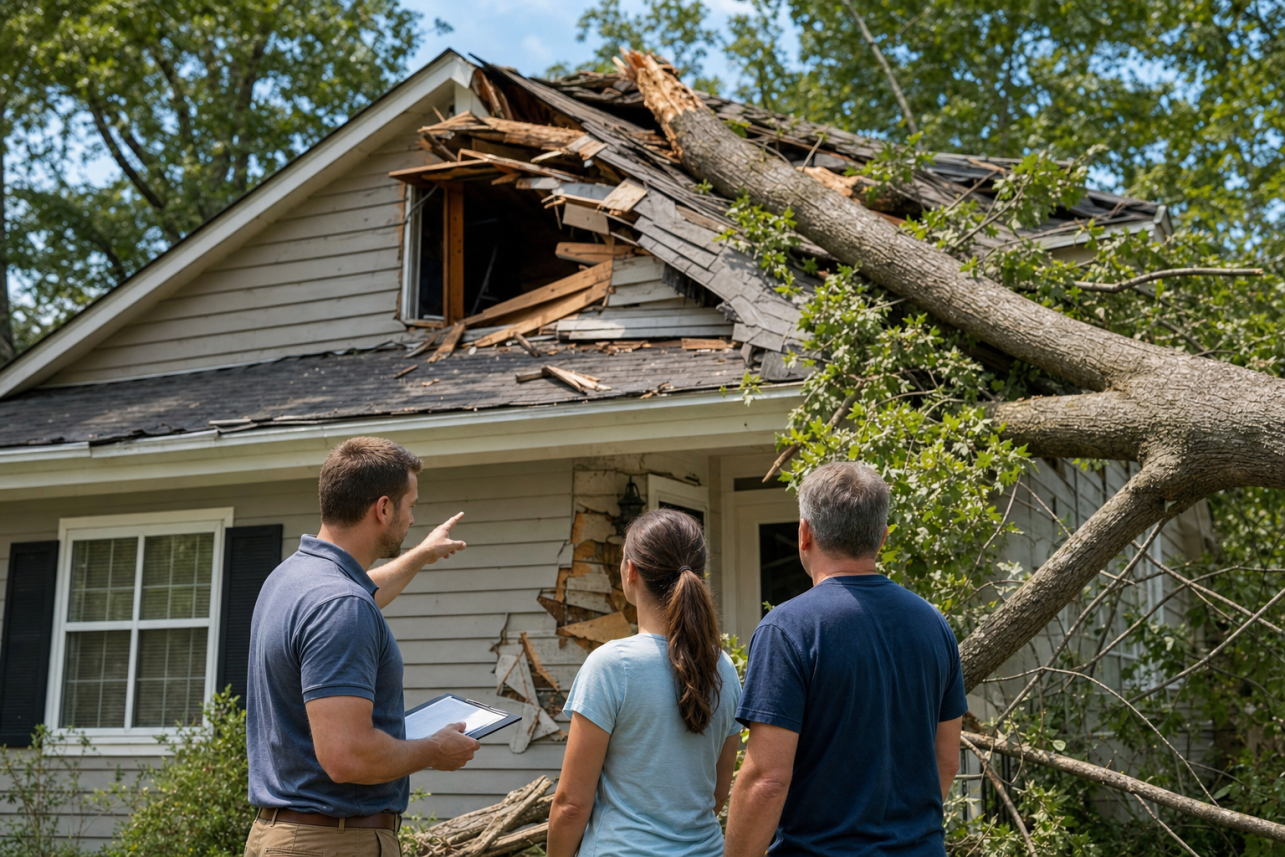
Usually, yes. Most homeowners policies include Additional Living Expenses coverage, often called Coverage D or Loss of Use. If a tree punches through your roof and the home is unsafe or uninhabitable while repairs are underway, this coverage pays the reasonable increase in your living costs — hotel or short-term rental, extra meal expenses, pet boarding, even added mileage if you're temporarily living farther from work or school in Wake County.
The key word is 'increase.' The insurer pays the difference between your normal costs and what you're spending now, so keep every receipt from day one. ALE limits are typically a percentage of your dwelling coverage or a set time period, and carriers sometimes try to cut off these payments before repairs are actually finished. You should not be forced back into a home with an open roof deck or active mold remediation.
North Carolina courts have backed policyholders when insurers wrongly refuse to pay what a policy promises. In Lovell v. Nationwide Mutual Insurance Co., 108 N.C. App. 416 (1993), a homeowner whose house was destroyed sued after the carrier refused to pay, and the jury's verdict for the insured — including punitive damages for bad-faith refusal — was upheld on appeal. That case is a reminder that an insurer's first position is not the final word.
For The Public Adjusters, Inc. is licensed and bonded, and when we handle a tree damage claim for a Raleigh family, we document displacement costs alongside the structural damage so nothing covered gets left off the table. We can't promise a specific outcome, but we can make sure your full loss is presented.
Local Relevance
Raleigh is the City of Oaks for a reason — mature willow oaks, red oaks, and tall loblolly pines stand over homes in nearly every neighborhood, from the older streets inside the Beltline to subdivisions built during the growth boom. That canopy is beautiful, and it is also the single biggest source of storm losses here.
Our weather pattern makes it worse. Tropical systems moving inland, spring thunderstorms, and the occasional ice storm all drop limbs and whole trees, and days of saturating rain soften the clay soil so that even healthy pines uproot. Anyone in Raleigh long enough remembers Hurricane Fran — most of that damage wasn't wind tearing off roofs; it was trees crushing them.
There's a wrinkle many Raleigh homeowners discover the hard way: when a neighbor's healthy tree falls on your house, it's normally your own policy that pays, not theirs. That surprises people, and it means the quality of your own claim presentation is everything. Carriers also lean hard on 'wear and tear' arguments in neighborhoods where roofs are twenty-plus years old, which is why thorough documentation matters so much on a Raleigh tree damage claim. We serve all of Wake County and the broader Triangle, including homeowners who need a tree fell on house insurance Chapel Hill claim handled the same way.
In our experience, trees cause more losses in Raleigh than wind itself — most of what gets called hurricane damage here is loblolly pines and big willow oaks coming down after days of rain soften the ground, a lesson Fran taught this city in 1996. And when it's the neighbor's tree on your roof, it's usually your own policy that responds, so how your claim is documented matters more than whose tree it was.
A Tree Is On Your House. Don't Face The Insurance Company Alone.
For The Public Adjusters, Inc. is licensed and bonded in North Carolina, and we represent you — never the carrier. The review of your policy and damage is free, and you owe nothing unless we recover for you. Call before you accept the insurance company's first number.
Call us: (919) 400-6440
Helpful Resources
- NCDOI Public Adjusters Guide
- Insurance Information Institute (III)
- North Carolina Department of Insurance — State regulator overseeing insurance and public adjuster licensing in NC
- Insurance Information Institute — Consumer education on homeowners coverage for fallen trees
Last updated: October 3, 2026